AC Repair and Troubleshooting: Is Your Pinehurst TX System Ready for the Fall Transition?
Why we check dormant heating parts before the first cold snap. Rely on our local service expertise and area tips to decide with confidence this fall.

The best air filtration upgrades that work with your AC don't require replacing your entire system. Here's a quick overview of the most effective options:
Most of these upgrades install directly into your existing AC system with no full replacement needed.
Here in Pinehurst, TX, most homes stay sealed up for much of the year to manage the heat. That means the same air keeps circulating inside — and it picks up dust, pollen, pet dander, mold spores, and VOCs along the way. According to the EPA, indoor air pollutant levels are often 2 to 5 times higher than outdoor levels, and in tightly sealed homes that number can climb even higher.
The good news? You don't need a brand-new HVAC system to breathe cleaner air. There several proven filtration upgrades that plug directly into the system you already own — and choosing the right one makes a significant difference in how your home feels and how your family breathes.

When you start researching how to clean up your indoor environment, you will generally find yourself choosing between two main paths: whole-home systems that integrate directly into your HVAC ductwork, or portable, single-room air cleaners. Both approaches have their place, but they work in very different ways.
Portable air cleaners are standalone units that you plug into a wall outlet. They rely on an internal fan to draw in air from the immediate room, pass it through a filter (usually a High-Efficiency Particulate Air, or HEPA, filter), and release the cleaned air back into the space. When selecting a portable unit, the most important metric to look for is the Clean Air Delivery Rate (CADR). This rating measures how quickly the unit filters dust, pollen, and tobacco smoke. As a rule of thumb, the CADR of your portable unit should be at least two-thirds of your room’s square footage. For example, a 300-square-foot bedroom needs an air cleaner with a smoke CADR of at least 195.
While portable units are excellent for targeted areas—such as a bedroom where an allergy sufferer sleeps—they are limited by walls and doorways. They cannot clean the air in your kitchen, living room, and hallway simultaneously.
That is where whole-home systems come in. These upgrades are installed directly into your existing central air conditioning system. Whenever your AC or heating fan runs, every cubic foot of air circulating through your home passes through the centralized filtration system. This provides consistent, home-wide protection.
If you want to achieve the healthiest indoor environment, the best strategy is often a combination of both: a whole-home system to manage overall dust and allergens, supplemented by a portable HEPA cleaner in bedrooms or home offices. To learn more about how we assess homes for these systems, check out our guide on Indoor Air Quality Cypress TX.
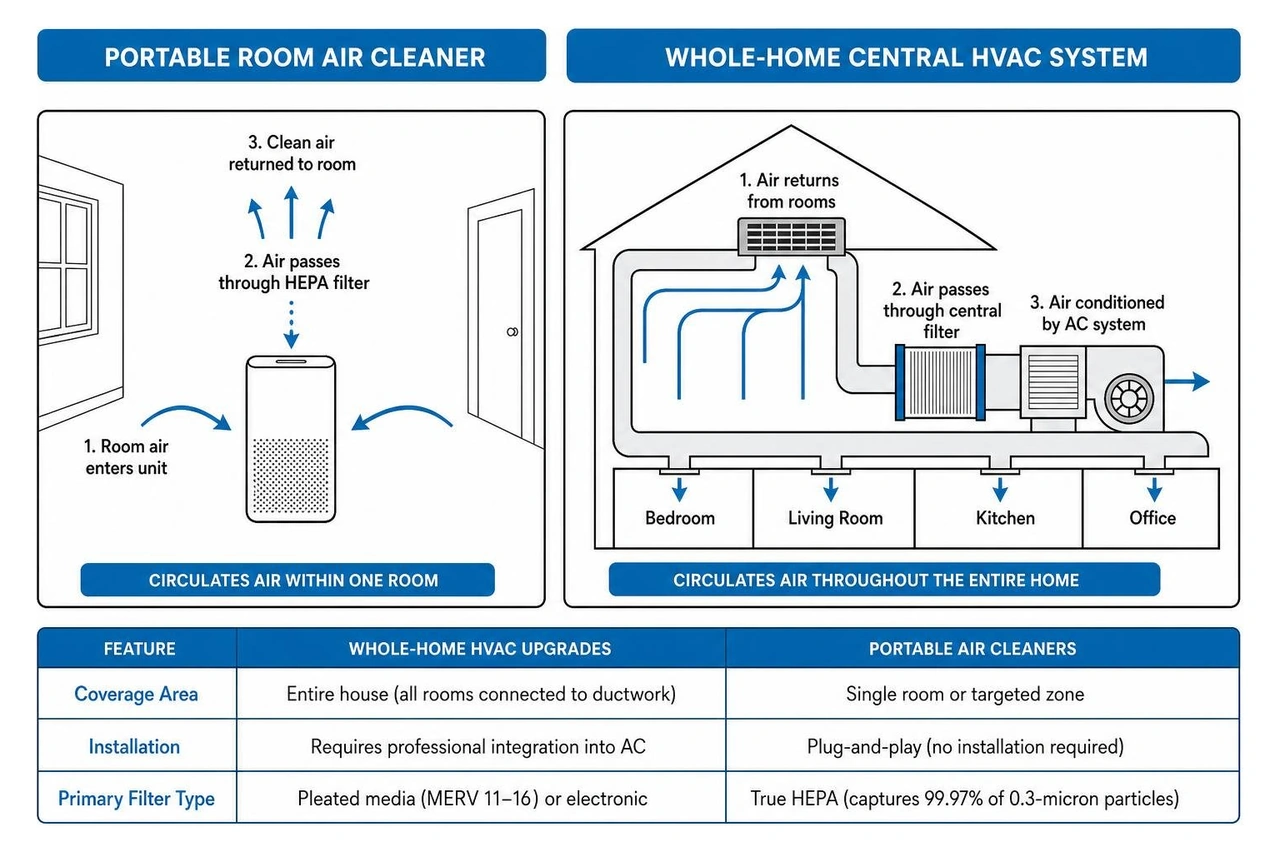
| Feature | Whole-Home HVAC Upgrades | Portable Air Cleaners |
|---|---|---|
| Coverage Area | Entire house (all rooms connected to ductwork) | Single room or targeted zone |
| Installation | Requires professional integration into AC | Plug-and-play (no installation required) |
| Primary Filter Type | Pleated media (MERV 11–16) or electronic | True HEPA (captures 99.97% of 0.3-micron particles) |
| Airflow Impact | Must be matched to system blower capacity | Self-contained fan; zero impact on central AC |
| Maintenance | Replaced every 3 to 12 months | Filter replacement every 6 to 12 months |
| Odor/Gas Removal | Excellent with carbon inserts or active purifiers | Dependent on the size of the carbon pre-filter |
If you have ever stood in the home improvement aisle looking at a wall of replacement filters, you know how confusing the options can be. The key to making sense of them is understanding the Minimum Efficiency Reporting Value, or MERV rating.
MERV ratings range from 1 to 20. This scale measures a filter’s ability to capture particles of various sizes, particularly those between 0.3 and 10 microns.
However, you cannot simply buy the highest-rated MERV filter on the shelf and slide it into your standard 1-inch filter slot. High-MERV filters are denser, which means they naturally restrict airflow. If your AC system's blower motor is not designed to push air through a highly restrictive filter, it will experience high static pressure.
This restriction strains your equipment, leading to weaker airflow, higher energy bills, frozen evaporator coils, and eventually, a system breakdown. To safely enjoy the benefits of a MERV 13 or higher filter, we often recommend installing a wider media filter cabinet (usually 4 to 5 inches thick). These thicker filters have deeply pleated material, which provides a massive surface area. This allows them to capture fine particles with very little resistance to your system's airflow.
If you are wondering whether your current system can handle a high-efficiency filter, our team can perform a static pressure test to find the perfect fit. Explore your options with our professional services for Whole Home Air Filtration Tomball TX.
When standard physical filters are not enough to address your home's air quality issues—especially if you struggle with lingering odors, chemical vapors, or mold—it is time to look at advanced in-duct air purifiers. These systems are installed inside your existing ductwork or air handler, cleaning the air as it passes through.
One of the most popular in-duct upgrades is ultraviolet (UV) germicidal lights. Because your AC evaporator coil is dark and damp, it is a prime breeding ground for mold, algae, and bacteria. By mounting a UV-C light directly above the coil, the constant stream of ultraviolet radiation destroys the DNA of these microorganisms, preventing them from reproducing and blowing into your home.
However, UV lights only sterilize what they can directly "see" (line-of-sight). To clean the moving airstream itself, homeowners often turn to air scrubbers or plasma-based purifiers. When choosing any electronic air cleaner, safety is paramount. Some older electronic models generate ozone as a byproduct, which can irritate lungs and worsen asthma. Always look for modern, zero-ozone certified systems (such as those meeting UL 2998 standards) that keep ozone outputs well below the World Health Organization’s strict safety limits.
To learn more about how these systems integrate with your central air, read about our advanced Air Purification System options.
Active air purification refers to technologies that actively send cleaning agents out into your living spaces, rather than waiting for pollutants to pass through a physical filter. The most common active technology is bipolar ionization (or cold plasma).
These devices are mounted inside your HVAC ductwork. When the system fan turns on, the purifier uses low-voltage electricity to split water vapor in the air into positive and negative ions. These ions are carried by the airflow into every room of your house.
Once in your living spaces, these ions seek out airborne particles like dust, pollen, smoke, and pet dander. Because the particles carry opposite charges, they are drawn together like tiny magnets, clumping into larger clusters (a process called agglomeration). Once these clusters become heavy enough, they either fall out of the air to be vacuumed up or are easily trapped by your standard HVAC filter on its next pass.
Additionally, these active ions interact with VOCs, chemical fumes, and pathogens, breaking down their molecular structure to neutralize odors and render viruses and bacteria harmless. For families with pets, this technology is a game-changer for controlling airborne hair and dander. Learn more about this process in our article on How Air Filtration Systems Remove Pet Dander.
Unlike active systems, passive air filtration relies entirely on capturing pollutants as they are drawn through a physical barrier. Passive upgrades do not release ions or oxidizers into your home; they simply act as an ultra-efficient trap.
The most common passive upgrade is a whole-home media cabinet. This involves a professional technician modifying your return air ductwork to accommodate a thick, pleated 4-inch or 5-inch media filter. Because these filters have up to nine times more surface area than a standard 1-inch filter, they last much longer (often up to a year) and capture smaller particles without choking your air conditioner's airflow.
Another excellent passive upgrade is a polarized media electronic air cleaner. This system slides directly into your existing 1-inch filter rack but plugs into a low-voltage power source. It places an electromagnetic charge on the filter fibers, turning them into a magnet for tiny particles. This allows the system to achieve MERV 14 equivalent filtration efficiency—capturing 97% of particles down to 0.3 microns—without the high resistance to airflow associated with standard high-MERV pleated filters.
To see how these passive systems can be integrated into your home, explore our services for Whole Home Air Purifiers Cypress TX.
Filtration is only one piece of the indoor air quality puzzle. To truly master your home's air, you must also manage humidity and fresh air exchange, especially in our humid Texas climate.
The EPA recommends keeping indoor relative humidity between 30% and 50%. When humidity climbs above 50%, your home becomes a breeding ground for dust mites and mold. While your air conditioner naturally removes some moisture as it cools, it is not designed to be a dedicated dehumidifier. During the spring and fall—when temperatures are mild but humidity is high—your AC does not run long enough to keep your home dry. Adding a whole-home dehumidifier to your HVAC system solves this problem, pulling gallons of moisture out of the air independently of your cooling cycle.
In addition to humidity control, modern, tightly sealed homes often suffer from a lack of fresh air. This is where mechanical ventilation upgrades like Energy Recovery Ventilators (ERVs) and Heat Recovery Ventilators (HRVs) come into play.
These systems continuously exhaust stale, polluted indoor air and replace it with fresh outdoor air. To keep your energy bills low, the ERV transfers heat and moisture between the incoming and outgoing air streams. This pre-cools and dehumidifies the fresh outdoor air before it ever reaches your AC unit, allowing you to breathe fresh air without overloading your cooling system.
Understanding how these systems work helps you make the best decision for your home. Here are answers to some of the most common questions we receive from homeowners.
The replacement schedule for an upgraded filter depends heavily on its thickness and your household conditions:
Keeping your filters fresh is the single easiest way to protect your AC equipment and maintain high airflow efficiency.
Yes, if it is not matched correctly to your system's blower capacity. Standard 1-inch filters rated MERV 13 or higher are often too restrictive for older or single-speed blower motors. This restriction increases static pressure, which reduces airflow, strains the motor, and can cause your system's cooling coils to freeze.
To safely upgrade to MERV 13 or higher, you should consult a professional HVAC technician. We can measure your system's current static pressure and determine if your blower can handle a high-efficiency filter, or if retrofitting your ductwork with a wider 4-inch media cabinet is the safer, more efficient choice.
No, they do not completely eliminate the need, but they do significantly reduce how often it needs to be done. Air filters are designed to capture airborne particles as they circulate through your system. However, dust, pet hair, and construction debris can still settle and accumulate inside your return and supply ducts over time—especially if the system was ever run without a filter or had leaky duct joints.
Think of filtration as daily maintenance and duct cleaning as a deep reset. Upgrading to a high-efficiency filter keeps your newly cleaned ducts pristine for years, preventing dust from blowing back into your living spaces.
Upgrading your home’s air filtration is one of the most effective ways to protect your family's health and keep your air conditioning system running efficiently. Whether you choose to install a high-capacity media filter, add an in-duct UV purifier, or integrate an active plasma system, the key to success is ensuring that these upgrades work in harmony with your existing equipment.
At Air Comfort Pros, we have over 35 years of experience helping homeowners across Pinehurst, Spring, Tomball, Cypress, and the north side of Harris County breathe easier. Our certified technicians can evaluate your current AC system, test your indoor air quality, and recommend the exact upgrades that fit your home, your health needs, and your budget.
If you are ready to transform the air you breathe, contact us today to schedule your indoor air quality consultation. Explore our full range of solutions on our IAQ service page.
The best air filtration upgrades that work with your AC don't require replacing your entire system. Here's a quick overview of the most effective options:
Most of these upgrades install directly into your existing AC system with no full replacement needed.
Here in Pinehurst, TX, most homes stay sealed up for much of the year to manage the heat. That means the same air keeps circulating inside — and it picks up dust, pollen, pet dander, mold spores, and VOCs along the way. According to the EPA, indoor air pollutant levels are often 2 to 5 times higher than outdoor levels, and in tightly sealed homes that number can climb even higher.
The good news? You don't need a brand-new HVAC system to breathe cleaner air. There several proven filtration upgrades that plug directly into the system you already own — and choosing the right one makes a significant difference in how your home feels and how your family breathes.
When you start researching how to clean up your indoor environment, you will generally find yourself choosing between two main paths: whole-home systems that integrate directly into your HVAC ductwork, or portable, single-room air cleaners. Both approaches have their place, but they work in very different ways.
Portable air cleaners are standalone units that you plug into a wall outlet. They rely on an internal fan to draw in air from the immediate room, pass it through a filter (usually a High-Efficiency Particulate Air, or HEPA, filter), and release the cleaned air back into the space. When selecting a portable unit, the most important metric to look for is the Clean Air Delivery Rate (CADR). This rating measures how quickly the unit filters dust, pollen, and tobacco smoke. As a rule of thumb, the CADR of your portable unit should be at least two-thirds of your room’s square footage. For example, a 300-square-foot bedroom needs an air cleaner with a smoke CADR of at least 195.
While portable units are excellent for targeted areas—such as a bedroom where an allergy sufferer sleeps—they are limited by walls and doorways. They cannot clean the air in your kitchen, living room, and hallway simultaneously.
That is where whole-home systems come in. These upgrades are installed directly into your existing central air conditioning system. Whenever your AC or heating fan runs, every cubic foot of air circulating through your home passes through the centralized filtration system. This provides consistent, home-wide protection.
If you want to achieve the healthiest indoor environment, the best strategy is often a combination of both: a whole-home system to manage overall dust and allergens, supplemented by a portable HEPA cleaner in bedrooms or home offices. To learn more about how we assess homes for these systems, check out our guide on Indoor Air Quality Cypress TX.
| Feature | Whole-Home HVAC Upgrades | Portable Air Cleaners |
|---|---|---|
| Coverage Area | Entire house (all rooms connected to ductwork) | Single room or targeted zone |
| Installation | Requires professional integration into AC | Plug-and-play (no installation required) |
| Primary Filter Type | Pleated media (MERV 11–16) or electronic | True HEPA (captures 99.97% of 0.3-micron particles) |
| Airflow Impact | Must be matched to system blower capacity | Self-contained fan; zero impact on central AC |
| Maintenance | Replaced every 3 to 12 months | Filter replacement every 6 to 12 months |
| Odor/Gas Removal | Excellent with carbon inserts or active purifiers | Dependent on the size of the carbon pre-filter |
If you have ever stood in the home improvement aisle looking at a wall of replacement filters, you know how confusing the options can be. The key to making sense of them is understanding the Minimum Efficiency Reporting Value, or MERV rating.
MERV ratings range from 1 to 20. This scale measures a filter’s ability to capture particles of various sizes, particularly those between 0.3 and 10 microns.
However, you cannot simply buy the highest-rated MERV filter on the shelf and slide it into your standard 1-inch filter slot. High-MERV filters are denser, which means they naturally restrict airflow. If your AC system's blower motor is not designed to push air through a highly restrictive filter, it will experience high static pressure.
This restriction strains your equipment, leading to weaker airflow, higher energy bills, frozen evaporator coils, and eventually, a system breakdown. To safely enjoy the benefits of a MERV 13 or higher filter, we often recommend installing a wider media filter cabinet (usually 4 to 5 inches thick). These thicker filters have deeply pleated material, which provides a massive surface area. This allows them to capture fine particles with very little resistance to your system's airflow.
If you are wondering whether your current system can handle a high-efficiency filter, our team can perform a static pressure test to find the perfect fit. Explore your options with our professional services for Whole Home Air Filtration Tomball TX.
When standard physical filters are not enough to address your home's air quality issues—especially if you struggle with lingering odors, chemical vapors, or mold—it is time to look at advanced in-duct air purifiers. These systems are installed inside your existing ductwork or air handler, cleaning the air as it passes through.
One of the most popular in-duct upgrades is ultraviolet (UV) germicidal lights. Because your AC evaporator coil is dark and damp, it is a prime breeding ground for mold, algae, and bacteria. By mounting a UV-C light directly above the coil, the constant stream of ultraviolet radiation destroys the DNA of these microorganisms, preventing them from reproducing and blowing into your home.
However, UV lights only sterilize what they can directly "see" (line-of-sight). To clean the moving airstream itself, homeowners often turn to air scrubbers or plasma-based purifiers. When choosing any electronic air cleaner, safety is paramount. Some older electronic models generate ozone as a byproduct, which can irritate lungs and worsen asthma. Always look for modern, zero-ozone certified systems (such as those meeting UL 2998 standards) that keep ozone outputs well below the World Health Organization’s strict safety limits.
To learn more about how these systems integrate with your central air, read about our advanced Air Purification System options.
Active air purification refers to technologies that actively send cleaning agents out into your living spaces, rather than waiting for pollutants to pass through a physical filter. The most common active technology is bipolar ionization (or cold plasma).
These devices are mounted inside your HVAC ductwork. When the system fan turns on, the purifier uses low-voltage electricity to split water vapor in the air into positive and negative ions. These ions are carried by the airflow into every room of your house.
Once in your living spaces, these ions seek out airborne particles like dust, pollen, smoke, and pet dander. Because the particles carry opposite charges, they are drawn together like tiny magnets, clumping into larger clusters (a process called agglomeration). Once these clusters become heavy enough, they either fall out of the air to be vacuumed up or are easily trapped by your standard HVAC filter on its next pass.
Additionally, these active ions interact with VOCs, chemical fumes, and pathogens, breaking down their molecular structure to neutralize odors and render viruses and bacteria harmless. For families with pets, this technology is a game-changer for controlling airborne hair and dander. Learn more about this process in our article on How Air Filtration Systems Remove Pet Dander.
Unlike active systems, passive air filtration relies entirely on capturing pollutants as they are drawn through a physical barrier. Passive upgrades do not release ions or oxidizers into your home; they simply act as an ultra-efficient trap.
The most common passive upgrade is a whole-home media cabinet. This involves a professional technician modifying your return air ductwork to accommodate a thick, pleated 4-inch or 5-inch media filter. Because these filters have up to nine times more surface area than a standard 1-inch filter, they last much longer (often up to a year) and capture smaller particles without choking your air conditioner's airflow.
Another excellent passive upgrade is a polarized media electronic air cleaner. This system slides directly into your existing 1-inch filter rack but plugs into a low-voltage power source. It places an electromagnetic charge on the filter fibers, turning them into a magnet for tiny particles. This allows the system to achieve MERV 14 equivalent filtration efficiency—capturing 97% of particles down to 0.3 microns—without the high resistance to airflow associated with standard high-MERV pleated filters.
To see how these passive systems can be integrated into your home, explore our services for Whole Home Air Purifiers Cypress TX.
Filtration is only one piece of the indoor air quality puzzle. To truly master your home's air, you must also manage humidity and fresh air exchange, especially in our humid Texas climate.
The EPA recommends keeping indoor relative humidity between 30% and 50%. When humidity climbs above 50%, your home becomes a breeding ground for dust mites and mold. While your air conditioner naturally removes some moisture as it cools, it is not designed to be a dedicated dehumidifier. During the spring and fall—when temperatures are mild but humidity is high—your AC does not run long enough to keep your home dry. Adding a whole-home dehumidifier to your HVAC system solves this problem, pulling gallons of moisture out of the air independently of your cooling cycle.
In addition to humidity control, modern, tightly sealed homes often suffer from a lack of fresh air. This is where mechanical ventilation upgrades like Energy Recovery Ventilators (ERVs) and Heat Recovery Ventilators (HRVs) come into play.
These systems continuously exhaust stale, polluted indoor air and replace it with fresh outdoor air. To keep your energy bills low, the ERV transfers heat and moisture between the incoming and outgoing air streams. This pre-cools and dehumidifies the fresh outdoor air before it ever reaches your AC unit, allowing you to breathe fresh air without overloading your cooling system.
Understanding how these systems work helps you make the best decision for your home. Here are answers to some of the most common questions we receive from homeowners.
The replacement schedule for an upgraded filter depends heavily on its thickness and your household conditions:
Keeping your filters fresh is the single easiest way to protect your AC equipment and maintain high airflow efficiency.
Yes, if it is not matched correctly to your system's blower capacity. Standard 1-inch filters rated MERV 13 or higher are often too restrictive for older or single-speed blower motors. This restriction increases static pressure, which reduces airflow, strains the motor, and can cause your system's cooling coils to freeze.
To safely upgrade to MERV 13 or higher, you should consult a professional HVAC technician. We can measure your system's current static pressure and determine if your blower can handle a high-efficiency filter, or if retrofitting your ductwork with a wider 4-inch media cabinet is the safer, more efficient choice.
No, they do not completely eliminate the need, but they do significantly reduce how often it needs to be done. Air filters are designed to capture airborne particles as they circulate through your system. However, dust, pet hair, and construction debris can still settle and accumulate inside your return and supply ducts over time—especially if the system was ever run without a filter or had leaky duct joints.
Think of filtration as daily maintenance and duct cleaning as a deep reset. Upgrading to a high-efficiency filter keeps your newly cleaned ducts pristine for years, preventing dust from blowing back into your living spaces.
Upgrading your home’s air filtration is one of the most effective ways to protect your family's health and keep your air conditioning system running efficiently. Whether you choose to install a high-capacity media filter, add an in-duct UV purifier, or integrate an active plasma system, the key to success is ensuring that these upgrades work in harmony with your existing equipment.
At Air Comfort Pros, we have over 35 years of experience helping homeowners across Pinehurst, Spring, Tomball, Cypress, and the north side of Harris County breathe easier. Our certified technicians can evaluate your current AC system, test your indoor air quality, and recommend the exact upgrades that fit your home, your health needs, and your budget.
If you are ready to transform the air you breathe, contact us today to schedule your indoor air quality consultation. Explore our full range of solutions on our IAQ service page.
The best air filtration upgrades that work with your AC don't require replacing your entire system. Here's a quick overview of the most effective options:
Most of these upgrades install directly into your existing AC system with no full replacement needed.
Here in Pinehurst, TX, most homes stay sealed up for much of the year to manage the heat. That means the same air keeps circulating inside — and it picks up dust, pollen, pet dander, mold spores, and VOCs along the way. According to the EPA, indoor air pollutant levels are often 2 to 5 times higher than outdoor levels, and in tightly sealed homes that number can climb even higher.
The good news? You don't need a brand-new HVAC system to breathe cleaner air. There several proven filtration upgrades that plug directly into the system you already own — and choosing the right one makes a significant difference in how your home feels and how your family breathes.
When you start researching how to clean up your indoor environment, you will generally find yourself choosing between two main paths: whole-home systems that integrate directly into your HVAC ductwork, or portable, single-room air cleaners. Both approaches have their place, but they work in very different ways.
Portable air cleaners are standalone units that you plug into a wall outlet. They rely on an internal fan to draw in air from the immediate room, pass it through a filter (usually a High-Efficiency Particulate Air, or HEPA, filter), and release the cleaned air back into the space. When selecting a portable unit, the most important metric to look for is the Clean Air Delivery Rate (CADR). This rating measures how quickly the unit filters dust, pollen, and tobacco smoke. As a rule of thumb, the CADR of your portable unit should be at least two-thirds of your room’s square footage. For example, a 300-square-foot bedroom needs an air cleaner with a smoke CADR of at least 195.
While portable units are excellent for targeted areas—such as a bedroom where an allergy sufferer sleeps—they are limited by walls and doorways. They cannot clean the air in your kitchen, living room, and hallway simultaneously.
That is where whole-home systems come in. These upgrades are installed directly into your existing central air conditioning system. Whenever your AC or heating fan runs, every cubic foot of air circulating through your home passes through the centralized filtration system. This provides consistent, home-wide protection.
If you want to achieve the healthiest indoor environment, the best strategy is often a combination of both: a whole-home system to manage overall dust and allergens, supplemented by a portable HEPA cleaner in bedrooms or home offices. To learn more about how we assess homes for these systems, check out our guide on Indoor Air Quality Cypress TX.
| Feature | Whole-Home HVAC Upgrades | Portable Air Cleaners |
|---|---|---|
| Coverage Area | Entire house (all rooms connected to ductwork) | Single room or targeted zone |
| Installation | Requires professional integration into AC | Plug-and-play (no installation required) |
| Primary Filter Type | Pleated media (MERV 11–16) or electronic | True HEPA (captures 99.97% of 0.3-micron particles) |
| Airflow Impact | Must be matched to system blower capacity | Self-contained fan; zero impact on central AC |
| Maintenance | Replaced every 3 to 12 months | Filter replacement every 6 to 12 months |
| Odor/Gas Removal | Excellent with carbon inserts or active purifiers | Dependent on the size of the carbon pre-filter |
If you have ever stood in the home improvement aisle looking at a wall of replacement filters, you know how confusing the options can be. The key to making sense of them is understanding the Minimum Efficiency Reporting Value, or MERV rating.
MERV ratings range from 1 to 20. This scale measures a filter’s ability to capture particles of various sizes, particularly those between 0.3 and 10 microns.
However, you cannot simply buy the highest-rated MERV filter on the shelf and slide it into your standard 1-inch filter slot. High-MERV filters are denser, which means they naturally restrict airflow. If your AC system's blower motor is not designed to push air through a highly restrictive filter, it will experience high static pressure.
This restriction strains your equipment, leading to weaker airflow, higher energy bills, frozen evaporator coils, and eventually, a system breakdown. To safely enjoy the benefits of a MERV 13 or higher filter, we often recommend installing a wider media filter cabinet (usually 4 to 5 inches thick). These thicker filters have deeply pleated material, which provides a massive surface area. This allows them to capture fine particles with very little resistance to your system's airflow.
If you are wondering whether your current system can handle a high-efficiency filter, our team can perform a static pressure test to find the perfect fit. Explore your options with our professional services for Whole Home Air Filtration Tomball TX.
When standard physical filters are not enough to address your home's air quality issues—especially if you struggle with lingering odors, chemical vapors, or mold—it is time to look at advanced in-duct air purifiers. These systems are installed inside your existing ductwork or air handler, cleaning the air as it passes through.
One of the most popular in-duct upgrades is ultraviolet (UV) germicidal lights. Because your AC evaporator coil is dark and damp, it is a prime breeding ground for mold, algae, and bacteria. By mounting a UV-C light directly above the coil, the constant stream of ultraviolet radiation destroys the DNA of these microorganisms, preventing them from reproducing and blowing into your home.
However, UV lights only sterilize what they can directly "see" (line-of-sight). To clean the moving airstream itself, homeowners often turn to air scrubbers or plasma-based purifiers. When choosing any electronic air cleaner, safety is paramount. Some older electronic models generate ozone as a byproduct, which can irritate lungs and worsen asthma. Always look for modern, zero-ozone certified systems (such as those meeting UL 2998 standards) that keep ozone outputs well below the World Health Organization’s strict safety limits.
To learn more about how these systems integrate with your central air, read about our advanced Air Purification System options.
Active air purification refers to technologies that actively send cleaning agents out into your living spaces, rather than waiting for pollutants to pass through a physical filter. The most common active technology is bipolar ionization (or cold plasma).
These devices are mounted inside your HVAC ductwork. When the system fan turns on, the purifier uses low-voltage electricity to split water vapor in the air into positive and negative ions. These ions are carried by the airflow into every room of your house.
Once in your living spaces, these ions seek out airborne particles like dust, pollen, smoke, and pet dander. Because the particles carry opposite charges, they are drawn together like tiny magnets, clumping into larger clusters (a process called agglomeration). Once these clusters become heavy enough, they either fall out of the air to be vacuumed up or are easily trapped by your standard HVAC filter on its next pass.
Additionally, these active ions interact with VOCs, chemical fumes, and pathogens, breaking down their molecular structure to neutralize odors and render viruses and bacteria harmless. For families with pets, this technology is a game-changer for controlling airborne hair and dander. Learn more about this process in our article on How Air Filtration Systems Remove Pet Dander.
Unlike active systems, passive air filtration relies entirely on capturing pollutants as they are drawn through a physical barrier. Passive upgrades do not release ions or oxidizers into your home; they simply act as an ultra-efficient trap.
The most common passive upgrade is a whole-home media cabinet. This involves a professional technician modifying your return air ductwork to accommodate a thick, pleated 4-inch or 5-inch media filter. Because these filters have up to nine times more surface area than a standard 1-inch filter, they last much longer (often up to a year) and capture smaller particles without choking your air conditioner's airflow.
Another excellent passive upgrade is a polarized media electronic air cleaner. This system slides directly into your existing 1-inch filter rack but plugs into a low-voltage power source. It places an electromagnetic charge on the filter fibers, turning them into a magnet for tiny particles. This allows the system to achieve MERV 14 equivalent filtration efficiency—capturing 97% of particles down to 0.3 microns—without the high resistance to airflow associated with standard high-MERV pleated filters.
To see how these passive systems can be integrated into your home, explore our services for Whole Home Air Purifiers Cypress TX.
Filtration is only one piece of the indoor air quality puzzle. To truly master your home's air, you must also manage humidity and fresh air exchange, especially in our humid Texas climate.
The EPA recommends keeping indoor relative humidity between 30% and 50%. When humidity climbs above 50%, your home becomes a breeding ground for dust mites and mold. While your air conditioner naturally removes some moisture as it cools, it is not designed to be a dedicated dehumidifier. During the spring and fall—when temperatures are mild but humidity is high—your AC does not run long enough to keep your home dry. Adding a whole-home dehumidifier to your HVAC system solves this problem, pulling gallons of moisture out of the air independently of your cooling cycle.
In addition to humidity control, modern, tightly sealed homes often suffer from a lack of fresh air. This is where mechanical ventilation upgrades like Energy Recovery Ventilators (ERVs) and Heat Recovery Ventilators (HRVs) come into play.
These systems continuously exhaust stale, polluted indoor air and replace it with fresh outdoor air. To keep your energy bills low, the ERV transfers heat and moisture between the incoming and outgoing air streams. This pre-cools and dehumidifies the fresh outdoor air before it ever reaches your AC unit, allowing you to breathe fresh air without overloading your cooling system.
Understanding how these systems work helps you make the best decision for your home. Here are answers to some of the most common questions we receive from homeowners.
The replacement schedule for an upgraded filter depends heavily on its thickness and your household conditions:
Keeping your filters fresh is the single easiest way to protect your AC equipment and maintain high airflow efficiency.
Yes, if it is not matched correctly to your system's blower capacity. Standard 1-inch filters rated MERV 13 or higher are often too restrictive for older or single-speed blower motors. This restriction increases static pressure, which reduces airflow, strains the motor, and can cause your system's cooling coils to freeze.
To safely upgrade to MERV 13 or higher, you should consult a professional HVAC technician. We can measure your system's current static pressure and determine if your blower can handle a high-efficiency filter, or if retrofitting your ductwork with a wider 4-inch media cabinet is the safer, more efficient choice.
No, they do not completely eliminate the need, but they do significantly reduce how often it needs to be done. Air filters are designed to capture airborne particles as they circulate through your system. However, dust, pet hair, and construction debris can still settle and accumulate inside your return and supply ducts over time—especially if the system was ever run without a filter or had leaky duct joints.
Think of filtration as daily maintenance and duct cleaning as a deep reset. Upgrading to a high-efficiency filter keeps your newly cleaned ducts pristine for years, preventing dust from blowing back into your living spaces.
Upgrading your home’s air filtration is one of the most effective ways to protect your family's health and keep your air conditioning system running efficiently. Whether you choose to install a high-capacity media filter, add an in-duct UV purifier, or integrate an active plasma system, the key to success is ensuring that these upgrades work in harmony with your existing equipment.
At Air Comfort Pros, we have over 35 years of experience helping homeowners across Pinehurst, Spring, Tomball, Cypress, and the north side of Harris County breathe easier. Our certified technicians can evaluate your current AC system, test your indoor air quality, and recommend the exact upgrades that fit your home, your health needs, and your budget.
If you are ready to transform the air you breathe, contact us today to schedule your indoor air quality consultation. Explore our full range of solutions on our IAQ service page.
The best air filtration upgrades that work with your AC don't require replacing your entire system. Here's a quick overview of the most effective options:
Most of these upgrades install directly into your existing AC system with no full replacement needed.
Here in Pinehurst, TX, most homes stay sealed up for much of the year to manage the heat. That means the same air keeps circulating inside — and it picks up dust, pollen, pet dander, mold spores, and VOCs along the way. According to the EPA, indoor air pollutant levels are often 2 to 5 times higher than outdoor levels, and in tightly sealed homes that number can climb even higher.
The good news? You don't need a brand-new HVAC system to breathe cleaner air. There several proven filtration upgrades that plug directly into the system you already own — and choosing the right one makes a significant difference in how your home feels and how your family breathes.
When you start researching how to clean up your indoor environment, you will generally find yourself choosing between two main paths: whole-home systems that integrate directly into your HVAC ductwork, or portable, single-room air cleaners. Both approaches have their place, but they work in very different ways.
Portable air cleaners are standalone units that you plug into a wall outlet. They rely on an internal fan to draw in air from the immediate room, pass it through a filter (usually a High-Efficiency Particulate Air, or HEPA, filter), and release the cleaned air back into the space. When selecting a portable unit, the most important metric to look for is the Clean Air Delivery Rate (CADR). This rating measures how quickly the unit filters dust, pollen, and tobacco smoke. As a rule of thumb, the CADR of your portable unit should be at least two-thirds of your room’s square footage. For example, a 300-square-foot bedroom needs an air cleaner with a smoke CADR of at least 195.
While portable units are excellent for targeted areas—such as a bedroom where an allergy sufferer sleeps—they are limited by walls and doorways. They cannot clean the air in your kitchen, living room, and hallway simultaneously.
That is where whole-home systems come in. These upgrades are installed directly into your existing central air conditioning system. Whenever your AC or heating fan runs, every cubic foot of air circulating through your home passes through the centralized filtration system. This provides consistent, home-wide protection.
If you want to achieve the healthiest indoor environment, the best strategy is often a combination of both: a whole-home system to manage overall dust and allergens, supplemented by a portable HEPA cleaner in bedrooms or home offices. To learn more about how we assess homes for these systems, check out our guide on Indoor Air Quality Cypress TX.
| Feature | Whole-Home HVAC Upgrades | Portable Air Cleaners |
|---|---|---|
| Coverage Area | Entire house (all rooms connected to ductwork) | Single room or targeted zone |
| Installation | Requires professional integration into AC | Plug-and-play (no installation required) |
| Primary Filter Type | Pleated media (MERV 11–16) or electronic | True HEPA (captures 99.97% of 0.3-micron particles) |
| Airflow Impact | Must be matched to system blower capacity | Self-contained fan; zero impact on central AC |
| Maintenance | Replaced every 3 to 12 months | Filter replacement every 6 to 12 months |
| Odor/Gas Removal | Excellent with carbon inserts or active purifiers | Dependent on the size of the carbon pre-filter |
If you have ever stood in the home improvement aisle looking at a wall of replacement filters, you know how confusing the options can be. The key to making sense of them is understanding the Minimum Efficiency Reporting Value, or MERV rating.
MERV ratings range from 1 to 20. This scale measures a filter’s ability to capture particles of various sizes, particularly those between 0.3 and 10 microns.
However, you cannot simply buy the highest-rated MERV filter on the shelf and slide it into your standard 1-inch filter slot. High-MERV filters are denser, which means they naturally restrict airflow. If your AC system's blower motor is not designed to push air through a highly restrictive filter, it will experience high static pressure.
This restriction strains your equipment, leading to weaker airflow, higher energy bills, frozen evaporator coils, and eventually, a system breakdown. To safely enjoy the benefits of a MERV 13 or higher filter, we often recommend installing a wider media filter cabinet (usually 4 to 5 inches thick). These thicker filters have deeply pleated material, which provides a massive surface area. This allows them to capture fine particles with very little resistance to your system's airflow.
If you are wondering whether your current system can handle a high-efficiency filter, our team can perform a static pressure test to find the perfect fit. Explore your options with our professional services for Whole Home Air Filtration Tomball TX.
When standard physical filters are not enough to address your home's air quality issues—especially if you struggle with lingering odors, chemical vapors, or mold—it is time to look at advanced in-duct air purifiers. These systems are installed inside your existing ductwork or air handler, cleaning the air as it passes through.
One of the most popular in-duct upgrades is ultraviolet (UV) germicidal lights. Because your AC evaporator coil is dark and damp, it is a prime breeding ground for mold, algae, and bacteria. By mounting a UV-C light directly above the coil, the constant stream of ultraviolet radiation destroys the DNA of these microorganisms, preventing them from reproducing and blowing into your home.
However, UV lights only sterilize what they can directly "see" (line-of-sight). To clean the moving airstream itself, homeowners often turn to air scrubbers or plasma-based purifiers. When choosing any electronic air cleaner, safety is paramount. Some older electronic models generate ozone as a byproduct, which can irritate lungs and worsen asthma. Always look for modern, zero-ozone certified systems (such as those meeting UL 2998 standards) that keep ozone outputs well below the World Health Organization’s strict safety limits.
To learn more about how these systems integrate with your central air, read about our advanced Air Purification System options.
Active air purification refers to technologies that actively send cleaning agents out into your living spaces, rather than waiting for pollutants to pass through a physical filter. The most common active technology is bipolar ionization (or cold plasma).
These devices are mounted inside your HVAC ductwork. When the system fan turns on, the purifier uses low-voltage electricity to split water vapor in the air into positive and negative ions. These ions are carried by the airflow into every room of your house.
Once in your living spaces, these ions seek out airborne particles like dust, pollen, smoke, and pet dander. Because the particles carry opposite charges, they are drawn together like tiny magnets, clumping into larger clusters (a process called agglomeration). Once these clusters become heavy enough, they either fall out of the air to be vacuumed up or are easily trapped by your standard HVAC filter on its next pass.
Additionally, these active ions interact with VOCs, chemical fumes, and pathogens, breaking down their molecular structure to neutralize odors and render viruses and bacteria harmless. For families with pets, this technology is a game-changer for controlling airborne hair and dander. Learn more about this process in our article on How Air Filtration Systems Remove Pet Dander.
Unlike active systems, passive air filtration relies entirely on capturing pollutants as they are drawn through a physical barrier. Passive upgrades do not release ions or oxidizers into your home; they simply act as an ultra-efficient trap.
The most common passive upgrade is a whole-home media cabinet. This involves a professional technician modifying your return air ductwork to accommodate a thick, pleated 4-inch or 5-inch media filter. Because these filters have up to nine times more surface area than a standard 1-inch filter, they last much longer (often up to a year) and capture smaller particles without choking your air conditioner's airflow.
Another excellent passive upgrade is a polarized media electronic air cleaner. This system slides directly into your existing 1-inch filter rack but plugs into a low-voltage power source. It places an electromagnetic charge on the filter fibers, turning them into a magnet for tiny particles. This allows the system to achieve MERV 14 equivalent filtration efficiency—capturing 97% of particles down to 0.3 microns—without the high resistance to airflow associated with standard high-MERV pleated filters.
To see how these passive systems can be integrated into your home, explore our services for Whole Home Air Purifiers Cypress TX.
Filtration is only one piece of the indoor air quality puzzle. To truly master your home's air, you must also manage humidity and fresh air exchange, especially in our humid Texas climate.
The EPA recommends keeping indoor relative humidity between 30% and 50%. When humidity climbs above 50%, your home becomes a breeding ground for dust mites and mold. While your air conditioner naturally removes some moisture as it cools, it is not designed to be a dedicated dehumidifier. During the spring and fall—when temperatures are mild but humidity is high—your AC does not run long enough to keep your home dry. Adding a whole-home dehumidifier to your HVAC system solves this problem, pulling gallons of moisture out of the air independently of your cooling cycle.
In addition to humidity control, modern, tightly sealed homes often suffer from a lack of fresh air. This is where mechanical ventilation upgrades like Energy Recovery Ventilators (ERVs) and Heat Recovery Ventilators (HRVs) come into play.
These systems continuously exhaust stale, polluted indoor air and replace it with fresh outdoor air. To keep your energy bills low, the ERV transfers heat and moisture between the incoming and outgoing air streams. This pre-cools and dehumidifies the fresh outdoor air before it ever reaches your AC unit, allowing you to breathe fresh air without overloading your cooling system.
Understanding how these systems work helps you make the best decision for your home. Here are answers to some of the most common questions we receive from homeowners.
The replacement schedule for an upgraded filter depends heavily on its thickness and your household conditions:
Keeping your filters fresh is the single easiest way to protect your AC equipment and maintain high airflow efficiency.
Yes, if it is not matched correctly to your system's blower capacity. Standard 1-inch filters rated MERV 13 or higher are often too restrictive for older or single-speed blower motors. This restriction increases static pressure, which reduces airflow, strains the motor, and can cause your system's cooling coils to freeze.
To safely upgrade to MERV 13 or higher, you should consult a professional HVAC technician. We can measure your system's current static pressure and determine if your blower can handle a high-efficiency filter, or if retrofitting your ductwork with a wider 4-inch media cabinet is the safer, more efficient choice.
No, they do not completely eliminate the need, but they do significantly reduce how often it needs to be done. Air filters are designed to capture airborne particles as they circulate through your system. However, dust, pet hair, and construction debris can still settle and accumulate inside your return and supply ducts over time—especially if the system was ever run without a filter or had leaky duct joints.
Think of filtration as daily maintenance and duct cleaning as a deep reset. Upgrading to a high-efficiency filter keeps your newly cleaned ducts pristine for years, preventing dust from blowing back into your living spaces.
Upgrading your home’s air filtration is one of the most effective ways to protect your family's health and keep your air conditioning system running efficiently. Whether you choose to install a high-capacity media filter, add an in-duct UV purifier, or integrate an active plasma system, the key to success is ensuring that these upgrades work in harmony with your existing equipment.
At Air Comfort Pros, we have over 35 years of experience helping homeowners across Pinehurst, Spring, Tomball, Cypress, and the north side of Harris County breathe easier. Our certified technicians can evaluate your current AC system, test your indoor air quality, and recommend the exact upgrades that fit your home, your health needs, and your budget.
If you are ready to transform the air you breathe, contact us today to schedule your indoor air quality consultation. Explore our full range of solutions on our IAQ service page.
The best air filtration upgrades that work with your AC don't require replacing your entire system. Here's a quick overview of the most effective options:
Most of these upgrades install directly into your existing AC system with no full replacement needed.
Here in Pinehurst, TX, most homes stay sealed up for much of the year to manage the heat. That means the same air keeps circulating inside — and it picks up dust, pollen, pet dander, mold spores, and VOCs along the way. According to the EPA, indoor air pollutant levels are often 2 to 5 times higher than outdoor levels, and in tightly sealed homes that number can climb even higher.
The good news? You don't need a brand-new HVAC system to breathe cleaner air. There several proven filtration upgrades that plug directly into the system you already own — and choosing the right one makes a significant difference in how your home feels and how your family breathes.
When you start researching how to clean up your indoor environment, you will generally find yourself choosing between two main paths: whole-home systems that integrate directly into your HVAC ductwork, or portable, single-room air cleaners. Both approaches have their place, but they work in very different ways.
Portable air cleaners are standalone units that you plug into a wall outlet. They rely on an internal fan to draw in air from the immediate room, pass it through a filter (usually a High-Efficiency Particulate Air, or HEPA, filter), and release the cleaned air back into the space. When selecting a portable unit, the most important metric to look for is the Clean Air Delivery Rate (CADR). This rating measures how quickly the unit filters dust, pollen, and tobacco smoke. As a rule of thumb, the CADR of your portable unit should be at least two-thirds of your room’s square footage. For example, a 300-square-foot bedroom needs an air cleaner with a smoke CADR of at least 195.
While portable units are excellent for targeted areas—such as a bedroom where an allergy sufferer sleeps—they are limited by walls and doorways. They cannot clean the air in your kitchen, living room, and hallway simultaneously.
That is where whole-home systems come in. These upgrades are installed directly into your existing central air conditioning system. Whenever your AC or heating fan runs, every cubic foot of air circulating through your home passes through the centralized filtration system. This provides consistent, home-wide protection.
If you want to achieve the healthiest indoor environment, the best strategy is often a combination of both: a whole-home system to manage overall dust and allergens, supplemented by a portable HEPA cleaner in bedrooms or home offices. To learn more about how we assess homes for these systems, check out our guide on Indoor Air Quality Cypress TX.
| Feature | Whole-Home HVAC Upgrades | Portable Air Cleaners |
|---|---|---|
| Coverage Area | Entire house (all rooms connected to ductwork) | Single room or targeted zone |
| Installation | Requires professional integration into AC | Plug-and-play (no installation required) |
| Primary Filter Type | Pleated media (MERV 11–16) or electronic | True HEPA (captures 99.97% of 0.3-micron particles) |
| Airflow Impact | Must be matched to system blower capacity | Self-contained fan; zero impact on central AC |
| Maintenance | Replaced every 3 to 12 months | Filter replacement every 6 to 12 months |
| Odor/Gas Removal | Excellent with carbon inserts or active purifiers | Dependent on the size of the carbon pre-filter |
If you have ever stood in the home improvement aisle looking at a wall of replacement filters, you know how confusing the options can be. The key to making sense of them is understanding the Minimum Efficiency Reporting Value, or MERV rating.
MERV ratings range from 1 to 20. This scale measures a filter’s ability to capture particles of various sizes, particularly those between 0.3 and 10 microns.
However, you cannot simply buy the highest-rated MERV filter on the shelf and slide it into your standard 1-inch filter slot. High-MERV filters are denser, which means they naturally restrict airflow. If your AC system's blower motor is not designed to push air through a highly restrictive filter, it will experience high static pressure.
This restriction strains your equipment, leading to weaker airflow, higher energy bills, frozen evaporator coils, and eventually, a system breakdown. To safely enjoy the benefits of a MERV 13 or higher filter, we often recommend installing a wider media filter cabinet (usually 4 to 5 inches thick). These thicker filters have deeply pleated material, which provides a massive surface area. This allows them to capture fine particles with very little resistance to your system's airflow.
If you are wondering whether your current system can handle a high-efficiency filter, our team can perform a static pressure test to find the perfect fit. Explore your options with our professional services for Whole Home Air Filtration Tomball TX.
When standard physical filters are not enough to address your home's air quality issues—especially if you struggle with lingering odors, chemical vapors, or mold—it is time to look at advanced in-duct air purifiers. These systems are installed inside your existing ductwork or air handler, cleaning the air as it passes through.
One of the most popular in-duct upgrades is ultraviolet (UV) germicidal lights. Because your AC evaporator coil is dark and damp, it is a prime breeding ground for mold, algae, and bacteria. By mounting a UV-C light directly above the coil, the constant stream of ultraviolet radiation destroys the DNA of these microorganisms, preventing them from reproducing and blowing into your home.
However, UV lights only sterilize what they can directly "see" (line-of-sight). To clean the moving airstream itself, homeowners often turn to air scrubbers or plasma-based purifiers. When choosing any electronic air cleaner, safety is paramount. Some older electronic models generate ozone as a byproduct, which can irritate lungs and worsen asthma. Always look for modern, zero-ozone certified systems (such as those meeting UL 2998 standards) that keep ozone outputs well below the World Health Organization’s strict safety limits.
To learn more about how these systems integrate with your central air, read about our advanced Air Purification System options.
Active air purification refers to technologies that actively send cleaning agents out into your living spaces, rather than waiting for pollutants to pass through a physical filter. The most common active technology is bipolar ionization (or cold plasma).
These devices are mounted inside your HVAC ductwork. When the system fan turns on, the purifier uses low-voltage electricity to split water vapor in the air into positive and negative ions. These ions are carried by the airflow into every room of your house.
Once in your living spaces, these ions seek out airborne particles like dust, pollen, smoke, and pet dander. Because the particles carry opposite charges, they are drawn together like tiny magnets, clumping into larger clusters (a process called agglomeration). Once these clusters become heavy enough, they either fall out of the air to be vacuumed up or are easily trapped by your standard HVAC filter on its next pass.
Additionally, these active ions interact with VOCs, chemical fumes, and pathogens, breaking down their molecular structure to neutralize odors and render viruses and bacteria harmless. For families with pets, this technology is a game-changer for controlling airborne hair and dander. Learn more about this process in our article on How Air Filtration Systems Remove Pet Dander.
Unlike active systems, passive air filtration relies entirely on capturing pollutants as they are drawn through a physical barrier. Passive upgrades do not release ions or oxidizers into your home; they simply act as an ultra-efficient trap.
The most common passive upgrade is a whole-home media cabinet. This involves a professional technician modifying your return air ductwork to accommodate a thick, pleated 4-inch or 5-inch media filter. Because these filters have up to nine times more surface area than a standard 1-inch filter, they last much longer (often up to a year) and capture smaller particles without choking your air conditioner's airflow.
Another excellent passive upgrade is a polarized media electronic air cleaner. This system slides directly into your existing 1-inch filter rack but plugs into a low-voltage power source. It places an electromagnetic charge on the filter fibers, turning them into a magnet for tiny particles. This allows the system to achieve MERV 14 equivalent filtration efficiency—capturing 97% of particles down to 0.3 microns—without the high resistance to airflow associated with standard high-MERV pleated filters.
To see how these passive systems can be integrated into your home, explore our services for Whole Home Air Purifiers Cypress TX.
Filtration is only one piece of the indoor air quality puzzle. To truly master your home's air, you must also manage humidity and fresh air exchange, especially in our humid Texas climate.
The EPA recommends keeping indoor relative humidity between 30% and 50%. When humidity climbs above 50%, your home becomes a breeding ground for dust mites and mold. While your air conditioner naturally removes some moisture as it cools, it is not designed to be a dedicated dehumidifier. During the spring and fall—when temperatures are mild but humidity is high—your AC does not run long enough to keep your home dry. Adding a whole-home dehumidifier to your HVAC system solves this problem, pulling gallons of moisture out of the air independently of your cooling cycle.
In addition to humidity control, modern, tightly sealed homes often suffer from a lack of fresh air. This is where mechanical ventilation upgrades like Energy Recovery Ventilators (ERVs) and Heat Recovery Ventilators (HRVs) come into play.
These systems continuously exhaust stale, polluted indoor air and replace it with fresh outdoor air. To keep your energy bills low, the ERV transfers heat and moisture between the incoming and outgoing air streams. This pre-cools and dehumidifies the fresh outdoor air before it ever reaches your AC unit, allowing you to breathe fresh air without overloading your cooling system.
Understanding how these systems work helps you make the best decision for your home. Here are answers to some of the most common questions we receive from homeowners.
The replacement schedule for an upgraded filter depends heavily on its thickness and your household conditions:
Keeping your filters fresh is the single easiest way to protect your AC equipment and maintain high airflow efficiency.
Yes, if it is not matched correctly to your system's blower capacity. Standard 1-inch filters rated MERV 13 or higher are often too restrictive for older or single-speed blower motors. This restriction increases static pressure, which reduces airflow, strains the motor, and can cause your system's cooling coils to freeze.
To safely upgrade to MERV 13 or higher, you should consult a professional HVAC technician. We can measure your system's current static pressure and determine if your blower can handle a high-efficiency filter, or if retrofitting your ductwork with a wider 4-inch media cabinet is the safer, more efficient choice.
No, they do not completely eliminate the need, but they do significantly reduce how often it needs to be done. Air filters are designed to capture airborne particles as they circulate through your system. However, dust, pet hair, and construction debris can still settle and accumulate inside your return and supply ducts over time—especially if the system was ever run without a filter or had leaky duct joints.
Think of filtration as daily maintenance and duct cleaning as a deep reset. Upgrading to a high-efficiency filter keeps your newly cleaned ducts pristine for years, preventing dust from blowing back into your living spaces.
Upgrading your home’s air filtration is one of the most effective ways to protect your family's health and keep your air conditioning system running efficiently. Whether you choose to install a high-capacity media filter, add an in-duct UV purifier, or integrate an active plasma system, the key to success is ensuring that these upgrades work in harmony with your existing equipment.
At Air Comfort Pros, we have over 35 years of experience helping homeowners across Pinehurst, Spring, Tomball, Cypress, and the north side of Harris County breathe easier. Our certified technicians can evaluate your current AC system, test your indoor air quality, and recommend the exact upgrades that fit your home, your health needs, and your budget.
If you are ready to transform the air you breathe, contact us today to schedule your indoor air quality consultation. Explore our full range of solutions on our IAQ service page.


Zane came out and did an amazing job! Super friendly, honest and transparent about the work that needed to be done. This is my second time working with Air Comfort Solutions and they’re my go to for HVAC services. Highly recommend.
God's AMAZING grace sent us Robert and Zane. We have been without air in this Texas heat for six weeks and four days. We've had a few contractors give us quotes all trying to upsell when we're at a low point. But not the guys at Air Comfort Solutions. They came in assessed our situation, gave us honest feedback, and showed us the issues as they proceeded with the assessment for clear understanding. We highly recommend them for their professionalism, quality products, and fair pricing. We hands down support them for all the work they do 💯 %.
Robert and Zane gone above and beyond to make the process easy and affordable.
Would definitely recommend!!
I’m writing this review to let everyone know that Air Comfort Solutions is the company to work with. I know the owner ( Robert) for several years now. He has been taking care of my residential and business work orders. Robert is professional, knowledgeable and will save you money. I just want to thank Robert for great job you have been doing for me.