


Do You Need 24 Hour AC Repair? Troubleshooting Your Fall Heating Startup
See why fall heater smells cause panic. Use our home maintenance tips and troubleshooting to decide if it's normal dust burn-off or time to call a pro.
How often should you service your ac in texas is one of the most important questions you can ask as a homeowner — and the answer is straightforward:
Most Texas homeowners should schedule professional AC service twice per year:
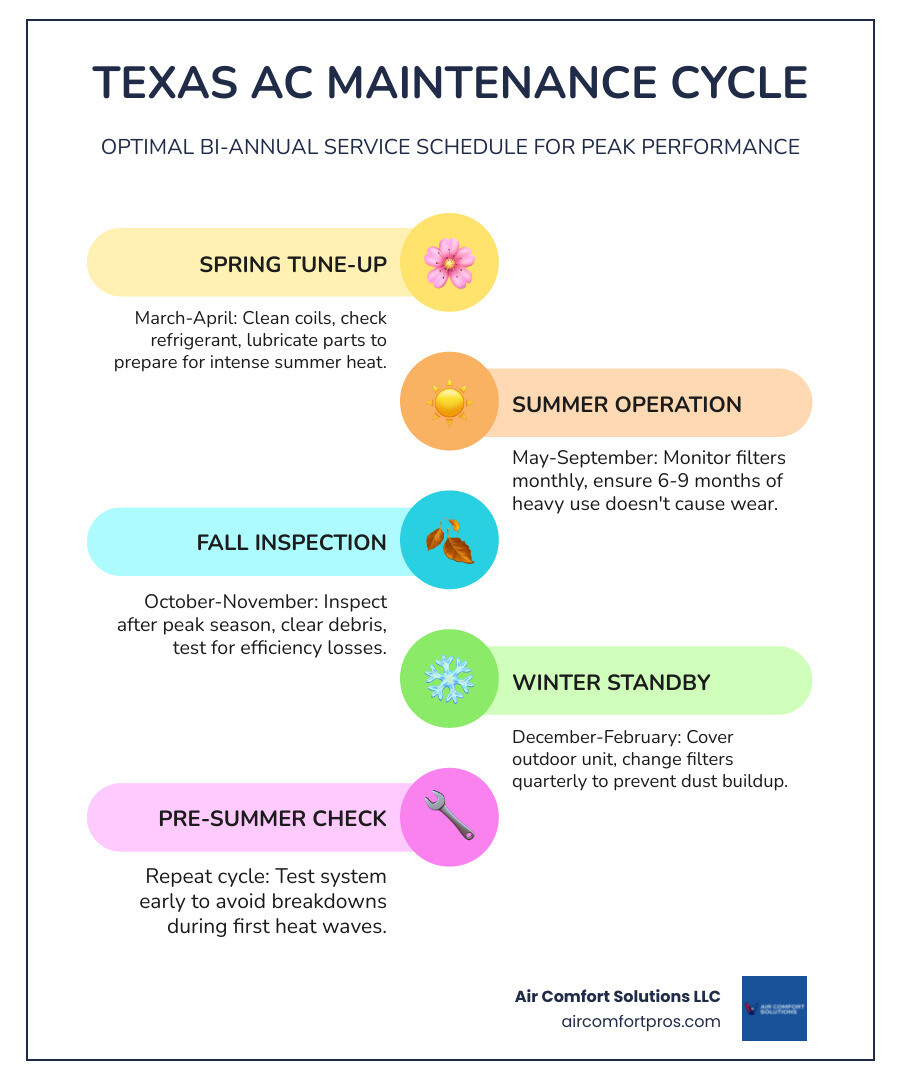
• Spring Tune-Up — Timing: March – April — Purpose: Prepare for peak summer cooling demand
• Fall Inspection — Timing: October – November — Purpose: Check system after heavy summer use; prep for heating season
Minimum: Once per year (spring) if budget is a concern — but twice yearly is strongly recommended given Texas conditions.
For older units (10+ years), or homes with pets, allergies, or high dust levels, more frequent checks may be needed.
Here in North Harris County, your air conditioner isn't just a convenience — it's essential. Texas summers routinely push systems to their limits for six to nine months out of the year. That's far more wear than most HVAC equipment is designed to handle without regular attention.
When maintenance gets skipped, small problems quietly grow into expensive ones. A dirty coil, a low refrigerant charge, or a clogged drain line can turn a routine tune-up into a full emergency repair — often at the worst possible moment, like the middle of a July heat wave.
The good news is that a consistent service schedule keeps your system running efficiently, helps lower your energy bills, and can extend the life of your equipment well beyond the typical 12–15 year lifespan.
In the industry, we often compare an HVAC system to a car. You wouldn't dream of driving 20,000 miles through a dusty desert without changing the oil, right? In Texas, our air conditioners are essentially "driving" in desert-like heat for nearly three-quarters of the year. Because of this, the consensus among experts is a bi-annual schedule.
Ideally, you want to hit those two major seasonal transitions. A spring tune-up ensures that when the first triple-digit day hits in May or June, your system is actually ready to handle the load. This is the time to focus on Preparing Your Cooling System for Summer. Conversely, a fall inspection allows us to check the system after it has been battered by a long summer, ensuring no components are on the verge of failure before the (admittedly shorter) heating season begins. For residents in our local area, staying on top of AC Maintenance in Tomball, TX is the best way to ensure peak performance year-round.
Why is Texas different from, say, Ohio or Oregon? It comes down to the sheer workload and environmental pressure. Our systems don't just "run"; they labor. Between the extreme temperatures that regularly exceed 100°F and the high humidity that forces the AC to work double-time as a dehumidifier, the mechanical strain is immense.
Furthermore, we deal with significant dust accumulation and high pollen pressure. These particles coat your coils and clog your filters, acting like a blanket that traps heat inside the unit. By prioritizing AC Maintenance in Spring, TX, you are effectively removing that "blanket" and allowing the system to breathe. This reduces the heavy workload on the compressor and significantly boosts system longevity.
Not every home uses its AC the same way. While the twice-yearly rule is a great baseline, certain factors might push you toward more frequent check-ins.
• Standard Residential — Recommended Frequency: 2x Per Year — Reason: General wear and tear in Texas climate.
• Commercial Property — Recommended Frequency: 4x Per Year (Quarterly) — Reason: Longer operating hours and higher occupant load.
• Homes with Pets/Allergies — Recommended Frequency: 2x Per Year + Monthly Filter Changes — Reason: Pet hair and dander clog coils and lower indoor air quality.
• High Dust/Construction Areas — Recommended Frequency: 3x Per Year — Reason: Particulates accumulate faster on outdoor condenser fins.
If you are in a high-traffic home or a commercial space in the city, AC Service in Houston, TX might need to happen more often to combat environmental pollutants and ensure the air remains healthy for everyone inside.
If your system is over 10 years old, it’s entering its "senior years." In Texas, the average lifespan of an AC unit is about 12 to 15 years, though well-maintained systems can sometimes stretch to 20. As parts age, they suffer from natural wear and tear that leads to an efficiency decline.
For these older units, we often recommend a more vigilant HVAC Maintenance Plan. At this stage, maintenance isn't just about cleaning; it’s about predictive repairs. We look for capacitor readings that are starting to drift or motors that are drawing more "amps" than they should. Catching these signs early can be the difference between a simple part swap and a catastrophic mid-August breakdown.
Many homeowners wonder what actually happens during those service visits. It’s much more than just a quick glance at the thermostat. A professional tune-up is a comprehensive medical check-up for your cooling system.
When we arrive for a service call, we follow a rigorous checklist to ensure every component is performing at its best. If you've never had a pro look at your system, you can learn more about What to Expect During Your First AC Tune-Up. Key tasks typically include:
• Coil Cleaning: We clean both the indoor evaporator coils and the outdoor condenser coils. Dirt on these coils is the #1 enemy of efficiency.
• Refrigerant Level Check: We ensure your system has the exact amount of refrigerant required. Too little (often due to a leak) or too much can damage the compressor.
• Electrical Inspection: We tighten all connections and measure the voltage and current on motors.
• Thermostat Calibration: We verify that your thermostat is actually communicating correctly with the unit.
• Lubrication: We grease moving parts to reduce friction, which lowers energy use and prevents part failure.
• Drain Line Clearing: We flush the condensate drain line to prevent those dreaded "water through the ceiling" leaks that happen when lines clog with algae.
• Blower Assembly & Safety Controls: We check the blower to ensure proper airflow and test all safety switches to protect your home.
The most immediate benefit you’ll notice from regular maintenance is in your wallet. An air conditioner that is struggling against dirty coils or a worn-out motor uses significantly more electricity to achieve the same cooling result. By keeping your system tuned, you maintain a higher SEER (Seasonal Energy Efficiency Ratio) rating, leading to lower utility bills.
In areas like the north side of Harris County, AC Maintenance in Magnolia, TX is a primary way homeowners reduce their carbon footprint. Beyond the savings, maintenance ensures consistent comfort — no more hot spots in the master bedroom or "clunking" sounds in the night.
Furthermore, many manufacturers actually require proof of annual professional maintenance to keep your equipment warranty valid. If a major part fails and you can't show you've had it serviced, you might be stuck with the full bill. Regular AC Maintenance in Cypress, TX is the best insurance policy against the stress of an unexpected breakdown.
While the heavy lifting should be left to certified technicians, there are several things you can do as a homeowner to support your system between professional visits.
1. Filter Replacement: This is the single most important DIY task. In Texas, we recommend checking your filter every 30 days. If it's dirty, change it! For a refresher, see our How to Replace AC Filters.
2. Outdoor Unit Clearance: Keep the area around your outdoor condenser clear. Trim back shrubs and remove grass clippings or leaves. The unit needs at least two feet of "breathing room" on all sides to exhaust heat effectively.
3. Vent Cleaning: Use your vacuum attachment to keep supply and return vents free of dust.
4. Thermostat Settings: Avoid "yo-yoing" the temperature. Setting the AC to 60°F won't make it cool faster; it just makes it run longer. Consider a programmable thermostat to save energy while you're at work.
5. Monitoring Performance: Pay attention to how the system sounds and smells. If you notice a change, it's better to call us early. Homeowners practicing AC Maintenance in The Woodlands often find that being "proactive" is much cheaper than being "reactive."
Sometimes, despite your best efforts, the system will give you a sign that it needs immediate help. If you notice any of the following, don't wait for your next scheduled tune-up:
• Weak Airflow: If the air coming out of the vents feels like a light breeze instead of a strong gust, you may have a blower or ductwork issue.
• Unusual Noises: Squealing, banging, or grinding sounds are never "normal."
• Strange Odors: Musty smells can indicate mold in the ducts, while "burning" smells suggest electrical trouble.
• Short Cycling: If your AC turns on and off every few minutes without actually cooling the house, it's under extreme stress.
• Frozen Coils: If you see ice on the copper lines or the indoor unit, turn it off immediately and call for HVAC Service in Conroe, TX. Running a frozen system can destroy the compressor.
• Moisture Leaks: Water pooling around your indoor furnace or air handler is a sign of a clogged drain or a cracked pan.
• Rising Energy Bills: If your kWh usage has spiked but the weather hasn't changed, your AC is likely losing its efficiency.
For those in our immediate service area, getting AC Service in Magnolia, TX as soon as these signs appear can save you from a much larger repair bill down the road.
While once a year is the absolute minimum, we strongly recommend twice-yearly service for the Houston and Pinehurst areas. Our "winters" are mild, meaning we use our AC systems much longer than people in northern states. This extended runtime creates more wear and tear, making that second check-up in the fall highly valuable for system longevity.
For the spring tune-up, March and April are the "sweet spots." This allows us to get your system ready before the real heat arrives in May. For the fall inspection, October and November are ideal. Scheduling during these shoulder seasons often means better availability for appointments!
Absolutely. Research shows that well-maintained systems last an average of 3 to 5 years longer than neglected ones. By keeping the coils clean and the motors lubricated, you prevent the "cascading failures" where one small, overworked part causes a major component to break.
At Air Comfort Solutions LLC, we’ve spent over 35 years helping our neighbors in Pinehurst, Magnolia, and the surrounding North Harris County communities stay cool. We know exactly what the Texas sun can do to an unprotected HVAC system. Our certified technicians are dedicated to providing honest, reliable service with upfront pricing, so you never have to guess about the health of your home's comfort.
Don't wait until you're sweating in your living room to think about your air conditioner. Whether you are in Spring, Tomball, or The Woodlands, a little prevention goes a long way. Schedule your AC Maintenance in Conroe, TX today and breathe easy knowing your system is ready for whatever the Texas weather throws its way!
How often should you service your ac in texas is one of the most important questions you can ask as a homeowner — and the answer is straightforward:
Most Texas homeowners should schedule professional AC service twice per year:
| Service Visit | Timing | Purpose |
|---|---|---|
| Spring Tune-Up | March – April | Prepare for peak summer cooling demand |
| Fall Inspection | October – November | Check system after heavy summer use; prep for heating season |
Minimum: Once per year (spring) if budget is a concern — but twice yearly is strongly recommended given Texas conditions.
For older units (10+ years), or homes with pets, allergies, or high dust levels, more frequent checks may be needed.
Here in North Harris County, your air conditioner isn't just a convenience — it's essential. Texas summers routinely push systems to their limits for six to nine months out of the year. That's far more wear than most HVAC equipment is designed to handle without regular attention.
When maintenance gets skipped, small problems quietly grow into expensive ones. A dirty coil, a low refrigerant charge, or a clogged drain line can turn a routine tune-up into a full emergency repair — often at the worst possible moment, like the middle of a July heat wave.
The good news is that a consistent service schedule keeps your system running efficiently, helps lower your energy bills, and can extend the life of your equipment well beyond the typical 12–15 year lifespan.
In the industry, we often compare an HVAC system to a car. You wouldn't dream of driving 20,000 miles through a dusty desert without changing the oil, right? In Texas, our air conditioners are essentially "driving" in desert-like heat for nearly three-quarters of the year. Because of this, the consensus among experts is a bi-annual schedule.
Ideally, you want to hit those two major seasonal transitions. A spring tune-up ensures that when the first triple-digit day hits in May or June, your system is actually ready to handle the load. This is the time to focus on Preparing Your Cooling System for Summer. Conversely, a fall inspection allows us to check the system after it has been battered by a long summer, ensuring no components are on the verge of failure before the (admittedly shorter) heating season begins. For residents in our local area, staying on top of AC Maintenance in Tomball, TX is the best way to ensure peak performance year-round.
Why is Texas different from, say, Ohio or Oregon? It comes down to the sheer workload and environmental pressure. Our systems don't just "run"; they labor. Between the extreme temperatures that regularly exceed 100°F and the high humidity that forces the AC to work double-time as a dehumidifier, the mechanical strain is immense.
Furthermore, we deal with significant dust accumulation and high pollen pressure. These particles coat your coils and clog your filters, acting like a blanket that traps heat inside the unit. By prioritizing AC Maintenance in Spring, TX, you are effectively removing that "blanket" and allowing the system to breathe. This reduces the heavy workload on the compressor and significantly boosts system longevity.
Not every home uses its AC the same way. While the twice-yearly rule is a great baseline, certain factors might push you toward more frequent check-ins.
| Factor | Recommended Frequency | Reason |
|---|---|---|
| Standard Residential | 2x Per Year | General wear and tear in Texas climate. |
| Commercial Property | 4x Per Year (Quarterly) | Longer operating hours and higher occupant load. |
| Homes with Pets/Allergies | 2x Per Year + Monthly Filter Changes | Pet hair and dander clog coils and lower indoor air quality. |
| High Dust/Construction Areas | 3x Per Year | Particulates accumulate faster on outdoor condenser fins. |
If you are in a high-traffic home or a commercial space in the city, AC Service in Houston, TX might need to happen more often to combat environmental pollutants and ensure the air remains healthy for everyone inside.
If your system is over 10 years old, it’s entering its "senior years." In Texas, the average lifespan of an AC unit is about 12 to 15 years, though well-maintained systems can sometimes stretch to 20. As parts age, they suffer from natural wear and tear that leads to an efficiency decline.
For these older units, we often recommend a more vigilant HVAC Maintenance Plan. At this stage, maintenance isn't just about cleaning; it’s about predictive repairs. We look for capacitor readings that are starting to drift or motors that are drawing more "amps" than they should. Catching these signs early can be the difference between a simple part swap and a catastrophic mid-August breakdown.
Many homeowners wonder what actually happens during those service visits. It’s much more than just a quick glance at the thermostat. A professional tune-up is a comprehensive medical check-up for your cooling system.
When we arrive for a service call, we follow a rigorous checklist to ensure every component is performing at its best. If you've never had a pro look at your system, you can learn more about What to Expect During Your First AC Tune-Up. Key tasks typically include:
The most immediate benefit you’ll notice from regular maintenance is in your wallet. An air conditioner that is struggling against dirty coils or a worn-out motor uses significantly more electricity to achieve the same cooling result. By keeping your system tuned, you maintain a higher SEER (Seasonal Energy Efficiency Ratio) rating, leading to lower utility bills.
In areas like the north side of Harris County, AC Maintenance in Magnolia, TX is a primary way homeowners reduce their carbon footprint. Beyond the savings, maintenance ensures consistent comfort — no more hot spots in the master bedroom or "clunking" sounds in the night.
Furthermore, many manufacturers actually require proof of annual professional maintenance to keep your equipment warranty valid. If a major part fails and you can't show you've had it serviced, you might be stuck with the full bill. Regular AC Maintenance in Cypress, TX is the best insurance policy against the stress of an unexpected breakdown.
While the heavy lifting should be left to certified technicians, there are several things you can do as a homeowner to support your system between professional visits.
Sometimes, despite your best efforts, the system will give you a sign that it needs immediate help. If you notice any of the following, don't wait for your next scheduled tune-up:
For those in our immediate service area, getting AC Service in Magnolia, TX as soon as these signs appear can save you from a much larger repair bill down the road.
While once a year is the absolute minimum, we strongly recommend twice-yearly service for the Houston and Pinehurst areas. Our "winters" are mild, meaning we use our AC systems much longer than people in northern states. This extended runtime creates more wear and tear, making that second check-up in the fall highly valuable for system longevity.
For the spring tune-up, March and April are the "sweet spots." This allows us to get your system ready before the real heat arrives in May. For the fall inspection, October and November are ideal. Scheduling during these shoulder seasons often means better availability for appointments!
Absolutely. Research shows that well-maintained systems last an average of 3 to 5 years longer than neglected ones. By keeping the coils clean and the motors lubricated, you prevent the "cascading failures" where one small, overworked part causes a major component to break.
At Air Comfort Solutions LLC, we’ve spent over 35 years helping our neighbors in Pinehurst, Magnolia, and the surrounding North Harris County communities stay cool. We know exactly what the Texas sun can do to an unprotected HVAC system. Our certified technicians are dedicated to providing honest, reliable service with upfront pricing, so you never have to guess about the health of your home's comfort.
Don't wait until you're sweating in your living room to think about your air conditioner. Whether you are in Spring, Tomball, or The Woodlands, a little prevention goes a long way. Schedule your AC Maintenance in Conroe, TX today and breathe easy knowing your system is ready for whatever the Texas weather throws its way!
How often should you service your ac in texas is one of the most important questions you can ask as a homeowner — and the answer is straightforward:
Most Texas homeowners should schedule professional AC service twice per year:
| Service Visit | Timing | Purpose |
|---|---|---|
| Spring Tune-Up | March – April | Prepare for peak summer cooling demand |
| Fall Inspection | October – November | Check system after heavy summer use; prep for heating season |
Minimum: Once per year (spring) if budget is a concern — but twice yearly is strongly recommended given Texas conditions.
For older units (10+ years), or homes with pets, allergies, or high dust levels, more frequent checks may be needed.
Here in North Harris County, your air conditioner isn't just a convenience — it's essential. Texas summers routinely push systems to their limits for six to nine months out of the year. That's far more wear than most HVAC equipment is designed to handle without regular attention.
When maintenance gets skipped, small problems quietly grow into expensive ones. A dirty coil, a low refrigerant charge, or a clogged drain line can turn a routine tune-up into a full emergency repair — often at the worst possible moment, like the middle of a July heat wave.
The good news is that a consistent service schedule keeps your system running efficiently, helps lower your energy bills, and can extend the life of your equipment well beyond the typical 12–15 year lifespan.
In the industry, we often compare an HVAC system to a car. You wouldn't dream of driving 20,000 miles through a dusty desert without changing the oil, right? In Texas, our air conditioners are essentially "driving" in desert-like heat for nearly three-quarters of the year. Because of this, the consensus among experts is a bi-annual schedule.
Ideally, you want to hit those two major seasonal transitions. A spring tune-up ensures that when the first triple-digit day hits in May or June, your system is actually ready to handle the load. This is the time to focus on Preparing Your Cooling System for Summer. Conversely, a fall inspection allows us to check the system after it has been battered by a long summer, ensuring no components are on the verge of failure before the (admittedly shorter) heating season begins. For residents in our local area, staying on top of AC Maintenance in Tomball, TX is the best way to ensure peak performance year-round.
Why is Texas different from, say, Ohio or Oregon? It comes down to the sheer workload and environmental pressure. Our systems don't just "run"; they labor. Between the extreme temperatures that regularly exceed 100°F and the high humidity that forces the AC to work double-time as a dehumidifier, the mechanical strain is immense.
Furthermore, we deal with significant dust accumulation and high pollen pressure. These particles coat your coils and clog your filters, acting like a blanket that traps heat inside the unit. By prioritizing AC Maintenance in Spring, TX, you are effectively removing that "blanket" and allowing the system to breathe. This reduces the heavy workload on the compressor and significantly boosts system longevity.
Not every home uses its AC the same way. While the twice-yearly rule is a great baseline, certain factors might push you toward more frequent check-ins.
| Factor | Recommended Frequency | Reason |
|---|---|---|
| Standard Residential | 2x Per Year | General wear and tear in Texas climate. |
| Commercial Property | 4x Per Year (Quarterly) | Longer operating hours and higher occupant load. |
| Homes with Pets/Allergies | 2x Per Year + Monthly Filter Changes | Pet hair and dander clog coils and lower indoor air quality. |
| High Dust/Construction Areas | 3x Per Year | Particulates accumulate faster on outdoor condenser fins. |
If you are in a high-traffic home or a commercial space in the city, AC Service in Houston, TX might need to happen more often to combat environmental pollutants and ensure the air remains healthy for everyone inside.
If your system is over 10 years old, it’s entering its "senior years." In Texas, the average lifespan of an AC unit is about 12 to 15 years, though well-maintained systems can sometimes stretch to 20. As parts age, they suffer from natural wear and tear that leads to an efficiency decline.
For these older units, we often recommend a more vigilant HVAC Maintenance Plan. At this stage, maintenance isn't just about cleaning; it’s about predictive repairs. We look for capacitor readings that are starting to drift or motors that are drawing more "amps" than they should. Catching these signs early can be the difference between a simple part swap and a catastrophic mid-August breakdown.
Many homeowners wonder what actually happens during those service visits. It’s much more than just a quick glance at the thermostat. A professional tune-up is a comprehensive medical check-up for your cooling system.
When we arrive for a service call, we follow a rigorous checklist to ensure every component is performing at its best. If you've never had a pro look at your system, you can learn more about What to Expect During Your First AC Tune-Up. Key tasks typically include:
The most immediate benefit you’ll notice from regular maintenance is in your wallet. An air conditioner that is struggling against dirty coils or a worn-out motor uses significantly more electricity to achieve the same cooling result. By keeping your system tuned, you maintain a higher SEER (Seasonal Energy Efficiency Ratio) rating, leading to lower utility bills.
In areas like the north side of Harris County, AC Maintenance in Magnolia, TX is a primary way homeowners reduce their carbon footprint. Beyond the savings, maintenance ensures consistent comfort — no more hot spots in the master bedroom or "clunking" sounds in the night.
Furthermore, many manufacturers actually require proof of annual professional maintenance to keep your equipment warranty valid. If a major part fails and you can't show you've had it serviced, you might be stuck with the full bill. Regular AC Maintenance in Cypress, TX is the best insurance policy against the stress of an unexpected breakdown.
While the heavy lifting should be left to certified technicians, there are several things you can do as a homeowner to support your system between professional visits.
Sometimes, despite your best efforts, the system will give you a sign that it needs immediate help. If you notice any of the following, don't wait for your next scheduled tune-up:
For those in our immediate service area, getting AC Service in Magnolia, TX as soon as these signs appear can save you from a much larger repair bill down the road.
While once a year is the absolute minimum, we strongly recommend twice-yearly service for the Houston and Pinehurst areas. Our "winters" are mild, meaning we use our AC systems much longer than people in northern states. This extended runtime creates more wear and tear, making that second check-up in the fall highly valuable for system longevity.
For the spring tune-up, March and April are the "sweet spots." This allows us to get your system ready before the real heat arrives in May. For the fall inspection, October and November are ideal. Scheduling during these shoulder seasons often means better availability for appointments!
Absolutely. Research shows that well-maintained systems last an average of 3 to 5 years longer than neglected ones. By keeping the coils clean and the motors lubricated, you prevent the "cascading failures" where one small, overworked part causes a major component to break.
At Air Comfort Solutions LLC, we’ve spent over 35 years helping our neighbors in Pinehurst, Magnolia, and the surrounding North Harris County communities stay cool. We know exactly what the Texas sun can do to an unprotected HVAC system. Our certified technicians are dedicated to providing honest, reliable service with upfront pricing, so you never have to guess about the health of your home's comfort.
Don't wait until you're sweating in your living room to think about your air conditioner. Whether you are in Spring, Tomball, or The Woodlands, a little prevention goes a long way. Schedule your AC Maintenance in Conroe, TX today and breathe easy knowing your system is ready for whatever the Texas weather throws its way!
How often should you service your ac in texas is one of the most important questions you can ask as a homeowner — and the answer is straightforward:
Most Texas homeowners should schedule professional AC service twice per year:
| Service Visit | Timing | Purpose |
|---|---|---|
| Spring Tune-Up | March – April | Prepare for peak summer cooling demand |
| Fall Inspection | October – November | Check system after heavy summer use; prep for heating season |
Minimum: Once per year (spring) if budget is a concern — but twice yearly is strongly recommended given Texas conditions.
For older units (10+ years), or homes with pets, allergies, or high dust levels, more frequent checks may be needed.
Here in North Harris County, your air conditioner isn't just a convenience — it's essential. Texas summers routinely push systems to their limits for six to nine months out of the year. That's far more wear than most HVAC equipment is designed to handle without regular attention.
When maintenance gets skipped, small problems quietly grow into expensive ones. A dirty coil, a low refrigerant charge, or a clogged drain line can turn a routine tune-up into a full emergency repair — often at the worst possible moment, like the middle of a July heat wave.
The good news is that a consistent service schedule keeps your system running efficiently, helps lower your energy bills, and can extend the life of your equipment well beyond the typical 12–15 year lifespan.
In the industry, we often compare an HVAC system to a car. You wouldn't dream of driving 20,000 miles through a dusty desert without changing the oil, right? In Texas, our air conditioners are essentially "driving" in desert-like heat for nearly three-quarters of the year. Because of this, the consensus among experts is a bi-annual schedule.
Ideally, you want to hit those two major seasonal transitions. A spring tune-up ensures that when the first triple-digit day hits in May or June, your system is actually ready to handle the load. This is the time to focus on Preparing Your Cooling System for Summer. Conversely, a fall inspection allows us to check the system after it has been battered by a long summer, ensuring no components are on the verge of failure before the (admittedly shorter) heating season begins. For residents in our local area, staying on top of AC Maintenance in Tomball, TX is the best way to ensure peak performance year-round.
Why is Texas different from, say, Ohio or Oregon? It comes down to the sheer workload and environmental pressure. Our systems don't just "run"; they labor. Between the extreme temperatures that regularly exceed 100°F and the high humidity that forces the AC to work double-time as a dehumidifier, the mechanical strain is immense.
Furthermore, we deal with significant dust accumulation and high pollen pressure. These particles coat your coils and clog your filters, acting like a blanket that traps heat inside the unit. By prioritizing AC Maintenance in Spring, TX, you are effectively removing that "blanket" and allowing the system to breathe. This reduces the heavy workload on the compressor and significantly boosts system longevity.
Not every home uses its AC the same way. While the twice-yearly rule is a great baseline, certain factors might push you toward more frequent check-ins.
| Factor | Recommended Frequency | Reason |
|---|---|---|
| Standard Residential | 2x Per Year | General wear and tear in Texas climate. |
| Commercial Property | 4x Per Year (Quarterly) | Longer operating hours and higher occupant load. |
| Homes with Pets/Allergies | 2x Per Year + Monthly Filter Changes | Pet hair and dander clog coils and lower indoor air quality. |
| High Dust/Construction Areas | 3x Per Year | Particulates accumulate faster on outdoor condenser fins. |
If you are in a high-traffic home or a commercial space in the city, AC Service in Houston, TX might need to happen more often to combat environmental pollutants and ensure the air remains healthy for everyone inside.
If your system is over 10 years old, it’s entering its "senior years." In Texas, the average lifespan of an AC unit is about 12 to 15 years, though well-maintained systems can sometimes stretch to 20. As parts age, they suffer from natural wear and tear that leads to an efficiency decline.
For these older units, we often recommend a more vigilant HVAC Maintenance Plan. At this stage, maintenance isn't just about cleaning; it’s about predictive repairs. We look for capacitor readings that are starting to drift or motors that are drawing more "amps" than they should. Catching these signs early can be the difference between a simple part swap and a catastrophic mid-August breakdown.
Many homeowners wonder what actually happens during those service visits. It’s much more than just a quick glance at the thermostat. A professional tune-up is a comprehensive medical check-up for your cooling system.
When we arrive for a service call, we follow a rigorous checklist to ensure every component is performing at its best. If you've never had a pro look at your system, you can learn more about What to Expect During Your First AC Tune-Up. Key tasks typically include:
The most immediate benefit you’ll notice from regular maintenance is in your wallet. An air conditioner that is struggling against dirty coils or a worn-out motor uses significantly more electricity to achieve the same cooling result. By keeping your system tuned, you maintain a higher SEER (Seasonal Energy Efficiency Ratio) rating, leading to lower utility bills.
In areas like the north side of Harris County, AC Maintenance in Magnolia, TX is a primary way homeowners reduce their carbon footprint. Beyond the savings, maintenance ensures consistent comfort — no more hot spots in the master bedroom or "clunking" sounds in the night.
Furthermore, many manufacturers actually require proof of annual professional maintenance to keep your equipment warranty valid. If a major part fails and you can't show you've had it serviced, you might be stuck with the full bill. Regular AC Maintenance in Cypress, TX is the best insurance policy against the stress of an unexpected breakdown.
While the heavy lifting should be left to certified technicians, there are several things you can do as a homeowner to support your system between professional visits.
Sometimes, despite your best efforts, the system will give you a sign that it needs immediate help. If you notice any of the following, don't wait for your next scheduled tune-up:
For those in our immediate service area, getting AC Service in Magnolia, TX as soon as these signs appear can save you from a much larger repair bill down the road.
While once a year is the absolute minimum, we strongly recommend twice-yearly service for the Houston and Pinehurst areas. Our "winters" are mild, meaning we use our AC systems much longer than people in northern states. This extended runtime creates more wear and tear, making that second check-up in the fall highly valuable for system longevity.
For the spring tune-up, March and April are the "sweet spots." This allows us to get your system ready before the real heat arrives in May. For the fall inspection, October and November are ideal. Scheduling during these shoulder seasons often means better availability for appointments!
Absolutely. Research shows that well-maintained systems last an average of 3 to 5 years longer than neglected ones. By keeping the coils clean and the motors lubricated, you prevent the "cascading failures" where one small, overworked part causes a major component to break.
At Air Comfort Solutions LLC, we’ve spent over 35 years helping our neighbors in Pinehurst, Magnolia, and the surrounding North Harris County communities stay cool. We know exactly what the Texas sun can do to an unprotected HVAC system. Our certified technicians are dedicated to providing honest, reliable service with upfront pricing, so you never have to guess about the health of your home's comfort.
Don't wait until you're sweating in your living room to think about your air conditioner. Whether you are in Spring, Tomball, or The Woodlands, a little prevention goes a long way. Schedule your AC Maintenance in Conroe, TX today and breathe easy knowing your system is ready for whatever the Texas weather throws its way!
How often should you service your ac in texas is one of the most important questions you can ask as a homeowner — and the answer is straightforward:
Most Texas homeowners should schedule professional AC service twice per year:
| Service Visit | Timing | Purpose |
|---|---|---|
| Spring Tune-Up | March – April | Prepare for peak summer cooling demand |
| Fall Inspection | October – November | Check system after heavy summer use; prep for heating season |
Minimum: Once per year (spring) if budget is a concern — but twice yearly is strongly recommended given Texas conditions.
For older units (10+ years), or homes with pets, allergies, or high dust levels, more frequent checks may be needed.
Here in North Harris County, your air conditioner isn't just a convenience — it's essential. Texas summers routinely push systems to their limits for six to nine months out of the year. That's far more wear than most HVAC equipment is designed to handle without regular attention.
When maintenance gets skipped, small problems quietly grow into expensive ones. A dirty coil, a low refrigerant charge, or a clogged drain line can turn a routine tune-up into a full emergency repair — often at the worst possible moment, like the middle of a July heat wave.
The good news is that a consistent service schedule keeps your system running efficiently, helps lower your energy bills, and can extend the life of your equipment well beyond the typical 12–15 year lifespan.
In the industry, we often compare an HVAC system to a car. You wouldn't dream of driving 20,000 miles through a dusty desert without changing the oil, right? In Texas, our air conditioners are essentially "driving" in desert-like heat for nearly three-quarters of the year. Because of this, the consensus among experts is a bi-annual schedule.
Ideally, you want to hit those two major seasonal transitions. A spring tune-up ensures that when the first triple-digit day hits in May or June, your system is actually ready to handle the load. This is the time to focus on Preparing Your Cooling System for Summer. Conversely, a fall inspection allows us to check the system after it has been battered by a long summer, ensuring no components are on the verge of failure before the (admittedly shorter) heating season begins. For residents in our local area, staying on top of AC Maintenance in Tomball, TX is the best way to ensure peak performance year-round.
Why is Texas different from, say, Ohio or Oregon? It comes down to the sheer workload and environmental pressure. Our systems don't just "run"; they labor. Between the extreme temperatures that regularly exceed 100°F and the high humidity that forces the AC to work double-time as a dehumidifier, the mechanical strain is immense.
Furthermore, we deal with significant dust accumulation and high pollen pressure. These particles coat your coils and clog your filters, acting like a blanket that traps heat inside the unit. By prioritizing AC Maintenance in Spring, TX, you are effectively removing that "blanket" and allowing the system to breathe. This reduces the heavy workload on the compressor and significantly boosts system longevity.
Not every home uses its AC the same way. While the twice-yearly rule is a great baseline, certain factors might push you toward more frequent check-ins.
| Factor | Recommended Frequency | Reason |
|---|---|---|
| Standard Residential | 2x Per Year | General wear and tear in Texas climate. |
| Commercial Property | 4x Per Year (Quarterly) | Longer operating hours and higher occupant load. |
| Homes with Pets/Allergies | 2x Per Year + Monthly Filter Changes | Pet hair and dander clog coils and lower indoor air quality. |
| High Dust/Construction Areas | 3x Per Year | Particulates accumulate faster on outdoor condenser fins. |
If you are in a high-traffic home or a commercial space in the city, AC Service in Houston, TX might need to happen more often to combat environmental pollutants and ensure the air remains healthy for everyone inside.
If your system is over 10 years old, it’s entering its "senior years." In Texas, the average lifespan of an AC unit is about 12 to 15 years, though well-maintained systems can sometimes stretch to 20. As parts age, they suffer from natural wear and tear that leads to an efficiency decline.
For these older units, we often recommend a more vigilant HVAC Maintenance Plan. At this stage, maintenance isn't just about cleaning; it’s about predictive repairs. We look for capacitor readings that are starting to drift or motors that are drawing more "amps" than they should. Catching these signs early can be the difference between a simple part swap and a catastrophic mid-August breakdown.
Many homeowners wonder what actually happens during those service visits. It’s much more than just a quick glance at the thermostat. A professional tune-up is a comprehensive medical check-up for your cooling system.
When we arrive for a service call, we follow a rigorous checklist to ensure every component is performing at its best. If you've never had a pro look at your system, you can learn more about What to Expect During Your First AC Tune-Up. Key tasks typically include:
The most immediate benefit you’ll notice from regular maintenance is in your wallet. An air conditioner that is struggling against dirty coils or a worn-out motor uses significantly more electricity to achieve the same cooling result. By keeping your system tuned, you maintain a higher SEER (Seasonal Energy Efficiency Ratio) rating, leading to lower utility bills.
In areas like the north side of Harris County, AC Maintenance in Magnolia, TX is a primary way homeowners reduce their carbon footprint. Beyond the savings, maintenance ensures consistent comfort — no more hot spots in the master bedroom or "clunking" sounds in the night.
Furthermore, many manufacturers actually require proof of annual professional maintenance to keep your equipment warranty valid. If a major part fails and you can't show you've had it serviced, you might be stuck with the full bill. Regular AC Maintenance in Cypress, TX is the best insurance policy against the stress of an unexpected breakdown.
While the heavy lifting should be left to certified technicians, there are several things you can do as a homeowner to support your system between professional visits.
Sometimes, despite your best efforts, the system will give you a sign that it needs immediate help. If you notice any of the following, don't wait for your next scheduled tune-up:
For those in our immediate service area, getting AC Service in Magnolia, TX as soon as these signs appear can save you from a much larger repair bill down the road.
While once a year is the absolute minimum, we strongly recommend twice-yearly service for the Houston and Pinehurst areas. Our "winters" are mild, meaning we use our AC systems much longer than people in northern states. This extended runtime creates more wear and tear, making that second check-up in the fall highly valuable for system longevity.
For the spring tune-up, March and April are the "sweet spots." This allows us to get your system ready before the real heat arrives in May. For the fall inspection, October and November are ideal. Scheduling during these shoulder seasons often means better availability for appointments!
Absolutely. Research shows that well-maintained systems last an average of 3 to 5 years longer than neglected ones. By keeping the coils clean and the motors lubricated, you prevent the "cascading failures" where one small, overworked part causes a major component to break.
At Air Comfort Solutions LLC, we’ve spent over 35 years helping our neighbors in Pinehurst, Magnolia, and the surrounding North Harris County communities stay cool. We know exactly what the Texas sun can do to an unprotected HVAC system. Our certified technicians are dedicated to providing honest, reliable service with upfront pricing, so you never have to guess about the health of your home's comfort.
Don't wait until you're sweating in your living room to think about your air conditioner. Whether you are in Spring, Tomball, or The Woodlands, a little prevention goes a long way. Schedule your AC Maintenance in Conroe, TX today and breathe easy knowing your system is ready for whatever the Texas weather throws its way!


Zane came out and did an amazing job! Super friendly, honest and transparent about the work that needed to be done. This is my second time working with Air Comfort Solutions and they’re my go to for HVAC services. Highly recommend.
God's AMAZING grace sent us Robert and Zane. We have been without air in this Texas heat for six weeks and four days. We've had a few contractors give us quotes all trying to upsell when we're at a low point. But not the guys at Air Comfort Solutions. They came in assessed our situation, gave us honest feedback, and showed us the issues as they proceeded with the assessment for clear understanding. We highly recommend them for their professionalism, quality products, and fair pricing. We hands down support them for all the work they do 💯 %.
Robert and Zane gone above and beyond to make the process easy and affordable.
Would definitely recommend!!
I’m writing this review to let everyone know that Air Comfort Solutions is the company to work with. I know the owner ( Robert) for several years now. He has been taking care of my residential and business work orders. Robert is professional, knowledgeable and will save you money. I just want to thank Robert for great job you have been doing for me.


