Assessing the Wear on Your AC Contactor After a Brutal Texas Summer
Months of continuous high-load cycling can leave electrical parts scarred and pitted. Catching a worn contactor during a fall tune-up prevents a welded-shut emergency.
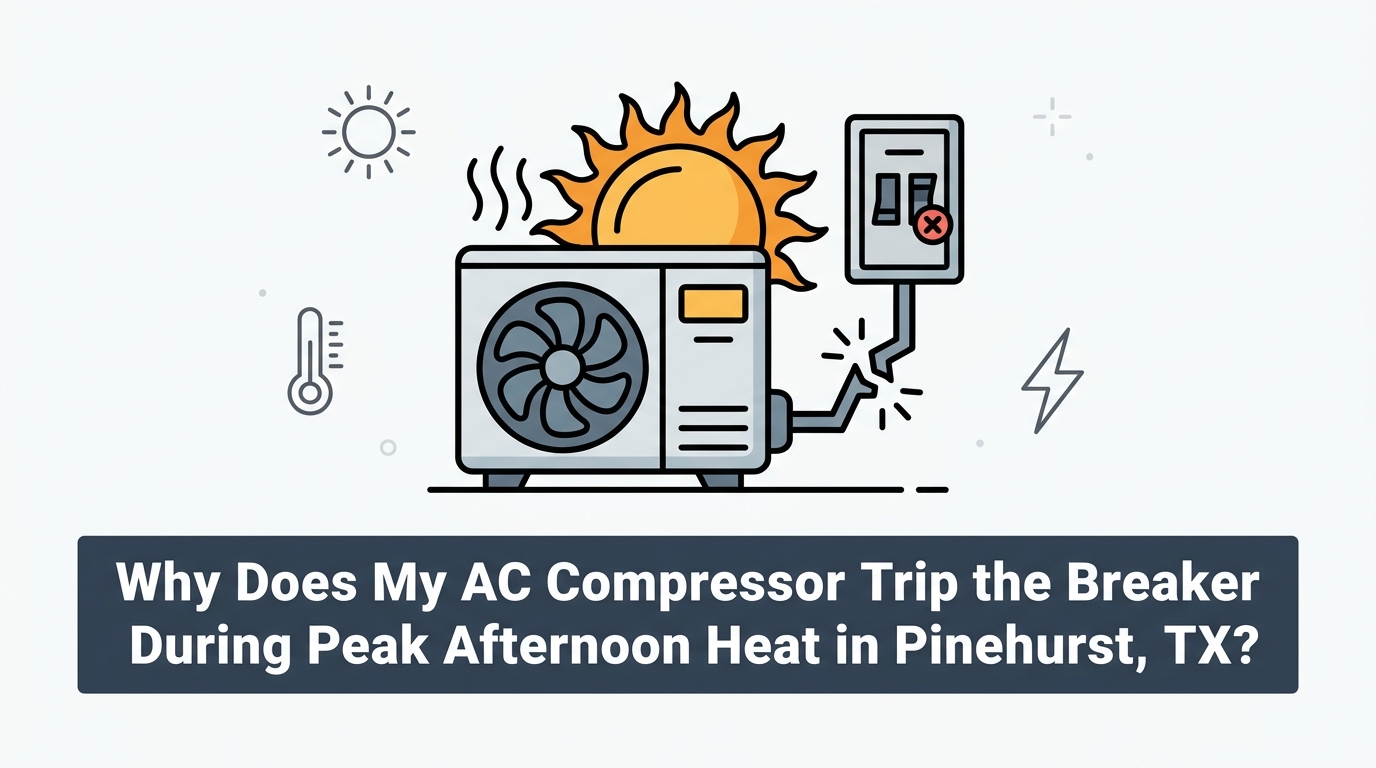
When the intense July sun is beating down on your roof, our dispatchers at Air Comfort Solutions often hear from panicked homeowners who are suddenly wondering why your AC compressor trips the breaker only during afternoon peak heat in Pinehurst. Your vents stop blowing cold air right when you need it most, leaving you sweating in your own living room. You walk out to the garage, open the electrical panel, and see the heavy-duty air conditioning breaker flipped to the middle position. This is the exact moment you face a critical choice. You might feel tempted to just flip the switch back to the "on" position so your family can cool down. However, as our team will quickly tell you, an afternoon-only tripped breaker is never just a random electrical glitch. It is a loud, clear warning sign of extreme thermal stress.
Before you touch that panel, you need to understand what is happening outside at your condenser. In our years of serving the local community, we have seen firsthand how pushing a struggling HVAC system back into operation without addressing the root cause is incredibly dangerous. That specific breaker tripped because your outdoor unit hit a wall. When the Texas summer afternoon peak heat combines with direct sunlight on your equipment, the system draws more power than the wires can safely handle. Resetting the breaker ignores the warning and forces electricity back into a compromised circuit.
Your electrical panel is designed to protect your home from electrical fires. Circuit breakers are not installed to be a nuisance; they are a vital safety mechanism. When an air conditioner is operating normally, it pulls a steady, predictable amount of electricity. When something goes wrong, that electrical demand spikes. The breaker's job is to monitor that demand and instantly cut the power if the current exceeds a safe limit.
Repeatedly resetting a tripped AC breaker forces electricity into a system that has already told you it cannot handle the load. This is a massive safety hazard. Every time you flip that switch back on, you send a massive surge of voltage into the compressor. If the system is suffering from thermal overload causing high amperage draw, that forced reset can permanently weld the internal compressor contacts together. We have watched a simple electrical issue quickly escalate into a destroyed compressor, which often means replacing the entire outdoor unit.
The golden rule of electrical safety we teach our customers: If your breaker trips once, it is a warning. If it trips twice, you are dealing with an electrical emergency that requires professional AC repair.
To understand why resetting the breaker is dangerous, you have to look at how the device actually works. Inside the breaker, there is a specialized mechanism that reacts to heat and magnetic forces generated by electrical current.
• Monitoring amp draw: The breaker constantly measures the amperage (the volume of electricity) flowing through the wires to your air conditioner.
• Detecting dangerous surges: If the compressor pulls 45 amps on a circuit designed for 30 amps, the internal components of the breaker heat up rapidly.
• Breaking the circuit: Before the copper wires inside your walls can melt or catch fire, the breaker snaps open, physically disconnecting the power supply.
Bypassing this defense mechanism puts your home at severe risk. The breaker tripped to save your house, not to inconvenience your afternoon.
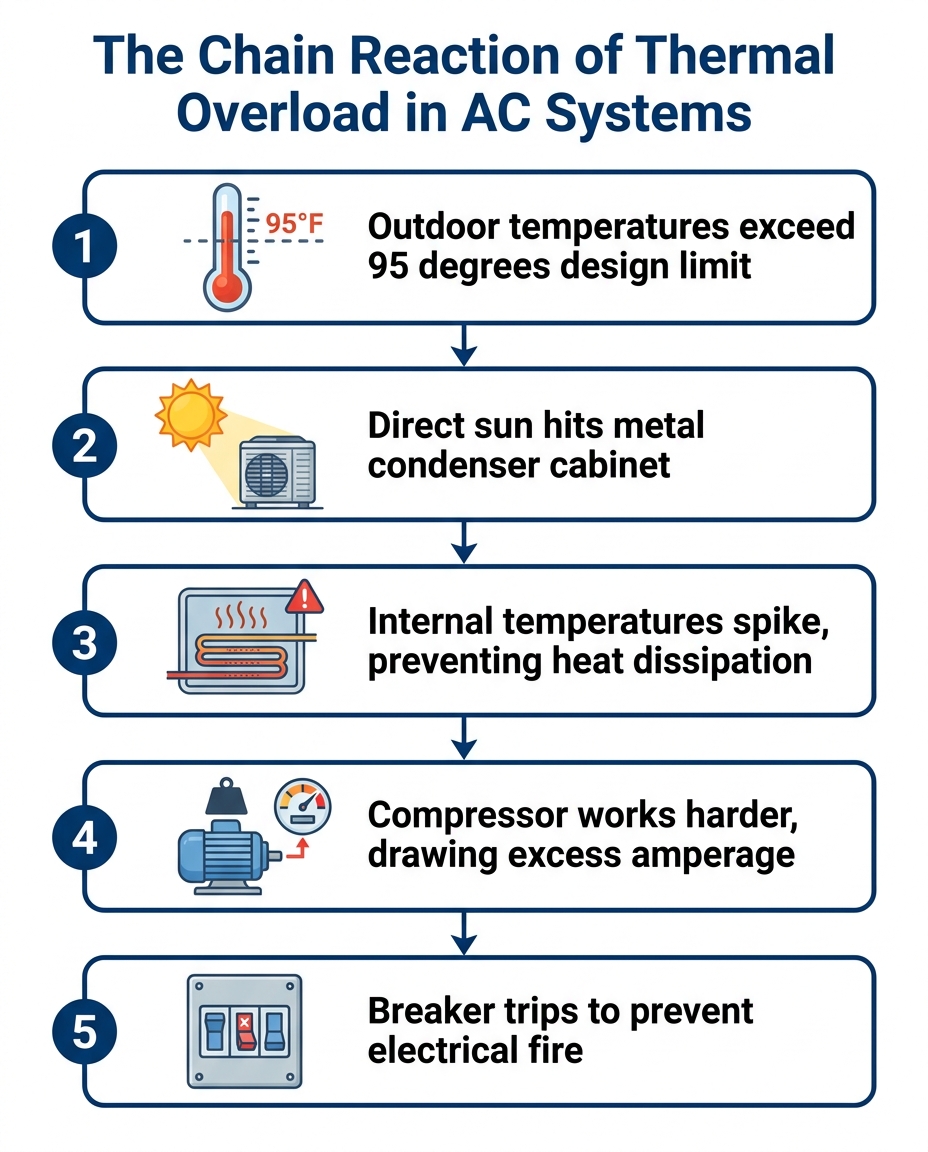
To fix the problem, you have to understand the environment your equipment operates in. Here in Pinehurst, TX, our technicians constantly see the toll of severe summer heatwaves where outdoor temperatures easily push past the 95-degree design limits of standard air conditioners. When the ambient temperature climbs into the triple digits, your outdoor condenser has to work significantly harder to do its job.
Your air conditioner does not actually "make" cold air. Instead, it absorbs heat from inside your home and pumps it outside. The outdoor condenser is responsible for releasing that trapped heat into the outdoor air. When the Texas summer afternoon peak heat hits the metal cabinet of your condenser, the internal operating temperatures skyrocket. If the air outside is hotter than the refrigerant coil inside the unit, the heat cannot transfer effectively. The system essentially chokes on its own heat, leading to a condition called thermal overload.
Heat always moves from a warmer area to a cooler area. This law of thermodynamics is the foundation of air conditioning.
• The indoor process: Warm indoor air blows over a cold evaporator coil. The refrigerant inside the coil absorbs the heat.
• The outdoor process: The heated refrigerant travels to the outdoor condenser. The compressor pressurizes the gas, making it extremely hot—hotter than the outdoor air.
• The heat transfer: The outdoor fan pulls ambient air across the condenser coils, pulling the heat out of the refrigerant and blowing it away.
When direct, intense sunlight bakes the condenser cabinet during the hottest part of the day, that heat transfer process slows down dramatically. The compressor runs longer and harder, trying desperately to push heat into an already boiling environment.
Amp draw is simply a measurement of how much electrical current a motor needs to do its job. When a compressor is struggling against extreme head pressure and thermal overload, it requires more torque to keep pumping refrigerant. To generate that extra torque, the motor pulls more electricity.
As the heat rises, the amp draw rises with it. Eventually, the overworked compressor pulls more electricity than the circuit can safely handle. The breaker detects this dangerous spike and trips to prevent an electrical fire.
While the blistering afternoon sun is the trigger, our repair team typically finds that underlying mechanical degradation is the true root cause of the failure. A brand-new, perfectly clean air conditioner can usually handle a hot afternoon. However, a pattern we see often is that an aging system with worn components will cross the threshold into thermal overload causing high amperage draw much faster.
When you combine extreme heat with neglected maintenance, the electrical load becomes too much for the system to bear. Identifying which specific component is failing requires professional diagnostics, but understanding the common culprits helps you see why the system only fails during the hottest hours.
The run capacitor is one of the most critical components in your outdoor unit. It acts like a powerful battery that stores energy and delivers a continuous electrical boost to keep the compressor motor spinning smoothly.
Capacitors are filled with a specialized fluid that helps them manage heat. Over time, and especially under the brutal Texas sun, this fluid degrades. When a capacitor begins to fail, it loses its ability to deliver that necessary electrical boost. The compressor motor then has to pull extra electricity directly from your home's electrical panel to make up the difference. This causes the amp draw to spike, tripping the breaker.
Your outdoor condenser relies on massive amounts of airflow to stay cool. The metal fins on the outside of the unit are designed to let air pass through easily.
Over the course of a year, those fins get clogged with dirt, pollen, grass clippings, and dust. This layer of grime acts like a heavy insulating blanket wrapped around your air conditioner. Dirty condenser coils can reduce cooling efficiency by up to 30 percent. When you combine suffocated, dirty coils with the afternoon sun, the heat has nowhere to go. The compressor overheats rapidly, the amp draw spikes, and the breaker trips to save the equipment.
• Failing Run Capacitor — How It Reacts to Heat: Fluid degrades faster in high temperatures, reducing stored energy. — Impact on the Compressor: Forces the motor to pull excess amperage from the panel, causing overheating.
• Dirty Condenser Coils — How It Reacts to Heat: Traps heat inside the unit, preventing proper airflow and dissipation. — Impact on the Compressor: Causes extreme thermal overload and high head pressure.
• Worn Motor Bearings — How It Reacts to Heat: Metal expands in the heat, increasing friction on worn parts. — Impact on the Compressor: Motor works harder to spin, leading to high amp draw and breaker trips.
When you are dealing with Texas summer afternoon peak heat and a tripped breaker, your immediate focus should be on safety and damage control. As HVAC professionals, we strongly advise that you cannot fix a thermal overload issue on your own, but you can take steps to protect your equipment while you wait for an Air Comfort Solutions technician to arrive.
Follow these exact steps to secure your system and prevent further damage:
1. Turn the thermostat to the "Off" position: Do this immediately. You must stop the indoor thermostat from calling for cooling. If the breaker is reset while the thermostat is calling for air, the system will immediately try to start under full load, which can cause a massive power surge.
2. Leave the tripped breaker alone: Resist the urge to flip the switch. Leave it exactly where it is. The breaker needs to remain off to protect your home.
3. Safely create shade for the outdoor unit: If your condenser is baking in direct sunlight, you can try to provide temporary shade. Set up a patio umbrella or a canopy near the unit. Crucial warning: Do not drape anything over the unit itself. You must maintain at least three feet of clearance around the top and sides for airflow.
4. Conduct a visual inspection: Walk outside and look at the condenser. Do you see a thick blanket of cottonwood seeds or grass clippings on the coils? Do you smell a burning, electrical odor? Take note of these details to tell your technician, but strongly avoid opening any panels or touching any electrical components.
5. Call for professional help: Review our emergency AC repair tips and contact a licensed technician to diagnose the high amp draw.
Afternoon thermal overload is largely preventable with proper system preparation. You do not have to wait for the hottest day of July to find out if your air conditioner can handle the stress. By shifting from reactive emergency mode to proactive care, you can ensure your system operates safely all summer long.
The key to surviving the summer is maximizing heat dissipation. This starts with a thorough, professional pre-season coil cleaning. When the condenser fins are perfectly clean, the system can release heat efficiently, even when the sun is beating down on the cabinet. A clean system does not have to fight against itself.
Additionally, routine testing of electrical components is mandatory. A technician can test your run capacitor with a multimeter to see exactly how much energy it is storing. If the capacitor is showing signs of weakness, it can be replaced before it damages the compressor. A well-maintained system operates at a lower, safer amperage. We highly recommend enrolling in an AC maintenance plan—it is the absolute best way to catch these underlying mechanical degradations before they cause thermal overload causing high amperage draw.
Your AC breaker keeps tripping in the summer because the system is pulling more electrical current than the circuit can safely handle. Extreme outdoor temperatures force the compressor to work harder to release heat. If the system has dirty coils or a weak capacitor, this added stress causes a massive spike in amp draw, which triggers the breaker to prevent an electrical fire.
Yes, extreme heat is a primary catalyst for tripped breakers. Direct sunlight on a metal condenser cabinet drastically raises the internal operating temperature. This environmental heat prevents the air conditioner from effectively dissipating the heat it pulled from your home, leading to thermal overload and a subsequent surge in electrical demand.
It is generally safe to reset a tripped AC breaker exactly one time to see if it was a temporary power fluctuation. However, if the breaker trips a second time, it is absolutely not safe to turn it back on. Repeatedly resetting the breaker forces electricity into a failing component, which can permanently destroy the compressor or start a fire.
Your AC only trips during the day because that is when the system faces the maximum thermal load. The combination of peak outdoor temperatures and direct solar radiation pushes the equipment past its safe operating limits. At night, the cooler ambient air allows the struggling system to dissipate heat just enough to keep the amp draw below the breaker's tripping point.
An AC compressor draws too many amps when it has to fight against high internal pressure or mechanical resistance. The most common causes are a failing run capacitor that cannot provide enough electrical boost, dirty condenser coils that trap heat, or worn internal motor bearings that create physical friction.
You can protect your condenser by planting shade trees or installing a breathable privacy fence nearby to block direct sunlight. However, you must ensure that any landscaping or fencing is placed at least three feet away from the unit. Never build a tight box or roof directly over the condenser, as this will trap the exhaust heat and make the thermal overload much worse.
An afternoon tripped breaker is a serious warning sign that your cooling system is under immense stress. When the Texas summer afternoon peak heat pushes your equipment to the breaking point, ignoring the problem will only lead to permanent damage. Our technicians have seen it happen time and again: the longer a system runs with thermal overload causing high amperage draw, the closer the compressor gets to total failure.
Professional diagnostics are absolutely required to safely test your system's amp draw, inspect the high-voltage electrical components, and clean the delicate condenser coils. Working with our team at Air Comfort Solutions means you get the fast, reliable expertise needed to handle heatwave-induced AC emergencies right here in our community. If your breaker refuses to stay on during the hottest part of the day, leave the panel alone and let our Pinehurst experts restore your cooling safely and permanently.


Zane came out and did an amazing job! Super friendly, honest and transparent about the work that needed to be done. This is my second time working with Air Comfort Solutions and they’re my go to for HVAC services. Highly recommend.
God's AMAZING grace sent us Robert and Zane. We have been without air in this Texas heat for six weeks and four days. We've had a few contractors give us quotes all trying to upsell when we're at a low point. But not the guys at Air Comfort Solutions. They came in assessed our situation, gave us honest feedback, and showed us the issues as they proceeded with the assessment for clear understanding. We highly recommend them for their professionalism, quality products, and fair pricing. We hands down support them for all the work they do 💯 %.
Robert and Zane gone above and beyond to make the process easy and affordable.
Would definitely recommend!!
I’m writing this review to let everyone know that Air Comfort Solutions is the company to work with. I know the owner ( Robert) for several years now. He has been taking care of my residential and business work orders. Robert is professional, knowledgeable and will save you money. I just want to thank Robert for great job you have been doing for me.