Why Reliable AC Service Matters in Pinehurst, TX
When you need ac repair in pinehurst, tx, you're likely dealing with a system that's stopped cooling, making strange noises, or driving up your energy bills during the hottest months of the year. In a climate where temperatures regularly exceed 90 degrees for extended periods, a functioning air conditioner isn't a luxury—it's essential for your family's comfort and health. This guide helps you understand common AC problems, recognize warning signs before they become expensive emergencies, and choose the right repair service to restore your home's comfort quickly and reliably.
Quick Answer: Top Signs You Need AC Repair in Pinehurst, TX:
• Warm air blowing from your vents instead of cool air
• Weak airflow or inconsistent cooling throughout your home
• Strange noises like grinding, squealing, or banging
• Water leaks around your indoor or outdoor unit
• Frequent cycling on and off without reaching set temperature
• High humidity indoors despite the AC running
• Unpleasant odors when the system operates
For comprehensive guidance on all your HVAC needs, visit our HVAC services page, and if you're ready to schedule a repair, contact our team today.
Whether you're experiencing your first AC breakdown or dealing with an aging system that needs frequent attention, understanding your options helps you make informed decisions. Regular maintenance can prevent many common issues, but when problems do arise, knowing what to look for in a repair service—from proper licensing to transparent pricing and emergency availability—ensures you get quality work that lasts. The average AC system serves your home for 8 to 15 years, but that lifespan depends heavily on proper care and timely repairs when issues emerge.
Recognizing the Warning Signs: When to Call for AC Repair
Imagine this: The Texas sun is beating down, the humidity is thick, and you walk into your Pinehurst home, expecting a blast of cool air, only to be met with... nothing. Or worse, warm air! Recognizing the early warning signs of an ailing air conditioner can save you from a complete system breakdown and potentially costly emergency repairs. In our experience, many homeowners only call us when their AC has completely given up the ghost. But your AC unit often tries to tell you it's struggling long before that final gasp.
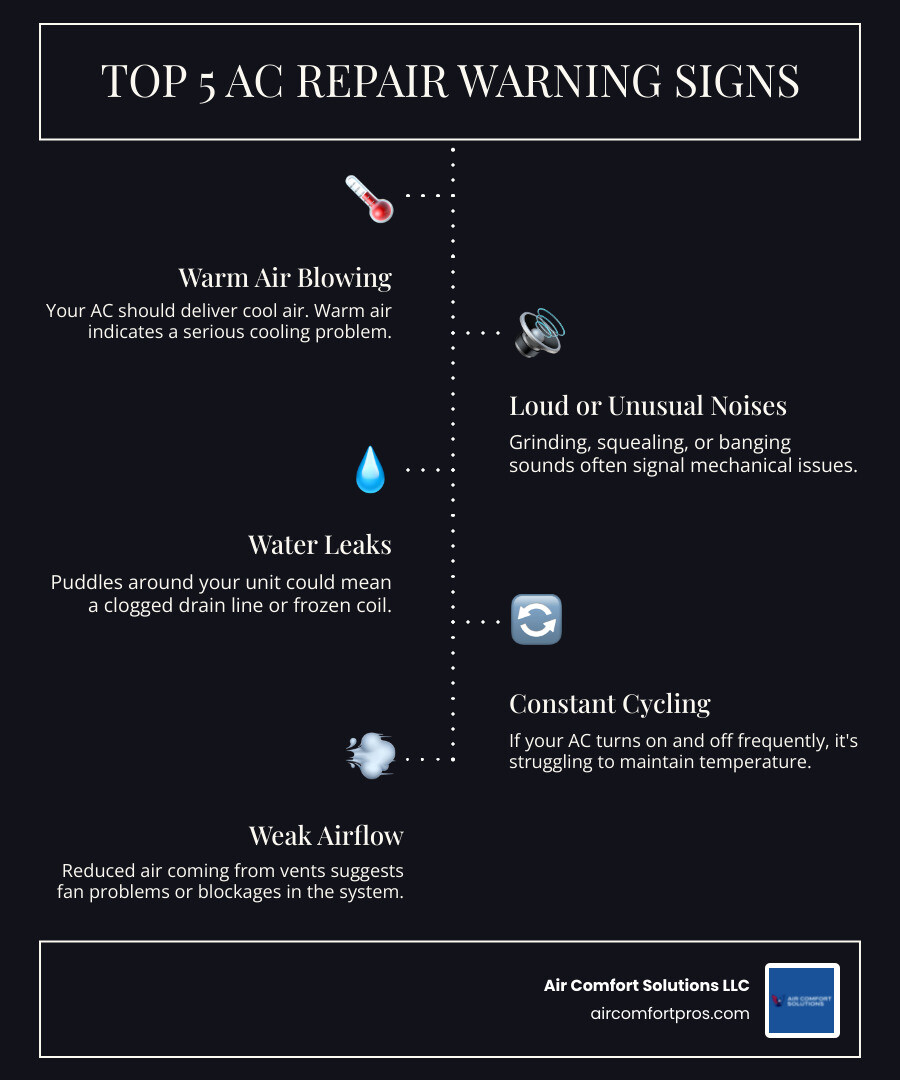
Here are the most common indicators that your AC unit needs professional attention:
• Warm Air from Vents: This is probably the most obvious sign. If your AC is running but the air coming out of the vents isn't cool, it could be due to a variety of issues, such as low refrigerant, a failing compressor, or a blocked condenser unit.
• Weak or No Airflow: Is one room an icebox while another is a sauna? Or is the air barely trickling out of your vents? Weak airflow suggests a problem with your fan, a clogged air filter, or issues within your ductwork. This can lead to inconsistent cooling, making your home feel unevenly comfortable (or uncomfortable!).
• Loud or Unusual Noises: Your AC unit should operate with a relatively consistent hum. If you start hearing grinding, squealing, banging, hissing, or bubbling sounds, it's a definite red flag. Grinding often indicates a problem with motor bearings, squealing could be a worn belt, and hissing might point to a refrigerant leak.
• Unpleasant Odors: A strange smell emanating from your vents is never a good sign. A burning smell could signal an electrical issue, while a musty odor often indicates mold or mildew growth within the unit or ductwork, especially prevalent in humid climates like Pinehurst, TX.
• Constant Cycling (Short-Cycling): If your AC unit is turning on and off frequently without completing a full cooling cycle, it's called short-cycling. This puts immense strain on the system's components, reduces its efficiency, and indicates underlying problems like an oversized unit, a dirty filter, or low refrigerant.
• Water Leaks Near the Unit: While a small amount of condensation is normal, significant puddles or dripping near your indoor or outdoor unit are not. Indoor water leaks are often caused by a clogged condensate drain line, which can lead to water damage and mold growth.
• High Indoor Humidity: Your AC unit doesn't just cool the air; it also removes humidity. If your home feels muggy even when the AC is running, it's a sign your system isn't dehumidifying effectively. This can be caused by an oversized unit, low refrigerant, or other mechanical issues.
Common Culprits Behind AC Malfunctions
When your AC acts up, it's usually one of a few common culprits:
• Refrigerant Leaks: Refrigerant is the lifeblood of your AC system, absorbing heat from your home and releasing it outside. If your unit is low on refrigerant, it likely has a leak. This isn't just about topping it off; the leak needs to be found and repaired, and then the refrigerant recharged by an EPA-certified technician.
• Frozen Evaporator Coils: If you see ice on your indoor coils, it's a clear sign of a problem. Frozen coils typically result from restricted airflow (e.g., a dirty air filter, blocked return vents) or low refrigerant levels. When coils freeze, they can't absorb heat effectively, leading to poor cooling and potential water damage as the ice melts.
• Clogged Condensate Drain: The condensate drain carries away the moisture removed from your home's air. Over time, algae and debris can clog this line, causing water to back up and overflow, often resulting in leaks and potential water damage inside your home.
• Faulty Thermostat: Sometimes, the problem isn't the AC unit itself but its brain—the thermostat. An inaccurate or malfunctioning thermostat can lead to inconsistent temperatures, short-cycling, or the unit not turning on at all. This is often an easier fix than a major mechanical issue.
• Dirty Air Filters: This is perhaps the easiest and most overlooked problem. A clogged air filter restricts airflow, forcing your AC to work harder, reducing efficiency, and potentially leading to frozen coils and system strain. We recommend checking your filter monthly!
Beyond the common culprits, more complex issues can arise from the electrical and mechanical components of your AC system:
• Compressor Failure: The compressor is the heart of your AC, circulating refrigerant and putting it under pressure. If it fails, your AC unit won't cool. This is often one of the most expensive repairs and can sometimes lead to considering a full system replacement.
• Malfunctioning Fan Motor: Both the indoor (blower) and outdoor (condenser) units have fans that move air. If either fan motor fails, airflow will be compromised, leading to poor cooling, overheating, and potential damage to other components.
• Worn Capacitors: Capacitors are electrical components that provide the necessary jolt to start motors (like the compressor and fan motors) and keep them running. If a capacitor fails, your AC unit might hum but not start, or it might struggle to run efficiently.
• Electrical Connection Issues: Loose or corroded wiring and electrical connections can cause your AC unit to malfunction, trip breakers, or even pose a safety hazard. Our certified technicians always inspect these connections during service visits.
The Crucial Role of Preventative AC Maintenance
In Pinehurst, TX, where your AC system works tirelessly for months on end, preventative maintenance isn't just a suggestion—it's a necessity. Think of it like regular oil changes for your car; you wouldn't skip those, especially if you drive in extreme conditions. Your AC operates in extreme conditions for a significant portion of the year.
Maintenance Frequency
For residents in Pinehurst, TX, and surrounding areas like Magnolia, Conroe, and Tomball, we generally recommend scheduling AC maintenance at least twice a year. This allows us to inspect your system before the intense summer heat sets in and again before the cooler months, ensuring it's ready to handle the temperature changes. This proactive approach helps prevent unexpected breakdowns when you need your AC the most.
Key Benefits of a Regular Tune-Up
Investing in regular AC maintenance brings a host of benefits that extend beyond just cooling your home:
• Improved Efficiency: A well-maintained AC unit operates more efficiently, meaning it uses less energy to achieve the desired temperature. Our technicians clean coils, check refrigerant levels, and ensure all components are working optimally to maximize efficiency.
• Lower Energy Consumption: With improved efficiency comes lower energy bills. When your AC unit isn't struggling to cool your home, it consumes less electricity, putting more money back in your pocket. This is a significant advantage in areas where AC units run nonstop for months.
• Extended Equipment Lifespan: An average AC unit is designed to last 8 to 15 years. However, with conscientious maintenance, you could enjoy 15 to 20 years of optimal performance from your system. Regular tune-ups address minor issues before they escalate into major problems, prolonging the life of your unit.
• Warranty Preservation: Many AC manufacturers require proof of annual professional maintenance by a licensed HVAC technician to uphold your warranty. Skipping maintenance could void your coverage, leaving you on the hook for expensive repairs that would otherwise be covered.
• Fewer Breakdowns: The primary goal of preventative maintenance is to catch small issues before they turn into inconvenient and often costly malfunctions. We inspect, clean, and adjust components, reducing the likelihood of unexpected breakdowns, especially during peak season.
• Improved Performance: A tuned-up AC unit cools your home more effectively and consistently, providing superior comfort levels throughout your living space.
• Better Indoor Air Quality: Regular maintenance includes checking and changing air filters, which directly impacts the quality of the air you breathe. We also inspect for potential mold growth and ensure proper ventilation.
• Peace of Mind: Knowing that your AC system has been professionally inspected and is running efficiently gives you one less thing to worry about, allowing you to enjoy your comfortable home without anxiety.
How Maintenance Improves Indoor Air Quality in Pinehurst
In humid climates like Pinehurst, TX, indoor air quality (IAQ) is a significant concern for homeowners. Your AC system plays a vital role in managing IAQ, and regular maintenance is key to keeping it effective.
• Clean Air Filters: The most direct impact on IAQ comes from your air filter. A clean filter traps dust, pollen, pet dander, and other airborne particulates, preventing them from circulating throughout your home and accumulating in your AC system. During maintenance, we ensure your filters are clean or recommend replacements.
• Ductwork Inspection: Leaky or dirty ductwork can introduce dust, allergens, and even mold spores into your conditioned air. Our maintenance checks often include a visual inspection of accessible ductwork to identify potential issues that could affect IAQ.
• Preventing Mold Growth: The humid environment of Pinehurst makes homes susceptible to mold. Your AC unit, particularly the evaporator coil and condensate pan, can become breeding grounds for mold if not properly maintained. Our technicians clean these areas and treat the drain pan for algae, preventing mold development and the musty odors that come with it. Neglecting AC maintenance can significantly increase the risk of mold in your system.
• Air Purification Solutions: Beyond basic maintenance, we can also discuss and install advanced air quality solutions like air purifiers, UV-C lights, humidifiers, and dehumidifiers to further improve your home's IAQ, especially beneficial for those with allergies or respiratory sensitivities.
Your Guide to AC Repair in Pinehurst, TX: Choosing a Trusted Professional
When your AC goes out, choosing the right repair service is paramount. You need a team that understands the unique challenges of the Pinehurst climate and can provide reliable, lasting solutions. At Air Comfort Solutions LLC, we pride ourselves on being that trusted partner for ac repair in pinehurst, tx.
What should you look for when selecting an AC repair service?
• Local Expertise: A company familiar with Pinehurst, TX, and the surrounding communities like Spring, Cypress, and Magnolia, will understand the specific demands placed on AC systems in this climate. Our team has over 35 years of experience serving the north side of Harris County.
• Experience: Longevity in the business often signals reliability and expertise. We've been providing expert HVAC services for decades, handling everything from routine maintenance to complex installations.
• Licensing and Insurance: Always verify that any HVAC contractor you consider is fully licensed and insured. This protects you, the homeowner, from liability and ensures the technicians meet state-mandated standards.
• Customer Reviews: What do other homeowners say? Reviews provide insight into a company's customer service, professionalism, and quality of work. We believe in earning your trust with every service call.
• Emergency Availability: AC breakdowns don't adhere to business hours. For crucial ac repair in pinehurst, tx, look for companies that offer emergency services, so you're not left sweltering for days.
• Commitment to Customer Satisfaction: A reputable company stands behind its work. We are committed to providing honest, reliable solutions and ensuring your complete satisfaction.
Essential Credentials for HVAC Technicians
The quality of your AC repair hinges on the expertise of the technician. Here’s what makes a technician truly qualified:
• State-Required Licensing: In Texas, HVAC technicians and contractors must be licensed by the Texas Department of Licensing and Regulation (TDLR) through their Air Conditioning and Refrigeration program. This ensures they meet specific training and competency standards.
• Industry Certifications: Look for technicians with certifications from recognized industry bodies, such as NATE (North American Technician Excellence) and EPA certifications. NATE-certified technicians have demonstrated a high level of knowledge and skill, while EPA certification is required for handling refrigerants safely and responsibly.
• Affiliation with Professional Organizations: Membership in organizations like the Air Conditioning Contractors of America (ACCA) indicates a commitment to industry best practices and ongoing professional development.
• Background-Checked Technicians: For your peace of mind, ensure the company you choose employs technicians who have undergone thorough background checks. We understand that inviting someone into your home requires trust, and we prioritize your safety and comfort.
What to Expect from a Quality AC Repair in Pinehurst, TX Service
When you call us for ac repair in pinehurst, tx, here's what you can expect from our service:
• 24/7 Emergency Repairs: We know AC emergencies don't wait for convenient times. That's why we offer emergency services to address your urgent cooling needs promptly.
• Upfront Communication: We believe in transparency. Our technicians will clearly explain the problem, outline the repair options, and provide a straightforward explanation before any work begins. You'll understand what's happening every step of the way.
• Comprehensive Diagnostics: We don't just guess. Our experienced technicians use advanced diagnostic tools to accurately identify the root cause of your AC problem, ensuring we fix it right the first time.
• Parts and Labor Warranties: A reputable service provider will offer warranties on both the parts they install and the labor they perform. This gives you confidence in the quality and durability of the repair.
• For any AC repair needs or questions, please don't hesitate to Contact Us. We're here to help keep your Pinehurst home comfortable.
Repair or Replace? A Homeowner's Decision Guide
One of the toughest decisions homeowners face when their AC unit breaks down is whether to repair it or invest in a new system. It's a balance between immediate cost savings and long-term financial and comfort benefits. The average lifespan of an air conditioning system is typically 8 to 15 years, but this can vary based on maintenance, usage, and the quality of the original installation.
To help you make an informed choice, consider these factors:
When to Choose AC Repair
• Unit is Less Than 10 Years Old: If your AC is relatively new, a repair is often the most cost-effective solution. Most major components should still have plenty of life left, and the system is likely still energy-efficient by current standards.
• Minor, Inexpensive Fix: If the problem is something simple like a clogged drain line, a faulty capacitor, or a dirty coil, a repair makes perfect sense. These fixes are usually quick and won't break the bank.
• First-Time Breakdown: If your unit has generally been reliable and this is its first significant issue, a repair is usually the way to go. It's less likely to be a sign of systemic failure.
Indicators It's Time for a New AC Installation
Sometimes, continuing to repair an old, struggling AC unit is like throwing good money after bad. Here are the signs it might be time for a new AC installation:
• System is Over 15 Years Old: As AC units age, their efficiency drops, and parts become harder to find. If your system is approaching or past its 15th birthday, a new, more energy-efficient model will likely save you money in the long run.
• Frequent and Costly Repairs: Are you calling us every summer for another repair? If the cost of repairing your AC unit is approaching 50% of the cost of a new system, it's generally more financially sound to replace it. Continual breakdowns disrupt your comfort and strain your budget.
• Rising Energy Bills: An aging or inefficient AC unit has to work harder to cool your home, leading to significantly higher electricity bills. Modern AC units have much higher SEER (Seasonal Energy Efficiency Ratio) ratings, meaning they use less energy to provide the same amount of cooling. Replacing an old unit can lead to substantial savings on your utility bills.
• Outdated Refrigerant: Many older AC units use R-22 refrigerant, which is being phased out due to environmental concerns. If your R-22 unit has a leak, recharging it can be very expensive, and parts for R-22 systems are becoming scarce. Replacing the unit with one that uses a more environmentally friendly refrigerant is a wise long-term decision.
• Age of Unit — Repair: Less than 10 years old — Replacement: More than 15 years old
• Repair Frequency — Repair: Infrequent or first major issue — Replacement: Frequent, recurring breakdowns
• Cost of Repair — Repair: Minor, less than 50% of new unit cost — Replacement: Significant, approaching 50% or more of new unit cost
• Energy Bills — Repair: Consistent, reasonable — Replacement: Steadily increasing despite normal usage
• Comfort Levels — Repair: Generally good, occasional minor issues — Replacement: Inconsistent cooling, high humidity, noisy operation
• Refrigerant Type — Repair: Uses current, readily available refrigerant — Replacement: Uses R-22 or other phased-out refrigerants
The decision to repair or replace your AC unit depends on your specific situation, budget, and long-term goals for home comfort and energy efficiency. Our experienced technicians can provide an honest assessment of your system and help you weigh the pros and cons of each option.
Frequently Asked Questions about AC Services
We understand that homeowners often have many questions about their AC systems. Here are some of the most common inquiries we receive:
How often should I change my air filter?
The frequency of changing your air filter can vary widely depending on several factors:
• Filter Type Variance: Some basic fiberglass filters might need changing monthly, while pleated filters can last up to three months. High-efficiency particulate air (HEPA) filters might last even longer, though they can restrict airflow if not properly maintained.
• General Recommendation (1-3 Months): For most homes, we recommend checking your air filter monthly and replacing it every one to three months.
• Pet and Allergy Considerations: If you have pets that shed a lot, or if family members suffer from allergies or asthma, you'll likely need to change your filter more frequently—perhaps every 30-45 days—to maintain good indoor air quality.
• Importance for Airflow: A clogged filter is the enemy of efficient cooling. It restricts airflow, making your AC unit work harder, consuming more energy, and potentially leading to frozen evaporator coils and system damage. So, keep an eye on that filter!
What is included in a professional AC maintenance visit?
A professional AC maintenance visit is a comprehensive tune-up designed to optimize your system's performance, prevent breakdowns, and extend its lifespan. While specific tasks can vary slightly, our visits typically include:
• Checking and adjusting blower components: Ensuring proper airflow.
• Verifying refrigerant charge: Checking for leaks and ensuring optimal levels.
• Inspecting voltage and amperage: To detect electrical issues.
• Checking refrigerant lines for leaks: Identifying potential environmental concerns and efficiency drops.
• Measuring proper temperature drop: Confirming effective cooling.
• Calibrating and cleaning the thermostat: Ensuring accurate temperature control.
• Inspecting electrical connections and safety controls: For safety and reliable operation.
• Cleaning the drain lines and pan: Preventing clogs and water damage, and treating for algae.
• Checking starting capacities: Ensuring the unit starts efficiently.
• Inspecting circuit breakers: For safety and preventing electrical overloads.
• Cleaning condenser and evaporator coils: Crucial for heat transfer and efficiency.
• Monitoring outside ambient air: For proper system operation.
• Checking superheat and sub-cooling: Advanced diagnostics for refrigerant performance.
• Assessing air quality and ductwork: Identifying potential IAQ issues.
• Verifying installation measurements: Ensuring the system is correctly sized and installed.
This detailed inspection helps us identify small issues before they become major problems, ensuring your system runs smoothly throughout the year.
Can older AC units still be repaired?
Yes, in many cases, older AC units can still be repaired. We have experience servicing a wide range of systems, including legacy models.
• Servicing Legacy Systems: Our skilled technicians are trained to work on various makes and models, even those that are no longer manufactured. We can often diagnose and repair issues in older units.
• Part Availability: The primary challenge with older units can be the availability of replacement parts, especially for very old or discontinued models. However, we have resources to source parts when possible.
• Honest Advice on Repair vs. Replace: While we can often repair older units, we also provide honest advice on whether a repair is truly in your best interest. If the cost of the repair is high, or if the unit is nearing the end of its lifespan and frequently breaking down, we'll discuss the benefits of replacement, such as improved energy efficiency and reliability. Our goal is to help you make the most cost-effective decision for your home.
For a full list of our offerings, please visit our Services page.
Conclusion: Ensuring Your Comfort in Pinehurst, TX
Living in Pinehurst, TX, means relying heavily on your air conditioning system for comfort and well-being. From recognizing the subtle signs of a struggling unit to understanding the critical role of preventative maintenance, we hope this guide has equipped you with the knowledge to keep your home cool and comfortable. Addressing AC issues promptly, whether it's a strange noise or weak airflow, can save you from more significant problems down the line.
Choosing a trusted, experienced, and licensed professional for your ac repair in pinehurst, tx is paramount. With over 35 years of experience, our team at Air Comfort Solutions LLC provides expert HVAC services, including AC repair, maintenance, and installation, across Pinehurst, Magnolia, Conroe, Tomball, Spring, Cypress, Houston, and the broader north side of Harris County. We're committed to delivering honest, reliable solutions with upfront communication.
Don't let a broken AC ruin your day. For reliable AC Repair Pinehurst, TX, trust our experienced team to keep you cool. We're just a call away, ready to restore comfort to your home.
Why Reliable AC Service Matters in Pinehurst, TX
When you need ac repair in pinehurst, tx, you're likely dealing with a system that's stopped cooling, making strange noises, or driving up your energy bills during the hottest months of the year. In a climate where temperatures regularly exceed 90 degrees for extended periods, a functioning air conditioner isn't a luxury—it's essential for your family's comfort and health. This guide helps you understand common AC problems, recognize warning signs before they become expensive emergencies, and choose the right repair service to restore your home's comfort quickly and reliably.
Quick Answer: Top Signs You Need AC Repair in Pinehurst, TX:
- Warm air blowing from your vents instead of cool air
- Weak airflow or inconsistent cooling throughout your home
- Strange noises like grinding, squealing, or banging
- Water leaks around your indoor or outdoor unit
- Frequent cycling on and off without reaching set temperature
- High humidity indoors despite the AC running
- Unpleasant odors when the system operates
For comprehensive guidance on all your HVAC needs, visit our HVAC services page, and if you're ready to schedule a repair, contact our team today.
Whether you're experiencing your first AC breakdown or dealing with an aging system that needs frequent attention, understanding your options helps you make informed decisions. Regular maintenance can prevent many common issues, but when problems do arise, knowing what to look for in a repair service—from proper licensing to transparent pricing and emergency availability—ensures you get quality work that lasts. The average AC system serves your home for 8 to 15 years, but that lifespan depends heavily on proper care and timely repairs when issues emerge.
Recognizing the Warning Signs: When to Call for AC Repair
Imagine this: The Texas sun is beating down, the humidity is thick, and you walk into your Pinehurst home, expecting a blast of cool air, only to be met with... nothing. Or worse, warm air! Recognizing the early warning signs of an ailing air conditioner can save you from a complete system breakdown and potentially costly emergency repairs. In our experience, many homeowners only call us when their AC has completely given up the ghost. But your AC unit often tries to tell you it's struggling long before that final gasp.
Here are the most common indicators that your AC unit needs professional attention:
- Warm Air from Vents: This is probably the most obvious sign. If your AC is running but the air coming out of the vents isn't cool, it could be due to a variety of issues, such as low refrigerant, a failing compressor, or a blocked condenser unit.
- Weak or No Airflow: Is one room an icebox while another is a sauna? Or is the air barely trickling out of your vents? Weak airflow suggests a problem with your fan, a clogged air filter, or issues within your ductwork. This can lead to inconsistent cooling, making your home feel unevenly comfortable (or uncomfortable!).
- Loud or Unusual Noises: Your AC unit should operate with a relatively consistent hum. If you start hearing grinding, squealing, banging, hissing, or bubbling sounds, it's a definite red flag. Grinding often indicates a problem with motor bearings, squealing could be a worn belt, and hissing might point to a refrigerant leak.
- Unpleasant Odors: A strange smell emanating from your vents is never a good sign. A burning smell could signal an electrical issue, while a musty odor often indicates mold or mildew growth within the unit or ductwork, especially prevalent in humid climates like Pinehurst, TX.
- Constant Cycling (Short-Cycling): If your AC unit is turning on and off frequently without completing a full cooling cycle, it's called short-cycling. This puts immense strain on the system's components, reduces its efficiency, and indicates underlying problems like an oversized unit, a dirty filter, or low refrigerant.
- Water Leaks Near the Unit: While a small amount of condensation is normal, significant puddles or dripping near your indoor or outdoor unit are not. Indoor water leaks are often caused by a clogged condensate drain line, which can lead to water damage and mold growth.
- High Indoor Humidity: Your AC unit doesn't just cool the air; it also removes humidity. If your home feels muggy even when the AC is running, it's a sign your system isn't dehumidifying effectively. This can be caused by an oversized unit, low refrigerant, or other mechanical issues.
Common Culprits Behind AC Malfunctions
When your AC acts up, it's usually one of a few common culprits:
- Refrigerant Leaks: Refrigerant is the lifeblood of your AC system, absorbing heat from your home and releasing it outside. If your unit is low on refrigerant, it likely has a leak. This isn't just about topping it off; the leak needs to be found and repaired, and then the refrigerant recharged by an EPA-certified technician.
- Frozen Evaporator Coils: If you see ice on your indoor coils, it's a clear sign of a problem. Frozen coils typically result from restricted airflow (e.g., a dirty air filter, blocked return vents) or low refrigerant levels. When coils freeze, they can't absorb heat effectively, leading to poor cooling and potential water damage as the ice melts.
- Clogged Condensate Drain: The condensate drain carries away the moisture removed from your home's air. Over time, algae and debris can clog this line, causing water to back up and overflow, often resulting in leaks and potential water damage inside your home.
- Faulty Thermostat: Sometimes, the problem isn't the AC unit itself but its brain—the thermostat. An inaccurate or malfunctioning thermostat can lead to inconsistent temperatures, short-cycling, or the unit not turning on at all. This is often an easier fix than a major mechanical issue.
- Dirty Air Filters: This is perhaps the easiest and most overlooked problem. A clogged air filter restricts airflow, forcing your AC to work harder, reducing efficiency, and potentially leading to frozen coils and system strain. We recommend checking your filter monthly!
Beyond the common culprits, more complex issues can arise from the electrical and mechanical components of your AC system:
- Compressor Failure: The compressor is the heart of your AC, circulating refrigerant and putting it under pressure. If it fails, your AC unit won't cool. This is often one of the most expensive repairs and can sometimes lead to considering a full system replacement.
- Malfunctioning Fan Motor: Both the indoor (blower) and outdoor (condenser) units have fans that move air. If either fan motor fails, airflow will be compromised, leading to poor cooling, overheating, and potential damage to other components.
- Worn Capacitors: Capacitors are electrical components that provide the necessary jolt to start motors (like the compressor and fan motors) and keep them running. If a capacitor fails, your AC unit might hum but not start, or it might struggle to run efficiently.
- Electrical Connection Issues: Loose or corroded wiring and electrical connections can cause your AC unit to malfunction, trip breakers, or even pose a safety hazard. Our certified technicians always inspect these connections during service visits.
The Crucial Role of Preventative AC Maintenance
In Pinehurst, TX, where your AC system works tirelessly for months on end, preventative maintenance isn't just a suggestion—it's a necessity. Think of it like regular oil changes for your car; you wouldn't skip those, especially if you drive in extreme conditions. Your AC operates in extreme conditions for a significant portion of the year.
Maintenance Frequency
For residents in Pinehurst, TX, and surrounding areas like Magnolia, Conroe, and Tomball, we generally recommend scheduling AC maintenance at least twice a year. This allows us to inspect your system before the intense summer heat sets in and again before the cooler months, ensuring it's ready to handle the temperature changes. This proactive approach helps prevent unexpected breakdowns when you need your AC the most.
Key Benefits of a Regular Tune-Up
Investing in regular AC maintenance brings a host of benefits that extend beyond just cooling your home:
- Improved Efficiency: A well-maintained AC unit operates more efficiently, meaning it uses less energy to achieve the desired temperature. Our technicians clean coils, check refrigerant levels, and ensure all components are working optimally to maximize efficiency.
- Lower Energy Consumption: With improved efficiency comes lower energy bills. When your AC unit isn't struggling to cool your home, it consumes less electricity, putting more money back in your pocket. This is a significant advantage in areas where AC units run nonstop for months.
- Extended Equipment Lifespan: An average AC unit is designed to last 8 to 15 years. However, with conscientious maintenance, you could enjoy 15 to 20 years of optimal performance from your system. Regular tune-ups address minor issues before they escalate into major problems, prolonging the life of your unit.
- Warranty Preservation: Many AC manufacturers require proof of annual professional maintenance by a licensed HVAC technician to uphold your warranty. Skipping maintenance could void your coverage, leaving you on the hook for expensive repairs that would otherwise be covered.
- Fewer Breakdowns: The primary goal of preventative maintenance is to catch small issues before they turn into inconvenient and often costly malfunctions. We inspect, clean, and adjust components, reducing the likelihood of unexpected breakdowns, especially during peak season.
- Improved Performance: A tuned-up AC unit cools your home more effectively and consistently, providing superior comfort levels throughout your living space.
- Better Indoor Air Quality: Regular maintenance includes checking and changing air filters, which directly impacts the quality of the air you breathe. We also inspect for potential mold growth and ensure proper ventilation.
- Peace of Mind: Knowing that your AC system has been professionally inspected and is running efficiently gives you one less thing to worry about, allowing you to enjoy your comfortable home without anxiety.
How Maintenance Improves Indoor Air Quality in Pinehurst
In humid climates like Pinehurst, TX, indoor air quality (IAQ) is a significant concern for homeowners. Your AC system plays a vital role in managing IAQ, and regular maintenance is key to keeping it effective.
- Clean Air Filters: The most direct impact on IAQ comes from your air filter. A clean filter traps dust, pollen, pet dander, and other airborne particulates, preventing them from circulating throughout your home and accumulating in your AC system. During maintenance, we ensure your filters are clean or recommend replacements.
- Ductwork Inspection: Leaky or dirty ductwork can introduce dust, allergens, and even mold spores into your conditioned air. Our maintenance checks often include a visual inspection of accessible ductwork to identify potential issues that could affect IAQ.
- Preventing Mold Growth: The humid environment of Pinehurst makes homes susceptible to mold. Your AC unit, particularly the evaporator coil and condensate pan, can become breeding grounds for mold if not properly maintained. Our technicians clean these areas and treat the drain pan for algae, preventing mold development and the musty odors that come with it. Neglecting AC maintenance can significantly increase the risk of mold in your system.
- Air Purification Solutions: Beyond basic maintenance, we can also discuss and install advanced air quality solutions like air purifiers, UV-C lights, humidifiers, and dehumidifiers to further improve your home's IAQ, especially beneficial for those with allergies or respiratory sensitivities.
Your Guide to AC Repair in Pinehurst, TX: Choosing a Trusted Professional
When your AC goes out, choosing the right repair service is paramount. You need a team that understands the unique challenges of the Pinehurst climate and can provide reliable, lasting solutions. At Air Comfort Solutions LLC, we pride ourselves on being that trusted partner for ac repair in pinehurst, tx.
What should you look for when selecting an AC repair service?
- Local Expertise: A company familiar with Pinehurst, TX, and the surrounding communities like Spring, Cypress, and Magnolia, will understand the specific demands placed on AC systems in this climate. Our team has over 35 years of experience serving the north side of Harris County.
- Experience: Longevity in the business often signals reliability and expertise. We've been providing expert HVAC services for decades, handling everything from routine maintenance to complex installations.
- Licensing and Insurance: Always verify that any HVAC contractor you consider is fully licensed and insured. This protects you, the homeowner, from liability and ensures the technicians meet state-mandated standards.
- Customer Reviews: What do other homeowners say? Reviews provide insight into a company's customer service, professionalism, and quality of work. We believe in earning your trust with every service call.
- Emergency Availability: AC breakdowns don't adhere to business hours. For crucial ac repair in pinehurst, tx, look for companies that offer emergency services, so you're not left sweltering for days.
- Commitment to Customer Satisfaction: A reputable company stands behind its work. We are committed to providing honest, reliable solutions and ensuring your complete satisfaction.
Essential Credentials for HVAC Technicians
The quality of your AC repair hinges on the expertise of the technician. Here’s what makes a technician truly qualified:
- State-Required Licensing: In Texas, HVAC technicians and contractors must be licensed by the Texas Department of Licensing and Regulation (TDLR) through their Air Conditioning and Refrigeration program. This ensures they meet specific training and competency standards.
- Industry Certifications: Look for technicians with certifications from recognized industry bodies, such as NATE (North American Technician Excellence) and EPA certifications. NATE-certified technicians have demonstrated a high level of knowledge and skill, while EPA certification is required for handling refrigerants safely and responsibly.
- Affiliation with Professional Organizations: Membership in organizations like the Air Conditioning Contractors of America (ACCA) indicates a commitment to industry best practices and ongoing professional development.
- Background-Checked Technicians: For your peace of mind, ensure the company you choose employs technicians who have undergone thorough background checks. We understand that inviting someone into your home requires trust, and we prioritize your safety and comfort.
What to Expect from a Quality AC Repair in Pinehurst, TX Service
When you call us for ac repair in pinehurst, tx, here's what you can expect from our service:
- 24/7 Emergency Repairs: We know AC emergencies don't wait for convenient times. That's why we offer emergency services to address your urgent cooling needs promptly.
- Upfront Communication: We believe in transparency. Our technicians will clearly explain the problem, outline the repair options, and provide a straightforward explanation before any work begins. You'll understand what's happening every step of the way.
- Comprehensive Diagnostics: We don't just guess. Our experienced technicians use advanced diagnostic tools to accurately identify the root cause of your AC problem, ensuring we fix it right the first time.
- Parts and Labor Warranties: A reputable service provider will offer warranties on both the parts they install and the labor they perform. This gives you confidence in the quality and durability of the repair.
- For any AC repair needs or questions, please don't hesitate to Contact Us. We're here to help keep your Pinehurst home comfortable.
Repair or Replace? A Homeowner's Decision Guide
One of the toughest decisions homeowners face when their AC unit breaks down is whether to repair it or invest in a new system. It's a balance between immediate cost savings and long-term financial and comfort benefits. The average lifespan of an air conditioning system is typically 8 to 15 years, but this can vary based on maintenance, usage, and the quality of the original installation.
To help you make an informed choice, consider these factors:
When to Choose AC Repair
- Unit is Less Than 10 Years Old: If your AC is relatively new, a repair is often the most cost-effective solution. Most major components should still have plenty of life left, and the system is likely still energy-efficient by current standards.
- Minor, Inexpensive Fix: If the problem is something simple like a clogged drain line, a faulty capacitor, or a dirty coil, a repair makes perfect sense. These fixes are usually quick and won't break the bank.
- First-Time Breakdown: If your unit has generally been reliable and this is its first significant issue, a repair is usually the way to go. It's less likely to be a sign of systemic failure.
Indicators It's Time for a New AC Installation
Sometimes, continuing to repair an old, struggling AC unit is like throwing good money after bad. Here are the signs it might be time for a new AC installation:
- System is Over 15 Years Old: As AC units age, their efficiency drops, and parts become harder to find. If your system is approaching or past its 15th birthday, a new, more energy-efficient model will likely save you money in the long run.
- Frequent and Costly Repairs: Are you calling us every summer for another repair? If the cost of repairing your AC unit is approaching 50% of the cost of a new system, it's generally more financially sound to replace it. Continual breakdowns disrupt your comfort and strain your budget.
- Rising Energy Bills: An aging or inefficient AC unit has to work harder to cool your home, leading to significantly higher electricity bills. Modern AC units have much higher SEER (Seasonal Energy Efficiency Ratio) ratings, meaning they use less energy to provide the same amount of cooling. Replacing an old unit can lead to substantial savings on your utility bills.
- Outdated Refrigerant: Many older AC units use R-22 refrigerant, which is being phased out due to environmental concerns. If your R-22 unit has a leak, recharging it can be very expensive, and parts for R-22 systems are becoming scarce. Replacing the unit with one that uses a more environmentally friendly refrigerant is a wise long-term decision.
| Factor | Repair | Replacement |
|---|
| Age of Unit | Less than 10 years old | More than 15 years old |
| Repair Frequency | Infrequent or first major issue | Frequent, recurring breakdowns |
| Cost of Repair | Minor, less than 50% of new unit cost | Significant, approaching 50% or more of new unit cost |
| Energy Bills | Consistent, reasonable | Steadily increasing despite normal usage |
| Comfort Levels | Generally good, occasional minor issues | Inconsistent cooling, high humidity, noisy operation |
| Refrigerant Type | Uses current, readily available refrigerant | Uses R-22 or other phased-out refrigerants |
The decision to repair or replace your AC unit depends on your specific situation, budget, and long-term goals for home comfort and energy efficiency. Our experienced technicians can provide an honest assessment of your system and help you weigh the pros and cons of each option.
Frequently Asked Questions about AC Services
We understand that homeowners often have many questions about their AC systems. Here are some of the most common inquiries we receive:
How often should I change my air filter?
The frequency of changing your air filter can vary widely depending on several factors:
- Filter Type Variance: Some basic fiberglass filters might need changing monthly, while pleated filters can last up to three months. High-efficiency particulate air (HEPA) filters might last even longer, though they can restrict airflow if not properly maintained.
- General Recommendation (1-3 Months): For most homes, we recommend checking your air filter monthly and replacing it every one to three months.
- Pet and Allergy Considerations: If you have pets that shed a lot, or if family members suffer from allergies or asthma, you'll likely need to change your filter more frequently—perhaps every 30-45 days—to maintain good indoor air quality.
- Importance for Airflow: A clogged filter is the enemy of efficient cooling. It restricts airflow, making your AC unit work harder, consuming more energy, and potentially leading to frozen evaporator coils and system damage. So, keep an eye on that filter!
What is included in a professional AC maintenance visit?
A professional AC maintenance visit is a comprehensive tune-up designed to optimize your system's performance, prevent breakdowns, and extend its lifespan. While specific tasks can vary slightly, our visits typically include:
- Checking and adjusting blower components: Ensuring proper airflow.
- Verifying refrigerant charge: Checking for leaks and ensuring optimal levels.
- Inspecting voltage and amperage: To detect electrical issues.
- Checking refrigerant lines for leaks: Identifying potential environmental concerns and efficiency drops.
- Measuring proper temperature drop: Confirming effective cooling.
- Calibrating and cleaning the thermostat: Ensuring accurate temperature control.
- Inspecting electrical connections and safety controls: For safety and reliable operation.
- Cleaning the drain lines and pan: Preventing clogs and water damage, and treating for algae.
- Checking starting capacities: Ensuring the unit starts efficiently.
- Inspecting circuit breakers: For safety and preventing electrical overloads.
- Cleaning condenser and evaporator coils: Crucial for heat transfer and efficiency.
- Monitoring outside ambient air: For proper system operation.
- Checking superheat and sub-cooling: Advanced diagnostics for refrigerant performance.
- Assessing air quality and ductwork: Identifying potential IAQ issues.
- Verifying installation measurements: Ensuring the system is correctly sized and installed.
This detailed inspection helps us identify small issues before they become major problems, ensuring your system runs smoothly throughout the year.
Can older AC units still be repaired?
Yes, in many cases, older AC units can still be repaired. We have experience servicing a wide range of systems, including legacy models.
- Servicing Legacy Systems: Our skilled technicians are trained to work on various makes and models, even those that are no longer manufactured. We can often diagnose and repair issues in older units.
- Part Availability: The primary challenge with older units can be the availability of replacement parts, especially for very old or discontinued models. However, we have resources to source parts when possible.
- Honest Advice on Repair vs. Replace: While we can often repair older units, we also provide honest advice on whether a repair is truly in your best interest. If the cost of the repair is high, or if the unit is nearing the end of its lifespan and frequently breaking down, we'll discuss the benefits of replacement, such as improved energy efficiency and reliability. Our goal is to help you make the most cost-effective decision for your home.
For a full list of our offerings, please visit our Services page.
Conclusion: Ensuring Your Comfort in Pinehurst, TX
Living in Pinehurst, TX, means relying heavily on your air conditioning system for comfort and well-being. From recognizing the subtle signs of a struggling unit to understanding the critical role of preventative maintenance, we hope this guide has equipped you with the knowledge to keep your home cool and comfortable. Addressing AC issues promptly, whether it's a strange noise or weak airflow, can save you from more significant problems down the line.
Choosing a trusted, experienced, and licensed professional for your ac repair in pinehurst, tx is paramount. With over 35 years of experience, our team at Air Comfort Solutions LLC provides expert HVAC services, including AC repair, maintenance, and installation, across Pinehurst, Magnolia, Conroe, Tomball, Spring, Cypress, Houston, and the broader north side of Harris County. We're committed to delivering honest, reliable solutions with upfront communication.
Don't let a broken AC ruin your day. For reliable AC Repair Pinehurst, TX, trust our experienced team to keep you cool. We're just a call away, ready to restore comfort to your home.
Why Reliable AC Service Matters in Pinehurst, TX
When you need ac repair in pinehurst, tx, you're likely dealing with a system that's stopped cooling, making strange noises, or driving up your energy bills during the hottest months of the year. In a climate where temperatures regularly exceed 90 degrees for extended periods, a functioning air conditioner isn't a luxury—it's essential for your family's comfort and health. This guide helps you understand common AC problems, recognize warning signs before they become expensive emergencies, and choose the right repair service to restore your home's comfort quickly and reliably.
Quick Answer: Top Signs You Need AC Repair in Pinehurst, TX:
- Warm air blowing from your vents instead of cool air
- Weak airflow or inconsistent cooling throughout your home
- Strange noises like grinding, squealing, or banging
- Water leaks around your indoor or outdoor unit
- Frequent cycling on and off without reaching set temperature
- High humidity indoors despite the AC running
- Unpleasant odors when the system operates
For comprehensive guidance on all your HVAC needs, visit our HVAC services page, and if you're ready to schedule a repair, contact our team today.
Whether you're experiencing your first AC breakdown or dealing with an aging system that needs frequent attention, understanding your options helps you make informed decisions. Regular maintenance can prevent many common issues, but when problems do arise, knowing what to look for in a repair service—from proper licensing to transparent pricing and emergency availability—ensures you get quality work that lasts. The average AC system serves your home for 8 to 15 years, but that lifespan depends heavily on proper care and timely repairs when issues emerge.
Recognizing the Warning Signs: When to Call for AC Repair
Imagine this: The Texas sun is beating down, the humidity is thick, and you walk into your Pinehurst home, expecting a blast of cool air, only to be met with... nothing. Or worse, warm air! Recognizing the early warning signs of an ailing air conditioner can save you from a complete system breakdown and potentially costly emergency repairs. In our experience, many homeowners only call us when their AC has completely given up the ghost. But your AC unit often tries to tell you it's struggling long before that final gasp.
Here are the most common indicators that your AC unit needs professional attention:
- Warm Air from Vents: This is probably the most obvious sign. If your AC is running but the air coming out of the vents isn't cool, it could be due to a variety of issues, such as low refrigerant, a failing compressor, or a blocked condenser unit.
- Weak or No Airflow: Is one room an icebox while another is a sauna? Or is the air barely trickling out of your vents? Weak airflow suggests a problem with your fan, a clogged air filter, or issues within your ductwork. This can lead to inconsistent cooling, making your home feel unevenly comfortable (or uncomfortable!).
- Loud or Unusual Noises: Your AC unit should operate with a relatively consistent hum. If you start hearing grinding, squealing, banging, hissing, or bubbling sounds, it's a definite red flag. Grinding often indicates a problem with motor bearings, squealing could be a worn belt, and hissing might point to a refrigerant leak.
- Unpleasant Odors: A strange smell emanating from your vents is never a good sign. A burning smell could signal an electrical issue, while a musty odor often indicates mold or mildew growth within the unit or ductwork, especially prevalent in humid climates like Pinehurst, TX.
- Constant Cycling (Short-Cycling): If your AC unit is turning on and off frequently without completing a full cooling cycle, it's called short-cycling. This puts immense strain on the system's components, reduces its efficiency, and indicates underlying problems like an oversized unit, a dirty filter, or low refrigerant.
- Water Leaks Near the Unit: While a small amount of condensation is normal, significant puddles or dripping near your indoor or outdoor unit are not. Indoor water leaks are often caused by a clogged condensate drain line, which can lead to water damage and mold growth.
- High Indoor Humidity: Your AC unit doesn't just cool the air; it also removes humidity. If your home feels muggy even when the AC is running, it's a sign your system isn't dehumidifying effectively. This can be caused by an oversized unit, low refrigerant, or other mechanical issues.
Common Culprits Behind AC Malfunctions
When your AC acts up, it's usually one of a few common culprits:
- Refrigerant Leaks: Refrigerant is the lifeblood of your AC system, absorbing heat from your home and releasing it outside. If your unit is low on refrigerant, it likely has a leak. This isn't just about topping it off; the leak needs to be found and repaired, and then the refrigerant recharged by an EPA-certified technician.
- Frozen Evaporator Coils: If you see ice on your indoor coils, it's a clear sign of a problem. Frozen coils typically result from restricted airflow (e.g., a dirty air filter, blocked return vents) or low refrigerant levels. When coils freeze, they can't absorb heat effectively, leading to poor cooling and potential water damage as the ice melts.
- Clogged Condensate Drain: The condensate drain carries away the moisture removed from your home's air. Over time, algae and debris can clog this line, causing water to back up and overflow, often resulting in leaks and potential water damage inside your home.
- Faulty Thermostat: Sometimes, the problem isn't the AC unit itself but its brain—the thermostat. An inaccurate or malfunctioning thermostat can lead to inconsistent temperatures, short-cycling, or the unit not turning on at all. This is often an easier fix than a major mechanical issue.
- Dirty Air Filters: This is perhaps the easiest and most overlooked problem. A clogged air filter restricts airflow, forcing your AC to work harder, reducing efficiency, and potentially leading to frozen coils and system strain. We recommend checking your filter monthly!
Beyond the common culprits, more complex issues can arise from the electrical and mechanical components of your AC system:
- Compressor Failure: The compressor is the heart of your AC, circulating refrigerant and putting it under pressure. If it fails, your AC unit won't cool. This is often one of the most expensive repairs and can sometimes lead to considering a full system replacement.
- Malfunctioning Fan Motor: Both the indoor (blower) and outdoor (condenser) units have fans that move air. If either fan motor fails, airflow will be compromised, leading to poor cooling, overheating, and potential damage to other components.
- Worn Capacitors: Capacitors are electrical components that provide the necessary jolt to start motors (like the compressor and fan motors) and keep them running. If a capacitor fails, your AC unit might hum but not start, or it might struggle to run efficiently.
- Electrical Connection Issues: Loose or corroded wiring and electrical connections can cause your AC unit to malfunction, trip breakers, or even pose a safety hazard. Our certified technicians always inspect these connections during service visits.
The Crucial Role of Preventative AC Maintenance
In Pinehurst, TX, where your AC system works tirelessly for months on end, preventative maintenance isn't just a suggestion—it's a necessity. Think of it like regular oil changes for your car; you wouldn't skip those, especially if you drive in extreme conditions. Your AC operates in extreme conditions for a significant portion of the year.
Maintenance Frequency
For residents in Pinehurst, TX, and surrounding areas like Magnolia, Conroe, and Tomball, we generally recommend scheduling AC maintenance at least twice a year. This allows us to inspect your system before the intense summer heat sets in and again before the cooler months, ensuring it's ready to handle the temperature changes. This proactive approach helps prevent unexpected breakdowns when you need your AC the most.
Key Benefits of a Regular Tune-Up
Investing in regular AC maintenance brings a host of benefits that extend beyond just cooling your home:
- Improved Efficiency: A well-maintained AC unit operates more efficiently, meaning it uses less energy to achieve the desired temperature. Our technicians clean coils, check refrigerant levels, and ensure all components are working optimally to maximize efficiency.
- Lower Energy Consumption: With improved efficiency comes lower energy bills. When your AC unit isn't struggling to cool your home, it consumes less electricity, putting more money back in your pocket. This is a significant advantage in areas where AC units run nonstop for months.
- Extended Equipment Lifespan: An average AC unit is designed to last 8 to 15 years. However, with conscientious maintenance, you could enjoy 15 to 20 years of optimal performance from your system. Regular tune-ups address minor issues before they escalate into major problems, prolonging the life of your unit.
- Warranty Preservation: Many AC manufacturers require proof of annual professional maintenance by a licensed HVAC technician to uphold your warranty. Skipping maintenance could void your coverage, leaving you on the hook for expensive repairs that would otherwise be covered.
- Fewer Breakdowns: The primary goal of preventative maintenance is to catch small issues before they turn into inconvenient and often costly malfunctions. We inspect, clean, and adjust components, reducing the likelihood of unexpected breakdowns, especially during peak season.
- Improved Performance: A tuned-up AC unit cools your home more effectively and consistently, providing superior comfort levels throughout your living space.
- Better Indoor Air Quality: Regular maintenance includes checking and changing air filters, which directly impacts the quality of the air you breathe. We also inspect for potential mold growth and ensure proper ventilation.
- Peace of Mind: Knowing that your AC system has been professionally inspected and is running efficiently gives you one less thing to worry about, allowing you to enjoy your comfortable home without anxiety.
How Maintenance Improves Indoor Air Quality in Pinehurst
In humid climates like Pinehurst, TX, indoor air quality (IAQ) is a significant concern for homeowners. Your AC system plays a vital role in managing IAQ, and regular maintenance is key to keeping it effective.
- Clean Air Filters: The most direct impact on IAQ comes from your air filter. A clean filter traps dust, pollen, pet dander, and other airborne particulates, preventing them from circulating throughout your home and accumulating in your AC system. During maintenance, we ensure your filters are clean or recommend replacements.
- Ductwork Inspection: Leaky or dirty ductwork can introduce dust, allergens, and even mold spores into your conditioned air. Our maintenance checks often include a visual inspection of accessible ductwork to identify potential issues that could affect IAQ.
- Preventing Mold Growth: The humid environment of Pinehurst makes homes susceptible to mold. Your AC unit, particularly the evaporator coil and condensate pan, can become breeding grounds for mold if not properly maintained. Our technicians clean these areas and treat the drain pan for algae, preventing mold development and the musty odors that come with it. Neglecting AC maintenance can significantly increase the risk of mold in your system.
- Air Purification Solutions: Beyond basic maintenance, we can also discuss and install advanced air quality solutions like air purifiers, UV-C lights, humidifiers, and dehumidifiers to further improve your home's IAQ, especially beneficial for those with allergies or respiratory sensitivities.
Your Guide to AC Repair in Pinehurst, TX: Choosing a Trusted Professional
When your AC goes out, choosing the right repair service is paramount. You need a team that understands the unique challenges of the Pinehurst climate and can provide reliable, lasting solutions. At Air Comfort Solutions LLC, we pride ourselves on being that trusted partner for ac repair in pinehurst, tx.
What should you look for when selecting an AC repair service?
- Local Expertise: A company familiar with Pinehurst, TX, and the surrounding communities like Spring, Cypress, and Magnolia, will understand the specific demands placed on AC systems in this climate. Our team has over 35 years of experience serving the north side of Harris County.
- Experience: Longevity in the business often signals reliability and expertise. We've been providing expert HVAC services for decades, handling everything from routine maintenance to complex installations.
- Licensing and Insurance: Always verify that any HVAC contractor you consider is fully licensed and insured. This protects you, the homeowner, from liability and ensures the technicians meet state-mandated standards.
- Customer Reviews: What do other homeowners say? Reviews provide insight into a company's customer service, professionalism, and quality of work. We believe in earning your trust with every service call.
- Emergency Availability: AC breakdowns don't adhere to business hours. For crucial ac repair in pinehurst, tx, look for companies that offer emergency services, so you're not left sweltering for days.
- Commitment to Customer Satisfaction: A reputable company stands behind its work. We are committed to providing honest, reliable solutions and ensuring your complete satisfaction.
Essential Credentials for HVAC Technicians
The quality of your AC repair hinges on the expertise of the technician. Here’s what makes a technician truly qualified:
- State-Required Licensing: In Texas, HVAC technicians and contractors must be licensed by the Texas Department of Licensing and Regulation (TDLR) through their Air Conditioning and Refrigeration program. This ensures they meet specific training and competency standards.
- Industry Certifications: Look for technicians with certifications from recognized industry bodies, such as NATE (North American Technician Excellence) and EPA certifications. NATE-certified technicians have demonstrated a high level of knowledge and skill, while EPA certification is required for handling refrigerants safely and responsibly.
- Affiliation with Professional Organizations: Membership in organizations like the Air Conditioning Contractors of America (ACCA) indicates a commitment to industry best practices and ongoing professional development.
- Background-Checked Technicians: For your peace of mind, ensure the company you choose employs technicians who have undergone thorough background checks. We understand that inviting someone into your home requires trust, and we prioritize your safety and comfort.
What to Expect from a Quality AC Repair in Pinehurst, TX Service
When you call us for ac repair in pinehurst, tx, here's what you can expect from our service:
- 24/7 Emergency Repairs: We know AC emergencies don't wait for convenient times. That's why we offer emergency services to address your urgent cooling needs promptly.
- Upfront Communication: We believe in transparency. Our technicians will clearly explain the problem, outline the repair options, and provide a straightforward explanation before any work begins. You'll understand what's happening every step of the way.
- Comprehensive Diagnostics: We don't just guess. Our experienced technicians use advanced diagnostic tools to accurately identify the root cause of your AC problem, ensuring we fix it right the first time.
- Parts and Labor Warranties: A reputable service provider will offer warranties on both the parts they install and the labor they perform. This gives you confidence in the quality and durability of the repair.
- For any AC repair needs or questions, please don't hesitate to Contact Us. We're here to help keep your Pinehurst home comfortable.
Repair or Replace? A Homeowner's Decision Guide
One of the toughest decisions homeowners face when their AC unit breaks down is whether to repair it or invest in a new system. It's a balance between immediate cost savings and long-term financial and comfort benefits. The average lifespan of an air conditioning system is typically 8 to 15 years, but this can vary based on maintenance, usage, and the quality of the original installation.
To help you make an informed choice, consider these factors:
When to Choose AC Repair
- Unit is Less Than 10 Years Old: If your AC is relatively new, a repair is often the most cost-effective solution. Most major components should still have plenty of life left, and the system is likely still energy-efficient by current standards.
- Minor, Inexpensive Fix: If the problem is something simple like a clogged drain line, a faulty capacitor, or a dirty coil, a repair makes perfect sense. These fixes are usually quick and won't break the bank.
- First-Time Breakdown: If your unit has generally been reliable and this is its first significant issue, a repair is usually the way to go. It's less likely to be a sign of systemic failure.
Indicators It's Time for a New AC Installation
Sometimes, continuing to repair an old, struggling AC unit is like throwing good money after bad. Here are the signs it might be time for a new AC installation:
- System is Over 15 Years Old: As AC units age, their efficiency drops, and parts become harder to find. If your system is approaching or past its 15th birthday, a new, more energy-efficient model will likely save you money in the long run.
- Frequent and Costly Repairs: Are you calling us every summer for another repair? If the cost of repairing your AC unit is approaching 50% of the cost of a new system, it's generally more financially sound to replace it. Continual breakdowns disrupt your comfort and strain your budget.
- Rising Energy Bills: An aging or inefficient AC unit has to work harder to cool your home, leading to significantly higher electricity bills. Modern AC units have much higher SEER (Seasonal Energy Efficiency Ratio) ratings, meaning they use less energy to provide the same amount of cooling. Replacing an old unit can lead to substantial savings on your utility bills.
- Outdated Refrigerant: Many older AC units use R-22 refrigerant, which is being phased out due to environmental concerns. If your R-22 unit has a leak, recharging it can be very expensive, and parts for R-22 systems are becoming scarce. Replacing the unit with one that uses a more environmentally friendly refrigerant is a wise long-term decision.
| Factor | Repair | Replacement |
|---|
| Age of Unit | Less than 10 years old | More than 15 years old |
| Repair Frequency | Infrequent or first major issue | Frequent, recurring breakdowns |
| Cost of Repair | Minor, less than 50% of new unit cost | Significant, approaching 50% or more of new unit cost |
| Energy Bills | Consistent, reasonable | Steadily increasing despite normal usage |
| Comfort Levels | Generally good, occasional minor issues | Inconsistent cooling, high humidity, noisy operation |
| Refrigerant Type | Uses current, readily available refrigerant | Uses R-22 or other phased-out refrigerants |
The decision to repair or replace your AC unit depends on your specific situation, budget, and long-term goals for home comfort and energy efficiency. Our experienced technicians can provide an honest assessment of your system and help you weigh the pros and cons of each option.
Frequently Asked Questions about AC Services
We understand that homeowners often have many questions about their AC systems. Here are some of the most common inquiries we receive:
How often should I change my air filter?
The frequency of changing your air filter can vary widely depending on several factors:
- Filter Type Variance: Some basic fiberglass filters might need changing monthly, while pleated filters can last up to three months. High-efficiency particulate air (HEPA) filters might last even longer, though they can restrict airflow if not properly maintained.
- General Recommendation (1-3 Months): For most homes, we recommend checking your air filter monthly and replacing it every one to three months.
- Pet and Allergy Considerations: If you have pets that shed a lot, or if family members suffer from allergies or asthma, you'll likely need to change your filter more frequently—perhaps every 30-45 days—to maintain good indoor air quality.
- Importance for Airflow: A clogged filter is the enemy of efficient cooling. It restricts airflow, making your AC unit work harder, consuming more energy, and potentially leading to frozen evaporator coils and system damage. So, keep an eye on that filter!
What is included in a professional AC maintenance visit?
A professional AC maintenance visit is a comprehensive tune-up designed to optimize your system's performance, prevent breakdowns, and extend its lifespan. While specific tasks can vary slightly, our visits typically include:
- Checking and adjusting blower components: Ensuring proper airflow.
- Verifying refrigerant charge: Checking for leaks and ensuring optimal levels.
- Inspecting voltage and amperage: To detect electrical issues.
- Checking refrigerant lines for leaks: Identifying potential environmental concerns and efficiency drops.
- Measuring proper temperature drop: Confirming effective cooling.
- Calibrating and cleaning the thermostat: Ensuring accurate temperature control.
- Inspecting electrical connections and safety controls: For safety and reliable operation.
- Cleaning the drain lines and pan: Preventing clogs and water damage, and treating for algae.
- Checking starting capacities: Ensuring the unit starts efficiently.
- Inspecting circuit breakers: For safety and preventing electrical overloads.
- Cleaning condenser and evaporator coils: Crucial for heat transfer and efficiency.
- Monitoring outside ambient air: For proper system operation.
- Checking superheat and sub-cooling: Advanced diagnostics for refrigerant performance.
- Assessing air quality and ductwork: Identifying potential IAQ issues.
- Verifying installation measurements: Ensuring the system is correctly sized and installed.
This detailed inspection helps us identify small issues before they become major problems, ensuring your system runs smoothly throughout the year.
Can older AC units still be repaired?
Yes, in many cases, older AC units can still be repaired. We have experience servicing a wide range of systems, including legacy models.
- Servicing Legacy Systems: Our skilled technicians are trained to work on various makes and models, even those that are no longer manufactured. We can often diagnose and repair issues in older units.
- Part Availability: The primary challenge with older units can be the availability of replacement parts, especially for very old or discontinued models. However, we have resources to source parts when possible.
- Honest Advice on Repair vs. Replace: While we can often repair older units, we also provide honest advice on whether a repair is truly in your best interest. If the cost of the repair is high, or if the unit is nearing the end of its lifespan and frequently breaking down, we'll discuss the benefits of replacement, such as improved energy efficiency and reliability. Our goal is to help you make the most cost-effective decision for your home.
For a full list of our offerings, please visit our Services page.
Conclusion: Ensuring Your Comfort in Pinehurst, TX
Living in Pinehurst, TX, means relying heavily on your air conditioning system for comfort and well-being. From recognizing the subtle signs of a struggling unit to understanding the critical role of preventative maintenance, we hope this guide has equipped you with the knowledge to keep your home cool and comfortable. Addressing AC issues promptly, whether it's a strange noise or weak airflow, can save you from more significant problems down the line.
Choosing a trusted, experienced, and licensed professional for your ac repair in pinehurst, tx is paramount. With over 35 years of experience, our team at Air Comfort Solutions LLC provides expert HVAC services, including AC repair, maintenance, and installation, across Pinehurst, Magnolia, Conroe, Tomball, Spring, Cypress, Houston, and the broader north side of Harris County. We're committed to delivering honest, reliable solutions with upfront communication.
Don't let a broken AC ruin your day. For reliable AC Repair Pinehurst, TX, trust our experienced team to keep you cool. We're just a call away, ready to restore comfort to your home.
Why Reliable AC Service Matters in Pinehurst, TX
When you need ac repair in pinehurst, tx, you're likely dealing with a system that's stopped cooling, making strange noises, or driving up your energy bills during the hottest months of the year. In a climate where temperatures regularly exceed 90 degrees for extended periods, a functioning air conditioner isn't a luxury—it's essential for your family's comfort and health. This guide helps you understand common AC problems, recognize warning signs before they become expensive emergencies, and choose the right repair service to restore your home's comfort quickly and reliably.
Quick Answer: Top Signs You Need AC Repair in Pinehurst, TX:
- Warm air blowing from your vents instead of cool air
- Weak airflow or inconsistent cooling throughout your home
- Strange noises like grinding, squealing, or banging
- Water leaks around your indoor or outdoor unit
- Frequent cycling on and off without reaching set temperature
- High humidity indoors despite the AC running
- Unpleasant odors when the system operates
For comprehensive guidance on all your HVAC needs, visit our HVAC services page, and if you're ready to schedule a repair, contact our team today.
Whether you're experiencing your first AC breakdown or dealing with an aging system that needs frequent attention, understanding your options helps you make informed decisions. Regular maintenance can prevent many common issues, but when problems do arise, knowing what to look for in a repair service—from proper licensing to transparent pricing and emergency availability—ensures you get quality work that lasts. The average AC system serves your home for 8 to 15 years, but that lifespan depends heavily on proper care and timely repairs when issues emerge.
Recognizing the Warning Signs: When to Call for AC Repair
Imagine this: The Texas sun is beating down, the humidity is thick, and you walk into your Pinehurst home, expecting a blast of cool air, only to be met with... nothing. Or worse, warm air! Recognizing the early warning signs of an ailing air conditioner can save you from a complete system breakdown and potentially costly emergency repairs. In our experience, many homeowners only call us when their AC has completely given up the ghost. But your AC unit often tries to tell you it's struggling long before that final gasp.
Here are the most common indicators that your AC unit needs professional attention:
- Warm Air from Vents: This is probably the most obvious sign. If your AC is running but the air coming out of the vents isn't cool, it could be due to a variety of issues, such as low refrigerant, a failing compressor, or a blocked condenser unit.
- Weak or No Airflow: Is one room an icebox while another is a sauna? Or is the air barely trickling out of your vents? Weak airflow suggests a problem with your fan, a clogged air filter, or issues within your ductwork. This can lead to inconsistent cooling, making your home feel unevenly comfortable (or uncomfortable!).
- Loud or Unusual Noises: Your AC unit should operate with a relatively consistent hum. If you start hearing grinding, squealing, banging, hissing, or bubbling sounds, it's a definite red flag. Grinding often indicates a problem with motor bearings, squealing could be a worn belt, and hissing might point to a refrigerant leak.
- Unpleasant Odors: A strange smell emanating from your vents is never a good sign. A burning smell could signal an electrical issue, while a musty odor often indicates mold or mildew growth within the unit or ductwork, especially prevalent in humid climates like Pinehurst, TX.
- Constant Cycling (Short-Cycling): If your AC unit is turning on and off frequently without completing a full cooling cycle, it's called short-cycling. This puts immense strain on the system's components, reduces its efficiency, and indicates underlying problems like an oversized unit, a dirty filter, or low refrigerant.
- Water Leaks Near the Unit: While a small amount of condensation is normal, significant puddles or dripping near your indoor or outdoor unit are not. Indoor water leaks are often caused by a clogged condensate drain line, which can lead to water damage and mold growth.
- High Indoor Humidity: Your AC unit doesn't just cool the air; it also removes humidity. If your home feels muggy even when the AC is running, it's a sign your system isn't dehumidifying effectively. This can be caused by an oversized unit, low refrigerant, or other mechanical issues.
Common Culprits Behind AC Malfunctions
When your AC acts up, it's usually one of a few common culprits:
- Refrigerant Leaks: Refrigerant is the lifeblood of your AC system, absorbing heat from your home and releasing it outside. If your unit is low on refrigerant, it likely has a leak. This isn't just about topping it off; the leak needs to be found and repaired, and then the refrigerant recharged by an EPA-certified technician.
- Frozen Evaporator Coils: If you see ice on your indoor coils, it's a clear sign of a problem. Frozen coils typically result from restricted airflow (e.g., a dirty air filter, blocked return vents) or low refrigerant levels. When coils freeze, they can't absorb heat effectively, leading to poor cooling and potential water damage as the ice melts.
- Clogged Condensate Drain: The condensate drain carries away the moisture removed from your home's air. Over time, algae and debris can clog this line, causing water to back up and overflow, often resulting in leaks and potential water damage inside your home.
- Faulty Thermostat: Sometimes, the problem isn't the AC unit itself but its brain—the thermostat. An inaccurate or malfunctioning thermostat can lead to inconsistent temperatures, short-cycling, or the unit not turning on at all. This is often an easier fix than a major mechanical issue.
- Dirty Air Filters: This is perhaps the easiest and most overlooked problem. A clogged air filter restricts airflow, forcing your AC to work harder, reducing efficiency, and potentially leading to frozen coils and system strain. We recommend checking your filter monthly!
Beyond the common culprits, more complex issues can arise from the electrical and mechanical components of your AC system:
- Compressor Failure: The compressor is the heart of your AC, circulating refrigerant and putting it under pressure. If it fails, your AC unit won't cool. This is often one of the most expensive repairs and can sometimes lead to considering a full system replacement.
- Malfunctioning Fan Motor: Both the indoor (blower) and outdoor (condenser) units have fans that move air. If either fan motor fails, airflow will be compromised, leading to poor cooling, overheating, and potential damage to other components.
- Worn Capacitors: Capacitors are electrical components that provide the necessary jolt to start motors (like the compressor and fan motors) and keep them running. If a capacitor fails, your AC unit might hum but not start, or it might struggle to run efficiently.
- Electrical Connection Issues: Loose or corroded wiring and electrical connections can cause your AC unit to malfunction, trip breakers, or even pose a safety hazard. Our certified technicians always inspect these connections during service visits.
The Crucial Role of Preventative AC Maintenance
In Pinehurst, TX, where your AC system works tirelessly for months on end, preventative maintenance isn't just a suggestion—it's a necessity. Think of it like regular oil changes for your car; you wouldn't skip those, especially if you drive in extreme conditions. Your AC operates in extreme conditions for a significant portion of the year.
Maintenance Frequency
For residents in Pinehurst, TX, and surrounding areas like Magnolia, Conroe, and Tomball, we generally recommend scheduling AC maintenance at least twice a year. This allows us to inspect your system before the intense summer heat sets in and again before the cooler months, ensuring it's ready to handle the temperature changes. This proactive approach helps prevent unexpected breakdowns when you need your AC the most.
Key Benefits of a Regular Tune-Up
Investing in regular AC maintenance brings a host of benefits that extend beyond just cooling your home:
- Improved Efficiency: A well-maintained AC unit operates more efficiently, meaning it uses less energy to achieve the desired temperature. Our technicians clean coils, check refrigerant levels, and ensure all components are working optimally to maximize efficiency.
- Lower Energy Consumption: With improved efficiency comes lower energy bills. When your AC unit isn't struggling to cool your home, it consumes less electricity, putting more money back in your pocket. This is a significant advantage in areas where AC units run nonstop for months.
- Extended Equipment Lifespan: An average AC unit is designed to last 8 to 15 years. However, with conscientious maintenance, you could enjoy 15 to 20 years of optimal performance from your system. Regular tune-ups address minor issues before they escalate into major problems, prolonging the life of your unit.
- Warranty Preservation: Many AC manufacturers require proof of annual professional maintenance by a licensed HVAC technician to uphold your warranty. Skipping maintenance could void your coverage, leaving you on the hook for expensive repairs that would otherwise be covered.
- Fewer Breakdowns: The primary goal of preventative maintenance is to catch small issues before they turn into inconvenient and often costly malfunctions. We inspect, clean, and adjust components, reducing the likelihood of unexpected breakdowns, especially during peak season.
- Improved Performance: A tuned-up AC unit cools your home more effectively and consistently, providing superior comfort levels throughout your living space.
- Better Indoor Air Quality: Regular maintenance includes checking and changing air filters, which directly impacts the quality of the air you breathe. We also inspect for potential mold growth and ensure proper ventilation.
- Peace of Mind: Knowing that your AC system has been professionally inspected and is running efficiently gives you one less thing to worry about, allowing you to enjoy your comfortable home without anxiety.
How Maintenance Improves Indoor Air Quality in Pinehurst
In humid climates like Pinehurst, TX, indoor air quality (IAQ) is a significant concern for homeowners. Your AC system plays a vital role in managing IAQ, and regular maintenance is key to keeping it effective.
- Clean Air Filters: The most direct impact on IAQ comes from your air filter. A clean filter traps dust, pollen, pet dander, and other airborne particulates, preventing them from circulating throughout your home and accumulating in your AC system. During maintenance, we ensure your filters are clean or recommend replacements.
- Ductwork Inspection: Leaky or dirty ductwork can introduce dust, allergens, and even mold spores into your conditioned air. Our maintenance checks often include a visual inspection of accessible ductwork to identify potential issues that could affect IAQ.
- Preventing Mold Growth: The humid environment of Pinehurst makes homes susceptible to mold. Your AC unit, particularly the evaporator coil and condensate pan, can become breeding grounds for mold if not properly maintained. Our technicians clean these areas and treat the drain pan for algae, preventing mold development and the musty odors that come with it. Neglecting AC maintenance can significantly increase the risk of mold in your system.
- Air Purification Solutions: Beyond basic maintenance, we can also discuss and install advanced air quality solutions like air purifiers, UV-C lights, humidifiers, and dehumidifiers to further improve your home's IAQ, especially beneficial for those with allergies or respiratory sensitivities.
Your Guide to AC Repair in Pinehurst, TX: Choosing a Trusted Professional
When your AC goes out, choosing the right repair service is paramount. You need a team that understands the unique challenges of the Pinehurst climate and can provide reliable, lasting solutions. At Air Comfort Solutions LLC, we pride ourselves on being that trusted partner for ac repair in pinehurst, tx.
What should you look for when selecting an AC repair service?
- Local Expertise: A company familiar with Pinehurst, TX, and the surrounding communities like Spring, Cypress, and Magnolia, will understand the specific demands placed on AC systems in this climate. Our team has over 35 years of experience serving the north side of Harris County.
- Experience: Longevity in the business often signals reliability and expertise. We've been providing expert HVAC services for decades, handling everything from routine maintenance to complex installations.
- Licensing and Insurance: Always verify that any HVAC contractor you consider is fully licensed and insured. This protects you, the homeowner, from liability and ensures the technicians meet state-mandated standards.
- Customer Reviews: What do other homeowners say? Reviews provide insight into a company's customer service, professionalism, and quality of work. We believe in earning your trust with every service call.
- Emergency Availability: AC breakdowns don't adhere to business hours. For crucial ac repair in pinehurst, tx, look for companies that offer emergency services, so you're not left sweltering for days.
- Commitment to Customer Satisfaction: A reputable company stands behind its work. We are committed to providing honest, reliable solutions and ensuring your complete satisfaction.
Essential Credentials for HVAC Technicians
The quality of your AC repair hinges on the expertise of the technician. Here’s what makes a technician truly qualified:
- State-Required Licensing: In Texas, HVAC technicians and contractors must be licensed by the Texas Department of Licensing and Regulation (TDLR) through their Air Conditioning and Refrigeration program. This ensures they meet specific training and competency standards.
- Industry Certifications: Look for technicians with certifications from recognized industry bodies, such as NATE (North American Technician Excellence) and EPA certifications. NATE-certified technicians have demonstrated a high level of knowledge and skill, while EPA certification is required for handling refrigerants safely and responsibly.
- Affiliation with Professional Organizations: Membership in organizations like the Air Conditioning Contractors of America (ACCA) indicates a commitment to industry best practices and ongoing professional development.
- Background-Checked Technicians: For your peace of mind, ensure the company you choose employs technicians who have undergone thorough background checks. We understand that inviting someone into your home requires trust, and we prioritize your safety and comfort.
What to Expect from a Quality AC Repair in Pinehurst, TX Service
When you call us for ac repair in pinehurst, tx, here's what you can expect from our service:
- 24/7 Emergency Repairs: We know AC emergencies don't wait for convenient times. That's why we offer emergency services to address your urgent cooling needs promptly.
- Upfront Communication: We believe in transparency. Our technicians will clearly explain the problem, outline the repair options, and provide a straightforward explanation before any work begins. You'll understand what's happening every step of the way.
- Comprehensive Diagnostics: We don't just guess. Our experienced technicians use advanced diagnostic tools to accurately identify the root cause of your AC problem, ensuring we fix it right the first time.
- Parts and Labor Warranties: A reputable service provider will offer warranties on both the parts they install and the labor they perform. This gives you confidence in the quality and durability of the repair.
- For any AC repair needs or questions, please don't hesitate to Contact Us. We're here to help keep your Pinehurst home comfortable.
Repair or Replace? A Homeowner's Decision Guide
One of the toughest decisions homeowners face when their AC unit breaks down is whether to repair it or invest in a new system. It's a balance between immediate cost savings and long-term financial and comfort benefits. The average lifespan of an air conditioning system is typically 8 to 15 years, but this can vary based on maintenance, usage, and the quality of the original installation.
To help you make an informed choice, consider these factors:
When to Choose AC Repair
- Unit is Less Than 10 Years Old: If your AC is relatively new, a repair is often the most cost-effective solution. Most major components should still have plenty of life left, and the system is likely still energy-efficient by current standards.
- Minor, Inexpensive Fix: If the problem is something simple like a clogged drain line, a faulty capacitor, or a dirty coil, a repair makes perfect sense. These fixes are usually quick and won't break the bank.
- First-Time Breakdown: If your unit has generally been reliable and this is its first significant issue, a repair is usually the way to go. It's less likely to be a sign of systemic failure.
Indicators It's Time for a New AC Installation
Sometimes, continuing to repair an old, struggling AC unit is like throwing good money after bad. Here are the signs it might be time for a new AC installation:
- System is Over 15 Years Old: As AC units age, their efficiency drops, and parts become harder to find. If your system is approaching or past its 15th birthday, a new, more energy-efficient model will likely save you money in the long run.
- Frequent and Costly Repairs: Are you calling us every summer for another repair? If the cost of repairing your AC unit is approaching 50% of the cost of a new system, it's generally more financially sound to replace it. Continual breakdowns disrupt your comfort and strain your budget.
- Rising Energy Bills: An aging or inefficient AC unit has to work harder to cool your home, leading to significantly higher electricity bills. Modern AC units have much higher SEER (Seasonal Energy Efficiency Ratio) ratings, meaning they use less energy to provide the same amount of cooling. Replacing an old unit can lead to substantial savings on your utility bills.
- Outdated Refrigerant: Many older AC units use R-22 refrigerant, which is being phased out due to environmental concerns. If your R-22 unit has a leak, recharging it can be very expensive, and parts for R-22 systems are becoming scarce. Replacing the unit with one that uses a more environmentally friendly refrigerant is a wise long-term decision.
| Factor | Repair | Replacement |
|---|
| Age of Unit | Less than 10 years old | More than 15 years old |
| Repair Frequency | Infrequent or first major issue | Frequent, recurring breakdowns |
| Cost of Repair | Minor, less than 50% of new unit cost | Significant, approaching 50% or more of new unit cost |
| Energy Bills | Consistent, reasonable | Steadily increasing despite normal usage |
| Comfort Levels | Generally good, occasional minor issues | Inconsistent cooling, high humidity, noisy operation |
| Refrigerant Type | Uses current, readily available refrigerant | Uses R-22 or other phased-out refrigerants |
The decision to repair or replace your AC unit depends on your specific situation, budget, and long-term goals for home comfort and energy efficiency. Our experienced technicians can provide an honest assessment of your system and help you weigh the pros and cons of each option.
Frequently Asked Questions about AC Services
We understand that homeowners often have many questions about their AC systems. Here are some of the most common inquiries we receive:
How often should I change my air filter?
The frequency of changing your air filter can vary widely depending on several factors:
- Filter Type Variance: Some basic fiberglass filters might need changing monthly, while pleated filters can last up to three months. High-efficiency particulate air (HEPA) filters might last even longer, though they can restrict airflow if not properly maintained.
- General Recommendation (1-3 Months): For most homes, we recommend checking your air filter monthly and replacing it every one to three months.
- Pet and Allergy Considerations: If you have pets that shed a lot, or if family members suffer from allergies or asthma, you'll likely need to change your filter more frequently—perhaps every 30-45 days—to maintain good indoor air quality.
- Importance for Airflow: A clogged filter is the enemy of efficient cooling. It restricts airflow, making your AC unit work harder, consuming more energy, and potentially leading to frozen evaporator coils and system damage. So, keep an eye on that filter!
What is included in a professional AC maintenance visit?
A professional AC maintenance visit is a comprehensive tune-up designed to optimize your system's performance, prevent breakdowns, and extend its lifespan. While specific tasks can vary slightly, our visits typically include:
- Checking and adjusting blower components: Ensuring proper airflow.
- Verifying refrigerant charge: Checking for leaks and ensuring optimal levels.
- Inspecting voltage and amperage: To detect electrical issues.
- Checking refrigerant lines for leaks: Identifying potential environmental concerns and efficiency drops.
- Measuring proper temperature drop: Confirming effective cooling.
- Calibrating and cleaning the thermostat: Ensuring accurate temperature control.
- Inspecting electrical connections and safety controls: For safety and reliable operation.
- Cleaning the drain lines and pan: Preventing clogs and water damage, and treating for algae.
- Checking starting capacities: Ensuring the unit starts efficiently.
- Inspecting circuit breakers: For safety and preventing electrical overloads.
- Cleaning condenser and evaporator coils: Crucial for heat transfer and efficiency.
- Monitoring outside ambient air: For proper system operation.
- Checking superheat and sub-cooling: Advanced diagnostics for refrigerant performance.
- Assessing air quality and ductwork: Identifying potential IAQ issues.
- Verifying installation measurements: Ensuring the system is correctly sized and installed.
This detailed inspection helps us identify small issues before they become major problems, ensuring your system runs smoothly throughout the year.
Can older AC units still be repaired?
Yes, in many cases, older AC units can still be repaired. We have experience servicing a wide range of systems, including legacy models.
- Servicing Legacy Systems: Our skilled technicians are trained to work on various makes and models, even those that are no longer manufactured. We can often diagnose and repair issues in older units.
- Part Availability: The primary challenge with older units can be the availability of replacement parts, especially for very old or discontinued models. However, we have resources to source parts when possible.
- Honest Advice on Repair vs. Replace: While we can often repair older units, we also provide honest advice on whether a repair is truly in your best interest. If the cost of the repair is high, or if the unit is nearing the end of its lifespan and frequently breaking down, we'll discuss the benefits of replacement, such as improved energy efficiency and reliability. Our goal is to help you make the most cost-effective decision for your home.
For a full list of our offerings, please visit our Services page.
Conclusion: Ensuring Your Comfort in Pinehurst, TX
Living in Pinehurst, TX, means relying heavily on your air conditioning system for comfort and well-being. From recognizing the subtle signs of a struggling unit to understanding the critical role of preventative maintenance, we hope this guide has equipped you with the knowledge to keep your home cool and comfortable. Addressing AC issues promptly, whether it's a strange noise or weak airflow, can save you from more significant problems down the line.
Choosing a trusted, experienced, and licensed professional for your ac repair in pinehurst, tx is paramount. With over 35 years of experience, our team at Air Comfort Solutions LLC provides expert HVAC services, including AC repair, maintenance, and installation, across Pinehurst, Magnolia, Conroe, Tomball, Spring, Cypress, Houston, and the broader north side of Harris County. We're committed to delivering honest, reliable solutions with upfront communication.
Don't let a broken AC ruin your day. For reliable AC Repair Pinehurst, TX, trust our experienced team to keep you cool. We're just a call away, ready to restore comfort to your home.
Why Reliable AC Service Matters in Pinehurst, TX
When you need ac repair in pinehurst, tx, you're likely dealing with a system that's stopped cooling, making strange noises, or driving up your energy bills during the hottest months of the year. In a climate where temperatures regularly exceed 90 degrees for extended periods, a functioning air conditioner isn't a luxury—it's essential for your family's comfort and health. This guide helps you understand common AC problems, recognize warning signs before they become expensive emergencies, and choose the right repair service to restore your home's comfort quickly and reliably.
Quick Answer: Top Signs You Need AC Repair in Pinehurst, TX:
- Warm air blowing from your vents instead of cool air
- Weak airflow or inconsistent cooling throughout your home
- Strange noises like grinding, squealing, or banging
- Water leaks around your indoor or outdoor unit
- Frequent cycling on and off without reaching set temperature
- High humidity indoors despite the AC running
- Unpleasant odors when the system operates
For comprehensive guidance on all your HVAC needs, visit our HVAC services page, and if you're ready to schedule a repair, contact our team today.
Whether you're experiencing your first AC breakdown or dealing with an aging system that needs frequent attention, understanding your options helps you make informed decisions. Regular maintenance can prevent many common issues, but when problems do arise, knowing what to look for in a repair service—from proper licensing to transparent pricing and emergency availability—ensures you get quality work that lasts. The average AC system serves your home for 8 to 15 years, but that lifespan depends heavily on proper care and timely repairs when issues emerge.
Recognizing the Warning Signs: When to Call for AC Repair
Imagine this: The Texas sun is beating down, the humidity is thick, and you walk into your Pinehurst home, expecting a blast of cool air, only to be met with... nothing. Or worse, warm air! Recognizing the early warning signs of an ailing air conditioner can save you from a complete system breakdown and potentially costly emergency repairs. In our experience, many homeowners only call us when their AC has completely given up the ghost. But your AC unit often tries to tell you it's struggling long before that final gasp.
Here are the most common indicators that your AC unit needs professional attention:
- Warm Air from Vents: This is probably the most obvious sign. If your AC is running but the air coming out of the vents isn't cool, it could be due to a variety of issues, such as low refrigerant, a failing compressor, or a blocked condenser unit.
- Weak or No Airflow: Is one room an icebox while another is a sauna? Or is the air barely trickling out of your vents? Weak airflow suggests a problem with your fan, a clogged air filter, or issues within your ductwork. This can lead to inconsistent cooling, making your home feel unevenly comfortable (or uncomfortable!).
- Loud or Unusual Noises: Your AC unit should operate with a relatively consistent hum. If you start hearing grinding, squealing, banging, hissing, or bubbling sounds, it's a definite red flag. Grinding often indicates a problem with motor bearings, squealing could be a worn belt, and hissing might point to a refrigerant leak.
- Unpleasant Odors: A strange smell emanating from your vents is never a good sign. A burning smell could signal an electrical issue, while a musty odor often indicates mold or mildew growth within the unit or ductwork, especially prevalent in humid climates like Pinehurst, TX.
- Constant Cycling (Short-Cycling): If your AC unit is turning on and off frequently without completing a full cooling cycle, it's called short-cycling. This puts immense strain on the system's components, reduces its efficiency, and indicates underlying problems like an oversized unit, a dirty filter, or low refrigerant.
- Water Leaks Near the Unit: While a small amount of condensation is normal, significant puddles or dripping near your indoor or outdoor unit are not. Indoor water leaks are often caused by a clogged condensate drain line, which can lead to water damage and mold growth.
- High Indoor Humidity: Your AC unit doesn't just cool the air; it also removes humidity. If your home feels muggy even when the AC is running, it's a sign your system isn't dehumidifying effectively. This can be caused by an oversized unit, low refrigerant, or other mechanical issues.
Common Culprits Behind AC Malfunctions
When your AC acts up, it's usually one of a few common culprits:
- Refrigerant Leaks: Refrigerant is the lifeblood of your AC system, absorbing heat from your home and releasing it outside. If your unit is low on refrigerant, it likely has a leak. This isn't just about topping it off; the leak needs to be found and repaired, and then the refrigerant recharged by an EPA-certified technician.
- Frozen Evaporator Coils: If you see ice on your indoor coils, it's a clear sign of a problem. Frozen coils typically result from restricted airflow (e.g., a dirty air filter, blocked return vents) or low refrigerant levels. When coils freeze, they can't absorb heat effectively, leading to poor cooling and potential water damage as the ice melts.
- Clogged Condensate Drain: The condensate drain carries away the moisture removed from your home's air. Over time, algae and debris can clog this line, causing water to back up and overflow, often resulting in leaks and potential water damage inside your home.
- Faulty Thermostat: Sometimes, the problem isn't the AC unit itself but its brain—the thermostat. An inaccurate or malfunctioning thermostat can lead to inconsistent temperatures, short-cycling, or the unit not turning on at all. This is often an easier fix than a major mechanical issue.
- Dirty Air Filters: This is perhaps the easiest and most overlooked problem. A clogged air filter restricts airflow, forcing your AC to work harder, reducing efficiency, and potentially leading to frozen coils and system strain. We recommend checking your filter monthly!
Beyond the common culprits, more complex issues can arise from the electrical and mechanical components of your AC system:
- Compressor Failure: The compressor is the heart of your AC, circulating refrigerant and putting it under pressure. If it fails, your AC unit won't cool. This is often one of the most expensive repairs and can sometimes lead to considering a full system replacement.
- Malfunctioning Fan Motor: Both the indoor (blower) and outdoor (condenser) units have fans that move air. If either fan motor fails, airflow will be compromised, leading to poor cooling, overheating, and potential damage to other components.
- Worn Capacitors: Capacitors are electrical components that provide the necessary jolt to start motors (like the compressor and fan motors) and keep them running. If a capacitor fails, your AC unit might hum but not start, or it might struggle to run efficiently.
- Electrical Connection Issues: Loose or corroded wiring and electrical connections can cause your AC unit to malfunction, trip breakers, or even pose a safety hazard. Our certified technicians always inspect these connections during service visits.
The Crucial Role of Preventative AC Maintenance
In Pinehurst, TX, where your AC system works tirelessly for months on end, preventative maintenance isn't just a suggestion—it's a necessity. Think of it like regular oil changes for your car; you wouldn't skip those, especially if you drive in extreme conditions. Your AC operates in extreme conditions for a significant portion of the year.
Maintenance Frequency
For residents in Pinehurst, TX, and surrounding areas like Magnolia, Conroe, and Tomball, we generally recommend scheduling AC maintenance at least twice a year. This allows us to inspect your system before the intense summer heat sets in and again before the cooler months, ensuring it's ready to handle the temperature changes. This proactive approach helps prevent unexpected breakdowns when you need your AC the most.
Key Benefits of a Regular Tune-Up
Investing in regular AC maintenance brings a host of benefits that extend beyond just cooling your home:
- Improved Efficiency: A well-maintained AC unit operates more efficiently, meaning it uses less energy to achieve the desired temperature. Our technicians clean coils, check refrigerant levels, and ensure all components are working optimally to maximize efficiency.
- Lower Energy Consumption: With improved efficiency comes lower energy bills. When your AC unit isn't struggling to cool your home, it consumes less electricity, putting more money back in your pocket. This is a significant advantage in areas where AC units run nonstop for months.
- Extended Equipment Lifespan: An average AC unit is designed to last 8 to 15 years. However, with conscientious maintenance, you could enjoy 15 to 20 years of optimal performance from your system. Regular tune-ups address minor issues before they escalate into major problems, prolonging the life of your unit.
- Warranty Preservation: Many AC manufacturers require proof of annual professional maintenance by a licensed HVAC technician to uphold your warranty. Skipping maintenance could void your coverage, leaving you on the hook for expensive repairs that would otherwise be covered.
- Fewer Breakdowns: The primary goal of preventative maintenance is to catch small issues before they turn into inconvenient and often costly malfunctions. We inspect, clean, and adjust components, reducing the likelihood of unexpected breakdowns, especially during peak season.
- Improved Performance: A tuned-up AC unit cools your home more effectively and consistently, providing superior comfort levels throughout your living space.
- Better Indoor Air Quality: Regular maintenance includes checking and changing air filters, which directly impacts the quality of the air you breathe. We also inspect for potential mold growth and ensure proper ventilation.
- Peace of Mind: Knowing that your AC system has been professionally inspected and is running efficiently gives you one less thing to worry about, allowing you to enjoy your comfortable home without anxiety.
How Maintenance Improves Indoor Air Quality in Pinehurst
In humid climates like Pinehurst, TX, indoor air quality (IAQ) is a significant concern for homeowners. Your AC system plays a vital role in managing IAQ, and regular maintenance is key to keeping it effective.
- Clean Air Filters: The most direct impact on IAQ comes from your air filter. A clean filter traps dust, pollen, pet dander, and other airborne particulates, preventing them from circulating throughout your home and accumulating in your AC system. During maintenance, we ensure your filters are clean or recommend replacements.
- Ductwork Inspection: Leaky or dirty ductwork can introduce dust, allergens, and even mold spores into your conditioned air. Our maintenance checks often include a visual inspection of accessible ductwork to identify potential issues that could affect IAQ.
- Preventing Mold Growth: The humid environment of Pinehurst makes homes susceptible to mold. Your AC unit, particularly the evaporator coil and condensate pan, can become breeding grounds for mold if not properly maintained. Our technicians clean these areas and treat the drain pan for algae, preventing mold development and the musty odors that come with it. Neglecting AC maintenance can significantly increase the risk of mold in your system.
- Air Purification Solutions: Beyond basic maintenance, we can also discuss and install advanced air quality solutions like air purifiers, UV-C lights, humidifiers, and dehumidifiers to further improve your home's IAQ, especially beneficial for those with allergies or respiratory sensitivities.
Your Guide to AC Repair in Pinehurst, TX: Choosing a Trusted Professional
When your AC goes out, choosing the right repair service is paramount. You need a team that understands the unique challenges of the Pinehurst climate and can provide reliable, lasting solutions. At Air Comfort Solutions LLC, we pride ourselves on being that trusted partner for ac repair in pinehurst, tx.
What should you look for when selecting an AC repair service?
- Local Expertise: A company familiar with Pinehurst, TX, and the surrounding communities like Spring, Cypress, and Magnolia, will understand the specific demands placed on AC systems in this climate. Our team has over 35 years of experience serving the north side of Harris County.
- Experience: Longevity in the business often signals reliability and expertise. We've been providing expert HVAC services for decades, handling everything from routine maintenance to complex installations.
- Licensing and Insurance: Always verify that any HVAC contractor you consider is fully licensed and insured. This protects you, the homeowner, from liability and ensures the technicians meet state-mandated standards.
- Customer Reviews: What do other homeowners say? Reviews provide insight into a company's customer service, professionalism, and quality of work. We believe in earning your trust with every service call.
- Emergency Availability: AC breakdowns don't adhere to business hours. For crucial ac repair in pinehurst, tx, look for companies that offer emergency services, so you're not left sweltering for days.
- Commitment to Customer Satisfaction: A reputable company stands behind its work. We are committed to providing honest, reliable solutions and ensuring your complete satisfaction.
Essential Credentials for HVAC Technicians
The quality of your AC repair hinges on the expertise of the technician. Here’s what makes a technician truly qualified:
- State-Required Licensing: In Texas, HVAC technicians and contractors must be licensed by the Texas Department of Licensing and Regulation (TDLR) through their Air Conditioning and Refrigeration program. This ensures they meet specific training and competency standards.
- Industry Certifications: Look for technicians with certifications from recognized industry bodies, such as NATE (North American Technician Excellence) and EPA certifications. NATE-certified technicians have demonstrated a high level of knowledge and skill, while EPA certification is required for handling refrigerants safely and responsibly.
- Affiliation with Professional Organizations: Membership in organizations like the Air Conditioning Contractors of America (ACCA) indicates a commitment to industry best practices and ongoing professional development.
- Background-Checked Technicians: For your peace of mind, ensure the company you choose employs technicians who have undergone thorough background checks. We understand that inviting someone into your home requires trust, and we prioritize your safety and comfort.
What to Expect from a Quality AC Repair in Pinehurst, TX Service
When you call us for ac repair in pinehurst, tx, here's what you can expect from our service:
- 24/7 Emergency Repairs: We know AC emergencies don't wait for convenient times. That's why we offer emergency services to address your urgent cooling needs promptly.
- Upfront Communication: We believe in transparency. Our technicians will clearly explain the problem, outline the repair options, and provide a straightforward explanation before any work begins. You'll understand what's happening every step of the way.
- Comprehensive Diagnostics: We don't just guess. Our experienced technicians use advanced diagnostic tools to accurately identify the root cause of your AC problem, ensuring we fix it right the first time.
- Parts and Labor Warranties: A reputable service provider will offer warranties on both the parts they install and the labor they perform. This gives you confidence in the quality and durability of the repair.
- For any AC repair needs or questions, please don't hesitate to Contact Us. We're here to help keep your Pinehurst home comfortable.
Repair or Replace? A Homeowner's Decision Guide
One of the toughest decisions homeowners face when their AC unit breaks down is whether to repair it or invest in a new system. It's a balance between immediate cost savings and long-term financial and comfort benefits. The average lifespan of an air conditioning system is typically 8 to 15 years, but this can vary based on maintenance, usage, and the quality of the original installation.
To help you make an informed choice, consider these factors:
When to Choose AC Repair
- Unit is Less Than 10 Years Old: If your AC is relatively new, a repair is often the most cost-effective solution. Most major components should still have plenty of life left, and the system is likely still energy-efficient by current standards.
- Minor, Inexpensive Fix: If the problem is something simple like a clogged drain line, a faulty capacitor, or a dirty coil, a repair makes perfect sense. These fixes are usually quick and won't break the bank.
- First-Time Breakdown: If your unit has generally been reliable and this is its first significant issue, a repair is usually the way to go. It's less likely to be a sign of systemic failure.
Indicators It's Time for a New AC Installation
Sometimes, continuing to repair an old, struggling AC unit is like throwing good money after bad. Here are the signs it might be time for a new AC installation:
- System is Over 15 Years Old: As AC units age, their efficiency drops, and parts become harder to find. If your system is approaching or past its 15th birthday, a new, more energy-efficient model will likely save you money in the long run.
- Frequent and Costly Repairs: Are you calling us every summer for another repair? If the cost of repairing your AC unit is approaching 50% of the cost of a new system, it's generally more financially sound to replace it. Continual breakdowns disrupt your comfort and strain your budget.
- Rising Energy Bills: An aging or inefficient AC unit has to work harder to cool your home, leading to significantly higher electricity bills. Modern AC units have much higher SEER (Seasonal Energy Efficiency Ratio) ratings, meaning they use less energy to provide the same amount of cooling. Replacing an old unit can lead to substantial savings on your utility bills.
- Outdated Refrigerant: Many older AC units use R-22 refrigerant, which is being phased out due to environmental concerns. If your R-22 unit has a leak, recharging it can be very expensive, and parts for R-22 systems are becoming scarce. Replacing the unit with one that uses a more environmentally friendly refrigerant is a wise long-term decision.
| Factor | Repair | Replacement |
|---|
| Age of Unit | Less than 10 years old | More than 15 years old |
| Repair Frequency | Infrequent or first major issue | Frequent, recurring breakdowns |
| Cost of Repair | Minor, less than 50% of new unit cost | Significant, approaching 50% or more of new unit cost |
| Energy Bills | Consistent, reasonable | Steadily increasing despite normal usage |
| Comfort Levels | Generally good, occasional minor issues | Inconsistent cooling, high humidity, noisy operation |
| Refrigerant Type | Uses current, readily available refrigerant | Uses R-22 or other phased-out refrigerants |
The decision to repair or replace your AC unit depends on your specific situation, budget, and long-term goals for home comfort and energy efficiency. Our experienced technicians can provide an honest assessment of your system and help you weigh the pros and cons of each option.
Frequently Asked Questions about AC Services
We understand that homeowners often have many questions about their AC systems. Here are some of the most common inquiries we receive:
How often should I change my air filter?
The frequency of changing your air filter can vary widely depending on several factors:
- Filter Type Variance: Some basic fiberglass filters might need changing monthly, while pleated filters can last up to three months. High-efficiency particulate air (HEPA) filters might last even longer, though they can restrict airflow if not properly maintained.
- General Recommendation (1-3 Months): For most homes, we recommend checking your air filter monthly and replacing it every one to three months.
- Pet and Allergy Considerations: If you have pets that shed a lot, or if family members suffer from allergies or asthma, you'll likely need to change your filter more frequently—perhaps every 30-45 days—to maintain good indoor air quality.
- Importance for Airflow: A clogged filter is the enemy of efficient cooling. It restricts airflow, making your AC unit work harder, consuming more energy, and potentially leading to frozen evaporator coils and system damage. So, keep an eye on that filter!
What is included in a professional AC maintenance visit?
A professional AC maintenance visit is a comprehensive tune-up designed to optimize your system's performance, prevent breakdowns, and extend its lifespan. While specific tasks can vary slightly, our visits typically include:
- Checking and adjusting blower components: Ensuring proper airflow.
- Verifying refrigerant charge: Checking for leaks and ensuring optimal levels.
- Inspecting voltage and amperage: To detect electrical issues.
- Checking refrigerant lines for leaks: Identifying potential environmental concerns and efficiency drops.
- Measuring proper temperature drop: Confirming effective cooling.
- Calibrating and cleaning the thermostat: Ensuring accurate temperature control.
- Inspecting electrical connections and safety controls: For safety and reliable operation.
- Cleaning the drain lines and pan: Preventing clogs and water damage, and treating for algae.
- Checking starting capacities: Ensuring the unit starts efficiently.
- Inspecting circuit breakers: For safety and preventing electrical overloads.
- Cleaning condenser and evaporator coils: Crucial for heat transfer and efficiency.
- Monitoring outside ambient air: For proper system operation.
- Checking superheat and sub-cooling: Advanced diagnostics for refrigerant performance.
- Assessing air quality and ductwork: Identifying potential IAQ issues.
- Verifying installation measurements: Ensuring the system is correctly sized and installed.
This detailed inspection helps us identify small issues before they become major problems, ensuring your system runs smoothly throughout the year.
Can older AC units still be repaired?
Yes, in many cases, older AC units can still be repaired. We have experience servicing a wide range of systems, including legacy models.
- Servicing Legacy Systems: Our skilled technicians are trained to work on various makes and models, even those that are no longer manufactured. We can often diagnose and repair issues in older units.
- Part Availability: The primary challenge with older units can be the availability of replacement parts, especially for very old or discontinued models. However, we have resources to source parts when possible.
- Honest Advice on Repair vs. Replace: While we can often repair older units, we also provide honest advice on whether a repair is truly in your best interest. If the cost of the repair is high, or if the unit is nearing the end of its lifespan and frequently breaking down, we'll discuss the benefits of replacement, such as improved energy efficiency and reliability. Our goal is to help you make the most cost-effective decision for your home.
For a full list of our offerings, please visit our Services page.
Conclusion: Ensuring Your Comfort in Pinehurst, TX
Living in Pinehurst, TX, means relying heavily on your air conditioning system for comfort and well-being. From recognizing the subtle signs of a struggling unit to understanding the critical role of preventative maintenance, we hope this guide has equipped you with the knowledge to keep your home cool and comfortable. Addressing AC issues promptly, whether it's a strange noise or weak airflow, can save you from more significant problems down the line.
Choosing a trusted, experienced, and licensed professional for your ac repair in pinehurst, tx is paramount. With over 35 years of experience, our team at Air Comfort Solutions LLC provides expert HVAC services, including AC repair, maintenance, and installation, across Pinehurst, Magnolia, Conroe, Tomball, Spring, Cypress, Houston, and the broader north side of Harris County. We're committed to delivering honest, reliable solutions with upfront communication.
Don't let a broken AC ruin your day. For reliable AC Repair Pinehurst, TX, trust our experienced team to keep you cool. We're just a call away, ready to restore comfort to your home.