The Reality of Scheduling Fall HVAC Maintenance Before the Rush
When the first Texas cold snap hits, same-day service becomes a week-long wait. Booking your heating tune-up in September is the only way to bypass the rush and guarantee a warm home.
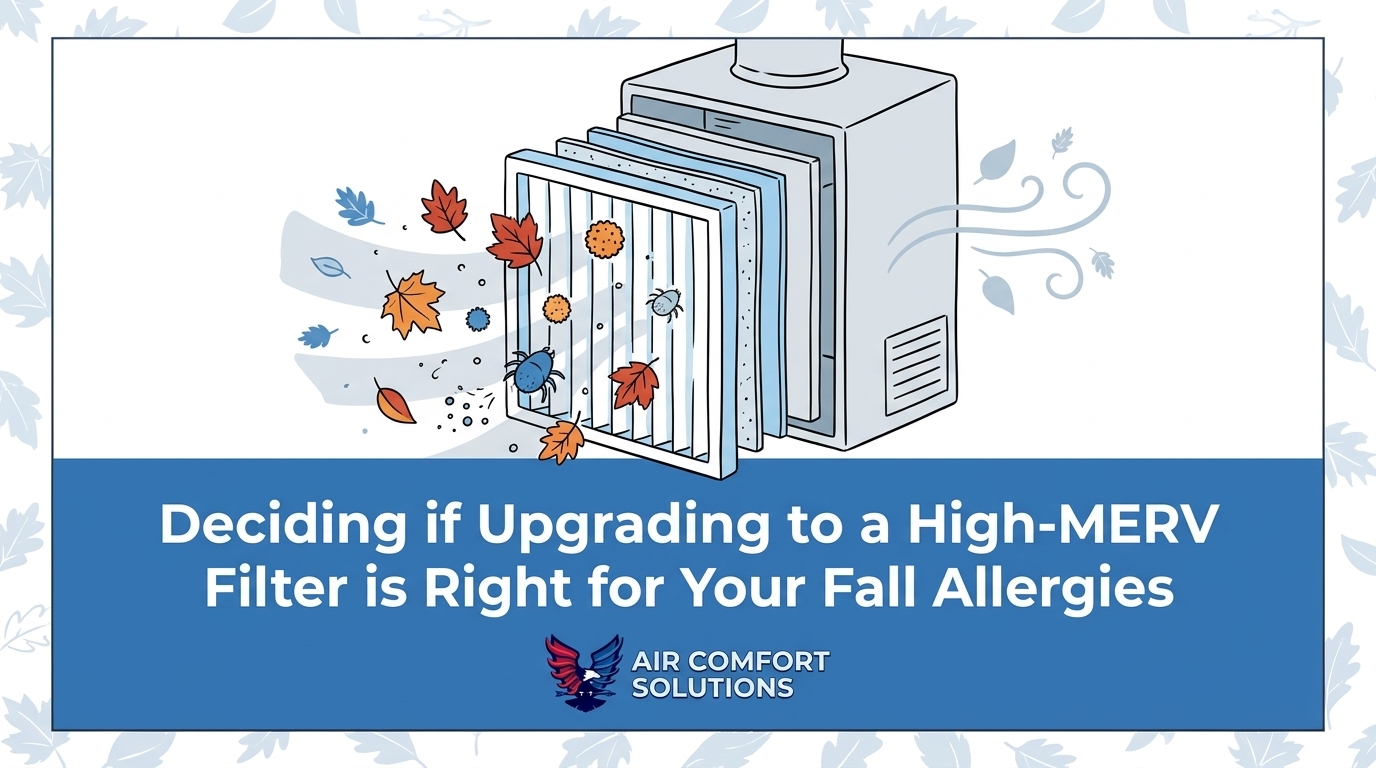
When deciding if upgrading to a high-MERV filter is right for your fall allergies, a common misconception our team at Air Comfort Solutions encounters is that buying the thickest, highest-rated filter on the hardware store shelf is the ultimate fix. Many homeowners assume that a denser pleated material acts as an impenetrable shield against airborne irritants. However, that heavy filtration media can also act like a brick wall for your system's airflow. If you are desperate for relief during the early fall ragweed season, you might inadvertently suffocate an older, non-variable-speed blower motor in the process. We constantly remind our customers that the real challenge lies in weighing the clear filtration benefits against the potential for severe equipment strain.
To protect both your breathing and your cooling equipment, you need a strategy that supports optimal HVAC system performance while implementing safe, effective indoor air quality solutions.
Before you swap out your standard filter for a hospital-grade upgrade, it helps to understand what the MERV rating system actually measures—something our technicians explain to Pinehurst homeowners almost daily. MERV stands for Minimum Efficiency Reporting Value. This scale dictates how effectively a filter traps specific particle sizes passing through your ductwork. The rating system focuses heavily on microscopic particles measured in microns. For context, a single strand of human hair is roughly 70 microns across. The allergens that trigger sneezing and congestion usually fall between 1.0 and 3.0 microns.
Most standard builder-grade filters sit around MERV 4 to MERV 8. These are primarily designed to protect the HVAC equipment itself from large debris, not necessarily to purify the air you breathe. When you jump to a MERV 13 rating, you are moving into a category designed to capture microscopic biological contaminants. Here is a closer look at the exact differences we see between the two most common choices for residential homes:
• Primary Purpose — Standard MERV 8 Filter: Protecting HVAC equipment from large dust and debris. — High-Efficiency MERV 13 Filter: Improving indoor air quality and capturing microscopic allergens.
• Particle Capture Size — Standard MERV 8 Filter: 3.0 to 10.0 microns. — High-Efficiency MERV 13 Filter: 1.0 to 3.0 microns (and smaller).
• What It Catches — Standard MERV 8 Filter: Lint, household dust, dust mites, and heavy pollen. — High-Efficiency MERV 13 Filter: Fine dust, pet dander, smoke, bacteria, and severe allergens.
• Airflow Resistance — Standard MERV 8 Filter: Low to moderate. Safe for almost all residential HVAC systems. — High-Efficiency MERV 13 Filter: High. Can severely restrict airflow if the blower motor is inadequate.
• Replacement Frequency — Standard MERV 8 Filter: Every 60 to 90 days depending on household conditions. — High-Efficiency MERV 13 Filter: Every 30 to 60 days to prevent dangerous static pressure buildup.
Looking at a direct comparison of MERV 13 vs MERV 8, the higher rating clearly offers superior protection for your lungs. However, that increased capture rate comes with a physical trade-off. The fibers in a MERV 13 filter are woven much tighter. While this tight weave stops microscopic ragweed pollen from circulating through your living room, it also forces your blower motor to work significantly harder to pull air through the return vent.

To understand why a premium filter can sometimes break an air conditioner, you have to understand static pressure. In the HVAC industry, static pressure refers to the resistance airflow faces as it moves through your ductwork, coils, and filters. Think of your ductwork like a human artery, and the blower motor as the heart. If you place a dense, highly restrictive filter in the system, you are essentially clogging that artery. The heart has to pump much harder to circulate the same amount of air.
This resistance becomes incredibly dangerous for older homes equipped with standard, single-stage blower motors. If you are exploring the best AC filter options for Houston area homes, you must account for the type of motor driving your system. Here is exactly how we see high static pressure break down older equipment in the field:
1. The Blower Motor Strains: Older systems typically use Permanent Split Capacitor (PSC) motors. These motors operate at a single, fixed speed. When a restrictive MERV 13 filter blocks the air intake, the motor does not have the technology to ramp up its power. Instead, it just strains against the resistance.
2. Heat Begins to Build: Because the PSC motor is working harder to pull air through a dense barrier, it begins to draw more electrical current. This excess current generates significant heat inside the motor housing.
3. Internal Components Overheat: Blower motors rely on the cool air passing over them from the return duct to keep their internal components from overheating. With airflow severely restricted by a thick filter, that cooling effect disappears.
4. Premature Motor Burnout: Without adequate cooling and under constant electrical strain, the motor's windings eventually melt or short out. What started as an attempt to improve indoor air quality ends in a catastrophic equipment failure.
Modern HVAC systems often feature Electronically Commutated Motors (ECM) or variable-speed blowers. These advanced motors can detect an increase in static pressure and automatically ramp up their speed to compensate. While a variable-speed motor can handle a MERV 13 filter much better than an older PSC motor, it will still consume significantly more electricity to do so. In our years of servicing Pinehurst TX area homes, we've found that slapping a premium filter onto an aging, single-speed system is a direct recipe for motor burnout.
The Problem: Our team at Air Comfort Solutions knows that the timing of early fall allergy season creates a unique hazard for HVAC systems in Southeast Texas. In many parts of the country, the arrival of fall pollen coincides with cooler temperatures, meaning the air conditioner runs less frequently. Locally, the early fall ragweed season directly overlaps with lingering 80-to-90-degree days and oppressive humidity. Your air conditioner is still running constantly to keep the house comfortable.
The Cause: When your AC runs continuous cycles during high heat, it requires a massive, uninterrupted volume of warm air blowing over the indoor evaporator coil. The refrigerant inside that coil is extremely cold. It relies on the heat from your home's air to absorb thermal energy and prevent the coil from dropping below freezing. If you install a highly restrictive filter to combat ragweed, you choke off that vital supply of warm air. The coil gets colder and colder. Because local humidity levels remain high in September, the air is thick with moisture. That moisture condenses on the freezing coil and quickly turns into a solid block of ice.
The Solution: You cannot force a restrictive filter into a system that must run constantly in high heat without risking a frozen coil and water damage from melting ice. Finding the right balance often requires professional Pinehurst AC service to measure your system's exact static pressure limits. One of our technicians can determine exactly how much filtration your specific equipment can handle while operating safely during long, hot cooling cycles.
If you recently upgraded to a premium filter and are worried about your system's health, your equipment will usually tell you it is struggling before it fails completely. Recognizing the early symptoms of high static pressure can save you from a major breakdown. When comparing the performance of MERV 13 vs MERV 8 filters in your home, our experts recommend watching closely for these critical warning signs:
• Weak airflow at the supply vents: Hold your hand over the vents in the rooms furthest from your indoor unit. If the airflow feels like a weak trickle rather than a steady breeze, your blower motor is failing to push air through the restrictive filter media.
• Unusual whining or straining noises: A healthy blower motor operates with a steady, low hum. If you hear a high-pitched whine, a rattling sound, or a deep straining noise coming from the utility closet or attic, the motor is working against severe resistance.
• Ice formation on the refrigerant lines: Check the copper pipes running to your indoor unit. If you see frost or solid ice building up on the lines, your evaporator coil is likely freezing over due to a lack of warm airflow. Turn the system off immediately.
• Extended cooling or heating cycles: If your system runs for hours on end without actually changing the temperature on the thermostat, it is starved for air. It cannot condition the home efficiently if it cannot move enough volume through the ductwork.
• Tripped circuit breakers: When a blower motor overheats because of a blocked filter, it draws excess amperage. This will often trip the dedicated breaker at your electrical panel. Never reset a tripped HVAC breaker repeatedly without investigating the cause.
If you notice any of these symptoms after changing your filter, remove the high-MERV filter immediately and replace it with a standard, cheaper option. If the symptoms persist, it is time to schedule routine HVAC maintenance with our team to assess the damage and recalibrate your system's airflow.
If your current HVAC system cannot safely handle the static pressure drop of a high-efficiency filter, you do not have to surrender to fall allergies. There are several highly effective ways to improve your indoor air quality without suffocating an older blower motor. In our experience outfitting Pinehurst TX area homes, a multi-layered approach works far better than relying on a single, thick filter.
Frequent Changes with Lower MERV Filters: Instead of using a dense MERV 13 filter, we often recommend dropping down to a MERV 8 or MERV 11 and changing it aggressively. Replacing a moderate filter every three weeks during peak allergy season ensures that pollen is removed from circulation before the filter becomes clogged enough to restrict airflow. A clean moderate filter is always safer for your equipment than a dirty premium filter.
Whole-Home Air Purifiers: Dedicated air purification systems are installed directly into your ductwork but operate differently than standard media filters. Electronic air cleaners, for example, use an electrical charge to ionize and capture microscopic particles without relying on dense, restrictive fabric. These systems offer hospital-grade purification with almost zero static pressure penalty on your blower motor.
Ultraviolet (UV) Light Systems: While UV lights do not capture physical dust or pollen, they are incredibly effective at neutralizing biological contaminants. Installed over the indoor evaporator coil, these lights destroy mold spores, bacteria, and viruses before they can circulate through your home. They add absolutely no resistance to your system's airflow.
Professional Duct Sealing: Sometimes the allergens in your home aren't coming through the front door; they are being pulled in from the attic. Leaky return ducts can suck in fiberglass insulation, severe dust, and outdoor pollen, bypassing your filter entirely. Having your ductwork professionally sealed ensures that all the air circulating in your home actually passes through your filtration system first.
Yes, a MERV 13 filter can absolutely damage your air conditioning system if the equipment is not designed to handle the increased static pressure. The dense material restricts the amount of air passing over the evaporator coil, which can quickly cause the coil to freeze solid. Additionally, the blower motor will strain to pull air through the barrier, leading to overheating and premature motor failure. We always advise verifying your system's capabilities before upgrading.
Whether a MERV 13 filter restricts airflow too much depends entirely on the type of blower motor your system uses. Older, single-stage motors often struggle significantly and will experience a dangerous drop in airflow volume. Modern variable-speed motors can usually overcome the resistance, though they will consume more energy to do so. Proper static pressure testing by a professional is the only way to know for sure if your system can handle the restriction.
For capturing microscopic fall allergens like ragweed and fine dust, a rating between MERV 11 and MERV 13 is generally ideal. These ratings are tight enough to trap particles between 1.0 and 3.0 microns effectively. However, the "best" filter is the highest rating your specific HVAC system can safely support without compromising airflow. If your system cannot handle a MERV 13, a MERV 8 changed very frequently is a safer, practical alternative.
Older homes with aging HVAC systems typically perform much better and safer with lower MERV ratings unless the ductwork and blower motor have been specifically upgraded. A MERV 11 filter offers a sensible middle ground, providing decent allergen capture with less static pressure penalty than a MERV 13. When dealing with older equipment, prioritizing airflow and motor health is critical to preventing sudden breakdowns during hot weather.
During peak pollen times, you should check a high-efficiency filter every single month and replace it at least every 30 to 60 days. Because these filters are so effective at trapping microscopic debris, they clog much faster than standard fiberglass filters. Leaving a dirty MERV 13 filter in place compounds the airflow restriction, creating a severe blockage that can freeze your coils or burn out your motor in a matter of days.
Achieving clean indoor air requires far more than just buying the most expensive product on the shelf. It requires matching the static pressure drop of your chosen filter to the specific capabilities of your home's existing blower motor. Guessing with thick filters on older equipment is a dangerous game that we frequently see end in frozen coils, tripped breakers, and burned-out motors. The goal is to protect your family's respiratory health without sacrificing the equipment that keeps your home comfortable.
For many Pinehurst TX area homes, finding this exact balance requires a professional perspective from a team you can trust. Relying on local expertise from Air Comfort Solutions ensures you get an accurate assessment of your system's airflow and static pressure limits. By letting our technicians test your equipment rather than guessing, you can implement an air quality strategy that effectively neutralizes fall allergens while keeping your cooling system running safely and efficiently all season long.


Zane came out and did an amazing job! Super friendly, honest and transparent about the work that needed to be done. This is my second time working with Air Comfort Solutions and they’re my go to for HVAC services. Highly recommend.
God's AMAZING grace sent us Robert and Zane. We have been without air in this Texas heat for six weeks and four days. We've had a few contractors give us quotes all trying to upsell when we're at a low point. But not the guys at Air Comfort Solutions. They came in assessed our situation, gave us honest feedback, and showed us the issues as they proceeded with the assessment for clear understanding. We highly recommend them for their professionalism, quality products, and fair pricing. We hands down support them for all the work they do 💯 %.
Robert and Zane gone above and beyond to make the process easy and affordable.
Would definitely recommend!!
I’m writing this review to let everyone know that Air Comfort Solutions is the company to work with. I know the owner ( Robert) for several years now. He has been taking care of my residential and business work orders. Robert is professional, knowledgeable and will save you money. I just want to thank Robert for great job you have been doing for me.