


Home Maintenance Tips and Troubleshooting: Safely Navigating the Fall Heating Transition
Why dormant heaters fail during the first cold snap. See our home maintenance tips and troubleshooting to safely prepare your HVAC for fall.
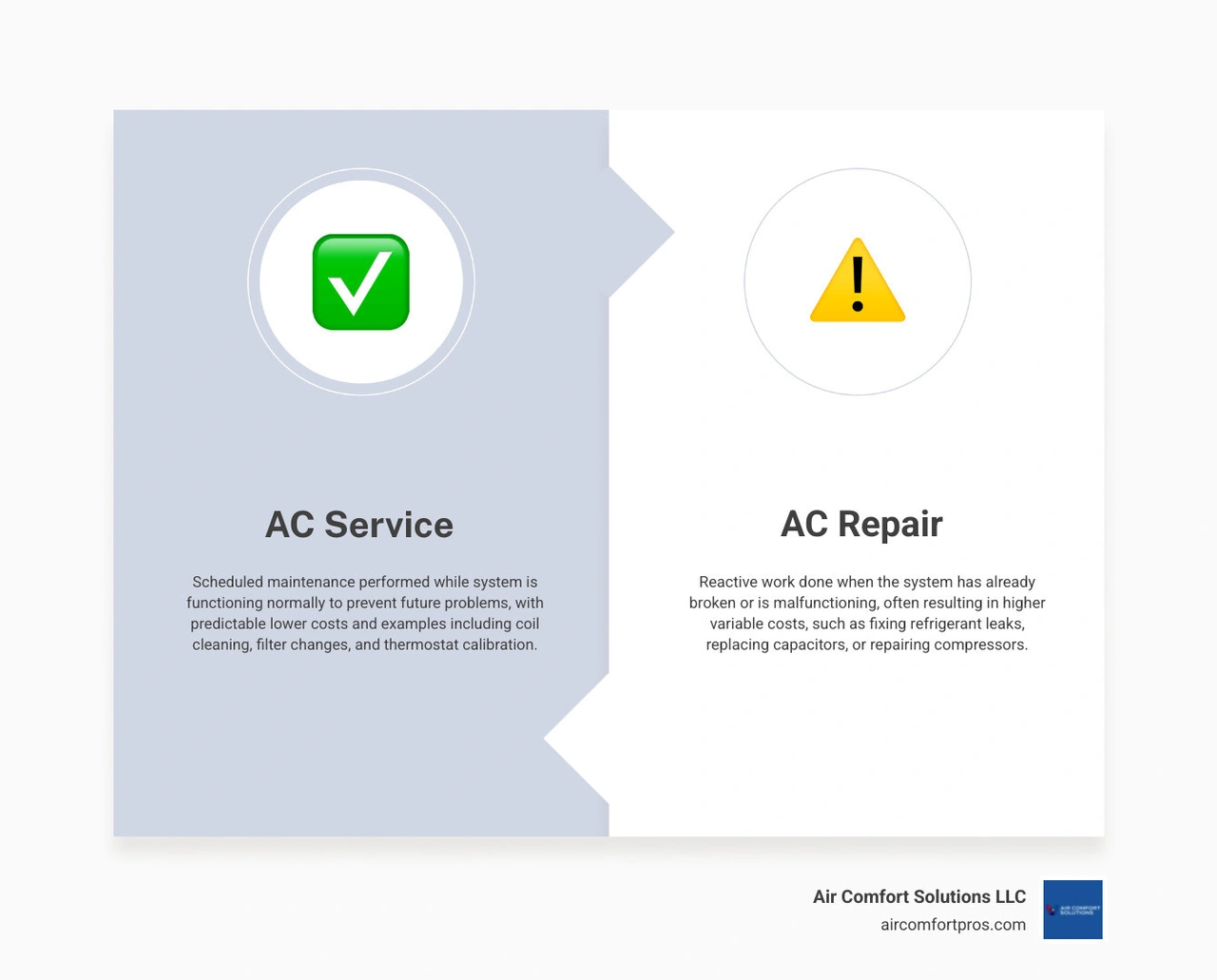
How AC service differs from AC repair comes down to one simple idea: service is proactive, and repair is reactive.
Here is a quick breakdown:
• Purpose — AC Service: Prevent problems before they happen — AC Repair: Fix a problem that already exists
• When it happens — AC Service: Scheduled, typically once or twice a year — AC Repair: When the system fails or shows warning signs
• System condition — AC Service: Still working normally — AC Repair: Malfunctioning or broken
• Cost predictability — AC Service: Predictable, lower cost — AC Repair: Variable, often higher cost
• Examples — AC Service: Coil cleaning, filter replacement, thermostat calibration — AC Repair: Replacing a capacitor, fixing a refrigerant leak, repairing a compressor
Many homeowners in Pinehurst, TX and across North Harris County only call an HVAC technician when something breaks. By then, what started as a small issue — a loose wire, a slightly low refrigerant charge, a clogged drain line — has often turned into a costly emergency repair on the hottest day of the year.
Understanding the difference between routine AC service and AC repair puts you back in control of your home comfort and your budget before a breakdown forces your hand.
To keep your home cool during our intense Texas summers, it helps to understand what is happening behind the scenes when a technician visits your home. The fundamental difference between these two services lies in the state of your air conditioning system when the technician arrives and the ultimate goal of the visit.
Think of AC service as the equivalent of taking your car in for a routine oil change, tire rotation, and fluid check. Your car is running fine, but you want to keep it that way. Proactive maintenance is designed to optimize performance, clean out the dirt and grime that naturally accumulates, and verify that every component is operating within its safe limits.
On the other hand, AC repair is like taking your car to the mechanic because the engine is smoking, or the brakes are grinding. It is a reactive measure. When we perform a repair, we are diagnosing a specific component failure that is actively preventing your system from cooling your home safely or efficiently.
During a routine service visit, our technicians run comprehensive system diagnostics. We measure electrical currents, check pressures, and clean critical parts. The system is fully operational, and our job is to keep it running at peak efficiency.
During a repair call, the system has usually suffered a component failure. Whether it is a dead capacitor, a burnt-out blower motor, or a failed compressor, the goal is to pinpoint the exact failure, determine why it happened, and replace or fix the damaged part to restore cooling.
• Primary Goal — AC Service (Preventative Maintenance): Maximize efficiency, extend system lifespan, and prevent breakdowns. — AC Repair (Corrective Action): Restore cooling capacity and fix broken components.
• System Status — AC Service (Preventative Maintenance): The system is running, though it may be working harder than necessary. — AC Repair (Corrective Action): The system is blowing warm air, making loud noises, or won't turn on.
• Scheduling — AC Service (Preventative Maintenance): Planned in advance, ideally during the mild spring months. — AC Repair (Corrective Action): Often urgent, requested immediately during peak summer heatwaves.
• Scope of Work — AC Service (Preventative Maintenance): Cleaning, safety inspections, minor adjustments, and performance testing. — AC Repair (Corrective Action): Diagnosing faults, replacing broken parts, and sealing leaks.
When we perform a professional AC service, we do not just swap out your air filter and call it a day. A comprehensive tune-up involves a detailed checklist designed to restore your system to its optimal operating state.
Here is what a professional AC service visit looks like:
• Coil Cleaning: Over time, your outdoor condenser coil collects dirt, grass clippings, and pollen, while your indoor evaporator coil can accumulate dust. This buildup acts as an insulating blanket, making it incredibly difficult for your system to release heat. We clean these coils to restore proper heat transfer.
• Electrical Connections: We inspect and tighten all electrical connections. Loose wires can cause voltage drops, arc damage, or premature component failure.
• Thermostat Calibration: We verify that your thermostat is reading the indoor temperature accurately and communicating correctly with your heating and cooling system.
• Condensate Drain Line Clearing: Algae, mold, and dust can clog your condensate drain line, leading to water backups that can damage your ceilings or walls. We clear and flush the drain to ensure water flows safely outside.
• Refrigerant Charge Verification: We check the refrigerant levels to make sure your system has the exact charge specified by the manufacturer. Operating with too little or too much refrigerant strains the compressor and slashes efficiency.
• Moving Parts Lubrication: We lubricate fan motors and bearings to reduce friction, which lowers energy consumption and prevents wear and tear.
To get a complete look at what happens during a professional maintenance visit, you can read our AC Maintenance Visit Complete Guide. If you are wondering how to keep your system protected year-round, you can also learn more about What Does an HVAC Maintenance Plan Include to see how regular visits are structured.
Timing is everything when it comes to managing your home's climate control. Knowing when to schedule routine care and when to call for emergency help can save you from unnecessary stress and sweat.
Maintenance should be scheduled when your system is working, but it has been a while since a professional looked at it. The absolute best time for this is in the spring, before the heavy summer heat arrives.
If you notice any of these subtle signs, it is time to schedule a service visit:
• Weak Airflow: Your home is still reaching the set temperature, but the air coming out of your vents feels sluggish.
• Rising Energy Bills: You notice your monthly utility bills creeping up compared to June of last year, even though your household habits haven’t changed.
• Dust Buildup: You find yourself dusting your furniture far more often, or there is visible dust gathering around your supply registers.
If you want to prepare your system for the coming season, check out our AC Service Spring TX Guide or our AC Service Tomball TX Complete Guide for localized tips. If you are debating whether structured care is right for you, read our analysis on Is an HVAC Maintenance Plan Worth It.
When your air conditioner moves past running inefficiently and crosses into actual failure, you need a repair, not a tune-up. Attempting to run a broken system can cause a chain reaction of damage that ruins other expensive parts.
Call for professional repair immediately if you experience:
• Warm Air: The fan is blowing, but the air coming from your vents is warm or lukewarm.
• Strange Noises: You hear squealing, grinding, rattling, or loud banging noises coming from either the indoor or outdoor unit.
• Frozen Coils: You see ice forming on your indoor evaporator coil or on the copper refrigerant lines running to your outdoor unit.
• Short Cycling: The system turns on and off rapidly every few minutes without ever completing a full cooling cycle.
If you are experiencing these issues right now, our guides can help you understand what is going wrong: check out the AC Repair Spring TX Complete Guide and the AC Repair Tomball TX Complete Guide for expert troubleshooting steps.
Skipping your annual AC service might seem like an easy way to save time, but it is a gamble that rarely pays off. Your air conditioner is a complex mechanical system that undergoes immense physical strain during hot Texas summers.
An unmaintained air conditioner can lose up to 5% of its efficiency every single year it skips service. Dirt on the coils, slightly loose electrical connections, and a dry blower motor force the system to work harder to move the same amount of cool air. This extra work translates directly into higher monthly energy bills and accelerated wear on your system's most expensive components.
The average lifespan of a well-maintained HVAC unit is between 15 to 25 years. Without regular service, that lifespan can easily be cut in half.
The most critical component we protect during a service visit is the compressor. Often referred to as the "heart" of your AC, the compressor is the single most expensive part to replace. When coils are dirty or refrigerant levels are incorrect, the compressor runs hot and under high pressure. Over time, this extra stress leads to premature compressor burnout. By keeping your system clean and properly balanced, routine maintenance shields your compressor from early failure.
Managing household expenses is all about predictability. Knowing how system age affects your choice between a service visit, a repair, or a complete replacement helps you make smart financial decisions.
Routine AC service is highly predictable. You can budget for it in advance, schedule it at your convenience, and enjoy the peace of mind that comes with knowing exactly what shape your system is in.
AC repairs, however, are notoriously unpredictable. They almost always happen when the system is under the greatest stress — which means the hottest afternoon of July or August.
As your air conditioner ages, the way you handle service and repairs should shift:
1. Under 10 Years Old: If your system is relatively young, regular service is vital to keep your manufacturer's warranty active. Most manufacturers require proof of annual professional maintenance to honor warranty parts claims. If a repair is needed, it is almost always best to fix the unit, as the surrounding components are still in good shape.
2. Over 10 Years Old: Once your system crosses the decade mark, components naturally begin to wear down. This is when the 50% Rule comes into play. If an older system breaks down and the cost of the repair exceeds 50% of the cost of a brand-new system, investing in a replacement is usually the smarter long-term financial choice.
If you are currently facing this tough choice, our guide on How to Decide Between AC Repair and Replacement can help you weigh your options.
For homeowners living in Pinehurst, TX and the surrounding north Harris County communities, air conditioning is not a luxury — it is a safety necessity. Our unique coastal-adjacent climate subjects your cooling system to some of the harshest operating conditions in the country.
• Extreme Heat and High Humidity: Our summers are incredibly long, hot, and humid. High humidity means your AC has to work twice as hard because it must remove moisture from the air before it can effectively lower the indoor temperature. This constant removal of water puts a heavy load on your condensate drain system, making regular drain line clearing during AC service essential to prevent indoor water damage.
• Salt Air Corrosion: Though we are slightly inland, the coastal air currents in Harris County carry trace amounts of moisture and salt that can accelerate the corrosion of outdoor aluminum fins and copper coils. Regular cleaning washes away these corrosive elements before they can eat through your coils and cause costly refrigerant leaks.
• Storm Season Stress: Heavy spring storms and tropical weather can blow leaves, twigs, and dirt directly into your outdoor condenser unit. If this debris is left inside, it can block airflow, unbalance fan blades, and trap moisture against electrical parts. Proactive service ensures your system is cleaned out and ready to withstand the storm season.
We recommend scheduling professional AC service at least once a year. For homes in our warm Texas climate, a spring tune-up is ideal to ensure your system is prepared for the intense summer heat. If you have an older system or a heat pump that provides both heating and cooling, bi-annual service (once in the spring and once in the fall) is highly recommended.
While regular maintenance drastically reduces the risk of unexpected breakdowns, it cannot completely eliminate normal wear and tear. Over time, parts like capacitors, contactors, and fan motors will eventually reach the end of their natural lifespan and require replacement. However, maintenance ensures these parts are checked regularly, allowing us to replace a weak capacitor during a scheduled visit before it fails and leaves you without cooling.
No. AC repairs should always be handled by licensed professionals. Modern air conditioners rely on high-voltage electricity, complex control boards, and pressurized chemical refrigerants. Handling these components without proper training, specialized tools, and EPA certification poses severe safety risks, can permanently damage your system, and will immediately void your manufacturer's warranty.
Understanding the difference between proactive AC service and reactive AC repair is the key to keeping your home comfortable, your energy bills low, and your system running for years to come.
At Air Comfort Solutions LLC, we bring over 35 years of local experience to every home we visit across Pinehurst, Tomball, Spring, Magnolia, and the surrounding communities. Whether you need a comprehensive spring tune-up to protect your system or a fast, reliable repair to get your home cool again, our certified technicians are here to help.
Protect your home's comfort and your peace of mind — Schedule Professional AC Services Today with our friendly local team.
How AC service differs from AC repair comes down to one simple idea: service is proactive, and repair is reactive.
Here is a quick breakdown:
| AC Service | AC Repair | |
|---|---|---|
| Purpose | Prevent problems before they happen | Fix a problem that already exists |
| When it happens | Scheduled, typically once or twice a year | When the system fails or shows warning signs |
| System condition | Still working normally | Malfunctioning or broken |
| Cost predictability | Predictable, lower cost | Variable, often higher cost |
| Examples | Coil cleaning, filter replacement, thermostat calibration | Replacing a capacitor, fixing a refrigerant leak, repairing a compressor |
Many homeowners in Pinehurst, TX and across North Harris County only call an HVAC technician when something breaks. By then, what started as a small issue — a loose wire, a slightly low refrigerant charge, a clogged drain line — has often turned into a costly emergency repair on the hottest day of the year.
Understanding the difference between routine AC service and AC repair puts you back in control of your home comfort and your budget before a breakdown forces your hand.
To keep your home cool during our intense Texas summers, it helps to understand what is happening behind the scenes when a technician visits your home. The fundamental difference between these two services lies in the state of your air conditioning system when the technician arrives and the ultimate goal of the visit.
Think of AC service as the equivalent of taking your car in for a routine oil change, tire rotation, and fluid check. Your car is running fine, but you want to keep it that way. Proactive maintenance is designed to optimize performance, clean out the dirt and grime that naturally accumulates, and verify that every component is operating within its safe limits.
On the other hand, AC repair is like taking your car to the mechanic because the engine is smoking, or the brakes are grinding. It is a reactive measure. When we perform a repair, we are diagnosing a specific component failure that is actively preventing your system from cooling your home safely or efficiently.
During a routine service visit, our technicians run comprehensive system diagnostics. We measure electrical currents, check pressures, and clean critical parts. The system is fully operational, and our job is to keep it running at peak efficiency.
During a repair call, the system has usually suffered a component failure. Whether it is a dead capacitor, a burnt-out blower motor, or a failed compressor, the goal is to pinpoint the exact failure, determine why it happened, and replace or fix the damaged part to restore cooling.
| Feature | AC Service (Preventative Maintenance) | AC Repair (Corrective Action) |
|---|---|---|
| Primary Goal | Maximize efficiency, extend system lifespan, and prevent breakdowns. | Restore cooling capacity and fix broken components. |
| System Status | The system is running, though it may be working harder than necessary. | The system is blowing warm air, making loud noises, or won't turn on. |
| Scheduling | Planned in advance, ideally during the mild spring months. | Often urgent, requested immediately during peak summer heatwaves. |
| Scope of Work | Cleaning, safety inspections, minor adjustments, and performance testing. | Diagnosing faults, replacing broken parts, and sealing leaks. |
When we perform a professional AC service, we do not just swap out your air filter and call it a day. A comprehensive tune-up involves a detailed checklist designed to restore your system to its optimal operating state.
Here is what a professional AC service visit looks like:
To get a complete look at what happens during a professional maintenance visit, you can read our AC Maintenance Visit Complete Guide. If you are wondering how to keep your system protected year-round, you can also learn more about What Does an HVAC Maintenance Plan Include to see how regular visits are structured.
Timing is everything when it comes to managing your home's climate control. Knowing when to schedule routine care and when to call for emergency help can save you from unnecessary stress and sweat.
Maintenance should be scheduled when your system is working, but it has been a while since a professional looked at it. The absolute best time for this is in the spring, before the heavy summer heat arrives.
If you notice any of these subtle signs, it is time to schedule a service visit:
If you want to prepare your system for the coming season, check out our AC Service Spring TX Guide or our AC Service Tomball TX Complete Guide for localized tips. If you are debating whether structured care is right for you, read our analysis on Is an HVAC Maintenance Plan Worth It.
When your air conditioner moves past running inefficiently and crosses into actual failure, you need a repair, not a tune-up. Attempting to run a broken system can cause a chain reaction of damage that ruins other expensive parts.
Call for professional repair immediately if you experience:
If you are experiencing these issues right now, our guides can help you understand what is going wrong: check out the AC Repair Spring TX Complete Guide and the AC Repair Tomball TX Complete Guide for expert troubleshooting steps.
Skipping your annual AC service might seem like an easy way to save time, but it is a gamble that rarely pays off. Your air conditioner is a complex mechanical system that undergoes immense physical strain during hot Texas summers.
An unmaintained air conditioner can lose up to 5% of its efficiency every single year it skips service. Dirt on the coils, slightly loose electrical connections, and a dry blower motor force the system to work harder to move the same amount of cool air. This extra work translates directly into higher monthly energy bills and accelerated wear on your system's most expensive components.
The average lifespan of a well-maintained HVAC unit is between 15 to 25 years. Without regular service, that lifespan can easily be cut in half.
The most critical component we protect during a service visit is the compressor. Often referred to as the "heart" of your AC, the compressor is the single most expensive part to replace. When coils are dirty or refrigerant levels are incorrect, the compressor runs hot and under high pressure. Over time, this extra stress leads to premature compressor burnout. By keeping your system clean and properly balanced, routine maintenance shields your compressor from early failure.
Managing household expenses is all about predictability. Knowing how system age affects your choice between a service visit, a repair, or a complete replacement helps you make smart financial decisions.
Routine AC service is highly predictable. You can budget for it in advance, schedule it at your convenience, and enjoy the peace of mind that comes with knowing exactly what shape your system is in.
AC repairs, however, are notoriously unpredictable. They almost always happen when the system is under the greatest stress — which means the hottest afternoon of July or August.
As your air conditioner ages, the way you handle service and repairs should shift:
If you are currently facing this tough choice, our guide on How to Decide Between AC Repair and Replacement can help you weigh your options.
For homeowners living in Pinehurst, TX and the surrounding north Harris County communities, air conditioning is not a luxury — it is a safety necessity. Our unique coastal-adjacent climate subjects your cooling system to some of the harshest operating conditions in the country.
We recommend scheduling professional AC service at least once a year. For homes in our warm Texas climate, a spring tune-up is ideal to ensure your system is prepared for the intense summer heat. If you have an older system or a heat pump that provides both heating and cooling, bi-annual service (once in the spring and once in the fall) is highly recommended.
While regular maintenance drastically reduces the risk of unexpected breakdowns, it cannot completely eliminate normal wear and tear. Over time, parts like capacitors, contactors, and fan motors will eventually reach the end of their natural lifespan and require replacement. However, maintenance ensures these parts are checked regularly, allowing us to replace a weak capacitor during a scheduled visit before it fails and leaves you without cooling.
No. AC repairs should always be handled by licensed professionals. Modern air conditioners rely on high-voltage electricity, complex control boards, and pressurized chemical refrigerants. Handling these components without proper training, specialized tools, and EPA certification poses severe safety risks, can permanently damage your system, and will immediately void your manufacturer's warranty.
Understanding the difference between proactive AC service and reactive AC repair is the key to keeping your home comfortable, your energy bills low, and your system running for years to come.
At Air Comfort Solutions LLC, we bring over 35 years of local experience to every home we visit across Pinehurst, Tomball, Spring, Magnolia, and the surrounding communities. Whether you need a comprehensive spring tune-up to protect your system or a fast, reliable repair to get your home cool again, our certified technicians are here to help.
Protect your home's comfort and your peace of mind — Schedule Professional AC Services Today with our friendly local team.
How AC service differs from AC repair comes down to one simple idea: service is proactive, and repair is reactive.
Here is a quick breakdown:
| AC Service | AC Repair | |
|---|---|---|
| Purpose | Prevent problems before they happen | Fix a problem that already exists |
| When it happens | Scheduled, typically once or twice a year | When the system fails or shows warning signs |
| System condition | Still working normally | Malfunctioning or broken |
| Cost predictability | Predictable, lower cost | Variable, often higher cost |
| Examples | Coil cleaning, filter replacement, thermostat calibration | Replacing a capacitor, fixing a refrigerant leak, repairing a compressor |
Many homeowners in Pinehurst, TX and across North Harris County only call an HVAC technician when something breaks. By then, what started as a small issue — a loose wire, a slightly low refrigerant charge, a clogged drain line — has often turned into a costly emergency repair on the hottest day of the year.
Understanding the difference between routine AC service and AC repair puts you back in control of your home comfort and your budget before a breakdown forces your hand.
To keep your home cool during our intense Texas summers, it helps to understand what is happening behind the scenes when a technician visits your home. The fundamental difference between these two services lies in the state of your air conditioning system when the technician arrives and the ultimate goal of the visit.
Think of AC service as the equivalent of taking your car in for a routine oil change, tire rotation, and fluid check. Your car is running fine, but you want to keep it that way. Proactive maintenance is designed to optimize performance, clean out the dirt and grime that naturally accumulates, and verify that every component is operating within its safe limits.
On the other hand, AC repair is like taking your car to the mechanic because the engine is smoking, or the brakes are grinding. It is a reactive measure. When we perform a repair, we are diagnosing a specific component failure that is actively preventing your system from cooling your home safely or efficiently.
During a routine service visit, our technicians run comprehensive system diagnostics. We measure electrical currents, check pressures, and clean critical parts. The system is fully operational, and our job is to keep it running at peak efficiency.
During a repair call, the system has usually suffered a component failure. Whether it is a dead capacitor, a burnt-out blower motor, or a failed compressor, the goal is to pinpoint the exact failure, determine why it happened, and replace or fix the damaged part to restore cooling.
| Feature | AC Service (Preventative Maintenance) | AC Repair (Corrective Action) |
|---|---|---|
| Primary Goal | Maximize efficiency, extend system lifespan, and prevent breakdowns. | Restore cooling capacity and fix broken components. |
| System Status | The system is running, though it may be working harder than necessary. | The system is blowing warm air, making loud noises, or won't turn on. |
| Scheduling | Planned in advance, ideally during the mild spring months. | Often urgent, requested immediately during peak summer heatwaves. |
| Scope of Work | Cleaning, safety inspections, minor adjustments, and performance testing. | Diagnosing faults, replacing broken parts, and sealing leaks. |
When we perform a professional AC service, we do not just swap out your air filter and call it a day. A comprehensive tune-up involves a detailed checklist designed to restore your system to its optimal operating state.
Here is what a professional AC service visit looks like:
To get a complete look at what happens during a professional maintenance visit, you can read our AC Maintenance Visit Complete Guide. If you are wondering how to keep your system protected year-round, you can also learn more about What Does an HVAC Maintenance Plan Include to see how regular visits are structured.
Timing is everything when it comes to managing your home's climate control. Knowing when to schedule routine care and when to call for emergency help can save you from unnecessary stress and sweat.
Maintenance should be scheduled when your system is working, but it has been a while since a professional looked at it. The absolute best time for this is in the spring, before the heavy summer heat arrives.
If you notice any of these subtle signs, it is time to schedule a service visit:
If you want to prepare your system for the coming season, check out our AC Service Spring TX Guide or our AC Service Tomball TX Complete Guide for localized tips. If you are debating whether structured care is right for you, read our analysis on Is an HVAC Maintenance Plan Worth It.
When your air conditioner moves past running inefficiently and crosses into actual failure, you need a repair, not a tune-up. Attempting to run a broken system can cause a chain reaction of damage that ruins other expensive parts.
Call for professional repair immediately if you experience:
If you are experiencing these issues right now, our guides can help you understand what is going wrong: check out the AC Repair Spring TX Complete Guide and the AC Repair Tomball TX Complete Guide for expert troubleshooting steps.
Skipping your annual AC service might seem like an easy way to save time, but it is a gamble that rarely pays off. Your air conditioner is a complex mechanical system that undergoes immense physical strain during hot Texas summers.
An unmaintained air conditioner can lose up to 5% of its efficiency every single year it skips service. Dirt on the coils, slightly loose electrical connections, and a dry blower motor force the system to work harder to move the same amount of cool air. This extra work translates directly into higher monthly energy bills and accelerated wear on your system's most expensive components.
The average lifespan of a well-maintained HVAC unit is between 15 to 25 years. Without regular service, that lifespan can easily be cut in half.
The most critical component we protect during a service visit is the compressor. Often referred to as the "heart" of your AC, the compressor is the single most expensive part to replace. When coils are dirty or refrigerant levels are incorrect, the compressor runs hot and under high pressure. Over time, this extra stress leads to premature compressor burnout. By keeping your system clean and properly balanced, routine maintenance shields your compressor from early failure.
Managing household expenses is all about predictability. Knowing how system age affects your choice between a service visit, a repair, or a complete replacement helps you make smart financial decisions.
Routine AC service is highly predictable. You can budget for it in advance, schedule it at your convenience, and enjoy the peace of mind that comes with knowing exactly what shape your system is in.
AC repairs, however, are notoriously unpredictable. They almost always happen when the system is under the greatest stress — which means the hottest afternoon of July or August.
As your air conditioner ages, the way you handle service and repairs should shift:
If you are currently facing this tough choice, our guide on How to Decide Between AC Repair and Replacement can help you weigh your options.
For homeowners living in Pinehurst, TX and the surrounding north Harris County communities, air conditioning is not a luxury — it is a safety necessity. Our unique coastal-adjacent climate subjects your cooling system to some of the harshest operating conditions in the country.
We recommend scheduling professional AC service at least once a year. For homes in our warm Texas climate, a spring tune-up is ideal to ensure your system is prepared for the intense summer heat. If you have an older system or a heat pump that provides both heating and cooling, bi-annual service (once in the spring and once in the fall) is highly recommended.
While regular maintenance drastically reduces the risk of unexpected breakdowns, it cannot completely eliminate normal wear and tear. Over time, parts like capacitors, contactors, and fan motors will eventually reach the end of their natural lifespan and require replacement. However, maintenance ensures these parts are checked regularly, allowing us to replace a weak capacitor during a scheduled visit before it fails and leaves you without cooling.
No. AC repairs should always be handled by licensed professionals. Modern air conditioners rely on high-voltage electricity, complex control boards, and pressurized chemical refrigerants. Handling these components without proper training, specialized tools, and EPA certification poses severe safety risks, can permanently damage your system, and will immediately void your manufacturer's warranty.
Understanding the difference between proactive AC service and reactive AC repair is the key to keeping your home comfortable, your energy bills low, and your system running for years to come.
At Air Comfort Solutions LLC, we bring over 35 years of local experience to every home we visit across Pinehurst, Tomball, Spring, Magnolia, and the surrounding communities. Whether you need a comprehensive spring tune-up to protect your system or a fast, reliable repair to get your home cool again, our certified technicians are here to help.
Protect your home's comfort and your peace of mind — Schedule Professional AC Services Today with our friendly local team.
How AC service differs from AC repair comes down to one simple idea: service is proactive, and repair is reactive.
Here is a quick breakdown:
| AC Service | AC Repair | |
|---|---|---|
| Purpose | Prevent problems before they happen | Fix a problem that already exists |
| When it happens | Scheduled, typically once or twice a year | When the system fails or shows warning signs |
| System condition | Still working normally | Malfunctioning or broken |
| Cost predictability | Predictable, lower cost | Variable, often higher cost |
| Examples | Coil cleaning, filter replacement, thermostat calibration | Replacing a capacitor, fixing a refrigerant leak, repairing a compressor |
Many homeowners in Pinehurst, TX and across North Harris County only call an HVAC technician when something breaks. By then, what started as a small issue — a loose wire, a slightly low refrigerant charge, a clogged drain line — has often turned into a costly emergency repair on the hottest day of the year.
Understanding the difference between routine AC service and AC repair puts you back in control of your home comfort and your budget before a breakdown forces your hand.
To keep your home cool during our intense Texas summers, it helps to understand what is happening behind the scenes when a technician visits your home. The fundamental difference between these two services lies in the state of your air conditioning system when the technician arrives and the ultimate goal of the visit.
Think of AC service as the equivalent of taking your car in for a routine oil change, tire rotation, and fluid check. Your car is running fine, but you want to keep it that way. Proactive maintenance is designed to optimize performance, clean out the dirt and grime that naturally accumulates, and verify that every component is operating within its safe limits.
On the other hand, AC repair is like taking your car to the mechanic because the engine is smoking, or the brakes are grinding. It is a reactive measure. When we perform a repair, we are diagnosing a specific component failure that is actively preventing your system from cooling your home safely or efficiently.
During a routine service visit, our technicians run comprehensive system diagnostics. We measure electrical currents, check pressures, and clean critical parts. The system is fully operational, and our job is to keep it running at peak efficiency.
During a repair call, the system has usually suffered a component failure. Whether it is a dead capacitor, a burnt-out blower motor, or a failed compressor, the goal is to pinpoint the exact failure, determine why it happened, and replace or fix the damaged part to restore cooling.
| Feature | AC Service (Preventative Maintenance) | AC Repair (Corrective Action) |
|---|---|---|
| Primary Goal | Maximize efficiency, extend system lifespan, and prevent breakdowns. | Restore cooling capacity and fix broken components. |
| System Status | The system is running, though it may be working harder than necessary. | The system is blowing warm air, making loud noises, or won't turn on. |
| Scheduling | Planned in advance, ideally during the mild spring months. | Often urgent, requested immediately during peak summer heatwaves. |
| Scope of Work | Cleaning, safety inspections, minor adjustments, and performance testing. | Diagnosing faults, replacing broken parts, and sealing leaks. |
When we perform a professional AC service, we do not just swap out your air filter and call it a day. A comprehensive tune-up involves a detailed checklist designed to restore your system to its optimal operating state.
Here is what a professional AC service visit looks like:
To get a complete look at what happens during a professional maintenance visit, you can read our AC Maintenance Visit Complete Guide. If you are wondering how to keep your system protected year-round, you can also learn more about What Does an HVAC Maintenance Plan Include to see how regular visits are structured.
Timing is everything when it comes to managing your home's climate control. Knowing when to schedule routine care and when to call for emergency help can save you from unnecessary stress and sweat.
Maintenance should be scheduled when your system is working, but it has been a while since a professional looked at it. The absolute best time for this is in the spring, before the heavy summer heat arrives.
If you notice any of these subtle signs, it is time to schedule a service visit:
If you want to prepare your system for the coming season, check out our AC Service Spring TX Guide or our AC Service Tomball TX Complete Guide for localized tips. If you are debating whether structured care is right for you, read our analysis on Is an HVAC Maintenance Plan Worth It.
When your air conditioner moves past running inefficiently and crosses into actual failure, you need a repair, not a tune-up. Attempting to run a broken system can cause a chain reaction of damage that ruins other expensive parts.
Call for professional repair immediately if you experience:
If you are experiencing these issues right now, our guides can help you understand what is going wrong: check out the AC Repair Spring TX Complete Guide and the AC Repair Tomball TX Complete Guide for expert troubleshooting steps.
Skipping your annual AC service might seem like an easy way to save time, but it is a gamble that rarely pays off. Your air conditioner is a complex mechanical system that undergoes immense physical strain during hot Texas summers.
An unmaintained air conditioner can lose up to 5% of its efficiency every single year it skips service. Dirt on the coils, slightly loose electrical connections, and a dry blower motor force the system to work harder to move the same amount of cool air. This extra work translates directly into higher monthly energy bills and accelerated wear on your system's most expensive components.
The average lifespan of a well-maintained HVAC unit is between 15 to 25 years. Without regular service, that lifespan can easily be cut in half.
The most critical component we protect during a service visit is the compressor. Often referred to as the "heart" of your AC, the compressor is the single most expensive part to replace. When coils are dirty or refrigerant levels are incorrect, the compressor runs hot and under high pressure. Over time, this extra stress leads to premature compressor burnout. By keeping your system clean and properly balanced, routine maintenance shields your compressor from early failure.
Managing household expenses is all about predictability. Knowing how system age affects your choice between a service visit, a repair, or a complete replacement helps you make smart financial decisions.
Routine AC service is highly predictable. You can budget for it in advance, schedule it at your convenience, and enjoy the peace of mind that comes with knowing exactly what shape your system is in.
AC repairs, however, are notoriously unpredictable. They almost always happen when the system is under the greatest stress — which means the hottest afternoon of July or August.
As your air conditioner ages, the way you handle service and repairs should shift:
If you are currently facing this tough choice, our guide on How to Decide Between AC Repair and Replacement can help you weigh your options.
For homeowners living in Pinehurst, TX and the surrounding north Harris County communities, air conditioning is not a luxury — it is a safety necessity. Our unique coastal-adjacent climate subjects your cooling system to some of the harshest operating conditions in the country.
We recommend scheduling professional AC service at least once a year. For homes in our warm Texas climate, a spring tune-up is ideal to ensure your system is prepared for the intense summer heat. If you have an older system or a heat pump that provides both heating and cooling, bi-annual service (once in the spring and once in the fall) is highly recommended.
While regular maintenance drastically reduces the risk of unexpected breakdowns, it cannot completely eliminate normal wear and tear. Over time, parts like capacitors, contactors, and fan motors will eventually reach the end of their natural lifespan and require replacement. However, maintenance ensures these parts are checked regularly, allowing us to replace a weak capacitor during a scheduled visit before it fails and leaves you without cooling.
No. AC repairs should always be handled by licensed professionals. Modern air conditioners rely on high-voltage electricity, complex control boards, and pressurized chemical refrigerants. Handling these components without proper training, specialized tools, and EPA certification poses severe safety risks, can permanently damage your system, and will immediately void your manufacturer's warranty.
Understanding the difference between proactive AC service and reactive AC repair is the key to keeping your home comfortable, your energy bills low, and your system running for years to come.
At Air Comfort Solutions LLC, we bring over 35 years of local experience to every home we visit across Pinehurst, Tomball, Spring, Magnolia, and the surrounding communities. Whether you need a comprehensive spring tune-up to protect your system or a fast, reliable repair to get your home cool again, our certified technicians are here to help.
Protect your home's comfort and your peace of mind — Schedule Professional AC Services Today with our friendly local team.
How AC service differs from AC repair comes down to one simple idea: service is proactive, and repair is reactive.
Here is a quick breakdown:
| AC Service | AC Repair | |
|---|---|---|
| Purpose | Prevent problems before they happen | Fix a problem that already exists |
| When it happens | Scheduled, typically once or twice a year | When the system fails or shows warning signs |
| System condition | Still working normally | Malfunctioning or broken |
| Cost predictability | Predictable, lower cost | Variable, often higher cost |
| Examples | Coil cleaning, filter replacement, thermostat calibration | Replacing a capacitor, fixing a refrigerant leak, repairing a compressor |
Many homeowners in Pinehurst, TX and across North Harris County only call an HVAC technician when something breaks. By then, what started as a small issue — a loose wire, a slightly low refrigerant charge, a clogged drain line — has often turned into a costly emergency repair on the hottest day of the year.
Understanding the difference between routine AC service and AC repair puts you back in control of your home comfort and your budget before a breakdown forces your hand.
To keep your home cool during our intense Texas summers, it helps to understand what is happening behind the scenes when a technician visits your home. The fundamental difference between these two services lies in the state of your air conditioning system when the technician arrives and the ultimate goal of the visit.
Think of AC service as the equivalent of taking your car in for a routine oil change, tire rotation, and fluid check. Your car is running fine, but you want to keep it that way. Proactive maintenance is designed to optimize performance, clean out the dirt and grime that naturally accumulates, and verify that every component is operating within its safe limits.
On the other hand, AC repair is like taking your car to the mechanic because the engine is smoking, or the brakes are grinding. It is a reactive measure. When we perform a repair, we are diagnosing a specific component failure that is actively preventing your system from cooling your home safely or efficiently.
During a routine service visit, our technicians run comprehensive system diagnostics. We measure electrical currents, check pressures, and clean critical parts. The system is fully operational, and our job is to keep it running at peak efficiency.
During a repair call, the system has usually suffered a component failure. Whether it is a dead capacitor, a burnt-out blower motor, or a failed compressor, the goal is to pinpoint the exact failure, determine why it happened, and replace or fix the damaged part to restore cooling.
| Feature | AC Service (Preventative Maintenance) | AC Repair (Corrective Action) |
|---|---|---|
| Primary Goal | Maximize efficiency, extend system lifespan, and prevent breakdowns. | Restore cooling capacity and fix broken components. |
| System Status | The system is running, though it may be working harder than necessary. | The system is blowing warm air, making loud noises, or won't turn on. |
| Scheduling | Planned in advance, ideally during the mild spring months. | Often urgent, requested immediately during peak summer heatwaves. |
| Scope of Work | Cleaning, safety inspections, minor adjustments, and performance testing. | Diagnosing faults, replacing broken parts, and sealing leaks. |
When we perform a professional AC service, we do not just swap out your air filter and call it a day. A comprehensive tune-up involves a detailed checklist designed to restore your system to its optimal operating state.
Here is what a professional AC service visit looks like:
To get a complete look at what happens during a professional maintenance visit, you can read our AC Maintenance Visit Complete Guide. If you are wondering how to keep your system protected year-round, you can also learn more about What Does an HVAC Maintenance Plan Include to see how regular visits are structured.
Timing is everything when it comes to managing your home's climate control. Knowing when to schedule routine care and when to call for emergency help can save you from unnecessary stress and sweat.
Maintenance should be scheduled when your system is working, but it has been a while since a professional looked at it. The absolute best time for this is in the spring, before the heavy summer heat arrives.
If you notice any of these subtle signs, it is time to schedule a service visit:
If you want to prepare your system for the coming season, check out our AC Service Spring TX Guide or our AC Service Tomball TX Complete Guide for localized tips. If you are debating whether structured care is right for you, read our analysis on Is an HVAC Maintenance Plan Worth It.
When your air conditioner moves past running inefficiently and crosses into actual failure, you need a repair, not a tune-up. Attempting to run a broken system can cause a chain reaction of damage that ruins other expensive parts.
Call for professional repair immediately if you experience:
If you are experiencing these issues right now, our guides can help you understand what is going wrong: check out the AC Repair Spring TX Complete Guide and the AC Repair Tomball TX Complete Guide for expert troubleshooting steps.
Skipping your annual AC service might seem like an easy way to save time, but it is a gamble that rarely pays off. Your air conditioner is a complex mechanical system that undergoes immense physical strain during hot Texas summers.
An unmaintained air conditioner can lose up to 5% of its efficiency every single year it skips service. Dirt on the coils, slightly loose electrical connections, and a dry blower motor force the system to work harder to move the same amount of cool air. This extra work translates directly into higher monthly energy bills and accelerated wear on your system's most expensive components.
The average lifespan of a well-maintained HVAC unit is between 15 to 25 years. Without regular service, that lifespan can easily be cut in half.
The most critical component we protect during a service visit is the compressor. Often referred to as the "heart" of your AC, the compressor is the single most expensive part to replace. When coils are dirty or refrigerant levels are incorrect, the compressor runs hot and under high pressure. Over time, this extra stress leads to premature compressor burnout. By keeping your system clean and properly balanced, routine maintenance shields your compressor from early failure.
Managing household expenses is all about predictability. Knowing how system age affects your choice between a service visit, a repair, or a complete replacement helps you make smart financial decisions.
Routine AC service is highly predictable. You can budget for it in advance, schedule it at your convenience, and enjoy the peace of mind that comes with knowing exactly what shape your system is in.
AC repairs, however, are notoriously unpredictable. They almost always happen when the system is under the greatest stress — which means the hottest afternoon of July or August.
As your air conditioner ages, the way you handle service and repairs should shift:
If you are currently facing this tough choice, our guide on How to Decide Between AC Repair and Replacement can help you weigh your options.
For homeowners living in Pinehurst, TX and the surrounding north Harris County communities, air conditioning is not a luxury — it is a safety necessity. Our unique coastal-adjacent climate subjects your cooling system to some of the harshest operating conditions in the country.
We recommend scheduling professional AC service at least once a year. For homes in our warm Texas climate, a spring tune-up is ideal to ensure your system is prepared for the intense summer heat. If you have an older system or a heat pump that provides both heating and cooling, bi-annual service (once in the spring and once in the fall) is highly recommended.
While regular maintenance drastically reduces the risk of unexpected breakdowns, it cannot completely eliminate normal wear and tear. Over time, parts like capacitors, contactors, and fan motors will eventually reach the end of their natural lifespan and require replacement. However, maintenance ensures these parts are checked regularly, allowing us to replace a weak capacitor during a scheduled visit before it fails and leaves you without cooling.
No. AC repairs should always be handled by licensed professionals. Modern air conditioners rely on high-voltage electricity, complex control boards, and pressurized chemical refrigerants. Handling these components without proper training, specialized tools, and EPA certification poses severe safety risks, can permanently damage your system, and will immediately void your manufacturer's warranty.
Understanding the difference between proactive AC service and reactive AC repair is the key to keeping your home comfortable, your energy bills low, and your system running for years to come.
At Air Comfort Solutions LLC, we bring over 35 years of local experience to every home we visit across Pinehurst, Tomball, Spring, Magnolia, and the surrounding communities. Whether you need a comprehensive spring tune-up to protect your system or a fast, reliable repair to get your home cool again, our certified technicians are here to help.
Protect your home's comfort and your peace of mind — Schedule Professional AC Services Today with our friendly local team.


Zane came out and did an amazing job! Super friendly, honest and transparent about the work that needed to be done. This is my second time working with Air Comfort Solutions and they’re my go to for HVAC services. Highly recommend.
God's AMAZING grace sent us Robert and Zane. We have been without air in this Texas heat for six weeks and four days. We've had a few contractors give us quotes all trying to upsell when we're at a low point. But not the guys at Air Comfort Solutions. They came in assessed our situation, gave us honest feedback, and showed us the issues as they proceeded with the assessment for clear understanding. We highly recommend them for their professionalism, quality products, and fair pricing. We hands down support them for all the work they do 💯 %.
Robert and Zane gone above and beyond to make the process easy and affordable.
Would definitely recommend!!
I’m writing this review to let everyone know that Air Comfort Solutions is the company to work with. I know the owner ( Robert) for several years now. He has been taking care of my residential and business work orders. Robert is professional, knowledgeable and will save you money. I just want to thank Robert for great job you have been doing for me.


