Assessing the Wear on Your AC Contactor After a Brutal Texas Summer
Months of continuous high-load cycling can leave electrical parts scarred and pitted. Catching a worn contactor during a fall tune-up prevents a welded-shut emergency.
The peak of summer is finally here, and understanding exactly why your AC condensate line clogs faster in the July heat can mean the difference between staying comfortable and facing an unexpected system shutdown. At Air Comfort Solutions, our technicians field countless emergency calls when an air conditioner abruptly powers down during a severe heatwave, and we often find the drain pan and condensate line are the hidden culprits. Dealing with a sudden loss of cooling is incredibly frustrating, especially when you rely on your system to combat the relentless July peak heat and high humidity we see here in Texas. Knowing how to handle this specific issue helps you make smart decisions about your cooling system when you need it most.
For comprehensive help with your system, explore our air conditioning services or secure your comfort with an AC maintenance plan.
Most homeowners assume that a sudden shutdown means a catastrophic mechanical failure, like a burned-out compressor or a blown motor. However, our team typically sees a reality that is much simpler, though no less disruptive. Your air conditioning system relies on a delicate balance of airflow, refrigerant, and moisture removal. When the extreme heat of mid-summer arrives, the sheer volume of work your system performs increases exponentially. This heavy workload directly accelerates the clogging process inside the narrow pipes designed to carry water away from your indoor unit.
The condensate drain line is a simple PVC pipe that routes extracted moisture from your indoor evaporator coil to the outside of your home. Directly beneath that coil sits the drain pan, which catches the dripping water before it enters the pipe. During milder seasons, this system handles a moderate trickle of water with ease. But as temperatures soar, the biological and mechanical realities of moving constant water through a dark, warm pipe create the perfect environment for blockages. Understanding this mid-summer surprise is the first step in keeping your home consistently cool.
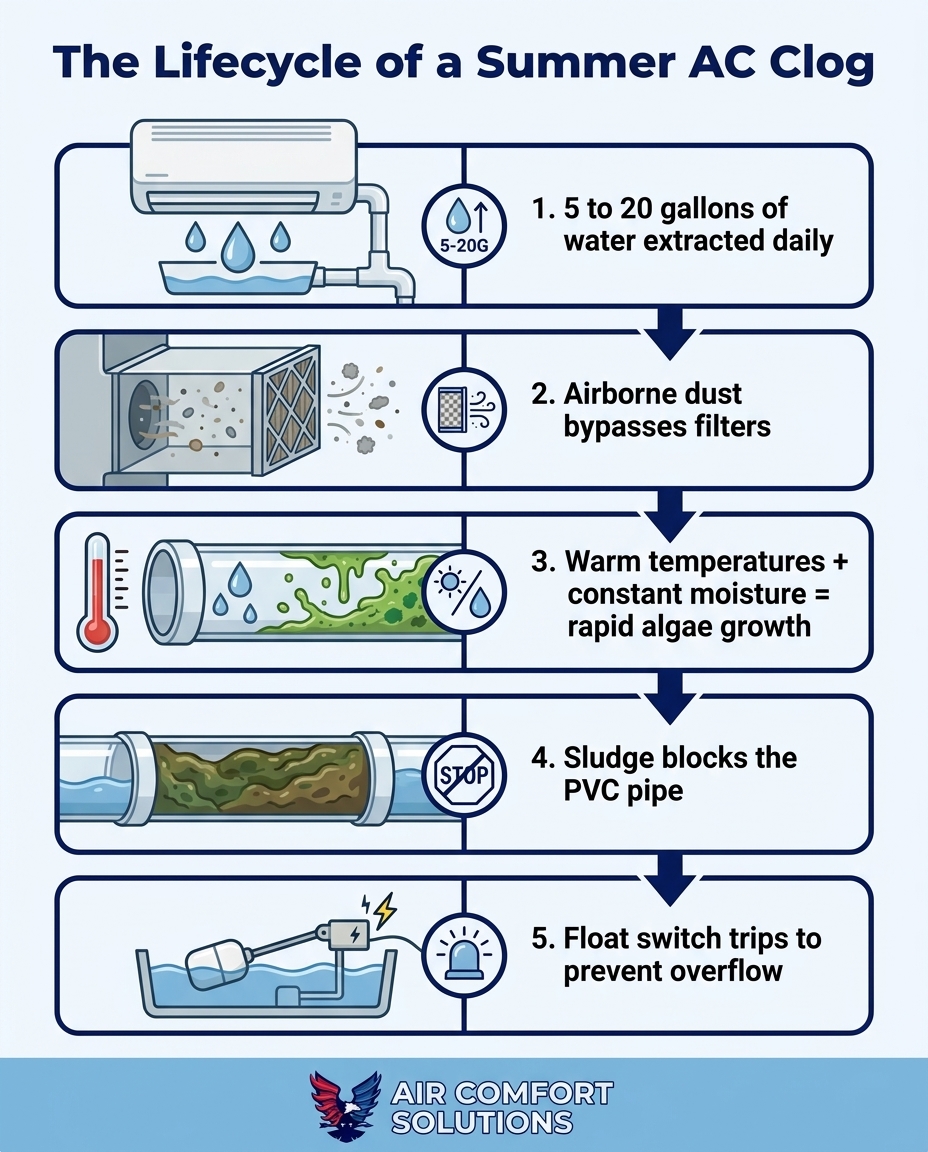
To understand why clogs happen so quickly in the summer, you have to look at the dual role of a central air conditioner. While we primarily think of an AC as a machine that cools the air, it is equally responsible for removing airborne moisture. In fact, you cannot effectively cool a home without simultaneously dehumidifying it. The Department of Energy notes that a typical central air conditioning system can extract anywhere from 5 to 20 gallons of water per day from the indoor air during high humidity conditions.
This massive volume of water turns your condensate drain line into a continuous, warm waterfall. In milder spring or fall weather, the AC runs in shorter cycles, allowing the drain line time to dry out between uses. However, Pinehurst frequently experiences relative humidity levels above 80% during summer mornings, forcing HVAC systems to work overtime as heavy-duty dehumidifiers. For Pinehurst TX area homes, this means the inside of the drain pipe stays perpetually soaked for months on end.
The mechanics of how this water is pulled from the air are straightforward, but the volume is what catches most homeowners off guard. Here is exactly how your system manages moisture during a heavy cooling cycle:
• Warm air circulation: Warm, humid indoor air is pulled through your return vents and passes over the freezing cold evaporator coil inside your indoor unit.
• Rapid condensation: As the warm air hits the cold metal, moisture condenses on the coil. This is the exact same physical reaction that causes water droplets to form on the outside of a cold glass of iced tea on a summer afternoon.
• Continuous drainage: The condensed water drips steadily off the coil fins into the drain pan below, where gravity feeds it into the condensate line and out of your house.
When you multiply those tiny droplets by the hours your system runs during a heatwave, you end up with dozens of gallons of water flowing through a pipe that is usually only three-quarters of an inch wide. Our crews at Air Comfort Solutions see firsthand how this constant moisture acts as the mechanical root cause of summer clogs.
Water alone does not clog a pipe. The true culprit behind the blockage is biological. Algae and mold spores are naturally present in the air all around us. They are microscopic, harmless in small numbers, and inevitably drawn into your HVAC system through the return air vents. Once these spores bypass your air filter and land in the drain pan, they find themselves in an environment perfectly suited for rapid reproduction.
The combination of July peak heat and high humidity creates the ultimate breeding ground. Algae requires three things to thrive: moisture, warmth, and darkness. Your condensate drain line provides a continuous supply of all three. During cooler months, the intermittent water flow and lower temperatures keep biological growth in check. But in mid-summer, the exponential growth rate of algae is staggering. What starts as a microscopic spore can multiply into a significant colony in a matter of days.
As the algae grows, it forms a thick, jelly-like sludge. This biological matter clings to the inside walls of the PVC pipe, slowly narrowing the passageway. Because the water flowing over it is warm, the colony is constantly insulated and fed. Eventually, this sludge becomes thick enough to catch other debris, creating a complete dam that halts the flow of water entirely. If you are noticing high humidity inside house even with AC running, it may be an early warning sign that your system is struggling to drain properly, leaving excess moisture sitting in the pan and re-evaporating into your home's air.
While algae is the biological engine of a summer clog, it rarely acts alone. Airborne dust, pet dander, and other microscopic debris play a massive role in giving the clog its structural integrity. Many homeowners are surprised to learn that their indoor air quality directly impacts the plumbing of their HVAC system.
When air filters become heavily soiled, or if low-quality fiberglass filters are used, significant amounts of household dust bypass the filtration system. This dust gets pulled directly into the blower motor and blown across the wet evaporator coil. Because the coil is dripping with condensation, the dust sticks to the moisture instead of passing through the ductwork. As the water drips down into the drain pan, it washes this dirt along with it.
When this steady stream of dirt meets the sticky algae growing in the drain line, they mix together. The result is a dense, impenetrable mud that is far more stubborn than algae alone. For many Pinehurst TX area homes we service, this combination of pet hair, dust, and biological growth is what turns a minor slow drain into a concrete-like blockage.
• Well-Maintained — Filter Status: Changed monthly, high MERV rating — Drain Line Impact: Clear water flow, minimal dust mixing with algae
• Neglected Maintenance — Filter Status: Clogged or low-quality fiberglass — Drain Line Impact: Heavy dust bypasses filter, creating dense mud in the pan
• High Pet Dander — Filter Status: Infrequent changes — Drain Line Impact: Hair and dander form strong physical webs inside the PVC pipe
The simple solution: The most effective way to reduce the physical debris entering your condensate line is to maintain a strict filter replacement schedule. By capturing the dust at the return grille, you prevent it from ever reaching the wet evaporator coil, starving the algae of the physical building blocks it uses to create a solid clog.
When the drain line finally clogs completely, the water has nowhere to go but backward. It begins to fill the drain pan located under the indoor unit. If this pan were to overflow, the consequences would be disastrous. A typical AC unit can produce enough water in a single afternoon to saturate drywall, warp hardwood floors, and collapse ceilings if the unit is located in an attic.
To prevent this catastrophic water damage, modern HVAC systems are equipped with a condensate float switch. This small, crucial safety device is typically mounted directly on the side of the drain pan or on the primary drain pipe itself. It operates on a very simple principle of buoyancy. Inside the switch is a small float that rests at the bottom of a cylinder. As the backed-up water rises in the pan, the float rises with it.
Once the float reaches a certain height, it mechanically breaks the low-voltage electrical circuit that communicates with your thermostat and outdoor compressor. The moment that circuit is broken, the AC instantly shuts off. While losing cooling in the middle of a heatwave is uncomfortable for Pinehurst TX area homes, our technicians always assure homeowners that a tripped float switch is actually a sign of success. It means your safety system is working exactly as designed, sacrificing temporary comfort to save your home from thousands of dollars in severe water damage.
There is a distinct difference between minor homeowner prevention and the necessity of professional deep-line extraction. Basic preventative measures are highly encouraged. Changing your air filters regularly reduces the dust load, and pouring a cup of white vinegar down the access tee every few months during the spring can help deter early algae growth. However, once a hard clog has formed and the float switch has tripped during the July peak heat and high humidity, basic maintenance is no longer enough.
At Air Comfort Solutions, we strongly caution against using DIY methods for clearing deep clogs. The internet is full of advice suggesting homeowners use high-pressure air compressors to blow out the lines. This is incredibly risky. Condensate lines are often made of older PVC pipes with glued joints hidden behind walls or under floors. Hitting a dense mud clog with high-pressure air can easily rupture those hidden joints, sending water pouring into your wall cavities every time the AC runs.
As a local HVAC expert familiar with Southeast Texas weather, Air Comfort Solutions knows exactly how to clear and treat drain lines to prevent costly mid-summer water backups. A professional extraction involves a careful, multi-step process we perform daily during the summer:
1. Specialized Vacuuming: Technicians use high-powered, sealed extraction vacuums from the outside termination point to pull the clog out, rather than pushing it deeper into the plumbing.
2. Full-Length Clearing: The entire length of the pipe is evaluated to ensure there are no secondary blockages hiding further down the line.
3. Biological Treatment: The drain pan and line are treated with professional-grade algaecides that inhibit future growth, preventing an immediate re-bloom.
4. Safety Verification: The float switch and secondary drain pans are tested to ensure they reset properly and are ready to protect the home.
Relying on professional Pinehurst HVAC services is the safest way to restore your cooling without risking damage to your home's hidden plumbing.
Summer clogs are a natural, albeit frustrating, result of heavy AC usage and the massive volumes of moisture pulled from the indoor air. When the heat is at its worst, your system is working its hardest to keep you comfortable, and the condensate line bears the brunt of that heavy lifting. For Pinehurst TX area homes, staying ahead of these biological blockages is key to uninterrupted comfort.
If you notice water pooling near your indoor unit, or if your system has suddenly shut down in the heat of the day, do not ignore a tripped float switch by trying to force the system back on. A clear, professionally treated drain line is the only way to ensure the water flows safely away from your property. Invite peace of mind back into your home by scheduling a thorough inspection with Air Comfort Solutions, and let our experts handle the heavy lifting so you can enjoy a cool, comfortable, and dry summer.
Why does my AC drain line keep clogging in the summer?
Your AC extracts significantly more moisture from the air during high summer humidity. This massive volume of continuous warm water creates the perfect breeding ground for algae and mold to grow rapidly inside the dark PVC pipe.
Why did my AC suddenly shut off during a heatwave?
A sudden shutdown is usually caused by the condensate float switch tripping. When the drain line clogs, water backs up into the drain pan, lifting the safety float which instantly cuts power to the system to prevent a major indoor flood.
What causes algae in AC condensate lines?
Airborne algae spores are naturally pulled into your HVAC system through the return vents. When these spores land in the continuously wet, warm, and dark environment of the drain pan and pipe, they multiply exponentially into a thick sludge.
How often should an AC drain line be cleared?
We recommend having your condensate drain line inspected and professionally cleared at least once a year during routine spring maintenance. In climates with extreme humidity like ours, a secondary check mid-summer can help prevent unexpected blockages.
Can a clogged AC drain line stop the AC from working?
Yes, a clogged drain line will absolutely stop the AC from working if your system is equipped with a modern safety float switch. The switch is designed to disable the cooling cycle entirely until the water is safely drained away.
Is it normal for my AC to produce gallons of water a day?
Yes, it is completely normal and means your system is dehumidifying properly. During peak summer heat and humidity, a central air conditioner can easily extract between 5 and 20 gallons of water from your indoor air every single day.


Zane came out and did an amazing job! Super friendly, honest and transparent about the work that needed to be done. This is my second time working with Air Comfort Solutions and they’re my go to for HVAC services. Highly recommend.
God's AMAZING grace sent us Robert and Zane. We have been without air in this Texas heat for six weeks and four days. We've had a few contractors give us quotes all trying to upsell when we're at a low point. But not the guys at Air Comfort Solutions. They came in assessed our situation, gave us honest feedback, and showed us the issues as they proceeded with the assessment for clear understanding. We highly recommend them for their professionalism, quality products, and fair pricing. We hands down support them for all the work they do 💯 %.
Robert and Zane gone above and beyond to make the process easy and affordable.
Would definitely recommend!!
I’m writing this review to let everyone know that Air Comfort Solutions is the company to work with. I know the owner ( Robert) for several years now. He has been taking care of my residential and business work orders. Robert is professional, knowledgeable and will save you money. I just want to thank Robert for great job you have been doing for me.