Heat Pump vs. Gas Furnace: Heating Options Comparisons for Homeowners
Weighing a new heat pump against a gas furnace before winter hits? Decide with confidence using these heating options comparisons for homeowners.
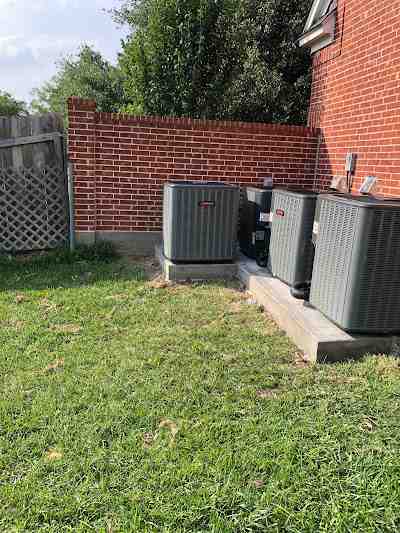
A pre-summer AC tune-up checklist for homeowners is one of the smartest things you can do before the Texas heat arrives. In Pinehurst, TX, temperatures climb fast — and when they do, your air conditioner needs to be ready.
Here’s a quick overview of the essential pre-summer AC tune-up tasks every homeowner should cover:
DIY Tasks:
1. Replace or inspect your air filter
2. Clear at least 2 feet around the outdoor condenser unit
3. Flush the condensate drain line with white vinegar
4. Test your thermostat by setting it several degrees below room temperature
5. Check all supply and return vents for blockages
6. Inspect refrigerant line insulation for cracks or damage
7. Run the system for a full cycle and listen for unusual noises
Professional Tasks:
1. Check and adjust refrigerant levels
2. Clean evaporator and condenser coils
3. Inspect and tighten electrical connections
4. Test capacitors and safety switches
5. Calibrate blower motor and thermostat
6. Verify system controls and starting cycle
7. Inspect condensate drain and drainage pan
Most homeowners don’t think about their AC until something goes wrong — usually on the hottest day of the year, when HVAC companies are fully booked and emergency service rates apply. Skipping routine maintenance doesn’t just risk a breakdown; it quietly chips away at your system’s efficiency every season. According to the U.S. Department of Energy, neglected systems can use up to 15% more energy than properly maintained ones. In a Texas summer that runs from May through September, that adds up fast.
The good news? A simple seasonal checklist — done in early spring before the rush — can keep your system running reliably all summer long.
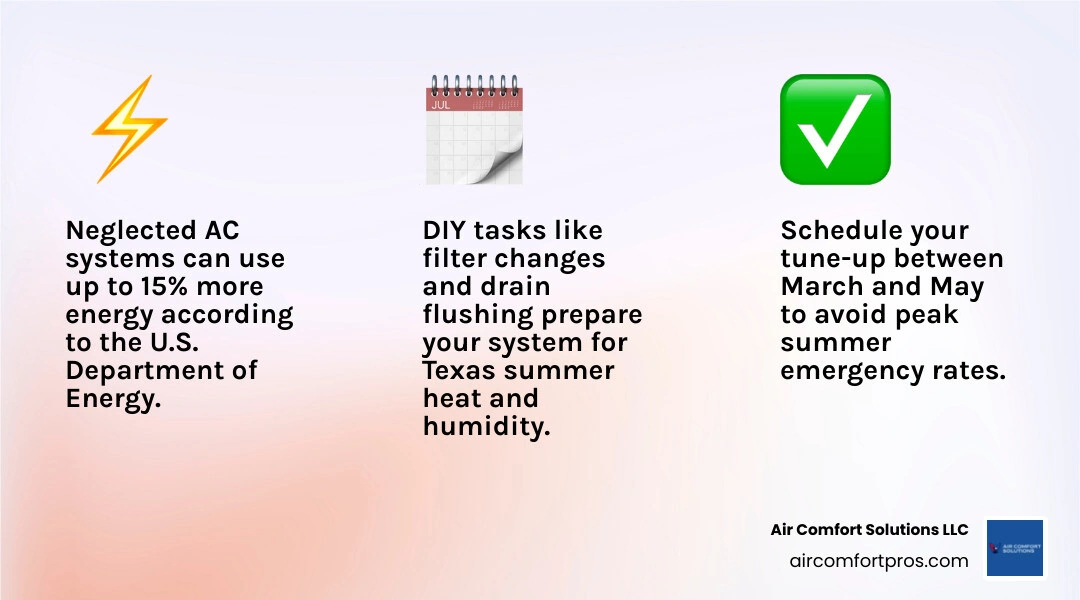
Living in the north side of Harris County, we know that summer isn’t just a season; it’s a marathon for our air conditioners. By the time May 2026 rolls around, our systems are already starting to feel the pressure of rising humidity and afternoon spikes. Using a pre-summer AC tune-up checklist for homeowners isn’t just about being organized; it’s about financial and mechanical survival.
One of the most immediate benefits of a tune-up is the impact on your monthly utility bills. When your system is clogged with dust or struggling with a worn-out capacitor, it has to run longer to reach your desired temperature. Statistics show that regular maintenance can reduce energy costs by up to 15%. In a large home in The Woodlands or Conroe, those savings can pay for the tune-up itself over a single summer.
When we optimize airflow, we ensure that every watt of electricity your system pulls is actually going toward cooling your home, rather than just fighting against friction and debris. You can learn more about this in our guide on AC Maintenance The Woodlands.
There is nothing quite like the panic of an AC failure during a July heatwave. Most system breakdowns are preventable. For example, a common cause of failure is a “slugging” compressor caused by a dirty evaporator coil or low refrigerant levels. By catching these issues in March or April, we prevent the “domino effect” where one small, cheap-to-fix part fails and takes out a major, expensive component with it. Understanding What Happens If You Skip AC Maintenance in Texas can help you visualize the risks of neglect, from frozen coils to total compressor burnout.
A central air conditioning system is a massive investment for any homeowner in Magnolia or Tomball. A well-maintained unit can easily last 15 to 20 years. Conversely, a neglected unit might start showing signs of terminal failure after just a decade. Think of a tune-up like an oil change for your car; you wouldn’t expect a truck to last 200,000 miles without maintenance, and your AC is no different. We’ve put together a comprehensive resource on How to Make Sure Your AC Survives a Texas Summer to help you maximize that lifespan.
Timing is everything. In our region, the “sweet spot” for your pre-summer AC tune-up checklist for homeowners is between March and early May. This allows you to beat the “June Rush” when every HVAC company in the Greater Houston area is swamped with emergency calls. By acting early, you ensure that if a part needs to be ordered, it arrives and is installed before the triple-digit temperatures arrive.
While we always recommend a professional for the technical “heavy lifting,” there are several tasks you can and should handle yourself to keep things running smoothly.
• Air Filter Replacement: This is the single most important DIY task. A clogged filter restricts airflow, forcing the blower motor to work harder and potentially causing the evaporator coil to freeze. We recommend checking your filter every 30 days during the peak summer months. For most homes in Pinehurst, a MERV 8 to MERV 11 filter provides the best balance of filtration and airflow.
• Clear the Perimeter: Your outdoor condenser unit needs to “breathe” to release the heat it pulls from your home. Ensure there is at least a 2-foot clearance around the unit. Trim back any bushes, remove tall weeds, and clear away any fallen leaves or debris that might be blocking the fins.
• Inspect the Suction Line: Look at the large copper pipe entering your outdoor unit. It should be covered in black foam insulation. If that insulation is cracked, missing, or brittle from the Texas sun, your system is losing cooling capacity before the air even reaches your vents.
• Vent Check: Walk through your home and make sure no furniture, rugs, or curtains are blocking the supply or return vents. Closing vents in unused rooms is actually a myth—it increases pressure in the ductwork and can lead to leaks or blower motor strain.
• Thermostat Battery Refresh: If your thermostat uses batteries, change them annually during your spring cleaning. A dead battery can lead to a “no-cool” situation that feels like a major breakdown but is actually a simple fix.
For a deeper dive into these steps, check out our AC Tuneup Spring TX Guide or our tips on Preparing Your Homes Cooling System for a Smooth Summer.

We often get asked, “How Often Should You Service Your AC in Texas?” The answer is twice a year: once in the spring for your cooling system and once in the fall for your heating system.
By scheduling your AC tune-up early, you avoid the seasonal backlog. By mid-June, most reputable companies are booked three to four weeks out for non-emergency services. If you wait until it’s 100 degrees outside to realize your AC isn’t cooling properly, you might be waiting in a very hot house for a technician to become available. Residents can find more localized advice in our AC Tuneup Tomball TX Complete Guide.
While DIY tasks are great for day-to-day upkeep, a professional tune-up is a deep-dive into the “health” of your system. When one of our certified technicians visits your home in Plantersville or Montgomery, they aren’t just looking to see if the air is cold; they are performing a forensic analysis of every component.
A professional visit starts with a thorough cleaning. We don’t just spray the outdoor unit with a hose; we often use specialized cleaners to remove the deep-seated dirt, pollen, and “cottonwood” seeds that can act as a blanket on your condenser coils. A dirty coil can reduce efficiency by 10% to 30% because it prevents the refrigerant from effectively releasing heat.
Inside the home, we inspect the evaporator coil. If this coil is dirty, it can lead to biological growth and poor indoor air quality. We also flush the condensate drain line. In our humid Texas climate, an AC unit can pull gallons of water out of the air every day. If that drain line clogs with algae or debris, it can back up and cause thousands of dollars in water damage to your ceilings or flooring.
Texas weather is hard on electrical components. The extreme heat, combined with occasional power surges from summer storms, can wear out capacitors and contactors. During a professional tune-up, we measure the “capacitance” of your start and run capacitors. If a capacitor is supposed to provide 35 microfarads but is only providing 30, it’s a ticking time bomb. Replacing it now prevents a service call later when the compressor fails to start on a Sunday afternoon.
We also tighten all electrical connections. Thermal cycling—the expansion and contraction of wires as they heat up and cool down—can actually loosen screws over time, leading to arcing or even fire hazards. You can read more about what to look for in our AC Maintenance Visit Complete Guide and What to Expect During Your First AC Tune-Up.
When we get into the technical weeds, we are looking at the “vitals” of the system. This includes:
• Filter Change — DIY or Professional?: DIY — Why It Matters: Prevents airflow restriction and frozen coils.
• Clear Debris — DIY or Professional?: DIY — Why It Matters: Ensures the outdoor unit can exhaust heat.
• Refrigerant Check — DIY or Professional?: Professional — Why It Matters: Essential for cooling; handling requires EPA certification.
• Amp Draw Test — DIY or Professional?: Professional — Why It Matters: Detects if motors are overworking or nearing failure.
• Capacitor Test — DIY or Professional?: Professional — Why It Matters: Ensures the “battery” for your motors is healthy.
• Coil Cleaning — DIY or Professional?: Professional — Why It Matters: Maximizes heat transfer and efficiency.
• Duct Inspection — DIY or Professional?: Professional — Why It Matters: Finds leaks that waste 20-30% of your cooled air.
Checking refrigerant levels is particularly critical. In Texas, we only use EPA Section 608-certified technicians because handling refrigerant is federally regulated. If your system is low on refrigerant, it means you have a leak. Simply “topping it off” is a temporary fix that wastes money and harms the environment. We find the leak, fix it, and then recharge the system to manufacturer specifications.
For those looking for a worry-free experience, many neighbors opt for a formal plan. You can see the details in our guide on What Does an HVAC Maintenance Plan Include and check out our local AC Tuneup Pinehurst TX Complete Guide.
Even with a pre-summer AC tune-up checklist for homeowners, your system might send you “S.O.S.” signals. Knowing how to read these can save you from a total system collapse.
• Weak Airflow: If you feel like the air coming out of your vents is more of a “whisper” than a “breeze,” you likely have a clogged filter, a failing blower motor, or a major duct leak.
• Warm Air: If the air isn’t icy cold, your refrigerant levels might be low, or your compressor might be struggling.
• Frequent Cycling: If your AC turns on and off every few minutes, it’s “short-cycling.” This is incredibly hard on the equipment and is often caused by an oversized unit or a malfunctioning thermostat.
• Unusual Noises: Squealing usually indicates a belt or motor issue. Banging or clanging often means something is loose in the blower assembly. Hissing is a classic sign of a refrigerant leak.
• Ice Formation: If you see ice on the copper lines outside or on the indoor unit, turn the system off immediately. Running a frozen AC can destroy the compressor. Ice is usually caused by restricted airflow or low refrigerant.
• Odors: A “dirty sock” smell usually indicates biological growth on the coils, while a burning smell suggests an electrical component is overheating.
If your system is older and experiencing these issues frequently, it might be time to look at Optimal Times for Upgrading Your Homes Air Conditioning System.
A thorough professional tune-up typically takes between 1 and 2 hours per system. If a technician is in and out in 15 minutes, they likely didn’t perform a full cleaning or electrical check. At Air Comfort Solutions, we take the time to run the system through a full cooling cycle to verify that the “delta T” (the temperature difference between the return and supply air) is within the ideal 15-20 degree range.
Most homeowners find that maintenance plans are well worth the investment. Beyond the two annual visits, our plan members usually receive priority scheduling—which is a lifesaver when the Pinehurst heat hits 105 degrees—and discounts on any repairs that might be needed. It’s essentially “insurance” for your comfort. You can explore the math behind this in our article: Is an HVAC Maintenance Plan Worth It.
At Air Comfort Solutions, we’ve been serving the Pinehurst, TX community and the north side of Harris County for over 35 years. We aren’t just technicians; we’re your neighbors. We understand the specific challenges that Texas humidity and dust put on a cooling system.
Our team provides honest, reliable solutions and upfront pricing so you never have to guess what you’re paying for. Whether you’re in Magnolia, The Woodlands, or right here in Pinehurst, we’re ready to help you cross every item off your pre-summer AC tune-up checklist for homeowners.
Don’t wait for the first heatwave to find out your AC isn’t up to the task. Secure your family’s comfort and your system’s efficiency today.
Ready to get your system in top shape? View our Maintenance Plan and schedule your visit today!
A pre-summer AC tune-up checklist for homeowners is one of the smartest things you can do before the Texas heat arrives. In Pinehurst, TX, temperatures climb fast — and when they do, your air conditioner needs to be ready.
Here's a quick overview of the essential pre-summer AC tune-up tasks every homeowner should cover:
DIY Tasks:
Professional Tasks:
Most homeowners don't think about their AC until something goes wrong — usually on the hottest day of the year, when HVAC companies are fully booked and emergency service rates apply. Skipping routine maintenance doesn't just risk a breakdown; it quietly chips away at your system's efficiency every season. According to the U.S. Department of Energy, neglected systems can use up to 15% more energy than properly maintained ones. In a Texas summer that runs from May through September, that adds up fast.
The good news? A simple seasonal checklist — done in early spring before the rush — can keep your system running reliably all summer long.
Living in the north side of Harris County, we know that summer isn't just a season; it's a marathon for our air conditioners. By the time May 2026 rolls around, our systems are already starting to feel the pressure of rising humidity and afternoon spikes. Using a pre-summer AC tune-up checklist for homeowners isn't just about being organized; it’s about financial and mechanical survival.
One of the most immediate benefits of a tune-up is the impact on your monthly utility bills. When your system is clogged with dust or struggling with a worn-out capacitor, it has to run longer to reach your desired temperature. Statistics show that regular maintenance can reduce energy costs by up to 15%. In a large home in The Woodlands or Conroe, those savings can pay for the tune-up itself over a single summer.
When we optimize airflow, we ensure that every watt of electricity your system pulls is actually going toward cooling your home, rather than just fighting against friction and debris. You can learn more about this in our guide on AC Maintenance The Woodlands.
There is nothing quite like the panic of an AC failure during a July heatwave. Most system breakdowns are preventable. For example, a common cause of failure is a "slugging" compressor caused by a dirty evaporator coil or low refrigerant levels. By catching these issues in March or April, we prevent the "domino effect" where one small, cheap-to-fix part fails and takes out a major, expensive component with it. Understanding What Happens If You Skip AC Maintenance in Texas can help you visualize the risks of neglect, from frozen coils to total compressor burnout.
A central air conditioning system is a massive investment for any homeowner in Magnolia or Tomball. A well-maintained unit can easily last 15 to 20 years. Conversely, a neglected unit might start showing signs of terminal failure after just a decade. Think of a tune-up like an oil change for your car; you wouldn't expect a truck to last 200,000 miles without maintenance, and your AC is no different. We’ve put together a comprehensive resource on How to Make Sure Your AC Survives a Texas Summer to help you maximize that lifespan.
Timing is everything. In our region, the "sweet spot" for your pre-summer AC tune-up checklist for homeowners is between March and early May. This allows you to beat the "June Rush" when every HVAC company in the Greater Houston area is swamped with emergency calls. By acting early, you ensure that if a part needs to be ordered, it arrives and is installed before the triple-digit temperatures arrive.
While we always recommend a professional for the technical "heavy lifting," there are several tasks you can and should handle yourself to keep things running smoothly.
For a deeper dive into these steps, check out our AC Tuneup Spring TX Guide or our tips on Preparing Your Homes Cooling System for a Smooth Summer.
We often get asked, "How Often Should You Service Your AC in Texas?" The answer is twice a year: once in the spring for your cooling system and once in the fall for your heating system.
By scheduling your AC tune-up early, you avoid the seasonal backlog. By mid-June, most reputable companies are booked three to four weeks out for non-emergency services. If you wait until it's 100 degrees outside to realize your AC isn't cooling properly, you might be waiting in a very hot house for a technician to become available. Residents can find more localized advice in our AC Tuneup Tomball TX Complete Guide.
While DIY tasks are great for day-to-day upkeep, a professional tune-up is a deep-dive into the "health" of your system. When one of our certified technicians visits your home in Plantersville or Montgomery, they aren't just looking to see if the air is cold; they are performing a forensic analysis of every component.
A professional visit starts with a thorough cleaning. We don't just spray the outdoor unit with a hose; we often use specialized cleaners to remove the deep-seated dirt, pollen, and "cottonwood" seeds that can act as a blanket on your condenser coils. A dirty coil can reduce efficiency by 10% to 30% because it prevents the refrigerant from effectively releasing heat.
Inside the home, we inspect the evaporator coil. If this coil is dirty, it can lead to biological growth and poor indoor air quality. We also flush the condensate drain line. In our humid Texas climate, an AC unit can pull gallons of water out of the air every day. If that drain line clogs with algae or debris, it can back up and cause thousands of dollars in water damage to your ceilings or flooring.
Texas weather is hard on electrical components. The extreme heat, combined with occasional power surges from summer storms, can wear out capacitors and contactors. During a professional tune-up, we measure the "capacitance" of your start and run capacitors. If a capacitor is supposed to provide 35 microfarads but is only providing 30, it’s a ticking time bomb. Replacing it now prevents a service call later when the compressor fails to start on a Sunday afternoon.
We also tighten all electrical connections. Thermal cycling—the expansion and contraction of wires as they heat up and cool down—can actually loosen screws over time, leading to arcing or even fire hazards. You can read more about what to look for in our AC Maintenance Visit Complete Guide and What to Expect During Your First AC Tune-Up.
When we get into the technical weeds, we are looking at the "vitals" of the system. This includes:
| Task | DIY or Professional? | Why It Matters |
|---|---|---|
| Filter Change | DIY | Prevents airflow restriction and frozen coils. |
| Clear Debris | DIY | Ensures the outdoor unit can exhaust heat. |
| Refrigerant Check | Professional | Essential for cooling; handling requires EPA certification. |
| Amp Draw Test | Professional | Detects if motors are overworking or nearing failure. |
| Capacitor Test | Professional | Ensures the "battery" for your motors is healthy. |
| Coil Cleaning | Professional | Maximizes heat transfer and efficiency. |
| Duct Inspection | Professional | Finds leaks that waste 20-30% of your cooled air. |
Checking refrigerant levels is particularly critical. In Texas, we only use EPA Section 608-certified technicians because handling refrigerant is federally regulated. If your system is low on refrigerant, it means you have a leak. Simply "topping it off" is a temporary fix that wastes money and harms the environment. We find the leak, fix it, and then recharge the system to manufacturer specifications.
For those looking for a worry-free experience, many neighbors opt for a formal plan. You can see the details in our guide on What Does an HVAC Maintenance Plan Include and check out our local AC Tuneup Pinehurst TX Complete Guide.
Even with a pre-summer AC tune-up checklist for homeowners, your system might send you "S.O.S." signals. Knowing how to read these can save you from a total system collapse.
If your system is older and experiencing these issues frequently, it might be time to look at Optimal Times for Upgrading Your Homes Air Conditioning System.
A thorough professional tune-up typically takes between 1 and 2 hours per system. If a technician is in and out in 15 minutes, they likely didn't perform a full cleaning or electrical check. At Air Comfort Pros, we take the time to run the system through a full cooling cycle to verify that the "delta T" (the temperature difference between the return and supply air) is within the ideal 15-20 degree range.
Most homeowners find that maintenance plans are well worth the investment. Beyond the two annual visits, our plan members usually receive priority scheduling—which is a lifesaver when the Pinehurst heat hits 105 degrees—and discounts on any repairs that might be needed. It’s essentially "insurance" for your comfort. You can explore the math behind this in our article: Is an HVAC Maintenance Plan Worth It.
At Air Comfort Pros, we’ve been serving the Pinehurst, TX community and the north side of Harris County for over 35 years. We aren't just technicians; we’re your neighbors. We understand the specific challenges that Texas humidity and dust put on a cooling system.
Our team provides honest, reliable solutions and upfront pricing so you never have to guess what you’re paying for. Whether you’re in Magnolia, The Woodlands, or right here in Pinehurst, we’re ready to help you cross every item off your pre-summer AC tune-up checklist for homeowners.
Don't wait for the first heatwave to find out your AC isn't up to the task. Secure your family's comfort and your system's efficiency today.
Ready to get your system in top shape? View our Maintenance Plan and schedule your visit today!
A pre-summer AC tune-up checklist for homeowners is one of the smartest things you can do before the Texas heat arrives. In Pinehurst, TX, temperatures climb fast — and when they do, your air conditioner needs to be ready.
Here's a quick overview of the essential pre-summer AC tune-up tasks every homeowner should cover:
DIY Tasks:
Professional Tasks:
Most homeowners don't think about their AC until something goes wrong — usually on the hottest day of the year, when HVAC companies are fully booked and emergency service rates apply. Skipping routine maintenance doesn't just risk a breakdown; it quietly chips away at your system's efficiency every season. According to the U.S. Department of Energy, neglected systems can use up to 15% more energy than properly maintained ones. In a Texas summer that runs from May through September, that adds up fast.
The good news? A simple seasonal checklist — done in early spring before the rush — can keep your system running reliably all summer long.
Living in the north side of Harris County, we know that summer isn't just a season; it's a marathon for our air conditioners. By the time May 2026 rolls around, our systems are already starting to feel the pressure of rising humidity and afternoon spikes. Using a pre-summer AC tune-up checklist for homeowners isn't just about being organized; it’s about financial and mechanical survival.
One of the most immediate benefits of a tune-up is the impact on your monthly utility bills. When your system is clogged with dust or struggling with a worn-out capacitor, it has to run longer to reach your desired temperature. Statistics show that regular maintenance can reduce energy costs by up to 15%. In a large home in The Woodlands or Conroe, those savings can pay for the tune-up itself over a single summer.
When we optimize airflow, we ensure that every watt of electricity your system pulls is actually going toward cooling your home, rather than just fighting against friction and debris. You can learn more about this in our guide on AC Maintenance The Woodlands.
There is nothing quite like the panic of an AC failure during a July heatwave. Most system breakdowns are preventable. For example, a common cause of failure is a "slugging" compressor caused by a dirty evaporator coil or low refrigerant levels. By catching these issues in March or April, we prevent the "domino effect" where one small, cheap-to-fix part fails and takes out a major, expensive component with it. Understanding What Happens If You Skip AC Maintenance in Texas can help you visualize the risks of neglect, from frozen coils to total compressor burnout.
A central air conditioning system is a massive investment for any homeowner in Magnolia or Tomball. A well-maintained unit can easily last 15 to 20 years. Conversely, a neglected unit might start showing signs of terminal failure after just a decade. Think of a tune-up like an oil change for your car; you wouldn't expect a truck to last 200,000 miles without maintenance, and your AC is no different. We’ve put together a comprehensive resource on How to Make Sure Your AC Survives a Texas Summer to help you maximize that lifespan.
Timing is everything. In our region, the "sweet spot" for your pre-summer AC tune-up checklist for homeowners is between March and early May. This allows you to beat the "June Rush" when every HVAC company in the Greater Houston area is swamped with emergency calls. By acting early, you ensure that if a part needs to be ordered, it arrives and is installed before the triple-digit temperatures arrive.
While we always recommend a professional for the technical "heavy lifting," there are several tasks you can and should handle yourself to keep things running smoothly.
For a deeper dive into these steps, check out our AC Tuneup Spring TX Guide or our tips on Preparing Your Homes Cooling System for a Smooth Summer.
We often get asked, "How Often Should You Service Your AC in Texas?" The answer is twice a year: once in the spring for your cooling system and once in the fall for your heating system.
By scheduling your AC tune-up early, you avoid the seasonal backlog. By mid-June, most reputable companies are booked three to four weeks out for non-emergency services. If you wait until it's 100 degrees outside to realize your AC isn't cooling properly, you might be waiting in a very hot house for a technician to become available. Residents can find more localized advice in our AC Tuneup Tomball TX Complete Guide.
While DIY tasks are great for day-to-day upkeep, a professional tune-up is a deep-dive into the "health" of your system. When one of our certified technicians visits your home in Plantersville or Montgomery, they aren't just looking to see if the air is cold; they are performing a forensic analysis of every component.
A professional visit starts with a thorough cleaning. We don't just spray the outdoor unit with a hose; we often use specialized cleaners to remove the deep-seated dirt, pollen, and "cottonwood" seeds that can act as a blanket on your condenser coils. A dirty coil can reduce efficiency by 10% to 30% because it prevents the refrigerant from effectively releasing heat.
Inside the home, we inspect the evaporator coil. If this coil is dirty, it can lead to biological growth and poor indoor air quality. We also flush the condensate drain line. In our humid Texas climate, an AC unit can pull gallons of water out of the air every day. If that drain line clogs with algae or debris, it can back up and cause thousands of dollars in water damage to your ceilings or flooring.
Texas weather is hard on electrical components. The extreme heat, combined with occasional power surges from summer storms, can wear out capacitors and contactors. During a professional tune-up, we measure the "capacitance" of your start and run capacitors. If a capacitor is supposed to provide 35 microfarads but is only providing 30, it’s a ticking time bomb. Replacing it now prevents a service call later when the compressor fails to start on a Sunday afternoon.
We also tighten all electrical connections. Thermal cycling—the expansion and contraction of wires as they heat up and cool down—can actually loosen screws over time, leading to arcing or even fire hazards. You can read more about what to look for in our AC Maintenance Visit Complete Guide and What to Expect During Your First AC Tune-Up.
When we get into the technical weeds, we are looking at the "vitals" of the system. This includes:
| Task | DIY or Professional? | Why It Matters |
|---|---|---|
| Filter Change | DIY | Prevents airflow restriction and frozen coils. |
| Clear Debris | DIY | Ensures the outdoor unit can exhaust heat. |
| Refrigerant Check | Professional | Essential for cooling; handling requires EPA certification. |
| Amp Draw Test | Professional | Detects if motors are overworking or nearing failure. |
| Capacitor Test | Professional | Ensures the "battery" for your motors is healthy. |
| Coil Cleaning | Professional | Maximizes heat transfer and efficiency. |
| Duct Inspection | Professional | Finds leaks that waste 20-30% of your cooled air. |
Checking refrigerant levels is particularly critical. In Texas, we only use EPA Section 608-certified technicians because handling refrigerant is federally regulated. If your system is low on refrigerant, it means you have a leak. Simply "topping it off" is a temporary fix that wastes money and harms the environment. We find the leak, fix it, and then recharge the system to manufacturer specifications.
For those looking for a worry-free experience, many neighbors opt for a formal plan. You can see the details in our guide on What Does an HVAC Maintenance Plan Include and check out our local AC Tuneup Pinehurst TX Complete Guide.
Even with a pre-summer AC tune-up checklist for homeowners, your system might send you "S.O.S." signals. Knowing how to read these can save you from a total system collapse.
If your system is older and experiencing these issues frequently, it might be time to look at Optimal Times for Upgrading Your Homes Air Conditioning System.
A thorough professional tune-up typically takes between 1 and 2 hours per system. If a technician is in and out in 15 minutes, they likely didn't perform a full cleaning or electrical check. At Air Comfort Pros, we take the time to run the system through a full cooling cycle to verify that the "delta T" (the temperature difference between the return and supply air) is within the ideal 15-20 degree range.
Most homeowners find that maintenance plans are well worth the investment. Beyond the two annual visits, our plan members usually receive priority scheduling—which is a lifesaver when the Pinehurst heat hits 105 degrees—and discounts on any repairs that might be needed. It’s essentially "insurance" for your comfort. You can explore the math behind this in our article: Is an HVAC Maintenance Plan Worth It.
At Air Comfort Pros, we’ve been serving the Pinehurst, TX community and the north side of Harris County for over 35 years. We aren't just technicians; we’re your neighbors. We understand the specific challenges that Texas humidity and dust put on a cooling system.
Our team provides honest, reliable solutions and upfront pricing so you never have to guess what you’re paying for. Whether you’re in Magnolia, The Woodlands, or right here in Pinehurst, we’re ready to help you cross every item off your pre-summer AC tune-up checklist for homeowners.
Don't wait for the first heatwave to find out your AC isn't up to the task. Secure your family's comfort and your system's efficiency today.
Ready to get your system in top shape? View our Maintenance Plan and schedule your visit today!
A pre-summer AC tune-up checklist for homeowners is one of the smartest things you can do before the Texas heat arrives. In Pinehurst, TX, temperatures climb fast — and when they do, your air conditioner needs to be ready.
Here's a quick overview of the essential pre-summer AC tune-up tasks every homeowner should cover:
DIY Tasks:
Professional Tasks:
Most homeowners don't think about their AC until something goes wrong — usually on the hottest day of the year, when HVAC companies are fully booked and emergency service rates apply. Skipping routine maintenance doesn't just risk a breakdown; it quietly chips away at your system's efficiency every season. According to the U.S. Department of Energy, neglected systems can use up to 15% more energy than properly maintained ones. In a Texas summer that runs from May through September, that adds up fast.
The good news? A simple seasonal checklist — done in early spring before the rush — can keep your system running reliably all summer long.
Living in the north side of Harris County, we know that summer isn't just a season; it's a marathon for our air conditioners. By the time May 2026 rolls around, our systems are already starting to feel the pressure of rising humidity and afternoon spikes. Using a pre-summer AC tune-up checklist for homeowners isn't just about being organized; it’s about financial and mechanical survival.
One of the most immediate benefits of a tune-up is the impact on your monthly utility bills. When your system is clogged with dust or struggling with a worn-out capacitor, it has to run longer to reach your desired temperature. Statistics show that regular maintenance can reduce energy costs by up to 15%. In a large home in The Woodlands or Conroe, those savings can pay for the tune-up itself over a single summer.
When we optimize airflow, we ensure that every watt of electricity your system pulls is actually going toward cooling your home, rather than just fighting against friction and debris. You can learn more about this in our guide on AC Maintenance The Woodlands.
There is nothing quite like the panic of an AC failure during a July heatwave. Most system breakdowns are preventable. For example, a common cause of failure is a "slugging" compressor caused by a dirty evaporator coil or low refrigerant levels. By catching these issues in March or April, we prevent the "domino effect" where one small, cheap-to-fix part fails and takes out a major, expensive component with it. Understanding What Happens If You Skip AC Maintenance in Texas can help you visualize the risks of neglect, from frozen coils to total compressor burnout.
A central air conditioning system is a massive investment for any homeowner in Magnolia or Tomball. A well-maintained unit can easily last 15 to 20 years. Conversely, a neglected unit might start showing signs of terminal failure after just a decade. Think of a tune-up like an oil change for your car; you wouldn't expect a truck to last 200,000 miles without maintenance, and your AC is no different. We’ve put together a comprehensive resource on How to Make Sure Your AC Survives a Texas Summer to help you maximize that lifespan.
Timing is everything. In our region, the "sweet spot" for your pre-summer AC tune-up checklist for homeowners is between March and early May. This allows you to beat the "June Rush" when every HVAC company in the Greater Houston area is swamped with emergency calls. By acting early, you ensure that if a part needs to be ordered, it arrives and is installed before the triple-digit temperatures arrive.
While we always recommend a professional for the technical "heavy lifting," there are several tasks you can and should handle yourself to keep things running smoothly.
For a deeper dive into these steps, check out our AC Tuneup Spring TX Guide or our tips on Preparing Your Homes Cooling System for a Smooth Summer.
We often get asked, "How Often Should You Service Your AC in Texas?" The answer is twice a year: once in the spring for your cooling system and once in the fall for your heating system.
By scheduling your AC tune-up early, you avoid the seasonal backlog. By mid-June, most reputable companies are booked three to four weeks out for non-emergency services. If you wait until it's 100 degrees outside to realize your AC isn't cooling properly, you might be waiting in a very hot house for a technician to become available. Residents can find more localized advice in our AC Tuneup Tomball TX Complete Guide.
While DIY tasks are great for day-to-day upkeep, a professional tune-up is a deep-dive into the "health" of your system. When one of our certified technicians visits your home in Plantersville or Montgomery, they aren't just looking to see if the air is cold; they are performing a forensic analysis of every component.
A professional visit starts with a thorough cleaning. We don't just spray the outdoor unit with a hose; we often use specialized cleaners to remove the deep-seated dirt, pollen, and "cottonwood" seeds that can act as a blanket on your condenser coils. A dirty coil can reduce efficiency by 10% to 30% because it prevents the refrigerant from effectively releasing heat.
Inside the home, we inspect the evaporator coil. If this coil is dirty, it can lead to biological growth and poor indoor air quality. We also flush the condensate drain line. In our humid Texas climate, an AC unit can pull gallons of water out of the air every day. If that drain line clogs with algae or debris, it can back up and cause thousands of dollars in water damage to your ceilings or flooring.
Texas weather is hard on electrical components. The extreme heat, combined with occasional power surges from summer storms, can wear out capacitors and contactors. During a professional tune-up, we measure the "capacitance" of your start and run capacitors. If a capacitor is supposed to provide 35 microfarads but is only providing 30, it’s a ticking time bomb. Replacing it now prevents a service call later when the compressor fails to start on a Sunday afternoon.
We also tighten all electrical connections. Thermal cycling—the expansion and contraction of wires as they heat up and cool down—can actually loosen screws over time, leading to arcing or even fire hazards. You can read more about what to look for in our AC Maintenance Visit Complete Guide and What to Expect During Your First AC Tune-Up.
When we get into the technical weeds, we are looking at the "vitals" of the system. This includes:
| Task | DIY or Professional? | Why It Matters |
|---|---|---|
| Filter Change | DIY | Prevents airflow restriction and frozen coils. |
| Clear Debris | DIY | Ensures the outdoor unit can exhaust heat. |
| Refrigerant Check | Professional | Essential for cooling; handling requires EPA certification. |
| Amp Draw Test | Professional | Detects if motors are overworking or nearing failure. |
| Capacitor Test | Professional | Ensures the "battery" for your motors is healthy. |
| Coil Cleaning | Professional | Maximizes heat transfer and efficiency. |
| Duct Inspection | Professional | Finds leaks that waste 20-30% of your cooled air. |
Checking refrigerant levels is particularly critical. In Texas, we only use EPA Section 608-certified technicians because handling refrigerant is federally regulated. If your system is low on refrigerant, it means you have a leak. Simply "topping it off" is a temporary fix that wastes money and harms the environment. We find the leak, fix it, and then recharge the system to manufacturer specifications.
For those looking for a worry-free experience, many neighbors opt for a formal plan. You can see the details in our guide on What Does an HVAC Maintenance Plan Include and check out our local AC Tuneup Pinehurst TX Complete Guide.
Even with a pre-summer AC tune-up checklist for homeowners, your system might send you "S.O.S." signals. Knowing how to read these can save you from a total system collapse.
If your system is older and experiencing these issues frequently, it might be time to look at Optimal Times for Upgrading Your Homes Air Conditioning System.
A thorough professional tune-up typically takes between 1 and 2 hours per system. If a technician is in and out in 15 minutes, they likely didn't perform a full cleaning or electrical check. At Air Comfort Pros, we take the time to run the system through a full cooling cycle to verify that the "delta T" (the temperature difference between the return and supply air) is within the ideal 15-20 degree range.
Most homeowners find that maintenance plans are well worth the investment. Beyond the two annual visits, our plan members usually receive priority scheduling—which is a lifesaver when the Pinehurst heat hits 105 degrees—and discounts on any repairs that might be needed. It’s essentially "insurance" for your comfort. You can explore the math behind this in our article: Is an HVAC Maintenance Plan Worth It.
At Air Comfort Pros, we’ve been serving the Pinehurst, TX community and the north side of Harris County for over 35 years. We aren't just technicians; we’re your neighbors. We understand the specific challenges that Texas humidity and dust put on a cooling system.
Our team provides honest, reliable solutions and upfront pricing so you never have to guess what you’re paying for. Whether you’re in Magnolia, The Woodlands, or right here in Pinehurst, we’re ready to help you cross every item off your pre-summer AC tune-up checklist for homeowners.
Don't wait for the first heatwave to find out your AC isn't up to the task. Secure your family's comfort and your system's efficiency today.
Ready to get your system in top shape? View our Maintenance Plan and schedule your visit today!
A pre-summer AC tune-up checklist for homeowners is one of the smartest things you can do before the Texas heat arrives. In Pinehurst, TX, temperatures climb fast — and when they do, your air conditioner needs to be ready.
Here's a quick overview of the essential pre-summer AC tune-up tasks every homeowner should cover:
DIY Tasks:
Professional Tasks:
Most homeowners don't think about their AC until something goes wrong — usually on the hottest day of the year, when HVAC companies are fully booked and emergency service rates apply. Skipping routine maintenance doesn't just risk a breakdown; it quietly chips away at your system's efficiency every season. According to the U.S. Department of Energy, neglected systems can use up to 15% more energy than properly maintained ones. In a Texas summer that runs from May through September, that adds up fast.
The good news? A simple seasonal checklist — done in early spring before the rush — can keep your system running reliably all summer long.
Living in the north side of Harris County, we know that summer isn't just a season; it's a marathon for our air conditioners. By the time May 2026 rolls around, our systems are already starting to feel the pressure of rising humidity and afternoon spikes. Using a pre-summer AC tune-up checklist for homeowners isn't just about being organized; it’s about financial and mechanical survival.
One of the most immediate benefits of a tune-up is the impact on your monthly utility bills. When your system is clogged with dust or struggling with a worn-out capacitor, it has to run longer to reach your desired temperature. Statistics show that regular maintenance can reduce energy costs by up to 15%. In a large home in The Woodlands or Conroe, those savings can pay for the tune-up itself over a single summer.
When we optimize airflow, we ensure that every watt of electricity your system pulls is actually going toward cooling your home, rather than just fighting against friction and debris. You can learn more about this in our guide on AC Maintenance The Woodlands.
There is nothing quite like the panic of an AC failure during a July heatwave. Most system breakdowns are preventable. For example, a common cause of failure is a "slugging" compressor caused by a dirty evaporator coil or low refrigerant levels. By catching these issues in March or April, we prevent the "domino effect" where one small, cheap-to-fix part fails and takes out a major, expensive component with it. Understanding What Happens If You Skip AC Maintenance in Texas can help you visualize the risks of neglect, from frozen coils to total compressor burnout.
A central air conditioning system is a massive investment for any homeowner in Magnolia or Tomball. A well-maintained unit can easily last 15 to 20 years. Conversely, a neglected unit might start showing signs of terminal failure after just a decade. Think of a tune-up like an oil change for your car; you wouldn't expect a truck to last 200,000 miles without maintenance, and your AC is no different. We’ve put together a comprehensive resource on How to Make Sure Your AC Survives a Texas Summer to help you maximize that lifespan.
Timing is everything. In our region, the "sweet spot" for your pre-summer AC tune-up checklist for homeowners is between March and early May. This allows you to beat the "June Rush" when every HVAC company in the Greater Houston area is swamped with emergency calls. By acting early, you ensure that if a part needs to be ordered, it arrives and is installed before the triple-digit temperatures arrive.
While we always recommend a professional for the technical "heavy lifting," there are several tasks you can and should handle yourself to keep things running smoothly.
For a deeper dive into these steps, check out our AC Tuneup Spring TX Guide or our tips on Preparing Your Homes Cooling System for a Smooth Summer.
We often get asked, "How Often Should You Service Your AC in Texas?" The answer is twice a year: once in the spring for your cooling system and once in the fall for your heating system.
By scheduling your AC tune-up early, you avoid the seasonal backlog. By mid-June, most reputable companies are booked three to four weeks out for non-emergency services. If you wait until it's 100 degrees outside to realize your AC isn't cooling properly, you might be waiting in a very hot house for a technician to become available. Residents can find more localized advice in our AC Tuneup Tomball TX Complete Guide.
While DIY tasks are great for day-to-day upkeep, a professional tune-up is a deep-dive into the "health" of your system. When one of our certified technicians visits your home in Plantersville or Montgomery, they aren't just looking to see if the air is cold; they are performing a forensic analysis of every component.
A professional visit starts with a thorough cleaning. We don't just spray the outdoor unit with a hose; we often use specialized cleaners to remove the deep-seated dirt, pollen, and "cottonwood" seeds that can act as a blanket on your condenser coils. A dirty coil can reduce efficiency by 10% to 30% because it prevents the refrigerant from effectively releasing heat.
Inside the home, we inspect the evaporator coil. If this coil is dirty, it can lead to biological growth and poor indoor air quality. We also flush the condensate drain line. In our humid Texas climate, an AC unit can pull gallons of water out of the air every day. If that drain line clogs with algae or debris, it can back up and cause thousands of dollars in water damage to your ceilings or flooring.
Texas weather is hard on electrical components. The extreme heat, combined with occasional power surges from summer storms, can wear out capacitors and contactors. During a professional tune-up, we measure the "capacitance" of your start and run capacitors. If a capacitor is supposed to provide 35 microfarads but is only providing 30, it’s a ticking time bomb. Replacing it now prevents a service call later when the compressor fails to start on a Sunday afternoon.
We also tighten all electrical connections. Thermal cycling—the expansion and contraction of wires as they heat up and cool down—can actually loosen screws over time, leading to arcing or even fire hazards. You can read more about what to look for in our AC Maintenance Visit Complete Guide and What to Expect During Your First AC Tune-Up.
When we get into the technical weeds, we are looking at the "vitals" of the system. This includes:
| Task | DIY or Professional? | Why It Matters |
|---|---|---|
| Filter Change | DIY | Prevents airflow restriction and frozen coils. |
| Clear Debris | DIY | Ensures the outdoor unit can exhaust heat. |
| Refrigerant Check | Professional | Essential for cooling; handling requires EPA certification. |
| Amp Draw Test | Professional | Detects if motors are overworking or nearing failure. |
| Capacitor Test | Professional | Ensures the "battery" for your motors is healthy. |
| Coil Cleaning | Professional | Maximizes heat transfer and efficiency. |
| Duct Inspection | Professional | Finds leaks that waste 20-30% of your cooled air. |
Checking refrigerant levels is particularly critical. In Texas, we only use EPA Section 608-certified technicians because handling refrigerant is federally regulated. If your system is low on refrigerant, it means you have a leak. Simply "topping it off" is a temporary fix that wastes money and harms the environment. We find the leak, fix it, and then recharge the system to manufacturer specifications.
For those looking for a worry-free experience, many neighbors opt for a formal plan. You can see the details in our guide on What Does an HVAC Maintenance Plan Include and check out our local AC Tuneup Pinehurst TX Complete Guide.
Even with a pre-summer AC tune-up checklist for homeowners, your system might send you "S.O.S." signals. Knowing how to read these can save you from a total system collapse.
If your system is older and experiencing these issues frequently, it might be time to look at Optimal Times for Upgrading Your Homes Air Conditioning System.
A thorough professional tune-up typically takes between 1 and 2 hours per system. If a technician is in and out in 15 minutes, they likely didn't perform a full cleaning or electrical check. At Air Comfort Pros, we take the time to run the system through a full cooling cycle to verify that the "delta T" (the temperature difference between the return and supply air) is within the ideal 15-20 degree range.
Most homeowners find that maintenance plans are well worth the investment. Beyond the two annual visits, our plan members usually receive priority scheduling—which is a lifesaver when the Pinehurst heat hits 105 degrees—and discounts on any repairs that might be needed. It’s essentially "insurance" for your comfort. You can explore the math behind this in our article: Is an HVAC Maintenance Plan Worth It.
At Air Comfort Pros, we’ve been serving the Pinehurst, TX community and the north side of Harris County for over 35 years. We aren't just technicians; we’re your neighbors. We understand the specific challenges that Texas humidity and dust put on a cooling system.
Our team provides honest, reliable solutions and upfront pricing so you never have to guess what you’re paying for. Whether you’re in Magnolia, The Woodlands, or right here in Pinehurst, we’re ready to help you cross every item off your pre-summer AC tune-up checklist for homeowners.
Don't wait for the first heatwave to find out your AC isn't up to the task. Secure your family's comfort and your system's efficiency today.
Ready to get your system in top shape? View our Maintenance Plan and schedule your visit today!


Zane came out and did an amazing job! Super friendly, honest and transparent about the work that needed to be done. This is my second time working with Air Comfort Solutions and they’re my go to for HVAC services. Highly recommend.
God's AMAZING grace sent us Robert and Zane. We have been without air in this Texas heat for six weeks and four days. We've had a few contractors give us quotes all trying to upsell when we're at a low point. But not the guys at Air Comfort Solutions. They came in assessed our situation, gave us honest feedback, and showed us the issues as they proceeded with the assessment for clear understanding. We highly recommend them for their professionalism, quality products, and fair pricing. We hands down support them for all the work they do 💯 %.
Robert and Zane gone above and beyond to make the process easy and affordable.
Would definitely recommend!!
I’m writing this review to let everyone know that Air Comfort Solutions is the company to work with. I know the owner ( Robert) for several years now. He has been taking care of my residential and business work orders. Robert is professional, knowledgeable and will save you money. I just want to thank Robert for great job you have been doing for me.