How Mild September Days Expose Oversized Air Conditioners
How Mild September Days Expose Oversized Air Conditioners
The September Transition: When Cooler Weather Creates Clammy Homes
Before the first true cold front arrives, understanding how mild September days expose oversized air conditioners can finally explain why your living room feels like a damp cave. The transition from peak summer heat to early fall brings a distinct shift in weather patterns. The outdoor temperatures begin to drop, offering a brief respite from the relentless sun, but the heavy moisture in the air often lingers. In our years of serving Pinehurst, TX, and across Southeast Texas, the team at Air Comfort Solutions has seen exactly how September brings lower sensible heat—meaning the actual temperature drops—but retains incredibly high latent heat, which is the humidity and dew point. This creates the perfect storm for home comfort issues.
You might notice a frustrating pattern during these early fall temperatures. Your cooling system kicks on, blasts freezing air into the room, and shuts off just a few minutes later. The thermostat reads a perfect 72 degrees, yet your skin feels sticky, the floors feel slick, and the air carries a heavy, musty quality. This high indoor humidity resulting in a clammy feeling is a hallmark sign that your system is struggling to manage the moisture load of the home. It cools the air far too quickly, leaving the dampness behind.
Understanding why this happens is the first step toward correcting the issue. Whether you need immediate adjustments to your current air conditioning setup or you are beginning to plan for a properly sized AC replacement in Pinehurst, identifying the root cause of this clammy sensation empowers you to make informed decisions about your home's indoor air quality.
Sensible vs. Latent Cooling: What Your System Actually Does
To understand why a home becomes uncomfortable during moderate weather, you have to look at the two distinct jobs your cooling equipment performs every time it turns on. Most homeowners assume an air conditioner simply pumps cold air into a room until the thermostat clicks off. In reality, a properly functioning system must balance two entirely different types of cooling to achieve true indoor comfort: sensible cooling and latent cooling. If these two elements fall out of balance, you will quickly discover why your house feels cold but the air is still muggy.
The Environmental Protection Agency (EPA) recommends keeping indoor relative humidity between 30 and 50 percent. When humidity creeps above 60 percent, the air feels heavy, sweat evaporates slower from your skin, and the environment becomes a breeding ground for biological growth. Maintaining that critical 30 to 50 percent range requires a system that can handle both the temperature and the moisture simultaneously.
• Sensible Cooling — What It Measures: The ambient air temperature (what the thermostat reads). — How It Impacts Comfort: Lowers the heat level in the room, making the air physically colder. — System Requirement: Requires adequate blowing capacity and refrigerant charge.
• Latent Cooling — What It Measures: The amount of water vapor (humidity) in the air. — How It Impacts Comfort: Removes moisture, making the air feel crisp, dry, and breathable. — System Requirement: Requires extended run times over a cold evaporator coil.
What is Sensible Cooling?
Sensible cooling focuses entirely on lowering the ambient air temperature. It is the measurable drop in heat that you can feel and verify with a thermometer. When you walk over to your thermostat and lower the setting from 75 degrees to 72 degrees, you are demanding sensible cooling. The system responds by pushing chilled air through the ductwork until the sensor detects that the room has reached the target number. Once that number is satisfied, the system shuts down, regardless of how much moisture remains in the air.
What is Latent Cooling?
Latent cooling is the removal of moisture from the air, and it is arguably the most important factor in how comfortable your home actually feels. This process involves the indoor evaporator coil. As warm, damp indoor air blows across the freezing cold coil, the water vapor in the air condenses into liquid water—much like droplets forming on the outside of a glass of ice water. This condensation drips into a drain pan and is routed outside your home. However, extracting enough moisture to impact your comfort requires extended run times. If the system shuts off too quickly, the latent cooling process is interrupted.
The Short-Cycling Problem: Why Bigger Isn't Better
The fundamental cause of high indoor humidity resulting in a clammy feeling often traces back to a mechanical behavior known as short-cycling. Short-cycling occurs when a cooling system turns on and off too rapidly, never completing a full, efficient cooling cycle. While this can sometimes point to a malfunctioning part, our technicians frequently find it is the primary symptom of an oversized unit. There is a persistent myth that installing a larger, more powerful unit will cool a house better and faster. While it certainly cools the house faster, "faster" is the exact opposite of what you need for humidity control.
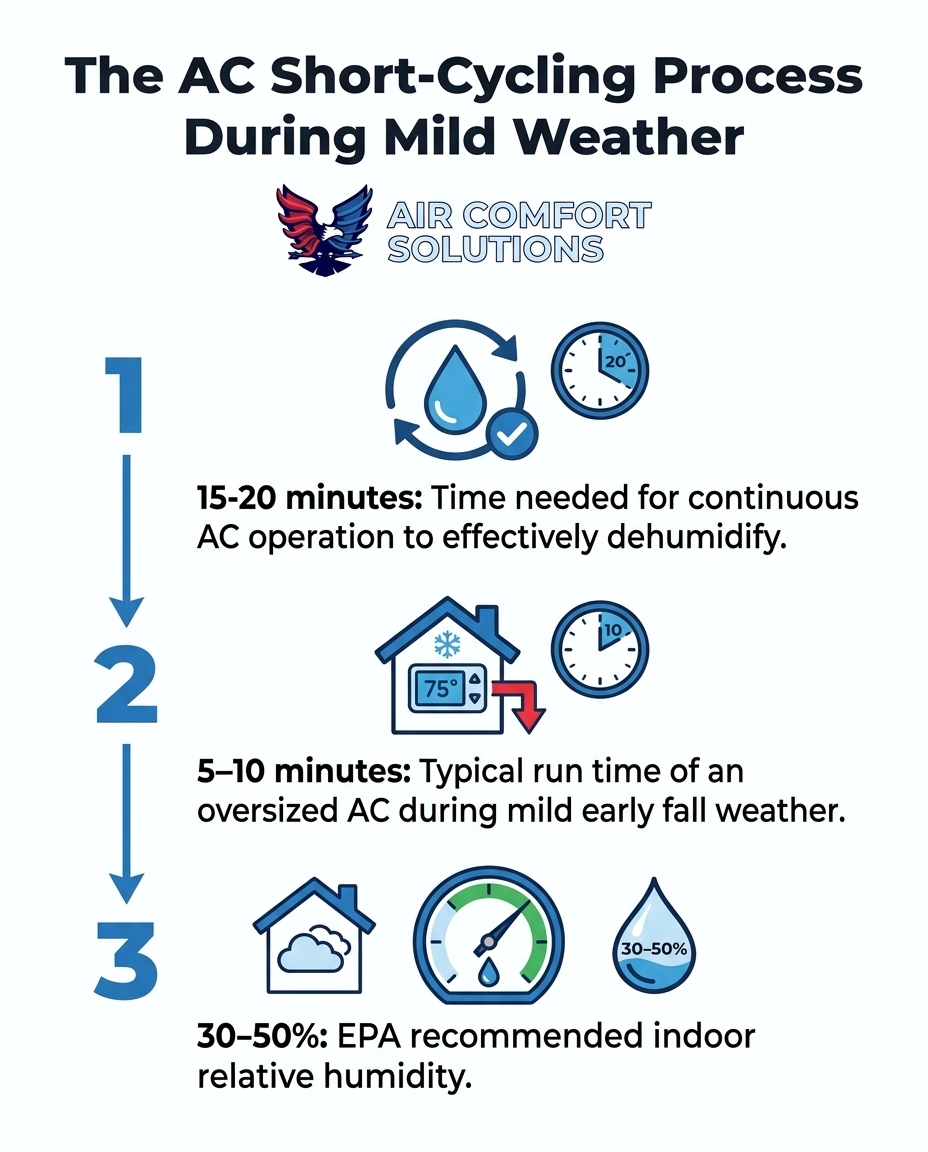
An air conditioner typically needs to run continuously for 15 to 20 minutes before the indoor evaporator coil gets cold enough to effectively condense moisture out of the air. The first few minutes of any cycle are dedicated purely to getting the equipment up to operating efficiency. It is only during the later stages of a prolonged cycle that heavy dehumidification takes place.
When an oversized unit kicks on, it blasts an enormous volume of cold air into the living space. Because the equipment is too large for the square footage, it satisfies the thermostat's sensible temperature demand in just 5 to 10 minutes. The thermostat, sensing that the room is now 72 degrees, sends the signal to shut the system down. The unit turns off long before it ever reaches the 15-minute mark required for effective moisture removal. The result is a home that is technically cold, but completely saturated with trapped humidity.
The AC Short-Cycling Process During Mild Weather
Why Early Fall Amplifies Air Conditioner Sizing Flaws
You might wonder why an oversized system suddenly feels so inadequate as the seasons change. A pattern we see often during early fall tune-ups is that the sizing flaw was always there, but the extreme summer weather was masking the problem. During 100-degree summer days, even an oversized unit has to work incredibly hard to fight back against the intense heat radiating through your roof, walls, and windows. Because the heat load is so massive, the unit is forced into longer cycles. It might run for 20 or 30 minutes at a time just to maintain the thermostat setting. By inadvertently running longer to fight the extreme heat, it ends up removing the humidity as a byproduct.
When outdoor temperatures drop to mild September and early fall temperatures, the sensible heat load decreases significantly. The system no longer has to fight a 100-degree sun beating down on the house. However, in regions like Southeast Texas, the outdoor dew points remain stubbornly high. The latent heat load (the moisture) is still pressing against your home's envelope, but the sensible heat load (the temperature) has vanished.
How Outdoor Temperatures Dictate Run Times
High heat forces longer cycles; moderate heat allows for rapid, abrupt cooling. Because the unit doesn't have to fight extreme temperatures, it meets the thermostat setting almost immediately. This drastically reduces run times. The shorter cycles mean the evaporator coil never reaches its peak moisture-extraction efficiency. The transition to fall completely exposes the unit's inability to dehumidify the space during moderate weather, leaving you shivering in a cold, damp room.
Ruling Out Mechanical Failures vs. Sizing Issues
Before concluding that your equipment is permanently oversized, it is vital to rule out repairable mechanical failures. A system that is perfectly sized for your home can still begin short-cycling if it is suffering from underlying operational issues. Distinguishing between a fundamental sizing error and a broken component requires professional diagnostics, as the symptoms often mirror one another.
If you are experiencing high indoor humidity resulting in a clammy feeling, our diagnostic team typically checks for several mechanical faults that could be forcing the system to short-cycle:
• Severely restricted airflow: A clogged, dirty air filter prevents enough warm air from passing over the evaporator coil. This causes the coil to drop below freezing, triggering safety switches that shut the system down prematurely.
• Frozen evaporator coils: Whether due to poor airflow or mechanical issues, a block of ice on the indoor coil entirely stops the dehumidification process and causes rapid cycling.
• Low refrigerant pressure: Refrigerant leaks alter the pressure dynamics of the system. Low pressure can cause the coil to freeze or trip low-pressure safety switches, interrupting the cycle after just a few minutes.
• Faulty thermostat sensors: If the thermostat is miscalibrated or located near a supply vent, it may register a false temperature drop, shutting the system off before the rest of the house is cooled.
Homeowners can and should check their air filters regularly, replacing them at the first sign of heavy dust buildup. However, diagnosing frozen coils, testing safety switches, or measuring refrigerant pressures requires specialized tools and licensing. If a fresh filter does not resolve the rapid cycling, scheduling professional AC repair is the only safe way to determine if you are dealing with a repairable mechanical fault or a unit that is simply too large for the home.
Restoring Comfort: Dehumidification and Right-Sizing Solutions
If professional diagnostics confirm that your equipment is functioning mechanically but is simply oversized for your square footage, you are not out of options. Living with a damp, clammy home is not a requirement of the changing seasons. There are clear, professional pathways to resolving the moisture problem, ranging from supplemental indoor air quality upgrades to long-term right-sizing strategies.
At Air Comfort Solutions, we have spent years understanding how the Southeast Texas climate impacts indoor environments. We focus on proper load calculations and right-sizing systems specifically for this region, ensuring both temperature and humidity control are perfectly balanced, no matter what the weather does outside.
Can a Dehumidifier Fix an Oversized System?
For homes with existing oversized equipment that is still relatively new, replacing the entire system might not make financial sense yet. In these cases, we often recommend supplemental indoor air quality solutions as a highly effective bridge. A whole-home dehumidifier integrates directly into your existing ductwork. Unlike your air conditioner, a dedicated dehumidifier measures moisture, not temperature. It can run independently of the cooling cycle, pulling damp air from the home, extracting the water, and returning dry, comfortable air without overcooling the space. This allows you to maintain a comfortable 72 degrees while keeping the humidity locked at a crisp 45 percent.
The Value of Professional Load Calculations
When the time does come to replace an aging, oversized unit, preventing a repeat of the problem is critical. Proper system sizing moves far beyond the old "rule of thumb" methods that simply guessed capacity based on square footage. A professional Manual J load calculation accounts for the home's specific orientation, the quality of the insulation, the type and number of windows, ceiling heights, and the local latent heat loads of the region.
Furthermore, upgrading to variable-speed or multi-stage equipment offers a permanent solution to the mild-weather dilemma. Unlike single-stage systems that blast at 100 percent capacity every time they turn on, variable-speed systems can dial their capacity down to 30 or 40 percent during mild September days. By running at a lower speed for a much longer duration, they maximize dehumidification without freezing you out of the room. Depending on current utility incentive programs or generic federal tax credits that may apply to qualifying heat pump or high-efficiency installations, an upgrade can also offer long-term financial benefits.
Frequently Asked Questions About AC Sizing and Indoor Humidity
Why is my house so humid with the AC running?
Your house remains humid because the AC is likely shutting off before it can extract moisture. An air conditioner needs to run continuously for at least 15 to 20 minutes for the indoor coil to get cold enough to condense water vapor. If the unit short-cycles, it cools the air but leaves the humidity behind.
How do I know if my AC is oversized?
The most common sign our technicians look for is short-cycling, where the unit runs for only 5 to 10 minutes at a time. You will also notice uneven temperatures between rooms, high indoor humidity resulting in a clammy feeling, and a system that cools the house extremely fast but never feels truly comfortable.
Does an oversized AC cause high humidity?
Yes, an oversized AC directly causes high indoor humidity during mild weather. Because it pushes a massive volume of cold air, it satisfies the thermostat's temperature setting much too quickly. This prevents the system from running long enough to perform latent cooling, which is the process of pulling moisture out of the air.
How long does an AC need to run to dehumidify?
An air conditioner typically needs to run for 15 to 20 minutes continuously to effectively dehumidify a space. The first few minutes of operation are spent bringing the evaporator coil down to the proper temperature. Only after the coil is freezing cold does significant condensation and moisture removal occur.
Why does my house feel cold but damp?
A cold but damp house indicates a lack of latent cooling. Your system is successfully lowering the sensible temperature, but failing to remove the water vapor. This happens frequently during mild September and early fall temperatures when the unit doesn't have to work hard against outdoor heat, leading to abbreviated run times.
What happens when an air conditioner is too big for a house?
When an air conditioner is too big, it cools the space too rapidly and shuts down prematurely. This constant starting and stopping increases wear and tear on the compressor, drives up energy consumption, and completely fails to control indoor humidity, leaving the home vulnerable to poor air quality and discomfort.
Take Control of Your Fall Indoor Comfort
A cold, clammy house during moderate weather is a clear indicator of poor dehumidification, most often caused by an oversized unit short-cycling. While the sudden shift to mild September and early fall temperatures can make your home feel uncomfortable, it also provides the perfect opportunity to identify and address hidden flaws in your cooling system's performance. You do not have to accept a living space that feels like a damp cave simply because the seasons are changing.
Our professional assessments at Air Comfort Solutions can identify the exact cause of your humidity issues, ruling out simple mechanical faults and recommending effective, long-term solutions. Whether the answer lies in integrating a whole-home dehumidifier to support your current setup or performing a precise load calculation for a properly sized upgrade, taking action now ensures your home remains a sanctuary. Schedule a professional evaluation today to restore the crisp, dry comfort your family deserves before the season progresses any further.
Zane came out and did an amazing job! Super friendly, honest and transparent about the work that needed to be done. This is my second time working with Air Comfort Solutions and they’re my go to for HVAC services. Highly recommend.
Markeith H.
God's AMAZING grace sent us Robert and Zane. We have been without air in this Texas heat for six weeks and four days. We've had a few contractors give us quotes all trying to upsell when we're at a low point. But not the guys at Air Comfort Solutions. They came in assessed our situation, gave us honest feedback, and showed us the issues as they proceeded with the assessment for clear understanding. We highly recommend them for their professionalism, quality products, and fair pricing. We hands down support them for all the work they do 💯 %.
Lena N.
Robert and Zane gone above and beyond to make the process easy and affordable. Would definitely recommend!!
Cameron J.
I’m writing this review to let everyone know that Air Comfort Solutions is the company to work with. I know the owner ( Robert) for several years now. He has been taking care of my residential and business work orders. Robert is professional, knowledgeable and will save you money. I just want to thank Robert for great job you have been doing for me.