What Your AC's Strange Noises Are Trying to Tell You

If you've been noticing ac making strange noises what they mean can feel confusing — but these sounds are actually your system's way of flagging a real problem before it gets worse. In Pinehurst and across North Harris County, where summer heat pushes AC systems hard, catching these warning signs early can be the difference between a quick fix and a full system replacement.
Here's a quick breakdown of the most common AC noises and what they typically signal:
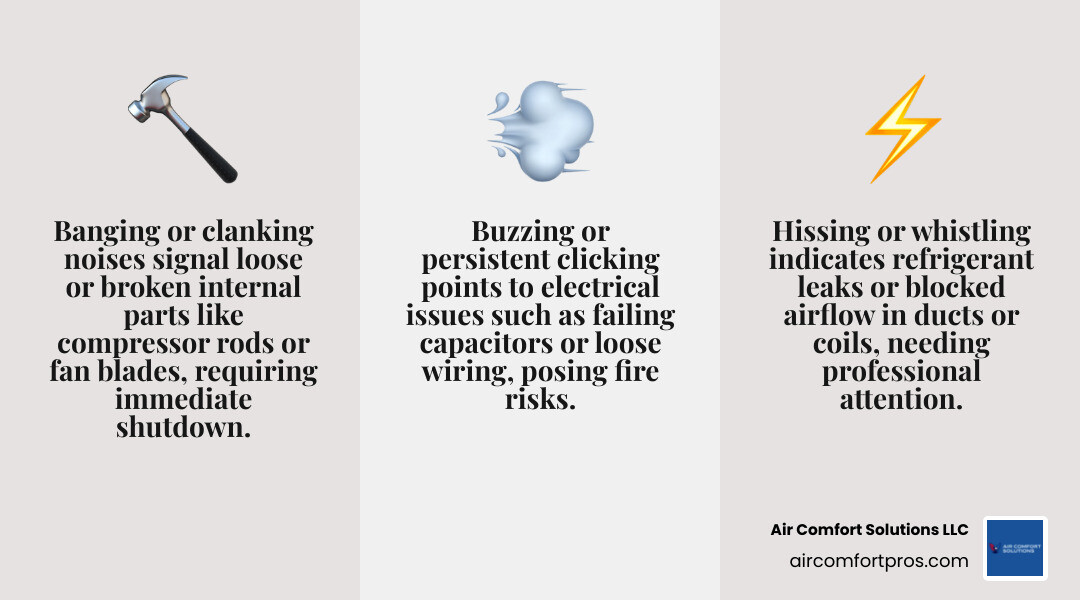
• Banging / Clanking — Likely Cause: Loose or broken internal parts (compressor, fan blades) — Urgency: High — turn off unit
• Hissing / Whistling — Likely Cause: Refrigerant leak or blocked airflow — Urgency: High — call a pro
• Screeching / Squealing — Likely Cause: Worn belt or failing motor bearings — Urgency: High — act quickly
• Buzzing — Likely Cause: Electrical issue, loose wiring, or frozen coils — Urgency: High — shut down system
• Clicking (persistent) — Likely Cause: Failing relay, capacitor, or thermostat — Urgency: Moderate to High
• Rattling — Likely Cause: Loose screws, panels, or debris — Urgency: Moderate
• Gurgling / Bubbling — Likely Cause: Refrigerant line air or clogged drain — Urgency: Moderate
• Humming (soft) — Likely Cause: Normal motor operation — Urgency: Normal
Most AC units should run with nothing more than a soft, steady hum and a gentle whoosh of airflow. Modern systems — including variable-speed units — are engineered to operate nearly silently. So if your system is suddenly sounding like something is loose, leaking, or grinding, that's not something to wait out.
As of April 2026, HVAC professionals across the region are seeing an uptick in noise-related service calls, many of which trace back to deferred maintenance during the off-season. The good news: most of these issues are diagnosable and fixable when caught early.
Keep reading to learn what each specific sound means, which ones you can address yourself, and when it's time to call in a certified technician.
A Homeowner's Guide to an AC Making Strange Noises and What They Mean
When we talk about an ac making strange noises what they mean, we are essentially translating the language of mechanical and electrical distress. Your air conditioner is a complex machine consisting of a compressor, fans, motors, and pressurized refrigerant lines. In our humid Texas climate, these components work overtime.
Strange sounds are rarely "just a quirk" of an older machine. They usually point to one of four categories: mechanical failure, electrical malfunctions, airflow restrictions, or simple component wear. For instance, if you hear a metallic friction sound, you might be dealing with Causes of AC Grinding Noises in Cypress, which often stems from worn-out motor bearings.
Ignoring these audio clues can lead to a shortened system lifespan. A loose fastener left un-tightened can vibrate until it shears off, damaging expensive coils. Similarly, a pressure imbalance that causes a "hiss" can eventually burn out your compressor—the "heart" of your AC. By April 2026, many homeowners in Magnolia and Tomball are opting for proactive maintenance to catch these loose parts before they become catastrophic failures.
Banging and Clanking: Loose Internal Parts
If your outdoor unit sounds like someone dropped a handful of silverware into a blender, you likely have a "banging" or "clanking" problem. This is almost always a sign of a loose or broken part. Inside the compressor, which is a sealed unit, parts like connecting rods, crankshafts, or internal springs can fail. If these break, they rattle around inside the housing, creating a heavy metallic bang. Unfortunately, a banging compressor usually requires a full replacement.
However, the noise might also come from the blower assembly. If the indoor blower fan becomes unbalanced or a motor mount breaks, the fan will hit the indoor blower housing as it spins. This not only makes a terrifying racket but also leads to poor performance. If you notice this sound accompanied by weak air from your vents, you may need to Resolve Poor Airflow from AC Vents by having a technician rebalance the fan or replace the motor mounts.
Hissing and Whistling: Refrigerant Leaks or Airflow Blocks
Hissing is one of the most urgent sounds your AC can make. In most cases, a persistent hiss indicates a refrigerant leak. Because refrigerant is under high pressure, it makes a "shhh" sound as it escapes through a tiny hole in the evaporator coils or refrigerant lines. This is a safety concern and an environmental hazard; if you hear this, turn the system off immediately.
Whistling, on the other hand, is usually an airflow issue. If your return vents are whistling, your system is likely "starving" for air. This happens when the air filter is extremely dirty or when there are restricted returns. High-pitched whistling can also be caused by duct leaks or a malfunctioning expansion valve. Interestingly, airflow issues can also lead to moisture problems; if your system isn't breathing right, you might find 6 Reasons Your AC Has a Musty Smell developing due to improper humidity removal.
Screeching and Squealing: Belt and Motor Bearing Issues
A high-pitched screech that sounds like a car's fan belt is exactly what it often is—a belt issue. While many modern residential units are direct-drive (no belts), older systems and some large-scale units use fan belts to connect the motor to the blower. Over time, these belts dry out, stretch, or slip, creating a loud squeal.
If your unit doesn't have a belt, that screeching is likely coming from the blower motor or the outdoor fan motor bearings. When the lubrication inside these bearings dries up, you get metal-on-metal contact. This friction creates intense heat and a piercing sound. While a quick lubrication might solve a "chirp," a full-blown screech usually means the bearing has failed. Interestingly, these sounds are similar to Why Your Furnace is Making Clicking Noises in that they often occur during the initial startup friction when the system first kicks on.
Differentiating Indoor vs. Outdoor Unit Sounds
To accurately diagnose an ac making strange noises what they mean, you first need to identify the source. Is the sound coming from the "closet" (the indoor evaporator unit) or the "yard" (the outdoor condenser unit)?
• Indoor Unit — Common Noises: Whistling, Popping, Bubbling, Clicking — Potential Issue: Dirty filter, duct expansion, clogged drain, or relay failure
• Outdoor Unit — Common Noises: Banging, Screeching, Buzzing, Hissing — Potential Issue: Compressor failure, fan motor bearings, electrical arcing, or refrigerant leak
Indoor noises like "popping" are often just thermal expansion—the sound of metal ductwork expanding as cold air rushes through it. However, if you hear a buzzing sound from the indoor unit, it could indicate that your evaporator coils have frozen over due to a lack of airflow.
If the noise is outdoor and accompanied by a strange odor, be alert. If your AC System Have an Electrical Burning Smell along with a buzzing or clicking sound, you likely have a significant electrical failure that requires an emergency shutdown.
DIY Steps for an AC Making Strange Noises and What They Mean
Before you panic and call for a full system replacement, there are a few simple DIY steps you can take to troubleshoot minor noises. Always remember to turn off the power at the thermostat and the circuit breaker before inspecting your equipment!
1. Check the Air Filter: A clogged filter is the #1 cause of whistling and buzzing. If the filter is gray and fuzzy, replace it. This is a common reason Why Furnace Blowing Cold Air in Spring or why an AC struggles to cool; the restricted airflow causes the whole system to vibrate and strain.
2. Clear Debris: Go outside and look at your condenser unit. Is there a stick poking through the grille? Are there dry leaves hitting the fan blades? A "thwapping" sound is often just debris that needs to be cleared away.
3. Tighten Loose Panels: Constant vibration can loosen the screws on the metal cabinets. If you hear a "rattle," try gently pressing on the panels. If the noise stops, simply tighten the cabinet screws with a screwdriver.
4. Inspect the Vents: Ensure no furniture or curtains are blocking the return air grilles. Blocked vents cause pressure to build up in the ducts, leading to whistling or "booming" sounds.
Buzzing and Clicking: Electrical Warning Signs
Buzzing is a sound that makes HVAC technicians nervous. It often points to "electrical arcing"—where electricity jumps between loose connections or failing wires. This is a major fire hazard. Buzzing can also be caused by a failing capacitor (the part that gives the motor a "jump start") or a contactor relay that is "chattering" because it can't stay closed.
Clicking is normal—once. You should hear a single click when the thermostat signals the system to turn on. However, rapid-fire clicking indicates that a relay is failing or that the thermostat is having trouble communicating with the unit. If your AC Keeps Tripping Circuit Breaker in Spring, do not keep resetting it. Repeated tripping combined with a buzzing or clicking sound is a clear sign of a short circuit or a grounded compressor.
When to Call a Professional in North Harris County
While we love a proactive homeowner, some things are simply too dangerous for DIY. In Pinehurst, Spring, and The Woodlands, professional intervention is required for any issue involving high-voltage electricity or pressurized refrigerant.
You should turn off your AC and call us immediately if:
• The system is "screaming": A high-pitched whistling or shrieking from the outdoor unit often means the compressor has reached dangerously high internal pressure.
• You hear hissing: Refrigerant handling is strictly regulated by the EPA. Only certified technicians with the proper equipment can legally and safely find and patch a leak.
• The unit is banging: As mentioned, this often involves internal compressor damage. Continuing to run the unit could cause the compressor to "seize" or even explode in rare high-pressure cases.
• You smell burning: Electrical smells combined with buzzing are a fire risk.
By April 2026, many of our neighbors are finding that if their system is over 12-15 years old, a noisy repair might not be as cost-effective as an upgrade. Modern variable-speed technology doesn't just lower your energy bills; it operates at decibel levels as low as 19dB—about the sound of a whisper.
Frequently Asked Questions
Why is my AC making strange noises and what do they mean during startup?
A brief "whoosh" of air and a single click are perfectly normal. You might also hear a slight hum for about 15 seconds as the compressor builds up pressure to begin the cooling cycle. However, if you hear a loud "clunk" or a sustained squeal every time the unit starts, it indicates that the motor is struggling to overcome friction or that the compressor mounts are worn out. If you want a truly silent startup, systems like the Hitachi airHome range use advanced technology to keep operation nearly imperceptible.
Can a dirty air filter cause my air conditioner to be loud?
Absolutely. A dirty filter restricts airflow, which forces the blower motor to work much harder. This strain can lead to a loud humming or buzzing sound. Furthermore, restricted airflow causes the temperature of the evaporator coils to drop too low, leading to ice buildup. A frozen AC unit often makes a distinct buzzing or "thumping" sound as the fan hits the ice. We recommend changing your filters every 1 to 3 months, especially during the dusty Pinehurst spring season.
Is a humming sound normal for a Pinehurst AC system?
A soft, steady hum is the sound of a healthy electric motor doing its job. However, if the humming becomes a loud "drone" or if the unit hums but the fan doesn't spin, you have a problem. This often means the motor is receiving electricity but is "stuck" due to a failed capacitor or seized bearings. In the context of April 2026 efficiency standards, a loud hum is often a sign that your system is consuming way more electricity than it should to maintain your comfort.
Conclusion
Your air conditioner doesn't have a voice, but it certainly knows how to communicate. Whether it's a subtle hiss, a rhythmic rattle, or a sudden bang, these sounds are a cry for help. At Air Comfort Solutions LLC, we’ve spent over 35 years helping our neighbors in Pinehurst, Magnolia, and Conroe decode these noises and restore peace and quiet to their homes.
Don't let a small "click" turn into a major "clunk." Our certified technicians provide honest, reliable solutions and upfront pricing to ensure your North Harris County home stays cool all summer long. If your system is making sounds you don't recognize, it’s time to act.
Schedule your professional AC inspection in Houston today and let us give you the peace of mind you deserve.
What Your AC's Strange Noises Are Trying to Tell You
If you've been noticing ac making strange noises what they mean can feel confusing — but these sounds are actually your system's way of flagging a real problem before it gets worse. In Pinehurst and across North Harris County, where summer heat pushes AC systems hard, catching these warning signs early can be the difference between a quick fix and a full system replacement.
Here's a quick breakdown of the most common AC noises and what they typically signal:
| Noise | Likely Cause | Urgency |
|---|
| Banging / Clanking | Loose or broken internal parts (compressor, fan blades) | High — turn off unit |
| Hissing / Whistling | Refrigerant leak or blocked airflow | High — call a pro |
| Screeching / Squealing | Worn belt or failing motor bearings | High — act quickly |
| Buzzing | Electrical issue, loose wiring, or frozen coils | High — shut down system |
| Clicking (persistent) | Failing relay, capacitor, or thermostat | Moderate to High |
| Rattling | Loose screws, panels, or debris | Moderate |
| Gurgling / Bubbling | Refrigerant line air or clogged drain | Moderate |
| Humming (soft) | Normal motor operation | Normal |
Most AC units should run with nothing more than a soft, steady hum and a gentle whoosh of airflow. Modern systems — including variable-speed units — are engineered to operate nearly silently. So if your system is suddenly sounding like something is loose, leaking, or grinding, that's not something to wait out.
As of April 2026, HVAC professionals across the region are seeing an uptick in noise-related service calls, many of which trace back to deferred maintenance during the off-season. The good news: most of these issues are diagnosable and fixable when caught early.
Keep reading to learn what each specific sound means, which ones you can address yourself, and when it's time to call in a certified technician.
A Homeowner's Guide to an AC Making Strange Noises and What They Mean
When we talk about an ac making strange noises what they mean, we are essentially translating the language of mechanical and electrical distress. Your air conditioner is a complex machine consisting of a compressor, fans, motors, and pressurized refrigerant lines. In our humid Texas climate, these components work overtime.
Strange sounds are rarely "just a quirk" of an older machine. They usually point to one of four categories: mechanical failure, electrical malfunctions, airflow restrictions, or simple component wear. For instance, if you hear a metallic friction sound, you might be dealing with Causes of AC Grinding Noises in Cypress, which often stems from worn-out motor bearings.
Ignoring these audio clues can lead to a shortened system lifespan. A loose fastener left un-tightened can vibrate until it shears off, damaging expensive coils. Similarly, a pressure imbalance that causes a "hiss" can eventually burn out your compressor—the "heart" of your AC. By April 2026, many homeowners in Magnolia and Tomball are opting for proactive maintenance to catch these loose parts before they become catastrophic failures.
Banging and Clanking: Loose Internal Parts
If your outdoor unit sounds like someone dropped a handful of silverware into a blender, you likely have a "banging" or "clanking" problem. This is almost always a sign of a loose or broken part. Inside the compressor, which is a sealed unit, parts like connecting rods, crankshafts, or internal springs can fail. If these break, they rattle around inside the housing, creating a heavy metallic bang. Unfortunately, a banging compressor usually requires a full replacement.
However, the noise might also come from the blower assembly. If the indoor blower fan becomes unbalanced or a motor mount breaks, the fan will hit the indoor blower housing as it spins. This not only makes a terrifying racket but also leads to poor performance. If you notice this sound accompanied by weak air from your vents, you may need to Resolve Poor Airflow from AC Vents by having a technician rebalance the fan or replace the motor mounts.
Hissing and Whistling: Refrigerant Leaks or Airflow Blocks
Hissing is one of the most urgent sounds your AC can make. In most cases, a persistent hiss indicates a refrigerant leak. Because refrigerant is under high pressure, it makes a "shhh" sound as it escapes through a tiny hole in the evaporator coils or refrigerant lines. This is a safety concern and an environmental hazard; if you hear this, turn the system off immediately.
Whistling, on the other hand, is usually an airflow issue. If your return vents are whistling, your system is likely "starving" for air. This happens when the air filter is extremely dirty or when there are restricted returns. High-pitched whistling can also be caused by duct leaks or a malfunctioning expansion valve. Interestingly, airflow issues can also lead to moisture problems; if your system isn't breathing right, you might find 6 Reasons Your AC Has a Musty Smell developing due to improper humidity removal.
Screeching and Squealing: Belt and Motor Bearing Issues
A high-pitched screech that sounds like a car's fan belt is exactly what it often is—a belt issue. While many modern residential units are direct-drive (no belts), older systems and some large-scale units use fan belts to connect the motor to the blower. Over time, these belts dry out, stretch, or slip, creating a loud squeal.
If your unit doesn't have a belt, that screeching is likely coming from the blower motor or the outdoor fan motor bearings. When the lubrication inside these bearings dries up, you get metal-on-metal contact. This friction creates intense heat and a piercing sound. While a quick lubrication might solve a "chirp," a full-blown screech usually means the bearing has failed. Interestingly, these sounds are similar to Why Your Furnace is Making Clicking Noises in that they often occur during the initial startup friction when the system first kicks on.
Differentiating Indoor vs. Outdoor Unit Sounds
To accurately diagnose an ac making strange noises what they mean, you first need to identify the source. Is the sound coming from the "closet" (the indoor evaporator unit) or the "yard" (the outdoor condenser unit)?
| Sound Source | Common Noises | Potential Issue |
|---|
| Indoor Unit | Whistling, Popping, Bubbling, Clicking | Dirty filter, duct expansion, clogged drain, or relay failure |
| Outdoor Unit | Banging, Screeching, Buzzing, Hissing | Compressor failure, fan motor bearings, electrical arcing, or refrigerant leak |
Indoor noises like "popping" are often just thermal expansion—the sound of metal ductwork expanding as cold air rushes through it. However, if you hear a buzzing sound from the indoor unit, it could indicate that your evaporator coils have frozen over due to a lack of airflow.
If the noise is outdoor and accompanied by a strange odor, be alert. If your AC System Have an Electrical Burning Smell along with a buzzing or clicking sound, you likely have a significant electrical failure that requires an emergency shutdown.
DIY Steps for an AC Making Strange Noises and What They Mean
Before you panic and call for a full system replacement, there are a few simple DIY steps you can take to troubleshoot minor noises. Always remember to turn off the power at the thermostat and the circuit breaker before inspecting your equipment!
- Check the Air Filter: A clogged filter is the #1 cause of whistling and buzzing. If the filter is gray and fuzzy, replace it. This is a common reason Why Furnace Blowing Cold Air in Spring or why an AC struggles to cool; the restricted airflow causes the whole system to vibrate and strain.
- Clear Debris: Go outside and look at your condenser unit. Is there a stick poking through the grille? Are there dry leaves hitting the fan blades? A "thwapping" sound is often just debris that needs to be cleared away.
- Tighten Loose Panels: Constant vibration can loosen the screws on the metal cabinets. If you hear a "rattle," try gently pressing on the panels. If the noise stops, simply tighten the cabinet screws with a screwdriver.
- Inspect the Vents: Ensure no furniture or curtains are blocking the return air grilles. Blocked vents cause pressure to build up in the ducts, leading to whistling or "booming" sounds.
Buzzing and Clicking: Electrical Warning Signs
Buzzing is a sound that makes HVAC technicians nervous. It often points to "electrical arcing"—where electricity jumps between loose connections or failing wires. This is a major fire hazard. Buzzing can also be caused by a failing capacitor (the part that gives the motor a "jump start") or a contactor relay that is "chattering" because it can't stay closed.
Clicking is normal—once. You should hear a single click when the thermostat signals the system to turn on. However, rapid-fire clicking indicates that a relay is failing or that the thermostat is having trouble communicating with the unit. If your AC Keeps Tripping Circuit Breaker in Spring, do not keep resetting it. Repeated tripping combined with a buzzing or clicking sound is a clear sign of a short circuit or a grounded compressor.
When to Call a Professional in North Harris County
While we love a proactive homeowner, some things are simply too dangerous for DIY. In Pinehurst, Spring, and The Woodlands, professional intervention is required for any issue involving high-voltage electricity or pressurized refrigerant.
You should turn off your AC and call us immediately if:
- The system is "screaming": A high-pitched whistling or shrieking from the outdoor unit often means the compressor has reached dangerously high internal pressure.
- You hear hissing: Refrigerant handling is strictly regulated by the EPA. Only certified technicians with the proper equipment can legally and safely find and patch a leak.
- The unit is banging: As mentioned, this often involves internal compressor damage. Continuing to run the unit could cause the compressor to "seize" or even explode in rare high-pressure cases.
- You smell burning: Electrical smells combined with buzzing are a fire risk.
By April 2026, many of our neighbors are finding that if their system is over 12-15 years old, a noisy repair might not be as cost-effective as an upgrade. Modern variable-speed technology doesn't just lower your energy bills; it operates at decibel levels as low as 19dB—about the sound of a whisper.
Frequently Asked Questions
Why is my AC making strange noises and what do they mean during startup?
A brief "whoosh" of air and a single click are perfectly normal. You might also hear a slight hum for about 15 seconds as the compressor builds up pressure to begin the cooling cycle. However, if you hear a loud "clunk" or a sustained squeal every time the unit starts, it indicates that the motor is struggling to overcome friction or that the compressor mounts are worn out. If you want a truly silent startup, systems like the Hitachi airHome range use advanced technology to keep operation nearly imperceptible.
Can a dirty air filter cause my air conditioner to be loud?
Absolutely. A dirty filter restricts airflow, which forces the blower motor to work much harder. This strain can lead to a loud humming or buzzing sound. Furthermore, restricted airflow causes the temperature of the evaporator coils to drop too low, leading to ice buildup. A frozen AC unit often makes a distinct buzzing or "thumping" sound as the fan hits the ice. We recommend changing your filters every 1 to 3 months, especially during the dusty Pinehurst spring season.
Is a humming sound normal for a Pinehurst AC system?
A soft, steady hum is the sound of a healthy electric motor doing its job. However, if the humming becomes a loud "drone" or if the unit hums but the fan doesn't spin, you have a problem. This often means the motor is receiving electricity but is "stuck" due to a failed capacitor or seized bearings. In the context of April 2026 efficiency standards, a loud hum is often a sign that your system is consuming way more electricity than it should to maintain your comfort.
Conclusion
Your air conditioner doesn't have a voice, but it certainly knows how to communicate. Whether it's a subtle hiss, a rhythmic rattle, or a sudden bang, these sounds are a cry for help. At Air Comfort Solutions LLC, we’ve spent over 35 years helping our neighbors in Pinehurst, Magnolia, and Conroe decode these noises and restore peace and quiet to their homes.
Don't let a small "click" turn into a major "clunk." Our certified technicians provide honest, reliable solutions and upfront pricing to ensure your North Harris County home stays cool all summer long. If your system is making sounds you don't recognize, it’s time to act.
Schedule your professional AC inspection in Houston today and let us give you the peace of mind you deserve.
What Your AC's Strange Noises Are Trying to Tell You
If you've been noticing ac making strange noises what they mean can feel confusing — but these sounds are actually your system's way of flagging a real problem before it gets worse. In Pinehurst and across North Harris County, where summer heat pushes AC systems hard, catching these warning signs early can be the difference between a quick fix and a full system replacement.
Here's a quick breakdown of the most common AC noises and what they typically signal:
| Noise | Likely Cause | Urgency |
|---|
| Banging / Clanking | Loose or broken internal parts (compressor, fan blades) | High — turn off unit |
| Hissing / Whistling | Refrigerant leak or blocked airflow | High — call a pro |
| Screeching / Squealing | Worn belt or failing motor bearings | High — act quickly |
| Buzzing | Electrical issue, loose wiring, or frozen coils | High — shut down system |
| Clicking (persistent) | Failing relay, capacitor, or thermostat | Moderate to High |
| Rattling | Loose screws, panels, or debris | Moderate |
| Gurgling / Bubbling | Refrigerant line air or clogged drain | Moderate |
| Humming (soft) | Normal motor operation | Normal |
Most AC units should run with nothing more than a soft, steady hum and a gentle whoosh of airflow. Modern systems — including variable-speed units — are engineered to operate nearly silently. So if your system is suddenly sounding like something is loose, leaking, or grinding, that's not something to wait out.
As of April 2026, HVAC professionals across the region are seeing an uptick in noise-related service calls, many of which trace back to deferred maintenance during the off-season. The good news: most of these issues are diagnosable and fixable when caught early.
Keep reading to learn what each specific sound means, which ones you can address yourself, and when it's time to call in a certified technician.
A Homeowner's Guide to an AC Making Strange Noises and What They Mean
When we talk about an ac making strange noises what they mean, we are essentially translating the language of mechanical and electrical distress. Your air conditioner is a complex machine consisting of a compressor, fans, motors, and pressurized refrigerant lines. In our humid Texas climate, these components work overtime.
Strange sounds are rarely "just a quirk" of an older machine. They usually point to one of four categories: mechanical failure, electrical malfunctions, airflow restrictions, or simple component wear. For instance, if you hear a metallic friction sound, you might be dealing with Causes of AC Grinding Noises in Cypress, which often stems from worn-out motor bearings.
Ignoring these audio clues can lead to a shortened system lifespan. A loose fastener left un-tightened can vibrate until it shears off, damaging expensive coils. Similarly, a pressure imbalance that causes a "hiss" can eventually burn out your compressor—the "heart" of your AC. By April 2026, many homeowners in Magnolia and Tomball are opting for proactive maintenance to catch these loose parts before they become catastrophic failures.
Banging and Clanking: Loose Internal Parts
If your outdoor unit sounds like someone dropped a handful of silverware into a blender, you likely have a "banging" or "clanking" problem. This is almost always a sign of a loose or broken part. Inside the compressor, which is a sealed unit, parts like connecting rods, crankshafts, or internal springs can fail. If these break, they rattle around inside the housing, creating a heavy metallic bang. Unfortunately, a banging compressor usually requires a full replacement.
However, the noise might also come from the blower assembly. If the indoor blower fan becomes unbalanced or a motor mount breaks, the fan will hit the indoor blower housing as it spins. This not only makes a terrifying racket but also leads to poor performance. If you notice this sound accompanied by weak air from your vents, you may need to Resolve Poor Airflow from AC Vents by having a technician rebalance the fan or replace the motor mounts.
Hissing and Whistling: Refrigerant Leaks or Airflow Blocks
Hissing is one of the most urgent sounds your AC can make. In most cases, a persistent hiss indicates a refrigerant leak. Because refrigerant is under high pressure, it makes a "shhh" sound as it escapes through a tiny hole in the evaporator coils or refrigerant lines. This is a safety concern and an environmental hazard; if you hear this, turn the system off immediately.
Whistling, on the other hand, is usually an airflow issue. If your return vents are whistling, your system is likely "starving" for air. This happens when the air filter is extremely dirty or when there are restricted returns. High-pitched whistling can also be caused by duct leaks or a malfunctioning expansion valve. Interestingly, airflow issues can also lead to moisture problems; if your system isn't breathing right, you might find 6 Reasons Your AC Has a Musty Smell developing due to improper humidity removal.
Screeching and Squealing: Belt and Motor Bearing Issues
A high-pitched screech that sounds like a car's fan belt is exactly what it often is—a belt issue. While many modern residential units are direct-drive (no belts), older systems and some large-scale units use fan belts to connect the motor to the blower. Over time, these belts dry out, stretch, or slip, creating a loud squeal.
If your unit doesn't have a belt, that screeching is likely coming from the blower motor or the outdoor fan motor bearings. When the lubrication inside these bearings dries up, you get metal-on-metal contact. This friction creates intense heat and a piercing sound. While a quick lubrication might solve a "chirp," a full-blown screech usually means the bearing has failed. Interestingly, these sounds are similar to Why Your Furnace is Making Clicking Noises in that they often occur during the initial startup friction when the system first kicks on.
Differentiating Indoor vs. Outdoor Unit Sounds
To accurately diagnose an ac making strange noises what they mean, you first need to identify the source. Is the sound coming from the "closet" (the indoor evaporator unit) or the "yard" (the outdoor condenser unit)?
| Sound Source | Common Noises | Potential Issue |
|---|
| Indoor Unit | Whistling, Popping, Bubbling, Clicking | Dirty filter, duct expansion, clogged drain, or relay failure |
| Outdoor Unit | Banging, Screeching, Buzzing, Hissing | Compressor failure, fan motor bearings, electrical arcing, or refrigerant leak |
Indoor noises like "popping" are often just thermal expansion—the sound of metal ductwork expanding as cold air rushes through it. However, if you hear a buzzing sound from the indoor unit, it could indicate that your evaporator coils have frozen over due to a lack of airflow.
If the noise is outdoor and accompanied by a strange odor, be alert. If your AC System Have an Electrical Burning Smell along with a buzzing or clicking sound, you likely have a significant electrical failure that requires an emergency shutdown.
DIY Steps for an AC Making Strange Noises and What They Mean
Before you panic and call for a full system replacement, there are a few simple DIY steps you can take to troubleshoot minor noises. Always remember to turn off the power at the thermostat and the circuit breaker before inspecting your equipment!
- Check the Air Filter: A clogged filter is the #1 cause of whistling and buzzing. If the filter is gray and fuzzy, replace it. This is a common reason Why Furnace Blowing Cold Air in Spring or why an AC struggles to cool; the restricted airflow causes the whole system to vibrate and strain.
- Clear Debris: Go outside and look at your condenser unit. Is there a stick poking through the grille? Are there dry leaves hitting the fan blades? A "thwapping" sound is often just debris that needs to be cleared away.
- Tighten Loose Panels: Constant vibration can loosen the screws on the metal cabinets. If you hear a "rattle," try gently pressing on the panels. If the noise stops, simply tighten the cabinet screws with a screwdriver.
- Inspect the Vents: Ensure no furniture or curtains are blocking the return air grilles. Blocked vents cause pressure to build up in the ducts, leading to whistling or "booming" sounds.
Buzzing and Clicking: Electrical Warning Signs
Buzzing is a sound that makes HVAC technicians nervous. It often points to "electrical arcing"—where electricity jumps between loose connections or failing wires. This is a major fire hazard. Buzzing can also be caused by a failing capacitor (the part that gives the motor a "jump start") or a contactor relay that is "chattering" because it can't stay closed.
Clicking is normal—once. You should hear a single click when the thermostat signals the system to turn on. However, rapid-fire clicking indicates that a relay is failing or that the thermostat is having trouble communicating with the unit. If your AC Keeps Tripping Circuit Breaker in Spring, do not keep resetting it. Repeated tripping combined with a buzzing or clicking sound is a clear sign of a short circuit or a grounded compressor.
When to Call a Professional in North Harris County
While we love a proactive homeowner, some things are simply too dangerous for DIY. In Pinehurst, Spring, and The Woodlands, professional intervention is required for any issue involving high-voltage electricity or pressurized refrigerant.
You should turn off your AC and call us immediately if:
- The system is "screaming": A high-pitched whistling or shrieking from the outdoor unit often means the compressor has reached dangerously high internal pressure.
- You hear hissing: Refrigerant handling is strictly regulated by the EPA. Only certified technicians with the proper equipment can legally and safely find and patch a leak.
- The unit is banging: As mentioned, this often involves internal compressor damage. Continuing to run the unit could cause the compressor to "seize" or even explode in rare high-pressure cases.
- You smell burning: Electrical smells combined with buzzing are a fire risk.
By April 2026, many of our neighbors are finding that if their system is over 12-15 years old, a noisy repair might not be as cost-effective as an upgrade. Modern variable-speed technology doesn't just lower your energy bills; it operates at decibel levels as low as 19dB—about the sound of a whisper.
Frequently Asked Questions
Why is my AC making strange noises and what do they mean during startup?
A brief "whoosh" of air and a single click are perfectly normal. You might also hear a slight hum for about 15 seconds as the compressor builds up pressure to begin the cooling cycle. However, if you hear a loud "clunk" or a sustained squeal every time the unit starts, it indicates that the motor is struggling to overcome friction or that the compressor mounts are worn out. If you want a truly silent startup, systems like the Hitachi airHome range use advanced technology to keep operation nearly imperceptible.
Can a dirty air filter cause my air conditioner to be loud?
Absolutely. A dirty filter restricts airflow, which forces the blower motor to work much harder. This strain can lead to a loud humming or buzzing sound. Furthermore, restricted airflow causes the temperature of the evaporator coils to drop too low, leading to ice buildup. A frozen AC unit often makes a distinct buzzing or "thumping" sound as the fan hits the ice. We recommend changing your filters every 1 to 3 months, especially during the dusty Pinehurst spring season.
Is a humming sound normal for a Pinehurst AC system?
A soft, steady hum is the sound of a healthy electric motor doing its job. However, if the humming becomes a loud "drone" or if the unit hums but the fan doesn't spin, you have a problem. This often means the motor is receiving electricity but is "stuck" due to a failed capacitor or seized bearings. In the context of April 2026 efficiency standards, a loud hum is often a sign that your system is consuming way more electricity than it should to maintain your comfort.
Conclusion
Your air conditioner doesn't have a voice, but it certainly knows how to communicate. Whether it's a subtle hiss, a rhythmic rattle, or a sudden bang, these sounds are a cry for help. At Air Comfort Solutions LLC, we’ve spent over 35 years helping our neighbors in Pinehurst, Magnolia, and Conroe decode these noises and restore peace and quiet to their homes.
Don't let a small "click" turn into a major "clunk." Our certified technicians provide honest, reliable solutions and upfront pricing to ensure your North Harris County home stays cool all summer long. If your system is making sounds you don't recognize, it’s time to act.
Schedule your professional AC inspection in Houston today and let us give you the peace of mind you deserve.
What Your AC's Strange Noises Are Trying to Tell You
If you've been noticing ac making strange noises what they mean can feel confusing — but these sounds are actually your system's way of flagging a real problem before it gets worse. In Pinehurst and across North Harris County, where summer heat pushes AC systems hard, catching these warning signs early can be the difference between a quick fix and a full system replacement.
Here's a quick breakdown of the most common AC noises and what they typically signal:
| Noise | Likely Cause | Urgency |
|---|
| Banging / Clanking | Loose or broken internal parts (compressor, fan blades) | High — turn off unit |
| Hissing / Whistling | Refrigerant leak or blocked airflow | High — call a pro |
| Screeching / Squealing | Worn belt or failing motor bearings | High — act quickly |
| Buzzing | Electrical issue, loose wiring, or frozen coils | High — shut down system |
| Clicking (persistent) | Failing relay, capacitor, or thermostat | Moderate to High |
| Rattling | Loose screws, panels, or debris | Moderate |
| Gurgling / Bubbling | Refrigerant line air or clogged drain | Moderate |
| Humming (soft) | Normal motor operation | Normal |
Most AC units should run with nothing more than a soft, steady hum and a gentle whoosh of airflow. Modern systems — including variable-speed units — are engineered to operate nearly silently. So if your system is suddenly sounding like something is loose, leaking, or grinding, that's not something to wait out.
As of April 2026, HVAC professionals across the region are seeing an uptick in noise-related service calls, many of which trace back to deferred maintenance during the off-season. The good news: most of these issues are diagnosable and fixable when caught early.
Keep reading to learn what each specific sound means, which ones you can address yourself, and when it's time to call in a certified technician.
A Homeowner's Guide to an AC Making Strange Noises and What They Mean
When we talk about an ac making strange noises what they mean, we are essentially translating the language of mechanical and electrical distress. Your air conditioner is a complex machine consisting of a compressor, fans, motors, and pressurized refrigerant lines. In our humid Texas climate, these components work overtime.
Strange sounds are rarely "just a quirk" of an older machine. They usually point to one of four categories: mechanical failure, electrical malfunctions, airflow restrictions, or simple component wear. For instance, if you hear a metallic friction sound, you might be dealing with Causes of AC Grinding Noises in Cypress, which often stems from worn-out motor bearings.
Ignoring these audio clues can lead to a shortened system lifespan. A loose fastener left un-tightened can vibrate until it shears off, damaging expensive coils. Similarly, a pressure imbalance that causes a "hiss" can eventually burn out your compressor—the "heart" of your AC. By April 2026, many homeowners in Magnolia and Tomball are opting for proactive maintenance to catch these loose parts before they become catastrophic failures.
Banging and Clanking: Loose Internal Parts
If your outdoor unit sounds like someone dropped a handful of silverware into a blender, you likely have a "banging" or "clanking" problem. This is almost always a sign of a loose or broken part. Inside the compressor, which is a sealed unit, parts like connecting rods, crankshafts, or internal springs can fail. If these break, they rattle around inside the housing, creating a heavy metallic bang. Unfortunately, a banging compressor usually requires a full replacement.
However, the noise might also come from the blower assembly. If the indoor blower fan becomes unbalanced or a motor mount breaks, the fan will hit the indoor blower housing as it spins. This not only makes a terrifying racket but also leads to poor performance. If you notice this sound accompanied by weak air from your vents, you may need to Resolve Poor Airflow from AC Vents by having a technician rebalance the fan or replace the motor mounts.
Hissing and Whistling: Refrigerant Leaks or Airflow Blocks
Hissing is one of the most urgent sounds your AC can make. In most cases, a persistent hiss indicates a refrigerant leak. Because refrigerant is under high pressure, it makes a "shhh" sound as it escapes through a tiny hole in the evaporator coils or refrigerant lines. This is a safety concern and an environmental hazard; if you hear this, turn the system off immediately.
Whistling, on the other hand, is usually an airflow issue. If your return vents are whistling, your system is likely "starving" for air. This happens when the air filter is extremely dirty or when there are restricted returns. High-pitched whistling can also be caused by duct leaks or a malfunctioning expansion valve. Interestingly, airflow issues can also lead to moisture problems; if your system isn't breathing right, you might find 6 Reasons Your AC Has a Musty Smell developing due to improper humidity removal.
Screeching and Squealing: Belt and Motor Bearing Issues
A high-pitched screech that sounds like a car's fan belt is exactly what it often is—a belt issue. While many modern residential units are direct-drive (no belts), older systems and some large-scale units use fan belts to connect the motor to the blower. Over time, these belts dry out, stretch, or slip, creating a loud squeal.
If your unit doesn't have a belt, that screeching is likely coming from the blower motor or the outdoor fan motor bearings. When the lubrication inside these bearings dries up, you get metal-on-metal contact. This friction creates intense heat and a piercing sound. While a quick lubrication might solve a "chirp," a full-blown screech usually means the bearing has failed. Interestingly, these sounds are similar to Why Your Furnace is Making Clicking Noises in that they often occur during the initial startup friction when the system first kicks on.
Differentiating Indoor vs. Outdoor Unit Sounds
To accurately diagnose an ac making strange noises what they mean, you first need to identify the source. Is the sound coming from the "closet" (the indoor evaporator unit) or the "yard" (the outdoor condenser unit)?
| Sound Source | Common Noises | Potential Issue |
|---|
| Indoor Unit | Whistling, Popping, Bubbling, Clicking | Dirty filter, duct expansion, clogged drain, or relay failure |
| Outdoor Unit | Banging, Screeching, Buzzing, Hissing | Compressor failure, fan motor bearings, electrical arcing, or refrigerant leak |
Indoor noises like "popping" are often just thermal expansion—the sound of metal ductwork expanding as cold air rushes through it. However, if you hear a buzzing sound from the indoor unit, it could indicate that your evaporator coils have frozen over due to a lack of airflow.
If the noise is outdoor and accompanied by a strange odor, be alert. If your AC System Have an Electrical Burning Smell along with a buzzing or clicking sound, you likely have a significant electrical failure that requires an emergency shutdown.
DIY Steps for an AC Making Strange Noises and What They Mean
Before you panic and call for a full system replacement, there are a few simple DIY steps you can take to troubleshoot minor noises. Always remember to turn off the power at the thermostat and the circuit breaker before inspecting your equipment!
- Check the Air Filter: A clogged filter is the #1 cause of whistling and buzzing. If the filter is gray and fuzzy, replace it. This is a common reason Why Furnace Blowing Cold Air in Spring or why an AC struggles to cool; the restricted airflow causes the whole system to vibrate and strain.
- Clear Debris: Go outside and look at your condenser unit. Is there a stick poking through the grille? Are there dry leaves hitting the fan blades? A "thwapping" sound is often just debris that needs to be cleared away.
- Tighten Loose Panels: Constant vibration can loosen the screws on the metal cabinets. If you hear a "rattle," try gently pressing on the panels. If the noise stops, simply tighten the cabinet screws with a screwdriver.
- Inspect the Vents: Ensure no furniture or curtains are blocking the return air grilles. Blocked vents cause pressure to build up in the ducts, leading to whistling or "booming" sounds.
Buzzing and Clicking: Electrical Warning Signs
Buzzing is a sound that makes HVAC technicians nervous. It often points to "electrical arcing"—where electricity jumps between loose connections or failing wires. This is a major fire hazard. Buzzing can also be caused by a failing capacitor (the part that gives the motor a "jump start") or a contactor relay that is "chattering" because it can't stay closed.
Clicking is normal—once. You should hear a single click when the thermostat signals the system to turn on. However, rapid-fire clicking indicates that a relay is failing or that the thermostat is having trouble communicating with the unit. If your AC Keeps Tripping Circuit Breaker in Spring, do not keep resetting it. Repeated tripping combined with a buzzing or clicking sound is a clear sign of a short circuit or a grounded compressor.
When to Call a Professional in North Harris County
While we love a proactive homeowner, some things are simply too dangerous for DIY. In Pinehurst, Spring, and The Woodlands, professional intervention is required for any issue involving high-voltage electricity or pressurized refrigerant.
You should turn off your AC and call us immediately if:
- The system is "screaming": A high-pitched whistling or shrieking from the outdoor unit often means the compressor has reached dangerously high internal pressure.
- You hear hissing: Refrigerant handling is strictly regulated by the EPA. Only certified technicians with the proper equipment can legally and safely find and patch a leak.
- The unit is banging: As mentioned, this often involves internal compressor damage. Continuing to run the unit could cause the compressor to "seize" or even explode in rare high-pressure cases.
- You smell burning: Electrical smells combined with buzzing are a fire risk.
By April 2026, many of our neighbors are finding that if their system is over 12-15 years old, a noisy repair might not be as cost-effective as an upgrade. Modern variable-speed technology doesn't just lower your energy bills; it operates at decibel levels as low as 19dB—about the sound of a whisper.
Frequently Asked Questions
Why is my AC making strange noises and what do they mean during startup?
A brief "whoosh" of air and a single click are perfectly normal. You might also hear a slight hum for about 15 seconds as the compressor builds up pressure to begin the cooling cycle. However, if you hear a loud "clunk" or a sustained squeal every time the unit starts, it indicates that the motor is struggling to overcome friction or that the compressor mounts are worn out. If you want a truly silent startup, systems like the Hitachi airHome range use advanced technology to keep operation nearly imperceptible.
Can a dirty air filter cause my air conditioner to be loud?
Absolutely. A dirty filter restricts airflow, which forces the blower motor to work much harder. This strain can lead to a loud humming or buzzing sound. Furthermore, restricted airflow causes the temperature of the evaporator coils to drop too low, leading to ice buildup. A frozen AC unit often makes a distinct buzzing or "thumping" sound as the fan hits the ice. We recommend changing your filters every 1 to 3 months, especially during the dusty Pinehurst spring season.
Is a humming sound normal for a Pinehurst AC system?
A soft, steady hum is the sound of a healthy electric motor doing its job. However, if the humming becomes a loud "drone" or if the unit hums but the fan doesn't spin, you have a problem. This often means the motor is receiving electricity but is "stuck" due to a failed capacitor or seized bearings. In the context of April 2026 efficiency standards, a loud hum is often a sign that your system is consuming way more electricity than it should to maintain your comfort.
Conclusion
Your air conditioner doesn't have a voice, but it certainly knows how to communicate. Whether it's a subtle hiss, a rhythmic rattle, or a sudden bang, these sounds are a cry for help. At Air Comfort Solutions LLC, we’ve spent over 35 years helping our neighbors in Pinehurst, Magnolia, and Conroe decode these noises and restore peace and quiet to their homes.
Don't let a small "click" turn into a major "clunk." Our certified technicians provide honest, reliable solutions and upfront pricing to ensure your North Harris County home stays cool all summer long. If your system is making sounds you don't recognize, it’s time to act.
Schedule your professional AC inspection in Houston today and let us give you the peace of mind you deserve.
What Your AC's Strange Noises Are Trying to Tell You
If you've been noticing ac making strange noises what they mean can feel confusing — but these sounds are actually your system's way of flagging a real problem before it gets worse. In Pinehurst and across North Harris County, where summer heat pushes AC systems hard, catching these warning signs early can be the difference between a quick fix and a full system replacement.
Here's a quick breakdown of the most common AC noises and what they typically signal:
| Noise | Likely Cause | Urgency |
|---|
| Banging / Clanking | Loose or broken internal parts (compressor, fan blades) | High — turn off unit |
| Hissing / Whistling | Refrigerant leak or blocked airflow | High — call a pro |
| Screeching / Squealing | Worn belt or failing motor bearings | High — act quickly |
| Buzzing | Electrical issue, loose wiring, or frozen coils | High — shut down system |
| Clicking (persistent) | Failing relay, capacitor, or thermostat | Moderate to High |
| Rattling | Loose screws, panels, or debris | Moderate |
| Gurgling / Bubbling | Refrigerant line air or clogged drain | Moderate |
| Humming (soft) | Normal motor operation | Normal |
Most AC units should run with nothing more than a soft, steady hum and a gentle whoosh of airflow. Modern systems — including variable-speed units — are engineered to operate nearly silently. So if your system is suddenly sounding like something is loose, leaking, or grinding, that's not something to wait out.
As of April 2026, HVAC professionals across the region are seeing an uptick in noise-related service calls, many of which trace back to deferred maintenance during the off-season. The good news: most of these issues are diagnosable and fixable when caught early.
Keep reading to learn what each specific sound means, which ones you can address yourself, and when it's time to call in a certified technician.
A Homeowner's Guide to an AC Making Strange Noises and What They Mean
When we talk about an ac making strange noises what they mean, we are essentially translating the language of mechanical and electrical distress. Your air conditioner is a complex machine consisting of a compressor, fans, motors, and pressurized refrigerant lines. In our humid Texas climate, these components work overtime.
Strange sounds are rarely "just a quirk" of an older machine. They usually point to one of four categories: mechanical failure, electrical malfunctions, airflow restrictions, or simple component wear. For instance, if you hear a metallic friction sound, you might be dealing with Causes of AC Grinding Noises in Cypress, which often stems from worn-out motor bearings.
Ignoring these audio clues can lead to a shortened system lifespan. A loose fastener left un-tightened can vibrate until it shears off, damaging expensive coils. Similarly, a pressure imbalance that causes a "hiss" can eventually burn out your compressor—the "heart" of your AC. By April 2026, many homeowners in Magnolia and Tomball are opting for proactive maintenance to catch these loose parts before they become catastrophic failures.
Banging and Clanking: Loose Internal Parts
If your outdoor unit sounds like someone dropped a handful of silverware into a blender, you likely have a "banging" or "clanking" problem. This is almost always a sign of a loose or broken part. Inside the compressor, which is a sealed unit, parts like connecting rods, crankshafts, or internal springs can fail. If these break, they rattle around inside the housing, creating a heavy metallic bang. Unfortunately, a banging compressor usually requires a full replacement.
However, the noise might also come from the blower assembly. If the indoor blower fan becomes unbalanced or a motor mount breaks, the fan will hit the indoor blower housing as it spins. This not only makes a terrifying racket but also leads to poor performance. If you notice this sound accompanied by weak air from your vents, you may need to Resolve Poor Airflow from AC Vents by having a technician rebalance the fan or replace the motor mounts.
Hissing and Whistling: Refrigerant Leaks or Airflow Blocks
Hissing is one of the most urgent sounds your AC can make. In most cases, a persistent hiss indicates a refrigerant leak. Because refrigerant is under high pressure, it makes a "shhh" sound as it escapes through a tiny hole in the evaporator coils or refrigerant lines. This is a safety concern and an environmental hazard; if you hear this, turn the system off immediately.
Whistling, on the other hand, is usually an airflow issue. If your return vents are whistling, your system is likely "starving" for air. This happens when the air filter is extremely dirty or when there are restricted returns. High-pitched whistling can also be caused by duct leaks or a malfunctioning expansion valve. Interestingly, airflow issues can also lead to moisture problems; if your system isn't breathing right, you might find 6 Reasons Your AC Has a Musty Smell developing due to improper humidity removal.
Screeching and Squealing: Belt and Motor Bearing Issues
A high-pitched screech that sounds like a car's fan belt is exactly what it often is—a belt issue. While many modern residential units are direct-drive (no belts), older systems and some large-scale units use fan belts to connect the motor to the blower. Over time, these belts dry out, stretch, or slip, creating a loud squeal.
If your unit doesn't have a belt, that screeching is likely coming from the blower motor or the outdoor fan motor bearings. When the lubrication inside these bearings dries up, you get metal-on-metal contact. This friction creates intense heat and a piercing sound. While a quick lubrication might solve a "chirp," a full-blown screech usually means the bearing has failed. Interestingly, these sounds are similar to Why Your Furnace is Making Clicking Noises in that they often occur during the initial startup friction when the system first kicks on.
Differentiating Indoor vs. Outdoor Unit Sounds
To accurately diagnose an ac making strange noises what they mean, you first need to identify the source. Is the sound coming from the "closet" (the indoor evaporator unit) or the "yard" (the outdoor condenser unit)?
| Sound Source | Common Noises | Potential Issue |
|---|
| Indoor Unit | Whistling, Popping, Bubbling, Clicking | Dirty filter, duct expansion, clogged drain, or relay failure |
| Outdoor Unit | Banging, Screeching, Buzzing, Hissing | Compressor failure, fan motor bearings, electrical arcing, or refrigerant leak |
Indoor noises like "popping" are often just thermal expansion—the sound of metal ductwork expanding as cold air rushes through it. However, if you hear a buzzing sound from the indoor unit, it could indicate that your evaporator coils have frozen over due to a lack of airflow.
If the noise is outdoor and accompanied by a strange odor, be alert. If your AC System Have an Electrical Burning Smell along with a buzzing or clicking sound, you likely have a significant electrical failure that requires an emergency shutdown.
DIY Steps for an AC Making Strange Noises and What They Mean
Before you panic and call for a full system replacement, there are a few simple DIY steps you can take to troubleshoot minor noises. Always remember to turn off the power at the thermostat and the circuit breaker before inspecting your equipment!
- Check the Air Filter: A clogged filter is the #1 cause of whistling and buzzing. If the filter is gray and fuzzy, replace it. This is a common reason Why Furnace Blowing Cold Air in Spring or why an AC struggles to cool; the restricted airflow causes the whole system to vibrate and strain.
- Clear Debris: Go outside and look at your condenser unit. Is there a stick poking through the grille? Are there dry leaves hitting the fan blades? A "thwapping" sound is often just debris that needs to be cleared away.
- Tighten Loose Panels: Constant vibration can loosen the screws on the metal cabinets. If you hear a "rattle," try gently pressing on the panels. If the noise stops, simply tighten the cabinet screws with a screwdriver.
- Inspect the Vents: Ensure no furniture or curtains are blocking the return air grilles. Blocked vents cause pressure to build up in the ducts, leading to whistling or "booming" sounds.
Buzzing and Clicking: Electrical Warning Signs
Buzzing is a sound that makes HVAC technicians nervous. It often points to "electrical arcing"—where electricity jumps between loose connections or failing wires. This is a major fire hazard. Buzzing can also be caused by a failing capacitor (the part that gives the motor a "jump start") or a contactor relay that is "chattering" because it can't stay closed.
Clicking is normal—once. You should hear a single click when the thermostat signals the system to turn on. However, rapid-fire clicking indicates that a relay is failing or that the thermostat is having trouble communicating with the unit. If your AC Keeps Tripping Circuit Breaker in Spring, do not keep resetting it. Repeated tripping combined with a buzzing or clicking sound is a clear sign of a short circuit or a grounded compressor.
When to Call a Professional in North Harris County
While we love a proactive homeowner, some things are simply too dangerous for DIY. In Pinehurst, Spring, and The Woodlands, professional intervention is required for any issue involving high-voltage electricity or pressurized refrigerant.
You should turn off your AC and call us immediately if:
- The system is "screaming": A high-pitched whistling or shrieking from the outdoor unit often means the compressor has reached dangerously high internal pressure.
- You hear hissing: Refrigerant handling is strictly regulated by the EPA. Only certified technicians with the proper equipment can legally and safely find and patch a leak.
- The unit is banging: As mentioned, this often involves internal compressor damage. Continuing to run the unit could cause the compressor to "seize" or even explode in rare high-pressure cases.
- You smell burning: Electrical smells combined with buzzing are a fire risk.
By April 2026, many of our neighbors are finding that if their system is over 12-15 years old, a noisy repair might not be as cost-effective as an upgrade. Modern variable-speed technology doesn't just lower your energy bills; it operates at decibel levels as low as 19dB—about the sound of a whisper.
Frequently Asked Questions
Why is my AC making strange noises and what do they mean during startup?
A brief "whoosh" of air and a single click are perfectly normal. You might also hear a slight hum for about 15 seconds as the compressor builds up pressure to begin the cooling cycle. However, if you hear a loud "clunk" or a sustained squeal every time the unit starts, it indicates that the motor is struggling to overcome friction or that the compressor mounts are worn out. If you want a truly silent startup, systems like the Hitachi airHome range use advanced technology to keep operation nearly imperceptible.
Can a dirty air filter cause my air conditioner to be loud?
Absolutely. A dirty filter restricts airflow, which forces the blower motor to work much harder. This strain can lead to a loud humming or buzzing sound. Furthermore, restricted airflow causes the temperature of the evaporator coils to drop too low, leading to ice buildup. A frozen AC unit often makes a distinct buzzing or "thumping" sound as the fan hits the ice. We recommend changing your filters every 1 to 3 months, especially during the dusty Pinehurst spring season.
Is a humming sound normal for a Pinehurst AC system?
A soft, steady hum is the sound of a healthy electric motor doing its job. However, if the humming becomes a loud "drone" or if the unit hums but the fan doesn't spin, you have a problem. This often means the motor is receiving electricity but is "stuck" due to a failed capacitor or seized bearings. In the context of April 2026 efficiency standards, a loud hum is often a sign that your system is consuming way more electricity than it should to maintain your comfort.
Conclusion
Your air conditioner doesn't have a voice, but it certainly knows how to communicate. Whether it's a subtle hiss, a rhythmic rattle, or a sudden bang, these sounds are a cry for help. At Air Comfort Solutions LLC, we’ve spent over 35 years helping our neighbors in Pinehurst, Magnolia, and Conroe decode these noises and restore peace and quiet to their homes.
Don't let a small "click" turn into a major "clunk." Our certified technicians provide honest, reliable solutions and upfront pricing to ensure your North Harris County home stays cool all summer long. If your system is making sounds you don't recognize, it’s time to act.
Schedule your professional AC inspection in Houston today and let us give you the peace of mind you deserve.