Why Every Texas Homeowner Needs an HVAC Maintenance Plan Right Now
HVAC maintenance tips for Texas homeowners are not optional — they are a survival strategy. In a state where summer temperatures routinely push past 100°F, your air conditioner works harder and longer than almost anywhere else in the country. Texas attics can reach 140–160°F in peak summer, duct systems take a constant beating, and sudden winter freezes can catch even a well-run system off guard.
The result? Texas HVAC systems that go without regular care tend to fail early — often right in the middle of a heat wave when you need them most. According to the U.S. Department of Energy, routine maintenance alone can cut energy consumption by up to 15%. And while a well-maintained system can last 15 to 20 years, a neglected one may give out in under 10.
Here is a quick overview of the most important HVAC maintenance steps for Texas homeowners:
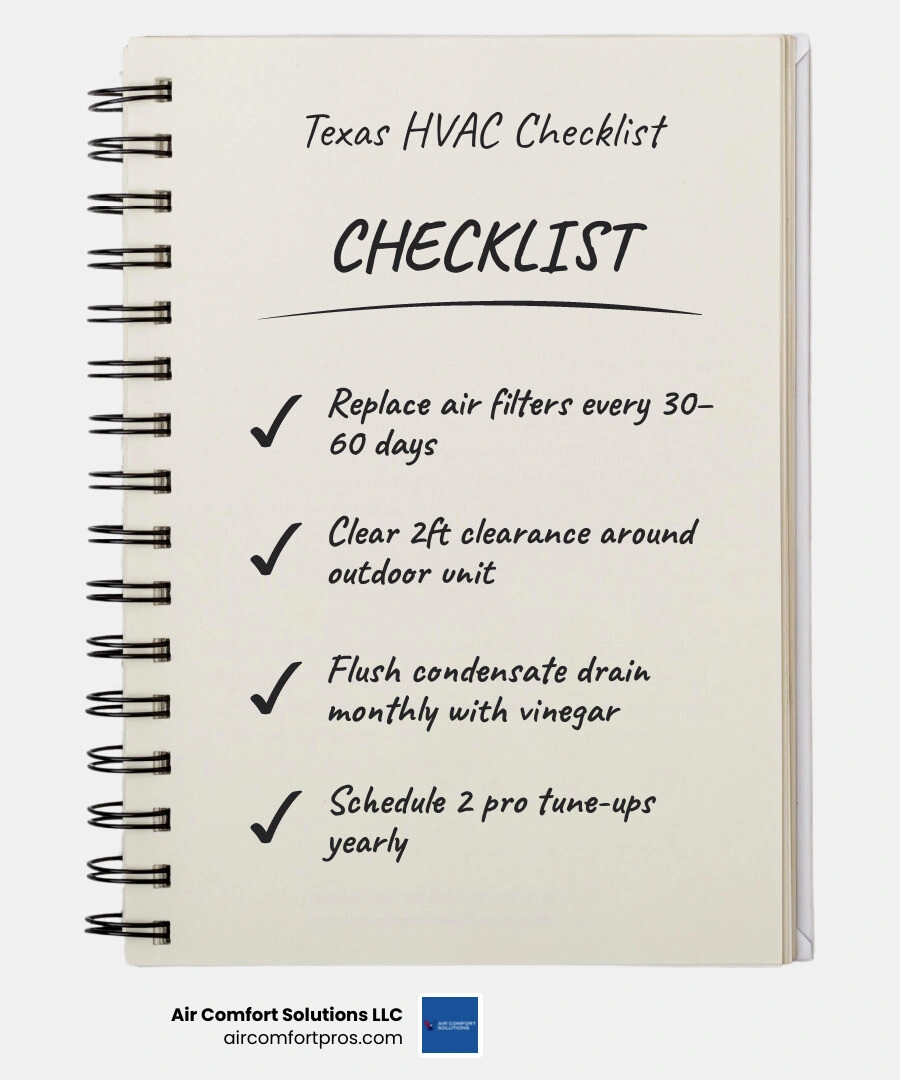
1. Replace air filters every 30–60 days (more often during peak pollen or cooling seasons)
2. Schedule two professional tune-ups per year — one in spring before the heat hits, one in fall before heating season
3. Clear debris from around your outdoor unit and maintain at least 2 feet of clearance on all sides
4. Flush your condensate drain line monthly with diluted white vinegar to prevent algae clogs
5. Set your thermostat to 78°F when home and 82–84°F when away during summer
6. Use ceiling fans counterclockwise in summer to enhance cooling without lowering the thermostat
7. Seal and insulate ductwork to stop up to 30% of conditioned air from escaping
8. Test smoke and carbon monoxide detectors before each heating season
9. Watch for warning signs like unusual noises, weak airflow, or sudden spikes in your energy bill
10. Consider an annual maintenance plan for priority service and fewer unexpected breakdowns
Whether you are in the humid coastal areas near Houston or the drier inland regions, keeping your system in top shape is the single best thing you can do for your home comfort and your wallet in 2026.
Why HVAC Maintenance Tips for Texas Homeowners are Essential in 2026
As we move through April 2026, the Texas climate continues to prove that our weather is anything but predictable. For those of us living in areas like Spring, Tomball, and Conroe, the transition from a mild spring to a blistering summer happens in the blink of an eye. This rapid shift places an immense load on your cooling system.
The Department of Energy recently updated efficiency standards, and as of 2023, all new split-system air conditioners in the Southwest must meet a minimum of 15 SEER2. While these modern units are incredibly efficient, they are also complex. Without following proper hvac maintenance tips for texas homeowners, even a high-end 16-SEER or 18-SEER unit can lose its efficiency edge.
Neglecting maintenance doesn't just lead to higher bills; it leads to a shorter system lifespan. In milder climates, an AC might last 20 years with minimal effort. In the Houston area, the "Texas tax" on machinery is real—high humidity and extreme heat cycles can kill a system in 10 years if it's neglected. By investing in AC Maintenance Houston TX and AC Maintenance Conroe TX, you are effectively protecting one of the most expensive appliances in your home.
Beyond the machinery, your health and safety are at stake. Proper maintenance ensures that your indoor air quality remains high, filtering out the heavy dust and pollen that plague North Harris County. It also ensures that safety components, like your furnace's heat exchanger, are intact before you turn on the heat during a sudden "Blue Norther" freeze.
DIY HVAC Maintenance Tips for Texas Homeowners: Monthly and Seasonal Tasks
While we always recommend professional intervention for the technical stuff, there is plenty you can do to keep the air flowing. Think of it like changing the oil in your car; you wouldn't wait for the engine to seize before checking the dipstick.
Monthly and Seasonal DIY HVAC Maintenance Tips for Texas Homeowners
The single most important task you can perform is changing your air filter. In Texas, a "standard" three-month filter rarely lasts three months. Between the cedar pollen in the winter, the oak pollen in the spring, and the dust blown in from West Texas or even the Sahara (yes, that happens!), your filters work overtime.
• Filter Frequency: Check your filter every 30 days. If it looks gray or furry, swap it out. During peak July heat, your system might run 16 hours a day, meaning that filter is catching twice as much debris as it would in October.
• Choosing the Right Filter: Look for a MERV rating between 8 and 13. A MERV 8 is great for general dust, while a MERV 11 or 13 is better if you have pets or allergies. Be careful, though—filters with too high a MERV rating can actually restrict airflow if your system isn't designed for them. You can learn more in our guide on How to Replace AC Filters.
• Outdoor Unit Clearance: Your outdoor condenser unit needs to "breathe" to release the heat it pulled from your house. We recommend at least 2 feet of clearance on all sides. For our neighbors in Magnolia and The Woodlands, this often means trimming back those fast-growing shrubs and clearing out pine needles. If you need help with a thorough cleaning, consider AC Maintenance Tomball TX services to ensure your coils are pristine.
Maintaining Airflow and Indoor Air Quality
Airflow is the lifeblood of your HVAC system. If the air can't move, the system can't cool.
• Vent Inspection: Walk through your home and ensure no furniture or heavy curtains are blocking your supply or return vents. Dust your registers regularly to prevent that "musty" smell when the air kicks on.
• Humidity Management: In East Texas, humidity is our constant companion. When the humidity inside your home climbs above 50%, it doesn't just feel sticky—it encourages mold growth in your ducts. Ensure your AC is running long enough cycles to dehumidify effectively. If you live in high-humidity zones, AC Maintenance Cypress TX can help verify that your system is properly balanced for moisture removal.
Preparing for Extreme Weather and Common Texas HVAC Issues
Texas weather is a game of extremes. We go from 105°F heat waves to "Snowmageddon" freezes in the same year. Preparing your system for these shifts is key to avoiding an emergency call.
Thermostat Settings and Efficiency Hacks
Many homeowners believe that turning the AC off when they leave for work saves money. In Texas, that's often a myth. If you let your house heat up to 85°F while you're at the office, your AC will have to labor for hours to cool the walls, furniture, and air back down to 72°F.
• The Golden Rule: Set your thermostat to 78°F when you are home. For every degree you raise the temperature in the summer, you can save about 3% to 5% on your cooling costs.
• Smart Upgrades: A smart thermostat can learn your schedule and adjust automatically. Many local utility companies even offer rebates for these.
• Ceiling Fan Magic: In the summer, set your fans to rotate counterclockwise. This creates a downdraft that makes you feel up to 4 degrees cooler through the wind-chill effect. Just remember: fans cool people, not rooms. Turn them off when you leave! For more prep tips, check out Preparing Your Home's Cooling System for a Smooth Summer and our AC Service Spring TX guide.
Preventing Clogged Drains and Coil Buildup
One of the most common reasons for a "no-cool" call in Houston and Spring is a clogged condensate drain line. As your AC removes humidity, that water has to go somewhere. In our humid climate, algae and slime love to grow in those pipes.
• The Vinegar Flush: Once a month during the summer, pour a cup of distilled white vinegar down your condensate drain access port. This kills the algae before it can form a clog.
• The Float Switch: Ensure your system has a working float switch. This safety device shuts the system down if the drain line clogs, preventing a ceiling-ruining overflow. If you are already seeing moisture where it shouldn't be, read our advice on What to Do When Your AC is Leaking Water.
• Winter Readiness: Don't forget the furnace! Before the first freeze, give your heating system a test run. A faint burning smell is normal for the first 20 minutes (that's just dust burning off), but anything persistent needs a look. See our tips on Protect Your Home with Routine Furnace Check-Ups.
The Role of Professional Tune-Ups and Maintenance Plans
While DIY tasks are great, there are parts of your system that require a certified touch. A professional tune-up is like a deep-tissue massage for your HVAC; it gets into the spots you can't reach.
• Change Air Filters — DIY: Yes — Professional: Yes
• Clear Debris Around Unit — DIY: Yes — Professional: Yes
• Clean Evaporator/Condenser Coils — DIY: No — Professional: Yes
• Check Refrigerant Levels — DIY: No — Professional: Yes
• Tighten Electrical Connections — DIY: No — Professional: Yes
• Measure Amperage/Voltage — DIY: No — Professional: Yes
• Flush Condensate Drain — DIY: Yes — Professional: Yes
• Calibrate Thermostat — DIY: No — Professional: Yes
• Inspect Ductwork for Leaks — DIY: Partial — Professional: Yes
When to Call for Professional HVAC Maintenance Tips for Texas Homeowners
Sometimes, your system tries to tell you it's struggling. Ignoring these signs is the fastest way to an expensive replacement.
• Unusual Noises: Banging, screeching, or persistent clicking are not normal. They often indicate a failing motor or a loose belt.
• Weak Airflow: If your vents are barely puffing, you might have a clogged coil or a blower motor issue.
• The "Mystery" Bill: If your energy bill jumps significantly but your habits haven't changed, your system is likely losing efficiency.
• Safety First: For gas systems, carbon monoxide is a silent threat. A professional inspection includes checking the heat exchanger for cracks. If you're unsure about your system's health, check our list of Signs Your AC Needs Repair or book an AC Service Houston TX visit.
We highly recommend a What to Expect During Your First AC Tune-Up if you've never had one, and joining an HVAC Maintenance Plan is the best way to ensure you never miss a seasonal check-up.
Maximizing System Lifespan and Efficiency
The goal of following hvac maintenance tips for texas homeowners is to get the full 15–20 years out of your investment. One of the biggest obstacles to that goal is leaky ductwork.
Energy Star estimates that the average home loses 20% to 30% of its conditioned air through gaps and leaks in the ducts. In Texas, where attics hit 150°F, that leak isn't just losing cool air—it's sucking in scorching, dusty attic air. Proper sealing and insulation can drastically reduce the strain on your compressor. If you notice uneven temperatures between rooms, it might be time for Ductwork Services Conroe TX.
Frequently Asked Questions about Texas HVAC Care
How often should I change my air filter in Texas?
In the Pinehurst and North Harris County area, we recommend checking your filter every 30 days. During high-use seasons (May through September) or heavy pollen seasons (March and April), you should replace it every 30–60 days. If you have multiple pets or suffer from severe allergies, monthly changes are a must.
What are the best thermostat settings for a Texas summer?
The U.S. Department of Energy recommends setting your thermostat to 78°F when you are home and raising it to 82–84°F when you are away for more than a few hours. This prevents your home from becoming a "heat soak" while still saving significant energy. Using ceiling fans allows you to feel comfortable at 78°F as if it were 74°F.
Why is my AC drain line clogging so frequently?
Our local humidity is the primary culprit. High moisture levels combined with dust that bypasses your filter create a perfect breeding ground for "zooglea" (the technical name for that slimy algae). Monthly vinegar flushes and annual professional cleanings are the best way to keep the water flowing out of your house instead of into your ceiling.
Conclusion
Taking care of your heating and cooling system doesn't have to be a headache. By following these hvac maintenance tips for texas homeowners, you can enjoy lower bills, cleaner air, and the peace of mind that comes with a reliable system.
At Air Comfort Solutions LLC, we've spent over 35 years helping our neighbors in Pinehurst, Magnolia, The Woodlands, and throughout the north side of Harris County stay comfortable. Our certified technicians believe in honest, reliable solutions and upfront pricing. Whether you need a quick spring tune-up or a comprehensive maintenance plan, we are here to help.
Ready to get your system in top shape for the 2026 season? Explore Our Services or schedule your HVAC Maintenance Spring TX today. Let's keep your home the cool sanctuary it's meant to be!
Why Every Texas Homeowner Needs an HVAC Maintenance Plan Right Now
HVAC maintenance tips for Texas homeowners are not optional — they are a survival strategy. In a state where summer temperatures routinely push past 100°F, your air conditioner works harder and longer than almost anywhere else in the country. Texas attics can reach 140–160°F in peak summer, duct systems take a constant beating, and sudden winter freezes can catch even a well-run system off guard.
The result? Texas HVAC systems that go without regular care tend to fail early — often right in the middle of a heat wave when you need them most. According to the U.S. Department of Energy, routine maintenance alone can cut energy consumption by up to 15%. And while a well-maintained system can last 15 to 20 years, a neglected one may give out in under 10.
Here is a quick overview of the most important HVAC maintenance steps for Texas homeowners:
- Replace air filters every 30–60 days (more often during peak pollen or cooling seasons)
- Schedule two professional tune-ups per year — one in spring before the heat hits, one in fall before heating season
- Clear debris from around your outdoor unit and maintain at least 2 feet of clearance on all sides
- Flush your condensate drain line monthly with diluted white vinegar to prevent algae clogs
- Set your thermostat to 78°F when home and 82–84°F when away during summer
- Use ceiling fans counterclockwise in summer to enhance cooling without lowering the thermostat
- Seal and insulate ductwork to stop up to 30% of conditioned air from escaping
- Test smoke and carbon monoxide detectors before each heating season
- Watch for warning signs like unusual noises, weak airflow, or sudden spikes in your energy bill
- Consider an annual maintenance plan for priority service and fewer unexpected breakdowns
Whether you are in the humid coastal areas near Houston or the drier inland regions, keeping your system in top shape is the single best thing you can do for your home comfort and your wallet in 2026.
Why HVAC Maintenance Tips for Texas Homeowners are Essential in 2026
As we move through April 2026, the Texas climate continues to prove that our weather is anything but predictable. For those of us living in areas like Spring, Tomball, and Conroe, the transition from a mild spring to a blistering summer happens in the blink of an eye. This rapid shift places an immense load on your cooling system.
The Department of Energy recently updated efficiency standards, and as of 2023, all new split-system air conditioners in the Southwest must meet a minimum of 15 SEER2. While these modern units are incredibly efficient, they are also complex. Without following proper hvac maintenance tips for texas homeowners, even a high-end 16-SEER or 18-SEER unit can lose its efficiency edge.
Neglecting maintenance doesn't just lead to higher bills; it leads to a shorter system lifespan. In milder climates, an AC might last 20 years with minimal effort. In the Houston area, the "Texas tax" on machinery is real—high humidity and extreme heat cycles can kill a system in 10 years if it's neglected. By investing in AC Maintenance Houston TX and AC Maintenance Conroe TX, you are effectively protecting one of the most expensive appliances in your home.
Beyond the machinery, your health and safety are at stake. Proper maintenance ensures that your indoor air quality remains high, filtering out the heavy dust and pollen that plague North Harris County. It also ensures that safety components, like your furnace's heat exchanger, are intact before you turn on the heat during a sudden "Blue Norther" freeze.
DIY HVAC Maintenance Tips for Texas Homeowners: Monthly and Seasonal Tasks
While we always recommend professional intervention for the technical stuff, there is plenty you can do to keep the air flowing. Think of it like changing the oil in your car; you wouldn't wait for the engine to seize before checking the dipstick.
Monthly and Seasonal DIY HVAC Maintenance Tips for Texas Homeowners
The single most important task you can perform is changing your air filter. In Texas, a "standard" three-month filter rarely lasts three months. Between the cedar pollen in the winter, the oak pollen in the spring, and the dust blown in from West Texas or even the Sahara (yes, that happens!), your filters work overtime.
- Filter Frequency: Check your filter every 30 days. If it looks gray or furry, swap it out. During peak July heat, your system might run 16 hours a day, meaning that filter is catching twice as much debris as it would in October.
- Choosing the Right Filter: Look for a MERV rating between 8 and 13. A MERV 8 is great for general dust, while a MERV 11 or 13 is better if you have pets or allergies. Be careful, though—filters with too high a MERV rating can actually restrict airflow if your system isn't designed for them. You can learn more in our guide on How to Replace AC Filters.
- Outdoor Unit Clearance: Your outdoor condenser unit needs to "breathe" to release the heat it pulled from your house. We recommend at least 2 feet of clearance on all sides. For our neighbors in Magnolia and The Woodlands, this often means trimming back those fast-growing shrubs and clearing out pine needles. If you need help with a thorough cleaning, consider AC Maintenance Tomball TX services to ensure your coils are pristine.
Maintaining Airflow and Indoor Air Quality
Airflow is the lifeblood of your HVAC system. If the air can't move, the system can't cool.
- Vent Inspection: Walk through your home and ensure no furniture or heavy curtains are blocking your supply or return vents. Dust your registers regularly to prevent that "musty" smell when the air kicks on.
- Humidity Management: In East Texas, humidity is our constant companion. When the humidity inside your home climbs above 50%, it doesn't just feel sticky—it encourages mold growth in your ducts. Ensure your AC is running long enough cycles to dehumidify effectively. If you live in high-humidity zones, AC Maintenance Cypress TX can help verify that your system is properly balanced for moisture removal.
Preparing for Extreme Weather and Common Texas HVAC Issues
Texas weather is a game of extremes. We go from 105°F heat waves to "Snowmageddon" freezes in the same year. Preparing your system for these shifts is key to avoiding an emergency call.
Thermostat Settings and Efficiency Hacks
Many homeowners believe that turning the AC off when they leave for work saves money. In Texas, that's often a myth. If you let your house heat up to 85°F while you're at the office, your AC will have to labor for hours to cool the walls, furniture, and air back down to 72°F.
- The Golden Rule: Set your thermostat to 78°F when you are home. For every degree you raise the temperature in the summer, you can save about 3% to 5% on your cooling costs.
- Smart Upgrades: A smart thermostat can learn your schedule and adjust automatically. Many local utility companies even offer rebates for these.
- Ceiling Fan Magic: In the summer, set your fans to rotate counterclockwise. This creates a downdraft that makes you feel up to 4 degrees cooler through the wind-chill effect. Just remember: fans cool people, not rooms. Turn them off when you leave! For more prep tips, check out Preparing Your Home's Cooling System for a Smooth Summer and our AC Service Spring TX guide.
Preventing Clogged Drains and Coil Buildup
One of the most common reasons for a "no-cool" call in Houston and Spring is a clogged condensate drain line. As your AC removes humidity, that water has to go somewhere. In our humid climate, algae and slime love to grow in those pipes.
- The Vinegar Flush: Once a month during the summer, pour a cup of distilled white vinegar down your condensate drain access port. This kills the algae before it can form a clog.
- The Float Switch: Ensure your system has a working float switch. This safety device shuts the system down if the drain line clogs, preventing a ceiling-ruining overflow. If you are already seeing moisture where it shouldn't be, read our advice on What to Do When Your AC is Leaking Water.
- Winter Readiness: Don't forget the furnace! Before the first freeze, give your heating system a test run. A faint burning smell is normal for the first 20 minutes (that's just dust burning off), but anything persistent needs a look. See our tips on Protect Your Home with Routine Furnace Check-Ups.
The Role of Professional Tune-Ups and Maintenance Plans
While DIY tasks are great, there are parts of your system that require a certified touch. A professional tune-up is like a deep-tissue massage for your HVAC; it gets into the spots you can't reach.
| Task | DIY | Professional |
|---|
| Change Air Filters | Yes | Yes |
| Clear Debris Around Unit | Yes | Yes |
| Clean Evaporator/Condenser Coils | No | Yes |
| Check Refrigerant Levels | No | Yes |
| Tighten Electrical Connections | No | Yes |
| Measure Amperage/Voltage | No | Yes |
| Flush Condensate Drain | Yes | Yes |
| Calibrate Thermostat | No | Yes |
| Inspect Ductwork for Leaks | Partial | Yes |
When to Call for Professional HVAC Maintenance Tips for Texas Homeowners
Sometimes, your system tries to tell you it's struggling. Ignoring these signs is the fastest way to an expensive replacement.
- Unusual Noises: Banging, screeching, or persistent clicking are not normal. They often indicate a failing motor or a loose belt.
- Weak Airflow: If your vents are barely puffing, you might have a clogged coil or a blower motor issue.
- The "Mystery" Bill: If your energy bill jumps significantly but your habits haven't changed, your system is likely losing efficiency.
- Safety First: For gas systems, carbon monoxide is a silent threat. A professional inspection includes checking the heat exchanger for cracks. If you're unsure about your system's health, check our list of Signs Your AC Needs Repair or book an AC Service Houston TX visit.
We highly recommend a What to Expect During Your First AC Tune-Up if you've never had one, and joining an HVAC Maintenance Plan is the best way to ensure you never miss a seasonal check-up.
Maximizing System Lifespan and Efficiency
The goal of following hvac maintenance tips for texas homeowners is to get the full 15–20 years out of your investment. One of the biggest obstacles to that goal is leaky ductwork.
Energy Star estimates that the average home loses 20% to 30% of its conditioned air through gaps and leaks in the ducts. In Texas, where attics hit 150°F, that leak isn't just losing cool air—it's sucking in scorching, dusty attic air. Proper sealing and insulation can drastically reduce the strain on your compressor. If you notice uneven temperatures between rooms, it might be time for Ductwork Services Conroe TX.
Frequently Asked Questions about Texas HVAC Care
How often should I change my air filter in Texas?
In the Pinehurst and North Harris County area, we recommend checking your filter every 30 days. During high-use seasons (May through September) or heavy pollen seasons (March and April), you should replace it every 30–60 days. If you have multiple pets or suffer from severe allergies, monthly changes are a must.
What are the best thermostat settings for a Texas summer?
The U.S. Department of Energy recommends setting your thermostat to 78°F when you are home and raising it to 82–84°F when you are away for more than a few hours. This prevents your home from becoming a "heat soak" while still saving significant energy. Using ceiling fans allows you to feel comfortable at 78°F as if it were 74°F.
Why is my AC drain line clogging so frequently?
Our local humidity is the primary culprit. High moisture levels combined with dust that bypasses your filter create a perfect breeding ground for "zooglea" (the technical name for that slimy algae). Monthly vinegar flushes and annual professional cleanings are the best way to keep the water flowing out of your house instead of into your ceiling.
Conclusion
Taking care of your heating and cooling system doesn't have to be a headache. By following these hvac maintenance tips for texas homeowners, you can enjoy lower bills, cleaner air, and the peace of mind that comes with a reliable system.
At Air Comfort Solutions LLC, we've spent over 35 years helping our neighbors in Pinehurst, Magnolia, The Woodlands, and throughout the north side of Harris County stay comfortable. Our certified technicians believe in honest, reliable solutions and upfront pricing. Whether you need a quick spring tune-up or a comprehensive maintenance plan, we are here to help.
Ready to get your system in top shape for the 2026 season? Explore Our Services or schedule your HVAC Maintenance Spring TX today. Let's keep your home the cool sanctuary it's meant to be!
Why Every Texas Homeowner Needs an HVAC Maintenance Plan Right Now
HVAC maintenance tips for Texas homeowners are not optional — they are a survival strategy. In a state where summer temperatures routinely push past 100°F, your air conditioner works harder and longer than almost anywhere else in the country. Texas attics can reach 140–160°F in peak summer, duct systems take a constant beating, and sudden winter freezes can catch even a well-run system off guard.
The result? Texas HVAC systems that go without regular care tend to fail early — often right in the middle of a heat wave when you need them most. According to the U.S. Department of Energy, routine maintenance alone can cut energy consumption by up to 15%. And while a well-maintained system can last 15 to 20 years, a neglected one may give out in under 10.
Here is a quick overview of the most important HVAC maintenance steps for Texas homeowners:
- Replace air filters every 30–60 days (more often during peak pollen or cooling seasons)
- Schedule two professional tune-ups per year — one in spring before the heat hits, one in fall before heating season
- Clear debris from around your outdoor unit and maintain at least 2 feet of clearance on all sides
- Flush your condensate drain line monthly with diluted white vinegar to prevent algae clogs
- Set your thermostat to 78°F when home and 82–84°F when away during summer
- Use ceiling fans counterclockwise in summer to enhance cooling without lowering the thermostat
- Seal and insulate ductwork to stop up to 30% of conditioned air from escaping
- Test smoke and carbon monoxide detectors before each heating season
- Watch for warning signs like unusual noises, weak airflow, or sudden spikes in your energy bill
- Consider an annual maintenance plan for priority service and fewer unexpected breakdowns
Whether you are in the humid coastal areas near Houston or the drier inland regions, keeping your system in top shape is the single best thing you can do for your home comfort and your wallet in 2026.
Why HVAC Maintenance Tips for Texas Homeowners are Essential in 2026
As we move through April 2026, the Texas climate continues to prove that our weather is anything but predictable. For those of us living in areas like Spring, Tomball, and Conroe, the transition from a mild spring to a blistering summer happens in the blink of an eye. This rapid shift places an immense load on your cooling system.
The Department of Energy recently updated efficiency standards, and as of 2023, all new split-system air conditioners in the Southwest must meet a minimum of 15 SEER2. While these modern units are incredibly efficient, they are also complex. Without following proper hvac maintenance tips for texas homeowners, even a high-end 16-SEER or 18-SEER unit can lose its efficiency edge.
Neglecting maintenance doesn't just lead to higher bills; it leads to a shorter system lifespan. In milder climates, an AC might last 20 years with minimal effort. In the Houston area, the "Texas tax" on machinery is real—high humidity and extreme heat cycles can kill a system in 10 years if it's neglected. By investing in AC Maintenance Houston TX and AC Maintenance Conroe TX, you are effectively protecting one of the most expensive appliances in your home.
Beyond the machinery, your health and safety are at stake. Proper maintenance ensures that your indoor air quality remains high, filtering out the heavy dust and pollen that plague North Harris County. It also ensures that safety components, like your furnace's heat exchanger, are intact before you turn on the heat during a sudden "Blue Norther" freeze.
DIY HVAC Maintenance Tips for Texas Homeowners: Monthly and Seasonal Tasks
While we always recommend professional intervention for the technical stuff, there is plenty you can do to keep the air flowing. Think of it like changing the oil in your car; you wouldn't wait for the engine to seize before checking the dipstick.
Monthly and Seasonal DIY HVAC Maintenance Tips for Texas Homeowners
The single most important task you can perform is changing your air filter. In Texas, a "standard" three-month filter rarely lasts three months. Between the cedar pollen in the winter, the oak pollen in the spring, and the dust blown in from West Texas or even the Sahara (yes, that happens!), your filters work overtime.
- Filter Frequency: Check your filter every 30 days. If it looks gray or furry, swap it out. During peak July heat, your system might run 16 hours a day, meaning that filter is catching twice as much debris as it would in October.
- Choosing the Right Filter: Look for a MERV rating between 8 and 13. A MERV 8 is great for general dust, while a MERV 11 or 13 is better if you have pets or allergies. Be careful, though—filters with too high a MERV rating can actually restrict airflow if your system isn't designed for them. You can learn more in our guide on How to Replace AC Filters.
- Outdoor Unit Clearance: Your outdoor condenser unit needs to "breathe" to release the heat it pulled from your house. We recommend at least 2 feet of clearance on all sides. For our neighbors in Magnolia and The Woodlands, this often means trimming back those fast-growing shrubs and clearing out pine needles. If you need help with a thorough cleaning, consider AC Maintenance Tomball TX services to ensure your coils are pristine.
Maintaining Airflow and Indoor Air Quality
Airflow is the lifeblood of your HVAC system. If the air can't move, the system can't cool.
- Vent Inspection: Walk through your home and ensure no furniture or heavy curtains are blocking your supply or return vents. Dust your registers regularly to prevent that "musty" smell when the air kicks on.
- Humidity Management: In East Texas, humidity is our constant companion. When the humidity inside your home climbs above 50%, it doesn't just feel sticky—it encourages mold growth in your ducts. Ensure your AC is running long enough cycles to dehumidify effectively. If you live in high-humidity zones, AC Maintenance Cypress TX can help verify that your system is properly balanced for moisture removal.
Preparing for Extreme Weather and Common Texas HVAC Issues
Texas weather is a game of extremes. We go from 105°F heat waves to "Snowmageddon" freezes in the same year. Preparing your system for these shifts is key to avoiding an emergency call.
Thermostat Settings and Efficiency Hacks
Many homeowners believe that turning the AC off when they leave for work saves money. In Texas, that's often a myth. If you let your house heat up to 85°F while you're at the office, your AC will have to labor for hours to cool the walls, furniture, and air back down to 72°F.
- The Golden Rule: Set your thermostat to 78°F when you are home. For every degree you raise the temperature in the summer, you can save about 3% to 5% on your cooling costs.
- Smart Upgrades: A smart thermostat can learn your schedule and adjust automatically. Many local utility companies even offer rebates for these.
- Ceiling Fan Magic: In the summer, set your fans to rotate counterclockwise. This creates a downdraft that makes you feel up to 4 degrees cooler through the wind-chill effect. Just remember: fans cool people, not rooms. Turn them off when you leave! For more prep tips, check out Preparing Your Home's Cooling System for a Smooth Summer and our AC Service Spring TX guide.
Preventing Clogged Drains and Coil Buildup
One of the most common reasons for a "no-cool" call in Houston and Spring is a clogged condensate drain line. As your AC removes humidity, that water has to go somewhere. In our humid climate, algae and slime love to grow in those pipes.
- The Vinegar Flush: Once a month during the summer, pour a cup of distilled white vinegar down your condensate drain access port. This kills the algae before it can form a clog.
- The Float Switch: Ensure your system has a working float switch. This safety device shuts the system down if the drain line clogs, preventing a ceiling-ruining overflow. If you are already seeing moisture where it shouldn't be, read our advice on What to Do When Your AC is Leaking Water.
- Winter Readiness: Don't forget the furnace! Before the first freeze, give your heating system a test run. A faint burning smell is normal for the first 20 minutes (that's just dust burning off), but anything persistent needs a look. See our tips on Protect Your Home with Routine Furnace Check-Ups.
The Role of Professional Tune-Ups and Maintenance Plans
While DIY tasks are great, there are parts of your system that require a certified touch. A professional tune-up is like a deep-tissue massage for your HVAC; it gets into the spots you can't reach.
| Task | DIY | Professional |
|---|
| Change Air Filters | Yes | Yes |
| Clear Debris Around Unit | Yes | Yes |
| Clean Evaporator/Condenser Coils | No | Yes |
| Check Refrigerant Levels | No | Yes |
| Tighten Electrical Connections | No | Yes |
| Measure Amperage/Voltage | No | Yes |
| Flush Condensate Drain | Yes | Yes |
| Calibrate Thermostat | No | Yes |
| Inspect Ductwork for Leaks | Partial | Yes |
When to Call for Professional HVAC Maintenance Tips for Texas Homeowners
Sometimes, your system tries to tell you it's struggling. Ignoring these signs is the fastest way to an expensive replacement.
- Unusual Noises: Banging, screeching, or persistent clicking are not normal. They often indicate a failing motor or a loose belt.
- Weak Airflow: If your vents are barely puffing, you might have a clogged coil or a blower motor issue.
- The "Mystery" Bill: If your energy bill jumps significantly but your habits haven't changed, your system is likely losing efficiency.
- Safety First: For gas systems, carbon monoxide is a silent threat. A professional inspection includes checking the heat exchanger for cracks. If you're unsure about your system's health, check our list of Signs Your AC Needs Repair or book an AC Service Houston TX visit.
We highly recommend a What to Expect During Your First AC Tune-Up if you've never had one, and joining an HVAC Maintenance Plan is the best way to ensure you never miss a seasonal check-up.
Maximizing System Lifespan and Efficiency
The goal of following hvac maintenance tips for texas homeowners is to get the full 15–20 years out of your investment. One of the biggest obstacles to that goal is leaky ductwork.
Energy Star estimates that the average home loses 20% to 30% of its conditioned air through gaps and leaks in the ducts. In Texas, where attics hit 150°F, that leak isn't just losing cool air—it's sucking in scorching, dusty attic air. Proper sealing and insulation can drastically reduce the strain on your compressor. If you notice uneven temperatures between rooms, it might be time for Ductwork Services Conroe TX.
Frequently Asked Questions about Texas HVAC Care
How often should I change my air filter in Texas?
In the Pinehurst and North Harris County area, we recommend checking your filter every 30 days. During high-use seasons (May through September) or heavy pollen seasons (March and April), you should replace it every 30–60 days. If you have multiple pets or suffer from severe allergies, monthly changes are a must.
What are the best thermostat settings for a Texas summer?
The U.S. Department of Energy recommends setting your thermostat to 78°F when you are home and raising it to 82–84°F when you are away for more than a few hours. This prevents your home from becoming a "heat soak" while still saving significant energy. Using ceiling fans allows you to feel comfortable at 78°F as if it were 74°F.
Why is my AC drain line clogging so frequently?
Our local humidity is the primary culprit. High moisture levels combined with dust that bypasses your filter create a perfect breeding ground for "zooglea" (the technical name for that slimy algae). Monthly vinegar flushes and annual professional cleanings are the best way to keep the water flowing out of your house instead of into your ceiling.
Conclusion
Taking care of your heating and cooling system doesn't have to be a headache. By following these hvac maintenance tips for texas homeowners, you can enjoy lower bills, cleaner air, and the peace of mind that comes with a reliable system.
At Air Comfort Solutions LLC, we've spent over 35 years helping our neighbors in Pinehurst, Magnolia, The Woodlands, and throughout the north side of Harris County stay comfortable. Our certified technicians believe in honest, reliable solutions and upfront pricing. Whether you need a quick spring tune-up or a comprehensive maintenance plan, we are here to help.
Ready to get your system in top shape for the 2026 season? Explore Our Services or schedule your HVAC Maintenance Spring TX today. Let's keep your home the cool sanctuary it's meant to be!
Why Every Texas Homeowner Needs an HVAC Maintenance Plan Right Now
HVAC maintenance tips for Texas homeowners are not optional — they are a survival strategy. In a state where summer temperatures routinely push past 100°F, your air conditioner works harder and longer than almost anywhere else in the country. Texas attics can reach 140–160°F in peak summer, duct systems take a constant beating, and sudden winter freezes can catch even a well-run system off guard.
The result? Texas HVAC systems that go without regular care tend to fail early — often right in the middle of a heat wave when you need them most. According to the U.S. Department of Energy, routine maintenance alone can cut energy consumption by up to 15%. And while a well-maintained system can last 15 to 20 years, a neglected one may give out in under 10.
Here is a quick overview of the most important HVAC maintenance steps for Texas homeowners:
- Replace air filters every 30–60 days (more often during peak pollen or cooling seasons)
- Schedule two professional tune-ups per year — one in spring before the heat hits, one in fall before heating season
- Clear debris from around your outdoor unit and maintain at least 2 feet of clearance on all sides
- Flush your condensate drain line monthly with diluted white vinegar to prevent algae clogs
- Set your thermostat to 78°F when home and 82–84°F when away during summer
- Use ceiling fans counterclockwise in summer to enhance cooling without lowering the thermostat
- Seal and insulate ductwork to stop up to 30% of conditioned air from escaping
- Test smoke and carbon monoxide detectors before each heating season
- Watch for warning signs like unusual noises, weak airflow, or sudden spikes in your energy bill
- Consider an annual maintenance plan for priority service and fewer unexpected breakdowns
Whether you are in the humid coastal areas near Houston or the drier inland regions, keeping your system in top shape is the single best thing you can do for your home comfort and your wallet in 2026.
Why HVAC Maintenance Tips for Texas Homeowners are Essential in 2026
As we move through April 2026, the Texas climate continues to prove that our weather is anything but predictable. For those of us living in areas like Spring, Tomball, and Conroe, the transition from a mild spring to a blistering summer happens in the blink of an eye. This rapid shift places an immense load on your cooling system.
The Department of Energy recently updated efficiency standards, and as of 2023, all new split-system air conditioners in the Southwest must meet a minimum of 15 SEER2. While these modern units are incredibly efficient, they are also complex. Without following proper hvac maintenance tips for texas homeowners, even a high-end 16-SEER or 18-SEER unit can lose its efficiency edge.
Neglecting maintenance doesn't just lead to higher bills; it leads to a shorter system lifespan. In milder climates, an AC might last 20 years with minimal effort. In the Houston area, the "Texas tax" on machinery is real—high humidity and extreme heat cycles can kill a system in 10 years if it's neglected. By investing in AC Maintenance Houston TX and AC Maintenance Conroe TX, you are effectively protecting one of the most expensive appliances in your home.
Beyond the machinery, your health and safety are at stake. Proper maintenance ensures that your indoor air quality remains high, filtering out the heavy dust and pollen that plague North Harris County. It also ensures that safety components, like your furnace's heat exchanger, are intact before you turn on the heat during a sudden "Blue Norther" freeze.
DIY HVAC Maintenance Tips for Texas Homeowners: Monthly and Seasonal Tasks
While we always recommend professional intervention for the technical stuff, there is plenty you can do to keep the air flowing. Think of it like changing the oil in your car; you wouldn't wait for the engine to seize before checking the dipstick.
Monthly and Seasonal DIY HVAC Maintenance Tips for Texas Homeowners
The single most important task you can perform is changing your air filter. In Texas, a "standard" three-month filter rarely lasts three months. Between the cedar pollen in the winter, the oak pollen in the spring, and the dust blown in from West Texas or even the Sahara (yes, that happens!), your filters work overtime.
- Filter Frequency: Check your filter every 30 days. If it looks gray or furry, swap it out. During peak July heat, your system might run 16 hours a day, meaning that filter is catching twice as much debris as it would in October.
- Choosing the Right Filter: Look for a MERV rating between 8 and 13. A MERV 8 is great for general dust, while a MERV 11 or 13 is better if you have pets or allergies. Be careful, though—filters with too high a MERV rating can actually restrict airflow if your system isn't designed for them. You can learn more in our guide on How to Replace AC Filters.
- Outdoor Unit Clearance: Your outdoor condenser unit needs to "breathe" to release the heat it pulled from your house. We recommend at least 2 feet of clearance on all sides. For our neighbors in Magnolia and The Woodlands, this often means trimming back those fast-growing shrubs and clearing out pine needles. If you need help with a thorough cleaning, consider AC Maintenance Tomball TX services to ensure your coils are pristine.
Maintaining Airflow and Indoor Air Quality
Airflow is the lifeblood of your HVAC system. If the air can't move, the system can't cool.
- Vent Inspection: Walk through your home and ensure no furniture or heavy curtains are blocking your supply or return vents. Dust your registers regularly to prevent that "musty" smell when the air kicks on.
- Humidity Management: In East Texas, humidity is our constant companion. When the humidity inside your home climbs above 50%, it doesn't just feel sticky—it encourages mold growth in your ducts. Ensure your AC is running long enough cycles to dehumidify effectively. If you live in high-humidity zones, AC Maintenance Cypress TX can help verify that your system is properly balanced for moisture removal.
Preparing for Extreme Weather and Common Texas HVAC Issues
Texas weather is a game of extremes. We go from 105°F heat waves to "Snowmageddon" freezes in the same year. Preparing your system for these shifts is key to avoiding an emergency call.
Thermostat Settings and Efficiency Hacks
Many homeowners believe that turning the AC off when they leave for work saves money. In Texas, that's often a myth. If you let your house heat up to 85°F while you're at the office, your AC will have to labor for hours to cool the walls, furniture, and air back down to 72°F.
- The Golden Rule: Set your thermostat to 78°F when you are home. For every degree you raise the temperature in the summer, you can save about 3% to 5% on your cooling costs.
- Smart Upgrades: A smart thermostat can learn your schedule and adjust automatically. Many local utility companies even offer rebates for these.
- Ceiling Fan Magic: In the summer, set your fans to rotate counterclockwise. This creates a downdraft that makes you feel up to 4 degrees cooler through the wind-chill effect. Just remember: fans cool people, not rooms. Turn them off when you leave! For more prep tips, check out Preparing Your Home's Cooling System for a Smooth Summer and our AC Service Spring TX guide.
Preventing Clogged Drains and Coil Buildup
One of the most common reasons for a "no-cool" call in Houston and Spring is a clogged condensate drain line. As your AC removes humidity, that water has to go somewhere. In our humid climate, algae and slime love to grow in those pipes.
- The Vinegar Flush: Once a month during the summer, pour a cup of distilled white vinegar down your condensate drain access port. This kills the algae before it can form a clog.
- The Float Switch: Ensure your system has a working float switch. This safety device shuts the system down if the drain line clogs, preventing a ceiling-ruining overflow. If you are already seeing moisture where it shouldn't be, read our advice on What to Do When Your AC is Leaking Water.
- Winter Readiness: Don't forget the furnace! Before the first freeze, give your heating system a test run. A faint burning smell is normal for the first 20 minutes (that's just dust burning off), but anything persistent needs a look. See our tips on Protect Your Home with Routine Furnace Check-Ups.
The Role of Professional Tune-Ups and Maintenance Plans
While DIY tasks are great, there are parts of your system that require a certified touch. A professional tune-up is like a deep-tissue massage for your HVAC; it gets into the spots you can't reach.
| Task | DIY | Professional |
|---|
| Change Air Filters | Yes | Yes |
| Clear Debris Around Unit | Yes | Yes |
| Clean Evaporator/Condenser Coils | No | Yes |
| Check Refrigerant Levels | No | Yes |
| Tighten Electrical Connections | No | Yes |
| Measure Amperage/Voltage | No | Yes |
| Flush Condensate Drain | Yes | Yes |
| Calibrate Thermostat | No | Yes |
| Inspect Ductwork for Leaks | Partial | Yes |
When to Call for Professional HVAC Maintenance Tips for Texas Homeowners
Sometimes, your system tries to tell you it's struggling. Ignoring these signs is the fastest way to an expensive replacement.
- Unusual Noises: Banging, screeching, or persistent clicking are not normal. They often indicate a failing motor or a loose belt.
- Weak Airflow: If your vents are barely puffing, you might have a clogged coil or a blower motor issue.
- The "Mystery" Bill: If your energy bill jumps significantly but your habits haven't changed, your system is likely losing efficiency.
- Safety First: For gas systems, carbon monoxide is a silent threat. A professional inspection includes checking the heat exchanger for cracks. If you're unsure about your system's health, check our list of Signs Your AC Needs Repair or book an AC Service Houston TX visit.
We highly recommend a What to Expect During Your First AC Tune-Up if you've never had one, and joining an HVAC Maintenance Plan is the best way to ensure you never miss a seasonal check-up.
Maximizing System Lifespan and Efficiency
The goal of following hvac maintenance tips for texas homeowners is to get the full 15–20 years out of your investment. One of the biggest obstacles to that goal is leaky ductwork.
Energy Star estimates that the average home loses 20% to 30% of its conditioned air through gaps and leaks in the ducts. In Texas, where attics hit 150°F, that leak isn't just losing cool air—it's sucking in scorching, dusty attic air. Proper sealing and insulation can drastically reduce the strain on your compressor. If you notice uneven temperatures between rooms, it might be time for Ductwork Services Conroe TX.
Frequently Asked Questions about Texas HVAC Care
How often should I change my air filter in Texas?
In the Pinehurst and North Harris County area, we recommend checking your filter every 30 days. During high-use seasons (May through September) or heavy pollen seasons (March and April), you should replace it every 30–60 days. If you have multiple pets or suffer from severe allergies, monthly changes are a must.
What are the best thermostat settings for a Texas summer?
The U.S. Department of Energy recommends setting your thermostat to 78°F when you are home and raising it to 82–84°F when you are away for more than a few hours. This prevents your home from becoming a "heat soak" while still saving significant energy. Using ceiling fans allows you to feel comfortable at 78°F as if it were 74°F.
Why is my AC drain line clogging so frequently?
Our local humidity is the primary culprit. High moisture levels combined with dust that bypasses your filter create a perfect breeding ground for "zooglea" (the technical name for that slimy algae). Monthly vinegar flushes and annual professional cleanings are the best way to keep the water flowing out of your house instead of into your ceiling.
Conclusion
Taking care of your heating and cooling system doesn't have to be a headache. By following these hvac maintenance tips for texas homeowners, you can enjoy lower bills, cleaner air, and the peace of mind that comes with a reliable system.
At Air Comfort Solutions LLC, we've spent over 35 years helping our neighbors in Pinehurst, Magnolia, The Woodlands, and throughout the north side of Harris County stay comfortable. Our certified technicians believe in honest, reliable solutions and upfront pricing. Whether you need a quick spring tune-up or a comprehensive maintenance plan, we are here to help.
Ready to get your system in top shape for the 2026 season? Explore Our Services or schedule your HVAC Maintenance Spring TX today. Let's keep your home the cool sanctuary it's meant to be!
Why Every Texas Homeowner Needs an HVAC Maintenance Plan Right Now
HVAC maintenance tips for Texas homeowners are not optional — they are a survival strategy. In a state where summer temperatures routinely push past 100°F, your air conditioner works harder and longer than almost anywhere else in the country. Texas attics can reach 140–160°F in peak summer, duct systems take a constant beating, and sudden winter freezes can catch even a well-run system off guard.
The result? Texas HVAC systems that go without regular care tend to fail early — often right in the middle of a heat wave when you need them most. According to the U.S. Department of Energy, routine maintenance alone can cut energy consumption by up to 15%. And while a well-maintained system can last 15 to 20 years, a neglected one may give out in under 10.
Here is a quick overview of the most important HVAC maintenance steps for Texas homeowners:
- Replace air filters every 30–60 days (more often during peak pollen or cooling seasons)
- Schedule two professional tune-ups per year — one in spring before the heat hits, one in fall before heating season
- Clear debris from around your outdoor unit and maintain at least 2 feet of clearance on all sides
- Flush your condensate drain line monthly with diluted white vinegar to prevent algae clogs
- Set your thermostat to 78°F when home and 82–84°F when away during summer
- Use ceiling fans counterclockwise in summer to enhance cooling without lowering the thermostat
- Seal and insulate ductwork to stop up to 30% of conditioned air from escaping
- Test smoke and carbon monoxide detectors before each heating season
- Watch for warning signs like unusual noises, weak airflow, or sudden spikes in your energy bill
- Consider an annual maintenance plan for priority service and fewer unexpected breakdowns
Whether you are in the humid coastal areas near Houston or the drier inland regions, keeping your system in top shape is the single best thing you can do for your home comfort and your wallet in 2026.
Why HVAC Maintenance Tips for Texas Homeowners are Essential in 2026
As we move through April 2026, the Texas climate continues to prove that our weather is anything but predictable. For those of us living in areas like Spring, Tomball, and Conroe, the transition from a mild spring to a blistering summer happens in the blink of an eye. This rapid shift places an immense load on your cooling system.
The Department of Energy recently updated efficiency standards, and as of 2023, all new split-system air conditioners in the Southwest must meet a minimum of 15 SEER2. While these modern units are incredibly efficient, they are also complex. Without following proper hvac maintenance tips for texas homeowners, even a high-end 16-SEER or 18-SEER unit can lose its efficiency edge.
Neglecting maintenance doesn't just lead to higher bills; it leads to a shorter system lifespan. In milder climates, an AC might last 20 years with minimal effort. In the Houston area, the "Texas tax" on machinery is real—high humidity and extreme heat cycles can kill a system in 10 years if it's neglected. By investing in AC Maintenance Houston TX and AC Maintenance Conroe TX, you are effectively protecting one of the most expensive appliances in your home.
Beyond the machinery, your health and safety are at stake. Proper maintenance ensures that your indoor air quality remains high, filtering out the heavy dust and pollen that plague North Harris County. It also ensures that safety components, like your furnace's heat exchanger, are intact before you turn on the heat during a sudden "Blue Norther" freeze.
DIY HVAC Maintenance Tips for Texas Homeowners: Monthly and Seasonal Tasks
While we always recommend professional intervention for the technical stuff, there is plenty you can do to keep the air flowing. Think of it like changing the oil in your car; you wouldn't wait for the engine to seize before checking the dipstick.
Monthly and Seasonal DIY HVAC Maintenance Tips for Texas Homeowners
The single most important task you can perform is changing your air filter. In Texas, a "standard" three-month filter rarely lasts three months. Between the cedar pollen in the winter, the oak pollen in the spring, and the dust blown in from West Texas or even the Sahara (yes, that happens!), your filters work overtime.
- Filter Frequency: Check your filter every 30 days. If it looks gray or furry, swap it out. During peak July heat, your system might run 16 hours a day, meaning that filter is catching twice as much debris as it would in October.
- Choosing the Right Filter: Look for a MERV rating between 8 and 13. A MERV 8 is great for general dust, while a MERV 11 or 13 is better if you have pets or allergies. Be careful, though—filters with too high a MERV rating can actually restrict airflow if your system isn't designed for them. You can learn more in our guide on How to Replace AC Filters.
- Outdoor Unit Clearance: Your outdoor condenser unit needs to "breathe" to release the heat it pulled from your house. We recommend at least 2 feet of clearance on all sides. For our neighbors in Magnolia and The Woodlands, this often means trimming back those fast-growing shrubs and clearing out pine needles. If you need help with a thorough cleaning, consider AC Maintenance Tomball TX services to ensure your coils are pristine.
Maintaining Airflow and Indoor Air Quality
Airflow is the lifeblood of your HVAC system. If the air can't move, the system can't cool.
- Vent Inspection: Walk through your home and ensure no furniture or heavy curtains are blocking your supply or return vents. Dust your registers regularly to prevent that "musty" smell when the air kicks on.
- Humidity Management: In East Texas, humidity is our constant companion. When the humidity inside your home climbs above 50%, it doesn't just feel sticky—it encourages mold growth in your ducts. Ensure your AC is running long enough cycles to dehumidify effectively. If you live in high-humidity zones, AC Maintenance Cypress TX can help verify that your system is properly balanced for moisture removal.
Preparing for Extreme Weather and Common Texas HVAC Issues
Texas weather is a game of extremes. We go from 105°F heat waves to "Snowmageddon" freezes in the same year. Preparing your system for these shifts is key to avoiding an emergency call.
Thermostat Settings and Efficiency Hacks
Many homeowners believe that turning the AC off when they leave for work saves money. In Texas, that's often a myth. If you let your house heat up to 85°F while you're at the office, your AC will have to labor for hours to cool the walls, furniture, and air back down to 72°F.
- The Golden Rule: Set your thermostat to 78°F when you are home. For every degree you raise the temperature in the summer, you can save about 3% to 5% on your cooling costs.
- Smart Upgrades: A smart thermostat can learn your schedule and adjust automatically. Many local utility companies even offer rebates for these.
- Ceiling Fan Magic: In the summer, set your fans to rotate counterclockwise. This creates a downdraft that makes you feel up to 4 degrees cooler through the wind-chill effect. Just remember: fans cool people, not rooms. Turn them off when you leave! For more prep tips, check out Preparing Your Home's Cooling System for a Smooth Summer and our AC Service Spring TX guide.
Preventing Clogged Drains and Coil Buildup
One of the most common reasons for a "no-cool" call in Houston and Spring is a clogged condensate drain line. As your AC removes humidity, that water has to go somewhere. In our humid climate, algae and slime love to grow in those pipes.
- The Vinegar Flush: Once a month during the summer, pour a cup of distilled white vinegar down your condensate drain access port. This kills the algae before it can form a clog.
- The Float Switch: Ensure your system has a working float switch. This safety device shuts the system down if the drain line clogs, preventing a ceiling-ruining overflow. If you are already seeing moisture where it shouldn't be, read our advice on What to Do When Your AC is Leaking Water.
- Winter Readiness: Don't forget the furnace! Before the first freeze, give your heating system a test run. A faint burning smell is normal for the first 20 minutes (that's just dust burning off), but anything persistent needs a look. See our tips on Protect Your Home with Routine Furnace Check-Ups.
The Role of Professional Tune-Ups and Maintenance Plans
While DIY tasks are great, there are parts of your system that require a certified touch. A professional tune-up is like a deep-tissue massage for your HVAC; it gets into the spots you can't reach.
| Task | DIY | Professional |
|---|
| Change Air Filters | Yes | Yes |
| Clear Debris Around Unit | Yes | Yes |
| Clean Evaporator/Condenser Coils | No | Yes |
| Check Refrigerant Levels | No | Yes |
| Tighten Electrical Connections | No | Yes |
| Measure Amperage/Voltage | No | Yes |
| Flush Condensate Drain | Yes | Yes |
| Calibrate Thermostat | No | Yes |
| Inspect Ductwork for Leaks | Partial | Yes |
When to Call for Professional HVAC Maintenance Tips for Texas Homeowners
Sometimes, your system tries to tell you it's struggling. Ignoring these signs is the fastest way to an expensive replacement.
- Unusual Noises: Banging, screeching, or persistent clicking are not normal. They often indicate a failing motor or a loose belt.
- Weak Airflow: If your vents are barely puffing, you might have a clogged coil or a blower motor issue.
- The "Mystery" Bill: If your energy bill jumps significantly but your habits haven't changed, your system is likely losing efficiency.
- Safety First: For gas systems, carbon monoxide is a silent threat. A professional inspection includes checking the heat exchanger for cracks. If you're unsure about your system's health, check our list of Signs Your AC Needs Repair or book an AC Service Houston TX visit.
We highly recommend a What to Expect During Your First AC Tune-Up if you've never had one, and joining an HVAC Maintenance Plan is the best way to ensure you never miss a seasonal check-up.
Maximizing System Lifespan and Efficiency
The goal of following hvac maintenance tips for texas homeowners is to get the full 15–20 years out of your investment. One of the biggest obstacles to that goal is leaky ductwork.
Energy Star estimates that the average home loses 20% to 30% of its conditioned air through gaps and leaks in the ducts. In Texas, where attics hit 150°F, that leak isn't just losing cool air—it's sucking in scorching, dusty attic air. Proper sealing and insulation can drastically reduce the strain on your compressor. If you notice uneven temperatures between rooms, it might be time for Ductwork Services Conroe TX.
Frequently Asked Questions about Texas HVAC Care
How often should I change my air filter in Texas?
In the Pinehurst and North Harris County area, we recommend checking your filter every 30 days. During high-use seasons (May through September) or heavy pollen seasons (March and April), you should replace it every 30–60 days. If you have multiple pets or suffer from severe allergies, monthly changes are a must.
What are the best thermostat settings for a Texas summer?
The U.S. Department of Energy recommends setting your thermostat to 78°F when you are home and raising it to 82–84°F when you are away for more than a few hours. This prevents your home from becoming a "heat soak" while still saving significant energy. Using ceiling fans allows you to feel comfortable at 78°F as if it were 74°F.
Why is my AC drain line clogging so frequently?
Our local humidity is the primary culprit. High moisture levels combined with dust that bypasses your filter create a perfect breeding ground for "zooglea" (the technical name for that slimy algae). Monthly vinegar flushes and annual professional cleanings are the best way to keep the water flowing out of your house instead of into your ceiling.
Conclusion
Taking care of your heating and cooling system doesn't have to be a headache. By following these hvac maintenance tips for texas homeowners, you can enjoy lower bills, cleaner air, and the peace of mind that comes with a reliable system.
At Air Comfort Solutions LLC, we've spent over 35 years helping our neighbors in Pinehurst, Magnolia, The Woodlands, and throughout the north side of Harris County stay comfortable. Our certified technicians believe in honest, reliable solutions and upfront pricing. Whether you need a quick spring tune-up or a comprehensive maintenance plan, we are here to help.
Ready to get your system in top shape for the 2026 season? Explore Our Services or schedule your HVAC Maintenance Spring TX today. Let's keep your home the cool sanctuary it's meant to be!