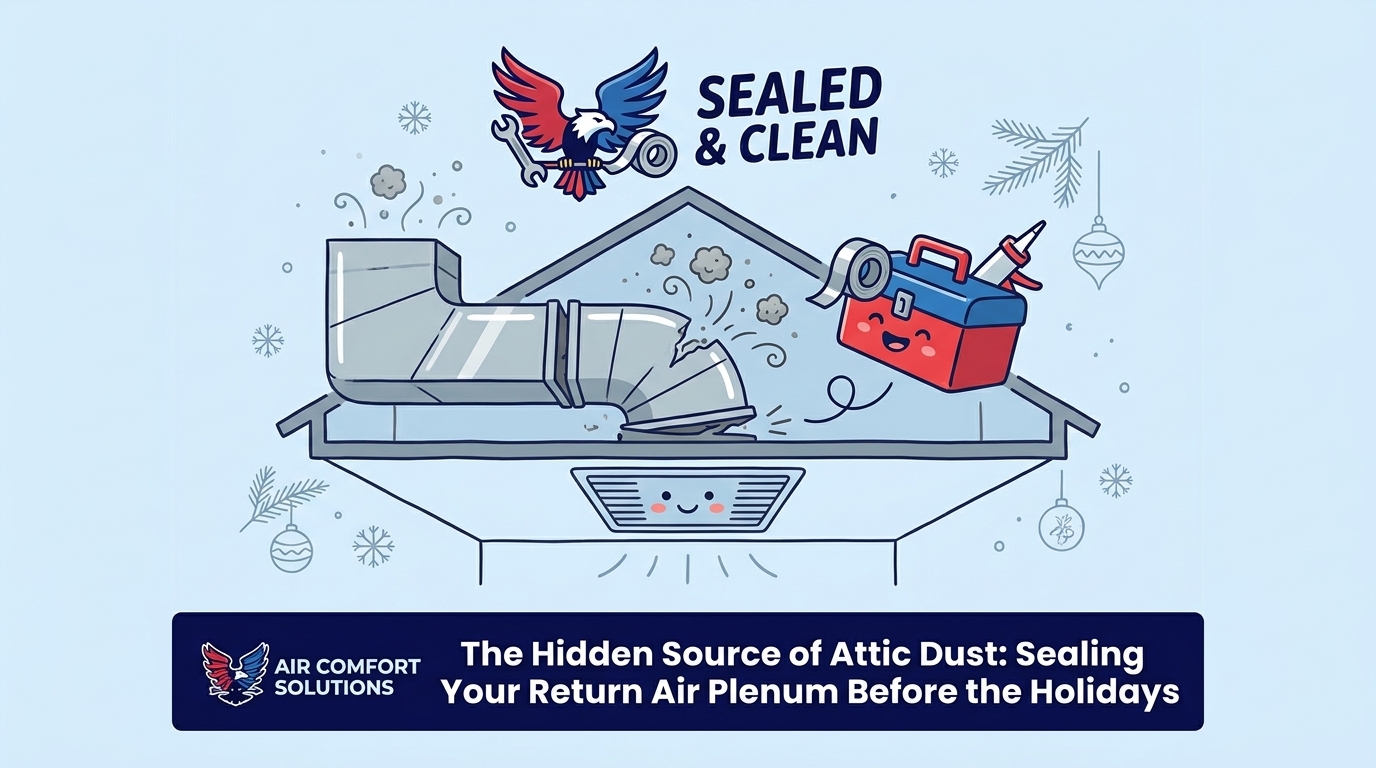
The Value of Sealing Your Return Air Plenum Before the Holidays
Most homeowners buy expensive filters to fix dusty air, not realizing a leaky return plenum in the attic is the real culprit. See why sealing it now saves your holiday gatherings.

The dirty condenser coil and AC performance connection is one of the most common — and most overlooked — reasons homes in Pinehurst, TX stop cooling properly. When dirt, pollen, and debris coat your outdoor unit's coils, your AC can't release heat the way it's designed to. The result? Your system works harder, runs longer, uses more energy, and still leaves you hot.
Here's a quick breakdown of how a dirty condenser coil affects your AC:
• Reduced cooling capacity — dirt acts as an insulating layer, trapping heat in the refrigerant instead of releasing it outside
• Higher energy bills — the system runs longer cycles trying to reach your set temperature, driving up electricity use by as much as 30%
• Increased component stress — the compressor and fan motor strain under elevated pressures and temperatures
• Risk of system failure — prolonged neglect can lead to compressor overheating, oil breakdown, and premature system failure
• Potential warranty issues — some manufacturers can void warranties if maintenance records show neglect
In short: a dirty coil makes every part of your AC work harder for worse results.
This matters especially in North Harris County, where the combination of heat, humidity, pollen, and grass clippings means outdoor units collect debris fast — and April is exactly the right time to catch problems before peak summer cooling demand hits.

To understand why a little bit of dust is such a big deal, we have to look at how your air conditioner actually works. Your AC doesn't "create" cold; it removes heat. The outdoor unit contains the condenser coil, which is a network of copper tubes surrounded by thin aluminum fins. Its primary job is heat rejection.
Inside your home, the evaporator coil absorbs heat. That heat is carried outside via refrigerant. Once it reaches the outdoor unit, the condenser fan pulls air across the coils to dissipate that heat into the Texas air. This is called the condensing process, where the refrigerant changes from a hot gas back into a liquid.
When dirt, grass clippings, or "cottonwood fuzz" coat those coils, they act as thermal insulation. Imagine wearing a heavy wool coat in the middle of a Houston July—that’s exactly how your AC feels. This "insulating blanket" prevents the refrigerant from shedding heat. Because the heat stays trapped in the system, the refrigerant remains too warm, and the cycle of cooling your home becomes incredibly inefficient. If left unaddressed, you may eventually need a Condenser Coil Repair to fix leaks or damage caused by this constant strain.
Furthermore, dirt doesn't just insulate; it creates physical airflow restriction. If air can't move freely through the fins, the heat exchange process grinds to a halt.
• Energy Consumption — Clean Condenser Coil: Standard / Baseline — Dirty Condenser Coil: Up to 30% Increase
• Heat Transfer Rate — Clean Condenser Coil: Optimal — Dirty Condenser Coil: Reduced by 7% or more
• System Pressure — Clean Condenser Coil: Normal (e.g., 200-400 psi) — Dirty Condenser Coil: Elevated / High
• Cooling Speed — Clean Condenser Coil: Fast / Efficient — Dirty Condenser Coil: Slow / Constant Running
• Component Lifespan — Clean Condenser Coil: 10–15 Years — Dirty Condenser Coil: Significantly Shortened
How do you know if the dirty condenser coil and AC performance connection is affecting your home? Since the outdoor unit is often tucked away behind the house or hidden by landscaping, many homeowners don't notice the buildup until the indoor temperature starts to climb.
One of the most obvious signs is your AC Blowing Hot. If the air coming out of your vents feels lukewarm even though the system is running, the refrigerant likely isn't shedding enough heat outside to provide cooling inside. This is a common reason Why Is My AC Not Cooling Properly in Tomball.
Other warning signs include:
• Sky-high energy bills: If your April 2026 electric bill looks like a mid-August bill, your coils are likely struggling.
• Long run cycles: The system seems to run "forever" without ever reaching the thermostat setting.
• Unusual noises: You might hear a strained humming or a louder-than-usual fan motor as the system fights against high internal pressures.
• Visible debris: If you look at your outdoor unit and see a "felt-like" layer of dust or matted grass on the metal fins, it’s time for a cleaning.
When the condenser coil is too dirty to reject heat, the temperature and pressure inside the system skyrocket. Modern AC units have safety switches designed to protect the compressor from exploding or melting down. When the pressure gets too high, the system will "trip" and shut off abruptly.
Once the system cools down slightly, it tries to start again, only to overheat and shut off once more. This rapid on-and-off behavior is known as short cycling. There are many Causes of AC Short Cycling in Conroe, but a fouled condenser is a leading culprit. Short cycling is incredibly hard on your equipment and can lead to a total system burnout in a very short amount of time.
Neglecting your coils isn't just about a slightly warmer house; it’s about the health of your entire HVAC system. The most expensive component in your outdoor unit is the compressor. It is the "heart" of the system, and it is highly sensitive to heat.
When coils are dirty, the compressor’s discharge temperature rises. In the HVAC world, we know that discharge temperatures should never exceed 225°F. Once you cross that threshold, carbonization occurs. This is where the oil that lubricates the compressor begins to break down and turn into a sludge-like carbon substance. Without proper lubrication, the internal metal parts of the compressor will grind together and fail.
Another strange side effect of the dirty condenser coil and AC performance connection is that it can actually cause indoor issues. You might find yourself asking, Why Is My AC Freezing Up in Summer in Tomball? While freezing is often an indoor evaporator issue, the imbalance of pressures caused by a dirty outdoor unit can disrupt the entire refrigerant cycle, leading to ice buildup and restricted airflow.
Finally, keep your paperwork in mind. Many manufacturers require proof of annual professional maintenance to honor equipment warranties. If a compressor fails and the technician finds years of dirt caked into the coils, the manufacturer may deny your claim, leaving you with a massive repair bill.
The damage from dirty coils is often cumulative. Even if the system doesn't fail today, the constant "component fatigue" shortens the lifespan of your unit. A well-maintained system in Pinehurst should last 15 years; a neglected one might only last 8 or 9.
Over time, you may also need to Resolve Poor Airflow From AC Vents because the fan motor has become "tired" from pushing against the resistance of dirty coils. The high heat also accelerates the degradation of electrical capacitors and wiring, leading to more frequent (and avoidable) service calls.
The good news is that the dirty condenser coil and AC performance connection is entirely preventable. In our 35+ years of experience serving the north side of Harris County, we’ve found that a little bit of prevention goes a long way toward a cool, stress-free summer.
The most effective strategy is scheduling an annual tune-up. If you’ve never had one, you can learn What to Expect During Your First AC Tune-Up here. Our technicians don't just "rinse" the unit; we check refrigerant levels, tighten electrical connections, and perform a deep cleaning of the coils.
Homeowners can also take these simple steps:
• Clear the "Dead Zone": Keep at least 2 to 3 feet of clear space around your outdoor unit. Trim back shrubs, weeds, and long grass.
• Mow Away from the Unit: When mowing the lawn, point the grass chute away from the AC so you aren't "power-loading" the coils with fresh clippings.
• Regular Filter Changes: While filters are inside, a clogged filter adds even more stress to a system already struggling with dirty outdoor coils.
• Join a Maintenance Plan: This ensures you never forget your seasonal service and often provides discounts on necessary repairs.
Preparing Your Home's Cooling System for a Smooth Summer starts with a simple visual inspection of that outdoor unit every month.
We often get asked if homeowners can clean their own coils. For light, surface-level debris like leaves or loose dust, a gentle rinse with a garden hose is perfectly fine. However, you must be careful.
1. Turn off the power: Always shut off the AC at the thermostat and the outdoor disconnect box before cleaning.
2. Avoid high pressure: Never use a power washer! The high-pressure stream will flatten the delicate aluminum fins, permanently blocking airflow.
3. Inside-out approach: The best way to clean is to spray from the inside of the unit outward, pushing the dirt out rather than deeper into the fins.
For heavy buildup, professional cleaning is necessary. We use specialized, non-corrosive chemical cleaners that break down grease and bonded dirt that a hose simply can't reach. If your fins are bent, we use specialized fin combs to straighten them and restore airflow. For residents in Magnolia, our AC Maintenance Magnolia TX service includes these professional-grade steps. If you're looking for more details, check out our AC Service Tomball Best Guide.
In a perfect world, once a year in the spring (like right now, in April 2026) is sufficient. However, if you live in a particularly dusty area, near a construction site, or have high-shedding trees like cottonwoods, you might need a cleaning every 3 to 6 months. After a major storm or a period of heavy pollen, it’s always a good idea to give the unit a quick visual check.
Yes! It sounds counterintuitive that a "dirty" and "hot" outdoor unit causes "ice" inside, but it’s all about heat absorption and pressure. If the outdoor coil can't release heat, the refrigerant doesn't cycle correctly. This can cause the indoor evaporator coil to drop below freezing, turning the condensation on the coils into a block of ice. If this happens, you’ll likely need AC Repair Magnolia TX to thaw the system and find the root cause.
Absolutely. Research shows that a dirty condenser coil can reduce efficiency by up to 30 percent. By restoring the dirty condenser coil and AC performance connection to a "clean" state, you allow the system to run shorter cycles. This efficiency recovery can lead to significant monthly savings. If you're wondering if the cost of the service is worth it, consider Is an HVAC Maintenance Plan Worth It for the long-term energy savings alone.
A dirty condenser coil is more than just a housekeeping "to-do"—it is a direct threat to your home's comfort and your wallet. By understanding the dirty condenser coil and AC performance connection, you can take the necessary steps to keep your system running smoothly through the toughest Texas heatwaves.
At Air Comfort Solutions LLC, we have spent over three decades helping our neighbors in Pinehurst, The Woodlands, and across North Harris County stay cool. Whether you need a simple cleaning or a complex repair, our certified technicians are here to provide honest, reliable service.
Don't let a layer of dust stand between you and a comfortable home. Explore Our Services today and let us help you prepare for the summer ahead. For the best in Pinehurst cooling and comprehensive Air Conditioning Services, we are just a phone call away.
The dirty condenser coil and AC performance connection is one of the most common — and most overlooked — reasons homes in Pinehurst, TX stop cooling properly. When dirt, pollen, and debris coat your outdoor unit's coils, your AC can't release heat the way it's designed to. The result? Your system works harder, runs longer, uses more energy, and still leaves you hot.
Here's a quick breakdown of how a dirty condenser coil affects your AC:
In short: a dirty coil makes every part of your AC work harder for worse results.
This matters especially in North Harris County, where the combination of heat, humidity, pollen, and grass clippings means outdoor units collect debris fast — and April is exactly the right time to catch problems before peak summer cooling demand hits.
To understand why a little bit of dust is such a big deal, we have to look at how your air conditioner actually works. Your AC doesn't "create" cold; it removes heat. The outdoor unit contains the condenser coil, which is a network of copper tubes surrounded by thin aluminum fins. Its primary job is heat rejection.
Inside your home, the evaporator coil absorbs heat. That heat is carried outside via refrigerant. Once it reaches the outdoor unit, the condenser fan pulls air across the coils to dissipate that heat into the Texas air. This is called the condensing process, where the refrigerant changes from a hot gas back into a liquid.
When dirt, grass clippings, or "cottonwood fuzz" coat those coils, they act as thermal insulation. Imagine wearing a heavy wool coat in the middle of a Houston July—that’s exactly how your AC feels. This "insulating blanket" prevents the refrigerant from shedding heat. Because the heat stays trapped in the system, the refrigerant remains too warm, and the cycle of cooling your home becomes incredibly inefficient. If left unaddressed, you may eventually need a Condenser Coil Repair to fix leaks or damage caused by this constant strain.
Furthermore, dirt doesn't just insulate; it creates physical airflow restriction. If air can't move freely through the fins, the heat exchange process grinds to a halt.
| Metric | Clean Condenser Coil | Dirty Condenser Coil |
|---|---|---|
| Energy Consumption | Standard / Baseline | Up to 30% Increase |
| Heat Transfer Rate | Optimal | Reduced by 7% or more |
| System Pressure | Normal (e.g., 200-400 psi) | Elevated / High |
| Cooling Speed | Fast / Efficient | Slow / Constant Running |
| Component Lifespan | 10–15 Years | Significantly Shortened |
How do you know if the dirty condenser coil and AC performance connection is affecting your home? Since the outdoor unit is often tucked away behind the house or hidden by landscaping, many homeowners don't notice the buildup until the indoor temperature starts to climb.
One of the most obvious signs is your AC Blowing Hot. If the air coming out of your vents feels lukewarm even though the system is running, the refrigerant likely isn't shedding enough heat outside to provide cooling inside. This is a common reason Why Is My AC Not Cooling Properly in Tomball.
Other warning signs include:
When the condenser coil is too dirty to reject heat, the temperature and pressure inside the system skyrocket. Modern AC units have safety switches designed to protect the compressor from exploding or melting down. When the pressure gets too high, the system will "trip" and shut off abruptly.
Once the system cools down slightly, it tries to start again, only to overheat and shut off once more. This rapid on-and-off behavior is known as short cycling. There are many Causes of AC Short Cycling in Conroe, but a fouled condenser is a leading culprit. Short cycling is incredibly hard on your equipment and can lead to a total system burnout in a very short amount of time.
Neglecting your coils isn't just about a slightly warmer house; it’s about the health of your entire HVAC system. The most expensive component in your outdoor unit is the compressor. It is the "heart" of the system, and it is highly sensitive to heat.
When coils are dirty, the compressor’s discharge temperature rises. In the HVAC world, we know that discharge temperatures should never exceed 225°F. Once you cross that threshold, carbonization occurs. This is where the oil that lubricates the compressor begins to break down and turn into a sludge-like carbon substance. Without proper lubrication, the internal metal parts of the compressor will grind together and fail.
Another strange side effect of the dirty condenser coil and AC performance connection is that it can actually cause indoor issues. You might find yourself asking, Why Is My AC Freezing Up in Summer in Tomball? While freezing is often an indoor evaporator issue, the imbalance of pressures caused by a dirty outdoor unit can disrupt the entire refrigerant cycle, leading to ice buildup and restricted airflow.
Finally, keep your paperwork in mind. Many manufacturers require proof of annual professional maintenance to honor equipment warranties. If a compressor fails and the technician finds years of dirt caked into the coils, the manufacturer may deny your claim, leaving you with a massive repair bill.
The damage from dirty coils is often cumulative. Even if the system doesn't fail today, the constant "component fatigue" shortens the lifespan of your unit. A well-maintained system in Pinehurst should last 15 years; a neglected one might only last 8 or 9.
Over time, you may also need to Resolve Poor Airflow From AC Vents because the fan motor has become "tired" from pushing against the resistance of dirty coils. The high heat also accelerates the degradation of electrical capacitors and wiring, leading to more frequent (and avoidable) service calls.
The good news is that the dirty condenser coil and AC performance connection is entirely preventable. In our 35+ years of experience serving the north side of Harris County, we’ve found that a little bit of prevention goes a long way toward a cool, stress-free summer.
The most effective strategy is scheduling an annual tune-up. If you’ve never had one, you can learn What to Expect During Your First AC Tune-Up here. Our technicians don't just "rinse" the unit; we check refrigerant levels, tighten electrical connections, and perform a deep cleaning of the coils.
Homeowners can also take these simple steps:
Preparing Your Home's Cooling System for a Smooth Summer starts with a simple visual inspection of that outdoor unit every month.
We often get asked if homeowners can clean their own coils. For light, surface-level debris like leaves or loose dust, a gentle rinse with a garden hose is perfectly fine. However, you must be careful.
For heavy buildup, professional cleaning is necessary. We use specialized, non-corrosive chemical cleaners that break down grease and bonded dirt that a hose simply can't reach. If your fins are bent, we use specialized fin combs to straighten them and restore airflow. For residents in Magnolia, our AC Maintenance Magnolia TX service includes these professional-grade steps. If you're looking for more details, check out our AC Service Tomball Best Guide.
In a perfect world, once a year in the spring (like right now, in April 2026) is sufficient. However, if you live in a particularly dusty area, near a construction site, or have high-shedding trees like cottonwoods, you might need a cleaning every 3 to 6 months. After a major storm or a period of heavy pollen, it’s always a good idea to give the unit a quick visual check.
Yes! It sounds counterintuitive that a "dirty" and "hot" outdoor unit causes "ice" inside, but it’s all about heat absorption and pressure. If the outdoor coil can't release heat, the refrigerant doesn't cycle correctly. This can cause the indoor evaporator coil to drop below freezing, turning the condensation on the coils into a block of ice. If this happens, you’ll likely need AC Repair Magnolia TX to thaw the system and find the root cause.
Absolutely. Research shows that a dirty condenser coil can reduce efficiency by up to 30 percent. By restoring the dirty condenser coil and AC performance connection to a "clean" state, you allow the system to run shorter cycles. This efficiency recovery can lead to significant monthly savings. If you're wondering if the cost of the service is worth it, consider Is an HVAC Maintenance Plan Worth It for the long-term energy savings alone.
A dirty condenser coil is more than just a housekeeping "to-do"—it is a direct threat to your home's comfort and your wallet. By understanding the dirty condenser coil and AC performance connection, you can take the necessary steps to keep your system running smoothly through the toughest Texas heatwaves.
At Air Comfort Solutions LLC, we have spent over three decades helping our neighbors in Pinehurst, The Woodlands, and across North Harris County stay cool. Whether you need a simple cleaning or a complex repair, our certified technicians are here to provide honest, reliable service.
Don't let a layer of dust stand between you and a comfortable home. Explore Our Services today and let us help you prepare for the summer ahead. For the best in Pinehurst cooling and comprehensive Air Conditioning Services, we are just a phone call away.
The dirty condenser coil and AC performance connection is one of the most common — and most overlooked — reasons homes in Pinehurst, TX stop cooling properly. When dirt, pollen, and debris coat your outdoor unit's coils, your AC can't release heat the way it's designed to. The result? Your system works harder, runs longer, uses more energy, and still leaves you hot.
Here's a quick breakdown of how a dirty condenser coil affects your AC:
In short: a dirty coil makes every part of your AC work harder for worse results.
This matters especially in North Harris County, where the combination of heat, humidity, pollen, and grass clippings means outdoor units collect debris fast — and April is exactly the right time to catch problems before peak summer cooling demand hits.
To understand why a little bit of dust is such a big deal, we have to look at how your air conditioner actually works. Your AC doesn't "create" cold; it removes heat. The outdoor unit contains the condenser coil, which is a network of copper tubes surrounded by thin aluminum fins. Its primary job is heat rejection.
Inside your home, the evaporator coil absorbs heat. That heat is carried outside via refrigerant. Once it reaches the outdoor unit, the condenser fan pulls air across the coils to dissipate that heat into the Texas air. This is called the condensing process, where the refrigerant changes from a hot gas back into a liquid.
When dirt, grass clippings, or "cottonwood fuzz" coat those coils, they act as thermal insulation. Imagine wearing a heavy wool coat in the middle of a Houston July—that’s exactly how your AC feels. This "insulating blanket" prevents the refrigerant from shedding heat. Because the heat stays trapped in the system, the refrigerant remains too warm, and the cycle of cooling your home becomes incredibly inefficient. If left unaddressed, you may eventually need a Condenser Coil Repair to fix leaks or damage caused by this constant strain.
Furthermore, dirt doesn't just insulate; it creates physical airflow restriction. If air can't move freely through the fins, the heat exchange process grinds to a halt.
| Metric | Clean Condenser Coil | Dirty Condenser Coil |
|---|---|---|
| Energy Consumption | Standard / Baseline | Up to 30% Increase |
| Heat Transfer Rate | Optimal | Reduced by 7% or more |
| System Pressure | Normal (e.g., 200-400 psi) | Elevated / High |
| Cooling Speed | Fast / Efficient | Slow / Constant Running |
| Component Lifespan | 10–15 Years | Significantly Shortened |
How do you know if the dirty condenser coil and AC performance connection is affecting your home? Since the outdoor unit is often tucked away behind the house or hidden by landscaping, many homeowners don't notice the buildup until the indoor temperature starts to climb.
One of the most obvious signs is your AC Blowing Hot. If the air coming out of your vents feels lukewarm even though the system is running, the refrigerant likely isn't shedding enough heat outside to provide cooling inside. This is a common reason Why Is My AC Not Cooling Properly in Tomball.
Other warning signs include:
When the condenser coil is too dirty to reject heat, the temperature and pressure inside the system skyrocket. Modern AC units have safety switches designed to protect the compressor from exploding or melting down. When the pressure gets too high, the system will "trip" and shut off abruptly.
Once the system cools down slightly, it tries to start again, only to overheat and shut off once more. This rapid on-and-off behavior is known as short cycling. There are many Causes of AC Short Cycling in Conroe, but a fouled condenser is a leading culprit. Short cycling is incredibly hard on your equipment and can lead to a total system burnout in a very short amount of time.
Neglecting your coils isn't just about a slightly warmer house; it’s about the health of your entire HVAC system. The most expensive component in your outdoor unit is the compressor. It is the "heart" of the system, and it is highly sensitive to heat.
When coils are dirty, the compressor’s discharge temperature rises. In the HVAC world, we know that discharge temperatures should never exceed 225°F. Once you cross that threshold, carbonization occurs. This is where the oil that lubricates the compressor begins to break down and turn into a sludge-like carbon substance. Without proper lubrication, the internal metal parts of the compressor will grind together and fail.
Another strange side effect of the dirty condenser coil and AC performance connection is that it can actually cause indoor issues. You might find yourself asking, Why Is My AC Freezing Up in Summer in Tomball? While freezing is often an indoor evaporator issue, the imbalance of pressures caused by a dirty outdoor unit can disrupt the entire refrigerant cycle, leading to ice buildup and restricted airflow.
Finally, keep your paperwork in mind. Many manufacturers require proof of annual professional maintenance to honor equipment warranties. If a compressor fails and the technician finds years of dirt caked into the coils, the manufacturer may deny your claim, leaving you with a massive repair bill.
The damage from dirty coils is often cumulative. Even if the system doesn't fail today, the constant "component fatigue" shortens the lifespan of your unit. A well-maintained system in Pinehurst should last 15 years; a neglected one might only last 8 or 9.
Over time, you may also need to Resolve Poor Airflow From AC Vents because the fan motor has become "tired" from pushing against the resistance of dirty coils. The high heat also accelerates the degradation of electrical capacitors and wiring, leading to more frequent (and avoidable) service calls.
The good news is that the dirty condenser coil and AC performance connection is entirely preventable. In our 35+ years of experience serving the north side of Harris County, we’ve found that a little bit of prevention goes a long way toward a cool, stress-free summer.
The most effective strategy is scheduling an annual tune-up. If you’ve never had one, you can learn What to Expect During Your First AC Tune-Up here. Our technicians don't just "rinse" the unit; we check refrigerant levels, tighten electrical connections, and perform a deep cleaning of the coils.
Homeowners can also take these simple steps:
Preparing Your Home's Cooling System for a Smooth Summer starts with a simple visual inspection of that outdoor unit every month.
We often get asked if homeowners can clean their own coils. For light, surface-level debris like leaves or loose dust, a gentle rinse with a garden hose is perfectly fine. However, you must be careful.
For heavy buildup, professional cleaning is necessary. We use specialized, non-corrosive chemical cleaners that break down grease and bonded dirt that a hose simply can't reach. If your fins are bent, we use specialized fin combs to straighten them and restore airflow. For residents in Magnolia, our AC Maintenance Magnolia TX service includes these professional-grade steps. If you're looking for more details, check out our AC Service Tomball Best Guide.
In a perfect world, once a year in the spring (like right now, in April 2026) is sufficient. However, if you live in a particularly dusty area, near a construction site, or have high-shedding trees like cottonwoods, you might need a cleaning every 3 to 6 months. After a major storm or a period of heavy pollen, it’s always a good idea to give the unit a quick visual check.
Yes! It sounds counterintuitive that a "dirty" and "hot" outdoor unit causes "ice" inside, but it’s all about heat absorption and pressure. If the outdoor coil can't release heat, the refrigerant doesn't cycle correctly. This can cause the indoor evaporator coil to drop below freezing, turning the condensation on the coils into a block of ice. If this happens, you’ll likely need AC Repair Magnolia TX to thaw the system and find the root cause.
Absolutely. Research shows that a dirty condenser coil can reduce efficiency by up to 30 percent. By restoring the dirty condenser coil and AC performance connection to a "clean" state, you allow the system to run shorter cycles. This efficiency recovery can lead to significant monthly savings. If you're wondering if the cost of the service is worth it, consider Is an HVAC Maintenance Plan Worth It for the long-term energy savings alone.
A dirty condenser coil is more than just a housekeeping "to-do"—it is a direct threat to your home's comfort and your wallet. By understanding the dirty condenser coil and AC performance connection, you can take the necessary steps to keep your system running smoothly through the toughest Texas heatwaves.
At Air Comfort Solutions LLC, we have spent over three decades helping our neighbors in Pinehurst, The Woodlands, and across North Harris County stay cool. Whether you need a simple cleaning or a complex repair, our certified technicians are here to provide honest, reliable service.
Don't let a layer of dust stand between you and a comfortable home. Explore Our Services today and let us help you prepare for the summer ahead. For the best in Pinehurst cooling and comprehensive Air Conditioning Services, we are just a phone call away.
The dirty condenser coil and AC performance connection is one of the most common — and most overlooked — reasons homes in Pinehurst, TX stop cooling properly. When dirt, pollen, and debris coat your outdoor unit's coils, your AC can't release heat the way it's designed to. The result? Your system works harder, runs longer, uses more energy, and still leaves you hot.
Here's a quick breakdown of how a dirty condenser coil affects your AC:
In short: a dirty coil makes every part of your AC work harder for worse results.
This matters especially in North Harris County, where the combination of heat, humidity, pollen, and grass clippings means outdoor units collect debris fast — and April is exactly the right time to catch problems before peak summer cooling demand hits.
To understand why a little bit of dust is such a big deal, we have to look at how your air conditioner actually works. Your AC doesn't "create" cold; it removes heat. The outdoor unit contains the condenser coil, which is a network of copper tubes surrounded by thin aluminum fins. Its primary job is heat rejection.
Inside your home, the evaporator coil absorbs heat. That heat is carried outside via refrigerant. Once it reaches the outdoor unit, the condenser fan pulls air across the coils to dissipate that heat into the Texas air. This is called the condensing process, where the refrigerant changes from a hot gas back into a liquid.
When dirt, grass clippings, or "cottonwood fuzz" coat those coils, they act as thermal insulation. Imagine wearing a heavy wool coat in the middle of a Houston July—that’s exactly how your AC feels. This "insulating blanket" prevents the refrigerant from shedding heat. Because the heat stays trapped in the system, the refrigerant remains too warm, and the cycle of cooling your home becomes incredibly inefficient. If left unaddressed, you may eventually need a Condenser Coil Repair to fix leaks or damage caused by this constant strain.
Furthermore, dirt doesn't just insulate; it creates physical airflow restriction. If air can't move freely through the fins, the heat exchange process grinds to a halt.
| Metric | Clean Condenser Coil | Dirty Condenser Coil |
|---|---|---|
| Energy Consumption | Standard / Baseline | Up to 30% Increase |
| Heat Transfer Rate | Optimal | Reduced by 7% or more |
| System Pressure | Normal (e.g., 200-400 psi) | Elevated / High |
| Cooling Speed | Fast / Efficient | Slow / Constant Running |
| Component Lifespan | 10–15 Years | Significantly Shortened |
How do you know if the dirty condenser coil and AC performance connection is affecting your home? Since the outdoor unit is often tucked away behind the house or hidden by landscaping, many homeowners don't notice the buildup until the indoor temperature starts to climb.
One of the most obvious signs is your AC Blowing Hot. If the air coming out of your vents feels lukewarm even though the system is running, the refrigerant likely isn't shedding enough heat outside to provide cooling inside. This is a common reason Why Is My AC Not Cooling Properly in Tomball.
Other warning signs include:
When the condenser coil is too dirty to reject heat, the temperature and pressure inside the system skyrocket. Modern AC units have safety switches designed to protect the compressor from exploding or melting down. When the pressure gets too high, the system will "trip" and shut off abruptly.
Once the system cools down slightly, it tries to start again, only to overheat and shut off once more. This rapid on-and-off behavior is known as short cycling. There are many Causes of AC Short Cycling in Conroe, but a fouled condenser is a leading culprit. Short cycling is incredibly hard on your equipment and can lead to a total system burnout in a very short amount of time.
Neglecting your coils isn't just about a slightly warmer house; it’s about the health of your entire HVAC system. The most expensive component in your outdoor unit is the compressor. It is the "heart" of the system, and it is highly sensitive to heat.
When coils are dirty, the compressor’s discharge temperature rises. In the HVAC world, we know that discharge temperatures should never exceed 225°F. Once you cross that threshold, carbonization occurs. This is where the oil that lubricates the compressor begins to break down and turn into a sludge-like carbon substance. Without proper lubrication, the internal metal parts of the compressor will grind together and fail.
Another strange side effect of the dirty condenser coil and AC performance connection is that it can actually cause indoor issues. You might find yourself asking, Why Is My AC Freezing Up in Summer in Tomball? While freezing is often an indoor evaporator issue, the imbalance of pressures caused by a dirty outdoor unit can disrupt the entire refrigerant cycle, leading to ice buildup and restricted airflow.
Finally, keep your paperwork in mind. Many manufacturers require proof of annual professional maintenance to honor equipment warranties. If a compressor fails and the technician finds years of dirt caked into the coils, the manufacturer may deny your claim, leaving you with a massive repair bill.
The damage from dirty coils is often cumulative. Even if the system doesn't fail today, the constant "component fatigue" shortens the lifespan of your unit. A well-maintained system in Pinehurst should last 15 years; a neglected one might only last 8 or 9.
Over time, you may also need to Resolve Poor Airflow From AC Vents because the fan motor has become "tired" from pushing against the resistance of dirty coils. The high heat also accelerates the degradation of electrical capacitors and wiring, leading to more frequent (and avoidable) service calls.
The good news is that the dirty condenser coil and AC performance connection is entirely preventable. In our 35+ years of experience serving the north side of Harris County, we’ve found that a little bit of prevention goes a long way toward a cool, stress-free summer.
The most effective strategy is scheduling an annual tune-up. If you’ve never had one, you can learn What to Expect During Your First AC Tune-Up here. Our technicians don't just "rinse" the unit; we check refrigerant levels, tighten electrical connections, and perform a deep cleaning of the coils.
Homeowners can also take these simple steps:
Preparing Your Home's Cooling System for a Smooth Summer starts with a simple visual inspection of that outdoor unit every month.
We often get asked if homeowners can clean their own coils. For light, surface-level debris like leaves or loose dust, a gentle rinse with a garden hose is perfectly fine. However, you must be careful.
For heavy buildup, professional cleaning is necessary. We use specialized, non-corrosive chemical cleaners that break down grease and bonded dirt that a hose simply can't reach. If your fins are bent, we use specialized fin combs to straighten them and restore airflow. For residents in Magnolia, our AC Maintenance Magnolia TX service includes these professional-grade steps. If you're looking for more details, check out our AC Service Tomball Best Guide.
In a perfect world, once a year in the spring (like right now, in April 2026) is sufficient. However, if you live in a particularly dusty area, near a construction site, or have high-shedding trees like cottonwoods, you might need a cleaning every 3 to 6 months. After a major storm or a period of heavy pollen, it’s always a good idea to give the unit a quick visual check.
Yes! It sounds counterintuitive that a "dirty" and "hot" outdoor unit causes "ice" inside, but it’s all about heat absorption and pressure. If the outdoor coil can't release heat, the refrigerant doesn't cycle correctly. This can cause the indoor evaporator coil to drop below freezing, turning the condensation on the coils into a block of ice. If this happens, you’ll likely need AC Repair Magnolia TX to thaw the system and find the root cause.
Absolutely. Research shows that a dirty condenser coil can reduce efficiency by up to 30 percent. By restoring the dirty condenser coil and AC performance connection to a "clean" state, you allow the system to run shorter cycles. This efficiency recovery can lead to significant monthly savings. If you're wondering if the cost of the service is worth it, consider Is an HVAC Maintenance Plan Worth It for the long-term energy savings alone.
A dirty condenser coil is more than just a housekeeping "to-do"—it is a direct threat to your home's comfort and your wallet. By understanding the dirty condenser coil and AC performance connection, you can take the necessary steps to keep your system running smoothly through the toughest Texas heatwaves.
At Air Comfort Solutions LLC, we have spent over three decades helping our neighbors in Pinehurst, The Woodlands, and across North Harris County stay cool. Whether you need a simple cleaning or a complex repair, our certified technicians are here to provide honest, reliable service.
Don't let a layer of dust stand between you and a comfortable home. Explore Our Services today and let us help you prepare for the summer ahead. For the best in Pinehurst cooling and comprehensive Air Conditioning Services, we are just a phone call away.
The dirty condenser coil and AC performance connection is one of the most common — and most overlooked — reasons homes in Pinehurst, TX stop cooling properly. When dirt, pollen, and debris coat your outdoor unit's coils, your AC can't release heat the way it's designed to. The result? Your system works harder, runs longer, uses more energy, and still leaves you hot.
Here's a quick breakdown of how a dirty condenser coil affects your AC:
In short: a dirty coil makes every part of your AC work harder for worse results.
This matters especially in North Harris County, where the combination of heat, humidity, pollen, and grass clippings means outdoor units collect debris fast — and April is exactly the right time to catch problems before peak summer cooling demand hits.
To understand why a little bit of dust is such a big deal, we have to look at how your air conditioner actually works. Your AC doesn't "create" cold; it removes heat. The outdoor unit contains the condenser coil, which is a network of copper tubes surrounded by thin aluminum fins. Its primary job is heat rejection.
Inside your home, the evaporator coil absorbs heat. That heat is carried outside via refrigerant. Once it reaches the outdoor unit, the condenser fan pulls air across the coils to dissipate that heat into the Texas air. This is called the condensing process, where the refrigerant changes from a hot gas back into a liquid.
When dirt, grass clippings, or "cottonwood fuzz" coat those coils, they act as thermal insulation. Imagine wearing a heavy wool coat in the middle of a Houston July—that’s exactly how your AC feels. This "insulating blanket" prevents the refrigerant from shedding heat. Because the heat stays trapped in the system, the refrigerant remains too warm, and the cycle of cooling your home becomes incredibly inefficient. If left unaddressed, you may eventually need a Condenser Coil Repair to fix leaks or damage caused by this constant strain.
Furthermore, dirt doesn't just insulate; it creates physical airflow restriction. If air can't move freely through the fins, the heat exchange process grinds to a halt.
| Metric | Clean Condenser Coil | Dirty Condenser Coil |
|---|---|---|
| Energy Consumption | Standard / Baseline | Up to 30% Increase |
| Heat Transfer Rate | Optimal | Reduced by 7% or more |
| System Pressure | Normal (e.g., 200-400 psi) | Elevated / High |
| Cooling Speed | Fast / Efficient | Slow / Constant Running |
| Component Lifespan | 10–15 Years | Significantly Shortened |
How do you know if the dirty condenser coil and AC performance connection is affecting your home? Since the outdoor unit is often tucked away behind the house or hidden by landscaping, many homeowners don't notice the buildup until the indoor temperature starts to climb.
One of the most obvious signs is your AC Blowing Hot. If the air coming out of your vents feels lukewarm even though the system is running, the refrigerant likely isn't shedding enough heat outside to provide cooling inside. This is a common reason Why Is My AC Not Cooling Properly in Tomball.
Other warning signs include:
When the condenser coil is too dirty to reject heat, the temperature and pressure inside the system skyrocket. Modern AC units have safety switches designed to protect the compressor from exploding or melting down. When the pressure gets too high, the system will "trip" and shut off abruptly.
Once the system cools down slightly, it tries to start again, only to overheat and shut off once more. This rapid on-and-off behavior is known as short cycling. There are many Causes of AC Short Cycling in Conroe, but a fouled condenser is a leading culprit. Short cycling is incredibly hard on your equipment and can lead to a total system burnout in a very short amount of time.
Neglecting your coils isn't just about a slightly warmer house; it’s about the health of your entire HVAC system. The most expensive component in your outdoor unit is the compressor. It is the "heart" of the system, and it is highly sensitive to heat.
When coils are dirty, the compressor’s discharge temperature rises. In the HVAC world, we know that discharge temperatures should never exceed 225°F. Once you cross that threshold, carbonization occurs. This is where the oil that lubricates the compressor begins to break down and turn into a sludge-like carbon substance. Without proper lubrication, the internal metal parts of the compressor will grind together and fail.
Another strange side effect of the dirty condenser coil and AC performance connection is that it can actually cause indoor issues. You might find yourself asking, Why Is My AC Freezing Up in Summer in Tomball? While freezing is often an indoor evaporator issue, the imbalance of pressures caused by a dirty outdoor unit can disrupt the entire refrigerant cycle, leading to ice buildup and restricted airflow.
Finally, keep your paperwork in mind. Many manufacturers require proof of annual professional maintenance to honor equipment warranties. If a compressor fails and the technician finds years of dirt caked into the coils, the manufacturer may deny your claim, leaving you with a massive repair bill.
The damage from dirty coils is often cumulative. Even if the system doesn't fail today, the constant "component fatigue" shortens the lifespan of your unit. A well-maintained system in Pinehurst should last 15 years; a neglected one might only last 8 or 9.
Over time, you may also need to Resolve Poor Airflow From AC Vents because the fan motor has become "tired" from pushing against the resistance of dirty coils. The high heat also accelerates the degradation of electrical capacitors and wiring, leading to more frequent (and avoidable) service calls.
The good news is that the dirty condenser coil and AC performance connection is entirely preventable. In our 35+ years of experience serving the north side of Harris County, we’ve found that a little bit of prevention goes a long way toward a cool, stress-free summer.
The most effective strategy is scheduling an annual tune-up. If you’ve never had one, you can learn What to Expect During Your First AC Tune-Up here. Our technicians don't just "rinse" the unit; we check refrigerant levels, tighten electrical connections, and perform a deep cleaning of the coils.
Homeowners can also take these simple steps:
Preparing Your Home's Cooling System for a Smooth Summer starts with a simple visual inspection of that outdoor unit every month.
We often get asked if homeowners can clean their own coils. For light, surface-level debris like leaves or loose dust, a gentle rinse with a garden hose is perfectly fine. However, you must be careful.
For heavy buildup, professional cleaning is necessary. We use specialized, non-corrosive chemical cleaners that break down grease and bonded dirt that a hose simply can't reach. If your fins are bent, we use specialized fin combs to straighten them and restore airflow. For residents in Magnolia, our AC Maintenance Magnolia TX service includes these professional-grade steps. If you're looking for more details, check out our AC Service Tomball Best Guide.
In a perfect world, once a year in the spring (like right now, in April 2026) is sufficient. However, if you live in a particularly dusty area, near a construction site, or have high-shedding trees like cottonwoods, you might need a cleaning every 3 to 6 months. After a major storm or a period of heavy pollen, it’s always a good idea to give the unit a quick visual check.
Yes! It sounds counterintuitive that a "dirty" and "hot" outdoor unit causes "ice" inside, but it’s all about heat absorption and pressure. If the outdoor coil can't release heat, the refrigerant doesn't cycle correctly. This can cause the indoor evaporator coil to drop below freezing, turning the condensation on the coils into a block of ice. If this happens, you’ll likely need AC Repair Magnolia TX to thaw the system and find the root cause.
Absolutely. Research shows that a dirty condenser coil can reduce efficiency by up to 30 percent. By restoring the dirty condenser coil and AC performance connection to a "clean" state, you allow the system to run shorter cycles. This efficiency recovery can lead to significant monthly savings. If you're wondering if the cost of the service is worth it, consider Is an HVAC Maintenance Plan Worth It for the long-term energy savings alone.
A dirty condenser coil is more than just a housekeeping "to-do"—it is a direct threat to your home's comfort and your wallet. By understanding the dirty condenser coil and AC performance connection, you can take the necessary steps to keep your system running smoothly through the toughest Texas heatwaves.
At Air Comfort Solutions LLC, we have spent over three decades helping our neighbors in Pinehurst, The Woodlands, and across North Harris County stay cool. Whether you need a simple cleaning or a complex repair, our certified technicians are here to provide honest, reliable service.
Don't let a layer of dust stand between you and a comfortable home. Explore Our Services today and let us help you prepare for the summer ahead. For the best in Pinehurst cooling and comprehensive Air Conditioning Services, we are just a phone call away.


Zane came out and did an amazing job! Super friendly, honest and transparent about the work that needed to be done. This is my second time working with Air Comfort Solutions and they’re my go to for HVAC services. Highly recommend.
God's AMAZING grace sent us Robert and Zane. We have been without air in this Texas heat for six weeks and four days. We've had a few contractors give us quotes all trying to upsell when we're at a low point. But not the guys at Air Comfort Solutions. They came in assessed our situation, gave us honest feedback, and showed us the issues as they proceeded with the assessment for clear understanding. We highly recommend them for their professionalism, quality products, and fair pricing. We hands down support them for all the work they do 💯 %.
Robert and Zane gone above and beyond to make the process easy and affordable.
Would definitely recommend!!
I’m writing this review to let everyone know that Air Comfort Solutions is the company to work with. I know the owner ( Robert) for several years now. He has been taking care of my residential and business work orders. Robert is professional, knowledgeable and will save you money. I just want to thank Robert for great job you have been doing for me.