
The Value of Sealing Your Return Air Plenum Before the Holidays
Most homeowners buy expensive filters to fix dusty air, not realizing a leaky return plenum in the attic is the real culprit. See why sealing it now saves your holiday gatherings.
Heat pump efficiency in warm climates explained simply: heat pumps move heat from one place to another instead of generating it from scratch, which means they can deliver 3 to 5 units of cooling or heating energy for every 1 unit of electricity they consume. That makes them one of the smartest choices for homeowners in Houston and North Harris County, where summers are long, brutal, and expensive to survive indoors.
If you're dealing with sky-high electricity bills every summer, an aging AC that can't keep up with triple-digit heat, or you're just wondering whether a heat pump is actually worth it in a warm climate — here's what you need to know at a glance:
Quick Answer: Heat Pump Efficiency in Warm Climates
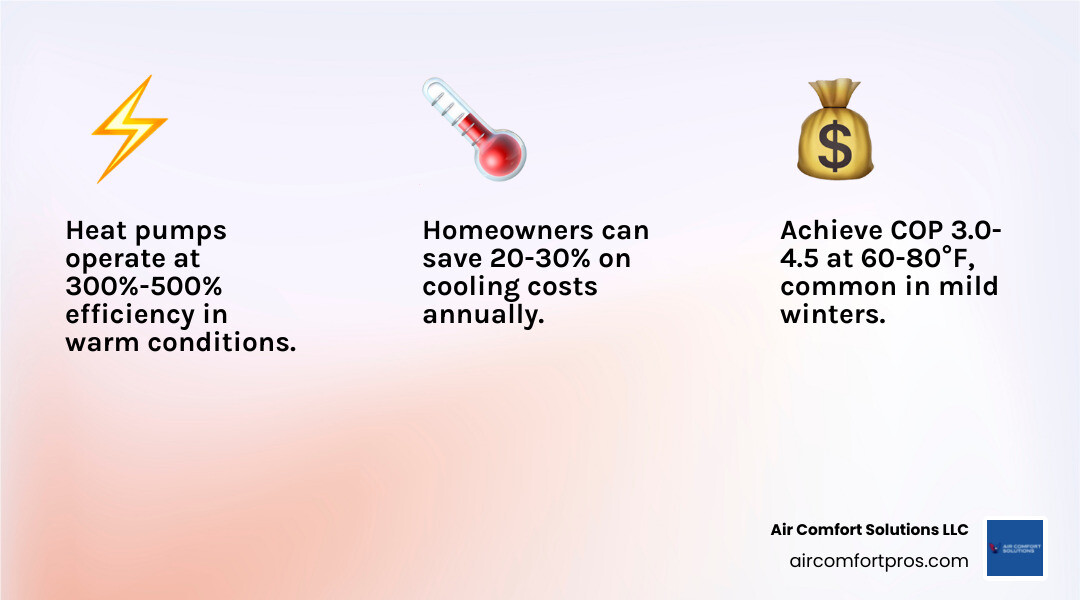
• How efficient are they? Heat pumps operate at 300% to 500% efficiency in warm conditions, meaning they move far more energy than they consume
• Best temperature range: At 60°F to 80°F outdoor temperatures — common in Houston's mild winters — heat pumps reach a COP (Coefficient of Performance) of 3.0 to 4.5
• Cooling performance: Comparable to a traditional air conditioner, but with significantly better efficiency when replacing an older unit
• Energy savings: Homeowners in hot climates can expect 20–30% savings on cooling costs compared to standard AC systems
• Minimum rating required: The DOE requires a minimum SEER2 of 14.3 for residential split-system heat pumps in the Southeast and Southwest regions
• Dual function: One system handles both cooling in summer and heating in mild Texas winters — no furnace needed in most Houston-area homes
• Environmental benefit: Switching from a gas furnace to a heat pump can cut household heating-related CO2 emissions by over 60%
Houston summers don't let up. From May through October, your HVAC system is running almost constantly — and if it's generating heat and then cooling against it, or working harder than it needs to, you're paying for it. Heat pumps sidestep that inefficiency entirely by transferring ambient heat rather than burning fuel or relying on electric resistance. For a climate like ours, that's not just a nice feature — it's a genuine game-changer for monthly utility costs and year-round comfort.
When we talk to neighbors in Pinehurst or The Woodlands about their HVAC needs, the conversation usually starts with one word: "Heat." In Southeast Texas, we don't just have summers; we have endurance tests. This is why the Heat Pump has become the go-to solution for modern Texas homes.
The magic of a heat pump lies in its dual-functionality. Think of it as a reversible air conditioner. In the summer, it works exactly like your traditional AC, pulling heat out of your living room and dumping it outside. But when those rare Texas "cold" snaps hit Houston or Conroe, the system simply reverses its flow. It finds the ambient heat that exists in the outdoor air (yes, even when it’s 40 degrees outside, there is plenty of thermal energy available!) and pumps it into your home.
Because our winters are generally mild—with design temperatures rarely dropping into the dangerous negatives seen up north—a heat pump doesn't have to work very hard to keep you cozy. Traditional furnaces generate heat by burning gas or using electric heat strips (which is like trying to warm your house with a giant toaster). This is incredibly energy-intensive. A heat pump, by contrast, just "relocates" heat. This process is 3 to 5 times more energy-efficient than a gas boiler or electric furnace. For us in the South, where we might only need the "heat" setting for a few weeks a year, having one highly efficient system that handles both seasons is the definition of energy conservation.
To really understand heat pump efficiency in warm climates explained, we have to look at the numbers. In the HVAC world, we use a metric called the Coefficient of Performance, or COP.
If a system has a COP of 1.0, it means for every 1 kilowatt of electricity you put in, you get 1 unit of heat out. Standard electric space heaters have a COP of 1.0. Heat pumps, however, typically achieve a COP between 3.0 and 4.5 when temperatures are between 60°F and 80°F. In simpler terms, that is 300% to 450% efficiency. You aren't "creating" 4 units of energy out of nowhere; you are simply using 1 unit of electricity to "move" 4 units of existing thermal energy from the backyard into your kitchen.
This is why Heat Pump Installation Houston TX is surging in popularity. In a warm climate, the "source" of heat (the outdoor air) is abundant. The system doesn't have to struggle to find energy to move. This leads to a much more relaxed refrigeration cycle, less wear and tear on the compressor, and significantly lower draws on your electrical panel.
Efficiency isn't just about the machine you buy; it's about how it's set up and maintained. For a home in Spring or Tomball to truly see those 400% efficiency gains, a few things need to happen:
1. Variable-Speed Compressors: Unlike older "on/off" systems that blast at 100% capacity or 0%, variable-speed units can cruise at 25% or 50% capacity. This maintains a steady temperature and uses a fraction of the power.
2. Proper Sizing: If a unit is too big, it "short cycles," turning on and off rapidly. This kills efficiency. We use "Manual J" calculations to ensure your system is perfectly sized for your specific square footage.
3. Regular Care: Dirt is the enemy of efficiency. Clogged coils make the heat transfer process much harder. Regular Heat Pump Maintenance Houston TX ensures that your system’s "heat exchangers" are clean and ready to move energy freely.
4. Airflow Optimization: If your ducts are leaky or your filters are clogged, your high-efficiency heat pump has to work twice as hard to push air through the house.
The bottom line for most of us is the monthly bill. Research shows that in hot climates like ours, heat pumps can save homeowners 20% to 30% on cooling costs compared to traditional air conditioners. This is especially true if you are replacing a unit that is 10 to 15 years old.
Think about it this way: if your current summer cooling bill is $300, a 25% reduction puts $75 back in your pocket every single month. Over the course of a long Houston summer, that adds up to hundreds of dollars. When you factor in the Heat Pump Replacement Magnolia TX incentives and the long-term ROI, the system often pays for itself much faster than a standard AC/furnace combo ever could.
If you’ve looked at a yellow "Energy Guide" tag lately, you’ve seen a lot of acronyms. For those of us in the Southwest, two matter most: SEER2 and EER2.
As of April 2026, we are operating under the Department of Energy’s (DOE) updated standards. For Heat Pump Installation Cypress TX and the surrounding areas, the minimum requirement is a SEER2 of 14.3. But what do these actually mean for your comfort?
• SEER2 (Seasonal Energy Efficiency Ratio 2): This measures how efficient the system is over an entire season. It factors in the highs and lows of the weather. A higher SEER2 (like 18 or 20) means the system is a "marathon runner"—it’s great at maintaining efficiency over long periods of time.
• EER2 (Energy Efficiency Ratio 2): This is arguably more important for Houston. EER2 measures how efficient the system is at a specific, high temperature (usually 95°F). While SEER2 tells you how it performs on a nice 82-degree day, EER2 tells you how it handles a Tuesday in August when the sun is trying to melt the asphalt.
In the South, the DOE sets higher standards because our cooling loads are so much higher. While a home in Maine might get by with a lower-rated unit, our systems are "stressed" more often. Choosing a unit with high-temperature performance (a high EER2) ensures that your efficiency doesn't "tank" just when you need it most.
• SEER2 — Regional Minimum (Southwest): 14.3 — High-Efficiency Benchmark: 17.0 - 22.0
• HSPF2 — Regional Minimum (Southwest): 7.5 — High-Efficiency Benchmark: 9.0+
• EER2 — Regional Minimum (Southwest): 11.7 — High-Efficiency Benchmark: 13.0+
In places like Tomball and Spring, the heat is only half the battle. The humidity is the real villain. "It’s not the heat, it’s the humidity" isn't just a cliché here; it’s a way of life.
Standard air conditioners are okay at removing moisture, but high-efficiency heat pumps are specialized tools for the job. Advanced features like inverter technology allow the system to run for longer, lower-intensity cycles. Instead of a quick "blast" of cold air that satisfies the thermostat but leaves the air feeling "sticky," these units run consistently, pulling gallons of water out of your indoor air every day.
If you find yourself needing a Heat Pump Repair Tomball TX, it’s often because a component is struggling with the heavy moisture load. Modern systems use multi-speed fans and smart home integration to balance cooling and dehumidification. By keeping the humidity lower, you can actually set your thermostat a few degrees higher and feel just as comfortable, which further boosts your energy savings.
Proactive Heat Pump Maintenance Spring TX is the best way to keep these moisture-removing features working. We check the condensate drains and ensure the evaporator coils are clean so that the water has a clear path out of your home and away from your foundation.
Switching to a heat pump isn't just a win for your wallet; it’s a win for the planet. Because these systems move heat rather than burning fossil fuels, the carbon footprint reduction is massive.
When we perform a Heat Pump Installation Conroe TX, we are helping that homeowner transition away from on-site methane emissions. Even if the electricity used to power the heat pump comes from a traditional power plant, the sheer efficiency of the heat transfer process means the total CO2 emissions for the home drop by about 25% to 60%. As the Texas power grid incorporates more renewable energy like wind and solar, your heat pump actually becomes "cleaner" over time.
Electrification is a major trend in 2026. Many homeowners in Magnolia are looking for sustainable home cooling options that don't rely on gas lines. With Heat Pump Maintenance Magnolia TX, these systems can last 15 years or more, providing a decade and a half of guilt-free, high-efficiency comfort.
In terms of cooling, they are virtually identical. Both use a compressor and refrigerant to remove heat. However, the heat pump includes a "reversing valve" that allows it to provide highly efficient heating in the winter. When replacing an older AC, a new heat pump almost always offers a significant jump in efficiency ratings, leading to lower bills.
Absolutely. Modern heat pumps are designed to operate effectively in extreme heat. RMI modeling has shown that high-efficiency heat pumps can maintain comfortable indoor temperatures even during heat waves reaching 108°F, often using 3% to 18% less energy than high-capacity standard AC units.
For our region, we recommend looking for a SEER2 of at least 15 or 16, and an EER2 of 12 or higher. If your budget allows, moving into the 18-22 SEER2 range with a variable-speed compressor will provide the best dehumidification and the lowest monthly operating costs.
Understanding heat pump efficiency in warm climates explained is the first step toward a more comfortable, affordable home. Whether you are in Pinehurst, Houston, or The Woodlands, the data is clear: heat pumps are the future of HVAC in the South. They offer the perfect balance of powerful cooling for our summers and efficient, mild heating for our winters.
At Air Comfort Solutions LLC, we’ve spent over 35 years providing expert HVAC services to our neighbors in North Harris County and Montgomery County. We know the local climate, we know the equipment, and we know how to make sure your system is running at its peak potential. From Heat Pump Installation Tomball TX to routine maintenance across the region, our certified technicians are here to provide honest, reliable solutions.
Ready to see how a high-efficiency Heat Pump can transform your home comfort? Give us a call today. We’re proud to serve Pinehurst, Plantersville, Magnolia, Houston, The Woodlands, Montgomery, Conroe, Spring, and Tomball with the best in heating and cooling technology.
Heat pump efficiency in warm climates explained simply: heat pumps move heat from one place to another instead of generating it from scratch, which means they can deliver 3 to 5 units of cooling or heating energy for every 1 unit of electricity they consume. That makes them one of the smartest choices for homeowners in Houston and North Harris County, where summers are long, brutal, and expensive to survive indoors.
If you're dealing with sky-high electricity bills every summer, an aging AC that can't keep up with triple-digit heat, or you're just wondering whether a heat pump is actually worth it in a warm climate — here's what you need to know at a glance:
Quick Answer: Heat Pump Efficiency in Warm Climates
Houston summers don't let up. From May through October, your HVAC system is running almost constantly — and if it's generating heat and then cooling against it, or working harder than it needs to, you're paying for it. Heat pumps sidestep that inefficiency entirely by transferring ambient heat rather than burning fuel or relying on electric resistance. For a climate like ours, that's not just a nice feature — it's a genuine game-changer for monthly utility costs and year-round comfort.
When we talk to neighbors in Pinehurst or The Woodlands about their HVAC needs, the conversation usually starts with one word: "Heat." In Southeast Texas, we don't just have summers; we have endurance tests. This is why the Heat Pump has become the go-to solution for modern Texas homes.
The magic of a heat pump lies in its dual-functionality. Think of it as a reversible air conditioner. In the summer, it works exactly like your traditional AC, pulling heat out of your living room and dumping it outside. But when those rare Texas "cold" snaps hit Houston or Conroe, the system simply reverses its flow. It finds the ambient heat that exists in the outdoor air (yes, even when it’s 40 degrees outside, there is plenty of thermal energy available!) and pumps it into your home.
Because our winters are generally mild—with design temperatures rarely dropping into the dangerous negatives seen up north—a heat pump doesn't have to work very hard to keep you cozy. Traditional furnaces generate heat by burning gas or using electric heat strips (which is like trying to warm your house with a giant toaster). This is incredibly energy-intensive. A heat pump, by contrast, just "relocates" heat. This process is 3 to 5 times more energy-efficient than a gas boiler or electric furnace. For us in the South, where we might only need the "heat" setting for a few weeks a year, having one highly efficient system that handles both seasons is the definition of energy conservation.
To really understand heat pump efficiency in warm climates explained, we have to look at the numbers. In the HVAC world, we use a metric called the Coefficient of Performance, or COP.
If a system has a COP of 1.0, it means for every 1 kilowatt of electricity you put in, you get 1 unit of heat out. Standard electric space heaters have a COP of 1.0. Heat pumps, however, typically achieve a COP between 3.0 and 4.5 when temperatures are between 60°F and 80°F. In simpler terms, that is 300% to 450% efficiency. You aren't "creating" 4 units of energy out of nowhere; you are simply using 1 unit of electricity to "move" 4 units of existing thermal energy from the backyard into your kitchen.
This is why Heat Pump Installation Houston TX is surging in popularity. In a warm climate, the "source" of heat (the outdoor air) is abundant. The system doesn't have to struggle to find energy to move. This leads to a much more relaxed refrigeration cycle, less wear and tear on the compressor, and significantly lower draws on your electrical panel.
Efficiency isn't just about the machine you buy; it's about how it's set up and maintained. For a home in Spring or Tomball to truly see those 400% efficiency gains, a few things need to happen:
The bottom line for most of us is the monthly bill. Research shows that in hot climates like ours, heat pumps can save homeowners 20% to 30% on cooling costs compared to traditional air conditioners. This is especially true if you are replacing a unit that is 10 to 15 years old.
Think about it this way: if your current summer cooling bill is $300, a 25% reduction puts $75 back in your pocket every single month. Over the course of a long Houston summer, that adds up to hundreds of dollars. When you factor in the Heat Pump Replacement Magnolia TX incentives and the long-term ROI, the system often pays for itself much faster than a standard AC/furnace combo ever could.
If you’ve looked at a yellow "Energy Guide" tag lately, you’ve seen a lot of acronyms. For those of us in the Southwest, two matter most: SEER2 and EER2.
As of April 2026, we are operating under the Department of Energy’s (DOE) updated standards. For Heat Pump Installation Cypress TX and the surrounding areas, the minimum requirement is a SEER2 of 14.3. But what do these actually mean for your comfort?
In the South, the DOE sets higher standards because our cooling loads are so much higher. While a home in Maine might get by with a lower-rated unit, our systems are "stressed" more often. Choosing a unit with high-temperature performance (a high EER2) ensures that your efficiency doesn't "tank" just when you need it most.
| Rating Type | Regional Minimum (Southwest) | High-Efficiency Benchmark |
|---|---|---|
| SEER2 | 14.3 | 17.0 - 22.0 |
| HSPF2 | 7.5 | 9.0+ |
| EER2 | 11.7 | 13.0+ |
In places like Tomball and Spring, the heat is only half the battle. The humidity is the real villain. "It’s not the heat, it’s the humidity" isn't just a cliché here; it’s a way of life.
Standard air conditioners are okay at removing moisture, but high-efficiency heat pumps are specialized tools for the job. Advanced features like inverter technology allow the system to run for longer, lower-intensity cycles. Instead of a quick "blast" of cold air that satisfies the thermostat but leaves the air feeling "sticky," these units run consistently, pulling gallons of water out of your indoor air every day.
If you find yourself needing a Heat Pump Repair Tomball TX, it’s often because a component is struggling with the heavy moisture load. Modern systems use multi-speed fans and smart home integration to balance cooling and dehumidification. By keeping the humidity lower, you can actually set your thermostat a few degrees higher and feel just as comfortable, which further boosts your energy savings.
Proactive Heat Pump Maintenance Spring TX is the best way to keep these moisture-removing features working. We check the condensate drains and ensure the evaporator coils are clean so that the water has a clear path out of your home and away from your foundation.
Switching to a heat pump isn't just a win for your wallet; it’s a win for the planet. Because these systems move heat rather than burning fossil fuels, the carbon footprint reduction is massive.
When we perform a Heat Pump Installation Conroe TX, we are helping that homeowner transition away from on-site methane emissions. Even if the electricity used to power the heat pump comes from a traditional power plant, the sheer efficiency of the heat transfer process means the total CO2 emissions for the home drop by about 25% to 60%. As the Texas power grid incorporates more renewable energy like wind and solar, your heat pump actually becomes "cleaner" over time.
Electrification is a major trend in 2026. Many homeowners in Magnolia are looking for sustainable home cooling options that don't rely on gas lines. With Heat Pump Maintenance Magnolia TX, these systems can last 15 years or more, providing a decade and a half of guilt-free, high-efficiency comfort.
In terms of cooling, they are virtually identical. Both use a compressor and refrigerant to remove heat. However, the heat pump includes a "reversing valve" that allows it to provide highly efficient heating in the winter. When replacing an older AC, a new heat pump almost always offers a significant jump in efficiency ratings, leading to lower bills.
Absolutely. Modern heat pumps are designed to operate effectively in extreme heat. RMI modeling has shown that high-efficiency heat pumps can maintain comfortable indoor temperatures even during heat waves reaching 108°F, often using 3% to 18% less energy than high-capacity standard AC units.
For our region, we recommend looking for a SEER2 of at least 15 or 16, and an EER2 of 12 or higher. If your budget allows, moving into the 18-22 SEER2 range with a variable-speed compressor will provide the best dehumidification and the lowest monthly operating costs.
Understanding heat pump efficiency in warm climates explained is the first step toward a more comfortable, affordable home. Whether you are in Pinehurst, Houston, or The Woodlands, the data is clear: heat pumps are the future of HVAC in the South. They offer the perfect balance of powerful cooling for our summers and efficient, mild heating for our winters.
At Air Comfort Solutions LLC, we’ve spent over 35 years providing expert HVAC services to our neighbors in North Harris County and Montgomery County. We know the local climate, we know the equipment, and we know how to make sure your system is running at its peak potential. From Heat Pump Installation Tomball TX to routine maintenance across the region, our certified technicians are here to provide honest, reliable solutions.
Ready to see how a high-efficiency Heat Pump can transform your home comfort? Give us a call today. We’re proud to serve Pinehurst, Plantersville, Magnolia, Houston, The Woodlands, Montgomery, Conroe, Spring, and Tomball with the best in heating and cooling technology.
Heat pump efficiency in warm climates explained simply: heat pumps move heat from one place to another instead of generating it from scratch, which means they can deliver 3 to 5 units of cooling or heating energy for every 1 unit of electricity they consume. That makes them one of the smartest choices for homeowners in Houston and North Harris County, where summers are long, brutal, and expensive to survive indoors.
If you're dealing with sky-high electricity bills every summer, an aging AC that can't keep up with triple-digit heat, or you're just wondering whether a heat pump is actually worth it in a warm climate — here's what you need to know at a glance:
Quick Answer: Heat Pump Efficiency in Warm Climates
Houston summers don't let up. From May through October, your HVAC system is running almost constantly — and if it's generating heat and then cooling against it, or working harder than it needs to, you're paying for it. Heat pumps sidestep that inefficiency entirely by transferring ambient heat rather than burning fuel or relying on electric resistance. For a climate like ours, that's not just a nice feature — it's a genuine game-changer for monthly utility costs and year-round comfort.
When we talk to neighbors in Pinehurst or The Woodlands about their HVAC needs, the conversation usually starts with one word: "Heat." In Southeast Texas, we don't just have summers; we have endurance tests. This is why the Heat Pump has become the go-to solution for modern Texas homes.
The magic of a heat pump lies in its dual-functionality. Think of it as a reversible air conditioner. In the summer, it works exactly like your traditional AC, pulling heat out of your living room and dumping it outside. But when those rare Texas "cold" snaps hit Houston or Conroe, the system simply reverses its flow. It finds the ambient heat that exists in the outdoor air (yes, even when it’s 40 degrees outside, there is plenty of thermal energy available!) and pumps it into your home.
Because our winters are generally mild—with design temperatures rarely dropping into the dangerous negatives seen up north—a heat pump doesn't have to work very hard to keep you cozy. Traditional furnaces generate heat by burning gas or using electric heat strips (which is like trying to warm your house with a giant toaster). This is incredibly energy-intensive. A heat pump, by contrast, just "relocates" heat. This process is 3 to 5 times more energy-efficient than a gas boiler or electric furnace. For us in the South, where we might only need the "heat" setting for a few weeks a year, having one highly efficient system that handles both seasons is the definition of energy conservation.
To really understand heat pump efficiency in warm climates explained, we have to look at the numbers. In the HVAC world, we use a metric called the Coefficient of Performance, or COP.
If a system has a COP of 1.0, it means for every 1 kilowatt of electricity you put in, you get 1 unit of heat out. Standard electric space heaters have a COP of 1.0. Heat pumps, however, typically achieve a COP between 3.0 and 4.5 when temperatures are between 60°F and 80°F. In simpler terms, that is 300% to 450% efficiency. You aren't "creating" 4 units of energy out of nowhere; you are simply using 1 unit of electricity to "move" 4 units of existing thermal energy from the backyard into your kitchen.
This is why Heat Pump Installation Houston TX is surging in popularity. In a warm climate, the "source" of heat (the outdoor air) is abundant. The system doesn't have to struggle to find energy to move. This leads to a much more relaxed refrigeration cycle, less wear and tear on the compressor, and significantly lower draws on your electrical panel.
Efficiency isn't just about the machine you buy; it's about how it's set up and maintained. For a home in Spring or Tomball to truly see those 400% efficiency gains, a few things need to happen:
The bottom line for most of us is the monthly bill. Research shows that in hot climates like ours, heat pumps can save homeowners 20% to 30% on cooling costs compared to traditional air conditioners. This is especially true if you are replacing a unit that is 10 to 15 years old.
Think about it this way: if your current summer cooling bill is $300, a 25% reduction puts $75 back in your pocket every single month. Over the course of a long Houston summer, that adds up to hundreds of dollars. When you factor in the Heat Pump Replacement Magnolia TX incentives and the long-term ROI, the system often pays for itself much faster than a standard AC/furnace combo ever could.
If you’ve looked at a yellow "Energy Guide" tag lately, you’ve seen a lot of acronyms. For those of us in the Southwest, two matter most: SEER2 and EER2.
As of April 2026, we are operating under the Department of Energy’s (DOE) updated standards. For Heat Pump Installation Cypress TX and the surrounding areas, the minimum requirement is a SEER2 of 14.3. But what do these actually mean for your comfort?
In the South, the DOE sets higher standards because our cooling loads are so much higher. While a home in Maine might get by with a lower-rated unit, our systems are "stressed" more often. Choosing a unit with high-temperature performance (a high EER2) ensures that your efficiency doesn't "tank" just when you need it most.
| Rating Type | Regional Minimum (Southwest) | High-Efficiency Benchmark |
|---|---|---|
| SEER2 | 14.3 | 17.0 - 22.0 |
| HSPF2 | 7.5 | 9.0+ |
| EER2 | 11.7 | 13.0+ |
In places like Tomball and Spring, the heat is only half the battle. The humidity is the real villain. "It’s not the heat, it’s the humidity" isn't just a cliché here; it’s a way of life.
Standard air conditioners are okay at removing moisture, but high-efficiency heat pumps are specialized tools for the job. Advanced features like inverter technology allow the system to run for longer, lower-intensity cycles. Instead of a quick "blast" of cold air that satisfies the thermostat but leaves the air feeling "sticky," these units run consistently, pulling gallons of water out of your indoor air every day.
If you find yourself needing a Heat Pump Repair Tomball TX, it’s often because a component is struggling with the heavy moisture load. Modern systems use multi-speed fans and smart home integration to balance cooling and dehumidification. By keeping the humidity lower, you can actually set your thermostat a few degrees higher and feel just as comfortable, which further boosts your energy savings.
Proactive Heat Pump Maintenance Spring TX is the best way to keep these moisture-removing features working. We check the condensate drains and ensure the evaporator coils are clean so that the water has a clear path out of your home and away from your foundation.
Switching to a heat pump isn't just a win for your wallet; it’s a win for the planet. Because these systems move heat rather than burning fossil fuels, the carbon footprint reduction is massive.
When we perform a Heat Pump Installation Conroe TX, we are helping that homeowner transition away from on-site methane emissions. Even if the electricity used to power the heat pump comes from a traditional power plant, the sheer efficiency of the heat transfer process means the total CO2 emissions for the home drop by about 25% to 60%. As the Texas power grid incorporates more renewable energy like wind and solar, your heat pump actually becomes "cleaner" over time.
Electrification is a major trend in 2026. Many homeowners in Magnolia are looking for sustainable home cooling options that don't rely on gas lines. With Heat Pump Maintenance Magnolia TX, these systems can last 15 years or more, providing a decade and a half of guilt-free, high-efficiency comfort.
In terms of cooling, they are virtually identical. Both use a compressor and refrigerant to remove heat. However, the heat pump includes a "reversing valve" that allows it to provide highly efficient heating in the winter. When replacing an older AC, a new heat pump almost always offers a significant jump in efficiency ratings, leading to lower bills.
Absolutely. Modern heat pumps are designed to operate effectively in extreme heat. RMI modeling has shown that high-efficiency heat pumps can maintain comfortable indoor temperatures even during heat waves reaching 108°F, often using 3% to 18% less energy than high-capacity standard AC units.
For our region, we recommend looking for a SEER2 of at least 15 or 16, and an EER2 of 12 or higher. If your budget allows, moving into the 18-22 SEER2 range with a variable-speed compressor will provide the best dehumidification and the lowest monthly operating costs.
Understanding heat pump efficiency in warm climates explained is the first step toward a more comfortable, affordable home. Whether you are in Pinehurst, Houston, or The Woodlands, the data is clear: heat pumps are the future of HVAC in the South. They offer the perfect balance of powerful cooling for our summers and efficient, mild heating for our winters.
At Air Comfort Solutions LLC, we’ve spent over 35 years providing expert HVAC services to our neighbors in North Harris County and Montgomery County. We know the local climate, we know the equipment, and we know how to make sure your system is running at its peak potential. From Heat Pump Installation Tomball TX to routine maintenance across the region, our certified technicians are here to provide honest, reliable solutions.
Ready to see how a high-efficiency Heat Pump can transform your home comfort? Give us a call today. We’re proud to serve Pinehurst, Plantersville, Magnolia, Houston, The Woodlands, Montgomery, Conroe, Spring, and Tomball with the best in heating and cooling technology.
Heat pump efficiency in warm climates explained simply: heat pumps move heat from one place to another instead of generating it from scratch, which means they can deliver 3 to 5 units of cooling or heating energy for every 1 unit of electricity they consume. That makes them one of the smartest choices for homeowners in Houston and North Harris County, where summers are long, brutal, and expensive to survive indoors.
If you're dealing with sky-high electricity bills every summer, an aging AC that can't keep up with triple-digit heat, or you're just wondering whether a heat pump is actually worth it in a warm climate — here's what you need to know at a glance:
Quick Answer: Heat Pump Efficiency in Warm Climates
Houston summers don't let up. From May through October, your HVAC system is running almost constantly — and if it's generating heat and then cooling against it, or working harder than it needs to, you're paying for it. Heat pumps sidestep that inefficiency entirely by transferring ambient heat rather than burning fuel or relying on electric resistance. For a climate like ours, that's not just a nice feature — it's a genuine game-changer for monthly utility costs and year-round comfort.
When we talk to neighbors in Pinehurst or The Woodlands about their HVAC needs, the conversation usually starts with one word: "Heat." In Southeast Texas, we don't just have summers; we have endurance tests. This is why the Heat Pump has become the go-to solution for modern Texas homes.
The magic of a heat pump lies in its dual-functionality. Think of it as a reversible air conditioner. In the summer, it works exactly like your traditional AC, pulling heat out of your living room and dumping it outside. But when those rare Texas "cold" snaps hit Houston or Conroe, the system simply reverses its flow. It finds the ambient heat that exists in the outdoor air (yes, even when it’s 40 degrees outside, there is plenty of thermal energy available!) and pumps it into your home.
Because our winters are generally mild—with design temperatures rarely dropping into the dangerous negatives seen up north—a heat pump doesn't have to work very hard to keep you cozy. Traditional furnaces generate heat by burning gas or using electric heat strips (which is like trying to warm your house with a giant toaster). This is incredibly energy-intensive. A heat pump, by contrast, just "relocates" heat. This process is 3 to 5 times more energy-efficient than a gas boiler or electric furnace. For us in the South, where we might only need the "heat" setting for a few weeks a year, having one highly efficient system that handles both seasons is the definition of energy conservation.
To really understand heat pump efficiency in warm climates explained, we have to look at the numbers. In the HVAC world, we use a metric called the Coefficient of Performance, or COP.
If a system has a COP of 1.0, it means for every 1 kilowatt of electricity you put in, you get 1 unit of heat out. Standard electric space heaters have a COP of 1.0. Heat pumps, however, typically achieve a COP between 3.0 and 4.5 when temperatures are between 60°F and 80°F. In simpler terms, that is 300% to 450% efficiency. You aren't "creating" 4 units of energy out of nowhere; you are simply using 1 unit of electricity to "move" 4 units of existing thermal energy from the backyard into your kitchen.
This is why Heat Pump Installation Houston TX is surging in popularity. In a warm climate, the "source" of heat (the outdoor air) is abundant. The system doesn't have to struggle to find energy to move. This leads to a much more relaxed refrigeration cycle, less wear and tear on the compressor, and significantly lower draws on your electrical panel.
Efficiency isn't just about the machine you buy; it's about how it's set up and maintained. For a home in Spring or Tomball to truly see those 400% efficiency gains, a few things need to happen:
The bottom line for most of us is the monthly bill. Research shows that in hot climates like ours, heat pumps can save homeowners 20% to 30% on cooling costs compared to traditional air conditioners. This is especially true if you are replacing a unit that is 10 to 15 years old.
Think about it this way: if your current summer cooling bill is $300, a 25% reduction puts $75 back in your pocket every single month. Over the course of a long Houston summer, that adds up to hundreds of dollars. When you factor in the Heat Pump Replacement Magnolia TX incentives and the long-term ROI, the system often pays for itself much faster than a standard AC/furnace combo ever could.
If you’ve looked at a yellow "Energy Guide" tag lately, you’ve seen a lot of acronyms. For those of us in the Southwest, two matter most: SEER2 and EER2.
As of April 2026, we are operating under the Department of Energy’s (DOE) updated standards. For Heat Pump Installation Cypress TX and the surrounding areas, the minimum requirement is a SEER2 of 14.3. But what do these actually mean for your comfort?
In the South, the DOE sets higher standards because our cooling loads are so much higher. While a home in Maine might get by with a lower-rated unit, our systems are "stressed" more often. Choosing a unit with high-temperature performance (a high EER2) ensures that your efficiency doesn't "tank" just when you need it most.
| Rating Type | Regional Minimum (Southwest) | High-Efficiency Benchmark |
|---|---|---|
| SEER2 | 14.3 | 17.0 - 22.0 |
| HSPF2 | 7.5 | 9.0+ |
| EER2 | 11.7 | 13.0+ |
In places like Tomball and Spring, the heat is only half the battle. The humidity is the real villain. "It’s not the heat, it’s the humidity" isn't just a cliché here; it’s a way of life.
Standard air conditioners are okay at removing moisture, but high-efficiency heat pumps are specialized tools for the job. Advanced features like inverter technology allow the system to run for longer, lower-intensity cycles. Instead of a quick "blast" of cold air that satisfies the thermostat but leaves the air feeling "sticky," these units run consistently, pulling gallons of water out of your indoor air every day.
If you find yourself needing a Heat Pump Repair Tomball TX, it’s often because a component is struggling with the heavy moisture load. Modern systems use multi-speed fans and smart home integration to balance cooling and dehumidification. By keeping the humidity lower, you can actually set your thermostat a few degrees higher and feel just as comfortable, which further boosts your energy savings.
Proactive Heat Pump Maintenance Spring TX is the best way to keep these moisture-removing features working. We check the condensate drains and ensure the evaporator coils are clean so that the water has a clear path out of your home and away from your foundation.
Switching to a heat pump isn't just a win for your wallet; it’s a win for the planet. Because these systems move heat rather than burning fossil fuels, the carbon footprint reduction is massive.
When we perform a Heat Pump Installation Conroe TX, we are helping that homeowner transition away from on-site methane emissions. Even if the electricity used to power the heat pump comes from a traditional power plant, the sheer efficiency of the heat transfer process means the total CO2 emissions for the home drop by about 25% to 60%. As the Texas power grid incorporates more renewable energy like wind and solar, your heat pump actually becomes "cleaner" over time.
Electrification is a major trend in 2026. Many homeowners in Magnolia are looking for sustainable home cooling options that don't rely on gas lines. With Heat Pump Maintenance Magnolia TX, these systems can last 15 years or more, providing a decade and a half of guilt-free, high-efficiency comfort.
In terms of cooling, they are virtually identical. Both use a compressor and refrigerant to remove heat. However, the heat pump includes a "reversing valve" that allows it to provide highly efficient heating in the winter. When replacing an older AC, a new heat pump almost always offers a significant jump in efficiency ratings, leading to lower bills.
Absolutely. Modern heat pumps are designed to operate effectively in extreme heat. RMI modeling has shown that high-efficiency heat pumps can maintain comfortable indoor temperatures even during heat waves reaching 108°F, often using 3% to 18% less energy than high-capacity standard AC units.
For our region, we recommend looking for a SEER2 of at least 15 or 16, and an EER2 of 12 or higher. If your budget allows, moving into the 18-22 SEER2 range with a variable-speed compressor will provide the best dehumidification and the lowest monthly operating costs.
Understanding heat pump efficiency in warm climates explained is the first step toward a more comfortable, affordable home. Whether you are in Pinehurst, Houston, or The Woodlands, the data is clear: heat pumps are the future of HVAC in the South. They offer the perfect balance of powerful cooling for our summers and efficient, mild heating for our winters.
At Air Comfort Solutions LLC, we’ve spent over 35 years providing expert HVAC services to our neighbors in North Harris County and Montgomery County. We know the local climate, we know the equipment, and we know how to make sure your system is running at its peak potential. From Heat Pump Installation Tomball TX to routine maintenance across the region, our certified technicians are here to provide honest, reliable solutions.
Ready to see how a high-efficiency Heat Pump can transform your home comfort? Give us a call today. We’re proud to serve Pinehurst, Plantersville, Magnolia, Houston, The Woodlands, Montgomery, Conroe, Spring, and Tomball with the best in heating and cooling technology.
Heat pump efficiency in warm climates explained simply: heat pumps move heat from one place to another instead of generating it from scratch, which means they can deliver 3 to 5 units of cooling or heating energy for every 1 unit of electricity they consume. That makes them one of the smartest choices for homeowners in Houston and North Harris County, where summers are long, brutal, and expensive to survive indoors.
If you're dealing with sky-high electricity bills every summer, an aging AC that can't keep up with triple-digit heat, or you're just wondering whether a heat pump is actually worth it in a warm climate — here's what you need to know at a glance:
Quick Answer: Heat Pump Efficiency in Warm Climates
Houston summers don't let up. From May through October, your HVAC system is running almost constantly — and if it's generating heat and then cooling against it, or working harder than it needs to, you're paying for it. Heat pumps sidestep that inefficiency entirely by transferring ambient heat rather than burning fuel or relying on electric resistance. For a climate like ours, that's not just a nice feature — it's a genuine game-changer for monthly utility costs and year-round comfort.
When we talk to neighbors in Pinehurst or The Woodlands about their HVAC needs, the conversation usually starts with one word: "Heat." In Southeast Texas, we don't just have summers; we have endurance tests. This is why the Heat Pump has become the go-to solution for modern Texas homes.
The magic of a heat pump lies in its dual-functionality. Think of it as a reversible air conditioner. In the summer, it works exactly like your traditional AC, pulling heat out of your living room and dumping it outside. But when those rare Texas "cold" snaps hit Houston or Conroe, the system simply reverses its flow. It finds the ambient heat that exists in the outdoor air (yes, even when it’s 40 degrees outside, there is plenty of thermal energy available!) and pumps it into your home.
Because our winters are generally mild—with design temperatures rarely dropping into the dangerous negatives seen up north—a heat pump doesn't have to work very hard to keep you cozy. Traditional furnaces generate heat by burning gas or using electric heat strips (which is like trying to warm your house with a giant toaster). This is incredibly energy-intensive. A heat pump, by contrast, just "relocates" heat. This process is 3 to 5 times more energy-efficient than a gas boiler or electric furnace. For us in the South, where we might only need the "heat" setting for a few weeks a year, having one highly efficient system that handles both seasons is the definition of energy conservation.
To really understand heat pump efficiency in warm climates explained, we have to look at the numbers. In the HVAC world, we use a metric called the Coefficient of Performance, or COP.
If a system has a COP of 1.0, it means for every 1 kilowatt of electricity you put in, you get 1 unit of heat out. Standard electric space heaters have a COP of 1.0. Heat pumps, however, typically achieve a COP between 3.0 and 4.5 when temperatures are between 60°F and 80°F. In simpler terms, that is 300% to 450% efficiency. You aren't "creating" 4 units of energy out of nowhere; you are simply using 1 unit of electricity to "move" 4 units of existing thermal energy from the backyard into your kitchen.
This is why Heat Pump Installation Houston TX is surging in popularity. In a warm climate, the "source" of heat (the outdoor air) is abundant. The system doesn't have to struggle to find energy to move. This leads to a much more relaxed refrigeration cycle, less wear and tear on the compressor, and significantly lower draws on your electrical panel.
Efficiency isn't just about the machine you buy; it's about how it's set up and maintained. For a home in Spring or Tomball to truly see those 400% efficiency gains, a few things need to happen:
The bottom line for most of us is the monthly bill. Research shows that in hot climates like ours, heat pumps can save homeowners 20% to 30% on cooling costs compared to traditional air conditioners. This is especially true if you are replacing a unit that is 10 to 15 years old.
Think about it this way: if your current summer cooling bill is $300, a 25% reduction puts $75 back in your pocket every single month. Over the course of a long Houston summer, that adds up to hundreds of dollars. When you factor in the Heat Pump Replacement Magnolia TX incentives and the long-term ROI, the system often pays for itself much faster than a standard AC/furnace combo ever could.
If you’ve looked at a yellow "Energy Guide" tag lately, you’ve seen a lot of acronyms. For those of us in the Southwest, two matter most: SEER2 and EER2.
As of April 2026, we are operating under the Department of Energy’s (DOE) updated standards. For Heat Pump Installation Cypress TX and the surrounding areas, the minimum requirement is a SEER2 of 14.3. But what do these actually mean for your comfort?
In the South, the DOE sets higher standards because our cooling loads are so much higher. While a home in Maine might get by with a lower-rated unit, our systems are "stressed" more often. Choosing a unit with high-temperature performance (a high EER2) ensures that your efficiency doesn't "tank" just when you need it most.
| Rating Type | Regional Minimum (Southwest) | High-Efficiency Benchmark |
|---|---|---|
| SEER2 | 14.3 | 17.0 - 22.0 |
| HSPF2 | 7.5 | 9.0+ |
| EER2 | 11.7 | 13.0+ |
In places like Tomball and Spring, the heat is only half the battle. The humidity is the real villain. "It’s not the heat, it’s the humidity" isn't just a cliché here; it’s a way of life.
Standard air conditioners are okay at removing moisture, but high-efficiency heat pumps are specialized tools for the job. Advanced features like inverter technology allow the system to run for longer, lower-intensity cycles. Instead of a quick "blast" of cold air that satisfies the thermostat but leaves the air feeling "sticky," these units run consistently, pulling gallons of water out of your indoor air every day.
If you find yourself needing a Heat Pump Repair Tomball TX, it’s often because a component is struggling with the heavy moisture load. Modern systems use multi-speed fans and smart home integration to balance cooling and dehumidification. By keeping the humidity lower, you can actually set your thermostat a few degrees higher and feel just as comfortable, which further boosts your energy savings.
Proactive Heat Pump Maintenance Spring TX is the best way to keep these moisture-removing features working. We check the condensate drains and ensure the evaporator coils are clean so that the water has a clear path out of your home and away from your foundation.
Switching to a heat pump isn't just a win for your wallet; it’s a win for the planet. Because these systems move heat rather than burning fossil fuels, the carbon footprint reduction is massive.
When we perform a Heat Pump Installation Conroe TX, we are helping that homeowner transition away from on-site methane emissions. Even if the electricity used to power the heat pump comes from a traditional power plant, the sheer efficiency of the heat transfer process means the total CO2 emissions for the home drop by about 25% to 60%. As the Texas power grid incorporates more renewable energy like wind and solar, your heat pump actually becomes "cleaner" over time.
Electrification is a major trend in 2026. Many homeowners in Magnolia are looking for sustainable home cooling options that don't rely on gas lines. With Heat Pump Maintenance Magnolia TX, these systems can last 15 years or more, providing a decade and a half of guilt-free, high-efficiency comfort.
In terms of cooling, they are virtually identical. Both use a compressor and refrigerant to remove heat. However, the heat pump includes a "reversing valve" that allows it to provide highly efficient heating in the winter. When replacing an older AC, a new heat pump almost always offers a significant jump in efficiency ratings, leading to lower bills.
Absolutely. Modern heat pumps are designed to operate effectively in extreme heat. RMI modeling has shown that high-efficiency heat pumps can maintain comfortable indoor temperatures even during heat waves reaching 108°F, often using 3% to 18% less energy than high-capacity standard AC units.
For our region, we recommend looking for a SEER2 of at least 15 or 16, and an EER2 of 12 or higher. If your budget allows, moving into the 18-22 SEER2 range with a variable-speed compressor will provide the best dehumidification and the lowest monthly operating costs.
Understanding heat pump efficiency in warm climates explained is the first step toward a more comfortable, affordable home. Whether you are in Pinehurst, Houston, or The Woodlands, the data is clear: heat pumps are the future of HVAC in the South. They offer the perfect balance of powerful cooling for our summers and efficient, mild heating for our winters.
At Air Comfort Solutions LLC, we’ve spent over 35 years providing expert HVAC services to our neighbors in North Harris County and Montgomery County. We know the local climate, we know the equipment, and we know how to make sure your system is running at its peak potential. From Heat Pump Installation Tomball TX to routine maintenance across the region, our certified technicians are here to provide honest, reliable solutions.
Ready to see how a high-efficiency Heat Pump can transform your home comfort? Give us a call today. We’re proud to serve Pinehurst, Plantersville, Magnolia, Houston, The Woodlands, Montgomery, Conroe, Spring, and Tomball with the best in heating and cooling technology.


Zane came out and did an amazing job! Super friendly, honest and transparent about the work that needed to be done. This is my second time working with Air Comfort Solutions and they’re my go to for HVAC services. Highly recommend.
God's AMAZING grace sent us Robert and Zane. We have been without air in this Texas heat for six weeks and four days. We've had a few contractors give us quotes all trying to upsell when we're at a low point. But not the guys at Air Comfort Solutions. They came in assessed our situation, gave us honest feedback, and showed us the issues as they proceeded with the assessment for clear understanding. We highly recommend them for their professionalism, quality products, and fair pricing. We hands down support them for all the work they do 💯 %.
Robert and Zane gone above and beyond to make the process easy and affordable.
Would definitely recommend!!
I’m writing this review to let everyone know that Air Comfort Solutions is the company to work with. I know the owner ( Robert) for several years now. He has been taking care of my residential and business work orders. Robert is professional, knowledgeable and will save you money. I just want to thank Robert for great job you have been doing for me.