


Do You Need 24 Hour AC Repair? Troubleshooting Your Fall Heating Startup
See why fall heater smells cause panic. Use our home maintenance tips and troubleshooting to decide if it's normal dust burn-off or time to call a pro.
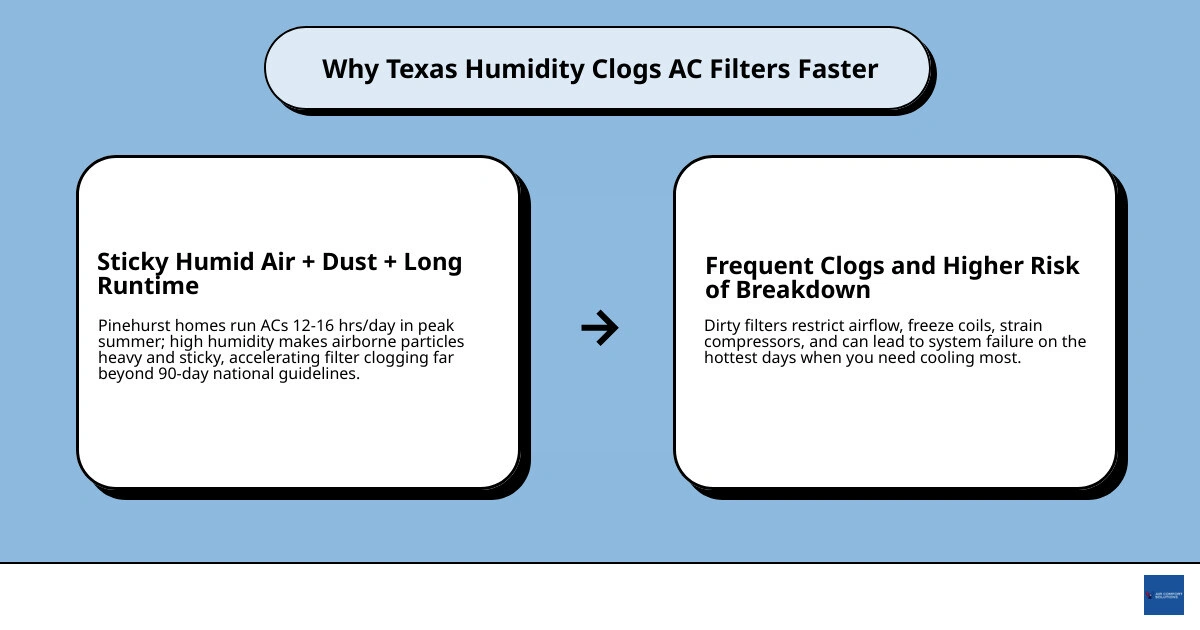
Knowing how often to change your AC filter in humid Texas heat could be the difference between a system that runs smoothly all summer and one that breaks down on the hottest day of the year. In Pinehurst, TX and across North Harris County, AC systems don’t get the breaks that systems in milder climates do. During peak summer, your unit can run 12 to 16 hours a day — and Dallas-Fort Worth alone logs 2.3 times the national average in cooling degree days. That kind of runtime, combined with high humidity that makes airborne particles sticky and heavy, clogs filters far faster than national guidelines suggest.
The generic “change your filter every 90 days” advice simply doesn’t apply here.
Here’s a quick-reference guide for Texas homeowners:
• Standard home, no pets — Filter Size: 1-inch pleated — Recommended Replacement Interval: Every 30-60 days
• Home with one pet — Filter Size: 1-inch pleated — Recommended Replacement Interval: Every 30-45 days
• Multiple pets or allergies — Filter Size: 1-inch pleated — Recommended Replacement Interval: Every 20-30 days
• Cedar fever season (Dec-Feb) — Filter Size: 1-inch pleated — Recommended Replacement Interval: Every 30 days or sooner
• Any household — Filter Size: 4-5 inch media filter — Recommended Replacement Interval: Every 6-12 months
For more on how your local climate affects your HVAC system, see How Southeast Texas Climate Affects Your HVAC System and How Humidity Affects Your AC Performance.
In the sections below, we’ll cover exactly what’s driving faster filter clogging in Texas, which filter types work best, and what happens when you let a dirty filter slide too long.
When we look at how often to change your AC filter in humid Texas heat, we have to look at the sheer workload we place on our air conditioners. A typical central air conditioner in our service areas—including Magnolia, Tomball, and Spring—can easily log more than 2,800 operating hours in a single summer.
When your system is running up to 16 hours a day to combat outdoor temperatures hovering near triple digits, it is constantly pulling indoor air through your return vents. Every single cubic foot of that air carries dust, skin cells, textile fibers, and outdoor pollutants that have made their way inside.
But heat is only half of the equation; humidity is the silent culprit that accelerates filter clogging. When indoor relative humidity levels rise, the moisture in the air binds to dry dust particles. Instead of remaining light and airy, the dust becomes heavy and sticky. When these damp, sticky particles hit your air filter, they cling to the fibers like glue.
Furthermore, high humidity causes the physical fibers of many standard filters to swell. This swelling can restrict airflow by as much as 25% to 35% even before a heavy layer of visible dirt has accumulated. If you are using standard pleated filters, the electrostatic charge that helps trap fine particles can also dissipate by 15% to 20% when exposed to high moisture levels, reducing the filter’s overall efficiency.
To keep your system running optimally, we highly recommend checking your filter every month. If you need help with the physical steps of swapping out your filter, read our step-by-step guide on How to Replace AC Filters: A Quick and Simple Guide.

In Texas, we don’t just worry about filter maintenance during the blistering summers. Our winter months bring their own unique challenge: mountain cedar season. Running from December through February, mountain cedar releases massive clouds of sticky, yellow pollen grains that coat everything in sight.
Even though your AC system runs less during the winter shoulder season, your heating system or heat pump is still circulating air. Because mountain cedar pollen particles are relatively large and exceptionally sticky, they bind rapidly to damp filter fibers. If you live in areas surrounded by cedar trees, such as Montgomery or Conroe, we recommend checking your air filter every 2 to 3 weeks during this winter peak and replacing it every 30 days without fail. Failing to do so can choke your system’s airflow just when you need your heating system to keep you cozy.
If you share your home with furry family members, your air filters have to work double-time. More than 60% of homes in the United States have pets, and their shedding fur and microscopic dander are constantly circulating through your indoor air.
In a humid climate, pet dander doesn’t just float harmlessly; it absorbs moisture from the air, making it heavier and more prone to settling deep inside the pleats of your AC filter. This creates a thick, felt-like barrier that rapidly chokes off your system’s airflow.
For households in Pinehurst and The Woodlands with a single pet, we recommend changing a standard 1-inch pleated filter every 30 to 45 days. If you have multiple pets, or if someone in your family suffers from asthma or severe allergies, that window shrinks to every 20 to 30 days. Keeping a fresh filter in place is one of the easiest ways to protect your indoor air quality and prevent dander from settling on your evaporator coils.
When shopping for air filters, you will inevitably run into MERV ratings. MERV stands for Minimum Efficiency Reporting Value, and it scales from 1 to 20. This rating tells us how effectively a filter traps airborne particles of various sizes. Choosing the right MERV rating is a delicate balancing act between clean air and healthy system airflow.
Let’s break down the most common filter types you’ll find in local hardware stores:
• Fiberglass Filters (MERV 1-4): These are the extremely thin, see-through filters. While they are very inexpensive, they only capture large particles like lint and heavy dust. They do almost nothing to improve indoor air quality or capture pollen, and they must be replaced every 30 days.
• Pleated Filters (MERV 8-11): This is the sweet spot for the vast majority of residential homes in Houston and surrounding areas. A MERV 8 to MERV 11 filter captures dust, pollen, pet dander, and mold spores while maintaining excellent airflow. They provide a great balance of protection for both your lungs and your air conditioner.
• Deep Media Filters (MERV 11-13, 4 to 5 inches thick): These thick, accordion-style filters are housed in a dedicated cabinet next to your air handler. Because they have vastly more surface area, they can hold a massive amount of dust before restricting airflow. They typically only need to be replaced every 6 to 12 months, making them incredibly convenient.
• HEPA Filters (MERV 17-20): While HEPA filters are incredible at trapping 99.97% of particles down to 0.3 microns (including viruses and bacteria), they are generally too restrictive for standard residential HVAC blower motors. Running a HEPA filter in a system not designed for it is like trying to breathe through a thick winter blanket—it will starve your AC of air and cause severe damage.
In our humid climate, a damp filter with a high MERV rating (such as an unapproved MERV 13 or higher) can act as a solid wall, drastically increasing static pressure. This forces your blower motor to work much harder, leading to premature motor failure and spiked energy bills. Stick to MERV 8 to 11 for standard 1-inch slots unless we have specifically modified your system for higher filtration.
Neglecting your air filter might seem like a minor oversight, but in the harsh Texas climate, it can lead to catastrophic system failures. Because our air conditioners work so hard, even a slight drop in airflow can trigger a chain reaction of expensive problems.
Here is what happens to your system when you skip filter replacements:
• Frozen Evaporator Coils: Your AC cools your home by blowing warm indoor air over a freezing-cold evaporator coil. If a dirty, clogged filter restricts that airflow, there isn’t enough warm air passing over the coil to keep it from getting too cold. The condensation on the coil will quickly freeze, turning your indoor unit into a solid block of ice.
• Compressor Fatigue and Failure: The compressor is the expensive “heart” of your air conditioning system. When coils freeze or airflow is restricted, liquid refrigerant can flood back into the compressor. This causes severe mechanical strain and can completely destroy the compressor, often forcing an entire system replacement.
• Spiked Energy Bills: According to the U.S. Department of Energy, simply replacing a dirty, clogged filter with a clean one can improve your HVAC system’s efficiency by 5% to 15%. When a filter is clogged, your system has to run much longer cycles to cool your home, which can easily spike your monthly utility bills by 10% to 20%.
• Shortened Equipment Lifespan: Because of our extreme heat and extended runtimes, central AC units in Texas typically last 10 to 15 years, compared to 15 to 20 years in milder northern climates. Running your system constantly under high static pressure from a clogged filter will wear out motors and electrical components, pushing your system toward an early grave.
If you want to dive deeper into the risks of neglecting your system, read our guide on What Happens If You Skip AC Maintenance in Texas. If you are already struggling with high humidity indoors, check out High Humidity Inside House Even With AC Running to understand how restricted airflow plays a role. To maximize your system’s years of service, read How to Extend the Life of Your AC in Texas.
You should never run your air conditioning system without a filter for more than a few minutes. The filter’s primary job is actually to protect the delicate internal components of your HVAC system, not just clean your breathing air.
Without a filter, airborne dust, pet hair, and debris will bypass the return duct and settle directly onto your damp evaporator coils and blower motor. This quickly creates a muddy, insulating layer of grime on the coils, destroying the system’s heat-transfer efficiency and potentially causing the system to overheat or freeze up.
Your air filter will always have one or more printed arrows on the outer frame. These arrows indicate the direction of required airflow. The arrow must always point toward the HVAC unit (the air handler or furnace) and away from the return air duct.
Installing a filter backward restricts airflow because the structural wire mesh or cardboard support is designed to face the unit to prevent the filter media from collapsing or being sucked into the blower fan.
We generally advise against using washable air filters in our humid Texas climate. Washable filters are typically made of woven plastic or electrostatic fibers that require monthly rinsing with water.
In a high-humidity environment like Spring or Houston, it is incredibly difficult to get these filters 100% dry before reinstalling them. Putting a damp filter back into your dark, warm HVAC closet creates the perfect breeding ground for mold spores and bacteria, which can quickly colonize your ductwork and spread throughout your home. Furthermore, washable filters typically have lower filtration efficiency compared to high-quality disposable pleated filters.
Managing how often to change your AC filter in humid Texas heat is one of the simplest yet most impactful maintenance tasks you can perform as a homeowner. By keeping a fresh, clean filter in your system, you protect your wallet from bloated energy bills, safeguard your family’s respiratory health, and prevent costly emergency breakdowns during the peak of summer.
However, while changing your filter is a fantastic DIY step, it is only one piece of the puzzle. To truly protect your investment and ensure your home remains a cool haven, professional maintenance is key. For a comprehensive look at what a professional tune-up entails, explore our AC Maintenance Plan Texas Guide 2026 and learn more about How Often Should You Service Your AC in Texas.
At Air Comfort Solutions LLC, we have over 35 years of experience keeping families comfortable across Pinehurst, Plantersville, Magnolia, Houston, The Woodlands, Montgomery, Conroe, Spring, and Tomball. Our certified technicians are ready to provide honest, reliable solutions and top-tier maintenance to keep your system running beautifully year-round.
Schedule professional AC maintenance and filter care with Air Comfort Solutions LLC today!
Knowing how often to change your AC filter in humid Texas heat could be the difference between a system that runs smoothly all summer and one that breaks down on the hottest day of the year. In Pinehurst, TX and across North Harris County, AC systems don't get the breaks that systems in milder climates do. During peak summer, your unit can run 12 to 16 hours a day — and Dallas-Fort Worth alone logs 2.3 times the national average in cooling degree days. That kind of runtime, combined with high humidity that makes airborne particles sticky and heavy, clogs filters far faster than national guidelines suggest.
The generic "change your filter every 90 days" advice simply doesn't apply here.
Here's a quick-reference guide for Texas homeowners:
| Household Type | Filter Size | Recommended Replacement Interval |
|---|---|---|
| Standard home, no pets | 1-inch pleated | Every 30-60 days |
| Home with one pet | 1-inch pleated | Every 30-45 days |
| Multiple pets or allergies | 1-inch pleated | Every 20-30 days |
| Cedar fever season (Dec-Feb) | 1-inch pleated | Every 30 days or sooner |
| Any household | 4-5 inch media filter | Every 6-12 months |
For more on how your local climate affects your HVAC system, see How Southeast Texas Climate Affects Your HVAC System and How Humidity Affects Your AC Performance.
In the sections below, we'll cover exactly what's driving faster filter clogging in Texas, which filter types work best, and what happens when you let a dirty filter slide too long.
When we look at how often to change your AC filter in humid Texas heat, we have to look at the sheer workload we place on our air conditioners. A typical central air conditioner in our service areas—including Magnolia, Tomball, and Spring—can easily log more than 2,800 operating hours in a single summer.
When your system is running up to 16 hours a day to combat outdoor temperatures hovering near triple digits, it is constantly pulling indoor air through your return vents. Every single cubic foot of that air carries dust, skin cells, textile fibers, and outdoor pollutants that have made their way inside.
But heat is only half of the equation; humidity is the silent culprit that accelerates filter clogging. When indoor relative humidity levels rise, the moisture in the air binds to dry dust particles. Instead of remaining light and airy, the dust becomes heavy and sticky. When these damp, sticky particles hit your air filter, they cling to the fibers like glue.
Furthermore, high humidity causes the physical fibers of many standard filters to swell. This swelling can restrict airflow by as much as 25% to 35% even before a heavy layer of visible dirt has accumulated. If you are using standard pleated filters, the electrostatic charge that helps trap fine particles can also dissipate by 15% to 20% when exposed to high moisture levels, reducing the filter's overall efficiency.
To keep your system running optimally, we highly recommend checking your filter every month. If you need help with the physical steps of swapping out your filter, read our step-by-step guide on How to Replace AC Filters: A Quick and Simple Guide.
In Texas, we don't just worry about filter maintenance during the blistering summers. Our winter months bring their own unique challenge: mountain cedar season. Running from December through February, mountain cedar releases massive clouds of sticky, yellow pollen grains that coat everything in sight.
Even though your AC system runs less during the winter shoulder season, your heating system or heat pump is still circulating air. Because mountain cedar pollen particles are relatively large and exceptionally sticky, they bind rapidly to damp filter fibers. If you live in areas surrounded by cedar trees, such as Montgomery or Conroe, we recommend checking your air filter every 2 to 3 weeks during this winter peak and replacing it every 30 days without fail. Failing to do so can choke your system's airflow just when you need your heating system to keep you cozy.
If you share your home with furry family members, your air filters have to work double-time. More than 60% of homes in the United States have pets, and their shedding fur and microscopic dander are constantly circulating through your indoor air.
In a humid climate, pet dander doesn't just float harmlessly; it absorbs moisture from the air, making it heavier and more prone to settling deep inside the pleats of your AC filter. This creates a thick, felt-like barrier that rapidly chokes off your system’s airflow.
For households in Pinehurst and The Woodlands with a single pet, we recommend changing a standard 1-inch pleated filter every 30 to 45 days. If you have multiple pets, or if someone in your family suffers from asthma or severe allergies, that window shrinks to every 20 to 30 days. Keeping a fresh filter in place is one of the easiest ways to protect your indoor air quality and prevent dander from settling on your evaporator coils.
When shopping for air filters, you will inevitably run into MERV ratings. MERV stands for Minimum Efficiency Reporting Value, and it scales from 1 to 20. This rating tells us how effectively a filter traps airborne particles of various sizes. Choosing the right MERV rating is a delicate balancing act between clean air and healthy system airflow.
Let's break down the most common filter types you'll find in local hardware stores:
In our humid climate, a damp filter with a high MERV rating (such as an unapproved MERV 13 or higher) can act as a solid wall, drastically increasing static pressure. This forces your blower motor to work much harder, leading to premature motor failure and spiked energy bills. Stick to MERV 8 to 11 for standard 1-inch slots unless we have specifically modified your system for higher filtration.
Neglecting your air filter might seem like a minor oversight, but in the harsh Texas climate, it can lead to catastrophic system failures. Because our air conditioners work so hard, even a slight drop in airflow can trigger a chain reaction of expensive problems.
Here is what happens to your system when you skip filter replacements:
If you want to dive deeper into the risks of neglecting your system, read our guide on What Happens If You Skip AC Maintenance in Texas. If you are already struggling with high humidity indoors, check out High Humidity Inside House Even With AC Running to understand how restricted airflow plays a role. To maximize your system's years of service, read How to Extend the Life of Your AC in Texas.
You should never run your air conditioning system without a filter for more than a few minutes. The filter's primary job is actually to protect the delicate internal components of your HVAC system, not just clean your breathing air.
Without a filter, airborne dust, pet hair, and debris will bypass the return duct and settle directly onto your damp evaporator coils and blower motor. This quickly creates a muddy, insulating layer of grime on the coils, destroying the system's heat-transfer efficiency and potentially causing the system to overheat or freeze up.
Your air filter will always have one or more printed arrows on the outer frame. These arrows indicate the direction of required airflow. The arrow must always point toward the HVAC unit (the air handler or furnace) and away from the return air duct.
Installing a filter backward restricts airflow because the structural wire mesh or cardboard support is designed to face the unit to prevent the filter media from collapsing or being sucked into the blower fan.
We generally advise against using washable air filters in our humid Texas climate. Washable filters are typically made of woven plastic or electrostatic fibers that require monthly rinsing with water.
In a high-humidity environment like Spring or Houston, it is incredibly difficult to get these filters 100% dry before reinstalling them. Putting a damp filter back into your dark, warm HVAC closet creates the perfect breeding ground for mold spores and bacteria, which can quickly colonize your ductwork and spread throughout your home. Furthermore, washable filters typically have lower filtration efficiency compared to high-quality disposable pleated filters.
Managing how often to change your AC filter in humid Texas heat is one of the simplest yet most impactful maintenance tasks you can perform as a homeowner. By keeping a fresh, clean filter in your system, you protect your wallet from bloated energy bills, safeguard your family’s respiratory health, and prevent costly emergency breakdowns during the peak of summer.
However, while changing your filter is a fantastic DIY step, it is only one piece of the puzzle. To truly protect your investment and ensure your home remains a cool haven, professional maintenance is key. For a comprehensive look at what a professional tune-up entails, explore our AC Maintenance Plan Texas Guide 2026 and learn more about How Often Should You Service Your AC in Texas.
At Air Comfort Solutions LLC (also known as Air Comfort Pros), we have over 35 years of experience keeping families comfortable across Pinehurst, Plantersville, Magnolia, Houston, The Woodlands, Montgomery, Conroe, Spring, and Tomball. Our certified technicians are ready to provide honest, reliable solutions and top-tier maintenance to keep your system running beautifully year-round.
Schedule professional AC maintenance and filter care with Air Comfort Solutions LLC today!
Knowing how often to change your AC filter in humid Texas heat could be the difference between a system that runs smoothly all summer and one that breaks down on the hottest day of the year. In Pinehurst, TX and across North Harris County, AC systems don't get the breaks that systems in milder climates do. During peak summer, your unit can run 12 to 16 hours a day — and Dallas-Fort Worth alone logs 2.3 times the national average in cooling degree days. That kind of runtime, combined with high humidity that makes airborne particles sticky and heavy, clogs filters far faster than national guidelines suggest.
The generic "change your filter every 90 days" advice simply doesn't apply here.
Here's a quick-reference guide for Texas homeowners:
| Household Type | Filter Size | Recommended Replacement Interval |
|---|---|---|
| Standard home, no pets | 1-inch pleated | Every 30-60 days |
| Home with one pet | 1-inch pleated | Every 30-45 days |
| Multiple pets or allergies | 1-inch pleated | Every 20-30 days |
| Cedar fever season (Dec-Feb) | 1-inch pleated | Every 30 days or sooner |
| Any household | 4-5 inch media filter | Every 6-12 months |
For more on how your local climate affects your HVAC system, see How Southeast Texas Climate Affects Your HVAC System and How Humidity Affects Your AC Performance.
In the sections below, we'll cover exactly what's driving faster filter clogging in Texas, which filter types work best, and what happens when you let a dirty filter slide too long.
When we look at how often to change your AC filter in humid Texas heat, we have to look at the sheer workload we place on our air conditioners. A typical central air conditioner in our service areas—including Magnolia, Tomball, and Spring—can easily log more than 2,800 operating hours in a single summer.
When your system is running up to 16 hours a day to combat outdoor temperatures hovering near triple digits, it is constantly pulling indoor air through your return vents. Every single cubic foot of that air carries dust, skin cells, textile fibers, and outdoor pollutants that have made their way inside.
But heat is only half of the equation; humidity is the silent culprit that accelerates filter clogging. When indoor relative humidity levels rise, the moisture in the air binds to dry dust particles. Instead of remaining light and airy, the dust becomes heavy and sticky. When these damp, sticky particles hit your air filter, they cling to the fibers like glue.
Furthermore, high humidity causes the physical fibers of many standard filters to swell. This swelling can restrict airflow by as much as 25% to 35% even before a heavy layer of visible dirt has accumulated. If you are using standard pleated filters, the electrostatic charge that helps trap fine particles can also dissipate by 15% to 20% when exposed to high moisture levels, reducing the filter's overall efficiency.
To keep your system running optimally, we highly recommend checking your filter every month. If you need help with the physical steps of swapping out your filter, read our step-by-step guide on How to Replace AC Filters: A Quick and Simple Guide.
In Texas, we don't just worry about filter maintenance during the blistering summers. Our winter months bring their own unique challenge: mountain cedar season. Running from December through February, mountain cedar releases massive clouds of sticky, yellow pollen grains that coat everything in sight.
Even though your AC system runs less during the winter shoulder season, your heating system or heat pump is still circulating air. Because mountain cedar pollen particles are relatively large and exceptionally sticky, they bind rapidly to damp filter fibers. If you live in areas surrounded by cedar trees, such as Montgomery or Conroe, we recommend checking your air filter every 2 to 3 weeks during this winter peak and replacing it every 30 days without fail. Failing to do so can choke your system's airflow just when you need your heating system to keep you cozy.
If you share your home with furry family members, your air filters have to work double-time. More than 60% of homes in the United States have pets, and their shedding fur and microscopic dander are constantly circulating through your indoor air.
In a humid climate, pet dander doesn't just float harmlessly; it absorbs moisture from the air, making it heavier and more prone to settling deep inside the pleats of your AC filter. This creates a thick, felt-like barrier that rapidly chokes off your system’s airflow.
For households in Pinehurst and The Woodlands with a single pet, we recommend changing a standard 1-inch pleated filter every 30 to 45 days. If you have multiple pets, or if someone in your family suffers from asthma or severe allergies, that window shrinks to every 20 to 30 days. Keeping a fresh filter in place is one of the easiest ways to protect your indoor air quality and prevent dander from settling on your evaporator coils.
When shopping for air filters, you will inevitably run into MERV ratings. MERV stands for Minimum Efficiency Reporting Value, and it scales from 1 to 20. This rating tells us how effectively a filter traps airborne particles of various sizes. Choosing the right MERV rating is a delicate balancing act between clean air and healthy system airflow.
Let's break down the most common filter types you'll find in local hardware stores:
In our humid climate, a damp filter with a high MERV rating (such as an unapproved MERV 13 or higher) can act as a solid wall, drastically increasing static pressure. This forces your blower motor to work much harder, leading to premature motor failure and spiked energy bills. Stick to MERV 8 to 11 for standard 1-inch slots unless we have specifically modified your system for higher filtration.
Neglecting your air filter might seem like a minor oversight, but in the harsh Texas climate, it can lead to catastrophic system failures. Because our air conditioners work so hard, even a slight drop in airflow can trigger a chain reaction of expensive problems.
Here is what happens to your system when you skip filter replacements:
If you want to dive deeper into the risks of neglecting your system, read our guide on What Happens If You Skip AC Maintenance in Texas. If you are already struggling with high humidity indoors, check out High Humidity Inside House Even With AC Running to understand how restricted airflow plays a role. To maximize your system's years of service, read How to Extend the Life of Your AC in Texas.
You should never run your air conditioning system without a filter for more than a few minutes. The filter's primary job is actually to protect the delicate internal components of your HVAC system, not just clean your breathing air.
Without a filter, airborne dust, pet hair, and debris will bypass the return duct and settle directly onto your damp evaporator coils and blower motor. This quickly creates a muddy, insulating layer of grime on the coils, destroying the system's heat-transfer efficiency and potentially causing the system to overheat or freeze up.
Your air filter will always have one or more printed arrows on the outer frame. These arrows indicate the direction of required airflow. The arrow must always point toward the HVAC unit (the air handler or furnace) and away from the return air duct.
Installing a filter backward restricts airflow because the structural wire mesh or cardboard support is designed to face the unit to prevent the filter media from collapsing or being sucked into the blower fan.
We generally advise against using washable air filters in our humid Texas climate. Washable filters are typically made of woven plastic or electrostatic fibers that require monthly rinsing with water.
In a high-humidity environment like Spring or Houston, it is incredibly difficult to get these filters 100% dry before reinstalling them. Putting a damp filter back into your dark, warm HVAC closet creates the perfect breeding ground for mold spores and bacteria, which can quickly colonize your ductwork and spread throughout your home. Furthermore, washable filters typically have lower filtration efficiency compared to high-quality disposable pleated filters.
Managing how often to change your AC filter in humid Texas heat is one of the simplest yet most impactful maintenance tasks you can perform as a homeowner. By keeping a fresh, clean filter in your system, you protect your wallet from bloated energy bills, safeguard your family’s respiratory health, and prevent costly emergency breakdowns during the peak of summer.
However, while changing your filter is a fantastic DIY step, it is only one piece of the puzzle. To truly protect your investment and ensure your home remains a cool haven, professional maintenance is key. For a comprehensive look at what a professional tune-up entails, explore our AC Maintenance Plan Texas Guide 2026 and learn more about How Often Should You Service Your AC in Texas.
At Air Comfort Solutions LLC (also known as Air Comfort Pros), we have over 35 years of experience keeping families comfortable across Pinehurst, Plantersville, Magnolia, Houston, The Woodlands, Montgomery, Conroe, Spring, and Tomball. Our certified technicians are ready to provide honest, reliable solutions and top-tier maintenance to keep your system running beautifully year-round.
Schedule professional AC maintenance and filter care with Air Comfort Solutions LLC today!
Knowing how often to change your AC filter in humid Texas heat could be the difference between a system that runs smoothly all summer and one that breaks down on the hottest day of the year. In Pinehurst, TX and across North Harris County, AC systems don't get the breaks that systems in milder climates do. During peak summer, your unit can run 12 to 16 hours a day — and Dallas-Fort Worth alone logs 2.3 times the national average in cooling degree days. That kind of runtime, combined with high humidity that makes airborne particles sticky and heavy, clogs filters far faster than national guidelines suggest.
The generic "change your filter every 90 days" advice simply doesn't apply here.
Here's a quick-reference guide for Texas homeowners:
| Household Type | Filter Size | Recommended Replacement Interval |
|---|---|---|
| Standard home, no pets | 1-inch pleated | Every 30-60 days |
| Home with one pet | 1-inch pleated | Every 30-45 days |
| Multiple pets or allergies | 1-inch pleated | Every 20-30 days |
| Cedar fever season (Dec-Feb) | 1-inch pleated | Every 30 days or sooner |
| Any household | 4-5 inch media filter | Every 6-12 months |
For more on how your local climate affects your HVAC system, see How Southeast Texas Climate Affects Your HVAC System and How Humidity Affects Your AC Performance.
In the sections below, we'll cover exactly what's driving faster filter clogging in Texas, which filter types work best, and what happens when you let a dirty filter slide too long.
When we look at how often to change your AC filter in humid Texas heat, we have to look at the sheer workload we place on our air conditioners. A typical central air conditioner in our service areas—including Magnolia, Tomball, and Spring—can easily log more than 2,800 operating hours in a single summer.
When your system is running up to 16 hours a day to combat outdoor temperatures hovering near triple digits, it is constantly pulling indoor air through your return vents. Every single cubic foot of that air carries dust, skin cells, textile fibers, and outdoor pollutants that have made their way inside.
But heat is only half of the equation; humidity is the silent culprit that accelerates filter clogging. When indoor relative humidity levels rise, the moisture in the air binds to dry dust particles. Instead of remaining light and airy, the dust becomes heavy and sticky. When these damp, sticky particles hit your air filter, they cling to the fibers like glue.
Furthermore, high humidity causes the physical fibers of many standard filters to swell. This swelling can restrict airflow by as much as 25% to 35% even before a heavy layer of visible dirt has accumulated. If you are using standard pleated filters, the electrostatic charge that helps trap fine particles can also dissipate by 15% to 20% when exposed to high moisture levels, reducing the filter's overall efficiency.
To keep your system running optimally, we highly recommend checking your filter every month. If you need help with the physical steps of swapping out your filter, read our step-by-step guide on How to Replace AC Filters: A Quick and Simple Guide.
In Texas, we don't just worry about filter maintenance during the blistering summers. Our winter months bring their own unique challenge: mountain cedar season. Running from December through February, mountain cedar releases massive clouds of sticky, yellow pollen grains that coat everything in sight.
Even though your AC system runs less during the winter shoulder season, your heating system or heat pump is still circulating air. Because mountain cedar pollen particles are relatively large and exceptionally sticky, they bind rapidly to damp filter fibers. If you live in areas surrounded by cedar trees, such as Montgomery or Conroe, we recommend checking your air filter every 2 to 3 weeks during this winter peak and replacing it every 30 days without fail. Failing to do so can choke your system's airflow just when you need your heating system to keep you cozy.
If you share your home with furry family members, your air filters have to work double-time. More than 60% of homes in the United States have pets, and their shedding fur and microscopic dander are constantly circulating through your indoor air.
In a humid climate, pet dander doesn't just float harmlessly; it absorbs moisture from the air, making it heavier and more prone to settling deep inside the pleats of your AC filter. This creates a thick, felt-like barrier that rapidly chokes off your system’s airflow.
For households in Pinehurst and The Woodlands with a single pet, we recommend changing a standard 1-inch pleated filter every 30 to 45 days. If you have multiple pets, or if someone in your family suffers from asthma or severe allergies, that window shrinks to every 20 to 30 days. Keeping a fresh filter in place is one of the easiest ways to protect your indoor air quality and prevent dander from settling on your evaporator coils.
When shopping for air filters, you will inevitably run into MERV ratings. MERV stands for Minimum Efficiency Reporting Value, and it scales from 1 to 20. This rating tells us how effectively a filter traps airborne particles of various sizes. Choosing the right MERV rating is a delicate balancing act between clean air and healthy system airflow.
Let's break down the most common filter types you'll find in local hardware stores:
In our humid climate, a damp filter with a high MERV rating (such as an unapproved MERV 13 or higher) can act as a solid wall, drastically increasing static pressure. This forces your blower motor to work much harder, leading to premature motor failure and spiked energy bills. Stick to MERV 8 to 11 for standard 1-inch slots unless we have specifically modified your system for higher filtration.
Neglecting your air filter might seem like a minor oversight, but in the harsh Texas climate, it can lead to catastrophic system failures. Because our air conditioners work so hard, even a slight drop in airflow can trigger a chain reaction of expensive problems.
Here is what happens to your system when you skip filter replacements:
If you want to dive deeper into the risks of neglecting your system, read our guide on What Happens If You Skip AC Maintenance in Texas. If you are already struggling with high humidity indoors, check out High Humidity Inside House Even With AC Running to understand how restricted airflow plays a role. To maximize your system's years of service, read How to Extend the Life of Your AC in Texas.
You should never run your air conditioning system without a filter for more than a few minutes. The filter's primary job is actually to protect the delicate internal components of your HVAC system, not just clean your breathing air.
Without a filter, airborne dust, pet hair, and debris will bypass the return duct and settle directly onto your damp evaporator coils and blower motor. This quickly creates a muddy, insulating layer of grime on the coils, destroying the system's heat-transfer efficiency and potentially causing the system to overheat or freeze up.
Your air filter will always have one or more printed arrows on the outer frame. These arrows indicate the direction of required airflow. The arrow must always point toward the HVAC unit (the air handler or furnace) and away from the return air duct.
Installing a filter backward restricts airflow because the structural wire mesh or cardboard support is designed to face the unit to prevent the filter media from collapsing or being sucked into the blower fan.
We generally advise against using washable air filters in our humid Texas climate. Washable filters are typically made of woven plastic or electrostatic fibers that require monthly rinsing with water.
In a high-humidity environment like Spring or Houston, it is incredibly difficult to get these filters 100% dry before reinstalling them. Putting a damp filter back into your dark, warm HVAC closet creates the perfect breeding ground for mold spores and bacteria, which can quickly colonize your ductwork and spread throughout your home. Furthermore, washable filters typically have lower filtration efficiency compared to high-quality disposable pleated filters.
Managing how often to change your AC filter in humid Texas heat is one of the simplest yet most impactful maintenance tasks you can perform as a homeowner. By keeping a fresh, clean filter in your system, you protect your wallet from bloated energy bills, safeguard your family’s respiratory health, and prevent costly emergency breakdowns during the peak of summer.
However, while changing your filter is a fantastic DIY step, it is only one piece of the puzzle. To truly protect your investment and ensure your home remains a cool haven, professional maintenance is key. For a comprehensive look at what a professional tune-up entails, explore our AC Maintenance Plan Texas Guide 2026 and learn more about How Often Should You Service Your AC in Texas.
At Air Comfort Solutions LLC (also known as Air Comfort Pros), we have over 35 years of experience keeping families comfortable across Pinehurst, Plantersville, Magnolia, Houston, The Woodlands, Montgomery, Conroe, Spring, and Tomball. Our certified technicians are ready to provide honest, reliable solutions and top-tier maintenance to keep your system running beautifully year-round.
Schedule professional AC maintenance and filter care with Air Comfort Solutions LLC today!
Knowing how often to change your AC filter in humid Texas heat could be the difference between a system that runs smoothly all summer and one that breaks down on the hottest day of the year. In Pinehurst, TX and across North Harris County, AC systems don't get the breaks that systems in milder climates do. During peak summer, your unit can run 12 to 16 hours a day — and Dallas-Fort Worth alone logs 2.3 times the national average in cooling degree days. That kind of runtime, combined with high humidity that makes airborne particles sticky and heavy, clogs filters far faster than national guidelines suggest.
The generic "change your filter every 90 days" advice simply doesn't apply here.
Here's a quick-reference guide for Texas homeowners:
| Household Type | Filter Size | Recommended Replacement Interval |
|---|---|---|
| Standard home, no pets | 1-inch pleated | Every 30-60 days |
| Home with one pet | 1-inch pleated | Every 30-45 days |
| Multiple pets or allergies | 1-inch pleated | Every 20-30 days |
| Cedar fever season (Dec-Feb) | 1-inch pleated | Every 30 days or sooner |
| Any household | 4-5 inch media filter | Every 6-12 months |
For more on how your local climate affects your HVAC system, see How Southeast Texas Climate Affects Your HVAC System and How Humidity Affects Your AC Performance.
In the sections below, we'll cover exactly what's driving faster filter clogging in Texas, which filter types work best, and what happens when you let a dirty filter slide too long.
When we look at how often to change your AC filter in humid Texas heat, we have to look at the sheer workload we place on our air conditioners. A typical central air conditioner in our service areas—including Magnolia, Tomball, and Spring—can easily log more than 2,800 operating hours in a single summer.
When your system is running up to 16 hours a day to combat outdoor temperatures hovering near triple digits, it is constantly pulling indoor air through your return vents. Every single cubic foot of that air carries dust, skin cells, textile fibers, and outdoor pollutants that have made their way inside.
But heat is only half of the equation; humidity is the silent culprit that accelerates filter clogging. When indoor relative humidity levels rise, the moisture in the air binds to dry dust particles. Instead of remaining light and airy, the dust becomes heavy and sticky. When these damp, sticky particles hit your air filter, they cling to the fibers like glue.
Furthermore, high humidity causes the physical fibers of many standard filters to swell. This swelling can restrict airflow by as much as 25% to 35% even before a heavy layer of visible dirt has accumulated. If you are using standard pleated filters, the electrostatic charge that helps trap fine particles can also dissipate by 15% to 20% when exposed to high moisture levels, reducing the filter's overall efficiency.
To keep your system running optimally, we highly recommend checking your filter every month. If you need help with the physical steps of swapping out your filter, read our step-by-step guide on How to Replace AC Filters: A Quick and Simple Guide.
In Texas, we don't just worry about filter maintenance during the blistering summers. Our winter months bring their own unique challenge: mountain cedar season. Running from December through February, mountain cedar releases massive clouds of sticky, yellow pollen grains that coat everything in sight.
Even though your AC system runs less during the winter shoulder season, your heating system or heat pump is still circulating air. Because mountain cedar pollen particles are relatively large and exceptionally sticky, they bind rapidly to damp filter fibers. If you live in areas surrounded by cedar trees, such as Montgomery or Conroe, we recommend checking your air filter every 2 to 3 weeks during this winter peak and replacing it every 30 days without fail. Failing to do so can choke your system's airflow just when you need your heating system to keep you cozy.
If you share your home with furry family members, your air filters have to work double-time. More than 60% of homes in the United States have pets, and their shedding fur and microscopic dander are constantly circulating through your indoor air.
In a humid climate, pet dander doesn't just float harmlessly; it absorbs moisture from the air, making it heavier and more prone to settling deep inside the pleats of your AC filter. This creates a thick, felt-like barrier that rapidly chokes off your system’s airflow.
For households in Pinehurst and The Woodlands with a single pet, we recommend changing a standard 1-inch pleated filter every 30 to 45 days. If you have multiple pets, or if someone in your family suffers from asthma or severe allergies, that window shrinks to every 20 to 30 days. Keeping a fresh filter in place is one of the easiest ways to protect your indoor air quality and prevent dander from settling on your evaporator coils.
When shopping for air filters, you will inevitably run into MERV ratings. MERV stands for Minimum Efficiency Reporting Value, and it scales from 1 to 20. This rating tells us how effectively a filter traps airborne particles of various sizes. Choosing the right MERV rating is a delicate balancing act between clean air and healthy system airflow.
Let's break down the most common filter types you'll find in local hardware stores:
In our humid climate, a damp filter with a high MERV rating (such as an unapproved MERV 13 or higher) can act as a solid wall, drastically increasing static pressure. This forces your blower motor to work much harder, leading to premature motor failure and spiked energy bills. Stick to MERV 8 to 11 for standard 1-inch slots unless we have specifically modified your system for higher filtration.
Neglecting your air filter might seem like a minor oversight, but in the harsh Texas climate, it can lead to catastrophic system failures. Because our air conditioners work so hard, even a slight drop in airflow can trigger a chain reaction of expensive problems.
Here is what happens to your system when you skip filter replacements:
If you want to dive deeper into the risks of neglecting your system, read our guide on What Happens If You Skip AC Maintenance in Texas. If you are already struggling with high humidity indoors, check out High Humidity Inside House Even With AC Running to understand how restricted airflow plays a role. To maximize your system's years of service, read How to Extend the Life of Your AC in Texas.
You should never run your air conditioning system without a filter for more than a few minutes. The filter's primary job is actually to protect the delicate internal components of your HVAC system, not just clean your breathing air.
Without a filter, airborne dust, pet hair, and debris will bypass the return duct and settle directly onto your damp evaporator coils and blower motor. This quickly creates a muddy, insulating layer of grime on the coils, destroying the system's heat-transfer efficiency and potentially causing the system to overheat or freeze up.
Your air filter will always have one or more printed arrows on the outer frame. These arrows indicate the direction of required airflow. The arrow must always point toward the HVAC unit (the air handler or furnace) and away from the return air duct.
Installing a filter backward restricts airflow because the structural wire mesh or cardboard support is designed to face the unit to prevent the filter media from collapsing or being sucked into the blower fan.
We generally advise against using washable air filters in our humid Texas climate. Washable filters are typically made of woven plastic or electrostatic fibers that require monthly rinsing with water.
In a high-humidity environment like Spring or Houston, it is incredibly difficult to get these filters 100% dry before reinstalling them. Putting a damp filter back into your dark, warm HVAC closet creates the perfect breeding ground for mold spores and bacteria, which can quickly colonize your ductwork and spread throughout your home. Furthermore, washable filters typically have lower filtration efficiency compared to high-quality disposable pleated filters.
Managing how often to change your AC filter in humid Texas heat is one of the simplest yet most impactful maintenance tasks you can perform as a homeowner. By keeping a fresh, clean filter in your system, you protect your wallet from bloated energy bills, safeguard your family’s respiratory health, and prevent costly emergency breakdowns during the peak of summer.
However, while changing your filter is a fantastic DIY step, it is only one piece of the puzzle. To truly protect your investment and ensure your home remains a cool haven, professional maintenance is key. For a comprehensive look at what a professional tune-up entails, explore our AC Maintenance Plan Texas Guide 2026 and learn more about How Often Should You Service Your AC in Texas.
At Air Comfort Solutions LLC (also known as Air Comfort Pros), we have over 35 years of experience keeping families comfortable across Pinehurst, Plantersville, Magnolia, Houston, The Woodlands, Montgomery, Conroe, Spring, and Tomball. Our certified technicians are ready to provide honest, reliable solutions and top-tier maintenance to keep your system running beautifully year-round.
Schedule professional AC maintenance and filter care with Air Comfort Solutions LLC today!


Zane came out and did an amazing job! Super friendly, honest and transparent about the work that needed to be done. This is my second time working with Air Comfort Solutions and they’re my go to for HVAC services. Highly recommend.
God's AMAZING grace sent us Robert and Zane. We have been without air in this Texas heat for six weeks and four days. We've had a few contractors give us quotes all trying to upsell when we're at a low point. But not the guys at Air Comfort Solutions. They came in assessed our situation, gave us honest feedback, and showed us the issues as they proceeded with the assessment for clear understanding. We highly recommend them for their professionalism, quality products, and fair pricing. We hands down support them for all the work they do 💯 %.
Robert and Zane gone above and beyond to make the process easy and affordable.
Would definitely recommend!!
I’m writing this review to let everyone know that Air Comfort Solutions is the company to work with. I know the owner ( Robert) for several years now. He has been taking care of my residential and business work orders. Robert is professional, knowledgeable and will save you money. I just want to thank Robert for great job you have been doing for me.


