AC Repair and Troubleshooting: Is Your Pinehurst TX System Ready for the Fall Transition?
Why we check dormant heating parts before the first cold snap. Rely on our local service expertise and area tips to decide with confidence this fall.
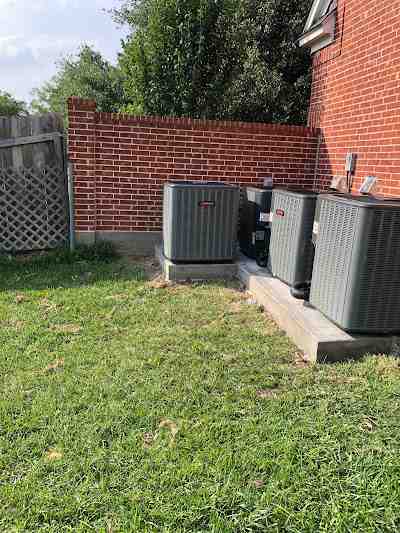
How to extend the life of your ac in texas comes down to a handful of consistent habits: change your filters every 30 days during summer, schedule professional tune-ups twice a year (spring and fall), keep your outdoor unit clear of debris, set your thermostat to 78°F, and seal any leaky ductwork.
Here is a quick summary of the most effective steps:
1. Change air filters monthly during peak cooling season (May through September)
2. Schedule biannual professional maintenance – once in March, once in October
3. Clear at least 24 inches around your outdoor condenser unit at all times
4. Set your thermostat to 78°F when home; raise it 7-10°F when away
5. Seal leaky ducts to stop losing cooled air before it reaches your rooms
6. Use the “auto” fan setting to reduce unnecessary motor runtime
7. Keep all indoor vents open – closing them builds pressure and strains the system
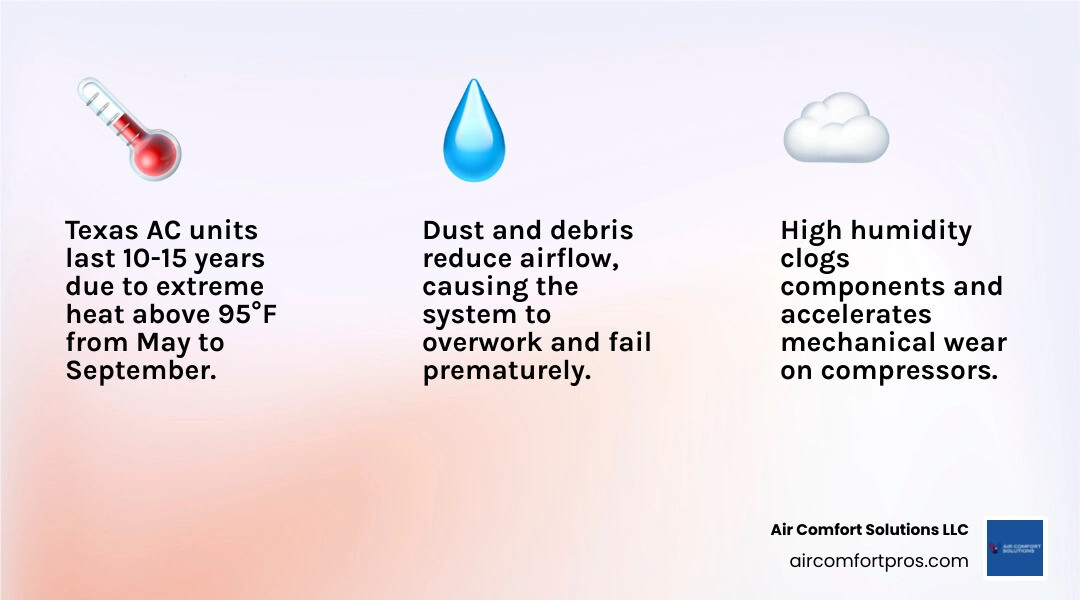
In Pinehurst, TX and across North Harris County, your air conditioner is not just a comfort appliance – it is closer to a survival tool. Texas summers routinely push temperatures above 95°F from May through September, and that relentless heat takes a real toll. While AC units in milder climates can last 15 to 20 years, units here typically last only 10 to 15 years. The reason is straightforward: your system runs almost constantly for months on end, fighting not just extreme heat but also high humidity and dust that clog components and accelerate wear.
Think of it the way you would a car engine. A car driven hard in tough conditions needs more frequent oil changes and checkups than one that rarely leaves the garage. Your AC is no different. The good news is that with the right strategy, proper maintenance can add 5 to 10 years to your system’s life – even in Texas’ demanding climate.
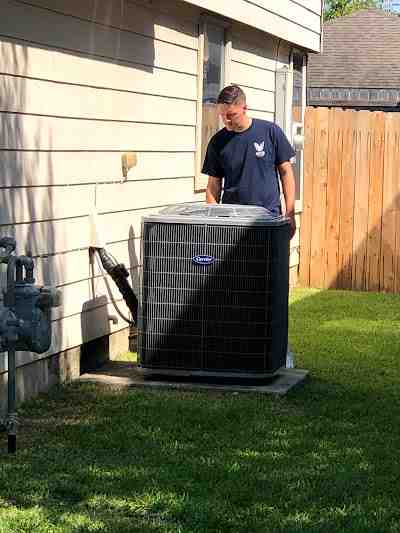
When we talk about how to extend the life of your ac in texas, we have to start with the outdoor condenser unit. This is the part of your system that does the “heavy lifting” by releasing the heat from your home into the outside air. In places like The Woodlands or Magnolia, our lush vegetation can actually become a problem for your AC.
Leaves, grass clippings, and overgrown shrubs act like a blanket, trapping heat inside the unit. If the condenser can’t “breathe,” the compressor has to work twice as hard to move heat, which leads to overheating and premature mechanical failure. We recommend maintaining at least a 24-inch (two-foot) clearance on all sides of the unit. This ensures maximum airflow and prevents the system from “suffocating” under the Texas sun.
Beyond just clearing the area, it is a great idea to gently rinse the outdoor coils with a garden hose periodically. Dust and pollen from our Texas springs can coat these coils, reducing efficiency by as much as 30%. By keeping the exterior clean, you ensure your unit doesn’t have to run longer cycles just to achieve the same cooling effect. For more localized advice on protecting your system, check out our guide on How to Make Sure Your AC Survives a Texas Summer.
If there is one “secret” to AC longevity, it’s the air filter. A dirty filter is the leading cause of airflow blockage, which forces your blower motor to work harder and can even cause your evaporator coils to freeze over. In May 2026, as we head into another sweltering season, this is the easiest DIY task you can perform to save your system.
In the Texas summer, we recommend checking your filter every 30 days. If it looks gray or fuzzy, change it. While many filters claim to last three months, the high dust and pollen levels in areas like Tomball and Spring often mean they clog much faster.
When choosing a filter, the MERV (Minimum Efficiency Reporting Value) rating matters. We typically suggest mid-grade pleated filters (MERV 8 to 11). While high-efficiency filters designed to catch tiny viruses sound great, they can sometimes be too restrictive for older residential units, causing the system to struggle for air. To learn the best way to handle this task, see our How to Replace AC Filters: A Quick and Simple Guide.
While DIY steps are vital, there are technical aspects of your AC that require a professional eye. Think of a professional tune-up as a “health screening” for your HVAC system. Our technicians check everything from refrigerant levels (which can’t be handled by homeowners) to electrical connections and safety switches.
A comprehensive inspection includes:
• Checking the thermostat calibration to ensure it isn’t overworking the unit.
• Inspecting contactors, relays, and circuit boards for signs of wear or scorching.
• Cleaning the condensate drain line to prevent water damage and microbial growth.
• Measuring voltage and current on motors to catch failing parts before they break.
For residents looking for AC Maintenance The Woodlands, having these checks done annually can prevent the “emergency” breakdown on a 100-degree Sunday afternoon. If you’re curious about the full checklist we use during these visits, you can read more about What Does an HVAC Maintenance Plan Include.
Regularly maintaining your AC can reduce electricity costs by up to 30%. In a state where air conditioning accounts for a massive portion of our monthly bills, that’s real money back in your pocket. But the financial benefit goes beyond the monthly bill; it’s about avoiding the $3,000 to $8,000 cost of a premature replacement.
In the Texas climate, we strongly advocate for a biannual maintenance schedule.
1. The Spring Tune-Up (March): This is the most critical visit. We prepare the system for the “marathon” it’s about to run from May through September.
2. The Fall Tune-Up (October): After a brutal summer, your system is likely tired. We check for any wear and tear caused by the heat and prepare the heating components for the winter months.
Documented professional maintenance is also often a requirement to keep your manufacturer’s warranty valid. If a major component like the compressor fails, the manufacturer may ask for service records to prove the unit wasn’t neglected. You can find out more about why this timing is so specific in our post on How Often Should You Service Your AC in Texas.
Many homeowners wonder if these visits are worth the investment. When you consider that proper maintenance can add 5 to 10 years to the life of your unit, the math usually works out in your favor. We dive deeper into this topic in our article, Is an HVAC Maintenance Plan Worth It.
Extending the life of your AC isn’t just about what you do to the machine; it’s about how you use it. The goal is to reduce the total number of “runtime hours” the compressor has to log. Every hour it isn’t running is an hour of life added back to the system.
One of the best habits you can adopt is setting your thermostat to 78°F when you are at home. Every degree lower than 78°F can significantly increase the workload on the system. If you are away for the day, raising the temperature by 7 to 10 degrees can save up to 10% on energy bills and give your system a much-needed rest.
• Thermostat at 78°F — Impact on AC Lifespan: High – Reduces compressor strain — Energy Savings: Up to 15%
• “Auto” Fan Setting — Impact on AC Lifespan: High – Prevents motor wear — Energy Savings: Moderate
• Ceiling Fans — Impact on AC Lifespan: Moderate – Allows higher AC settings — Energy Savings: High
• Duct Sealing — Impact on AC Lifespan: Very High – Prevents “lost” cooling — Energy Savings: Up to 20%
Another critical setting is the “Auto” vs. “On” switch for your fan. Always use the Auto setting. When the fan is set to “On,” it runs continuously even when the AC isn’t cooling. This not only wastes electricity but also prevents humidity from draining off the coils, potentially blowing that moisture back into your home.
Don’t forget the “envelope” of your home. A typical home loses 25% of its cool air through leaky AC ductwork. Sealing and insulating these ducts reduces the strain on your AC because it doesn’t have to work as hard to reach your desired temperature. Combining these habits with Preparing Your Home’s Cooling System for a Smooth Summer will ensure your Pinehurst home stays comfortable without killing your unit.
We hear many of the same concerns from homeowners in Conroe, Montgomery, and Plantersville. Understanding the “why” behind maintenance helps you make better decisions for your home. If you’ve ever wondered about the consequences of skipping a service, check out What Happens If You Skip AC Maintenance in Texas.
In Texas, AC units typically last 10 to 15 years. While the national average is often cited as 15 to 20 years, our extreme heat and high humidity act as a “Texas tax” on machinery. The high humidity means your AC has a dual job: it has to lower the temperature and extract gallons of moisture from the air simultaneously. This constant moisture and heat accelerate mechanical aging. However, with consistent professional care, some Texas homeowners do manage to push their systems to the 18 or 20-year mark.
As your system ages, it will start to “talk” to you. Warning signs include:
• Frequent Repairs: If you are calling us more than once a year for repairs, the cumulative cost will soon outweigh the price of a new unit.
• Rising Energy Bills: If your usage hasn’t changed but your bills are spiking, your system is losing efficiency.
• Unusual Noises: Grinding, banging, or squealing sounds often indicate mechanical failure in the motor or compressor.
• Inconsistent Cooling: If some rooms are freezing while others are sweltering, the system is struggling to move air effectively.
• Age: If your unit is over 15 years old, it is statistically nearing the end of its reliable life in the Texas climate.
During a Texas summer, you should check your filter every 30 days. If you have pets, live in a dusty area, or have family members with allergies, you may even need to change it every 30 days. In the milder months (like November or March), you can often go 60 to 90 days, but from May to September, the “monthly check” is a non-negotiable rule for extending your AC’s life.
How to extend the life of your ac in texas isn’t about luck; it’s about a strategy. By combining simple homeowner habits like monthly filter changes and thermostat management with professional biannual tune-ups, you can protect your investment and keep your home a sanctuary against the heat.
At Air Comfort Solutions LLC, we have over 35 years of experience helping families in Pinehurst, Magnolia, Tomball, and the surrounding North Harris County areas stay cool. Our certified technicians understand the unique challenges of the Texas climate and are dedicated to providing honest, reliable service to keep your “Texas workhorse” running for years to come.
Ready to give your AC the care it deserves? Explore our HVAC Maintenance Plan today to ensure your system is ready for whatever the Texas summer throws your way!
How to extend the life of your ac in texas comes down to a handful of consistent habits: change your filters every 30 days during summer, schedule professional tune-ups twice a year (spring and fall), keep your outdoor unit clear of debris, set your thermostat to 78°F, and seal any leaky ductwork.
Here is a quick summary of the most effective steps:
In Pinehurst, TX and across North Harris County, your air conditioner is not just a comfort appliance - it is closer to a survival tool. Texas summers routinely push temperatures above 95°F from May through September, and that relentless heat takes a real toll. While AC units in milder climates can last 15 to 20 years, units here typically last only 10 to 15 years. The reason is straightforward: your system runs almost constantly for months on end, fighting not just extreme heat but also high humidity and dust that clog components and accelerate wear.
Think of it the way you would a car engine. A car driven hard in tough conditions needs more frequent oil changes and checkups than one that rarely leaves the garage. Your AC is no different. The good news is that with the right strategy, proper maintenance can add 5 to 10 years to your system's life - even in Texas' demanding climate.
When we talk about how to extend the life of your ac in texas, we have to start with the outdoor condenser unit. This is the part of your system that does the "heavy lifting" by releasing the heat from your home into the outside air. In places like The Woodlands or Magnolia, our lush vegetation can actually become a problem for your AC.
Leaves, grass clippings, and overgrown shrubs act like a blanket, trapping heat inside the unit. If the condenser can't "breathe," the compressor has to work twice as hard to move heat, which leads to overheating and premature mechanical failure. We recommend maintaining at least a 24-inch (two-foot) clearance on all sides of the unit. This ensures maximum airflow and prevents the system from "suffocating" under the Texas sun.
Beyond just clearing the area, it is a great idea to gently rinse the outdoor coils with a garden hose periodically. Dust and pollen from our Texas springs can coat these coils, reducing efficiency by as much as 30%. By keeping the exterior clean, you ensure your unit doesn't have to run longer cycles just to achieve the same cooling effect. For more localized advice on protecting your system, check out our guide on How to Make Sure Your AC Survives a Texas Summer.
If there is one "secret" to AC longevity, it’s the air filter. A dirty filter is the leading cause of airflow blockage, which forces your blower motor to work harder and can even cause your evaporator coils to freeze over. In May 2026, as we head into another sweltering season, this is the easiest DIY task you can perform to save your system.
In the Texas summer, we recommend checking your filter every 30 days. If it looks gray or fuzzy, change it. While many filters claim to last three months, the high dust and pollen levels in areas like Tomball and Spring often mean they clog much faster.
When choosing a filter, the MERV (Minimum Efficiency Reporting Value) rating matters. We typically suggest mid-grade pleated filters (MERV 8 to 11). While high-efficiency filters designed to catch tiny viruses sound great, they can sometimes be too restrictive for older residential units, causing the system to struggle for air. To learn the best way to handle this task, see our How to Replace AC Filters: A Quick and Simple Guide.
While DIY steps are vital, there are technical aspects of your AC that require a professional eye. Think of a professional tune-up as a "health screening" for your HVAC system. Our technicians check everything from refrigerant levels (which can't be handled by homeowners) to electrical connections and safety switches.
A comprehensive inspection includes:
For residents looking for AC Maintenance The Woodlands, having these checks done annually can prevent the "emergency" breakdown on a 100-degree Sunday afternoon. If you're curious about the full checklist we use during these visits, you can read more about What Does an HVAC Maintenance Plan Include.
Regularly maintaining your AC can reduce electricity costs by up to 30%. In a state where air conditioning accounts for a massive portion of our monthly bills, that's real money back in your pocket. But the financial benefit goes beyond the monthly bill; it’s about avoiding the $3,000 to $8,000 cost of a premature replacement.
In the Texas climate, we strongly advocate for a biannual maintenance schedule.
Documented professional maintenance is also often a requirement to keep your manufacturer's warranty valid. If a major component like the compressor fails, the manufacturer may ask for service records to prove the unit wasn't neglected. You can find out more about why this timing is so specific in our post on How Often Should You Service Your AC in Texas.
Many homeowners wonder if these visits are worth the investment. When you consider that proper maintenance can add 5 to 10 years to the life of your unit, the math usually works out in your favor. We dive deeper into this topic in our article, Is an HVAC Maintenance Plan Worth It.
Extending the life of your AC isn't just about what you do to the machine; it's about how you use it. The goal is to reduce the total number of "runtime hours" the compressor has to log. Every hour it isn't running is an hour of life added back to the system.
One of the best habits you can adopt is setting your thermostat to 78°F when you are at home. Every degree lower than 78°F can significantly increase the workload on the system. If you are away for the day, raising the temperature by 7 to 10 degrees can save up to 10% on energy bills and give your system a much-needed rest.
| Habit | Impact on AC Lifespan | Energy Savings |
|---|---|---|
| Thermostat at 78°F | High - Reduces compressor strain | Up to 15% |
| "Auto" Fan Setting | High - Prevents motor wear | Moderate |
| Ceiling Fans | Moderate - Allows higher AC settings | High |
| Duct Sealing | Very High - Prevents "lost" cooling | Up to 20% |
Another critical setting is the "Auto" vs. "On" switch for your fan. Always use the Auto setting. When the fan is set to "On," it runs continuously even when the AC isn't cooling. This not only wastes electricity but also prevents humidity from draining off the coils, potentially blowing that moisture back into your home.
Don't forget the "envelope" of your home. A typical home loses 25% of its cool air through leaky AC ductwork. Sealing and insulating these ducts reduces the strain on your AC because it doesn't have to work as hard to reach your desired temperature. Combining these habits with Preparing Your Home's Cooling System for a Smooth Summer will ensure your Pinehurst home stays comfortable without killing your unit.
We hear many of the same concerns from homeowners in Conroe, Montgomery, and Plantersville. Understanding the "why" behind maintenance helps you make better decisions for your home. If you've ever wondered about the consequences of skipping a service, check out What Happens If You Skip AC Maintenance in Texas.
In Texas, AC units typically last 10 to 15 years. While the national average is often cited as 15 to 20 years, our extreme heat and high humidity act as a "Texas tax" on machinery. The high humidity means your AC has a dual job: it has to lower the temperature and extract gallons of moisture from the air simultaneously. This constant moisture and heat accelerate mechanical aging. However, with consistent professional care, some Texas homeowners do manage to push their systems to the 18 or 20-year mark.
As your system ages, it will start to "talk" to you. Warning signs include:
During a Texas summer, you should check your filter every 30 days. If you have pets, live in a dusty area, or have family members with allergies, you may even need to change it every 30 days. In the milder months (like November or March), you can often go 60 to 90 days, but from May to September, the "monthly check" is a non-negotiable rule for extending your AC's life.
How to extend the life of your ac in texas isn't about luck; it's about a strategy. By combining simple homeowner habits like monthly filter changes and thermostat management with professional biannual tune-ups, you can protect your investment and keep your home a sanctuary against the heat.
At Air Comfort Solutions LLC (Air Comfort Pros), we have over 35 years of experience helping families in Pinehurst, Magnolia, Tomball, and the surrounding North Harris County areas stay cool. Our certified technicians understand the unique challenges of the Texas climate and are dedicated to providing honest, reliable service to keep your "Texas workhorse" running for years to come.
Ready to give your AC the care it deserves? Explore our HVAC Maintenance Plan today to ensure your system is ready for whatever the Texas summer throws your way!
How to extend the life of your ac in texas comes down to a handful of consistent habits: change your filters every 30 days during summer, schedule professional tune-ups twice a year (spring and fall), keep your outdoor unit clear of debris, set your thermostat to 78°F, and seal any leaky ductwork.
Here is a quick summary of the most effective steps:
In Pinehurst, TX and across North Harris County, your air conditioner is not just a comfort appliance - it is closer to a survival tool. Texas summers routinely push temperatures above 95°F from May through September, and that relentless heat takes a real toll. While AC units in milder climates can last 15 to 20 years, units here typically last only 10 to 15 years. The reason is straightforward: your system runs almost constantly for months on end, fighting not just extreme heat but also high humidity and dust that clog components and accelerate wear.
Think of it the way you would a car engine. A car driven hard in tough conditions needs more frequent oil changes and checkups than one that rarely leaves the garage. Your AC is no different. The good news is that with the right strategy, proper maintenance can add 5 to 10 years to your system's life - even in Texas' demanding climate.
When we talk about how to extend the life of your ac in texas, we have to start with the outdoor condenser unit. This is the part of your system that does the "heavy lifting" by releasing the heat from your home into the outside air. In places like The Woodlands or Magnolia, our lush vegetation can actually become a problem for your AC.
Leaves, grass clippings, and overgrown shrubs act like a blanket, trapping heat inside the unit. If the condenser can't "breathe," the compressor has to work twice as hard to move heat, which leads to overheating and premature mechanical failure. We recommend maintaining at least a 24-inch (two-foot) clearance on all sides of the unit. This ensures maximum airflow and prevents the system from "suffocating" under the Texas sun.
Beyond just clearing the area, it is a great idea to gently rinse the outdoor coils with a garden hose periodically. Dust and pollen from our Texas springs can coat these coils, reducing efficiency by as much as 30%. By keeping the exterior clean, you ensure your unit doesn't have to run longer cycles just to achieve the same cooling effect. For more localized advice on protecting your system, check out our guide on How to Make Sure Your AC Survives a Texas Summer.
If there is one "secret" to AC longevity, it’s the air filter. A dirty filter is the leading cause of airflow blockage, which forces your blower motor to work harder and can even cause your evaporator coils to freeze over. In May 2026, as we head into another sweltering season, this is the easiest DIY task you can perform to save your system.
In the Texas summer, we recommend checking your filter every 30 days. If it looks gray or fuzzy, change it. While many filters claim to last three months, the high dust and pollen levels in areas like Tomball and Spring often mean they clog much faster.
When choosing a filter, the MERV (Minimum Efficiency Reporting Value) rating matters. We typically suggest mid-grade pleated filters (MERV 8 to 11). While high-efficiency filters designed to catch tiny viruses sound great, they can sometimes be too restrictive for older residential units, causing the system to struggle for air. To learn the best way to handle this task, see our How to Replace AC Filters: A Quick and Simple Guide.
While DIY steps are vital, there are technical aspects of your AC that require a professional eye. Think of a professional tune-up as a "health screening" for your HVAC system. Our technicians check everything from refrigerant levels (which can't be handled by homeowners) to electrical connections and safety switches.
A comprehensive inspection includes:
For residents looking for AC Maintenance The Woodlands, having these checks done annually can prevent the "emergency" breakdown on a 100-degree Sunday afternoon. If you're curious about the full checklist we use during these visits, you can read more about What Does an HVAC Maintenance Plan Include.
Regularly maintaining your AC can reduce electricity costs by up to 30%. In a state where air conditioning accounts for a massive portion of our monthly bills, that's real money back in your pocket. But the financial benefit goes beyond the monthly bill; it’s about avoiding the $3,000 to $8,000 cost of a premature replacement.
In the Texas climate, we strongly advocate for a biannual maintenance schedule.
Documented professional maintenance is also often a requirement to keep your manufacturer's warranty valid. If a major component like the compressor fails, the manufacturer may ask for service records to prove the unit wasn't neglected. You can find out more about why this timing is so specific in our post on How Often Should You Service Your AC in Texas.
Many homeowners wonder if these visits are worth the investment. When you consider that proper maintenance can add 5 to 10 years to the life of your unit, the math usually works out in your favor. We dive deeper into this topic in our article, Is an HVAC Maintenance Plan Worth It.
Extending the life of your AC isn't just about what you do to the machine; it's about how you use it. The goal is to reduce the total number of "runtime hours" the compressor has to log. Every hour it isn't running is an hour of life added back to the system.
One of the best habits you can adopt is setting your thermostat to 78°F when you are at home. Every degree lower than 78°F can significantly increase the workload on the system. If you are away for the day, raising the temperature by 7 to 10 degrees can save up to 10% on energy bills and give your system a much-needed rest.
| Habit | Impact on AC Lifespan | Energy Savings |
|---|---|---|
| Thermostat at 78°F | High - Reduces compressor strain | Up to 15% |
| "Auto" Fan Setting | High - Prevents motor wear | Moderate |
| Ceiling Fans | Moderate - Allows higher AC settings | High |
| Duct Sealing | Very High - Prevents "lost" cooling | Up to 20% |
Another critical setting is the "Auto" vs. "On" switch for your fan. Always use the Auto setting. When the fan is set to "On," it runs continuously even when the AC isn't cooling. This not only wastes electricity but also prevents humidity from draining off the coils, potentially blowing that moisture back into your home.
Don't forget the "envelope" of your home. A typical home loses 25% of its cool air through leaky AC ductwork. Sealing and insulating these ducts reduces the strain on your AC because it doesn't have to work as hard to reach your desired temperature. Combining these habits with Preparing Your Home's Cooling System for a Smooth Summer will ensure your Pinehurst home stays comfortable without killing your unit.
We hear many of the same concerns from homeowners in Conroe, Montgomery, and Plantersville. Understanding the "why" behind maintenance helps you make better decisions for your home. If you've ever wondered about the consequences of skipping a service, check out What Happens If You Skip AC Maintenance in Texas.
In Texas, AC units typically last 10 to 15 years. While the national average is often cited as 15 to 20 years, our extreme heat and high humidity act as a "Texas tax" on machinery. The high humidity means your AC has a dual job: it has to lower the temperature and extract gallons of moisture from the air simultaneously. This constant moisture and heat accelerate mechanical aging. However, with consistent professional care, some Texas homeowners do manage to push their systems to the 18 or 20-year mark.
As your system ages, it will start to "talk" to you. Warning signs include:
During a Texas summer, you should check your filter every 30 days. If you have pets, live in a dusty area, or have family members with allergies, you may even need to change it every 30 days. In the milder months (like November or March), you can often go 60 to 90 days, but from May to September, the "monthly check" is a non-negotiable rule for extending your AC's life.
How to extend the life of your ac in texas isn't about luck; it's about a strategy. By combining simple homeowner habits like monthly filter changes and thermostat management with professional biannual tune-ups, you can protect your investment and keep your home a sanctuary against the heat.
At Air Comfort Solutions LLC (Air Comfort Pros), we have over 35 years of experience helping families in Pinehurst, Magnolia, Tomball, and the surrounding North Harris County areas stay cool. Our certified technicians understand the unique challenges of the Texas climate and are dedicated to providing honest, reliable service to keep your "Texas workhorse" running for years to come.
Ready to give your AC the care it deserves? Explore our HVAC Maintenance Plan today to ensure your system is ready for whatever the Texas summer throws your way!
How to extend the life of your ac in texas comes down to a handful of consistent habits: change your filters every 30 days during summer, schedule professional tune-ups twice a year (spring and fall), keep your outdoor unit clear of debris, set your thermostat to 78°F, and seal any leaky ductwork.
Here is a quick summary of the most effective steps:
In Pinehurst, TX and across North Harris County, your air conditioner is not just a comfort appliance - it is closer to a survival tool. Texas summers routinely push temperatures above 95°F from May through September, and that relentless heat takes a real toll. While AC units in milder climates can last 15 to 20 years, units here typically last only 10 to 15 years. The reason is straightforward: your system runs almost constantly for months on end, fighting not just extreme heat but also high humidity and dust that clog components and accelerate wear.
Think of it the way you would a car engine. A car driven hard in tough conditions needs more frequent oil changes and checkups than one that rarely leaves the garage. Your AC is no different. The good news is that with the right strategy, proper maintenance can add 5 to 10 years to your system's life - even in Texas' demanding climate.
When we talk about how to extend the life of your ac in texas, we have to start with the outdoor condenser unit. This is the part of your system that does the "heavy lifting" by releasing the heat from your home into the outside air. In places like The Woodlands or Magnolia, our lush vegetation can actually become a problem for your AC.
Leaves, grass clippings, and overgrown shrubs act like a blanket, trapping heat inside the unit. If the condenser can't "breathe," the compressor has to work twice as hard to move heat, which leads to overheating and premature mechanical failure. We recommend maintaining at least a 24-inch (two-foot) clearance on all sides of the unit. This ensures maximum airflow and prevents the system from "suffocating" under the Texas sun.
Beyond just clearing the area, it is a great idea to gently rinse the outdoor coils with a garden hose periodically. Dust and pollen from our Texas springs can coat these coils, reducing efficiency by as much as 30%. By keeping the exterior clean, you ensure your unit doesn't have to run longer cycles just to achieve the same cooling effect. For more localized advice on protecting your system, check out our guide on How to Make Sure Your AC Survives a Texas Summer.
If there is one "secret" to AC longevity, it’s the air filter. A dirty filter is the leading cause of airflow blockage, which forces your blower motor to work harder and can even cause your evaporator coils to freeze over. In May 2026, as we head into another sweltering season, this is the easiest DIY task you can perform to save your system.
In the Texas summer, we recommend checking your filter every 30 days. If it looks gray or fuzzy, change it. While many filters claim to last three months, the high dust and pollen levels in areas like Tomball and Spring often mean they clog much faster.
When choosing a filter, the MERV (Minimum Efficiency Reporting Value) rating matters. We typically suggest mid-grade pleated filters (MERV 8 to 11). While high-efficiency filters designed to catch tiny viruses sound great, they can sometimes be too restrictive for older residential units, causing the system to struggle for air. To learn the best way to handle this task, see our How to Replace AC Filters: A Quick and Simple Guide.
While DIY steps are vital, there are technical aspects of your AC that require a professional eye. Think of a professional tune-up as a "health screening" for your HVAC system. Our technicians check everything from refrigerant levels (which can't be handled by homeowners) to electrical connections and safety switches.
A comprehensive inspection includes:
For residents looking for AC Maintenance The Woodlands, having these checks done annually can prevent the "emergency" breakdown on a 100-degree Sunday afternoon. If you're curious about the full checklist we use during these visits, you can read more about What Does an HVAC Maintenance Plan Include.
Regularly maintaining your AC can reduce electricity costs by up to 30%. In a state where air conditioning accounts for a massive portion of our monthly bills, that's real money back in your pocket. But the financial benefit goes beyond the monthly bill; it’s about avoiding the $3,000 to $8,000 cost of a premature replacement.
In the Texas climate, we strongly advocate for a biannual maintenance schedule.
Documented professional maintenance is also often a requirement to keep your manufacturer's warranty valid. If a major component like the compressor fails, the manufacturer may ask for service records to prove the unit wasn't neglected. You can find out more about why this timing is so specific in our post on How Often Should You Service Your AC in Texas.
Many homeowners wonder if these visits are worth the investment. When you consider that proper maintenance can add 5 to 10 years to the life of your unit, the math usually works out in your favor. We dive deeper into this topic in our article, Is an HVAC Maintenance Plan Worth It.
Extending the life of your AC isn't just about what you do to the machine; it's about how you use it. The goal is to reduce the total number of "runtime hours" the compressor has to log. Every hour it isn't running is an hour of life added back to the system.
One of the best habits you can adopt is setting your thermostat to 78°F when you are at home. Every degree lower than 78°F can significantly increase the workload on the system. If you are away for the day, raising the temperature by 7 to 10 degrees can save up to 10% on energy bills and give your system a much-needed rest.
| Habit | Impact on AC Lifespan | Energy Savings |
|---|---|---|
| Thermostat at 78°F | High - Reduces compressor strain | Up to 15% |
| "Auto" Fan Setting | High - Prevents motor wear | Moderate |
| Ceiling Fans | Moderate - Allows higher AC settings | High |
| Duct Sealing | Very High - Prevents "lost" cooling | Up to 20% |
Another critical setting is the "Auto" vs. "On" switch for your fan. Always use the Auto setting. When the fan is set to "On," it runs continuously even when the AC isn't cooling. This not only wastes electricity but also prevents humidity from draining off the coils, potentially blowing that moisture back into your home.
Don't forget the "envelope" of your home. A typical home loses 25% of its cool air through leaky AC ductwork. Sealing and insulating these ducts reduces the strain on your AC because it doesn't have to work as hard to reach your desired temperature. Combining these habits with Preparing Your Home's Cooling System for a Smooth Summer will ensure your Pinehurst home stays comfortable without killing your unit.
We hear many of the same concerns from homeowners in Conroe, Montgomery, and Plantersville. Understanding the "why" behind maintenance helps you make better decisions for your home. If you've ever wondered about the consequences of skipping a service, check out What Happens If You Skip AC Maintenance in Texas.
In Texas, AC units typically last 10 to 15 years. While the national average is often cited as 15 to 20 years, our extreme heat and high humidity act as a "Texas tax" on machinery. The high humidity means your AC has a dual job: it has to lower the temperature and extract gallons of moisture from the air simultaneously. This constant moisture and heat accelerate mechanical aging. However, with consistent professional care, some Texas homeowners do manage to push their systems to the 18 or 20-year mark.
As your system ages, it will start to "talk" to you. Warning signs include:
During a Texas summer, you should check your filter every 30 days. If you have pets, live in a dusty area, or have family members with allergies, you may even need to change it every 30 days. In the milder months (like November or March), you can often go 60 to 90 days, but from May to September, the "monthly check" is a non-negotiable rule for extending your AC's life.
How to extend the life of your ac in texas isn't about luck; it's about a strategy. By combining simple homeowner habits like monthly filter changes and thermostat management with professional biannual tune-ups, you can protect your investment and keep your home a sanctuary against the heat.
At Air Comfort Solutions LLC (Air Comfort Pros), we have over 35 years of experience helping families in Pinehurst, Magnolia, Tomball, and the surrounding North Harris County areas stay cool. Our certified technicians understand the unique challenges of the Texas climate and are dedicated to providing honest, reliable service to keep your "Texas workhorse" running for years to come.
Ready to give your AC the care it deserves? Explore our HVAC Maintenance Plan today to ensure your system is ready for whatever the Texas summer throws your way!
How to extend the life of your ac in texas comes down to a handful of consistent habits: change your filters every 30 days during summer, schedule professional tune-ups twice a year (spring and fall), keep your outdoor unit clear of debris, set your thermostat to 78°F, and seal any leaky ductwork.
Here is a quick summary of the most effective steps:
In Pinehurst, TX and across North Harris County, your air conditioner is not just a comfort appliance - it is closer to a survival tool. Texas summers routinely push temperatures above 95°F from May through September, and that relentless heat takes a real toll. While AC units in milder climates can last 15 to 20 years, units here typically last only 10 to 15 years. The reason is straightforward: your system runs almost constantly for months on end, fighting not just extreme heat but also high humidity and dust that clog components and accelerate wear.
Think of it the way you would a car engine. A car driven hard in tough conditions needs more frequent oil changes and checkups than one that rarely leaves the garage. Your AC is no different. The good news is that with the right strategy, proper maintenance can add 5 to 10 years to your system's life - even in Texas' demanding climate.
When we talk about how to extend the life of your ac in texas, we have to start with the outdoor condenser unit. This is the part of your system that does the "heavy lifting" by releasing the heat from your home into the outside air. In places like The Woodlands or Magnolia, our lush vegetation can actually become a problem for your AC.
Leaves, grass clippings, and overgrown shrubs act like a blanket, trapping heat inside the unit. If the condenser can't "breathe," the compressor has to work twice as hard to move heat, which leads to overheating and premature mechanical failure. We recommend maintaining at least a 24-inch (two-foot) clearance on all sides of the unit. This ensures maximum airflow and prevents the system from "suffocating" under the Texas sun.
Beyond just clearing the area, it is a great idea to gently rinse the outdoor coils with a garden hose periodically. Dust and pollen from our Texas springs can coat these coils, reducing efficiency by as much as 30%. By keeping the exterior clean, you ensure your unit doesn't have to run longer cycles just to achieve the same cooling effect. For more localized advice on protecting your system, check out our guide on How to Make Sure Your AC Survives a Texas Summer.
If there is one "secret" to AC longevity, it’s the air filter. A dirty filter is the leading cause of airflow blockage, which forces your blower motor to work harder and can even cause your evaporator coils to freeze over. In May 2026, as we head into another sweltering season, this is the easiest DIY task you can perform to save your system.
In the Texas summer, we recommend checking your filter every 30 days. If it looks gray or fuzzy, change it. While many filters claim to last three months, the high dust and pollen levels in areas like Tomball and Spring often mean they clog much faster.
When choosing a filter, the MERV (Minimum Efficiency Reporting Value) rating matters. We typically suggest mid-grade pleated filters (MERV 8 to 11). While high-efficiency filters designed to catch tiny viruses sound great, they can sometimes be too restrictive for older residential units, causing the system to struggle for air. To learn the best way to handle this task, see our How to Replace AC Filters: A Quick and Simple Guide.
While DIY steps are vital, there are technical aspects of your AC that require a professional eye. Think of a professional tune-up as a "health screening" for your HVAC system. Our technicians check everything from refrigerant levels (which can't be handled by homeowners) to electrical connections and safety switches.
A comprehensive inspection includes:
For residents looking for AC Maintenance The Woodlands, having these checks done annually can prevent the "emergency" breakdown on a 100-degree Sunday afternoon. If you're curious about the full checklist we use during these visits, you can read more about What Does an HVAC Maintenance Plan Include.
Regularly maintaining your AC can reduce electricity costs by up to 30%. In a state where air conditioning accounts for a massive portion of our monthly bills, that's real money back in your pocket. But the financial benefit goes beyond the monthly bill; it’s about avoiding the $3,000 to $8,000 cost of a premature replacement.
In the Texas climate, we strongly advocate for a biannual maintenance schedule.
Documented professional maintenance is also often a requirement to keep your manufacturer's warranty valid. If a major component like the compressor fails, the manufacturer may ask for service records to prove the unit wasn't neglected. You can find out more about why this timing is so specific in our post on How Often Should You Service Your AC in Texas.
Many homeowners wonder if these visits are worth the investment. When you consider that proper maintenance can add 5 to 10 years to the life of your unit, the math usually works out in your favor. We dive deeper into this topic in our article, Is an HVAC Maintenance Plan Worth It.
Extending the life of your AC isn't just about what you do to the machine; it's about how you use it. The goal is to reduce the total number of "runtime hours" the compressor has to log. Every hour it isn't running is an hour of life added back to the system.
One of the best habits you can adopt is setting your thermostat to 78°F when you are at home. Every degree lower than 78°F can significantly increase the workload on the system. If you are away for the day, raising the temperature by 7 to 10 degrees can save up to 10% on energy bills and give your system a much-needed rest.
| Habit | Impact on AC Lifespan | Energy Savings |
|---|---|---|
| Thermostat at 78°F | High - Reduces compressor strain | Up to 15% |
| "Auto" Fan Setting | High - Prevents motor wear | Moderate |
| Ceiling Fans | Moderate - Allows higher AC settings | High |
| Duct Sealing | Very High - Prevents "lost" cooling | Up to 20% |
Another critical setting is the "Auto" vs. "On" switch for your fan. Always use the Auto setting. When the fan is set to "On," it runs continuously even when the AC isn't cooling. This not only wastes electricity but also prevents humidity from draining off the coils, potentially blowing that moisture back into your home.
Don't forget the "envelope" of your home. A typical home loses 25% of its cool air through leaky AC ductwork. Sealing and insulating these ducts reduces the strain on your AC because it doesn't have to work as hard to reach your desired temperature. Combining these habits with Preparing Your Home's Cooling System for a Smooth Summer will ensure your Pinehurst home stays comfortable without killing your unit.
We hear many of the same concerns from homeowners in Conroe, Montgomery, and Plantersville. Understanding the "why" behind maintenance helps you make better decisions for your home. If you've ever wondered about the consequences of skipping a service, check out What Happens If You Skip AC Maintenance in Texas.
In Texas, AC units typically last 10 to 15 years. While the national average is often cited as 15 to 20 years, our extreme heat and high humidity act as a "Texas tax" on machinery. The high humidity means your AC has a dual job: it has to lower the temperature and extract gallons of moisture from the air simultaneously. This constant moisture and heat accelerate mechanical aging. However, with consistent professional care, some Texas homeowners do manage to push their systems to the 18 or 20-year mark.
As your system ages, it will start to "talk" to you. Warning signs include:
During a Texas summer, you should check your filter every 30 days. If you have pets, live in a dusty area, or have family members with allergies, you may even need to change it every 30 days. In the milder months (like November or March), you can often go 60 to 90 days, but from May to September, the "monthly check" is a non-negotiable rule for extending your AC's life.
How to extend the life of your ac in texas isn't about luck; it's about a strategy. By combining simple homeowner habits like monthly filter changes and thermostat management with professional biannual tune-ups, you can protect your investment and keep your home a sanctuary against the heat.
At Air Comfort Solutions LLC (Air Comfort Pros), we have over 35 years of experience helping families in Pinehurst, Magnolia, Tomball, and the surrounding North Harris County areas stay cool. Our certified technicians understand the unique challenges of the Texas climate and are dedicated to providing honest, reliable service to keep your "Texas workhorse" running for years to come.
Ready to give your AC the care it deserves? Explore our HVAC Maintenance Plan today to ensure your system is ready for whatever the Texas summer throws your way!


Zane came out and did an amazing job! Super friendly, honest and transparent about the work that needed to be done. This is my second time working with Air Comfort Solutions and they’re my go to for HVAC services. Highly recommend.
God's AMAZING grace sent us Robert and Zane. We have been without air in this Texas heat for six weeks and four days. We've had a few contractors give us quotes all trying to upsell when we're at a low point. But not the guys at Air Comfort Solutions. They came in assessed our situation, gave us honest feedback, and showed us the issues as they proceeded with the assessment for clear understanding. We highly recommend them for their professionalism, quality products, and fair pricing. We hands down support them for all the work they do 💯 %.
Robert and Zane gone above and beyond to make the process easy and affordable.
Would definitely recommend!!
I’m writing this review to let everyone know that Air Comfort Solutions is the company to work with. I know the owner ( Robert) for several years now. He has been taking care of my residential and business work orders. Robert is professional, knowledgeable and will save you money. I just want to thank Robert for great job you have been doing for me.