



Home Maintenance Tips and Troubleshooting: Is Your Fall HVAC Startup an Emergency?
Smell burning dust during your fall heating startup? See why we recommend these home maintenance tips and troubleshooting steps to spot real HVAC hazards.
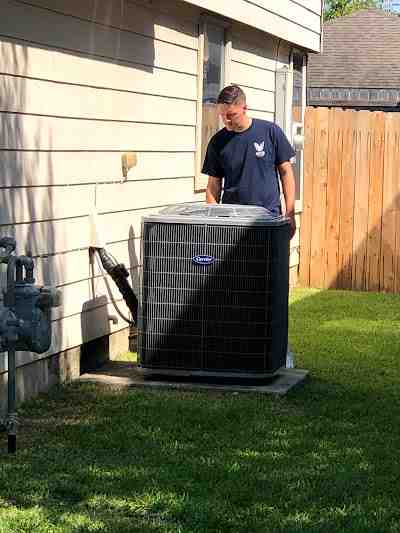
The best time of year to schedule your AC tune-up is early spring — ideally between March and May — before the Texas heat arrives and HVAC technicians fill up with emergency calls.
Quick answer for Pinehurst homeowners:
• Best time: Early spring (March–May)
• Second best: Early summer (June) if you missed spring
• Acceptable backup: Fall (September–November)
• Avoid: Scheduling during peak summer heat when technicians are busiest and wait times are longest
Here in North Harris County, summers are no joke. Temperatures regularly push past 90°F — and air conditioners in the Houston area can run nine to ten months out of the year. That’s an enormous workload for any mechanical system, and it means skipping routine maintenance is a gamble most homeowners eventually regret.
Think of it like taking your car in for an oil change. You wouldn’t wait until the engine seizes to schedule service. Your AC works the same way — small problems caught in spring cost far less to fix than emergency breakdowns in July.
Most homeowners don’t think about their air conditioner until the first scorching day of summer. By then, HVAC technicians are already slammed with emergency calls, parts may be on backorder, and you could be waiting days — or longer — for service. A planned spring tune-up puts you ahead of all of that.
This guide walks you through everything you need to know: why spring is the optimal window, what risks come with waiting, what a professional tune-up actually includes, and how regular maintenance protects both your system and your wallet.
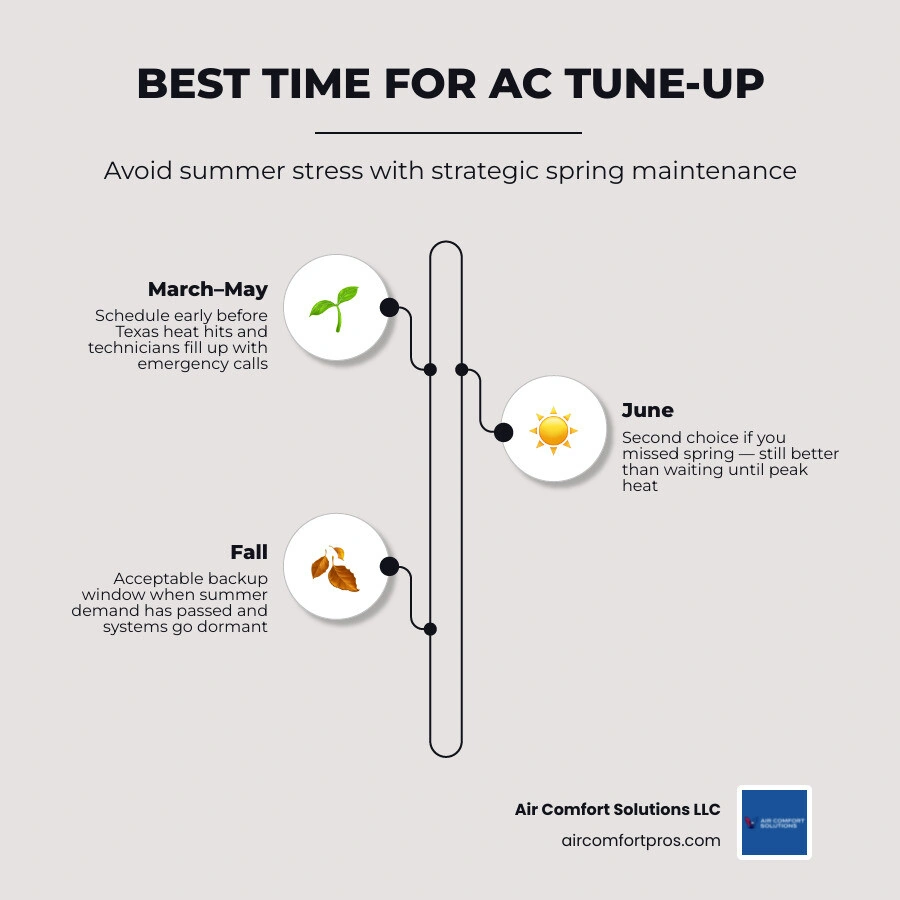
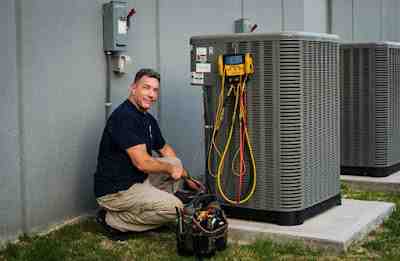
Spring is the undisputed “golden window” for air conditioning maintenance. As the winter chill fades and we transition into the mild, pleasant days of March and April, your cooling system is sitting dormant. This quiet period is the perfect opportunity to address system health before the heavy demand of summer begins.
During this shoulder season, the weather is warm enough for technicians to accurately test your system’s cooling cycle, yet mild enough that you won’t suffer if the system is turned off for an hour or two during service. Taking advantage of this time ensures your home is ready for the heat long before the first major humidity spike hits Harris County.
By focusing on preventive care during the spring, you ensure that every component is clean, lubricated, and calibrated. This proactive approach directly impacts your comfort and your wallet. A clean system runs more efficiently, which keeps your monthly utility bills from skyrocketing when the outdoor temperatures climb. Taking these steps is one of the most effective ways of Preparing Your Homes Cooling System for a Smooth Summer.
When the first true heatwave of the year rolls across Pinehurst, Tomball, and Magnolia, thousands of homeowners turn on their air conditioners at the exact same time. Systems that sat dormant all winter are suddenly pushed to their limits, leading to an inevitable wave of equipment failures.
During these peak summer weeks, HVAC companies are flooded with emergency repair calls. If you wait until then to schedule a routine tune-up, you will likely face long wait times and limited appointment availability.
Scheduling in early spring gives you complete control over your calendar. Technicians have much more flexible schedules during the shoulder season, meaning you can book an appointment at a time that is truly convenient for you. You get prompt, unhurried service from a technician who has the time to meticulously inspect every detail of your system. It is one of the smartest Things to Do Before Triple Digit Temperatures Hit.
An air conditioner that has not been serviced can lose a significant amount of its operating efficiency over time. Dust, pollen, and outdoor debris accumulate on the coils and internal components during periods of dormancy. When your system has to push air through dirty filters and fouled coils, it must work much harder to cool your home.
Industry data shows that a neglected AC unit can use 15% to 30% more energy just to achieve the same level of cooling as a well-maintained system. Furthermore, severely fouled AC coils can increase compressor energy consumption by 30% or more.
A professional spring tune-up optimizes your system’s airflow, deep-cleans the heat-exchange surfaces, and ensures all electrical components are drawing the correct voltage. This keeps your cooling performance high and your energy bills manageable, even when the Texas summer is at its most relentless.
Waiting until the middle of summer to think about your air conditioner is a high-risk strategy. When your system is already under immense strain from triple-digit outdoor temperatures, any underlying weakness in the system is magnified.
To help visualize why timing matters so much, consider how scheduling impacts your overall service experience:
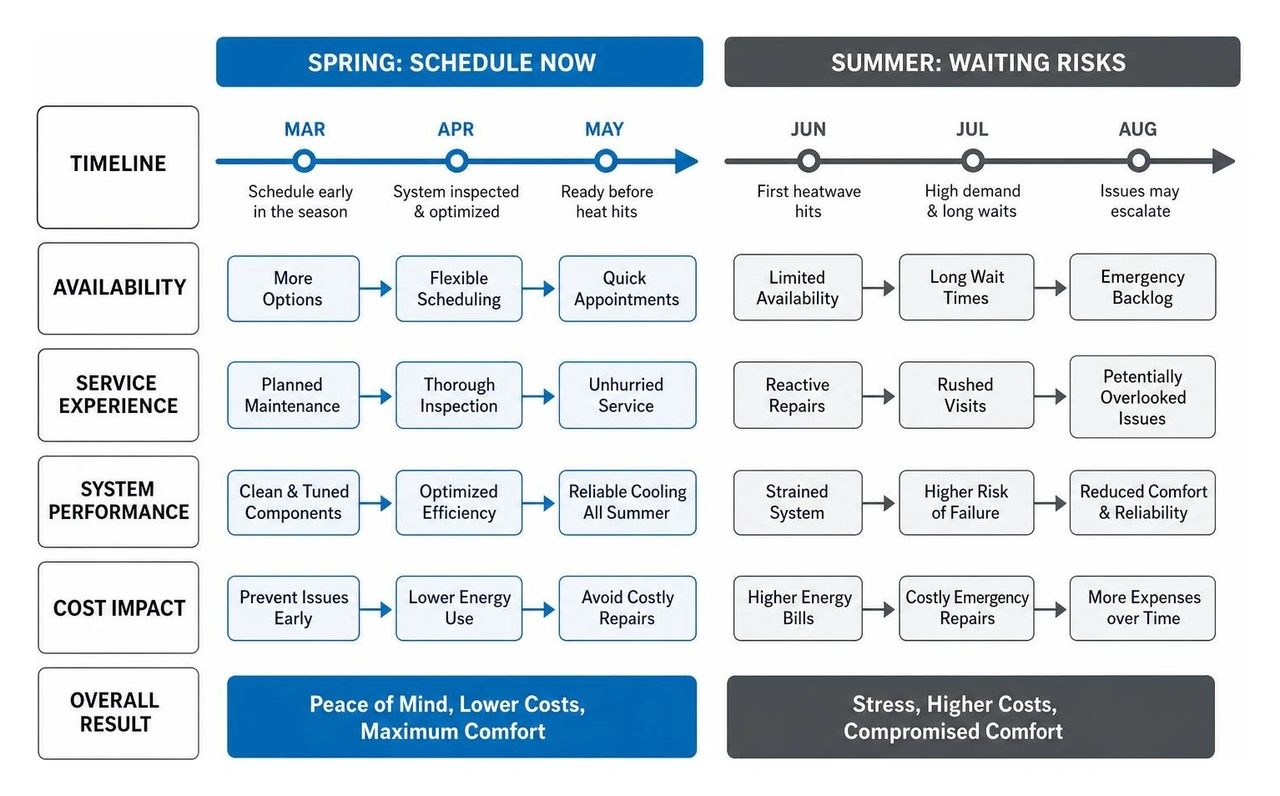
By taking action early, you avoid the stress of reactive repairs. If you want to dive deeper into protecting your system, read our guide on How to Make Sure Your AC Survives a Texas Summer.
There is nothing worse than coming home after a long day to find your house hotter than the outdoors. When an AC system is forced to run constantly in extreme heat without a pre-season inspection, critical components are highly vulnerable to failure.
The most severe risk of neglected maintenance is compressor failure. The compressor is the heart of your air conditioning system, responsible for pumping refrigerant through the coils. If the system is struggling with dirty coils, restricted airflow, or incorrect refrigerant levels, the compressor will overheat and eventually shut down.
A system shutdown during a humid Texas summer is more than just uncomfortable—it can quickly become a safety hazard for children, elderly family members, and pets. High indoor humidity can also lead to rapid mold growth and indoor air quality issues.
When local temperatures spike, emergency service calls take priority for every HVAC provider in the region. If your system breaks down in July or August, you may find yourself waiting days for a technician to become available.
During these peak periods, parts manufacturers also experience high demand, which can lead to supply chain delays. A minor issue like a worn-out capacitor or a failing fan motor—which could have been easily identified and replaced in fifteen minutes during a spring visit—can turn into a multi-day ordeal if the replacement part is backordered in the middle of summer.
Choosing the best time of year to schedule your ac tune up means planning ahead so you never have to compete with hundreds of other local families for emergency scheduling.
A professional AC tune-up is a comprehensive, hands-on service designed to restore your cooling system to peak operating condition. It is much more than a simple visual inspection or a quick filter swap.
When a professional technician arrives at your home, they perform a series of technical checks, cleanings, and safety calibrations that require specialized diagnostic equipment. If you are new to home ownership or have never had your system professionally serviced before, you can learn more by checking out our articles on What to Expect During Your First AC Tune-Up and our AC Maintenance Visit Complete Guide.
A thorough, professional maintenance visit generally takes between one and two hours. During this time, the technician systematically works through a checklist of critical tasks to ensure every part of your system is operating safely and efficiently.
Key steps in a professional tune-up include:
• Coil Cleaning: Removing dirt, dust, and organic debris from both the indoor evaporator coil and the outdoor condenser coil to maximize heat transfer.
• Refrigerant Level Check: Measuring the system’s refrigerant charge to ensure there are no leaks and that the system is operating at the manufacturer’s specified pressure.
• Condensate Drain Line Flushing: Clearing out algae, dust, and blockages from the drain line to prevent water damage and indoor leaks.
• Electrical Inspection: Tightening loose connections, measuring voltage and currents on motors, and testing capacitors for wear.
• Thermostat Calibration: Verifying that your thermostat is communicating accurately with your cooling system to prevent short-cycling.
For a detailed breakdown of what our technicians look for, explore What Does Professional AC Service Include and our practical Pre-Summer AC Tune-Up Checklist for Homeowners.
While there are several important tasks homeowners should perform regularly—such as changing air filters every 30 to 90 days and keeping the outdoor unit clear of weeds and debris—a comprehensive tune-up requires professional expertise.
Modern air conditioning systems are complex thermodynamic and electrical machines. Checking refrigerant levels requires specialized gauges and, by federal law, handling refrigerant requires EPA certification. Testing electrical components like capacitors and contactors requires working with high-voltage circuits, which carries significant safety risks if handled incorrectly.
Professional technicians have the training, diagnostic tools, and experience to spot subtle warning signs—like a slightly weak capacitor or a minor refrigerant leak—long before they cause a complete system failure.
Investing in preventative care is about protecting your long-term investment. Your air conditioner is one of the most expensive systems in your home, and keeping it in top shape provides long-term peace of mind.
Many homeowners wonder if joining a formal service plan is worth the commitment. To help weigh your options, you can read our guide on Is an HVAC Maintenance Plan Worth It.
An air conditioning unit that receives regular, professional care almost always lasts longer than a neglected system. While a neglected AC unit might begin to fail after just 10 to 12 years of heavy use in the harsh Texas climate, a well-maintained system can easily last 15 to 20 years.
Regular maintenance minimizes unnecessary wear and tear on critical components. When the coils are clean and the airflow is unrestricted, the compressor and fan motors do not have to work as hard or run as long to cool your home. This slows down the overall depreciation of the system, helping you get the maximum value out of your equipment before it eventually needs to be replaced.
Almost all major air conditioning manufacturers require proof of regular, professional maintenance to keep their equipment warranties valid. If a major component like your compressor or evaporator coil fails within the warranty period, the manufacturer may request service records proving the system was maintained annually.
If you cannot provide documented proof of professional maintenance, your warranty claim could be denied, leaving you responsible for the full cost of replacing the failed component. Keeping up with your annual spring service is the easiest way to protect this valuable coverage. For more details on managing your system’s long-term care in Texas, refer to our AC Maintenance Plan Texas Guide 2026.
Homeowners should schedule professional AC maintenance at least once per year. In regions like Texas with long, intense cooling seasons, scheduling an annual check-up is essential to ensure reliability.
If you have a heat pump system that provides both heating and cooling, it should be serviced twice a year—once in the spring before the cooling season and once in the fall before the heating season. For older systems or homes with pets and allergy sufferers, bi-annual checks are highly recommended. You can find more tailored advice in our article on How Often Should You Service Your AC in Texas.
If you missed the spring window, the next best time is early summer (June). While schedules will be busier, it is still far better to get your system serviced before the extreme heat of July and August arrives.
Alternatively, early fall (September to November) is an excellent backup choice. A fall tune-up allows us to clear away the heavy dirt and debris accumulated over the summer, ensuring the system is clean before it sits idle during the winter months.
You should schedule a professional visit immediately if you notice any of the following warning signs:
• Weak Airflow: Cool air is coming out of the vents, but it is barely blowing.
• Warm Air: The system is running constantly, but the air coming out of the registers is warm or room temperature.
• Unusual Noises: You hear squealing, grinding, rattling, or loud banging sounds when the system starts or runs.
• Frequent Cycling: The system turns on and off rapidly without ever fully cooling your home.
• High Indoor Humidity: Your home feels sticky or clammy, even when the AC is running.
Preparing your home for the long Texas summer does not have to be stressful. By understanding the best time of year to schedule your ac tune up and taking action in the spring, you can enjoy dependable comfort all year long.
At Air Comfort Solutions, we provide expert HVAC services throughout Pinehurst, Plantersville, Magnolia, Houston, The Woodlands, Montgomery, Conroe, Spring, and Tomball. With over 35 years of experience and certified technicians, we are dedicated to keeping your home cool, safe, and comfortable.
Don’t wait for the summer heat to catch you off guard. Take control of your home’s comfort and energy bills today. Schedule your professional AC maintenance in Houston, TX with Air Comfort Solutions and experience the honest, reliable service our community has trusted for decades.
The best time of year to schedule your AC tune-up is early spring — ideally between March and May — before the Texas heat arrives and HVAC technicians fill up with emergency calls.
Quick answer for Pinehurst homeowners:
Here in North Harris County, summers are no joke. Temperatures regularly push past 90°F — and air conditioners in the Houston area can run nine to ten months out of the year. That's an enormous workload for any mechanical system, and it means skipping routine maintenance is a gamble most homeowners eventually regret.
Think of it like taking your car in for an oil change. You wouldn't wait until the engine seizes to schedule service. Your AC works the same way — small problems caught in spring cost far less to fix than emergency breakdowns in July.
Most homeowners don't think about their air conditioner until the first scorching day of summer. By then, HVAC technicians are already slammed with emergency calls, parts may be on backorder, and you could be waiting days — or longer — for service. A planned spring tune-up puts you ahead of all of that.
This guide walks you through everything you need to know: why spring is the optimal window, what risks come with waiting, what a professional tune-up actually includes, and how regular maintenance protects both your system and your wallet.
Spring is the undisputed "golden window" for air conditioning maintenance. As the winter chill fades and we transition into the mild, pleasant days of March and April, your cooling system is sitting dormant. This quiet period is the perfect opportunity to address system health before the heavy demand of summer begins.
During this shoulder season, the weather is warm enough for technicians to accurately test your system's cooling cycle, yet mild enough that you won't suffer if the system is turned off for an hour or two during service. Taking advantage of this time ensures your home is ready for the heat long before the first major humidity spike hits Harris County.
By focusing on preventive care during the spring, you ensure that every component is clean, lubricated, and calibrated. This proactive approach directly impacts your comfort and your wallet. A clean system runs more efficiently, which keeps your monthly utility bills from skyrocketing when the outdoor temperatures climb. Taking these steps is one of the most effective ways of Preparing Your Homes Cooling System for a Smooth Summer.
When the first true heatwave of the year rolls across Pinehurst, Tomball, and Magnolia, thousands of homeowners turn on their air conditioners at the exact same time. Systems that sat dormant all winter are suddenly pushed to their limits, leading to an inevitable wave of equipment failures.
During these peak summer weeks, HVAC companies are flooded with emergency repair calls. If you wait until then to schedule a routine tune-up, you will likely face long wait times and limited appointment availability.
Scheduling in early spring gives you complete control over your calendar. Technicians have much more flexible schedules during the shoulder season, meaning you can book an appointment at a time that is truly convenient for you. You get prompt, unhurried service from a technician who has the time to meticulously inspect every detail of your system. It is one of the smartest Things to Do Before Triple Digit Temperatures Hit.
An air conditioner that has not been serviced can lose a significant amount of its operating efficiency over time. Dust, pollen, and outdoor debris accumulate on the coils and internal components during periods of dormancy. When your system has to push air through dirty filters and fouled coils, it must work much harder to cool your home.
Industry data shows that a neglected AC unit can use 15% to 30% more energy just to achieve the same level of cooling as a well-maintained system. Furthermore, severely fouled AC coils can increase compressor energy consumption by 30% or more.
A professional spring tune-up optimizes your system's airflow, deep-cleans the heat-exchange surfaces, and ensures all electrical components are drawing the correct voltage. This keeps your cooling performance high and your energy bills manageable, even when the Texas summer is at its most relentless.
Waiting until the middle of summer to think about your air conditioner is a high-risk strategy. When your system is already under immense strain from triple-digit outdoor temperatures, any underlying weakness in the system is magnified.
To help visualize why timing matters so much, consider how scheduling impacts your overall service experience:
By taking action early, you avoid the stress of reactive repairs. If you want to dive deeper into protecting your system, read our guide on How to Make Sure Your AC Survives a Texas Summer.
There is nothing worse than coming home after a long day to find your house hotter than the outdoors. When an AC system is forced to run constantly in extreme heat without a pre-season inspection, critical components are highly vulnerable to failure.
The most severe risk of neglected maintenance is compressor failure. The compressor is the heart of your air conditioning system, responsible for pumping refrigerant through the coils. If the system is struggling with dirty coils, restricted airflow, or incorrect refrigerant levels, the compressor will overheat and eventually shut down.
A system shutdown during a humid Texas summer is more than just uncomfortable—it can quickly become a safety hazard for children, elderly family members, and pets. High indoor humidity can also lead to rapid mold growth and indoor air quality issues.
When local temperatures spike, emergency service calls take priority for every HVAC provider in the region. If your system breaks down in July or August, you may find yourself waiting days for a technician to become available.
During these peak periods, parts manufacturers also experience high demand, which can lead to supply chain delays. A minor issue like a worn-out capacitor or a failing fan motor—which could have been easily identified and replaced in fifteen minutes during a spring visit—can turn into a multi-day ordeal if the replacement part is backordered in the middle of summer.
Choosing the best time of year to schedule your ac tune up means planning ahead so you never have to compete with hundreds of other local families for emergency scheduling.
A professional AC tune-up is a comprehensive, hands-on service designed to restore your cooling system to peak operating condition. It is much more than a simple visual inspection or a quick filter swap.
When a professional technician arrives at your home, they perform a series of technical checks, cleanings, and safety calibrations that require specialized diagnostic equipment. If you are new to home ownership or have never had your system professionally serviced before, you can learn more by checking out our articles on What to Expect During Your First AC Tune-Up and our AC Maintenance Visit Complete Guide.
A thorough, professional maintenance visit generally takes between one and two hours. During this time, the technician systematically works through a checklist of critical tasks to ensure every part of your system is operating safely and efficiently.
Key steps in a professional tune-up include:
For a detailed breakdown of what our technicians look for, explore What Does Professional AC Service Include and our practical Pre-Summer AC Tune-Up Checklist for Homeowners.
While there are several important tasks homeowners should perform regularly—such as changing air filters every 30 to 90 days and keeping the outdoor unit clear of weeds and debris—a comprehensive tune-up requires professional expertise.
Modern air conditioning systems are complex thermodynamic and electrical machines. Checking refrigerant levels requires specialized gauges and, by federal law, handling refrigerant requires EPA certification. Testing electrical components like capacitors and contactors requires working with high-voltage circuits, which carries significant safety risks if handled incorrectly.
Professional technicians have the training, diagnostic tools, and experience to spot subtle warning signs—like a slightly weak capacitor or a minor refrigerant leak—long before they cause a complete system failure.
Investing in preventative care is about protecting your long-term investment. Your air conditioner is one of the most expensive systems in your home, and keeping it in top shape provides long-term peace of mind.
Many homeowners wonder if joining a formal service plan is worth the commitment. To help weigh your options, you can read our guide on Is an HVAC Maintenance Plan Worth It.
An air conditioning unit that receives regular, professional care almost always lasts longer than a neglected system. While a neglected AC unit might begin to fail after just 10 to 12 years of heavy use in the harsh Texas climate, a well-maintained system can easily last 15 to 20 years.
Regular maintenance minimizes unnecessary wear and tear on critical components. When the coils are clean and the airflow is unrestricted, the compressor and fan motors do not have to work as hard or run as long to cool your home. This slows down the overall depreciation of the system, helping you get the maximum value out of your equipment before it eventually needs to be replaced.
Almost all major air conditioning manufacturers require proof of regular, professional maintenance to keep their equipment warranties valid. If a major component like your compressor or evaporator coil fails within the warranty period, the manufacturer may request service records proving the system was maintained annually.
If you cannot provide documented proof of professional maintenance, your warranty claim could be denied, leaving you responsible for the full cost of replacing the failed component. Keeping up with your annual spring service is the easiest way to protect this valuable coverage. For more details on managing your system's long-term care in Texas, refer to our AC Maintenance Plan Texas Guide 2026.
Homeowners should schedule professional AC maintenance at least once per year. In regions like Texas with long, intense cooling seasons, scheduling an annual check-up is essential to ensure reliability.
If you have a heat pump system that provides both heating and cooling, it should be serviced twice a year—once in the spring before the cooling season and once in the fall before the heating season. For older systems or homes with pets and allergy sufferers, bi-annual checks are highly recommended. You can find more tailored advice in our article on How Often Should You Service Your AC in Texas.
If you missed the spring window, the next best time is early summer (June). While schedules will be busier, it is still far better to get your system serviced before the extreme heat of July and August arrives.
Alternatively, early fall (September to November) is an excellent backup choice. A fall tune-up allows us to clear away the heavy dirt and debris accumulated over the summer, ensuring the system is clean before it sits idle during the winter months.
You should schedule a professional visit immediately if you notice any of the following warning signs:
Preparing your home for the long Texas summer does not have to be stressful. By understanding the best time of year to schedule your ac tune up and taking action in the spring, you can enjoy dependable comfort all year long.
At Air Comfort Pros, we provide expert HVAC services throughout Pinehurst, Plantersville, Magnolia, Houston, The Woodlands, Montgomery, Conroe, Spring, and Tomball. With over 35 years of experience and certified technicians, we are dedicated to keeping your home cool, safe, and comfortable.
Don't wait for the summer heat to catch you off guard. Take control of your home's comfort and energy bills today. Schedule your professional AC maintenance in Houston, TX with Air Comfort Pros and experience the honest, reliable service our community has trusted for decades.
The best time of year to schedule your AC tune-up is early spring — ideally between March and May — before the Texas heat arrives and HVAC technicians fill up with emergency calls.
Quick answer for Pinehurst homeowners:
Here in North Harris County, summers are no joke. Temperatures regularly push past 90°F — and air conditioners in the Houston area can run nine to ten months out of the year. That's an enormous workload for any mechanical system, and it means skipping routine maintenance is a gamble most homeowners eventually regret.
Think of it like taking your car in for an oil change. You wouldn't wait until the engine seizes to schedule service. Your AC works the same way — small problems caught in spring cost far less to fix than emergency breakdowns in July.
Most homeowners don't think about their air conditioner until the first scorching day of summer. By then, HVAC technicians are already slammed with emergency calls, parts may be on backorder, and you could be waiting days — or longer — for service. A planned spring tune-up puts you ahead of all of that.
This guide walks you through everything you need to know: why spring is the optimal window, what risks come with waiting, what a professional tune-up actually includes, and how regular maintenance protects both your system and your wallet.
Spring is the undisputed "golden window" for air conditioning maintenance. As the winter chill fades and we transition into the mild, pleasant days of March and April, your cooling system is sitting dormant. This quiet period is the perfect opportunity to address system health before the heavy demand of summer begins.
During this shoulder season, the weather is warm enough for technicians to accurately test your system's cooling cycle, yet mild enough that you won't suffer if the system is turned off for an hour or two during service. Taking advantage of this time ensures your home is ready for the heat long before the first major humidity spike hits Harris County.
By focusing on preventive care during the spring, you ensure that every component is clean, lubricated, and calibrated. This proactive approach directly impacts your comfort and your wallet. A clean system runs more efficiently, which keeps your monthly utility bills from skyrocketing when the outdoor temperatures climb. Taking these steps is one of the most effective ways of Preparing Your Homes Cooling System for a Smooth Summer.
When the first true heatwave of the year rolls across Pinehurst, Tomball, and Magnolia, thousands of homeowners turn on their air conditioners at the exact same time. Systems that sat dormant all winter are suddenly pushed to their limits, leading to an inevitable wave of equipment failures.
During these peak summer weeks, HVAC companies are flooded with emergency repair calls. If you wait until then to schedule a routine tune-up, you will likely face long wait times and limited appointment availability.
Scheduling in early spring gives you complete control over your calendar. Technicians have much more flexible schedules during the shoulder season, meaning you can book an appointment at a time that is truly convenient for you. You get prompt, unhurried service from a technician who has the time to meticulously inspect every detail of your system. It is one of the smartest Things to Do Before Triple Digit Temperatures Hit.
An air conditioner that has not been serviced can lose a significant amount of its operating efficiency over time. Dust, pollen, and outdoor debris accumulate on the coils and internal components during periods of dormancy. When your system has to push air through dirty filters and fouled coils, it must work much harder to cool your home.
Industry data shows that a neglected AC unit can use 15% to 30% more energy just to achieve the same level of cooling as a well-maintained system. Furthermore, severely fouled AC coils can increase compressor energy consumption by 30% or more.
A professional spring tune-up optimizes your system's airflow, deep-cleans the heat-exchange surfaces, and ensures all electrical components are drawing the correct voltage. This keeps your cooling performance high and your energy bills manageable, even when the Texas summer is at its most relentless.
Waiting until the middle of summer to think about your air conditioner is a high-risk strategy. When your system is already under immense strain from triple-digit outdoor temperatures, any underlying weakness in the system is magnified.
To help visualize why timing matters so much, consider how scheduling impacts your overall service experience:
By taking action early, you avoid the stress of reactive repairs. If you want to dive deeper into protecting your system, read our guide on How to Make Sure Your AC Survives a Texas Summer.
There is nothing worse than coming home after a long day to find your house hotter than the outdoors. When an AC system is forced to run constantly in extreme heat without a pre-season inspection, critical components are highly vulnerable to failure.
The most severe risk of neglected maintenance is compressor failure. The compressor is the heart of your air conditioning system, responsible for pumping refrigerant through the coils. If the system is struggling with dirty coils, restricted airflow, or incorrect refrigerant levels, the compressor will overheat and eventually shut down.
A system shutdown during a humid Texas summer is more than just uncomfortable—it can quickly become a safety hazard for children, elderly family members, and pets. High indoor humidity can also lead to rapid mold growth and indoor air quality issues.
When local temperatures spike, emergency service calls take priority for every HVAC provider in the region. If your system breaks down in July or August, you may find yourself waiting days for a technician to become available.
During these peak periods, parts manufacturers also experience high demand, which can lead to supply chain delays. A minor issue like a worn-out capacitor or a failing fan motor—which could have been easily identified and replaced in fifteen minutes during a spring visit—can turn into a multi-day ordeal if the replacement part is backordered in the middle of summer.
Choosing the best time of year to schedule your ac tune up means planning ahead so you never have to compete with hundreds of other local families for emergency scheduling.
A professional AC tune-up is a comprehensive, hands-on service designed to restore your cooling system to peak operating condition. It is much more than a simple visual inspection or a quick filter swap.
When a professional technician arrives at your home, they perform a series of technical checks, cleanings, and safety calibrations that require specialized diagnostic equipment. If you are new to home ownership or have never had your system professionally serviced before, you can learn more by checking out our articles on What to Expect During Your First AC Tune-Up and our AC Maintenance Visit Complete Guide.
A thorough, professional maintenance visit generally takes between one and two hours. During this time, the technician systematically works through a checklist of critical tasks to ensure every part of your system is operating safely and efficiently.
Key steps in a professional tune-up include:
For a detailed breakdown of what our technicians look for, explore What Does Professional AC Service Include and our practical Pre-Summer AC Tune-Up Checklist for Homeowners.
While there are several important tasks homeowners should perform regularly—such as changing air filters every 30 to 90 days and keeping the outdoor unit clear of weeds and debris—a comprehensive tune-up requires professional expertise.
Modern air conditioning systems are complex thermodynamic and electrical machines. Checking refrigerant levels requires specialized gauges and, by federal law, handling refrigerant requires EPA certification. Testing electrical components like capacitors and contactors requires working with high-voltage circuits, which carries significant safety risks if handled incorrectly.
Professional technicians have the training, diagnostic tools, and experience to spot subtle warning signs—like a slightly weak capacitor or a minor refrigerant leak—long before they cause a complete system failure.
Investing in preventative care is about protecting your long-term investment. Your air conditioner is one of the most expensive systems in your home, and keeping it in top shape provides long-term peace of mind.
Many homeowners wonder if joining a formal service plan is worth the commitment. To help weigh your options, you can read our guide on Is an HVAC Maintenance Plan Worth It.
An air conditioning unit that receives regular, professional care almost always lasts longer than a neglected system. While a neglected AC unit might begin to fail after just 10 to 12 years of heavy use in the harsh Texas climate, a well-maintained system can easily last 15 to 20 years.
Regular maintenance minimizes unnecessary wear and tear on critical components. When the coils are clean and the airflow is unrestricted, the compressor and fan motors do not have to work as hard or run as long to cool your home. This slows down the overall depreciation of the system, helping you get the maximum value out of your equipment before it eventually needs to be replaced.
Almost all major air conditioning manufacturers require proof of regular, professional maintenance to keep their equipment warranties valid. If a major component like your compressor or evaporator coil fails within the warranty period, the manufacturer may request service records proving the system was maintained annually.
If you cannot provide documented proof of professional maintenance, your warranty claim could be denied, leaving you responsible for the full cost of replacing the failed component. Keeping up with your annual spring service is the easiest way to protect this valuable coverage. For more details on managing your system's long-term care in Texas, refer to our AC Maintenance Plan Texas Guide 2026.
Homeowners should schedule professional AC maintenance at least once per year. In regions like Texas with long, intense cooling seasons, scheduling an annual check-up is essential to ensure reliability.
If you have a heat pump system that provides both heating and cooling, it should be serviced twice a year—once in the spring before the cooling season and once in the fall before the heating season. For older systems or homes with pets and allergy sufferers, bi-annual checks are highly recommended. You can find more tailored advice in our article on How Often Should You Service Your AC in Texas.
If you missed the spring window, the next best time is early summer (June). While schedules will be busier, it is still far better to get your system serviced before the extreme heat of July and August arrives.
Alternatively, early fall (September to November) is an excellent backup choice. A fall tune-up allows us to clear away the heavy dirt and debris accumulated over the summer, ensuring the system is clean before it sits idle during the winter months.
You should schedule a professional visit immediately if you notice any of the following warning signs:
Preparing your home for the long Texas summer does not have to be stressful. By understanding the best time of year to schedule your ac tune up and taking action in the spring, you can enjoy dependable comfort all year long.
At Air Comfort Pros, we provide expert HVAC services throughout Pinehurst, Plantersville, Magnolia, Houston, The Woodlands, Montgomery, Conroe, Spring, and Tomball. With over 35 years of experience and certified technicians, we are dedicated to keeping your home cool, safe, and comfortable.
Don't wait for the summer heat to catch you off guard. Take control of your home's comfort and energy bills today. Schedule your professional AC maintenance in Houston, TX with Air Comfort Pros and experience the honest, reliable service our community has trusted for decades.
The best time of year to schedule your AC tune-up is early spring — ideally between March and May — before the Texas heat arrives and HVAC technicians fill up with emergency calls.
Quick answer for Pinehurst homeowners:
Here in North Harris County, summers are no joke. Temperatures regularly push past 90°F — and air conditioners in the Houston area can run nine to ten months out of the year. That's an enormous workload for any mechanical system, and it means skipping routine maintenance is a gamble most homeowners eventually regret.
Think of it like taking your car in for an oil change. You wouldn't wait until the engine seizes to schedule service. Your AC works the same way — small problems caught in spring cost far less to fix than emergency breakdowns in July.
Most homeowners don't think about their air conditioner until the first scorching day of summer. By then, HVAC technicians are already slammed with emergency calls, parts may be on backorder, and you could be waiting days — or longer — for service. A planned spring tune-up puts you ahead of all of that.
This guide walks you through everything you need to know: why spring is the optimal window, what risks come with waiting, what a professional tune-up actually includes, and how regular maintenance protects both your system and your wallet.
Spring is the undisputed "golden window" for air conditioning maintenance. As the winter chill fades and we transition into the mild, pleasant days of March and April, your cooling system is sitting dormant. This quiet period is the perfect opportunity to address system health before the heavy demand of summer begins.
During this shoulder season, the weather is warm enough for technicians to accurately test your system's cooling cycle, yet mild enough that you won't suffer if the system is turned off for an hour or two during service. Taking advantage of this time ensures your home is ready for the heat long before the first major humidity spike hits Harris County.
By focusing on preventive care during the spring, you ensure that every component is clean, lubricated, and calibrated. This proactive approach directly impacts your comfort and your wallet. A clean system runs more efficiently, which keeps your monthly utility bills from skyrocketing when the outdoor temperatures climb. Taking these steps is one of the most effective ways of Preparing Your Homes Cooling System for a Smooth Summer.
When the first true heatwave of the year rolls across Pinehurst, Tomball, and Magnolia, thousands of homeowners turn on their air conditioners at the exact same time. Systems that sat dormant all winter are suddenly pushed to their limits, leading to an inevitable wave of equipment failures.
During these peak summer weeks, HVAC companies are flooded with emergency repair calls. If you wait until then to schedule a routine tune-up, you will likely face long wait times and limited appointment availability.
Scheduling in early spring gives you complete control over your calendar. Technicians have much more flexible schedules during the shoulder season, meaning you can book an appointment at a time that is truly convenient for you. You get prompt, unhurried service from a technician who has the time to meticulously inspect every detail of your system. It is one of the smartest Things to Do Before Triple Digit Temperatures Hit.
An air conditioner that has not been serviced can lose a significant amount of its operating efficiency over time. Dust, pollen, and outdoor debris accumulate on the coils and internal components during periods of dormancy. When your system has to push air through dirty filters and fouled coils, it must work much harder to cool your home.
Industry data shows that a neglected AC unit can use 15% to 30% more energy just to achieve the same level of cooling as a well-maintained system. Furthermore, severely fouled AC coils can increase compressor energy consumption by 30% or more.
A professional spring tune-up optimizes your system's airflow, deep-cleans the heat-exchange surfaces, and ensures all electrical components are drawing the correct voltage. This keeps your cooling performance high and your energy bills manageable, even when the Texas summer is at its most relentless.
Waiting until the middle of summer to think about your air conditioner is a high-risk strategy. When your system is already under immense strain from triple-digit outdoor temperatures, any underlying weakness in the system is magnified.
To help visualize why timing matters so much, consider how scheduling impacts your overall service experience:
By taking action early, you avoid the stress of reactive repairs. If you want to dive deeper into protecting your system, read our guide on How to Make Sure Your AC Survives a Texas Summer.
There is nothing worse than coming home after a long day to find your house hotter than the outdoors. When an AC system is forced to run constantly in extreme heat without a pre-season inspection, critical components are highly vulnerable to failure.
The most severe risk of neglected maintenance is compressor failure. The compressor is the heart of your air conditioning system, responsible for pumping refrigerant through the coils. If the system is struggling with dirty coils, restricted airflow, or incorrect refrigerant levels, the compressor will overheat and eventually shut down.
A system shutdown during a humid Texas summer is more than just uncomfortable—it can quickly become a safety hazard for children, elderly family members, and pets. High indoor humidity can also lead to rapid mold growth and indoor air quality issues.
When local temperatures spike, emergency service calls take priority for every HVAC provider in the region. If your system breaks down in July or August, you may find yourself waiting days for a technician to become available.
During these peak periods, parts manufacturers also experience high demand, which can lead to supply chain delays. A minor issue like a worn-out capacitor or a failing fan motor—which could have been easily identified and replaced in fifteen minutes during a spring visit—can turn into a multi-day ordeal if the replacement part is backordered in the middle of summer.
Choosing the best time of year to schedule your ac tune up means planning ahead so you never have to compete with hundreds of other local families for emergency scheduling.
A professional AC tune-up is a comprehensive, hands-on service designed to restore your cooling system to peak operating condition. It is much more than a simple visual inspection or a quick filter swap.
When a professional technician arrives at your home, they perform a series of technical checks, cleanings, and safety calibrations that require specialized diagnostic equipment. If you are new to home ownership or have never had your system professionally serviced before, you can learn more by checking out our articles on What to Expect During Your First AC Tune-Up and our AC Maintenance Visit Complete Guide.
A thorough, professional maintenance visit generally takes between one and two hours. During this time, the technician systematically works through a checklist of critical tasks to ensure every part of your system is operating safely and efficiently.
Key steps in a professional tune-up include:
For a detailed breakdown of what our technicians look for, explore What Does Professional AC Service Include and our practical Pre-Summer AC Tune-Up Checklist for Homeowners.
While there are several important tasks homeowners should perform regularly—such as changing air filters every 30 to 90 days and keeping the outdoor unit clear of weeds and debris—a comprehensive tune-up requires professional expertise.
Modern air conditioning systems are complex thermodynamic and electrical machines. Checking refrigerant levels requires specialized gauges and, by federal law, handling refrigerant requires EPA certification. Testing electrical components like capacitors and contactors requires working with high-voltage circuits, which carries significant safety risks if handled incorrectly.
Professional technicians have the training, diagnostic tools, and experience to spot subtle warning signs—like a slightly weak capacitor or a minor refrigerant leak—long before they cause a complete system failure.
Investing in preventative care is about protecting your long-term investment. Your air conditioner is one of the most expensive systems in your home, and keeping it in top shape provides long-term peace of mind.
Many homeowners wonder if joining a formal service plan is worth the commitment. To help weigh your options, you can read our guide on Is an HVAC Maintenance Plan Worth It.
An air conditioning unit that receives regular, professional care almost always lasts longer than a neglected system. While a neglected AC unit might begin to fail after just 10 to 12 years of heavy use in the harsh Texas climate, a well-maintained system can easily last 15 to 20 years.
Regular maintenance minimizes unnecessary wear and tear on critical components. When the coils are clean and the airflow is unrestricted, the compressor and fan motors do not have to work as hard or run as long to cool your home. This slows down the overall depreciation of the system, helping you get the maximum value out of your equipment before it eventually needs to be replaced.
Almost all major air conditioning manufacturers require proof of regular, professional maintenance to keep their equipment warranties valid. If a major component like your compressor or evaporator coil fails within the warranty period, the manufacturer may request service records proving the system was maintained annually.
If you cannot provide documented proof of professional maintenance, your warranty claim could be denied, leaving you responsible for the full cost of replacing the failed component. Keeping up with your annual spring service is the easiest way to protect this valuable coverage. For more details on managing your system's long-term care in Texas, refer to our AC Maintenance Plan Texas Guide 2026.
Homeowners should schedule professional AC maintenance at least once per year. In regions like Texas with long, intense cooling seasons, scheduling an annual check-up is essential to ensure reliability.
If you have a heat pump system that provides both heating and cooling, it should be serviced twice a year—once in the spring before the cooling season and once in the fall before the heating season. For older systems or homes with pets and allergy sufferers, bi-annual checks are highly recommended. You can find more tailored advice in our article on How Often Should You Service Your AC in Texas.
If you missed the spring window, the next best time is early summer (June). While schedules will be busier, it is still far better to get your system serviced before the extreme heat of July and August arrives.
Alternatively, early fall (September to November) is an excellent backup choice. A fall tune-up allows us to clear away the heavy dirt and debris accumulated over the summer, ensuring the system is clean before it sits idle during the winter months.
You should schedule a professional visit immediately if you notice any of the following warning signs:
Preparing your home for the long Texas summer does not have to be stressful. By understanding the best time of year to schedule your ac tune up and taking action in the spring, you can enjoy dependable comfort all year long.
At Air Comfort Pros, we provide expert HVAC services throughout Pinehurst, Plantersville, Magnolia, Houston, The Woodlands, Montgomery, Conroe, Spring, and Tomball. With over 35 years of experience and certified technicians, we are dedicated to keeping your home cool, safe, and comfortable.
Don't wait for the summer heat to catch you off guard. Take control of your home's comfort and energy bills today. Schedule your professional AC maintenance in Houston, TX with Air Comfort Pros and experience the honest, reliable service our community has trusted for decades.
The best time of year to schedule your AC tune-up is early spring — ideally between March and May — before the Texas heat arrives and HVAC technicians fill up with emergency calls.
Quick answer for Pinehurst homeowners:
Here in North Harris County, summers are no joke. Temperatures regularly push past 90°F — and air conditioners in the Houston area can run nine to ten months out of the year. That's an enormous workload for any mechanical system, and it means skipping routine maintenance is a gamble most homeowners eventually regret.
Think of it like taking your car in for an oil change. You wouldn't wait until the engine seizes to schedule service. Your AC works the same way — small problems caught in spring cost far less to fix than emergency breakdowns in July.
Most homeowners don't think about their air conditioner until the first scorching day of summer. By then, HVAC technicians are already slammed with emergency calls, parts may be on backorder, and you could be waiting days — or longer — for service. A planned spring tune-up puts you ahead of all of that.
This guide walks you through everything you need to know: why spring is the optimal window, what risks come with waiting, what a professional tune-up actually includes, and how regular maintenance protects both your system and your wallet.
Spring is the undisputed "golden window" for air conditioning maintenance. As the winter chill fades and we transition into the mild, pleasant days of March and April, your cooling system is sitting dormant. This quiet period is the perfect opportunity to address system health before the heavy demand of summer begins.
During this shoulder season, the weather is warm enough for technicians to accurately test your system's cooling cycle, yet mild enough that you won't suffer if the system is turned off for an hour or two during service. Taking advantage of this time ensures your home is ready for the heat long before the first major humidity spike hits Harris County.
By focusing on preventive care during the spring, you ensure that every component is clean, lubricated, and calibrated. This proactive approach directly impacts your comfort and your wallet. A clean system runs more efficiently, which keeps your monthly utility bills from skyrocketing when the outdoor temperatures climb. Taking these steps is one of the most effective ways of Preparing Your Homes Cooling System for a Smooth Summer.
When the first true heatwave of the year rolls across Pinehurst, Tomball, and Magnolia, thousands of homeowners turn on their air conditioners at the exact same time. Systems that sat dormant all winter are suddenly pushed to their limits, leading to an inevitable wave of equipment failures.
During these peak summer weeks, HVAC companies are flooded with emergency repair calls. If you wait until then to schedule a routine tune-up, you will likely face long wait times and limited appointment availability.
Scheduling in early spring gives you complete control over your calendar. Technicians have much more flexible schedules during the shoulder season, meaning you can book an appointment at a time that is truly convenient for you. You get prompt, unhurried service from a technician who has the time to meticulously inspect every detail of your system. It is one of the smartest Things to Do Before Triple Digit Temperatures Hit.
An air conditioner that has not been serviced can lose a significant amount of its operating efficiency over time. Dust, pollen, and outdoor debris accumulate on the coils and internal components during periods of dormancy. When your system has to push air through dirty filters and fouled coils, it must work much harder to cool your home.
Industry data shows that a neglected AC unit can use 15% to 30% more energy just to achieve the same level of cooling as a well-maintained system. Furthermore, severely fouled AC coils can increase compressor energy consumption by 30% or more.
A professional spring tune-up optimizes your system's airflow, deep-cleans the heat-exchange surfaces, and ensures all electrical components are drawing the correct voltage. This keeps your cooling performance high and your energy bills manageable, even when the Texas summer is at its most relentless.
Waiting until the middle of summer to think about your air conditioner is a high-risk strategy. When your system is already under immense strain from triple-digit outdoor temperatures, any underlying weakness in the system is magnified.
To help visualize why timing matters so much, consider how scheduling impacts your overall service experience:
By taking action early, you avoid the stress of reactive repairs. If you want to dive deeper into protecting your system, read our guide on How to Make Sure Your AC Survives a Texas Summer.
There is nothing worse than coming home after a long day to find your house hotter than the outdoors. When an AC system is forced to run constantly in extreme heat without a pre-season inspection, critical components are highly vulnerable to failure.
The most severe risk of neglected maintenance is compressor failure. The compressor is the heart of your air conditioning system, responsible for pumping refrigerant through the coils. If the system is struggling with dirty coils, restricted airflow, or incorrect refrigerant levels, the compressor will overheat and eventually shut down.
A system shutdown during a humid Texas summer is more than just uncomfortable—it can quickly become a safety hazard for children, elderly family members, and pets. High indoor humidity can also lead to rapid mold growth and indoor air quality issues.
When local temperatures spike, emergency service calls take priority for every HVAC provider in the region. If your system breaks down in July or August, you may find yourself waiting days for a technician to become available.
During these peak periods, parts manufacturers also experience high demand, which can lead to supply chain delays. A minor issue like a worn-out capacitor or a failing fan motor—which could have been easily identified and replaced in fifteen minutes during a spring visit—can turn into a multi-day ordeal if the replacement part is backordered in the middle of summer.
Choosing the best time of year to schedule your ac tune up means planning ahead so you never have to compete with hundreds of other local families for emergency scheduling.
A professional AC tune-up is a comprehensive, hands-on service designed to restore your cooling system to peak operating condition. It is much more than a simple visual inspection or a quick filter swap.
When a professional technician arrives at your home, they perform a series of technical checks, cleanings, and safety calibrations that require specialized diagnostic equipment. If you are new to home ownership or have never had your system professionally serviced before, you can learn more by checking out our articles on What to Expect During Your First AC Tune-Up and our AC Maintenance Visit Complete Guide.
A thorough, professional maintenance visit generally takes between one and two hours. During this time, the technician systematically works through a checklist of critical tasks to ensure every part of your system is operating safely and efficiently.
Key steps in a professional tune-up include:
For a detailed breakdown of what our technicians look for, explore What Does Professional AC Service Include and our practical Pre-Summer AC Tune-Up Checklist for Homeowners.
While there are several important tasks homeowners should perform regularly—such as changing air filters every 30 to 90 days and keeping the outdoor unit clear of weeds and debris—a comprehensive tune-up requires professional expertise.
Modern air conditioning systems are complex thermodynamic and electrical machines. Checking refrigerant levels requires specialized gauges and, by federal law, handling refrigerant requires EPA certification. Testing electrical components like capacitors and contactors requires working with high-voltage circuits, which carries significant safety risks if handled incorrectly.
Professional technicians have the training, diagnostic tools, and experience to spot subtle warning signs—like a slightly weak capacitor or a minor refrigerant leak—long before they cause a complete system failure.
Investing in preventative care is about protecting your long-term investment. Your air conditioner is one of the most expensive systems in your home, and keeping it in top shape provides long-term peace of mind.
Many homeowners wonder if joining a formal service plan is worth the commitment. To help weigh your options, you can read our guide on Is an HVAC Maintenance Plan Worth It.
An air conditioning unit that receives regular, professional care almost always lasts longer than a neglected system. While a neglected AC unit might begin to fail after just 10 to 12 years of heavy use in the harsh Texas climate, a well-maintained system can easily last 15 to 20 years.
Regular maintenance minimizes unnecessary wear and tear on critical components. When the coils are clean and the airflow is unrestricted, the compressor and fan motors do not have to work as hard or run as long to cool your home. This slows down the overall depreciation of the system, helping you get the maximum value out of your equipment before it eventually needs to be replaced.
Almost all major air conditioning manufacturers require proof of regular, professional maintenance to keep their equipment warranties valid. If a major component like your compressor or evaporator coil fails within the warranty period, the manufacturer may request service records proving the system was maintained annually.
If you cannot provide documented proof of professional maintenance, your warranty claim could be denied, leaving you responsible for the full cost of replacing the failed component. Keeping up with your annual spring service is the easiest way to protect this valuable coverage. For more details on managing your system's long-term care in Texas, refer to our AC Maintenance Plan Texas Guide 2026.
Homeowners should schedule professional AC maintenance at least once per year. In regions like Texas with long, intense cooling seasons, scheduling an annual check-up is essential to ensure reliability.
If you have a heat pump system that provides both heating and cooling, it should be serviced twice a year—once in the spring before the cooling season and once in the fall before the heating season. For older systems or homes with pets and allergy sufferers, bi-annual checks are highly recommended. You can find more tailored advice in our article on How Often Should You Service Your AC in Texas.
If you missed the spring window, the next best time is early summer (June). While schedules will be busier, it is still far better to get your system serviced before the extreme heat of July and August arrives.
Alternatively, early fall (September to November) is an excellent backup choice. A fall tune-up allows us to clear away the heavy dirt and debris accumulated over the summer, ensuring the system is clean before it sits idle during the winter months.
You should schedule a professional visit immediately if you notice any of the following warning signs:
Preparing your home for the long Texas summer does not have to be stressful. By understanding the best time of year to schedule your ac tune up and taking action in the spring, you can enjoy dependable comfort all year long.
At Air Comfort Pros, we provide expert HVAC services throughout Pinehurst, Plantersville, Magnolia, Houston, The Woodlands, Montgomery, Conroe, Spring, and Tomball. With over 35 years of experience and certified technicians, we are dedicated to keeping your home cool, safe, and comfortable.
Don't wait for the summer heat to catch you off guard. Take control of your home's comfort and energy bills today. Schedule your professional AC maintenance in Houston, TX with Air Comfort Pros and experience the honest, reliable service our community has trusted for decades.


Zane came out and did an amazing job! Super friendly, honest and transparent about the work that needed to be done. This is my second time working with Air Comfort Solutions and they’re my go to for HVAC services. Highly recommend.
God's AMAZING grace sent us Robert and Zane. We have been without air in this Texas heat for six weeks and four days. We've had a few contractors give us quotes all trying to upsell when we're at a low point. But not the guys at Air Comfort Solutions. They came in assessed our situation, gave us honest feedback, and showed us the issues as they proceeded with the assessment for clear understanding. We highly recommend them for their professionalism, quality products, and fair pricing. We hands down support them for all the work they do 💯 %.
Robert and Zane gone above and beyond to make the process easy and affordable.
Would definitely recommend!!
I’m writing this review to let everyone know that Air Comfort Solutions is the company to work with. I know the owner ( Robert) for several years now. He has been taking care of my residential and business work orders. Robert is professional, knowledgeable and will save you money. I just want to thank Robert for great job you have been doing for me.


