Why Texas Homeowners in Pinehurst Are Asking If an AC Maintenance Plan Is Worth It
Is an AC maintenance plan worth it in Texas? For most homeowners in Pinehurst and across North Harris County, the answer is yes — and the reasons come down to how hard your system actually works here compared to almost anywhere else in the country.
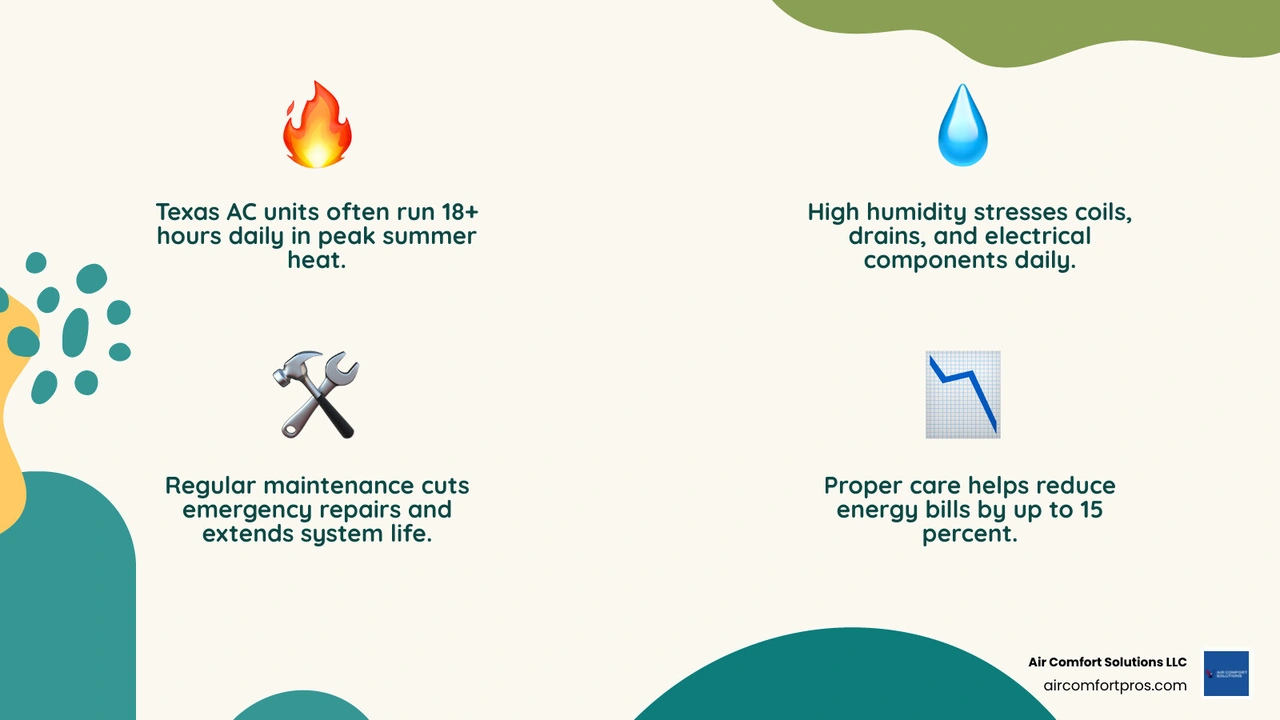
Texas AC systems can run 18 or more hours a day during peak summer. High humidity puts extra stress on drain lines, coils, and electrical components. And when your system fails in the middle of August, you are not just uncomfortable — you are looking at long wait times, emergency repair costs, and the very real risk of heat becoming a health issue inside your own home.
A maintenance plan is designed to get ahead of those problems before they happen. Think of it the way most people think about oil changes for a car. You do not wait for the engine to fail. You service it on schedule so it keeps running.
Here is a quick look at whether a plan makes sense for your situation:
• Run your AC heavily through long Texas summers — Is a Maintenance Plan Worth It?: Almost certainly yes
• System is more than 5 years old — Is a Maintenance Plan Worth It?: Yes — parts wear faster in hot climates
• Want to keep your manufacturer's warranty valid — Is a Maintenance Plan Worth It?: Yes — most require documented annual service
• New system, light usage, mild habits — Is a Maintenance Plan Worth It?: Still beneficial, though one-time tune-ups may suffice
• Older system (10+ years) — Is a Maintenance Plan Worth It?: Strongly recommended — predictive care prevents emergencies
The sections below break down exactly what these plans include, what they cost you in risk if you skip them, and how to find the right provider in Pinehurst, TX.
Is an AC Maintenance Plan Worth It in Texas?
In Pinehurst, Magnolia, Tomball, Montgomery, Conroe, Spring, The Woodlands, Houston, Plantersville, and nearby areas on the north side of Harris County, air conditioning is not a luxury item. It is basic survival with a thermostat.
That is why the short answer to is an AC maintenance plan worth it in Texas is usually yes. Our local climate creates a perfect storm for HVAC wear:
• Long cooling seasons
• High humidity
• Heavy pollen and dust
• More condensate production
• Long daily runtime in summer
• Sudden weather swings that still require heating checks in cooler months
Research consistently shows that regular HVAC maintenance can improve efficiency by up to 15%, reduce breakdown risk by around 40%, and help systems last closer to 15 to 20 years instead of failing much earlier from neglect. In Texas, those differences matter more because systems simply do more work.
Why is an AC maintenance plan worth it in Texas for most homeowners?
For most homeowners here, a maintenance plan is worth it because it helps with the three things people care about most:
1. Avoiding breakdowns during extreme heat
2. Keeping energy bills from creeping higher
3. Getting more life out of the equipment they already own
A plan also adds something people sometimes overlook until the worst possible moment: convenience. Many plans include reminders, scheduled seasonal visits, and priority service when demand spikes. In other words, you are less likely to be at the back of the line when everybody else's AC gives up on the same 100-degree day.
If your AC runs hard all summer, a plan is less about "extra service" and more about basic protection.
When is an AC maintenance plan worth it in Texas less often?
There are a few situations where a full maintenance plan may be less essential:
• You have a brand-new system and follow the manufacturer's service schedule closely
• The home is a vacation property with limited occupancy
• Your usage is unusually light for this area
• You reliably schedule one-time professional tune-ups without fail
Even then, most Texas homeowners still benefit from ongoing maintenance because our climate is not mild. A neglected system here can go from "working fine" to "blowing warm air on a Saturday afternoon" with impressive speed. Not the kind of Texas speed we enjoy.
What an AC Maintenance Plan Includes and How Often to Schedule Service
A good plan is more than a quick glance at your outdoor unit. It should be structured, thorough, and focused on both performance and prevention.
If you want a deeper look at the visit itself, see What Does an HVAC Maintenance Plan Include and this AC Maintenance Visit Complete Guide.
What is an AC maintenance plan and what does it typically include?
An AC maintenance plan is a scheduled preventative service program designed to keep your system operating safely and efficiently throughout the year. In Texas, these plans often include two visits annually: one focused on cooling season prep and one focused on heating season prep.
Typical maintenance tasks include:
• Checking and replacing or recommending air filter service
• Testing thermostat operation and calibration
• Inspecting electrical connections
• Testing capacitors and contactors
• Measuring refrigerant levels and checking for leaks
• Cleaning condenser coils
• Inspecting evaporator coil condition
• Flushing or clearing condensate drain lines
• Checking blower components
• Measuring airflow
• Inspecting duct performance and visible issues
• Verifying safety controls
• Looking for early signs of wear on motors and other moving parts
This matters because many serious failures start as small, quiet problems. A weak capacitor, dirty coil, or partially clogged drain line does not always announce itself dramatically. It just waits until your house is hottest.
How often should homeowners in Texas schedule AC maintenance?
In our area, twice-yearly service is the best standard for most homes:
• Spring: cooling inspection and tune-up before peak summer heat
• Fall: heating inspection and seasonal performance check
That schedule matches the heavy workload Texas systems face. One visit a year is better than nothing, but two visits are usually the smarter plan here because your system does not get much of an off-season.
For more detail, read How Often Should You Service Your AC in Texas.
The Biggest Benefits of Regular AC Maintenance in Pinehurst and Across Texas
The value of regular maintenance is not just one thing. It is a mix of lower operating costs, fewer surprise repairs, steadier comfort, and longer equipment life.
• Scheduled service before peak seasons — Pay-As-Needed Approach: Often reactive after a problem appears
• Better maintenance records — Pay-As-Needed Approach: Easier to forget documentation
• Small issues found earlier — Pay-As-Needed Approach: Problems may grow unnoticed
• Lower chance of peak-season breakdowns — Pay-As-Needed Approach: Greater risk of emergency calls
• Better consistency in efficiency — Pay-As-Needed Approach: Performance often slips over time
• Priority service is often included — Pay-As-Needed Approach: Longer waits are more common in summer
How regular maintenance helps AC systems last longer
Your AC wears out faster when it has to fight through dirt, airflow restrictions, electrical strain, or incorrect refrigerant levels. Maintenance reduces that strain.
For example:
• Clean coils help transfer heat properly
• Proper airflow keeps the blower and evaporator from overworking
• Refrigerant checks prevent cooling problems and compressor stress
• Electrical testing catches weak components before they damage others
• Drain line service prevents moisture-related shutdowns and water problems
Research in the HVAC industry consistently points to maintained systems lasting significantly longer. A well-maintained system may last 15 to 20 years, while neglected systems often fail much sooner, sometimes in the 8 to 12 year range.
In Texas, where runtime is so high, preventing extra wear is a big deal. Even a small performance issue can turn into months of unnecessary strain because your AC is running so often.
Can an AC maintenance plan help lower energy bills in Texas?
Yes, often noticeably.
Dirty coils and poor maintenance can reduce efficiency by 10% to 25%. That means your system uses more energy to do the same job. In a hot, humid area like Pinehurst, that extra effort shows up quickly on the power bill.
Maintenance helps lower energy use by:
• Cleaning heat-transfer surfaces
• Restoring proper airflow
• Confirming thermostat accuracy
• Catching duct or airflow issues
• Identifying refrigerant problems
• Reducing overcycling and long run times caused by minor faults
Well-maintained systems can save up to 15% on energy bills according to the research gathered for this topic. That does not mean every home gets exactly the same result, but it does show why maintenance often pays off in a Texas cooling season.
Does an AC maintenance plan protect your manufacturer’s warranty?
It can help in a very practical way: documentation.
Many manufacturers require regular professional maintenance to keep warranty coverage valid. The exact terms vary by brand and model, so homeowners should always read their warranty documents. But documented service history is often important if a major part fails and a claim is filed.
A maintenance plan makes this easier because it creates a routine record of professional service. That is especially valuable for newer systems. Nobody wants to discover that a parts claim got complicated because maintenance was skipped or never documented.
Common Texas AC Problems a Maintenance Plan Can Help Prevent
Texas heat and humidity create some very specific AC problems, especially in Southeast Texas and the north side of Harris County. If you want a broader look at what neglect can lead to, see What Happens If You Skip AC Maintenance in Texas, How Southeast Texas Climate Affects Your HVAC System, and Why Do AC Units Wear Out Faster in Hot Climates.
What common AC problems can be prevented with regular maintenance in Texas?
Regular maintenance can help prevent or catch early signs of:
• Warm air caused by low refrigerant or airflow problems
• Frozen evaporator coils
• Dirty condenser coils reducing cooling performance
• Clogged condensate drains from algae and debris
• Weak airflow from blower, duct, or filter issues
• Capacitor and contactor wear
• Short cycling
• Water leaks and moisture damage near the air handler
• Thermostat miscalibration
• Excessive system strain that leads to compressor damage
More than 80% of emergency AC calls are tied to issues that routine maintenance can often reduce or prevent, according to research summarized for Texas HVAC content. That does not mean maintenance stops every possible repair, but it absolutely improves the odds.
How Texas heat and humidity change AC maintenance needs
Our local climate increases maintenance needs in ways homeowners can actually see:
• Humidity means more condensate, which raises the chance of drain line clogs
• Long runtime means faster wear on electrical parts
• Dirt, pollen, and grass debris collect on outdoor coils
• Moisture can contribute to corrosion over time
• Storm season can leave outdoor units dirty or obstructed
• Extended cooling months mean systems have less downtime
In practical terms, Texas AC systems work harder and longer than systems in many milder climates. Some homes here may see over 2,500 hours of annual cooling runtime. That is why "I'll just wait until something seems wrong" is not a great strategy.
DIY vs Professional Service and How to Choose the Right Plan Provider
Homeowners absolutely have an important role in AC care. But DIY maintenance and professional maintenance are not the same thing. They work best together.
For a local perspective on service and trust, here is a helpful read on the Benefits of Choosing a Local Family-Owned HVAC Company.
What homeowners can do themselves between maintenance visits
There is plenty you can do to help your system between tune-ups:
• Change filters regularly, often every 1 to 3 months depending on pets, dust, and allergies
• Keep supply and return vents open and unblocked
• Trim vegetation around the outdoor unit and keep at least a couple of feet of clearance
• Clear leaves, grass, and debris from around the condenser
• Watch for visible ice on refrigerant lines or the indoor coil area
• Listen for unusual buzzing, rattling, or grinding
• Monitor for weak airflow or rooms that suddenly stop cooling well
• Keep an eye on the thermostat and utility bills for unusual changes
These steps help, and they matter. A clogged filter alone can create airflow problems that strain the whole system.
What professional AC service catches that DIY usually misses
This is the part where professional maintenance earns its keep.
A trained technician can spot issues that are difficult or unsafe for homeowners to diagnose, such as:
• Refrigerant leaks
• Capacitor weakness before failure
• Contactor wear
• Electrical connection problems
• Improper amp draw
• Thermostat calibration issues
• Early blower or motor stress
• Coil conditions that are not obvious from the outside
• Hidden airflow restrictions
• Drain line issues that need a full flush or clearing
Refrigerant work and electrical testing are not good DIY experiments. Your AC should cool the house, not become a science fair project in your attic.
What should homeowners look for when choosing an AC maintenance plan provider in Texas?
Not every maintenance plan is equal. Homeowners should look for:
• Clear written details about what each visit includes
• Professional maintenance records
• Seasonal scheduling and reminders
• Technicians experienced with Texas climate demands
• Honest communication and upfront recommendations
• Priority service options during peak weather
• A company that checks the full system, not just the thermostat and a clipboard
At Air Comfort Solutions LLC, we focus on honest service, clear communication, and thorough maintenance for homeowners in Pinehurst and surrounding communities. With more than 35 years of experience, certified technicians, upfront pricing, and flexible financing for larger HVAC needs, we aim to make preventive care simple instead of stressful.
Frequently Asked Questions About Is an AC Maintenance Plan Worth It in Texas?
Is an AC maintenance plan worth it in Texas for a new AC system?
Yes, usually.
A newer system may not need repairs right away, but that does not mean it should be ignored. Maintenance helps keep it operating close to factory specs, supports efficiency, and provides the service records many manufacturers expect for warranty protection.
It is a little like buying a new truck and then never changing the oil because it is still shiny. The shine is not the issue.
Is an AC maintenance plan worth it in Texas for an older AC system?
Absolutely, and often even more so.
Older systems have more wear on motors, capacitors, contactors, coils, and other components. They are also less forgiving when small issues go unchecked. Regular maintenance can help catch problems before they become major failures and may help delay replacement by keeping the system operating as smoothly as possible.
If your system is more than 10 years old and still carrying your home through long Texas summers, maintenance is usually a very wise move.
Is one annual visit enough in Texas, or do I really need two?
For most homes in our service area, two visits a year are best.
One annual visit is certainly better than skipping maintenance, but Texas systems face heavier demand than systems in cooler climates. A spring cooling tune-up prepares the AC for the hardest part of the year, while a fall visit checks heating performance and helps catch issues after the long cooling season.
So, do you really need two? In many Pinehurst-area homes, yes. Especially if your equipment runs heavily, your home has indoor air quality concerns, or your system is older.
Conclusion
For most homeowners in Pinehurst and across the north side of Harris County, an AC maintenance plan is worth it because it helps prevent breakdowns, supports lower energy use, extends system life, and keeps your comfort more reliable during a very long Texas cooling season.
It is not magic, and it does not guarantee that no repair will ever happen. What it does do is put the odds back in your favor.
If you want to stay ahead of summer problems, we recommend reading Preparing Your Home's Cooling System for a Smooth Summer, How to Make Sure Your AC Survives a Texas Summer, and Is an HVAC Maintenance Plan Worth It.
And if you are ready to make maintenance one less thing to worry about, you can get more information about our maintenance services.
At Air Comfort Solutions LLC, we help homeowners in Pinehurst and nearby communities protect their comfort with dependable HVAC maintenance, experienced service, and practical recommendations that fit real Texas homes.
Why Texas Homeowners in Pinehurst Are Asking If an AC Maintenance Plan Is Worth It
Is an AC maintenance plan worth it in Texas? For most homeowners in Pinehurst and across North Harris County, the answer is yes — and the reasons come down to how hard your system actually works here compared to almost anywhere else in the country.
Texas AC systems can run 18 or more hours a day during peak summer. High humidity puts extra stress on drain lines, coils, and electrical components. And when your system fails in the middle of August, you are not just uncomfortable — you are looking at long wait times, emergency repair costs, and the very real risk of heat becoming a health issue inside your own home.
A maintenance plan is designed to get ahead of those problems before they happen. Think of it the way most people think about oil changes for a car. You do not wait for the engine to fail. You service it on schedule so it keeps running.
Here is a quick look at whether a plan makes sense for your situation:
| Your Situation | Is a Maintenance Plan Worth It? |
|---|
| Run your AC heavily through long Texas summers | Almost certainly yes |
| System is more than 5 years old | Yes — parts wear faster in hot climates |
| Want to keep your manufacturer's warranty valid | Yes — most require documented annual service |
| New system, light usage, mild habits | Still beneficial, though one-time tune-ups may suffice |
| Older system (10+ years) | Strongly recommended — predictive care prevents emergencies |
The sections below break down exactly what these plans include, what they cost you in risk if you skip them, and how to find the right provider in Pinehurst, TX.
Is an AC Maintenance Plan Worth It in Texas?
In Pinehurst, Magnolia, Tomball, Montgomery, Conroe, Spring, The Woodlands, Houston, Plantersville, and nearby areas on the north side of Harris County, air conditioning is not a luxury item. It is basic survival with a thermostat.
That is why the short answer to is an AC maintenance plan worth it in Texas is usually yes. Our local climate creates a perfect storm for HVAC wear:
- Long cooling seasons
- High humidity
- Heavy pollen and dust
- More condensate production
- Long daily runtime in summer
- Sudden weather swings that still require heating checks in cooler months
Research consistently shows that regular HVAC maintenance can improve efficiency by up to 15%, reduce breakdown risk by around 40%, and help systems last closer to 15 to 20 years instead of failing much earlier from neglect. In Texas, those differences matter more because systems simply do more work.
Why is an AC maintenance plan worth it in Texas for most homeowners?
For most homeowners here, a maintenance plan is worth it because it helps with the three things people care about most:
- Avoiding breakdowns during extreme heat
- Keeping energy bills from creeping higher
- Getting more life out of the equipment they already own
A plan also adds something people sometimes overlook until the worst possible moment: convenience. Many plans include reminders, scheduled seasonal visits, and priority service when demand spikes. In other words, you are less likely to be at the back of the line when everybody else's AC gives up on the same 100-degree day.
If your AC runs hard all summer, a plan is less about "extra service" and more about basic protection.
When is an AC maintenance plan worth it in Texas less often?
There are a few situations where a full maintenance plan may be less essential:
- You have a brand-new system and follow the manufacturer's service schedule closely
- The home is a vacation property with limited occupancy
- Your usage is unusually light for this area
- You reliably schedule one-time professional tune-ups without fail
Even then, most Texas homeowners still benefit from ongoing maintenance because our climate is not mild. A neglected system here can go from "working fine" to "blowing warm air on a Saturday afternoon" with impressive speed. Not the kind of Texas speed we enjoy.
What an AC Maintenance Plan Includes and How Often to Schedule Service
A good plan is more than a quick glance at your outdoor unit. It should be structured, thorough, and focused on both performance and prevention.
If you want a deeper look at the visit itself, see What Does an HVAC Maintenance Plan Include and this AC Maintenance Visit Complete Guide.
What is an AC maintenance plan and what does it typically include?
An AC maintenance plan is a scheduled preventative service program designed to keep your system operating safely and efficiently throughout the year. In Texas, these plans often include two visits annually: one focused on cooling season prep and one focused on heating season prep.
Typical maintenance tasks include:
- Checking and replacing or recommending air filter service
- Testing thermostat operation and calibration
- Inspecting electrical connections
- Testing capacitors and contactors
- Measuring refrigerant levels and checking for leaks
- Cleaning condenser coils
- Inspecting evaporator coil condition
- Flushing or clearing condensate drain lines
- Checking blower components
- Measuring airflow
- Inspecting duct performance and visible issues
- Verifying safety controls
- Looking for early signs of wear on motors and other moving parts
This matters because many serious failures start as small, quiet problems. A weak capacitor, dirty coil, or partially clogged drain line does not always announce itself dramatically. It just waits until your house is hottest.
How often should homeowners in Texas schedule AC maintenance?
In our area, twice-yearly service is the best standard for most homes:
- Spring: cooling inspection and tune-up before peak summer heat
- Fall: heating inspection and seasonal performance check
That schedule matches the heavy workload Texas systems face. One visit a year is better than nothing, but two visits are usually the smarter plan here because your system does not get much of an off-season.
For more detail, read How Often Should You Service Your AC in Texas.
The Biggest Benefits of Regular AC Maintenance in Pinehurst and Across Texas
The value of regular maintenance is not just one thing. It is a mix of lower operating costs, fewer surprise repairs, steadier comfort, and longer equipment life.
| Maintenance Plan | Pay-As-Needed Approach |
|---|
| Scheduled service before peak seasons | Often reactive after a problem appears |
| Better maintenance records | Easier to forget documentation |
| Small issues found earlier | Problems may grow unnoticed |
| Lower chance of peak-season breakdowns | Greater risk of emergency calls |
| Better consistency in efficiency | Performance often slips over time |
| Priority service is often included | Longer waits are more common in summer |
How regular maintenance helps AC systems last longer
Your AC wears out faster when it has to fight through dirt, airflow restrictions, electrical strain, or incorrect refrigerant levels. Maintenance reduces that strain.
For example:
- Clean coils help transfer heat properly
- Proper airflow keeps the blower and evaporator from overworking
- Refrigerant checks prevent cooling problems and compressor stress
- Electrical testing catches weak components before they damage others
- Drain line service prevents moisture-related shutdowns and water problems
Research in the HVAC industry consistently points to maintained systems lasting significantly longer. A well-maintained system may last 15 to 20 years, while neglected systems often fail much sooner, sometimes in the 8 to 12 year range.
In Texas, where runtime is so high, preventing extra wear is a big deal. Even a small performance issue can turn into months of unnecessary strain because your AC is running so often.
Can an AC maintenance plan help lower energy bills in Texas?
Yes, often noticeably.
Dirty coils and poor maintenance can reduce efficiency by 10% to 25%. That means your system uses more energy to do the same job. In a hot, humid area like Pinehurst, that extra effort shows up quickly on the power bill.
Maintenance helps lower energy use by:
- Cleaning heat-transfer surfaces
- Restoring proper airflow
- Confirming thermostat accuracy
- Catching duct or airflow issues
- Identifying refrigerant problems
- Reducing overcycling and long run times caused by minor faults
Well-maintained systems can save up to 15% on energy bills according to the research gathered for this topic. That does not mean every home gets exactly the same result, but it does show why maintenance often pays off in a Texas cooling season.
Does an AC maintenance plan protect your manufacturer’s warranty?
It can help in a very practical way: documentation.
Many manufacturers require regular professional maintenance to keep warranty coverage valid. The exact terms vary by brand and model, so homeowners should always read their warranty documents. But documented service history is often important if a major part fails and a claim is filed.
A maintenance plan makes this easier because it creates a routine record of professional service. That is especially valuable for newer systems. Nobody wants to discover that a parts claim got complicated because maintenance was skipped or never documented.
Common Texas AC Problems a Maintenance Plan Can Help Prevent
Texas heat and humidity create some very specific AC problems, especially in Southeast Texas and the north side of Harris County. If you want a broader look at what neglect can lead to, see What Happens If You Skip AC Maintenance in Texas, How Southeast Texas Climate Affects Your HVAC System, and Why Do AC Units Wear Out Faster in Hot Climates.
What common AC problems can be prevented with regular maintenance in Texas?
Regular maintenance can help prevent or catch early signs of:
- Warm air caused by low refrigerant or airflow problems
- Frozen evaporator coils
- Dirty condenser coils reducing cooling performance
- Clogged condensate drains from algae and debris
- Weak airflow from blower, duct, or filter issues
- Capacitor and contactor wear
- Short cycling
- Water leaks and moisture damage near the air handler
- Thermostat miscalibration
- Excessive system strain that leads to compressor damage
More than 80% of emergency AC calls are tied to issues that routine maintenance can often reduce or prevent, according to research summarized for Texas HVAC content. That does not mean maintenance stops every possible repair, but it absolutely improves the odds.
How Texas heat and humidity change AC maintenance needs
Our local climate increases maintenance needs in ways homeowners can actually see:
- Humidity means more condensate, which raises the chance of drain line clogs
- Long runtime means faster wear on electrical parts
- Dirt, pollen, and grass debris collect on outdoor coils
- Moisture can contribute to corrosion over time
- Storm season can leave outdoor units dirty or obstructed
- Extended cooling months mean systems have less downtime
In practical terms, Texas AC systems work harder and longer than systems in many milder climates. Some homes here may see over 2,500 hours of annual cooling runtime. That is why "I'll just wait until something seems wrong" is not a great strategy.
DIY vs Professional Service and How to Choose the Right Plan Provider
Homeowners absolutely have an important role in AC care. But DIY maintenance and professional maintenance are not the same thing. They work best together.
For a local perspective on service and trust, here is a helpful read on the Benefits of Choosing a Local Family-Owned HVAC Company.
What homeowners can do themselves between maintenance visits
There is plenty you can do to help your system between tune-ups:
- Change filters regularly, often every 1 to 3 months depending on pets, dust, and allergies
- Keep supply and return vents open and unblocked
- Trim vegetation around the outdoor unit and keep at least a couple of feet of clearance
- Clear leaves, grass, and debris from around the condenser
- Watch for visible ice on refrigerant lines or the indoor coil area
- Listen for unusual buzzing, rattling, or grinding
- Monitor for weak airflow or rooms that suddenly stop cooling well
- Keep an eye on the thermostat and utility bills for unusual changes
These steps help, and they matter. A clogged filter alone can create airflow problems that strain the whole system.
What professional AC service catches that DIY usually misses
This is the part where professional maintenance earns its keep.
A trained technician can spot issues that are difficult or unsafe for homeowners to diagnose, such as:
- Refrigerant leaks
- Capacitor weakness before failure
- Contactor wear
- Electrical connection problems
- Improper amp draw
- Thermostat calibration issues
- Early blower or motor stress
- Coil conditions that are not obvious from the outside
- Hidden airflow restrictions
- Drain line issues that need a full flush or clearing
Refrigerant work and electrical testing are not good DIY experiments. Your AC should cool the house, not become a science fair project in your attic.
What should homeowners look for when choosing an AC maintenance plan provider in Texas?
Not every maintenance plan is equal. Homeowners should look for:
- Clear written details about what each visit includes
- Professional maintenance records
- Seasonal scheduling and reminders
- Technicians experienced with Texas climate demands
- Honest communication and upfront recommendations
- Priority service options during peak weather
- A company that checks the full system, not just the thermostat and a clipboard
At Air Comfort Solutions LLC, we focus on honest service, clear communication, and thorough maintenance for homeowners in Pinehurst and surrounding communities. With more than 35 years of experience, certified technicians, upfront pricing, and flexible financing for larger HVAC needs, we aim to make preventive care simple instead of stressful.
Frequently Asked Questions About Is an AC Maintenance Plan Worth It in Texas?
Is an AC maintenance plan worth it in Texas for a new AC system?
Yes, usually.
A newer system may not need repairs right away, but that does not mean it should be ignored. Maintenance helps keep it operating close to factory specs, supports efficiency, and provides the service records many manufacturers expect for warranty protection.
It is a little like buying a new truck and then never changing the oil because it is still shiny. The shine is not the issue.
Is an AC maintenance plan worth it in Texas for an older AC system?
Absolutely, and often even more so.
Older systems have more wear on motors, capacitors, contactors, coils, and other components. They are also less forgiving when small issues go unchecked. Regular maintenance can help catch problems before they become major failures and may help delay replacement by keeping the system operating as smoothly as possible.
If your system is more than 10 years old and still carrying your home through long Texas summers, maintenance is usually a very wise move.
Is one annual visit enough in Texas, or do I really need two?
For most homes in our service area, two visits a year are best.
One annual visit is certainly better than skipping maintenance, but Texas systems face heavier demand than systems in cooler climates. A spring cooling tune-up prepares the AC for the hardest part of the year, while a fall visit checks heating performance and helps catch issues after the long cooling season.
So, do you really need two? In many Pinehurst-area homes, yes. Especially if your equipment runs heavily, your home has indoor air quality concerns, or your system is older.
Conclusion
For most homeowners in Pinehurst and across the north side of Harris County, an AC maintenance plan is worth it because it helps prevent breakdowns, supports lower energy use, extends system life, and keeps your comfort more reliable during a very long Texas cooling season.
It is not magic, and it does not guarantee that no repair will ever happen. What it does do is put the odds back in your favor.
If you want to stay ahead of summer problems, we recommend reading Preparing Your Home's Cooling System for a Smooth Summer, How to Make Sure Your AC Survives a Texas Summer, and Is an HVAC Maintenance Plan Worth It.
And if you are ready to make maintenance one less thing to worry about, you can get more information about our maintenance services.
At Air Comfort Solutions LLC, we help homeowners in Pinehurst and nearby communities protect their comfort with dependable HVAC maintenance, experienced service, and practical recommendations that fit real Texas homes.
Why Texas Homeowners in Pinehurst Are Asking If an AC Maintenance Plan Is Worth It
Is an AC maintenance plan worth it in Texas? For most homeowners in Pinehurst and across North Harris County, the answer is yes — and the reasons come down to how hard your system actually works here compared to almost anywhere else in the country.
Texas AC systems can run 18 or more hours a day during peak summer. High humidity puts extra stress on drain lines, coils, and electrical components. And when your system fails in the middle of August, you are not just uncomfortable — you are looking at long wait times, emergency repair costs, and the very real risk of heat becoming a health issue inside your own home.
A maintenance plan is designed to get ahead of those problems before they happen. Think of it the way most people think about oil changes for a car. You do not wait for the engine to fail. You service it on schedule so it keeps running.
Here is a quick look at whether a plan makes sense for your situation:
| Your Situation | Is a Maintenance Plan Worth It? |
|---|
| Run your AC heavily through long Texas summers | Almost certainly yes |
| System is more than 5 years old | Yes — parts wear faster in hot climates |
| Want to keep your manufacturer's warranty valid | Yes — most require documented annual service |
| New system, light usage, mild habits | Still beneficial, though one-time tune-ups may suffice |
| Older system (10+ years) | Strongly recommended — predictive care prevents emergencies |
The sections below break down exactly what these plans include, what they cost you in risk if you skip them, and how to find the right provider in Pinehurst, TX.
Is an AC Maintenance Plan Worth It in Texas?
In Pinehurst, Magnolia, Tomball, Montgomery, Conroe, Spring, The Woodlands, Houston, Plantersville, and nearby areas on the north side of Harris County, air conditioning is not a luxury item. It is basic survival with a thermostat.
That is why the short answer to is an AC maintenance plan worth it in Texas is usually yes. Our local climate creates a perfect storm for HVAC wear:
- Long cooling seasons
- High humidity
- Heavy pollen and dust
- More condensate production
- Long daily runtime in summer
- Sudden weather swings that still require heating checks in cooler months
Research consistently shows that regular HVAC maintenance can improve efficiency by up to 15%, reduce breakdown risk by around 40%, and help systems last closer to 15 to 20 years instead of failing much earlier from neglect. In Texas, those differences matter more because systems simply do more work.
Why is an AC maintenance plan worth it in Texas for most homeowners?
For most homeowners here, a maintenance plan is worth it because it helps with the three things people care about most:
- Avoiding breakdowns during extreme heat
- Keeping energy bills from creeping higher
- Getting more life out of the equipment they already own
A plan also adds something people sometimes overlook until the worst possible moment: convenience. Many plans include reminders, scheduled seasonal visits, and priority service when demand spikes. In other words, you are less likely to be at the back of the line when everybody else's AC gives up on the same 100-degree day.
If your AC runs hard all summer, a plan is less about "extra service" and more about basic protection.
When is an AC maintenance plan worth it in Texas less often?
There are a few situations where a full maintenance plan may be less essential:
- You have a brand-new system and follow the manufacturer's service schedule closely
- The home is a vacation property with limited occupancy
- Your usage is unusually light for this area
- You reliably schedule one-time professional tune-ups without fail
Even then, most Texas homeowners still benefit from ongoing maintenance because our climate is not mild. A neglected system here can go from "working fine" to "blowing warm air on a Saturday afternoon" with impressive speed. Not the kind of Texas speed we enjoy.
What an AC Maintenance Plan Includes and How Often to Schedule Service
A good plan is more than a quick glance at your outdoor unit. It should be structured, thorough, and focused on both performance and prevention.
If you want a deeper look at the visit itself, see What Does an HVAC Maintenance Plan Include and this AC Maintenance Visit Complete Guide.
What is an AC maintenance plan and what does it typically include?
An AC maintenance plan is a scheduled preventative service program designed to keep your system operating safely and efficiently throughout the year. In Texas, these plans often include two visits annually: one focused on cooling season prep and one focused on heating season prep.
Typical maintenance tasks include:
- Checking and replacing or recommending air filter service
- Testing thermostat operation and calibration
- Inspecting electrical connections
- Testing capacitors and contactors
- Measuring refrigerant levels and checking for leaks
- Cleaning condenser coils
- Inspecting evaporator coil condition
- Flushing or clearing condensate drain lines
- Checking blower components
- Measuring airflow
- Inspecting duct performance and visible issues
- Verifying safety controls
- Looking for early signs of wear on motors and other moving parts
This matters because many serious failures start as small, quiet problems. A weak capacitor, dirty coil, or partially clogged drain line does not always announce itself dramatically. It just waits until your house is hottest.
How often should homeowners in Texas schedule AC maintenance?
In our area, twice-yearly service is the best standard for most homes:
- Spring: cooling inspection and tune-up before peak summer heat
- Fall: heating inspection and seasonal performance check
That schedule matches the heavy workload Texas systems face. One visit a year is better than nothing, but two visits are usually the smarter plan here because your system does not get much of an off-season.
For more detail, read How Often Should You Service Your AC in Texas.
The Biggest Benefits of Regular AC Maintenance in Pinehurst and Across Texas
The value of regular maintenance is not just one thing. It is a mix of lower operating costs, fewer surprise repairs, steadier comfort, and longer equipment life.
| Maintenance Plan | Pay-As-Needed Approach |
|---|
| Scheduled service before peak seasons | Often reactive after a problem appears |
| Better maintenance records | Easier to forget documentation |
| Small issues found earlier | Problems may grow unnoticed |
| Lower chance of peak-season breakdowns | Greater risk of emergency calls |
| Better consistency in efficiency | Performance often slips over time |
| Priority service is often included | Longer waits are more common in summer |
How regular maintenance helps AC systems last longer
Your AC wears out faster when it has to fight through dirt, airflow restrictions, electrical strain, or incorrect refrigerant levels. Maintenance reduces that strain.
For example:
- Clean coils help transfer heat properly
- Proper airflow keeps the blower and evaporator from overworking
- Refrigerant checks prevent cooling problems and compressor stress
- Electrical testing catches weak components before they damage others
- Drain line service prevents moisture-related shutdowns and water problems
Research in the HVAC industry consistently points to maintained systems lasting significantly longer. A well-maintained system may last 15 to 20 years, while neglected systems often fail much sooner, sometimes in the 8 to 12 year range.
In Texas, where runtime is so high, preventing extra wear is a big deal. Even a small performance issue can turn into months of unnecessary strain because your AC is running so often.
Can an AC maintenance plan help lower energy bills in Texas?
Yes, often noticeably.
Dirty coils and poor maintenance can reduce efficiency by 10% to 25%. That means your system uses more energy to do the same job. In a hot, humid area like Pinehurst, that extra effort shows up quickly on the power bill.
Maintenance helps lower energy use by:
- Cleaning heat-transfer surfaces
- Restoring proper airflow
- Confirming thermostat accuracy
- Catching duct or airflow issues
- Identifying refrigerant problems
- Reducing overcycling and long run times caused by minor faults
Well-maintained systems can save up to 15% on energy bills according to the research gathered for this topic. That does not mean every home gets exactly the same result, but it does show why maintenance often pays off in a Texas cooling season.
Does an AC maintenance plan protect your manufacturer’s warranty?
It can help in a very practical way: documentation.
Many manufacturers require regular professional maintenance to keep warranty coverage valid. The exact terms vary by brand and model, so homeowners should always read their warranty documents. But documented service history is often important if a major part fails and a claim is filed.
A maintenance plan makes this easier because it creates a routine record of professional service. That is especially valuable for newer systems. Nobody wants to discover that a parts claim got complicated because maintenance was skipped or never documented.
Common Texas AC Problems a Maintenance Plan Can Help Prevent
Texas heat and humidity create some very specific AC problems, especially in Southeast Texas and the north side of Harris County. If you want a broader look at what neglect can lead to, see What Happens If You Skip AC Maintenance in Texas, How Southeast Texas Climate Affects Your HVAC System, and Why Do AC Units Wear Out Faster in Hot Climates.
What common AC problems can be prevented with regular maintenance in Texas?
Regular maintenance can help prevent or catch early signs of:
- Warm air caused by low refrigerant or airflow problems
- Frozen evaporator coils
- Dirty condenser coils reducing cooling performance
- Clogged condensate drains from algae and debris
- Weak airflow from blower, duct, or filter issues
- Capacitor and contactor wear
- Short cycling
- Water leaks and moisture damage near the air handler
- Thermostat miscalibration
- Excessive system strain that leads to compressor damage
More than 80% of emergency AC calls are tied to issues that routine maintenance can often reduce or prevent, according to research summarized for Texas HVAC content. That does not mean maintenance stops every possible repair, but it absolutely improves the odds.
How Texas heat and humidity change AC maintenance needs
Our local climate increases maintenance needs in ways homeowners can actually see:
- Humidity means more condensate, which raises the chance of drain line clogs
- Long runtime means faster wear on electrical parts
- Dirt, pollen, and grass debris collect on outdoor coils
- Moisture can contribute to corrosion over time
- Storm season can leave outdoor units dirty or obstructed
- Extended cooling months mean systems have less downtime
In practical terms, Texas AC systems work harder and longer than systems in many milder climates. Some homes here may see over 2,500 hours of annual cooling runtime. That is why "I'll just wait until something seems wrong" is not a great strategy.
DIY vs Professional Service and How to Choose the Right Plan Provider
Homeowners absolutely have an important role in AC care. But DIY maintenance and professional maintenance are not the same thing. They work best together.
For a local perspective on service and trust, here is a helpful read on the Benefits of Choosing a Local Family-Owned HVAC Company.
What homeowners can do themselves between maintenance visits
There is plenty you can do to help your system between tune-ups:
- Change filters regularly, often every 1 to 3 months depending on pets, dust, and allergies
- Keep supply and return vents open and unblocked
- Trim vegetation around the outdoor unit and keep at least a couple of feet of clearance
- Clear leaves, grass, and debris from around the condenser
- Watch for visible ice on refrigerant lines or the indoor coil area
- Listen for unusual buzzing, rattling, or grinding
- Monitor for weak airflow or rooms that suddenly stop cooling well
- Keep an eye on the thermostat and utility bills for unusual changes
These steps help, and they matter. A clogged filter alone can create airflow problems that strain the whole system.
What professional AC service catches that DIY usually misses
This is the part where professional maintenance earns its keep.
A trained technician can spot issues that are difficult or unsafe for homeowners to diagnose, such as:
- Refrigerant leaks
- Capacitor weakness before failure
- Contactor wear
- Electrical connection problems
- Improper amp draw
- Thermostat calibration issues
- Early blower or motor stress
- Coil conditions that are not obvious from the outside
- Hidden airflow restrictions
- Drain line issues that need a full flush or clearing
Refrigerant work and electrical testing are not good DIY experiments. Your AC should cool the house, not become a science fair project in your attic.
What should homeowners look for when choosing an AC maintenance plan provider in Texas?
Not every maintenance plan is equal. Homeowners should look for:
- Clear written details about what each visit includes
- Professional maintenance records
- Seasonal scheduling and reminders
- Technicians experienced with Texas climate demands
- Honest communication and upfront recommendations
- Priority service options during peak weather
- A company that checks the full system, not just the thermostat and a clipboard
At Air Comfort Solutions LLC, we focus on honest service, clear communication, and thorough maintenance for homeowners in Pinehurst and surrounding communities. With more than 35 years of experience, certified technicians, upfront pricing, and flexible financing for larger HVAC needs, we aim to make preventive care simple instead of stressful.
Frequently Asked Questions About Is an AC Maintenance Plan Worth It in Texas?
Is an AC maintenance plan worth it in Texas for a new AC system?
Yes, usually.
A newer system may not need repairs right away, but that does not mean it should be ignored. Maintenance helps keep it operating close to factory specs, supports efficiency, and provides the service records many manufacturers expect for warranty protection.
It is a little like buying a new truck and then never changing the oil because it is still shiny. The shine is not the issue.
Is an AC maintenance plan worth it in Texas for an older AC system?
Absolutely, and often even more so.
Older systems have more wear on motors, capacitors, contactors, coils, and other components. They are also less forgiving when small issues go unchecked. Regular maintenance can help catch problems before they become major failures and may help delay replacement by keeping the system operating as smoothly as possible.
If your system is more than 10 years old and still carrying your home through long Texas summers, maintenance is usually a very wise move.
Is one annual visit enough in Texas, or do I really need two?
For most homes in our service area, two visits a year are best.
One annual visit is certainly better than skipping maintenance, but Texas systems face heavier demand than systems in cooler climates. A spring cooling tune-up prepares the AC for the hardest part of the year, while a fall visit checks heating performance and helps catch issues after the long cooling season.
So, do you really need two? In many Pinehurst-area homes, yes. Especially if your equipment runs heavily, your home has indoor air quality concerns, or your system is older.
Conclusion
For most homeowners in Pinehurst and across the north side of Harris County, an AC maintenance plan is worth it because it helps prevent breakdowns, supports lower energy use, extends system life, and keeps your comfort more reliable during a very long Texas cooling season.
It is not magic, and it does not guarantee that no repair will ever happen. What it does do is put the odds back in your favor.
If you want to stay ahead of summer problems, we recommend reading Preparing Your Home's Cooling System for a Smooth Summer, How to Make Sure Your AC Survives a Texas Summer, and Is an HVAC Maintenance Plan Worth It.
And if you are ready to make maintenance one less thing to worry about, you can get more information about our maintenance services.
At Air Comfort Solutions LLC, we help homeowners in Pinehurst and nearby communities protect their comfort with dependable HVAC maintenance, experienced service, and practical recommendations that fit real Texas homes.
Why Texas Homeowners in Pinehurst Are Asking If an AC Maintenance Plan Is Worth It
Is an AC maintenance plan worth it in Texas? For most homeowners in Pinehurst and across North Harris County, the answer is yes — and the reasons come down to how hard your system actually works here compared to almost anywhere else in the country.
Texas AC systems can run 18 or more hours a day during peak summer. High humidity puts extra stress on drain lines, coils, and electrical components. And when your system fails in the middle of August, you are not just uncomfortable — you are looking at long wait times, emergency repair costs, and the very real risk of heat becoming a health issue inside your own home.
A maintenance plan is designed to get ahead of those problems before they happen. Think of it the way most people think about oil changes for a car. You do not wait for the engine to fail. You service it on schedule so it keeps running.
Here is a quick look at whether a plan makes sense for your situation:
| Your Situation | Is a Maintenance Plan Worth It? |
|---|
| Run your AC heavily through long Texas summers | Almost certainly yes |
| System is more than 5 years old | Yes — parts wear faster in hot climates |
| Want to keep your manufacturer's warranty valid | Yes — most require documented annual service |
| New system, light usage, mild habits | Still beneficial, though one-time tune-ups may suffice |
| Older system (10+ years) | Strongly recommended — predictive care prevents emergencies |
The sections below break down exactly what these plans include, what they cost you in risk if you skip them, and how to find the right provider in Pinehurst, TX.
Is an AC Maintenance Plan Worth It in Texas?
In Pinehurst, Magnolia, Tomball, Montgomery, Conroe, Spring, The Woodlands, Houston, Plantersville, and nearby areas on the north side of Harris County, air conditioning is not a luxury item. It is basic survival with a thermostat.
That is why the short answer to is an AC maintenance plan worth it in Texas is usually yes. Our local climate creates a perfect storm for HVAC wear:
- Long cooling seasons
- High humidity
- Heavy pollen and dust
- More condensate production
- Long daily runtime in summer
- Sudden weather swings that still require heating checks in cooler months
Research consistently shows that regular HVAC maintenance can improve efficiency by up to 15%, reduce breakdown risk by around 40%, and help systems last closer to 15 to 20 years instead of failing much earlier from neglect. In Texas, those differences matter more because systems simply do more work.
Why is an AC maintenance plan worth it in Texas for most homeowners?
For most homeowners here, a maintenance plan is worth it because it helps with the three things people care about most:
- Avoiding breakdowns during extreme heat
- Keeping energy bills from creeping higher
- Getting more life out of the equipment they already own
A plan also adds something people sometimes overlook until the worst possible moment: convenience. Many plans include reminders, scheduled seasonal visits, and priority service when demand spikes. In other words, you are less likely to be at the back of the line when everybody else's AC gives up on the same 100-degree day.
If your AC runs hard all summer, a plan is less about "extra service" and more about basic protection.
When is an AC maintenance plan worth it in Texas less often?
There are a few situations where a full maintenance plan may be less essential:
- You have a brand-new system and follow the manufacturer's service schedule closely
- The home is a vacation property with limited occupancy
- Your usage is unusually light for this area
- You reliably schedule one-time professional tune-ups without fail
Even then, most Texas homeowners still benefit from ongoing maintenance because our climate is not mild. A neglected system here can go from "working fine" to "blowing warm air on a Saturday afternoon" with impressive speed. Not the kind of Texas speed we enjoy.
What an AC Maintenance Plan Includes and How Often to Schedule Service
A good plan is more than a quick glance at your outdoor unit. It should be structured, thorough, and focused on both performance and prevention.
If you want a deeper look at the visit itself, see What Does an HVAC Maintenance Plan Include and this AC Maintenance Visit Complete Guide.
What is an AC maintenance plan and what does it typically include?
An AC maintenance plan is a scheduled preventative service program designed to keep your system operating safely and efficiently throughout the year. In Texas, these plans often include two visits annually: one focused on cooling season prep and one focused on heating season prep.
Typical maintenance tasks include:
- Checking and replacing or recommending air filter service
- Testing thermostat operation and calibration
- Inspecting electrical connections
- Testing capacitors and contactors
- Measuring refrigerant levels and checking for leaks
- Cleaning condenser coils
- Inspecting evaporator coil condition
- Flushing or clearing condensate drain lines
- Checking blower components
- Measuring airflow
- Inspecting duct performance and visible issues
- Verifying safety controls
- Looking for early signs of wear on motors and other moving parts
This matters because many serious failures start as small, quiet problems. A weak capacitor, dirty coil, or partially clogged drain line does not always announce itself dramatically. It just waits until your house is hottest.
How often should homeowners in Texas schedule AC maintenance?
In our area, twice-yearly service is the best standard for most homes:
- Spring: cooling inspection and tune-up before peak summer heat
- Fall: heating inspection and seasonal performance check
That schedule matches the heavy workload Texas systems face. One visit a year is better than nothing, but two visits are usually the smarter plan here because your system does not get much of an off-season.
For more detail, read How Often Should You Service Your AC in Texas.
The Biggest Benefits of Regular AC Maintenance in Pinehurst and Across Texas
The value of regular maintenance is not just one thing. It is a mix of lower operating costs, fewer surprise repairs, steadier comfort, and longer equipment life.
| Maintenance Plan | Pay-As-Needed Approach |
|---|
| Scheduled service before peak seasons | Often reactive after a problem appears |
| Better maintenance records | Easier to forget documentation |
| Small issues found earlier | Problems may grow unnoticed |
| Lower chance of peak-season breakdowns | Greater risk of emergency calls |
| Better consistency in efficiency | Performance often slips over time |
| Priority service is often included | Longer waits are more common in summer |
How regular maintenance helps AC systems last longer
Your AC wears out faster when it has to fight through dirt, airflow restrictions, electrical strain, or incorrect refrigerant levels. Maintenance reduces that strain.
For example:
- Clean coils help transfer heat properly
- Proper airflow keeps the blower and evaporator from overworking
- Refrigerant checks prevent cooling problems and compressor stress
- Electrical testing catches weak components before they damage others
- Drain line service prevents moisture-related shutdowns and water problems
Research in the HVAC industry consistently points to maintained systems lasting significantly longer. A well-maintained system may last 15 to 20 years, while neglected systems often fail much sooner, sometimes in the 8 to 12 year range.
In Texas, where runtime is so high, preventing extra wear is a big deal. Even a small performance issue can turn into months of unnecessary strain because your AC is running so often.
Can an AC maintenance plan help lower energy bills in Texas?
Yes, often noticeably.
Dirty coils and poor maintenance can reduce efficiency by 10% to 25%. That means your system uses more energy to do the same job. In a hot, humid area like Pinehurst, that extra effort shows up quickly on the power bill.
Maintenance helps lower energy use by:
- Cleaning heat-transfer surfaces
- Restoring proper airflow
- Confirming thermostat accuracy
- Catching duct or airflow issues
- Identifying refrigerant problems
- Reducing overcycling and long run times caused by minor faults
Well-maintained systems can save up to 15% on energy bills according to the research gathered for this topic. That does not mean every home gets exactly the same result, but it does show why maintenance often pays off in a Texas cooling season.
Does an AC maintenance plan protect your manufacturer’s warranty?
It can help in a very practical way: documentation.
Many manufacturers require regular professional maintenance to keep warranty coverage valid. The exact terms vary by brand and model, so homeowners should always read their warranty documents. But documented service history is often important if a major part fails and a claim is filed.
A maintenance plan makes this easier because it creates a routine record of professional service. That is especially valuable for newer systems. Nobody wants to discover that a parts claim got complicated because maintenance was skipped or never documented.
Common Texas AC Problems a Maintenance Plan Can Help Prevent
Texas heat and humidity create some very specific AC problems, especially in Southeast Texas and the north side of Harris County. If you want a broader look at what neglect can lead to, see What Happens If You Skip AC Maintenance in Texas, How Southeast Texas Climate Affects Your HVAC System, and Why Do AC Units Wear Out Faster in Hot Climates.
What common AC problems can be prevented with regular maintenance in Texas?
Regular maintenance can help prevent or catch early signs of:
- Warm air caused by low refrigerant or airflow problems
- Frozen evaporator coils
- Dirty condenser coils reducing cooling performance
- Clogged condensate drains from algae and debris
- Weak airflow from blower, duct, or filter issues
- Capacitor and contactor wear
- Short cycling
- Water leaks and moisture damage near the air handler
- Thermostat miscalibration
- Excessive system strain that leads to compressor damage
More than 80% of emergency AC calls are tied to issues that routine maintenance can often reduce or prevent, according to research summarized for Texas HVAC content. That does not mean maintenance stops every possible repair, but it absolutely improves the odds.
How Texas heat and humidity change AC maintenance needs
Our local climate increases maintenance needs in ways homeowners can actually see:
- Humidity means more condensate, which raises the chance of drain line clogs
- Long runtime means faster wear on electrical parts
- Dirt, pollen, and grass debris collect on outdoor coils
- Moisture can contribute to corrosion over time
- Storm season can leave outdoor units dirty or obstructed
- Extended cooling months mean systems have less downtime
In practical terms, Texas AC systems work harder and longer than systems in many milder climates. Some homes here may see over 2,500 hours of annual cooling runtime. That is why "I'll just wait until something seems wrong" is not a great strategy.
DIY vs Professional Service and How to Choose the Right Plan Provider
Homeowners absolutely have an important role in AC care. But DIY maintenance and professional maintenance are not the same thing. They work best together.
For a local perspective on service and trust, here is a helpful read on the Benefits of Choosing a Local Family-Owned HVAC Company.
What homeowners can do themselves between maintenance visits
There is plenty you can do to help your system between tune-ups:
- Change filters regularly, often every 1 to 3 months depending on pets, dust, and allergies
- Keep supply and return vents open and unblocked
- Trim vegetation around the outdoor unit and keep at least a couple of feet of clearance
- Clear leaves, grass, and debris from around the condenser
- Watch for visible ice on refrigerant lines or the indoor coil area
- Listen for unusual buzzing, rattling, or grinding
- Monitor for weak airflow or rooms that suddenly stop cooling well
- Keep an eye on the thermostat and utility bills for unusual changes
These steps help, and they matter. A clogged filter alone can create airflow problems that strain the whole system.
What professional AC service catches that DIY usually misses
This is the part where professional maintenance earns its keep.
A trained technician can spot issues that are difficult or unsafe for homeowners to diagnose, such as:
- Refrigerant leaks
- Capacitor weakness before failure
- Contactor wear
- Electrical connection problems
- Improper amp draw
- Thermostat calibration issues
- Early blower or motor stress
- Coil conditions that are not obvious from the outside
- Hidden airflow restrictions
- Drain line issues that need a full flush or clearing
Refrigerant work and electrical testing are not good DIY experiments. Your AC should cool the house, not become a science fair project in your attic.
What should homeowners look for when choosing an AC maintenance plan provider in Texas?
Not every maintenance plan is equal. Homeowners should look for:
- Clear written details about what each visit includes
- Professional maintenance records
- Seasonal scheduling and reminders
- Technicians experienced with Texas climate demands
- Honest communication and upfront recommendations
- Priority service options during peak weather
- A company that checks the full system, not just the thermostat and a clipboard
At Air Comfort Solutions LLC, we focus on honest service, clear communication, and thorough maintenance for homeowners in Pinehurst and surrounding communities. With more than 35 years of experience, certified technicians, upfront pricing, and flexible financing for larger HVAC needs, we aim to make preventive care simple instead of stressful.
Frequently Asked Questions About Is an AC Maintenance Plan Worth It in Texas?
Is an AC maintenance plan worth it in Texas for a new AC system?
Yes, usually.
A newer system may not need repairs right away, but that does not mean it should be ignored. Maintenance helps keep it operating close to factory specs, supports efficiency, and provides the service records many manufacturers expect for warranty protection.
It is a little like buying a new truck and then never changing the oil because it is still shiny. The shine is not the issue.
Is an AC maintenance plan worth it in Texas for an older AC system?
Absolutely, and often even more so.
Older systems have more wear on motors, capacitors, contactors, coils, and other components. They are also less forgiving when small issues go unchecked. Regular maintenance can help catch problems before they become major failures and may help delay replacement by keeping the system operating as smoothly as possible.
If your system is more than 10 years old and still carrying your home through long Texas summers, maintenance is usually a very wise move.
Is one annual visit enough in Texas, or do I really need two?
For most homes in our service area, two visits a year are best.
One annual visit is certainly better than skipping maintenance, but Texas systems face heavier demand than systems in cooler climates. A spring cooling tune-up prepares the AC for the hardest part of the year, while a fall visit checks heating performance and helps catch issues after the long cooling season.
So, do you really need two? In many Pinehurst-area homes, yes. Especially if your equipment runs heavily, your home has indoor air quality concerns, or your system is older.
Conclusion
For most homeowners in Pinehurst and across the north side of Harris County, an AC maintenance plan is worth it because it helps prevent breakdowns, supports lower energy use, extends system life, and keeps your comfort more reliable during a very long Texas cooling season.
It is not magic, and it does not guarantee that no repair will ever happen. What it does do is put the odds back in your favor.
If you want to stay ahead of summer problems, we recommend reading Preparing Your Home's Cooling System for a Smooth Summer, How to Make Sure Your AC Survives a Texas Summer, and Is an HVAC Maintenance Plan Worth It.
And if you are ready to make maintenance one less thing to worry about, you can get more information about our maintenance services.
At Air Comfort Solutions LLC, we help homeowners in Pinehurst and nearby communities protect their comfort with dependable HVAC maintenance, experienced service, and practical recommendations that fit real Texas homes.
Why Texas Homeowners in Pinehurst Are Asking If an AC Maintenance Plan Is Worth It
Is an AC maintenance plan worth it in Texas? For most homeowners in Pinehurst and across North Harris County, the answer is yes — and the reasons come down to how hard your system actually works here compared to almost anywhere else in the country.
Texas AC systems can run 18 or more hours a day during peak summer. High humidity puts extra stress on drain lines, coils, and electrical components. And when your system fails in the middle of August, you are not just uncomfortable — you are looking at long wait times, emergency repair costs, and the very real risk of heat becoming a health issue inside your own home.
A maintenance plan is designed to get ahead of those problems before they happen. Think of it the way most people think about oil changes for a car. You do not wait for the engine to fail. You service it on schedule so it keeps running.
Here is a quick look at whether a plan makes sense for your situation:
| Your Situation | Is a Maintenance Plan Worth It? |
|---|
| Run your AC heavily through long Texas summers | Almost certainly yes |
| System is more than 5 years old | Yes — parts wear faster in hot climates |
| Want to keep your manufacturer's warranty valid | Yes — most require documented annual service |
| New system, light usage, mild habits | Still beneficial, though one-time tune-ups may suffice |
| Older system (10+ years) | Strongly recommended — predictive care prevents emergencies |
The sections below break down exactly what these plans include, what they cost you in risk if you skip them, and how to find the right provider in Pinehurst, TX.
Is an AC Maintenance Plan Worth It in Texas?
In Pinehurst, Magnolia, Tomball, Montgomery, Conroe, Spring, The Woodlands, Houston, Plantersville, and nearby areas on the north side of Harris County, air conditioning is not a luxury item. It is basic survival with a thermostat.
That is why the short answer to is an AC maintenance plan worth it in Texas is usually yes. Our local climate creates a perfect storm for HVAC wear:
- Long cooling seasons
- High humidity
- Heavy pollen and dust
- More condensate production
- Long daily runtime in summer
- Sudden weather swings that still require heating checks in cooler months
Research consistently shows that regular HVAC maintenance can improve efficiency by up to 15%, reduce breakdown risk by around 40%, and help systems last closer to 15 to 20 years instead of failing much earlier from neglect. In Texas, those differences matter more because systems simply do more work.
Why is an AC maintenance plan worth it in Texas for most homeowners?
For most homeowners here, a maintenance plan is worth it because it helps with the three things people care about most:
- Avoiding breakdowns during extreme heat
- Keeping energy bills from creeping higher
- Getting more life out of the equipment they already own
A plan also adds something people sometimes overlook until the worst possible moment: convenience. Many plans include reminders, scheduled seasonal visits, and priority service when demand spikes. In other words, you are less likely to be at the back of the line when everybody else's AC gives up on the same 100-degree day.
If your AC runs hard all summer, a plan is less about "extra service" and more about basic protection.
When is an AC maintenance plan worth it in Texas less often?
There are a few situations where a full maintenance plan may be less essential:
- You have a brand-new system and follow the manufacturer's service schedule closely
- The home is a vacation property with limited occupancy
- Your usage is unusually light for this area
- You reliably schedule one-time professional tune-ups without fail
Even then, most Texas homeowners still benefit from ongoing maintenance because our climate is not mild. A neglected system here can go from "working fine" to "blowing warm air on a Saturday afternoon" with impressive speed. Not the kind of Texas speed we enjoy.
What an AC Maintenance Plan Includes and How Often to Schedule Service
A good plan is more than a quick glance at your outdoor unit. It should be structured, thorough, and focused on both performance and prevention.
If you want a deeper look at the visit itself, see What Does an HVAC Maintenance Plan Include and this AC Maintenance Visit Complete Guide.
What is an AC maintenance plan and what does it typically include?
An AC maintenance plan is a scheduled preventative service program designed to keep your system operating safely and efficiently throughout the year. In Texas, these plans often include two visits annually: one focused on cooling season prep and one focused on heating season prep.
Typical maintenance tasks include:
- Checking and replacing or recommending air filter service
- Testing thermostat operation and calibration
- Inspecting electrical connections
- Testing capacitors and contactors
- Measuring refrigerant levels and checking for leaks
- Cleaning condenser coils
- Inspecting evaporator coil condition
- Flushing or clearing condensate drain lines
- Checking blower components
- Measuring airflow
- Inspecting duct performance and visible issues
- Verifying safety controls
- Looking for early signs of wear on motors and other moving parts
This matters because many serious failures start as small, quiet problems. A weak capacitor, dirty coil, or partially clogged drain line does not always announce itself dramatically. It just waits until your house is hottest.
How often should homeowners in Texas schedule AC maintenance?
In our area, twice-yearly service is the best standard for most homes:
- Spring: cooling inspection and tune-up before peak summer heat
- Fall: heating inspection and seasonal performance check
That schedule matches the heavy workload Texas systems face. One visit a year is better than nothing, but two visits are usually the smarter plan here because your system does not get much of an off-season.
For more detail, read How Often Should You Service Your AC in Texas.
The Biggest Benefits of Regular AC Maintenance in Pinehurst and Across Texas
The value of regular maintenance is not just one thing. It is a mix of lower operating costs, fewer surprise repairs, steadier comfort, and longer equipment life.
| Maintenance Plan | Pay-As-Needed Approach |
|---|
| Scheduled service before peak seasons | Often reactive after a problem appears |
| Better maintenance records | Easier to forget documentation |
| Small issues found earlier | Problems may grow unnoticed |
| Lower chance of peak-season breakdowns | Greater risk of emergency calls |
| Better consistency in efficiency | Performance often slips over time |
| Priority service is often included | Longer waits are more common in summer |
How regular maintenance helps AC systems last longer
Your AC wears out faster when it has to fight through dirt, airflow restrictions, electrical strain, or incorrect refrigerant levels. Maintenance reduces that strain.
For example:
- Clean coils help transfer heat properly
- Proper airflow keeps the blower and evaporator from overworking
- Refrigerant checks prevent cooling problems and compressor stress
- Electrical testing catches weak components before they damage others
- Drain line service prevents moisture-related shutdowns and water problems
Research in the HVAC industry consistently points to maintained systems lasting significantly longer. A well-maintained system may last 15 to 20 years, while neglected systems often fail much sooner, sometimes in the 8 to 12 year range.
In Texas, where runtime is so high, preventing extra wear is a big deal. Even a small performance issue can turn into months of unnecessary strain because your AC is running so often.
Can an AC maintenance plan help lower energy bills in Texas?
Yes, often noticeably.
Dirty coils and poor maintenance can reduce efficiency by 10% to 25%. That means your system uses more energy to do the same job. In a hot, humid area like Pinehurst, that extra effort shows up quickly on the power bill.
Maintenance helps lower energy use by:
- Cleaning heat-transfer surfaces
- Restoring proper airflow
- Confirming thermostat accuracy
- Catching duct or airflow issues
- Identifying refrigerant problems
- Reducing overcycling and long run times caused by minor faults
Well-maintained systems can save up to 15% on energy bills according to the research gathered for this topic. That does not mean every home gets exactly the same result, but it does show why maintenance often pays off in a Texas cooling season.
Does an AC maintenance plan protect your manufacturer’s warranty?
It can help in a very practical way: documentation.
Many manufacturers require regular professional maintenance to keep warranty coverage valid. The exact terms vary by brand and model, so homeowners should always read their warranty documents. But documented service history is often important if a major part fails and a claim is filed.
A maintenance plan makes this easier because it creates a routine record of professional service. That is especially valuable for newer systems. Nobody wants to discover that a parts claim got complicated because maintenance was skipped or never documented.
Common Texas AC Problems a Maintenance Plan Can Help Prevent
Texas heat and humidity create some very specific AC problems, especially in Southeast Texas and the north side of Harris County. If you want a broader look at what neglect can lead to, see What Happens If You Skip AC Maintenance in Texas, How Southeast Texas Climate Affects Your HVAC System, and Why Do AC Units Wear Out Faster in Hot Climates.
What common AC problems can be prevented with regular maintenance in Texas?
Regular maintenance can help prevent or catch early signs of:
- Warm air caused by low refrigerant or airflow problems
- Frozen evaporator coils
- Dirty condenser coils reducing cooling performance
- Clogged condensate drains from algae and debris
- Weak airflow from blower, duct, or filter issues
- Capacitor and contactor wear
- Short cycling
- Water leaks and moisture damage near the air handler
- Thermostat miscalibration
- Excessive system strain that leads to compressor damage
More than 80% of emergency AC calls are tied to issues that routine maintenance can often reduce or prevent, according to research summarized for Texas HVAC content. That does not mean maintenance stops every possible repair, but it absolutely improves the odds.
How Texas heat and humidity change AC maintenance needs
Our local climate increases maintenance needs in ways homeowners can actually see:
- Humidity means more condensate, which raises the chance of drain line clogs
- Long runtime means faster wear on electrical parts
- Dirt, pollen, and grass debris collect on outdoor coils
- Moisture can contribute to corrosion over time
- Storm season can leave outdoor units dirty or obstructed
- Extended cooling months mean systems have less downtime
In practical terms, Texas AC systems work harder and longer than systems in many milder climates. Some homes here may see over 2,500 hours of annual cooling runtime. That is why "I'll just wait until something seems wrong" is not a great strategy.
DIY vs Professional Service and How to Choose the Right Plan Provider
Homeowners absolutely have an important role in AC care. But DIY maintenance and professional maintenance are not the same thing. They work best together.
For a local perspective on service and trust, here is a helpful read on the Benefits of Choosing a Local Family-Owned HVAC Company.
What homeowners can do themselves between maintenance visits
There is plenty you can do to help your system between tune-ups:
- Change filters regularly, often every 1 to 3 months depending on pets, dust, and allergies
- Keep supply and return vents open and unblocked
- Trim vegetation around the outdoor unit and keep at least a couple of feet of clearance
- Clear leaves, grass, and debris from around the condenser
- Watch for visible ice on refrigerant lines or the indoor coil area
- Listen for unusual buzzing, rattling, or grinding
- Monitor for weak airflow or rooms that suddenly stop cooling well
- Keep an eye on the thermostat and utility bills for unusual changes
These steps help, and they matter. A clogged filter alone can create airflow problems that strain the whole system.
What professional AC service catches that DIY usually misses
This is the part where professional maintenance earns its keep.
A trained technician can spot issues that are difficult or unsafe for homeowners to diagnose, such as:
- Refrigerant leaks
- Capacitor weakness before failure
- Contactor wear
- Electrical connection problems
- Improper amp draw
- Thermostat calibration issues
- Early blower or motor stress
- Coil conditions that are not obvious from the outside
- Hidden airflow restrictions
- Drain line issues that need a full flush or clearing
Refrigerant work and electrical testing are not good DIY experiments. Your AC should cool the house, not become a science fair project in your attic.
What should homeowners look for when choosing an AC maintenance plan provider in Texas?
Not every maintenance plan is equal. Homeowners should look for:
- Clear written details about what each visit includes
- Professional maintenance records
- Seasonal scheduling and reminders
- Technicians experienced with Texas climate demands
- Honest communication and upfront recommendations
- Priority service options during peak weather
- A company that checks the full system, not just the thermostat and a clipboard
At Air Comfort Solutions LLC, we focus on honest service, clear communication, and thorough maintenance for homeowners in Pinehurst and surrounding communities. With more than 35 years of experience, certified technicians, upfront pricing, and flexible financing for larger HVAC needs, we aim to make preventive care simple instead of stressful.
Frequently Asked Questions About Is an AC Maintenance Plan Worth It in Texas?
Is an AC maintenance plan worth it in Texas for a new AC system?
Yes, usually.
A newer system may not need repairs right away, but that does not mean it should be ignored. Maintenance helps keep it operating close to factory specs, supports efficiency, and provides the service records many manufacturers expect for warranty protection.
It is a little like buying a new truck and then never changing the oil because it is still shiny. The shine is not the issue.
Is an AC maintenance plan worth it in Texas for an older AC system?
Absolutely, and often even more so.
Older systems have more wear on motors, capacitors, contactors, coils, and other components. They are also less forgiving when small issues go unchecked. Regular maintenance can help catch problems before they become major failures and may help delay replacement by keeping the system operating as smoothly as possible.
If your system is more than 10 years old and still carrying your home through long Texas summers, maintenance is usually a very wise move.
Is one annual visit enough in Texas, or do I really need two?
For most homes in our service area, two visits a year are best.
One annual visit is certainly better than skipping maintenance, but Texas systems face heavier demand than systems in cooler climates. A spring cooling tune-up prepares the AC for the hardest part of the year, while a fall visit checks heating performance and helps catch issues after the long cooling season.
So, do you really need two? In many Pinehurst-area homes, yes. Especially if your equipment runs heavily, your home has indoor air quality concerns, or your system is older.
Conclusion
For most homeowners in Pinehurst and across the north side of Harris County, an AC maintenance plan is worth it because it helps prevent breakdowns, supports lower energy use, extends system life, and keeps your comfort more reliable during a very long Texas cooling season.
It is not magic, and it does not guarantee that no repair will ever happen. What it does do is put the odds back in your favor.
If you want to stay ahead of summer problems, we recommend reading Preparing Your Home's Cooling System for a Smooth Summer, How to Make Sure Your AC Survives a Texas Summer, and Is an HVAC Maintenance Plan Worth It.
And if you are ready to make maintenance one less thing to worry about, you can get more information about our maintenance services.
At Air Comfort Solutions LLC, we help homeowners in Pinehurst and nearby communities protect their comfort with dependable HVAC maintenance, experienced service, and practical recommendations that fit real Texas homes.