Burning Smell on Fall Startup? When to Call for 24 Hour AC Repair
Why we always check for dust burn-off first. Review our home maintenance tips and troubleshooting advice to decide if that fall HVAC smell needs a pro.
How temperature swings affect your heating and cooling is one of the most overlooked causes of HVAC wear, high energy bills, and unexpected breakdowns — especially during the unpredictable transitional seasons common in North Harris County.
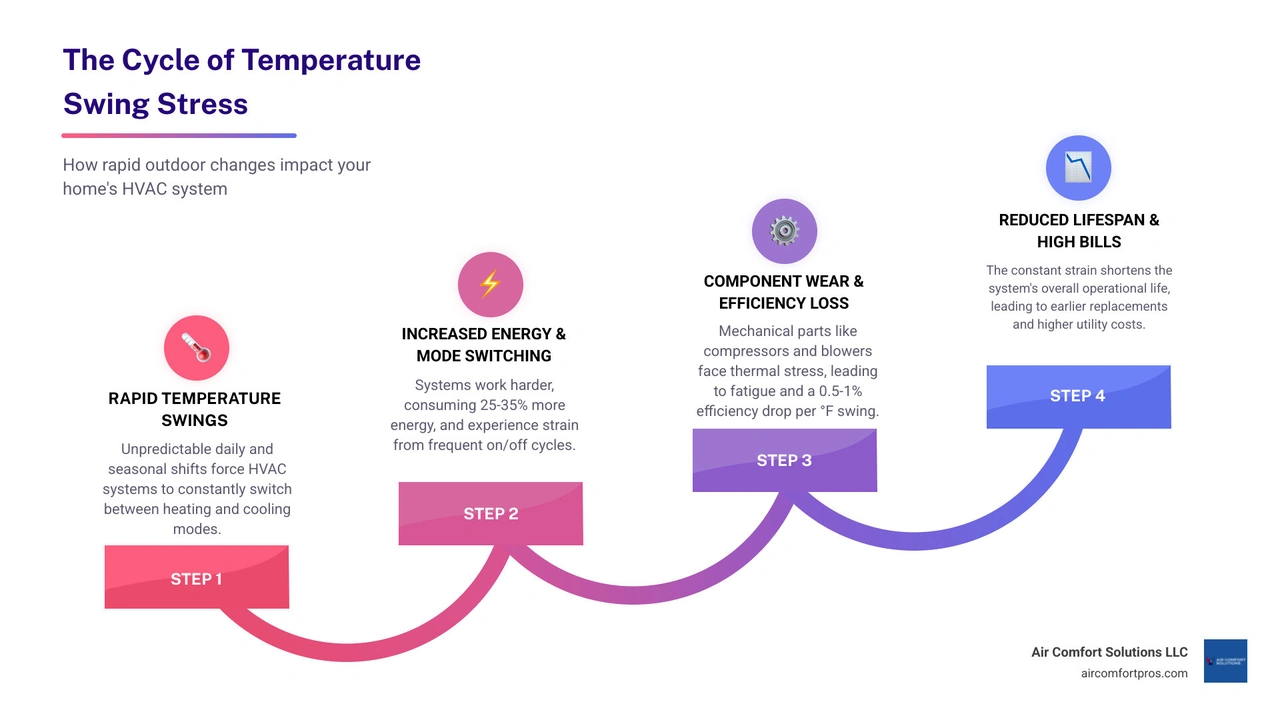
Here is a quick summary of what happens when outdoor temperatures fluctuate rapidly:
• Increased energy use - A 20°F daily swing can push energy consumption up by 25-35%
• Component wear - Compressors, blower motors, and heat exchangers expand and contract repeatedly, accelerating mechanical fatigue
• Efficiency loss - For every 1°F of temperature swing, HVAC efficiency drops by 0.5-1% (ASHRAE)
• Mode switching strain - Systems forced to heat in the morning and cool by afternoon cycle far more than designed for
• Shorter system lifespan - Systems in variable climates work 15-30% harder than those in stable environments
If you have noticed your energy bills creeping up, your system running longer than usual, or certain rooms feeling stuffy or cold, temperature swings may be the reason.
Spring and fall in the Pinehurst area bring exactly these kinds of wild shifts — mornings that call for the furnace, afternoons that demand the air conditioner. That back-and-forth is not just uncomfortable. It puts real, measurable stress on every major component of your HVAC system.
The good news is that understanding how this stress builds up is the first step to protecting your home comfort system before small problems become costly repairs.
Living in areas like Tomball, Spring, or The Woodlands, we are no strangers to the "Texas rollercoaster." You might wake up to a crisp 45°F morning that requires a sweater and the heater, only to find yourself cranking the AC by 3:00 PM when the mercury hits 80°F. While we can just change our clothes, our HVAC systems have a much harder time adapting.
Daily fluctuations and seasonal transitions are the primary drivers of system fatigue. When the outdoor temperature shifts drastically, your home’s "thermal envelope"—the walls, windows, and roof—struggles to keep up. This creates a lag effect where your AC might still be fighting the heat absorbed by your attic during the day, even as the outdoor air begins to cool down at night.
The financial impact of these swings is significant. Research shows that systems in variable climates work 15–30% harder than those in stable environments. To help you visualize the impact, consider the following data on energy consumption:
• 10°F Daily Swing — Energy Use Increase: 12–18% — System Wear Level: Moderate
• 20°F Daily Swing — Energy Use Increase: 25–35% — System Wear Level: Severe
• 30°F+ Daily Swing — Energy Use Increase: 40–50% — System Wear Level: Extreme
During these transitional periods, it is vital to ensure your equipment is ready for the workload. Preparing Your Home's Cooling System for a Smooth Summer is a great way to start mitigating these effects before the peak heat arrives.
When we talk about how temperature swings affect your heating and cooling, we have to look under the hood. HVAC components are made of metal, plastic, and rubber—all of which react to temperature changes.
1. Thermal Expansion and Metal Fatigue: Much like bending a paperclip back and forth until it snaps, the metal in your heat exchanger expands when hot and contracts when cold. Rapid swings accelerate this process, leading to microscopic cracks. In a furnace, these cracks are a major safety hazard.
2. Compressor Wear: The compressor is the "heart" of your AC. Frequent cycling caused by fluctuating outdoor temperatures forces the compressor to start and stop more often. Since the most "painful" part of a motor's life is the startup, this leads to premature failure.
3. Refrigerant Pressure: As temperatures shift, the pressure of the refrigerant inside your lines fluctuates wildly. This places stress on seals and joints, often leading to leaks that wouldn't occur in a more stable environment.
4. Electrical Demand: Sudden cold snaps or heat spikes put immense strain on capacitors and blower motors. If a component is already weakened, a 30-degree swing is often the "final straw" that causes a total system shutdown.
One of the most damaging things a homeowner can do during a Texas spring is "flip-flopping" between heat and cool multiple times a day. While it’s tempting to chase the perfect 72°F, this causes several issues:
• Moisture Buildup: When you switch from cooling to heating, the residual moisture on your evaporator coil can "bake" off, sending a surge of humidity into your ductwork.
• Dirty Sock Syndrome: This is a real industry term! It refers to a musty, moldy smell that occurs when bacteria on a damp coil are heated up, creating a literal "stinky sock" odor throughout the house.
• Compressor Slugging: If you switch to cooling too quickly after running the heat, the refrigerant may not have had time to equalize, potentially sending liquid refrigerant into the compressor (which is designed only for gas), causing instant damage.
If you find your Why Furnace Blowing Cold Air in Spring, it may be a sign that the system is struggling to transition between these modes effectively.
How do you know if the Pinehurst weather is winning the battle against your HVAC? Your system usually tries to tell you before it quits entirely.
The most common sign is short cycling. This happens when your unit turns on, runs for a few minutes, and shuts back off, only to repeat the process ten minutes later. This is often a sign that the system is "confused" by the rapid shifts in indoor and outdoor temperatures or that a sensor is failing due to thermal stress.
Other red flags include:
• Unusual Noises: Banging, clanking, or high-pitched whirring often indicate that blower motors or fans are struggling with the increased workload.
• Uneven Temperatures: If the upstairs is a sauna while the downstairs is an icebox, your system isn't mixing the air effectively enough to combat the outdoor swings.
• High Humidity: An AC's primary job is actually dehumidification. If your home feels "sticky" despite the air being cool, the system isn't running long enough cycles to remove moisture. You may need to Address High Humidity Despite Running AC specifically if this persists.
Efficiency is where temperature swings hit you the hardest—right in the wallet. According to ASHRAE (the American Society of Heating, Refrigerating and Air-Conditioning Engineers), for every 1°F temperature swing, HVAC efficiency drops by 0.5-1%.
When the weather is erratic, the system has to work 15-30% harder to maintain a "steady state" inside the home. This leads to utility bill spikes that can catch homeowners in Montgomery or Conroe off guard. Over time, this constant "overwork" reduces the total lifespan of your system. A unit that might have lasted 15 years in a milder climate might only last 10 or 12 years here due to the sheer volume of cycles it must perform.
Temperature swings are "magnified" by a home that isn't well-sealed. Think of your home like a thermos; if the lid is cracked, the coffee gets cold.
• Duct Leakage: Ducts can lose up to 30% of their airflow through small leaks. When temperatures swing, these leaks allow conditioned air to escape into attics or crawlspaces, forcing the system to run even longer to compensate.
• Heat Retention: Materials like brick and concrete have "thermal mass," meaning they hold onto heat. In the evening, even if it’s 65°F outside, your brick walls might still be radiating 80°F heat into your living room. Without proper insulation, your HVAC system has to fight this "ghost heat" all night long.
If your system is older and struggling to keep up with these demands, it might be one of the Optimal Times for Upgrading Your Home's Air Conditioning System.
While we can't control the weather in Magnolia or Plantersville, we can control how our homes respond to it.
The first line of defense is a smart thermostat. Modern thermostats use "adaptive recovery" to learn how long it takes to heat or cool your home based on the actual outdoor weather. Instead of a sudden "shock" to the system at 5:00 PM, a smart thermostat can gradually adjust the temperature throughout the day.
Zoning systems are another high-impact solution. By using dampers in your ductwork, a zoned system can send more cooling to the sunny side of the house in the afternoon and more heat to the bedrooms at night, reducing the overall load on the central unit.
To truly "future-proof" your comfort, consider these technical upgrades:
1. Variable-Speed Technology: Unlike traditional "on/off" systems, variable-speed motors can run at 30% or 70% capacity. This allows them to "cruise" along, maintaining a steady temperature without the constant stress of starting and stopping.
2. Compressor Blankets: These help stabilize the temperature of the compressor itself, reducing the thermal shock during cold starts.
3. Surge Protection: Rapid weather changes often come with storms or grid instability. A dedicated HVAC surge protector can save your control board from a costly "fry."
4. Consistent Maintenance: Tightening electrical connections that have loosened due to thermal expansion and checking refrigerant pressures are essential tasks that prevent small "swing-related" issues from becoming disasters.
There is no substitute for a professional eye. A NATE-certified technician can spot the "micro-cracks" in a heat exchanger or a weakening capacitor long before the system fails on a 100-degree day.
Annual inspections are especially critical for older systems. If your unit is over 12 years old, it was likely not designed with the high-efficiency standards needed to handle modern climate variability. Knowing the Signs Your Heating System Needs Replacement can help you plan an upgrade on your own terms, rather than during an emergency.
While modern systems are built to handle it, doing so frequently is not ideal. Most thermostats have a built-in 5-minute compressor delay. Never bypass this. This delay allows the refrigerant pressures to equalize. If you force the system to switch too quickly, you risk "locking" the compressor. To minimize moisture in the ducts, try to leave the fan running for 10-15 minutes after switching modes to dry out the coils.
A 20°F daily variation typically leads to a 25-35% increase in energy use. This happens because the system cannot operate in its most efficient "steady state." It has to work at maximum capacity to overcome the rapid change in the home's internal temperature. During transitional seasons, this can add a significant amount to your monthly utility bill.
We recommend finding a "comfort zone" between 68°F and 72°F. Many modern thermostats have an "Auto Changeover" feature. This allows you to set a range (e.g., Heat at 68, Cool at 74). The system will automatically maintain the home within that window without you having to manually flip the switch. This prevents the system from "fighting itself" and encourages more moderate, incremental adjustments.
At Air Comfort Solutions LLC, we have spent over 35 years helping families in Pinehurst, Houston, and The Woodlands navigate the challenges of our local climate. We know that how temperature swings affect your heating and cooling is a major concern for homeowners who value both comfort and equipment longevity.
By implementing smart thermostat strategies, ensuring your home is well-insulated, and keeping up with professional maintenance, you can protect your investment from the "Texas rollercoaster." Our certified technicians are ready to provide honest, reliable solutions tailored to the specific needs of North Harris County homes.
Don't wait for the next 40-degree swing to find out if your system is up to the task. Schedule your professional HVAC evaluation today and ensure your home remains a sanctuary of comfort, no matter what the weather does outside.
How temperature swings affect your heating and cooling is one of the most overlooked causes of HVAC wear, high energy bills, and unexpected breakdowns — especially during the unpredictable transitional seasons common in North Harris County.
Here is a quick summary of what happens when outdoor temperatures fluctuate rapidly:
If you have noticed your energy bills creeping up, your system running longer than usual, or certain rooms feeling stuffy or cold, temperature swings may be the reason.
Spring and fall in the Pinehurst area bring exactly these kinds of wild shifts — mornings that call for the furnace, afternoons that demand the air conditioner. That back-and-forth is not just uncomfortable. It puts real, measurable stress on every major component of your HVAC system.
The good news is that understanding how this stress builds up is the first step to protecting your home comfort system before small problems become costly repairs.
Living in areas like Tomball, Spring, or The Woodlands, we are no strangers to the "Texas rollercoaster." You might wake up to a crisp 45°F morning that requires a sweater and the heater, only to find yourself cranking the AC by 3:00 PM when the mercury hits 80°F. While we can just change our clothes, our HVAC systems have a much harder time adapting.
Daily fluctuations and seasonal transitions are the primary drivers of system fatigue. When the outdoor temperature shifts drastically, your home’s "thermal envelope"—the walls, windows, and roof—struggles to keep up. This creates a lag effect where your AC might still be fighting the heat absorbed by your attic during the day, even as the outdoor air begins to cool down at night.
The financial impact of these swings is significant. Research shows that systems in variable climates work 15–30% harder than those in stable environments. To help you visualize the impact, consider the following data on energy consumption:
| Temperature Variation | Energy Use Increase | System Wear Level |
|---|---|---|
| 10°F Daily Swing | 12–18% | Moderate |
| 20°F Daily Swing | 25–35% | Severe |
| 30°F+ Daily Swing | 40–50% | Extreme |
During these transitional periods, it is vital to ensure your equipment is ready for the workload. Preparing Your Home's Cooling System for a Smooth Summer is a great way to start mitigating these effects before the peak heat arrives.
When we talk about how temperature swings affect your heating and cooling, we have to look under the hood. HVAC components are made of metal, plastic, and rubber—all of which react to temperature changes.
One of the most damaging things a homeowner can do during a Texas spring is "flip-flopping" between heat and cool multiple times a day. While it’s tempting to chase the perfect 72°F, this causes several issues:
If you find your Why Furnace Blowing Cold Air in Spring, it may be a sign that the system is struggling to transition between these modes effectively.
How do you know if the Pinehurst weather is winning the battle against your HVAC? Your system usually tries to tell you before it quits entirely.
The most common sign is short cycling. This happens when your unit turns on, runs for a few minutes, and shuts back off, only to repeat the process ten minutes later. This is often a sign that the system is "confused" by the rapid shifts in indoor and outdoor temperatures or that a sensor is failing due to thermal stress.
Other red flags include:
Efficiency is where temperature swings hit you the hardest—right in the wallet. According to ASHRAE (the American Society of Heating, Refrigerating and Air-Conditioning Engineers), for every 1°F temperature swing, HVAC efficiency drops by 0.5-1%.
When the weather is erratic, the system has to work 15-30% harder to maintain a "steady state" inside the home. This leads to utility bill spikes that can catch homeowners in Montgomery or Conroe off guard. Over time, this constant "overwork" reduces the total lifespan of your system. A unit that might have lasted 15 years in a milder climate might only last 10 or 12 years here due to the sheer volume of cycles it must perform.
Temperature swings are "magnified" by a home that isn't well-sealed. Think of your home like a thermos; if the lid is cracked, the coffee gets cold.
If your system is older and struggling to keep up with these demands, it might be one of the Optimal Times for Upgrading Your Home's Air Conditioning System.
While we can't control the weather in Magnolia or Plantersville, we can control how our homes respond to it.
The first line of defense is a smart thermostat. Modern thermostats use "adaptive recovery" to learn how long it takes to heat or cool your home based on the actual outdoor weather. Instead of a sudden "shock" to the system at 5:00 PM, a smart thermostat can gradually adjust the temperature throughout the day.
Zoning systems are another high-impact solution. By using dampers in your ductwork, a zoned system can send more cooling to the sunny side of the house in the afternoon and more heat to the bedrooms at night, reducing the overall load on the central unit.
To truly "future-proof" your comfort, consider these technical upgrades:
There is no substitute for a professional eye. A NATE-certified technician can spot the "micro-cracks" in a heat exchanger or a weakening capacitor long before the system fails on a 100-degree day.
Annual inspections are especially critical for older systems. If your unit is over 12 years old, it was likely not designed with the high-efficiency standards needed to handle modern climate variability. Knowing the Signs Your Heating System Needs Replacement can help you plan an upgrade on your own terms, rather than during an emergency.
While modern systems are built to handle it, doing so frequently is not ideal. Most thermostats have a built-in 5-minute compressor delay. Never bypass this. This delay allows the refrigerant pressures to equalize. If you force the system to switch too quickly, you risk "locking" the compressor. To minimize moisture in the ducts, try to leave the fan running for 10-15 minutes after switching modes to dry out the coils.
A 20°F daily variation typically leads to a 25-35% increase in energy use. This happens because the system cannot operate in its most efficient "steady state." It has to work at maximum capacity to overcome the rapid change in the home's internal temperature. During transitional seasons, this can add a significant amount to your monthly utility bill.
We recommend finding a "comfort zone" between 68°F and 72°F. Many modern thermostats have an "Auto Changeover" feature. This allows you to set a range (e.g., Heat at 68, Cool at 74). The system will automatically maintain the home within that window without you having to manually flip the switch. This prevents the system from "fighting itself" and encourages more moderate, incremental adjustments.
At Air Comfort Solutions LLC, we have spent over 35 years helping families in Pinehurst, Houston, and The Woodlands navigate the challenges of our local climate. We know that how temperature swings affect your heating and cooling is a major concern for homeowners who value both comfort and equipment longevity.
By implementing smart thermostat strategies, ensuring your home is well-insulated, and keeping up with professional maintenance, you can protect your investment from the "Texas rollercoaster." Our certified technicians are ready to provide honest, reliable solutions tailored to the specific needs of North Harris County homes.
Don't wait for the next 40-degree swing to find out if your system is up to the task. Schedule your professional HVAC evaluation today and ensure your home remains a sanctuary of comfort, no matter what the weather does outside.
How temperature swings affect your heating and cooling is one of the most overlooked causes of HVAC wear, high energy bills, and unexpected breakdowns — especially during the unpredictable transitional seasons common in North Harris County.
Here is a quick summary of what happens when outdoor temperatures fluctuate rapidly:
If you have noticed your energy bills creeping up, your system running longer than usual, or certain rooms feeling stuffy or cold, temperature swings may be the reason.
Spring and fall in the Pinehurst area bring exactly these kinds of wild shifts — mornings that call for the furnace, afternoons that demand the air conditioner. That back-and-forth is not just uncomfortable. It puts real, measurable stress on every major component of your HVAC system.
The good news is that understanding how this stress builds up is the first step to protecting your home comfort system before small problems become costly repairs.
Living in areas like Tomball, Spring, or The Woodlands, we are no strangers to the "Texas rollercoaster." You might wake up to a crisp 45°F morning that requires a sweater and the heater, only to find yourself cranking the AC by 3:00 PM when the mercury hits 80°F. While we can just change our clothes, our HVAC systems have a much harder time adapting.
Daily fluctuations and seasonal transitions are the primary drivers of system fatigue. When the outdoor temperature shifts drastically, your home’s "thermal envelope"—the walls, windows, and roof—struggles to keep up. This creates a lag effect where your AC might still be fighting the heat absorbed by your attic during the day, even as the outdoor air begins to cool down at night.
The financial impact of these swings is significant. Research shows that systems in variable climates work 15–30% harder than those in stable environments. To help you visualize the impact, consider the following data on energy consumption:
| Temperature Variation | Energy Use Increase | System Wear Level |
|---|---|---|
| 10°F Daily Swing | 12–18% | Moderate |
| 20°F Daily Swing | 25–35% | Severe |
| 30°F+ Daily Swing | 40–50% | Extreme |
During these transitional periods, it is vital to ensure your equipment is ready for the workload. Preparing Your Home's Cooling System for a Smooth Summer is a great way to start mitigating these effects before the peak heat arrives.
When we talk about how temperature swings affect your heating and cooling, we have to look under the hood. HVAC components are made of metal, plastic, and rubber—all of which react to temperature changes.
One of the most damaging things a homeowner can do during a Texas spring is "flip-flopping" between heat and cool multiple times a day. While it’s tempting to chase the perfect 72°F, this causes several issues:
If you find your Why Furnace Blowing Cold Air in Spring, it may be a sign that the system is struggling to transition between these modes effectively.
How do you know if the Pinehurst weather is winning the battle against your HVAC? Your system usually tries to tell you before it quits entirely.
The most common sign is short cycling. This happens when your unit turns on, runs for a few minutes, and shuts back off, only to repeat the process ten minutes later. This is often a sign that the system is "confused" by the rapid shifts in indoor and outdoor temperatures or that a sensor is failing due to thermal stress.
Other red flags include:
Efficiency is where temperature swings hit you the hardest—right in the wallet. According to ASHRAE (the American Society of Heating, Refrigerating and Air-Conditioning Engineers), for every 1°F temperature swing, HVAC efficiency drops by 0.5-1%.
When the weather is erratic, the system has to work 15-30% harder to maintain a "steady state" inside the home. This leads to utility bill spikes that can catch homeowners in Montgomery or Conroe off guard. Over time, this constant "overwork" reduces the total lifespan of your system. A unit that might have lasted 15 years in a milder climate might only last 10 or 12 years here due to the sheer volume of cycles it must perform.
Temperature swings are "magnified" by a home that isn't well-sealed. Think of your home like a thermos; if the lid is cracked, the coffee gets cold.
If your system is older and struggling to keep up with these demands, it might be one of the Optimal Times for Upgrading Your Home's Air Conditioning System.
While we can't control the weather in Magnolia or Plantersville, we can control how our homes respond to it.
The first line of defense is a smart thermostat. Modern thermostats use "adaptive recovery" to learn how long it takes to heat or cool your home based on the actual outdoor weather. Instead of a sudden "shock" to the system at 5:00 PM, a smart thermostat can gradually adjust the temperature throughout the day.
Zoning systems are another high-impact solution. By using dampers in your ductwork, a zoned system can send more cooling to the sunny side of the house in the afternoon and more heat to the bedrooms at night, reducing the overall load on the central unit.
To truly "future-proof" your comfort, consider these technical upgrades:
There is no substitute for a professional eye. A NATE-certified technician can spot the "micro-cracks" in a heat exchanger or a weakening capacitor long before the system fails on a 100-degree day.
Annual inspections are especially critical for older systems. If your unit is over 12 years old, it was likely not designed with the high-efficiency standards needed to handle modern climate variability. Knowing the Signs Your Heating System Needs Replacement can help you plan an upgrade on your own terms, rather than during an emergency.
While modern systems are built to handle it, doing so frequently is not ideal. Most thermostats have a built-in 5-minute compressor delay. Never bypass this. This delay allows the refrigerant pressures to equalize. If you force the system to switch too quickly, you risk "locking" the compressor. To minimize moisture in the ducts, try to leave the fan running for 10-15 minutes after switching modes to dry out the coils.
A 20°F daily variation typically leads to a 25-35% increase in energy use. This happens because the system cannot operate in its most efficient "steady state." It has to work at maximum capacity to overcome the rapid change in the home's internal temperature. During transitional seasons, this can add a significant amount to your monthly utility bill.
We recommend finding a "comfort zone" between 68°F and 72°F. Many modern thermostats have an "Auto Changeover" feature. This allows you to set a range (e.g., Heat at 68, Cool at 74). The system will automatically maintain the home within that window without you having to manually flip the switch. This prevents the system from "fighting itself" and encourages more moderate, incremental adjustments.
At Air Comfort Solutions LLC, we have spent over 35 years helping families in Pinehurst, Houston, and The Woodlands navigate the challenges of our local climate. We know that how temperature swings affect your heating and cooling is a major concern for homeowners who value both comfort and equipment longevity.
By implementing smart thermostat strategies, ensuring your home is well-insulated, and keeping up with professional maintenance, you can protect your investment from the "Texas rollercoaster." Our certified technicians are ready to provide honest, reliable solutions tailored to the specific needs of North Harris County homes.
Don't wait for the next 40-degree swing to find out if your system is up to the task. Schedule your professional HVAC evaluation today and ensure your home remains a sanctuary of comfort, no matter what the weather does outside.
How temperature swings affect your heating and cooling is one of the most overlooked causes of HVAC wear, high energy bills, and unexpected breakdowns — especially during the unpredictable transitional seasons common in North Harris County.
Here is a quick summary of what happens when outdoor temperatures fluctuate rapidly:
If you have noticed your energy bills creeping up, your system running longer than usual, or certain rooms feeling stuffy or cold, temperature swings may be the reason.
Spring and fall in the Pinehurst area bring exactly these kinds of wild shifts — mornings that call for the furnace, afternoons that demand the air conditioner. That back-and-forth is not just uncomfortable. It puts real, measurable stress on every major component of your HVAC system.
The good news is that understanding how this stress builds up is the first step to protecting your home comfort system before small problems become costly repairs.
Living in areas like Tomball, Spring, or The Woodlands, we are no strangers to the "Texas rollercoaster." You might wake up to a crisp 45°F morning that requires a sweater and the heater, only to find yourself cranking the AC by 3:00 PM when the mercury hits 80°F. While we can just change our clothes, our HVAC systems have a much harder time adapting.
Daily fluctuations and seasonal transitions are the primary drivers of system fatigue. When the outdoor temperature shifts drastically, your home’s "thermal envelope"—the walls, windows, and roof—struggles to keep up. This creates a lag effect where your AC might still be fighting the heat absorbed by your attic during the day, even as the outdoor air begins to cool down at night.
The financial impact of these swings is significant. Research shows that systems in variable climates work 15–30% harder than those in stable environments. To help you visualize the impact, consider the following data on energy consumption:
| Temperature Variation | Energy Use Increase | System Wear Level |
|---|---|---|
| 10°F Daily Swing | 12–18% | Moderate |
| 20°F Daily Swing | 25–35% | Severe |
| 30°F+ Daily Swing | 40–50% | Extreme |
During these transitional periods, it is vital to ensure your equipment is ready for the workload. Preparing Your Home's Cooling System for a Smooth Summer is a great way to start mitigating these effects before the peak heat arrives.
When we talk about how temperature swings affect your heating and cooling, we have to look under the hood. HVAC components are made of metal, plastic, and rubber—all of which react to temperature changes.
One of the most damaging things a homeowner can do during a Texas spring is "flip-flopping" between heat and cool multiple times a day. While it’s tempting to chase the perfect 72°F, this causes several issues:
If you find your Why Furnace Blowing Cold Air in Spring, it may be a sign that the system is struggling to transition between these modes effectively.
How do you know if the Pinehurst weather is winning the battle against your HVAC? Your system usually tries to tell you before it quits entirely.
The most common sign is short cycling. This happens when your unit turns on, runs for a few minutes, and shuts back off, only to repeat the process ten minutes later. This is often a sign that the system is "confused" by the rapid shifts in indoor and outdoor temperatures or that a sensor is failing due to thermal stress.
Other red flags include:
Efficiency is where temperature swings hit you the hardest—right in the wallet. According to ASHRAE (the American Society of Heating, Refrigerating and Air-Conditioning Engineers), for every 1°F temperature swing, HVAC efficiency drops by 0.5-1%.
When the weather is erratic, the system has to work 15-30% harder to maintain a "steady state" inside the home. This leads to utility bill spikes that can catch homeowners in Montgomery or Conroe off guard. Over time, this constant "overwork" reduces the total lifespan of your system. A unit that might have lasted 15 years in a milder climate might only last 10 or 12 years here due to the sheer volume of cycles it must perform.
Temperature swings are "magnified" by a home that isn't well-sealed. Think of your home like a thermos; if the lid is cracked, the coffee gets cold.
If your system is older and struggling to keep up with these demands, it might be one of the Optimal Times for Upgrading Your Home's Air Conditioning System.
While we can't control the weather in Magnolia or Plantersville, we can control how our homes respond to it.
The first line of defense is a smart thermostat. Modern thermostats use "adaptive recovery" to learn how long it takes to heat or cool your home based on the actual outdoor weather. Instead of a sudden "shock" to the system at 5:00 PM, a smart thermostat can gradually adjust the temperature throughout the day.
Zoning systems are another high-impact solution. By using dampers in your ductwork, a zoned system can send more cooling to the sunny side of the house in the afternoon and more heat to the bedrooms at night, reducing the overall load on the central unit.
To truly "future-proof" your comfort, consider these technical upgrades:
There is no substitute for a professional eye. A NATE-certified technician can spot the "micro-cracks" in a heat exchanger or a weakening capacitor long before the system fails on a 100-degree day.
Annual inspections are especially critical for older systems. If your unit is over 12 years old, it was likely not designed with the high-efficiency standards needed to handle modern climate variability. Knowing the Signs Your Heating System Needs Replacement can help you plan an upgrade on your own terms, rather than during an emergency.
While modern systems are built to handle it, doing so frequently is not ideal. Most thermostats have a built-in 5-minute compressor delay. Never bypass this. This delay allows the refrigerant pressures to equalize. If you force the system to switch too quickly, you risk "locking" the compressor. To minimize moisture in the ducts, try to leave the fan running for 10-15 minutes after switching modes to dry out the coils.
A 20°F daily variation typically leads to a 25-35% increase in energy use. This happens because the system cannot operate in its most efficient "steady state." It has to work at maximum capacity to overcome the rapid change in the home's internal temperature. During transitional seasons, this can add a significant amount to your monthly utility bill.
We recommend finding a "comfort zone" between 68°F and 72°F. Many modern thermostats have an "Auto Changeover" feature. This allows you to set a range (e.g., Heat at 68, Cool at 74). The system will automatically maintain the home within that window without you having to manually flip the switch. This prevents the system from "fighting itself" and encourages more moderate, incremental adjustments.
At Air Comfort Solutions LLC, we have spent over 35 years helping families in Pinehurst, Houston, and The Woodlands navigate the challenges of our local climate. We know that how temperature swings affect your heating and cooling is a major concern for homeowners who value both comfort and equipment longevity.
By implementing smart thermostat strategies, ensuring your home is well-insulated, and keeping up with professional maintenance, you can protect your investment from the "Texas rollercoaster." Our certified technicians are ready to provide honest, reliable solutions tailored to the specific needs of North Harris County homes.
Don't wait for the next 40-degree swing to find out if your system is up to the task. Schedule your professional HVAC evaluation today and ensure your home remains a sanctuary of comfort, no matter what the weather does outside.
How temperature swings affect your heating and cooling is one of the most overlooked causes of HVAC wear, high energy bills, and unexpected breakdowns — especially during the unpredictable transitional seasons common in North Harris County.
Here is a quick summary of what happens when outdoor temperatures fluctuate rapidly:
If you have noticed your energy bills creeping up, your system running longer than usual, or certain rooms feeling stuffy or cold, temperature swings may be the reason.
Spring and fall in the Pinehurst area bring exactly these kinds of wild shifts — mornings that call for the furnace, afternoons that demand the air conditioner. That back-and-forth is not just uncomfortable. It puts real, measurable stress on every major component of your HVAC system.
The good news is that understanding how this stress builds up is the first step to protecting your home comfort system before small problems become costly repairs.
Living in areas like Tomball, Spring, or The Woodlands, we are no strangers to the "Texas rollercoaster." You might wake up to a crisp 45°F morning that requires a sweater and the heater, only to find yourself cranking the AC by 3:00 PM when the mercury hits 80°F. While we can just change our clothes, our HVAC systems have a much harder time adapting.
Daily fluctuations and seasonal transitions are the primary drivers of system fatigue. When the outdoor temperature shifts drastically, your home’s "thermal envelope"—the walls, windows, and roof—struggles to keep up. This creates a lag effect where your AC might still be fighting the heat absorbed by your attic during the day, even as the outdoor air begins to cool down at night.
The financial impact of these swings is significant. Research shows that systems in variable climates work 15–30% harder than those in stable environments. To help you visualize the impact, consider the following data on energy consumption:
| Temperature Variation | Energy Use Increase | System Wear Level |
|---|---|---|
| 10°F Daily Swing | 12–18% | Moderate |
| 20°F Daily Swing | 25–35% | Severe |
| 30°F+ Daily Swing | 40–50% | Extreme |
During these transitional periods, it is vital to ensure your equipment is ready for the workload. Preparing Your Home's Cooling System for a Smooth Summer is a great way to start mitigating these effects before the peak heat arrives.
When we talk about how temperature swings affect your heating and cooling, we have to look under the hood. HVAC components are made of metal, plastic, and rubber—all of which react to temperature changes.
One of the most damaging things a homeowner can do during a Texas spring is "flip-flopping" between heat and cool multiple times a day. While it’s tempting to chase the perfect 72°F, this causes several issues:
If you find your Why Furnace Blowing Cold Air in Spring, it may be a sign that the system is struggling to transition between these modes effectively.
How do you know if the Pinehurst weather is winning the battle against your HVAC? Your system usually tries to tell you before it quits entirely.
The most common sign is short cycling. This happens when your unit turns on, runs for a few minutes, and shuts back off, only to repeat the process ten minutes later. This is often a sign that the system is "confused" by the rapid shifts in indoor and outdoor temperatures or that a sensor is failing due to thermal stress.
Other red flags include:
Efficiency is where temperature swings hit you the hardest—right in the wallet. According to ASHRAE (the American Society of Heating, Refrigerating and Air-Conditioning Engineers), for every 1°F temperature swing, HVAC efficiency drops by 0.5-1%.
When the weather is erratic, the system has to work 15-30% harder to maintain a "steady state" inside the home. This leads to utility bill spikes that can catch homeowners in Montgomery or Conroe off guard. Over time, this constant "overwork" reduces the total lifespan of your system. A unit that might have lasted 15 years in a milder climate might only last 10 or 12 years here due to the sheer volume of cycles it must perform.
Temperature swings are "magnified" by a home that isn't well-sealed. Think of your home like a thermos; if the lid is cracked, the coffee gets cold.
If your system is older and struggling to keep up with these demands, it might be one of the Optimal Times for Upgrading Your Home's Air Conditioning System.
While we can't control the weather in Magnolia or Plantersville, we can control how our homes respond to it.
The first line of defense is a smart thermostat. Modern thermostats use "adaptive recovery" to learn how long it takes to heat or cool your home based on the actual outdoor weather. Instead of a sudden "shock" to the system at 5:00 PM, a smart thermostat can gradually adjust the temperature throughout the day.
Zoning systems are another high-impact solution. By using dampers in your ductwork, a zoned system can send more cooling to the sunny side of the house in the afternoon and more heat to the bedrooms at night, reducing the overall load on the central unit.
To truly "future-proof" your comfort, consider these technical upgrades:
There is no substitute for a professional eye. A NATE-certified technician can spot the "micro-cracks" in a heat exchanger or a weakening capacitor long before the system fails on a 100-degree day.
Annual inspections are especially critical for older systems. If your unit is over 12 years old, it was likely not designed with the high-efficiency standards needed to handle modern climate variability. Knowing the Signs Your Heating System Needs Replacement can help you plan an upgrade on your own terms, rather than during an emergency.
While modern systems are built to handle it, doing so frequently is not ideal. Most thermostats have a built-in 5-minute compressor delay. Never bypass this. This delay allows the refrigerant pressures to equalize. If you force the system to switch too quickly, you risk "locking" the compressor. To minimize moisture in the ducts, try to leave the fan running for 10-15 minutes after switching modes to dry out the coils.
A 20°F daily variation typically leads to a 25-35% increase in energy use. This happens because the system cannot operate in its most efficient "steady state." It has to work at maximum capacity to overcome the rapid change in the home's internal temperature. During transitional seasons, this can add a significant amount to your monthly utility bill.
We recommend finding a "comfort zone" between 68°F and 72°F. Many modern thermostats have an "Auto Changeover" feature. This allows you to set a range (e.g., Heat at 68, Cool at 74). The system will automatically maintain the home within that window without you having to manually flip the switch. This prevents the system from "fighting itself" and encourages more moderate, incremental adjustments.
At Air Comfort Solutions LLC, we have spent over 35 years helping families in Pinehurst, Houston, and The Woodlands navigate the challenges of our local climate. We know that how temperature swings affect your heating and cooling is a major concern for homeowners who value both comfort and equipment longevity.
By implementing smart thermostat strategies, ensuring your home is well-insulated, and keeping up with professional maintenance, you can protect your investment from the "Texas rollercoaster." Our certified technicians are ready to provide honest, reliable solutions tailored to the specific needs of North Harris County homes.
Don't wait for the next 40-degree swing to find out if your system is up to the task. Schedule your professional HVAC evaluation today and ensure your home remains a sanctuary of comfort, no matter what the weather does outside.


Zane came out and did an amazing job! Super friendly, honest and transparent about the work that needed to be done. This is my second time working with Air Comfort Solutions and they’re my go to for HVAC services. Highly recommend.
God's AMAZING grace sent us Robert and Zane. We have been without air in this Texas heat for six weeks and four days. We've had a few contractors give us quotes all trying to upsell when we're at a low point. But not the guys at Air Comfort Solutions. They came in assessed our situation, gave us honest feedback, and showed us the issues as they proceeded with the assessment for clear understanding. We highly recommend them for their professionalism, quality products, and fair pricing. We hands down support them for all the work they do 💯 %.
Robert and Zane gone above and beyond to make the process easy and affordable.
Would definitely recommend!!
I’m writing this review to let everyone know that Air Comfort Solutions is the company to work with. I know the owner ( Robert) for several years now. He has been taking care of my residential and business work orders. Robert is professional, knowledgeable and will save you money. I just want to thank Robert for great job you have been doing for me.