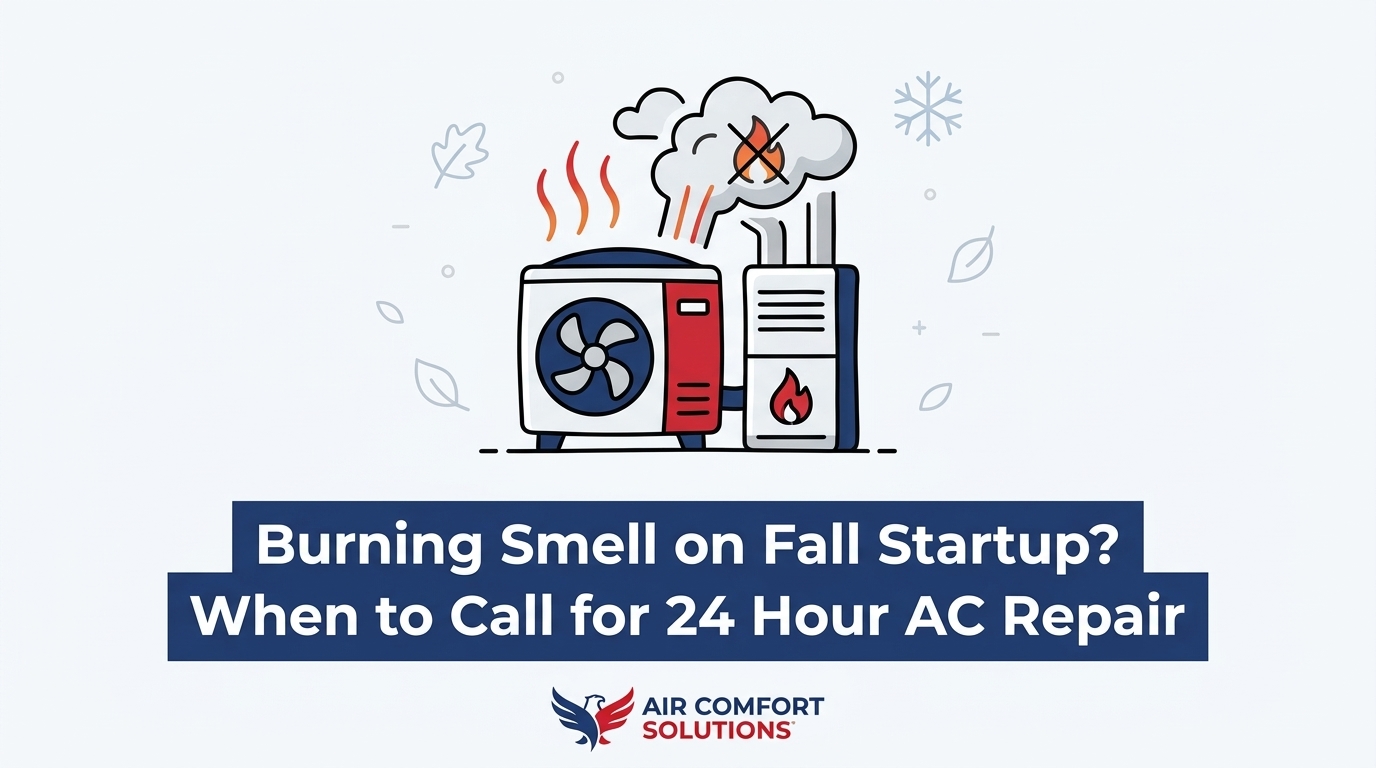
Burning Smell on Fall Startup? When to Call for 24 Hour AC Repair
Why we always check for dust burn-off first. Review our home maintenance tips and troubleshooting advice to decide if that fall HVAC smell needs a pro.
The best hvac setup for southeast texas weather combines a properly sized variable-speed heat pump or central air conditioner with whole-home dehumidification, a smart thermostat, and MERV 8-13 filtration — all sized using a Manual J load calculation at roughly 400 sq ft per ton.
Quick-reference setup guide:
1. System type: Variable-speed heat pump or high-SEER2 central AC (SEER2 16 or higher)
2. Sizing: Manual J load calculation — plan for 400 sq ft per ton or less
3. Humidity control: Whole-home dehumidifier targeting 30-50% indoor relative humidity
4. Thermostat: Smart thermostat set to 78°F when home, 82°F when away
5. Filtration: MERV 8 to MERV 13 air filter, changed every 1-3 months
6. Maintenance: Bi-annual professional tune-ups (before summer and before winter)
Southeast Texas is not just hot — it's relentlessly humid. Houston sits in ASHRAE Climate Zone 2A, a hot-humid classification that brings roughly 3,100 cooling degree days per year and an air conditioner that runs 8 to 10 months annually. Morning humidity along the Gulf Coast routinely tops 74%, and muggy conditions dominate around 92% of the cooling season.
That combination puts a unique demand on your HVAC system. It's not enough to simply cool the air — your system has to remove massive amounts of moisture at the same time. When it doesn't, your home feels clammy and uncomfortable even if the thermostat reads 75°F. Heating and cooling already account for nearly 50% of a home's energy use nationwide, and in a climate like ours, an undersized, oversized, or wrong-type system makes that number climb fast.
The sections below break down exactly which equipment works best here, why humidity control is the real challenge, and how to build a setup that keeps your home genuinely comfortable all year long.

When we talk about the "load" on an air conditioner in places like Houston or Cypress, we are talking about two things: sensible heat (the temperature you see on a thermometer) and latent heat (the moisture in the air). In Southeast Texas, the latent load is often the bigger bully.
Because we are in ASHRAE Zone 2A, our homes face Gulf Coast moisture levels that can exceed 85 grains of water per pound of dry air. To tackle this, a standard "rule of thumb" for sizing won't cut it. While a contractor in a moderate climate might suggest one ton of cooling for every 500 or 600 square feet, the best hvac setup for southeast texas weather requires a tighter ratio. We typically look at 400 square feet per ton or less to ensure the system can actually keep up with a 95°F afternoon.
However, bigger isn't always better. If your system is oversized, it will "short-cycle," meaning it turns on, cools the air temperature quickly, and shuts off before it has a chance to pull the moisture out of the air. This leaves you with a home that is 72°F but feels like a swamp. This is why a professional HVAC Installation Houston TX must always begin with a Manual J load calculation. This scientific assessment looks at your home's insulation, window types, and sun exposure to find the "Goldilocks" size—not too big, not too small. For homeowners seeking an HVAC Installation Cypress TX, getting this calculation right is the difference between a crisp, dry home and a clammy one.
In the past, AC units were either "on" or "off." They ran at 100% blast until the thermostat was satisfied, then quit. In our humid climate, this is inefficient. The modern solution is variable-speed (inverter) technology.
Think of a variable-speed system like a dimmer switch rather than a standard light switch. It can adjust its capacity to run at 30% or 60% for most of the day. Because it runs for longer periods at a lower speed, it provides much more consistent dehumidification. ASHRAE studies show that these longer runtimes can lower indoor relative humidity by as much as 10 points without using more energy.
When you schedule an HVAC Service Conroe TX, our technicians often recommend these systems because they eliminate the "hot spots" often found in multi-story homes. They provide stable temperatures and significantly reduced cycling, which saves on your electricity bill and extends the life of the equipment.
Even the best variable-speed AC can struggle during the "shoulder seasons"—those weeks in April or October when it’s 75°F outside with 90% humidity. Since it’s not hot enough for the AC to run much, the moisture builds up indoors.
This is where a whole-home dehumidifier becomes a game-changer. These units are integrated into your Ductwork Services Conroe TX and can extract 70 to 100 pints of water per day. By keeping your home in the 30-50% relative humidity range, you prevent mold growth and musty odors. More importantly, it allows you to feel comfortable at a higher temperature. With proper moisture management, 75°F can feel just as pleasant as 72°F, potentially saving you 10% or more on cooling costs.
Choosing between a traditional central AC (paired with a gas furnace) and a heat pump is a major decision for any Texas homeowner.
• Cooling Efficiency — Central AC + Furnace: SEER2 14 to 20+ — Heat Pump System: SEER2 16 to 20+
• Heating Method — Central AC + Furnace: Natural Gas or Electric — Heat Pump System: Refrigerant Cycle (Electric)
• Humidity Removal — Central AC + Furnace: Excellent (if variable speed) — Heat Pump System: Superior (with inverter tech)
• Winter Performance — Central AC + Furnace: Best for deep freezes — Heat Pump System: Ideal for mild TX winters
• Installation — Central AC + Furnace: Standard — Heat Pump System: Dual-fuel options available
Whether you are looking for Air Conditioning for the summer or reliable Heating for the winter, ENERGY STAR certification is a must. These high-efficiency units can reduce energy consumption by up to 50% compared to older models. For a high-quality HVAC Installation Spring TX, we often guide customers toward systems with a SEER2 rating of 16 or higher to maximize long-term savings.
Heat pumps have gained massive popularity in the Houston area recently. Unlike a furnace that creates heat, a heat pump moves heat from one place to another. In the summer, it moves heat out of your house. In the winter, it reverses the process to pull heat from the outside air and bring it indoors.
Because Southeast Texas winters are generally mild (our average January low is about 42°F), heat pumps are incredibly efficient here. Modern inverter heat pumps can cool effectively even when temperatures soar above 110°F and heat efficiently down to 17°F. For those rare deep freezes, we can install a "dual-fuel" setup that uses a gas furnace as a backup.
Homeowners opting for a Heat Pump Installation Cypress TX or a Heat Pump Installation Houston TX can also take advantage of the federal Inflation Reduction Act (IRA) 25C tax credit, which may cover 30% of the costs (up to $2,000 annually).
If you live in a historic home in Magnolia TX or have a room that always stays hot—like a converted garage or a sunroom—a ductless mini-split might be the perfect addition. These systems don't require bulky ducts. Instead, they use small indoor units connected to an outdoor compressor via thin refrigerant lines.
Mini-splits are incredibly efficient, often exceeding 20 SEER, and allow for precise room-by-room control. This prevents energy waste in rooms you aren't using. When we perform an HVAC Installation Conroe TX, we often find mini-splits are the best way to preserve the architectural integrity of older homes while providing modern, "ice-cold" comfort.
The main unit is the heart of the system, but the accessories are the brains. A Trane Thermostat Replacement Conroe TX can help you manage your home's climate with precision.
We recommend setting your thermostat to 78°F during the summer. While that sounds high, pairing it with a ceiling fan makes it feel 4 degrees cooler. You can save up to 10% a year on utility costs by adjusting your thermostat 7°-10°F for 8 hours a day (like when you're at work). A smart Home Thermostat Replacement Cypress TX learns your schedule and does this for you automatically.
Don't forget the air filters! In a humid climate like The Woodlands TX, we suggest MERV 8 to MERV 13 filters. These are thick enough to catch mold spores and pollen but won't choke your system's airflow. Change them every 30 to 90 days—especially if you have pets or live near the coast where salt and pollen are high.
In Southeast Texas, your AC is a marathon runner. It works harder and longer than systems in almost any other part of the country. To prevent mid-July breakdowns, bi-annual tune-ups are non-negotiable.
Our HVAC Maintenance Magnolia TX and HVAC Maintenance Spring TX services focus on the "silent killers" of HVAC units:
• Coil Rinsing: Salt air and dust can coat your outdoor coils. A simple low-pressure rinse every few months prevents corrosion.
• Refrigerant Checks: Even a small leak causes the system to work overtime, spiking your bills.
• Condensate Drain Clearing: Because our air is so wet, your AC pulls gallons of water out of the sky daily. If the drain line clogs with algae, it can flood your attic or closet.
• Electrical Inspection: High heat can cause capacitors to fail early. We check these components to ensure they are within safe operating ranges.
If you do run into trouble, prompt HVAC Repair Magnolia TX is essential to prevent a small issue from turning into a total compressor failure.
The Department of Energy and local experts suggest 78°F when you are home. If you are away for more than 8 hours, raise it to 82°F. Never turn the AC completely off in the summer; the humidity will build up, and your system will have to work twice as hard to recover when you get back. For personalized advice, an HVAC Service Magnolia TX professional can help you calibrate your settings for maximum savings.
Standard 1-inch filters should be checked monthly and changed at least every 90 days. However, in Spring TX, high pollen counts and humidity can make filters get "fuzzy" faster. If you have pets or allergies, every 30-45 days is safer.
This is almost always a sign of "latent load failure." Either your system is oversized and short-cycling (not running long enough to dehumidify), or your fan is set to "On" instead of "Auto." When the fan stays on constantly, it blows the moisture sitting on the wet coils back into your house. If the problem persists, an HVAC Service Conroe TX expert can perform a load calculation to see if your system is the right fit for your home.
Building the best hvac setup for southeast texas weather isn't just about buying the biggest unit on the market. It's about balance—balancing cooling power with humidity control, and energy efficiency with long-term reliability.
At Air Comfort Solutions LLC, we have over 35 years of experience helping neighbors in Pinehurst, Magnolia, Houston, and the surrounding areas stay cool. Our certified technicians understand the unique demands of the North Harris County climate. Whether you need a simple tune-up or a full system replacement, we offer honest, reliable HVAC solutions with upfront pricing and flexible financing. Don't spend another summer in a clammy home—let us help you build the perfect setup for your family.
The best hvac setup for southeast texas weather combines a properly sized variable-speed heat pump or central air conditioner with whole-home dehumidification, a smart thermostat, and MERV 8-13 filtration — all sized using a Manual J load calculation at roughly 400 sq ft per ton.
Quick-reference setup guide:
Southeast Texas is not just hot — it's relentlessly humid. Houston sits in ASHRAE Climate Zone 2A, a hot-humid classification that brings roughly 3,100 cooling degree days per year and an air conditioner that runs 8 to 10 months annually. Morning humidity along the Gulf Coast routinely tops 74%, and muggy conditions dominate around 92% of the cooling season.
That combination puts a unique demand on your HVAC system. It's not enough to simply cool the air — your system has to remove massive amounts of moisture at the same time. When it doesn't, your home feels clammy and uncomfortable even if the thermostat reads 75°F. Heating and cooling already account for nearly 50% of a home's energy use nationwide, and in a climate like ours, an undersized, oversized, or wrong-type system makes that number climb fast.
The sections below break down exactly which equipment works best here, why humidity control is the real challenge, and how to build a setup that keeps your home genuinely comfortable all year long.
When we talk about the "load" on an air conditioner in places like Houston or Cypress, we are talking about two things: sensible heat (the temperature you see on a thermometer) and latent heat (the moisture in the air). In Southeast Texas, the latent load is often the bigger bully.
Because we are in ASHRAE Zone 2A, our homes face Gulf Coast moisture levels that can exceed 85 grains of water per pound of dry air. To tackle this, a standard "rule of thumb" for sizing won't cut it. While a contractor in a moderate climate might suggest one ton of cooling for every 500 or 600 square feet, the best hvac setup for southeast texas weather requires a tighter ratio. We typically look at 400 square feet per ton or less to ensure the system can actually keep up with a 95°F afternoon.
However, bigger isn't always better. If your system is oversized, it will "short-cycle," meaning it turns on, cools the air temperature quickly, and shuts off before it has a chance to pull the moisture out of the air. This leaves you with a home that is 72°F but feels like a swamp. This is why a professional HVAC Installation Houston TX must always begin with a Manual J load calculation. This scientific assessment looks at your home's insulation, window types, and sun exposure to find the "Goldilocks" size—not too big, not too small. For homeowners seeking an HVAC Installation Cypress TX, getting this calculation right is the difference between a crisp, dry home and a clammy one.
In the past, AC units were either "on" or "off." They ran at 100% blast until the thermostat was satisfied, then quit. In our humid climate, this is inefficient. The modern solution is variable-speed (inverter) technology.
Think of a variable-speed system like a dimmer switch rather than a standard light switch. It can adjust its capacity to run at 30% or 60% for most of the day. Because it runs for longer periods at a lower speed, it provides much more consistent dehumidification. ASHRAE studies show that these longer runtimes can lower indoor relative humidity by as much as 10 points without using more energy.
When you schedule an HVAC Service Conroe TX, our technicians often recommend these systems because they eliminate the "hot spots" often found in multi-story homes. They provide stable temperatures and significantly reduced cycling, which saves on your electricity bill and extends the life of the equipment.
Even the best variable-speed AC can struggle during the "shoulder seasons"—those weeks in April or October when it’s 75°F outside with 90% humidity. Since it’s not hot enough for the AC to run much, the moisture builds up indoors.
This is where a whole-home dehumidifier becomes a game-changer. These units are integrated into your Ductwork Services Conroe TX and can extract 70 to 100 pints of water per day. By keeping your home in the 30-50% relative humidity range, you prevent mold growth and musty odors. More importantly, it allows you to feel comfortable at a higher temperature. With proper moisture management, 75°F can feel just as pleasant as 72°F, potentially saving you 10% or more on cooling costs.
Choosing between a traditional central AC (paired with a gas furnace) and a heat pump is a major decision for any Texas homeowner.
| Feature | Central AC + Furnace | Heat Pump System |
|---|---|---|
| Cooling Efficiency | SEER2 14 to 20+ | SEER2 16 to 20+ |
| Heating Method | Natural Gas or Electric | Refrigerant Cycle (Electric) |
| Humidity Removal | Excellent (if variable speed) | Superior (with inverter tech) |
| Winter Performance | Best for deep freezes | Ideal for mild TX winters |
| Installation | Standard | Dual-fuel options available |
Whether you are looking for Air Conditioning for the summer or reliable Heating for the winter, ENERGY STAR certification is a must. These high-efficiency units can reduce energy consumption by up to 50% compared to older models. For a high-quality HVAC Installation Spring TX, we often guide customers toward systems with a SEER2 rating of 16 or higher to maximize long-term savings.
Heat pumps have gained massive popularity in the Houston area recently. Unlike a furnace that creates heat, a heat pump moves heat from one place to another. In the summer, it moves heat out of your house. In the winter, it reverses the process to pull heat from the outside air and bring it indoors.
Because Southeast Texas winters are generally mild (our average January low is about 42°F), heat pumps are incredibly efficient here. Modern inverter heat pumps can cool effectively even when temperatures soar above 110°F and heat efficiently down to 17°F. For those rare deep freezes, we can install a "dual-fuel" setup that uses a gas furnace as a backup.
Homeowners opting for a Heat Pump Installation Cypress TX or a Heat Pump Installation Houston TX can also take advantage of the federal Inflation Reduction Act (IRA) 25C tax credit, which may cover 30% of the costs (up to $2,000 annually).
If you live in a historic home in Magnolia TX or have a room that always stays hot—like a converted garage or a sunroom—a ductless mini-split might be the perfect addition. These systems don't require bulky ducts. Instead, they use small indoor units connected to an outdoor compressor via thin refrigerant lines.
Mini-splits are incredibly efficient, often exceeding 20 SEER, and allow for precise room-by-room control. This prevents energy waste in rooms you aren't using. When we perform an HVAC Installation Conroe TX, we often find mini-splits are the best way to preserve the architectural integrity of older homes while providing modern, "ice-cold" comfort.
The main unit is the heart of the system, but the accessories are the brains. A Trane Thermostat Replacement Conroe TX can help you manage your home's climate with precision.
We recommend setting your thermostat to 78°F during the summer. While that sounds high, pairing it with a ceiling fan makes it feel 4 degrees cooler. You can save up to 10% a year on utility costs by adjusting your thermostat 7°-10°F for 8 hours a day (like when you're at work). A smart Home Thermostat Replacement Cypress TX learns your schedule and does this for you automatically.
Don't forget the air filters! In a humid climate like The Woodlands TX, we suggest MERV 8 to MERV 13 filters. These are thick enough to catch mold spores and pollen but won't choke your system's airflow. Change them every 30 to 90 days—especially if you have pets or live near the coast where salt and pollen are high.
In Southeast Texas, your AC is a marathon runner. It works harder and longer than systems in almost any other part of the country. To prevent mid-July breakdowns, bi-annual tune-ups are non-negotiable.
Our HVAC Maintenance Magnolia TX and HVAC Maintenance Spring TX services focus on the "silent killers" of HVAC units:
If you do run into trouble, prompt HVAC Repair Magnolia TX is essential to prevent a small issue from turning into a total compressor failure.
The Department of Energy and local experts suggest 78°F when you are home. If you are away for more than 8 hours, raise it to 82°F. Never turn the AC completely off in the summer; the humidity will build up, and your system will have to work twice as hard to recover when you get back. For personalized advice, an HVAC Service Magnolia TX professional can help you calibrate your settings for maximum savings.
Standard 1-inch filters should be checked monthly and changed at least every 90 days. However, in Spring TX, high pollen counts and humidity can make filters get "fuzzy" faster. If you have pets or allergies, every 30-45 days is safer.
This is almost always a sign of "latent load failure." Either your system is oversized and short-cycling (not running long enough to dehumidify), or your fan is set to "On" instead of "Auto." When the fan stays on constantly, it blows the moisture sitting on the wet coils back into your house. If the problem persists, an HVAC Service Conroe TX expert can perform a load calculation to see if your system is the right fit for your home.
Building the best hvac setup for southeast texas weather isn't just about buying the biggest unit on the market. It's about balance—balancing cooling power with humidity control, and energy efficiency with long-term reliability.
At Air Comfort Solutions LLC, we have over 35 years of experience helping neighbors in Pinehurst, Magnolia, Houston, and the surrounding areas stay cool. Our certified technicians understand the unique demands of the North Harris County climate. Whether you need a simple tune-up or a full system replacement, we offer honest, reliable HVAC solutions with upfront pricing and flexible financing. Don't spend another summer in a clammy home—let us help you build the perfect setup for your family.
The best hvac setup for southeast texas weather combines a properly sized variable-speed heat pump or central air conditioner with whole-home dehumidification, a smart thermostat, and MERV 8-13 filtration — all sized using a Manual J load calculation at roughly 400 sq ft per ton.
Quick-reference setup guide:
Southeast Texas is not just hot — it's relentlessly humid. Houston sits in ASHRAE Climate Zone 2A, a hot-humid classification that brings roughly 3,100 cooling degree days per year and an air conditioner that runs 8 to 10 months annually. Morning humidity along the Gulf Coast routinely tops 74%, and muggy conditions dominate around 92% of the cooling season.
That combination puts a unique demand on your HVAC system. It's not enough to simply cool the air — your system has to remove massive amounts of moisture at the same time. When it doesn't, your home feels clammy and uncomfortable even if the thermostat reads 75°F. Heating and cooling already account for nearly 50% of a home's energy use nationwide, and in a climate like ours, an undersized, oversized, or wrong-type system makes that number climb fast.
The sections below break down exactly which equipment works best here, why humidity control is the real challenge, and how to build a setup that keeps your home genuinely comfortable all year long.
When we talk about the "load" on an air conditioner in places like Houston or Cypress, we are talking about two things: sensible heat (the temperature you see on a thermometer) and latent heat (the moisture in the air). In Southeast Texas, the latent load is often the bigger bully.
Because we are in ASHRAE Zone 2A, our homes face Gulf Coast moisture levels that can exceed 85 grains of water per pound of dry air. To tackle this, a standard "rule of thumb" for sizing won't cut it. While a contractor in a moderate climate might suggest one ton of cooling for every 500 or 600 square feet, the best hvac setup for southeast texas weather requires a tighter ratio. We typically look at 400 square feet per ton or less to ensure the system can actually keep up with a 95°F afternoon.
However, bigger isn't always better. If your system is oversized, it will "short-cycle," meaning it turns on, cools the air temperature quickly, and shuts off before it has a chance to pull the moisture out of the air. This leaves you with a home that is 72°F but feels like a swamp. This is why a professional HVAC Installation Houston TX must always begin with a Manual J load calculation. This scientific assessment looks at your home's insulation, window types, and sun exposure to find the "Goldilocks" size—not too big, not too small. For homeowners seeking an HVAC Installation Cypress TX, getting this calculation right is the difference between a crisp, dry home and a clammy one.
In the past, AC units were either "on" or "off." They ran at 100% blast until the thermostat was satisfied, then quit. In our humid climate, this is inefficient. The modern solution is variable-speed (inverter) technology.
Think of a variable-speed system like a dimmer switch rather than a standard light switch. It can adjust its capacity to run at 30% or 60% for most of the day. Because it runs for longer periods at a lower speed, it provides much more consistent dehumidification. ASHRAE studies show that these longer runtimes can lower indoor relative humidity by as much as 10 points without using more energy.
When you schedule an HVAC Service Conroe TX, our technicians often recommend these systems because they eliminate the "hot spots" often found in multi-story homes. They provide stable temperatures and significantly reduced cycling, which saves on your electricity bill and extends the life of the equipment.
Even the best variable-speed AC can struggle during the "shoulder seasons"—those weeks in April or October when it’s 75°F outside with 90% humidity. Since it’s not hot enough for the AC to run much, the moisture builds up indoors.
This is where a whole-home dehumidifier becomes a game-changer. These units are integrated into your Ductwork Services Conroe TX and can extract 70 to 100 pints of water per day. By keeping your home in the 30-50% relative humidity range, you prevent mold growth and musty odors. More importantly, it allows you to feel comfortable at a higher temperature. With proper moisture management, 75°F can feel just as pleasant as 72°F, potentially saving you 10% or more on cooling costs.
Choosing between a traditional central AC (paired with a gas furnace) and a heat pump is a major decision for any Texas homeowner.
| Feature | Central AC + Furnace | Heat Pump System |
|---|---|---|
| Cooling Efficiency | SEER2 14 to 20+ | SEER2 16 to 20+ |
| Heating Method | Natural Gas or Electric | Refrigerant Cycle (Electric) |
| Humidity Removal | Excellent (if variable speed) | Superior (with inverter tech) |
| Winter Performance | Best for deep freezes | Ideal for mild TX winters |
| Installation | Standard | Dual-fuel options available |
Whether you are looking for Air Conditioning for the summer or reliable Heating for the winter, ENERGY STAR certification is a must. These high-efficiency units can reduce energy consumption by up to 50% compared to older models. For a high-quality HVAC Installation Spring TX, we often guide customers toward systems with a SEER2 rating of 16 or higher to maximize long-term savings.
Heat pumps have gained massive popularity in the Houston area recently. Unlike a furnace that creates heat, a heat pump moves heat from one place to another. In the summer, it moves heat out of your house. In the winter, it reverses the process to pull heat from the outside air and bring it indoors.
Because Southeast Texas winters are generally mild (our average January low is about 42°F), heat pumps are incredibly efficient here. Modern inverter heat pumps can cool effectively even when temperatures soar above 110°F and heat efficiently down to 17°F. For those rare deep freezes, we can install a "dual-fuel" setup that uses a gas furnace as a backup.
Homeowners opting for a Heat Pump Installation Cypress TX or a Heat Pump Installation Houston TX can also take advantage of the federal Inflation Reduction Act (IRA) 25C tax credit, which may cover 30% of the costs (up to $2,000 annually).
If you live in a historic home in Magnolia TX or have a room that always stays hot—like a converted garage or a sunroom—a ductless mini-split might be the perfect addition. These systems don't require bulky ducts. Instead, they use small indoor units connected to an outdoor compressor via thin refrigerant lines.
Mini-splits are incredibly efficient, often exceeding 20 SEER, and allow for precise room-by-room control. This prevents energy waste in rooms you aren't using. When we perform an HVAC Installation Conroe TX, we often find mini-splits are the best way to preserve the architectural integrity of older homes while providing modern, "ice-cold" comfort.
The main unit is the heart of the system, but the accessories are the brains. A Trane Thermostat Replacement Conroe TX can help you manage your home's climate with precision.
We recommend setting your thermostat to 78°F during the summer. While that sounds high, pairing it with a ceiling fan makes it feel 4 degrees cooler. You can save up to 10% a year on utility costs by adjusting your thermostat 7°-10°F for 8 hours a day (like when you're at work). A smart Home Thermostat Replacement Cypress TX learns your schedule and does this for you automatically.
Don't forget the air filters! In a humid climate like The Woodlands TX, we suggest MERV 8 to MERV 13 filters. These are thick enough to catch mold spores and pollen but won't choke your system's airflow. Change them every 30 to 90 days—especially if you have pets or live near the coast where salt and pollen are high.
In Southeast Texas, your AC is a marathon runner. It works harder and longer than systems in almost any other part of the country. To prevent mid-July breakdowns, bi-annual tune-ups are non-negotiable.
Our HVAC Maintenance Magnolia TX and HVAC Maintenance Spring TX services focus on the "silent killers" of HVAC units:
If you do run into trouble, prompt HVAC Repair Magnolia TX is essential to prevent a small issue from turning into a total compressor failure.
The Department of Energy and local experts suggest 78°F when you are home. If you are away for more than 8 hours, raise it to 82°F. Never turn the AC completely off in the summer; the humidity will build up, and your system will have to work twice as hard to recover when you get back. For personalized advice, an HVAC Service Magnolia TX professional can help you calibrate your settings for maximum savings.
Standard 1-inch filters should be checked monthly and changed at least every 90 days. However, in Spring TX, high pollen counts and humidity can make filters get "fuzzy" faster. If you have pets or allergies, every 30-45 days is safer.
This is almost always a sign of "latent load failure." Either your system is oversized and short-cycling (not running long enough to dehumidify), or your fan is set to "On" instead of "Auto." When the fan stays on constantly, it blows the moisture sitting on the wet coils back into your house. If the problem persists, an HVAC Service Conroe TX expert can perform a load calculation to see if your system is the right fit for your home.
Building the best hvac setup for southeast texas weather isn't just about buying the biggest unit on the market. It's about balance—balancing cooling power with humidity control, and energy efficiency with long-term reliability.
At Air Comfort Solutions LLC, we have over 35 years of experience helping neighbors in Pinehurst, Magnolia, Houston, and the surrounding areas stay cool. Our certified technicians understand the unique demands of the North Harris County climate. Whether you need a simple tune-up or a full system replacement, we offer honest, reliable HVAC solutions with upfront pricing and flexible financing. Don't spend another summer in a clammy home—let us help you build the perfect setup for your family.
The best hvac setup for southeast texas weather combines a properly sized variable-speed heat pump or central air conditioner with whole-home dehumidification, a smart thermostat, and MERV 8-13 filtration — all sized using a Manual J load calculation at roughly 400 sq ft per ton.
Quick-reference setup guide:
Southeast Texas is not just hot — it's relentlessly humid. Houston sits in ASHRAE Climate Zone 2A, a hot-humid classification that brings roughly 3,100 cooling degree days per year and an air conditioner that runs 8 to 10 months annually. Morning humidity along the Gulf Coast routinely tops 74%, and muggy conditions dominate around 92% of the cooling season.
That combination puts a unique demand on your HVAC system. It's not enough to simply cool the air — your system has to remove massive amounts of moisture at the same time. When it doesn't, your home feels clammy and uncomfortable even if the thermostat reads 75°F. Heating and cooling already account for nearly 50% of a home's energy use nationwide, and in a climate like ours, an undersized, oversized, or wrong-type system makes that number climb fast.
The sections below break down exactly which equipment works best here, why humidity control is the real challenge, and how to build a setup that keeps your home genuinely comfortable all year long.
When we talk about the "load" on an air conditioner in places like Houston or Cypress, we are talking about two things: sensible heat (the temperature you see on a thermometer) and latent heat (the moisture in the air). In Southeast Texas, the latent load is often the bigger bully.
Because we are in ASHRAE Zone 2A, our homes face Gulf Coast moisture levels that can exceed 85 grains of water per pound of dry air. To tackle this, a standard "rule of thumb" for sizing won't cut it. While a contractor in a moderate climate might suggest one ton of cooling for every 500 or 600 square feet, the best hvac setup for southeast texas weather requires a tighter ratio. We typically look at 400 square feet per ton or less to ensure the system can actually keep up with a 95°F afternoon.
However, bigger isn't always better. If your system is oversized, it will "short-cycle," meaning it turns on, cools the air temperature quickly, and shuts off before it has a chance to pull the moisture out of the air. This leaves you with a home that is 72°F but feels like a swamp. This is why a professional HVAC Installation Houston TX must always begin with a Manual J load calculation. This scientific assessment looks at your home's insulation, window types, and sun exposure to find the "Goldilocks" size—not too big, not too small. For homeowners seeking an HVAC Installation Cypress TX, getting this calculation right is the difference between a crisp, dry home and a clammy one.
In the past, AC units were either "on" or "off." They ran at 100% blast until the thermostat was satisfied, then quit. In our humid climate, this is inefficient. The modern solution is variable-speed (inverter) technology.
Think of a variable-speed system like a dimmer switch rather than a standard light switch. It can adjust its capacity to run at 30% or 60% for most of the day. Because it runs for longer periods at a lower speed, it provides much more consistent dehumidification. ASHRAE studies show that these longer runtimes can lower indoor relative humidity by as much as 10 points without using more energy.
When you schedule an HVAC Service Conroe TX, our technicians often recommend these systems because they eliminate the "hot spots" often found in multi-story homes. They provide stable temperatures and significantly reduced cycling, which saves on your electricity bill and extends the life of the equipment.
Even the best variable-speed AC can struggle during the "shoulder seasons"—those weeks in April or October when it’s 75°F outside with 90% humidity. Since it’s not hot enough for the AC to run much, the moisture builds up indoors.
This is where a whole-home dehumidifier becomes a game-changer. These units are integrated into your Ductwork Services Conroe TX and can extract 70 to 100 pints of water per day. By keeping your home in the 30-50% relative humidity range, you prevent mold growth and musty odors. More importantly, it allows you to feel comfortable at a higher temperature. With proper moisture management, 75°F can feel just as pleasant as 72°F, potentially saving you 10% or more on cooling costs.
Choosing between a traditional central AC (paired with a gas furnace) and a heat pump is a major decision for any Texas homeowner.
| Feature | Central AC + Furnace | Heat Pump System |
|---|---|---|
| Cooling Efficiency | SEER2 14 to 20+ | SEER2 16 to 20+ |
| Heating Method | Natural Gas or Electric | Refrigerant Cycle (Electric) |
| Humidity Removal | Excellent (if variable speed) | Superior (with inverter tech) |
| Winter Performance | Best for deep freezes | Ideal for mild TX winters |
| Installation | Standard | Dual-fuel options available |
Whether you are looking for Air Conditioning for the summer or reliable Heating for the winter, ENERGY STAR certification is a must. These high-efficiency units can reduce energy consumption by up to 50% compared to older models. For a high-quality HVAC Installation Spring TX, we often guide customers toward systems with a SEER2 rating of 16 or higher to maximize long-term savings.
Heat pumps have gained massive popularity in the Houston area recently. Unlike a furnace that creates heat, a heat pump moves heat from one place to another. In the summer, it moves heat out of your house. In the winter, it reverses the process to pull heat from the outside air and bring it indoors.
Because Southeast Texas winters are generally mild (our average January low is about 42°F), heat pumps are incredibly efficient here. Modern inverter heat pumps can cool effectively even when temperatures soar above 110°F and heat efficiently down to 17°F. For those rare deep freezes, we can install a "dual-fuel" setup that uses a gas furnace as a backup.
Homeowners opting for a Heat Pump Installation Cypress TX or a Heat Pump Installation Houston TX can also take advantage of the federal Inflation Reduction Act (IRA) 25C tax credit, which may cover 30% of the costs (up to $2,000 annually).
If you live in a historic home in Magnolia TX or have a room that always stays hot—like a converted garage or a sunroom—a ductless mini-split might be the perfect addition. These systems don't require bulky ducts. Instead, they use small indoor units connected to an outdoor compressor via thin refrigerant lines.
Mini-splits are incredibly efficient, often exceeding 20 SEER, and allow for precise room-by-room control. This prevents energy waste in rooms you aren't using. When we perform an HVAC Installation Conroe TX, we often find mini-splits are the best way to preserve the architectural integrity of older homes while providing modern, "ice-cold" comfort.
The main unit is the heart of the system, but the accessories are the brains. A Trane Thermostat Replacement Conroe TX can help you manage your home's climate with precision.
We recommend setting your thermostat to 78°F during the summer. While that sounds high, pairing it with a ceiling fan makes it feel 4 degrees cooler. You can save up to 10% a year on utility costs by adjusting your thermostat 7°-10°F for 8 hours a day (like when you're at work). A smart Home Thermostat Replacement Cypress TX learns your schedule and does this for you automatically.
Don't forget the air filters! In a humid climate like The Woodlands TX, we suggest MERV 8 to MERV 13 filters. These are thick enough to catch mold spores and pollen but won't choke your system's airflow. Change them every 30 to 90 days—especially if you have pets or live near the coast where salt and pollen are high.
In Southeast Texas, your AC is a marathon runner. It works harder and longer than systems in almost any other part of the country. To prevent mid-July breakdowns, bi-annual tune-ups are non-negotiable.
Our HVAC Maintenance Magnolia TX and HVAC Maintenance Spring TX services focus on the "silent killers" of HVAC units:
If you do run into trouble, prompt HVAC Repair Magnolia TX is essential to prevent a small issue from turning into a total compressor failure.
The Department of Energy and local experts suggest 78°F when you are home. If you are away for more than 8 hours, raise it to 82°F. Never turn the AC completely off in the summer; the humidity will build up, and your system will have to work twice as hard to recover when you get back. For personalized advice, an HVAC Service Magnolia TX professional can help you calibrate your settings for maximum savings.
Standard 1-inch filters should be checked monthly and changed at least every 90 days. However, in Spring TX, high pollen counts and humidity can make filters get "fuzzy" faster. If you have pets or allergies, every 30-45 days is safer.
This is almost always a sign of "latent load failure." Either your system is oversized and short-cycling (not running long enough to dehumidify), or your fan is set to "On" instead of "Auto." When the fan stays on constantly, it blows the moisture sitting on the wet coils back into your house. If the problem persists, an HVAC Service Conroe TX expert can perform a load calculation to see if your system is the right fit for your home.
Building the best hvac setup for southeast texas weather isn't just about buying the biggest unit on the market. It's about balance—balancing cooling power with humidity control, and energy efficiency with long-term reliability.
At Air Comfort Solutions LLC, we have over 35 years of experience helping neighbors in Pinehurst, Magnolia, Houston, and the surrounding areas stay cool. Our certified technicians understand the unique demands of the North Harris County climate. Whether you need a simple tune-up or a full system replacement, we offer honest, reliable HVAC solutions with upfront pricing and flexible financing. Don't spend another summer in a clammy home—let us help you build the perfect setup for your family.
The best hvac setup for southeast texas weather combines a properly sized variable-speed heat pump or central air conditioner with whole-home dehumidification, a smart thermostat, and MERV 8-13 filtration — all sized using a Manual J load calculation at roughly 400 sq ft per ton.
Quick-reference setup guide:
Southeast Texas is not just hot — it's relentlessly humid. Houston sits in ASHRAE Climate Zone 2A, a hot-humid classification that brings roughly 3,100 cooling degree days per year and an air conditioner that runs 8 to 10 months annually. Morning humidity along the Gulf Coast routinely tops 74%, and muggy conditions dominate around 92% of the cooling season.
That combination puts a unique demand on your HVAC system. It's not enough to simply cool the air — your system has to remove massive amounts of moisture at the same time. When it doesn't, your home feels clammy and uncomfortable even if the thermostat reads 75°F. Heating and cooling already account for nearly 50% of a home's energy use nationwide, and in a climate like ours, an undersized, oversized, or wrong-type system makes that number climb fast.
The sections below break down exactly which equipment works best here, why humidity control is the real challenge, and how to build a setup that keeps your home genuinely comfortable all year long.
When we talk about the "load" on an air conditioner in places like Houston or Cypress, we are talking about two things: sensible heat (the temperature you see on a thermometer) and latent heat (the moisture in the air). In Southeast Texas, the latent load is often the bigger bully.
Because we are in ASHRAE Zone 2A, our homes face Gulf Coast moisture levels that can exceed 85 grains of water per pound of dry air. To tackle this, a standard "rule of thumb" for sizing won't cut it. While a contractor in a moderate climate might suggest one ton of cooling for every 500 or 600 square feet, the best hvac setup for southeast texas weather requires a tighter ratio. We typically look at 400 square feet per ton or less to ensure the system can actually keep up with a 95°F afternoon.
However, bigger isn't always better. If your system is oversized, it will "short-cycle," meaning it turns on, cools the air temperature quickly, and shuts off before it has a chance to pull the moisture out of the air. This leaves you with a home that is 72°F but feels like a swamp. This is why a professional HVAC Installation Houston TX must always begin with a Manual J load calculation. This scientific assessment looks at your home's insulation, window types, and sun exposure to find the "Goldilocks" size—not too big, not too small. For homeowners seeking an HVAC Installation Cypress TX, getting this calculation right is the difference between a crisp, dry home and a clammy one.
In the past, AC units were either "on" or "off." They ran at 100% blast until the thermostat was satisfied, then quit. In our humid climate, this is inefficient. The modern solution is variable-speed (inverter) technology.
Think of a variable-speed system like a dimmer switch rather than a standard light switch. It can adjust its capacity to run at 30% or 60% for most of the day. Because it runs for longer periods at a lower speed, it provides much more consistent dehumidification. ASHRAE studies show that these longer runtimes can lower indoor relative humidity by as much as 10 points without using more energy.
When you schedule an HVAC Service Conroe TX, our technicians often recommend these systems because they eliminate the "hot spots" often found in multi-story homes. They provide stable temperatures and significantly reduced cycling, which saves on your electricity bill and extends the life of the equipment.
Even the best variable-speed AC can struggle during the "shoulder seasons"—those weeks in April or October when it’s 75°F outside with 90% humidity. Since it’s not hot enough for the AC to run much, the moisture builds up indoors.
This is where a whole-home dehumidifier becomes a game-changer. These units are integrated into your Ductwork Services Conroe TX and can extract 70 to 100 pints of water per day. By keeping your home in the 30-50% relative humidity range, you prevent mold growth and musty odors. More importantly, it allows you to feel comfortable at a higher temperature. With proper moisture management, 75°F can feel just as pleasant as 72°F, potentially saving you 10% or more on cooling costs.
Choosing between a traditional central AC (paired with a gas furnace) and a heat pump is a major decision for any Texas homeowner.
| Feature | Central AC + Furnace | Heat Pump System |
|---|---|---|
| Cooling Efficiency | SEER2 14 to 20+ | SEER2 16 to 20+ |
| Heating Method | Natural Gas or Electric | Refrigerant Cycle (Electric) |
| Humidity Removal | Excellent (if variable speed) | Superior (with inverter tech) |
| Winter Performance | Best for deep freezes | Ideal for mild TX winters |
| Installation | Standard | Dual-fuel options available |
Whether you are looking for Air Conditioning for the summer or reliable Heating for the winter, ENERGY STAR certification is a must. These high-efficiency units can reduce energy consumption by up to 50% compared to older models. For a high-quality HVAC Installation Spring TX, we often guide customers toward systems with a SEER2 rating of 16 or higher to maximize long-term savings.
Heat pumps have gained massive popularity in the Houston area recently. Unlike a furnace that creates heat, a heat pump moves heat from one place to another. In the summer, it moves heat out of your house. In the winter, it reverses the process to pull heat from the outside air and bring it indoors.
Because Southeast Texas winters are generally mild (our average January low is about 42°F), heat pumps are incredibly efficient here. Modern inverter heat pumps can cool effectively even when temperatures soar above 110°F and heat efficiently down to 17°F. For those rare deep freezes, we can install a "dual-fuel" setup that uses a gas furnace as a backup.
Homeowners opting for a Heat Pump Installation Cypress TX or a Heat Pump Installation Houston TX can also take advantage of the federal Inflation Reduction Act (IRA) 25C tax credit, which may cover 30% of the costs (up to $2,000 annually).
If you live in a historic home in Magnolia TX or have a room that always stays hot—like a converted garage or a sunroom—a ductless mini-split might be the perfect addition. These systems don't require bulky ducts. Instead, they use small indoor units connected to an outdoor compressor via thin refrigerant lines.
Mini-splits are incredibly efficient, often exceeding 20 SEER, and allow for precise room-by-room control. This prevents energy waste in rooms you aren't using. When we perform an HVAC Installation Conroe TX, we often find mini-splits are the best way to preserve the architectural integrity of older homes while providing modern, "ice-cold" comfort.
The main unit is the heart of the system, but the accessories are the brains. A Trane Thermostat Replacement Conroe TX can help you manage your home's climate with precision.
We recommend setting your thermostat to 78°F during the summer. While that sounds high, pairing it with a ceiling fan makes it feel 4 degrees cooler. You can save up to 10% a year on utility costs by adjusting your thermostat 7°-10°F for 8 hours a day (like when you're at work). A smart Home Thermostat Replacement Cypress TX learns your schedule and does this for you automatically.
Don't forget the air filters! In a humid climate like The Woodlands TX, we suggest MERV 8 to MERV 13 filters. These are thick enough to catch mold spores and pollen but won't choke your system's airflow. Change them every 30 to 90 days—especially if you have pets or live near the coast where salt and pollen are high.
In Southeast Texas, your AC is a marathon runner. It works harder and longer than systems in almost any other part of the country. To prevent mid-July breakdowns, bi-annual tune-ups are non-negotiable.
Our HVAC Maintenance Magnolia TX and HVAC Maintenance Spring TX services focus on the "silent killers" of HVAC units:
If you do run into trouble, prompt HVAC Repair Magnolia TX is essential to prevent a small issue from turning into a total compressor failure.
The Department of Energy and local experts suggest 78°F when you are home. If you are away for more than 8 hours, raise it to 82°F. Never turn the AC completely off in the summer; the humidity will build up, and your system will have to work twice as hard to recover when you get back. For personalized advice, an HVAC Service Magnolia TX professional can help you calibrate your settings for maximum savings.
Standard 1-inch filters should be checked monthly and changed at least every 90 days. However, in Spring TX, high pollen counts and humidity can make filters get "fuzzy" faster. If you have pets or allergies, every 30-45 days is safer.
This is almost always a sign of "latent load failure." Either your system is oversized and short-cycling (not running long enough to dehumidify), or your fan is set to "On" instead of "Auto." When the fan stays on constantly, it blows the moisture sitting on the wet coils back into your house. If the problem persists, an HVAC Service Conroe TX expert can perform a load calculation to see if your system is the right fit for your home.
Building the best hvac setup for southeast texas weather isn't just about buying the biggest unit on the market. It's about balance—balancing cooling power with humidity control, and energy efficiency with long-term reliability.
At Air Comfort Solutions LLC, we have over 35 years of experience helping neighbors in Pinehurst, Magnolia, Houston, and the surrounding areas stay cool. Our certified technicians understand the unique demands of the North Harris County climate. Whether you need a simple tune-up or a full system replacement, we offer honest, reliable HVAC solutions with upfront pricing and flexible financing. Don't spend another summer in a clammy home—let us help you build the perfect setup for your family.


Zane came out and did an amazing job! Super friendly, honest and transparent about the work that needed to be done. This is my second time working with Air Comfort Solutions and they’re my go to for HVAC services. Highly recommend.
God's AMAZING grace sent us Robert and Zane. We have been without air in this Texas heat for six weeks and four days. We've had a few contractors give us quotes all trying to upsell when we're at a low point. But not the guys at Air Comfort Solutions. They came in assessed our situation, gave us honest feedback, and showed us the issues as they proceeded with the assessment for clear understanding. We highly recommend them for their professionalism, quality products, and fair pricing. We hands down support them for all the work they do 💯 %.
Robert and Zane gone above and beyond to make the process easy and affordable.
Would definitely recommend!!
I’m writing this review to let everyone know that Air Comfort Solutions is the company to work with. I know the owner ( Robert) for several years now. He has been taking care of my residential and business work orders. Robert is professional, knowledgeable and will save you money. I just want to thank Robert for great job you have been doing for me.