Burning Smell on Fall Startup? When to Call for 24 Hour AC Repair
Why we always check for dust burn-off first. Review our home maintenance tips and troubleshooting advice to decide if that fall HVAC smell needs a pro.
How hot humid climate shortens hvac lifespan comes down to one simple truth: your system never gets a break. In a place like Pinehurst, TX, where summer humidity regularly pushes past 70-90% and temperatures stay brutal for months, your AC is fighting two battles at once — removing heat and pulling moisture from the air. That double workload adds up fast.
Here is a quick breakdown of the main ways hot, humid conditions cut years off your system:
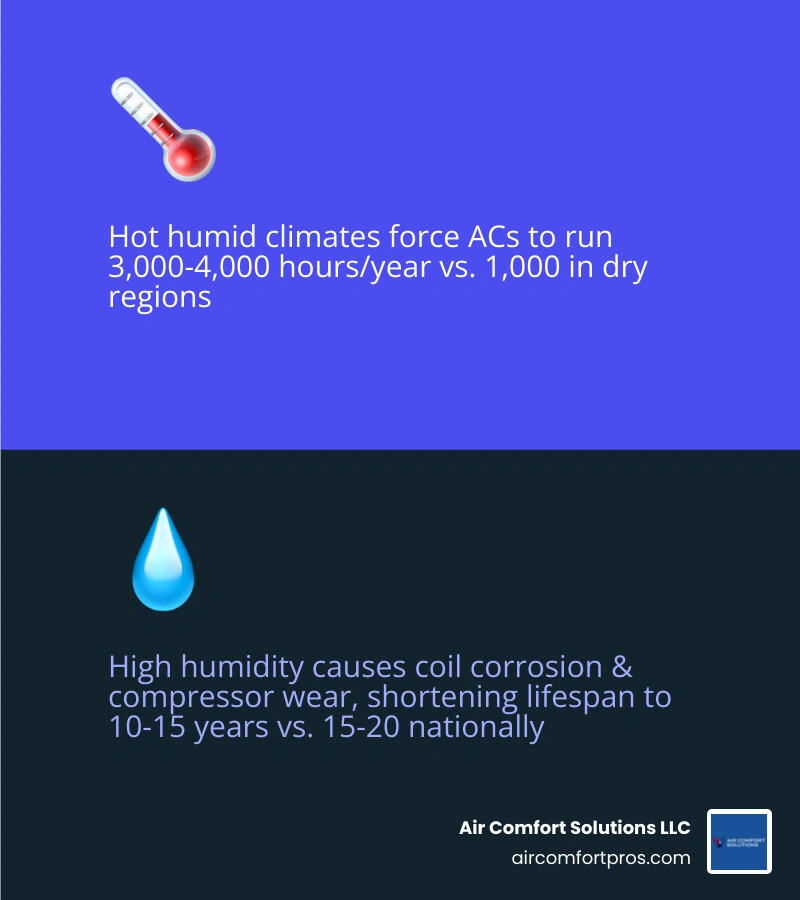
• Longer run times - Systems in hot, humid regions like Pinehurst can run 3,000-4,000 hours per year, compared to around 1,000 hours in northern states
• Accelerated compressor wear - The most expensive component in your system wears out in 10-15 years in humid climates vs. 15-20 years in milder regions
• Coil corrosion - Constant moisture exposure breaks down aluminum fins and copper coils faster
• Mold and mildew buildup - Excess moisture in drain pans and ductwork creates biofilm that chokes airflow and strains components
• Shorter overall lifespan - HVAC systems in hot, humid climates typically last 10-15 years, compared to the national average of 15-20 years
The math is sobering. A Florida or Gulf Coast system can accumulate the equivalent of 15 years of northern wear in just 5 to 6 years. The same principle applies right here in North Harris County. Your system is not failing because it is cheap or poorly made — it is failing because the climate is genuinely that demanding.
The good news? Understanding why this happens puts you in control of what to do about it.
To understand why our local climate is so taxing, we have to look at the "latent load." In HVAC terms, sensible heat is what you see on the thermometer, but latent heat is the energy held in water vapor. In Pinehurst and surrounding areas like Tomball and Magnolia, the latent load is massive. Your air conditioner acts as a giant dehumidifier, but when the air is "soupy," the coils stay saturated.
This constant moisture creates a cycle of fatigue. Because humid air holds onto heat more effectively than dry air, your home feels warmer even at lower temperatures. This often leads homeowners to "crank down" the thermostat, which only forces the system to run longer cycles. When a system runs for 3,000 to 4,000 hours annually—as many do in Southeast Texas—the mechanical parts simply reach their "mileage limit" much sooner than a system in a temperate state like Ohio or Michigan.
If you find yourself wondering why your home feels "sticky" even when the air is blowing cold, you may need to Address High Humidity Despite Running AC. When the relative humidity inside stays above 60%, the system isn't just working hard; it's struggling to stay ahead of the moisture infiltration.
One of the silent killers of HVAC longevity in our region is formicary corrosion. This isn't your typical "rust." It is a sophisticated type of copper corrosion caused by a chemical reaction between moisture, copper, and organic acids found in household products. In a high-humidity environment, the evaporator coil is constantly wet. This wetness acts as a catalyst, creating microscopic tunnels (pitting) through the copper tubing.
Furthermore, for those of us in the North Houston area, environmental factors like salt air (which can travel further inland than most realize) and industrial emissions accelerate the breakdown of aluminum fins. Once these fins corrode, they lose their ability to transfer heat efficiently. This is why AC Maintenance Spring TX is so critical; regular cleaning removes the corrosive films before they can eat through the metal.
The compressor is the heart of your HVAC system, and in a hot, humid climate, it’s essentially running a marathon every single day. High outdoor temperatures create high "head pressure" within the system. To move heat from a 75°F indoors to a 100°F outdoors, the compressor has to work significantly harder than it would if it were only 85°F outside.
When you add humidity to the mix, the system has to run much longer to achieve the same level of comfort. This leads to thermal stress. Internal valves can leak, motor windings can overheat, and the lubricant inside the compressor can break down. Without proper HVAC Maintenance Magnolia TX, a compressor that should have lasted 20 years might give up the ghost by year 11 or 12.
It isn't just the "big" parts that suffer. The humid Texas environment attacks the entire ecosystem of your HVAC unit. Moisture is the enemy of electrical components and structural integrity.
• Evaporator Coils: These stay damp for months at a time, making them ground zero for corrosion and mold.
• Condensate Lines and Drain Pans: High humidity means a massive volume of water is being pulled from your air. If the drain pan is pitched incorrectly or the line is clogged with "algae" (biofilm), water will back up.
• Electrical Contactors and Capacitors: Frequent cycling in high heat causes these parts to pit and fail. In our area, even fire ants are attracted to the electrical fields in outdoor units, often causing short circuits.
• Blower Motors: When coils are clogged with moisture and dust, the blower motor has to work against higher "static pressure," leading to premature burnout.
Protecting your IAQ (Indoor Air Quality) is also a struggle when these components fail. A damp system is a breeding ground for biological growth that can eventually spread into your ductwork.
You don't have to be an HVAC expert to know when the Pinehurst humidity is winning the war. Your system will usually send out "S.O.S." signals before it fails completely.
1. Short Cycling: If your AC turns on and off every few minutes, it’s likely over-pressurizing or overheating. This is a primary way how hot humid climate shortens hvac lifespan—the constant starting and stopping places immense torque on the motor.
2. Musty Odors: That "dirty sock" smell usually indicates that moisture isn't draining properly, leading to biological growth on the coils or in the ducts.
3. Ice on the Lines: It seems counterintuitive, but high humidity combined with restricted airflow (from a dirty filter or corroded coil) can cause the refrigerant lines to freeze over, even in 100-degree weather.
4. Inconsistent Temperatures: If the living room is a sauna but the bedroom is an icebox, your system is likely losing its "static" push due to wear and tear.
If you notice these signs, it's time to learn What to Expect During Your First AC Tune-Up. Catching a failing capacitor or a clogged drain line early can save the compressor from a fatal heart attack later in the season.
While we can't change the Texas weather, we can change how your system handles it. Modern technology has given us several tools to fight back against the humidity.
Traditional AC units are either "on" or "off." Variable-speed units, however, can run at lower speeds for longer periods. This is actually better for your system. It allows for constant dehumidification without the mechanical stress of frequent starts and stops.
By installing a dedicated dehumidifier, you take the "latent load" off your AC. This allows the AC to focus solely on cooling the air, which can extend its lifespan by several years. For those concerned about allergens and mold, pairing this with Whole Home Air Purifiers Cypress TX ensures your air is both dry and clean.
• Humidity Control — Single-Stage AC: Moderate (only when cooling) — Variable-Speed AC: Excellent (runs longer at low speed)
• Energy Efficiency — Single-Stage AC: Standard — Variable-Speed AC: High
• System Stress — Single-Stage AC: High (frequent starts/stops) — Variable-Speed AC: Low (gradual adjustments)
• Lifespan in Pinehurst — Single-Stage AC: 10-12 years — Variable-Speed AC: 13-15+ years (with maintenance)
• Filter Changes: In high-use months, change your filters every 30 days.
• Outdoor Clearance: Keep at least 2 feet of space around your outdoor unit. Trim back those Texas shrubs!
• Coil Rinsing: Gently rinsing your outdoor coils with a garden hose (not a pressure washer!) can remove salt and dust buildup.
Eventually, every homeowner in the Houston area faces the big question: do I fix it again or start fresh?
In our experience, the "$5,000 Rule" is a great starting point. Multiply the age of your system by the cost of the repair. If the total is more than $5,000, it is usually more economical to replace the unit. For example, a $600 repair on a 10-year-old system equals $6,000—suggesting it's time for an upgrade.
Furthermore, consider the SEER2 ratings. Older systems (pre-2015) often have SEER ratings around 10 or 13. New systems in our region are now required to be at least 15 SEER2. The energy savings alone can often offset the cost of a new unit over a few summers. If you have a heat pump, it works year-round in Texas, so Heat Pump Maintenance Houston TX is even more vital for making that repair-vs-replace decision.
In Pinehurst and the surrounding North Harris County area, you can expect a central AC or heat pump to last between 10 and 14 years. While systems in the North might reach 20 years, the heavy workload and humidity here cause components to age roughly twice as fast.
Yes. When the AC pulls moisture out of the air, the inside of the air handler becomes very damp. If dust (which acts as food) gets past your filter and settles on those damp coils, mold can begin to grow. This is why high-quality filtration and regular coil cleaning are non-negotiable in Texas.
We recommend professional maintenance at least twice a year—once in the spring before the brutal heat hits, and once in the fall. Because our systems run for thousands of hours, a "once a year" checkup often isn't enough to catch the rapid wear caused by our humidity.
At Air Comfort Solutions LLC, we have spent over 35 years helping our neighbors in Pinehurst, Tomball, Magnolia, and across North Harris County navigate the challenges of our unique climate. We know exactly how hot humid climate shortens hvac lifespan, and we have the certified expertise to help you fight back.
Whether you need a precision tune-up to clear out a season's worth of humidity-induced "sludge" or you're ready to explore a high-efficiency variable-speed replacement, we are here to provide honest, upfront solutions. Don't wait for the next 100-degree day to find out your system is struggling.
Protect your investment and your family's comfort by joining our Maintenance Plan today. From Spring to Plantersville, we’ve got you covered.
Contact our experts for reliable HVAC solutions and let us help you get the maximum life out of your air conditioning system!
How hot humid climate shortens hvac lifespan comes down to one simple truth: your system never gets a break. In a place like Pinehurst, TX, where summer humidity regularly pushes past 70-90% and temperatures stay brutal for months, your AC is fighting two battles at once — removing heat and pulling moisture from the air. That double workload adds up fast.
Here is a quick breakdown of the main ways hot, humid conditions cut years off your system:
The math is sobering. A Florida or Gulf Coast system can accumulate the equivalent of 15 years of northern wear in just 5 to 6 years. The same principle applies right here in North Harris County. Your system is not failing because it is cheap or poorly made — it is failing because the climate is genuinely that demanding.
The good news? Understanding why this happens puts you in control of what to do about it.
To understand why our local climate is so taxing, we have to look at the "latent load." In HVAC terms, sensible heat is what you see on the thermometer, but latent heat is the energy held in water vapor. In Pinehurst and surrounding areas like Tomball and Magnolia, the latent load is massive. Your air conditioner acts as a giant dehumidifier, but when the air is "soupy," the coils stay saturated.
This constant moisture creates a cycle of fatigue. Because humid air holds onto heat more effectively than dry air, your home feels warmer even at lower temperatures. This often leads homeowners to "crank down" the thermostat, which only forces the system to run longer cycles. When a system runs for 3,000 to 4,000 hours annually—as many do in Southeast Texas—the mechanical parts simply reach their "mileage limit" much sooner than a system in a temperate state like Ohio or Michigan.
If you find yourself wondering why your home feels "sticky" even when the air is blowing cold, you may need to Address High Humidity Despite Running AC. When the relative humidity inside stays above 60%, the system isn't just working hard; it's struggling to stay ahead of the moisture infiltration.
One of the silent killers of HVAC longevity in our region is formicary corrosion. This isn't your typical "rust." It is a sophisticated type of copper corrosion caused by a chemical reaction between moisture, copper, and organic acids found in household products. In a high-humidity environment, the evaporator coil is constantly wet. This wetness acts as a catalyst, creating microscopic tunnels (pitting) through the copper tubing.
Furthermore, for those of us in the North Houston area, environmental factors like salt air (which can travel further inland than most realize) and industrial emissions accelerate the breakdown of aluminum fins. Once these fins corrode, they lose their ability to transfer heat efficiently. This is why AC Maintenance Spring TX is so critical; regular cleaning removes the corrosive films before they can eat through the metal.
The compressor is the heart of your HVAC system, and in a hot, humid climate, it’s essentially running a marathon every single day. High outdoor temperatures create high "head pressure" within the system. To move heat from a 75°F indoors to a 100°F outdoors, the compressor has to work significantly harder than it would if it were only 85°F outside.
When you add humidity to the mix, the system has to run much longer to achieve the same level of comfort. This leads to thermal stress. Internal valves can leak, motor windings can overheat, and the lubricant inside the compressor can break down. Without proper HVAC Maintenance Magnolia TX, a compressor that should have lasted 20 years might give up the ghost by year 11 or 12.
It isn't just the "big" parts that suffer. The humid Texas environment attacks the entire ecosystem of your HVAC unit. Moisture is the enemy of electrical components and structural integrity.
Protecting your IAQ (Indoor Air Quality) is also a struggle when these components fail. A damp system is a breeding ground for biological growth that can eventually spread into your ductwork.
You don't have to be an HVAC expert to know when the Pinehurst humidity is winning the war. Your system will usually send out "S.O.S." signals before it fails completely.
If you notice these signs, it's time to learn What to Expect During Your First AC Tune-Up. Catching a failing capacitor or a clogged drain line early can save the compressor from a fatal heart attack later in the season.
While we can't change the Texas weather, we can change how your system handles it. Modern technology has given us several tools to fight back against the humidity.
Traditional AC units are either "on" or "off." Variable-speed units, however, can run at lower speeds for longer periods. This is actually better for your system. It allows for constant dehumidification without the mechanical stress of frequent starts and stops.
By installing a dedicated dehumidifier, you take the "latent load" off your AC. This allows the AC to focus solely on cooling the air, which can extend its lifespan by several years. For those concerned about allergens and mold, pairing this with Whole Home Air Purifiers Cypress TX ensures your air is both dry and clean.
| Feature | Single-Stage AC | Variable-Speed AC |
|---|---|---|
| Humidity Control | Moderate (only when cooling) | Excellent (runs longer at low speed) |
| Energy Efficiency | Standard | High |
| System Stress | High (frequent starts/stops) | Low (gradual adjustments) |
| Lifespan in Pinehurst | 10-12 years | 13-15+ years (with maintenance) |
Eventually, every homeowner in the Houston area faces the big question: do I fix it again or start fresh?
In our experience, the "$5,000 Rule" is a great starting point. Multiply the age of your system by the cost of the repair. If the total is more than $5,000, it is usually more economical to replace the unit. For example, a $600 repair on a 10-year-old system equals $6,000—suggesting it's time for an upgrade.
Furthermore, consider the SEER2 ratings. Older systems (pre-2015) often have SEER ratings around 10 or 13. New systems in our region are now required to be at least 15 SEER2. The energy savings alone can often offset the cost of a new unit over a few summers. If you have a heat pump, it works year-round in Texas, so Heat Pump Maintenance Houston TX is even more vital for making that repair-vs-replace decision.
In Pinehurst and the surrounding North Harris County area, you can expect a central AC or heat pump to last between 10 and 14 years. While systems in the North might reach 20 years, the heavy workload and humidity here cause components to age roughly twice as fast.
Yes. When the AC pulls moisture out of the air, the inside of the air handler becomes very damp. If dust (which acts as food) gets past your filter and settles on those damp coils, mold can begin to grow. This is why high-quality filtration and regular coil cleaning are non-negotiable in Texas.
We recommend professional maintenance at least twice a year—once in the spring before the brutal heat hits, and once in the fall. Because our systems run for thousands of hours, a "once a year" checkup often isn't enough to catch the rapid wear caused by our humidity.
At Air Comfort Solutions LLC, we have spent over 35 years helping our neighbors in Pinehurst, Tomball, Magnolia, and across North Harris County navigate the challenges of our unique climate. We know exactly how hot humid climate shortens hvac lifespan, and we have the certified expertise to help you fight back.
Whether you need a precision tune-up to clear out a season's worth of humidity-induced "sludge" or you're ready to explore a high-efficiency variable-speed replacement, we are here to provide honest, upfront solutions. Don't wait for the next 100-degree day to find out your system is struggling.
Protect your investment and your family's comfort by joining our Maintenance Plan today. From Spring to Plantersville, we’ve got you covered.
Contact our experts for reliable HVAC solutions and let us help you get the maximum life out of your air conditioning system!
How hot humid climate shortens hvac lifespan comes down to one simple truth: your system never gets a break. In a place like Pinehurst, TX, where summer humidity regularly pushes past 70-90% and temperatures stay brutal for months, your AC is fighting two battles at once — removing heat and pulling moisture from the air. That double workload adds up fast.
Here is a quick breakdown of the main ways hot, humid conditions cut years off your system:
The math is sobering. A Florida or Gulf Coast system can accumulate the equivalent of 15 years of northern wear in just 5 to 6 years. The same principle applies right here in North Harris County. Your system is not failing because it is cheap or poorly made — it is failing because the climate is genuinely that demanding.
The good news? Understanding why this happens puts you in control of what to do about it.
To understand why our local climate is so taxing, we have to look at the "latent load." In HVAC terms, sensible heat is what you see on the thermometer, but latent heat is the energy held in water vapor. In Pinehurst and surrounding areas like Tomball and Magnolia, the latent load is massive. Your air conditioner acts as a giant dehumidifier, but when the air is "soupy," the coils stay saturated.
This constant moisture creates a cycle of fatigue. Because humid air holds onto heat more effectively than dry air, your home feels warmer even at lower temperatures. This often leads homeowners to "crank down" the thermostat, which only forces the system to run longer cycles. When a system runs for 3,000 to 4,000 hours annually—as many do in Southeast Texas—the mechanical parts simply reach their "mileage limit" much sooner than a system in a temperate state like Ohio or Michigan.
If you find yourself wondering why your home feels "sticky" even when the air is blowing cold, you may need to Address High Humidity Despite Running AC. When the relative humidity inside stays above 60%, the system isn't just working hard; it's struggling to stay ahead of the moisture infiltration.
One of the silent killers of HVAC longevity in our region is formicary corrosion. This isn't your typical "rust." It is a sophisticated type of copper corrosion caused by a chemical reaction between moisture, copper, and organic acids found in household products. In a high-humidity environment, the evaporator coil is constantly wet. This wetness acts as a catalyst, creating microscopic tunnels (pitting) through the copper tubing.
Furthermore, for those of us in the North Houston area, environmental factors like salt air (which can travel further inland than most realize) and industrial emissions accelerate the breakdown of aluminum fins. Once these fins corrode, they lose their ability to transfer heat efficiently. This is why AC Maintenance Spring TX is so critical; regular cleaning removes the corrosive films before they can eat through the metal.
The compressor is the heart of your HVAC system, and in a hot, humid climate, it’s essentially running a marathon every single day. High outdoor temperatures create high "head pressure" within the system. To move heat from a 75°F indoors to a 100°F outdoors, the compressor has to work significantly harder than it would if it were only 85°F outside.
When you add humidity to the mix, the system has to run much longer to achieve the same level of comfort. This leads to thermal stress. Internal valves can leak, motor windings can overheat, and the lubricant inside the compressor can break down. Without proper HVAC Maintenance Magnolia TX, a compressor that should have lasted 20 years might give up the ghost by year 11 or 12.
It isn't just the "big" parts that suffer. The humid Texas environment attacks the entire ecosystem of your HVAC unit. Moisture is the enemy of electrical components and structural integrity.
Protecting your IAQ (Indoor Air Quality) is also a struggle when these components fail. A damp system is a breeding ground for biological growth that can eventually spread into your ductwork.
You don't have to be an HVAC expert to know when the Pinehurst humidity is winning the war. Your system will usually send out "S.O.S." signals before it fails completely.
If you notice these signs, it's time to learn What to Expect During Your First AC Tune-Up. Catching a failing capacitor or a clogged drain line early can save the compressor from a fatal heart attack later in the season.
While we can't change the Texas weather, we can change how your system handles it. Modern technology has given us several tools to fight back against the humidity.
Traditional AC units are either "on" or "off." Variable-speed units, however, can run at lower speeds for longer periods. This is actually better for your system. It allows for constant dehumidification without the mechanical stress of frequent starts and stops.
By installing a dedicated dehumidifier, you take the "latent load" off your AC. This allows the AC to focus solely on cooling the air, which can extend its lifespan by several years. For those concerned about allergens and mold, pairing this with Whole Home Air Purifiers Cypress TX ensures your air is both dry and clean.
| Feature | Single-Stage AC | Variable-Speed AC |
|---|---|---|
| Humidity Control | Moderate (only when cooling) | Excellent (runs longer at low speed) |
| Energy Efficiency | Standard | High |
| System Stress | High (frequent starts/stops) | Low (gradual adjustments) |
| Lifespan in Pinehurst | 10-12 years | 13-15+ years (with maintenance) |
Eventually, every homeowner in the Houston area faces the big question: do I fix it again or start fresh?
In our experience, the "$5,000 Rule" is a great starting point. Multiply the age of your system by the cost of the repair. If the total is more than $5,000, it is usually more economical to replace the unit. For example, a $600 repair on a 10-year-old system equals $6,000—suggesting it's time for an upgrade.
Furthermore, consider the SEER2 ratings. Older systems (pre-2015) often have SEER ratings around 10 or 13. New systems in our region are now required to be at least 15 SEER2. The energy savings alone can often offset the cost of a new unit over a few summers. If you have a heat pump, it works year-round in Texas, so Heat Pump Maintenance Houston TX is even more vital for making that repair-vs-replace decision.
In Pinehurst and the surrounding North Harris County area, you can expect a central AC or heat pump to last between 10 and 14 years. While systems in the North might reach 20 years, the heavy workload and humidity here cause components to age roughly twice as fast.
Yes. When the AC pulls moisture out of the air, the inside of the air handler becomes very damp. If dust (which acts as food) gets past your filter and settles on those damp coils, mold can begin to grow. This is why high-quality filtration and regular coil cleaning are non-negotiable in Texas.
We recommend professional maintenance at least twice a year—once in the spring before the brutal heat hits, and once in the fall. Because our systems run for thousands of hours, a "once a year" checkup often isn't enough to catch the rapid wear caused by our humidity.
At Air Comfort Solutions LLC, we have spent over 35 years helping our neighbors in Pinehurst, Tomball, Magnolia, and across North Harris County navigate the challenges of our unique climate. We know exactly how hot humid climate shortens hvac lifespan, and we have the certified expertise to help you fight back.
Whether you need a precision tune-up to clear out a season's worth of humidity-induced "sludge" or you're ready to explore a high-efficiency variable-speed replacement, we are here to provide honest, upfront solutions. Don't wait for the next 100-degree day to find out your system is struggling.
Protect your investment and your family's comfort by joining our Maintenance Plan today. From Spring to Plantersville, we’ve got you covered.
Contact our experts for reliable HVAC solutions and let us help you get the maximum life out of your air conditioning system!
How hot humid climate shortens hvac lifespan comes down to one simple truth: your system never gets a break. In a place like Pinehurst, TX, where summer humidity regularly pushes past 70-90% and temperatures stay brutal for months, your AC is fighting two battles at once — removing heat and pulling moisture from the air. That double workload adds up fast.
Here is a quick breakdown of the main ways hot, humid conditions cut years off your system:
The math is sobering. A Florida or Gulf Coast system can accumulate the equivalent of 15 years of northern wear in just 5 to 6 years. The same principle applies right here in North Harris County. Your system is not failing because it is cheap or poorly made — it is failing because the climate is genuinely that demanding.
The good news? Understanding why this happens puts you in control of what to do about it.
To understand why our local climate is so taxing, we have to look at the "latent load." In HVAC terms, sensible heat is what you see on the thermometer, but latent heat is the energy held in water vapor. In Pinehurst and surrounding areas like Tomball and Magnolia, the latent load is massive. Your air conditioner acts as a giant dehumidifier, but when the air is "soupy," the coils stay saturated.
This constant moisture creates a cycle of fatigue. Because humid air holds onto heat more effectively than dry air, your home feels warmer even at lower temperatures. This often leads homeowners to "crank down" the thermostat, which only forces the system to run longer cycles. When a system runs for 3,000 to 4,000 hours annually—as many do in Southeast Texas—the mechanical parts simply reach their "mileage limit" much sooner than a system in a temperate state like Ohio or Michigan.
If you find yourself wondering why your home feels "sticky" even when the air is blowing cold, you may need to Address High Humidity Despite Running AC. When the relative humidity inside stays above 60%, the system isn't just working hard; it's struggling to stay ahead of the moisture infiltration.
One of the silent killers of HVAC longevity in our region is formicary corrosion. This isn't your typical "rust." It is a sophisticated type of copper corrosion caused by a chemical reaction between moisture, copper, and organic acids found in household products. In a high-humidity environment, the evaporator coil is constantly wet. This wetness acts as a catalyst, creating microscopic tunnels (pitting) through the copper tubing.
Furthermore, for those of us in the North Houston area, environmental factors like salt air (which can travel further inland than most realize) and industrial emissions accelerate the breakdown of aluminum fins. Once these fins corrode, they lose their ability to transfer heat efficiently. This is why AC Maintenance Spring TX is so critical; regular cleaning removes the corrosive films before they can eat through the metal.
The compressor is the heart of your HVAC system, and in a hot, humid climate, it’s essentially running a marathon every single day. High outdoor temperatures create high "head pressure" within the system. To move heat from a 75°F indoors to a 100°F outdoors, the compressor has to work significantly harder than it would if it were only 85°F outside.
When you add humidity to the mix, the system has to run much longer to achieve the same level of comfort. This leads to thermal stress. Internal valves can leak, motor windings can overheat, and the lubricant inside the compressor can break down. Without proper HVAC Maintenance Magnolia TX, a compressor that should have lasted 20 years might give up the ghost by year 11 or 12.
It isn't just the "big" parts that suffer. The humid Texas environment attacks the entire ecosystem of your HVAC unit. Moisture is the enemy of electrical components and structural integrity.
Protecting your IAQ (Indoor Air Quality) is also a struggle when these components fail. A damp system is a breeding ground for biological growth that can eventually spread into your ductwork.
You don't have to be an HVAC expert to know when the Pinehurst humidity is winning the war. Your system will usually send out "S.O.S." signals before it fails completely.
If you notice these signs, it's time to learn What to Expect During Your First AC Tune-Up. Catching a failing capacitor or a clogged drain line early can save the compressor from a fatal heart attack later in the season.
While we can't change the Texas weather, we can change how your system handles it. Modern technology has given us several tools to fight back against the humidity.
Traditional AC units are either "on" or "off." Variable-speed units, however, can run at lower speeds for longer periods. This is actually better for your system. It allows for constant dehumidification without the mechanical stress of frequent starts and stops.
By installing a dedicated dehumidifier, you take the "latent load" off your AC. This allows the AC to focus solely on cooling the air, which can extend its lifespan by several years. For those concerned about allergens and mold, pairing this with Whole Home Air Purifiers Cypress TX ensures your air is both dry and clean.
| Feature | Single-Stage AC | Variable-Speed AC |
|---|---|---|
| Humidity Control | Moderate (only when cooling) | Excellent (runs longer at low speed) |
| Energy Efficiency | Standard | High |
| System Stress | High (frequent starts/stops) | Low (gradual adjustments) |
| Lifespan in Pinehurst | 10-12 years | 13-15+ years (with maintenance) |
Eventually, every homeowner in the Houston area faces the big question: do I fix it again or start fresh?
In our experience, the "$5,000 Rule" is a great starting point. Multiply the age of your system by the cost of the repair. If the total is more than $5,000, it is usually more economical to replace the unit. For example, a $600 repair on a 10-year-old system equals $6,000—suggesting it's time for an upgrade.
Furthermore, consider the SEER2 ratings. Older systems (pre-2015) often have SEER ratings around 10 or 13. New systems in our region are now required to be at least 15 SEER2. The energy savings alone can often offset the cost of a new unit over a few summers. If you have a heat pump, it works year-round in Texas, so Heat Pump Maintenance Houston TX is even more vital for making that repair-vs-replace decision.
In Pinehurst and the surrounding North Harris County area, you can expect a central AC or heat pump to last between 10 and 14 years. While systems in the North might reach 20 years, the heavy workload and humidity here cause components to age roughly twice as fast.
Yes. When the AC pulls moisture out of the air, the inside of the air handler becomes very damp. If dust (which acts as food) gets past your filter and settles on those damp coils, mold can begin to grow. This is why high-quality filtration and regular coil cleaning are non-negotiable in Texas.
We recommend professional maintenance at least twice a year—once in the spring before the brutal heat hits, and once in the fall. Because our systems run for thousands of hours, a "once a year" checkup often isn't enough to catch the rapid wear caused by our humidity.
At Air Comfort Solutions LLC, we have spent over 35 years helping our neighbors in Pinehurst, Tomball, Magnolia, and across North Harris County navigate the challenges of our unique climate. We know exactly how hot humid climate shortens hvac lifespan, and we have the certified expertise to help you fight back.
Whether you need a precision tune-up to clear out a season's worth of humidity-induced "sludge" or you're ready to explore a high-efficiency variable-speed replacement, we are here to provide honest, upfront solutions. Don't wait for the next 100-degree day to find out your system is struggling.
Protect your investment and your family's comfort by joining our Maintenance Plan today. From Spring to Plantersville, we’ve got you covered.
Contact our experts for reliable HVAC solutions and let us help you get the maximum life out of your air conditioning system!
How hot humid climate shortens hvac lifespan comes down to one simple truth: your system never gets a break. In a place like Pinehurst, TX, where summer humidity regularly pushes past 70-90% and temperatures stay brutal for months, your AC is fighting two battles at once — removing heat and pulling moisture from the air. That double workload adds up fast.
Here is a quick breakdown of the main ways hot, humid conditions cut years off your system:
The math is sobering. A Florida or Gulf Coast system can accumulate the equivalent of 15 years of northern wear in just 5 to 6 years. The same principle applies right here in North Harris County. Your system is not failing because it is cheap or poorly made — it is failing because the climate is genuinely that demanding.
The good news? Understanding why this happens puts you in control of what to do about it.
To understand why our local climate is so taxing, we have to look at the "latent load." In HVAC terms, sensible heat is what you see on the thermometer, but latent heat is the energy held in water vapor. In Pinehurst and surrounding areas like Tomball and Magnolia, the latent load is massive. Your air conditioner acts as a giant dehumidifier, but when the air is "soupy," the coils stay saturated.
This constant moisture creates a cycle of fatigue. Because humid air holds onto heat more effectively than dry air, your home feels warmer even at lower temperatures. This often leads homeowners to "crank down" the thermostat, which only forces the system to run longer cycles. When a system runs for 3,000 to 4,000 hours annually—as many do in Southeast Texas—the mechanical parts simply reach their "mileage limit" much sooner than a system in a temperate state like Ohio or Michigan.
If you find yourself wondering why your home feels "sticky" even when the air is blowing cold, you may need to Address High Humidity Despite Running AC. When the relative humidity inside stays above 60%, the system isn't just working hard; it's struggling to stay ahead of the moisture infiltration.
One of the silent killers of HVAC longevity in our region is formicary corrosion. This isn't your typical "rust." It is a sophisticated type of copper corrosion caused by a chemical reaction between moisture, copper, and organic acids found in household products. In a high-humidity environment, the evaporator coil is constantly wet. This wetness acts as a catalyst, creating microscopic tunnels (pitting) through the copper tubing.
Furthermore, for those of us in the North Houston area, environmental factors like salt air (which can travel further inland than most realize) and industrial emissions accelerate the breakdown of aluminum fins. Once these fins corrode, they lose their ability to transfer heat efficiently. This is why AC Maintenance Spring TX is so critical; regular cleaning removes the corrosive films before they can eat through the metal.
The compressor is the heart of your HVAC system, and in a hot, humid climate, it’s essentially running a marathon every single day. High outdoor temperatures create high "head pressure" within the system. To move heat from a 75°F indoors to a 100°F outdoors, the compressor has to work significantly harder than it would if it were only 85°F outside.
When you add humidity to the mix, the system has to run much longer to achieve the same level of comfort. This leads to thermal stress. Internal valves can leak, motor windings can overheat, and the lubricant inside the compressor can break down. Without proper HVAC Maintenance Magnolia TX, a compressor that should have lasted 20 years might give up the ghost by year 11 or 12.
It isn't just the "big" parts that suffer. The humid Texas environment attacks the entire ecosystem of your HVAC unit. Moisture is the enemy of electrical components and structural integrity.
Protecting your IAQ (Indoor Air Quality) is also a struggle when these components fail. A damp system is a breeding ground for biological growth that can eventually spread into your ductwork.
You don't have to be an HVAC expert to know when the Pinehurst humidity is winning the war. Your system will usually send out "S.O.S." signals before it fails completely.
If you notice these signs, it's time to learn What to Expect During Your First AC Tune-Up. Catching a failing capacitor or a clogged drain line early can save the compressor from a fatal heart attack later in the season.
While we can't change the Texas weather, we can change how your system handles it. Modern technology has given us several tools to fight back against the humidity.
Traditional AC units are either "on" or "off." Variable-speed units, however, can run at lower speeds for longer periods. This is actually better for your system. It allows for constant dehumidification without the mechanical stress of frequent starts and stops.
By installing a dedicated dehumidifier, you take the "latent load" off your AC. This allows the AC to focus solely on cooling the air, which can extend its lifespan by several years. For those concerned about allergens and mold, pairing this with Whole Home Air Purifiers Cypress TX ensures your air is both dry and clean.
| Feature | Single-Stage AC | Variable-Speed AC |
|---|---|---|
| Humidity Control | Moderate (only when cooling) | Excellent (runs longer at low speed) |
| Energy Efficiency | Standard | High |
| System Stress | High (frequent starts/stops) | Low (gradual adjustments) |
| Lifespan in Pinehurst | 10-12 years | 13-15+ years (with maintenance) |
Eventually, every homeowner in the Houston area faces the big question: do I fix it again or start fresh?
In our experience, the "$5,000 Rule" is a great starting point. Multiply the age of your system by the cost of the repair. If the total is more than $5,000, it is usually more economical to replace the unit. For example, a $600 repair on a 10-year-old system equals $6,000—suggesting it's time for an upgrade.
Furthermore, consider the SEER2 ratings. Older systems (pre-2015) often have SEER ratings around 10 or 13. New systems in our region are now required to be at least 15 SEER2. The energy savings alone can often offset the cost of a new unit over a few summers. If you have a heat pump, it works year-round in Texas, so Heat Pump Maintenance Houston TX is even more vital for making that repair-vs-replace decision.
In Pinehurst and the surrounding North Harris County area, you can expect a central AC or heat pump to last between 10 and 14 years. While systems in the North might reach 20 years, the heavy workload and humidity here cause components to age roughly twice as fast.
Yes. When the AC pulls moisture out of the air, the inside of the air handler becomes very damp. If dust (which acts as food) gets past your filter and settles on those damp coils, mold can begin to grow. This is why high-quality filtration and regular coil cleaning are non-negotiable in Texas.
We recommend professional maintenance at least twice a year—once in the spring before the brutal heat hits, and once in the fall. Because our systems run for thousands of hours, a "once a year" checkup often isn't enough to catch the rapid wear caused by our humidity.
At Air Comfort Solutions LLC, we have spent over 35 years helping our neighbors in Pinehurst, Tomball, Magnolia, and across North Harris County navigate the challenges of our unique climate. We know exactly how hot humid climate shortens hvac lifespan, and we have the certified expertise to help you fight back.
Whether you need a precision tune-up to clear out a season's worth of humidity-induced "sludge" or you're ready to explore a high-efficiency variable-speed replacement, we are here to provide honest, upfront solutions. Don't wait for the next 100-degree day to find out your system is struggling.
Protect your investment and your family's comfort by joining our Maintenance Plan today. From Spring to Plantersville, we’ve got you covered.
Contact our experts for reliable HVAC solutions and let us help you get the maximum life out of your air conditioning system!


Zane came out and did an amazing job! Super friendly, honest and transparent about the work that needed to be done. This is my second time working with Air Comfort Solutions and they’re my go to for HVAC services. Highly recommend.
God's AMAZING grace sent us Robert and Zane. We have been without air in this Texas heat for six weeks and four days. We've had a few contractors give us quotes all trying to upsell when we're at a low point. But not the guys at Air Comfort Solutions. They came in assessed our situation, gave us honest feedback, and showed us the issues as they proceeded with the assessment for clear understanding. We highly recommend them for their professionalism, quality products, and fair pricing. We hands down support them for all the work they do 💯 %.
Robert and Zane gone above and beyond to make the process easy and affordable.
Would definitely recommend!!
I’m writing this review to let everyone know that Air Comfort Solutions is the company to work with. I know the owner ( Robert) for several years now. He has been taking care of my residential and business work orders. Robert is professional, knowledgeable and will save you money. I just want to thank Robert for great job you have been doing for me.