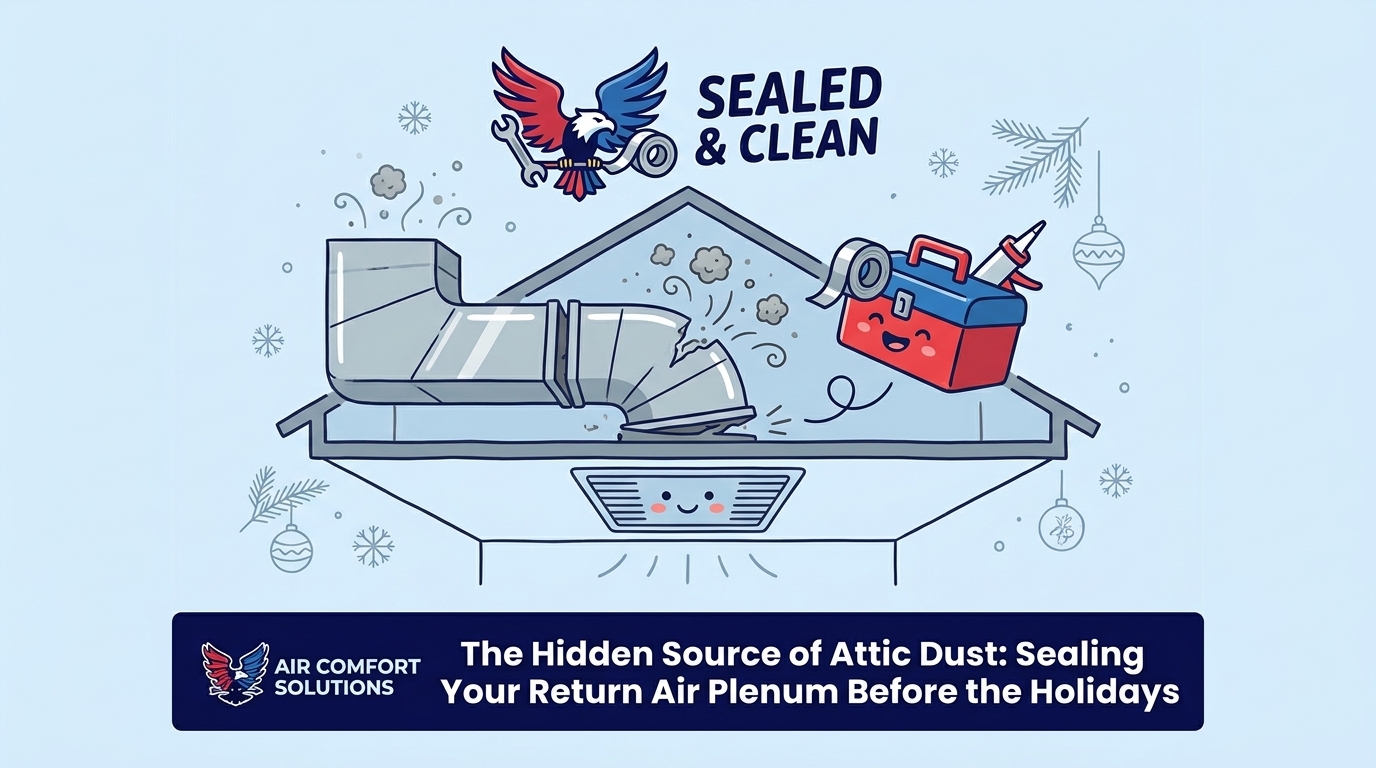
The Value of Sealing Your Return Air Plenum Before the Holidays
Most homeowners buy expensive filters to fix dusty air, not realizing a leaky return plenum in the attic is the real culprit. See why sealing it now saves your holiday gatherings.
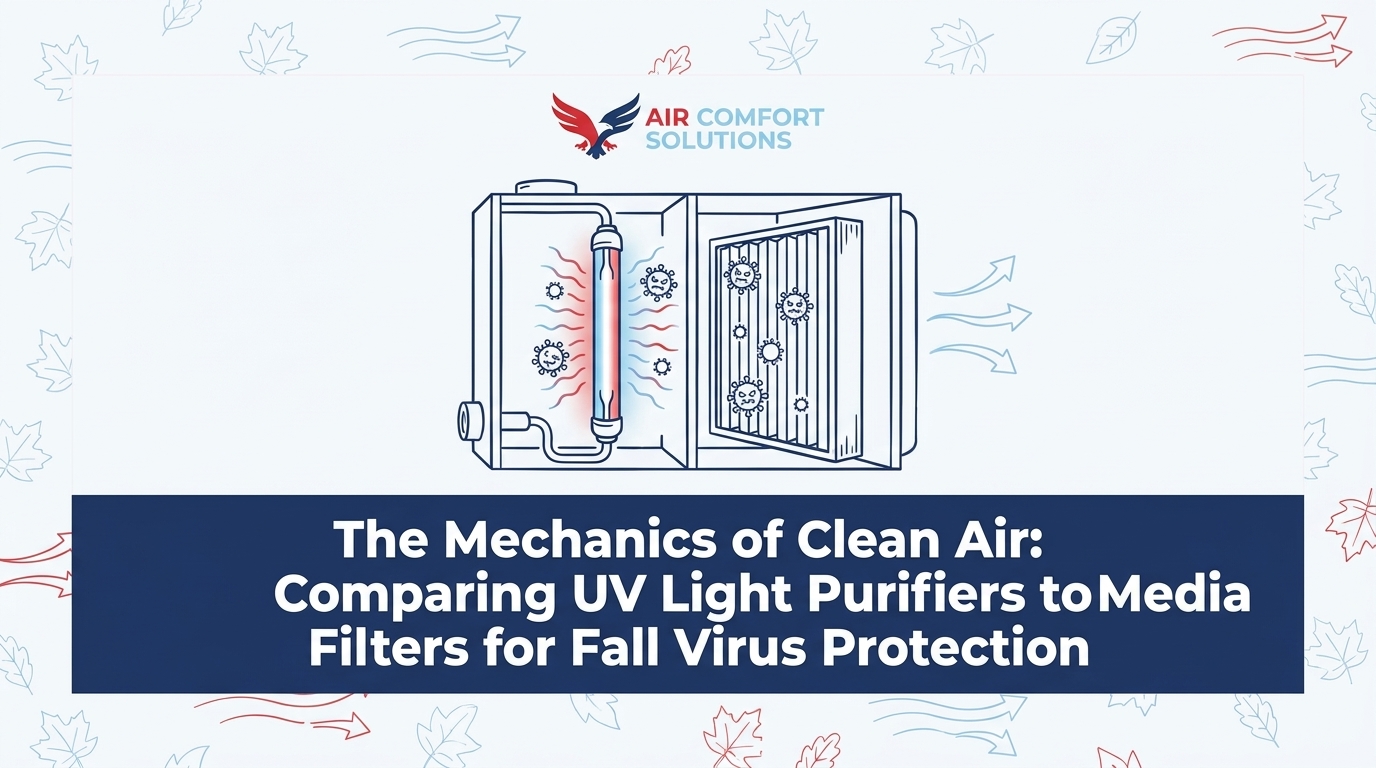
When comparing UV light purifiers to media filters for fall virus protection, our technicians frequently encounter a common myth: the belief that slapping a high-end filter into your HVAC system is guaranteed to stop back-to-school viruses from spreading through your home. You might assume that because a product is labeled as an "air purifier" or a "premium filter," it acts as an impenetrable wall against all airborne threats. The reality is far more nuanced. Standard HVAC filters—even the expensive ones found at the local hardware store—are primarily designed to protect your heating and cooling equipment from large dust particles and debris, not to safeguard human respiratory systems from microscopic pathogens.
As we approach the September pre-heating season transition, homeowners face a concrete problem: deciding between biological neutralization and particulate capture. Before the cold season arrives and forces homes to be sealed tightly to conserve energy, you have to decide whether to invest in UV lights, media filters, or a combination of both to protect your family. Making an informed choice requires understanding that these devices do not perform the same job. One acts as a physical net, while the other acts as a biological neutralizer.
To learn more about your options, read our guide on indoor air quality and explore our air purification system solutions.
To make the right upgrade for your home, you have to look at the foundational mechanics of how different indoor air quality systems operate. Neither system is a direct replacement for the other; they solve fundamentally different problems based on the size and nature of the contaminant.
Media filters rely entirely on physical capture. They act like a microscopic net for airborne particulates. As your HVAC blower pulls air through the return ducts, the air is forced through a dense, pleated material. If a particle is larger than the gaps in the filter media, it gets stuck. This physical trapping is highly effective for inorganic matter and larger allergens, but it simply holds the particle in place.
UV-C purifiers, on the other hand, rely on biological neutralization. They do not "trap" anything. Instead, they emit ultraviolet light at a specific wavelength (typically 254 nanometers) that penetrates the cellular walls of microorganisms. This light alters the DNA and RNA of viruses, bacteria, and mold spores, destroying their ability to replicate. A virus that cannot replicate is effectively inert and harmless to humans.
In our years of serving homes across Pinehurst TX, our technicians at Air Comfort Solutions have found that understanding this distinction is the first step toward building a healthy indoor environment. Particulate size ultimately determines which system is most effective for your specific concerns.
To visualize how these technologies diverge, it helps to look at exactly what they are designed to stop from circulating through your living spaces.
• Primary Mechanism — High-Efficiency Media Filters: Physical trapping (interception and impaction) — UV-C Light Purifiers: Biological neutralization (DNA/RNA disruption)
• Dust & Dirt — High-Efficiency Media Filters: Highly effective — UV-C Light Purifiers: Ineffective (light does not destroy dirt)
• Pet Dander & Pollen — High-Efficiency Media Filters: Highly effective — UV-C Light Purifiers: Ineffective
• Viruses & Bacteria — High-Efficiency Media Filters: Traps some, but organisms remain alive — UV-C Light Purifiers: Highly effective at neutralizing and rendering inert
• Mold Spores — High-Efficiency Media Filters: Traps larger spores, but mold can grow on the filter — UV-C Light Purifiers: Destroys spores and prevents growth on HVAC coils
• Airflow Impact — High-Efficiency Media Filters: Can restrict airflow if not properly sized — UV-C Light Purifiers: Zero impact on HVAC static pressure
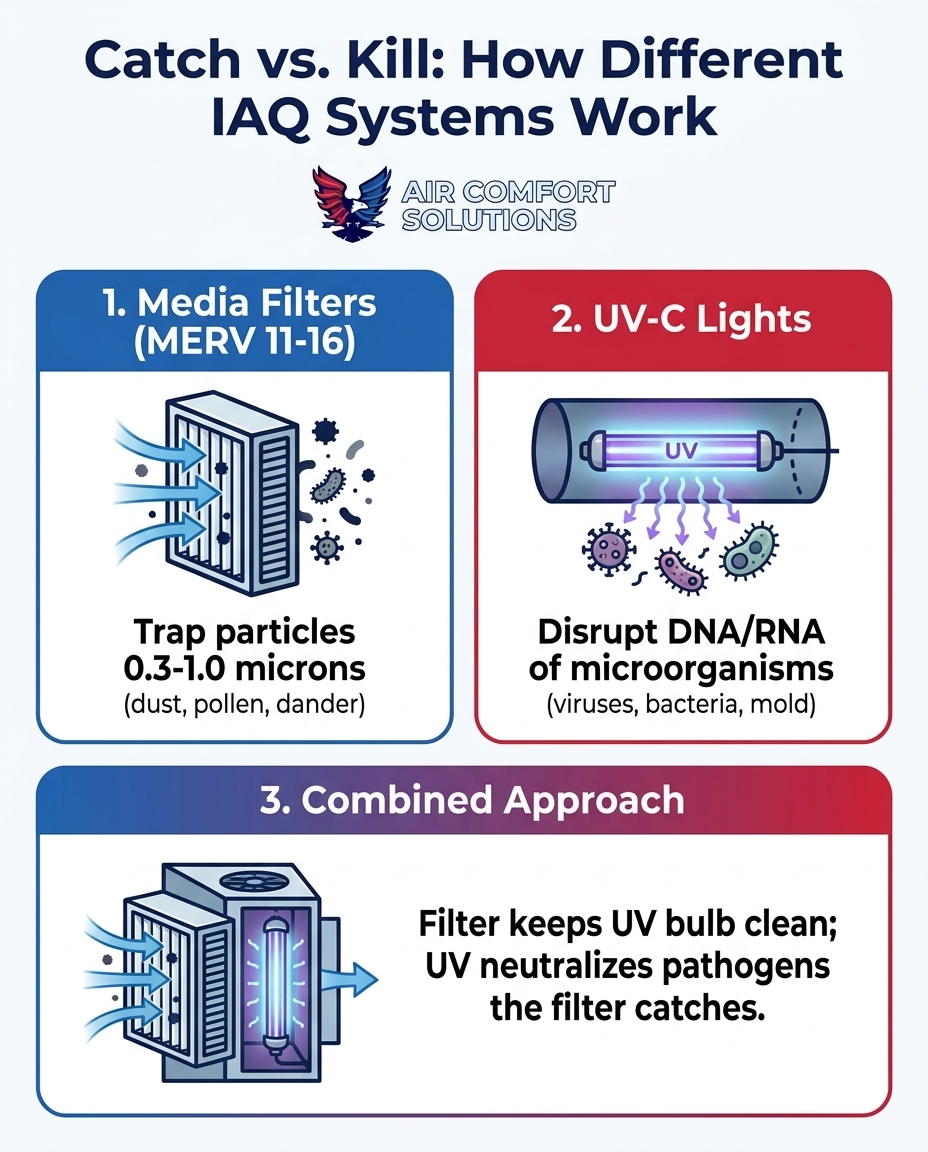
When we talk about high-efficiency media filters, we are generally referring to filters with a Minimum Efficiency Reporting Value (MERV) rating between 11 and 16. Unlike standard 1-inch fiberglass filters that only catch large boulders of dust, these advanced filters are engineered to trap microscopic particles as small as 0.3 to 1.0 microns. When our team at Air Comfort Solutions upgrades systems for homeowners in Pinehurst TX, this becomes the primary line of defense against seasonal pollen, dust mites, and asthma triggers that spike during the autumn months.
The mechanics of how these filters work go far beyond a simple screen. They utilize deep, dense, pleated material. This pleating is critical because it drastically increases the surface area of the filter. A larger surface area allows the filter to catch significantly more particulates without severely restricting the airflow your HVAC system needs to function. If you want to explore the specific ratings suitable for our region, reviewing the best AC filter options for Houston area homes can help you match the MERV rating to your blower's capacity.
Here is the step-by-step process of how a media filter manages indoor air:
1. Initial Draw and Interception: The HVAC blower pulls stale indoor air through the return ducts. As the air approaches the media cabinet, the largest particles (pet hair, heavy dust) are intercepted by the outermost layers of the filter fibers.
2. Deep Pleat Impaction: As the air continues through the dense pleats, medium-sized particles (pollen, larger mold spores) cannot navigate the complex maze of fibers. They collide directly with the filter material and become permanently embedded.
3. Electrostatic Attraction: Many high-MERV media filters carry a static electric charge. This acts like a magnet for the finest particles (smoke, fine dander, some bacteria), pulling them out of the airstream and locking them to the fibers.
4. Continuous Turnover: Because a properly sized media filter does not choke the HVAC blower, the system can continuously cycle the air in your home, progressively lowering the total particulate count with every pass.
However, it is vital to clarify their limitations: while high-efficiency media filters will capture some larger pathogens, they do not "kill" them. A virus trapped in a filter is still a live virus, which is why physical filtration is only one half of the indoor air quality equation.
To address the biological threats that bypass physical filters, the HVAC industry turns to the science of ultraviolet germicidal irradiation (UVGI). Specifically, UV-C light operates at a wavelength that is highly destructive to microscopic life. While UV-A and UV-B rays from the sun cause sunburns, UV-C is mostly filtered out by the Earth's atmosphere. By harnessing this specific wavelength inside your ductwork, you create an inhospitable environment for seasonal pathogens.
Cellular Disruption: When a virus or bacterium passes through the UV-C light field, the high-energy photons penetrate the organism's cellular walls. The light specifically targets the nucleic acids, fracturing the DNA and RNA bonds. Once this genetic material is scrambled, the organism loses its ability to perform vital cellular functions, most notably the ability to replicate. In the context of human health, a virus that cannot multiply cannot cause an infection.
ASHRAE Guidelines and Efficacy: The American Society of Heating, Refrigerating and Air-Conditioning Engineers (ASHRAE) heavily supports the use of UV-C technology for disrupting microorganism replication. Their guidelines confirm that proper irradiance (the intensity of the light) combined with adequate exposure time is highly effective against the microscopic pathogens responsible for upper respiratory infections.
Installation Mechanics: These systems are not standalone units sitting in the corner of a room. UV lights are installed directly within the dark, enclosed spaces of your HVAC ductwork or positioned directly over the indoor evaporator coil. As air circulates through the home during the September pre-heating season transition, it is forced to pass through this sterilization zone.
Targeting the Invisible: The back-to-school season introduces a high volume of cold and flu viruses into the home environment. Because these viruses are incredibly small—often less than 0.1 microns—they easily slip through even the most advanced media filters. UV-C light acts as the ultimate biological safeguard, neutralizing these microscopic threats before they can be redistributed through your living room vents.
Evaluating air purifiers requires looking at the regional climate context. Systems that work perfectly in dry, arid regions often face unique challenges in coastal or humid environments. Our service technicians frequently see the results of this firsthand: in Southeast Texas, we maintain average fall humidity levels well above 60%, creating an environment where biological contaminants thrive if indoor air isn't properly managed.
The Problem: When a high-efficiency media filter successfully traps organic matter—such as dust mites, skin cells, and pollen—it inadvertently creates a food source. If moisture is introduced into this environment, you have the perfect recipe for biological growth. In humid climates, moisture frequently condenses inside the HVAC system, particularly around the evaporator coil and the adjacent filter cabinet.
The Cause: The specific climate conditions in Pinehurst TX mean that your air conditioner is constantly battling high moisture loads, even deep into the fall months. When the blower shuts off, the dark, damp environment inside the ductwork allows mold spores to settle on the nutrient-rich surface of the media filter. Over time, the filter itself can become a breeding ground, eventually releasing new mold spores back into the airstream every time the system turns on.
The Solution: This is where the strategic placement of UV light becomes a game-changer. By positioning a UV-C lamp directly over the evaporator coil and near the filter cabinet, the light continuously bathes these surfaces in germicidal energy. This prevents mold from taking root on the trapped particulates and keeps the physical filter clean. It is a critical, often-overlooked aspect of indoor air quality management that prevents secondary biological issues from developing inside your expensive HVAC equipment.
If media filters catch physical particles and UV lights kill biological threats, the logical conclusion is that the most robust defense uses both systems in tandem. Relying on just one technology leaves a distinct gap in your home's air quality profile. A combined approach delivers comprehensive protection that addresses both the allergens that cause asthma and the viruses that cause seasonal illness.
The Catch and Kill Synergy: These two systems actively improve each other's performance. A UV bulb coated in a thick layer of dust loses a significant amount of its germicidal irradiance. By installing a high-efficiency media filter upstream of the UV light, the filter catches the physical debris, keeping the UV bulb pristine and maximizing its light output. Conversely, the UV light continuously shines on the filter and the surrounding coil, killing the live pathogens and mold spores that the filter catches. This "catch and kill" methodology ensures that nothing survives the journey through your ductwork.
Tailored for Local Challenges: Over our years of working on HVAC systems throughout the area, our team at Air Comfort Solutions has seen firsthand why generic, one-size-fits-all products fail. That is why we provide tailored, locally-tested indoor air quality solutions designed specifically for the unique humidity and allergen challenges of the Pinehurst area. We understand that a home with severe allergy sufferers requires a different filtration strategy than a home primarily concerned with back-to-school viruses. Integrating both technologies covers all bases.
Professional Assessment: Before combining these systems, it is vital to have a professional assess your HVAC system's specific airflow and spatial constraints. Not every duct system has the physical space for a thick media cabinet and a UV light rack, and older blower motors may struggle against the static pressure of a high-MERV filter. If you are considering air filtration upgrades, a proper static pressure test will ensure your equipment can handle the enhancement without straining the motor.
As the weather shifts and the September pre-heating season transition begins, now is the ideal time to evaluate your home's specific requirements. Once winter sets in and windows remain firmly shut, any trapped indoor pollutants will continuously recirculate. Guide your decision-making process by evaluating your household's primary concerns and the physical realities of your HVAC system.
• Identify primary health triggers: Evaluate whether your main issue is physical (pet dander, heavy dust, seasonal pollen) or biological (frequent colds, lingering viruses, mold sensitivities). This dictates whether you should prioritize a media filter upgrade, a UV installation, or both.
• Act during the transition window: The early fall is the most strategic time to upgrade. Implementing these systems before your home is completely sealed for the winter ensures you aren't trapping the initial wave of back-to-school pathogens indoors.
• Check existing HVAC compatibility: Inspect your current filter setup. If your system only accommodates a 1-inch filter slot, upgrading to a 4-inch or 5-inch high-efficiency media cabinet will require modifying the return plenum.
• Assess ductwork space: UV-C lights require a specific amount of straight ductwork or clear space over the evaporator coil to ensure adequate exposure time for the passing air.
• Consult a local expert: Recommend consulting with an indoor air quality specialist who can design a tailored strategy that balances filtration efficiency with your system's airflow requirements.
Understanding the distinct mechanics of biological versus particulate filtration empowers you to make better health decisions for your family. There is no single magic bullet for indoor air quality; a media filter will not stop a microscopic virus, and a UV light will not remove pet hair from the air. Recognizing these limitations is the key to building an effective defense during the September pre-heating season transition.
The right combination depends entirely on your specific household needs, your family's health concerns, and your existing HVAC setup. By addressing both the physical debris and the biological threats, you create an environment that is genuinely clean, not just visibly dust-free.
You don't have to navigate these technical decisions alone. Reach out to our local experts to weigh these options, test your system's compatibility, and design a balanced indoor air quality strategy that brings lasting comfort to your home.
Yes, using a UV light and a media filter together is highly recommended for comprehensive air quality. The media filter captures physical particles like dust and dander, while the UV light neutralizes biological threats like viruses and mold. In fact, the media filter helps keep the UV bulb clean from dust, which maximizes the light's germicidal effectiveness.
Yes, UV-C lights are scientifically proven to neutralize airborne viruses. The specific wavelength of UV-C light penetrates the cellular structure of pathogens and disrupts their DNA or RNA. This damage prevents the virus from replicating, rendering it harmless as it passes through your ductwork.
A media filter is significantly better at improving indoor air quality than a standard 1-inch filter. Standard filters are primarily designed to keep large debris out of your HVAC equipment, whereas thick, pleated media filters have the surface area to trap microscopic allergens, pollen, and fine dust without restricting system airflow.
For trapping fall allergens effectively, a MERV rating between 11 and 16 is generally best for residential systems. Filters in this range are dense enough to capture fine particulates like pollen, pet dander, and mold spores. However, it is critical to ensure your HVAC blower can handle the increased resistance of high-MERV filters before installing one.
Yes, UV lights are highly effective at killing mold spores and preventing biological growth inside your HVAC system. When installed directly over the indoor evaporator coil, the continuous UV-C exposure stops mold from forming on the damp surfaces of the coil and the adjacent drain pan, keeping the system sanitary.
UV bulbs typically need to be replaced once every 12 to 24 months, as their germicidal intensity degrades over time even if they still emit visible blue light. High-efficiency media filters (4 to 5 inches thick) generally need to be replaced every 6 to 12 months, depending on your home's dust levels, pet count, and blower usage.


Zane came out and did an amazing job! Super friendly, honest and transparent about the work that needed to be done. This is my second time working with Air Comfort Solutions and they’re my go to for HVAC services. Highly recommend.
God's AMAZING grace sent us Robert and Zane. We have been without air in this Texas heat for six weeks and four days. We've had a few contractors give us quotes all trying to upsell when we're at a low point. But not the guys at Air Comfort Solutions. They came in assessed our situation, gave us honest feedback, and showed us the issues as they proceeded with the assessment for clear understanding. We highly recommend them for their professionalism, quality products, and fair pricing. We hands down support them for all the work they do 💯 %.
Robert and Zane gone above and beyond to make the process easy and affordable.
Would definitely recommend!!
I’m writing this review to let everyone know that Air Comfort Solutions is the company to work with. I know the owner ( Robert) for several years now. He has been taking care of my residential and business work orders. Robert is professional, knowledgeable and will save you money. I just want to thank Robert for great job you have been doing for me.