Is That Burning Smell Normal? When to Call for 24 Hour AC Repair During Fall Startup
Smell burning during your fall heating startup? Apply our home maintenance tips and troubleshooting to know what is normal and when to call a pro on this.
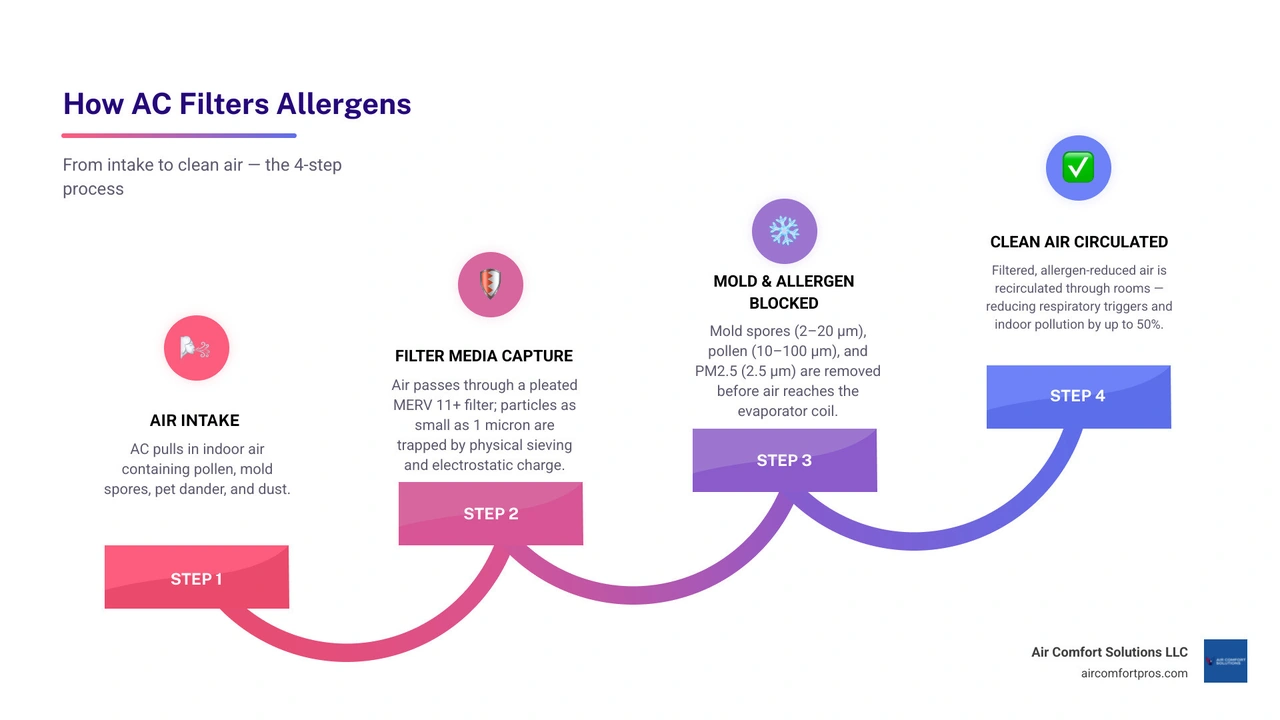
How your AC filters allergens, pollen, and mold spores comes down to one core process: as your system runs, it pulls air through a filter that physically traps airborne particles before recirculating that air back into your living spaces. Here is a quick breakdown:
The problem is that most homeowners in North Harris County run their AC constantly through brutal Texas summers — but never think about what that filter is actually doing, or not doing, for the air their family breathes.
Indoor air can be two to five times more polluted than outdoor air, according to the EPA. And in a humid climate like Pinehurst, TX, a neglected AC system does not just fail to clean your air — it can actively make things worse by circulating mold spores, pollen, and fine particulates through every room in your home.
I'm Robert Patterson, and in this guide I'll walk you through exactly how your AC filter works, what it can and cannot remove, and what steps keep your system running as a genuine line of defense against indoor allergens.
Simple how your ac filters allergens pollen and mold spores word guide:
To understand how your air conditioner acts as a shield against microscopic invaders, we have to look at the physical mechanics of filtration. Your HVAC system is essentially a giant air-recirculation pump. When the system is running, the blower motor pulls air from your living spaces through the return grilles, pushes it across the cold evaporator coils to cool it, and sends it back through your supply vents.
The air filter sits directly in this airflow path, acting as a physical gatekeeper.
How does a basic piece of pleated material stop microscopic particles traveling at high speeds? It relies on three primary physical principles:
Many modern pleated filters also utilize a passive electrostatic charge. During manufacturing, the synthetic fibers are charged so they act like tiny magnets. When airborne irritants pass through, the static charge pulls them out of the airstream and binds them to the fibers. This allows the filter to capture much smaller particles without needing to be so dense that it chokes off your system’s airflow. This process is crucial for understanding How Air Filtration Systems Remove Pet Dander and other microscopic proteins that trigger indoor allergy symptoms.
To appreciate what your filter is up against, we have to talk about micron sizes. A micron (or micrometer) is one-millionth of a meter. For context, a single strand of human hair is roughly 50 to 70 microns in diameter.
The airborne irritants floating through your home in Pinehurst, TX, vary wildly in size:
Understanding these sizes is the key to choosing a filter that actually protects your health, rather than one that simply protects your AC equipment from large dust bunnies.
When shopping for an air filter, you will see a rating known as MERV, which stands for Minimum Efficiency Reporting Value. Developed by ASHRAE in 1987, this scale ranges from 1 to 16 for residential and light commercial systems. The higher the MERV rating, the better the filter is at trapping smaller, more stubborn particles.
For residential homes, the sweet spot almost always falls between MERV 8 and MERV 13. Let's look at how these ratings compare in their filtration efficiency:
| Filter Rating | Capture Efficiency (3.0 – 10.0 Microns) | Capture Efficiency (1.0 – 3.0 Microns) | Capture Efficiency (0.3 – 1.0 Microns) | What It Captures |
|---|---|---|---|---|
| MERV 8 | ~90% | ~70% | Under 20% | Large dust, pollen, mold spores, lint |
| MERV 11 | 90%+ | ~80% to 85% | ~35% to 50% | Adds pet dander, fine dust, automobile emissions |
| MERV 13 | 98%+ | 90%+ | ~50% to 75% | Adds bacteria, smoke, microscopic sneeze droplets |
For standard homes without pets or severe allergies, a MERV 8 filter provides basic protection. However, if you suffer from seasonal allergies or asthma, upgrading to a MERV 11 or MERV 13 pleated filter is highly recommended. These mid-to-high-tier filters capture more than 90% of pollen, mold spores, and pet dander, significantly reducing your daily exposure to respiratory triggers.
While it is tempting to run out and buy the highest-rated MERV filter on the shelf, doing so without evaluating your HVAC system can lead to serious, expensive mechanical failures.
As a filter becomes denser to trap smaller particles, it inherently creates more resistance to airflow. In the HVAC industry, this resistance is measured as static pressure.
If your AC system's blower motor was not designed to push air through a highly restrictive barrier, a high-MERV filter acts like a clogged artery. The consequences of restricted airflow include:
HEPA (High-Efficiency Particulate Air) filters are the gold standard of air cleaning, capable of removing up to 99.97% of airborne particles down to 0.3 microns. However, true HEPA filters do not belong in standard residential HVAC return slots.
A true HEPA filter is incredibly dense. Standard residential blower motors simply do not have the power to overcome the extreme static pressure drop a HEPA filter creates. Trying to run a HEPA filter in a standard 1-inch return slot is the mechanical equivalent of trying to breathe through a coffee stirrer straw while running a marathon. It will choke your system, freeze your coils, and potentially destroy your compressor within days.
If you want HEPA-level filtration in your home, you have two safe options:
A common misconception is that running your air conditioner automatically purifies your indoor air. The truth is more nuanced: your AC only cleans the air if it is equipped with a high-quality, clean filter and is maintained properly.
Standard residential air conditioners do not bring fresh air in from the outside. Instead, they continuously recirculate the same air already inside your home. If you have a cheap fiberglass filter (which only catches about 5% of small particles and is designed solely to protect the equipment from large dust), running your AC will actually worsen your allergies. It acts as a fan, continuously kicking up settled dust, pet dander, and mold spores, and blowing them back into your breathing zone.
To turn your AC into an active air-cleaning system, you must pair it with a proper pleated filter and run the system’s fan. Most thermostats have a setting for "Auto" (the fan only runs when the system is actively cooling) and "On" (the fan runs continuously). Running the fan continuously during high-allergen seasons ensures that your home's air is constantly passing through the filter, keeping particulate levels low. However, this also means you must inspect and change your filter more frequently. To learn more about how your system interacts with your home's breathing environment, explore our resource on Indoor Air Quality.
Your air conditioner's primary job is to cool your home, but a major byproduct of that cooling is dehumidification. As warm, humid air passes over the cold evaporator coils, moisture condenses on the metal fins and drips down into a condensate drain pan, where it is channeled outside.
This process makes the inside of your AC unit incredibly damp. If you combine this constant moisture with organic dust that slips past a cheap or poorly fitted filter, you create the perfect breeding ground for mold. Mold spores can germinate on damp surfaces in as little as 24 to 48 hours.
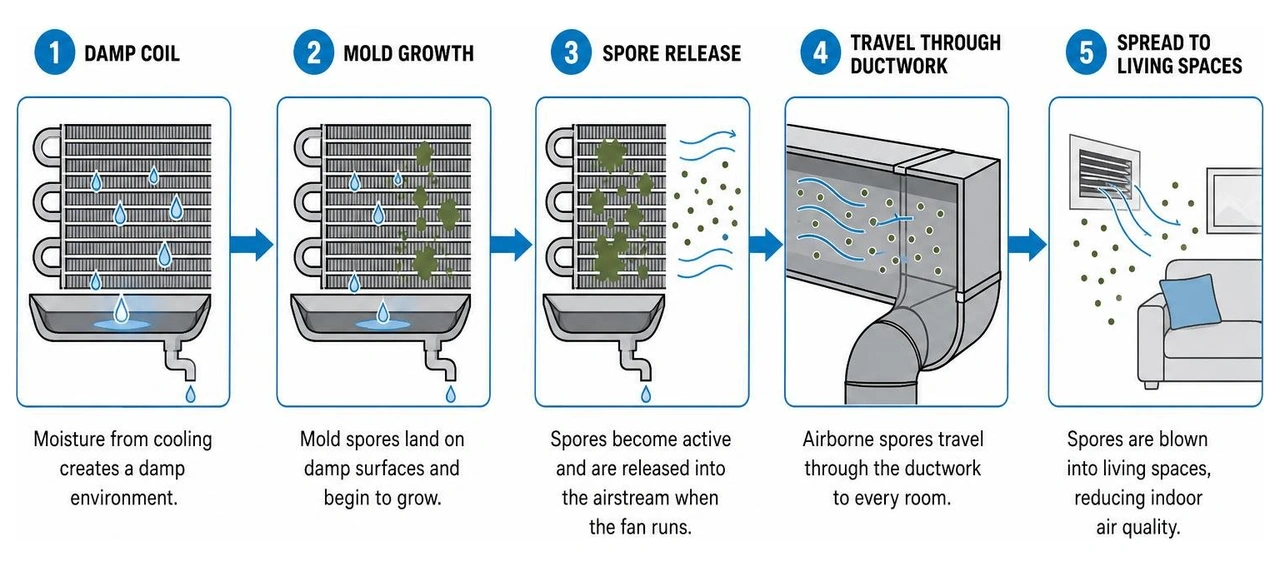
Once mold takes hold on your evaporator coils or inside your dark, cool ductwork, every single time your blower fan turns on, it will blast millions of active mold spores directly into your living spaces. This is a primary cause of "dirty sock syndrome"—that musty, damp odor that hits you when your AC kicks on. If you live in a high-humidity area, understanding this dynamic is essential. Dive deeper into this topic with our article on How Your AC Affects Indoor Air Quality in Humid Climates.
While physical filters trap airborne particles, your AC also fights allergens through humidity control.
Dust mites and mold spores thrive in high-humidity environments. Dust mites, which are one of the leading causes of year-round indoor allergies, cannot survive when the relative humidity (RH) drops below 50%. Similarly, mold spores require a surface humidity of 65% or higher to germinate and grow.
By keeping your home's relative humidity strictly between 30% and 50%, your AC starves these allergens of the moisture they need to survive and reproduce. This indirect filtration is incredibly powerful, but it requires your AC to run efficient, complete cooling cycles. An oversized AC system that "cools" your home too quickly (short-cycling) will turn off before it has a chance to pull moisture out of the air, leaving your home cold but clammy—and highly susceptible to mold growth.
If you want your air conditioner to actively protect your family from pollen, mold, and dander, you cannot take a "set it and forget it" approach. A healthy, allergy-friendly HVAC system requires a consistent maintenance routine:
A standard, basic fiberglass filter (typically rated MERV 1 to 4) cannot capture PM2.5 particles; they simply pass through the wide gaps in the fibers. However, a high-quality pleated MERV 13 filter is highly effective, capturing up to 40% more PM2.5 fine particulates than a standard MERV 8 filter. For complete protection against fine smoke and combustion particles, we recommend pairing a MERV 11 or 13 HVAC filter with a standalone HEPA air purifier in high-traffic rooms.
The most common sign of mold growth inside an HVAC system is a persistent, musty, or damp odor (often compared to wet socks) when the system first turns on. Other warning signs include visible dark splotches or slimy buildup around your supply vents, a dusty film on your evaporator coils, or family members experiencing unexplained respiratory symptoms, coughing, or watery eyes that improve when they leave the house.
Upgrading to a MERV 13 filter will not automatically void your warranty, but it can if your system is not rated to handle the added airflow resistance. If a MERV 13 filter causes excessive static pressure, leading to a frozen coil or a burned-out blower motor, the manufacturer may attribute the failure to neglect and deny your warranty claim. Always check your system's manufacturer specifications or consult a professional technician before upgrading to a MERV 13 filter.
Your air conditioner is more than just a tool to beat the Texas heat; it is your home's primary defense system against outdoor pollen, microscopic mold spores, and stubborn pet dander. By understanding how your AC filters allergens, pollen, and mold spores, you can make informed decisions about your filtration levels, protect your expensive HVAC equipment from airflow strain, and ensure your family breathes clean, healthy air year-round.
At Air Comfort Pros, we have spent over 35 years helping homeowners across Pinehurst, TX, and North Harris County maintain comfortable, healthy homes. Whether you need an indoor air quality assessment, professional duct sealing, or a whole-home air purification upgrade, our certified technicians are here to help with honest, reliable solutions and upfront pricing.
Ready to transform your home's air quality? Explore our specialized local solutions today:
To learn more about our complete range of home comfort and air cleaning services, visit our main Indoor Air Quality page and let us help you breathe easier today!
How your AC filters allergens, pollen, and mold spores comes down to one core process: as your system runs, it pulls air through a filter that physically traps airborne particles before recirculating that air back into your living spaces. Here is a quick breakdown:
The problem is that most homeowners in North Harris County run their AC constantly through brutal Texas summers — but never think about what that filter is actually doing, or not doing, for the air their family breathes.
Indoor air can be two to five times more polluted than outdoor air, according to the EPA. And in a humid climate like Pinehurst, TX, a neglected AC system does not just fail to clean your air — it can actively make things worse by circulating mold spores, pollen, and fine particulates through every room in your home.
I'm Robert Patterson, and in this guide I'll walk you through exactly how your AC filter works, what it can and cannot remove, and what steps keep your system running as a genuine line of defense against indoor allergens.
Simple how your ac filters allergens pollen and mold spores word guide:
To understand how your air conditioner acts as a shield against microscopic invaders, we have to look at the physical mechanics of filtration. Your HVAC system is essentially a giant air-recirculation pump. When the system is running, the blower motor pulls air from your living spaces through the return grilles, pushes it across the cold evaporator coils to cool it, and sends it back through your supply vents.
The air filter sits directly in this airflow path, acting as a physical gatekeeper.
How does a basic piece of pleated material stop microscopic particles traveling at high speeds? It relies on three primary physical principles:
Many modern pleated filters also utilize a passive electrostatic charge. During manufacturing, the synthetic fibers are charged so they act like tiny magnets. When airborne irritants pass through, the static charge pulls them out of the airstream and binds them to the fibers. This allows the filter to capture much smaller particles without needing to be so dense that it chokes off your system’s airflow. This process is crucial for understanding How Air Filtration Systems Remove Pet Dander and other microscopic proteins that trigger indoor allergy symptoms.
To appreciate what your filter is up against, we have to talk about micron sizes. A micron (or micrometer) is one-millionth of a meter. For context, a single strand of human hair is roughly 50 to 70 microns in diameter.
The airborne irritants floating through your home in Pinehurst, TX, vary wildly in size:
Understanding these sizes is the key to choosing a filter that actually protects your health, rather than one that simply protects your AC equipment from large dust bunnies.
When shopping for an air filter, you will see a rating known as MERV, which stands for Minimum Efficiency Reporting Value. Developed by ASHRAE in 1987, this scale ranges from 1 to 16 for residential and light commercial systems. The higher the MERV rating, the better the filter is at trapping smaller, more stubborn particles.
For residential homes, the sweet spot almost always falls between MERV 8 and MERV 13. Let's look at how these ratings compare in their filtration efficiency:
| Filter Rating | Capture Efficiency (3.0 – 10.0 Microns) | Capture Efficiency (1.0 – 3.0 Microns) | Capture Efficiency (0.3 – 1.0 Microns) | What It Captures |
|---|---|---|---|---|
| MERV 8 | ~90% | ~70% | Under 20% | Large dust, pollen, mold spores, lint |
| MERV 11 | 90%+ | ~80% to 85% | ~35% to 50% | Adds pet dander, fine dust, automobile emissions |
| MERV 13 | 98%+ | 90%+ | ~50% to 75% | Adds bacteria, smoke, microscopic sneeze droplets |
For standard homes without pets or severe allergies, a MERV 8 filter provides basic protection. However, if you suffer from seasonal allergies or asthma, upgrading to a MERV 11 or MERV 13 pleated filter is highly recommended. These mid-to-high-tier filters capture more than 90% of pollen, mold spores, and pet dander, significantly reducing your daily exposure to respiratory triggers.
While it is tempting to run out and buy the highest-rated MERV filter on the shelf, doing so without evaluating your HVAC system can lead to serious, expensive mechanical failures.
As a filter becomes denser to trap smaller particles, it inherently creates more resistance to airflow. In the HVAC industry, this resistance is measured as static pressure.
If your AC system's blower motor was not designed to push air through a highly restrictive barrier, a high-MERV filter acts like a clogged artery. The consequences of restricted airflow include:
HEPA (High-Efficiency Particulate Air) filters are the gold standard of air cleaning, capable of removing up to 99.97% of airborne particles down to 0.3 microns. However, true HEPA filters do not belong in standard residential HVAC return slots.
A true HEPA filter is incredibly dense. Standard residential blower motors simply do not have the power to overcome the extreme static pressure drop a HEPA filter creates. Trying to run a HEPA filter in a standard 1-inch return slot is the mechanical equivalent of trying to breathe through a coffee stirrer straw while running a marathon. It will choke your system, freeze your coils, and potentially destroy your compressor within days.
If you want HEPA-level filtration in your home, you have two safe options:
A common misconception is that running your air conditioner automatically purifies your indoor air. The truth is more nuanced: your AC only cleans the air if it is equipped with a high-quality, clean filter and is maintained properly.
Standard residential air conditioners do not bring fresh air in from the outside. Instead, they continuously recirculate the same air already inside your home. If you have a cheap fiberglass filter (which only catches about 5% of small particles and is designed solely to protect the equipment from large dust), running your AC will actually worsen your allergies. It acts as a fan, continuously kicking up settled dust, pet dander, and mold spores, and blowing them back into your breathing zone.
To turn your AC into an active air-cleaning system, you must pair it with a proper pleated filter and run the system’s fan. Most thermostats have a setting for "Auto" (the fan only runs when the system is actively cooling) and "On" (the fan runs continuously). Running the fan continuously during high-allergen seasons ensures that your home's air is constantly passing through the filter, keeping particulate levels low. However, this also means you must inspect and change your filter more frequently. To learn more about how your system interacts with your home's breathing environment, explore our resource on Indoor Air Quality.
Your air conditioner's primary job is to cool your home, but a major byproduct of that cooling is dehumidification. As warm, humid air passes over the cold evaporator coils, moisture condenses on the metal fins and drips down into a condensate drain pan, where it is channeled outside.
This process makes the inside of your AC unit incredibly damp. If you combine this constant moisture with organic dust that slips past a cheap or poorly fitted filter, you create the perfect breeding ground for mold. Mold spores can germinate on damp surfaces in as little as 24 to 48 hours.
Once mold takes hold on your evaporator coils or inside your dark, cool ductwork, every single time your blower fan turns on, it will blast millions of active mold spores directly into your living spaces. This is a primary cause of "dirty sock syndrome"—that musty, damp odor that hits you when your AC kicks on. If you live in a high-humidity area, understanding this dynamic is essential. Dive deeper into this topic with our article on How Your AC Affects Indoor Air Quality in Humid Climates.
While physical filters trap airborne particles, your AC also fights allergens through humidity control.
Dust mites and mold spores thrive in high-humidity environments. Dust mites, which are one of the leading causes of year-round indoor allergies, cannot survive when the relative humidity (RH) drops below 50%. Similarly, mold spores require a surface humidity of 65% or higher to germinate and grow.
By keeping your home's relative humidity strictly between 30% and 50%, your AC starves these allergens of the moisture they need to survive and reproduce. This indirect filtration is incredibly powerful, but it requires your AC to run efficient, complete cooling cycles. An oversized AC system that "cools" your home too quickly (short-cycling) will turn off before it has a chance to pull moisture out of the air, leaving your home cold but clammy—and highly susceptible to mold growth.
If you want your air conditioner to actively protect your family from pollen, mold, and dander, you cannot take a "set it and forget it" approach. A healthy, allergy-friendly HVAC system requires a consistent maintenance routine:
A standard, basic fiberglass filter (typically rated MERV 1 to 4) cannot capture PM2.5 particles; they simply pass through the wide gaps in the fibers. However, a high-quality pleated MERV 13 filter is highly effective, capturing up to 40% more PM2.5 fine particulates than a standard MERV 8 filter. For complete protection against fine smoke and combustion particles, we recommend pairing a MERV 11 or 13 HVAC filter with a standalone HEPA air purifier in high-traffic rooms.
The most common sign of mold growth inside an HVAC system is a persistent, musty, or damp odor (often compared to wet socks) when the system first turns on. Other warning signs include visible dark splotches or slimy buildup around your supply vents, a dusty film on your evaporator coils, or family members experiencing unexplained respiratory symptoms, coughing, or watery eyes that improve when they leave the house.
Upgrading to a MERV 13 filter will not automatically void your warranty, but it can if your system is not rated to handle the added airflow resistance. If a MERV 13 filter causes excessive static pressure, leading to a frozen coil or a burned-out blower motor, the manufacturer may attribute the failure to neglect and deny your warranty claim. Always check your system's manufacturer specifications or consult a professional technician before upgrading to a MERV 13 filter.
Your air conditioner is more than just a tool to beat the Texas heat; it is your home's primary defense system against outdoor pollen, microscopic mold spores, and stubborn pet dander. By understanding how your AC filters allergens, pollen, and mold spores, you can make informed decisions about your filtration levels, protect your expensive HVAC equipment from airflow strain, and ensure your family breathes clean, healthy air year-round.
At Air Comfort Pros, we have spent over 35 years helping homeowners across Pinehurst, TX, and North Harris County maintain comfortable, healthy homes. Whether you need an indoor air quality assessment, professional duct sealing, or a whole-home air purification upgrade, our certified technicians are here to help with honest, reliable solutions and upfront pricing.
Ready to transform your home's air quality? Explore our specialized local solutions today:
To learn more about our complete range of home comfort and air cleaning services, visit our main Indoor Air Quality page and let us help you breathe easier today!
How your AC filters allergens, pollen, and mold spores comes down to one core process: as your system runs, it pulls air through a filter that physically traps airborne particles before recirculating that air back into your living spaces. Here is a quick breakdown:
The problem is that most homeowners in North Harris County run their AC constantly through brutal Texas summers — but never think about what that filter is actually doing, or not doing, for the air their family breathes.
Indoor air can be two to five times more polluted than outdoor air, according to the EPA. And in a humid climate like Pinehurst, TX, a neglected AC system does not just fail to clean your air — it can actively make things worse by circulating mold spores, pollen, and fine particulates through every room in your home.
I'm Robert Patterson, and in this guide I'll walk you through exactly how your AC filter works, what it can and cannot remove, and what steps keep your system running as a genuine line of defense against indoor allergens.
Simple how your ac filters allergens pollen and mold spores word guide:
To understand how your air conditioner acts as a shield against microscopic invaders, we have to look at the physical mechanics of filtration. Your HVAC system is essentially a giant air-recirculation pump. When the system is running, the blower motor pulls air from your living spaces through the return grilles, pushes it across the cold evaporator coils to cool it, and sends it back through your supply vents.
The air filter sits directly in this airflow path, acting as a physical gatekeeper.
How does a basic piece of pleated material stop microscopic particles traveling at high speeds? It relies on three primary physical principles:
Many modern pleated filters also utilize a passive electrostatic charge. During manufacturing, the synthetic fibers are charged so they act like tiny magnets. When airborne irritants pass through, the static charge pulls them out of the airstream and binds them to the fibers. This allows the filter to capture much smaller particles without needing to be so dense that it chokes off your system’s airflow. This process is crucial for understanding How Air Filtration Systems Remove Pet Dander and other microscopic proteins that trigger indoor allergy symptoms.
To appreciate what your filter is up against, we have to talk about micron sizes. A micron (or micrometer) is one-millionth of a meter. For context, a single strand of human hair is roughly 50 to 70 microns in diameter.
The airborne irritants floating through your home in Pinehurst, TX, vary wildly in size:
Understanding these sizes is the key to choosing a filter that actually protects your health, rather than one that simply protects your AC equipment from large dust bunnies.
When shopping for an air filter, you will see a rating known as MERV, which stands for Minimum Efficiency Reporting Value. Developed by ASHRAE in 1987, this scale ranges from 1 to 16 for residential and light commercial systems. The higher the MERV rating, the better the filter is at trapping smaller, more stubborn particles.
For residential homes, the sweet spot almost always falls between MERV 8 and MERV 13. Let's look at how these ratings compare in their filtration efficiency:
| Filter Rating | Capture Efficiency (3.0 – 10.0 Microns) | Capture Efficiency (1.0 – 3.0 Microns) | Capture Efficiency (0.3 – 1.0 Microns) | What It Captures |
|---|---|---|---|---|
| MERV 8 | ~90% | ~70% | Under 20% | Large dust, pollen, mold spores, lint |
| MERV 11 | 90%+ | ~80% to 85% | ~35% to 50% | Adds pet dander, fine dust, automobile emissions |
| MERV 13 | 98%+ | 90%+ | ~50% to 75% | Adds bacteria, smoke, microscopic sneeze droplets |
For standard homes without pets or severe allergies, a MERV 8 filter provides basic protection. However, if you suffer from seasonal allergies or asthma, upgrading to a MERV 11 or MERV 13 pleated filter is highly recommended. These mid-to-high-tier filters capture more than 90% of pollen, mold spores, and pet dander, significantly reducing your daily exposure to respiratory triggers.
While it is tempting to run out and buy the highest-rated MERV filter on the shelf, doing so without evaluating your HVAC system can lead to serious, expensive mechanical failures.
As a filter becomes denser to trap smaller particles, it inherently creates more resistance to airflow. In the HVAC industry, this resistance is measured as static pressure.
If your AC system's blower motor was not designed to push air through a highly restrictive barrier, a high-MERV filter acts like a clogged artery. The consequences of restricted airflow include:
HEPA (High-Efficiency Particulate Air) filters are the gold standard of air cleaning, capable of removing up to 99.97% of airborne particles down to 0.3 microns. However, true HEPA filters do not belong in standard residential HVAC return slots.
A true HEPA filter is incredibly dense. Standard residential blower motors simply do not have the power to overcome the extreme static pressure drop a HEPA filter creates. Trying to run a HEPA filter in a standard 1-inch return slot is the mechanical equivalent of trying to breathe through a coffee stirrer straw while running a marathon. It will choke your system, freeze your coils, and potentially destroy your compressor within days.
If you want HEPA-level filtration in your home, you have two safe options:
A common misconception is that running your air conditioner automatically purifies your indoor air. The truth is more nuanced: your AC only cleans the air if it is equipped with a high-quality, clean filter and is maintained properly.
Standard residential air conditioners do not bring fresh air in from the outside. Instead, they continuously recirculate the same air already inside your home. If you have a cheap fiberglass filter (which only catches about 5% of small particles and is designed solely to protect the equipment from large dust), running your AC will actually worsen your allergies. It acts as a fan, continuously kicking up settled dust, pet dander, and mold spores, and blowing them back into your breathing zone.
To turn your AC into an active air-cleaning system, you must pair it with a proper pleated filter and run the system’s fan. Most thermostats have a setting for "Auto" (the fan only runs when the system is actively cooling) and "On" (the fan runs continuously). Running the fan continuously during high-allergen seasons ensures that your home's air is constantly passing through the filter, keeping particulate levels low. However, this also means you must inspect and change your filter more frequently. To learn more about how your system interacts with your home's breathing environment, explore our resource on Indoor Air Quality.
Your air conditioner's primary job is to cool your home, but a major byproduct of that cooling is dehumidification. As warm, humid air passes over the cold evaporator coils, moisture condenses on the metal fins and drips down into a condensate drain pan, where it is channeled outside.
This process makes the inside of your AC unit incredibly damp. If you combine this constant moisture with organic dust that slips past a cheap or poorly fitted filter, you create the perfect breeding ground for mold. Mold spores can germinate on damp surfaces in as little as 24 to 48 hours.
Once mold takes hold on your evaporator coils or inside your dark, cool ductwork, every single time your blower fan turns on, it will blast millions of active mold spores directly into your living spaces. This is a primary cause of "dirty sock syndrome"—that musty, damp odor that hits you when your AC kicks on. If you live in a high-humidity area, understanding this dynamic is essential. Dive deeper into this topic with our article on How Your AC Affects Indoor Air Quality in Humid Climates.
While physical filters trap airborne particles, your AC also fights allergens through humidity control.
Dust mites and mold spores thrive in high-humidity environments. Dust mites, which are one of the leading causes of year-round indoor allergies, cannot survive when the relative humidity (RH) drops below 50%. Similarly, mold spores require a surface humidity of 65% or higher to germinate and grow.
By keeping your home's relative humidity strictly between 30% and 50%, your AC starves these allergens of the moisture they need to survive and reproduce. This indirect filtration is incredibly powerful, but it requires your AC to run efficient, complete cooling cycles. An oversized AC system that "cools" your home too quickly (short-cycling) will turn off before it has a chance to pull moisture out of the air, leaving your home cold but clammy—and highly susceptible to mold growth.
If you want your air conditioner to actively protect your family from pollen, mold, and dander, you cannot take a "set it and forget it" approach. A healthy, allergy-friendly HVAC system requires a consistent maintenance routine:
A standard, basic fiberglass filter (typically rated MERV 1 to 4) cannot capture PM2.5 particles; they simply pass through the wide gaps in the fibers. However, a high-quality pleated MERV 13 filter is highly effective, capturing up to 40% more PM2.5 fine particulates than a standard MERV 8 filter. For complete protection against fine smoke and combustion particles, we recommend pairing a MERV 11 or 13 HVAC filter with a standalone HEPA air purifier in high-traffic rooms.
The most common sign of mold growth inside an HVAC system is a persistent, musty, or damp odor (often compared to wet socks) when the system first turns on. Other warning signs include visible dark splotches or slimy buildup around your supply vents, a dusty film on your evaporator coils, or family members experiencing unexplained respiratory symptoms, coughing, or watery eyes that improve when they leave the house.
Upgrading to a MERV 13 filter will not automatically void your warranty, but it can if your system is not rated to handle the added airflow resistance. If a MERV 13 filter causes excessive static pressure, leading to a frozen coil or a burned-out blower motor, the manufacturer may attribute the failure to neglect and deny your warranty claim. Always check your system's manufacturer specifications or consult a professional technician before upgrading to a MERV 13 filter.
Your air conditioner is more than just a tool to beat the Texas heat; it is your home's primary defense system against outdoor pollen, microscopic mold spores, and stubborn pet dander. By understanding how your AC filters allergens, pollen, and mold spores, you can make informed decisions about your filtration levels, protect your expensive HVAC equipment from airflow strain, and ensure your family breathes clean, healthy air year-round.
At Air Comfort Pros, we have spent over 35 years helping homeowners across Pinehurst, TX, and North Harris County maintain comfortable, healthy homes. Whether you need an indoor air quality assessment, professional duct sealing, or a whole-home air purification upgrade, our certified technicians are here to help with honest, reliable solutions and upfront pricing.
Ready to transform your home's air quality? Explore our specialized local solutions today:
To learn more about our complete range of home comfort and air cleaning services, visit our main Indoor Air Quality page and let us help you breathe easier today!
How your AC filters allergens, pollen, and mold spores comes down to one core process: as your system runs, it pulls air through a filter that physically traps airborne particles before recirculating that air back into your living spaces. Here is a quick breakdown:
The problem is that most homeowners in North Harris County run their AC constantly through brutal Texas summers — but never think about what that filter is actually doing, or not doing, for the air their family breathes.
Indoor air can be two to five times more polluted than outdoor air, according to the EPA. And in a humid climate like Pinehurst, TX, a neglected AC system does not just fail to clean your air — it can actively make things worse by circulating mold spores, pollen, and fine particulates through every room in your home.
I'm Robert Patterson, and in this guide I'll walk you through exactly how your AC filter works, what it can and cannot remove, and what steps keep your system running as a genuine line of defense against indoor allergens.
Simple how your ac filters allergens pollen and mold spores word guide:
To understand how your air conditioner acts as a shield against microscopic invaders, we have to look at the physical mechanics of filtration. Your HVAC system is essentially a giant air-recirculation pump. When the system is running, the blower motor pulls air from your living spaces through the return grilles, pushes it across the cold evaporator coils to cool it, and sends it back through your supply vents.
The air filter sits directly in this airflow path, acting as a physical gatekeeper.
How does a basic piece of pleated material stop microscopic particles traveling at high speeds? It relies on three primary physical principles:
Many modern pleated filters also utilize a passive electrostatic charge. During manufacturing, the synthetic fibers are charged so they act like tiny magnets. When airborne irritants pass through, the static charge pulls them out of the airstream and binds them to the fibers. This allows the filter to capture much smaller particles without needing to be so dense that it chokes off your system’s airflow. This process is crucial for understanding How Air Filtration Systems Remove Pet Dander and other microscopic proteins that trigger indoor allergy symptoms.
To appreciate what your filter is up against, we have to talk about micron sizes. A micron (or micrometer) is one-millionth of a meter. For context, a single strand of human hair is roughly 50 to 70 microns in diameter.
The airborne irritants floating through your home in Pinehurst, TX, vary wildly in size:
Understanding these sizes is the key to choosing a filter that actually protects your health, rather than one that simply protects your AC equipment from large dust bunnies.
When shopping for an air filter, you will see a rating known as MERV, which stands for Minimum Efficiency Reporting Value. Developed by ASHRAE in 1987, this scale ranges from 1 to 16 for residential and light commercial systems. The higher the MERV rating, the better the filter is at trapping smaller, more stubborn particles.
For residential homes, the sweet spot almost always falls between MERV 8 and MERV 13. Let's look at how these ratings compare in their filtration efficiency:
| Filter Rating | Capture Efficiency (3.0 – 10.0 Microns) | Capture Efficiency (1.0 – 3.0 Microns) | Capture Efficiency (0.3 – 1.0 Microns) | What It Captures |
|---|---|---|---|---|
| MERV 8 | ~90% | ~70% | Under 20% | Large dust, pollen, mold spores, lint |
| MERV 11 | 90%+ | ~80% to 85% | ~35% to 50% | Adds pet dander, fine dust, automobile emissions |
| MERV 13 | 98%+ | 90%+ | ~50% to 75% | Adds bacteria, smoke, microscopic sneeze droplets |
For standard homes without pets or severe allergies, a MERV 8 filter provides basic protection. However, if you suffer from seasonal allergies or asthma, upgrading to a MERV 11 or MERV 13 pleated filter is highly recommended. These mid-to-high-tier filters capture more than 90% of pollen, mold spores, and pet dander, significantly reducing your daily exposure to respiratory triggers.
While it is tempting to run out and buy the highest-rated MERV filter on the shelf, doing so without evaluating your HVAC system can lead to serious, expensive mechanical failures.
As a filter becomes denser to trap smaller particles, it inherently creates more resistance to airflow. In the HVAC industry, this resistance is measured as static pressure.
If your AC system's blower motor was not designed to push air through a highly restrictive barrier, a high-MERV filter acts like a clogged artery. The consequences of restricted airflow include:
HEPA (High-Efficiency Particulate Air) filters are the gold standard of air cleaning, capable of removing up to 99.97% of airborne particles down to 0.3 microns. However, true HEPA filters do not belong in standard residential HVAC return slots.
A true HEPA filter is incredibly dense. Standard residential blower motors simply do not have the power to overcome the extreme static pressure drop a HEPA filter creates. Trying to run a HEPA filter in a standard 1-inch return slot is the mechanical equivalent of trying to breathe through a coffee stirrer straw while running a marathon. It will choke your system, freeze your coils, and potentially destroy your compressor within days.
If you want HEPA-level filtration in your home, you have two safe options:
A common misconception is that running your air conditioner automatically purifies your indoor air. The truth is more nuanced: your AC only cleans the air if it is equipped with a high-quality, clean filter and is maintained properly.
Standard residential air conditioners do not bring fresh air in from the outside. Instead, they continuously recirculate the same air already inside your home. If you have a cheap fiberglass filter (which only catches about 5% of small particles and is designed solely to protect the equipment from large dust), running your AC will actually worsen your allergies. It acts as a fan, continuously kicking up settled dust, pet dander, and mold spores, and blowing them back into your breathing zone.
To turn your AC into an active air-cleaning system, you must pair it with a proper pleated filter and run the system’s fan. Most thermostats have a setting for "Auto" (the fan only runs when the system is actively cooling) and "On" (the fan runs continuously). Running the fan continuously during high-allergen seasons ensures that your home's air is constantly passing through the filter, keeping particulate levels low. However, this also means you must inspect and change your filter more frequently. To learn more about how your system interacts with your home's breathing environment, explore our resource on Indoor Air Quality.
Your air conditioner's primary job is to cool your home, but a major byproduct of that cooling is dehumidification. As warm, humid air passes over the cold evaporator coils, moisture condenses on the metal fins and drips down into a condensate drain pan, where it is channeled outside.
This process makes the inside of your AC unit incredibly damp. If you combine this constant moisture with organic dust that slips past a cheap or poorly fitted filter, you create the perfect breeding ground for mold. Mold spores can germinate on damp surfaces in as little as 24 to 48 hours.
Once mold takes hold on your evaporator coils or inside your dark, cool ductwork, every single time your blower fan turns on, it will blast millions of active mold spores directly into your living spaces. This is a primary cause of "dirty sock syndrome"—that musty, damp odor that hits you when your AC kicks on. If you live in a high-humidity area, understanding this dynamic is essential. Dive deeper into this topic with our article on How Your AC Affects Indoor Air Quality in Humid Climates.
While physical filters trap airborne particles, your AC also fights allergens through humidity control.
Dust mites and mold spores thrive in high-humidity environments. Dust mites, which are one of the leading causes of year-round indoor allergies, cannot survive when the relative humidity (RH) drops below 50%. Similarly, mold spores require a surface humidity of 65% or higher to germinate and grow.
By keeping your home's relative humidity strictly between 30% and 50%, your AC starves these allergens of the moisture they need to survive and reproduce. This indirect filtration is incredibly powerful, but it requires your AC to run efficient, complete cooling cycles. An oversized AC system that "cools" your home too quickly (short-cycling) will turn off before it has a chance to pull moisture out of the air, leaving your home cold but clammy—and highly susceptible to mold growth.
If you want your air conditioner to actively protect your family from pollen, mold, and dander, you cannot take a "set it and forget it" approach. A healthy, allergy-friendly HVAC system requires a consistent maintenance routine:
A standard, basic fiberglass filter (typically rated MERV 1 to 4) cannot capture PM2.5 particles; they simply pass through the wide gaps in the fibers. However, a high-quality pleated MERV 13 filter is highly effective, capturing up to 40% more PM2.5 fine particulates than a standard MERV 8 filter. For complete protection against fine smoke and combustion particles, we recommend pairing a MERV 11 or 13 HVAC filter with a standalone HEPA air purifier in high-traffic rooms.
The most common sign of mold growth inside an HVAC system is a persistent, musty, or damp odor (often compared to wet socks) when the system first turns on. Other warning signs include visible dark splotches or slimy buildup around your supply vents, a dusty film on your evaporator coils, or family members experiencing unexplained respiratory symptoms, coughing, or watery eyes that improve when they leave the house.
Upgrading to a MERV 13 filter will not automatically void your warranty, but it can if your system is not rated to handle the added airflow resistance. If a MERV 13 filter causes excessive static pressure, leading to a frozen coil or a burned-out blower motor, the manufacturer may attribute the failure to neglect and deny your warranty claim. Always check your system's manufacturer specifications or consult a professional technician before upgrading to a MERV 13 filter.
Your air conditioner is more than just a tool to beat the Texas heat; it is your home's primary defense system against outdoor pollen, microscopic mold spores, and stubborn pet dander. By understanding how your AC filters allergens, pollen, and mold spores, you can make informed decisions about your filtration levels, protect your expensive HVAC equipment from airflow strain, and ensure your family breathes clean, healthy air year-round.
At Air Comfort Pros, we have spent over 35 years helping homeowners across Pinehurst, TX, and North Harris County maintain comfortable, healthy homes. Whether you need an indoor air quality assessment, professional duct sealing, or a whole-home air purification upgrade, our certified technicians are here to help with honest, reliable solutions and upfront pricing.
Ready to transform your home's air quality? Explore our specialized local solutions today:
To learn more about our complete range of home comfort and air cleaning services, visit our main Indoor Air Quality page and let us help you breathe easier today!
How your AC filters allergens, pollen, and mold spores comes down to one core process: as your system runs, it pulls air through a filter that physically traps airborne particles before recirculating that air back into your living spaces. Here is a quick breakdown:
The problem is that most homeowners in North Harris County run their AC constantly through brutal Texas summers — but never think about what that filter is actually doing, or not doing, for the air their family breathes.
Indoor air can be two to five times more polluted than outdoor air, according to the EPA. And in a humid climate like Pinehurst, TX, a neglected AC system does not just fail to clean your air — it can actively make things worse by circulating mold spores, pollen, and fine particulates through every room in your home.
I'm Robert Patterson, and in this guide I'll walk you through exactly how your AC filter works, what it can and cannot remove, and what steps keep your system running as a genuine line of defense against indoor allergens.
Simple how your ac filters allergens pollen and mold spores word guide:
To understand how your air conditioner acts as a shield against microscopic invaders, we have to look at the physical mechanics of filtration. Your HVAC system is essentially a giant air-recirculation pump. When the system is running, the blower motor pulls air from your living spaces through the return grilles, pushes it across the cold evaporator coils to cool it, and sends it back through your supply vents.
The air filter sits directly in this airflow path, acting as a physical gatekeeper.
How does a basic piece of pleated material stop microscopic particles traveling at high speeds? It relies on three primary physical principles:
Many modern pleated filters also utilize a passive electrostatic charge. During manufacturing, the synthetic fibers are charged so they act like tiny magnets. When airborne irritants pass through, the static charge pulls them out of the airstream and binds them to the fibers. This allows the filter to capture much smaller particles without needing to be so dense that it chokes off your system’s airflow. This process is crucial for understanding How Air Filtration Systems Remove Pet Dander and other microscopic proteins that trigger indoor allergy symptoms.
To appreciate what your filter is up against, we have to talk about micron sizes. A micron (or micrometer) is one-millionth of a meter. For context, a single strand of human hair is roughly 50 to 70 microns in diameter.
The airborne irritants floating through your home in Pinehurst, TX, vary wildly in size:
Understanding these sizes is the key to choosing a filter that actually protects your health, rather than one that simply protects your AC equipment from large dust bunnies.
When shopping for an air filter, you will see a rating known as MERV, which stands for Minimum Efficiency Reporting Value. Developed by ASHRAE in 1987, this scale ranges from 1 to 16 for residential and light commercial systems. The higher the MERV rating, the better the filter is at trapping smaller, more stubborn particles.
For residential homes, the sweet spot almost always falls between MERV 8 and MERV 13. Let's look at how these ratings compare in their filtration efficiency:
| Filter Rating | Capture Efficiency (3.0 – 10.0 Microns) | Capture Efficiency (1.0 – 3.0 Microns) | Capture Efficiency (0.3 – 1.0 Microns) | What It Captures |
|---|---|---|---|---|
| MERV 8 | ~90% | ~70% | Under 20% | Large dust, pollen, mold spores, lint |
| MERV 11 | 90%+ | ~80% to 85% | ~35% to 50% | Adds pet dander, fine dust, automobile emissions |
| MERV 13 | 98%+ | 90%+ | ~50% to 75% | Adds bacteria, smoke, microscopic sneeze droplets |
For standard homes without pets or severe allergies, a MERV 8 filter provides basic protection. However, if you suffer from seasonal allergies or asthma, upgrading to a MERV 11 or MERV 13 pleated filter is highly recommended. These mid-to-high-tier filters capture more than 90% of pollen, mold spores, and pet dander, significantly reducing your daily exposure to respiratory triggers.
While it is tempting to run out and buy the highest-rated MERV filter on the shelf, doing so without evaluating your HVAC system can lead to serious, expensive mechanical failures.
As a filter becomes denser to trap smaller particles, it inherently creates more resistance to airflow. In the HVAC industry, this resistance is measured as static pressure.
If your AC system's blower motor was not designed to push air through a highly restrictive barrier, a high-MERV filter acts like a clogged artery. The consequences of restricted airflow include:
HEPA (High-Efficiency Particulate Air) filters are the gold standard of air cleaning, capable of removing up to 99.97% of airborne particles down to 0.3 microns. However, true HEPA filters do not belong in standard residential HVAC return slots.
A true HEPA filter is incredibly dense. Standard residential blower motors simply do not have the power to overcome the extreme static pressure drop a HEPA filter creates. Trying to run a HEPA filter in a standard 1-inch return slot is the mechanical equivalent of trying to breathe through a coffee stirrer straw while running a marathon. It will choke your system, freeze your coils, and potentially destroy your compressor within days.
If you want HEPA-level filtration in your home, you have two safe options:
A common misconception is that running your air conditioner automatically purifies your indoor air. The truth is more nuanced: your AC only cleans the air if it is equipped with a high-quality, clean filter and is maintained properly.
Standard residential air conditioners do not bring fresh air in from the outside. Instead, they continuously recirculate the same air already inside your home. If you have a cheap fiberglass filter (which only catches about 5% of small particles and is designed solely to protect the equipment from large dust), running your AC will actually worsen your allergies. It acts as a fan, continuously kicking up settled dust, pet dander, and mold spores, and blowing them back into your breathing zone.
To turn your AC into an active air-cleaning system, you must pair it with a proper pleated filter and run the system’s fan. Most thermostats have a setting for "Auto" (the fan only runs when the system is actively cooling) and "On" (the fan runs continuously). Running the fan continuously during high-allergen seasons ensures that your home's air is constantly passing through the filter, keeping particulate levels low. However, this also means you must inspect and change your filter more frequently. To learn more about how your system interacts with your home's breathing environment, explore our resource on Indoor Air Quality.
Your air conditioner's primary job is to cool your home, but a major byproduct of that cooling is dehumidification. As warm, humid air passes over the cold evaporator coils, moisture condenses on the metal fins and drips down into a condensate drain pan, where it is channeled outside.
This process makes the inside of your AC unit incredibly damp. If you combine this constant moisture with organic dust that slips past a cheap or poorly fitted filter, you create the perfect breeding ground for mold. Mold spores can germinate on damp surfaces in as little as 24 to 48 hours.
Once mold takes hold on your evaporator coils or inside your dark, cool ductwork, every single time your blower fan turns on, it will blast millions of active mold spores directly into your living spaces. This is a primary cause of "dirty sock syndrome"—that musty, damp odor that hits you when your AC kicks on. If you live in a high-humidity area, understanding this dynamic is essential. Dive deeper into this topic with our article on How Your AC Affects Indoor Air Quality in Humid Climates.
While physical filters trap airborne particles, your AC also fights allergens through humidity control.
Dust mites and mold spores thrive in high-humidity environments. Dust mites, which are one of the leading causes of year-round indoor allergies, cannot survive when the relative humidity (RH) drops below 50%. Similarly, mold spores require a surface humidity of 65% or higher to germinate and grow.
By keeping your home's relative humidity strictly between 30% and 50%, your AC starves these allergens of the moisture they need to survive and reproduce. This indirect filtration is incredibly powerful, but it requires your AC to run efficient, complete cooling cycles. An oversized AC system that "cools" your home too quickly (short-cycling) will turn off before it has a chance to pull moisture out of the air, leaving your home cold but clammy—and highly susceptible to mold growth.
If you want your air conditioner to actively protect your family from pollen, mold, and dander, you cannot take a "set it and forget it" approach. A healthy, allergy-friendly HVAC system requires a consistent maintenance routine:
A standard, basic fiberglass filter (typically rated MERV 1 to 4) cannot capture PM2.5 particles; they simply pass through the wide gaps in the fibers. However, a high-quality pleated MERV 13 filter is highly effective, capturing up to 40% more PM2.5 fine particulates than a standard MERV 8 filter. For complete protection against fine smoke and combustion particles, we recommend pairing a MERV 11 or 13 HVAC filter with a standalone HEPA air purifier in high-traffic rooms.
The most common sign of mold growth inside an HVAC system is a persistent, musty, or damp odor (often compared to wet socks) when the system first turns on. Other warning signs include visible dark splotches or slimy buildup around your supply vents, a dusty film on your evaporator coils, or family members experiencing unexplained respiratory symptoms, coughing, or watery eyes that improve when they leave the house.
Upgrading to a MERV 13 filter will not automatically void your warranty, but it can if your system is not rated to handle the added airflow resistance. If a MERV 13 filter causes excessive static pressure, leading to a frozen coil or a burned-out blower motor, the manufacturer may attribute the failure to neglect and deny your warranty claim. Always check your system's manufacturer specifications or consult a professional technician before upgrading to a MERV 13 filter.
Your air conditioner is more than just a tool to beat the Texas heat; it is your home's primary defense system against outdoor pollen, microscopic mold spores, and stubborn pet dander. By understanding how your AC filters allergens, pollen, and mold spores, you can make informed decisions about your filtration levels, protect your expensive HVAC equipment from airflow strain, and ensure your family breathes clean, healthy air year-round.
At Air Comfort Pros, we have spent over 35 years helping homeowners across Pinehurst, TX, and North Harris County maintain comfortable, healthy homes. Whether you need an indoor air quality assessment, professional duct sealing, or a whole-home air purification upgrade, our certified technicians are here to help with honest, reliable solutions and upfront pricing.
Ready to transform your home's air quality? Explore our specialized local solutions today:
To learn more about our complete range of home comfort and air cleaning services, visit our main Indoor Air Quality page and let us help you breathe easier today!


Zane came out and did an amazing job! Super friendly, honest and transparent about the work that needed to be done. This is my second time working with Air Comfort Solutions and they’re my go to for HVAC services. Highly recommend.
God's AMAZING grace sent us Robert and Zane. We have been without air in this Texas heat for six weeks and four days. We've had a few contractors give us quotes all trying to upsell when we're at a low point. But not the guys at Air Comfort Solutions. They came in assessed our situation, gave us honest feedback, and showed us the issues as they proceeded with the assessment for clear understanding. We highly recommend them for their professionalism, quality products, and fair pricing. We hands down support them for all the work they do 💯 %.
Robert and Zane gone above and beyond to make the process easy and affordable.
Would definitely recommend!!
I’m writing this review to let everyone know that Air Comfort Solutions is the company to work with. I know the owner ( Robert) for several years now. He has been taking care of my residential and business work orders. Robert is professional, knowledgeable and will save you money. I just want to thank Robert for great job you have been doing for me.