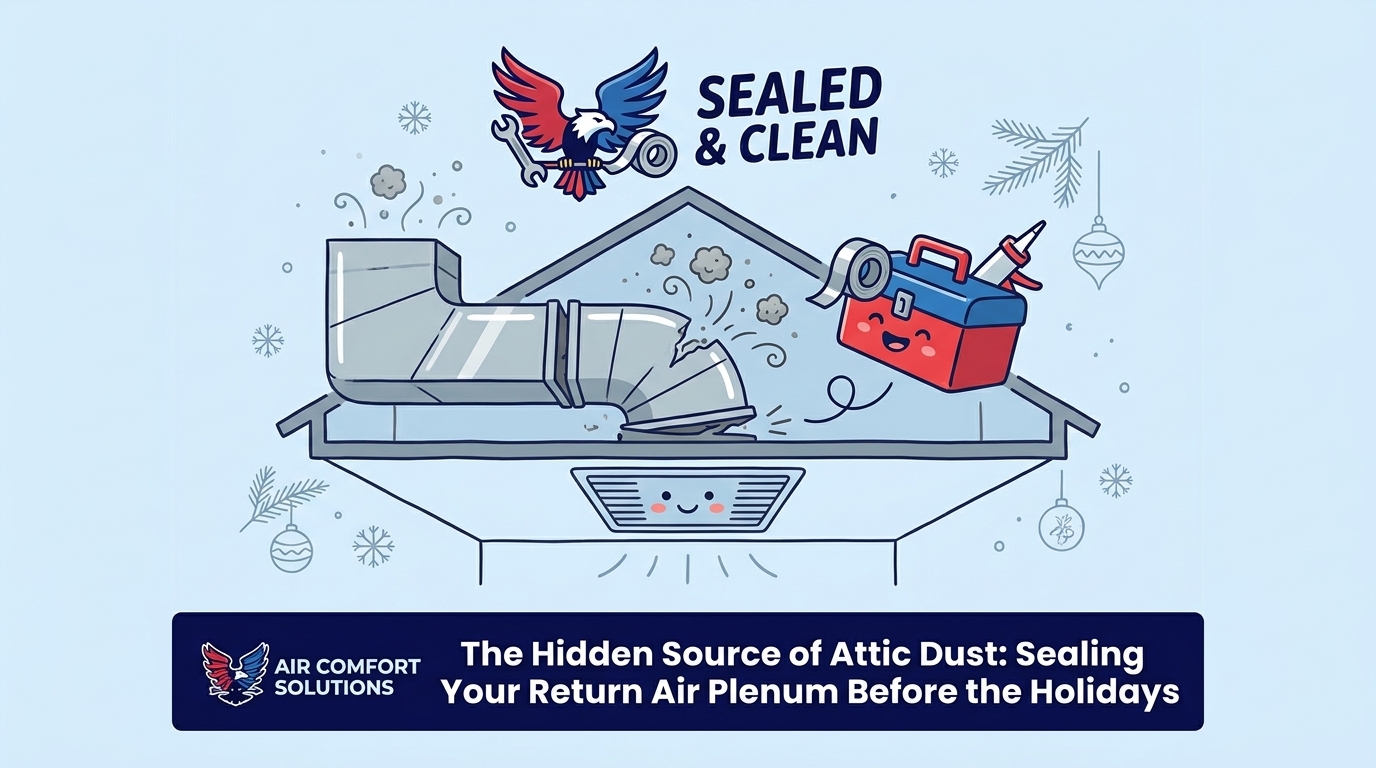
The Value of Sealing Your Return Air Plenum Before the Holidays
Most homeowners buy expensive filters to fix dusty air, not realizing a leaky return plenum in the attic is the real culprit. See why sealing it now saves your holiday gatherings.

A widespread misconception we encounter among homeowners is that running the air conditioner is all it takes to keep indoor air comfortably dry, making the process of comparing whole-home dehumidifiers against standard AC moisture removal for fall feel completely unnecessary. For most of the summer, this myth seems to hold true. When it is blistering hot outside, your air conditioning system runs almost continuously, and as a byproduct of that long cooling cycle, it pulls gallons of water out of your indoor air. But as the seasons shift, that dynamic completely changes.
During the September transition with lower temps but high humidity, our technicians at Air Comfort Solutions frequently see a very specific, uncomfortable phenomenon: the cold and clammy house. Here in Southeast Texas, the ambient outdoor temperature drops just enough to give your air conditioner a break, but the heavy, moisture-laden Gulf Coast air remains stubbornly in place. Your thermostat registers a comfortable 72 degrees, yet your skin feels sticky, the floors feel slightly damp, and the air carries a heavy, musty quality.
This creates a frustrating decision point for homeowners. Do you keep dropping the thermostat lower and lower, freezing your family just to force the system to dry out the air? Or do you look for a smarter, dedicated solution? True indoor comfort goes far beyond simple temperature control. Achieving a truly healthy home environment means recognizing that comprehensive indoor air quality solutions require more than just traditional air conditioning services. To understand why your home feels like a damp cave in the early fall, you have to look closely at how your cooling system is actually designed to operate.
To understand why your house feels so damp during the shoulder season, you need to understand the difference between sensible cooling and latent cooling. Standard air conditioners are incredibly effective machines, but they are entirely temperature-driven. They are designed to manage sensible heat—the heat you can feel and measure with a thermometer.
When your thermostat detects that the room is too warm, it signals the AC compressor to turn on. Warm indoor air is pulled through your return ducts and blown across a very cold evaporator coil. As the air passes over this icy surface, two things happen. First, the air loses its sensible heat (it gets colder). Second, because cold air cannot hold as much moisture as warm air, water vapor condenses on the coil and drips away into a drain pan. This secondary process is latent cooling—the removal of moisture.
Here is the critical catch: moisture removal is merely a byproduct of the cooling cycle. Your air conditioner does not have a sensor that tells it when the house is too humid. It only knows when the house is too warm.
In the middle of August, your AC runs for long, extended cycles, giving the evaporator coil plenty of time to wring the humidity out of the air like a sponge. But in early fall, the outdoor temperature might only be 78 degrees. Your AC turns on, quickly blasts cold air into the room, and satisfies the thermostat setting in just ten minutes. The system shuts off before it has had enough time to extract any meaningful amount of moisture.
This rapid on-and-off operation is known as short-cycling. When this happens, you will often see your indoor relative humidity spiking above 50-60% despite comfortable thermostat settings. The air is cool, but it is saturated with water. When our team responds to calls from customers dealing with high humidity inside your house even with the AC running, this mild-weather short-cycling is almost always the culprit we uncover.
If a standard air conditioner is a temperature-driven machine, a whole-home dehumidifier is a moisture-driven machine. This fundamental difference in design is what makes dedicated dehumidification the ultimate solution for fall comfort.
Unlike your air conditioner, a whole-home dehumidifier operates completely independently of your home's cooling cycle. Instead of relying on a thermostat, it is controlled by a humidistat. You set your desired indoor humidity level—usually around 45%—and the system monitors the air 24 hours a day. When the moisture level rises above your set point, the dehumidifier kicks on, regardless of whether your air conditioner is running or not.
These systems are integrated directly into your home's existing HVAC ductwork, usually sitting right next to your central air handler. When the humidistat calls for dehumidification, the system pulls air from your return ducts. It passes this air over its own dedicated cooling coil to extract the water vapor. However, unlike an AC, it then passes that dried air over a warm condenser coil, bringing it back up to room temperature before sending it through your supply vents.
In our experience installing these units across the Gulf Coast, this reheat process is the secret to shoulder-season comfort. A high-quality whole-home system can remove up to 90 to 130 pints of water per day from your indoor air without dropping the temperature of your home by a single degree. By separating temperature control from moisture control, you completely solve the early fall dilemma, ensuring your home feels warm, dry, and perfectly balanced.
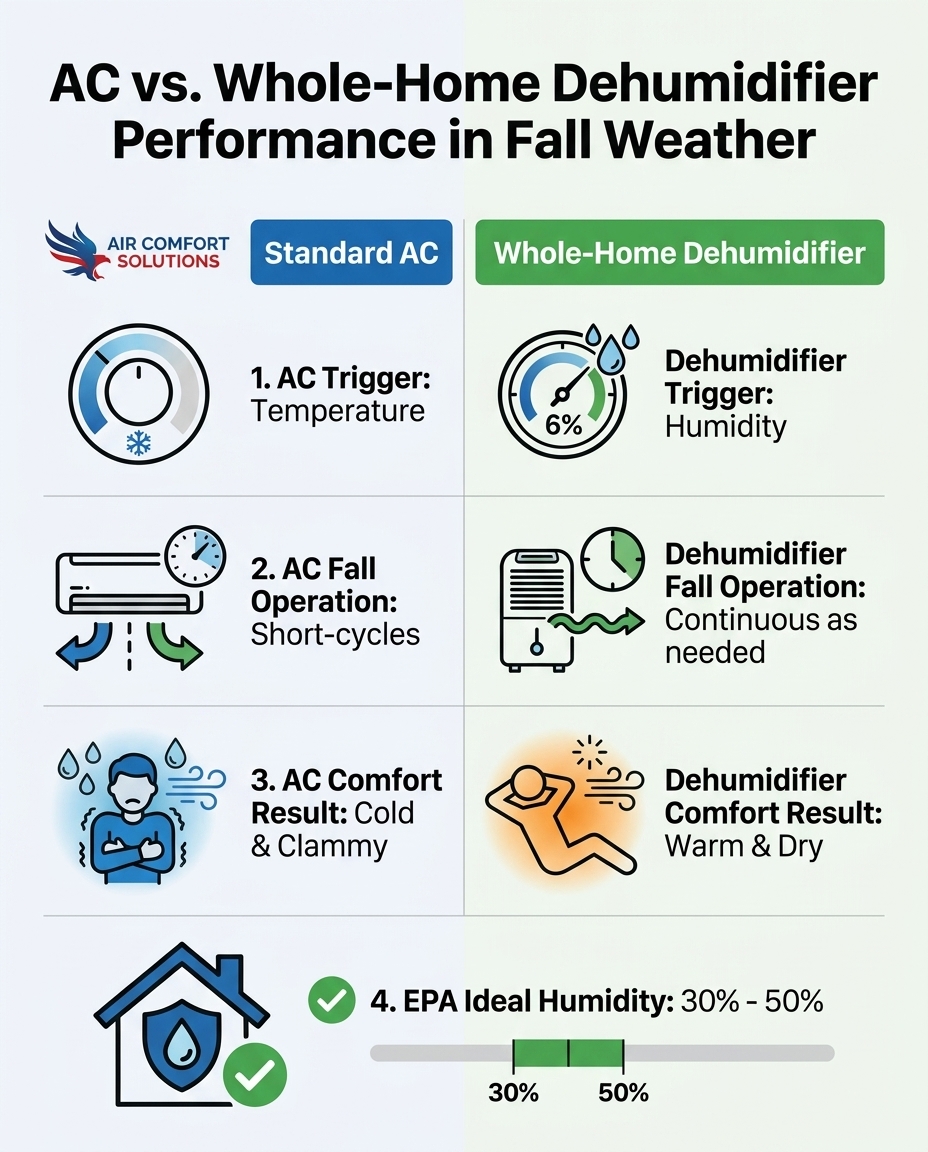
When you look at how these two systems perform during the autumn months, the differences in efficiency and comfort become starkly clear. While they both remove water from the air, their triggers, performance metrics, and end results are vastly different.
• Primary Trigger — Standard Air Conditioner: Thermostat (reacts only to temperature) — Whole-Home Dehumidifier: Humidistat (reacts only to moisture)
• Fall Weather Operation — Standard Air Conditioner: Poor. Short-cycles frequently as temperatures drop. — Whole-Home Dehumidifier: Excellent. Runs continuously as needed until dry.
• Impact on Indoor Comfort — Standard Air Conditioner: Leaves air feeling cold, damp, and clammy. — Whole-Home Dehumidifier: Maintains a warm, dry, and crisp environment.
• Energy Efficiency in Fall — Standard Air Conditioner: Low. Wastes power overcooling the house. — Whole-Home Dehumidifier: High. Delivers targeted moisture extraction.
As the table illustrates, relying on your AC for fall dehumidification forces the system to do a job it wasn't designed for in mild weather. The dedicated dehumidifier, on the other hand, excels precisely when the air conditioner begins to struggle.
When the house feels sticky in September, most homeowners resort to a very common behavioral workaround: they walk over to the thermostat and crank it down to 68 degrees. The logic makes sense on the surface. If you lower the temperature setting, the AC is forced to run longer, which means it will pull more humidity out of the air. But this strategy, known as the overcooling trap, comes with significant hidden costs.
First and foremost, you are putting massive unnecessary strain on your HVAC equipment. Your air conditioner is designed to maintain a comfortable temperature, not to act as a brute-force dehumidifier. By forcing the compressor to run long cycles in mild weather, you are accelerating the wear and tear on critical moving parts. The blower motor works overtime, the contactors degrade faster, and the compressor itself takes a beating. Our technicians constantly emphasize that this unnecessary strain highlights exactly why keeping up with a comprehensive HVAC maintenance plan is so critical for the longevity of your system.
Beyond the mechanical toll, overcooling is incredibly wasteful. You are paying high utility bills to chill your home to an uncomfortably cold temperature, just to achieve a tolerable level of humidity. You end up wearing sweaters inside your own house while it is 75 degrees outside.
When you have proper moisture control through a dedicated dehumidifier, the opposite happens. Because dry air feels naturally cooler on your skin than humid air, you can actually set your thermostat higher—often to 74 or 75 degrees—and feel just as comfortable as you would at 68 degrees in a damp house. You stop fighting your thermostat, reduce the runtime of your heavy-duty AC compressor, and finally enjoy a comfortable living space.
Generic, national HVAC advice often fails homeowners in our specific region. A blog post written for a homeowner in the dry Southwest or the chilly Northeast simply does not apply to the realities of the Gulf Coast. At Air Comfort Solutions, we've spent years serving Pinehurst TX and surrounding areas, and we know firsthand that the late-summer and early-fall humidity challenges require specific, localized solutions.
National chains often push bigger, more powerful air conditioners as the solution to every comfort problem. But as we have established, a larger AC will cool the house even faster, leading to worse short-cycling and even higher humidity. This is where our local Gulf Coast climate expertise makes all the difference. Our team understands that Southeast Texas transitions mean weeks of 70-degree days with 80% outdoor humidity. We know that the only way to effectively combat this without freezing your family is to decouple your moisture removal from your temperature control.
The Environmental Protection Agency recommends keeping indoor relative humidity between 30% and 50%. Staying in this sweet spot prevents mold growth, deters dust mites, protects hardwood floors from warping, and keeps your indoor air smelling fresh. Achieving this requires properly sizing a whole-home dehumidifier and expertly integrating it into your existing ductwork. If you want to transform your indoor air quality, relying on our expert Pinehurst HVAC services ensures your new system is calibrated specifically for the heavy moisture loads of our regional climate.
An air conditioner only dehumidifies effectively during peak summer heat when it runs continuously for long periods. Because its primary job is cooling, it loses its dehumidification effectiveness entirely in milder weather due to short-cycling. A dedicated dehumidifier is built specifically to remove moisture regardless of the temperature, making it far superior for humidity control.
Your house feels humid because the AC satisfies the temperature setting too quickly in mild weather. The system blasts cold air, hits the target temperature on the thermostat, and shuts off after just a few minutes. This leaves the heavy moisture behind because the compressor simply did not run long enough to extract the latent heat from the air.
A whole-home dehumidifier is highly recommended in humid climates like the Gulf Coast, even if you have excellent central air. Central air is designed for temperature management, not precise moisture control. Adding a dehumidifier prevents the need to overcool your home during the long, damp shoulder seasons, saving your equipment from unnecessary wear.
Yes, they work perfectly in tandem to create the ultimate indoor environment. The dehumidifier handles the latent heat (moisture), which actually allows the air conditioner to efficiently manage the sensible heat (temperature) with much less effort. They complement each other without interfering with one another's operation.
The ideal indoor humidity level is between 30% and 50%, according to EPA guidelines. Keeping your home within this range ensures that the air feels crisp and comfortable on your skin. It also protects your home's structure and prevents the growth of mold and mildew that thrive in damp, stagnant air.
You do not have to spend another autumn shivering in your own living room just to keep the dampness at bay. The cold and clammy shoulder-season phenomenon is a structural problem with how standard cooling systems operate, but it is a problem with a definitive, proven solution. By choosing to separate your temperature control from your moisture control, you create a clear path to solving the clammy moisture problem without ever having to overcool your home again. Stop fighting your thermostat and stop putting unnecessary miles on your air conditioner's compressor. Reach out to our team at Air Comfort Solutions to discuss how a dedicated whole-home dehumidifier can finally give you the warm, dry, and perfectly balanced indoor air quality you deserve.


Zane came out and did an amazing job! Super friendly, honest and transparent about the work that needed to be done. This is my second time working with Air Comfort Solutions and they’re my go to for HVAC services. Highly recommend.
God's AMAZING grace sent us Robert and Zane. We have been without air in this Texas heat for six weeks and four days. We've had a few contractors give us quotes all trying to upsell when we're at a low point. But not the guys at Air Comfort Solutions. They came in assessed our situation, gave us honest feedback, and showed us the issues as they proceeded with the assessment for clear understanding. We highly recommend them for their professionalism, quality products, and fair pricing. We hands down support them for all the work they do 💯 %.
Robert and Zane gone above and beyond to make the process easy and affordable.
Would definitely recommend!!
I’m writing this review to let everyone know that Air Comfort Solutions is the company to work with. I know the owner ( Robert) for several years now. He has been taking care of my residential and business work orders. Robert is professional, knowledgeable and will save you money. I just want to thank Robert for great job you have been doing for me.