Burning Smell on Fall Startup? When to Call for 24 Hour AC Repair
Why we always check for dust burn-off first. Review our home maintenance tips and troubleshooting advice to decide if that fall HVAC smell needs a pro.
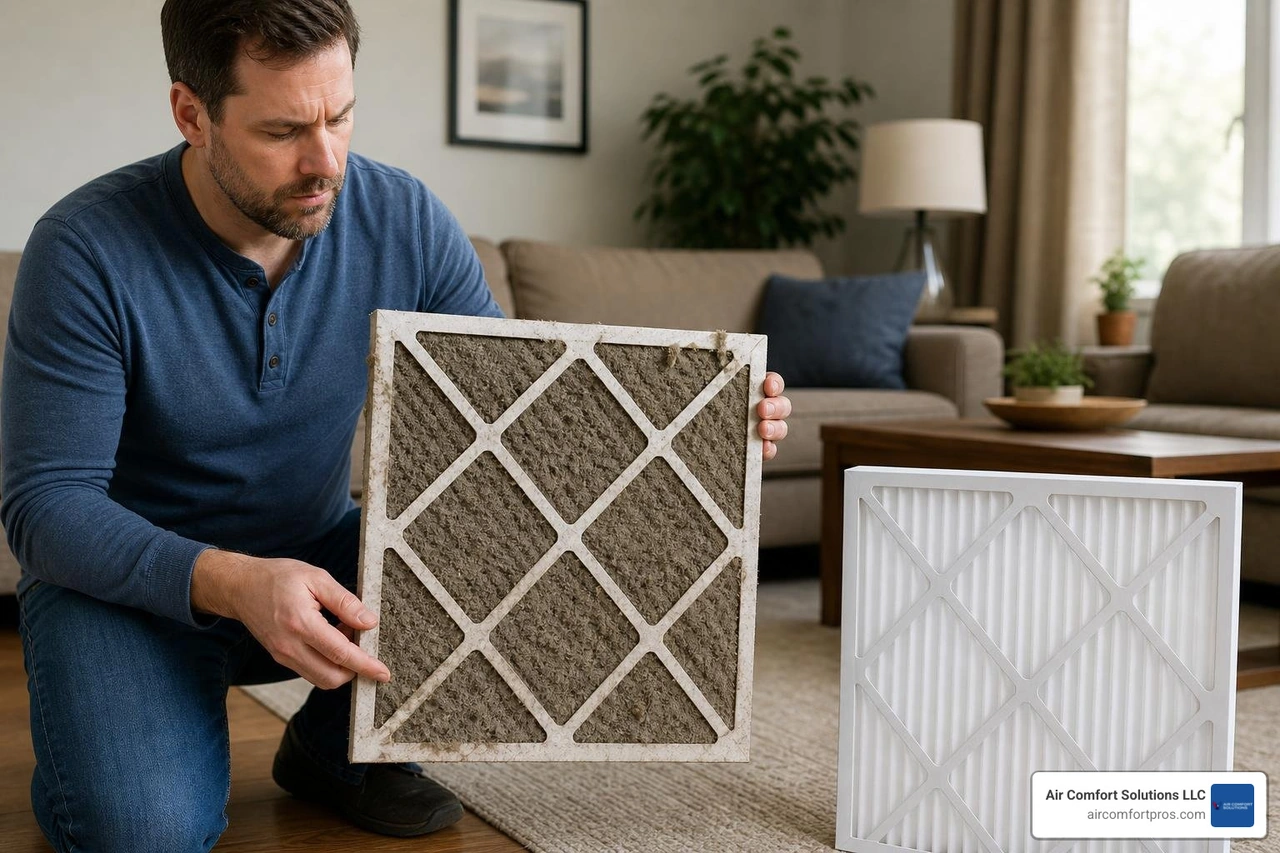
What happens when you don't change your AC filter is one of the most important things a Pinehurst homeowner can understand before a small, easily avoided problem turns into a costly breakdown. Here is a quick summary:
When you skip AC filter changes, you can expect:
Think of your HVAC system as the lungs of your home. A clogged filter is like slowly restricting its ability to breathe — and in a climate like Pinehurst, TX, where air conditioners run hard for months on end, that strain adds up fast. HVAC technicians regularly visit homes where utility bills are running 20% to 30% higher than expected, only to find the culprit is a completely blocked filter that costs just a few dollars to replace.
I'm Robert Patterson, and in this guide I'll walk you through every consequence of filter neglect — and exactly what you can do to protect your system and your family's comfort.
What happens when you dont change your ac filter terminology:
When we ignore our air filters, we are essentially placing a mechanical chokehold on the most expensive appliance in our homes. To understand why a dirty filter is so damaging, we have to look at the physics of airflow and static pressure.
Most residential HVAC systems are designed to operate safely under a maximum of 0.5 inches of water column Static Pressure (SP). Your home's ductwork naturally consumes about 0.1 to 0.2 inches of that limit. This leaves a narrow margin of only 0.3 to 0.4 inches of SP for the air filter.
As dust, pet hair, and airborne debris blanket the filter surface, the resistance to airflow climbs. Think of it like trying to drink a thick milkshake through a pinhole straw. The harder your system has to pull, the higher the static pressure rises, pushing past safe operating limits and triggering a cascade of mechanical issues.
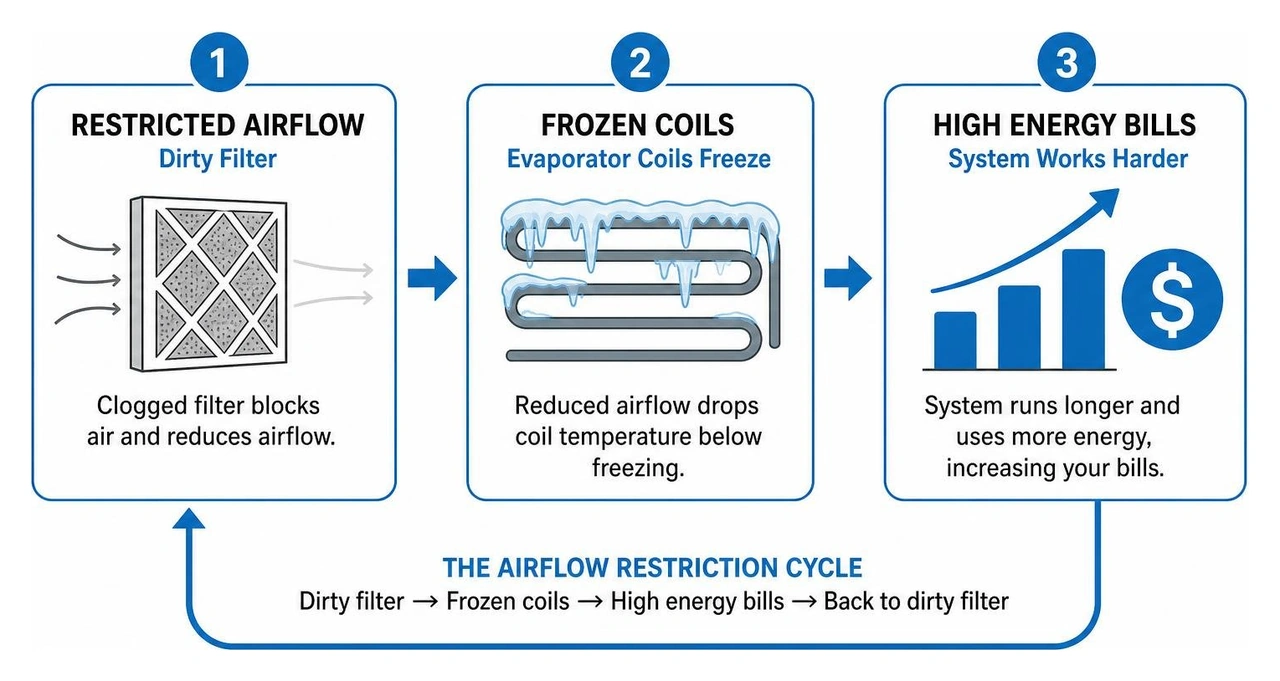
When airflow is severely restricted, the entire thermodynamic balance of your air conditioner falls apart. Without a steady volume of warm indoor air passing over the cold evaporator coils, the heat transfer process is disrupted. This lack of heat load causes the temperature of the refrigerant inside the coils to plunge below freezing, leading directly to a frozen evaporator coil.
Once ice blankets the coils, they can no longer absorb heat, which is the primary reason behind a homeowner asking why is my AC running but not cooling.
The heart of your HVAC system's air distribution is the blower motor. When a clogged filter restricts airflow, the blower motor must work significantly harder to pull air through the dense barrier of dirt. This continuous resistance creates massive electrical and mechanical strain, causing the motor to draw more power, overheat, and run much longer than it was designed to.
This mechanical strain manifests in several ways:
When an evaporator coil freezes due to restricted airflow, it doesn't just stop cooling your home—it also creates a major risk of water damage.
As the ice buildup on the coil eventually melts during a system shutdown, a massive volume of water releases all at once. This sudden deluge can easily overwhelm your AC's primary condensate drain pan.
To make matters worse, when a filter is clogged, unfiltered air often forces its way around the edges of the filter frame (a phenomenon known as filter bypass). This raw dust and pet dander settle directly onto the wet, cold surfaces of the evaporator coil. When the ice thaws, this accumulation of grime washes down into the narrow, primary condensate drain line, forming a thick sludge that completely plugs the drain.
The result? Water backs up and overflows into your home, damaging ceilings, drywall, and flooring.
The financial consequences of neglecting a simple filter change go far beyond the cost of a replacement. The table below illustrates the stark contrast between a well-maintained system and one struggling with a dirty filter:
| System Metric | Clean Air Filter | Clogged Air Filter |
|---|---|---|
| Energy Consumption | Standard / Optimized | Increased by 5% to 15% |
| Blower Motor Strain | Minimal; runs at design static pressure | Severe; prone to overheating and burnout |
| Coil Condition | Clean; optimal heat transfer | Dirty / Iced over; blocked heat transfer |
| System Lifespan | Full life expectancy (15–25 years) | Reduced by 6 to 12 years due to constant wear |
| Repair Risks | Low; routine maintenance keeps parts safe | High; risk of compressor or blower motor failure |
A dirty air filter can easily increase your monthly energy bill by 5% to 15%. In the hot, humid summers of Pinehurst and North Harris County, where air conditioners run almost continuously, that percentage translates to a significant amount of wasted money over a single season.
Furthermore, the mechanical strain of operating under high static pressure will eventually lead to component failure. Replacing a burnt-out blower motor can easily cost a substantial amount, and compressor failures are often so expensive that they require a complete system replacement.
Additionally, when dust bypasses a clogged filter, it doesn't just dirty the indoor coil; it can also lead to a dirty condenser coil, further degrading the outdoor unit's performance and accelerating system failure.
Many homeowners believe that standard 1-inch filters are primarily designed to purify the air they breathe. In reality, their main job is to act as a mechanical shield to protect the sensitive internal components of the HVAC system from debris. However, neglecting these filters has a direct, devastating impact on your indoor air quality (IAQ) and your family's health.
The EPA states that the air inside our homes is, on average, two to five times more polluted than the air outdoors. When a filter becomes completely saturated with dust, pet dander, and pollen, it reaches its holding capacity. From this point on, two dangerous phenomena occur:
In our humid Texas climate, this issue becomes even more hazardous. When paper-based filters absorb high indoor humidity, they can sag, collapse, or become damp.
This moisture, combined with the trapped organic dust on the filter, creates a perfect breeding ground for mold, mildew, and bacteria. These microorganisms can release unpleasant, musty odors and airborne spores that trigger asthma attacks, severe allergies, watery eyes, and respiratory infections.
To learn more about how your system interacts with our local climate, read our guide on how your AC affects indoor air quality in humid climates.
The best way to protect your home, your wallet, and your health is to establish a consistent, proactive filter replacement schedule. While manufacturers often print a generic "change every 90 days" recommendation on their packaging, real-world conditions in Texas require a more tailored approach.
Several lifestyle and environmental factors should dictate how often you change your filter:
When choosing a replacement filter, pay close attention to the Minimum Efficiency Reporting Value (MERV) rating, which ranges from 1 to 16:
For a deeper dive into choosing the right filter and maintaining it under local conditions, check out our articles on how often to change your ac filter in humid texas heat and our step-by-step how to replace ac filters: a quick and simple guide.
No, you should never run your air conditioner without a filter, even for a single night.
Without a filter in place, raw dust, pet hair, and airborne debris are sucked directly into the return vents. This debris blankets the wet evaporator coils and coats the blower motor blades. Within just 24 to 48 hours of operation without a filter, enough grime can accumulate on the coils to restrict heat transfer, clog your condensate drain line, and put the blower motor at risk of burning out.
If you do not have a replacement filter ready, it is always safer to turn the system off at the thermostat until you can slide a clean filter into place.
Your HVAC system will usually tell you when its filter is completely clogged. Keep an ear and an eye out for these common warning signs:
Yes. Major HVAC manufacturers require proof of regular, proper maintenance to honor warranty claims on expensive components like compressors, heat exchangers, and blower motors.
If a critical component fails and the technician notes that the failure was caused by long-term airflow restriction from a neglected filter, the manufacturer can—and often will—deny your warranty claim. Keeping a simple log of your filter changes and scheduling professional tune-ups provides the documented proof of maintenance you need to protect your warranty.
Understanding what happens when you dont change your ac filter is the first step toward protecting your home's comfort, your family's health, and your hard-earned money. A simple, regular filter replacement is the single most effective DIY maintenance task you can perform.
However, a clean filter only represents a small portion of the comprehensive care your heating and cooling system needs to run reliably year after year. To ensure your system is fully prepared to handle the intense Texas heat, professional maintenance is essential.
At Air Comfort Solutions LLC, we have over 35 years of experience keeping homes in Pinehurst, Magnolia, The Woodlands, Tomball, and surrounding areas perfectly comfortable.
To learn more about what goes into keeping your system running at peak performance, explore our AC Tune-Up Guide for Houston Area Homeowners and find out what does professional AC service include.
For year-round peace of mind, lower utility bills, and priority service, check out our AC Maintenance Plan Texas Guide 2026.
Don't wait for a frozen coil or an unexpected breakdown to catch you off guard. Schedule your professional AC maintenance with Air Comfort Pros today!
What happens when you don't change your AC filter is one of the most important things a Pinehurst homeowner can understand before a small, easily avoided problem turns into a costly breakdown. Here is a quick summary:
When you skip AC filter changes, you can expect:
Think of your HVAC system as the lungs of your home. A clogged filter is like slowly restricting its ability to breathe — and in a climate like Pinehurst, TX, where air conditioners run hard for months on end, that strain adds up fast. HVAC technicians regularly visit homes where utility bills are running 20% to 30% higher than expected, only to find the culprit is a completely blocked filter that costs just a few dollars to replace.
I'm Robert Patterson, and in this guide I'll walk you through every consequence of filter neglect — and exactly what you can do to protect your system and your family's comfort.
What happens when you dont change your ac filter terminology:
When we ignore our air filters, we are essentially placing a mechanical chokehold on the most expensive appliance in our homes. To understand why a dirty filter is so damaging, we have to look at the physics of airflow and static pressure.
Most residential HVAC systems are designed to operate safely under a maximum of 0.5 inches of water column Static Pressure (SP). Your home's ductwork naturally consumes about 0.1 to 0.2 inches of that limit. This leaves a narrow margin of only 0.3 to 0.4 inches of SP for the air filter.
As dust, pet hair, and airborne debris blanket the filter surface, the resistance to airflow climbs. Think of it like trying to drink a thick milkshake through a pinhole straw. The harder your system has to pull, the higher the static pressure rises, pushing past safe operating limits and triggering a cascade of mechanical issues.
When airflow is severely restricted, the entire thermodynamic balance of your air conditioner falls apart. Without a steady volume of warm indoor air passing over the cold evaporator coils, the heat transfer process is disrupted. This lack of heat load causes the temperature of the refrigerant inside the coils to plunge below freezing, leading directly to a frozen evaporator coil.
Once ice blankets the coils, they can no longer absorb heat, which is the primary reason behind a homeowner asking why is my AC running but not cooling.
The heart of your HVAC system's air distribution is the blower motor. When a clogged filter restricts airflow, the blower motor must work significantly harder to pull air through the dense barrier of dirt. This continuous resistance creates massive electrical and mechanical strain, causing the motor to draw more power, overheat, and run much longer than it was designed to.
This mechanical strain manifests in several ways:
When an evaporator coil freezes due to restricted airflow, it doesn't just stop cooling your home—it also creates a major risk of water damage.
As the ice buildup on the coil eventually melts during a system shutdown, a massive volume of water releases all at once. This sudden deluge can easily overwhelm your AC's primary condensate drain pan.
To make matters worse, when a filter is clogged, unfiltered air often forces its way around the edges of the filter frame (a phenomenon known as filter bypass). This raw dust and pet dander settle directly onto the wet, cold surfaces of the evaporator coil. When the ice thaws, this accumulation of grime washes down into the narrow, primary condensate drain line, forming a thick sludge that completely plugs the drain.
The result? Water backs up and overflows into your home, damaging ceilings, drywall, and flooring.
The financial consequences of neglecting a simple filter change go far beyond the cost of a replacement. The table below illustrates the stark contrast between a well-maintained system and one struggling with a dirty filter:
| System Metric | Clean Air Filter | Clogged Air Filter |
|---|---|---|
| Energy Consumption | Standard / Optimized | Increased by 5% to 15% |
| Blower Motor Strain | Minimal; runs at design static pressure | Severe; prone to overheating and burnout |
| Coil Condition | Clean; optimal heat transfer | Dirty / Iced over; blocked heat transfer |
| System Lifespan | Full life expectancy (15–25 years) | Reduced by 6 to 12 years due to constant wear |
| Repair Risks | Low; routine maintenance keeps parts safe | High; risk of compressor or blower motor failure |
A dirty air filter can easily increase your monthly energy bill by 5% to 15%. In the hot, humid summers of Pinehurst and North Harris County, where air conditioners run almost continuously, that percentage translates to a significant amount of wasted money over a single season.
Furthermore, the mechanical strain of operating under high static pressure will eventually lead to component failure. Replacing a burnt-out blower motor can easily cost a substantial amount, and compressor failures are often so expensive that they require a complete system replacement.
Additionally, when dust bypasses a clogged filter, it doesn't just dirty the indoor coil; it can also lead to a dirty condenser coil, further degrading the outdoor unit's performance and accelerating system failure.
Many homeowners believe that standard 1-inch filters are primarily designed to purify the air they breathe. In reality, their main job is to act as a mechanical shield to protect the sensitive internal components of the HVAC system from debris. However, neglecting these filters has a direct, devastating impact on your indoor air quality (IAQ) and your family's health.
The EPA states that the air inside our homes is, on average, two to five times more polluted than the air outdoors. When a filter becomes completely saturated with dust, pet dander, and pollen, it reaches its holding capacity. From this point on, two dangerous phenomena occur:
In our humid Texas climate, this issue becomes even more hazardous. When paper-based filters absorb high indoor humidity, they can sag, collapse, or become damp.
This moisture, combined with the trapped organic dust on the filter, creates a perfect breeding ground for mold, mildew, and bacteria. These microorganisms can release unpleasant, musty odors and airborne spores that trigger asthma attacks, severe allergies, watery eyes, and respiratory infections.
To learn more about how your system interacts with our local climate, read our guide on how your AC affects indoor air quality in humid climates.
The best way to protect your home, your wallet, and your health is to establish a consistent, proactive filter replacement schedule. While manufacturers often print a generic "change every 90 days" recommendation on their packaging, real-world conditions in Texas require a more tailored approach.
Several lifestyle and environmental factors should dictate how often you change your filter:
When choosing a replacement filter, pay close attention to the Minimum Efficiency Reporting Value (MERV) rating, which ranges from 1 to 16:
For a deeper dive into choosing the right filter and maintaining it under local conditions, check out our articles on how often to change your ac filter in humid texas heat and our step-by-step how to replace ac filters: a quick and simple guide.
No, you should never run your air conditioner without a filter, even for a single night.
Without a filter in place, raw dust, pet hair, and airborne debris are sucked directly into the return vents. This debris blankets the wet evaporator coils and coats the blower motor blades. Within just 24 to 48 hours of operation without a filter, enough grime can accumulate on the coils to restrict heat transfer, clog your condensate drain line, and put the blower motor at risk of burning out.
If you do not have a replacement filter ready, it is always safer to turn the system off at the thermostat until you can slide a clean filter into place.
Your HVAC system will usually tell you when its filter is completely clogged. Keep an ear and an eye out for these common warning signs:
Yes. Major HVAC manufacturers require proof of regular, proper maintenance to honor warranty claims on expensive components like compressors, heat exchangers, and blower motors.
If a critical component fails and the technician notes that the failure was caused by long-term airflow restriction from a neglected filter, the manufacturer can—and often will—deny your warranty claim. Keeping a simple log of your filter changes and scheduling professional tune-ups provides the documented proof of maintenance you need to protect your warranty.
Understanding what happens when you dont change your ac filter is the first step toward protecting your home's comfort, your family's health, and your hard-earned money. A simple, regular filter replacement is the single most effective DIY maintenance task you can perform.
However, a clean filter only represents a small portion of the comprehensive care your heating and cooling system needs to run reliably year after year. To ensure your system is fully prepared to handle the intense Texas heat, professional maintenance is essential.
At Air Comfort Solutions LLC, we have over 35 years of experience keeping homes in Pinehurst, Magnolia, The Woodlands, Tomball, and surrounding areas perfectly comfortable.
To learn more about what goes into keeping your system running at peak performance, explore our AC Tune-Up Guide for Houston Area Homeowners and find out what does professional AC service include.
For year-round peace of mind, lower utility bills, and priority service, check out our AC Maintenance Plan Texas Guide 2026.
Don't wait for a frozen coil or an unexpected breakdown to catch you off guard. Schedule your professional AC maintenance with Air Comfort Pros today!
What happens when you don't change your AC filter is one of the most important things a Pinehurst homeowner can understand before a small, easily avoided problem turns into a costly breakdown. Here is a quick summary:
When you skip AC filter changes, you can expect:
Think of your HVAC system as the lungs of your home. A clogged filter is like slowly restricting its ability to breathe — and in a climate like Pinehurst, TX, where air conditioners run hard for months on end, that strain adds up fast. HVAC technicians regularly visit homes where utility bills are running 20% to 30% higher than expected, only to find the culprit is a completely blocked filter that costs just a few dollars to replace.
I'm Robert Patterson, and in this guide I'll walk you through every consequence of filter neglect — and exactly what you can do to protect your system and your family's comfort.
What happens when you dont change your ac filter terminology:
When we ignore our air filters, we are essentially placing a mechanical chokehold on the most expensive appliance in our homes. To understand why a dirty filter is so damaging, we have to look at the physics of airflow and static pressure.
Most residential HVAC systems are designed to operate safely under a maximum of 0.5 inches of water column Static Pressure (SP). Your home's ductwork naturally consumes about 0.1 to 0.2 inches of that limit. This leaves a narrow margin of only 0.3 to 0.4 inches of SP for the air filter.
As dust, pet hair, and airborne debris blanket the filter surface, the resistance to airflow climbs. Think of it like trying to drink a thick milkshake through a pinhole straw. The harder your system has to pull, the higher the static pressure rises, pushing past safe operating limits and triggering a cascade of mechanical issues.
When airflow is severely restricted, the entire thermodynamic balance of your air conditioner falls apart. Without a steady volume of warm indoor air passing over the cold evaporator coils, the heat transfer process is disrupted. This lack of heat load causes the temperature of the refrigerant inside the coils to plunge below freezing, leading directly to a frozen evaporator coil.
Once ice blankets the coils, they can no longer absorb heat, which is the primary reason behind a homeowner asking why is my AC running but not cooling.
The heart of your HVAC system's air distribution is the blower motor. When a clogged filter restricts airflow, the blower motor must work significantly harder to pull air through the dense barrier of dirt. This continuous resistance creates massive electrical and mechanical strain, causing the motor to draw more power, overheat, and run much longer than it was designed to.
This mechanical strain manifests in several ways:
When an evaporator coil freezes due to restricted airflow, it doesn't just stop cooling your home—it also creates a major risk of water damage.
As the ice buildup on the coil eventually melts during a system shutdown, a massive volume of water releases all at once. This sudden deluge can easily overwhelm your AC's primary condensate drain pan.
To make matters worse, when a filter is clogged, unfiltered air often forces its way around the edges of the filter frame (a phenomenon known as filter bypass). This raw dust and pet dander settle directly onto the wet, cold surfaces of the evaporator coil. When the ice thaws, this accumulation of grime washes down into the narrow, primary condensate drain line, forming a thick sludge that completely plugs the drain.
The result? Water backs up and overflows into your home, damaging ceilings, drywall, and flooring.
The financial consequences of neglecting a simple filter change go far beyond the cost of a replacement. The table below illustrates the stark contrast between a well-maintained system and one struggling with a dirty filter:
| System Metric | Clean Air Filter | Clogged Air Filter |
|---|---|---|
| Energy Consumption | Standard / Optimized | Increased by 5% to 15% |
| Blower Motor Strain | Minimal; runs at design static pressure | Severe; prone to overheating and burnout |
| Coil Condition | Clean; optimal heat transfer | Dirty / Iced over; blocked heat transfer |
| System Lifespan | Full life expectancy (15–25 years) | Reduced by 6 to 12 years due to constant wear |
| Repair Risks | Low; routine maintenance keeps parts safe | High; risk of compressor or blower motor failure |
A dirty air filter can easily increase your monthly energy bill by 5% to 15%. In the hot, humid summers of Pinehurst and North Harris County, where air conditioners run almost continuously, that percentage translates to a significant amount of wasted money over a single season.
Furthermore, the mechanical strain of operating under high static pressure will eventually lead to component failure. Replacing a burnt-out blower motor can easily cost a substantial amount, and compressor failures are often so expensive that they require a complete system replacement.
Additionally, when dust bypasses a clogged filter, it doesn't just dirty the indoor coil; it can also lead to a dirty condenser coil, further degrading the outdoor unit's performance and accelerating system failure.
Many homeowners believe that standard 1-inch filters are primarily designed to purify the air they breathe. In reality, their main job is to act as a mechanical shield to protect the sensitive internal components of the HVAC system from debris. However, neglecting these filters has a direct, devastating impact on your indoor air quality (IAQ) and your family's health.
The EPA states that the air inside our homes is, on average, two to five times more polluted than the air outdoors. When a filter becomes completely saturated with dust, pet dander, and pollen, it reaches its holding capacity. From this point on, two dangerous phenomena occur:
In our humid Texas climate, this issue becomes even more hazardous. When paper-based filters absorb high indoor humidity, they can sag, collapse, or become damp.
This moisture, combined with the trapped organic dust on the filter, creates a perfect breeding ground for mold, mildew, and bacteria. These microorganisms can release unpleasant, musty odors and airborne spores that trigger asthma attacks, severe allergies, watery eyes, and respiratory infections.
To learn more about how your system interacts with our local climate, read our guide on how your AC affects indoor air quality in humid climates.
The best way to protect your home, your wallet, and your health is to establish a consistent, proactive filter replacement schedule. While manufacturers often print a generic "change every 90 days" recommendation on their packaging, real-world conditions in Texas require a more tailored approach.
Several lifestyle and environmental factors should dictate how often you change your filter:
When choosing a replacement filter, pay close attention to the Minimum Efficiency Reporting Value (MERV) rating, which ranges from 1 to 16:
For a deeper dive into choosing the right filter and maintaining it under local conditions, check out our articles on how often to change your ac filter in humid texas heat and our step-by-step how to replace ac filters: a quick and simple guide.
No, you should never run your air conditioner without a filter, even for a single night.
Without a filter in place, raw dust, pet hair, and airborne debris are sucked directly into the return vents. This debris blankets the wet evaporator coils and coats the blower motor blades. Within just 24 to 48 hours of operation without a filter, enough grime can accumulate on the coils to restrict heat transfer, clog your condensate drain line, and put the blower motor at risk of burning out.
If you do not have a replacement filter ready, it is always safer to turn the system off at the thermostat until you can slide a clean filter into place.
Your HVAC system will usually tell you when its filter is completely clogged. Keep an ear and an eye out for these common warning signs:
Yes. Major HVAC manufacturers require proof of regular, proper maintenance to honor warranty claims on expensive components like compressors, heat exchangers, and blower motors.
If a critical component fails and the technician notes that the failure was caused by long-term airflow restriction from a neglected filter, the manufacturer can—and often will—deny your warranty claim. Keeping a simple log of your filter changes and scheduling professional tune-ups provides the documented proof of maintenance you need to protect your warranty.
Understanding what happens when you dont change your ac filter is the first step toward protecting your home's comfort, your family's health, and your hard-earned money. A simple, regular filter replacement is the single most effective DIY maintenance task you can perform.
However, a clean filter only represents a small portion of the comprehensive care your heating and cooling system needs to run reliably year after year. To ensure your system is fully prepared to handle the intense Texas heat, professional maintenance is essential.
At Air Comfort Solutions LLC, we have over 35 years of experience keeping homes in Pinehurst, Magnolia, The Woodlands, Tomball, and surrounding areas perfectly comfortable.
To learn more about what goes into keeping your system running at peak performance, explore our AC Tune-Up Guide for Houston Area Homeowners and find out what does professional AC service include.
For year-round peace of mind, lower utility bills, and priority service, check out our AC Maintenance Plan Texas Guide 2026.
Don't wait for a frozen coil or an unexpected breakdown to catch you off guard. Schedule your professional AC maintenance with Air Comfort Pros today!
What happens when you don't change your AC filter is one of the most important things a Pinehurst homeowner can understand before a small, easily avoided problem turns into a costly breakdown. Here is a quick summary:
When you skip AC filter changes, you can expect:
Think of your HVAC system as the lungs of your home. A clogged filter is like slowly restricting its ability to breathe — and in a climate like Pinehurst, TX, where air conditioners run hard for months on end, that strain adds up fast. HVAC technicians regularly visit homes where utility bills are running 20% to 30% higher than expected, only to find the culprit is a completely blocked filter that costs just a few dollars to replace.
I'm Robert Patterson, and in this guide I'll walk you through every consequence of filter neglect — and exactly what you can do to protect your system and your family's comfort.
What happens when you dont change your ac filter terminology:
When we ignore our air filters, we are essentially placing a mechanical chokehold on the most expensive appliance in our homes. To understand why a dirty filter is so damaging, we have to look at the physics of airflow and static pressure.
Most residential HVAC systems are designed to operate safely under a maximum of 0.5 inches of water column Static Pressure (SP). Your home's ductwork naturally consumes about 0.1 to 0.2 inches of that limit. This leaves a narrow margin of only 0.3 to 0.4 inches of SP for the air filter.
As dust, pet hair, and airborne debris blanket the filter surface, the resistance to airflow climbs. Think of it like trying to drink a thick milkshake through a pinhole straw. The harder your system has to pull, the higher the static pressure rises, pushing past safe operating limits and triggering a cascade of mechanical issues.
When airflow is severely restricted, the entire thermodynamic balance of your air conditioner falls apart. Without a steady volume of warm indoor air passing over the cold evaporator coils, the heat transfer process is disrupted. This lack of heat load causes the temperature of the refrigerant inside the coils to plunge below freezing, leading directly to a frozen evaporator coil.
Once ice blankets the coils, they can no longer absorb heat, which is the primary reason behind a homeowner asking why is my AC running but not cooling.
The heart of your HVAC system's air distribution is the blower motor. When a clogged filter restricts airflow, the blower motor must work significantly harder to pull air through the dense barrier of dirt. This continuous resistance creates massive electrical and mechanical strain, causing the motor to draw more power, overheat, and run much longer than it was designed to.
This mechanical strain manifests in several ways:
When an evaporator coil freezes due to restricted airflow, it doesn't just stop cooling your home—it also creates a major risk of water damage.
As the ice buildup on the coil eventually melts during a system shutdown, a massive volume of water releases all at once. This sudden deluge can easily overwhelm your AC's primary condensate drain pan.
To make matters worse, when a filter is clogged, unfiltered air often forces its way around the edges of the filter frame (a phenomenon known as filter bypass). This raw dust and pet dander settle directly onto the wet, cold surfaces of the evaporator coil. When the ice thaws, this accumulation of grime washes down into the narrow, primary condensate drain line, forming a thick sludge that completely plugs the drain.
The result? Water backs up and overflows into your home, damaging ceilings, drywall, and flooring.
The financial consequences of neglecting a simple filter change go far beyond the cost of a replacement. The table below illustrates the stark contrast between a well-maintained system and one struggling with a dirty filter:
| System Metric | Clean Air Filter | Clogged Air Filter |
|---|---|---|
| Energy Consumption | Standard / Optimized | Increased by 5% to 15% |
| Blower Motor Strain | Minimal; runs at design static pressure | Severe; prone to overheating and burnout |
| Coil Condition | Clean; optimal heat transfer | Dirty / Iced over; blocked heat transfer |
| System Lifespan | Full life expectancy (15–25 years) | Reduced by 6 to 12 years due to constant wear |
| Repair Risks | Low; routine maintenance keeps parts safe | High; risk of compressor or blower motor failure |
A dirty air filter can easily increase your monthly energy bill by 5% to 15%. In the hot, humid summers of Pinehurst and North Harris County, where air conditioners run almost continuously, that percentage translates to a significant amount of wasted money over a single season.
Furthermore, the mechanical strain of operating under high static pressure will eventually lead to component failure. Replacing a burnt-out blower motor can easily cost a substantial amount, and compressor failures are often so expensive that they require a complete system replacement.
Additionally, when dust bypasses a clogged filter, it doesn't just dirty the indoor coil; it can also lead to a dirty condenser coil, further degrading the outdoor unit's performance and accelerating system failure.
Many homeowners believe that standard 1-inch filters are primarily designed to purify the air they breathe. In reality, their main job is to act as a mechanical shield to protect the sensitive internal components of the HVAC system from debris. However, neglecting these filters has a direct, devastating impact on your indoor air quality (IAQ) and your family's health.
The EPA states that the air inside our homes is, on average, two to five times more polluted than the air outdoors. When a filter becomes completely saturated with dust, pet dander, and pollen, it reaches its holding capacity. From this point on, two dangerous phenomena occur:
In our humid Texas climate, this issue becomes even more hazardous. When paper-based filters absorb high indoor humidity, they can sag, collapse, or become damp.
This moisture, combined with the trapped organic dust on the filter, creates a perfect breeding ground for mold, mildew, and bacteria. These microorganisms can release unpleasant, musty odors and airborne spores that trigger asthma attacks, severe allergies, watery eyes, and respiratory infections.
To learn more about how your system interacts with our local climate, read our guide on how your AC affects indoor air quality in humid climates.
The best way to protect your home, your wallet, and your health is to establish a consistent, proactive filter replacement schedule. While manufacturers often print a generic "change every 90 days" recommendation on their packaging, real-world conditions in Texas require a more tailored approach.
Several lifestyle and environmental factors should dictate how often you change your filter:
When choosing a replacement filter, pay close attention to the Minimum Efficiency Reporting Value (MERV) rating, which ranges from 1 to 16:
For a deeper dive into choosing the right filter and maintaining it under local conditions, check out our articles on how often to change your ac filter in humid texas heat and our step-by-step how to replace ac filters: a quick and simple guide.
No, you should never run your air conditioner without a filter, even for a single night.
Without a filter in place, raw dust, pet hair, and airborne debris are sucked directly into the return vents. This debris blankets the wet evaporator coils and coats the blower motor blades. Within just 24 to 48 hours of operation without a filter, enough grime can accumulate on the coils to restrict heat transfer, clog your condensate drain line, and put the blower motor at risk of burning out.
If you do not have a replacement filter ready, it is always safer to turn the system off at the thermostat until you can slide a clean filter into place.
Your HVAC system will usually tell you when its filter is completely clogged. Keep an ear and an eye out for these common warning signs:
Yes. Major HVAC manufacturers require proof of regular, proper maintenance to honor warranty claims on expensive components like compressors, heat exchangers, and blower motors.
If a critical component fails and the technician notes that the failure was caused by long-term airflow restriction from a neglected filter, the manufacturer can—and often will—deny your warranty claim. Keeping a simple log of your filter changes and scheduling professional tune-ups provides the documented proof of maintenance you need to protect your warranty.
Understanding what happens when you dont change your ac filter is the first step toward protecting your home's comfort, your family's health, and your hard-earned money. A simple, regular filter replacement is the single most effective DIY maintenance task you can perform.
However, a clean filter only represents a small portion of the comprehensive care your heating and cooling system needs to run reliably year after year. To ensure your system is fully prepared to handle the intense Texas heat, professional maintenance is essential.
At Air Comfort Solutions LLC, we have over 35 years of experience keeping homes in Pinehurst, Magnolia, The Woodlands, Tomball, and surrounding areas perfectly comfortable.
To learn more about what goes into keeping your system running at peak performance, explore our AC Tune-Up Guide for Houston Area Homeowners and find out what does professional AC service include.
For year-round peace of mind, lower utility bills, and priority service, check out our AC Maintenance Plan Texas Guide 2026.
Don't wait for a frozen coil or an unexpected breakdown to catch you off guard. Schedule your professional AC maintenance with Air Comfort Pros today!
What happens when you don't change your AC filter is one of the most important things a Pinehurst homeowner can understand before a small, easily avoided problem turns into a costly breakdown. Here is a quick summary:
When you skip AC filter changes, you can expect:
Think of your HVAC system as the lungs of your home. A clogged filter is like slowly restricting its ability to breathe — and in a climate like Pinehurst, TX, where air conditioners run hard for months on end, that strain adds up fast. HVAC technicians regularly visit homes where utility bills are running 20% to 30% higher than expected, only to find the culprit is a completely blocked filter that costs just a few dollars to replace.
I'm Robert Patterson, and in this guide I'll walk you through every consequence of filter neglect — and exactly what you can do to protect your system and your family's comfort.
What happens when you dont change your ac filter terminology:
When we ignore our air filters, we are essentially placing a mechanical chokehold on the most expensive appliance in our homes. To understand why a dirty filter is so damaging, we have to look at the physics of airflow and static pressure.
Most residential HVAC systems are designed to operate safely under a maximum of 0.5 inches of water column Static Pressure (SP). Your home's ductwork naturally consumes about 0.1 to 0.2 inches of that limit. This leaves a narrow margin of only 0.3 to 0.4 inches of SP for the air filter.
As dust, pet hair, and airborne debris blanket the filter surface, the resistance to airflow climbs. Think of it like trying to drink a thick milkshake through a pinhole straw. The harder your system has to pull, the higher the static pressure rises, pushing past safe operating limits and triggering a cascade of mechanical issues.
When airflow is severely restricted, the entire thermodynamic balance of your air conditioner falls apart. Without a steady volume of warm indoor air passing over the cold evaporator coils, the heat transfer process is disrupted. This lack of heat load causes the temperature of the refrigerant inside the coils to plunge below freezing, leading directly to a frozen evaporator coil.
Once ice blankets the coils, they can no longer absorb heat, which is the primary reason behind a homeowner asking why is my AC running but not cooling.
The heart of your HVAC system's air distribution is the blower motor. When a clogged filter restricts airflow, the blower motor must work significantly harder to pull air through the dense barrier of dirt. This continuous resistance creates massive electrical and mechanical strain, causing the motor to draw more power, overheat, and run much longer than it was designed to.
This mechanical strain manifests in several ways:
When an evaporator coil freezes due to restricted airflow, it doesn't just stop cooling your home—it also creates a major risk of water damage.
As the ice buildup on the coil eventually melts during a system shutdown, a massive volume of water releases all at once. This sudden deluge can easily overwhelm your AC's primary condensate drain pan.
To make matters worse, when a filter is clogged, unfiltered air often forces its way around the edges of the filter frame (a phenomenon known as filter bypass). This raw dust and pet dander settle directly onto the wet, cold surfaces of the evaporator coil. When the ice thaws, this accumulation of grime washes down into the narrow, primary condensate drain line, forming a thick sludge that completely plugs the drain.
The result? Water backs up and overflows into your home, damaging ceilings, drywall, and flooring.
The financial consequences of neglecting a simple filter change go far beyond the cost of a replacement. The table below illustrates the stark contrast between a well-maintained system and one struggling with a dirty filter:
| System Metric | Clean Air Filter | Clogged Air Filter |
|---|---|---|
| Energy Consumption | Standard / Optimized | Increased by 5% to 15% |
| Blower Motor Strain | Minimal; runs at design static pressure | Severe; prone to overheating and burnout |
| Coil Condition | Clean; optimal heat transfer | Dirty / Iced over; blocked heat transfer |
| System Lifespan | Full life expectancy (15–25 years) | Reduced by 6 to 12 years due to constant wear |
| Repair Risks | Low; routine maintenance keeps parts safe | High; risk of compressor or blower motor failure |
A dirty air filter can easily increase your monthly energy bill by 5% to 15%. In the hot, humid summers of Pinehurst and North Harris County, where air conditioners run almost continuously, that percentage translates to a significant amount of wasted money over a single season.
Furthermore, the mechanical strain of operating under high static pressure will eventually lead to component failure. Replacing a burnt-out blower motor can easily cost a substantial amount, and compressor failures are often so expensive that they require a complete system replacement.
Additionally, when dust bypasses a clogged filter, it doesn't just dirty the indoor coil; it can also lead to a dirty condenser coil, further degrading the outdoor unit's performance and accelerating system failure.
Many homeowners believe that standard 1-inch filters are primarily designed to purify the air they breathe. In reality, their main job is to act as a mechanical shield to protect the sensitive internal components of the HVAC system from debris. However, neglecting these filters has a direct, devastating impact on your indoor air quality (IAQ) and your family's health.
The EPA states that the air inside our homes is, on average, two to five times more polluted than the air outdoors. When a filter becomes completely saturated with dust, pet dander, and pollen, it reaches its holding capacity. From this point on, two dangerous phenomena occur:
In our humid Texas climate, this issue becomes even more hazardous. When paper-based filters absorb high indoor humidity, they can sag, collapse, or become damp.
This moisture, combined with the trapped organic dust on the filter, creates a perfect breeding ground for mold, mildew, and bacteria. These microorganisms can release unpleasant, musty odors and airborne spores that trigger asthma attacks, severe allergies, watery eyes, and respiratory infections.
To learn more about how your system interacts with our local climate, read our guide on how your AC affects indoor air quality in humid climates.
The best way to protect your home, your wallet, and your health is to establish a consistent, proactive filter replacement schedule. While manufacturers often print a generic "change every 90 days" recommendation on their packaging, real-world conditions in Texas require a more tailored approach.
Several lifestyle and environmental factors should dictate how often you change your filter:
When choosing a replacement filter, pay close attention to the Minimum Efficiency Reporting Value (MERV) rating, which ranges from 1 to 16:
For a deeper dive into choosing the right filter and maintaining it under local conditions, check out our articles on how often to change your ac filter in humid texas heat and our step-by-step how to replace ac filters: a quick and simple guide.
No, you should never run your air conditioner without a filter, even for a single night.
Without a filter in place, raw dust, pet hair, and airborne debris are sucked directly into the return vents. This debris blankets the wet evaporator coils and coats the blower motor blades. Within just 24 to 48 hours of operation without a filter, enough grime can accumulate on the coils to restrict heat transfer, clog your condensate drain line, and put the blower motor at risk of burning out.
If you do not have a replacement filter ready, it is always safer to turn the system off at the thermostat until you can slide a clean filter into place.
Your HVAC system will usually tell you when its filter is completely clogged. Keep an ear and an eye out for these common warning signs:
Yes. Major HVAC manufacturers require proof of regular, proper maintenance to honor warranty claims on expensive components like compressors, heat exchangers, and blower motors.
If a critical component fails and the technician notes that the failure was caused by long-term airflow restriction from a neglected filter, the manufacturer can—and often will—deny your warranty claim. Keeping a simple log of your filter changes and scheduling professional tune-ups provides the documented proof of maintenance you need to protect your warranty.
Understanding what happens when you dont change your ac filter is the first step toward protecting your home's comfort, your family's health, and your hard-earned money. A simple, regular filter replacement is the single most effective DIY maintenance task you can perform.
However, a clean filter only represents a small portion of the comprehensive care your heating and cooling system needs to run reliably year after year. To ensure your system is fully prepared to handle the intense Texas heat, professional maintenance is essential.
At Air Comfort Solutions LLC, we have over 35 years of experience keeping homes in Pinehurst, Magnolia, The Woodlands, Tomball, and surrounding areas perfectly comfortable.
To learn more about what goes into keeping your system running at peak performance, explore our AC Tune-Up Guide for Houston Area Homeowners and find out what does professional AC service include.
For year-round peace of mind, lower utility bills, and priority service, check out our AC Maintenance Plan Texas Guide 2026.
Don't wait for a frozen coil or an unexpected breakdown to catch you off guard. Schedule your professional AC maintenance with Air Comfort Pros today!


Zane came out and did an amazing job! Super friendly, honest and transparent about the work that needed to be done. This is my second time working with Air Comfort Solutions and they’re my go to for HVAC services. Highly recommend.
God's AMAZING grace sent us Robert and Zane. We have been without air in this Texas heat for six weeks and four days. We've had a few contractors give us quotes all trying to upsell when we're at a low point. But not the guys at Air Comfort Solutions. They came in assessed our situation, gave us honest feedback, and showed us the issues as they proceeded with the assessment for clear understanding. We highly recommend them for their professionalism, quality products, and fair pricing. We hands down support them for all the work they do 💯 %.
Robert and Zane gone above and beyond to make the process easy and affordable.
Would definitely recommend!!
I’m writing this review to let everyone know that Air Comfort Solutions is the company to work with. I know the owner ( Robert) for several years now. He has been taking care of my residential and business work orders. Robert is professional, knowledgeable and will save you money. I just want to thank Robert for great job you have been doing for me.