Air Conditioning
Why Improper Refrigerant Charge Is Quietly Destroying Your AC System
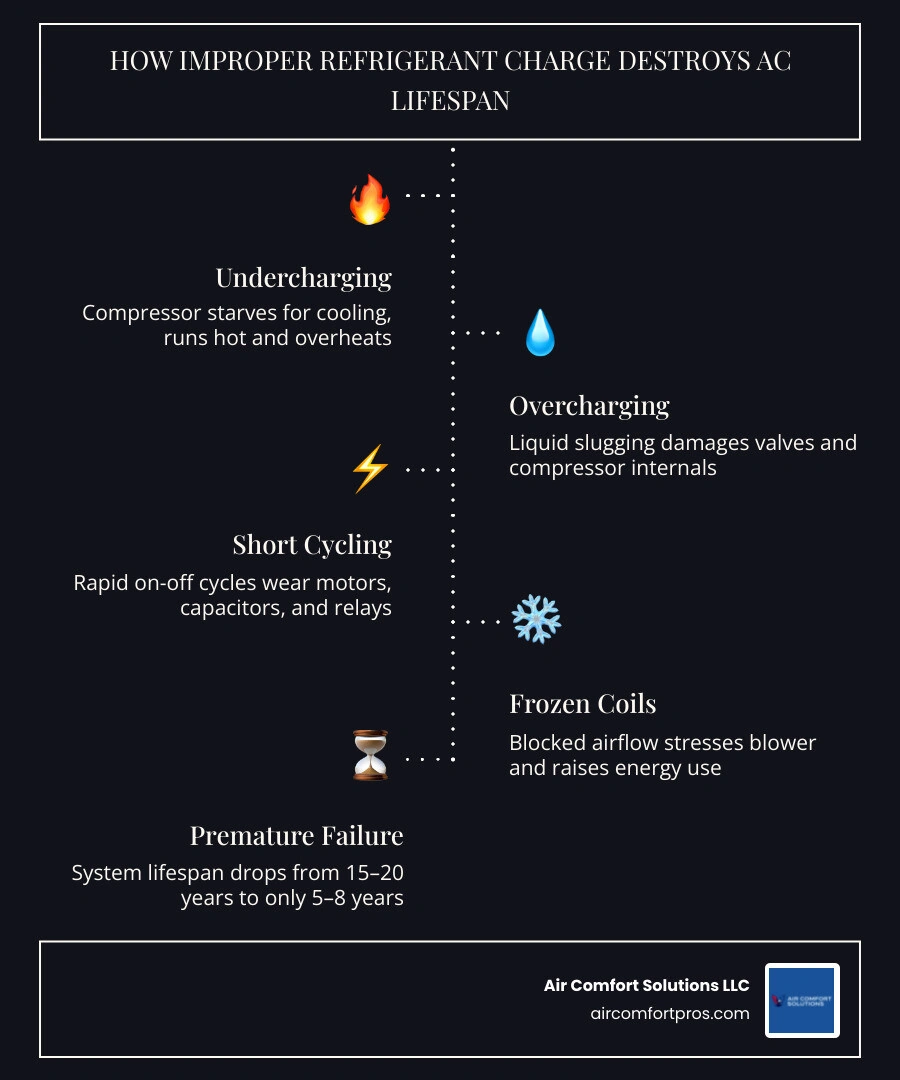
Understanding how improper refrigerant charge reduces your AC lifespan could be the difference between a system that lasts 15–20 years and one that fails in as little as 5–8 years. Here is a quick summary of the core ways it causes damage:
How Improper Refrigerant Charge Reduces Your AC Lifespan:
- Undercharging forces the compressor to run without adequate motor cooling, leading to overheating and eventual burnout
- Overcharging sends liquid refrigerant into the compressor, causing mechanical damage known as liquid slugging
- Both conditions trigger short cycling, which strains motors, capacitors, and electrical components with every start-up
- Frozen evaporator coils block airflow and compound stress on every downstream component
- Ongoing inefficiency from either condition can accelerate component wear 2–3 times faster than normal
The problem is more widespread than most homeowners realize. Field studies show that roughly 78% of HVAC systems arrive undercharged straight from installation — often because technicians do not account for the extra refrigerant needed in longer copper line sets. On top of that, the EPA estimates that residential systems lose between 5% and 11% of their refrigerant charge every year through normal wear and micro-leaks. In a hot, demanding climate like Pinehurst, TX, where your system runs hard for months at a time, that slow drain on refrigerant charge translates directly into accelerated wear and a shortened system life.
The good news is that charge-related damage is almost entirely preventable with the right installation practices and routine maintenance. This guide covers everything you need to know — from the mechanics of how incorrect charge levels destroy your compressor, to the diagnostic tools professionals use to catch problems early, to the steps you can take right now to protect your investment.
How improper refrigerant charge reduces your ac lifespan further reading:
- how bad ac installation causes problems for years
- how ductwork mistakes during installation hurt your comfort
The Goldilocks Zone: What is Proper Refrigerant Charge?
To understand how improper refrigerant charge reduces your AC lifespan, we first have to look at what refrigerant actually does. Refrigerant is not "fuel" that your air conditioner consumes. Instead, it is a heat-transfer medium that continuously cycles between liquid and gas states, acting as a thermal conveyor belt.
In a perfectly balanced cycle, the indoor evaporator coil allows the liquid refrigerant to evaporate into a gas, absorbing heat from your home's indoor air in the process. This low-pressure gas travels outdoors to the compressor, which squeezes it into a high-pressure, high-temperature vapor. The outdoor condenser coil then sheds that heat into the outside air, condensing the refrigerant back into a liquid before sending it back indoors.
Under ideal conditions, the Average Lifespan of an HVAC System in Texas ranges from 15 to 20 years. However, achieving this longevity requires the system to operate within its manufacturer-specified "Goldilocks Zone." This means the volume of refrigerant must match the system's internal volume down to the ounce.
When we look at Why Do AC Units Wear Out Faster in Hot Climates, the relentless summer heat in Pinehurst, TX, and surrounding areas like Magnolia, Tomball, and Spring means our cooling systems operate under much higher thermal loads. If the refrigerant level is even slightly off, the physical properties of the refrigeration cycle break down. This forces the system to run longer, consume more electricity, and experience elevated operating temperatures that degrade vital mechanical parts.
How Improper Refrigerant Charge Reduces Your AC Lifespan
When an air conditioner is operating with an incorrect charge, the compressor—the expensive, heavy-duty "heart" of your AC—bears the brunt of the abuse. The compressor is designed to handle very specific pressures and temperatures. When those parameters are breached, the physical strain accelerates wear and tear, often slicing the equipment's life expectancy in half.
Instead of enjoying a reliable system for up to two decades, homeowners with improperly charged units frequently face catastrophic compressor failure in just 5 to 8 years. This premature breakdown is heavily compounded by our local weather. As detailed in our guide on How Hot Humid Climate Shortens HVAC Lifespan, high humidity levels require consistent, uninterrupted cooling cycles to extract moisture from the air. When the refrigerant charge is incorrect, the system cannot dehumidify or cool effectively, keeping your home muggy while running the compressor to death.
To visualize how these two extremes threaten your system, let's compare the mechanical impacts of undercharging versus overcharging:
| Impact Category | Undercharged System (<90% of Design Charge) | Overcharged System (>110% of Design Charge) |
|---|---|---|
| Primary Physical Symptom | Low operating pressures, evaporator coil frosting | High operating pressures, liquid refrigerant bypass |
| Compressor Hazard | Overheating due to lack of cool return vapor; oil starvation | Liquid slugging; broken valves, pistons, and scrolls |
| Lubrication Status | Oil pools in line sets; compressor runs dry | Oil is diluted by liquid refrigerant, causing metal-on-metal friction |
| System Run Cycles | Runs continuously to meet thermostat demands | Short cycles due to high-pressure switch trips |
| Lifespan Expectancy | Reduced to 5–8 years (burnout) | Reduced to 5–8 years (mechanical seizure) |
Undercharging: How Improper Refrigerant Charge Reduces Your AC Lifespan Through Starvation
Undercharging is the most common charge issue we encounter in the field. When a system lacks sufficient refrigerant, the internal pressure drops significantly. This pressure drop lowers the boiling point of the refrigerant, causing it to vaporize too early in the evaporator coil.
While that might sound like it would make the air colder, it actually starves the system. The refrigerant absorbs less heat overall, meaning the home remains warm. Because the compressor relies on the cool, returning refrigerant vapor to dissipate the intense heat generated by its own electrical windings, a starved system causes the compressor motor to run dangerously hot.
Without this cooling vapor, the internal temperature of the compressor climbs past safe operating limits. This extreme heat degrades the winding insulation inside the motor, culminating in a catastrophic electrical short-circuit known as a "compressor burnout."
Furthermore, refrigerant is responsible for carrying the compressor's lubricating oil through the system. When the charge is low, the velocity of the refrigerant vapor drops. The oil can no longer travel back to the compressor, pooling instead in the outdoor line sets or the indoor evaporator coil. Starved of lubrication, the compressor's internal pistons or scrolls grind together, shedding metal shavings and eventually seizing completely. Homeowners can learn to spot these issues early by recognizing the Low Refrigerant Signs in Your AC System.
Overcharging: How Improper Refrigerant Charge Reduces Your AC Lifespan Through Liquid Slugging
While undercharging starves the system, overcharging does the exact opposite—and the consequences are often much more violent. Many well-meaning but unqualified individuals assume that adding "a little extra" refrigerant will boost cooling performance. In reality, overcharging is highly destructive.
An overcharged system has too much refrigerant crammed into the closed-loop system, which skyrockets operating pressures. Because the condenser coil cannot reject enough heat to condense the excess refrigerant, liquid refrigerant backs up into the outdoor unit.
The primary danger here is liquid slugging. Compressors are strictly designed to compress vapor, not liquid. Unlike gases, liquids cannot be compressed. When liquid refrigerant floods back through the suction line and enters the compressor's cylinder, the piston or scroll attempts to compress it. This creates an instantaneous, violent hydraulic shock that can shatter compressor valves, snap connecting rods, damage pistons, and crack the internal scroll plates.
Additionally, an overcharged system exhibits excessively high subcooling levels. This means the liquid refrigerant remains too cold and dense as it enters the expansion valve, throwing off the entire thermal balance of your system and forcing the compressor to work against extreme head pressures. This continuous high-load operation strains the compressor motor, leading to rapid electrical failure and a severely shortened lifespan.
The Cascading Failures of Incorrect Refrigerant Levels
The damage caused by an improper refrigerant charge is rarely isolated to the compressor. Instead, it triggers a domino effect of cascading failures that strain every corner of your HVAC system.
One of the most notable symptoms of a low refrigerant charge is a frozen evaporator coil. When system pressure drops, the temperature of the coil falls below freezing. Moisture extracted from your home's indoor air accumulates on the coil and flash-freezes, forming a block of ice. This ice acts as an insulating barrier, blocking all airflow.
As the ice thickens, the system struggles to cool, leading to continuous operation. When the ice eventually melts, it can overflow the condensate drain pan, causing water damage to your ceilings, walls, and floors.

Another common side effect of improper charge is short cycling. When pressures climb too high (due to overcharging) or drop too low (due to undercharging), built-in safety switches trip to protect the system. This causes the air conditioner to turn on and off every few minutes. Short cycling places immense electrical strain on your system's run capacitors, contactors, and fan motors, wearing them out years ahead of schedule.
These issues are incredibly common. If you need to Troubleshoot AC Refrigerant Leaks in Tomball, a system leaking 5% to 11% of its charge annually will quickly hit a critical performance tipping point.
According to laboratory testing, a refrigerant charge reduction of just 25% leads to:
- An average energy efficiency reduction of about 15%
- A capacity degradation of about 20%
- A 16% drop in the system's Seasonal Energy Efficiency Ratio (SEER) value
- An increase in annual operating costs of approximately $100 per ton of capacity
With 50% to 67% of all field-installed air conditioners suffering from improper charge or airflow issues, many homeowners are paying significantly more on their utility bills while actively wearing out their equipment.
Diagnostic Methods: How Professionals Detect and Correct Charge Issues
Because refrigerant charge is so critical, professional technicians use highly precise diagnostic tools rather than guessing or relying purely on pressure gauges. Simply hooking up manifold gauges and looking at pressures is no longer sufficient for modern, high-efficiency systems.
To accurately assess the charge, a certified technician must calculate superheat and subcooling:
- Superheat (for Fixed Orifice/Piston Systems): This measures the temperature rise of the refrigerant vapor after it has completely evaporated. A superheat calculation ensures that liquid refrigerant is not returning to the compressor.
- Subcooling (for Thermostatic Expansion Valve / TXV Systems): This measures how much heat the liquid refrigerant loses after condensing in the outdoor coil. Accurate subcooling measurements ensure there is enough liquid refrigerant to feed the expansion valve properly.
During a comprehensive maintenance visit, a technician will also use electronic leak detectors and digital scales. If a system is low on refrigerant, we must find and repair the leak rather than simply topping it off. Weighing the refrigerant out of the system and weighing the new charge in with digital scales is the only way to guarantee a perfect factory charge. Homeowners can see what to expect during these visits by reviewing our AC Maintenance Visit Complete Guide.
Best Practices to Protect Your Cooling Investment in Pinehurst, TX
Protecting your air conditioner from charge-related wear starts at installation and continues throughout the system's life.
First, ensure your system is sized correctly using a Manual J load calculation. An oversized or undersized system will have improper refrigerant flows from day one. Second, if a leak is detected, insist on a professional leak repair. Adding refrigerant to a leaking system is a temporary fix that violates EPA regulations under Section 608, which governs the safe handling of greenhouse gases.
To keep your system running smoothly in our demanding Texas climate, check out our professional tips on How to Extend the Life of Your AC in Texas. Skipping these vital steps can lead to severe consequences, which we outline in our guide on What Happens If You Skip AC Maintenance in Texas.
Lastly, keeping your refrigerant charge at manufacturer-specified levels is essential for protecting your manufacturer warranty. If a compressor fails and the manufacturer determines that the failure was caused by operating the system with an improper charge, they may void your warranty coverage, leaving you with an expensive repair bill.
Frequently Asked Questions about AC Refrigerant Charge
Why does low refrigerant cause my AC coils to freeze?
When refrigerant levels are low, the pressure inside the evaporator coil drops. This pressure drop lowers the boiling point of the refrigerant, causing the coil's surface temperature to fall below freezing. As the system pulls warm, humid air across the freezing coil, the moisture in the air flash-freezes on contact. This ice accumulation restricts airflow, trapping the cold air and causing a cascading freeze that can travel all the way down the copper lines to the outdoor unit.
Can I add refrigerant to my home air conditioner myself?
No. Under Section 608 of the Clean Air Act, it is illegal for anyone without EPA certification to purchase or handle refrigerant. Additionally, charging a system requires specialized equipment like manifold gauges, digital scales, and micron gauges. Attempting to add refrigerant yourself without calculating superheat and subcooling will almost certainly result in overcharging or undercharging, which can destroy your compressor and pose severe safety hazards.
How do I know if my AC has a refrigerant leak?
Common signs of a refrigerant leak include:
- Warm air blowing from your supply vents
- A noticeable drop in cooling capacity
- Hissing or bubbling noises coming from the indoor or outdoor unit
- Ice forming on the evaporator coil or the outdoor brass valves
- A sudden, unexplained spike in your monthly electricity bills
- High indoor humidity levels despite the system running constantly
Conclusion
Your air conditioner is a major investment, and keeping its refrigerant charge balanced is the single most effective way to protect that investment. Operating your system with an incorrect charge forces every component to work twice as hard, leading to premature failures, high energy bills, and a drastically shortened equipment lifespan.
At Air Comfort Pros, we have over 35 years of experience keeping homes cool and comfortable throughout Pinehurst, TX, and the north side of Harris County—including Plantersville, Magnolia, Houston, The Woodlands, Montgomery, Conroe, Spring, and Tomball. Our certified, highly trained technicians use state-of-the-art diagnostic equipment to ensure your system is charged perfectly to manufacturer specifications.
Don't let an improper refrigerant charge quietly destroy your air conditioner. Protect your home's comfort and extend your system's lifespan by scheduling a professional inspection today.
Why Improper Refrigerant Charge Is Quietly Destroying Your AC System
Understanding how improper refrigerant charge reduces your AC lifespan could be the difference between a system that lasts 15–20 years and one that fails in as little as 5–8 years. Here is a quick summary of the core ways it causes damage:
How Improper Refrigerant Charge Reduces Your AC Lifespan:
- Undercharging forces the compressor to run without adequate motor cooling, leading to overheating and eventual burnout
- Overcharging sends liquid refrigerant into the compressor, causing mechanical damage known as liquid slugging
- Both conditions trigger short cycling, which strains motors, capacitors, and electrical components with every start-up
- Frozen evaporator coils block airflow and compound stress on every downstream component
- Ongoing inefficiency from either condition can accelerate component wear 2–3 times faster than normal
The problem is more widespread than most homeowners realize. Field studies show that roughly 78% of HVAC systems arrive undercharged straight from installation — often because technicians do not account for the extra refrigerant needed in longer copper line sets. On top of that, the EPA estimates that residential systems lose between 5% and 11% of their refrigerant charge every year through normal wear and micro-leaks. In a hot, demanding climate like Pinehurst, TX, where your system runs hard for months at a time, that slow drain on refrigerant charge translates directly into accelerated wear and a shortened system life.
The good news is that charge-related damage is almost entirely preventable with the right installation practices and routine maintenance. This guide covers everything you need to know — from the mechanics of how incorrect charge levels destroy your compressor, to the diagnostic tools professionals use to catch problems early, to the steps you can take right now to protect your investment.
How improper refrigerant charge reduces your ac lifespan further reading:
- how bad ac installation causes problems for years
- how ductwork mistakes during installation hurt your comfort
The Goldilocks Zone: What is Proper Refrigerant Charge?
To understand how improper refrigerant charge reduces your AC lifespan, we first have to look at what refrigerant actually does. Refrigerant is not "fuel" that your air conditioner consumes. Instead, it is a heat-transfer medium that continuously cycles between liquid and gas states, acting as a thermal conveyor belt.
In a perfectly balanced cycle, the indoor evaporator coil allows the liquid refrigerant to evaporate into a gas, absorbing heat from your home's indoor air in the process. This low-pressure gas travels outdoors to the compressor, which squeezes it into a high-pressure, high-temperature vapor. The outdoor condenser coil then sheds that heat into the outside air, condensing the refrigerant back into a liquid before sending it back indoors.
Under ideal conditions, the Average Lifespan of an HVAC System in Texas ranges from 15 to 20 years. However, achieving this longevity requires the system to operate within its manufacturer-specified "Goldilocks Zone." This means the volume of refrigerant must match the system's internal volume down to the ounce.
When we look at Why Do AC Units Wear Out Faster in Hot Climates, the relentless summer heat in Pinehurst, TX, and surrounding areas like Magnolia, Tomball, and Spring means our cooling systems operate under much higher thermal loads. If the refrigerant level is even slightly off, the physical properties of the refrigeration cycle break down. This forces the system to run longer, consume more electricity, and experience elevated operating temperatures that degrade vital mechanical parts.
How Improper Refrigerant Charge Reduces Your AC Lifespan
When an air conditioner is operating with an incorrect charge, the compressor—the expensive, heavy-duty "heart" of your AC—bears the brunt of the abuse. The compressor is designed to handle very specific pressures and temperatures. When those parameters are breached, the physical strain accelerates wear and tear, often slicing the equipment's life expectancy in half.
Instead of enjoying a reliable system for up to two decades, homeowners with improperly charged units frequently face catastrophic compressor failure in just 5 to 8 years. This premature breakdown is heavily compounded by our local weather. As detailed in our guide on How Hot Humid Climate Shortens HVAC Lifespan, high humidity levels require consistent, uninterrupted cooling cycles to extract moisture from the air. When the refrigerant charge is incorrect, the system cannot dehumidify or cool effectively, keeping your home muggy while running the compressor to death.
To visualize how these two extremes threaten your system, let's compare the mechanical impacts of undercharging versus overcharging:
| Impact Category | Undercharged System (<90% of Design Charge) | Overcharged System (>110% of Design Charge) |
|---|---|---|
| Primary Physical Symptom | Low operating pressures, evaporator coil frosting | High operating pressures, liquid refrigerant bypass |
| Compressor Hazard | Overheating due to lack of cool return vapor; oil starvation | Liquid slugging; broken valves, pistons, and scrolls |
| Lubrication Status | Oil pools in line sets; compressor runs dry | Oil is diluted by liquid refrigerant, causing metal-on-metal friction |
| System Run Cycles | Runs continuously to meet thermostat demands | Short cycles due to high-pressure switch trips |
| Lifespan Expectancy | Reduced to 5–8 years (burnout) | Reduced to 5–8 years (mechanical seizure) |
Undercharging: How Improper Refrigerant Charge Reduces Your AC Lifespan Through Starvation
Undercharging is the most common charge issue we encounter in the field. When a system lacks sufficient refrigerant, the internal pressure drops significantly. This pressure drop lowers the boiling point of the refrigerant, causing it to vaporize too early in the evaporator coil.
While that might sound like it would make the air colder, it actually starves the system. The refrigerant absorbs less heat overall, meaning the home remains warm. Because the compressor relies on the cool, returning refrigerant vapor to dissipate the intense heat generated by its own electrical windings, a starved system causes the compressor motor to run dangerously hot.
Without this cooling vapor, the internal temperature of the compressor climbs past safe operating limits. This extreme heat degrades the winding insulation inside the motor, culminating in a catastrophic electrical short-circuit known as a "compressor burnout."
Furthermore, refrigerant is responsible for carrying the compressor's lubricating oil through the system. When the charge is low, the velocity of the refrigerant vapor drops. The oil can no longer travel back to the compressor, pooling instead in the outdoor line sets or the indoor evaporator coil. Starved of lubrication, the compressor's internal pistons or scrolls grind together, shedding metal shavings and eventually seizing completely. Homeowners can learn to spot these issues early by recognizing the Low Refrigerant Signs in Your AC System.
Overcharging: How Improper Refrigerant Charge Reduces Your AC Lifespan Through Liquid Slugging
While undercharging starves the system, overcharging does the exact opposite—and the consequences are often much more violent. Many well-meaning but unqualified individuals assume that adding "a little extra" refrigerant will boost cooling performance. In reality, overcharging is highly destructive.
An overcharged system has too much refrigerant crammed into the closed-loop system, which skyrockets operating pressures. Because the condenser coil cannot reject enough heat to condense the excess refrigerant, liquid refrigerant backs up into the outdoor unit.
The primary danger here is liquid slugging. Compressors are strictly designed to compress vapor, not liquid. Unlike gases, liquids cannot be compressed. When liquid refrigerant floods back through the suction line and enters the compressor's cylinder, the piston or scroll attempts to compress it. This creates an instantaneous, violent hydraulic shock that can shatter compressor valves, snap connecting rods, damage pistons, and crack the internal scroll plates.
Additionally, an overcharged system exhibits excessively high subcooling levels. This means the liquid refrigerant remains too cold and dense as it enters the expansion valve, throwing off the entire thermal balance of your system and forcing the compressor to work against extreme head pressures. This continuous high-load operation strains the compressor motor, leading to rapid electrical failure and a severely shortened lifespan.
The Cascading Failures of Incorrect Refrigerant Levels
The damage caused by an improper refrigerant charge is rarely isolated to the compressor. Instead, it triggers a domino effect of cascading failures that strain every corner of your HVAC system.
One of the most notable symptoms of a low refrigerant charge is a frozen evaporator coil. When system pressure drops, the temperature of the coil falls below freezing. Moisture extracted from your home's indoor air accumulates on the coil and flash-freezes, forming a block of ice. This ice acts as an insulating barrier, blocking all airflow.
As the ice thickens, the system struggles to cool, leading to continuous operation. When the ice eventually melts, it can overflow the condensate drain pan, causing water damage to your ceilings, walls, and floors.
Another common side effect of improper charge is short cycling. When pressures climb too high (due to overcharging) or drop too low (due to undercharging), built-in safety switches trip to protect the system. This causes the air conditioner to turn on and off every few minutes. Short cycling places immense electrical strain on your system's run capacitors, contactors, and fan motors, wearing them out years ahead of schedule.
These issues are incredibly common. If you need to Troubleshoot AC Refrigerant Leaks in Tomball, a system leaking 5% to 11% of its charge annually will quickly hit a critical performance tipping point.
According to laboratory testing, a refrigerant charge reduction of just 25% leads to:
- An average energy efficiency reduction of about 15%
- A capacity degradation of about 20%
- A 16% drop in the system's Seasonal Energy Efficiency Ratio (SEER) value
- An increase in annual operating costs of approximately $100 per ton of capacity
With 50% to 67% of all field-installed air conditioners suffering from improper charge or airflow issues, many homeowners are paying significantly more on their utility bills while actively wearing out their equipment.
Diagnostic Methods: How Professionals Detect and Correct Charge Issues
Because refrigerant charge is so critical, professional technicians use highly precise diagnostic tools rather than guessing or relying purely on pressure gauges. Simply hooking up manifold gauges and looking at pressures is no longer sufficient for modern, high-efficiency systems.
To accurately assess the charge, a certified technician must calculate superheat and subcooling:
- Superheat (for Fixed Orifice/Piston Systems): This measures the temperature rise of the refrigerant vapor after it has completely evaporated. A superheat calculation ensures that liquid refrigerant is not returning to the compressor.
- Subcooling (for Thermostatic Expansion Valve / TXV Systems): This measures how much heat the liquid refrigerant loses after condensing in the outdoor coil. Accurate subcooling measurements ensure there is enough liquid refrigerant to feed the expansion valve properly.
During a comprehensive maintenance visit, a technician will also use electronic leak detectors and digital scales. If a system is low on refrigerant, we must find and repair the leak rather than simply topping it off. Weighing the refrigerant out of the system and weighing the new charge in with digital scales is the only way to guarantee a perfect factory charge. Homeowners can see what to expect during these visits by reviewing our AC Maintenance Visit Complete Guide.
Best Practices to Protect Your Cooling Investment in Pinehurst, TX
Protecting your air conditioner from charge-related wear starts at installation and continues throughout the system's life.
First, ensure your system is sized correctly using a Manual J load calculation. An oversized or undersized system will have improper refrigerant flows from day one. Second, if a leak is detected, insist on a professional leak repair. Adding refrigerant to a leaking system is a temporary fix that violates EPA regulations under Section 608, which governs the safe handling of greenhouse gases.
To keep your system running smoothly in our demanding Texas climate, check out our professional tips on How to Extend the Life of Your AC in Texas. Skipping these vital steps can lead to severe consequences, which we outline in our guide on What Happens If You Skip AC Maintenance in Texas.
Lastly, keeping your refrigerant charge at manufacturer-specified levels is essential for protecting your manufacturer warranty. If a compressor fails and the manufacturer determines that the failure was caused by operating the system with an improper charge, they may void your warranty coverage, leaving you with an expensive repair bill.
Frequently Asked Questions about AC Refrigerant Charge
Why does low refrigerant cause my AC coils to freeze?
When refrigerant levels are low, the pressure inside the evaporator coil drops. This pressure drop lowers the boiling point of the refrigerant, causing the coil's surface temperature to fall below freezing. As the system pulls warm, humid air across the freezing coil, the moisture in the air flash-freezes on contact. This ice accumulation restricts airflow, trapping the cold air and causing a cascading freeze that can travel all the way down the copper lines to the outdoor unit.
Can I add refrigerant to my home air conditioner myself?
No. Under Section 608 of the Clean Air Act, it is illegal for anyone without EPA certification to purchase or handle refrigerant. Additionally, charging a system requires specialized equipment like manifold gauges, digital scales, and micron gauges. Attempting to add refrigerant yourself without calculating superheat and subcooling will almost certainly result in overcharging or undercharging, which can destroy your compressor and pose severe safety hazards.
How do I know if my AC has a refrigerant leak?
Common signs of a refrigerant leak include:
- Warm air blowing from your supply vents
- A noticeable drop in cooling capacity
- Hissing or bubbling noises coming from the indoor or outdoor unit
- Ice forming on the evaporator coil or the outdoor brass valves
- A sudden, unexplained spike in your monthly electricity bills
- High indoor humidity levels despite the system running constantly
Conclusion
Your air conditioner is a major investment, and keeping its refrigerant charge balanced is the single most effective way to protect that investment. Operating your system with an incorrect charge forces every component to work twice as hard, leading to premature failures, high energy bills, and a drastically shortened equipment lifespan.
At Air Comfort Pros, we have over 35 years of experience keeping homes cool and comfortable throughout Pinehurst, TX, and the north side of Harris County—including Plantersville, Magnolia, Houston, The Woodlands, Montgomery, Conroe, Spring, and Tomball. Our certified, highly trained technicians use state-of-the-art diagnostic equipment to ensure your system is charged perfectly to manufacturer specifications.
Don't let an improper refrigerant charge quietly destroy your air conditioner. Protect your home's comfort and extend your system's lifespan by scheduling a professional inspection today.
Why Improper Refrigerant Charge Is Quietly Destroying Your AC System
Understanding how improper refrigerant charge reduces your AC lifespan could be the difference between a system that lasts 15–20 years and one that fails in as little as 5–8 years. Here is a quick summary of the core ways it causes damage:
How Improper Refrigerant Charge Reduces Your AC Lifespan:
- Undercharging forces the compressor to run without adequate motor cooling, leading to overheating and eventual burnout
- Overcharging sends liquid refrigerant into the compressor, causing mechanical damage known as liquid slugging
- Both conditions trigger short cycling, which strains motors, capacitors, and electrical components with every start-up
- Frozen evaporator coils block airflow and compound stress on every downstream component
- Ongoing inefficiency from either condition can accelerate component wear 2–3 times faster than normal
The problem is more widespread than most homeowners realize. Field studies show that roughly 78% of HVAC systems arrive undercharged straight from installation — often because technicians do not account for the extra refrigerant needed in longer copper line sets. On top of that, the EPA estimates that residential systems lose between 5% and 11% of their refrigerant charge every year through normal wear and micro-leaks. In a hot, demanding climate like Pinehurst, TX, where your system runs hard for months at a time, that slow drain on refrigerant charge translates directly into accelerated wear and a shortened system life.
The good news is that charge-related damage is almost entirely preventable with the right installation practices and routine maintenance. This guide covers everything you need to know — from the mechanics of how incorrect charge levels destroy your compressor, to the diagnostic tools professionals use to catch problems early, to the steps you can take right now to protect your investment.
How improper refrigerant charge reduces your ac lifespan further reading:
- how bad ac installation causes problems for years
- how ductwork mistakes during installation hurt your comfort
The Goldilocks Zone: What is Proper Refrigerant Charge?
To understand how improper refrigerant charge reduces your AC lifespan, we first have to look at what refrigerant actually does. Refrigerant is not "fuel" that your air conditioner consumes. Instead, it is a heat-transfer medium that continuously cycles between liquid and gas states, acting as a thermal conveyor belt.
In a perfectly balanced cycle, the indoor evaporator coil allows the liquid refrigerant to evaporate into a gas, absorbing heat from your home's indoor air in the process. This low-pressure gas travels outdoors to the compressor, which squeezes it into a high-pressure, high-temperature vapor. The outdoor condenser coil then sheds that heat into the outside air, condensing the refrigerant back into a liquid before sending it back indoors.
Under ideal conditions, the Average Lifespan of an HVAC System in Texas ranges from 15 to 20 years. However, achieving this longevity requires the system to operate within its manufacturer-specified "Goldilocks Zone." This means the volume of refrigerant must match the system's internal volume down to the ounce.
When we look at Why Do AC Units Wear Out Faster in Hot Climates, the relentless summer heat in Pinehurst, TX, and surrounding areas like Magnolia, Tomball, and Spring means our cooling systems operate under much higher thermal loads. If the refrigerant level is even slightly off, the physical properties of the refrigeration cycle break down. This forces the system to run longer, consume more electricity, and experience elevated operating temperatures that degrade vital mechanical parts.
How Improper Refrigerant Charge Reduces Your AC Lifespan
When an air conditioner is operating with an incorrect charge, the compressor—the expensive, heavy-duty "heart" of your AC—bears the brunt of the abuse. The compressor is designed to handle very specific pressures and temperatures. When those parameters are breached, the physical strain accelerates wear and tear, often slicing the equipment's life expectancy in half.
Instead of enjoying a reliable system for up to two decades, homeowners with improperly charged units frequently face catastrophic compressor failure in just 5 to 8 years. This premature breakdown is heavily compounded by our local weather. As detailed in our guide on How Hot Humid Climate Shortens HVAC Lifespan, high humidity levels require consistent, uninterrupted cooling cycles to extract moisture from the air. When the refrigerant charge is incorrect, the system cannot dehumidify or cool effectively, keeping your home muggy while running the compressor to death.
To visualize how these two extremes threaten your system, let's compare the mechanical impacts of undercharging versus overcharging:
| Impact Category | Undercharged System (<90% of Design Charge) | Overcharged System (>110% of Design Charge) |
|---|---|---|
| Primary Physical Symptom | Low operating pressures, evaporator coil frosting | High operating pressures, liquid refrigerant bypass |
| Compressor Hazard | Overheating due to lack of cool return vapor; oil starvation | Liquid slugging; broken valves, pistons, and scrolls |
| Lubrication Status | Oil pools in line sets; compressor runs dry | Oil is diluted by liquid refrigerant, causing metal-on-metal friction |
| System Run Cycles | Runs continuously to meet thermostat demands | Short cycles due to high-pressure switch trips |
| Lifespan Expectancy | Reduced to 5–8 years (burnout) | Reduced to 5–8 years (mechanical seizure) |
Undercharging: How Improper Refrigerant Charge Reduces Your AC Lifespan Through Starvation
Undercharging is the most common charge issue we encounter in the field. When a system lacks sufficient refrigerant, the internal pressure drops significantly. This pressure drop lowers the boiling point of the refrigerant, causing it to vaporize too early in the evaporator coil.
While that might sound like it would make the air colder, it actually starves the system. The refrigerant absorbs less heat overall, meaning the home remains warm. Because the compressor relies on the cool, returning refrigerant vapor to dissipate the intense heat generated by its own electrical windings, a starved system causes the compressor motor to run dangerously hot.
Without this cooling vapor, the internal temperature of the compressor climbs past safe operating limits. This extreme heat degrades the winding insulation inside the motor, culminating in a catastrophic electrical short-circuit known as a "compressor burnout."
Furthermore, refrigerant is responsible for carrying the compressor's lubricating oil through the system. When the charge is low, the velocity of the refrigerant vapor drops. The oil can no longer travel back to the compressor, pooling instead in the outdoor line sets or the indoor evaporator coil. Starved of lubrication, the compressor's internal pistons or scrolls grind together, shedding metal shavings and eventually seizing completely. Homeowners can learn to spot these issues early by recognizing the Low Refrigerant Signs in Your AC System.
Overcharging: How Improper Refrigerant Charge Reduces Your AC Lifespan Through Liquid Slugging
While undercharging starves the system, overcharging does the exact opposite—and the consequences are often much more violent. Many well-meaning but unqualified individuals assume that adding "a little extra" refrigerant will boost cooling performance. In reality, overcharging is highly destructive.
An overcharged system has too much refrigerant crammed into the closed-loop system, which skyrockets operating pressures. Because the condenser coil cannot reject enough heat to condense the excess refrigerant, liquid refrigerant backs up into the outdoor unit.
The primary danger here is liquid slugging. Compressors are strictly designed to compress vapor, not liquid. Unlike gases, liquids cannot be compressed. When liquid refrigerant floods back through the suction line and enters the compressor's cylinder, the piston or scroll attempts to compress it. This creates an instantaneous, violent hydraulic shock that can shatter compressor valves, snap connecting rods, damage pistons, and crack the internal scroll plates.
Additionally, an overcharged system exhibits excessively high subcooling levels. This means the liquid refrigerant remains too cold and dense as it enters the expansion valve, throwing off the entire thermal balance of your system and forcing the compressor to work against extreme head pressures. This continuous high-load operation strains the compressor motor, leading to rapid electrical failure and a severely shortened lifespan.
The Cascading Failures of Incorrect Refrigerant Levels
The damage caused by an improper refrigerant charge is rarely isolated to the compressor. Instead, it triggers a domino effect of cascading failures that strain every corner of your HVAC system.
One of the most notable symptoms of a low refrigerant charge is a frozen evaporator coil. When system pressure drops, the temperature of the coil falls below freezing. Moisture extracted from your home's indoor air accumulates on the coil and flash-freezes, forming a block of ice. This ice acts as an insulating barrier, blocking all airflow.
As the ice thickens, the system struggles to cool, leading to continuous operation. When the ice eventually melts, it can overflow the condensate drain pan, causing water damage to your ceilings, walls, and floors.
Another common side effect of improper charge is short cycling. When pressures climb too high (due to overcharging) or drop too low (due to undercharging), built-in safety switches trip to protect the system. This causes the air conditioner to turn on and off every few minutes. Short cycling places immense electrical strain on your system's run capacitors, contactors, and fan motors, wearing them out years ahead of schedule.
These issues are incredibly common. If you need to Troubleshoot AC Refrigerant Leaks in Tomball, a system leaking 5% to 11% of its charge annually will quickly hit a critical performance tipping point.
According to laboratory testing, a refrigerant charge reduction of just 25% leads to:
- An average energy efficiency reduction of about 15%
- A capacity degradation of about 20%
- A 16% drop in the system's Seasonal Energy Efficiency Ratio (SEER) value
- An increase in annual operating costs of approximately $100 per ton of capacity
With 50% to 67% of all field-installed air conditioners suffering from improper charge or airflow issues, many homeowners are paying significantly more on their utility bills while actively wearing out their equipment.
Diagnostic Methods: How Professionals Detect and Correct Charge Issues
Because refrigerant charge is so critical, professional technicians use highly precise diagnostic tools rather than guessing or relying purely on pressure gauges. Simply hooking up manifold gauges and looking at pressures is no longer sufficient for modern, high-efficiency systems.
To accurately assess the charge, a certified technician must calculate superheat and subcooling:
- Superheat (for Fixed Orifice/Piston Systems): This measures the temperature rise of the refrigerant vapor after it has completely evaporated. A superheat calculation ensures that liquid refrigerant is not returning to the compressor.
- Subcooling (for Thermostatic Expansion Valve / TXV Systems): This measures how much heat the liquid refrigerant loses after condensing in the outdoor coil. Accurate subcooling measurements ensure there is enough liquid refrigerant to feed the expansion valve properly.
During a comprehensive maintenance visit, a technician will also use electronic leak detectors and digital scales. If a system is low on refrigerant, we must find and repair the leak rather than simply topping it off. Weighing the refrigerant out of the system and weighing the new charge in with digital scales is the only way to guarantee a perfect factory charge. Homeowners can see what to expect during these visits by reviewing our AC Maintenance Visit Complete Guide.
Best Practices to Protect Your Cooling Investment in Pinehurst, TX
Protecting your air conditioner from charge-related wear starts at installation and continues throughout the system's life.
First, ensure your system is sized correctly using a Manual J load calculation. An oversized or undersized system will have improper refrigerant flows from day one. Second, if a leak is detected, insist on a professional leak repair. Adding refrigerant to a leaking system is a temporary fix that violates EPA regulations under Section 608, which governs the safe handling of greenhouse gases.
To keep your system running smoothly in our demanding Texas climate, check out our professional tips on How to Extend the Life of Your AC in Texas. Skipping these vital steps can lead to severe consequences, which we outline in our guide on What Happens If You Skip AC Maintenance in Texas.
Lastly, keeping your refrigerant charge at manufacturer-specified levels is essential for protecting your manufacturer warranty. If a compressor fails and the manufacturer determines that the failure was caused by operating the system with an improper charge, they may void your warranty coverage, leaving you with an expensive repair bill.
Frequently Asked Questions about AC Refrigerant Charge
Why does low refrigerant cause my AC coils to freeze?
When refrigerant levels are low, the pressure inside the evaporator coil drops. This pressure drop lowers the boiling point of the refrigerant, causing the coil's surface temperature to fall below freezing. As the system pulls warm, humid air across the freezing coil, the moisture in the air flash-freezes on contact. This ice accumulation restricts airflow, trapping the cold air and causing a cascading freeze that can travel all the way down the copper lines to the outdoor unit.
Can I add refrigerant to my home air conditioner myself?
No. Under Section 608 of the Clean Air Act, it is illegal for anyone without EPA certification to purchase or handle refrigerant. Additionally, charging a system requires specialized equipment like manifold gauges, digital scales, and micron gauges. Attempting to add refrigerant yourself without calculating superheat and subcooling will almost certainly result in overcharging or undercharging, which can destroy your compressor and pose severe safety hazards.
How do I know if my AC has a refrigerant leak?
Common signs of a refrigerant leak include:
- Warm air blowing from your supply vents
- A noticeable drop in cooling capacity
- Hissing or bubbling noises coming from the indoor or outdoor unit
- Ice forming on the evaporator coil or the outdoor brass valves
- A sudden, unexplained spike in your monthly electricity bills
- High indoor humidity levels despite the system running constantly
Conclusion
Your air conditioner is a major investment, and keeping its refrigerant charge balanced is the single most effective way to protect that investment. Operating your system with an incorrect charge forces every component to work twice as hard, leading to premature failures, high energy bills, and a drastically shortened equipment lifespan.
At Air Comfort Pros, we have over 35 years of experience keeping homes cool and comfortable throughout Pinehurst, TX, and the north side of Harris County—including Plantersville, Magnolia, Houston, The Woodlands, Montgomery, Conroe, Spring, and Tomball. Our certified, highly trained technicians use state-of-the-art diagnostic equipment to ensure your system is charged perfectly to manufacturer specifications.
Don't let an improper refrigerant charge quietly destroy your air conditioner. Protect your home's comfort and extend your system's lifespan by scheduling a professional inspection today.
Why Improper Refrigerant Charge Is Quietly Destroying Your AC System
Understanding how improper refrigerant charge reduces your AC lifespan could be the difference between a system that lasts 15–20 years and one that fails in as little as 5–8 years. Here is a quick summary of the core ways it causes damage:
How Improper Refrigerant Charge Reduces Your AC Lifespan:
- Undercharging forces the compressor to run without adequate motor cooling, leading to overheating and eventual burnout
- Overcharging sends liquid refrigerant into the compressor, causing mechanical damage known as liquid slugging
- Both conditions trigger short cycling, which strains motors, capacitors, and electrical components with every start-up
- Frozen evaporator coils block airflow and compound stress on every downstream component
- Ongoing inefficiency from either condition can accelerate component wear 2–3 times faster than normal
The problem is more widespread than most homeowners realize. Field studies show that roughly 78% of HVAC systems arrive undercharged straight from installation — often because technicians do not account for the extra refrigerant needed in longer copper line sets. On top of that, the EPA estimates that residential systems lose between 5% and 11% of their refrigerant charge every year through normal wear and micro-leaks. In a hot, demanding climate like Pinehurst, TX, where your system runs hard for months at a time, that slow drain on refrigerant charge translates directly into accelerated wear and a shortened system life.
The good news is that charge-related damage is almost entirely preventable with the right installation practices and routine maintenance. This guide covers everything you need to know — from the mechanics of how incorrect charge levels destroy your compressor, to the diagnostic tools professionals use to catch problems early, to the steps you can take right now to protect your investment.
How improper refrigerant charge reduces your ac lifespan further reading:
- how bad ac installation causes problems for years
- how ductwork mistakes during installation hurt your comfort
The Goldilocks Zone: What is Proper Refrigerant Charge?
To understand how improper refrigerant charge reduces your AC lifespan, we first have to look at what refrigerant actually does. Refrigerant is not "fuel" that your air conditioner consumes. Instead, it is a heat-transfer medium that continuously cycles between liquid and gas states, acting as a thermal conveyor belt.
In a perfectly balanced cycle, the indoor evaporator coil allows the liquid refrigerant to evaporate into a gas, absorbing heat from your home's indoor air in the process. This low-pressure gas travels outdoors to the compressor, which squeezes it into a high-pressure, high-temperature vapor. The outdoor condenser coil then sheds that heat into the outside air, condensing the refrigerant back into a liquid before sending it back indoors.
Under ideal conditions, the Average Lifespan of an HVAC System in Texas ranges from 15 to 20 years. However, achieving this longevity requires the system to operate within its manufacturer-specified "Goldilocks Zone." This means the volume of refrigerant must match the system's internal volume down to the ounce.
When we look at Why Do AC Units Wear Out Faster in Hot Climates, the relentless summer heat in Pinehurst, TX, and surrounding areas like Magnolia, Tomball, and Spring means our cooling systems operate under much higher thermal loads. If the refrigerant level is even slightly off, the physical properties of the refrigeration cycle break down. This forces the system to run longer, consume more electricity, and experience elevated operating temperatures that degrade vital mechanical parts.
How Improper Refrigerant Charge Reduces Your AC Lifespan
When an air conditioner is operating with an incorrect charge, the compressor—the expensive, heavy-duty "heart" of your AC—bears the brunt of the abuse. The compressor is designed to handle very specific pressures and temperatures. When those parameters are breached, the physical strain accelerates wear and tear, often slicing the equipment's life expectancy in half.
Instead of enjoying a reliable system for up to two decades, homeowners with improperly charged units frequently face catastrophic compressor failure in just 5 to 8 years. This premature breakdown is heavily compounded by our local weather. As detailed in our guide on How Hot Humid Climate Shortens HVAC Lifespan, high humidity levels require consistent, uninterrupted cooling cycles to extract moisture from the air. When the refrigerant charge is incorrect, the system cannot dehumidify or cool effectively, keeping your home muggy while running the compressor to death.
To visualize how these two extremes threaten your system, let's compare the mechanical impacts of undercharging versus overcharging:
| Impact Category | Undercharged System (<90% of Design Charge) | Overcharged System (>110% of Design Charge) |
|---|---|---|
| Primary Physical Symptom | Low operating pressures, evaporator coil frosting | High operating pressures, liquid refrigerant bypass |
| Compressor Hazard | Overheating due to lack of cool return vapor; oil starvation | Liquid slugging; broken valves, pistons, and scrolls |
| Lubrication Status | Oil pools in line sets; compressor runs dry | Oil is diluted by liquid refrigerant, causing metal-on-metal friction |
| System Run Cycles | Runs continuously to meet thermostat demands | Short cycles due to high-pressure switch trips |
| Lifespan Expectancy | Reduced to 5–8 years (burnout) | Reduced to 5–8 years (mechanical seizure) |
Undercharging: How Improper Refrigerant Charge Reduces Your AC Lifespan Through Starvation
Undercharging is the most common charge issue we encounter in the field. When a system lacks sufficient refrigerant, the internal pressure drops significantly. This pressure drop lowers the boiling point of the refrigerant, causing it to vaporize too early in the evaporator coil.
While that might sound like it would make the air colder, it actually starves the system. The refrigerant absorbs less heat overall, meaning the home remains warm. Because the compressor relies on the cool, returning refrigerant vapor to dissipate the intense heat generated by its own electrical windings, a starved system causes the compressor motor to run dangerously hot.
Without this cooling vapor, the internal temperature of the compressor climbs past safe operating limits. This extreme heat degrades the winding insulation inside the motor, culminating in a catastrophic electrical short-circuit known as a "compressor burnout."
Furthermore, refrigerant is responsible for carrying the compressor's lubricating oil through the system. When the charge is low, the velocity of the refrigerant vapor drops. The oil can no longer travel back to the compressor, pooling instead in the outdoor line sets or the indoor evaporator coil. Starved of lubrication, the compressor's internal pistons or scrolls grind together, shedding metal shavings and eventually seizing completely. Homeowners can learn to spot these issues early by recognizing the Low Refrigerant Signs in Your AC System.
Overcharging: How Improper Refrigerant Charge Reduces Your AC Lifespan Through Liquid Slugging
While undercharging starves the system, overcharging does the exact opposite—and the consequences are often much more violent. Many well-meaning but unqualified individuals assume that adding "a little extra" refrigerant will boost cooling performance. In reality, overcharging is highly destructive.
An overcharged system has too much refrigerant crammed into the closed-loop system, which skyrockets operating pressures. Because the condenser coil cannot reject enough heat to condense the excess refrigerant, liquid refrigerant backs up into the outdoor unit.
The primary danger here is liquid slugging. Compressors are strictly designed to compress vapor, not liquid. Unlike gases, liquids cannot be compressed. When liquid refrigerant floods back through the suction line and enters the compressor's cylinder, the piston or scroll attempts to compress it. This creates an instantaneous, violent hydraulic shock that can shatter compressor valves, snap connecting rods, damage pistons, and crack the internal scroll plates.
Additionally, an overcharged system exhibits excessively high subcooling levels. This means the liquid refrigerant remains too cold and dense as it enters the expansion valve, throwing off the entire thermal balance of your system and forcing the compressor to work against extreme head pressures. This continuous high-load operation strains the compressor motor, leading to rapid electrical failure and a severely shortened lifespan.
The Cascading Failures of Incorrect Refrigerant Levels
The damage caused by an improper refrigerant charge is rarely isolated to the compressor. Instead, it triggers a domino effect of cascading failures that strain every corner of your HVAC system.
One of the most notable symptoms of a low refrigerant charge is a frozen evaporator coil. When system pressure drops, the temperature of the coil falls below freezing. Moisture extracted from your home's indoor air accumulates on the coil and flash-freezes, forming a block of ice. This ice acts as an insulating barrier, blocking all airflow.
As the ice thickens, the system struggles to cool, leading to continuous operation. When the ice eventually melts, it can overflow the condensate drain pan, causing water damage to your ceilings, walls, and floors.
Another common side effect of improper charge is short cycling. When pressures climb too high (due to overcharging) or drop too low (due to undercharging), built-in safety switches trip to protect the system. This causes the air conditioner to turn on and off every few minutes. Short cycling places immense electrical strain on your system's run capacitors, contactors, and fan motors, wearing them out years ahead of schedule.
These issues are incredibly common. If you need to Troubleshoot AC Refrigerant Leaks in Tomball, a system leaking 5% to 11% of its charge annually will quickly hit a critical performance tipping point.
According to laboratory testing, a refrigerant charge reduction of just 25% leads to:
- An average energy efficiency reduction of about 15%
- A capacity degradation of about 20%
- A 16% drop in the system's Seasonal Energy Efficiency Ratio (SEER) value
- An increase in annual operating costs of approximately $100 per ton of capacity
With 50% to 67% of all field-installed air conditioners suffering from improper charge or airflow issues, many homeowners are paying significantly more on their utility bills while actively wearing out their equipment.
Diagnostic Methods: How Professionals Detect and Correct Charge Issues
Because refrigerant charge is so critical, professional technicians use highly precise diagnostic tools rather than guessing or relying purely on pressure gauges. Simply hooking up manifold gauges and looking at pressures is no longer sufficient for modern, high-efficiency systems.
To accurately assess the charge, a certified technician must calculate superheat and subcooling:
- Superheat (for Fixed Orifice/Piston Systems): This measures the temperature rise of the refrigerant vapor after it has completely evaporated. A superheat calculation ensures that liquid refrigerant is not returning to the compressor.
- Subcooling (for Thermostatic Expansion Valve / TXV Systems): This measures how much heat the liquid refrigerant loses after condensing in the outdoor coil. Accurate subcooling measurements ensure there is enough liquid refrigerant to feed the expansion valve properly.
During a comprehensive maintenance visit, a technician will also use electronic leak detectors and digital scales. If a system is low on refrigerant, we must find and repair the leak rather than simply topping it off. Weighing the refrigerant out of the system and weighing the new charge in with digital scales is the only way to guarantee a perfect factory charge. Homeowners can see what to expect during these visits by reviewing our AC Maintenance Visit Complete Guide.
Best Practices to Protect Your Cooling Investment in Pinehurst, TX
Protecting your air conditioner from charge-related wear starts at installation and continues throughout the system's life.
First, ensure your system is sized correctly using a Manual J load calculation. An oversized or undersized system will have improper refrigerant flows from day one. Second, if a leak is detected, insist on a professional leak repair. Adding refrigerant to a leaking system is a temporary fix that violates EPA regulations under Section 608, which governs the safe handling of greenhouse gases.
To keep your system running smoothly in our demanding Texas climate, check out our professional tips on How to Extend the Life of Your AC in Texas. Skipping these vital steps can lead to severe consequences, which we outline in our guide on What Happens If You Skip AC Maintenance in Texas.
Lastly, keeping your refrigerant charge at manufacturer-specified levels is essential for protecting your manufacturer warranty. If a compressor fails and the manufacturer determines that the failure was caused by operating the system with an improper charge, they may void your warranty coverage, leaving you with an expensive repair bill.
Frequently Asked Questions about AC Refrigerant Charge
Why does low refrigerant cause my AC coils to freeze?
When refrigerant levels are low, the pressure inside the evaporator coil drops. This pressure drop lowers the boiling point of the refrigerant, causing the coil's surface temperature to fall below freezing. As the system pulls warm, humid air across the freezing coil, the moisture in the air flash-freezes on contact. This ice accumulation restricts airflow, trapping the cold air and causing a cascading freeze that can travel all the way down the copper lines to the outdoor unit.
Can I add refrigerant to my home air conditioner myself?
No. Under Section 608 of the Clean Air Act, it is illegal for anyone without EPA certification to purchase or handle refrigerant. Additionally, charging a system requires specialized equipment like manifold gauges, digital scales, and micron gauges. Attempting to add refrigerant yourself without calculating superheat and subcooling will almost certainly result in overcharging or undercharging, which can destroy your compressor and pose severe safety hazards.
How do I know if my AC has a refrigerant leak?
Common signs of a refrigerant leak include:
- Warm air blowing from your supply vents
- A noticeable drop in cooling capacity
- Hissing or bubbling noises coming from the indoor or outdoor unit
- Ice forming on the evaporator coil or the outdoor brass valves
- A sudden, unexplained spike in your monthly electricity bills
- High indoor humidity levels despite the system running constantly
Conclusion
Your air conditioner is a major investment, and keeping its refrigerant charge balanced is the single most effective way to protect that investment. Operating your system with an incorrect charge forces every component to work twice as hard, leading to premature failures, high energy bills, and a drastically shortened equipment lifespan.
At Air Comfort Pros, we have over 35 years of experience keeping homes cool and comfortable throughout Pinehurst, TX, and the north side of Harris County—including Plantersville, Magnolia, Houston, The Woodlands, Montgomery, Conroe, Spring, and Tomball. Our certified, highly trained technicians use state-of-the-art diagnostic equipment to ensure your system is charged perfectly to manufacturer specifications.
Don't let an improper refrigerant charge quietly destroy your air conditioner. Protect your home's comfort and extend your system's lifespan by scheduling a professional inspection today.
Why Improper Refrigerant Charge Is Quietly Destroying Your AC System
Understanding how improper refrigerant charge reduces your AC lifespan could be the difference between a system that lasts 15–20 years and one that fails in as little as 5–8 years. Here is a quick summary of the core ways it causes damage:
How Improper Refrigerant Charge Reduces Your AC Lifespan:
- Undercharging forces the compressor to run without adequate motor cooling, leading to overheating and eventual burnout
- Overcharging sends liquid refrigerant into the compressor, causing mechanical damage known as liquid slugging
- Both conditions trigger short cycling, which strains motors, capacitors, and electrical components with every start-up
- Frozen evaporator coils block airflow and compound stress on every downstream component
- Ongoing inefficiency from either condition can accelerate component wear 2–3 times faster than normal
The problem is more widespread than most homeowners realize. Field studies show that roughly 78% of HVAC systems arrive undercharged straight from installation — often because technicians do not account for the extra refrigerant needed in longer copper line sets. On top of that, the EPA estimates that residential systems lose between 5% and 11% of their refrigerant charge every year through normal wear and micro-leaks. In a hot, demanding climate like Pinehurst, TX, where your system runs hard for months at a time, that slow drain on refrigerant charge translates directly into accelerated wear and a shortened system life.
The good news is that charge-related damage is almost entirely preventable with the right installation practices and routine maintenance. This guide covers everything you need to know — from the mechanics of how incorrect charge levels destroy your compressor, to the diagnostic tools professionals use to catch problems early, to the steps you can take right now to protect your investment.
How improper refrigerant charge reduces your ac lifespan further reading:
- how bad ac installation causes problems for years
- how ductwork mistakes during installation hurt your comfort
The Goldilocks Zone: What is Proper Refrigerant Charge?
To understand how improper refrigerant charge reduces your AC lifespan, we first have to look at what refrigerant actually does. Refrigerant is not "fuel" that your air conditioner consumes. Instead, it is a heat-transfer medium that continuously cycles between liquid and gas states, acting as a thermal conveyor belt.
In a perfectly balanced cycle, the indoor evaporator coil allows the liquid refrigerant to evaporate into a gas, absorbing heat from your home's indoor air in the process. This low-pressure gas travels outdoors to the compressor, which squeezes it into a high-pressure, high-temperature vapor. The outdoor condenser coil then sheds that heat into the outside air, condensing the refrigerant back into a liquid before sending it back indoors.
Under ideal conditions, the Average Lifespan of an HVAC System in Texas ranges from 15 to 20 years. However, achieving this longevity requires the system to operate within its manufacturer-specified "Goldilocks Zone." This means the volume of refrigerant must match the system's internal volume down to the ounce.
When we look at Why Do AC Units Wear Out Faster in Hot Climates, the relentless summer heat in Pinehurst, TX, and surrounding areas like Magnolia, Tomball, and Spring means our cooling systems operate under much higher thermal loads. If the refrigerant level is even slightly off, the physical properties of the refrigeration cycle break down. This forces the system to run longer, consume more electricity, and experience elevated operating temperatures that degrade vital mechanical parts.
How Improper Refrigerant Charge Reduces Your AC Lifespan
When an air conditioner is operating with an incorrect charge, the compressor—the expensive, heavy-duty "heart" of your AC—bears the brunt of the abuse. The compressor is designed to handle very specific pressures and temperatures. When those parameters are breached, the physical strain accelerates wear and tear, often slicing the equipment's life expectancy in half.
Instead of enjoying a reliable system for up to two decades, homeowners with improperly charged units frequently face catastrophic compressor failure in just 5 to 8 years. This premature breakdown is heavily compounded by our local weather. As detailed in our guide on How Hot Humid Climate Shortens HVAC Lifespan, high humidity levels require consistent, uninterrupted cooling cycles to extract moisture from the air. When the refrigerant charge is incorrect, the system cannot dehumidify or cool effectively, keeping your home muggy while running the compressor to death.
To visualize how these two extremes threaten your system, let's compare the mechanical impacts of undercharging versus overcharging:
| Impact Category | Undercharged System (<90% of Design Charge) | Overcharged System (>110% of Design Charge) |
|---|---|---|
| Primary Physical Symptom | Low operating pressures, evaporator coil frosting | High operating pressures, liquid refrigerant bypass |
| Compressor Hazard | Overheating due to lack of cool return vapor; oil starvation | Liquid slugging; broken valves, pistons, and scrolls |
| Lubrication Status | Oil pools in line sets; compressor runs dry | Oil is diluted by liquid refrigerant, causing metal-on-metal friction |
| System Run Cycles | Runs continuously to meet thermostat demands | Short cycles due to high-pressure switch trips |
| Lifespan Expectancy | Reduced to 5–8 years (burnout) | Reduced to 5–8 years (mechanical seizure) |
Undercharging: How Improper Refrigerant Charge Reduces Your AC Lifespan Through Starvation
Undercharging is the most common charge issue we encounter in the field. When a system lacks sufficient refrigerant, the internal pressure drops significantly. This pressure drop lowers the boiling point of the refrigerant, causing it to vaporize too early in the evaporator coil.
While that might sound like it would make the air colder, it actually starves the system. The refrigerant absorbs less heat overall, meaning the home remains warm. Because the compressor relies on the cool, returning refrigerant vapor to dissipate the intense heat generated by its own electrical windings, a starved system causes the compressor motor to run dangerously hot.
Without this cooling vapor, the internal temperature of the compressor climbs past safe operating limits. This extreme heat degrades the winding insulation inside the motor, culminating in a catastrophic electrical short-circuit known as a "compressor burnout."
Furthermore, refrigerant is responsible for carrying the compressor's lubricating oil through the system. When the charge is low, the velocity of the refrigerant vapor drops. The oil can no longer travel back to the compressor, pooling instead in the outdoor line sets or the indoor evaporator coil. Starved of lubrication, the compressor's internal pistons or scrolls grind together, shedding metal shavings and eventually seizing completely. Homeowners can learn to spot these issues early by recognizing the Low Refrigerant Signs in Your AC System.
Overcharging: How Improper Refrigerant Charge Reduces Your AC Lifespan Through Liquid Slugging
While undercharging starves the system, overcharging does the exact opposite—and the consequences are often much more violent. Many well-meaning but unqualified individuals assume that adding "a little extra" refrigerant will boost cooling performance. In reality, overcharging is highly destructive.
An overcharged system has too much refrigerant crammed into the closed-loop system, which skyrockets operating pressures. Because the condenser coil cannot reject enough heat to condense the excess refrigerant, liquid refrigerant backs up into the outdoor unit.
The primary danger here is liquid slugging. Compressors are strictly designed to compress vapor, not liquid. Unlike gases, liquids cannot be compressed. When liquid refrigerant floods back through the suction line and enters the compressor's cylinder, the piston or scroll attempts to compress it. This creates an instantaneous, violent hydraulic shock that can shatter compressor valves, snap connecting rods, damage pistons, and crack the internal scroll plates.
Additionally, an overcharged system exhibits excessively high subcooling levels. This means the liquid refrigerant remains too cold and dense as it enters the expansion valve, throwing off the entire thermal balance of your system and forcing the compressor to work against extreme head pressures. This continuous high-load operation strains the compressor motor, leading to rapid electrical failure and a severely shortened lifespan.
The Cascading Failures of Incorrect Refrigerant Levels
The damage caused by an improper refrigerant charge is rarely isolated to the compressor. Instead, it triggers a domino effect of cascading failures that strain every corner of your HVAC system.
One of the most notable symptoms of a low refrigerant charge is a frozen evaporator coil. When system pressure drops, the temperature of the coil falls below freezing. Moisture extracted from your home's indoor air accumulates on the coil and flash-freezes, forming a block of ice. This ice acts as an insulating barrier, blocking all airflow.
As the ice thickens, the system struggles to cool, leading to continuous operation. When the ice eventually melts, it can overflow the condensate drain pan, causing water damage to your ceilings, walls, and floors.
Another common side effect of improper charge is short cycling. When pressures climb too high (due to overcharging) or drop too low (due to undercharging), built-in safety switches trip to protect the system. This causes the air conditioner to turn on and off every few minutes. Short cycling places immense electrical strain on your system's run capacitors, contactors, and fan motors, wearing them out years ahead of schedule.
These issues are incredibly common. If you need to Troubleshoot AC Refrigerant Leaks in Tomball, a system leaking 5% to 11% of its charge annually will quickly hit a critical performance tipping point.
According to laboratory testing, a refrigerant charge reduction of just 25% leads to:
- An average energy efficiency reduction of about 15%
- A capacity degradation of about 20%
- A 16% drop in the system's Seasonal Energy Efficiency Ratio (SEER) value
- An increase in annual operating costs of approximately $100 per ton of capacity
With 50% to 67% of all field-installed air conditioners suffering from improper charge or airflow issues, many homeowners are paying significantly more on their utility bills while actively wearing out their equipment.
Diagnostic Methods: How Professionals Detect and Correct Charge Issues
Because refrigerant charge is so critical, professional technicians use highly precise diagnostic tools rather than guessing or relying purely on pressure gauges. Simply hooking up manifold gauges and looking at pressures is no longer sufficient for modern, high-efficiency systems.
To accurately assess the charge, a certified technician must calculate superheat and subcooling:
- Superheat (for Fixed Orifice/Piston Systems): This measures the temperature rise of the refrigerant vapor after it has completely evaporated. A superheat calculation ensures that liquid refrigerant is not returning to the compressor.
- Subcooling (for Thermostatic Expansion Valve / TXV Systems): This measures how much heat the liquid refrigerant loses after condensing in the outdoor coil. Accurate subcooling measurements ensure there is enough liquid refrigerant to feed the expansion valve properly.
During a comprehensive maintenance visit, a technician will also use electronic leak detectors and digital scales. If a system is low on refrigerant, we must find and repair the leak rather than simply topping it off. Weighing the refrigerant out of the system and weighing the new charge in with digital scales is the only way to guarantee a perfect factory charge. Homeowners can see what to expect during these visits by reviewing our AC Maintenance Visit Complete Guide.
Best Practices to Protect Your Cooling Investment in Pinehurst, TX
Protecting your air conditioner from charge-related wear starts at installation and continues throughout the system's life.
First, ensure your system is sized correctly using a Manual J load calculation. An oversized or undersized system will have improper refrigerant flows from day one. Second, if a leak is detected, insist on a professional leak repair. Adding refrigerant to a leaking system is a temporary fix that violates EPA regulations under Section 608, which governs the safe handling of greenhouse gases.
To keep your system running smoothly in our demanding Texas climate, check out our professional tips on How to Extend the Life of Your AC in Texas. Skipping these vital steps can lead to severe consequences, which we outline in our guide on What Happens If You Skip AC Maintenance in Texas.
Lastly, keeping your refrigerant charge at manufacturer-specified levels is essential for protecting your manufacturer warranty. If a compressor fails and the manufacturer determines that the failure was caused by operating the system with an improper charge, they may void your warranty coverage, leaving you with an expensive repair bill.
Frequently Asked Questions about AC Refrigerant Charge
Why does low refrigerant cause my AC coils to freeze?
When refrigerant levels are low, the pressure inside the evaporator coil drops. This pressure drop lowers the boiling point of the refrigerant, causing the coil's surface temperature to fall below freezing. As the system pulls warm, humid air across the freezing coil, the moisture in the air flash-freezes on contact. This ice accumulation restricts airflow, trapping the cold air and causing a cascading freeze that can travel all the way down the copper lines to the outdoor unit.
Can I add refrigerant to my home air conditioner myself?
No. Under Section 608 of the Clean Air Act, it is illegal for anyone without EPA certification to purchase or handle refrigerant. Additionally, charging a system requires specialized equipment like manifold gauges, digital scales, and micron gauges. Attempting to add refrigerant yourself without calculating superheat and subcooling will almost certainly result in overcharging or undercharging, which can destroy your compressor and pose severe safety hazards.
How do I know if my AC has a refrigerant leak?
Common signs of a refrigerant leak include:
- Warm air blowing from your supply vents
- A noticeable drop in cooling capacity
- Hissing or bubbling noises coming from the indoor or outdoor unit
- Ice forming on the evaporator coil or the outdoor brass valves
- A sudden, unexplained spike in your monthly electricity bills
- High indoor humidity levels despite the system running constantly
Conclusion
Your air conditioner is a major investment, and keeping its refrigerant charge balanced is the single most effective way to protect that investment. Operating your system with an incorrect charge forces every component to work twice as hard, leading to premature failures, high energy bills, and a drastically shortened equipment lifespan.
At Air Comfort Pros, we have over 35 years of experience keeping homes cool and comfortable throughout Pinehurst, TX, and the north side of Harris County—including Plantersville, Magnolia, Houston, The Woodlands, Montgomery, Conroe, Spring, and Tomball. Our certified, highly trained technicians use state-of-the-art diagnostic equipment to ensure your system is charged perfectly to manufacturer specifications.
Don't let an improper refrigerant charge quietly destroy your air conditioner. Protect your home's comfort and extend your system's lifespan by scheduling a professional inspection today.

Customer Testimonials

Zane came out and did an amazing job! Super friendly, honest and transparent about the work that needed to be done. This is my second time working with Air Comfort Solutions and they’re my go to for HVAC services. Highly recommend.
Markeith H.
God's AMAZING grace sent us Robert and Zane. We have been without air in this Texas heat for six weeks and four days. We've had a few contractors give us quotes all trying to upsell when we're at a low point. But not the guys at Air Comfort Solutions. They came in assessed our situation, gave us honest feedback, and showed us the issues as they proceeded with the assessment for clear understanding. We highly recommend them for their professionalism, quality products, and fair pricing. We hands down support them for all the work they do 💯 %.
Lena N.
Robert and Zane gone above and beyond to make the process easy and affordable.
Would definitely recommend!!
Cameron J.
I’m writing this review to let everyone know that Air Comfort Solutions is the company to work with. I know the owner ( Robert) for several years now. He has been taking care of my residential and business work orders. Robert is professional, knowledgeable and will save you money. I just want to thank Robert for great job you have been doing for me.
Ali A.
Blogs
Stay updated with our latest blog posts.