Is It Worth Fixing an Old Air Conditioner in Texas? Here's the Short Answer
Is it worth fixing an old air conditioner in Texas depends on a few key factors — mainly the age of your system, what the repair costs, and how many times you've already called for service.
Quick answer:
• System is under 8 years old, minor repair needed — Recommendation: Repair is usually worth it
• System is 8-12 years old, moderate repair needed — Recommendation: Use the $5,000 Rule to decide
• System is over 12 years old, major component failed — Recommendation: Replacement is likely the smarter move
• System uses R-22 (Freon) refrigerant — Recommendation: Lean strongly toward replacement
• Repair cost exceeds 50% of a new system's price — Recommendation: Replace — don't throw good money after bad
In Texas, air conditioning isn't a luxury — it's a necessity for survival. Summers here are long, brutal, and relentless. The Dallas-Fort Worth area alone logs more than 100 days above 90°F each year, and the state racks up 2.3 times the national average in cooling degree days. That kind of heat doesn't just make your home uncomfortable — it puts your AC system under constant, grinding stress that wears it out far sooner than systems in cooler parts of the country.
While the national average lifespan for a central AC unit is around 15 years, Texas homeowners are often looking at a system that's running on borrowed time by year 10 or 12. That gap matters a lot when you're staring at a repair bill and trying to decide whether it makes sense to pay it — or put that money toward something new.
This guide walks you through the honest, practical math behind that decision so you can stop guessing and start acting with confidence.
Why Texas Wears Out Air Conditioners Faster Than Other States
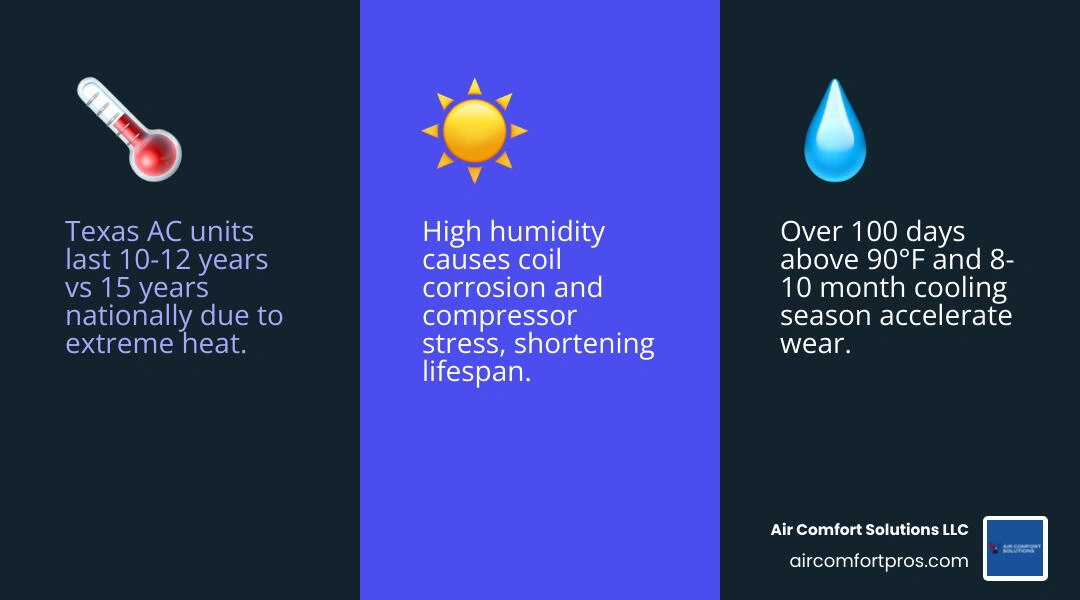
Living in Pinehurst or The Woodlands, we know that our AC units don't get much of a vacation. While a homeowner in a cooler state might only run their air conditioning for three months out of the year, Texas systems often hum along for eight to ten months. This relentless demand is the primary reason why AC units wear out faster in hot climates.
How extreme heat and humidity shorten AC life
In our part of the state, it’s not just the heat—it’s the humidity. Your air conditioner has two jobs: lowering the temperature and removing moisture from the air. High humidity forces the evaporator coil and compressor to work double-time. This extra load leads to faster compressor stress and can even cause coil corrosion over time. When you combine this with 234 sunny days a year and more than 100 days above 90 degrees, you have a recipe for mechanical exhaustion.
Why Texas homes hit the “gray zone” sooner
In the HVAC world, the "gray zone" is that period where a system is still running but has become a "sunk cost" trap. In cooler states, this might happen at year 15. In Texas, we often see units enter this zone between years 8 and 12. During this time, the risk of a total breakdown during a July heatwave increases significantly. When you’re deciding is it worth fixing an old air conditioner in texas, a 10-year-old unit here has likely "worked" as many hours as a 20-year-old unit in the Midwest.
How skipped maintenance makes old systems fail even faster
The Texas environment is also dusty and full of pollen. If maintenance is neglected, dirty coils act like a blanket, trapping heat and forcing the motor to work harder. This leads to airflow loss and clogged drain lines. To keep an older system limping along, regular check-ups are vital. You can learn more about the consequences in our guide on what happens if you skip AC maintenance in Texas and find out how often you should service your AC in Texas to protect your investment.
Is It Worth Fixing an Old Air Conditioner in Texas? Use These Decision Rules
When a technician hands you a repair quote, it’s easy to feel overwhelmed. We use a few industry-standard "rules of thumb" to help our customers in Magnolia and Tomball make a logical, math-based choice. These rules help remove the emotion from the decision of how to decide between AC repair and replacement.
The $5,000 Rule: a simple way to judge is it worth fixing an old air conditioner in Texas
The $5,000 Rule is one of the most reliable formulas we use. You simply multiply the age of the unit by the cost of the repair.
• Example: A 10-year-old unit needs a repair. 10 years x repair cost. If the total is over $5,000, replacement is generally the smarter financial move.
• Why it works: It balances the immediate cost against the remaining life expectancy of the equipment.
How the 50% Rule applies to compressors and evaporator coils
If you are facing a major component failure—like a dead compressor or a leaking evaporator coil—we recommend the 50% Rule. If the repair cost is more than half the cost of a brand-new system, you are likely throwing money into a "sunk cost." Major repairs on an old system don't reset the clock on the other aging parts; your fan motor or electronics could still fail next month.
When a simple repair still makes sense
Not every breakdown means you need a new unit. If your system is younger (under 8-10 years) and has a solid maintenance history, simple repairs are very sensible. Replacing a capacitor, a contactor, or a thermostat is a relatively minor fix that can get a healthy system back up and running quickly.
The Hidden Costs of Keeping an Old AC Running
Sometimes the cost of an old AC isn't in the repairs, but in the monthly "tax" you pay to your utility company. An aging system loses efficiency every year. In fact, a 15-year-old system can consume up to 57% more energy than it did the day it was installed.
Warning signs your old AC is no longer cooling or dehumidifying efficiently
Beyond a total breakdown, there are subtle signs your AC needs repair in Houston area heat. If you notice warm air coming from the vents, muggy rooms, or musty odors, your system is struggling to keep up with the Texas humidity. Hot spots in certain rooms or longer cooling cycles are also indicators that the mechanical components are reaching their limit.
How much energy old units waste compared with modern SEER2 systems
The efficiency jump from an old 10 SEER unit to a modern 16+ SEER2 system is massive. Homeowners in the Spring and Conroe areas often see monthly cooling cost reductions of 30% to 40% after an upgrade. For a typical Texas home, this can translate to annual savings of $300 to $600.
Why frequent summer repairs become a reliability problem in Texas
In Texas, a broken AC in August is more than an inconvenience—it’s a safety issue. If you find yourself calling for service multiple times a season, you’re dealing with a reliability problem. These emergency service calls add up, and the stress of wondering "will it work today?" takes a toll on your family's comfort.
Refrigerant Changes That Can Make Old Systems a Bad Bet
The industry is currently undergoing significant regulatory changes that affect the long-term serviceability of older units. If your system was installed before 2010, it likely uses R-22 (Freon), which has been phased out.
Why R-22 systems are especially risky to keep repairing
Since R-22 is no longer produced, the supply is extremely limited. Repairing a leak in an R-22 system is often prohibitively expensive because the refrigerant itself costs a fortune. In most cases, finding a leak in an R-22 unit is a definitive sign that it’s time to replace the equipment.
What the 2025 A2L refrigerant transition means for today’s R-410A equipment
As of 2025, the industry is transitioning to A2L refrigerants (like R-32 and R-454B). While current R-410A systems will be supported for years to come, the shift means that older technology will gradually become more expensive to maintain. Planning for a modern system now ensures you have a unit that is compatible with future service standards.
Safety risks of aging HVAC equipment
Old systems aren't just inefficient; they can be hazardous. Aging electrical components can lead to burned wires or capacitor failures that pose fire risks. Furthermore, if you have a combined HVAC system, an old furnace could develop heat exchanger cracks, leading to carbon monoxide risks. Keeping a system past its prime requires a careful eye on these safety factors.
When Replacement Brings Better Value for Texas Homeowners
While the initial investment of a new system is higher, the long-term value for a Texas homeowner is often much greater. From lower bills to improved indoor air quality, a new system changes the way you experience your home.
Federal tax credits and Texas-area incentives available in 2026
In 2026, homeowners can still take advantage of federal tax credits under the Inflation Reduction Act. Qualifying high-efficiency heat pumps may be eligible for credits up to $2,000. Additionally, many local Texas utility providers offer rebates for upgrading to SEER2-rated equipment, helping to offset the initial cost.
How a new HVAC system can help resale value and time on market
In the Texas real estate market, a new, efficient HVAC system is a major selling point. Buyers are often wary of homes with 12-year-old AC units, knowing a replacement is imminent. A new system provides buyer confidence and can actually decrease the time your home stays on the market.
Is it worth fixing an old air conditioner in Texas if you plan to stay in the home?
If you plan to live in your home for the next five years or more, replacement is almost always the better financial move. The accumulated energy savings, combined with the "peace of mind" that comes from a manufacturer’s warranty, far outweighs the cost of patching up an old unit year after year. To help your new system last, we recommend looking into is an HVAC maintenance plan worth it to protect your new investment.
Frequently Asked Questions About Fixing an Old Air Conditioner in Texas
At what age should you stop repairing an air conditioner in Texas?
Once a system hits the 10-to-12-year mark, you should start evaluating every repair carefully. If the unit has a history of breakdowns or requires a major part like a compressor, it is usually time to stop repairing.
Can an old AC still work fine but cost too much to keep?
Yes. Many systems "work" in the sense that they blow cold air, but they may be running 24/7 to do so. This hidden inefficiency shows up in your electric bill. If your bills are rising but your comfort is declining, the system is costing you more than you think.
Should you repair or replace before peak summer arrives?
We always suggest making these decisions in the spring. You can find more tips on how to make sure your AC survives a Texas summer by being proactive. Replacing in the "off-season" gives you more scheduling flexibility and prevents the emergency of a total breakdown in 100-degree heat.
Conclusion: The Smartest Next Step Before You Spend More on an Old AC
Deciding is it worth fixing an old air conditioner in texas doesn't have to be a guessing game. By applying the $5,000 rule and considering the high cost of Texas energy, the right path usually becomes clear. At Air Comfort Solutions LLC, we believe in providing our neighbors in Pinehurst, Magnolia, and the surrounding areas with honest evaluations and upfront options.
Whether you need a reliable repair to get through the season or you're ready to upgrade to a high-efficiency SEER2 system, we are here to help. Don't wait until the next heatwave to find out your AC can't keep up.
For a professional evaluation of your current system or to explore your upgrade options, visit our AC replacement services in Spring, TX and let our certified technicians help you stay cool for years to come.
Is It Worth Fixing an Old Air Conditioner in Texas? Here's the Short Answer
Is it worth fixing an old air conditioner in Texas depends on a few key factors — mainly the age of your system, what the repair costs, and how many times you've already called for service.
Quick answer:
| Situation | Recommendation |
|---|
| System is under 8 years old, minor repair needed | Repair is usually worth it |
| System is 8-12 years old, moderate repair needed | Use the $5,000 Rule to decide |
| System is over 12 years old, major component failed | Replacement is likely the smarter move |
| System uses R-22 (Freon) refrigerant | Lean strongly toward replacement |
| Repair cost exceeds 50% of a new system's price | Replace — don't throw good money after bad |
In Texas, air conditioning isn't a luxury — it's a necessity for survival. Summers here are long, brutal, and relentless. The Dallas-Fort Worth area alone logs more than 100 days above 90°F each year, and the state racks up 2.3 times the national average in cooling degree days. That kind of heat doesn't just make your home uncomfortable — it puts your AC system under constant, grinding stress that wears it out far sooner than systems in cooler parts of the country.
While the national average lifespan for a central AC unit is around 15 years, Texas homeowners are often looking at a system that's running on borrowed time by year 10 or 12. That gap matters a lot when you're staring at a repair bill and trying to decide whether it makes sense to pay it — or put that money toward something new.
This guide walks you through the honest, practical math behind that decision so you can stop guessing and start acting with confidence.
Why Texas Wears Out Air Conditioners Faster Than Other States
Living in Pinehurst or The Woodlands, we know that our AC units don't get much of a vacation. While a homeowner in a cooler state might only run their air conditioning for three months out of the year, Texas systems often hum along for eight to ten months. This relentless demand is the primary reason why AC units wear out faster in hot climates.
How extreme heat and humidity shorten AC life
In our part of the state, it’s not just the heat—it’s the humidity. Your air conditioner has two jobs: lowering the temperature and removing moisture from the air. High humidity forces the evaporator coil and compressor to work double-time. This extra load leads to faster compressor stress and can even cause coil corrosion over time. When you combine this with 234 sunny days a year and more than 100 days above 90 degrees, you have a recipe for mechanical exhaustion.
Why Texas homes hit the “gray zone” sooner
In the HVAC world, the "gray zone" is that period where a system is still running but has become a "sunk cost" trap. In cooler states, this might happen at year 15. In Texas, we often see units enter this zone between years 8 and 12. During this time, the risk of a total breakdown during a July heatwave increases significantly. When you’re deciding is it worth fixing an old air conditioner in texas, a 10-year-old unit here has likely "worked" as many hours as a 20-year-old unit in the Midwest.
How skipped maintenance makes old systems fail even faster
The Texas environment is also dusty and full of pollen. If maintenance is neglected, dirty coils act like a blanket, trapping heat and forcing the motor to work harder. This leads to airflow loss and clogged drain lines. To keep an older system limping along, regular check-ups are vital. You can learn more about the consequences in our guide on what happens if you skip AC maintenance in Texas and find out how often you should service your AC in Texas to protect your investment.
Is It Worth Fixing an Old Air Conditioner in Texas? Use These Decision Rules
When a technician hands you a repair quote, it’s easy to feel overwhelmed. We use a few industry-standard "rules of thumb" to help our customers in Magnolia and Tomball make a logical, math-based choice. These rules help remove the emotion from the decision of how to decide between AC repair and replacement.
The $5,000 Rule: a simple way to judge is it worth fixing an old air conditioner in Texas
The $5,000 Rule is one of the most reliable formulas we use. You simply multiply the age of the unit by the cost of the repair.
- Example: A 10-year-old unit needs a repair. 10 years x repair cost. If the total is over $5,000, replacement is generally the smarter financial move.
- Why it works: It balances the immediate cost against the remaining life expectancy of the equipment.
How the 50% Rule applies to compressors and evaporator coils
If you are facing a major component failure—like a dead compressor or a leaking evaporator coil—we recommend the 50% Rule. If the repair cost is more than half the cost of a brand-new system, you are likely throwing money into a "sunk cost." Major repairs on an old system don't reset the clock on the other aging parts; your fan motor or electronics could still fail next month.
When a simple repair still makes sense
Not every breakdown means you need a new unit. If your system is younger (under 8-10 years) and has a solid maintenance history, simple repairs are very sensible. Replacing a capacitor, a contactor, or a thermostat is a relatively minor fix that can get a healthy system back up and running quickly.
The Hidden Costs of Keeping an Old AC Running
Sometimes the cost of an old AC isn't in the repairs, but in the monthly "tax" you pay to your utility company. An aging system loses efficiency every year. In fact, a 15-year-old system can consume up to 57% more energy than it did the day it was installed.
Warning signs your old AC is no longer cooling or dehumidifying efficiently
Beyond a total breakdown, there are subtle signs your AC needs repair in Houston area heat. If you notice warm air coming from the vents, muggy rooms, or musty odors, your system is struggling to keep up with the Texas humidity. Hot spots in certain rooms or longer cooling cycles are also indicators that the mechanical components are reaching their limit.
How much energy old units waste compared with modern SEER2 systems
The efficiency jump from an old 10 SEER unit to a modern 16+ SEER2 system is massive. Homeowners in the Spring and Conroe areas often see monthly cooling cost reductions of 30% to 40% after an upgrade. For a typical Texas home, this can translate to annual savings of $300 to $600.
Why frequent summer repairs become a reliability problem in Texas
In Texas, a broken AC in August is more than an inconvenience—it’s a safety issue. If you find yourself calling for service multiple times a season, you’re dealing with a reliability problem. These emergency service calls add up, and the stress of wondering "will it work today?" takes a toll on your family's comfort.
Refrigerant Changes That Can Make Old Systems a Bad Bet
The industry is currently undergoing significant regulatory changes that affect the long-term serviceability of older units. If your system was installed before 2010, it likely uses R-22 (Freon), which has been phased out.
Why R-22 systems are especially risky to keep repairing
Since R-22 is no longer produced, the supply is extremely limited. Repairing a leak in an R-22 system is often prohibitively expensive because the refrigerant itself costs a fortune. In most cases, finding a leak in an R-22 unit is a definitive sign that it’s time to replace the equipment.
What the 2025 A2L refrigerant transition means for today’s R-410A equipment
As of 2025, the industry is transitioning to A2L refrigerants (like R-32 and R-454B). While current R-410A systems will be supported for years to come, the shift means that older technology will gradually become more expensive to maintain. Planning for a modern system now ensures you have a unit that is compatible with future service standards.
Safety risks of aging HVAC equipment
Old systems aren't just inefficient; they can be hazardous. Aging electrical components can lead to burned wires or capacitor failures that pose fire risks. Furthermore, if you have a combined HVAC system, an old furnace could develop heat exchanger cracks, leading to carbon monoxide risks. Keeping a system past its prime requires a careful eye on these safety factors.
When Replacement Brings Better Value for Texas Homeowners
While the initial investment of a new system is higher, the long-term value for a Texas homeowner is often much greater. From lower bills to improved indoor air quality, a new system changes the way you experience your home.
Federal tax credits and Texas-area incentives available in 2026
In 2026, homeowners can still take advantage of federal tax credits under the Inflation Reduction Act. Qualifying high-efficiency heat pumps may be eligible for credits up to $2,000. Additionally, many local Texas utility providers offer rebates for upgrading to SEER2-rated equipment, helping to offset the initial cost.
How a new HVAC system can help resale value and time on market
In the Texas real estate market, a new, efficient HVAC system is a major selling point. Buyers are often wary of homes with 12-year-old AC units, knowing a replacement is imminent. A new system provides buyer confidence and can actually decrease the time your home stays on the market.
Is it worth fixing an old air conditioner in Texas if you plan to stay in the home?
If you plan to live in your home for the next five years or more, replacement is almost always the better financial move. The accumulated energy savings, combined with the "peace of mind" that comes from a manufacturer’s warranty, far outweighs the cost of patching up an old unit year after year. To help your new system last, we recommend looking into is an HVAC maintenance plan worth it to protect your new investment.
Frequently Asked Questions About Fixing an Old Air Conditioner in Texas
At what age should you stop repairing an air conditioner in Texas?
Once a system hits the 10-to-12-year mark, you should start evaluating every repair carefully. If the unit has a history of breakdowns or requires a major part like a compressor, it is usually time to stop repairing.
Can an old AC still work fine but cost too much to keep?
Yes. Many systems "work" in the sense that they blow cold air, but they may be running 24/7 to do so. This hidden inefficiency shows up in your electric bill. If your bills are rising but your comfort is declining, the system is costing you more than you think.
Should you repair or replace before peak summer arrives?
We always suggest making these decisions in the spring. You can find more tips on how to make sure your AC survives a Texas summer by being proactive. Replacing in the "off-season" gives you more scheduling flexibility and prevents the emergency of a total breakdown in 100-degree heat.
Conclusion: The Smartest Next Step Before You Spend More on an Old AC
Deciding is it worth fixing an old air conditioner in texas doesn't have to be a guessing game. By applying the $5,000 rule and considering the high cost of Texas energy, the right path usually becomes clear. At Air Comfort Solutions LLC, we believe in providing our neighbors in Pinehurst, Magnolia, and the surrounding areas with honest evaluations and upfront options.
Whether you need a reliable repair to get through the season or you're ready to upgrade to a high-efficiency SEER2 system, we are here to help. Don't wait until the next heatwave to find out your AC can't keep up.
For a professional evaluation of your current system or to explore your upgrade options, visit our AC replacement services in Spring, TX and let our certified technicians help you stay cool for years to come.
Is It Worth Fixing an Old Air Conditioner in Texas? Here's the Short Answer
Is it worth fixing an old air conditioner in Texas depends on a few key factors — mainly the age of your system, what the repair costs, and how many times you've already called for service.
Quick answer:
| Situation | Recommendation |
|---|
| System is under 8 years old, minor repair needed | Repair is usually worth it |
| System is 8-12 years old, moderate repair needed | Use the $5,000 Rule to decide |
| System is over 12 years old, major component failed | Replacement is likely the smarter move |
| System uses R-22 (Freon) refrigerant | Lean strongly toward replacement |
| Repair cost exceeds 50% of a new system's price | Replace — don't throw good money after bad |
In Texas, air conditioning isn't a luxury — it's a necessity for survival. Summers here are long, brutal, and relentless. The Dallas-Fort Worth area alone logs more than 100 days above 90°F each year, and the state racks up 2.3 times the national average in cooling degree days. That kind of heat doesn't just make your home uncomfortable — it puts your AC system under constant, grinding stress that wears it out far sooner than systems in cooler parts of the country.
While the national average lifespan for a central AC unit is around 15 years, Texas homeowners are often looking at a system that's running on borrowed time by year 10 or 12. That gap matters a lot when you're staring at a repair bill and trying to decide whether it makes sense to pay it — or put that money toward something new.
This guide walks you through the honest, practical math behind that decision so you can stop guessing and start acting with confidence.
Why Texas Wears Out Air Conditioners Faster Than Other States
Living in Pinehurst or The Woodlands, we know that our AC units don't get much of a vacation. While a homeowner in a cooler state might only run their air conditioning for three months out of the year, Texas systems often hum along for eight to ten months. This relentless demand is the primary reason why AC units wear out faster in hot climates.
How extreme heat and humidity shorten AC life
In our part of the state, it’s not just the heat—it’s the humidity. Your air conditioner has two jobs: lowering the temperature and removing moisture from the air. High humidity forces the evaporator coil and compressor to work double-time. This extra load leads to faster compressor stress and can even cause coil corrosion over time. When you combine this with 234 sunny days a year and more than 100 days above 90 degrees, you have a recipe for mechanical exhaustion.
Why Texas homes hit the “gray zone” sooner
In the HVAC world, the "gray zone" is that period where a system is still running but has become a "sunk cost" trap. In cooler states, this might happen at year 15. In Texas, we often see units enter this zone between years 8 and 12. During this time, the risk of a total breakdown during a July heatwave increases significantly. When you’re deciding is it worth fixing an old air conditioner in texas, a 10-year-old unit here has likely "worked" as many hours as a 20-year-old unit in the Midwest.
How skipped maintenance makes old systems fail even faster
The Texas environment is also dusty and full of pollen. If maintenance is neglected, dirty coils act like a blanket, trapping heat and forcing the motor to work harder. This leads to airflow loss and clogged drain lines. To keep an older system limping along, regular check-ups are vital. You can learn more about the consequences in our guide on what happens if you skip AC maintenance in Texas and find out how often you should service your AC in Texas to protect your investment.
Is It Worth Fixing an Old Air Conditioner in Texas? Use These Decision Rules
When a technician hands you a repair quote, it’s easy to feel overwhelmed. We use a few industry-standard "rules of thumb" to help our customers in Magnolia and Tomball make a logical, math-based choice. These rules help remove the emotion from the decision of how to decide between AC repair and replacement.
The $5,000 Rule: a simple way to judge is it worth fixing an old air conditioner in Texas
The $5,000 Rule is one of the most reliable formulas we use. You simply multiply the age of the unit by the cost of the repair.
- Example: A 10-year-old unit needs a repair. 10 years x repair cost. If the total is over $5,000, replacement is generally the smarter financial move.
- Why it works: It balances the immediate cost against the remaining life expectancy of the equipment.
How the 50% Rule applies to compressors and evaporator coils
If you are facing a major component failure—like a dead compressor or a leaking evaporator coil—we recommend the 50% Rule. If the repair cost is more than half the cost of a brand-new system, you are likely throwing money into a "sunk cost." Major repairs on an old system don't reset the clock on the other aging parts; your fan motor or electronics could still fail next month.
When a simple repair still makes sense
Not every breakdown means you need a new unit. If your system is younger (under 8-10 years) and has a solid maintenance history, simple repairs are very sensible. Replacing a capacitor, a contactor, or a thermostat is a relatively minor fix that can get a healthy system back up and running quickly.
The Hidden Costs of Keeping an Old AC Running
Sometimes the cost of an old AC isn't in the repairs, but in the monthly "tax" you pay to your utility company. An aging system loses efficiency every year. In fact, a 15-year-old system can consume up to 57% more energy than it did the day it was installed.
Warning signs your old AC is no longer cooling or dehumidifying efficiently
Beyond a total breakdown, there are subtle signs your AC needs repair in Houston area heat. If you notice warm air coming from the vents, muggy rooms, or musty odors, your system is struggling to keep up with the Texas humidity. Hot spots in certain rooms or longer cooling cycles are also indicators that the mechanical components are reaching their limit.
How much energy old units waste compared with modern SEER2 systems
The efficiency jump from an old 10 SEER unit to a modern 16+ SEER2 system is massive. Homeowners in the Spring and Conroe areas often see monthly cooling cost reductions of 30% to 40% after an upgrade. For a typical Texas home, this can translate to annual savings of $300 to $600.
Why frequent summer repairs become a reliability problem in Texas
In Texas, a broken AC in August is more than an inconvenience—it’s a safety issue. If you find yourself calling for service multiple times a season, you’re dealing with a reliability problem. These emergency service calls add up, and the stress of wondering "will it work today?" takes a toll on your family's comfort.
Refrigerant Changes That Can Make Old Systems a Bad Bet
The industry is currently undergoing significant regulatory changes that affect the long-term serviceability of older units. If your system was installed before 2010, it likely uses R-22 (Freon), which has been phased out.
Why R-22 systems are especially risky to keep repairing
Since R-22 is no longer produced, the supply is extremely limited. Repairing a leak in an R-22 system is often prohibitively expensive because the refrigerant itself costs a fortune. In most cases, finding a leak in an R-22 unit is a definitive sign that it’s time to replace the equipment.
What the 2025 A2L refrigerant transition means for today’s R-410A equipment
As of 2025, the industry is transitioning to A2L refrigerants (like R-32 and R-454B). While current R-410A systems will be supported for years to come, the shift means that older technology will gradually become more expensive to maintain. Planning for a modern system now ensures you have a unit that is compatible with future service standards.
Safety risks of aging HVAC equipment
Old systems aren't just inefficient; they can be hazardous. Aging electrical components can lead to burned wires or capacitor failures that pose fire risks. Furthermore, if you have a combined HVAC system, an old furnace could develop heat exchanger cracks, leading to carbon monoxide risks. Keeping a system past its prime requires a careful eye on these safety factors.
When Replacement Brings Better Value for Texas Homeowners
While the initial investment of a new system is higher, the long-term value for a Texas homeowner is often much greater. From lower bills to improved indoor air quality, a new system changes the way you experience your home.
Federal tax credits and Texas-area incentives available in 2026
In 2026, homeowners can still take advantage of federal tax credits under the Inflation Reduction Act. Qualifying high-efficiency heat pumps may be eligible for credits up to $2,000. Additionally, many local Texas utility providers offer rebates for upgrading to SEER2-rated equipment, helping to offset the initial cost.
How a new HVAC system can help resale value and time on market
In the Texas real estate market, a new, efficient HVAC system is a major selling point. Buyers are often wary of homes with 12-year-old AC units, knowing a replacement is imminent. A new system provides buyer confidence and can actually decrease the time your home stays on the market.
Is it worth fixing an old air conditioner in Texas if you plan to stay in the home?
If you plan to live in your home for the next five years or more, replacement is almost always the better financial move. The accumulated energy savings, combined with the "peace of mind" that comes from a manufacturer’s warranty, far outweighs the cost of patching up an old unit year after year. To help your new system last, we recommend looking into is an HVAC maintenance plan worth it to protect your new investment.
Frequently Asked Questions About Fixing an Old Air Conditioner in Texas
At what age should you stop repairing an air conditioner in Texas?
Once a system hits the 10-to-12-year mark, you should start evaluating every repair carefully. If the unit has a history of breakdowns or requires a major part like a compressor, it is usually time to stop repairing.
Can an old AC still work fine but cost too much to keep?
Yes. Many systems "work" in the sense that they blow cold air, but they may be running 24/7 to do so. This hidden inefficiency shows up in your electric bill. If your bills are rising but your comfort is declining, the system is costing you more than you think.
Should you repair or replace before peak summer arrives?
We always suggest making these decisions in the spring. You can find more tips on how to make sure your AC survives a Texas summer by being proactive. Replacing in the "off-season" gives you more scheduling flexibility and prevents the emergency of a total breakdown in 100-degree heat.
Conclusion: The Smartest Next Step Before You Spend More on an Old AC
Deciding is it worth fixing an old air conditioner in texas doesn't have to be a guessing game. By applying the $5,000 rule and considering the high cost of Texas energy, the right path usually becomes clear. At Air Comfort Solutions LLC, we believe in providing our neighbors in Pinehurst, Magnolia, and the surrounding areas with honest evaluations and upfront options.
Whether you need a reliable repair to get through the season or you're ready to upgrade to a high-efficiency SEER2 system, we are here to help. Don't wait until the next heatwave to find out your AC can't keep up.
For a professional evaluation of your current system or to explore your upgrade options, visit our AC replacement services in Spring, TX and let our certified technicians help you stay cool for years to come.
Is It Worth Fixing an Old Air Conditioner in Texas? Here's the Short Answer
Is it worth fixing an old air conditioner in Texas depends on a few key factors — mainly the age of your system, what the repair costs, and how many times you've already called for service.
Quick answer:
| Situation | Recommendation |
|---|
| System is under 8 years old, minor repair needed | Repair is usually worth it |
| System is 8-12 years old, moderate repair needed | Use the $5,000 Rule to decide |
| System is over 12 years old, major component failed | Replacement is likely the smarter move |
| System uses R-22 (Freon) refrigerant | Lean strongly toward replacement |
| Repair cost exceeds 50% of a new system's price | Replace — don't throw good money after bad |
In Texas, air conditioning isn't a luxury — it's a necessity for survival. Summers here are long, brutal, and relentless. The Dallas-Fort Worth area alone logs more than 100 days above 90°F each year, and the state racks up 2.3 times the national average in cooling degree days. That kind of heat doesn't just make your home uncomfortable — it puts your AC system under constant, grinding stress that wears it out far sooner than systems in cooler parts of the country.
While the national average lifespan for a central AC unit is around 15 years, Texas homeowners are often looking at a system that's running on borrowed time by year 10 or 12. That gap matters a lot when you're staring at a repair bill and trying to decide whether it makes sense to pay it — or put that money toward something new.
This guide walks you through the honest, practical math behind that decision so you can stop guessing and start acting with confidence.
Why Texas Wears Out Air Conditioners Faster Than Other States
Living in Pinehurst or The Woodlands, we know that our AC units don't get much of a vacation. While a homeowner in a cooler state might only run their air conditioning for three months out of the year, Texas systems often hum along for eight to ten months. This relentless demand is the primary reason why AC units wear out faster in hot climates.
How extreme heat and humidity shorten AC life
In our part of the state, it’s not just the heat—it’s the humidity. Your air conditioner has two jobs: lowering the temperature and removing moisture from the air. High humidity forces the evaporator coil and compressor to work double-time. This extra load leads to faster compressor stress and can even cause coil corrosion over time. When you combine this with 234 sunny days a year and more than 100 days above 90 degrees, you have a recipe for mechanical exhaustion.
Why Texas homes hit the “gray zone” sooner
In the HVAC world, the "gray zone" is that period where a system is still running but has become a "sunk cost" trap. In cooler states, this might happen at year 15. In Texas, we often see units enter this zone between years 8 and 12. During this time, the risk of a total breakdown during a July heatwave increases significantly. When you’re deciding is it worth fixing an old air conditioner in texas, a 10-year-old unit here has likely "worked" as many hours as a 20-year-old unit in the Midwest.
How skipped maintenance makes old systems fail even faster
The Texas environment is also dusty and full of pollen. If maintenance is neglected, dirty coils act like a blanket, trapping heat and forcing the motor to work harder. This leads to airflow loss and clogged drain lines. To keep an older system limping along, regular check-ups are vital. You can learn more about the consequences in our guide on what happens if you skip AC maintenance in Texas and find out how often you should service your AC in Texas to protect your investment.
Is It Worth Fixing an Old Air Conditioner in Texas? Use These Decision Rules
When a technician hands you a repair quote, it’s easy to feel overwhelmed. We use a few industry-standard "rules of thumb" to help our customers in Magnolia and Tomball make a logical, math-based choice. These rules help remove the emotion from the decision of how to decide between AC repair and replacement.
The $5,000 Rule: a simple way to judge is it worth fixing an old air conditioner in Texas
The $5,000 Rule is one of the most reliable formulas we use. You simply multiply the age of the unit by the cost of the repair.
- Example: A 10-year-old unit needs a repair. 10 years x repair cost. If the total is over $5,000, replacement is generally the smarter financial move.
- Why it works: It balances the immediate cost against the remaining life expectancy of the equipment.
How the 50% Rule applies to compressors and evaporator coils
If you are facing a major component failure—like a dead compressor or a leaking evaporator coil—we recommend the 50% Rule. If the repair cost is more than half the cost of a brand-new system, you are likely throwing money into a "sunk cost." Major repairs on an old system don't reset the clock on the other aging parts; your fan motor or electronics could still fail next month.
When a simple repair still makes sense
Not every breakdown means you need a new unit. If your system is younger (under 8-10 years) and has a solid maintenance history, simple repairs are very sensible. Replacing a capacitor, a contactor, or a thermostat is a relatively minor fix that can get a healthy system back up and running quickly.
The Hidden Costs of Keeping an Old AC Running
Sometimes the cost of an old AC isn't in the repairs, but in the monthly "tax" you pay to your utility company. An aging system loses efficiency every year. In fact, a 15-year-old system can consume up to 57% more energy than it did the day it was installed.
Warning signs your old AC is no longer cooling or dehumidifying efficiently
Beyond a total breakdown, there are subtle signs your AC needs repair in Houston area heat. If you notice warm air coming from the vents, muggy rooms, or musty odors, your system is struggling to keep up with the Texas humidity. Hot spots in certain rooms or longer cooling cycles are also indicators that the mechanical components are reaching their limit.
How much energy old units waste compared with modern SEER2 systems
The efficiency jump from an old 10 SEER unit to a modern 16+ SEER2 system is massive. Homeowners in the Spring and Conroe areas often see monthly cooling cost reductions of 30% to 40% after an upgrade. For a typical Texas home, this can translate to annual savings of $300 to $600.
Why frequent summer repairs become a reliability problem in Texas
In Texas, a broken AC in August is more than an inconvenience—it’s a safety issue. If you find yourself calling for service multiple times a season, you’re dealing with a reliability problem. These emergency service calls add up, and the stress of wondering "will it work today?" takes a toll on your family's comfort.
Refrigerant Changes That Can Make Old Systems a Bad Bet
The industry is currently undergoing significant regulatory changes that affect the long-term serviceability of older units. If your system was installed before 2010, it likely uses R-22 (Freon), which has been phased out.
Why R-22 systems are especially risky to keep repairing
Since R-22 is no longer produced, the supply is extremely limited. Repairing a leak in an R-22 system is often prohibitively expensive because the refrigerant itself costs a fortune. In most cases, finding a leak in an R-22 unit is a definitive sign that it’s time to replace the equipment.
What the 2025 A2L refrigerant transition means for today’s R-410A equipment
As of 2025, the industry is transitioning to A2L refrigerants (like R-32 and R-454B). While current R-410A systems will be supported for years to come, the shift means that older technology will gradually become more expensive to maintain. Planning for a modern system now ensures you have a unit that is compatible with future service standards.
Safety risks of aging HVAC equipment
Old systems aren't just inefficient; they can be hazardous. Aging electrical components can lead to burned wires or capacitor failures that pose fire risks. Furthermore, if you have a combined HVAC system, an old furnace could develop heat exchanger cracks, leading to carbon monoxide risks. Keeping a system past its prime requires a careful eye on these safety factors.
When Replacement Brings Better Value for Texas Homeowners
While the initial investment of a new system is higher, the long-term value for a Texas homeowner is often much greater. From lower bills to improved indoor air quality, a new system changes the way you experience your home.
Federal tax credits and Texas-area incentives available in 2026
In 2026, homeowners can still take advantage of federal tax credits under the Inflation Reduction Act. Qualifying high-efficiency heat pumps may be eligible for credits up to $2,000. Additionally, many local Texas utility providers offer rebates for upgrading to SEER2-rated equipment, helping to offset the initial cost.
How a new HVAC system can help resale value and time on market
In the Texas real estate market, a new, efficient HVAC system is a major selling point. Buyers are often wary of homes with 12-year-old AC units, knowing a replacement is imminent. A new system provides buyer confidence and can actually decrease the time your home stays on the market.
Is it worth fixing an old air conditioner in Texas if you plan to stay in the home?
If you plan to live in your home for the next five years or more, replacement is almost always the better financial move. The accumulated energy savings, combined with the "peace of mind" that comes from a manufacturer’s warranty, far outweighs the cost of patching up an old unit year after year. To help your new system last, we recommend looking into is an HVAC maintenance plan worth it to protect your new investment.
Frequently Asked Questions About Fixing an Old Air Conditioner in Texas
At what age should you stop repairing an air conditioner in Texas?
Once a system hits the 10-to-12-year mark, you should start evaluating every repair carefully. If the unit has a history of breakdowns or requires a major part like a compressor, it is usually time to stop repairing.
Can an old AC still work fine but cost too much to keep?
Yes. Many systems "work" in the sense that they blow cold air, but they may be running 24/7 to do so. This hidden inefficiency shows up in your electric bill. If your bills are rising but your comfort is declining, the system is costing you more than you think.
Should you repair or replace before peak summer arrives?
We always suggest making these decisions in the spring. You can find more tips on how to make sure your AC survives a Texas summer by being proactive. Replacing in the "off-season" gives you more scheduling flexibility and prevents the emergency of a total breakdown in 100-degree heat.
Conclusion: The Smartest Next Step Before You Spend More on an Old AC
Deciding is it worth fixing an old air conditioner in texas doesn't have to be a guessing game. By applying the $5,000 rule and considering the high cost of Texas energy, the right path usually becomes clear. At Air Comfort Solutions LLC, we believe in providing our neighbors in Pinehurst, Magnolia, and the surrounding areas with honest evaluations and upfront options.
Whether you need a reliable repair to get through the season or you're ready to upgrade to a high-efficiency SEER2 system, we are here to help. Don't wait until the next heatwave to find out your AC can't keep up.
For a professional evaluation of your current system or to explore your upgrade options, visit our AC replacement services in Spring, TX and let our certified technicians help you stay cool for years to come.
Is It Worth Fixing an Old Air Conditioner in Texas? Here's the Short Answer
Is it worth fixing an old air conditioner in Texas depends on a few key factors — mainly the age of your system, what the repair costs, and how many times you've already called for service.
Quick answer:
| Situation | Recommendation |
|---|
| System is under 8 years old, minor repair needed | Repair is usually worth it |
| System is 8-12 years old, moderate repair needed | Use the $5,000 Rule to decide |
| System is over 12 years old, major component failed | Replacement is likely the smarter move |
| System uses R-22 (Freon) refrigerant | Lean strongly toward replacement |
| Repair cost exceeds 50% of a new system's price | Replace — don't throw good money after bad |
In Texas, air conditioning isn't a luxury — it's a necessity for survival. Summers here are long, brutal, and relentless. The Dallas-Fort Worth area alone logs more than 100 days above 90°F each year, and the state racks up 2.3 times the national average in cooling degree days. That kind of heat doesn't just make your home uncomfortable — it puts your AC system under constant, grinding stress that wears it out far sooner than systems in cooler parts of the country.
While the national average lifespan for a central AC unit is around 15 years, Texas homeowners are often looking at a system that's running on borrowed time by year 10 or 12. That gap matters a lot when you're staring at a repair bill and trying to decide whether it makes sense to pay it — or put that money toward something new.
This guide walks you through the honest, practical math behind that decision so you can stop guessing and start acting with confidence.
Why Texas Wears Out Air Conditioners Faster Than Other States
Living in Pinehurst or The Woodlands, we know that our AC units don't get much of a vacation. While a homeowner in a cooler state might only run their air conditioning for three months out of the year, Texas systems often hum along for eight to ten months. This relentless demand is the primary reason why AC units wear out faster in hot climates.
How extreme heat and humidity shorten AC life
In our part of the state, it’s not just the heat—it’s the humidity. Your air conditioner has two jobs: lowering the temperature and removing moisture from the air. High humidity forces the evaporator coil and compressor to work double-time. This extra load leads to faster compressor stress and can even cause coil corrosion over time. When you combine this with 234 sunny days a year and more than 100 days above 90 degrees, you have a recipe for mechanical exhaustion.
Why Texas homes hit the “gray zone” sooner
In the HVAC world, the "gray zone" is that period where a system is still running but has become a "sunk cost" trap. In cooler states, this might happen at year 15. In Texas, we often see units enter this zone between years 8 and 12. During this time, the risk of a total breakdown during a July heatwave increases significantly. When you’re deciding is it worth fixing an old air conditioner in texas, a 10-year-old unit here has likely "worked" as many hours as a 20-year-old unit in the Midwest.
How skipped maintenance makes old systems fail even faster
The Texas environment is also dusty and full of pollen. If maintenance is neglected, dirty coils act like a blanket, trapping heat and forcing the motor to work harder. This leads to airflow loss and clogged drain lines. To keep an older system limping along, regular check-ups are vital. You can learn more about the consequences in our guide on what happens if you skip AC maintenance in Texas and find out how often you should service your AC in Texas to protect your investment.
Is It Worth Fixing an Old Air Conditioner in Texas? Use These Decision Rules
When a technician hands you a repair quote, it’s easy to feel overwhelmed. We use a few industry-standard "rules of thumb" to help our customers in Magnolia and Tomball make a logical, math-based choice. These rules help remove the emotion from the decision of how to decide between AC repair and replacement.
The $5,000 Rule: a simple way to judge is it worth fixing an old air conditioner in Texas
The $5,000 Rule is one of the most reliable formulas we use. You simply multiply the age of the unit by the cost of the repair.
- Example: A 10-year-old unit needs a repair. 10 years x repair cost. If the total is over $5,000, replacement is generally the smarter financial move.
- Why it works: It balances the immediate cost against the remaining life expectancy of the equipment.
How the 50% Rule applies to compressors and evaporator coils
If you are facing a major component failure—like a dead compressor or a leaking evaporator coil—we recommend the 50% Rule. If the repair cost is more than half the cost of a brand-new system, you are likely throwing money into a "sunk cost." Major repairs on an old system don't reset the clock on the other aging parts; your fan motor or electronics could still fail next month.
When a simple repair still makes sense
Not every breakdown means you need a new unit. If your system is younger (under 8-10 years) and has a solid maintenance history, simple repairs are very sensible. Replacing a capacitor, a contactor, or a thermostat is a relatively minor fix that can get a healthy system back up and running quickly.
The Hidden Costs of Keeping an Old AC Running
Sometimes the cost of an old AC isn't in the repairs, but in the monthly "tax" you pay to your utility company. An aging system loses efficiency every year. In fact, a 15-year-old system can consume up to 57% more energy than it did the day it was installed.
Warning signs your old AC is no longer cooling or dehumidifying efficiently
Beyond a total breakdown, there are subtle signs your AC needs repair in Houston area heat. If you notice warm air coming from the vents, muggy rooms, or musty odors, your system is struggling to keep up with the Texas humidity. Hot spots in certain rooms or longer cooling cycles are also indicators that the mechanical components are reaching their limit.
How much energy old units waste compared with modern SEER2 systems
The efficiency jump from an old 10 SEER unit to a modern 16+ SEER2 system is massive. Homeowners in the Spring and Conroe areas often see monthly cooling cost reductions of 30% to 40% after an upgrade. For a typical Texas home, this can translate to annual savings of $300 to $600.
Why frequent summer repairs become a reliability problem in Texas
In Texas, a broken AC in August is more than an inconvenience—it’s a safety issue. If you find yourself calling for service multiple times a season, you’re dealing with a reliability problem. These emergency service calls add up, and the stress of wondering "will it work today?" takes a toll on your family's comfort.
Refrigerant Changes That Can Make Old Systems a Bad Bet
The industry is currently undergoing significant regulatory changes that affect the long-term serviceability of older units. If your system was installed before 2010, it likely uses R-22 (Freon), which has been phased out.
Why R-22 systems are especially risky to keep repairing
Since R-22 is no longer produced, the supply is extremely limited. Repairing a leak in an R-22 system is often prohibitively expensive because the refrigerant itself costs a fortune. In most cases, finding a leak in an R-22 unit is a definitive sign that it’s time to replace the equipment.
What the 2025 A2L refrigerant transition means for today’s R-410A equipment
As of 2025, the industry is transitioning to A2L refrigerants (like R-32 and R-454B). While current R-410A systems will be supported for years to come, the shift means that older technology will gradually become more expensive to maintain. Planning for a modern system now ensures you have a unit that is compatible with future service standards.
Safety risks of aging HVAC equipment
Old systems aren't just inefficient; they can be hazardous. Aging electrical components can lead to burned wires or capacitor failures that pose fire risks. Furthermore, if you have a combined HVAC system, an old furnace could develop heat exchanger cracks, leading to carbon monoxide risks. Keeping a system past its prime requires a careful eye on these safety factors.
When Replacement Brings Better Value for Texas Homeowners
While the initial investment of a new system is higher, the long-term value for a Texas homeowner is often much greater. From lower bills to improved indoor air quality, a new system changes the way you experience your home.
Federal tax credits and Texas-area incentives available in 2026
In 2026, homeowners can still take advantage of federal tax credits under the Inflation Reduction Act. Qualifying high-efficiency heat pumps may be eligible for credits up to $2,000. Additionally, many local Texas utility providers offer rebates for upgrading to SEER2-rated equipment, helping to offset the initial cost.
How a new HVAC system can help resale value and time on market
In the Texas real estate market, a new, efficient HVAC system is a major selling point. Buyers are often wary of homes with 12-year-old AC units, knowing a replacement is imminent. A new system provides buyer confidence and can actually decrease the time your home stays on the market.
Is it worth fixing an old air conditioner in Texas if you plan to stay in the home?
If you plan to live in your home for the next five years or more, replacement is almost always the better financial move. The accumulated energy savings, combined with the "peace of mind" that comes from a manufacturer’s warranty, far outweighs the cost of patching up an old unit year after year. To help your new system last, we recommend looking into is an HVAC maintenance plan worth it to protect your new investment.
Frequently Asked Questions About Fixing an Old Air Conditioner in Texas
At what age should you stop repairing an air conditioner in Texas?
Once a system hits the 10-to-12-year mark, you should start evaluating every repair carefully. If the unit has a history of breakdowns or requires a major part like a compressor, it is usually time to stop repairing.
Can an old AC still work fine but cost too much to keep?
Yes. Many systems "work" in the sense that they blow cold air, but they may be running 24/7 to do so. This hidden inefficiency shows up in your electric bill. If your bills are rising but your comfort is declining, the system is costing you more than you think.
Should you repair or replace before peak summer arrives?
We always suggest making these decisions in the spring. You can find more tips on how to make sure your AC survives a Texas summer by being proactive. Replacing in the "off-season" gives you more scheduling flexibility and prevents the emergency of a total breakdown in 100-degree heat.
Conclusion: The Smartest Next Step Before You Spend More on an Old AC
Deciding is it worth fixing an old air conditioner in texas doesn't have to be a guessing game. By applying the $5,000 rule and considering the high cost of Texas energy, the right path usually becomes clear. At Air Comfort Solutions LLC, we believe in providing our neighbors in Pinehurst, Magnolia, and the surrounding areas with honest evaluations and upfront options.
Whether you need a reliable repair to get through the season or you're ready to upgrade to a high-efficiency SEER2 system, we are here to help. Don't wait until the next heatwave to find out your AC can't keep up.
For a professional evaluation of your current system or to explore your upgrade options, visit our AC replacement services in Spring, TX and let our certified technicians help you stay cool for years to come.