How Mild September Days Expose Oversized Air Conditioners
When early fall weather arrives, your cooling system might struggle to remove humidity. Discover why a home feels damp and cold when an oversized AC short-cycles.
How the refrigerant transition affects your next AC purchase is something every homeowner in Pinehurst, TX needs to understand before signing off on a new system in 2026. If you are shopping for a new air conditioner right now, the rules have already changed — and they affect what equipment is available, how it is installed, and what happens when your older system needs a repair.
Here is a quick summary of the key ways the refrigerant transition affects your next AC purchase:
The bottom line: if your R-410A system is older or developing problems, the rising cost of repairs and shrinking refrigerant supply make this an important time to understand your options. If your system is running fine, there is no panic needed — but knowing what is coming will help you plan smarter.
Think of it this way: walking into an HVAC supply house today, you will notice the old R-410A equipment pushed to the back and marked up, while the new A2L systems are front and center. The market has already moved. The question is whether your next purchase moves with it — or gets left behind.
The transition we are experiencing in 2026 is part of a larger environmental strategy mandated by the federal government. To understand why this is happening, we have to look at the legislation guiding the heating and cooling industry.
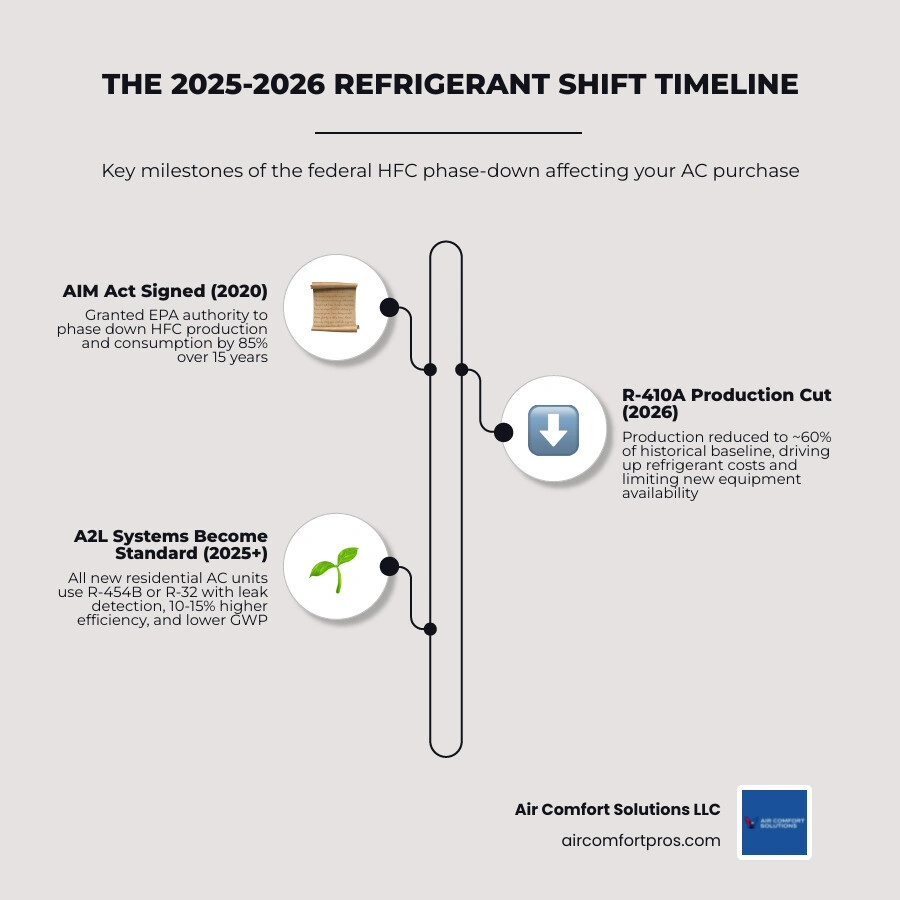
The American Innovation and Manufacturing (AIM) Act of 2020 granted the Environmental Protection Agency (EPA) the authority to phase down the production and consumption of hydrofluorocarbons (HFCs). HFCs are organic compounds commonly used as refrigerants. While they do not deplete the ozone layer like older chlorofluorocarbons (CFCs), they are potent greenhouse gases.
The metric used to measure this impact is Global Warming Potential (GWP). Carbon dioxide has a GWP baseline of 1. Under the EPA’s Technology Transitions Program, all new residential air conditioning and heat pump systems manufactured after January 1, 2025, must use refrigerants with a GWP of 700 or less.
To enforce this transition, the EPA mandated a strict phase-down schedule for older, high-GWP refrigerants. As of 2026, R-410A production allowances have been slashed by 40% of their historical baseline, with an ultimate goal of an 85% reduction by 2036. This scheduled constriction of raw material is already reshaping the service and replacement landscape for homeowners.
For nearly two decades, R-410A was the gold standard for residential air conditioning. However, it carries a GWP of 2,088. This means releasing a single pound of R-410A into the atmosphere has the same environmental warming impact as burning over a thousand pounds of coal.
Because of this massive environmental footprint, R-410A cannot meet the EPA's new maximum GWP limit of 700. The chemical phase-out is well underway. While existing systems can still legally operate on R-410A, the manufacturing of new units utilizing this gas has completely stopped. To get a detailed breakdown of the differences between these fluids, you can read our comparison on R410A vs R454B Refrigerant What You Need to Know.
As a homeowner shopping for a system in 2026, your options look different than they did just a couple of years ago. The industry has aligned around a new class of refrigerants known as A2L. These fluids, primarily R-454B and R-32, have a much lower environmental impact. R-454B has a GWP of 466 (a 78% reduction from R-410A), while R-32 has a GWP of 675 (a 68% reduction).
The grace period for installing older R-410A inventory has closed. This means that if you are purchasing a new system today, it will almost certainly be an A2L-compliant unit. Navigating this selection requires matching the right system capacity to your home's unique footprint. To learn more about modern equipment options, check out our guide on How to Choose the Right AC System for Your Home.

When you purchase a new air conditioner in 2026, you cannot simply swap out the outdoor condensing unit and leave your old indoor evaporator coil in place. The transition to A2L refrigerants makes a complete, matched system replacement mandatory.
A2L systems operate under different pressure dynamics and require entirely different synthetic compressor oils—specifically polyolester (POE) oils—which are chemically incompatible with older R-410A systems. Additionally, because A2L refrigerants are classified as mildly flammable, new indoor coils are engineered with integrated safety sensors and control boards. Mixing an old indoor coil with a new A2L outdoor condenser will result in mechanical failure, void your manufacturer warranty, and bypass necessary safety systems.
The ASHRAE safety classification designates these new gases as "A2L." The "A" stands for non-toxic, "2" indicates flammability, and "L" means low burning velocity. In plain terms, they are "mildly flammable."
While the word "flammable" can sound alarming, A2L refrigerants are incredibly difficult to ignite. They require a high concentration of gas and a consistent, high-energy open flame to burn. To put this in perspective, common household items like hairspray, aerosol cooking sprays, rubbing alcohol, and cosmetics are significantly more flammable than A2L refrigerants. In fact, A2L variants have been used safely in millions of passenger vehicles since 2013.
To ensure total safety in residential settings, manufacturers build advanced mitigation systems directly into the equipment. New A2L indoor units feature integrated Refrigerant Detection Systems (RDS). If a leak is detected:
Beyond safety, these systems deliver remarkable performance gains. New A2L systems are engineered to run 10% to 15% more efficiently than their R-410A predecessors. If you want to understand how these efficiency improvements translate to lower utility bills, read our article on What is a SEER2 Rating on an AC Unit.
The two primary replacements for R-410A possess excellent thermodynamic properties. R-32 has about a 10% higher thermal capacity than R-410A, which allows the system to transfer heat more efficiently while requiring roughly 30% less refrigerant charge. Systems designed around R-32 can achieve up to a 12% efficiency boost over older models.
R-454B (a blend of 68.9% R-32 and 31.1% R-1234yf) delivers an 8% to 10% efficiency increase. Both refrigerants reduce compressor strain, which can extend the overall lifespan of your system. This superior heat transfer capability is particularly vital in the hot, humid Southeast Texas climate, where air conditioners must work overtime to remove moisture and heat from the air. To explore the best equipment setups for our local climate, read about the Best AC System for Hot Humid Climates.
Homeowners with aging R-410A systems face a critical decision when components fail. Should you repair the old unit or upgrade to a new A2L system?
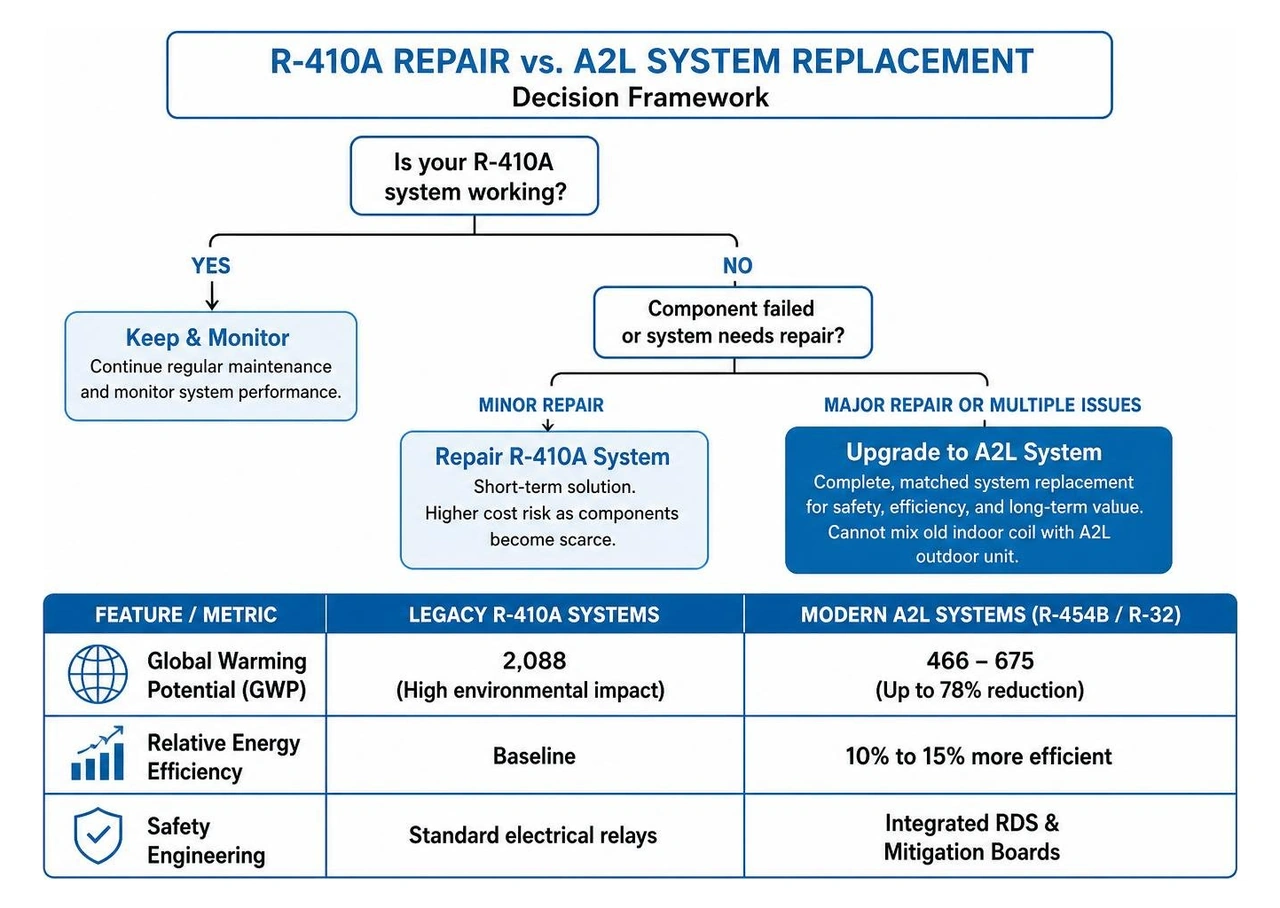
| Feature / Metric | Legacy R-410A Systems | Modern A2L Systems (R-454B / R-32) |
|---|---|---|
| Global Warming Potential (GWP) | 2,088 (High environmental impact) | 466 – 675 (Up to 78% reduction) |
| Relative Energy Efficiency | Baseline | 10% to 15% more efficient |
| Safety Engineering | Standard electrical relays | Integrated RDS & Mitigation Boards |
| Servicing Cost Trend | Rising rapidly due to production cuts | Normalizing as market scales |
| Retrofit Compatibility | Cannot accept A2L refrigerants | Requires fully matched new components |
If you are trying to weigh these options for your home, our guide on How to Decide Between AC Repair and Replacement provides an excellent starting point.
The primary financial pressure of this transition is felt during standard maintenance. Because the EPA slashed R-410A production allowances to 60% of the historical baseline in 2026, the wholesale price of the gas has doubled over the last couple of years.
If your older system develops a leak, paying to repeatedly top off the refrigerant is no longer a viable strategy. It is the mechanical equivalent of pumping air into a tire with a rusty nail in it — you are simply pouring expensive, scarce gas into the atmosphere. If you suspect your unit is low on charge, look for the warning signs detailed in Low Refrigerant Signs in Your AC System. If you live near our northern service areas, you can also read about how to Troubleshoot AC Refrigerant Leaks in Tomball.
The average lifespan of an air conditioner in Southeast Texas is typically 10 to 15 years. The combination of intense summer heat, high humidity, and coastal-inland atmospheric conditions causes systems to wear out faster than they would in milder climates.
When deciding whether to repair an older R-410A system, we recommend using the "$5,000 Rule." Multiply the age of your system by the cost of the proposed repair. If the total exceeds $5,000, investing those funds into a new, highly efficient A2L system is generally the more logical long-term decision. To see how this math works in real-world scenarios, read our explanation of The $5000 Rule for AC Replacement. Understanding how our local environment impacts your equipment can also help you make this choice; learn more at How Southeast Texas Climate Affects Your HVAC System.
Because A2L systems require updated safety protocols and specialized tools, choosing the right contractor is more important than ever. When comparing quotes, you need to ensure you are comparing identical, fully matched systems installed by qualified professionals. For tips on evaluating your options, read our guide on How to Compare AC Quotes from Different Companies.
Installing an A2L system requires precision and specialized training. Because these refrigerants are mildly flammable, technicians must use spark-resistant vacuum pumps, recovery machines, and electronic leak detectors specifically rated for A2L gases.
During the installation process, the technician must perform a continuous dry nitrogen purge while brazing the copper lines to prevent oxidation inside the pipes. They must also pull a deep vacuum down to 250 microns or below to ensure the system is completely dehydrated and leak-free. Skipping these steps can lead to premature compressor failure and safety issues. To understand what separates a professional installation from a rushed job, read What Separates a Good AC Installation from a Bad One and discover How Bad AC Installation Causes Problems for Years.
Upgrading to a modern A2L system is an excellent opportunity to lower your monthly utility bills. Modern SEER2-compliant units use variable-speed compressors and advanced blowers to maintain precise indoor comfort while consuming significantly less power. To learn how these efficiency metrics impact your wallet, check out How SEER2 Ratings Affect Energy Bills.
Additionally, homeowners can take advantage of federal incentives to offset the initial purchase. Under Section 25C of the Inflation Reduction Act, you can claim a federal tax credit of up to $2,000 for qualifying high-efficiency heat pumps, or up to $600 for qualifying central AC units.
No. There is absolutely no legal mandate requiring you to replace a working R-410A air conditioner. You can continue to run, service, and repair your current system for the remainder of its natural lifespan. However, as R-410A supplies continue to decrease due to EPA phase-downs, servicing leaks will become increasingly expensive. Taking proactive care of your unit is the best way to delay replacement. For practical tips, read our guide on How to Extend the Life of Your AC in Texas.
No. You cannot retrofit an existing R-410A system to run on A2L refrigerants. A2L gases operate under different pressure profiles, require different synthetic POE lubricants, and require specialized expansion valves. Furthermore, older systems lack the integrated leak detection sensors and mitigation boards required by safety codes for mildly flammable gases. Attempting to convert an older system will destroy the compressor, void all manufacturer warranties, and create significant safety hazards.
Yes. Under the Inflation Reduction Act (Section 25C), homeowners who install qualifying high-efficiency comfort systems can claim substantial federal tax credits. Qualifying heat pump installations may eligible for a tax credit of up to $2,000, while qualifying central air conditioning units can receive up to $600.
The 2026 refrigerant transition does not have to be a source of stress or confusion. While the rules governing home cooling have changed, the result is a new generation of air conditioners and heat pumps that are safer, better for the environment, and significantly more energy-efficient. By understanding how this shift impacts equipment compatibility, repair costs, and installation requirements, you can make an informed decision that future-proofs your home comfort.
At Air Comfort Solutions LLC (serving Pinehurst, TX, and the north side of Harris County), our certified technicians have over 35 years of local experience. We are fully trained in A2L safety protocols, utilize specialized spark-resistant tools, and perform every installation to the highest industry standards. Whether you want to keep your current R-410A system running smoothly or are ready to explore a high-efficiency upgrade, we are here to help.
To learn more about modern, reliable cooling options for your home, visit our Air Conditioning service page or contact our friendly team today to schedule a personalized home comfort consultation!
How the refrigerant transition affects your next AC purchase is something every homeowner in Pinehurst, TX needs to understand before signing off on a new system in 2026. If you are shopping for a new air conditioner right now, the rules have already changed — and they affect what equipment is available, how it is installed, and what happens when your older system needs a repair.
Here is a quick summary of the key ways the refrigerant transition affects your next AC purchase:
The bottom line: if your R-410A system is older or developing problems, the rising cost of repairs and shrinking refrigerant supply make this an important time to understand your options. If your system is running fine, there is no panic needed — but knowing what is coming will help you plan smarter.
Think of it this way: walking into an HVAC supply house today, you will notice the old R-410A equipment pushed to the back and marked up, while the new A2L systems are front and center. The market has already moved. The question is whether your next purchase moves with it — or gets left behind.
The transition we are experiencing in 2026 is part of a larger environmental strategy mandated by the federal government. To understand why this is happening, we have to look at the legislation guiding the heating and cooling industry.
The American Innovation and Manufacturing (AIM) Act of 2020 granted the Environmental Protection Agency (EPA) the authority to phase down the production and consumption of hydrofluorocarbons (HFCs). HFCs are organic compounds commonly used as refrigerants. While they do not deplete the ozone layer like older chlorofluorocarbons (CFCs), they are potent greenhouse gases.
The metric used to measure this impact is Global Warming Potential (GWP). Carbon dioxide has a GWP baseline of 1. Under the EPA’s Technology Transitions Program, all new residential air conditioning and heat pump systems manufactured after January 1, 2025, must use refrigerants with a GWP of 700 or less.
To enforce this transition, the EPA mandated a strict phase-down schedule for older, high-GWP refrigerants. As of 2026, R-410A production allowances have been slashed by 40% of their historical baseline, with an ultimate goal of an 85% reduction by 2036. This scheduled constriction of raw material is already reshaping the service and replacement landscape for homeowners.
For nearly two decades, R-410A was the gold standard for residential air conditioning. However, it carries a GWP of 2,088. This means releasing a single pound of R-410A into the atmosphere has the same environmental warming impact as burning over a thousand pounds of coal.
Because of this massive environmental footprint, R-410A cannot meet the EPA's new maximum GWP limit of 700. The chemical phase-out is well underway. While existing systems can still legally operate on R-410A, the manufacturing of new units utilizing this gas has completely stopped. To get a detailed breakdown of the differences between these fluids, you can read our comparison on R410A vs R454B Refrigerant What You Need to Know.
As a homeowner shopping for a system in 2026, your options look different than they did just a couple of years ago. The industry has aligned around a new class of refrigerants known as A2L. These fluids, primarily R-454B and R-32, have a much lower environmental impact. R-454B has a GWP of 466 (a 78% reduction from R-410A), while R-32 has a GWP of 675 (a 68% reduction).
The grace period for installing older R-410A inventory has closed. This means that if you are purchasing a new system today, it will almost certainly be an A2L-compliant unit. Navigating this selection requires matching the right system capacity to your home's unique footprint. To learn more about modern equipment options, check out our guide on How to Choose the Right AC System for Your Home.
When you purchase a new air conditioner in 2026, you cannot simply swap out the outdoor condensing unit and leave your old indoor evaporator coil in place. The transition to A2L refrigerants makes a complete, matched system replacement mandatory.
A2L systems operate under different pressure dynamics and require entirely different synthetic compressor oils—specifically polyolester (POE) oils—which are chemically incompatible with older R-410A systems. Additionally, because A2L refrigerants are classified as mildly flammable, new indoor coils are engineered with integrated safety sensors and control boards. Mixing an old indoor coil with a new A2L outdoor condenser will result in mechanical failure, void your manufacturer warranty, and bypass necessary safety systems.
The ASHRAE safety classification designates these new gases as "A2L." The "A" stands for non-toxic, "2" indicates flammability, and "L" means low burning velocity. In plain terms, they are "mildly flammable."
While the word "flammable" can sound alarming, A2L refrigerants are incredibly difficult to ignite. They require a high concentration of gas and a consistent, high-energy open flame to burn. To put this in perspective, common household items like hairspray, aerosol cooking sprays, rubbing alcohol, and cosmetics are significantly more flammable than A2L refrigerants. In fact, A2L variants have been used safely in millions of passenger vehicles since 2013.
To ensure total safety in residential settings, manufacturers build advanced mitigation systems directly into the equipment. New A2L indoor units feature integrated Refrigerant Detection Systems (RDS). If a leak is detected:
Beyond safety, these systems deliver remarkable performance gains. New A2L systems are engineered to run 10% to 15% more efficiently than their R-410A predecessors. If you want to understand how these efficiency improvements translate to lower utility bills, read our article on What is a SEER2 Rating on an AC Unit.
The two primary replacements for R-410A possess excellent thermodynamic properties. R-32 has about a 10% higher thermal capacity than R-410A, which allows the system to transfer heat more efficiently while requiring roughly 30% less refrigerant charge. Systems designed around R-32 can achieve up to a 12% efficiency boost over older models.
R-454B (a blend of 68.9% R-32 and 31.1% R-1234yf) delivers an 8% to 10% efficiency increase. Both refrigerants reduce compressor strain, which can extend the overall lifespan of your system. This superior heat transfer capability is particularly vital in the hot, humid Southeast Texas climate, where air conditioners must work overtime to remove moisture and heat from the air. To explore the best equipment setups for our local climate, read about the Best AC System for Hot Humid Climates.
Homeowners with aging R-410A systems face a critical decision when components fail. Should you repair the old unit or upgrade to a new A2L system?
| Feature / Metric | Legacy R-410A Systems | Modern A2L Systems (R-454B / R-32) |
|---|---|---|
| Global Warming Potential (GWP) | 2,088 (High environmental impact) | 466 – 675 (Up to 78% reduction) |
| Relative Energy Efficiency | Baseline | 10% to 15% more efficient |
| Safety Engineering | Standard electrical relays | Integrated RDS & Mitigation Boards |
| Servicing Cost Trend | Rising rapidly due to production cuts | Normalizing as market scales |
| Retrofit Compatibility | Cannot accept A2L refrigerants | Requires fully matched new components |
If you are trying to weigh these options for your home, our guide on How to Decide Between AC Repair and Replacement provides an excellent starting point.
The primary financial pressure of this transition is felt during standard maintenance. Because the EPA slashed R-410A production allowances to 60% of the historical baseline in 2026, the wholesale price of the gas has doubled over the last couple of years.
If your older system develops a leak, paying to repeatedly top off the refrigerant is no longer a viable strategy. It is the mechanical equivalent of pumping air into a tire with a rusty nail in it — you are simply pouring expensive, scarce gas into the atmosphere. If you suspect your unit is low on charge, look for the warning signs detailed in Low Refrigerant Signs in Your AC System. If you live near our northern service areas, you can also read about how to Troubleshoot AC Refrigerant Leaks in Tomball.
The average lifespan of an air conditioner in Southeast Texas is typically 10 to 15 years. The combination of intense summer heat, high humidity, and coastal-inland atmospheric conditions causes systems to wear out faster than they would in milder climates.
When deciding whether to repair an older R-410A system, we recommend using the "$5,000 Rule." Multiply the age of your system by the cost of the proposed repair. If the total exceeds $5,000, investing those funds into a new, highly efficient A2L system is generally the more logical long-term decision. To see how this math works in real-world scenarios, read our explanation of The $5000 Rule for AC Replacement. Understanding how our local environment impacts your equipment can also help you make this choice; learn more at How Southeast Texas Climate Affects Your HVAC System.
Because A2L systems require updated safety protocols and specialized tools, choosing the right contractor is more important than ever. When comparing quotes, you need to ensure you are comparing identical, fully matched systems installed by qualified professionals. For tips on evaluating your options, read our guide on How to Compare AC Quotes from Different Companies.
Installing an A2L system requires precision and specialized training. Because these refrigerants are mildly flammable, technicians must use spark-resistant vacuum pumps, recovery machines, and electronic leak detectors specifically rated for A2L gases.
During the installation process, the technician must perform a continuous dry nitrogen purge while brazing the copper lines to prevent oxidation inside the pipes. They must also pull a deep vacuum down to 250 microns or below to ensure the system is completely dehydrated and leak-free. Skipping these steps can lead to premature compressor failure and safety issues. To understand what separates a professional installation from a rushed job, read What Separates a Good AC Installation from a Bad One and discover How Bad AC Installation Causes Problems for Years.
Upgrading to a modern A2L system is an excellent opportunity to lower your monthly utility bills. Modern SEER2-compliant units use variable-speed compressors and advanced blowers to maintain precise indoor comfort while consuming significantly less power. To learn how these efficiency metrics impact your wallet, check out How SEER2 Ratings Affect Energy Bills.
Additionally, homeowners can take advantage of federal incentives to offset the initial purchase. Under Section 25C of the Inflation Reduction Act, you can claim a federal tax credit of up to $2,000 for qualifying high-efficiency heat pumps, or up to $600 for qualifying central AC units.
No. There is absolutely no legal mandate requiring you to replace a working R-410A air conditioner. You can continue to run, service, and repair your current system for the remainder of its natural lifespan. However, as R-410A supplies continue to decrease due to EPA phase-downs, servicing leaks will become increasingly expensive. Taking proactive care of your unit is the best way to delay replacement. For practical tips, read our guide on How to Extend the Life of Your AC in Texas.
No. You cannot retrofit an existing R-410A system to run on A2L refrigerants. A2L gases operate under different pressure profiles, require different synthetic POE lubricants, and require specialized expansion valves. Furthermore, older systems lack the integrated leak detection sensors and mitigation boards required by safety codes for mildly flammable gases. Attempting to convert an older system will destroy the compressor, void all manufacturer warranties, and create significant safety hazards.
Yes. Under the Inflation Reduction Act (Section 25C), homeowners who install qualifying high-efficiency comfort systems can claim substantial federal tax credits. Qualifying heat pump installations may eligible for a tax credit of up to $2,000, while qualifying central air conditioning units can receive up to $600.
The 2026 refrigerant transition does not have to be a source of stress or confusion. While the rules governing home cooling have changed, the result is a new generation of air conditioners and heat pumps that are safer, better for the environment, and significantly more energy-efficient. By understanding how this shift impacts equipment compatibility, repair costs, and installation requirements, you can make an informed decision that future-proofs your home comfort.
At Air Comfort Solutions LLC (serving Pinehurst, TX, and the north side of Harris County), our certified technicians have over 35 years of local experience. We are fully trained in A2L safety protocols, utilize specialized spark-resistant tools, and perform every installation to the highest industry standards. Whether you want to keep your current R-410A system running smoothly or are ready to explore a high-efficiency upgrade, we are here to help.
To learn more about modern, reliable cooling options for your home, visit our Air Conditioning service page or contact our friendly team today to schedule a personalized home comfort consultation!
How the refrigerant transition affects your next AC purchase is something every homeowner in Pinehurst, TX needs to understand before signing off on a new system in 2026. If you are shopping for a new air conditioner right now, the rules have already changed — and they affect what equipment is available, how it is installed, and what happens when your older system needs a repair.
Here is a quick summary of the key ways the refrigerant transition affects your next AC purchase:
The bottom line: if your R-410A system is older or developing problems, the rising cost of repairs and shrinking refrigerant supply make this an important time to understand your options. If your system is running fine, there is no panic needed — but knowing what is coming will help you plan smarter.
Think of it this way: walking into an HVAC supply house today, you will notice the old R-410A equipment pushed to the back and marked up, while the new A2L systems are front and center. The market has already moved. The question is whether your next purchase moves with it — or gets left behind.
The transition we are experiencing in 2026 is part of a larger environmental strategy mandated by the federal government. To understand why this is happening, we have to look at the legislation guiding the heating and cooling industry.
The American Innovation and Manufacturing (AIM) Act of 2020 granted the Environmental Protection Agency (EPA) the authority to phase down the production and consumption of hydrofluorocarbons (HFCs). HFCs are organic compounds commonly used as refrigerants. While they do not deplete the ozone layer like older chlorofluorocarbons (CFCs), they are potent greenhouse gases.
The metric used to measure this impact is Global Warming Potential (GWP). Carbon dioxide has a GWP baseline of 1. Under the EPA’s Technology Transitions Program, all new residential air conditioning and heat pump systems manufactured after January 1, 2025, must use refrigerants with a GWP of 700 or less.
To enforce this transition, the EPA mandated a strict phase-down schedule for older, high-GWP refrigerants. As of 2026, R-410A production allowances have been slashed by 40% of their historical baseline, with an ultimate goal of an 85% reduction by 2036. This scheduled constriction of raw material is already reshaping the service and replacement landscape for homeowners.
For nearly two decades, R-410A was the gold standard for residential air conditioning. However, it carries a GWP of 2,088. This means releasing a single pound of R-410A into the atmosphere has the same environmental warming impact as burning over a thousand pounds of coal.
Because of this massive environmental footprint, R-410A cannot meet the EPA's new maximum GWP limit of 700. The chemical phase-out is well underway. While existing systems can still legally operate on R-410A, the manufacturing of new units utilizing this gas has completely stopped. To get a detailed breakdown of the differences between these fluids, you can read our comparison on R410A vs R454B Refrigerant What You Need to Know.
As a homeowner shopping for a system in 2026, your options look different than they did just a couple of years ago. The industry has aligned around a new class of refrigerants known as A2L. These fluids, primarily R-454B and R-32, have a much lower environmental impact. R-454B has a GWP of 466 (a 78% reduction from R-410A), while R-32 has a GWP of 675 (a 68% reduction).
The grace period for installing older R-410A inventory has closed. This means that if you are purchasing a new system today, it will almost certainly be an A2L-compliant unit. Navigating this selection requires matching the right system capacity to your home's unique footprint. To learn more about modern equipment options, check out our guide on How to Choose the Right AC System for Your Home.
When you purchase a new air conditioner in 2026, you cannot simply swap out the outdoor condensing unit and leave your old indoor evaporator coil in place. The transition to A2L refrigerants makes a complete, matched system replacement mandatory.
A2L systems operate under different pressure dynamics and require entirely different synthetic compressor oils—specifically polyolester (POE) oils—which are chemically incompatible with older R-410A systems. Additionally, because A2L refrigerants are classified as mildly flammable, new indoor coils are engineered with integrated safety sensors and control boards. Mixing an old indoor coil with a new A2L outdoor condenser will result in mechanical failure, void your manufacturer warranty, and bypass necessary safety systems.
The ASHRAE safety classification designates these new gases as "A2L." The "A" stands for non-toxic, "2" indicates flammability, and "L" means low burning velocity. In plain terms, they are "mildly flammable."
While the word "flammable" can sound alarming, A2L refrigerants are incredibly difficult to ignite. They require a high concentration of gas and a consistent, high-energy open flame to burn. To put this in perspective, common household items like hairspray, aerosol cooking sprays, rubbing alcohol, and cosmetics are significantly more flammable than A2L refrigerants. In fact, A2L variants have been used safely in millions of passenger vehicles since 2013.
To ensure total safety in residential settings, manufacturers build advanced mitigation systems directly into the equipment. New A2L indoor units feature integrated Refrigerant Detection Systems (RDS). If a leak is detected:
Beyond safety, these systems deliver remarkable performance gains. New A2L systems are engineered to run 10% to 15% more efficiently than their R-410A predecessors. If you want to understand how these efficiency improvements translate to lower utility bills, read our article on What is a SEER2 Rating on an AC Unit.
The two primary replacements for R-410A possess excellent thermodynamic properties. R-32 has about a 10% higher thermal capacity than R-410A, which allows the system to transfer heat more efficiently while requiring roughly 30% less refrigerant charge. Systems designed around R-32 can achieve up to a 12% efficiency boost over older models.
R-454B (a blend of 68.9% R-32 and 31.1% R-1234yf) delivers an 8% to 10% efficiency increase. Both refrigerants reduce compressor strain, which can extend the overall lifespan of your system. This superior heat transfer capability is particularly vital in the hot, humid Southeast Texas climate, where air conditioners must work overtime to remove moisture and heat from the air. To explore the best equipment setups for our local climate, read about the Best AC System for Hot Humid Climates.
Homeowners with aging R-410A systems face a critical decision when components fail. Should you repair the old unit or upgrade to a new A2L system?
| Feature / Metric | Legacy R-410A Systems | Modern A2L Systems (R-454B / R-32) |
|---|---|---|
| Global Warming Potential (GWP) | 2,088 (High environmental impact) | 466 – 675 (Up to 78% reduction) |
| Relative Energy Efficiency | Baseline | 10% to 15% more efficient |
| Safety Engineering | Standard electrical relays | Integrated RDS & Mitigation Boards |
| Servicing Cost Trend | Rising rapidly due to production cuts | Normalizing as market scales |
| Retrofit Compatibility | Cannot accept A2L refrigerants | Requires fully matched new components |
If you are trying to weigh these options for your home, our guide on How to Decide Between AC Repair and Replacement provides an excellent starting point.
The primary financial pressure of this transition is felt during standard maintenance. Because the EPA slashed R-410A production allowances to 60% of the historical baseline in 2026, the wholesale price of the gas has doubled over the last couple of years.
If your older system develops a leak, paying to repeatedly top off the refrigerant is no longer a viable strategy. It is the mechanical equivalent of pumping air into a tire with a rusty nail in it — you are simply pouring expensive, scarce gas into the atmosphere. If you suspect your unit is low on charge, look for the warning signs detailed in Low Refrigerant Signs in Your AC System. If you live near our northern service areas, you can also read about how to Troubleshoot AC Refrigerant Leaks in Tomball.
The average lifespan of an air conditioner in Southeast Texas is typically 10 to 15 years. The combination of intense summer heat, high humidity, and coastal-inland atmospheric conditions causes systems to wear out faster than they would in milder climates.
When deciding whether to repair an older R-410A system, we recommend using the "$5,000 Rule." Multiply the age of your system by the cost of the proposed repair. If the total exceeds $5,000, investing those funds into a new, highly efficient A2L system is generally the more logical long-term decision. To see how this math works in real-world scenarios, read our explanation of The $5000 Rule for AC Replacement. Understanding how our local environment impacts your equipment can also help you make this choice; learn more at How Southeast Texas Climate Affects Your HVAC System.
Because A2L systems require updated safety protocols and specialized tools, choosing the right contractor is more important than ever. When comparing quotes, you need to ensure you are comparing identical, fully matched systems installed by qualified professionals. For tips on evaluating your options, read our guide on How to Compare AC Quotes from Different Companies.
Installing an A2L system requires precision and specialized training. Because these refrigerants are mildly flammable, technicians must use spark-resistant vacuum pumps, recovery machines, and electronic leak detectors specifically rated for A2L gases.
During the installation process, the technician must perform a continuous dry nitrogen purge while brazing the copper lines to prevent oxidation inside the pipes. They must also pull a deep vacuum down to 250 microns or below to ensure the system is completely dehydrated and leak-free. Skipping these steps can lead to premature compressor failure and safety issues. To understand what separates a professional installation from a rushed job, read What Separates a Good AC Installation from a Bad One and discover How Bad AC Installation Causes Problems for Years.
Upgrading to a modern A2L system is an excellent opportunity to lower your monthly utility bills. Modern SEER2-compliant units use variable-speed compressors and advanced blowers to maintain precise indoor comfort while consuming significantly less power. To learn how these efficiency metrics impact your wallet, check out How SEER2 Ratings Affect Energy Bills.
Additionally, homeowners can take advantage of federal incentives to offset the initial purchase. Under Section 25C of the Inflation Reduction Act, you can claim a federal tax credit of up to $2,000 for qualifying high-efficiency heat pumps, or up to $600 for qualifying central AC units.
No. There is absolutely no legal mandate requiring you to replace a working R-410A air conditioner. You can continue to run, service, and repair your current system for the remainder of its natural lifespan. However, as R-410A supplies continue to decrease due to EPA phase-downs, servicing leaks will become increasingly expensive. Taking proactive care of your unit is the best way to delay replacement. For practical tips, read our guide on How to Extend the Life of Your AC in Texas.
No. You cannot retrofit an existing R-410A system to run on A2L refrigerants. A2L gases operate under different pressure profiles, require different synthetic POE lubricants, and require specialized expansion valves. Furthermore, older systems lack the integrated leak detection sensors and mitigation boards required by safety codes for mildly flammable gases. Attempting to convert an older system will destroy the compressor, void all manufacturer warranties, and create significant safety hazards.
Yes. Under the Inflation Reduction Act (Section 25C), homeowners who install qualifying high-efficiency comfort systems can claim substantial federal tax credits. Qualifying heat pump installations may eligible for a tax credit of up to $2,000, while qualifying central air conditioning units can receive up to $600.
The 2026 refrigerant transition does not have to be a source of stress or confusion. While the rules governing home cooling have changed, the result is a new generation of air conditioners and heat pumps that are safer, better for the environment, and significantly more energy-efficient. By understanding how this shift impacts equipment compatibility, repair costs, and installation requirements, you can make an informed decision that future-proofs your home comfort.
At Air Comfort Solutions LLC (serving Pinehurst, TX, and the north side of Harris County), our certified technicians have over 35 years of local experience. We are fully trained in A2L safety protocols, utilize specialized spark-resistant tools, and perform every installation to the highest industry standards. Whether you want to keep your current R-410A system running smoothly or are ready to explore a high-efficiency upgrade, we are here to help.
To learn more about modern, reliable cooling options for your home, visit our Air Conditioning service page or contact our friendly team today to schedule a personalized home comfort consultation!
How the refrigerant transition affects your next AC purchase is something every homeowner in Pinehurst, TX needs to understand before signing off on a new system in 2026. If you are shopping for a new air conditioner right now, the rules have already changed — and they affect what equipment is available, how it is installed, and what happens when your older system needs a repair.
Here is a quick summary of the key ways the refrigerant transition affects your next AC purchase:
The bottom line: if your R-410A system is older or developing problems, the rising cost of repairs and shrinking refrigerant supply make this an important time to understand your options. If your system is running fine, there is no panic needed — but knowing what is coming will help you plan smarter.
Think of it this way: walking into an HVAC supply house today, you will notice the old R-410A equipment pushed to the back and marked up, while the new A2L systems are front and center. The market has already moved. The question is whether your next purchase moves with it — or gets left behind.
The transition we are experiencing in 2026 is part of a larger environmental strategy mandated by the federal government. To understand why this is happening, we have to look at the legislation guiding the heating and cooling industry.
The American Innovation and Manufacturing (AIM) Act of 2020 granted the Environmental Protection Agency (EPA) the authority to phase down the production and consumption of hydrofluorocarbons (HFCs). HFCs are organic compounds commonly used as refrigerants. While they do not deplete the ozone layer like older chlorofluorocarbons (CFCs), they are potent greenhouse gases.
The metric used to measure this impact is Global Warming Potential (GWP). Carbon dioxide has a GWP baseline of 1. Under the EPA’s Technology Transitions Program, all new residential air conditioning and heat pump systems manufactured after January 1, 2025, must use refrigerants with a GWP of 700 or less.
To enforce this transition, the EPA mandated a strict phase-down schedule for older, high-GWP refrigerants. As of 2026, R-410A production allowances have been slashed by 40% of their historical baseline, with an ultimate goal of an 85% reduction by 2036. This scheduled constriction of raw material is already reshaping the service and replacement landscape for homeowners.
For nearly two decades, R-410A was the gold standard for residential air conditioning. However, it carries a GWP of 2,088. This means releasing a single pound of R-410A into the atmosphere has the same environmental warming impact as burning over a thousand pounds of coal.
Because of this massive environmental footprint, R-410A cannot meet the EPA's new maximum GWP limit of 700. The chemical phase-out is well underway. While existing systems can still legally operate on R-410A, the manufacturing of new units utilizing this gas has completely stopped. To get a detailed breakdown of the differences between these fluids, you can read our comparison on R410A vs R454B Refrigerant What You Need to Know.
As a homeowner shopping for a system in 2026, your options look different than they did just a couple of years ago. The industry has aligned around a new class of refrigerants known as A2L. These fluids, primarily R-454B and R-32, have a much lower environmental impact. R-454B has a GWP of 466 (a 78% reduction from R-410A), while R-32 has a GWP of 675 (a 68% reduction).
The grace period for installing older R-410A inventory has closed. This means that if you are purchasing a new system today, it will almost certainly be an A2L-compliant unit. Navigating this selection requires matching the right system capacity to your home's unique footprint. To learn more about modern equipment options, check out our guide on How to Choose the Right AC System for Your Home.
When you purchase a new air conditioner in 2026, you cannot simply swap out the outdoor condensing unit and leave your old indoor evaporator coil in place. The transition to A2L refrigerants makes a complete, matched system replacement mandatory.
A2L systems operate under different pressure dynamics and require entirely different synthetic compressor oils—specifically polyolester (POE) oils—which are chemically incompatible with older R-410A systems. Additionally, because A2L refrigerants are classified as mildly flammable, new indoor coils are engineered with integrated safety sensors and control boards. Mixing an old indoor coil with a new A2L outdoor condenser will result in mechanical failure, void your manufacturer warranty, and bypass necessary safety systems.
The ASHRAE safety classification designates these new gases as "A2L." The "A" stands for non-toxic, "2" indicates flammability, and "L" means low burning velocity. In plain terms, they are "mildly flammable."
While the word "flammable" can sound alarming, A2L refrigerants are incredibly difficult to ignite. They require a high concentration of gas and a consistent, high-energy open flame to burn. To put this in perspective, common household items like hairspray, aerosol cooking sprays, rubbing alcohol, and cosmetics are significantly more flammable than A2L refrigerants. In fact, A2L variants have been used safely in millions of passenger vehicles since 2013.
To ensure total safety in residential settings, manufacturers build advanced mitigation systems directly into the equipment. New A2L indoor units feature integrated Refrigerant Detection Systems (RDS). If a leak is detected:
Beyond safety, these systems deliver remarkable performance gains. New A2L systems are engineered to run 10% to 15% more efficiently than their R-410A predecessors. If you want to understand how these efficiency improvements translate to lower utility bills, read our article on What is a SEER2 Rating on an AC Unit.
The two primary replacements for R-410A possess excellent thermodynamic properties. R-32 has about a 10% higher thermal capacity than R-410A, which allows the system to transfer heat more efficiently while requiring roughly 30% less refrigerant charge. Systems designed around R-32 can achieve up to a 12% efficiency boost over older models.
R-454B (a blend of 68.9% R-32 and 31.1% R-1234yf) delivers an 8% to 10% efficiency increase. Both refrigerants reduce compressor strain, which can extend the overall lifespan of your system. This superior heat transfer capability is particularly vital in the hot, humid Southeast Texas climate, where air conditioners must work overtime to remove moisture and heat from the air. To explore the best equipment setups for our local climate, read about the Best AC System for Hot Humid Climates.
Homeowners with aging R-410A systems face a critical decision when components fail. Should you repair the old unit or upgrade to a new A2L system?
| Feature / Metric | Legacy R-410A Systems | Modern A2L Systems (R-454B / R-32) |
|---|---|---|
| Global Warming Potential (GWP) | 2,088 (High environmental impact) | 466 – 675 (Up to 78% reduction) |
| Relative Energy Efficiency | Baseline | 10% to 15% more efficient |
| Safety Engineering | Standard electrical relays | Integrated RDS & Mitigation Boards |
| Servicing Cost Trend | Rising rapidly due to production cuts | Normalizing as market scales |
| Retrofit Compatibility | Cannot accept A2L refrigerants | Requires fully matched new components |
If you are trying to weigh these options for your home, our guide on How to Decide Between AC Repair and Replacement provides an excellent starting point.
The primary financial pressure of this transition is felt during standard maintenance. Because the EPA slashed R-410A production allowances to 60% of the historical baseline in 2026, the wholesale price of the gas has doubled over the last couple of years.
If your older system develops a leak, paying to repeatedly top off the refrigerant is no longer a viable strategy. It is the mechanical equivalent of pumping air into a tire with a rusty nail in it — you are simply pouring expensive, scarce gas into the atmosphere. If you suspect your unit is low on charge, look for the warning signs detailed in Low Refrigerant Signs in Your AC System. If you live near our northern service areas, you can also read about how to Troubleshoot AC Refrigerant Leaks in Tomball.
The average lifespan of an air conditioner in Southeast Texas is typically 10 to 15 years. The combination of intense summer heat, high humidity, and coastal-inland atmospheric conditions causes systems to wear out faster than they would in milder climates.
When deciding whether to repair an older R-410A system, we recommend using the "$5,000 Rule." Multiply the age of your system by the cost of the proposed repair. If the total exceeds $5,000, investing those funds into a new, highly efficient A2L system is generally the more logical long-term decision. To see how this math works in real-world scenarios, read our explanation of The $5000 Rule for AC Replacement. Understanding how our local environment impacts your equipment can also help you make this choice; learn more at How Southeast Texas Climate Affects Your HVAC System.
Because A2L systems require updated safety protocols and specialized tools, choosing the right contractor is more important than ever. When comparing quotes, you need to ensure you are comparing identical, fully matched systems installed by qualified professionals. For tips on evaluating your options, read our guide on How to Compare AC Quotes from Different Companies.
Installing an A2L system requires precision and specialized training. Because these refrigerants are mildly flammable, technicians must use spark-resistant vacuum pumps, recovery machines, and electronic leak detectors specifically rated for A2L gases.
During the installation process, the technician must perform a continuous dry nitrogen purge while brazing the copper lines to prevent oxidation inside the pipes. They must also pull a deep vacuum down to 250 microns or below to ensure the system is completely dehydrated and leak-free. Skipping these steps can lead to premature compressor failure and safety issues. To understand what separates a professional installation from a rushed job, read What Separates a Good AC Installation from a Bad One and discover How Bad AC Installation Causes Problems for Years.
Upgrading to a modern A2L system is an excellent opportunity to lower your monthly utility bills. Modern SEER2-compliant units use variable-speed compressors and advanced blowers to maintain precise indoor comfort while consuming significantly less power. To learn how these efficiency metrics impact your wallet, check out How SEER2 Ratings Affect Energy Bills.
Additionally, homeowners can take advantage of federal incentives to offset the initial purchase. Under Section 25C of the Inflation Reduction Act, you can claim a federal tax credit of up to $2,000 for qualifying high-efficiency heat pumps, or up to $600 for qualifying central AC units.
No. There is absolutely no legal mandate requiring you to replace a working R-410A air conditioner. You can continue to run, service, and repair your current system for the remainder of its natural lifespan. However, as R-410A supplies continue to decrease due to EPA phase-downs, servicing leaks will become increasingly expensive. Taking proactive care of your unit is the best way to delay replacement. For practical tips, read our guide on How to Extend the Life of Your AC in Texas.
No. You cannot retrofit an existing R-410A system to run on A2L refrigerants. A2L gases operate under different pressure profiles, require different synthetic POE lubricants, and require specialized expansion valves. Furthermore, older systems lack the integrated leak detection sensors and mitigation boards required by safety codes for mildly flammable gases. Attempting to convert an older system will destroy the compressor, void all manufacturer warranties, and create significant safety hazards.
Yes. Under the Inflation Reduction Act (Section 25C), homeowners who install qualifying high-efficiency comfort systems can claim substantial federal tax credits. Qualifying heat pump installations may eligible for a tax credit of up to $2,000, while qualifying central air conditioning units can receive up to $600.
The 2026 refrigerant transition does not have to be a source of stress or confusion. While the rules governing home cooling have changed, the result is a new generation of air conditioners and heat pumps that are safer, better for the environment, and significantly more energy-efficient. By understanding how this shift impacts equipment compatibility, repair costs, and installation requirements, you can make an informed decision that future-proofs your home comfort.
At Air Comfort Solutions LLC (serving Pinehurst, TX, and the north side of Harris County), our certified technicians have over 35 years of local experience. We are fully trained in A2L safety protocols, utilize specialized spark-resistant tools, and perform every installation to the highest industry standards. Whether you want to keep your current R-410A system running smoothly or are ready to explore a high-efficiency upgrade, we are here to help.
To learn more about modern, reliable cooling options for your home, visit our Air Conditioning service page or contact our friendly team today to schedule a personalized home comfort consultation!
How the refrigerant transition affects your next AC purchase is something every homeowner in Pinehurst, TX needs to understand before signing off on a new system in 2026. If you are shopping for a new air conditioner right now, the rules have already changed — and they affect what equipment is available, how it is installed, and what happens when your older system needs a repair.
Here is a quick summary of the key ways the refrigerant transition affects your next AC purchase:
The bottom line: if your R-410A system is older or developing problems, the rising cost of repairs and shrinking refrigerant supply make this an important time to understand your options. If your system is running fine, there is no panic needed — but knowing what is coming will help you plan smarter.
Think of it this way: walking into an HVAC supply house today, you will notice the old R-410A equipment pushed to the back and marked up, while the new A2L systems are front and center. The market has already moved. The question is whether your next purchase moves with it — or gets left behind.
The transition we are experiencing in 2026 is part of a larger environmental strategy mandated by the federal government. To understand why this is happening, we have to look at the legislation guiding the heating and cooling industry.
The American Innovation and Manufacturing (AIM) Act of 2020 granted the Environmental Protection Agency (EPA) the authority to phase down the production and consumption of hydrofluorocarbons (HFCs). HFCs are organic compounds commonly used as refrigerants. While they do not deplete the ozone layer like older chlorofluorocarbons (CFCs), they are potent greenhouse gases.
The metric used to measure this impact is Global Warming Potential (GWP). Carbon dioxide has a GWP baseline of 1. Under the EPA’s Technology Transitions Program, all new residential air conditioning and heat pump systems manufactured after January 1, 2025, must use refrigerants with a GWP of 700 or less.
To enforce this transition, the EPA mandated a strict phase-down schedule for older, high-GWP refrigerants. As of 2026, R-410A production allowances have been slashed by 40% of their historical baseline, with an ultimate goal of an 85% reduction by 2036. This scheduled constriction of raw material is already reshaping the service and replacement landscape for homeowners.
For nearly two decades, R-410A was the gold standard for residential air conditioning. However, it carries a GWP of 2,088. This means releasing a single pound of R-410A into the atmosphere has the same environmental warming impact as burning over a thousand pounds of coal.
Because of this massive environmental footprint, R-410A cannot meet the EPA's new maximum GWP limit of 700. The chemical phase-out is well underway. While existing systems can still legally operate on R-410A, the manufacturing of new units utilizing this gas has completely stopped. To get a detailed breakdown of the differences between these fluids, you can read our comparison on R410A vs R454B Refrigerant What You Need to Know.
As a homeowner shopping for a system in 2026, your options look different than they did just a couple of years ago. The industry has aligned around a new class of refrigerants known as A2L. These fluids, primarily R-454B and R-32, have a much lower environmental impact. R-454B has a GWP of 466 (a 78% reduction from R-410A), while R-32 has a GWP of 675 (a 68% reduction).
The grace period for installing older R-410A inventory has closed. This means that if you are purchasing a new system today, it will almost certainly be an A2L-compliant unit. Navigating this selection requires matching the right system capacity to your home's unique footprint. To learn more about modern equipment options, check out our guide on How to Choose the Right AC System for Your Home.
When you purchase a new air conditioner in 2026, you cannot simply swap out the outdoor condensing unit and leave your old indoor evaporator coil in place. The transition to A2L refrigerants makes a complete, matched system replacement mandatory.
A2L systems operate under different pressure dynamics and require entirely different synthetic compressor oils—specifically polyolester (POE) oils—which are chemically incompatible with older R-410A systems. Additionally, because A2L refrigerants are classified as mildly flammable, new indoor coils are engineered with integrated safety sensors and control boards. Mixing an old indoor coil with a new A2L outdoor condenser will result in mechanical failure, void your manufacturer warranty, and bypass necessary safety systems.
The ASHRAE safety classification designates these new gases as "A2L." The "A" stands for non-toxic, "2" indicates flammability, and "L" means low burning velocity. In plain terms, they are "mildly flammable."
While the word "flammable" can sound alarming, A2L refrigerants are incredibly difficult to ignite. They require a high concentration of gas and a consistent, high-energy open flame to burn. To put this in perspective, common household items like hairspray, aerosol cooking sprays, rubbing alcohol, and cosmetics are significantly more flammable than A2L refrigerants. In fact, A2L variants have been used safely in millions of passenger vehicles since 2013.
To ensure total safety in residential settings, manufacturers build advanced mitigation systems directly into the equipment. New A2L indoor units feature integrated Refrigerant Detection Systems (RDS). If a leak is detected:
Beyond safety, these systems deliver remarkable performance gains. New A2L systems are engineered to run 10% to 15% more efficiently than their R-410A predecessors. If you want to understand how these efficiency improvements translate to lower utility bills, read our article on What is a SEER2 Rating on an AC Unit.
The two primary replacements for R-410A possess excellent thermodynamic properties. R-32 has about a 10% higher thermal capacity than R-410A, which allows the system to transfer heat more efficiently while requiring roughly 30% less refrigerant charge. Systems designed around R-32 can achieve up to a 12% efficiency boost over older models.
R-454B (a blend of 68.9% R-32 and 31.1% R-1234yf) delivers an 8% to 10% efficiency increase. Both refrigerants reduce compressor strain, which can extend the overall lifespan of your system. This superior heat transfer capability is particularly vital in the hot, humid Southeast Texas climate, where air conditioners must work overtime to remove moisture and heat from the air. To explore the best equipment setups for our local climate, read about the Best AC System for Hot Humid Climates.
Homeowners with aging R-410A systems face a critical decision when components fail. Should you repair the old unit or upgrade to a new A2L system?
| Feature / Metric | Legacy R-410A Systems | Modern A2L Systems (R-454B / R-32) |
|---|---|---|
| Global Warming Potential (GWP) | 2,088 (High environmental impact) | 466 – 675 (Up to 78% reduction) |
| Relative Energy Efficiency | Baseline | 10% to 15% more efficient |
| Safety Engineering | Standard electrical relays | Integrated RDS & Mitigation Boards |
| Servicing Cost Trend | Rising rapidly due to production cuts | Normalizing as market scales |
| Retrofit Compatibility | Cannot accept A2L refrigerants | Requires fully matched new components |
If you are trying to weigh these options for your home, our guide on How to Decide Between AC Repair and Replacement provides an excellent starting point.
The primary financial pressure of this transition is felt during standard maintenance. Because the EPA slashed R-410A production allowances to 60% of the historical baseline in 2026, the wholesale price of the gas has doubled over the last couple of years.
If your older system develops a leak, paying to repeatedly top off the refrigerant is no longer a viable strategy. It is the mechanical equivalent of pumping air into a tire with a rusty nail in it — you are simply pouring expensive, scarce gas into the atmosphere. If you suspect your unit is low on charge, look for the warning signs detailed in Low Refrigerant Signs in Your AC System. If you live near our northern service areas, you can also read about how to Troubleshoot AC Refrigerant Leaks in Tomball.
The average lifespan of an air conditioner in Southeast Texas is typically 10 to 15 years. The combination of intense summer heat, high humidity, and coastal-inland atmospheric conditions causes systems to wear out faster than they would in milder climates.
When deciding whether to repair an older R-410A system, we recommend using the "$5,000 Rule." Multiply the age of your system by the cost of the proposed repair. If the total exceeds $5,000, investing those funds into a new, highly efficient A2L system is generally the more logical long-term decision. To see how this math works in real-world scenarios, read our explanation of The $5000 Rule for AC Replacement. Understanding how our local environment impacts your equipment can also help you make this choice; learn more at How Southeast Texas Climate Affects Your HVAC System.
Because A2L systems require updated safety protocols and specialized tools, choosing the right contractor is more important than ever. When comparing quotes, you need to ensure you are comparing identical, fully matched systems installed by qualified professionals. For tips on evaluating your options, read our guide on How to Compare AC Quotes from Different Companies.
Installing an A2L system requires precision and specialized training. Because these refrigerants are mildly flammable, technicians must use spark-resistant vacuum pumps, recovery machines, and electronic leak detectors specifically rated for A2L gases.
During the installation process, the technician must perform a continuous dry nitrogen purge while brazing the copper lines to prevent oxidation inside the pipes. They must also pull a deep vacuum down to 250 microns or below to ensure the system is completely dehydrated and leak-free. Skipping these steps can lead to premature compressor failure and safety issues. To understand what separates a professional installation from a rushed job, read What Separates a Good AC Installation from a Bad One and discover How Bad AC Installation Causes Problems for Years.
Upgrading to a modern A2L system is an excellent opportunity to lower your monthly utility bills. Modern SEER2-compliant units use variable-speed compressors and advanced blowers to maintain precise indoor comfort while consuming significantly less power. To learn how these efficiency metrics impact your wallet, check out How SEER2 Ratings Affect Energy Bills.
Additionally, homeowners can take advantage of federal incentives to offset the initial purchase. Under Section 25C of the Inflation Reduction Act, you can claim a federal tax credit of up to $2,000 for qualifying high-efficiency heat pumps, or up to $600 for qualifying central AC units.
No. There is absolutely no legal mandate requiring you to replace a working R-410A air conditioner. You can continue to run, service, and repair your current system for the remainder of its natural lifespan. However, as R-410A supplies continue to decrease due to EPA phase-downs, servicing leaks will become increasingly expensive. Taking proactive care of your unit is the best way to delay replacement. For practical tips, read our guide on How to Extend the Life of Your AC in Texas.
No. You cannot retrofit an existing R-410A system to run on A2L refrigerants. A2L gases operate under different pressure profiles, require different synthetic POE lubricants, and require specialized expansion valves. Furthermore, older systems lack the integrated leak detection sensors and mitigation boards required by safety codes for mildly flammable gases. Attempting to convert an older system will destroy the compressor, void all manufacturer warranties, and create significant safety hazards.
Yes. Under the Inflation Reduction Act (Section 25C), homeowners who install qualifying high-efficiency comfort systems can claim substantial federal tax credits. Qualifying heat pump installations may eligible for a tax credit of up to $2,000, while qualifying central air conditioning units can receive up to $600.
The 2026 refrigerant transition does not have to be a source of stress or confusion. While the rules governing home cooling have changed, the result is a new generation of air conditioners and heat pumps that are safer, better for the environment, and significantly more energy-efficient. By understanding how this shift impacts equipment compatibility, repair costs, and installation requirements, you can make an informed decision that future-proofs your home comfort.
At Air Comfort Solutions LLC (serving Pinehurst, TX, and the north side of Harris County), our certified technicians have over 35 years of local experience. We are fully trained in A2L safety protocols, utilize specialized spark-resistant tools, and perform every installation to the highest industry standards. Whether you want to keep your current R-410A system running smoothly or are ready to explore a high-efficiency upgrade, we are here to help.
To learn more about modern, reliable cooling options for your home, visit our Air Conditioning service page or contact our friendly team today to schedule a personalized home comfort consultation!


Zane came out and did an amazing job! Super friendly, honest and transparent about the work that needed to be done. This is my second time working with Air Comfort Solutions and they’re my go to for HVAC services. Highly recommend.
God's AMAZING grace sent us Robert and Zane. We have been without air in this Texas heat for six weeks and four days. We've had a few contractors give us quotes all trying to upsell when we're at a low point. But not the guys at Air Comfort Solutions. They came in assessed our situation, gave us honest feedback, and showed us the issues as they proceeded with the assessment for clear understanding. We highly recommend them for their professionalism, quality products, and fair pricing. We hands down support them for all the work they do 💯 %.
Robert and Zane gone above and beyond to make the process easy and affordable.
Would definitely recommend!!
I’m writing this review to let everyone know that Air Comfort Solutions is the company to work with. I know the owner ( Robert) for several years now. He has been taking care of my residential and business work orders. Robert is professional, knowledgeable and will save you money. I just want to thank Robert for great job you have been doing for me.