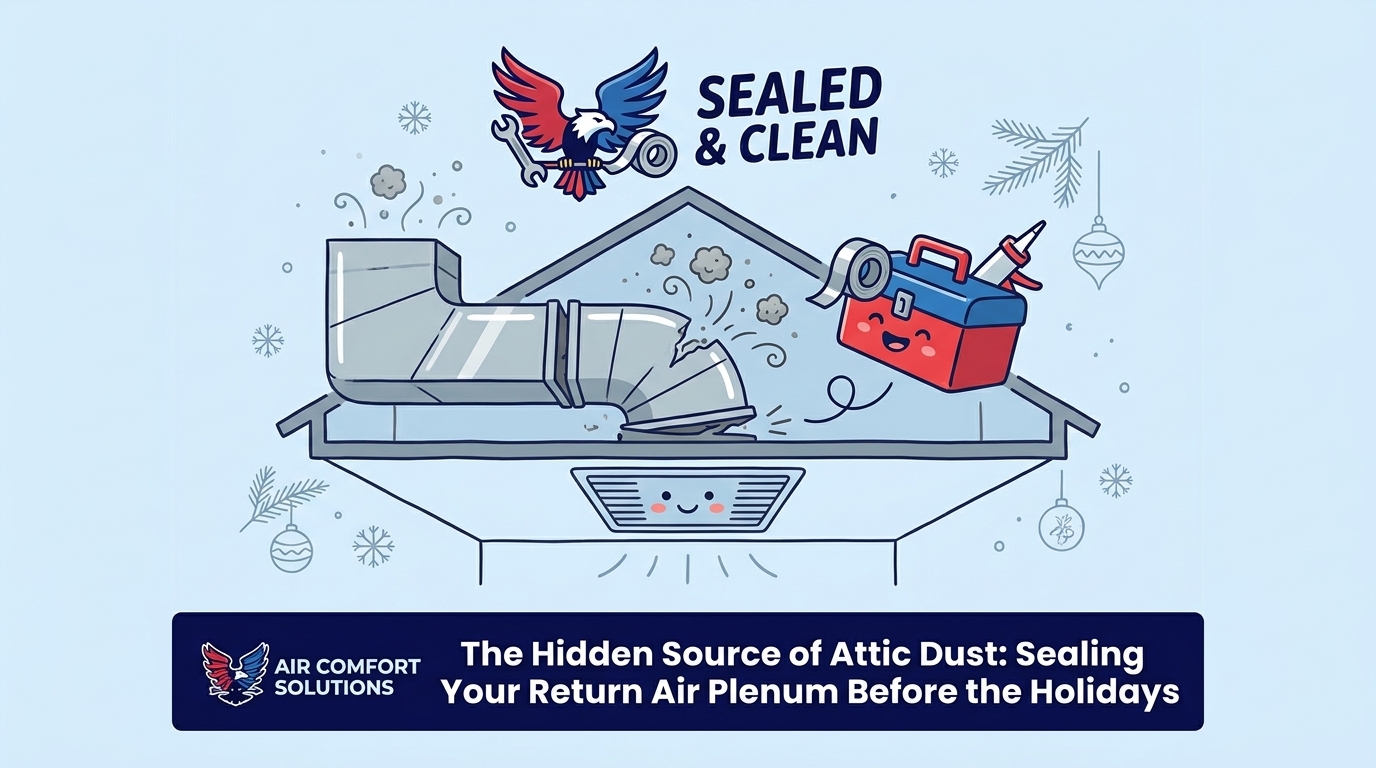
The Value of Sealing Your Return Air Plenum Before the Holidays
Most homeowners buy expensive filters to fix dusty air, not realizing a leaky return plenum in the attic is the real culprit. See why sealing it now saves your holiday gatherings.

What separates a good AC installation from a bad one comes down to a handful of technical decisions made during setup — most of which are invisible to the homeowner once the job is done.
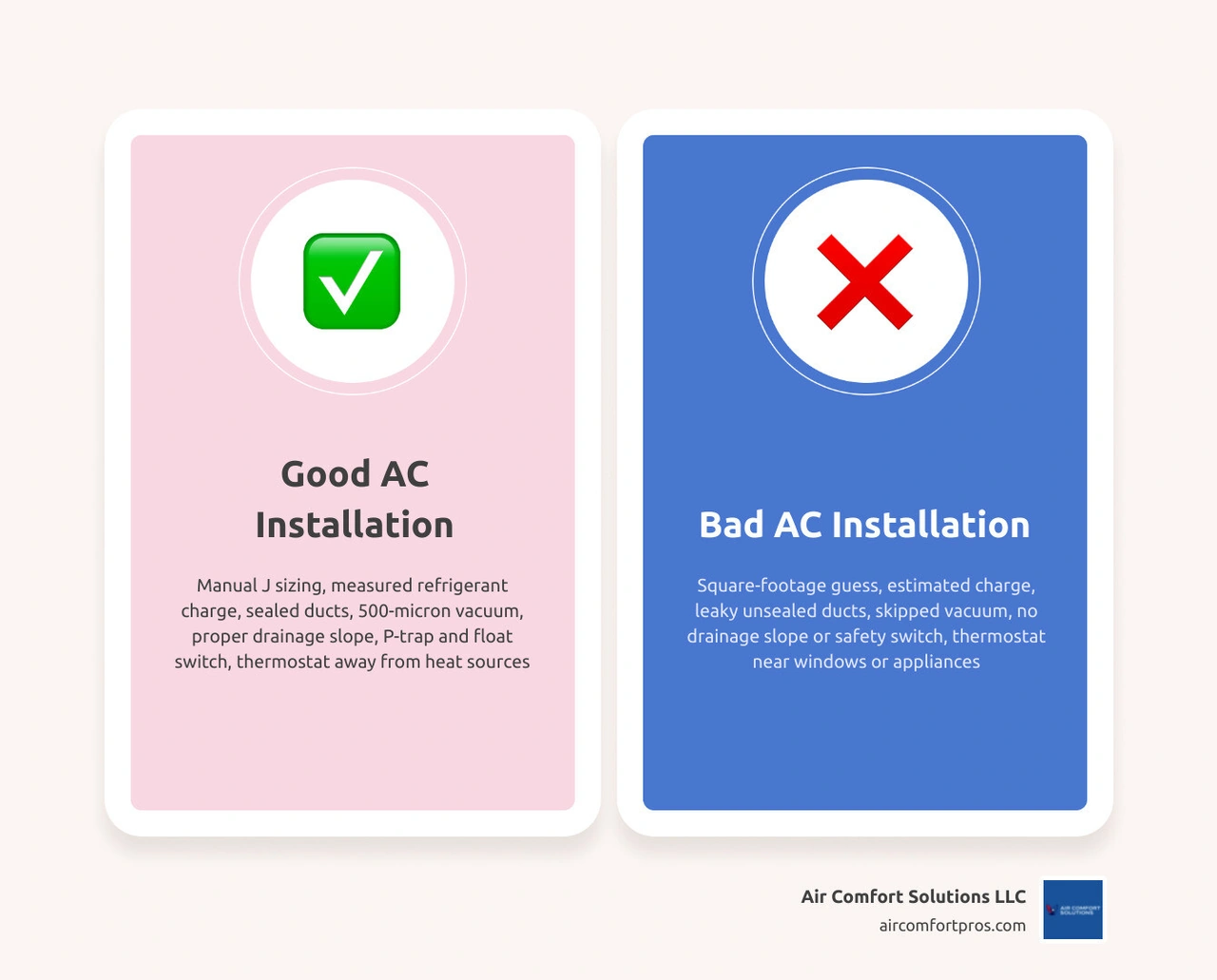
Here is a quick breakdown of the key differences:
• System sizing — Good Installation: Manual J load calculation — Bad Installation: Square-footage guesswork
• Refrigerant charge — Good Installation: Measured with digital manifolds — Bad Installation: Estimated by feel
• Ductwork — Good Installation: Sealed with mastic, balanced airflow — Bad Installation: Leaky ducts, no static pressure test
• Vacuum procedure — Good Installation: Pulled to 500 microns or below — Bad Installation: Skipped or rushed
• Drainage — Good Installation: Proper slope, P-trap, float switch — Bad Installation: No slope, no safety switch
• Thermostat placement — Good Installation: Interior wall, away from heat sources — Bad Installation: Near windows, vents, or appliances
• Documentation — Good Installation: Commissioning report provided — Bad Installation: No records left behind
Most homeowners spend a lot of time comparing brands and SEER ratings before buying a new system. That research matters — but it only tells part of the story. A high-efficiency unit installed incorrectly will underperform a basic unit that was set up right. According to industry data, a properly installed central AC should last 15 to 25 years. A bad installation can cut that down to 10 years or less, sometimes failing between years 8 and 12.
In a place like Pinehurst, TX — where air conditioning can account for 50% or more of your summer electric bill — the difference between a careful installation and a rushed one shows up every single month on your utility statement, and eventually in an early system failure.
The good news is that the standards for a quality installation are well-defined. The bad news is that shortcuts are common, and most problems don’t surface until months or years later.
Learn more about what separates a good ac installation from a bad one:
• how bad ac installation causes problems for years
• how ductwork mistakes during installation hurt your comfort
• how improper refrigerant charge reduces your ac lifespan
One of the most foundational steps in any air conditioning installation happens before the equipment even arrives at your home. It involves calculating exactly how much cooling capacity your home actually needs.
Historically, many contractors relied on lazy “rules of thumb,” such as allocating one ton of cooling capacity for every 500 square feet of living space. This guesswork is a major red flag. Modern homes feature varying levels of insulation, different window types, unique architectural orientations, and varying ceiling heights. Sizing a system solely on square footage is a recipe for long-term operational trouble.
To get sizing right, a professional contractor must perform an ACCA Manual J load calculation. This scientific protocol evaluates:
• The thermal resistance (R-value) of your walls, floors, and attic insulation.
• The total square footage and orientation of your windows (e.g., west-facing glass vs. north-facing glass).
• Local climate baselines (which are crucial for the intense heat of a Southeast Texas summer).
• Internal heat gains from occupants and household appliances.
Skipping this calculation typically leads to two major issues: oversizing or undersizing. While an undersized system will run constantly and struggle to keep your home cool on a hot afternoon, oversizing is actually the more common and destructive mistake.
When a system is too large, it quickly blasts the home with cold air and shuts off. This rapid cycling prevents the system from running long enough to remove moisture from the air, turning your home into a cold, clammy space. To understand how to achieve the perfect balance of temperature and humidity control, you can read about the Best AC System for Hot Humid Climates.
When sizing errors occur, the consequences extend far beyond minor comfort complaints. They directly impact the mechanical integrity of your equipment.
• Latent Heat Removal: An air conditioner has two jobs: lowering the air temperature (sensible cooling) and removing airborne moisture (latent cooling). An oversized system short-cycles so rapidly that the indoor evaporator coil never stays cold long enough to condense and drain away humidity.
• Accelerated Component Wear: The most electrically and mechanically stressful moment for an air conditioner is when it starts up. Oversized systems start and stop twice as often as correctly sized systems. This frequent cycling places immense strain on the compressor, motor windings, and contactors, drastically shortening their lifespans.
• Uneven Cooling and Hot Spots: Proper cooling requires continuous, calculated airflow. When a system short-cycles, the air in rooms furthest from the indoor unit doesn’t get fully circulated. This leaves you with freezing rooms right next to the air handler and uncomfortably warm bedrooms at the far end of the house.
For example, a typical bedroom has a design heating and cooling load of 2,500 BTU/h or less. If an installer puts in a standard ductless mini-split head rated at 9,000 to 12,000 BTU/h without checking the load requirements, that room will suffer from constant temperature swings and high humidity.
Once the equipment is physically set up, the technical assembly begins. This is where precision separates the true professionals from the rushed installers.
First, the refrigerant charge must be exact. Modern high-efficiency systems are incredibly sensitive to refrigerant levels. Even a minor 5% deviation from the manufacturer’s specified charge can drop the system’s operating efficiency by double digits and place unnecessary stress on the compressor.
To charge a system correctly, an installer cannot rely on old-school, subjective habits like the “beer can cold” method (feeling the suction line with a hand). Instead, they must use digital manifolds to measure precise superheat and subcooling levels under load, adjusting the charge to match the manufacturer’s exact charging chart.
Second, the vacuum pull-down process is absolutely critical. When copper refrigerant lines are brazed together, air and atmospheric moisture enter the lines. If an installer fails to pull a proper vacuum, that trapped moisture reacts with the synthetic POE (polyolester) oil used in modern systems. This chemical reaction forms a highly corrosive acid that slowly eats away at the compressor’s copper motor windings, leading to a premature compressor burnout within three to five years.
Finally, electrical safety cannot be ignored. The outdoor condenser and indoor air handler require dedicated circuits, correctly sized wiring gauges, and matching circuit breakers. If a contractor matches a new system to an old, undersized circuit breaker or fails to verify the unit’s minimum circuit ampacity (MCA), you risk frequent electrical trips or dangerous electrical shorts. You can read more about how these hidden technical shortcuts impact your home by reviewing How Bad AC Installation Causes Problems for Years.
To prevent these invisible failures, a high-quality installation incorporates several specialized tools and protective measures:
• The Digital Micron Gauge: A standard manifold gauge set cannot accurately measure a deep vacuum. A good installer connects a dedicated digital micron gauge to verify that the system pulls down to 500 microns or below, and holds that vacuum to prove the system is dry and completely leak-free.
• Preventing Compressor Burnout: By ensuring a clean, moisture-free refrigerant loop, the risk of acid formation is completely eliminated, protecting the compressor — the expensive “heart” of your AC.
• Vibration Mounts: Outdoor condensers contain powerful compressors and fan motors that create natural vibrations. A good installation includes heavy-duty rubber or neoprene anti-vibration pads beneath the unit’s feet. Without these, micro-vibrations can cause the copper refrigerant lines to rub against metal casings, eventually creating microscopic leaks.
• Wiring Safety and Code Compliance: All high-voltage and low-voltage connections must be tightly secured inside weather-tight conduit (whip) and connected to a properly rated outdoor disconnect box. Loose electrical connections generate heat, which can fry control boards and create fire hazards.
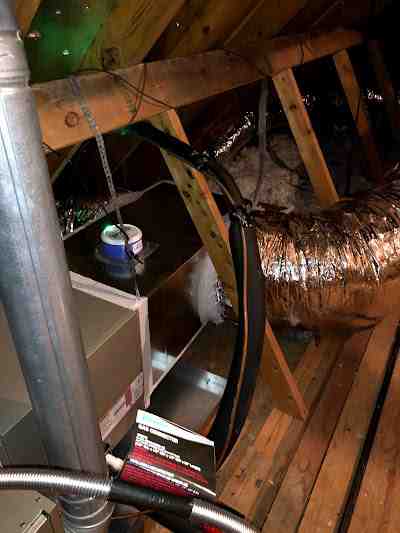
An air conditioner is only as good as the ductwork it is connected to. You can buy the most efficient, advanced AC unit on the market, but if it is forced to blow air through a leaky, poorly designed duct system, you will waste money and suffer from poor comfort.
Ductwork acts as the circulatory system of your home. If the ducts are too small, restricted, or poorly routed, the system encounters high static pressure. Static pressure is essentially the resistance to airflow within the system. Think of it like trying to breathe through a thin cocktail straw — your lungs have to work significantly harder.
High static pressure forces the indoor blower motor (especially modern variable-speed ECM motors) to ramp up to its maximum speed to deliver the required airflow. This dramatically increases your electricity consumption, creates excessive noise, and causes the blower motor to fail prematurely.
Furthermore, leaky ductwork is a massive source of energy waste and indoor air quality problems. Industry data shows that the average home loses 20% to 30% of its conditioned air through unsealed duct joints, cracks, and disconnects in unconditioned spaces like attics or crawlspaces. This means you are paying to cool your hot attic while your living spaces remain warm.
When upgrading your system, it is crucial to evaluate whether your existing ductwork can handle the new equipment. For advice on evaluating your current setup, see our guide on How to Decide Between AC Repair and Replacement.
To prevent these losses, a professional installer will:
1. Measure Static Pressure: Use a digital manometer to test the static pressure on both the supply and return sides of the system during commissioning.
2. Seal with Fiber-Reinforced Mastic: Apply a thick layer of professional, fiber-reinforced mastic sealant (often referred to in the industry as “pookie”) to all duct connections. Standard silver duct tape dries out, loses its adhesive properties, and fails within a few years, whereas mastic creates a permanent, airtight seal.
3. Balance Airflow: Adjust dampers and registers to ensure that every room receives the exact volume of air (measured in CFM, or cubic feet per minute) required to keep temperatures consistent throughout the home.
Two of the most common “silent killers” of home comfort and structural integrity are proper condensate drainage and precise thermostat installation.
As your air conditioner cools your indoor air, it extracts gallons of water from the humidity every day. This water collects in a drain pan beneath the indoor evaporator coil and must be safely routed outside or to a home drain.
A bad installation often ignores the simple laws of gravity. If the condensate drain line is not sloped downward at a minimum of 1/4 inch per foot, or if the line sags, water will pool in the line. This standing water quickly becomes a breeding ground for algae and mold, which eventually clogs the line and causes water to overflow. If your indoor unit is located in your attic, a single clogged drain line can result in thousands of dollars in drywall and ceiling damage.
To prevent water damage, a good installation includes:
• A properly sloped drain line with an integrated P-trap to prevent sewer gases from entering your air stream.
• A secondary, emergency drain pan placed beneath the indoor unit.
• An electronic float switch (safety switch) installed in the secondary pan or drain line. If the primary line clogs and water rises, the float switch instantly cuts power to the AC system, stopping the production of condensate before an overflow occurs.
Similarly, thermostat placement plays a massive role in how your system cycles. If a thermostat is placed in a poor location, it will read “ghost temperatures” that do not reflect the actual climate of your home.
For example, if a thermostat is mounted on an exterior wall, near a drafty window, directly under a supply vent, or near a heat-producing appliance (like a kitchen stove or lamp), it will trick the system into running too long or shutting off too early. A professional installer will always place the thermostat on a central, interior wall away from direct sunlight and drafts, ensuring accurate temperature sensing and balanced system cycling.
If you are planning an upgrade, choosing the right season can also make a major difference in your overall experience. You can read about the Optimal Times for Upgrading Your Home’s Air Conditioning System to plan your project perfectly.
A new air conditioning system is a major financial investment. Protecting that investment requires understanding how installation quality directly affects your manufacturer’s warranty.
Major equipment manufacturers (such as Trane, Lennox, and Carrier) offer robust parts warranties, often lasting 5 to 10 years. However, these warranties contain strict compliance clauses. If a component fails and the manufacturer determines that the failure was caused by improper installation — such as a skipped vacuum pull that caused acid damage, incorrect electrical wiring, or severe system oversizing — they can, and will, deny your warranty claim.
To ensure your warranty remains valid, you must have your system installed by a licensed professional who provides a detailed commissioning report documenting the system’s final operating pressures, temperatures, electrical draws, and static pressures.
As of June 2026, manufacturers are stricter than ever regarding these documentation requirements. If you have recently had a new system installed, look out for these common warning signs of a poor installation:
• Excessive Noise or Vibrations: Rattling, whistling in the vents, or loud outdoor vibrations indicate poor mounting or high static pressure.
• Uneven Cooling: Significant temperature differences between rooms indicate unbalanced airflow or duct design issues.
• High Utility Bills: If your energy bills remain high despite installing a high-SEER system, the unit is likely short-cycling or losing air through leaky ducts.
• Frequent System Cycling: Turning on and off every few minutes is a classic sign of an oversized system.
To help you evaluate your installation, use this simple checklist:
• Sizing Method — Professional Setup (The Good): Comprehensive Manual J load calculation — Rushed Setup (The Bad): Guestimate based on square footage
• Duct Connections — Professional Setup (The Good): Sealed with fiber-reinforced mastic — Rushed Setup (The Bad): Sealed with standard tape or left unsealed
• Line Vacuum — Professional Setup (The Good): Pulled below 500 microns with digital gauge — Rushed Setup (The Bad): Rushed purge using refrigerant gas
• Safety Devices — Professional Setup (The Good): Float switch and secondary drain pan installed — Rushed Setup (The Bad): No overflow protection installed
• Airflow Test — Professional Setup (The Good): Static pressure tested with a manometer — Rushed Setup (The Bad): No airflow testing performed
• Commissioning — Professional Setup (The Good): Full startup report with subcooling/superheat — Rushed Setup (The Bad): System turned on, blows cold, technician leaves
With a high-quality installation and routine annual maintenance, a modern central air conditioning system should last between 15 and 25 years. However, a poor installation that forces the system to run under high static pressure, with an incorrect refrigerant charge, or through frequent short-cycling can cut that lifespan down to 10 years or less — often leading to major component failures by year 8.
Yes. Most major manufacturers require their systems to be installed by a licensed professional HVAC technician in strict accordance with their installation manuals and local building codes. If a major component like the compressor fails and the manufacturer finds evidence of installation errors (such as moisture contamination or incorrect wiring), they may deny the parts claim, leaving you to pay for the repair.
The three most common and costly installation mistakes are:
1. Incorrect System Sizing: Typically oversizing the unit, which prevents proper humidity control and causes premature component wear.
2. Leaky or Undersized Ductwork: Which wastes up to 30% of your cooling capacity and places immense strain on the blower motor.
3. Improper Refrigerant Charge: Charging the system by “feel” rather than using digital tools to measure precise subcooling and superheat levels.
At Air Comfort Solutions, we know that the quality of your AC installation matters just as much as the brand of equipment you choose. Serving Pinehurst, TX, and the north side of Harris County, our team of experienced, licensed technicians is dedicated to providing dependable comfort through precise, code-compliant installations. We never skip steps, we always perform detailed load calculations, and we stand behind our work with honest, reliable service.
If you want to ensure your new system is set up for maximum efficiency and long-term reliability, we are here to help. We proudly serve homeowners across our local communities:
Don’t leave your comfort or your energy bills to chance. Schedule your professional AC installation today with the trusted experts at Air Comfort Solutions.
What separates a good AC installation from a bad one comes down to a handful of technical decisions made during setup — most of which are invisible to the homeowner once the job is done.
Here is a quick breakdown of the key differences:
| Factor | Good Installation | Bad Installation |
|---|---|---|
| System sizing | Manual J load calculation | Square-footage guesswork |
| Refrigerant charge | Measured with digital manifolds | Estimated by feel |
| Ductwork | Sealed with mastic, balanced airflow | Leaky ducts, no static pressure test |
| Vacuum procedure | Pulled to 500 microns or below | Skipped or rushed |
| Drainage | Proper slope, P-trap, float switch | No slope, no safety switch |
| Thermostat placement | Interior wall, away from heat sources | Near windows, vents, or appliances |
| Documentation | Commissioning report provided | No records left behind |
Most homeowners spend a lot of time comparing brands and SEER ratings before buying a new system. That research matters — but it only tells part of the story. A high-efficiency unit installed incorrectly will underperform a basic unit that was set up right. According to industry data, a properly installed central AC should last 15 to 25 years. A bad installation can cut that down to 10 years or less, sometimes failing between years 8 and 12.
In a place like Pinehurst, TX — where air conditioning can account for 50% or more of your summer electric bill — the difference between a careful installation and a rushed one shows up every single month on your utility statement, and eventually in an early system failure.
The good news is that the standards for a quality installation are well-defined. The bad news is that shortcuts are common, and most problems don't surface until months or years later.
Learn more about what separates a good ac installation from a bad one:
One of the most foundational steps in any air conditioning installation happens before the equipment even arrives at your home. It involves calculating exactly how much cooling capacity your home actually needs.
Historically, many contractors relied on lazy "rules of thumb," such as allocating one ton of cooling capacity for every 500 square feet of living space. This guesswork is a major red flag. Modern homes feature varying levels of insulation, different window types, unique architectural orientations, and varying ceiling heights. Sizing a system solely on square footage is a recipe for long-term operational trouble.
To get sizing right, a professional contractor must perform an ACCA Manual J load calculation. This scientific protocol evaluates:
Skipping this calculation typically leads to two major issues: oversizing or undersizing. While an undersized system will run constantly and struggle to keep your home cool on a hot afternoon, oversizing is actually the more common and destructive mistake.
When a system is too large, it quickly blasts the home with cold air and shuts off. This rapid cycling prevents the system from running long enough to remove moisture from the air, turning your home into a cold, clammy space. To understand how to achieve the perfect balance of temperature and humidity control, you can read about the Best AC System for Hot Humid Climates.
When sizing errors occur, the consequences extend far beyond minor comfort complaints. They directly impact the mechanical integrity of your equipment.
For example, a typical bedroom has a design heating and cooling load of 2,500 BTU/h or less. If an installer puts in a standard ductless mini-split head rated at 9,000 to 12,000 BTU/h without checking the load requirements, that room will suffer from constant temperature swings and high humidity.
Once the equipment is physically set up, the technical assembly begins. This is where precision separates the true professionals from the rushed installers.
First, the refrigerant charge must be exact. Modern high-efficiency systems are incredibly sensitive to refrigerant levels. Even a minor 5% deviation from the manufacturer's specified charge can drop the system's operating efficiency by double digits and place unnecessary stress on the compressor.
To charge a system correctly, an installer cannot rely on old-school, subjective habits like the "beer can cold" method (feeling the suction line with a hand). Instead, they must use digital manifolds to measure precise superheat and subcooling levels under load, adjusting the charge to match the manufacturer's exact charging chart.
Second, the vacuum pull-down process is absolutely critical. When copper refrigerant lines are brazed together, air and atmospheric moisture enter the lines. If an installer fails to pull a proper vacuum, that trapped moisture reacts with the synthetic POE (polyolester) oil used in modern systems. This chemical reaction forms a highly corrosive acid that slowly eats away at the compressor's copper motor windings, leading to a premature compressor burnout within three to five years.
Finally, electrical safety cannot be ignored. The outdoor condenser and indoor air handler require dedicated circuits, correctly sized wiring gauges, and matching circuit breakers. If a contractor matches a new system to an old, undersized circuit breaker or fails to verify the unit's minimum circuit ampacity (MCA), you risk frequent electrical trips or dangerous electrical shorts. You can read more about how these hidden technical shortcuts impact your home by reviewing How Bad AC Installation Causes Problems for Years.
To prevent these invisible failures, a high-quality installation incorporates several specialized tools and protective measures:
An air conditioner is only as good as the ductwork it is connected to. You can buy the most efficient, advanced AC unit on the market, but if it is forced to blow air through a leaky, poorly designed duct system, you will waste money and suffer from poor comfort.
Ductwork acts as the circulatory system of your home. If the ducts are too small, restricted, or poorly routed, the system encounters high static pressure. Static pressure is essentially the resistance to airflow within the system. Think of it like trying to breathe through a thin cocktail straw — your lungs have to work significantly harder.
High static pressure forces the indoor blower motor (especially modern variable-speed ECM motors) to ramp up to its maximum speed to deliver the required airflow. This dramatically increases your electricity consumption, creates excessive noise, and causes the blower motor to fail prematurely.
Furthermore, leaky ductwork is a massive source of energy waste and indoor air quality problems. Industry data shows that the average home loses 20% to 30% of its conditioned air through unsealed duct joints, cracks, and disconnects in unconditioned spaces like attics or crawlspaces. This means you are paying to cool your hot attic while your living spaces remain warm.
When upgrading your system, it is crucial to evaluate whether your existing ductwork can handle the new equipment. For advice on evaluating your current setup, see our guide on How to Decide Between AC Repair and Replacement.
To prevent these losses, a professional installer will:
Two of the most common "silent killers" of home comfort and structural integrity are proper condensate drainage and precise thermostat installation.
As your air conditioner cools your indoor air, it extracts gallons of water from the humidity every day. This water collects in a drain pan beneath the indoor evaporator coil and must be safely routed outside or to a home drain.
A bad installation often ignores the simple laws of gravity. If the condensate drain line is not sloped downward at a minimum of 1/4 inch per foot, or if the line sags, water will pool in the line. This standing water quickly becomes a breeding ground for algae and mold, which eventually clogs the line and causes water to overflow. If your indoor unit is located in your attic, a single clogged drain line can result in thousands of dollars in drywall and ceiling damage.
To prevent water damage, a good installation includes:
Similarly, thermostat placement plays a massive role in how your system cycles. If a thermostat is placed in a poor location, it will read "ghost temperatures" that do not reflect the actual climate of your home.
For example, if a thermostat is mounted on an exterior wall, near a drafty window, directly under a supply vent, or near a heat-producing appliance (like a kitchen stove or lamp), it will trick the system into running too long or shutting off too early. A professional installer will always place the thermostat on a central, interior wall away from direct sunlight and drafts, ensuring accurate temperature sensing and balanced system cycling.
If you are planning an upgrade, choosing the right season can also make a major difference in your overall experience. You can read about the Optimal Times for Upgrading Your Home's Air Conditioning System to plan your project perfectly.
A new air conditioning system is a major financial investment. Protecting that investment requires understanding how installation quality directly affects your manufacturer's warranty.
Major equipment manufacturers (such as Trane, Lennox, and Carrier) offer robust parts warranties, often lasting 5 to 10 years. However, these warranties contain strict compliance clauses. If a component fails and the manufacturer determines that the failure was caused by improper installation — such as a skipped vacuum pull that caused acid damage, incorrect electrical wiring, or severe system oversizing — they can, and will, deny your warranty claim.
To ensure your warranty remains valid, you must have your system installed by a licensed professional who provides a detailed commissioning report documenting the system's final operating pressures, temperatures, electrical draws, and static pressures.
As of June 2026, manufacturers are stricter than ever regarding these documentation requirements. If you have recently had a new system installed, look out for these common warning signs of a poor installation:
To help you evaluate your installation, use this simple checklist:
| Installation Step | Professional Setup (The Good) | Rushed Setup (The Bad) |
|---|---|---|
| Sizing Method | Comprehensive Manual J load calculation | Guestimate based on square footage |
| Duct Connections | Sealed with fiber-reinforced mastic | Sealed with standard tape or left unsealed |
| Line Vacuum | Pulled below 500 microns with digital gauge | Rushed purge using refrigerant gas |
| Safety Devices | Float switch and secondary drain pan installed | No overflow protection installed |
| Airflow Test | Static pressure tested with a manometer | No airflow testing performed |
| Commissioning | Full startup report with subcooling/superheat | System turned on, blows cold, technician leaves |
With a high-quality installation and routine annual maintenance, a modern central air conditioning system should last between 15 and 25 years. However, a poor installation that forces the system to run under high static pressure, with an incorrect refrigerant charge, or through frequent short-cycling can cut that lifespan down to 10 years or less — often leading to major component failures by year 8.
Yes. Most major manufacturers require their systems to be installed by a licensed professional HVAC technician in strict accordance with their installation manuals and local building codes. If a major component like the compressor fails and the manufacturer finds evidence of installation errors (such as moisture contamination or incorrect wiring), they may deny the parts claim, leaving you to pay for the repair.
The three most common and costly installation mistakes are:
At Air Comfort Pros, we know that the quality of your AC installation matters just as much as the brand of equipment you choose. Serving Pinehurst, TX, and the north side of Harris County, our team of experienced, licensed technicians is dedicated to providing dependable comfort through precise, code-compliant installations. We never skip steps, we always perform detailed load calculations, and we stand behind our work with honest, reliable service.
If you want to ensure your new system is set up for maximum efficiency and long-term reliability, we are here to help. We proudly serve homeowners across our local communities:
Don't leave your comfort or your energy bills to chance. Schedule your professional AC installation today with the trusted experts at Air Comfort Pros.
What separates a good AC installation from a bad one comes down to a handful of technical decisions made during setup — most of which are invisible to the homeowner once the job is done.
Here is a quick breakdown of the key differences:
| Factor | Good Installation | Bad Installation |
|---|---|---|
| System sizing | Manual J load calculation | Square-footage guesswork |
| Refrigerant charge | Measured with digital manifolds | Estimated by feel |
| Ductwork | Sealed with mastic, balanced airflow | Leaky ducts, no static pressure test |
| Vacuum procedure | Pulled to 500 microns or below | Skipped or rushed |
| Drainage | Proper slope, P-trap, float switch | No slope, no safety switch |
| Thermostat placement | Interior wall, away from heat sources | Near windows, vents, or appliances |
| Documentation | Commissioning report provided | No records left behind |
Most homeowners spend a lot of time comparing brands and SEER ratings before buying a new system. That research matters — but it only tells part of the story. A high-efficiency unit installed incorrectly will underperform a basic unit that was set up right. According to industry data, a properly installed central AC should last 15 to 25 years. A bad installation can cut that down to 10 years or less, sometimes failing between years 8 and 12.
In a place like Pinehurst, TX — where air conditioning can account for 50% or more of your summer electric bill — the difference between a careful installation and a rushed one shows up every single month on your utility statement, and eventually in an early system failure.
The good news is that the standards for a quality installation are well-defined. The bad news is that shortcuts are common, and most problems don't surface until months or years later.
Learn more about what separates a good ac installation from a bad one:
One of the most foundational steps in any air conditioning installation happens before the equipment even arrives at your home. It involves calculating exactly how much cooling capacity your home actually needs.
Historically, many contractors relied on lazy "rules of thumb," such as allocating one ton of cooling capacity for every 500 square feet of living space. This guesswork is a major red flag. Modern homes feature varying levels of insulation, different window types, unique architectural orientations, and varying ceiling heights. Sizing a system solely on square footage is a recipe for long-term operational trouble.
To get sizing right, a professional contractor must perform an ACCA Manual J load calculation. This scientific protocol evaluates:
Skipping this calculation typically leads to two major issues: oversizing or undersizing. While an undersized system will run constantly and struggle to keep your home cool on a hot afternoon, oversizing is actually the more common and destructive mistake.
When a system is too large, it quickly blasts the home with cold air and shuts off. This rapid cycling prevents the system from running long enough to remove moisture from the air, turning your home into a cold, clammy space. To understand how to achieve the perfect balance of temperature and humidity control, you can read about the Best AC System for Hot Humid Climates.
When sizing errors occur, the consequences extend far beyond minor comfort complaints. They directly impact the mechanical integrity of your equipment.
For example, a typical bedroom has a design heating and cooling load of 2,500 BTU/h or less. If an installer puts in a standard ductless mini-split head rated at 9,000 to 12,000 BTU/h without checking the load requirements, that room will suffer from constant temperature swings and high humidity.
Once the equipment is physically set up, the technical assembly begins. This is where precision separates the true professionals from the rushed installers.
First, the refrigerant charge must be exact. Modern high-efficiency systems are incredibly sensitive to refrigerant levels. Even a minor 5% deviation from the manufacturer's specified charge can drop the system's operating efficiency by double digits and place unnecessary stress on the compressor.
To charge a system correctly, an installer cannot rely on old-school, subjective habits like the "beer can cold" method (feeling the suction line with a hand). Instead, they must use digital manifolds to measure precise superheat and subcooling levels under load, adjusting the charge to match the manufacturer's exact charging chart.
Second, the vacuum pull-down process is absolutely critical. When copper refrigerant lines are brazed together, air and atmospheric moisture enter the lines. If an installer fails to pull a proper vacuum, that trapped moisture reacts with the synthetic POE (polyolester) oil used in modern systems. This chemical reaction forms a highly corrosive acid that slowly eats away at the compressor's copper motor windings, leading to a premature compressor burnout within three to five years.
Finally, electrical safety cannot be ignored. The outdoor condenser and indoor air handler require dedicated circuits, correctly sized wiring gauges, and matching circuit breakers. If a contractor matches a new system to an old, undersized circuit breaker or fails to verify the unit's minimum circuit ampacity (MCA), you risk frequent electrical trips or dangerous electrical shorts. You can read more about how these hidden technical shortcuts impact your home by reviewing How Bad AC Installation Causes Problems for Years.
To prevent these invisible failures, a high-quality installation incorporates several specialized tools and protective measures:
An air conditioner is only as good as the ductwork it is connected to. You can buy the most efficient, advanced AC unit on the market, but if it is forced to blow air through a leaky, poorly designed duct system, you will waste money and suffer from poor comfort.
Ductwork acts as the circulatory system of your home. If the ducts are too small, restricted, or poorly routed, the system encounters high static pressure. Static pressure is essentially the resistance to airflow within the system. Think of it like trying to breathe through a thin cocktail straw — your lungs have to work significantly harder.
High static pressure forces the indoor blower motor (especially modern variable-speed ECM motors) to ramp up to its maximum speed to deliver the required airflow. This dramatically increases your electricity consumption, creates excessive noise, and causes the blower motor to fail prematurely.
Furthermore, leaky ductwork is a massive source of energy waste and indoor air quality problems. Industry data shows that the average home loses 20% to 30% of its conditioned air through unsealed duct joints, cracks, and disconnects in unconditioned spaces like attics or crawlspaces. This means you are paying to cool your hot attic while your living spaces remain warm.
When upgrading your system, it is crucial to evaluate whether your existing ductwork can handle the new equipment. For advice on evaluating your current setup, see our guide on How to Decide Between AC Repair and Replacement.
To prevent these losses, a professional installer will:
Two of the most common "silent killers" of home comfort and structural integrity are proper condensate drainage and precise thermostat installation.
As your air conditioner cools your indoor air, it extracts gallons of water from the humidity every day. This water collects in a drain pan beneath the indoor evaporator coil and must be safely routed outside or to a home drain.
A bad installation often ignores the simple laws of gravity. If the condensate drain line is not sloped downward at a minimum of 1/4 inch per foot, or if the line sags, water will pool in the line. This standing water quickly becomes a breeding ground for algae and mold, which eventually clogs the line and causes water to overflow. If your indoor unit is located in your attic, a single clogged drain line can result in thousands of dollars in drywall and ceiling damage.
To prevent water damage, a good installation includes:
Similarly, thermostat placement plays a massive role in how your system cycles. If a thermostat is placed in a poor location, it will read "ghost temperatures" that do not reflect the actual climate of your home.
For example, if a thermostat is mounted on an exterior wall, near a drafty window, directly under a supply vent, or near a heat-producing appliance (like a kitchen stove or lamp), it will trick the system into running too long or shutting off too early. A professional installer will always place the thermostat on a central, interior wall away from direct sunlight and drafts, ensuring accurate temperature sensing and balanced system cycling.
If you are planning an upgrade, choosing the right season can also make a major difference in your overall experience. You can read about the Optimal Times for Upgrading Your Home's Air Conditioning System to plan your project perfectly.
A new air conditioning system is a major financial investment. Protecting that investment requires understanding how installation quality directly affects your manufacturer's warranty.
Major equipment manufacturers (such as Trane, Lennox, and Carrier) offer robust parts warranties, often lasting 5 to 10 years. However, these warranties contain strict compliance clauses. If a component fails and the manufacturer determines that the failure was caused by improper installation — such as a skipped vacuum pull that caused acid damage, incorrect electrical wiring, or severe system oversizing — they can, and will, deny your warranty claim.
To ensure your warranty remains valid, you must have your system installed by a licensed professional who provides a detailed commissioning report documenting the system's final operating pressures, temperatures, electrical draws, and static pressures.
As of June 2026, manufacturers are stricter than ever regarding these documentation requirements. If you have recently had a new system installed, look out for these common warning signs of a poor installation:
To help you evaluate your installation, use this simple checklist:
| Installation Step | Professional Setup (The Good) | Rushed Setup (The Bad) |
|---|---|---|
| Sizing Method | Comprehensive Manual J load calculation | Guestimate based on square footage |
| Duct Connections | Sealed with fiber-reinforced mastic | Sealed with standard tape or left unsealed |
| Line Vacuum | Pulled below 500 microns with digital gauge | Rushed purge using refrigerant gas |
| Safety Devices | Float switch and secondary drain pan installed | No overflow protection installed |
| Airflow Test | Static pressure tested with a manometer | No airflow testing performed |
| Commissioning | Full startup report with subcooling/superheat | System turned on, blows cold, technician leaves |
With a high-quality installation and routine annual maintenance, a modern central air conditioning system should last between 15 and 25 years. However, a poor installation that forces the system to run under high static pressure, with an incorrect refrigerant charge, or through frequent short-cycling can cut that lifespan down to 10 years or less — often leading to major component failures by year 8.
Yes. Most major manufacturers require their systems to be installed by a licensed professional HVAC technician in strict accordance with their installation manuals and local building codes. If a major component like the compressor fails and the manufacturer finds evidence of installation errors (such as moisture contamination or incorrect wiring), they may deny the parts claim, leaving you to pay for the repair.
The three most common and costly installation mistakes are:
At Air Comfort Pros, we know that the quality of your AC installation matters just as much as the brand of equipment you choose. Serving Pinehurst, TX, and the north side of Harris County, our team of experienced, licensed technicians is dedicated to providing dependable comfort through precise, code-compliant installations. We never skip steps, we always perform detailed load calculations, and we stand behind our work with honest, reliable service.
If you want to ensure your new system is set up for maximum efficiency and long-term reliability, we are here to help. We proudly serve homeowners across our local communities:
Don't leave your comfort or your energy bills to chance. Schedule your professional AC installation today with the trusted experts at Air Comfort Pros.
What separates a good AC installation from a bad one comes down to a handful of technical decisions made during setup — most of which are invisible to the homeowner once the job is done.
Here is a quick breakdown of the key differences:
| Factor | Good Installation | Bad Installation |
|---|---|---|
| System sizing | Manual J load calculation | Square-footage guesswork |
| Refrigerant charge | Measured with digital manifolds | Estimated by feel |
| Ductwork | Sealed with mastic, balanced airflow | Leaky ducts, no static pressure test |
| Vacuum procedure | Pulled to 500 microns or below | Skipped or rushed |
| Drainage | Proper slope, P-trap, float switch | No slope, no safety switch |
| Thermostat placement | Interior wall, away from heat sources | Near windows, vents, or appliances |
| Documentation | Commissioning report provided | No records left behind |
Most homeowners spend a lot of time comparing brands and SEER ratings before buying a new system. That research matters — but it only tells part of the story. A high-efficiency unit installed incorrectly will underperform a basic unit that was set up right. According to industry data, a properly installed central AC should last 15 to 25 years. A bad installation can cut that down to 10 years or less, sometimes failing between years 8 and 12.
In a place like Pinehurst, TX — where air conditioning can account for 50% or more of your summer electric bill — the difference between a careful installation and a rushed one shows up every single month on your utility statement, and eventually in an early system failure.
The good news is that the standards for a quality installation are well-defined. The bad news is that shortcuts are common, and most problems don't surface until months or years later.
Learn more about what separates a good ac installation from a bad one:
One of the most foundational steps in any air conditioning installation happens before the equipment even arrives at your home. It involves calculating exactly how much cooling capacity your home actually needs.
Historically, many contractors relied on lazy "rules of thumb," such as allocating one ton of cooling capacity for every 500 square feet of living space. This guesswork is a major red flag. Modern homes feature varying levels of insulation, different window types, unique architectural orientations, and varying ceiling heights. Sizing a system solely on square footage is a recipe for long-term operational trouble.
To get sizing right, a professional contractor must perform an ACCA Manual J load calculation. This scientific protocol evaluates:
Skipping this calculation typically leads to two major issues: oversizing or undersizing. While an undersized system will run constantly and struggle to keep your home cool on a hot afternoon, oversizing is actually the more common and destructive mistake.
When a system is too large, it quickly blasts the home with cold air and shuts off. This rapid cycling prevents the system from running long enough to remove moisture from the air, turning your home into a cold, clammy space. To understand how to achieve the perfect balance of temperature and humidity control, you can read about the Best AC System for Hot Humid Climates.
When sizing errors occur, the consequences extend far beyond minor comfort complaints. They directly impact the mechanical integrity of your equipment.
For example, a typical bedroom has a design heating and cooling load of 2,500 BTU/h or less. If an installer puts in a standard ductless mini-split head rated at 9,000 to 12,000 BTU/h without checking the load requirements, that room will suffer from constant temperature swings and high humidity.
Once the equipment is physically set up, the technical assembly begins. This is where precision separates the true professionals from the rushed installers.
First, the refrigerant charge must be exact. Modern high-efficiency systems are incredibly sensitive to refrigerant levels. Even a minor 5% deviation from the manufacturer's specified charge can drop the system's operating efficiency by double digits and place unnecessary stress on the compressor.
To charge a system correctly, an installer cannot rely on old-school, subjective habits like the "beer can cold" method (feeling the suction line with a hand). Instead, they must use digital manifolds to measure precise superheat and subcooling levels under load, adjusting the charge to match the manufacturer's exact charging chart.
Second, the vacuum pull-down process is absolutely critical. When copper refrigerant lines are brazed together, air and atmospheric moisture enter the lines. If an installer fails to pull a proper vacuum, that trapped moisture reacts with the synthetic POE (polyolester) oil used in modern systems. This chemical reaction forms a highly corrosive acid that slowly eats away at the compressor's copper motor windings, leading to a premature compressor burnout within three to five years.
Finally, electrical safety cannot be ignored. The outdoor condenser and indoor air handler require dedicated circuits, correctly sized wiring gauges, and matching circuit breakers. If a contractor matches a new system to an old, undersized circuit breaker or fails to verify the unit's minimum circuit ampacity (MCA), you risk frequent electrical trips or dangerous electrical shorts. You can read more about how these hidden technical shortcuts impact your home by reviewing How Bad AC Installation Causes Problems for Years.
To prevent these invisible failures, a high-quality installation incorporates several specialized tools and protective measures:
An air conditioner is only as good as the ductwork it is connected to. You can buy the most efficient, advanced AC unit on the market, but if it is forced to blow air through a leaky, poorly designed duct system, you will waste money and suffer from poor comfort.
Ductwork acts as the circulatory system of your home. If the ducts are too small, restricted, or poorly routed, the system encounters high static pressure. Static pressure is essentially the resistance to airflow within the system. Think of it like trying to breathe through a thin cocktail straw — your lungs have to work significantly harder.
High static pressure forces the indoor blower motor (especially modern variable-speed ECM motors) to ramp up to its maximum speed to deliver the required airflow. This dramatically increases your electricity consumption, creates excessive noise, and causes the blower motor to fail prematurely.
Furthermore, leaky ductwork is a massive source of energy waste and indoor air quality problems. Industry data shows that the average home loses 20% to 30% of its conditioned air through unsealed duct joints, cracks, and disconnects in unconditioned spaces like attics or crawlspaces. This means you are paying to cool your hot attic while your living spaces remain warm.
When upgrading your system, it is crucial to evaluate whether your existing ductwork can handle the new equipment. For advice on evaluating your current setup, see our guide on How to Decide Between AC Repair and Replacement.
To prevent these losses, a professional installer will:
Two of the most common "silent killers" of home comfort and structural integrity are proper condensate drainage and precise thermostat installation.
As your air conditioner cools your indoor air, it extracts gallons of water from the humidity every day. This water collects in a drain pan beneath the indoor evaporator coil and must be safely routed outside or to a home drain.
A bad installation often ignores the simple laws of gravity. If the condensate drain line is not sloped downward at a minimum of 1/4 inch per foot, or if the line sags, water will pool in the line. This standing water quickly becomes a breeding ground for algae and mold, which eventually clogs the line and causes water to overflow. If your indoor unit is located in your attic, a single clogged drain line can result in thousands of dollars in drywall and ceiling damage.
To prevent water damage, a good installation includes:
Similarly, thermostat placement plays a massive role in how your system cycles. If a thermostat is placed in a poor location, it will read "ghost temperatures" that do not reflect the actual climate of your home.
For example, if a thermostat is mounted on an exterior wall, near a drafty window, directly under a supply vent, or near a heat-producing appliance (like a kitchen stove or lamp), it will trick the system into running too long or shutting off too early. A professional installer will always place the thermostat on a central, interior wall away from direct sunlight and drafts, ensuring accurate temperature sensing and balanced system cycling.
If you are planning an upgrade, choosing the right season can also make a major difference in your overall experience. You can read about the Optimal Times for Upgrading Your Home's Air Conditioning System to plan your project perfectly.
A new air conditioning system is a major financial investment. Protecting that investment requires understanding how installation quality directly affects your manufacturer's warranty.
Major equipment manufacturers (such as Trane, Lennox, and Carrier) offer robust parts warranties, often lasting 5 to 10 years. However, these warranties contain strict compliance clauses. If a component fails and the manufacturer determines that the failure was caused by improper installation — such as a skipped vacuum pull that caused acid damage, incorrect electrical wiring, or severe system oversizing — they can, and will, deny your warranty claim.
To ensure your warranty remains valid, you must have your system installed by a licensed professional who provides a detailed commissioning report documenting the system's final operating pressures, temperatures, electrical draws, and static pressures.
As of June 2026, manufacturers are stricter than ever regarding these documentation requirements. If you have recently had a new system installed, look out for these common warning signs of a poor installation:
To help you evaluate your installation, use this simple checklist:
| Installation Step | Professional Setup (The Good) | Rushed Setup (The Bad) |
|---|---|---|
| Sizing Method | Comprehensive Manual J load calculation | Guestimate based on square footage |
| Duct Connections | Sealed with fiber-reinforced mastic | Sealed with standard tape or left unsealed |
| Line Vacuum | Pulled below 500 microns with digital gauge | Rushed purge using refrigerant gas |
| Safety Devices | Float switch and secondary drain pan installed | No overflow protection installed |
| Airflow Test | Static pressure tested with a manometer | No airflow testing performed |
| Commissioning | Full startup report with subcooling/superheat | System turned on, blows cold, technician leaves |
With a high-quality installation and routine annual maintenance, a modern central air conditioning system should last between 15 and 25 years. However, a poor installation that forces the system to run under high static pressure, with an incorrect refrigerant charge, or through frequent short-cycling can cut that lifespan down to 10 years or less — often leading to major component failures by year 8.
Yes. Most major manufacturers require their systems to be installed by a licensed professional HVAC technician in strict accordance with their installation manuals and local building codes. If a major component like the compressor fails and the manufacturer finds evidence of installation errors (such as moisture contamination or incorrect wiring), they may deny the parts claim, leaving you to pay for the repair.
The three most common and costly installation mistakes are:
At Air Comfort Pros, we know that the quality of your AC installation matters just as much as the brand of equipment you choose. Serving Pinehurst, TX, and the north side of Harris County, our team of experienced, licensed technicians is dedicated to providing dependable comfort through precise, code-compliant installations. We never skip steps, we always perform detailed load calculations, and we stand behind our work with honest, reliable service.
If you want to ensure your new system is set up for maximum efficiency and long-term reliability, we are here to help. We proudly serve homeowners across our local communities:
Don't leave your comfort or your energy bills to chance. Schedule your professional AC installation today with the trusted experts at Air Comfort Pros.
What separates a good AC installation from a bad one comes down to a handful of technical decisions made during setup — most of which are invisible to the homeowner once the job is done.
Here is a quick breakdown of the key differences:
| Factor | Good Installation | Bad Installation |
|---|---|---|
| System sizing | Manual J load calculation | Square-footage guesswork |
| Refrigerant charge | Measured with digital manifolds | Estimated by feel |
| Ductwork | Sealed with mastic, balanced airflow | Leaky ducts, no static pressure test |
| Vacuum procedure | Pulled to 500 microns or below | Skipped or rushed |
| Drainage | Proper slope, P-trap, float switch | No slope, no safety switch |
| Thermostat placement | Interior wall, away from heat sources | Near windows, vents, or appliances |
| Documentation | Commissioning report provided | No records left behind |
Most homeowners spend a lot of time comparing brands and SEER ratings before buying a new system. That research matters — but it only tells part of the story. A high-efficiency unit installed incorrectly will underperform a basic unit that was set up right. According to industry data, a properly installed central AC should last 15 to 25 years. A bad installation can cut that down to 10 years or less, sometimes failing between years 8 and 12.
In a place like Pinehurst, TX — where air conditioning can account for 50% or more of your summer electric bill — the difference between a careful installation and a rushed one shows up every single month on your utility statement, and eventually in an early system failure.
The good news is that the standards for a quality installation are well-defined. The bad news is that shortcuts are common, and most problems don't surface until months or years later.
Learn more about what separates a good ac installation from a bad one:
One of the most foundational steps in any air conditioning installation happens before the equipment even arrives at your home. It involves calculating exactly how much cooling capacity your home actually needs.
Historically, many contractors relied on lazy "rules of thumb," such as allocating one ton of cooling capacity for every 500 square feet of living space. This guesswork is a major red flag. Modern homes feature varying levels of insulation, different window types, unique architectural orientations, and varying ceiling heights. Sizing a system solely on square footage is a recipe for long-term operational trouble.
To get sizing right, a professional contractor must perform an ACCA Manual J load calculation. This scientific protocol evaluates:
Skipping this calculation typically leads to two major issues: oversizing or undersizing. While an undersized system will run constantly and struggle to keep your home cool on a hot afternoon, oversizing is actually the more common and destructive mistake.
When a system is too large, it quickly blasts the home with cold air and shuts off. This rapid cycling prevents the system from running long enough to remove moisture from the air, turning your home into a cold, clammy space. To understand how to achieve the perfect balance of temperature and humidity control, you can read about the Best AC System for Hot Humid Climates.
When sizing errors occur, the consequences extend far beyond minor comfort complaints. They directly impact the mechanical integrity of your equipment.
For example, a typical bedroom has a design heating and cooling load of 2,500 BTU/h or less. If an installer puts in a standard ductless mini-split head rated at 9,000 to 12,000 BTU/h without checking the load requirements, that room will suffer from constant temperature swings and high humidity.
Once the equipment is physically set up, the technical assembly begins. This is where precision separates the true professionals from the rushed installers.
First, the refrigerant charge must be exact. Modern high-efficiency systems are incredibly sensitive to refrigerant levels. Even a minor 5% deviation from the manufacturer's specified charge can drop the system's operating efficiency by double digits and place unnecessary stress on the compressor.
To charge a system correctly, an installer cannot rely on old-school, subjective habits like the "beer can cold" method (feeling the suction line with a hand). Instead, they must use digital manifolds to measure precise superheat and subcooling levels under load, adjusting the charge to match the manufacturer's exact charging chart.
Second, the vacuum pull-down process is absolutely critical. When copper refrigerant lines are brazed together, air and atmospheric moisture enter the lines. If an installer fails to pull a proper vacuum, that trapped moisture reacts with the synthetic POE (polyolester) oil used in modern systems. This chemical reaction forms a highly corrosive acid that slowly eats away at the compressor's copper motor windings, leading to a premature compressor burnout within three to five years.
Finally, electrical safety cannot be ignored. The outdoor condenser and indoor air handler require dedicated circuits, correctly sized wiring gauges, and matching circuit breakers. If a contractor matches a new system to an old, undersized circuit breaker or fails to verify the unit's minimum circuit ampacity (MCA), you risk frequent electrical trips or dangerous electrical shorts. You can read more about how these hidden technical shortcuts impact your home by reviewing How Bad AC Installation Causes Problems for Years.
To prevent these invisible failures, a high-quality installation incorporates several specialized tools and protective measures:
An air conditioner is only as good as the ductwork it is connected to. You can buy the most efficient, advanced AC unit on the market, but if it is forced to blow air through a leaky, poorly designed duct system, you will waste money and suffer from poor comfort.
Ductwork acts as the circulatory system of your home. If the ducts are too small, restricted, or poorly routed, the system encounters high static pressure. Static pressure is essentially the resistance to airflow within the system. Think of it like trying to breathe through a thin cocktail straw — your lungs have to work significantly harder.
High static pressure forces the indoor blower motor (especially modern variable-speed ECM motors) to ramp up to its maximum speed to deliver the required airflow. This dramatically increases your electricity consumption, creates excessive noise, and causes the blower motor to fail prematurely.
Furthermore, leaky ductwork is a massive source of energy waste and indoor air quality problems. Industry data shows that the average home loses 20% to 30% of its conditioned air through unsealed duct joints, cracks, and disconnects in unconditioned spaces like attics or crawlspaces. This means you are paying to cool your hot attic while your living spaces remain warm.
When upgrading your system, it is crucial to evaluate whether your existing ductwork can handle the new equipment. For advice on evaluating your current setup, see our guide on How to Decide Between AC Repair and Replacement.
To prevent these losses, a professional installer will:
Two of the most common "silent killers" of home comfort and structural integrity are proper condensate drainage and precise thermostat installation.
As your air conditioner cools your indoor air, it extracts gallons of water from the humidity every day. This water collects in a drain pan beneath the indoor evaporator coil and must be safely routed outside or to a home drain.
A bad installation often ignores the simple laws of gravity. If the condensate drain line is not sloped downward at a minimum of 1/4 inch per foot, or if the line sags, water will pool in the line. This standing water quickly becomes a breeding ground for algae and mold, which eventually clogs the line and causes water to overflow. If your indoor unit is located in your attic, a single clogged drain line can result in thousands of dollars in drywall and ceiling damage.
To prevent water damage, a good installation includes:
Similarly, thermostat placement plays a massive role in how your system cycles. If a thermostat is placed in a poor location, it will read "ghost temperatures" that do not reflect the actual climate of your home.
For example, if a thermostat is mounted on an exterior wall, near a drafty window, directly under a supply vent, or near a heat-producing appliance (like a kitchen stove or lamp), it will trick the system into running too long or shutting off too early. A professional installer will always place the thermostat on a central, interior wall away from direct sunlight and drafts, ensuring accurate temperature sensing and balanced system cycling.
If you are planning an upgrade, choosing the right season can also make a major difference in your overall experience. You can read about the Optimal Times for Upgrading Your Home's Air Conditioning System to plan your project perfectly.
A new air conditioning system is a major financial investment. Protecting that investment requires understanding how installation quality directly affects your manufacturer's warranty.
Major equipment manufacturers (such as Trane, Lennox, and Carrier) offer robust parts warranties, often lasting 5 to 10 years. However, these warranties contain strict compliance clauses. If a component fails and the manufacturer determines that the failure was caused by improper installation — such as a skipped vacuum pull that caused acid damage, incorrect electrical wiring, or severe system oversizing — they can, and will, deny your warranty claim.
To ensure your warranty remains valid, you must have your system installed by a licensed professional who provides a detailed commissioning report documenting the system's final operating pressures, temperatures, electrical draws, and static pressures.
As of June 2026, manufacturers are stricter than ever regarding these documentation requirements. If you have recently had a new system installed, look out for these common warning signs of a poor installation:
To help you evaluate your installation, use this simple checklist:
| Installation Step | Professional Setup (The Good) | Rushed Setup (The Bad) |
|---|---|---|
| Sizing Method | Comprehensive Manual J load calculation | Guestimate based on square footage |
| Duct Connections | Sealed with fiber-reinforced mastic | Sealed with standard tape or left unsealed |
| Line Vacuum | Pulled below 500 microns with digital gauge | Rushed purge using refrigerant gas |
| Safety Devices | Float switch and secondary drain pan installed | No overflow protection installed |
| Airflow Test | Static pressure tested with a manometer | No airflow testing performed |
| Commissioning | Full startup report with subcooling/superheat | System turned on, blows cold, technician leaves |
With a high-quality installation and routine annual maintenance, a modern central air conditioning system should last between 15 and 25 years. However, a poor installation that forces the system to run under high static pressure, with an incorrect refrigerant charge, or through frequent short-cycling can cut that lifespan down to 10 years or less — often leading to major component failures by year 8.
Yes. Most major manufacturers require their systems to be installed by a licensed professional HVAC technician in strict accordance with their installation manuals and local building codes. If a major component like the compressor fails and the manufacturer finds evidence of installation errors (such as moisture contamination or incorrect wiring), they may deny the parts claim, leaving you to pay for the repair.
The three most common and costly installation mistakes are:
At Air Comfort Pros, we know that the quality of your AC installation matters just as much as the brand of equipment you choose. Serving Pinehurst, TX, and the north side of Harris County, our team of experienced, licensed technicians is dedicated to providing dependable comfort through precise, code-compliant installations. We never skip steps, we always perform detailed load calculations, and we stand behind our work with honest, reliable service.
If you want to ensure your new system is set up for maximum efficiency and long-term reliability, we are here to help. We proudly serve homeowners across our local communities:
Don't leave your comfort or your energy bills to chance. Schedule your professional AC installation today with the trusted experts at Air Comfort Pros.


Zane came out and did an amazing job! Super friendly, honest and transparent about the work that needed to be done. This is my second time working with Air Comfort Solutions and they’re my go to for HVAC services. Highly recommend.
God's AMAZING grace sent us Robert and Zane. We have been without air in this Texas heat for six weeks and four days. We've had a few contractors give us quotes all trying to upsell when we're at a low point. But not the guys at Air Comfort Solutions. They came in assessed our situation, gave us honest feedback, and showed us the issues as they proceeded with the assessment for clear understanding. We highly recommend them for their professionalism, quality products, and fair pricing. We hands down support them for all the work they do 💯 %.
Robert and Zane gone above and beyond to make the process easy and affordable.
Would definitely recommend!!
I’m writing this review to let everyone know that Air Comfort Solutions is the company to work with. I know the owner ( Robert) for several years now. He has been taking care of my residential and business work orders. Robert is professional, knowledgeable and will save you money. I just want to thank Robert for great job you have been doing for me.