The Value of Sealing Your Return Air Plenum Before the Holidays
Most homeowners buy expensive filters to fix dusty air, not realizing a leaky return plenum in the attic is the real culprit. See why sealing it now saves your holiday gatherings.
How your existing ductwork affects your AC choices is one of the most overlooked factors when upgrading a cooling system — especially here in Pinehurst, TX, where summer heat puts every component of your HVAC system under serious stress.
Here is a quick answer if you need it now:
Think of it this way: upgrading your AC without evaluating your ductwork is like putting a high-performance engine into a car with clogged, worn-out fuel lines. The engine cannot perform, no matter how good it is. Your new AC unit is no different — it can only deliver the comfort and efficiency it promises if the duct system behind it is up to the job.
This guide walks you through everything you need to know, from airflow physics and static pressure to repair-versus-replace decisions and ductless alternatives, so you can make a confident, informed choice before your next AC installation.
When you start shopping for a new air conditioning system, it is easy to focus entirely on the outdoor condenser and the indoor evaporator coil. However, your ductwork is the vital highway system that delivers conditioned air to every room in your home. If that highway is narrow, bumpy, or full of exits that lead straight into your attic, your brand-new system will struggle.
To understand how your existing ductwork affects your AC choices, we first have to look at the relationship between static pressure and airflow capacity. Airflow is measured in Cubic Feet per Minute (CFM). As a general rule of thumb, every 1 ton of cooling capacity requires approximately 400 CFM of airflow to operate correctly. If you install a 3-ton air conditioner, your duct system must be physically capable of moving 1,200 CFM of air without excessive resistance.
When your existing ducts are too small or poorly designed, they restrict this vital airflow. This restriction increases the system's static pressure, which is essentially the resistance to airflow within your ducts. Think of it like blood pressure: when your blood vessels are narrow or clogged, your heart has to pump much harder to circulate blood. High static pressure forces your AC's blower motor to work overtime, which drastically reduces its overall operating efficiency and leads to premature system failure.
Before you make any final decisions about your next system, it is crucial to understand How to Choose the Right AC System for Your Home. If your existing ductwork is too restrictive, you may have to modify your duct system or adjust your equipment choices to prevent performance issues. Additionally, knowing What Size Air Conditioner Do I Need? is only half the battle; your ducts must be sized to match that equipment perfectly.
If you are planning to upgrade to a high-efficiency system—such as an 18 SEER2 or variable-speed unit—your existing ductwork will play a decisive role in whether that system can actually achieve its rated efficiency.
Modern high-efficiency systems use advanced evaporator coils with a much higher fin density than older, legacy units. These tightly packed aluminum fins maximize heat transfer, but they also create significantly more physical resistance to airflow. If your existing ductwork is already borderline restrictive, adding a high-efficiency coil with high fin density can push your system's static pressure into the danger zone.
Furthermore, modern variable-speed blower motors are designed to adjust their speed dynamically to maintain proper airflow. If these motors encounter high static pressure caused by restrictive ducts, they will ramp up to their maximum speed to force the air through. While this keeps the air moving, it also:
This is why proper sizing is so critical. To see how these factors interlock, read about How Incorrect Sizing During Installation Wastes Energy. If your ducts cannot support the dense coils and variable airflow of a high-SEER system, you may find that a standard-efficiency system is actually a more reliable choice unless you are willing to modify the ductwork.
The overall physical condition and layout of your ducts will often dictate whether you should stick with a traditional central AC, transition to an electric heat pump, or bypass your ducts entirely with a ductless mini-split system.
If your home has existing, well-maintained sheet metal ductwork, upgrading to a modern central AC or a central heat pump is usually a straightforward process. Heat pumps are highly versatile and efficient, but because they deliver slightly cooler supply air during the heating cycle compared to traditional gas furnaces, they often require a higher airflow rate (CFM) to keep your home feeling warm. This means your ducts must be in excellent shape and properly sized to handle the increased airflow demands of a heat pump.
On the other hand, if your existing ducts are located in a hard-to-reach crawlspace, are heavily deteriorated, or are completely undersized, the cost of repairing or replacing them can be substantial. In these scenarios, a ductless mini-split system becomes an incredibly attractive alternative.
Ductless systems use individual, wall-mounted indoor air handlers connected to an outdoor compressor via small refrigerant lines. By bypassing ductwork entirely, ductless mini-splits:
If you are located on the north side of Harris County or nearby areas, you can explore our comprehensive Ductwork Services in Conroe, TX to evaluate whether your current ducts can be salvaged or if a ductless alternative is your best path forward.
To ensure a new air conditioner works perfectly, professional HVAC contractors rely on a precise three-step design process established by the Air Conditioning Contractors of America (ACCA):
Without these calculations, installers are simply guessing. A common industry rule of thumb is that 1 ton of cooling capacity requires 400 CFM of airflow. If your home requires a 4-ton system, your ductwork must be designed to distribute 1,600 CFM smoothly throughout your home.
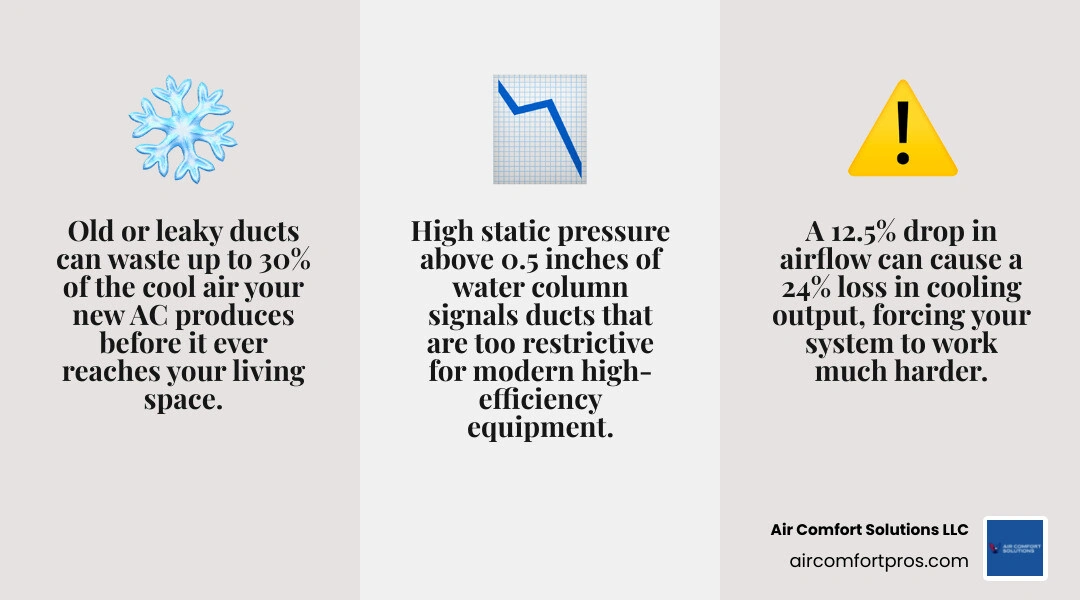
The ideal external static pressure for a residential duct system is between 0.3 and 0.5 Inches of Water Column (IWC). When static pressure climbs above 0.5 IWC, airflow begins to drop. If it reaches 0.8 IWC or higher, the system is severely choked, which can reduce cooling capacity by up to 24% with only a minor 12.5% reduction in actual airflow.
The material of your ducts also heavily influences airflow resistance. Smooth, rigid metal ducts offer very little resistance, while flexible ductwork—which is highly common in modern Texas homes—creates much more friction, especially if it is sagging, kinked, or has sharp bends.
| Duct Material Type | Relative Airflow Resistance | Common Lifespan | Vulnerability to Installation Mistakes |
|---|---|---|---|
| Rigid Sheet Metal | Low (Smooth surface allows fast, laminar airflow) | 20 to 30+ Years | Low (Sturdy and holds its shape well) |
| Flexible Ductwork | High (Internal wire ridges create air turbulence) | 15 Years | High (Sagging, sharp bends, and pinches drastically restrict airflow) |
| Fiberglass Duct Board | Medium (Rougher interior texture than metal) | 15 to 20 Years | Medium (Can degrade if exposed to moisture or physical damage) |
Ductwork does not last forever. While rigid sheet metal can easily last 30 years or more, flexible ductwork and fiberglass duct board typically have a lifespan of 15 to 25 years. Over time, materials degrade, joints pull apart, and insulation deteriorates in the extreme heat of a Texas attic, where summer temperatures can easily soar past 130°F.
If you are planning to install a new AC, look out for these common signs that your ducts need professional attention first:
To understand how proper installation practices impact your long-term comfort, read about How Ductwork Mistakes During Installation Hurt Your Comfort. Ensuring your ducts are properly sealed with professional-grade mastic sealant or foil-backed tape—rather than standard gray duct tape, which quickly breaks down in hot attics—is a critical step in preparing your home for a new AC.
Upgrading your home comfort system is a major decision, and it is completely natural to have questions about how your existing infrastructure will interact with new technology. Here are some of the most common questions we hear from homeowners in Pinehurst and the surrounding communities.
In many cases, yes, but it requires professional testing first. Modern high-efficiency systems (such as SEER2-compliant units) utilize larger, denser evaporator coils to maximize energy efficiency. These dense coils create more physical resistance to airflow than older, thinner coils.
If your existing ductwork is already undersized or has high static pressure, installing a high-SEER unit can cause severe blower motor strain, noisy operation, and even frozen coils. Before upgrading, we always recommend measuring your system's static pressure to ensure your ducts can handle the airflow requirements of modern equipment.
You should strongly consider replacing your ductwork if:
If your ducts are still structurally sound but have minor leaks, professional duct sealing and minor repairs are often a highly effective and practical alternative to a full replacement.
If your home's layout, tight attic space, or architectural style (such as historic homes with plaster walls or vaulted ceilings) makes it impossible to modify or expand your existing ductwork, you do not have to settle for poor performance.
Ductless mini-split systems are the perfect solution for these challenging spaces. By bypassing ductwork entirely, you can enjoy whisper-quiet comfort, incredible energy efficiency, and precise temperature control in every room without major renovations or cutting into your walls.
At the end of the day, your air conditioner and your ductwork are a team. Even the most advanced, high-efficiency AC system on the market will underperform, waste energy, and break down prematurely if it is forced to breathe through a restrictive, leaky, or outdated duct system.
At Air Comfort Pros, we have over 35 years of experience helping homeowners across Pinehurst, Magnolia, The Woodlands, Conroe, Spring, and Tomball find the perfect home comfort solutions. Our certified, experienced technicians can perform precise static pressure tests, evaluate your existing ductwork, and help you choose the ideal system for your home's unique layout and your family's comfort goals.
Are you ready to ensure your home's infrastructure is fully prepared for a high-efficiency comfort upgrade? Schedule Air Conditioning Services Today with our trusted local team!
How your existing ductwork affects your AC choices is one of the most overlooked factors when upgrading a cooling system — especially here in Pinehurst, TX, where summer heat puts every component of your HVAC system under serious stress.
Here is a quick answer if you need it now:
Think of it this way: upgrading your AC without evaluating your ductwork is like putting a high-performance engine into a car with clogged, worn-out fuel lines. The engine cannot perform, no matter how good it is. Your new AC unit is no different — it can only deliver the comfort and efficiency it promises if the duct system behind it is up to the job.
This guide walks you through everything you need to know, from airflow physics and static pressure to repair-versus-replace decisions and ductless alternatives, so you can make a confident, informed choice before your next AC installation.
When you start shopping for a new air conditioning system, it is easy to focus entirely on the outdoor condenser and the indoor evaporator coil. However, your ductwork is the vital highway system that delivers conditioned air to every room in your home. If that highway is narrow, bumpy, or full of exits that lead straight into your attic, your brand-new system will struggle.
To understand how your existing ductwork affects your AC choices, we first have to look at the relationship between static pressure and airflow capacity. Airflow is measured in Cubic Feet per Minute (CFM). As a general rule of thumb, every 1 ton of cooling capacity requires approximately 400 CFM of airflow to operate correctly. If you install a 3-ton air conditioner, your duct system must be physically capable of moving 1,200 CFM of air without excessive resistance.
When your existing ducts are too small or poorly designed, they restrict this vital airflow. This restriction increases the system's static pressure, which is essentially the resistance to airflow within your ducts. Think of it like blood pressure: when your blood vessels are narrow or clogged, your heart has to pump much harder to circulate blood. High static pressure forces your AC's blower motor to work overtime, which drastically reduces its overall operating efficiency and leads to premature system failure.
Before you make any final decisions about your next system, it is crucial to understand How to Choose the Right AC System for Your Home. If your existing ductwork is too restrictive, you may have to modify your duct system or adjust your equipment choices to prevent performance issues. Additionally, knowing What Size Air Conditioner Do I Need? is only half the battle; your ducts must be sized to match that equipment perfectly.
If you are planning to upgrade to a high-efficiency system—such as an 18 SEER2 or variable-speed unit—your existing ductwork will play a decisive role in whether that system can actually achieve its rated efficiency.
Modern high-efficiency systems use advanced evaporator coils with a much higher fin density than older, legacy units. These tightly packed aluminum fins maximize heat transfer, but they also create significantly more physical resistance to airflow. If your existing ductwork is already borderline restrictive, adding a high-efficiency coil with high fin density can push your system's static pressure into the danger zone.
Furthermore, modern variable-speed blower motors are designed to adjust their speed dynamically to maintain proper airflow. If these motors encounter high static pressure caused by restrictive ducts, they will ramp up to their maximum speed to force the air through. While this keeps the air moving, it also:
This is why proper sizing is so critical. To see how these factors interlock, read about How Incorrect Sizing During Installation Wastes Energy. If your ducts cannot support the dense coils and variable airflow of a high-SEER system, you may find that a standard-efficiency system is actually a more reliable choice unless you are willing to modify the ductwork.
The overall physical condition and layout of your ducts will often dictate whether you should stick with a traditional central AC, transition to an electric heat pump, or bypass your ducts entirely with a ductless mini-split system.
If your home has existing, well-maintained sheet metal ductwork, upgrading to a modern central AC or a central heat pump is usually a straightforward process. Heat pumps are highly versatile and efficient, but because they deliver slightly cooler supply air during the heating cycle compared to traditional gas furnaces, they often require a higher airflow rate (CFM) to keep your home feeling warm. This means your ducts must be in excellent shape and properly sized to handle the increased airflow demands of a heat pump.
On the other hand, if your existing ducts are located in a hard-to-reach crawlspace, are heavily deteriorated, or are completely undersized, the cost of repairing or replacing them can be substantial. In these scenarios, a ductless mini-split system becomes an incredibly attractive alternative.
Ductless systems use individual, wall-mounted indoor air handlers connected to an outdoor compressor via small refrigerant lines. By bypassing ductwork entirely, ductless mini-splits:
If you are located on the north side of Harris County or nearby areas, you can explore our comprehensive Ductwork Services in Conroe, TX to evaluate whether your current ducts can be salvaged or if a ductless alternative is your best path forward.
To ensure a new air conditioner works perfectly, professional HVAC contractors rely on a precise three-step design process established by the Air Conditioning Contractors of America (ACCA):
Without these calculations, installers are simply guessing. A common industry rule of thumb is that 1 ton of cooling capacity requires 400 CFM of airflow. If your home requires a 4-ton system, your ductwork must be designed to distribute 1,600 CFM smoothly throughout your home.
The ideal external static pressure for a residential duct system is between 0.3 and 0.5 Inches of Water Column (IWC). When static pressure climbs above 0.5 IWC, airflow begins to drop. If it reaches 0.8 IWC or higher, the system is severely choked, which can reduce cooling capacity by up to 24% with only a minor 12.5% reduction in actual airflow.
The material of your ducts also heavily influences airflow resistance. Smooth, rigid metal ducts offer very little resistance, while flexible ductwork—which is highly common in modern Texas homes—creates much more friction, especially if it is sagging, kinked, or has sharp bends.
| Duct Material Type | Relative Airflow Resistance | Common Lifespan | Vulnerability to Installation Mistakes |
|---|---|---|---|
| Rigid Sheet Metal | Low (Smooth surface allows fast, laminar airflow) | 20 to 30+ Years | Low (Sturdy and holds its shape well) |
| Flexible Ductwork | High (Internal wire ridges create air turbulence) | 15 Years | High (Sagging, sharp bends, and pinches drastically restrict airflow) |
| Fiberglass Duct Board | Medium (Rougher interior texture than metal) | 15 to 20 Years | Medium (Can degrade if exposed to moisture or physical damage) |
Ductwork does not last forever. While rigid sheet metal can easily last 30 years or more, flexible ductwork and fiberglass duct board typically have a lifespan of 15 to 25 years. Over time, materials degrade, joints pull apart, and insulation deteriorates in the extreme heat of a Texas attic, where summer temperatures can easily soar past 130°F.
If you are planning to install a new AC, look out for these common signs that your ducts need professional attention first:
To understand how proper installation practices impact your long-term comfort, read about How Ductwork Mistakes During Installation Hurt Your Comfort. Ensuring your ducts are properly sealed with professional-grade mastic sealant or foil-backed tape—rather than standard gray duct tape, which quickly breaks down in hot attics—is a critical step in preparing your home for a new AC.
Upgrading your home comfort system is a major decision, and it is completely natural to have questions about how your existing infrastructure will interact with new technology. Here are some of the most common questions we hear from homeowners in Pinehurst and the surrounding communities.
In many cases, yes, but it requires professional testing first. Modern high-efficiency systems (such as SEER2-compliant units) utilize larger, denser evaporator coils to maximize energy efficiency. These dense coils create more physical resistance to airflow than older, thinner coils.
If your existing ductwork is already undersized or has high static pressure, installing a high-SEER unit can cause severe blower motor strain, noisy operation, and even frozen coils. Before upgrading, we always recommend measuring your system's static pressure to ensure your ducts can handle the airflow requirements of modern equipment.
You should strongly consider replacing your ductwork if:
If your ducts are still structurally sound but have minor leaks, professional duct sealing and minor repairs are often a highly effective and practical alternative to a full replacement.
If your home's layout, tight attic space, or architectural style (such as historic homes with plaster walls or vaulted ceilings) makes it impossible to modify or expand your existing ductwork, you do not have to settle for poor performance.
Ductless mini-split systems are the perfect solution for these challenging spaces. By bypassing ductwork entirely, you can enjoy whisper-quiet comfort, incredible energy efficiency, and precise temperature control in every room without major renovations or cutting into your walls.
At the end of the day, your air conditioner and your ductwork are a team. Even the most advanced, high-efficiency AC system on the market will underperform, waste energy, and break down prematurely if it is forced to breathe through a restrictive, leaky, or outdated duct system.
At Air Comfort Pros, we have over 35 years of experience helping homeowners across Pinehurst, Magnolia, The Woodlands, Conroe, Spring, and Tomball find the perfect home comfort solutions. Our certified, experienced technicians can perform precise static pressure tests, evaluate your existing ductwork, and help you choose the ideal system for your home's unique layout and your family's comfort goals.
Are you ready to ensure your home's infrastructure is fully prepared for a high-efficiency comfort upgrade? Schedule Air Conditioning Services Today with our trusted local team!
How your existing ductwork affects your AC choices is one of the most overlooked factors when upgrading a cooling system — especially here in Pinehurst, TX, where summer heat puts every component of your HVAC system under serious stress.
Here is a quick answer if you need it now:
Think of it this way: upgrading your AC without evaluating your ductwork is like putting a high-performance engine into a car with clogged, worn-out fuel lines. The engine cannot perform, no matter how good it is. Your new AC unit is no different — it can only deliver the comfort and efficiency it promises if the duct system behind it is up to the job.
This guide walks you through everything you need to know, from airflow physics and static pressure to repair-versus-replace decisions and ductless alternatives, so you can make a confident, informed choice before your next AC installation.
When you start shopping for a new air conditioning system, it is easy to focus entirely on the outdoor condenser and the indoor evaporator coil. However, your ductwork is the vital highway system that delivers conditioned air to every room in your home. If that highway is narrow, bumpy, or full of exits that lead straight into your attic, your brand-new system will struggle.
To understand how your existing ductwork affects your AC choices, we first have to look at the relationship between static pressure and airflow capacity. Airflow is measured in Cubic Feet per Minute (CFM). As a general rule of thumb, every 1 ton of cooling capacity requires approximately 400 CFM of airflow to operate correctly. If you install a 3-ton air conditioner, your duct system must be physically capable of moving 1,200 CFM of air without excessive resistance.
When your existing ducts are too small or poorly designed, they restrict this vital airflow. This restriction increases the system's static pressure, which is essentially the resistance to airflow within your ducts. Think of it like blood pressure: when your blood vessels are narrow or clogged, your heart has to pump much harder to circulate blood. High static pressure forces your AC's blower motor to work overtime, which drastically reduces its overall operating efficiency and leads to premature system failure.
Before you make any final decisions about your next system, it is crucial to understand How to Choose the Right AC System for Your Home. If your existing ductwork is too restrictive, you may have to modify your duct system or adjust your equipment choices to prevent performance issues. Additionally, knowing What Size Air Conditioner Do I Need? is only half the battle; your ducts must be sized to match that equipment perfectly.
If you are planning to upgrade to a high-efficiency system—such as an 18 SEER2 or variable-speed unit—your existing ductwork will play a decisive role in whether that system can actually achieve its rated efficiency.
Modern high-efficiency systems use advanced evaporator coils with a much higher fin density than older, legacy units. These tightly packed aluminum fins maximize heat transfer, but they also create significantly more physical resistance to airflow. If your existing ductwork is already borderline restrictive, adding a high-efficiency coil with high fin density can push your system's static pressure into the danger zone.
Furthermore, modern variable-speed blower motors are designed to adjust their speed dynamically to maintain proper airflow. If these motors encounter high static pressure caused by restrictive ducts, they will ramp up to their maximum speed to force the air through. While this keeps the air moving, it also:
This is why proper sizing is so critical. To see how these factors interlock, read about How Incorrect Sizing During Installation Wastes Energy. If your ducts cannot support the dense coils and variable airflow of a high-SEER system, you may find that a standard-efficiency system is actually a more reliable choice unless you are willing to modify the ductwork.
The overall physical condition and layout of your ducts will often dictate whether you should stick with a traditional central AC, transition to an electric heat pump, or bypass your ducts entirely with a ductless mini-split system.
If your home has existing, well-maintained sheet metal ductwork, upgrading to a modern central AC or a central heat pump is usually a straightforward process. Heat pumps are highly versatile and efficient, but because they deliver slightly cooler supply air during the heating cycle compared to traditional gas furnaces, they often require a higher airflow rate (CFM) to keep your home feeling warm. This means your ducts must be in excellent shape and properly sized to handle the increased airflow demands of a heat pump.
On the other hand, if your existing ducts are located in a hard-to-reach crawlspace, are heavily deteriorated, or are completely undersized, the cost of repairing or replacing them can be substantial. In these scenarios, a ductless mini-split system becomes an incredibly attractive alternative.
Ductless systems use individual, wall-mounted indoor air handlers connected to an outdoor compressor via small refrigerant lines. By bypassing ductwork entirely, ductless mini-splits:
If you are located on the north side of Harris County or nearby areas, you can explore our comprehensive Ductwork Services in Conroe, TX to evaluate whether your current ducts can be salvaged or if a ductless alternative is your best path forward.
To ensure a new air conditioner works perfectly, professional HVAC contractors rely on a precise three-step design process established by the Air Conditioning Contractors of America (ACCA):
Without these calculations, installers are simply guessing. A common industry rule of thumb is that 1 ton of cooling capacity requires 400 CFM of airflow. If your home requires a 4-ton system, your ductwork must be designed to distribute 1,600 CFM smoothly throughout your home.
The ideal external static pressure for a residential duct system is between 0.3 and 0.5 Inches of Water Column (IWC). When static pressure climbs above 0.5 IWC, airflow begins to drop. If it reaches 0.8 IWC or higher, the system is severely choked, which can reduce cooling capacity by up to 24% with only a minor 12.5% reduction in actual airflow.
The material of your ducts also heavily influences airflow resistance. Smooth, rigid metal ducts offer very little resistance, while flexible ductwork—which is highly common in modern Texas homes—creates much more friction, especially if it is sagging, kinked, or has sharp bends.
| Duct Material Type | Relative Airflow Resistance | Common Lifespan | Vulnerability to Installation Mistakes |
|---|---|---|---|
| Rigid Sheet Metal | Low (Smooth surface allows fast, laminar airflow) | 20 to 30+ Years | Low (Sturdy and holds its shape well) |
| Flexible Ductwork | High (Internal wire ridges create air turbulence) | 15 Years | High (Sagging, sharp bends, and pinches drastically restrict airflow) |
| Fiberglass Duct Board | Medium (Rougher interior texture than metal) | 15 to 20 Years | Medium (Can degrade if exposed to moisture or physical damage) |
Ductwork does not last forever. While rigid sheet metal can easily last 30 years or more, flexible ductwork and fiberglass duct board typically have a lifespan of 15 to 25 years. Over time, materials degrade, joints pull apart, and insulation deteriorates in the extreme heat of a Texas attic, where summer temperatures can easily soar past 130°F.
If you are planning to install a new AC, look out for these common signs that your ducts need professional attention first:
To understand how proper installation practices impact your long-term comfort, read about How Ductwork Mistakes During Installation Hurt Your Comfort. Ensuring your ducts are properly sealed with professional-grade mastic sealant or foil-backed tape—rather than standard gray duct tape, which quickly breaks down in hot attics—is a critical step in preparing your home for a new AC.
Upgrading your home comfort system is a major decision, and it is completely natural to have questions about how your existing infrastructure will interact with new technology. Here are some of the most common questions we hear from homeowners in Pinehurst and the surrounding communities.
In many cases, yes, but it requires professional testing first. Modern high-efficiency systems (such as SEER2-compliant units) utilize larger, denser evaporator coils to maximize energy efficiency. These dense coils create more physical resistance to airflow than older, thinner coils.
If your existing ductwork is already undersized or has high static pressure, installing a high-SEER unit can cause severe blower motor strain, noisy operation, and even frozen coils. Before upgrading, we always recommend measuring your system's static pressure to ensure your ducts can handle the airflow requirements of modern equipment.
You should strongly consider replacing your ductwork if:
If your ducts are still structurally sound but have minor leaks, professional duct sealing and minor repairs are often a highly effective and practical alternative to a full replacement.
If your home's layout, tight attic space, or architectural style (such as historic homes with plaster walls or vaulted ceilings) makes it impossible to modify or expand your existing ductwork, you do not have to settle for poor performance.
Ductless mini-split systems are the perfect solution for these challenging spaces. By bypassing ductwork entirely, you can enjoy whisper-quiet comfort, incredible energy efficiency, and precise temperature control in every room without major renovations or cutting into your walls.
At the end of the day, your air conditioner and your ductwork are a team. Even the most advanced, high-efficiency AC system on the market will underperform, waste energy, and break down prematurely if it is forced to breathe through a restrictive, leaky, or outdated duct system.
At Air Comfort Pros, we have over 35 years of experience helping homeowners across Pinehurst, Magnolia, The Woodlands, Conroe, Spring, and Tomball find the perfect home comfort solutions. Our certified, experienced technicians can perform precise static pressure tests, evaluate your existing ductwork, and help you choose the ideal system for your home's unique layout and your family's comfort goals.
Are you ready to ensure your home's infrastructure is fully prepared for a high-efficiency comfort upgrade? Schedule Air Conditioning Services Today with our trusted local team!
How your existing ductwork affects your AC choices is one of the most overlooked factors when upgrading a cooling system — especially here in Pinehurst, TX, where summer heat puts every component of your HVAC system under serious stress.
Here is a quick answer if you need it now:
Think of it this way: upgrading your AC without evaluating your ductwork is like putting a high-performance engine into a car with clogged, worn-out fuel lines. The engine cannot perform, no matter how good it is. Your new AC unit is no different — it can only deliver the comfort and efficiency it promises if the duct system behind it is up to the job.
This guide walks you through everything you need to know, from airflow physics and static pressure to repair-versus-replace decisions and ductless alternatives, so you can make a confident, informed choice before your next AC installation.
When you start shopping for a new air conditioning system, it is easy to focus entirely on the outdoor condenser and the indoor evaporator coil. However, your ductwork is the vital highway system that delivers conditioned air to every room in your home. If that highway is narrow, bumpy, or full of exits that lead straight into your attic, your brand-new system will struggle.
To understand how your existing ductwork affects your AC choices, we first have to look at the relationship between static pressure and airflow capacity. Airflow is measured in Cubic Feet per Minute (CFM). As a general rule of thumb, every 1 ton of cooling capacity requires approximately 400 CFM of airflow to operate correctly. If you install a 3-ton air conditioner, your duct system must be physically capable of moving 1,200 CFM of air without excessive resistance.
When your existing ducts are too small or poorly designed, they restrict this vital airflow. This restriction increases the system's static pressure, which is essentially the resistance to airflow within your ducts. Think of it like blood pressure: when your blood vessels are narrow or clogged, your heart has to pump much harder to circulate blood. High static pressure forces your AC's blower motor to work overtime, which drastically reduces its overall operating efficiency and leads to premature system failure.
Before you make any final decisions about your next system, it is crucial to understand How to Choose the Right AC System for Your Home. If your existing ductwork is too restrictive, you may have to modify your duct system or adjust your equipment choices to prevent performance issues. Additionally, knowing What Size Air Conditioner Do I Need? is only half the battle; your ducts must be sized to match that equipment perfectly.
If you are planning to upgrade to a high-efficiency system—such as an 18 SEER2 or variable-speed unit—your existing ductwork will play a decisive role in whether that system can actually achieve its rated efficiency.
Modern high-efficiency systems use advanced evaporator coils with a much higher fin density than older, legacy units. These tightly packed aluminum fins maximize heat transfer, but they also create significantly more physical resistance to airflow. If your existing ductwork is already borderline restrictive, adding a high-efficiency coil with high fin density can push your system's static pressure into the danger zone.
Furthermore, modern variable-speed blower motors are designed to adjust their speed dynamically to maintain proper airflow. If these motors encounter high static pressure caused by restrictive ducts, they will ramp up to their maximum speed to force the air through. While this keeps the air moving, it also:
This is why proper sizing is so critical. To see how these factors interlock, read about How Incorrect Sizing During Installation Wastes Energy. If your ducts cannot support the dense coils and variable airflow of a high-SEER system, you may find that a standard-efficiency system is actually a more reliable choice unless you are willing to modify the ductwork.
The overall physical condition and layout of your ducts will often dictate whether you should stick with a traditional central AC, transition to an electric heat pump, or bypass your ducts entirely with a ductless mini-split system.
If your home has existing, well-maintained sheet metal ductwork, upgrading to a modern central AC or a central heat pump is usually a straightforward process. Heat pumps are highly versatile and efficient, but because they deliver slightly cooler supply air during the heating cycle compared to traditional gas furnaces, they often require a higher airflow rate (CFM) to keep your home feeling warm. This means your ducts must be in excellent shape and properly sized to handle the increased airflow demands of a heat pump.
On the other hand, if your existing ducts are located in a hard-to-reach crawlspace, are heavily deteriorated, or are completely undersized, the cost of repairing or replacing them can be substantial. In these scenarios, a ductless mini-split system becomes an incredibly attractive alternative.
Ductless systems use individual, wall-mounted indoor air handlers connected to an outdoor compressor via small refrigerant lines. By bypassing ductwork entirely, ductless mini-splits:
If you are located on the north side of Harris County or nearby areas, you can explore our comprehensive Ductwork Services in Conroe, TX to evaluate whether your current ducts can be salvaged or if a ductless alternative is your best path forward.
To ensure a new air conditioner works perfectly, professional HVAC contractors rely on a precise three-step design process established by the Air Conditioning Contractors of America (ACCA):
Without these calculations, installers are simply guessing. A common industry rule of thumb is that 1 ton of cooling capacity requires 400 CFM of airflow. If your home requires a 4-ton system, your ductwork must be designed to distribute 1,600 CFM smoothly throughout your home.
The ideal external static pressure for a residential duct system is between 0.3 and 0.5 Inches of Water Column (IWC). When static pressure climbs above 0.5 IWC, airflow begins to drop. If it reaches 0.8 IWC or higher, the system is severely choked, which can reduce cooling capacity by up to 24% with only a minor 12.5% reduction in actual airflow.
The material of your ducts also heavily influences airflow resistance. Smooth, rigid metal ducts offer very little resistance, while flexible ductwork—which is highly common in modern Texas homes—creates much more friction, especially if it is sagging, kinked, or has sharp bends.
| Duct Material Type | Relative Airflow Resistance | Common Lifespan | Vulnerability to Installation Mistakes |
|---|---|---|---|
| Rigid Sheet Metal | Low (Smooth surface allows fast, laminar airflow) | 20 to 30+ Years | Low (Sturdy and holds its shape well) |
| Flexible Ductwork | High (Internal wire ridges create air turbulence) | 15 Years | High (Sagging, sharp bends, and pinches drastically restrict airflow) |
| Fiberglass Duct Board | Medium (Rougher interior texture than metal) | 15 to 20 Years | Medium (Can degrade if exposed to moisture or physical damage) |
Ductwork does not last forever. While rigid sheet metal can easily last 30 years or more, flexible ductwork and fiberglass duct board typically have a lifespan of 15 to 25 years. Over time, materials degrade, joints pull apart, and insulation deteriorates in the extreme heat of a Texas attic, where summer temperatures can easily soar past 130°F.
If you are planning to install a new AC, look out for these common signs that your ducts need professional attention first:
To understand how proper installation practices impact your long-term comfort, read about How Ductwork Mistakes During Installation Hurt Your Comfort. Ensuring your ducts are properly sealed with professional-grade mastic sealant or foil-backed tape—rather than standard gray duct tape, which quickly breaks down in hot attics—is a critical step in preparing your home for a new AC.
Upgrading your home comfort system is a major decision, and it is completely natural to have questions about how your existing infrastructure will interact with new technology. Here are some of the most common questions we hear from homeowners in Pinehurst and the surrounding communities.
In many cases, yes, but it requires professional testing first. Modern high-efficiency systems (such as SEER2-compliant units) utilize larger, denser evaporator coils to maximize energy efficiency. These dense coils create more physical resistance to airflow than older, thinner coils.
If your existing ductwork is already undersized or has high static pressure, installing a high-SEER unit can cause severe blower motor strain, noisy operation, and even frozen coils. Before upgrading, we always recommend measuring your system's static pressure to ensure your ducts can handle the airflow requirements of modern equipment.
You should strongly consider replacing your ductwork if:
If your ducts are still structurally sound but have minor leaks, professional duct sealing and minor repairs are often a highly effective and practical alternative to a full replacement.
If your home's layout, tight attic space, or architectural style (such as historic homes with plaster walls or vaulted ceilings) makes it impossible to modify or expand your existing ductwork, you do not have to settle for poor performance.
Ductless mini-split systems are the perfect solution for these challenging spaces. By bypassing ductwork entirely, you can enjoy whisper-quiet comfort, incredible energy efficiency, and precise temperature control in every room without major renovations or cutting into your walls.
At the end of the day, your air conditioner and your ductwork are a team. Even the most advanced, high-efficiency AC system on the market will underperform, waste energy, and break down prematurely if it is forced to breathe through a restrictive, leaky, or outdated duct system.
At Air Comfort Pros, we have over 35 years of experience helping homeowners across Pinehurst, Magnolia, The Woodlands, Conroe, Spring, and Tomball find the perfect home comfort solutions. Our certified, experienced technicians can perform precise static pressure tests, evaluate your existing ductwork, and help you choose the ideal system for your home's unique layout and your family's comfort goals.
Are you ready to ensure your home's infrastructure is fully prepared for a high-efficiency comfort upgrade? Schedule Air Conditioning Services Today with our trusted local team!
How your existing ductwork affects your AC choices is one of the most overlooked factors when upgrading a cooling system — especially here in Pinehurst, TX, where summer heat puts every component of your HVAC system under serious stress.
Here is a quick answer if you need it now:
Think of it this way: upgrading your AC without evaluating your ductwork is like putting a high-performance engine into a car with clogged, worn-out fuel lines. The engine cannot perform, no matter how good it is. Your new AC unit is no different — it can only deliver the comfort and efficiency it promises if the duct system behind it is up to the job.
This guide walks you through everything you need to know, from airflow physics and static pressure to repair-versus-replace decisions and ductless alternatives, so you can make a confident, informed choice before your next AC installation.
When you start shopping for a new air conditioning system, it is easy to focus entirely on the outdoor condenser and the indoor evaporator coil. However, your ductwork is the vital highway system that delivers conditioned air to every room in your home. If that highway is narrow, bumpy, or full of exits that lead straight into your attic, your brand-new system will struggle.
To understand how your existing ductwork affects your AC choices, we first have to look at the relationship between static pressure and airflow capacity. Airflow is measured in Cubic Feet per Minute (CFM). As a general rule of thumb, every 1 ton of cooling capacity requires approximately 400 CFM of airflow to operate correctly. If you install a 3-ton air conditioner, your duct system must be physically capable of moving 1,200 CFM of air without excessive resistance.
When your existing ducts are too small or poorly designed, they restrict this vital airflow. This restriction increases the system's static pressure, which is essentially the resistance to airflow within your ducts. Think of it like blood pressure: when your blood vessels are narrow or clogged, your heart has to pump much harder to circulate blood. High static pressure forces your AC's blower motor to work overtime, which drastically reduces its overall operating efficiency and leads to premature system failure.
Before you make any final decisions about your next system, it is crucial to understand How to Choose the Right AC System for Your Home. If your existing ductwork is too restrictive, you may have to modify your duct system or adjust your equipment choices to prevent performance issues. Additionally, knowing What Size Air Conditioner Do I Need? is only half the battle; your ducts must be sized to match that equipment perfectly.
If you are planning to upgrade to a high-efficiency system—such as an 18 SEER2 or variable-speed unit—your existing ductwork will play a decisive role in whether that system can actually achieve its rated efficiency.
Modern high-efficiency systems use advanced evaporator coils with a much higher fin density than older, legacy units. These tightly packed aluminum fins maximize heat transfer, but they also create significantly more physical resistance to airflow. If your existing ductwork is already borderline restrictive, adding a high-efficiency coil with high fin density can push your system's static pressure into the danger zone.
Furthermore, modern variable-speed blower motors are designed to adjust their speed dynamically to maintain proper airflow. If these motors encounter high static pressure caused by restrictive ducts, they will ramp up to their maximum speed to force the air through. While this keeps the air moving, it also:
This is why proper sizing is so critical. To see how these factors interlock, read about How Incorrect Sizing During Installation Wastes Energy. If your ducts cannot support the dense coils and variable airflow of a high-SEER system, you may find that a standard-efficiency system is actually a more reliable choice unless you are willing to modify the ductwork.
The overall physical condition and layout of your ducts will often dictate whether you should stick with a traditional central AC, transition to an electric heat pump, or bypass your ducts entirely with a ductless mini-split system.
If your home has existing, well-maintained sheet metal ductwork, upgrading to a modern central AC or a central heat pump is usually a straightforward process. Heat pumps are highly versatile and efficient, but because they deliver slightly cooler supply air during the heating cycle compared to traditional gas furnaces, they often require a higher airflow rate (CFM) to keep your home feeling warm. This means your ducts must be in excellent shape and properly sized to handle the increased airflow demands of a heat pump.
On the other hand, if your existing ducts are located in a hard-to-reach crawlspace, are heavily deteriorated, or are completely undersized, the cost of repairing or replacing them can be substantial. In these scenarios, a ductless mini-split system becomes an incredibly attractive alternative.
Ductless systems use individual, wall-mounted indoor air handlers connected to an outdoor compressor via small refrigerant lines. By bypassing ductwork entirely, ductless mini-splits:
If you are located on the north side of Harris County or nearby areas, you can explore our comprehensive Ductwork Services in Conroe, TX to evaluate whether your current ducts can be salvaged or if a ductless alternative is your best path forward.
To ensure a new air conditioner works perfectly, professional HVAC contractors rely on a precise three-step design process established by the Air Conditioning Contractors of America (ACCA):
Without these calculations, installers are simply guessing. A common industry rule of thumb is that 1 ton of cooling capacity requires 400 CFM of airflow. If your home requires a 4-ton system, your ductwork must be designed to distribute 1,600 CFM smoothly throughout your home.
The ideal external static pressure for a residential duct system is between 0.3 and 0.5 Inches of Water Column (IWC). When static pressure climbs above 0.5 IWC, airflow begins to drop. If it reaches 0.8 IWC or higher, the system is severely choked, which can reduce cooling capacity by up to 24% with only a minor 12.5% reduction in actual airflow.
The material of your ducts also heavily influences airflow resistance. Smooth, rigid metal ducts offer very little resistance, while flexible ductwork—which is highly common in modern Texas homes—creates much more friction, especially if it is sagging, kinked, or has sharp bends.
| Duct Material Type | Relative Airflow Resistance | Common Lifespan | Vulnerability to Installation Mistakes |
|---|---|---|---|
| Rigid Sheet Metal | Low (Smooth surface allows fast, laminar airflow) | 20 to 30+ Years | Low (Sturdy and holds its shape well) |
| Flexible Ductwork | High (Internal wire ridges create air turbulence) | 15 Years | High (Sagging, sharp bends, and pinches drastically restrict airflow) |
| Fiberglass Duct Board | Medium (Rougher interior texture than metal) | 15 to 20 Years | Medium (Can degrade if exposed to moisture or physical damage) |
Ductwork does not last forever. While rigid sheet metal can easily last 30 years or more, flexible ductwork and fiberglass duct board typically have a lifespan of 15 to 25 years. Over time, materials degrade, joints pull apart, and insulation deteriorates in the extreme heat of a Texas attic, where summer temperatures can easily soar past 130°F.
If you are planning to install a new AC, look out for these common signs that your ducts need professional attention first:
To understand how proper installation practices impact your long-term comfort, read about How Ductwork Mistakes During Installation Hurt Your Comfort. Ensuring your ducts are properly sealed with professional-grade mastic sealant or foil-backed tape—rather than standard gray duct tape, which quickly breaks down in hot attics—is a critical step in preparing your home for a new AC.
Upgrading your home comfort system is a major decision, and it is completely natural to have questions about how your existing infrastructure will interact with new technology. Here are some of the most common questions we hear from homeowners in Pinehurst and the surrounding communities.
In many cases, yes, but it requires professional testing first. Modern high-efficiency systems (such as SEER2-compliant units) utilize larger, denser evaporator coils to maximize energy efficiency. These dense coils create more physical resistance to airflow than older, thinner coils.
If your existing ductwork is already undersized or has high static pressure, installing a high-SEER unit can cause severe blower motor strain, noisy operation, and even frozen coils. Before upgrading, we always recommend measuring your system's static pressure to ensure your ducts can handle the airflow requirements of modern equipment.
You should strongly consider replacing your ductwork if:
If your ducts are still structurally sound but have minor leaks, professional duct sealing and minor repairs are often a highly effective and practical alternative to a full replacement.
If your home's layout, tight attic space, or architectural style (such as historic homes with plaster walls or vaulted ceilings) makes it impossible to modify or expand your existing ductwork, you do not have to settle for poor performance.
Ductless mini-split systems are the perfect solution for these challenging spaces. By bypassing ductwork entirely, you can enjoy whisper-quiet comfort, incredible energy efficiency, and precise temperature control in every room without major renovations or cutting into your walls.
At the end of the day, your air conditioner and your ductwork are a team. Even the most advanced, high-efficiency AC system on the market will underperform, waste energy, and break down prematurely if it is forced to breathe through a restrictive, leaky, or outdated duct system.
At Air Comfort Pros, we have over 35 years of experience helping homeowners across Pinehurst, Magnolia, The Woodlands, Conroe, Spring, and Tomball find the perfect home comfort solutions. Our certified, experienced technicians can perform precise static pressure tests, evaluate your existing ductwork, and help you choose the ideal system for your home's unique layout and your family's comfort goals.
Are you ready to ensure your home's infrastructure is fully prepared for a high-efficiency comfort upgrade? Schedule Air Conditioning Services Today with our trusted local team!


Zane came out and did an amazing job! Super friendly, honest and transparent about the work that needed to be done. This is my second time working with Air Comfort Solutions and they’re my go to for HVAC services. Highly recommend.
God's AMAZING grace sent us Robert and Zane. We have been without air in this Texas heat for six weeks and four days. We've had a few contractors give us quotes all trying to upsell when we're at a low point. But not the guys at Air Comfort Solutions. They came in assessed our situation, gave us honest feedback, and showed us the issues as they proceeded with the assessment for clear understanding. We highly recommend them for their professionalism, quality products, and fair pricing. We hands down support them for all the work they do 💯 %.
Robert and Zane gone above and beyond to make the process easy and affordable.
Would definitely recommend!!
I’m writing this review to let everyone know that Air Comfort Solutions is the company to work with. I know the owner ( Robert) for several years now. He has been taking care of my residential and business work orders. Robert is professional, knowledgeable and will save you money. I just want to thank Robert for great job you have been doing for me.