The Reality of Scheduling Fall HVAC Maintenance Before the Rush
When the first Texas cold snap hits, same-day service becomes a week-long wait. Booking your heating tune-up in September is the only way to bypass the rush and guarantee a warm home.

If you've ever wondered what size air conditioner do I need for your home, you're asking one of the most important HVAC questions you can ask — especially in North Harris County, where summer heat is relentless and an undersized or oversized unit can mean months of discomfort and wasted energy.
Here's a quick-reference guide to get you started:
AC Size by Home Square Footage (General Estimate)
• 600 – 1,000 — Recommended AC Size: 1.5 tons (18,000 BTU)
• 1,000 – 1,300 — Recommended AC Size: 2 tons (24,000 BTU)
• 1,300 – 1,600 — Recommended AC Size: 2.5 tons (30,000 BTU)
• 1,600 – 1,900 — Recommended AC Size: 3 tons (36,000 BTU)
• 1,900 – 2,200 — Recommended AC Size: 3.5 tons (42,000 BTU)
• 2,200 – 2,600 — Recommended AC Size: 4 tons (48,000 BTU)
• 2,600 – 3,200 — Recommended AC Size: 5 tons (60,000 BTU)
Note: These are starting estimates. In hot, humid climates like Pinehurst, TX, you'll often need to size up. A professional Manual J load calculation gives you the most accurate result.
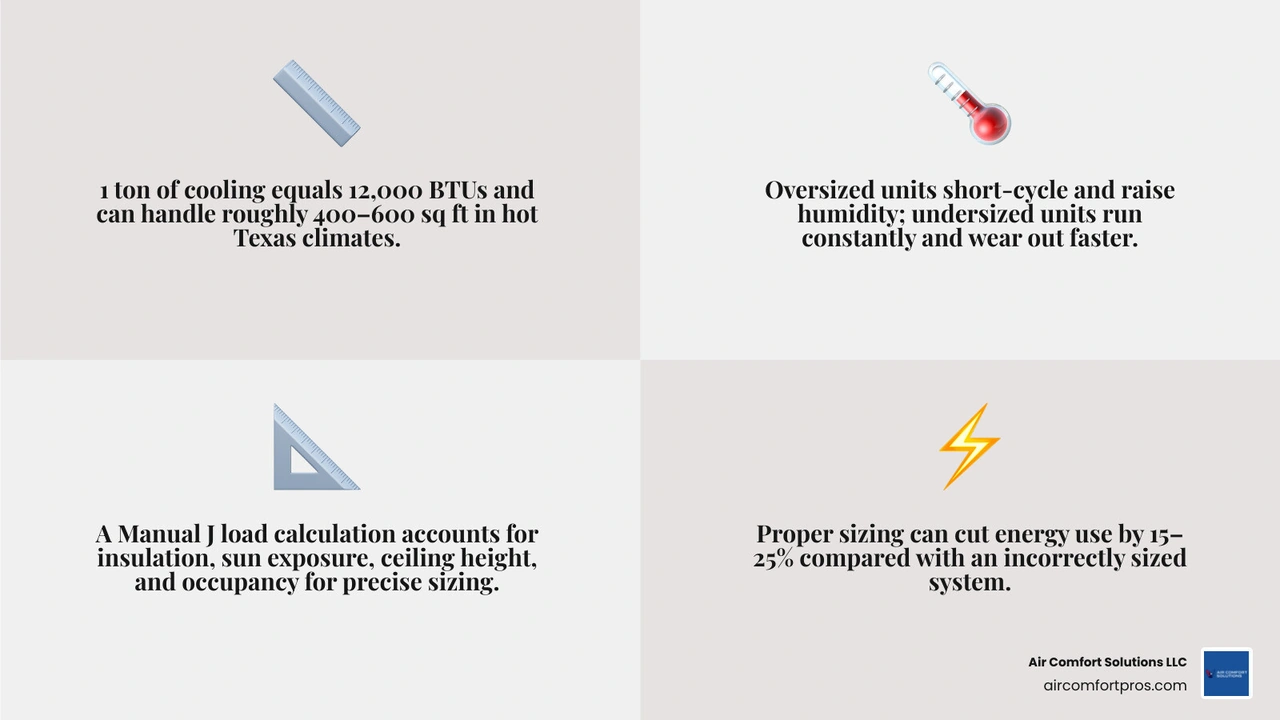
Getting the size wrong in either direction causes real problems. An oversized unit short-cycles — it cools the air fast but shuts off before pulling enough humidity out, leaving your home feeling cold and clammy. An undersized unit runs nonstop, struggles on the hottest days, and wears out far sooner than it should. According to industry data, an oversized AC can consume 15–25% more electricity than a properly sized system, simply due to the extra energy burned on repeated start-up cycles.
Central AC systems typically last 15–20 years, which means the sizing decision you make today will affect your comfort and energy bills for a long time. Getting it right from the start — whether you're replacing an aging system or installing one for the first time — is well worth the effort.
For a deeper look at when it makes sense to upgrade your system entirely, see Optimal Times for Upgrading Your Home's Air Conditioning System.
The sections below walk you through how BTU and tonnage work, how square footage and climate affect sizing, and why factors like insulation, ceiling height, and sun exposure matter just as much as your home's footprint.
What size air conditioner do i need terms made easy:
• best ac system for hot humid climates
• high efficiency ac features worth paying for
To accurately answer what size air conditioner do I need, we must first clarify the two primary units of measurement used in the heating and cooling industry: BTUs and tonnage.
A BTU, or British Thermal Unit, is a basic measure of thermal energy. Specifically, it is the amount of energy required to raise or lower the temperature of one pound of water by one degree Fahrenheit at sea level. In air conditioning, BTU ratings indicate the system's cooling capacity — meaning how much heat the unit can remove from an indoor space in one hour. The higher the BTU rating, the more heat the air conditioner can extract from your home.
When dealing with central air conditioning systems, you will hear the term "ton" or "tonnage" used far more often than BTUs. It is important to know that tonnage has absolutely nothing to do with the physical weight of the air conditioner itself.
Instead, the term dates back to the 19th-century ice-harvesting trade. Historically, cooling was achieved using large blocks of ice. One "ton" of cooling capacity is defined as the amount of heat energy required to completely melt one short ton (2,000 pounds) of ice over a 24-hour period. Because it takes 286,000 BTUs to melt that much ice, dividing this number by 24 hours yields approximately 12,000 BTUs per hour.
Therefore, one ton of air conditioning capacity equals exactly 12,000 BTUs per hour.
Converting between BTUs and tonnage is straightforward. You can easily switch between the two using these simple formulas:
• BTUs to Tons: Total BTUs / 12,000 = Tons of Cooling Capacity
• Tons to BTUs: Tons x 12,000 = Total BTUs
To help you visualize these differences, here is a quick-reference table comparing standard residential AC sizes:
• 1.5 Tons — Cooling Capacity (BTUs per Hour): 18,000 BTU/hr
• 2.0 Tons — Cooling Capacity (BTUs per Hour): 24,000 BTU/hr
• 2.5 Tons — Cooling Capacity (BTUs per Hour): 30,000 BTU/hr
• 3.0 Tons — Cooling Capacity (BTUs per Hour): 36,000 BTU/hr
• 3.5 Tons — Cooling Capacity (BTUs per Hour): 42,000 BTU/hr
• 4.0 Tons — Cooling Capacity (BTUs per Hour): 48,000 BTU/hr
• 5.0 Tons — Cooling Capacity (BTUs per Hour): 60,000 BTU/hr
Most residential central air systems range from 1.5 to 5 tons, usually increasing in half-ton increments. If a home requires more than 5 tons of cooling, HVAC experts will typically install multiple systems to distribute the load evenly and provide better temperature control.
How efficiently your system delivers this cooling capacity depends heavily on its design. To learn more about how efficiency standards factor into your decision, read our guide on What is a SEER2 Rating on an AC Unit.
Determining the exact cooling capacity your home needs involves looking at square footage, regional climate, and system design. While online calculators provide a helpful starting point, understanding the mechanics behind these estimates helps you make a more informed decision.
A basic rule of thumb used in the HVAC industry is that a home needs about 20 to 60 BTUs per square foot of living space. However, this wide range exists because of regional climate differences.
The United States is divided into different climate zones. Cooler northern states might only require 20 to 30 BTUs per square foot because their peak summer temperatures are mild. In contrast, the Texas Gulf Coast — including Houston, Pinehurst, Spring, and Conroe — sits in a hot, humid climate zone where cooling loads are exceptionally high. In our local area, homes typically require 40 to 60 BTUs per square foot to maintain comfortable indoor temperatures during the peak of summer.
Because we experience prolonged triple-digit heat and high humidity, relying on generic national averages can lead to buying an undersized system that will fail to keep your family comfortable. For localized advice, check out our AC Replacement Guide Pinehurst TX or explore our comprehensive AC Replacement Houston TX Complete Guide.
To give you a realistic idea of what your home might require in our hot southern climate, here is a list of baseline square footage ranges mapped to recommended tonnage:
• 800 to 1,200 sq ft: Typically requires a 2-ton unit (24,000 BTUs)
• 1,200 to 1,500 sq ft: Typically requires a 2.5-ton unit (30,000 BTUs)
• 1,500 to 1,800 sq ft: Typically requires a 3-ton unit (36,000 BTUs)
• 1,800 to 2,200 sq ft: Typically requires a 3.5-ton unit (42,000 BTUs)
• 2,200 to 2,500 sq ft: Typically requires a 4-ton unit (48,000 BTUs)
• 2,500 to 3,000+ sq ft: Typically requires a 5-ton unit (60,000 BTUs) or dual systems
If you own a standard 2,000 square-foot home in places like The Woodlands, Montgomery, or Tomball, you are likely looking at a 3.5-ton or 4-ton AC unit.
In a milder climate, a 3-ton unit might suffice for a 2,000 square-foot layout. However, in Texas, a 3-ton unit will often struggle to keep up on a July afternoon, leading to continuous operation and high energy bills. Conversely, a 5-ton system would be vastly oversized, causing rapid short-cycling and leaving your home feeling humid.
Choosing between a 3.5-ton and a 4-ton system for a 2,000 square-foot home depends heavily on your home’s insulation, window quality, and layout. If you are debating the long-term savings of upgrading your system, read our analysis on Is a High Efficiency AC Worth the Extra Cost in Texas.
The type of air conditioning system you install also influences how you calculate your required capacity:
• Central AC: Central systems must be sized to cool the entire home at once. Because the air travels through a network of ducts, sizing must account for ductwork heat gain and potential airflow restrictions.
• Ductless Mini-Splits: These systems are highly efficient because they cool specific zones or individual rooms directly, eliminating duct losses. Mini-splits are excellent for home additions or older homes in Magnolia and Plantersville that lack existing ductwork.
• Window and Portable Units: These are temporary, single-room solutions. While window units vent heat directly outside, portable ACs emit some radiant heat back into the room from their exhaust hoses. Because of this, portable units require a slightly higher BTU rating (often measured using Department of Energy or DOE standards) to cool the same square footage as a window unit.
While square footage is a great starting point, it is only one piece of the puzzle. Two homes of the exact same size can require completely different AC capacities based on how they are built and oriented.
When we perform a professional load calculation, we look closely at several critical variables:
• Home Insulation Quality: Modern homes built with high-quality wall insulation (like R-19 or R-21) and thick attic insulation (R-38 or higher) trap cool air exceptionally well. Older homes with settled or missing insulation allow heat to seep in quickly, requiring a larger AC capacity to offset the heat gain.
• Windows and Sun Exposure: Windows are the weakest point in your home's thermal envelope. The number of windows, their direction (south and west-facing windows let in massive amounts of radiant heat), and whether they have double-pane glass or low-E coatings significantly alter your cooling load. Direct, unshaded sunlight hitting windows can increase a room's cooling requirements by 10% to 15%.
• Ceiling Height: Standard sizing calculations assume an 8-foot ceiling. If your home in Conroe or Spring features vaulted ceilings or open-concept living areas with 10-foot or 12-foot ceilings, you have a much larger volume of air to cool. As a rule of thumb, we add 10% to the cooling load for 9-foot ceilings and 20% for 10-foot ceilings.
• Occupancy Load: People generate body heat. A standard cooling calculation assumes two regular occupants. For every additional person who lives in the home, you must add approximately 600 BTUs of cooling capacity to the overall calculation.
• Heat-Generating Appliances: Kitchens are notorious for retaining heat due to ovens, stoves, dishwashers, and refrigerators. We automatically add about 4,000 BTUs to the calculation for kitchens. Additionally, home offices with multiple computers, monitors, and servers require extra cooling capacity (roughly 400 BTUs per active electronic device).
Understanding these variables helps explain why two seemingly identical homes might need different systems. To see how standard and high-efficiency systems handle these varying loads, check out our Standard Efficiency vs High Efficiency AC Comparison.
Installing the wrong size air conditioner is a mistake that can haunt you for years. It affects your daily comfort, your monthly utility bills, and the physical lifespan of your equipment.
Many homeowners assume that "bigger is always better" when it comes to air conditioning. In reality, an oversized system is a recipe for a cold, clammy, and expensive home.
Because the system has too much cooling power, it lowers the indoor temperature incredibly fast. While this might sound nice, it causes the system to short-cycle. The AC turns on, runs for a few minutes, satisfies the thermostat, and shuts off.
Because it runs in short bursts, it never completes a full cooling cycle. Air conditioners require continuous operation to pull moisture out of the air. When a system short-cycles, the humidity remains trapped inside. This results in a home that feels cold but damp — creating a perfect breeding ground for mold, mildew, and musty odors. Furthermore, the constant starting and stopping places immense mechanical stress on the compressor, wearing out components up to three times faster and spiking your electricity bills.
An undersized air conditioner faces the opposite problem: it simply cannot keep up with the heat. On a typical summer afternoon, an undersized unit will run continuously without ever reaching your target thermostat setting.
Because the system is running in permanent overdrive, its mechanical components will wear out prematurely. You will face frequent breakdowns, a shorter system lifespan, and sky-high energy bills from a compressor that never turns off.
If your current system is struggling, you may be facing the classic dilemma of whether to patch it up or start fresh. For practical advice on making this choice, read How to Decide Between AC Repair and Replacement and learn about The $5000 Dollar Rule for AC Replacement.
A Manual J load calculation is the standard, mathematically precise method developed by the Air Conditioning Contractors of America (ACCA) to determine a building's exact heating and cooling loads.
Unlike rough square-footage estimates, a Manual J calculation takes into account dozens of specific details about your home. This includes your home’s exact geographic location, wall construction, roof type, insulation levels, window orientation, ductwork layout, and even the color of your roof shingles. It is the only industry-approved method for ensuring your new air conditioner is sized perfectly for your unique living space.
SEER2 (Seasonal Energy Efficiency Ratio 2) measures how efficiently an air conditioner uses electricity over an entire cooling season.
It is important to understand that SEER2 ratings measure efficiency, not capacity. A 3-ton unit rated at 15 SEER2 and a 3-ton unit rated at 20 SEER2 provide the exact same amount of cooling power (36,000 BTUs). However, the 20 SEER2 system will use significantly less electricity to deliver that cooling, resulting in lower monthly bills. To understand how these efficiency ratings translate into real-world savings, take a look at How SEER2 Ratings Affect Energy Bills.
If you want to know the size of your current air conditioner, you can usually find it hidden within the model number printed on the outdoor condenser's manufacturer label.
Manufacturers do not write "3 tons" on the label. Instead, they encode the capacity in BTUs. Look for a two-digit number in the middle of the model number that is divisible by 6 or 12. These digits represent the nominal cooling capacity in thousands of BTUs.
For example, if your model number is GSX140241K:
• Locate the digits 24 in the middle.
• This indicates the unit is rated for 24,000 BTUs.
• Divide 24,000 by 12,000 (the BTUs in one ton).
• Your existing system is a 2-ton unit.
Common numbers to look for include:
• 18 = 1.5 tons (18,000 BTUs)
• 24 = 2.0 tons (24,000 BTUs)
• 30 = 2.5 tons (30,000 BTUs)
• 36 = 3.0 tons (36,000 BTUs)
• 42 = 3.5 tons (42,000 BTUs)
• 48 = 4.0 tons (48,000 BTUs)
• 60 = 5.0 tons (60,000 BTUs)
Finding the perfect answer to what size air conditioner do I need is about more than just matching a number on a chart to your home's square footage. It requires balancing insulation quality, window placements, ceiling heights, and the intense demands of our local Texas climate.
While rough calculations and online guides are great for planning, nothing replaces the accuracy of a professional home assessment. Sizing your system correctly protects your investment, keeps your energy bills manageable, and ensures your home remains a cool, dry sanctuary all summer long.
At Air Comfort Solutions LLC, we have over 35 years of experience helping homeowners across Pinehurst, Plantersville, Magnolia, Houston, The Woodlands, Montgomery, Conroe, Spring, and Tomball stay comfortable in every season. Our certified, licensed technicians provide honest, upfront assessments and precise Manual J calculations to ensure your new system is sized perfectly for your home.
Ready to secure dependable comfort for your Texas home? Contact us today to schedule a professional assessment or explore our Air Conditioning Services to learn more about how we can help you stay cool.
If you've ever wondered what size air conditioner do I need for your home, you're asking one of the most important HVAC questions you can ask — especially in North Harris County, where summer heat is relentless and an undersized or oversized unit can mean months of discomfort and wasted energy.
Here's a quick-reference guide to get you started:
AC Size by Home Square Footage (General Estimate)
| Home Size (sq ft) | Recommended AC Size |
|---|---|
| 600 – 1,000 | 1.5 tons (18,000 BTU) |
| 1,000 – 1,300 | 2 tons (24,000 BTU) |
| 1,300 – 1,600 | 2.5 tons (30,000 BTU) |
| 1,600 – 1,900 | 3 tons (36,000 BTU) |
| 1,900 – 2,200 | 3.5 tons (42,000 BTU) |
| 2,200 – 2,600 | 4 tons (48,000 BTU) |
| 2,600 – 3,200 | 5 tons (60,000 BTU) |
Note: These are starting estimates. In hot, humid climates like Pinehurst, TX, you'll often need to size up. A professional Manual J load calculation gives you the most accurate result.
Getting the size wrong in either direction causes real problems. An oversized unit short-cycles — it cools the air fast but shuts off before pulling enough humidity out, leaving your home feeling cold and clammy. An undersized unit runs nonstop, struggles on the hottest days, and wears out far sooner than it should. According to industry data, an oversized AC can consume 15–25% more electricity than a properly sized system, simply due to the extra energy burned on repeated start-up cycles.
Central AC systems typically last 15–20 years, which means the sizing decision you make today will affect your comfort and energy bills for a long time. Getting it right from the start — whether you're replacing an aging system or installing one for the first time — is well worth the effort.
For a deeper look at when it makes sense to upgrade your system entirely, see Optimal Times for Upgrading Your Home's Air Conditioning System.
The sections below walk you through how BTU and tonnage work, how square footage and climate affect sizing, and why factors like insulation, ceiling height, and sun exposure matter just as much as your home's footprint.
What size air conditioner do i need terms made easy:
To accurately answer what size air conditioner do I need, we must first clarify the two primary units of measurement used in the heating and cooling industry: BTUs and tonnage.
A BTU, or British Thermal Unit, is a basic measure of thermal energy. Specifically, it is the amount of energy required to raise or lower the temperature of one pound of water by one degree Fahrenheit at sea level. In air conditioning, BTU ratings indicate the system's cooling capacity — meaning how much heat the unit can remove from an indoor space in one hour. The higher the BTU rating, the more heat the air conditioner can extract from your home.
When dealing with central air conditioning systems, you will hear the term "ton" or "tonnage" used far more often than BTUs. It is important to know that tonnage has absolutely nothing to do with the physical weight of the air conditioner itself.
Instead, the term dates back to the 19th-century ice-harvesting trade. Historically, cooling was achieved using large blocks of ice. One "ton" of cooling capacity is defined as the amount of heat energy required to completely melt one short ton (2,000 pounds) of ice over a 24-hour period. Because it takes 286,000 BTUs to melt that much ice, dividing this number by 24 hours yields approximately 12,000 BTUs per hour.
Therefore, one ton of air conditioning capacity equals exactly 12,000 BTUs per hour.
Converting between BTUs and tonnage is straightforward. You can easily switch between the two using these simple formulas:
To help you visualize these differences, here is a quick-reference table comparing standard residential AC sizes:
| AC Tonnage | Cooling Capacity (BTUs per Hour) |
|---|---|
| 1.5 Tons | 18,000 BTU/hr |
| 2.0 Tons | 24,000 BTU/hr |
| 2.5 Tons | 30,000 BTU/hr |
| 3.0 Tons | 36,000 BTU/hr |
| 3.5 Tons | 42,000 BTU/hr |
| 4.0 Tons | 48,000 BTU/hr |
| 5.0 Tons | 60,000 BTU/hr |
Most residential central air systems range from 1.5 to 5 tons, usually increasing in half-ton increments. If a home requires more than 5 tons of cooling, HVAC experts will typically install multiple systems to distribute the load evenly and provide better temperature control.
How efficiently your system delivers this cooling capacity depends heavily on its design. To learn more about how efficiency standards factor into your decision, read our guide on What is a SEER2 Rating on an AC Unit.
Determining the exact cooling capacity your home needs involves looking at square footage, regional climate, and system design. While online calculators provide a helpful starting point, understanding the mechanics behind these estimates helps you make a more informed decision.
A basic rule of thumb used in the HVAC industry is that a home needs about 20 to 60 BTUs per square foot of living space. However, this wide range exists because of regional climate differences.
The United States is divided into different climate zones. Cooler northern states might only require 20 to 30 BTUs per square foot because their peak summer temperatures are mild. In contrast, the Texas Gulf Coast — including Houston, Pinehurst, Spring, and Conroe — sits in a hot, humid climate zone where cooling loads are exceptionally high. In our local area, homes typically require 40 to 60 BTUs per square foot to maintain comfortable indoor temperatures during the peak of summer.
Because we experience prolonged triple-digit heat and high humidity, relying on generic national averages can lead to buying an undersized system that will fail to keep your family comfortable. For localized advice, check out our AC Replacement Guide Pinehurst TX or explore our comprehensive AC Replacement Houston TX Complete Guide.
To give you a realistic idea of what your home might require in our hot southern climate, here is a list of baseline square footage ranges mapped to recommended tonnage:
If you own a standard 2,000 square-foot home in places like The Woodlands, Montgomery, or Tomball, you are likely looking at a 3.5-ton or 4-ton AC unit.
In a milder climate, a 3-ton unit might suffice for a 2,000 square-foot layout. However, in Texas, a 3-ton unit will often struggle to keep up on a July afternoon, leading to continuous operation and high energy bills. Conversely, a 5-ton system would be vastly oversized, causing rapid short-cycling and leaving your home feeling humid.
Choosing between a 3.5-ton and a 4-ton system for a 2,000 square-foot home depends heavily on your home’s insulation, window quality, and layout. If you are debating the long-term savings of upgrading your system, read our analysis on Is a High Efficiency AC Worth the Extra Cost in Texas.
The type of air conditioning system you install also influences how you calculate your required capacity:
While square footage is a great starting point, it is only one piece of the puzzle. Two homes of the exact same size can require completely different AC capacities based on how they are built and oriented.
When we perform a professional load calculation, we look closely at several critical variables:
Understanding these variables helps explain why two seemingly identical homes might need different systems. To see how standard and high-efficiency systems handle these varying loads, check out our Standard Efficiency vs High Efficiency AC Comparison.
Installing the wrong size air conditioner is a mistake that can haunt you for years. It affects your daily comfort, your monthly utility bills, and the physical lifespan of your equipment.
Many homeowners assume that "bigger is always better" when it comes to air conditioning. In reality, an oversized system is a recipe for a cold, clammy, and expensive home.
Because the system has too much cooling power, it lowers the indoor temperature incredibly fast. While this might sound nice, it causes the system to short-cycle. The AC turns on, runs for a few minutes, satisfies the thermostat, and shuts off.
Because it runs in short bursts, it never completes a full cooling cycle. Air conditioners require continuous operation to pull moisture out of the air. When a system short-cycles, the humidity remains trapped inside. This results in a home that feels cold but damp — creating a perfect breeding ground for mold, mildew, and musty odors. Furthermore, the constant starting and stopping places immense mechanical stress on the compressor, wearing out components up to three times faster and spiking your electricity bills.
An undersized air conditioner faces the opposite problem: it simply cannot keep up with the heat. On a typical summer afternoon, an undersized unit will run continuously without ever reaching your target thermostat setting.
Because the system is running in permanent overdrive, its mechanical components will wear out prematurely. You will face frequent breakdowns, a shorter system lifespan, and sky-high energy bills from a compressor that never turns off.
If your current system is struggling, you may be facing the classic dilemma of whether to patch it up or start fresh. For practical advice on making this choice, read How to Decide Between AC Repair and Replacement and learn about The $5000 Dollar Rule for AC Replacement.
A Manual J load calculation is the standard, mathematically precise method developed by the Air Conditioning Contractors of America (ACCA) to determine a building's exact heating and cooling loads.
Unlike rough square-footage estimates, a Manual J calculation takes into account dozens of specific details about your home. This includes your home’s exact geographic location, wall construction, roof type, insulation levels, window orientation, ductwork layout, and even the color of your roof shingles. It is the only industry-approved method for ensuring your new air conditioner is sized perfectly for your unique living space.
SEER2 (Seasonal Energy Efficiency Ratio 2) measures how efficiently an air conditioner uses electricity over an entire cooling season.
It is important to understand that SEER2 ratings measure efficiency, not capacity. A 3-ton unit rated at 15 SEER2 and a 3-ton unit rated at 20 SEER2 provide the exact same amount of cooling power (36,000 BTUs). However, the 20 SEER2 system will use significantly less electricity to deliver that cooling, resulting in lower monthly bills. To understand how these efficiency ratings translate into real-world savings, take a look at How SEER2 Ratings Affect Energy Bills.
If you want to know the size of your current air conditioner, you can usually find it hidden within the model number printed on the outdoor condenser's manufacturer label.
Manufacturers do not write "3 tons" on the label. Instead, they encode the capacity in BTUs. Look for a two-digit number in the middle of the model number that is divisible by 6 or 12. These digits represent the nominal cooling capacity in thousands of BTUs.
For example, if your model number is GSX140241K:
Common numbers to look for include:
Finding the perfect answer to what size air conditioner do I need is about more than just matching a number on a chart to your home's square footage. It requires balancing insulation quality, window placements, ceiling heights, and the intense demands of our local Texas climate.
While rough calculations and online guides are great for planning, nothing replaces the accuracy of a professional home assessment. Sizing your system correctly protects your investment, keeps your energy bills manageable, and ensures your home remains a cool, dry sanctuary all summer long.
At Air Comfort Solutions LLC, we have over 35 years of experience helping homeowners across Pinehurst, Plantersville, Magnolia, Houston, The Woodlands, Montgomery, Conroe, Spring, and Tomball stay comfortable in every season. Our certified, licensed technicians provide honest, upfront assessments and precise Manual J calculations to ensure your new system is sized perfectly for your home.
Ready to secure dependable comfort for your Texas home? Contact us today to schedule a professional assessment or explore our Air Conditioning Services to learn more about how we can help you stay cool.
If you've ever wondered what size air conditioner do I need for your home, you're asking one of the most important HVAC questions you can ask — especially in North Harris County, where summer heat is relentless and an undersized or oversized unit can mean months of discomfort and wasted energy.
Here's a quick-reference guide to get you started:
AC Size by Home Square Footage (General Estimate)
| Home Size (sq ft) | Recommended AC Size |
|---|---|
| 600 – 1,000 | 1.5 tons (18,000 BTU) |
| 1,000 – 1,300 | 2 tons (24,000 BTU) |
| 1,300 – 1,600 | 2.5 tons (30,000 BTU) |
| 1,600 – 1,900 | 3 tons (36,000 BTU) |
| 1,900 – 2,200 | 3.5 tons (42,000 BTU) |
| 2,200 – 2,600 | 4 tons (48,000 BTU) |
| 2,600 – 3,200 | 5 tons (60,000 BTU) |
Note: These are starting estimates. In hot, humid climates like Pinehurst, TX, you'll often need to size up. A professional Manual J load calculation gives you the most accurate result.
Getting the size wrong in either direction causes real problems. An oversized unit short-cycles — it cools the air fast but shuts off before pulling enough humidity out, leaving your home feeling cold and clammy. An undersized unit runs nonstop, struggles on the hottest days, and wears out far sooner than it should. According to industry data, an oversized AC can consume 15–25% more electricity than a properly sized system, simply due to the extra energy burned on repeated start-up cycles.
Central AC systems typically last 15–20 years, which means the sizing decision you make today will affect your comfort and energy bills for a long time. Getting it right from the start — whether you're replacing an aging system or installing one for the first time — is well worth the effort.
For a deeper look at when it makes sense to upgrade your system entirely, see Optimal Times for Upgrading Your Home's Air Conditioning System.
The sections below walk you through how BTU and tonnage work, how square footage and climate affect sizing, and why factors like insulation, ceiling height, and sun exposure matter just as much as your home's footprint.
What size air conditioner do i need terms made easy:
To accurately answer what size air conditioner do I need, we must first clarify the two primary units of measurement used in the heating and cooling industry: BTUs and tonnage.
A BTU, or British Thermal Unit, is a basic measure of thermal energy. Specifically, it is the amount of energy required to raise or lower the temperature of one pound of water by one degree Fahrenheit at sea level. In air conditioning, BTU ratings indicate the system's cooling capacity — meaning how much heat the unit can remove from an indoor space in one hour. The higher the BTU rating, the more heat the air conditioner can extract from your home.
When dealing with central air conditioning systems, you will hear the term "ton" or "tonnage" used far more often than BTUs. It is important to know that tonnage has absolutely nothing to do with the physical weight of the air conditioner itself.
Instead, the term dates back to the 19th-century ice-harvesting trade. Historically, cooling was achieved using large blocks of ice. One "ton" of cooling capacity is defined as the amount of heat energy required to completely melt one short ton (2,000 pounds) of ice over a 24-hour period. Because it takes 286,000 BTUs to melt that much ice, dividing this number by 24 hours yields approximately 12,000 BTUs per hour.
Therefore, one ton of air conditioning capacity equals exactly 12,000 BTUs per hour.
Converting between BTUs and tonnage is straightforward. You can easily switch between the two using these simple formulas:
To help you visualize these differences, here is a quick-reference table comparing standard residential AC sizes:
| AC Tonnage | Cooling Capacity (BTUs per Hour) |
|---|---|
| 1.5 Tons | 18,000 BTU/hr |
| 2.0 Tons | 24,000 BTU/hr |
| 2.5 Tons | 30,000 BTU/hr |
| 3.0 Tons | 36,000 BTU/hr |
| 3.5 Tons | 42,000 BTU/hr |
| 4.0 Tons | 48,000 BTU/hr |
| 5.0 Tons | 60,000 BTU/hr |
Most residential central air systems range from 1.5 to 5 tons, usually increasing in half-ton increments. If a home requires more than 5 tons of cooling, HVAC experts will typically install multiple systems to distribute the load evenly and provide better temperature control.
How efficiently your system delivers this cooling capacity depends heavily on its design. To learn more about how efficiency standards factor into your decision, read our guide on What is a SEER2 Rating on an AC Unit.
Determining the exact cooling capacity your home needs involves looking at square footage, regional climate, and system design. While online calculators provide a helpful starting point, understanding the mechanics behind these estimates helps you make a more informed decision.
A basic rule of thumb used in the HVAC industry is that a home needs about 20 to 60 BTUs per square foot of living space. However, this wide range exists because of regional climate differences.
The United States is divided into different climate zones. Cooler northern states might only require 20 to 30 BTUs per square foot because their peak summer temperatures are mild. In contrast, the Texas Gulf Coast — including Houston, Pinehurst, Spring, and Conroe — sits in a hot, humid climate zone where cooling loads are exceptionally high. In our local area, homes typically require 40 to 60 BTUs per square foot to maintain comfortable indoor temperatures during the peak of summer.
Because we experience prolonged triple-digit heat and high humidity, relying on generic national averages can lead to buying an undersized system that will fail to keep your family comfortable. For localized advice, check out our AC Replacement Guide Pinehurst TX or explore our comprehensive AC Replacement Houston TX Complete Guide.
To give you a realistic idea of what your home might require in our hot southern climate, here is a list of baseline square footage ranges mapped to recommended tonnage:
If you own a standard 2,000 square-foot home in places like The Woodlands, Montgomery, or Tomball, you are likely looking at a 3.5-ton or 4-ton AC unit.
In a milder climate, a 3-ton unit might suffice for a 2,000 square-foot layout. However, in Texas, a 3-ton unit will often struggle to keep up on a July afternoon, leading to continuous operation and high energy bills. Conversely, a 5-ton system would be vastly oversized, causing rapid short-cycling and leaving your home feeling humid.
Choosing between a 3.5-ton and a 4-ton system for a 2,000 square-foot home depends heavily on your home’s insulation, window quality, and layout. If you are debating the long-term savings of upgrading your system, read our analysis on Is a High Efficiency AC Worth the Extra Cost in Texas.
The type of air conditioning system you install also influences how you calculate your required capacity:
While square footage is a great starting point, it is only one piece of the puzzle. Two homes of the exact same size can require completely different AC capacities based on how they are built and oriented.
When we perform a professional load calculation, we look closely at several critical variables:
Understanding these variables helps explain why two seemingly identical homes might need different systems. To see how standard and high-efficiency systems handle these varying loads, check out our Standard Efficiency vs High Efficiency AC Comparison.
Installing the wrong size air conditioner is a mistake that can haunt you for years. It affects your daily comfort, your monthly utility bills, and the physical lifespan of your equipment.
Many homeowners assume that "bigger is always better" when it comes to air conditioning. In reality, an oversized system is a recipe for a cold, clammy, and expensive home.
Because the system has too much cooling power, it lowers the indoor temperature incredibly fast. While this might sound nice, it causes the system to short-cycle. The AC turns on, runs for a few minutes, satisfies the thermostat, and shuts off.
Because it runs in short bursts, it never completes a full cooling cycle. Air conditioners require continuous operation to pull moisture out of the air. When a system short-cycles, the humidity remains trapped inside. This results in a home that feels cold but damp — creating a perfect breeding ground for mold, mildew, and musty odors. Furthermore, the constant starting and stopping places immense mechanical stress on the compressor, wearing out components up to three times faster and spiking your electricity bills.
An undersized air conditioner faces the opposite problem: it simply cannot keep up with the heat. On a typical summer afternoon, an undersized unit will run continuously without ever reaching your target thermostat setting.
Because the system is running in permanent overdrive, its mechanical components will wear out prematurely. You will face frequent breakdowns, a shorter system lifespan, and sky-high energy bills from a compressor that never turns off.
If your current system is struggling, you may be facing the classic dilemma of whether to patch it up or start fresh. For practical advice on making this choice, read How to Decide Between AC Repair and Replacement and learn about The $5000 Dollar Rule for AC Replacement.
A Manual J load calculation is the standard, mathematically precise method developed by the Air Conditioning Contractors of America (ACCA) to determine a building's exact heating and cooling loads.
Unlike rough square-footage estimates, a Manual J calculation takes into account dozens of specific details about your home. This includes your home’s exact geographic location, wall construction, roof type, insulation levels, window orientation, ductwork layout, and even the color of your roof shingles. It is the only industry-approved method for ensuring your new air conditioner is sized perfectly for your unique living space.
SEER2 (Seasonal Energy Efficiency Ratio 2) measures how efficiently an air conditioner uses electricity over an entire cooling season.
It is important to understand that SEER2 ratings measure efficiency, not capacity. A 3-ton unit rated at 15 SEER2 and a 3-ton unit rated at 20 SEER2 provide the exact same amount of cooling power (36,000 BTUs). However, the 20 SEER2 system will use significantly less electricity to deliver that cooling, resulting in lower monthly bills. To understand how these efficiency ratings translate into real-world savings, take a look at How SEER2 Ratings Affect Energy Bills.
If you want to know the size of your current air conditioner, you can usually find it hidden within the model number printed on the outdoor condenser's manufacturer label.
Manufacturers do not write "3 tons" on the label. Instead, they encode the capacity in BTUs. Look for a two-digit number in the middle of the model number that is divisible by 6 or 12. These digits represent the nominal cooling capacity in thousands of BTUs.
For example, if your model number is GSX140241K:
Common numbers to look for include:
Finding the perfect answer to what size air conditioner do I need is about more than just matching a number on a chart to your home's square footage. It requires balancing insulation quality, window placements, ceiling heights, and the intense demands of our local Texas climate.
While rough calculations and online guides are great for planning, nothing replaces the accuracy of a professional home assessment. Sizing your system correctly protects your investment, keeps your energy bills manageable, and ensures your home remains a cool, dry sanctuary all summer long.
At Air Comfort Solutions LLC, we have over 35 years of experience helping homeowners across Pinehurst, Plantersville, Magnolia, Houston, The Woodlands, Montgomery, Conroe, Spring, and Tomball stay comfortable in every season. Our certified, licensed technicians provide honest, upfront assessments and precise Manual J calculations to ensure your new system is sized perfectly for your home.
Ready to secure dependable comfort for your Texas home? Contact us today to schedule a professional assessment or explore our Air Conditioning Services to learn more about how we can help you stay cool.
If you've ever wondered what size air conditioner do I need for your home, you're asking one of the most important HVAC questions you can ask — especially in North Harris County, where summer heat is relentless and an undersized or oversized unit can mean months of discomfort and wasted energy.
Here's a quick-reference guide to get you started:
AC Size by Home Square Footage (General Estimate)
| Home Size (sq ft) | Recommended AC Size |
|---|---|
| 600 – 1,000 | 1.5 tons (18,000 BTU) |
| 1,000 – 1,300 | 2 tons (24,000 BTU) |
| 1,300 – 1,600 | 2.5 tons (30,000 BTU) |
| 1,600 – 1,900 | 3 tons (36,000 BTU) |
| 1,900 – 2,200 | 3.5 tons (42,000 BTU) |
| 2,200 – 2,600 | 4 tons (48,000 BTU) |
| 2,600 – 3,200 | 5 tons (60,000 BTU) |
Note: These are starting estimates. In hot, humid climates like Pinehurst, TX, you'll often need to size up. A professional Manual J load calculation gives you the most accurate result.
Getting the size wrong in either direction causes real problems. An oversized unit short-cycles — it cools the air fast but shuts off before pulling enough humidity out, leaving your home feeling cold and clammy. An undersized unit runs nonstop, struggles on the hottest days, and wears out far sooner than it should. According to industry data, an oversized AC can consume 15–25% more electricity than a properly sized system, simply due to the extra energy burned on repeated start-up cycles.
Central AC systems typically last 15–20 years, which means the sizing decision you make today will affect your comfort and energy bills for a long time. Getting it right from the start — whether you're replacing an aging system or installing one for the first time — is well worth the effort.
For a deeper look at when it makes sense to upgrade your system entirely, see Optimal Times for Upgrading Your Home's Air Conditioning System.
The sections below walk you through how BTU and tonnage work, how square footage and climate affect sizing, and why factors like insulation, ceiling height, and sun exposure matter just as much as your home's footprint.
What size air conditioner do i need terms made easy:
To accurately answer what size air conditioner do I need, we must first clarify the two primary units of measurement used in the heating and cooling industry: BTUs and tonnage.
A BTU, or British Thermal Unit, is a basic measure of thermal energy. Specifically, it is the amount of energy required to raise or lower the temperature of one pound of water by one degree Fahrenheit at sea level. In air conditioning, BTU ratings indicate the system's cooling capacity — meaning how much heat the unit can remove from an indoor space in one hour. The higher the BTU rating, the more heat the air conditioner can extract from your home.
When dealing with central air conditioning systems, you will hear the term "ton" or "tonnage" used far more often than BTUs. It is important to know that tonnage has absolutely nothing to do with the physical weight of the air conditioner itself.
Instead, the term dates back to the 19th-century ice-harvesting trade. Historically, cooling was achieved using large blocks of ice. One "ton" of cooling capacity is defined as the amount of heat energy required to completely melt one short ton (2,000 pounds) of ice over a 24-hour period. Because it takes 286,000 BTUs to melt that much ice, dividing this number by 24 hours yields approximately 12,000 BTUs per hour.
Therefore, one ton of air conditioning capacity equals exactly 12,000 BTUs per hour.
Converting between BTUs and tonnage is straightforward. You can easily switch between the two using these simple formulas:
To help you visualize these differences, here is a quick-reference table comparing standard residential AC sizes:
| AC Tonnage | Cooling Capacity (BTUs per Hour) |
|---|---|
| 1.5 Tons | 18,000 BTU/hr |
| 2.0 Tons | 24,000 BTU/hr |
| 2.5 Tons | 30,000 BTU/hr |
| 3.0 Tons | 36,000 BTU/hr |
| 3.5 Tons | 42,000 BTU/hr |
| 4.0 Tons | 48,000 BTU/hr |
| 5.0 Tons | 60,000 BTU/hr |
Most residential central air systems range from 1.5 to 5 tons, usually increasing in half-ton increments. If a home requires more than 5 tons of cooling, HVAC experts will typically install multiple systems to distribute the load evenly and provide better temperature control.
How efficiently your system delivers this cooling capacity depends heavily on its design. To learn more about how efficiency standards factor into your decision, read our guide on What is a SEER2 Rating on an AC Unit.
Determining the exact cooling capacity your home needs involves looking at square footage, regional climate, and system design. While online calculators provide a helpful starting point, understanding the mechanics behind these estimates helps you make a more informed decision.
A basic rule of thumb used in the HVAC industry is that a home needs about 20 to 60 BTUs per square foot of living space. However, this wide range exists because of regional climate differences.
The United States is divided into different climate zones. Cooler northern states might only require 20 to 30 BTUs per square foot because their peak summer temperatures are mild. In contrast, the Texas Gulf Coast — including Houston, Pinehurst, Spring, and Conroe — sits in a hot, humid climate zone where cooling loads are exceptionally high. In our local area, homes typically require 40 to 60 BTUs per square foot to maintain comfortable indoor temperatures during the peak of summer.
Because we experience prolonged triple-digit heat and high humidity, relying on generic national averages can lead to buying an undersized system that will fail to keep your family comfortable. For localized advice, check out our AC Replacement Guide Pinehurst TX or explore our comprehensive AC Replacement Houston TX Complete Guide.
To give you a realistic idea of what your home might require in our hot southern climate, here is a list of baseline square footage ranges mapped to recommended tonnage:
If you own a standard 2,000 square-foot home in places like The Woodlands, Montgomery, or Tomball, you are likely looking at a 3.5-ton or 4-ton AC unit.
In a milder climate, a 3-ton unit might suffice for a 2,000 square-foot layout. However, in Texas, a 3-ton unit will often struggle to keep up on a July afternoon, leading to continuous operation and high energy bills. Conversely, a 5-ton system would be vastly oversized, causing rapid short-cycling and leaving your home feeling humid.
Choosing between a 3.5-ton and a 4-ton system for a 2,000 square-foot home depends heavily on your home’s insulation, window quality, and layout. If you are debating the long-term savings of upgrading your system, read our analysis on Is a High Efficiency AC Worth the Extra Cost in Texas.
The type of air conditioning system you install also influences how you calculate your required capacity:
While square footage is a great starting point, it is only one piece of the puzzle. Two homes of the exact same size can require completely different AC capacities based on how they are built and oriented.
When we perform a professional load calculation, we look closely at several critical variables:
Understanding these variables helps explain why two seemingly identical homes might need different systems. To see how standard and high-efficiency systems handle these varying loads, check out our Standard Efficiency vs High Efficiency AC Comparison.
Installing the wrong size air conditioner is a mistake that can haunt you for years. It affects your daily comfort, your monthly utility bills, and the physical lifespan of your equipment.
Many homeowners assume that "bigger is always better" when it comes to air conditioning. In reality, an oversized system is a recipe for a cold, clammy, and expensive home.
Because the system has too much cooling power, it lowers the indoor temperature incredibly fast. While this might sound nice, it causes the system to short-cycle. The AC turns on, runs for a few minutes, satisfies the thermostat, and shuts off.
Because it runs in short bursts, it never completes a full cooling cycle. Air conditioners require continuous operation to pull moisture out of the air. When a system short-cycles, the humidity remains trapped inside. This results in a home that feels cold but damp — creating a perfect breeding ground for mold, mildew, and musty odors. Furthermore, the constant starting and stopping places immense mechanical stress on the compressor, wearing out components up to three times faster and spiking your electricity bills.
An undersized air conditioner faces the opposite problem: it simply cannot keep up with the heat. On a typical summer afternoon, an undersized unit will run continuously without ever reaching your target thermostat setting.
Because the system is running in permanent overdrive, its mechanical components will wear out prematurely. You will face frequent breakdowns, a shorter system lifespan, and sky-high energy bills from a compressor that never turns off.
If your current system is struggling, you may be facing the classic dilemma of whether to patch it up or start fresh. For practical advice on making this choice, read How to Decide Between AC Repair and Replacement and learn about The $5000 Dollar Rule for AC Replacement.
A Manual J load calculation is the standard, mathematically precise method developed by the Air Conditioning Contractors of America (ACCA) to determine a building's exact heating and cooling loads.
Unlike rough square-footage estimates, a Manual J calculation takes into account dozens of specific details about your home. This includes your home’s exact geographic location, wall construction, roof type, insulation levels, window orientation, ductwork layout, and even the color of your roof shingles. It is the only industry-approved method for ensuring your new air conditioner is sized perfectly for your unique living space.
SEER2 (Seasonal Energy Efficiency Ratio 2) measures how efficiently an air conditioner uses electricity over an entire cooling season.
It is important to understand that SEER2 ratings measure efficiency, not capacity. A 3-ton unit rated at 15 SEER2 and a 3-ton unit rated at 20 SEER2 provide the exact same amount of cooling power (36,000 BTUs). However, the 20 SEER2 system will use significantly less electricity to deliver that cooling, resulting in lower monthly bills. To understand how these efficiency ratings translate into real-world savings, take a look at How SEER2 Ratings Affect Energy Bills.
If you want to know the size of your current air conditioner, you can usually find it hidden within the model number printed on the outdoor condenser's manufacturer label.
Manufacturers do not write "3 tons" on the label. Instead, they encode the capacity in BTUs. Look for a two-digit number in the middle of the model number that is divisible by 6 or 12. These digits represent the nominal cooling capacity in thousands of BTUs.
For example, if your model number is GSX140241K:
Common numbers to look for include:
Finding the perfect answer to what size air conditioner do I need is about more than just matching a number on a chart to your home's square footage. It requires balancing insulation quality, window placements, ceiling heights, and the intense demands of our local Texas climate.
While rough calculations and online guides are great for planning, nothing replaces the accuracy of a professional home assessment. Sizing your system correctly protects your investment, keeps your energy bills manageable, and ensures your home remains a cool, dry sanctuary all summer long.
At Air Comfort Solutions LLC, we have over 35 years of experience helping homeowners across Pinehurst, Plantersville, Magnolia, Houston, The Woodlands, Montgomery, Conroe, Spring, and Tomball stay comfortable in every season. Our certified, licensed technicians provide honest, upfront assessments and precise Manual J calculations to ensure your new system is sized perfectly for your home.
Ready to secure dependable comfort for your Texas home? Contact us today to schedule a professional assessment or explore our Air Conditioning Services to learn more about how we can help you stay cool.
If you've ever wondered what size air conditioner do I need for your home, you're asking one of the most important HVAC questions you can ask — especially in North Harris County, where summer heat is relentless and an undersized or oversized unit can mean months of discomfort and wasted energy.
Here's a quick-reference guide to get you started:
AC Size by Home Square Footage (General Estimate)
| Home Size (sq ft) | Recommended AC Size |
|---|---|
| 600 – 1,000 | 1.5 tons (18,000 BTU) |
| 1,000 – 1,300 | 2 tons (24,000 BTU) |
| 1,300 – 1,600 | 2.5 tons (30,000 BTU) |
| 1,600 – 1,900 | 3 tons (36,000 BTU) |
| 1,900 – 2,200 | 3.5 tons (42,000 BTU) |
| 2,200 – 2,600 | 4 tons (48,000 BTU) |
| 2,600 – 3,200 | 5 tons (60,000 BTU) |
Note: These are starting estimates. In hot, humid climates like Pinehurst, TX, you'll often need to size up. A professional Manual J load calculation gives you the most accurate result.
Getting the size wrong in either direction causes real problems. An oversized unit short-cycles — it cools the air fast but shuts off before pulling enough humidity out, leaving your home feeling cold and clammy. An undersized unit runs nonstop, struggles on the hottest days, and wears out far sooner than it should. According to industry data, an oversized AC can consume 15–25% more electricity than a properly sized system, simply due to the extra energy burned on repeated start-up cycles.
Central AC systems typically last 15–20 years, which means the sizing decision you make today will affect your comfort and energy bills for a long time. Getting it right from the start — whether you're replacing an aging system or installing one for the first time — is well worth the effort.
For a deeper look at when it makes sense to upgrade your system entirely, see Optimal Times for Upgrading Your Home's Air Conditioning System.
The sections below walk you through how BTU and tonnage work, how square footage and climate affect sizing, and why factors like insulation, ceiling height, and sun exposure matter just as much as your home's footprint.
What size air conditioner do i need terms made easy:
To accurately answer what size air conditioner do I need, we must first clarify the two primary units of measurement used in the heating and cooling industry: BTUs and tonnage.
A BTU, or British Thermal Unit, is a basic measure of thermal energy. Specifically, it is the amount of energy required to raise or lower the temperature of one pound of water by one degree Fahrenheit at sea level. In air conditioning, BTU ratings indicate the system's cooling capacity — meaning how much heat the unit can remove from an indoor space in one hour. The higher the BTU rating, the more heat the air conditioner can extract from your home.
When dealing with central air conditioning systems, you will hear the term "ton" or "tonnage" used far more often than BTUs. It is important to know that tonnage has absolutely nothing to do with the physical weight of the air conditioner itself.
Instead, the term dates back to the 19th-century ice-harvesting trade. Historically, cooling was achieved using large blocks of ice. One "ton" of cooling capacity is defined as the amount of heat energy required to completely melt one short ton (2,000 pounds) of ice over a 24-hour period. Because it takes 286,000 BTUs to melt that much ice, dividing this number by 24 hours yields approximately 12,000 BTUs per hour.
Therefore, one ton of air conditioning capacity equals exactly 12,000 BTUs per hour.
Converting between BTUs and tonnage is straightforward. You can easily switch between the two using these simple formulas:
To help you visualize these differences, here is a quick-reference table comparing standard residential AC sizes:
| AC Tonnage | Cooling Capacity (BTUs per Hour) |
|---|---|
| 1.5 Tons | 18,000 BTU/hr |
| 2.0 Tons | 24,000 BTU/hr |
| 2.5 Tons | 30,000 BTU/hr |
| 3.0 Tons | 36,000 BTU/hr |
| 3.5 Tons | 42,000 BTU/hr |
| 4.0 Tons | 48,000 BTU/hr |
| 5.0 Tons | 60,000 BTU/hr |
Most residential central air systems range from 1.5 to 5 tons, usually increasing in half-ton increments. If a home requires more than 5 tons of cooling, HVAC experts will typically install multiple systems to distribute the load evenly and provide better temperature control.
How efficiently your system delivers this cooling capacity depends heavily on its design. To learn more about how efficiency standards factor into your decision, read our guide on What is a SEER2 Rating on an AC Unit.
Determining the exact cooling capacity your home needs involves looking at square footage, regional climate, and system design. While online calculators provide a helpful starting point, understanding the mechanics behind these estimates helps you make a more informed decision.
A basic rule of thumb used in the HVAC industry is that a home needs about 20 to 60 BTUs per square foot of living space. However, this wide range exists because of regional climate differences.
The United States is divided into different climate zones. Cooler northern states might only require 20 to 30 BTUs per square foot because their peak summer temperatures are mild. In contrast, the Texas Gulf Coast — including Houston, Pinehurst, Spring, and Conroe — sits in a hot, humid climate zone where cooling loads are exceptionally high. In our local area, homes typically require 40 to 60 BTUs per square foot to maintain comfortable indoor temperatures during the peak of summer.
Because we experience prolonged triple-digit heat and high humidity, relying on generic national averages can lead to buying an undersized system that will fail to keep your family comfortable. For localized advice, check out our AC Replacement Guide Pinehurst TX or explore our comprehensive AC Replacement Houston TX Complete Guide.
To give you a realistic idea of what your home might require in our hot southern climate, here is a list of baseline square footage ranges mapped to recommended tonnage:
If you own a standard 2,000 square-foot home in places like The Woodlands, Montgomery, or Tomball, you are likely looking at a 3.5-ton or 4-ton AC unit.
In a milder climate, a 3-ton unit might suffice for a 2,000 square-foot layout. However, in Texas, a 3-ton unit will often struggle to keep up on a July afternoon, leading to continuous operation and high energy bills. Conversely, a 5-ton system would be vastly oversized, causing rapid short-cycling and leaving your home feeling humid.
Choosing between a 3.5-ton and a 4-ton system for a 2,000 square-foot home depends heavily on your home’s insulation, window quality, and layout. If you are debating the long-term savings of upgrading your system, read our analysis on Is a High Efficiency AC Worth the Extra Cost in Texas.
The type of air conditioning system you install also influences how you calculate your required capacity:
While square footage is a great starting point, it is only one piece of the puzzle. Two homes of the exact same size can require completely different AC capacities based on how they are built and oriented.
When we perform a professional load calculation, we look closely at several critical variables:
Understanding these variables helps explain why two seemingly identical homes might need different systems. To see how standard and high-efficiency systems handle these varying loads, check out our Standard Efficiency vs High Efficiency AC Comparison.
Installing the wrong size air conditioner is a mistake that can haunt you for years. It affects your daily comfort, your monthly utility bills, and the physical lifespan of your equipment.
Many homeowners assume that "bigger is always better" when it comes to air conditioning. In reality, an oversized system is a recipe for a cold, clammy, and expensive home.
Because the system has too much cooling power, it lowers the indoor temperature incredibly fast. While this might sound nice, it causes the system to short-cycle. The AC turns on, runs for a few minutes, satisfies the thermostat, and shuts off.
Because it runs in short bursts, it never completes a full cooling cycle. Air conditioners require continuous operation to pull moisture out of the air. When a system short-cycles, the humidity remains trapped inside. This results in a home that feels cold but damp — creating a perfect breeding ground for mold, mildew, and musty odors. Furthermore, the constant starting and stopping places immense mechanical stress on the compressor, wearing out components up to three times faster and spiking your electricity bills.
An undersized air conditioner faces the opposite problem: it simply cannot keep up with the heat. On a typical summer afternoon, an undersized unit will run continuously without ever reaching your target thermostat setting.
Because the system is running in permanent overdrive, its mechanical components will wear out prematurely. You will face frequent breakdowns, a shorter system lifespan, and sky-high energy bills from a compressor that never turns off.
If your current system is struggling, you may be facing the classic dilemma of whether to patch it up or start fresh. For practical advice on making this choice, read How to Decide Between AC Repair and Replacement and learn about The $5000 Dollar Rule for AC Replacement.
A Manual J load calculation is the standard, mathematically precise method developed by the Air Conditioning Contractors of America (ACCA) to determine a building's exact heating and cooling loads.
Unlike rough square-footage estimates, a Manual J calculation takes into account dozens of specific details about your home. This includes your home’s exact geographic location, wall construction, roof type, insulation levels, window orientation, ductwork layout, and even the color of your roof shingles. It is the only industry-approved method for ensuring your new air conditioner is sized perfectly for your unique living space.
SEER2 (Seasonal Energy Efficiency Ratio 2) measures how efficiently an air conditioner uses electricity over an entire cooling season.
It is important to understand that SEER2 ratings measure efficiency, not capacity. A 3-ton unit rated at 15 SEER2 and a 3-ton unit rated at 20 SEER2 provide the exact same amount of cooling power (36,000 BTUs). However, the 20 SEER2 system will use significantly less electricity to deliver that cooling, resulting in lower monthly bills. To understand how these efficiency ratings translate into real-world savings, take a look at How SEER2 Ratings Affect Energy Bills.
If you want to know the size of your current air conditioner, you can usually find it hidden within the model number printed on the outdoor condenser's manufacturer label.
Manufacturers do not write "3 tons" on the label. Instead, they encode the capacity in BTUs. Look for a two-digit number in the middle of the model number that is divisible by 6 or 12. These digits represent the nominal cooling capacity in thousands of BTUs.
For example, if your model number is GSX140241K:
Common numbers to look for include:
Finding the perfect answer to what size air conditioner do I need is about more than just matching a number on a chart to your home's square footage. It requires balancing insulation quality, window placements, ceiling heights, and the intense demands of our local Texas climate.
While rough calculations and online guides are great for planning, nothing replaces the accuracy of a professional home assessment. Sizing your system correctly protects your investment, keeps your energy bills manageable, and ensures your home remains a cool, dry sanctuary all summer long.
At Air Comfort Solutions LLC, we have over 35 years of experience helping homeowners across Pinehurst, Plantersville, Magnolia, Houston, The Woodlands, Montgomery, Conroe, Spring, and Tomball stay comfortable in every season. Our certified, licensed technicians provide honest, upfront assessments and precise Manual J calculations to ensure your new system is sized perfectly for your home.
Ready to secure dependable comfort for your Texas home? Contact us today to schedule a professional assessment or explore our Air Conditioning Services to learn more about how we can help you stay cool.


Zane came out and did an amazing job! Super friendly, honest and transparent about the work that needed to be done. This is my second time working with Air Comfort Solutions and they’re my go to for HVAC services. Highly recommend.
God's AMAZING grace sent us Robert and Zane. We have been without air in this Texas heat for six weeks and four days. We've had a few contractors give us quotes all trying to upsell when we're at a low point. But not the guys at Air Comfort Solutions. They came in assessed our situation, gave us honest feedback, and showed us the issues as they proceeded with the assessment for clear understanding. We highly recommend them for their professionalism, quality products, and fair pricing. We hands down support them for all the work they do 💯 %.
Robert and Zane gone above and beyond to make the process easy and affordable.
Would definitely recommend!!
I’m writing this review to let everyone know that Air Comfort Solutions is the company to work with. I know the owner ( Robert) for several years now. He has been taking care of my residential and business work orders. Robert is professional, knowledgeable and will save you money. I just want to thank Robert for great job you have been doing for me.