Why Knowing How to Choose the Right AC System for Your Home Matters in Pinehurst, TX
Knowing how to choose the right AC system for your home is one of the most important decisions you’ll make as a homeowner in Pinehurst, TX — and getting it wrong can mean years of high energy bills, uncomfortable rooms, and costly breakdowns. With Southeast Texas summers pushing temperatures well above 90°F and humidity that never seems to let up, your air conditioner isn’t a luxury. It’s a necessity.
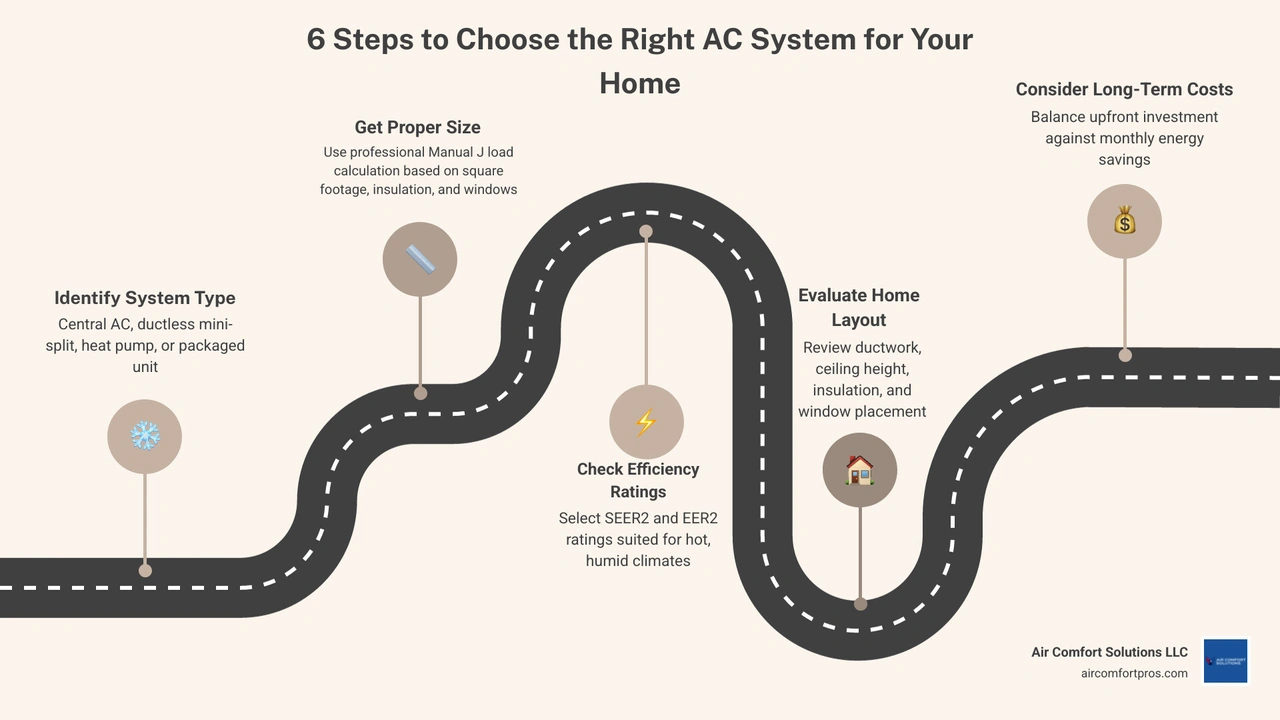
Here’s a quick overview of the key steps to choosing the right AC system for your home:
1. Identify the right system type — central AC, ductless mini-split, heat pump, or packaged unit
2. Get a proper size calculation — use a professional Manual J load calculation, not just square footage
3. Understand efficiency ratings — look for SEER2 and EER2 ratings that match your climate
4. Evaluate your home’s layout — consider ductwork condition, insulation, ceiling height, and window placement
5. Think long-term — balance upfront investment against monthly energy savings
6. Hire a qualified installer — proper installation protects your comfort, efficiency, and warranty
The stakes are real. According to Consumer Reports data tracking over 13,000 units, about 19% of central AC systems purchased between 2009 and 2024 ran into at least one significant problem — and nearly a quarter of those stopped working properly altogether. Choosing the right system from the start, sized and installed correctly, is how you avoid becoming that statistic.
This guide walks you through everything you need to know — from system types and sizing to efficiency ratings and when to replace an aging unit — so you can make a confident, informed decision for your home and your family’s comfort.
How to choose the right ac system for your home glossary:
• best ac system for hot humid climates
• high efficiency ac features worth paying for
• what size air conditioner do i need
Understanding Your Options: Types of AC Systems Available

When it comes to selecting a cooling system for your home, there is no one-size-fits-all solution. The layout of your house, the status of your existing infrastructure, and your personal comfort goals all play major roles in determining which system type is ideal. Let’s look at the primary configurations available on the market today.
• Central Air Conditioning (Split Systems): This is the most common setup in Southeast Texas. It consists of an indoor unit (evaporator coil and blower) and an outdoor unit (compressor and condenser). It relies on a network of supply and return ducts to distribute conditioned air throughout the entire home.
• Ductless Mini-Splits: These systems bypass ductwork entirely. They feature an outdoor condenser connected directly to one or more sleek, wall-mounted indoor air handlers.
• Heat Pumps: Heat pumps look and operate exactly like central air conditioners during the summer, but they can reverse their operation in the winter to provide efficient heating.
• Packaged Units: Often used in homes with limited indoor space, packaged systems house all components (compressor, condenser, and evaporator) in a single outdoor cabinet, usually installed on the roof or a concrete slab.
Selecting the wrong configuration can lead to uneven temperatures and unnecessary energy waste. To make sure you get the most efficient performance, it is helpful to design the Best HVAC Setup for Southeast Texas Weather based on your home’s unique layout.
Central Air Conditioning vs. Ductless Mini-Splits
The debate between central air conditioning and ductless mini-split systems usually comes down to your home’s existing architecture and how you prefer to manage your indoor comfort.
Central AC is highly effective for homes that already have functional, well-sealed ductwork. It provides uniform, consistent cooling across every room and keeps your equipment hidden away out of sight. Additionally, central systems allow you to integrate advanced whole-house indoor air quality (IAQ) solutions, such as media air cleaners, UV lights, and whole-home dehumidifiers, directly into the duct system.
However, if your home has an older design without ductwork, or if you have recently added a new room, converted a garage, or finished an attic, installing ductless mini-splits can be a game-changer. Ductless systems provide zoned cooling, allowing you to set different temperatures in different rooms. This means you do not have to waste energy cooling unoccupied spaces.
Furthermore, because ductless systems do not rely on ducts, they eliminate the energy loss associated with leaky ductwork. In fact, unsealed or poorly insulated ducts can waste 20 to 30 percent of the energy used to run your system. By choosing ductless, you bypass this common efficiency pitfall completely. For our local weather, discovering the Best AC System for Hot Humid Climates will help you weigh these options more effectively.
The Versatility of Heat Pumps in Southeast Texas
For homeowners in Pinehurst, Magnolia, Spring, and surrounding areas, heat pumps represent an incredibly smart and versatile option. Rather than generating heat through combustion or electrical resistance, heat pumps simply move heat from one place to another.
In the summer, a heat pump extracts heat from inside your home and transfers it outdoors, keeping you cool. In our mild Texas winters, it reverses this cycle, extracting heat from the outdoor air and pumping it inside. Because they transfer heat rather than generate it, heat pumps operate with incredible efficiency, often lowering winter energy use significantly compared to traditional electric furnaces.
When deciding on a heat pump, it is crucial to understand how our local weather patterns interact with your equipment. You can learn more about how our regional weather impacts system selection in our guide on How Southeast Texas Climate Affects Your HVAC System.
Sizing Matters: How to Choose the Right AC System for Your Home
One of the most common and costly mistakes a homeowner can make is assuming that “bigger is always better” when buying a new air conditioner. In the HVAC world, purchasing an oversized system is just as problematic as buying one that is too small.
To start, you must understand how cooling capacity is measured:
• BTU (British Thermal Unit): A measurement of the heat energy an air conditioner can remove from your home per hour. One BTU is the amount of energy required to raise or lower the temperature of one pound of water by one degree Fahrenheit.
• Tonnage: Central air conditioners are rated in “tons.” This does not refer to the physical weight of the unit. Instead, one ton of cooling capacity is equal to 12,000 BTUs per hour. For example, a 3-ton air conditioner can remove 36,000 BTUs of heat per hour.
As a general rule of thumb, a 2-ton unit can cool a 1,200-square-foot home, while a 5-ton unit is typically needed for a 3,000-square-foot home. However, you should never rely on simple square footage estimates alone. To get a head start on understanding the exact capacity your home needs, read our detailed breakdown on What Size Air Conditioner Do I Need.
Why a Manual J Load Calculation is Essential
To determine the exact capacity your home requires, a professional HVAC technician must perform a Manual J load calculation. This is the industry-standard scientific method for sizing heating and cooling systems.
A Manual J calculation looks far beyond simple square footage. It evaluates a wide variety of factors that influence how heat enters and leaves your home, including:
• Insulation Levels: The R-value of the insulation in your attic, walls, and floors.
• Windows and Doors: The number, size, orientation, and glass type (such as single-pane vs. double-pane low-E glass) of all windows.
• Sun Exposure and Shading: Which directions your windows face and whether your home is shaded by trees or neighboring structures.
• Ceiling Heights: High or vaulted ceilings increase the volume of air that needs to be conditioned.
• Occupancy: The number of people regularly living in the home (each person adds roughly 600 BTUs of heat).
• Heat-Generating Appliances: Kitchen layouts and appliances that contribute to the indoor heat load.
Skipping this calculation and relying on a simple “rule of thumb” estimate is a major red flag when working with an HVAC contractor. A precise Manual J calculation ensures your system is sized perfectly for your home’s unique thermal envelope.
The Pitfalls of Oversized vs. Undersized AC Units
What happens if your AC system is sized incorrectly? Let’s look at the consequences of both scenarios:
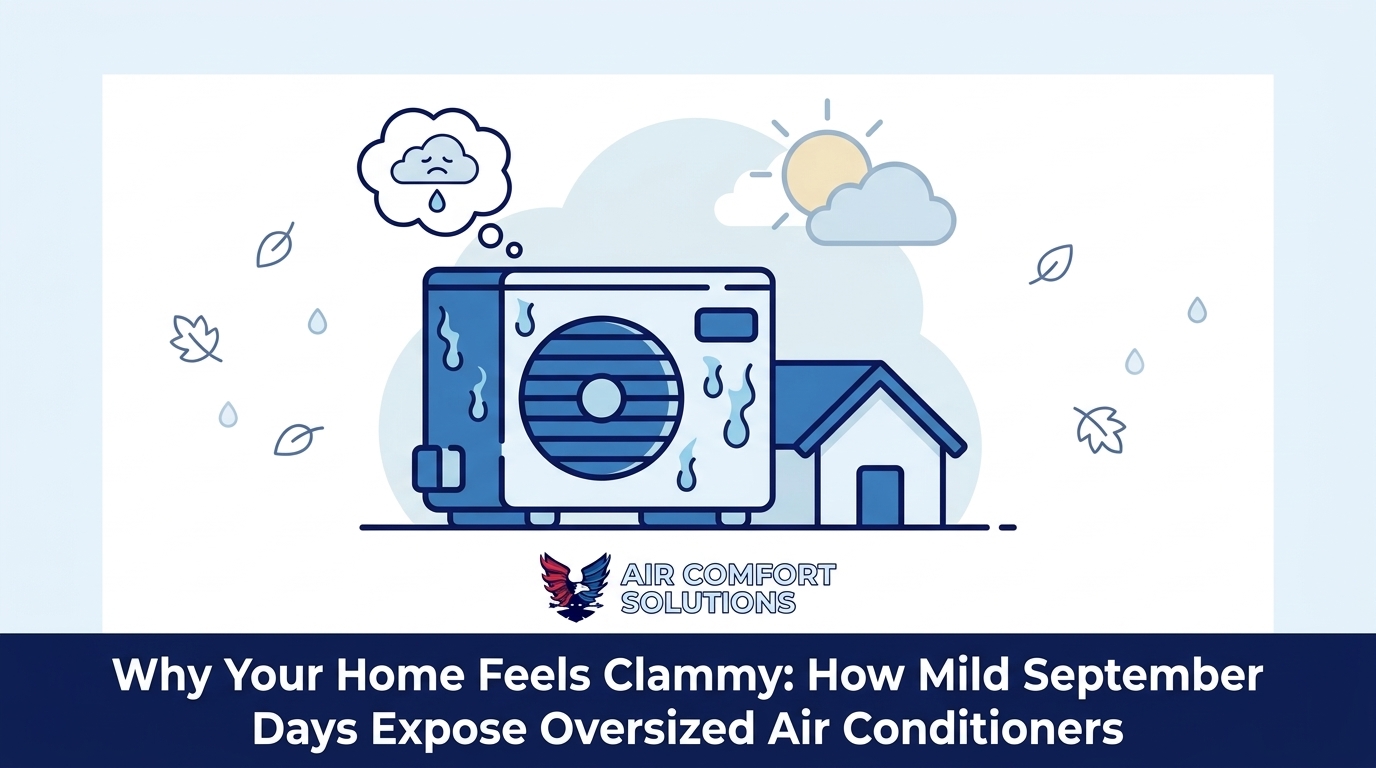
• Too Large (Oversized) — Common Symptoms: – Cools the house very quickly– Shuts off after only a few minutes (short-cycling)– Indoor air feels cold but clammy and humid — Long-Term Consequences: – High energy bills due to frequent startup power surges– Premature system wear and tear– Mold and mildew growth from poor dehumidification
• Too Small (Undersized) — Common Symptoms: – Runs constantly without stopping– Struggles to reach the thermostat setpoint on hot days– Uneven cooling with warm spots throughout the house — Long-Term Consequences: – Sky-high utility bills from continuous operation– Shortened system lifespan– Frequent compressor failures
In Southeast Texas, dehumidification is just as important as temperature control. An oversized system cools the air so fast that it shuts down before it has a chance to run long enough to pull moisture out of the air. This leaves you with cold, sticky indoor air and a high risk of mold. To see how these factors play out in your daily comfort, read our article on How Humidity Affects Your AC Performance.
Decoding Energy Efficiency: SEER2, EER2, and Smart Features
Modern air conditioners are significantly more efficient than those manufactured just a decade ago. However, understanding the labels and ratings can feel like learning a new language. When evaluating new systems, you will primarily look at SEER2 and EER2 ratings.
To help you visualize the differences between standard and high-efficiency options, here is a quick comparison:
• SEER2 Rating — Standard Efficiency AC: Typically 14.3 to 15 — High-Efficiency AC: 16 to 22+
• Compressor Type — Standard Efficiency AC: Single-Stage (On/Off at 100% capacity) — High-Efficiency AC: Two-Stage or Variable-Speed (Inverter)
• Humidity Control — Standard Efficiency AC: Basic — High-Efficiency AC: Advanced (runs longer at lower speeds)
• Noise Levels — Standard Efficiency AC: Standard (72 to 76 dB) — High-Efficiency AC: Ultra-Quiet (often under 60 dB)
• Smart Integration — Standard Efficiency AC: Optional / Basic — High-Efficiency AC: Built-in / Advanced Diagnostics
To dive deeper into how these tiers stack up against one another, check out our comprehensive Standard Efficiency vs High Efficiency AC Comparison.
How SEER2 and EER2 Ratings Impact Your Utility Bills
In 2023, the Department of Energy updated its testing standards to better reflect real-world operating conditions, introducing SEER2 (Seasonal Energy Efficiency Ratio 2) and EER2 (Energy Efficiency Ratio 2). These updated standards test systems under higher static pressures to better replicate the resistance of actual home ductwork.
• SEER2: Measures the efficiency of the system over an entire cooling season. It calculates the total cooling output divided by the total electrical energy consumed.
• EER2: Measures the system’s efficiency at a specific, constant outdoor temperature (usually 95°F).
In consistently hot climates like Southeast Texas, EER2 can be an incredibly important metric because it tells you how efficiently your system will perform during the absolute hottest hours of the summer. In Texas, the minimum allowable efficiency rating for new split-system air conditioners is 15 SEER2.
Upgrading to a higher rating can yield substantial monthly savings. To understand the science behind these labels, read What is a SEER2 Rating on an AC Unit, and to see how those numbers translate to real-world savings, check out our guide on How SEER2 Ratings Affect Energy Bills.
High-Efficiency Features Worth the Investment
If you decide to invest in a high-efficiency system, there are several advanced features that are well worth the extra upfront investment:
• Variable-Speed (Inverter) Compressors: Traditional single-stage air conditioners are either 100% on or completely off. Variable-speed compressors can adjust their output incrementally (anywhere from 25% to 100% capacity) to match your home’s exact cooling needs. This allows them to run almost continuously at lower, highly efficient speeds, maintaining your indoor temperature within half a degree.
• Smart Thermostat Integration: A smart thermostat learns your daily routine, adjusts temperatures automatically when you leave, and can be controlled remotely via your phone. According to the Department of Energy, setting your thermostat correctly can reduce your cooling costs by about 10 percent. Additionally, you will save about 3 percent on your utility bill for every degree you raise the set temperature on your central air.
• Ceiling Fan Synergy: Don’t underestimate simple solutions! Utilizing a box or ceiling fan costs very little to run and creates a wind-chill effect that makes you feel 3°F to 4°F cooler, allowing you to set your thermostat higher without sacrificing comfort.
To help you decide which upgrades make the most sense for your budget, read our expert analysis on High Efficiency AC Features Worth Paying For and evaluate the long-term financial benefits in Is a High Efficiency AC Worth the Extra Cost in Texas.
When to Repair vs. Replace Your Existing AC System
At some point, every homeowner faces a difficult choice: should you continue patching up your old air conditioner, or is it finally time to invest in a complete system replacement?
Generally, an air conditioning system has a lifespan of 10 to 15 years. If your system is approaching or has passed this window, it will likely begin requiring more frequent repairs and operating with significantly reduced efficiency. If you are struggling to make this choice, our guide on How to Decide Between AC Repair and Replacement offers a helpful roadmap.
Applying the $5,000 Rule for AC Replacement
To take the guesswork out of the repair-versus-replace dilemma, many HVAC professionals recommend using the $5,000 Rule.
The formula is incredibly simple:
1. Take the age of your current AC system (in years).
2. Multiply that number by the cost of the proposed repair.
3. If the total exceeds $5,000, you should replace the system. If the total is less than $5,000, a repair is likely the more sensible choice.
For example, if you have a 10-year-old system that needs a repair, and the multiplication of its age by the repair cost exceeds that threshold, investing in a new, high-efficiency system is almost always the more financially sound decision in the long run. To see how this rule applies to your specific situation, read The $5000 Dollar Rule for AC Replacement.
Optimal Times for Upgrading Your Home’s Air Conditioning System
If you do decide that a replacement is necessary, timing your purchase can make a big difference in your overall experience. Most homeowners wait until their system completely breaks down in the middle of a July heatwave to buy a new unit. This often leads to rushed decisions made under extreme stress.
Instead, the ideal time to upgrade your system is during the “shoulder seasons” — specifically late winter or early spring. During these periods, HVAC technicians have more flexible schedules, allowing for a more relaxed installation process. To learn more about planning ahead, read our articles on When Should You Replace Your AC in a Hot Climate and Optimal Times for Upgrading Your Home’s Air Conditioning System.
Frequently Asked Questions About Choosing a Home AC
How do I choose the right ac system for my home based on my local climate?
In Southeast Texas, your AC has to work incredibly hard to combat both extreme heat and heavy coastal humidity. Look for a system with a SEER2 rating of 15 or higher (the Texas minimum) and prioritize units with variable-speed compressors. These systems run longer, gentler cycles that are incredibly effective at pulling moisture out of your indoor air, keeping you comfortable without needing to drop your thermostat to freezing temperatures.
What is the difference between SEER and SEER2 ratings?
SEER2 is the updated national efficiency standard that took effect in 2023. While the old SEER testing standard evaluated equipment in a laboratory environment with zero static pressure, SEER2 tests units under a much higher external static pressure to better replicate how the system will perform when connected to real ductwork in an actual home. Because of this more rigorous testing, a system’s SEER2 rating will typically be slightly lower numerically than its old SEER rating, but it represents a much more accurate picture of real-world efficiency.
Why is professional installation so important when I choose the right ac system for my home?
Even the most advanced, expensive high-efficiency air conditioner on the market will underperform, break down prematurely, and waste energy if it is installed incorrectly. Professional installation by certified technicians ensures that your ductwork is properly sized and sealed, your refrigerant charge is exact, and your system’s electrical connections are safe. Furthermore, major manufacturers require professional installation to keep your equipment warranty active.
Conclusion
Knowing how to choose the right AC system for your home is a major milestone in protecting your home’s comfort, improving your indoor air quality, and keeping your monthly utility bills manageable. By understanding system types, insisting on a professional Manual J load calculation, and selecting the right efficiency features for our unique climate, you can enjoy dependable comfort for many years to come.
At Air Comfort Solutions LLC, we have been providing expert, reliable HVAC services to homeowners in Pinehurst, TX, and across the north side of Harris County for over 35 years. Our certified technicians are dedicated to helping you find the perfect cooling solutions tailored to your home’s unique layout and your family’s needs.
Don’t leave your summer comfort to chance. Schedule your professional AC consultation today with Air Comfort Solutions and let us help you make the right choice for your home.
Why Knowing How to Choose the Right AC System for Your Home Matters in Pinehurst, TX
Knowing how to choose the right AC system for your home is one of the most important decisions you'll make as a homeowner in Pinehurst, TX — and getting it wrong can mean years of high energy bills, uncomfortable rooms, and costly breakdowns. With Southeast Texas summers pushing temperatures well above 90°F and humidity that never seems to let up, your air conditioner isn't a luxury. It's a necessity.
Here's a quick overview of the key steps to choosing the right AC system for your home:
- Identify the right system type — central AC, ductless mini-split, heat pump, or packaged unit
- Get a proper size calculation — use a professional Manual J load calculation, not just square footage
- Understand efficiency ratings — look for SEER2 and EER2 ratings that match your climate
- Evaluate your home's layout — consider ductwork condition, insulation, ceiling height, and window placement
- Think long-term — balance upfront investment against monthly energy savings
- Hire a qualified installer — proper installation protects your comfort, efficiency, and warranty
The stakes are real. According to Consumer Reports data tracking over 13,000 units, about 19% of central AC systems purchased between 2009 and 2024 ran into at least one significant problem — and nearly a quarter of those stopped working properly altogether. Choosing the right system from the start, sized and installed correctly, is how you avoid becoming that statistic.
This guide walks you through everything you need to know — from system types and sizing to efficiency ratings and when to replace an aging unit — so you can make a confident, informed decision for your home and your family's comfort.
How to choose the right ac system for your home glossary:
Understanding Your Options: Types of AC Systems Available
When it comes to selecting a cooling system for your home, there is no one-size-fits-all solution. The layout of your house, the status of your existing infrastructure, and your personal comfort goals all play major roles in determining which system type is ideal. Let's look at the primary configurations available on the market today.
- Central Air Conditioning (Split Systems): This is the most common setup in Southeast Texas. It consists of an indoor unit (evaporator coil and blower) and an outdoor unit (compressor and condenser). It relies on a network of supply and return ducts to distribute conditioned air throughout the entire home.
- Ductless Mini-Splits: These systems bypass ductwork entirely. They feature an outdoor condenser connected directly to one or more sleek, wall-mounted indoor air handlers.
- Heat Pumps: Heat pumps look and operate exactly like central air conditioners during the summer, but they can reverse their operation in the winter to provide efficient heating.
- Packaged Units: Often used in homes with limited indoor space, packaged systems house all components (compressor, condenser, and evaporator) in a single outdoor cabinet, usually installed on the roof or a concrete slab.
Selecting the wrong configuration can lead to uneven temperatures and unnecessary energy waste. To make sure you get the most efficient performance, it is helpful to design the Best HVAC Setup for Southeast Texas Weather based on your home's unique layout.
Central Air Conditioning vs. Ductless Mini-Splits
The debate between central air conditioning and ductless mini-split systems usually comes down to your home’s existing architecture and how you prefer to manage your indoor comfort.
Central AC is highly effective for homes that already have functional, well-sealed ductwork. It provides uniform, consistent cooling across every room and keeps your equipment hidden away out of sight. Additionally, central systems allow you to integrate advanced whole-house indoor air quality (IAQ) solutions, such as media air cleaners, UV lights, and whole-home dehumidifiers, directly into the duct system.
However, if your home has an older design without ductwork, or if you have recently added a new room, converted a garage, or finished an attic, installing ductless mini-splits can be a game-changer. Ductless systems provide zoned cooling, allowing you to set different temperatures in different rooms. This means you do not have to waste energy cooling unoccupied spaces.
Furthermore, because ductless systems do not rely on ducts, they eliminate the energy loss associated with leaky ductwork. In fact, unsealed or poorly insulated ducts can waste 20 to 30 percent of the energy used to run your system. By choosing ductless, you bypass this common efficiency pitfall completely. For our local weather, discovering the Best AC System for Hot Humid Climates will help you weigh these options more effectively.
The Versatility of Heat Pumps in Southeast Texas
For homeowners in Pinehurst, Magnolia, Spring, and surrounding areas, heat pumps represent an incredibly smart and versatile option. Rather than generating heat through combustion or electrical resistance, heat pumps simply move heat from one place to another.
In the summer, a heat pump extracts heat from inside your home and transfers it outdoors, keeping you cool. In our mild Texas winters, it reverses this cycle, extracting heat from the outdoor air and pumping it inside. Because they transfer heat rather than generate it, heat pumps operate with incredible efficiency, often lowering winter energy use significantly compared to traditional electric furnaces.
When deciding on a heat pump, it is crucial to understand how our local weather patterns interact with your equipment. You can learn more about how our regional weather impacts system selection in our guide on How Southeast Texas Climate Affects Your HVAC System.
Sizing Matters: How to Choose the Right AC System for Your Home
One of the most common and costly mistakes a homeowner can make is assuming that "bigger is always better" when buying a new air conditioner. In the HVAC world, purchasing an oversized system is just as problematic as buying one that is too small.
To start, you must understand how cooling capacity is measured:
- BTU (British Thermal Unit): A measurement of the heat energy an air conditioner can remove from your home per hour. One BTU is the amount of energy required to raise or lower the temperature of one pound of water by one degree Fahrenheit.
- Tonnage: Central air conditioners are rated in "tons." This does not refer to the physical weight of the unit. Instead, one ton of cooling capacity is equal to 12,000 BTUs per hour. For example, a 3-ton air conditioner can remove 36,000 BTUs of heat per hour.
As a general rule of thumb, a 2-ton unit can cool a 1,200-square-foot home, while a 5-ton unit is typically needed for a 3,000-square-foot home. However, you should never rely on simple square footage estimates alone. To get a head start on understanding the exact capacity your home needs, read our detailed breakdown on What Size Air Conditioner Do I Need.
Why a Manual J Load Calculation is Essential
To determine the exact capacity your home requires, a professional HVAC technician must perform a Manual J load calculation. This is the industry-standard scientific method for sizing heating and cooling systems.
A Manual J calculation looks far beyond simple square footage. It evaluates a wide variety of factors that influence how heat enters and leaves your home, including:
- Insulation Levels: The R-value of the insulation in your attic, walls, and floors.
- Windows and Doors: The number, size, orientation, and glass type (such as single-pane vs. double-pane low-E glass) of all windows.
- Sun Exposure and Shading: Which directions your windows face and whether your home is shaded by trees or neighboring structures.
- Ceiling Heights: High or vaulted ceilings increase the volume of air that needs to be conditioned.
- Occupancy: The number of people regularly living in the home (each person adds roughly 600 BTUs of heat).
- Heat-Generating Appliances: Kitchen layouts and appliances that contribute to the indoor heat load.
Skipping this calculation and relying on a simple "rule of thumb" estimate is a major red flag when working with an HVAC contractor. A precise Manual J calculation ensures your system is sized perfectly for your home's unique thermal envelope.
The Pitfalls of Oversized vs. Undersized AC Units
What happens if your AC system is sized incorrectly? Let's look at the consequences of both scenarios:
| System Status | Common Symptoms | Long-Term Consequences |
|---|
| Too Large (Oversized) | - Cools the house very quickly
- Shuts off after only a few minutes (short-cycling)
- Indoor air feels cold but clammy and humid | - High energy bills due to frequent startup power surges
- Premature system wear and tear
- Mold and mildew growth from poor dehumidification |
| Too Small (Undersized) | - Runs constantly without stopping
- Struggles to reach the thermostat setpoint on hot days
- Uneven cooling with warm spots throughout the house | - Sky-high utility bills from continuous operation
- Shortened system lifespan
- Frequent compressor failures |
In Southeast Texas, dehumidification is just as important as temperature control. An oversized system cools the air so fast that it shuts down before it has a chance to run long enough to pull moisture out of the air. This leaves you with cold, sticky indoor air and a high risk of mold. To see how these factors play out in your daily comfort, read our article on How Humidity Affects Your AC Performance.
Decoding Energy Efficiency: SEER2, EER2, and Smart Features
Modern air conditioners are significantly more efficient than those manufactured just a decade ago. However, understanding the labels and ratings can feel like learning a new language. When evaluating new systems, you will primarily look at SEER2 and EER2 ratings.
To help you visualize the differences between standard and high-efficiency options, here is a quick comparison:
| Feature | Standard Efficiency AC | High-Efficiency AC |
|---|
| SEER2 Rating | Typically 14.3 to 15 | 16 to 22+ |
| Compressor Type | Single-Stage (On/Off at 100% capacity) | Two-Stage or Variable-Speed (Inverter) |
| Humidity Control | Basic | Advanced (runs longer at lower speeds) |
| Noise Levels | Standard (72 to 76 dB) | Ultra-Quiet (often under 60 dB) |
| Smart Integration | Optional / Basic | Built-in / Advanced Diagnostics |
To dive deeper into how these tiers stack up against one another, check out our comprehensive Standard Efficiency vs High Efficiency AC Comparison.
How SEER2 and EER2 Ratings Impact Your Utility Bills
In 2023, the Department of Energy updated its testing standards to better reflect real-world operating conditions, introducing SEER2 (Seasonal Energy Efficiency Ratio 2) and EER2 (Energy Efficiency Ratio 2). These updated standards test systems under higher static pressures to mimic the resistance of actual home ductwork.
- SEER2: Measures the efficiency of the system over an entire cooling season. It calculates the total cooling output divided by the total electrical energy consumed.
- EER2: Measures the system’s efficiency at a specific, constant outdoor temperature (usually 95°F).
In consistently hot climates like Southeast Texas, EER2 can be an incredibly important metric because it tells you how efficiently your system will perform during the absolute hottest hours of the summer. In Texas, the minimum allowable efficiency rating for new split-system air conditioners is 15 SEER2.
Upgrading to a higher rating can yield substantial monthly savings. To understand the science behind these labels, read What is a SEER2 Rating on an AC Unit, and to see how those numbers translate to real-world savings, check out our guide on How SEER2 Ratings Affect Energy Bills.
High-Efficiency Features Worth the Investment
If you decide to invest in a high-efficiency system, there are several advanced features that are well worth the extra upfront investment:
- Variable-Speed (Inverter) Compressors: Traditional single-stage air conditioners are either 100% on or completely off. Variable-speed compressors can adjust their output incrementally (anywhere from 25% to 100% capacity) to match your home's exact cooling needs. This allows them to run almost continuously at lower, highly efficient speeds, maintaining your indoor temperature within half a degree.
- Smart Thermostat Integration: A smart thermostat learns your daily routine, adjusts temperatures automatically when you leave, and can be controlled remotely via your phone. According to the Department of Energy, setting your thermostat correctly can reduce your cooling costs by about 10 percent. Additionally, you will save about 3 percent on your utility bill for every degree you raise the set temperature on your central air.
- Ceiling Fan Synergy: Don't underestimate simple solutions! Utilizing a box or ceiling fan costs very little to run and creates a wind-chill effect that makes you feel 3°F to 4°F cooler, allowing you to set your thermostat higher without sacrificing comfort.
To help you decide which upgrades make the most sense for your budget, read our expert analysis on High Efficiency AC Features Worth Paying For and evaluate the long-term financial benefits in Is a High Efficiency AC Worth the Extra Cost in Texas.
When to Repair vs. Replace Your Existing AC System
At some point, every homeowner faces a difficult choice: should you continue patching up your old air conditioner, or is it finally time to invest in a complete system replacement?
Generally, an air conditioning system has a lifespan of 10 to 15 years. If your system is approaching or has passed this window, it will likely begin requiring more frequent repairs and operating with significantly reduced efficiency. If you are struggling to make this choice, our guide on How to Decide Between AC Repair and Replacement offers a helpful roadmap.
Applying the $5,000 Rule for AC Replacement
To take the guesswork out of the repair-versus-replace dilemma, many HVAC professionals recommend using the $5,000 Rule.
The formula is incredibly simple:
- Take the age of your current AC system (in years).
- Multiply that number by the cost of the proposed repair.
- If the total exceeds $5,000, you should replace the system. If the total is less than $5,000, a repair is likely the more sensible choice.
For example, if you have a 10-year-old system that needs a repair, and the multiplication of its age by the repair cost exceeds that threshold, investing in a new, high-efficiency system is almost always the more financially sound decision in the long run. To see how this rule applies to your specific situation, read The $5000 Dollar Rule for AC Replacement.
Optimal Times for Upgrading Your Home's Air Conditioning System
If you do decide that a replacement is necessary, timing your purchase can make a big difference in your overall experience. Most homeowners wait until their system completely breaks down in the middle of a July heatwave to buy a new unit. This often leads to rushed decisions made under extreme stress.
Instead, the ideal time to upgrade your system is during the "shoulder seasons" — specifically late winter or early spring. During these periods, HVAC technicians have more flexible schedules, allowing for a more relaxed installation process. To learn more about planning ahead, read our articles on When Should You Replace Your AC in a Hot Climate and Optimal Times for Upgrading Your Home's Air Conditioning System.
Frequently Asked Questions About Choosing a Home AC
How do I choose the right ac system for my home based on my local climate?
In Southeast Texas, your AC has to work incredibly hard to combat both extreme heat and heavy coastal humidity. Look for a system with a SEER2 rating of 15 or higher (the Texas minimum) and prioritize units with variable-speed compressors. These systems run longer, gentler cycles that are incredibly effective at pulling moisture out of your indoor air, keeping you comfortable without needing to drop your thermostat to freezing temperatures.
What is the difference between SEER and SEER2 ratings?
SEER2 is the updated national efficiency standard that took effect in 2023. While the old SEER testing standard evaluated equipment in a laboratory environment with zero static pressure, SEER2 tests units under a much higher external static pressure to better replicate how the system will perform when connected to real ductwork in an actual home. Because of this more rigorous testing, a system's SEER2 rating will typically be slightly lower numerically than its old SEER rating, but it represents a much more accurate picture of real-world efficiency.
Why is professional installation so important when I choose the right ac system for my home?
Even the most advanced, expensive high-efficiency air conditioner on the market will underperform, break down prematurely, and waste energy if it is installed incorrectly. Professional installation by certified technicians ensures that your ductwork is properly sized and sealed, your refrigerant charge is exact, and your system's electrical connections are safe. Furthermore, major manufacturers require professional installation to keep your equipment warranty active.
Conclusion
Knowing how to choose the right AC system for your home is a major milestone in protecting your home's comfort, improving your indoor air quality, and keeping your monthly utility bills manageable. By understanding system types, insisting on a professional Manual J load calculation, and selecting the right efficiency features for our unique climate, you can enjoy dependable comfort for many years to come.
At Air Comfort Solutions LLC, we have been providing expert, reliable HVAC services to homeowners in Pinehurst, TX, and across the north side of Harris County for over 35 years. Our certified technicians are dedicated to helping you find the perfect cooling solutions tailored to your home's unique layout and your family's needs.
Don't leave your summer comfort to chance. Schedule your professional AC consultation today with Air Comfort Pros and let us help you make the right choice for your home.
Why Knowing How to Choose the Right AC System for Your Home Matters in Pinehurst, TX
Knowing how to choose the right AC system for your home is one of the most important decisions you'll make as a homeowner in Pinehurst, TX — and getting it wrong can mean years of high energy bills, uncomfortable rooms, and costly breakdowns. With Southeast Texas summers pushing temperatures well above 90°F and humidity that never seems to let up, your air conditioner isn't a luxury. It's a necessity.
Here's a quick overview of the key steps to choosing the right AC system for your home:
- Identify the right system type — central AC, ductless mini-split, heat pump, or packaged unit
- Get a proper size calculation — use a professional Manual J load calculation, not just square footage
- Understand efficiency ratings — look for SEER2 and EER2 ratings that match your climate
- Evaluate your home's layout — consider ductwork condition, insulation, ceiling height, and window placement
- Think long-term — balance upfront investment against monthly energy savings
- Hire a qualified installer — proper installation protects your comfort, efficiency, and warranty
The stakes are real. According to Consumer Reports data tracking over 13,000 units, about 19% of central AC systems purchased between 2009 and 2024 ran into at least one significant problem — and nearly a quarter of those stopped working properly altogether. Choosing the right system from the start, sized and installed correctly, is how you avoid becoming that statistic.
This guide walks you through everything you need to know — from system types and sizing to efficiency ratings and when to replace an aging unit — so you can make a confident, informed decision for your home and your family's comfort.
How to choose the right ac system for your home glossary:
Understanding Your Options: Types of AC Systems Available
When it comes to selecting a cooling system for your home, there is no one-size-fits-all solution. The layout of your house, the status of your existing infrastructure, and your personal comfort goals all play major roles in determining which system type is ideal. Let's look at the primary configurations available on the market today.
- Central Air Conditioning (Split Systems): This is the most common setup in Southeast Texas. It consists of an indoor unit (evaporator coil and blower) and an outdoor unit (compressor and condenser). It relies on a network of supply and return ducts to distribute conditioned air throughout the entire home.
- Ductless Mini-Splits: These systems bypass ductwork entirely. They feature an outdoor condenser connected directly to one or more sleek, wall-mounted indoor air handlers.
- Heat Pumps: Heat pumps look and operate exactly like central air conditioners during the summer, but they can reverse their operation in the winter to provide efficient heating.
- Packaged Units: Often used in homes with limited indoor space, packaged systems house all components (compressor, condenser, and evaporator) in a single outdoor cabinet, usually installed on the roof or a concrete slab.
Selecting the wrong configuration can lead to uneven temperatures and unnecessary energy waste. To make sure you get the most efficient performance, it is helpful to design the Best HVAC Setup for Southeast Texas Weather based on your home's unique layout.
Central Air Conditioning vs. Ductless Mini-Splits
The debate between central air conditioning and ductless mini-split systems usually comes down to your home’s existing architecture and how you prefer to manage your indoor comfort.
Central AC is highly effective for homes that already have functional, well-sealed ductwork. It provides uniform, consistent cooling across every room and keeps your equipment hidden away out of sight. Additionally, central systems allow you to integrate advanced whole-house indoor air quality (IAQ) solutions, such as media air cleaners, UV lights, and whole-home dehumidifiers, directly into the duct system.
However, if your home has an older design without ductwork, or if you have recently added a new room, converted a garage, or finished an attic, installing ductless mini-splits can be a game-changer. Ductless systems provide zoned cooling, allowing you to set different temperatures in different rooms. This means you do not have to waste energy cooling unoccupied spaces.
Furthermore, because ductless systems do not rely on ducts, they eliminate the energy loss associated with leaky ductwork. In fact, unsealed or poorly insulated ducts can waste 20 to 30 percent of the energy used to run your system. By choosing ductless, you bypass this common efficiency pitfall completely. For our local weather, discovering the Best AC System for Hot Humid Climates will help you weigh these options more effectively.
The Versatility of Heat Pumps in Southeast Texas
For homeowners in Pinehurst, Magnolia, Spring, and surrounding areas, heat pumps represent an incredibly smart and versatile option. Rather than generating heat through combustion or electrical resistance, heat pumps simply move heat from one place to another.
In the summer, a heat pump extracts heat from inside your home and transfers it outdoors, keeping you cool. In our mild Texas winters, it reverses this cycle, extracting heat from the outdoor air and pumping it inside. Because they transfer heat rather than generate it, heat pumps operate with incredible efficiency, often lowering winter energy use significantly compared to traditional electric furnaces.
When deciding on a heat pump, it is crucial to understand how our local weather patterns interact with your equipment. You can learn more about how our regional weather impacts system selection in our guide on How Southeast Texas Climate Affects Your HVAC System.
Sizing Matters: How to Choose the Right AC System for Your Home
One of the most common and costly mistakes a homeowner can make is assuming that "bigger is always better" when buying a new air conditioner. In the HVAC world, purchasing an oversized system is just as problematic as buying one that is too small.
To start, you must understand how cooling capacity is measured:
- BTU (British Thermal Unit): A measurement of the heat energy an air conditioner can remove from your home per hour. One BTU is the amount of energy required to raise or lower the temperature of one pound of water by one degree Fahrenheit.
- Tonnage: Central air conditioners are rated in "tons." This does not refer to the physical weight of the unit. Instead, one ton of cooling capacity is equal to 12,000 BTUs per hour. For example, a 3-ton air conditioner can remove 36,000 BTUs of heat per hour.
As a general rule of thumb, a 2-ton unit can cool a 1,200-square-foot home, while a 5-ton unit is typically needed for a 3,000-square-foot home. However, you should never rely on simple square footage estimates alone. To get a head start on understanding the exact capacity your home needs, read our detailed breakdown on What Size Air Conditioner Do I Need.
Why a Manual J Load Calculation is Essential
To determine the exact capacity your home requires, a professional HVAC technician must perform a Manual J load calculation. This is the industry-standard scientific method for sizing heating and cooling systems.
A Manual J calculation looks far beyond simple square footage. It evaluates a wide variety of factors that influence how heat enters and leaves your home, including:
- Insulation Levels: The R-value of the insulation in your attic, walls, and floors.
- Windows and Doors: The number, size, orientation, and glass type (such as single-pane vs. double-pane low-E glass) of all windows.
- Sun Exposure and Shading: Which directions your windows face and whether your home is shaded by trees or neighboring structures.
- Ceiling Heights: High or vaulted ceilings increase the volume of air that needs to be conditioned.
- Occupancy: The number of people regularly living in the home (each person adds roughly 600 BTUs of heat).
- Heat-Generating Appliances: Kitchen layouts and appliances that contribute to the indoor heat load.
Skipping this calculation and relying on a simple "rule of thumb" estimate is a major red flag when working with an HVAC contractor. A precise Manual J calculation ensures your system is sized perfectly for your home's unique thermal envelope.
The Pitfalls of Oversized vs. Undersized AC Units
What happens if your AC system is sized incorrectly? Let's look at the consequences of both scenarios:
| System Status | Common Symptoms | Long-Term Consequences |
|---|
| Too Large (Oversized) | - Cools the house very quickly
- Shuts off after only a few minutes (short-cycling)
- Indoor air feels cold but clammy and humid | - High energy bills due to frequent startup power surges
- Premature system wear and tear
- Mold and mildew growth from poor dehumidification |
| Too Small (Undersized) | - Runs constantly without stopping
- Struggles to reach the thermostat setpoint on hot days
- Uneven cooling with warm spots throughout the house | - Sky-high utility bills from continuous operation
- Shortened system lifespan
- Frequent compressor failures |
In Southeast Texas, dehumidification is just as important as temperature control. An oversized system cools the air so fast that it shuts down before it has a chance to run long enough to pull moisture out of the air. This leaves you with cold, sticky indoor air and a high risk of mold. To see how these factors play out in your daily comfort, read our article on How Humidity Affects Your AC Performance.
Decoding Energy Efficiency: SEER2, EER2, and Smart Features
Modern air conditioners are significantly more efficient than those manufactured just a decade ago. However, understanding the labels and ratings can feel like learning a new language. When evaluating new systems, you will primarily look at SEER2 and EER2 ratings.
To help you visualize the differences between standard and high-efficiency options, here is a quick comparison:
| Feature | Standard Efficiency AC | High-Efficiency AC |
|---|
| SEER2 Rating | Typically 14.3 to 15 | 16 to 22+ |
| Compressor Type | Single-Stage (On/Off at 100% capacity) | Two-Stage or Variable-Speed (Inverter) |
| Humidity Control | Basic | Advanced (runs longer at lower speeds) |
| Noise Levels | Standard (72 to 76 dB) | Ultra-Quiet (often under 60 dB) |
| Smart Integration | Optional / Basic | Built-in / Advanced Diagnostics |
To dive deeper into how these tiers stack up against one another, check out our comprehensive Standard Efficiency vs High Efficiency AC Comparison.
How SEER2 and EER2 Ratings Impact Your Utility Bills
In 2023, the Department of Energy updated its testing standards to better reflect real-world operating conditions, introducing SEER2 (Seasonal Energy Efficiency Ratio 2) and EER2 (Energy Efficiency Ratio 2). These updated standards test systems under higher static pressures to mimic the resistance of actual home ductwork.
- SEER2: Measures the efficiency of the system over an entire cooling season. It calculates the total cooling output divided by the total electrical energy consumed.
- EER2: Measures the system’s efficiency at a specific, constant outdoor temperature (usually 95°F).
In consistently hot climates like Southeast Texas, EER2 can be an incredibly important metric because it tells you how efficiently your system will perform during the absolute hottest hours of the summer. In Texas, the minimum allowable efficiency rating for new split-system air conditioners is 15 SEER2.
Upgrading to a higher rating can yield substantial monthly savings. To understand the science behind these labels, read What is a SEER2 Rating on an AC Unit, and to see how those numbers translate to real-world savings, check out our guide on How SEER2 Ratings Affect Energy Bills.
High-Efficiency Features Worth the Investment
If you decide to invest in a high-efficiency system, there are several advanced features that are well worth the extra upfront investment:
- Variable-Speed (Inverter) Compressors: Traditional single-stage air conditioners are either 100% on or completely off. Variable-speed compressors can adjust their output incrementally (anywhere from 25% to 100% capacity) to match your home's exact cooling needs. This allows them to run almost continuously at lower, highly efficient speeds, maintaining your indoor temperature within half a degree.
- Smart Thermostat Integration: A smart thermostat learns your daily routine, adjusts temperatures automatically when you leave, and can be controlled remotely via your phone. According to the Department of Energy, setting your thermostat correctly can reduce your cooling costs by about 10 percent. Additionally, you will save about 3 percent on your utility bill for every degree you raise the set temperature on your central air.
- Ceiling Fan Synergy: Don't underestimate simple solutions! Utilizing a box or ceiling fan costs very little to run and creates a wind-chill effect that makes you feel 3°F to 4°F cooler, allowing you to set your thermostat higher without sacrificing comfort.
To help you decide which upgrades make the most sense for your budget, read our expert analysis on High Efficiency AC Features Worth Paying For and evaluate the long-term financial benefits in Is a High Efficiency AC Worth the Extra Cost in Texas.
When to Repair vs. Replace Your Existing AC System
At some point, every homeowner faces a difficult choice: should you continue patching up your old air conditioner, or is it finally time to invest in a complete system replacement?
Generally, an air conditioning system has a lifespan of 10 to 15 years. If your system is approaching or has passed this window, it will likely begin requiring more frequent repairs and operating with significantly reduced efficiency. If you are struggling to make this choice, our guide on How to Decide Between AC Repair and Replacement offers a helpful roadmap.
Applying the $5,000 Rule for AC Replacement
To take the guesswork out of the repair-versus-replace dilemma, many HVAC professionals recommend using the $5,000 Rule.
The formula is incredibly simple:
- Take the age of your current AC system (in years).
- Multiply that number by the cost of the proposed repair.
- If the total exceeds $5,000, you should replace the system. If the total is less than $5,000, a repair is likely the more sensible choice.
For example, if you have a 10-year-old system that needs a repair, and the multiplication of its age by the repair cost exceeds that threshold, investing in a new, high-efficiency system is almost always the more financially sound decision in the long run. To see how this rule applies to your specific situation, read The $5000 Dollar Rule for AC Replacement.
Optimal Times for Upgrading Your Home's Air Conditioning System
If you do decide that a replacement is necessary, timing your purchase can make a big difference in your overall experience. Most homeowners wait until their system completely breaks down in the middle of a July heatwave to buy a new unit. This often leads to rushed decisions made under extreme stress.
Instead, the ideal time to upgrade your system is during the "shoulder seasons" — specifically late winter or early spring. During these periods, HVAC technicians have more flexible schedules, allowing for a more relaxed installation process. To learn more about planning ahead, read our articles on When Should You Replace Your AC in a Hot Climate and Optimal Times for Upgrading Your Home's Air Conditioning System.
Frequently Asked Questions About Choosing a Home AC
How do I choose the right ac system for my home based on my local climate?
In Southeast Texas, your AC has to work incredibly hard to combat both extreme heat and heavy coastal humidity. Look for a system with a SEER2 rating of 15 or higher (the Texas minimum) and prioritize units with variable-speed compressors. These systems run longer, gentler cycles that are incredibly effective at pulling moisture out of your indoor air, keeping you comfortable without needing to drop your thermostat to freezing temperatures.
What is the difference between SEER and SEER2 ratings?
SEER2 is the updated national efficiency standard that took effect in 2023. While the old SEER testing standard evaluated equipment in a laboratory environment with zero static pressure, SEER2 tests units under a much higher external static pressure to better replicate how the system will perform when connected to real ductwork in an actual home. Because of this more rigorous testing, a system's SEER2 rating will typically be slightly lower numerically than its old SEER rating, but it represents a much more accurate picture of real-world efficiency.
Why is professional installation so important when I choose the right ac system for my home?
Even the most advanced, expensive high-efficiency air conditioner on the market will underperform, break down prematurely, and waste energy if it is installed incorrectly. Professional installation by certified technicians ensures that your ductwork is properly sized and sealed, your refrigerant charge is exact, and your system's electrical connections are safe. Furthermore, major manufacturers require professional installation to keep your equipment warranty active.
Conclusion
Knowing how to choose the right AC system for your home is a major milestone in protecting your home's comfort, improving your indoor air quality, and keeping your monthly utility bills manageable. By understanding system types, insisting on a professional Manual J load calculation, and selecting the right efficiency features for our unique climate, you can enjoy dependable comfort for many years to come.
At Air Comfort Solutions LLC, we have been providing expert, reliable HVAC services to homeowners in Pinehurst, TX, and across the north side of Harris County for over 35 years. Our certified technicians are dedicated to helping you find the perfect cooling solutions tailored to your home's unique layout and your family's needs.
Don't leave your summer comfort to chance. Schedule your professional AC consultation today with Air Comfort Pros and let us help you make the right choice for your home.
Why Knowing How to Choose the Right AC System for Your Home Matters in Pinehurst, TX
Knowing how to choose the right AC system for your home is one of the most important decisions you'll make as a homeowner in Pinehurst, TX — and getting it wrong can mean years of high energy bills, uncomfortable rooms, and costly breakdowns. With Southeast Texas summers pushing temperatures well above 90°F and humidity that never seems to let up, your air conditioner isn't a luxury. It's a necessity.
Here's a quick overview of the key steps to choosing the right AC system for your home:
- Identify the right system type — central AC, ductless mini-split, heat pump, or packaged unit
- Get a proper size calculation — use a professional Manual J load calculation, not just square footage
- Understand efficiency ratings — look for SEER2 and EER2 ratings that match your climate
- Evaluate your home's layout — consider ductwork condition, insulation, ceiling height, and window placement
- Think long-term — balance upfront investment against monthly energy savings
- Hire a qualified installer — proper installation protects your comfort, efficiency, and warranty
The stakes are real. According to Consumer Reports data tracking over 13,000 units, about 19% of central AC systems purchased between 2009 and 2024 ran into at least one significant problem — and nearly a quarter of those stopped working properly altogether. Choosing the right system from the start, sized and installed correctly, is how you avoid becoming that statistic.
This guide walks you through everything you need to know — from system types and sizing to efficiency ratings and when to replace an aging unit — so you can make a confident, informed decision for your home and your family's comfort.
How to choose the right ac system for your home glossary:
Understanding Your Options: Types of AC Systems Available
When it comes to selecting a cooling system for your home, there is no one-size-fits-all solution. The layout of your house, the status of your existing infrastructure, and your personal comfort goals all play major roles in determining which system type is ideal. Let's look at the primary configurations available on the market today.
- Central Air Conditioning (Split Systems): This is the most common setup in Southeast Texas. It consists of an indoor unit (evaporator coil and blower) and an outdoor unit (compressor and condenser). It relies on a network of supply and return ducts to distribute conditioned air throughout the entire home.
- Ductless Mini-Splits: These systems bypass ductwork entirely. They feature an outdoor condenser connected directly to one or more sleek, wall-mounted indoor air handlers.
- Heat Pumps: Heat pumps look and operate exactly like central air conditioners during the summer, but they can reverse their operation in the winter to provide efficient heating.
- Packaged Units: Often used in homes with limited indoor space, packaged systems house all components (compressor, condenser, and evaporator) in a single outdoor cabinet, usually installed on the roof or a concrete slab.
Selecting the wrong configuration can lead to uneven temperatures and unnecessary energy waste. To make sure you get the most efficient performance, it is helpful to design the Best HVAC Setup for Southeast Texas Weather based on your home's unique layout.
Central Air Conditioning vs. Ductless Mini-Splits
The debate between central air conditioning and ductless mini-split systems usually comes down to your home’s existing architecture and how you prefer to manage your indoor comfort.
Central AC is highly effective for homes that already have functional, well-sealed ductwork. It provides uniform, consistent cooling across every room and keeps your equipment hidden away out of sight. Additionally, central systems allow you to integrate advanced whole-house indoor air quality (IAQ) solutions, such as media air cleaners, UV lights, and whole-home dehumidifiers, directly into the duct system.
However, if your home has an older design without ductwork, or if you have recently added a new room, converted a garage, or finished an attic, installing ductless mini-splits can be a game-changer. Ductless systems provide zoned cooling, allowing you to set different temperatures in different rooms. This means you do not have to waste energy cooling unoccupied spaces.
Furthermore, because ductless systems do not rely on ducts, they eliminate the energy loss associated with leaky ductwork. In fact, unsealed or poorly insulated ducts can waste 20 to 30 percent of the energy used to run your system. By choosing ductless, you bypass this common efficiency pitfall completely. For our local weather, discovering the Best AC System for Hot Humid Climates will help you weigh these options more effectively.
The Versatility of Heat Pumps in Southeast Texas
For homeowners in Pinehurst, Magnolia, Spring, and surrounding areas, heat pumps represent an incredibly smart and versatile option. Rather than generating heat through combustion or electrical resistance, heat pumps simply move heat from one place to another.
In the summer, a heat pump extracts heat from inside your home and transfers it outdoors, keeping you cool. In our mild Texas winters, it reverses this cycle, extracting heat from the outdoor air and pumping it inside. Because they transfer heat rather than generate it, heat pumps operate with incredible efficiency, often lowering winter energy use significantly compared to traditional electric furnaces.
When deciding on a heat pump, it is crucial to understand how our local weather patterns interact with your equipment. You can learn more about how our regional weather impacts system selection in our guide on How Southeast Texas Climate Affects Your HVAC System.
Sizing Matters: How to Choose the Right AC System for Your Home
One of the most common and costly mistakes a homeowner can make is assuming that "bigger is always better" when buying a new air conditioner. In the HVAC world, purchasing an oversized system is just as problematic as buying one that is too small.
To start, you must understand how cooling capacity is measured:
- BTU (British Thermal Unit): A measurement of the heat energy an air conditioner can remove from your home per hour. One BTU is the amount of energy required to raise or lower the temperature of one pound of water by one degree Fahrenheit.
- Tonnage: Central air conditioners are rated in "tons." This does not refer to the physical weight of the unit. Instead, one ton of cooling capacity is equal to 12,000 BTUs per hour. For example, a 3-ton air conditioner can remove 36,000 BTUs of heat per hour.
As a general rule of thumb, a 2-ton unit can cool a 1,200-square-foot home, while a 5-ton unit is typically needed for a 3,000-square-foot home. However, you should never rely on simple square footage estimates alone. To get a head start on understanding the exact capacity your home needs, read our detailed breakdown on What Size Air Conditioner Do I Need.
Why a Manual J Load Calculation is Essential
To determine the exact capacity your home requires, a professional HVAC technician must perform a Manual J load calculation. This is the industry-standard scientific method for sizing heating and cooling systems.
A Manual J calculation looks far beyond simple square footage. It evaluates a wide variety of factors that influence how heat enters and leaves your home, including:
- Insulation Levels: The R-value of the insulation in your attic, walls, and floors.
- Windows and Doors: The number, size, orientation, and glass type (such as single-pane vs. double-pane low-E glass) of all windows.
- Sun Exposure and Shading: Which directions your windows face and whether your home is shaded by trees or neighboring structures.
- Ceiling Heights: High or vaulted ceilings increase the volume of air that needs to be conditioned.
- Occupancy: The number of people regularly living in the home (each person adds roughly 600 BTUs of heat).
- Heat-Generating Appliances: Kitchen layouts and appliances that contribute to the indoor heat load.
Skipping this calculation and relying on a simple "rule of thumb" estimate is a major red flag when working with an HVAC contractor. A precise Manual J calculation ensures your system is sized perfectly for your home's unique thermal envelope.
The Pitfalls of Oversized vs. Undersized AC Units
What happens if your AC system is sized incorrectly? Let's look at the consequences of both scenarios:
| System Status | Common Symptoms | Long-Term Consequences |
|---|
| Too Large (Oversized) | - Cools the house very quickly
- Shuts off after only a few minutes (short-cycling)
- Indoor air feels cold but clammy and humid | - High energy bills due to frequent startup power surges
- Premature system wear and tear
- Mold and mildew growth from poor dehumidification |
| Too Small (Undersized) | - Runs constantly without stopping
- Struggles to reach the thermostat setpoint on hot days
- Uneven cooling with warm spots throughout the house | - Sky-high utility bills from continuous operation
- Shortened system lifespan
- Frequent compressor failures |
In Southeast Texas, dehumidification is just as important as temperature control. An oversized system cools the air so fast that it shuts down before it has a chance to run long enough to pull moisture out of the air. This leaves you with cold, sticky indoor air and a high risk of mold. To see how these factors play out in your daily comfort, read our article on How Humidity Affects Your AC Performance.
Decoding Energy Efficiency: SEER2, EER2, and Smart Features
Modern air conditioners are significantly more efficient than those manufactured just a decade ago. However, understanding the labels and ratings can feel like learning a new language. When evaluating new systems, you will primarily look at SEER2 and EER2 ratings.
To help you visualize the differences between standard and high-efficiency options, here is a quick comparison:
| Feature | Standard Efficiency AC | High-Efficiency AC |
|---|
| SEER2 Rating | Typically 14.3 to 15 | 16 to 22+ |
| Compressor Type | Single-Stage (On/Off at 100% capacity) | Two-Stage or Variable-Speed (Inverter) |
| Humidity Control | Basic | Advanced (runs longer at lower speeds) |
| Noise Levels | Standard (72 to 76 dB) | Ultra-Quiet (often under 60 dB) |
| Smart Integration | Optional / Basic | Built-in / Advanced Diagnostics |
To dive deeper into how these tiers stack up against one another, check out our comprehensive Standard Efficiency vs High Efficiency AC Comparison.
How SEER2 and EER2 Ratings Impact Your Utility Bills
In 2023, the Department of Energy updated its testing standards to better reflect real-world operating conditions, introducing SEER2 (Seasonal Energy Efficiency Ratio 2) and EER2 (Energy Efficiency Ratio 2). These updated standards test systems under higher static pressures to mimic the resistance of actual home ductwork.
- SEER2: Measures the efficiency of the system over an entire cooling season. It calculates the total cooling output divided by the total electrical energy consumed.
- EER2: Measures the system’s efficiency at a specific, constant outdoor temperature (usually 95°F).
In consistently hot climates like Southeast Texas, EER2 can be an incredibly important metric because it tells you how efficiently your system will perform during the absolute hottest hours of the summer. In Texas, the minimum allowable efficiency rating for new split-system air conditioners is 15 SEER2.
Upgrading to a higher rating can yield substantial monthly savings. To understand the science behind these labels, read What is a SEER2 Rating on an AC Unit, and to see how those numbers translate to real-world savings, check out our guide on How SEER2 Ratings Affect Energy Bills.
High-Efficiency Features Worth the Investment
If you decide to invest in a high-efficiency system, there are several advanced features that are well worth the extra upfront investment:
- Variable-Speed (Inverter) Compressors: Traditional single-stage air conditioners are either 100% on or completely off. Variable-speed compressors can adjust their output incrementally (anywhere from 25% to 100% capacity) to match your home's exact cooling needs. This allows them to run almost continuously at lower, highly efficient speeds, maintaining your indoor temperature within half a degree.
- Smart Thermostat Integration: A smart thermostat learns your daily routine, adjusts temperatures automatically when you leave, and can be controlled remotely via your phone. According to the Department of Energy, setting your thermostat correctly can reduce your cooling costs by about 10 percent. Additionally, you will save about 3 percent on your utility bill for every degree you raise the set temperature on your central air.
- Ceiling Fan Synergy: Don't underestimate simple solutions! Utilizing a box or ceiling fan costs very little to run and creates a wind-chill effect that makes you feel 3°F to 4°F cooler, allowing you to set your thermostat higher without sacrificing comfort.
To help you decide which upgrades make the most sense for your budget, read our expert analysis on High Efficiency AC Features Worth Paying For and evaluate the long-term financial benefits in Is a High Efficiency AC Worth the Extra Cost in Texas.
When to Repair vs. Replace Your Existing AC System
At some point, every homeowner faces a difficult choice: should you continue patching up your old air conditioner, or is it finally time to invest in a complete system replacement?
Generally, an air conditioning system has a lifespan of 10 to 15 years. If your system is approaching or has passed this window, it will likely begin requiring more frequent repairs and operating with significantly reduced efficiency. If you are struggling to make this choice, our guide on How to Decide Between AC Repair and Replacement offers a helpful roadmap.
Applying the $5,000 Rule for AC Replacement
To take the guesswork out of the repair-versus-replace dilemma, many HVAC professionals recommend using the $5,000 Rule.
The formula is incredibly simple:
- Take the age of your current AC system (in years).
- Multiply that number by the cost of the proposed repair.
- If the total exceeds $5,000, you should replace the system. If the total is less than $5,000, a repair is likely the more sensible choice.
For example, if you have a 10-year-old system that needs a repair, and the multiplication of its age by the repair cost exceeds that threshold, investing in a new, high-efficiency system is almost always the more financially sound decision in the long run. To see how this rule applies to your specific situation, read The $5000 Dollar Rule for AC Replacement.
Optimal Times for Upgrading Your Home's Air Conditioning System
If you do decide that a replacement is necessary, timing your purchase can make a big difference in your overall experience. Most homeowners wait until their system completely breaks down in the middle of a July heatwave to buy a new unit. This often leads to rushed decisions made under extreme stress.
Instead, the ideal time to upgrade your system is during the "shoulder seasons" — specifically late winter or early spring. During these periods, HVAC technicians have more flexible schedules, allowing for a more relaxed installation process. To learn more about planning ahead, read our articles on When Should You Replace Your AC in a Hot Climate and Optimal Times for Upgrading Your Home's Air Conditioning System.
Frequently Asked Questions About Choosing a Home AC
How do I choose the right ac system for my home based on my local climate?
In Southeast Texas, your AC has to work incredibly hard to combat both extreme heat and heavy coastal humidity. Look for a system with a SEER2 rating of 15 or higher (the Texas minimum) and prioritize units with variable-speed compressors. These systems run longer, gentler cycles that are incredibly effective at pulling moisture out of your indoor air, keeping you comfortable without needing to drop your thermostat to freezing temperatures.
What is the difference between SEER and SEER2 ratings?
SEER2 is the updated national efficiency standard that took effect in 2023. While the old SEER testing standard evaluated equipment in a laboratory environment with zero static pressure, SEER2 tests units under a much higher external static pressure to better replicate how the system will perform when connected to real ductwork in an actual home. Because of this more rigorous testing, a system's SEER2 rating will typically be slightly lower numerically than its old SEER rating, but it represents a much more accurate picture of real-world efficiency.
Why is professional installation so important when I choose the right ac system for my home?
Even the most advanced, expensive high-efficiency air conditioner on the market will underperform, break down prematurely, and waste energy if it is installed incorrectly. Professional installation by certified technicians ensures that your ductwork is properly sized and sealed, your refrigerant charge is exact, and your system's electrical connections are safe. Furthermore, major manufacturers require professional installation to keep your equipment warranty active.
Conclusion
Knowing how to choose the right AC system for your home is a major milestone in protecting your home's comfort, improving your indoor air quality, and keeping your monthly utility bills manageable. By understanding system types, insisting on a professional Manual J load calculation, and selecting the right efficiency features for our unique climate, you can enjoy dependable comfort for many years to come.
At Air Comfort Solutions LLC, we have been providing expert, reliable HVAC services to homeowners in Pinehurst, TX, and across the north side of Harris County for over 35 years. Our certified technicians are dedicated to helping you find the perfect cooling solutions tailored to your home's unique layout and your family's needs.
Don't leave your summer comfort to chance. Schedule your professional AC consultation today with Air Comfort Pros and let us help you make the right choice for your home.
Why Knowing How to Choose the Right AC System for Your Home Matters in Pinehurst, TX
Knowing how to choose the right AC system for your home is one of the most important decisions you'll make as a homeowner in Pinehurst, TX — and getting it wrong can mean years of high energy bills, uncomfortable rooms, and costly breakdowns. With Southeast Texas summers pushing temperatures well above 90°F and humidity that never seems to let up, your air conditioner isn't a luxury. It's a necessity.
Here's a quick overview of the key steps to choosing the right AC system for your home:
- Identify the right system type — central AC, ductless mini-split, heat pump, or packaged unit
- Get a proper size calculation — use a professional Manual J load calculation, not just square footage
- Understand efficiency ratings — look for SEER2 and EER2 ratings that match your climate
- Evaluate your home's layout — consider ductwork condition, insulation, ceiling height, and window placement
- Think long-term — balance upfront investment against monthly energy savings
- Hire a qualified installer — proper installation protects your comfort, efficiency, and warranty
The stakes are real. According to Consumer Reports data tracking over 13,000 units, about 19% of central AC systems purchased between 2009 and 2024 ran into at least one significant problem — and nearly a quarter of those stopped working properly altogether. Choosing the right system from the start, sized and installed correctly, is how you avoid becoming that statistic.
This guide walks you through everything you need to know — from system types and sizing to efficiency ratings and when to replace an aging unit — so you can make a confident, informed decision for your home and your family's comfort.
How to choose the right ac system for your home glossary:
Understanding Your Options: Types of AC Systems Available
When it comes to selecting a cooling system for your home, there is no one-size-fits-all solution. The layout of your house, the status of your existing infrastructure, and your personal comfort goals all play major roles in determining which system type is ideal. Let's look at the primary configurations available on the market today.
- Central Air Conditioning (Split Systems): This is the most common setup in Southeast Texas. It consists of an indoor unit (evaporator coil and blower) and an outdoor unit (compressor and condenser). It relies on a network of supply and return ducts to distribute conditioned air throughout the entire home.
- Ductless Mini-Splits: These systems bypass ductwork entirely. They feature an outdoor condenser connected directly to one or more sleek, wall-mounted indoor air handlers.
- Heat Pumps: Heat pumps look and operate exactly like central air conditioners during the summer, but they can reverse their operation in the winter to provide efficient heating.
- Packaged Units: Often used in homes with limited indoor space, packaged systems house all components (compressor, condenser, and evaporator) in a single outdoor cabinet, usually installed on the roof or a concrete slab.
Selecting the wrong configuration can lead to uneven temperatures and unnecessary energy waste. To make sure you get the most efficient performance, it is helpful to design the Best HVAC Setup for Southeast Texas Weather based on your home's unique layout.
Central Air Conditioning vs. Ductless Mini-Splits
The debate between central air conditioning and ductless mini-split systems usually comes down to your home’s existing architecture and how you prefer to manage your indoor comfort.
Central AC is highly effective for homes that already have functional, well-sealed ductwork. It provides uniform, consistent cooling across every room and keeps your equipment hidden away out of sight. Additionally, central systems allow you to integrate advanced whole-house indoor air quality (IAQ) solutions, such as media air cleaners, UV lights, and whole-home dehumidifiers, directly into the duct system.
However, if your home has an older design without ductwork, or if you have recently added a new room, converted a garage, or finished an attic, installing ductless mini-splits can be a game-changer. Ductless systems provide zoned cooling, allowing you to set different temperatures in different rooms. This means you do not have to waste energy cooling unoccupied spaces.
Furthermore, because ductless systems do not rely on ducts, they eliminate the energy loss associated with leaky ductwork. In fact, unsealed or poorly insulated ducts can waste 20 to 30 percent of the energy used to run your system. By choosing ductless, you bypass this common efficiency pitfall completely. For our local weather, discovering the Best AC System for Hot Humid Climates will help you weigh these options more effectively.
The Versatility of Heat Pumps in Southeast Texas
For homeowners in Pinehurst, Magnolia, Spring, and surrounding areas, heat pumps represent an incredibly smart and versatile option. Rather than generating heat through combustion or electrical resistance, heat pumps simply move heat from one place to another.
In the summer, a heat pump extracts heat from inside your home and transfers it outdoors, keeping you cool. In our mild Texas winters, it reverses this cycle, extracting heat from the outdoor air and pumping it inside. Because they transfer heat rather than generate it, heat pumps operate with incredible efficiency, often lowering winter energy use significantly compared to traditional electric furnaces.
When deciding on a heat pump, it is crucial to understand how our local weather patterns interact with your equipment. You can learn more about how our regional weather impacts system selection in our guide on How Southeast Texas Climate Affects Your HVAC System.
Sizing Matters: How to Choose the Right AC System for Your Home
One of the most common and costly mistakes a homeowner can make is assuming that "bigger is always better" when buying a new air conditioner. In the HVAC world, purchasing an oversized system is just as problematic as buying one that is too small.
To start, you must understand how cooling capacity is measured:
- BTU (British Thermal Unit): A measurement of the heat energy an air conditioner can remove from your home per hour. One BTU is the amount of energy required to raise or lower the temperature of one pound of water by one degree Fahrenheit.
- Tonnage: Central air conditioners are rated in "tons." This does not refer to the physical weight of the unit. Instead, one ton of cooling capacity is equal to 12,000 BTUs per hour. For example, a 3-ton air conditioner can remove 36,000 BTUs of heat per hour.
As a general rule of thumb, a 2-ton unit can cool a 1,200-square-foot home, while a 5-ton unit is typically needed for a 3,000-square-foot home. However, you should never rely on simple square footage estimates alone. To get a head start on understanding the exact capacity your home needs, read our detailed breakdown on What Size Air Conditioner Do I Need.
Why a Manual J Load Calculation is Essential
To determine the exact capacity your home requires, a professional HVAC technician must perform a Manual J load calculation. This is the industry-standard scientific method for sizing heating and cooling systems.
A Manual J calculation looks far beyond simple square footage. It evaluates a wide variety of factors that influence how heat enters and leaves your home, including:
- Insulation Levels: The R-value of the insulation in your attic, walls, and floors.
- Windows and Doors: The number, size, orientation, and glass type (such as single-pane vs. double-pane low-E glass) of all windows.
- Sun Exposure and Shading: Which directions your windows face and whether your home is shaded by trees or neighboring structures.
- Ceiling Heights: High or vaulted ceilings increase the volume of air that needs to be conditioned.
- Occupancy: The number of people regularly living in the home (each person adds roughly 600 BTUs of heat).
- Heat-Generating Appliances: Kitchen layouts and appliances that contribute to the indoor heat load.
Skipping this calculation and relying on a simple "rule of thumb" estimate is a major red flag when working with an HVAC contractor. A precise Manual J calculation ensures your system is sized perfectly for your home's unique thermal envelope.
The Pitfalls of Oversized vs. Undersized AC Units
What happens if your AC system is sized incorrectly? Let's look at the consequences of both scenarios:
| System Status | Common Symptoms | Long-Term Consequences |
|---|
| Too Large (Oversized) | - Cools the house very quickly
- Shuts off after only a few minutes (short-cycling)
- Indoor air feels cold but clammy and humid | - High energy bills due to frequent startup power surges
- Premature system wear and tear
- Mold and mildew growth from poor dehumidification |
| Too Small (Undersized) | - Runs constantly without stopping
- Struggles to reach the thermostat setpoint on hot days
- Uneven cooling with warm spots throughout the house | - Sky-high utility bills from continuous operation
- Shortened system lifespan
- Frequent compressor failures |
In Southeast Texas, dehumidification is just as important as temperature control. An oversized system cools the air so fast that it shuts down before it has a chance to run long enough to pull moisture out of the air. This leaves you with cold, sticky indoor air and a high risk of mold. To see how these factors play out in your daily comfort, read our article on How Humidity Affects Your AC Performance.
Decoding Energy Efficiency: SEER2, EER2, and Smart Features
Modern air conditioners are significantly more efficient than those manufactured just a decade ago. However, understanding the labels and ratings can feel like learning a new language. When evaluating new systems, you will primarily look at SEER2 and EER2 ratings.
To help you visualize the differences between standard and high-efficiency options, here is a quick comparison:
| Feature | Standard Efficiency AC | High-Efficiency AC |
|---|
| SEER2 Rating | Typically 14.3 to 15 | 16 to 22+ |
| Compressor Type | Single-Stage (On/Off at 100% capacity) | Two-Stage or Variable-Speed (Inverter) |
| Humidity Control | Basic | Advanced (runs longer at lower speeds) |
| Noise Levels | Standard (72 to 76 dB) | Ultra-Quiet (often under 60 dB) |
| Smart Integration | Optional / Basic | Built-in / Advanced Diagnostics |
To dive deeper into how these tiers stack up against one another, check out our comprehensive Standard Efficiency vs High Efficiency AC Comparison.
How SEER2 and EER2 Ratings Impact Your Utility Bills
In 2023, the Department of Energy updated its testing standards to better reflect real-world operating conditions, introducing SEER2 (Seasonal Energy Efficiency Ratio 2) and EER2 (Energy Efficiency Ratio 2). These updated standards test systems under higher static pressures to mimic the resistance of actual home ductwork.
- SEER2: Measures the efficiency of the system over an entire cooling season. It calculates the total cooling output divided by the total electrical energy consumed.
- EER2: Measures the system’s efficiency at a specific, constant outdoor temperature (usually 95°F).
In consistently hot climates like Southeast Texas, EER2 can be an incredibly important metric because it tells you how efficiently your system will perform during the absolute hottest hours of the summer. In Texas, the minimum allowable efficiency rating for new split-system air conditioners is 15 SEER2.
Upgrading to a higher rating can yield substantial monthly savings. To understand the science behind these labels, read What is a SEER2 Rating on an AC Unit, and to see how those numbers translate to real-world savings, check out our guide on How SEER2 Ratings Affect Energy Bills.
High-Efficiency Features Worth the Investment
If you decide to invest in a high-efficiency system, there are several advanced features that are well worth the extra upfront investment:
- Variable-Speed (Inverter) Compressors: Traditional single-stage air conditioners are either 100% on or completely off. Variable-speed compressors can adjust their output incrementally (anywhere from 25% to 100% capacity) to match your home's exact cooling needs. This allows them to run almost continuously at lower, highly efficient speeds, maintaining your indoor temperature within half a degree.
- Smart Thermostat Integration: A smart thermostat learns your daily routine, adjusts temperatures automatically when you leave, and can be controlled remotely via your phone. According to the Department of Energy, setting your thermostat correctly can reduce your cooling costs by about 10 percent. Additionally, you will save about 3 percent on your utility bill for every degree you raise the set temperature on your central air.
- Ceiling Fan Synergy: Don't underestimate simple solutions! Utilizing a box or ceiling fan costs very little to run and creates a wind-chill effect that makes you feel 3°F to 4°F cooler, allowing you to set your thermostat higher without sacrificing comfort.
To help you decide which upgrades make the most sense for your budget, read our expert analysis on High Efficiency AC Features Worth Paying For and evaluate the long-term financial benefits in Is a High Efficiency AC Worth the Extra Cost in Texas.
When to Repair vs. Replace Your Existing AC System
At some point, every homeowner faces a difficult choice: should you continue patching up your old air conditioner, or is it finally time to invest in a complete system replacement?
Generally, an air conditioning system has a lifespan of 10 to 15 years. If your system is approaching or has passed this window, it will likely begin requiring more frequent repairs and operating with significantly reduced efficiency. If you are struggling to make this choice, our guide on How to Decide Between AC Repair and Replacement offers a helpful roadmap.
Applying the $5,000 Rule for AC Replacement
To take the guesswork out of the repair-versus-replace dilemma, many HVAC professionals recommend using the $5,000 Rule.
The formula is incredibly simple:
- Take the age of your current AC system (in years).
- Multiply that number by the cost of the proposed repair.
- If the total exceeds $5,000, you should replace the system. If the total is less than $5,000, a repair is likely the more sensible choice.
For example, if you have a 10-year-old system that needs a repair, and the multiplication of its age by the repair cost exceeds that threshold, investing in a new, high-efficiency system is almost always the more financially sound decision in the long run. To see how this rule applies to your specific situation, read The $5000 Dollar Rule for AC Replacement.
Optimal Times for Upgrading Your Home's Air Conditioning System
If you do decide that a replacement is necessary, timing your purchase can make a big difference in your overall experience. Most homeowners wait until their system completely breaks down in the middle of a July heatwave to buy a new unit. This often leads to rushed decisions made under extreme stress.
Instead, the ideal time to upgrade your system is during the "shoulder seasons" — specifically late winter or early spring. During these periods, HVAC technicians have more flexible schedules, allowing for a more relaxed installation process. To learn more about planning ahead, read our articles on When Should You Replace Your AC in a Hot Climate and Optimal Times for Upgrading Your Home's Air Conditioning System.
Frequently Asked Questions About Choosing a Home AC
How do I choose the right ac system for my home based on my local climate?
In Southeast Texas, your AC has to work incredibly hard to combat both extreme heat and heavy coastal humidity. Look for a system with a SEER2 rating of 15 or higher (the Texas minimum) and prioritize units with variable-speed compressors. These systems run longer, gentler cycles that are incredibly effective at pulling moisture out of your indoor air, keeping you comfortable without needing to drop your thermostat to freezing temperatures.
What is the difference between SEER and SEER2 ratings?
SEER2 is the updated national efficiency standard that took effect in 2023. While the old SEER testing standard evaluated equipment in a laboratory environment with zero static pressure, SEER2 tests units under a much higher external static pressure to better replicate how the system will perform when connected to real ductwork in an actual home. Because of this more rigorous testing, a system's SEER2 rating will typically be slightly lower numerically than its old SEER rating, but it represents a much more accurate picture of real-world efficiency.
Why is professional installation so important when I choose the right ac system for my home?
Even the most advanced, expensive high-efficiency air conditioner on the market will underperform, break down prematurely, and waste energy if it is installed incorrectly. Professional installation by certified technicians ensures that your ductwork is properly sized and sealed, your refrigerant charge is exact, and your system's electrical connections are safe. Furthermore, major manufacturers require professional installation to keep your equipment warranty active.
Conclusion
Knowing how to choose the right AC system for your home is a major milestone in protecting your home's comfort, improving your indoor air quality, and keeping your monthly utility bills manageable. By understanding system types, insisting on a professional Manual J load calculation, and selecting the right efficiency features for our unique climate, you can enjoy dependable comfort for many years to come.
At Air Comfort Solutions LLC, we have been providing expert, reliable HVAC services to homeowners in Pinehurst, TX, and across the north side of Harris County for over 35 years. Our certified technicians are dedicated to helping you find the perfect cooling solutions tailored to your home's unique layout and your family's needs.
Don't leave your summer comfort to chance. Schedule your professional AC consultation today with Air Comfort Pros and let us help you make the right choice for your home.