Why Houston’s Climate Demands Precise AC Sizing
Knowing how to pick the right size AC for year-round Houston cooling is one of the most important decisions you'll make as a homeowner in North Harris County. Get it wrong and you're looking at sticky, humid air indoors, sky-high energy bills, and an AC unit that wears out years ahead of schedule. Get it right and your home stays consistently comfortable — even through Houston's brutal eight-month cooling season.
Here's the short answer:
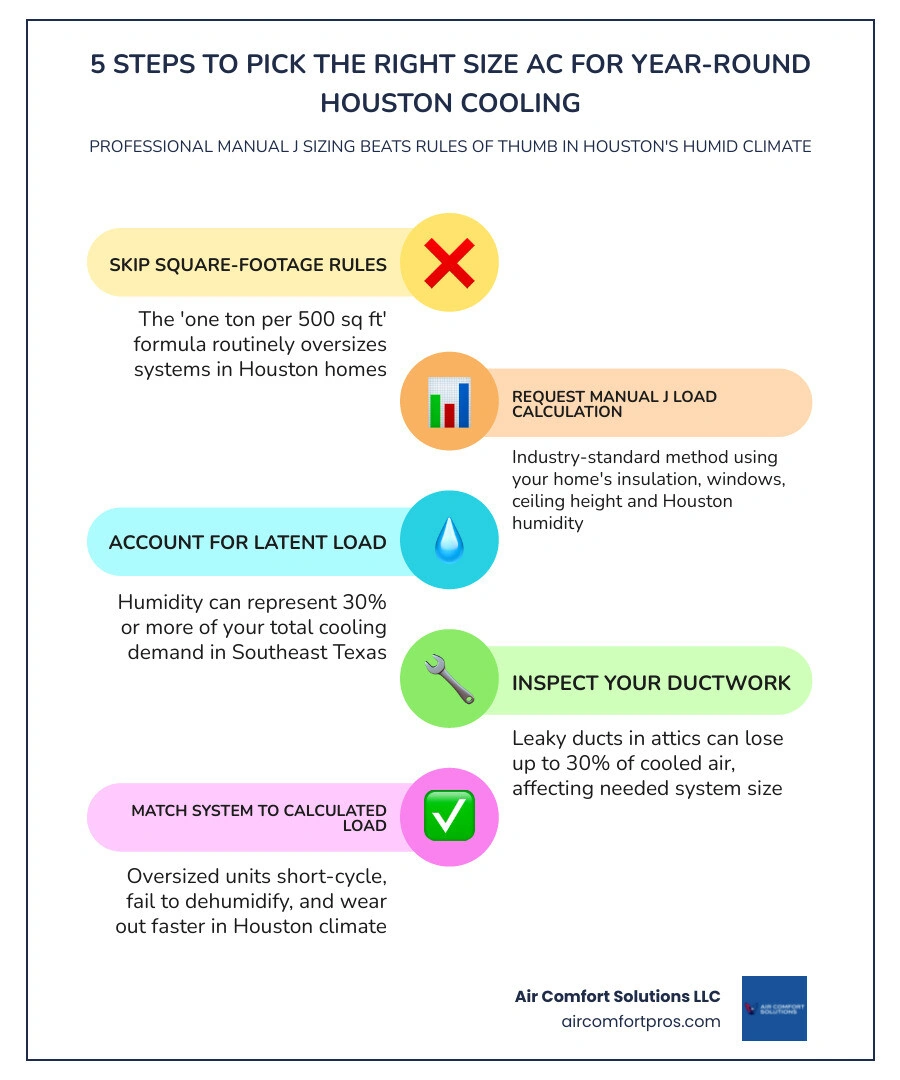
- Skip the square-footage rules of thumb. The common "one ton per 500–600 square feet" formula routinely oversizes AC systems in Houston homes.
- Request a Manual J load calculation. This is the industry-standard method required by building codes. It accounts for your home's insulation, windows, ceiling height, orientation, ductwork, and Houston's specific humidity levels.
- Account for latent load. In Houston, humidity can represent 30% or more of your total cooling demand — a factor generic online calculators ignore.
- Inspect your ductwork first. Leaky or poorly insulated ducts in unconditioned attics can lose up to 30% of cooled air, directly affecting what size system you need.
- Match the system to the actual calculated load. Bigger is not safer. An oversized AC short-cycles, fails to dehumidify, and wears out faster in Houston's climate.
In Houston, air conditioning isn't a seasonal convenience — it's a year-round necessity. The combination of extreme summer heat, Gulf Coast humidity, and long cooling seasons that stretch well into fall creates challenges that most generic AC sizing advice simply wasn't built to handle. A properly sized system is the foundation of everything: comfort, efficiency, and equipment longevity.
If you live anywhere around Pinehurst, Tomball, or Spring, you know that our weather is unique. We don't just deal with heat; we deal with a thick, heavy blanket of Gulf Coast humidity that lingers for most of the year. This intense climate is why generic, national sizing charts fall flat when applied to Southeast Texas homes.
To understand why precise sizing matters here, we have to look at how an air conditioner actually works. Your AC has two distinct jobs:
- Sensible Cooling: This is the process of lowering the actual temperature on your thermostat. It’s the physical removal of heat from the air.
- Latent Cooling: This is the process of removing moisture (humidity) from the air.
In drier parts of the country, HVAC systems focus almost entirely on sensible cooling. But in our area, the latent load—the energy required to pull water out of the air—can represent 30% or more of your system's total workload. To get a deeper look at this dynamic, read about How Southeast Texas Climate Affects Your HVAC System.
If your system is sized too large, it will lower the indoor temperature so quickly that it shuts off before it has a chance to run a full dehumidification cycle. You end up with a home that is cold but clammy, creating the perfect breeding ground for mold and mildew. For more details on this issue, explore How Humidity Affects Your AC Performance.
To combat this, modern systems in Texas are required to meet updated efficiency standards. Currently, new systems sold in Texas must meet a minimum of 14.3 SEER2 (often simplified to 15 SEER2). However, for our long, intense cooling seasons, we highly recommend a SEER2 rating of 16 or higher, paired with variable-speed technology. To find out which technology handles this best, check out our guide on the Best AC System for Hot Humid Climates.
The Science Behind How to Pick the Right Size AC for Year-Round Houston Cooling
When we talk about the size of an air conditioner, we aren't talking about its physical dimensions. We are talking about its cooling capacity, which is measured in BTUs (British Thermal Units) and tonnage.
- BTU (British Thermal Unit): The amount of heat energy required to raise the temperature of one pound of water by one degree Fahrenheit. In HVAC terms, it measures how much heat a system can remove per hour.
- Tonnage: One "ton" of air conditioning capacity equals 12,000 BTUs per hour. Therefore, a 3-ton system can remove 36,000 BTUs of heat per hour. Residential systems typically range from 1.5 to 5 tons, in half-ton increments.
Determining exactly how many BTUs your home needs is not a guessing game. It requires a highly detailed mathematical formula known as a Manual J load calculation, which is the gold standard established by the Air Conditioning Contractors of America (ACCA). If you want to dive deeper into how these measurements translate to your home, read our article What Size Air Conditioner Do I Need.
Why Rules of Thumb Fail When Learning How to Pick the Right Size AC for Year-Round Houston Cooling
For decades, many local contractors relied on simple square-footage rules of thumb, such as "one ton of cooling for every 500 square feet." In fact, the typical system in Texas is still sized at roughly one ton per 588 square feet of living space.
However, ACCA design criteria recommend a target closer to 800 to 900 square feet per ton for properly sized systems, and updated insulating materials in modern new construction can push that figure closer to 1,000 square feet per ton.
Using a generic square-footage rule of thumb fails because it ignores how homes are built today. A 2,000-square-foot home built in Magnolia in 1980 with single-pane windows and poor attic insulation has vastly different cooling needs than a tightly sealed, heavily insulated 2,000-square-foot home built in The Woodlands in 2024. Relying on simple square footage almost always results in installing an oversized system, which wastes energy and leaves your home feeling damp.
Step-by-Step: How to Pick the Right Size AC for Year-Round Houston Cooling Using Manual J
To perform a true Manual J load calculation, we don't just walk around with a tape measure. We use specialized software to build a thermal model of your home.

Here is how the process works step-by-step:
- Data Collection: We inspect and measure every room, documenting wall construction, insulation levels (especially in the attic), window types, ceiling heights, and the orientation of the home relative to the sun.
- Infiltration Assessment: We evaluate how much outside air leaks into the home through gaps, doors, and construction joints.
- Sensible vs. Latent Modeling: The software calculates exactly how much sensible heat your home gains from the sun and outdoor air, alongside the latent heat added by local humidity and household occupants.
- Equipment Selection (Manual S): Once the Manual J load is established, we use ACCA’s Manual S protocol to select an AC unit that matches those exact sensible and latent cooling requirements under local design temperatures (which, for the Houston area, is an outdoor design temperature of 94°F dry bulb and 77°F wet bulb).
Key Home Factors That Influence Your AC Tonnage
Every house has its own unique thermal footprint. When determining how to pick the right size AC for year-round Houston cooling, several critical factors can shift your required tonnage up or down:
- Attic Insulation: Heat rises, but in a Houston summer, intense heat also pushes down from your attic. While older homes may only have a few inches of fiberglass, modern codes require a minimum of R-38 attic insulation. Upgrading your insulation before buying a new AC can actually allow you to install a smaller, less expensive system.
- Window Orientation and Solar Heat Gain: Windows facing south and west bear the brunt of the Texas sun. A home with a large wall of west-facing windows will absorb a massive amount of solar heat in the afternoon, requiring more cooling capacity than an identical home with north-facing windows.
- Ceiling Height: Standard calculations assume 8-foot ceilings. If your home in Conroe or Montgomery features vaulted, cathedral, or 12-foot ceilings, you have a much larger volume of air that needs to be conditioned, which increases your required cooling capacity.
- Home Layout and Zoning: Multi-story homes are notoriously difficult to cool evenly because heat naturally rises to the second floor. Sizing a single system for a two-story home often leads to a freezing downstairs and a hot upstairs. In these cases, zoning the home or using ductless mini-splits is often a better approach than simply installing a massive single unit.
To learn more about how these individual elements come together to shape your comfort, read our detailed guide on How to Choose the Right AC System for Your Home.
The Risks of Getting the Size Wrong: Oversized vs. Undersized
Sizing an air conditioner is a delicate balancing act. Some homeowners assume that buying a larger system than necessary is a safe bet—a "buffer" against our hottest 100-degree days. In reality, oversizing is one of the most expensive mistakes you can make. Conversely, an undersized system will leave you sweating when you need relief most.
| Issue / Consequence | Oversized AC System | Undersized AC System |
|---|
| Cycle Length | Short, rapid cycles (short cycling) | Runs constantly without stopping |
| Indoor Humidity | High (clammy air, mold risk) | High (system cannot keep up) |
| Energy Consumption | High (frequent starting draws peak electrical current) | High (runs 24/7 during summer) |
| Equipment Lifespan | Reduced by 3–5 years due to compressor wear | Reduced due to continuous mechanical strain |
| Temperature Consistency | Hot and cold spots throughout the home | Thermostat never reaches the set point |
An oversized system wastes energy because electric motors consume the most power during startup. When a system cycles on and off up to 15 times an hour, it spikes your utility bills and places immense wear on the compressor. To understand the financial impact of this, read about How Incorrect Sizing During Installation Wastes Energy.
On the flip side, an undersized system will run continuously throughout the summer, struggling to keep up with the heat load. This constant operation leads to premature component failure and shortened equipment life. To protect your investment, it's also crucial to understand how other installation details affect longevity, such as How Improper Refrigerant Charge Reduces Your AC Lifespan.
You can install the most perfectly sized, high-efficiency AC unit on the market, but if your ductwork is designed poorly or leaking air, your home will still be uncomfortable. Your ductwork is the circulatory system of your home; it must be designed to handle the exact volume of air your AC produces.
In many local homes, the ductwork is located in unconditioned attic spaces where summer temperatures can easily soar to 140°F. If those ducts are leaking, they can lose up to 30% of your system's cooling capacity directly into the attic.
Furthermore, improper duct sizing restricts airflow, which alters the system's static pressure (the resistance to airflow in the system). For a residential HVAC system to run efficiently, static pressure should ideally remain between 0.5 and 0.7 inches of water column. When ductwork is too small for the AC unit, static pressure spikes, causing the system to run loud, freeze up, and fail prematurely.
To avoid these common installation pitfalls, we highly recommend reading about How Ductwork Mistakes During Installation Hurt Your Comfort.
Frequently Asked Questions About Houston AC Sizing
How do I know if my current Houston AC is the wrong size?
If your system is constantly turning on and off in 5- to 10-minute bursts, it is likely oversized. You will also notice that your home feels cool but clammy, with indoor relative humidity consistently sitting above 60%. If your system runs 24/7 without a break and your thermostat never reaches your desired temperature on a 95-degree afternoon, it is likely undersized.
Does a higher SEER2 rating mean I need a smaller AC unit?
No. SEER2 measures energy efficiency (how much cooling output you get per watt of electricity used), while tonnage measures overall cooling capacity. A 3-ton, 14.3 SEER2 system and a 3-ton, 18 SEER2 system remove the exact same amount of heat from your home. However, the higher SEER2 system will use significantly less electricity to do so and often features a variable-speed compressor that excels at humidity control.
Can I use an online calculator to size my home's AC?
Online calculators can provide a very rough ballpark estimate, but they should never be used to purchase equipment. Online tools cannot account for local variables like Pinehurst's extreme relative humidity, the condition of your attic ductwork, or the specific solar heat gain of your windows. Only a professional, on-site Manual J load calculation is reliable.
Conclusion
At Air Comfort Pros, we believe that a home comfort system is only as good as the science behind its installation. Serving Pinehurst, Magnolia, Tomball, Spring, and the surrounding North Harris County communities for over 35 years, our certified technicians never rely on guesswork or outdated rules of thumb.
Sizing your system correctly is the most critical step in protecting your investment, keeping your utility bills low, and ensuring your family stays comfortable through every hot, humid summer. To understand what makes a professional installation stand out, check out What Separates a Good AC Installation from a Bad One and learn How a Quality Installation Pays for Itself Over Time.
Ready to experience true, year-round comfort? Schedule your professional AC installation with Air Comfort Pros today, and let our team perform a precise load calculation tailored to your home.
Why Houston’s Climate Demands Precise AC Sizing
Knowing how to pick the right size AC for year-round Houston cooling is one of the most important decisions you'll make as a homeowner in North Harris County. Get it wrong and you're looking at sticky, humid air indoors, sky-high energy bills, and an AC unit that wears out years ahead of schedule. Get it right and your home stays consistently comfortable — even through Houston's brutal eight-month cooling season.
Here's the short answer:
- Skip the square-footage rules of thumb. The common "one ton per 500–600 square feet" formula routinely oversizes AC systems in Houston homes.
- Request a Manual J load calculation. This is the industry-standard method required by building codes. It accounts for your home's insulation, windows, ceiling height, orientation, ductwork, and Houston's specific humidity levels.
- Account for latent load. In Houston, humidity can represent 30% or more of your total cooling demand — a factor generic online calculators ignore.
- Inspect your ductwork first. Leaky or poorly insulated ducts in unconditioned attics can lose up to 30% of cooled air, directly affecting what size system you need.
- Match the system to the actual calculated load. Bigger is not safer. An oversized AC short-cycles, fails to dehumidify, and wears out faster in Houston's climate.
In Houston, air conditioning isn't a seasonal convenience — it's a year-round necessity. The combination of extreme summer heat, Gulf Coast humidity, and long cooling seasons that stretch well into fall creates challenges that most generic AC sizing advice simply wasn't built to handle. A properly sized system is the foundation of everything: comfort, efficiency, and equipment longevity.
If you live anywhere around Pinehurst, Tomball, or Spring, you know that our weather is unique. We don't just deal with heat; we deal with a thick, heavy blanket of Gulf Coast humidity that lingers for most of the year. This intense climate is why generic, national sizing charts fall flat when applied to Southeast Texas homes.
To understand why precise sizing matters here, we have to look at how an air conditioner actually works. Your AC has two distinct jobs:
- Sensible Cooling: This is the process of lowering the actual temperature on your thermostat. It’s the physical removal of heat from the air.
- Latent Cooling: This is the process of removing moisture (humidity) from the air.
In drier parts of the country, HVAC systems focus almost entirely on sensible cooling. But in our area, the latent load—the energy required to pull water out of the air—can represent 30% or more of your system's total workload. To get a deeper look at this dynamic, read about How Southeast Texas Climate Affects Your HVAC System.
If your system is sized too large, it will lower the indoor temperature so quickly that it shuts off before it has a chance to run a full dehumidification cycle. You end up with a home that is cold but clammy, creating the perfect breeding ground for mold and mildew. For more details on this issue, explore How Humidity Affects Your AC Performance.
To combat this, modern systems in Texas are required to meet updated efficiency standards. Currently, new systems sold in Texas must meet a minimum of 14.3 SEER2 (often simplified to 15 SEER2). However, for our long, intense cooling seasons, we highly recommend a SEER2 rating of 16 or higher, paired with variable-speed technology. To find out which technology handles this best, check out our guide on the Best AC System for Hot Humid Climates.
The Science Behind How to Pick the Right Size AC for Year-Round Houston Cooling
When we talk about the size of an air conditioner, we aren't talking about its physical dimensions. We are talking about its cooling capacity, which is measured in BTUs (British Thermal Units) and tonnage.
- BTU (British Thermal Unit): The amount of heat energy required to raise the temperature of one pound of water by one degree Fahrenheit. In HVAC terms, it measures how much heat a system can remove per hour.
- Tonnage: One "ton" of air conditioning capacity equals 12,000 BTUs per hour. Therefore, a 3-ton system can remove 36,000 BTUs of heat per hour. Residential systems typically range from 1.5 to 5 tons, in half-ton increments.
Determining exactly how many BTUs your home needs is not a guessing game. It requires a highly detailed mathematical formula known as a Manual J load calculation, which is the gold standard established by the Air Conditioning Contractors of America (ACCA). If you want to dive deeper into how these measurements translate to your home, read our article What Size Air Conditioner Do I Need.
Why Rules of Thumb Fail When Learning How to Pick the Right Size AC for Year-Round Houston Cooling
For decades, many local contractors relied on simple square-footage rules of thumb, such as "one ton of cooling for every 500 square feet." In fact, the typical system in Texas is still sized at roughly one ton per 588 square feet of living space.
However, ACCA design criteria recommend a target closer to 800 to 900 square feet per ton for properly sized systems, and updated insulating materials in modern new construction can push that figure closer to 1,000 square feet per ton.
Using a generic square-footage rule of thumb fails because it ignores how homes are built today. A 2,000-square-foot home built in Magnolia in 1980 with single-pane windows and poor attic insulation has vastly different cooling needs than a tightly sealed, heavily insulated 2,000-square-foot home built in The Woodlands in 2024. Relying on simple square footage almost always results in installing an oversized system, which wastes energy and leaves your home feeling damp.
Step-by-Step: How to Pick the Right Size AC for Year-Round Houston Cooling Using Manual J
To perform a true Manual J load calculation, we don't just walk around with a tape measure. We use specialized software to build a thermal model of your home.
Here is how the process works step-by-step:
- Data Collection: We inspect and measure every room, documenting wall construction, insulation levels (especially in the attic), window types, ceiling heights, and the orientation of the home relative to the sun.
- Infiltration Assessment: We evaluate how much outside air leaks into the home through gaps, doors, and construction joints.
- Sensible vs. Latent Modeling: The software calculates exactly how much sensible heat your home gains from the sun and outdoor air, alongside the latent heat added by local humidity and household occupants.
- Equipment Selection (Manual S): Once the Manual J load is established, we use ACCA’s Manual S protocol to select an AC unit that matches those exact sensible and latent cooling requirements under local design temperatures (which, for the Houston area, is an outdoor design temperature of 94°F dry bulb and 77°F wet bulb).
Key Home Factors That Influence Your AC Tonnage
Every house has its own unique thermal footprint. When determining how to pick the right size AC for year-round Houston cooling, several critical factors can shift your required tonnage up or down:
- Attic Insulation: Heat rises, but in a Houston summer, intense heat also pushes down from your attic. While older homes may only have a few inches of fiberglass, modern codes require a minimum of R-38 attic insulation. Upgrading your insulation before buying a new AC can actually allow you to install a smaller, less expensive system.
- Window Orientation and Solar Heat Gain: Windows facing south and west bear the brunt of the Texas sun. A home with a large wall of west-facing windows will absorb a massive amount of solar heat in the afternoon, requiring more cooling capacity than an identical home with north-facing windows.
- Ceiling Height: Standard calculations assume 8-foot ceilings. If your home in Conroe or Montgomery features vaulted, cathedral, or 12-foot ceilings, you have a much larger volume of air that needs to be conditioned, which increases your required cooling capacity.
- Home Layout and Zoning: Multi-story homes are notoriously difficult to cool evenly because heat naturally rises to the second floor. Sizing a single system for a two-story home often leads to a freezing downstairs and a hot upstairs. In these cases, zoning the home or using ductless mini-splits is often a better approach than simply installing a massive single unit.
To learn more about how these individual elements come together to shape your comfort, read our detailed guide on How to Choose the Right AC System for Your Home.
The Risks of Getting the Size Wrong: Oversized vs. Undersized
Sizing an air conditioner is a delicate balancing act. Some homeowners assume that buying a larger system than necessary is a safe bet—a "buffer" against our hottest 100-degree days. In reality, oversizing is one of the most expensive mistakes you can make. Conversely, an undersized system will leave you sweating when you need relief most.
| Issue / Consequence | Oversized AC System | Undersized AC System |
|---|
| Cycle Length | Short, rapid cycles (short cycling) | Runs constantly without stopping |
| Indoor Humidity | High (clammy air, mold risk) | High (system cannot keep up) |
| Energy Consumption | High (frequent starting draws peak electrical current) | High (runs 24/7 during summer) |
| Equipment Lifespan | Reduced by 3–5 years due to compressor wear | Reduced due to continuous mechanical strain |
| Temperature Consistency | Hot and cold spots throughout the home | Thermostat never reaches the set point |
An oversized system wastes energy because electric motors consume the most power during startup. When a system cycles on and off up to 15 times an hour, it spikes your utility bills and places immense wear on the compressor. To understand the financial impact of this, read about How Incorrect Sizing During Installation Wastes Energy.
On the flip side, an undersized system will run continuously throughout the summer, struggling to keep up with the heat load. This constant operation leads to premature component failure and shortened equipment life. To protect your investment, it's also crucial to understand how other installation details affect longevity, such as How Improper Refrigerant Charge Reduces Your AC Lifespan.
You can install the most perfectly sized, high-efficiency AC unit on the market, but if your ductwork is designed poorly or leaking air, your home will still be uncomfortable. Your ductwork is the circulatory system of your home; it must be designed to handle the exact volume of air your AC produces.
In many local homes, the ductwork is located in unconditioned attic spaces where summer temperatures can easily soar to 140°F. If those ducts are leaking, they can lose up to 30% of your system's cooling capacity directly into the attic.
Furthermore, improper duct sizing restricts airflow, which alters the system's static pressure (the resistance to airflow in the system). For a residential HVAC system to run efficiently, static pressure should ideally remain between 0.5 and 0.7 inches of water column. When ductwork is too small for the AC unit, static pressure spikes, causing the system to run loud, freeze up, and fail prematurely.
To avoid these common installation pitfalls, we highly recommend reading about How Ductwork Mistakes During Installation Hurt Your Comfort.
Frequently Asked Questions About Houston AC Sizing
How do I know if my current Houston AC is the wrong size?
If your system is constantly turning on and off in 5- to 10-minute bursts, it is likely oversized. You will also notice that your home feels cool but clammy, with indoor relative humidity consistently sitting above 60%. If your system runs 24/7 without a break and your thermostat never reaches your desired temperature on a 95-degree afternoon, it is likely undersized.
Does a higher SEER2 rating mean I need a smaller AC unit?
No. SEER2 measures energy efficiency (how much cooling output you get per watt of electricity used), while tonnage measures overall cooling capacity. A 3-ton, 14.3 SEER2 system and a 3-ton, 18 SEER2 system remove the exact same amount of heat from your home. However, the higher SEER2 system will use significantly less electricity to do so and often features a variable-speed compressor that excels at humidity control.
Can I use an online calculator to size my home's AC?
Online calculators can provide a very rough ballpark estimate, but they should never be used to purchase equipment. Online tools cannot account for local variables like Pinehurst's extreme relative humidity, the condition of your attic ductwork, or the specific solar heat gain of your windows. Only a professional, on-site Manual J load calculation is reliable.
Conclusion
At Air Comfort Pros, we believe that a home comfort system is only as good as the science behind its installation. Serving Pinehurst, Magnolia, Tomball, Spring, and the surrounding North Harris County communities for over 35 years, our certified technicians never rely on guesswork or outdated rules of thumb.
Sizing your system correctly is the most critical step in protecting your investment, keeping your utility bills low, and ensuring your family stays comfortable through every hot, humid summer. To understand what makes a professional installation stand out, check out What Separates a Good AC Installation from a Bad One and learn How a Quality Installation Pays for Itself Over Time.
Ready to experience true, year-round comfort? Schedule your professional AC installation with Air Comfort Pros today, and let our team perform a precise load calculation tailored to your home.
Why Houston’s Climate Demands Precise AC Sizing
Knowing how to pick the right size AC for year-round Houston cooling is one of the most important decisions you'll make as a homeowner in North Harris County. Get it wrong and you're looking at sticky, humid air indoors, sky-high energy bills, and an AC unit that wears out years ahead of schedule. Get it right and your home stays consistently comfortable — even through Houston's brutal eight-month cooling season.
Here's the short answer:
- Skip the square-footage rules of thumb. The common "one ton per 500–600 square feet" formula routinely oversizes AC systems in Houston homes.
- Request a Manual J load calculation. This is the industry-standard method required by building codes. It accounts for your home's insulation, windows, ceiling height, orientation, ductwork, and Houston's specific humidity levels.
- Account for latent load. In Houston, humidity can represent 30% or more of your total cooling demand — a factor generic online calculators ignore.
- Inspect your ductwork first. Leaky or poorly insulated ducts in unconditioned attics can lose up to 30% of cooled air, directly affecting what size system you need.
- Match the system to the actual calculated load. Bigger is not safer. An oversized AC short-cycles, fails to dehumidify, and wears out faster in Houston's climate.
In Houston, air conditioning isn't a seasonal convenience — it's a year-round necessity. The combination of extreme summer heat, Gulf Coast humidity, and long cooling seasons that stretch well into fall creates challenges that most generic AC sizing advice simply wasn't built to handle. A properly sized system is the foundation of everything: comfort, efficiency, and equipment longevity.
If you live anywhere around Pinehurst, Tomball, or Spring, you know that our weather is unique. We don't just deal with heat; we deal with a thick, heavy blanket of Gulf Coast humidity that lingers for most of the year. This intense climate is why generic, national sizing charts fall flat when applied to Southeast Texas homes.
To understand why precise sizing matters here, we have to look at how an air conditioner actually works. Your AC has two distinct jobs:
- Sensible Cooling: This is the process of lowering the actual temperature on your thermostat. It’s the physical removal of heat from the air.
- Latent Cooling: This is the process of removing moisture (humidity) from the air.
In drier parts of the country, HVAC systems focus almost entirely on sensible cooling. But in our area, the latent load—the energy required to pull water out of the air—can represent 30% or more of your system's total workload. To get a deeper look at this dynamic, read about How Southeast Texas Climate Affects Your HVAC System.
If your system is sized too large, it will lower the indoor temperature so quickly that it shuts off before it has a chance to run a full dehumidification cycle. You end up with a home that is cold but clammy, creating the perfect breeding ground for mold and mildew. For more details on this issue, explore How Humidity Affects Your AC Performance.
To combat this, modern systems in Texas are required to meet updated efficiency standards. Currently, new systems sold in Texas must meet a minimum of 14.3 SEER2 (often simplified to 15 SEER2). However, for our long, intense cooling seasons, we highly recommend a SEER2 rating of 16 or higher, paired with variable-speed technology. To find out which technology handles this best, check out our guide on the Best AC System for Hot Humid Climates.
The Science Behind How to Pick the Right Size AC for Year-Round Houston Cooling
When we talk about the size of an air conditioner, we aren't talking about its physical dimensions. We are talking about its cooling capacity, which is measured in BTUs (British Thermal Units) and tonnage.
- BTU (British Thermal Unit): The amount of heat energy required to raise the temperature of one pound of water by one degree Fahrenheit. In HVAC terms, it measures how much heat a system can remove per hour.
- Tonnage: One "ton" of air conditioning capacity equals 12,000 BTUs per hour. Therefore, a 3-ton system can remove 36,000 BTUs of heat per hour. Residential systems typically range from 1.5 to 5 tons, in half-ton increments.
Determining exactly how many BTUs your home needs is not a guessing game. It requires a highly detailed mathematical formula known as a Manual J load calculation, which is the gold standard established by the Air Conditioning Contractors of America (ACCA). If you want to dive deeper into how these measurements translate to your home, read our article What Size Air Conditioner Do I Need.
Why Rules of Thumb Fail When Learning How to Pick the Right Size AC for Year-Round Houston Cooling
For decades, many local contractors relied on simple square-footage rules of thumb, such as "one ton of cooling for every 500 square feet." In fact, the typical system in Texas is still sized at roughly one ton per 588 square feet of living space.
However, ACCA design criteria recommend a target closer to 800 to 900 square feet per ton for properly sized systems, and updated insulating materials in modern new construction can push that figure closer to 1,000 square feet per ton.
Using a generic square-footage rule of thumb fails because it ignores how homes are built today. A 2,000-square-foot home built in Magnolia in 1980 with single-pane windows and poor attic insulation has vastly different cooling needs than a tightly sealed, heavily insulated 2,000-square-foot home built in The Woodlands in 2024. Relying on simple square footage almost always results in installing an oversized system, which wastes energy and leaves your home feeling damp.
Step-by-Step: How to Pick the Right Size AC for Year-Round Houston Cooling Using Manual J
To perform a true Manual J load calculation, we don't just walk around with a tape measure. We use specialized software to build a thermal model of your home.
Here is how the process works step-by-step:
- Data Collection: We inspect and measure every room, documenting wall construction, insulation levels (especially in the attic), window types, ceiling heights, and the orientation of the home relative to the sun.
- Infiltration Assessment: We evaluate how much outside air leaks into the home through gaps, doors, and construction joints.
- Sensible vs. Latent Modeling: The software calculates exactly how much sensible heat your home gains from the sun and outdoor air, alongside the latent heat added by local humidity and household occupants.
- Equipment Selection (Manual S): Once the Manual J load is established, we use ACCA’s Manual S protocol to select an AC unit that matches those exact sensible and latent cooling requirements under local design temperatures (which, for the Houston area, is an outdoor design temperature of 94°F dry bulb and 77°F wet bulb).
Key Home Factors That Influence Your AC Tonnage
Every house has its own unique thermal footprint. When determining how to pick the right size AC for year-round Houston cooling, several critical factors can shift your required tonnage up or down:
- Attic Insulation: Heat rises, but in a Houston summer, intense heat also pushes down from your attic. While older homes may only have a few inches of fiberglass, modern codes require a minimum of R-38 attic insulation. Upgrading your insulation before buying a new AC can actually allow you to install a smaller, less expensive system.
- Window Orientation and Solar Heat Gain: Windows facing south and west bear the brunt of the Texas sun. A home with a large wall of west-facing windows will absorb a massive amount of solar heat in the afternoon, requiring more cooling capacity than an identical home with north-facing windows.
- Ceiling Height: Standard calculations assume 8-foot ceilings. If your home in Conroe or Montgomery features vaulted, cathedral, or 12-foot ceilings, you have a much larger volume of air that needs to be conditioned, which increases your required cooling capacity.
- Home Layout and Zoning: Multi-story homes are notoriously difficult to cool evenly because heat naturally rises to the second floor. Sizing a single system for a two-story home often leads to a freezing downstairs and a hot upstairs. In these cases, zoning the home or using ductless mini-splits is often a better approach than simply installing a massive single unit.
To learn more about how these individual elements come together to shape your comfort, read our detailed guide on How to Choose the Right AC System for Your Home.
The Risks of Getting the Size Wrong: Oversized vs. Undersized
Sizing an air conditioner is a delicate balancing act. Some homeowners assume that buying a larger system than necessary is a safe bet—a "buffer" against our hottest 100-degree days. In reality, oversizing is one of the most expensive mistakes you can make. Conversely, an undersized system will leave you sweating when you need relief most.
| Issue / Consequence | Oversized AC System | Undersized AC System |
|---|
| Cycle Length | Short, rapid cycles (short cycling) | Runs constantly without stopping |
| Indoor Humidity | High (clammy air, mold risk) | High (system cannot keep up) |
| Energy Consumption | High (frequent starting draws peak electrical current) | High (runs 24/7 during summer) |
| Equipment Lifespan | Reduced by 3–5 years due to compressor wear | Reduced due to continuous mechanical strain |
| Temperature Consistency | Hot and cold spots throughout the home | Thermostat never reaches the set point |
An oversized system wastes energy because electric motors consume the most power during startup. When a system cycles on and off up to 15 times an hour, it spikes your utility bills and places immense wear on the compressor. To understand the financial impact of this, read about How Incorrect Sizing During Installation Wastes Energy.
On the flip side, an undersized system will run continuously throughout the summer, struggling to keep up with the heat load. This constant operation leads to premature component failure and shortened equipment life. To protect your investment, it's also crucial to understand how other installation details affect longevity, such as How Improper Refrigerant Charge Reduces Your AC Lifespan.
You can install the most perfectly sized, high-efficiency AC unit on the market, but if your ductwork is designed poorly or leaking air, your home will still be uncomfortable. Your ductwork is the circulatory system of your home; it must be designed to handle the exact volume of air your AC produces.
In many local homes, the ductwork is located in unconditioned attic spaces where summer temperatures can easily soar to 140°F. If those ducts are leaking, they can lose up to 30% of your system's cooling capacity directly into the attic.
Furthermore, improper duct sizing restricts airflow, which alters the system's static pressure (the resistance to airflow in the system). For a residential HVAC system to run efficiently, static pressure should ideally remain between 0.5 and 0.7 inches of water column. When ductwork is too small for the AC unit, static pressure spikes, causing the system to run loud, freeze up, and fail prematurely.
To avoid these common installation pitfalls, we highly recommend reading about How Ductwork Mistakes During Installation Hurt Your Comfort.
Frequently Asked Questions About Houston AC Sizing
How do I know if my current Houston AC is the wrong size?
If your system is constantly turning on and off in 5- to 10-minute bursts, it is likely oversized. You will also notice that your home feels cool but clammy, with indoor relative humidity consistently sitting above 60%. If your system runs 24/7 without a break and your thermostat never reaches your desired temperature on a 95-degree afternoon, it is likely undersized.
Does a higher SEER2 rating mean I need a smaller AC unit?
No. SEER2 measures energy efficiency (how much cooling output you get per watt of electricity used), while tonnage measures overall cooling capacity. A 3-ton, 14.3 SEER2 system and a 3-ton, 18 SEER2 system remove the exact same amount of heat from your home. However, the higher SEER2 system will use significantly less electricity to do so and often features a variable-speed compressor that excels at humidity control.
Can I use an online calculator to size my home's AC?
Online calculators can provide a very rough ballpark estimate, but they should never be used to purchase equipment. Online tools cannot account for local variables like Pinehurst's extreme relative humidity, the condition of your attic ductwork, or the specific solar heat gain of your windows. Only a professional, on-site Manual J load calculation is reliable.
Conclusion
At Air Comfort Pros, we believe that a home comfort system is only as good as the science behind its installation. Serving Pinehurst, Magnolia, Tomball, Spring, and the surrounding North Harris County communities for over 35 years, our certified technicians never rely on guesswork or outdated rules of thumb.
Sizing your system correctly is the most critical step in protecting your investment, keeping your utility bills low, and ensuring your family stays comfortable through every hot, humid summer. To understand what makes a professional installation stand out, check out What Separates a Good AC Installation from a Bad One and learn How a Quality Installation Pays for Itself Over Time.
Ready to experience true, year-round comfort? Schedule your professional AC installation with Air Comfort Pros today, and let our team perform a precise load calculation tailored to your home.
Why Houston’s Climate Demands Precise AC Sizing
Knowing how to pick the right size AC for year-round Houston cooling is one of the most important decisions you'll make as a homeowner in North Harris County. Get it wrong and you're looking at sticky, humid air indoors, sky-high energy bills, and an AC unit that wears out years ahead of schedule. Get it right and your home stays consistently comfortable — even through Houston's brutal eight-month cooling season.
Here's the short answer:
- Skip the square-footage rules of thumb. The common "one ton per 500–600 square feet" formula routinely oversizes AC systems in Houston homes.
- Request a Manual J load calculation. This is the industry-standard method required by building codes. It accounts for your home's insulation, windows, ceiling height, orientation, ductwork, and Houston's specific humidity levels.
- Account for latent load. In Houston, humidity can represent 30% or more of your total cooling demand — a factor generic online calculators ignore.
- Inspect your ductwork first. Leaky or poorly insulated ducts in unconditioned attics can lose up to 30% of cooled air, directly affecting what size system you need.
- Match the system to the actual calculated load. Bigger is not safer. An oversized AC short-cycles, fails to dehumidify, and wears out faster in Houston's climate.
In Houston, air conditioning isn't a seasonal convenience — it's a year-round necessity. The combination of extreme summer heat, Gulf Coast humidity, and long cooling seasons that stretch well into fall creates challenges that most generic AC sizing advice simply wasn't built to handle. A properly sized system is the foundation of everything: comfort, efficiency, and equipment longevity.
If you live anywhere around Pinehurst, Tomball, or Spring, you know that our weather is unique. We don't just deal with heat; we deal with a thick, heavy blanket of Gulf Coast humidity that lingers for most of the year. This intense climate is why generic, national sizing charts fall flat when applied to Southeast Texas homes.
To understand why precise sizing matters here, we have to look at how an air conditioner actually works. Your AC has two distinct jobs:
- Sensible Cooling: This is the process of lowering the actual temperature on your thermostat. It’s the physical removal of heat from the air.
- Latent Cooling: This is the process of removing moisture (humidity) from the air.
In drier parts of the country, HVAC systems focus almost entirely on sensible cooling. But in our area, the latent load—the energy required to pull water out of the air—can represent 30% or more of your system's total workload. To get a deeper look at this dynamic, read about How Southeast Texas Climate Affects Your HVAC System.
If your system is sized too large, it will lower the indoor temperature so quickly that it shuts off before it has a chance to run a full dehumidification cycle. You end up with a home that is cold but clammy, creating the perfect breeding ground for mold and mildew. For more details on this issue, explore How Humidity Affects Your AC Performance.
To combat this, modern systems in Texas are required to meet updated efficiency standards. Currently, new systems sold in Texas must meet a minimum of 14.3 SEER2 (often simplified to 15 SEER2). However, for our long, intense cooling seasons, we highly recommend a SEER2 rating of 16 or higher, paired with variable-speed technology. To find out which technology handles this best, check out our guide on the Best AC System for Hot Humid Climates.
The Science Behind How to Pick the Right Size AC for Year-Round Houston Cooling
When we talk about the size of an air conditioner, we aren't talking about its physical dimensions. We are talking about its cooling capacity, which is measured in BTUs (British Thermal Units) and tonnage.
- BTU (British Thermal Unit): The amount of heat energy required to raise the temperature of one pound of water by one degree Fahrenheit. In HVAC terms, it measures how much heat a system can remove per hour.
- Tonnage: One "ton" of air conditioning capacity equals 12,000 BTUs per hour. Therefore, a 3-ton system can remove 36,000 BTUs of heat per hour. Residential systems typically range from 1.5 to 5 tons, in half-ton increments.
Determining exactly how many BTUs your home needs is not a guessing game. It requires a highly detailed mathematical formula known as a Manual J load calculation, which is the gold standard established by the Air Conditioning Contractors of America (ACCA). If you want to dive deeper into how these measurements translate to your home, read our article What Size Air Conditioner Do I Need.
Why Rules of Thumb Fail When Learning How to Pick the Right Size AC for Year-Round Houston Cooling
For decades, many local contractors relied on simple square-footage rules of thumb, such as "one ton of cooling for every 500 square feet." In fact, the typical system in Texas is still sized at roughly one ton per 588 square feet of living space.
However, ACCA design criteria recommend a target closer to 800 to 900 square feet per ton for properly sized systems, and updated insulating materials in modern new construction can push that figure closer to 1,000 square feet per ton.
Using a generic square-footage rule of thumb fails because it ignores how homes are built today. A 2,000-square-foot home built in Magnolia in 1980 with single-pane windows and poor attic insulation has vastly different cooling needs than a tightly sealed, heavily insulated 2,000-square-foot home built in The Woodlands in 2024. Relying on simple square footage almost always results in installing an oversized system, which wastes energy and leaves your home feeling damp.
Step-by-Step: How to Pick the Right Size AC for Year-Round Houston Cooling Using Manual J
To perform a true Manual J load calculation, we don't just walk around with a tape measure. We use specialized software to build a thermal model of your home.
Here is how the process works step-by-step:
- Data Collection: We inspect and measure every room, documenting wall construction, insulation levels (especially in the attic), window types, ceiling heights, and the orientation of the home relative to the sun.
- Infiltration Assessment: We evaluate how much outside air leaks into the home through gaps, doors, and construction joints.
- Sensible vs. Latent Modeling: The software calculates exactly how much sensible heat your home gains from the sun and outdoor air, alongside the latent heat added by local humidity and household occupants.
- Equipment Selection (Manual S): Once the Manual J load is established, we use ACCA’s Manual S protocol to select an AC unit that matches those exact sensible and latent cooling requirements under local design temperatures (which, for the Houston area, is an outdoor design temperature of 94°F dry bulb and 77°F wet bulb).
Key Home Factors That Influence Your AC Tonnage
Every house has its own unique thermal footprint. When determining how to pick the right size AC for year-round Houston cooling, several critical factors can shift your required tonnage up or down:
- Attic Insulation: Heat rises, but in a Houston summer, intense heat also pushes down from your attic. While older homes may only have a few inches of fiberglass, modern codes require a minimum of R-38 attic insulation. Upgrading your insulation before buying a new AC can actually allow you to install a smaller, less expensive system.
- Window Orientation and Solar Heat Gain: Windows facing south and west bear the brunt of the Texas sun. A home with a large wall of west-facing windows will absorb a massive amount of solar heat in the afternoon, requiring more cooling capacity than an identical home with north-facing windows.
- Ceiling Height: Standard calculations assume 8-foot ceilings. If your home in Conroe or Montgomery features vaulted, cathedral, or 12-foot ceilings, you have a much larger volume of air that needs to be conditioned, which increases your required cooling capacity.
- Home Layout and Zoning: Multi-story homes are notoriously difficult to cool evenly because heat naturally rises to the second floor. Sizing a single system for a two-story home often leads to a freezing downstairs and a hot upstairs. In these cases, zoning the home or using ductless mini-splits is often a better approach than simply installing a massive single unit.
To learn more about how these individual elements come together to shape your comfort, read our detailed guide on How to Choose the Right AC System for Your Home.
The Risks of Getting the Size Wrong: Oversized vs. Undersized
Sizing an air conditioner is a delicate balancing act. Some homeowners assume that buying a larger system than necessary is a safe bet—a "buffer" against our hottest 100-degree days. In reality, oversizing is one of the most expensive mistakes you can make. Conversely, an undersized system will leave you sweating when you need relief most.
| Issue / Consequence | Oversized AC System | Undersized AC System |
|---|
| Cycle Length | Short, rapid cycles (short cycling) | Runs constantly without stopping |
| Indoor Humidity | High (clammy air, mold risk) | High (system cannot keep up) |
| Energy Consumption | High (frequent starting draws peak electrical current) | High (runs 24/7 during summer) |
| Equipment Lifespan | Reduced by 3–5 years due to compressor wear | Reduced due to continuous mechanical strain |
| Temperature Consistency | Hot and cold spots throughout the home | Thermostat never reaches the set point |
An oversized system wastes energy because electric motors consume the most power during startup. When a system cycles on and off up to 15 times an hour, it spikes your utility bills and places immense wear on the compressor. To understand the financial impact of this, read about How Incorrect Sizing During Installation Wastes Energy.
On the flip side, an undersized system will run continuously throughout the summer, struggling to keep up with the heat load. This constant operation leads to premature component failure and shortened equipment life. To protect your investment, it's also crucial to understand how other installation details affect longevity, such as How Improper Refrigerant Charge Reduces Your AC Lifespan.
You can install the most perfectly sized, high-efficiency AC unit on the market, but if your ductwork is designed poorly or leaking air, your home will still be uncomfortable. Your ductwork is the circulatory system of your home; it must be designed to handle the exact volume of air your AC produces.
In many local homes, the ductwork is located in unconditioned attic spaces where summer temperatures can easily soar to 140°F. If those ducts are leaking, they can lose up to 30% of your system's cooling capacity directly into the attic.
Furthermore, improper duct sizing restricts airflow, which alters the system's static pressure (the resistance to airflow in the system). For a residential HVAC system to run efficiently, static pressure should ideally remain between 0.5 and 0.7 inches of water column. When ductwork is too small for the AC unit, static pressure spikes, causing the system to run loud, freeze up, and fail prematurely.
To avoid these common installation pitfalls, we highly recommend reading about How Ductwork Mistakes During Installation Hurt Your Comfort.
Frequently Asked Questions About Houston AC Sizing
How do I know if my current Houston AC is the wrong size?
If your system is constantly turning on and off in 5- to 10-minute bursts, it is likely oversized. You will also notice that your home feels cool but clammy, with indoor relative humidity consistently sitting above 60%. If your system runs 24/7 without a break and your thermostat never reaches your desired temperature on a 95-degree afternoon, it is likely undersized.
Does a higher SEER2 rating mean I need a smaller AC unit?
No. SEER2 measures energy efficiency (how much cooling output you get per watt of electricity used), while tonnage measures overall cooling capacity. A 3-ton, 14.3 SEER2 system and a 3-ton, 18 SEER2 system remove the exact same amount of heat from your home. However, the higher SEER2 system will use significantly less electricity to do so and often features a variable-speed compressor that excels at humidity control.
Can I use an online calculator to size my home's AC?
Online calculators can provide a very rough ballpark estimate, but they should never be used to purchase equipment. Online tools cannot account for local variables like Pinehurst's extreme relative humidity, the condition of your attic ductwork, or the specific solar heat gain of your windows. Only a professional, on-site Manual J load calculation is reliable.
Conclusion
At Air Comfort Pros, we believe that a home comfort system is only as good as the science behind its installation. Serving Pinehurst, Magnolia, Tomball, Spring, and the surrounding North Harris County communities for over 35 years, our certified technicians never rely on guesswork or outdated rules of thumb.
Sizing your system correctly is the most critical step in protecting your investment, keeping your utility bills low, and ensuring your family stays comfortable through every hot, humid summer. To understand what makes a professional installation stand out, check out What Separates a Good AC Installation from a Bad One and learn How a Quality Installation Pays for Itself Over Time.
Ready to experience true, year-round comfort? Schedule your professional AC installation with Air Comfort Pros today, and let our team perform a precise load calculation tailored to your home.
Why Houston’s Climate Demands Precise AC Sizing
Knowing how to pick the right size AC for year-round Houston cooling is one of the most important decisions you'll make as a homeowner in North Harris County. Get it wrong and you're looking at sticky, humid air indoors, sky-high energy bills, and an AC unit that wears out years ahead of schedule. Get it right and your home stays consistently comfortable — even through Houston's brutal eight-month cooling season.
Here's the short answer:
- Skip the square-footage rules of thumb. The common "one ton per 500–600 square feet" formula routinely oversizes AC systems in Houston homes.
- Request a Manual J load calculation. This is the industry-standard method required by building codes. It accounts for your home's insulation, windows, ceiling height, orientation, ductwork, and Houston's specific humidity levels.
- Account for latent load. In Houston, humidity can represent 30% or more of your total cooling demand — a factor generic online calculators ignore.
- Inspect your ductwork first. Leaky or poorly insulated ducts in unconditioned attics can lose up to 30% of cooled air, directly affecting what size system you need.
- Match the system to the actual calculated load. Bigger is not safer. An oversized AC short-cycles, fails to dehumidify, and wears out faster in Houston's climate.
In Houston, air conditioning isn't a seasonal convenience — it's a year-round necessity. The combination of extreme summer heat, Gulf Coast humidity, and long cooling seasons that stretch well into fall creates challenges that most generic AC sizing advice simply wasn't built to handle. A properly sized system is the foundation of everything: comfort, efficiency, and equipment longevity.
If you live anywhere around Pinehurst, Tomball, or Spring, you know that our weather is unique. We don't just deal with heat; we deal with a thick, heavy blanket of Gulf Coast humidity that lingers for most of the year. This intense climate is why generic, national sizing charts fall flat when applied to Southeast Texas homes.
To understand why precise sizing matters here, we have to look at how an air conditioner actually works. Your AC has two distinct jobs:
- Sensible Cooling: This is the process of lowering the actual temperature on your thermostat. It’s the physical removal of heat from the air.
- Latent Cooling: This is the process of removing moisture (humidity) from the air.
In drier parts of the country, HVAC systems focus almost entirely on sensible cooling. But in our area, the latent load—the energy required to pull water out of the air—can represent 30% or more of your system's total workload. To get a deeper look at this dynamic, read about How Southeast Texas Climate Affects Your HVAC System.
If your system is sized too large, it will lower the indoor temperature so quickly that it shuts off before it has a chance to run a full dehumidification cycle. You end up with a home that is cold but clammy, creating the perfect breeding ground for mold and mildew. For more details on this issue, explore How Humidity Affects Your AC Performance.
To combat this, modern systems in Texas are required to meet updated efficiency standards. Currently, new systems sold in Texas must meet a minimum of 14.3 SEER2 (often simplified to 15 SEER2). However, for our long, intense cooling seasons, we highly recommend a SEER2 rating of 16 or higher, paired with variable-speed technology. To find out which technology handles this best, check out our guide on the Best AC System for Hot Humid Climates.
The Science Behind How to Pick the Right Size AC for Year-Round Houston Cooling
When we talk about the size of an air conditioner, we aren't talking about its physical dimensions. We are talking about its cooling capacity, which is measured in BTUs (British Thermal Units) and tonnage.
- BTU (British Thermal Unit): The amount of heat energy required to raise the temperature of one pound of water by one degree Fahrenheit. In HVAC terms, it measures how much heat a system can remove per hour.
- Tonnage: One "ton" of air conditioning capacity equals 12,000 BTUs per hour. Therefore, a 3-ton system can remove 36,000 BTUs of heat per hour. Residential systems typically range from 1.5 to 5 tons, in half-ton increments.
Determining exactly how many BTUs your home needs is not a guessing game. It requires a highly detailed mathematical formula known as a Manual J load calculation, which is the gold standard established by the Air Conditioning Contractors of America (ACCA). If you want to dive deeper into how these measurements translate to your home, read our article What Size Air Conditioner Do I Need.
Why Rules of Thumb Fail When Learning How to Pick the Right Size AC for Year-Round Houston Cooling
For decades, many local contractors relied on simple square-footage rules of thumb, such as "one ton of cooling for every 500 square feet." In fact, the typical system in Texas is still sized at roughly one ton per 588 square feet of living space.
However, ACCA design criteria recommend a target closer to 800 to 900 square feet per ton for properly sized systems, and updated insulating materials in modern new construction can push that figure closer to 1,000 square feet per ton.
Using a generic square-footage rule of thumb fails because it ignores how homes are built today. A 2,000-square-foot home built in Magnolia in 1980 with single-pane windows and poor attic insulation has vastly different cooling needs than a tightly sealed, heavily insulated 2,000-square-foot home built in The Woodlands in 2024. Relying on simple square footage almost always results in installing an oversized system, which wastes energy and leaves your home feeling damp.
Step-by-Step: How to Pick the Right Size AC for Year-Round Houston Cooling Using Manual J
To perform a true Manual J load calculation, we don't just walk around with a tape measure. We use specialized software to build a thermal model of your home.
Here is how the process works step-by-step:
- Data Collection: We inspect and measure every room, documenting wall construction, insulation levels (especially in the attic), window types, ceiling heights, and the orientation of the home relative to the sun.
- Infiltration Assessment: We evaluate how much outside air leaks into the home through gaps, doors, and construction joints.
- Sensible vs. Latent Modeling: The software calculates exactly how much sensible heat your home gains from the sun and outdoor air, alongside the latent heat added by local humidity and household occupants.
- Equipment Selection (Manual S): Once the Manual J load is established, we use ACCA’s Manual S protocol to select an AC unit that matches those exact sensible and latent cooling requirements under local design temperatures (which, for the Houston area, is an outdoor design temperature of 94°F dry bulb and 77°F wet bulb).
Key Home Factors That Influence Your AC Tonnage
Every house has its own unique thermal footprint. When determining how to pick the right size AC for year-round Houston cooling, several critical factors can shift your required tonnage up or down:
- Attic Insulation: Heat rises, but in a Houston summer, intense heat also pushes down from your attic. While older homes may only have a few inches of fiberglass, modern codes require a minimum of R-38 attic insulation. Upgrading your insulation before buying a new AC can actually allow you to install a smaller, less expensive system.
- Window Orientation and Solar Heat Gain: Windows facing south and west bear the brunt of the Texas sun. A home with a large wall of west-facing windows will absorb a massive amount of solar heat in the afternoon, requiring more cooling capacity than an identical home with north-facing windows.
- Ceiling Height: Standard calculations assume 8-foot ceilings. If your home in Conroe or Montgomery features vaulted, cathedral, or 12-foot ceilings, you have a much larger volume of air that needs to be conditioned, which increases your required cooling capacity.
- Home Layout and Zoning: Multi-story homes are notoriously difficult to cool evenly because heat naturally rises to the second floor. Sizing a single system for a two-story home often leads to a freezing downstairs and a hot upstairs. In these cases, zoning the home or using ductless mini-splits is often a better approach than simply installing a massive single unit.
To learn more about how these individual elements come together to shape your comfort, read our detailed guide on How to Choose the Right AC System for Your Home.
The Risks of Getting the Size Wrong: Oversized vs. Undersized
Sizing an air conditioner is a delicate balancing act. Some homeowners assume that buying a larger system than necessary is a safe bet—a "buffer" against our hottest 100-degree days. In reality, oversizing is one of the most expensive mistakes you can make. Conversely, an undersized system will leave you sweating when you need relief most.
| Issue / Consequence | Oversized AC System | Undersized AC System |
|---|
| Cycle Length | Short, rapid cycles (short cycling) | Runs constantly without stopping |
| Indoor Humidity | High (clammy air, mold risk) | High (system cannot keep up) |
| Energy Consumption | High (frequent starting draws peak electrical current) | High (runs 24/7 during summer) |
| Equipment Lifespan | Reduced by 3–5 years due to compressor wear | Reduced due to continuous mechanical strain |
| Temperature Consistency | Hot and cold spots throughout the home | Thermostat never reaches the set point |
An oversized system wastes energy because electric motors consume the most power during startup. When a system cycles on and off up to 15 times an hour, it spikes your utility bills and places immense wear on the compressor. To understand the financial impact of this, read about How Incorrect Sizing During Installation Wastes Energy.
On the flip side, an undersized system will run continuously throughout the summer, struggling to keep up with the heat load. This constant operation leads to premature component failure and shortened equipment life. To protect your investment, it's also crucial to understand how other installation details affect longevity, such as How Improper Refrigerant Charge Reduces Your AC Lifespan.
You can install the most perfectly sized, high-efficiency AC unit on the market, but if your ductwork is designed poorly or leaking air, your home will still be uncomfortable. Your ductwork is the circulatory system of your home; it must be designed to handle the exact volume of air your AC produces.
In many local homes, the ductwork is located in unconditioned attic spaces where summer temperatures can easily soar to 140°F. If those ducts are leaking, they can lose up to 30% of your system's cooling capacity directly into the attic.
Furthermore, improper duct sizing restricts airflow, which alters the system's static pressure (the resistance to airflow in the system). For a residential HVAC system to run efficiently, static pressure should ideally remain between 0.5 and 0.7 inches of water column. When ductwork is too small for the AC unit, static pressure spikes, causing the system to run loud, freeze up, and fail prematurely.
To avoid these common installation pitfalls, we highly recommend reading about How Ductwork Mistakes During Installation Hurt Your Comfort.
Frequently Asked Questions About Houston AC Sizing
How do I know if my current Houston AC is the wrong size?
If your system is constantly turning on and off in 5- to 10-minute bursts, it is likely oversized. You will also notice that your home feels cool but clammy, with indoor relative humidity consistently sitting above 60%. If your system runs 24/7 without a break and your thermostat never reaches your desired temperature on a 95-degree afternoon, it is likely undersized.
Does a higher SEER2 rating mean I need a smaller AC unit?
No. SEER2 measures energy efficiency (how much cooling output you get per watt of electricity used), while tonnage measures overall cooling capacity. A 3-ton, 14.3 SEER2 system and a 3-ton, 18 SEER2 system remove the exact same amount of heat from your home. However, the higher SEER2 system will use significantly less electricity to do so and often features a variable-speed compressor that excels at humidity control.
Can I use an online calculator to size my home's AC?
Online calculators can provide a very rough ballpark estimate, but they should never be used to purchase equipment. Online tools cannot account for local variables like Pinehurst's extreme relative humidity, the condition of your attic ductwork, or the specific solar heat gain of your windows. Only a professional, on-site Manual J load calculation is reliable.
Conclusion
At Air Comfort Pros, we believe that a home comfort system is only as good as the science behind its installation. Serving Pinehurst, Magnolia, Tomball, Spring, and the surrounding North Harris County communities for over 35 years, our certified technicians never rely on guesswork or outdated rules of thumb.
Sizing your system correctly is the most critical step in protecting your investment, keeping your utility bills low, and ensuring your family stays comfortable through every hot, humid summer. To understand what makes a professional installation stand out, check out What Separates a Good AC Installation from a Bad One and learn How a Quality Installation Pays for Itself Over Time.
Ready to experience true, year-round comfort? Schedule your professional AC installation with Air Comfort Pros today, and let our team perform a precise load calculation tailored to your home.