The Value of Sealing Your Return Air Plenum Before the Holidays
Most homeowners buy expensive filters to fix dusty air, not realizing a leaky return plenum in the attic is the real culprit. See why sealing it now saves your holiday gatherings.
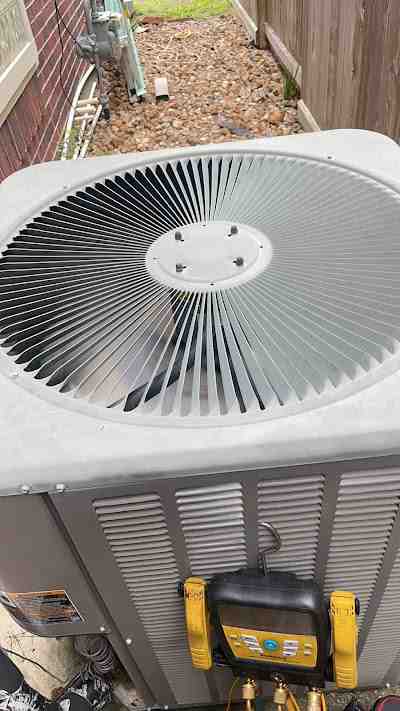
Understanding how condenser coil damage leads to costly ac repair is the best way to protect your home from sudden summer breakdowns. When hot, humid Texas weather hits, your cooling system has to work overtime to keep you comfortable. If the delicate outdoor coils get clogged with dirt, bent by a lawnmower, or eaten away by coastal humidity, the heat has nowhere to go. This simple airflow blockage puts immense strain on your entire system, eventually burning out the compressor. When this happens, you need professional air conditioning repair in Pinehurst, TX, to save your system before a minor issue turns into a total breakdown.
If you suspect your system is struggling, visit our homepage to learn more about our services, or schedule your AC repair immediately to prevent further damage.
When your outdoor condenser coil is damaged, it cannot release heat from your home. This triggers a mechanical chain reaction that forces you to face major repair bills. Here is exactly how it happens:
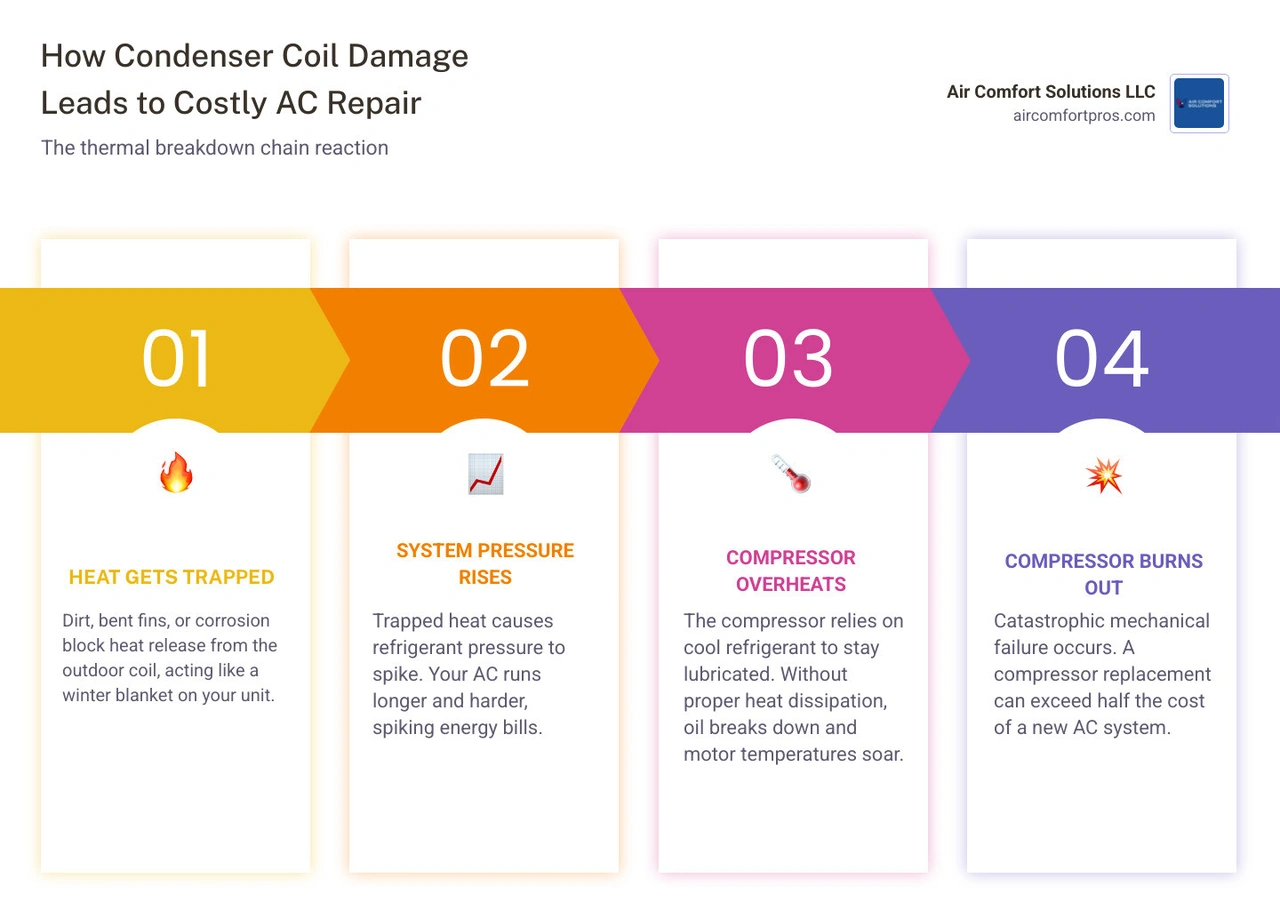
Simple how condenser coil damage leads to costly ac repair glossary:
To understand why damage to your condenser coil is such a big deal, it helps to know what this component actually does. Many homeowners think an air conditioner creates cold air. In reality, your AC is a heat relocation machine. It absorbs heat from inside your living room and dumps it outside.
This heat relocation process relies on a continuous cycle of refrigerant. The indoor evaporator coil absorbs the heat, turning the low-pressure refrigerant liquid into a gas. This gas travels outside to the compressor, which pressurizes it, turning it into a hot, high-pressure vapor.
This is where the outdoor condenser coil comes into play. The condenser coil is a winding network of copper or aluminum tubing surrounded by thousands of paper-thin aluminum fins. As the hot refrigerant gas flows through these tubes, the large outdoor fan draws ambient air across the aluminum fins. This airflow facilitates heat dissipation, cooling the hot refrigerant gas until it undergoes a phase change and condenses back into a high-pressure liquid. This liquid then flows back indoors to repeat the cooling cycle.
The condenser coil is the unsung hero of your home comfort system. If this coil cannot perform its job, the entire heat exchange loop breaks down. When everything is working perfectly, your AC maintains a delicate balance of temperature and humidity.
However, if the outdoor coil is blocked, dirty, or damaged, the heat transfer process slows to a crawl. The refrigerant stays hot, which means it cannot absorb more heat when it travels back inside. This is why a system with a struggling condenser will continue to blow lukewarm or warm air from your vents. For a deeper look into how dirty coils directly impact your system's output, check out our guide on the Dirty Condenser Coil and AC Performance Connection.
Our outdoor AC units are built to withstand the elements, but they are not invincible. In communities like Magnolia, Tomball, and Spring, TX, several local factors can quickly degrade or physically damage your outdoor condenser coils.
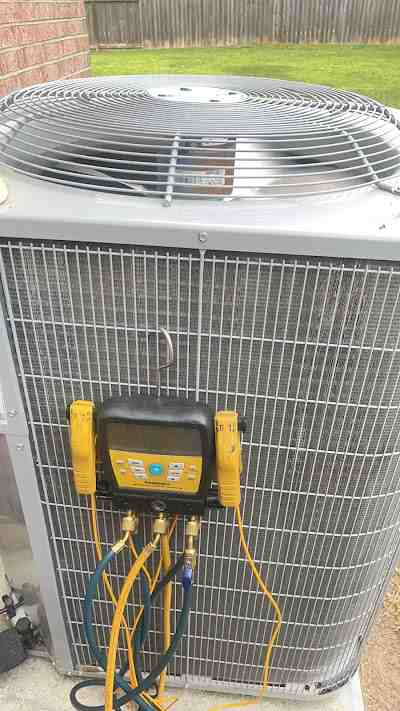
In Southeast Texas, we deal with a unique mix of high humidity and coastal air. This combination accelerates a chemical phenomenon known as formicary corrosion.
Formicary corrosion occurs when household volatile organic compounds (VOCs)—found in common cleaning products, cosmetics, paints, and air fresheners—react with the moisture on copper tubing. This chemical reaction creates microscopic, tunnel-like pinhole leaks in the copper. Because these leaks are so small, they are incredibly difficult to detect without specialized electronic leak testing, but they will quietly drain your system of refrigerant, leading to a massive decline in cooling performance.
When your condenser coil is compromised, the financial consequences extend far beyond a slight drop in comfort. It creates a mechanical chain reaction that can destroy the most expensive parts of your air conditioner.
Because a dirty or damaged coil cannot release heat effectively, it causes severe airflow restriction and heat dissipation failure. The air conditioner is forced to run longer and work harder to achieve the temperature set on your thermostat. This constant operation leads to massive energy waste. In fact, a dirty or damaged condenser coil can increase your AC's energy consumption by up to 30%.
This prolonged strain will wear out mechanical parts, leading to some of the Most Common AC Repairs and What Causes Them, such as failed fan motors, blown capacitors, and burnt wiring.
The most severe consequence of neglecting a damaged condenser coil is compressor failure. The compressor is often called the "heart" of your AC system, and it is also the most expensive single component to replace.
The compressor relies on a steady stream of cool, returning refrigerant to keep its internal motor from overheating. It also depends on the oil carried by the refrigerant to keep its moving parts lubricated. When a damaged condenser coil restricts heat exchange, the compressor begins "redlining." It operates at incredibly high temperatures and pressures.
If there is a refrigerant leak in the damaged coil, the system will also lose its vital lubricating oil. Running a compressor under these conditions is like driving a car without engine oil—it will suffer a dry mechanical failure and seize up. If you are dealing with a leaking or severely damaged coil, prompt Condenser Coil Repair is absolutely essential to prevent complete compressor burnout.
It might seem counterintuitive that a problem with your outdoor unit can cause your indoor system to freeze solid, but it happens all the time.
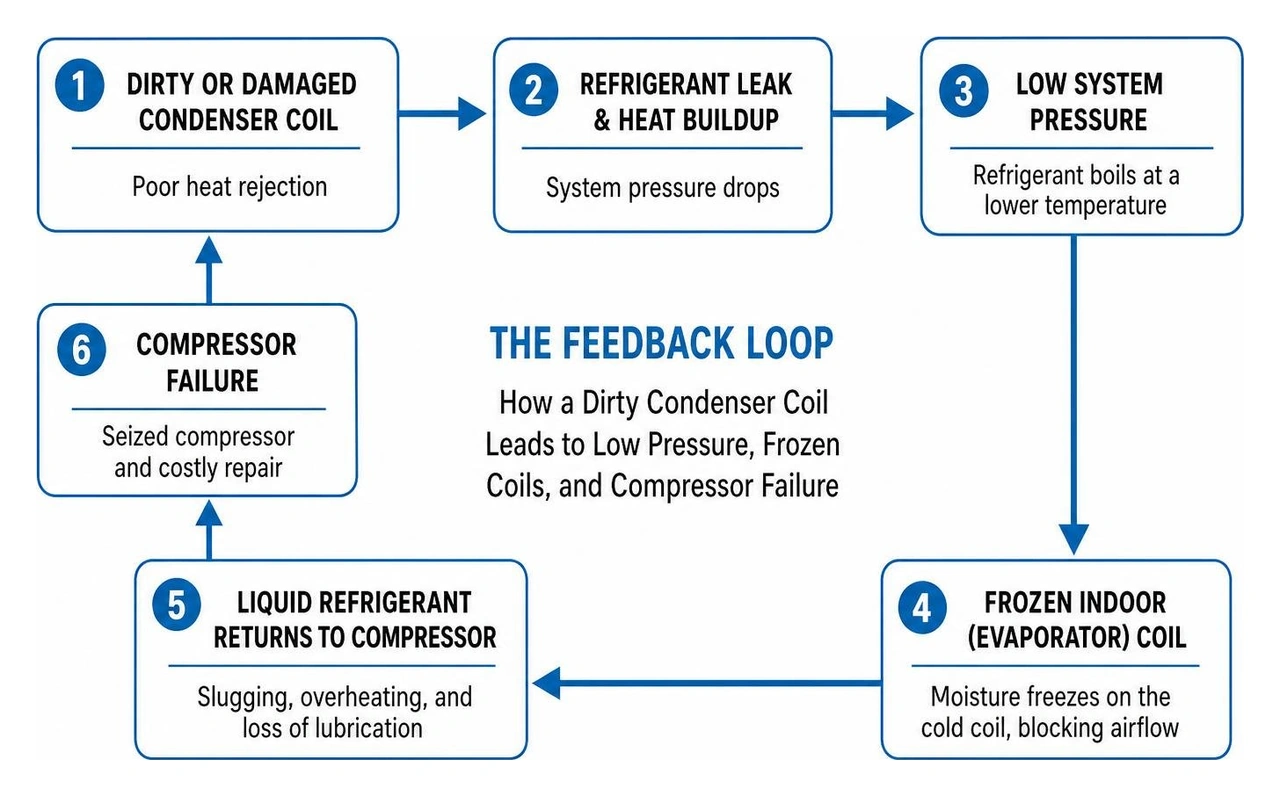
When a damaged condenser coil causes a refrigerant leak, the overall pressure within the system drops. As pressure drops, the temperature of the refrigerant inside the indoor evaporator coil falls below the freezing point. The moisture in your indoor air condenses onto the freezing coil and instantly turns to ice.
This ice buildup creates a physical barrier that blocks indoor airflow entirely. Your home will stop cooling, and the ice can travel down the copper lines, potentially causing liquid refrigerant to flood back into the compressor—a process known as "slugging" that will instantly destroy the compressor motor.
When a technician tells you that your condenser coil is severely damaged or leaking, you face a major decision: should you repair the coil, replace just the coil, or install a completely new AC system?
This decision depends heavily on several key factors:
| Factor | Repair/Replace Coil Only | Replace Entire HVAC System |
|---|---|---|
| System Age | Best for units under 8 years old | Best for units over 10–12 years old |
| Warranty Status | Ideal if parts are still covered under manufacturer warranty | Best if the warranty has expired |
| Refrigerant Type | Practical for R-410A systems | Highly recommended for old R-22 systems |
| Long-Term Efficiency | Keeps existing SEER rating | Upgrades system to modern SEER2 standards |
To take the guesswork out of this decision, many industry professionals use a simple mathematical matrix called the 5,000 Rule.
To use this rule, multiply the age of your AC unit by the estimated cost of the repair. If the total is less than 5,000, repairing the unit is generally a sound decision. If the total exceeds 5,000, your money is better spent on a modern, high-efficiency system replacement.
$$\text{Age of Unit (Years)} \times \text{Cost of Repair} = \text{Decision Number}$$
For example, if you have a 12-year-old system and the repair is significant, the calculation will easily exceed the 5,000 threshold, making a full system replacement the more logical long-term financial strategy.
The good news is that you can easily prevent most condenser coil damage with a few basic habits and proactive steps.
Technically, your system might continue to run with minor coil damage, but doing so is highly discouraged. Running an AC with a compromised coil creates a severe system imbalance. It forces the compressor to run at dangerously high temperatures, which can trigger an emergency electrical shutdown or lead to sudden, catastrophic compressor burnout. It is always safer and cheaper to turn the system off and call for professional service immediately.
For most homes in the Pinehurst, TX area, a professional coil cleaning once a year during your spring tune-up is perfectly sufficient. However, if your home is located near unpaved roads, active construction zones, or if you have heavy-shedding pets that spend time near the outdoor unit, you may need your coils professionally cleaned twice a year to maintain peak operating efficiency.
Whether your insurance covers the damage depends entirely on what caused it. Standard homeowners insurance policies are designed to cover sudden and accidental physical damage. For example, if a severe storm knocks a tree branch onto your outdoor unit or a hailstorm flattens your condenser fins, your policy will likely cover the replacement.
However, insurance will never cover damage caused by normal wear and tear, corrosion, dog urine, or a lack of routine maintenance. Keeping detailed professional maintenance records is the best way to prove to your insurance company that you have taken proper care of your system if you ever need to file a claim.
Your air conditioner's condenser coil plays a vital role in keeping your home cool during our intense Texas summers. Neglecting this simple component is one of the fastest ways to turn a minor maintenance task into a catastrophic, expensive system failure. By keeping the area around your outdoor unit clear, rinsing the coils gently, and scheduling regular professional tune-ups, you can protect your compressor and keep your utility bills low.
At Air Comfort Pros, we have over 35 years of experience helping homeowners in Pinehurst, Magnolia, Tomball, and the north side of Harris County stay comfortable all year long. Our certified technicians provide honest, reliable solutions, upfront pricing, and flexible financing options.
Don't wait for the heat to take a toll on your system. Schedule your professional AC repair in Tomball, TX today and let our family take care of yours!
Understanding how condenser coil damage leads to costly ac repair is the best way to protect your home from sudden summer breakdowns. When hot, humid Texas weather hits, your cooling system has to work overtime to keep you comfortable. If the delicate outdoor coils get clogged with dirt, bent by a lawnmower, or eaten away by coastal humidity, the heat has nowhere to go. This simple airflow blockage puts immense strain on your entire system, eventually burning out the compressor. When this happens, you need professional air conditioning repair in Pinehurst, TX, to save your system before a minor issue turns into a total breakdown.
If you suspect your system is struggling, visit our homepage to learn more about our services, or schedule your AC repair immediately to prevent further damage.
When your outdoor condenser coil is damaged, it cannot release heat from your home. This triggers a mechanical chain reaction that forces you to face major repair bills. Here is exactly how it happens:
Simple how condenser coil damage leads to costly ac repair glossary:
To understand why damage to your condenser coil is such a big deal, it helps to know what this component actually does. Many homeowners think an air conditioner creates cold air. In reality, your AC is a heat relocation machine. It absorbs heat from inside your living room and dumps it outside.
This heat relocation process relies on a continuous cycle of refrigerant. The indoor evaporator coil absorbs the heat, turning the low-pressure refrigerant liquid into a gas. This gas travels outside to the compressor, which pressurizes it, turning it into a hot, high-pressure vapor.
This is where the outdoor condenser coil comes into play. The condenser coil is a winding network of copper or aluminum tubing surrounded by thousands of paper-thin aluminum fins. As the hot refrigerant gas flows through these tubes, the large outdoor fan draws ambient air across the aluminum fins. This airflow facilitates heat dissipation, cooling the hot refrigerant gas until it undergoes a phase change and condenses back into a high-pressure liquid. This liquid then flows back indoors to repeat the cooling cycle.
The condenser coil is the unsung hero of your home comfort system. If this coil cannot perform its job, the entire heat exchange loop breaks down. When everything is working perfectly, your AC maintains a delicate balance of temperature and humidity.
However, if the outdoor coil is blocked, dirty, or damaged, the heat transfer process slows to a crawl. The refrigerant stays hot, which means it cannot absorb more heat when it travels back inside. This is why a system with a struggling condenser will continue to blow lukewarm or warm air from your vents. For a deeper look into how dirty coils directly impact your system's output, check out our guide on the Dirty Condenser Coil and AC Performance Connection.
Our outdoor AC units are built to withstand the elements, but they are not invincible. In communities like Magnolia, Tomball, and Spring, TX, several local factors can quickly degrade or physically damage your outdoor condenser coils.
In Southeast Texas, we deal with a unique mix of high humidity and coastal air. This combination accelerates a chemical phenomenon known as formicary corrosion.
Formicary corrosion occurs when household volatile organic compounds (VOCs)—found in common cleaning products, cosmetics, paints, and air fresheners—react with the moisture on copper tubing. This chemical reaction creates microscopic, tunnel-like pinhole leaks in the copper. Because these leaks are so small, they are incredibly difficult to detect without specialized electronic leak testing, but they will quietly drain your system of refrigerant, leading to a massive decline in cooling performance.
When your condenser coil is compromised, the financial consequences extend far beyond a slight drop in comfort. It creates a mechanical chain reaction that can destroy the most expensive parts of your air conditioner.
Because a dirty or damaged coil cannot release heat effectively, it causes severe airflow restriction and heat dissipation failure. The air conditioner is forced to run longer and work harder to achieve the temperature set on your thermostat. This constant operation leads to massive energy waste. In fact, a dirty or damaged condenser coil can increase your AC's energy consumption by up to 30%.
This prolonged strain will wear out mechanical parts, leading to some of the Most Common AC Repairs and What Causes Them, such as failed fan motors, blown capacitors, and burnt wiring.
The most severe consequence of neglecting a damaged condenser coil is compressor failure. The compressor is often called the "heart" of your AC system, and it is also the most expensive single component to replace.
The compressor relies on a steady stream of cool, returning refrigerant to keep its internal motor from overheating. It also depends on the oil carried by the refrigerant to keep its moving parts lubricated. When a damaged condenser coil restricts heat exchange, the compressor begins "redlining." It operates at incredibly high temperatures and pressures.
If there is a refrigerant leak in the damaged coil, the system will also lose its vital lubricating oil. Running a compressor under these conditions is like driving a car without engine oil—it will suffer a dry mechanical failure and seize up. If you are dealing with a leaking or severely damaged coil, prompt Condenser Coil Repair is absolutely essential to prevent complete compressor burnout.
It might seem counterintuitive that a problem with your outdoor unit can cause your indoor system to freeze solid, but it happens all the time.
When a damaged condenser coil causes a refrigerant leak, the overall pressure within the system drops. As pressure drops, the temperature of the refrigerant inside the indoor evaporator coil falls below the freezing point. The moisture in your indoor air condenses onto the freezing coil and instantly turns to ice.
This ice buildup creates a physical barrier that blocks indoor airflow entirely. Your home will stop cooling, and the ice can travel down the copper lines, potentially causing liquid refrigerant to flood back into the compressor—a process known as "slugging" that will instantly destroy the compressor motor.
When a technician tells you that your condenser coil is severely damaged or leaking, you face a major decision: should you repair the coil, replace just the coil, or install a completely new AC system?
This decision depends heavily on several key factors:
| Factor | Repair/Replace Coil Only | Replace Entire HVAC System |
|---|---|---|
| System Age | Best for units under 8 years old | Best for units over 10–12 years old |
| Warranty Status | Ideal if parts are still covered under manufacturer warranty | Best if the warranty has expired |
| Refrigerant Type | Practical for R-410A systems | Highly recommended for old R-22 systems |
| Long-Term Efficiency | Keeps existing SEER rating | Upgrades system to modern SEER2 standards |
To take the guesswork out of this decision, many industry professionals use a simple mathematical matrix called the 5,000 Rule.
To use this rule, multiply the age of your AC unit by the estimated cost of the repair. If the total is less than 5,000, repairing the unit is generally a sound decision. If the total exceeds 5,000, your money is better spent on a modern, high-efficiency system replacement.
$$\text{Age of Unit (Years)} \times \text{Cost of Repair} = \text{Decision Number}$$
For example, if you have a 12-year-old system and the repair is significant, the calculation will easily exceed the 5,000 threshold, making a full system replacement the more logical long-term financial strategy.
The good news is that you can easily prevent most condenser coil damage with a few basic habits and proactive steps.
Technically, your system might continue to run with minor coil damage, but doing so is highly discouraged. Running an AC with a compromised coil creates a severe system imbalance. It forces the compressor to run at dangerously high temperatures, which can trigger an emergency electrical shutdown or lead to sudden, catastrophic compressor burnout. It is always safer and cheaper to turn the system off and call for professional service immediately.
For most homes in the Pinehurst, TX area, a professional coil cleaning once a year during your spring tune-up is perfectly sufficient. However, if your home is located near unpaved roads, active construction zones, or if you have heavy-shedding pets that spend time near the outdoor unit, you may need your coils professionally cleaned twice a year to maintain peak operating efficiency.
Whether your insurance covers the damage depends entirely on what caused it. Standard homeowners insurance policies are designed to cover sudden and accidental physical damage. For example, if a severe storm knocks a tree branch onto your outdoor unit or a hailstorm flattens your condenser fins, your policy will likely cover the replacement.
However, insurance will never cover damage caused by normal wear and tear, corrosion, dog urine, or a lack of routine maintenance. Keeping detailed professional maintenance records is the best way to prove to your insurance company that you have taken proper care of your system if you ever need to file a claim.
Your air conditioner's condenser coil plays a vital role in keeping your home cool during our intense Texas summers. Neglecting this simple component is one of the fastest ways to turn a minor maintenance task into a catastrophic, expensive system failure. By keeping the area around your outdoor unit clear, rinsing the coils gently, and scheduling regular professional tune-ups, you can protect your compressor and keep your utility bills low.
At Air Comfort Pros, we have over 35 years of experience helping homeowners in Pinehurst, Magnolia, Tomball, and the north side of Harris County stay comfortable all year long. Our certified technicians provide honest, reliable solutions, upfront pricing, and flexible financing options.
Don't wait for the heat to take a toll on your system. Schedule your professional AC repair in Tomball, TX today and let our family take care of yours!
Understanding how condenser coil damage leads to costly ac repair is the best way to protect your home from sudden summer breakdowns. When hot, humid Texas weather hits, your cooling system has to work overtime to keep you comfortable. If the delicate outdoor coils get clogged with dirt, bent by a lawnmower, or eaten away by coastal humidity, the heat has nowhere to go. This simple airflow blockage puts immense strain on your entire system, eventually burning out the compressor. When this happens, you need professional air conditioning repair in Pinehurst, TX, to save your system before a minor issue turns into a total breakdown.
If you suspect your system is struggling, visit our homepage to learn more about our services, or schedule your AC repair immediately to prevent further damage.
When your outdoor condenser coil is damaged, it cannot release heat from your home. This triggers a mechanical chain reaction that forces you to face major repair bills. Here is exactly how it happens:
Simple how condenser coil damage leads to costly ac repair glossary:
To understand why damage to your condenser coil is such a big deal, it helps to know what this component actually does. Many homeowners think an air conditioner creates cold air. In reality, your AC is a heat relocation machine. It absorbs heat from inside your living room and dumps it outside.
This heat relocation process relies on a continuous cycle of refrigerant. The indoor evaporator coil absorbs the heat, turning the low-pressure refrigerant liquid into a gas. This gas travels outside to the compressor, which pressurizes it, turning it into a hot, high-pressure vapor.
This is where the outdoor condenser coil comes into play. The condenser coil is a winding network of copper or aluminum tubing surrounded by thousands of paper-thin aluminum fins. As the hot refrigerant gas flows through these tubes, the large outdoor fan draws ambient air across the aluminum fins. This airflow facilitates heat dissipation, cooling the hot refrigerant gas until it undergoes a phase change and condenses back into a high-pressure liquid. This liquid then flows back indoors to repeat the cooling cycle.
The condenser coil is the unsung hero of your home comfort system. If this coil cannot perform its job, the entire heat exchange loop breaks down. When everything is working perfectly, your AC maintains a delicate balance of temperature and humidity.
However, if the outdoor coil is blocked, dirty, or damaged, the heat transfer process slows to a crawl. The refrigerant stays hot, which means it cannot absorb more heat when it travels back inside. This is why a system with a struggling condenser will continue to blow lukewarm or warm air from your vents. For a deeper look into how dirty coils directly impact your system's output, check out our guide on the Dirty Condenser Coil and AC Performance Connection.
Our outdoor AC units are built to withstand the elements, but they are not invincible. In communities like Magnolia, Tomball, and Spring, TX, several local factors can quickly degrade or physically damage your outdoor condenser coils.
In Southeast Texas, we deal with a unique mix of high humidity and coastal air. This combination accelerates a chemical phenomenon known as formicary corrosion.
Formicary corrosion occurs when household volatile organic compounds (VOCs)—found in common cleaning products, cosmetics, paints, and air fresheners—react with the moisture on copper tubing. This chemical reaction creates microscopic, tunnel-like pinhole leaks in the copper. Because these leaks are so small, they are incredibly difficult to detect without specialized electronic leak testing, but they will quietly drain your system of refrigerant, leading to a massive decline in cooling performance.
When your condenser coil is compromised, the financial consequences extend far beyond a slight drop in comfort. It creates a mechanical chain reaction that can destroy the most expensive parts of your air conditioner.
Because a dirty or damaged coil cannot release heat effectively, it causes severe airflow restriction and heat dissipation failure. The air conditioner is forced to run longer and work harder to achieve the temperature set on your thermostat. This constant operation leads to massive energy waste. In fact, a dirty or damaged condenser coil can increase your AC's energy consumption by up to 30%.
This prolonged strain will wear out mechanical parts, leading to some of the Most Common AC Repairs and What Causes Them, such as failed fan motors, blown capacitors, and burnt wiring.
The most severe consequence of neglecting a damaged condenser coil is compressor failure. The compressor is often called the "heart" of your AC system, and it is also the most expensive single component to replace.
The compressor relies on a steady stream of cool, returning refrigerant to keep its internal motor from overheating. It also depends on the oil carried by the refrigerant to keep its moving parts lubricated. When a damaged condenser coil restricts heat exchange, the compressor begins "redlining." It operates at incredibly high temperatures and pressures.
If there is a refrigerant leak in the damaged coil, the system will also lose its vital lubricating oil. Running a compressor under these conditions is like driving a car without engine oil—it will suffer a dry mechanical failure and seize up. If you are dealing with a leaking or severely damaged coil, prompt Condenser Coil Repair is absolutely essential to prevent complete compressor burnout.
It might seem counterintuitive that a problem with your outdoor unit can cause your indoor system to freeze solid, but it happens all the time.
When a damaged condenser coil causes a refrigerant leak, the overall pressure within the system drops. As pressure drops, the temperature of the refrigerant inside the indoor evaporator coil falls below the freezing point. The moisture in your indoor air condenses onto the freezing coil and instantly turns to ice.
This ice buildup creates a physical barrier that blocks indoor airflow entirely. Your home will stop cooling, and the ice can travel down the copper lines, potentially causing liquid refrigerant to flood back into the compressor—a process known as "slugging" that will instantly destroy the compressor motor.
When a technician tells you that your condenser coil is severely damaged or leaking, you face a major decision: should you repair the coil, replace just the coil, or install a completely new AC system?
This decision depends heavily on several key factors:
| Factor | Repair/Replace Coil Only | Replace Entire HVAC System |
|---|---|---|
| System Age | Best for units under 8 years old | Best for units over 10–12 years old |
| Warranty Status | Ideal if parts are still covered under manufacturer warranty | Best if the warranty has expired |
| Refrigerant Type | Practical for R-410A systems | Highly recommended for old R-22 systems |
| Long-Term Efficiency | Keeps existing SEER rating | Upgrades system to modern SEER2 standards |
To take the guesswork out of this decision, many industry professionals use a simple mathematical matrix called the 5,000 Rule.
To use this rule, multiply the age of your AC unit by the estimated cost of the repair. If the total is less than 5,000, repairing the unit is generally a sound decision. If the total exceeds 5,000, your money is better spent on a modern, high-efficiency system replacement.
$$\text{Age of Unit (Years)} \times \text{Cost of Repair} = \text{Decision Number}$$
For example, if you have a 12-year-old system and the repair is significant, the calculation will easily exceed the 5,000 threshold, making a full system replacement the more logical long-term financial strategy.
The good news is that you can easily prevent most condenser coil damage with a few basic habits and proactive steps.
Technically, your system might continue to run with minor coil damage, but doing so is highly discouraged. Running an AC with a compromised coil creates a severe system imbalance. It forces the compressor to run at dangerously high temperatures, which can trigger an emergency electrical shutdown or lead to sudden, catastrophic compressor burnout. It is always safer and cheaper to turn the system off and call for professional service immediately.
For most homes in the Pinehurst, TX area, a professional coil cleaning once a year during your spring tune-up is perfectly sufficient. However, if your home is located near unpaved roads, active construction zones, or if you have heavy-shedding pets that spend time near the outdoor unit, you may need your coils professionally cleaned twice a year to maintain peak operating efficiency.
Whether your insurance covers the damage depends entirely on what caused it. Standard homeowners insurance policies are designed to cover sudden and accidental physical damage. For example, if a severe storm knocks a tree branch onto your outdoor unit or a hailstorm flattens your condenser fins, your policy will likely cover the replacement.
However, insurance will never cover damage caused by normal wear and tear, corrosion, dog urine, or a lack of routine maintenance. Keeping detailed professional maintenance records is the best way to prove to your insurance company that you have taken proper care of your system if you ever need to file a claim.
Your air conditioner's condenser coil plays a vital role in keeping your home cool during our intense Texas summers. Neglecting this simple component is one of the fastest ways to turn a minor maintenance task into a catastrophic, expensive system failure. By keeping the area around your outdoor unit clear, rinsing the coils gently, and scheduling regular professional tune-ups, you can protect your compressor and keep your utility bills low.
At Air Comfort Pros, we have over 35 years of experience helping homeowners in Pinehurst, Magnolia, Tomball, and the north side of Harris County stay comfortable all year long. Our certified technicians provide honest, reliable solutions, upfront pricing, and flexible financing options.
Don't wait for the heat to take a toll on your system. Schedule your professional AC repair in Tomball, TX today and let our family take care of yours!
Understanding how condenser coil damage leads to costly ac repair is the best way to protect your home from sudden summer breakdowns. When hot, humid Texas weather hits, your cooling system has to work overtime to keep you comfortable. If the delicate outdoor coils get clogged with dirt, bent by a lawnmower, or eaten away by coastal humidity, the heat has nowhere to go. This simple airflow blockage puts immense strain on your entire system, eventually burning out the compressor. When this happens, you need professional air conditioning repair in Pinehurst, TX, to save your system before a minor issue turns into a total breakdown.
If you suspect your system is struggling, visit our homepage to learn more about our services, or schedule your AC repair immediately to prevent further damage.
When your outdoor condenser coil is damaged, it cannot release heat from your home. This triggers a mechanical chain reaction that forces you to face major repair bills. Here is exactly how it happens:
Simple how condenser coil damage leads to costly ac repair glossary:
To understand why damage to your condenser coil is such a big deal, it helps to know what this component actually does. Many homeowners think an air conditioner creates cold air. In reality, your AC is a heat relocation machine. It absorbs heat from inside your living room and dumps it outside.
This heat relocation process relies on a continuous cycle of refrigerant. The indoor evaporator coil absorbs the heat, turning the low-pressure refrigerant liquid into a gas. This gas travels outside to the compressor, which pressurizes it, turning it into a hot, high-pressure vapor.
This is where the outdoor condenser coil comes into play. The condenser coil is a winding network of copper or aluminum tubing surrounded by thousands of paper-thin aluminum fins. As the hot refrigerant gas flows through these tubes, the large outdoor fan draws ambient air across the aluminum fins. This airflow facilitates heat dissipation, cooling the hot refrigerant gas until it undergoes a phase change and condenses back into a high-pressure liquid. This liquid then flows back indoors to repeat the cooling cycle.
The condenser coil is the unsung hero of your home comfort system. If this coil cannot perform its job, the entire heat exchange loop breaks down. When everything is working perfectly, your AC maintains a delicate balance of temperature and humidity.
However, if the outdoor coil is blocked, dirty, or damaged, the heat transfer process slows to a crawl. The refrigerant stays hot, which means it cannot absorb more heat when it travels back inside. This is why a system with a struggling condenser will continue to blow lukewarm or warm air from your vents. For a deeper look into how dirty coils directly impact your system's output, check out our guide on the Dirty Condenser Coil and AC Performance Connection.
Our outdoor AC units are built to withstand the elements, but they are not invincible. In communities like Magnolia, Tomball, and Spring, TX, several local factors can quickly degrade or physically damage your outdoor condenser coils.
In Southeast Texas, we deal with a unique mix of high humidity and coastal air. This combination accelerates a chemical phenomenon known as formicary corrosion.
Formicary corrosion occurs when household volatile organic compounds (VOCs)—found in common cleaning products, cosmetics, paints, and air fresheners—react with the moisture on copper tubing. This chemical reaction creates microscopic, tunnel-like pinhole leaks in the copper. Because these leaks are so small, they are incredibly difficult to detect without specialized electronic leak testing, but they will quietly drain your system of refrigerant, leading to a massive decline in cooling performance.
When your condenser coil is compromised, the financial consequences extend far beyond a slight drop in comfort. It creates a mechanical chain reaction that can destroy the most expensive parts of your air conditioner.
Because a dirty or damaged coil cannot release heat effectively, it causes severe airflow restriction and heat dissipation failure. The air conditioner is forced to run longer and work harder to achieve the temperature set on your thermostat. This constant operation leads to massive energy waste. In fact, a dirty or damaged condenser coil can increase your AC's energy consumption by up to 30%.
This prolonged strain will wear out mechanical parts, leading to some of the Most Common AC Repairs and What Causes Them, such as failed fan motors, blown capacitors, and burnt wiring.
The most severe consequence of neglecting a damaged condenser coil is compressor failure. The compressor is often called the "heart" of your AC system, and it is also the most expensive single component to replace.
The compressor relies on a steady stream of cool, returning refrigerant to keep its internal motor from overheating. It also depends on the oil carried by the refrigerant to keep its moving parts lubricated. When a damaged condenser coil restricts heat exchange, the compressor begins "redlining." It operates at incredibly high temperatures and pressures.
If there is a refrigerant leak in the damaged coil, the system will also lose its vital lubricating oil. Running a compressor under these conditions is like driving a car without engine oil—it will suffer a dry mechanical failure and seize up. If you are dealing with a leaking or severely damaged coil, prompt Condenser Coil Repair is absolutely essential to prevent complete compressor burnout.
It might seem counterintuitive that a problem with your outdoor unit can cause your indoor system to freeze solid, but it happens all the time.
When a damaged condenser coil causes a refrigerant leak, the overall pressure within the system drops. As pressure drops, the temperature of the refrigerant inside the indoor evaporator coil falls below the freezing point. The moisture in your indoor air condenses onto the freezing coil and instantly turns to ice.
This ice buildup creates a physical barrier that blocks indoor airflow entirely. Your home will stop cooling, and the ice can travel down the copper lines, potentially causing liquid refrigerant to flood back into the compressor—a process known as "slugging" that will instantly destroy the compressor motor.
When a technician tells you that your condenser coil is severely damaged or leaking, you face a major decision: should you repair the coil, replace just the coil, or install a completely new AC system?
This decision depends heavily on several key factors:
| Factor | Repair/Replace Coil Only | Replace Entire HVAC System |
|---|---|---|
| System Age | Best for units under 8 years old | Best for units over 10–12 years old |
| Warranty Status | Ideal if parts are still covered under manufacturer warranty | Best if the warranty has expired |
| Refrigerant Type | Practical for R-410A systems | Highly recommended for old R-22 systems |
| Long-Term Efficiency | Keeps existing SEER rating | Upgrades system to modern SEER2 standards |
To take the guesswork out of this decision, many industry professionals use a simple mathematical matrix called the 5,000 Rule.
To use this rule, multiply the age of your AC unit by the estimated cost of the repair. If the total is less than 5,000, repairing the unit is generally a sound decision. If the total exceeds 5,000, your money is better spent on a modern, high-efficiency system replacement.
$$\text{Age of Unit (Years)} \times \text{Cost of Repair} = \text{Decision Number}$$
For example, if you have a 12-year-old system and the repair is significant, the calculation will easily exceed the 5,000 threshold, making a full system replacement the more logical long-term financial strategy.
The good news is that you can easily prevent most condenser coil damage with a few basic habits and proactive steps.
Technically, your system might continue to run with minor coil damage, but doing so is highly discouraged. Running an AC with a compromised coil creates a severe system imbalance. It forces the compressor to run at dangerously high temperatures, which can trigger an emergency electrical shutdown or lead to sudden, catastrophic compressor burnout. It is always safer and cheaper to turn the system off and call for professional service immediately.
For most homes in the Pinehurst, TX area, a professional coil cleaning once a year during your spring tune-up is perfectly sufficient. However, if your home is located near unpaved roads, active construction zones, or if you have heavy-shedding pets that spend time near the outdoor unit, you may need your coils professionally cleaned twice a year to maintain peak operating efficiency.
Whether your insurance covers the damage depends entirely on what caused it. Standard homeowners insurance policies are designed to cover sudden and accidental physical damage. For example, if a severe storm knocks a tree branch onto your outdoor unit or a hailstorm flattens your condenser fins, your policy will likely cover the replacement.
However, insurance will never cover damage caused by normal wear and tear, corrosion, dog urine, or a lack of routine maintenance. Keeping detailed professional maintenance records is the best way to prove to your insurance company that you have taken proper care of your system if you ever need to file a claim.
Your air conditioner's condenser coil plays a vital role in keeping your home cool during our intense Texas summers. Neglecting this simple component is one of the fastest ways to turn a minor maintenance task into a catastrophic, expensive system failure. By keeping the area around your outdoor unit clear, rinsing the coils gently, and scheduling regular professional tune-ups, you can protect your compressor and keep your utility bills low.
At Air Comfort Pros, we have over 35 years of experience helping homeowners in Pinehurst, Magnolia, Tomball, and the north side of Harris County stay comfortable all year long. Our certified technicians provide honest, reliable solutions, upfront pricing, and flexible financing options.
Don't wait for the heat to take a toll on your system. Schedule your professional AC repair in Tomball, TX today and let our family take care of yours!
Understanding how condenser coil damage leads to costly ac repair is the best way to protect your home from sudden summer breakdowns. When hot, humid Texas weather hits, your cooling system has to work overtime to keep you comfortable. If the delicate outdoor coils get clogged with dirt, bent by a lawnmower, or eaten away by coastal humidity, the heat has nowhere to go. This simple airflow blockage puts immense strain on your entire system, eventually burning out the compressor. When this happens, you need professional air conditioning repair in Pinehurst, TX, to save your system before a minor issue turns into a total breakdown.
If you suspect your system is struggling, visit our homepage to learn more about our services, or schedule your AC repair immediately to prevent further damage.
When your outdoor condenser coil is damaged, it cannot release heat from your home. This triggers a mechanical chain reaction that forces you to face major repair bills. Here is exactly how it happens:
Simple how condenser coil damage leads to costly ac repair glossary:
To understand why damage to your condenser coil is such a big deal, it helps to know what this component actually does. Many homeowners think an air conditioner creates cold air. In reality, your AC is a heat relocation machine. It absorbs heat from inside your living room and dumps it outside.
This heat relocation process relies on a continuous cycle of refrigerant. The indoor evaporator coil absorbs the heat, turning the low-pressure refrigerant liquid into a gas. This gas travels outside to the compressor, which pressurizes it, turning it into a hot, high-pressure vapor.
This is where the outdoor condenser coil comes into play. The condenser coil is a winding network of copper or aluminum tubing surrounded by thousands of paper-thin aluminum fins. As the hot refrigerant gas flows through these tubes, the large outdoor fan draws ambient air across the aluminum fins. This airflow facilitates heat dissipation, cooling the hot refrigerant gas until it undergoes a phase change and condenses back into a high-pressure liquid. This liquid then flows back indoors to repeat the cooling cycle.
The condenser coil is the unsung hero of your home comfort system. If this coil cannot perform its job, the entire heat exchange loop breaks down. When everything is working perfectly, your AC maintains a delicate balance of temperature and humidity.
However, if the outdoor coil is blocked, dirty, or damaged, the heat transfer process slows to a crawl. The refrigerant stays hot, which means it cannot absorb more heat when it travels back inside. This is why a system with a struggling condenser will continue to blow lukewarm or warm air from your vents. For a deeper look into how dirty coils directly impact your system's output, check out our guide on the Dirty Condenser Coil and AC Performance Connection.
Our outdoor AC units are built to withstand the elements, but they are not invincible. In communities like Magnolia, Tomball, and Spring, TX, several local factors can quickly degrade or physically damage your outdoor condenser coils.
In Southeast Texas, we deal with a unique mix of high humidity and coastal air. This combination accelerates a chemical phenomenon known as formicary corrosion.
Formicary corrosion occurs when household volatile organic compounds (VOCs)—found in common cleaning products, cosmetics, paints, and air fresheners—react with the moisture on copper tubing. This chemical reaction creates microscopic, tunnel-like pinhole leaks in the copper. Because these leaks are so small, they are incredibly difficult to detect without specialized electronic leak testing, but they will quietly drain your system of refrigerant, leading to a massive decline in cooling performance.
When your condenser coil is compromised, the financial consequences extend far beyond a slight drop in comfort. It creates a mechanical chain reaction that can destroy the most expensive parts of your air conditioner.
Because a dirty or damaged coil cannot release heat effectively, it causes severe airflow restriction and heat dissipation failure. The air conditioner is forced to run longer and work harder to achieve the temperature set on your thermostat. This constant operation leads to massive energy waste. In fact, a dirty or damaged condenser coil can increase your AC's energy consumption by up to 30%.
This prolonged strain will wear out mechanical parts, leading to some of the Most Common AC Repairs and What Causes Them, such as failed fan motors, blown capacitors, and burnt wiring.
The most severe consequence of neglecting a damaged condenser coil is compressor failure. The compressor is often called the "heart" of your AC system, and it is also the most expensive single component to replace.
The compressor relies on a steady stream of cool, returning refrigerant to keep its internal motor from overheating. It also depends on the oil carried by the refrigerant to keep its moving parts lubricated. When a damaged condenser coil restricts heat exchange, the compressor begins "redlining." It operates at incredibly high temperatures and pressures.
If there is a refrigerant leak in the damaged coil, the system will also lose its vital lubricating oil. Running a compressor under these conditions is like driving a car without engine oil—it will suffer a dry mechanical failure and seize up. If you are dealing with a leaking or severely damaged coil, prompt Condenser Coil Repair is absolutely essential to prevent complete compressor burnout.
It might seem counterintuitive that a problem with your outdoor unit can cause your indoor system to freeze solid, but it happens all the time.
When a damaged condenser coil causes a refrigerant leak, the overall pressure within the system drops. As pressure drops, the temperature of the refrigerant inside the indoor evaporator coil falls below the freezing point. The moisture in your indoor air condenses onto the freezing coil and instantly turns to ice.
This ice buildup creates a physical barrier that blocks indoor airflow entirely. Your home will stop cooling, and the ice can travel down the copper lines, potentially causing liquid refrigerant to flood back into the compressor—a process known as "slugging" that will instantly destroy the compressor motor.
When a technician tells you that your condenser coil is severely damaged or leaking, you face a major decision: should you repair the coil, replace just the coil, or install a completely new AC system?
This decision depends heavily on several key factors:
| Factor | Repair/Replace Coil Only | Replace Entire HVAC System |
|---|---|---|
| System Age | Best for units under 8 years old | Best for units over 10–12 years old |
| Warranty Status | Ideal if parts are still covered under manufacturer warranty | Best if the warranty has expired |
| Refrigerant Type | Practical for R-410A systems | Highly recommended for old R-22 systems |
| Long-Term Efficiency | Keeps existing SEER rating | Upgrades system to modern SEER2 standards |
To take the guesswork out of this decision, many industry professionals use a simple mathematical matrix called the 5,000 Rule.
To use this rule, multiply the age of your AC unit by the estimated cost of the repair. If the total is less than 5,000, repairing the unit is generally a sound decision. If the total exceeds 5,000, your money is better spent on a modern, high-efficiency system replacement.
$$\text{Age of Unit (Years)} \times \text{Cost of Repair} = \text{Decision Number}$$
For example, if you have a 12-year-old system and the repair is significant, the calculation will easily exceed the 5,000 threshold, making a full system replacement the more logical long-term financial strategy.
The good news is that you can easily prevent most condenser coil damage with a few basic habits and proactive steps.
Technically, your system might continue to run with minor coil damage, but doing so is highly discouraged. Running an AC with a compromised coil creates a severe system imbalance. It forces the compressor to run at dangerously high temperatures, which can trigger an emergency electrical shutdown or lead to sudden, catastrophic compressor burnout. It is always safer and cheaper to turn the system off and call for professional service immediately.
For most homes in the Pinehurst, TX area, a professional coil cleaning once a year during your spring tune-up is perfectly sufficient. However, if your home is located near unpaved roads, active construction zones, or if you have heavy-shedding pets that spend time near the outdoor unit, you may need your coils professionally cleaned twice a year to maintain peak operating efficiency.
Whether your insurance covers the damage depends entirely on what caused it. Standard homeowners insurance policies are designed to cover sudden and accidental physical damage. For example, if a severe storm knocks a tree branch onto your outdoor unit or a hailstorm flattens your condenser fins, your policy will likely cover the replacement.
However, insurance will never cover damage caused by normal wear and tear, corrosion, dog urine, or a lack of routine maintenance. Keeping detailed professional maintenance records is the best way to prove to your insurance company that you have taken proper care of your system if you ever need to file a claim.
Your air conditioner's condenser coil plays a vital role in keeping your home cool during our intense Texas summers. Neglecting this simple component is one of the fastest ways to turn a minor maintenance task into a catastrophic, expensive system failure. By keeping the area around your outdoor unit clear, rinsing the coils gently, and scheduling regular professional tune-ups, you can protect your compressor and keep your utility bills low.
At Air Comfort Pros, we have over 35 years of experience helping homeowners in Pinehurst, Magnolia, Tomball, and the north side of Harris County stay comfortable all year long. Our certified technicians provide honest, reliable solutions, upfront pricing, and flexible financing options.
Don't wait for the heat to take a toll on your system. Schedule your professional AC repair in Tomball, TX today and let our family take care of yours!


Zane came out and did an amazing job! Super friendly, honest and transparent about the work that needed to be done. This is my second time working with Air Comfort Solutions and they’re my go to for HVAC services. Highly recommend.
God's AMAZING grace sent us Robert and Zane. We have been without air in this Texas heat for six weeks and four days. We've had a few contractors give us quotes all trying to upsell when we're at a low point. But not the guys at Air Comfort Solutions. They came in assessed our situation, gave us honest feedback, and showed us the issues as they proceeded with the assessment for clear understanding. We highly recommend them for their professionalism, quality products, and fair pricing. We hands down support them for all the work they do 💯 %.
Robert and Zane gone above and beyond to make the process easy and affordable.
Would definitely recommend!!
I’m writing this review to let everyone know that Air Comfort Solutions is the company to work with. I know the owner ( Robert) for several years now. He has been taking care of my residential and business work orders. Robert is professional, knowledgeable and will save you money. I just want to thank Robert for great job you have been doing for me.