Why Your Carbon Monoxide Detectors Need Testing Before Turning on the Furnace
Why Your Carbon Monoxide Detectors Need Testing Before Turning on the Furnace
The Hidden Risks of Firing Up a Dormant Heating System
That first sudden temperature drop of the season arrives, and your immediate instinct is to step to the thermostat and switch the system over to heat. But at Air Comfort Solutions, we've seen firsthand that before that igniter clicks and warm air fills your home, there is a critical safety check you must perform. Understanding exactly why your carbon monoxide detectors need testing before turning on the furnace is a non-negotiable step in preparing your home for the colder months. Relying on outdated detectors with expired sensors or dead batteries leaves your family completely vulnerable to a silent threat.
Carbon monoxide (CO) is a byproduct of incomplete combustion. It is entirely colorless, odorless, and tasteless. You cannot see it gathering in a hallway, you cannot smell it circulating through your vents, and you will not taste it in the air. Because human senses are completely blind to this gas, functional, highly sensitive detectors serve as your home's only reliable early warning system. Without them, the physical symptoms of carbon monoxide exposure—which closely mimic the seasonal flu, including headaches, dizziness, and nausea—often go misdiagnosed until the concentration reaches dangerous levels.
Homeowners in Pinehurst TX and surrounding areas often trust that their heating systems will operate flawlessly year after year. However, our team typically sees that firing up a furnace that has sat completely dormant for months introduces unique mechanical risks. As you transition into the heating season, ensuring your home has a functioning safety net is paramount. This is why securing professional HVAC services goes hand-in-hand with verifying your localized alarms. If your heating equipment develops a venting issue, your detectors are the final barrier between a mechanical failure and a medical emergency.
• The invisible threat: Carbon monoxide mixes seamlessly with indoor air, making it undetectable without specialized sensors.
• The false sense of security: Having detectors mounted on the wall means nothing if the internal chemical sensors have degraded past their operational lifespan.
• The timing factor: The highest risk of CO exposure occurs during the first few weeks of fall, when untested systems are forced to run continuously.
Understanding How Summer Dormancy Affects Heating Equipment
The core problem with early fall furnace startups lies in the long period of inactivity that precedes them. In our years of servicing heating systems across Pinehurst TX, we consistently see the toll long, highly humid summers take while furnaces sit completely dormant for six to eight months. During this extended downtime, the internal environment of your furnace is exposed to ambient moisture, static dust accumulation, and potential pest activity. When a sudden winter cold snap forces the system to fire up abruptly, these hidden summertime issues manifest as active safety hazards.
One of the most frequent culprits behind early-season carbon monoxide leaks is a compromised ventilation path. Over the summer, our technicians frequently find that birds, rodents, or insects like mud daubers have found their way into exterior exhaust flues to build nests. If a flue pipe is partially or completely blocked by debris, the toxic exhaust gases generated during the combustion process cannot safely vent outdoors. Instead, the backdraft forces these gases directly back into your basement, utility closet, or living spaces.
Internal corrosion is another major factor. The high humidity of the off-season can accelerate rust on critical metal components. When the furnace ignites, the sudden introduction of extreme heat causes these metal parts to expand rapidly. If a component is already weakened by rust, this thermal stress can cause it to crack or warp. Because these are highly technical internal combustion issues, resolving them requires a licensed professional. This is exactly why we inspect the flue pipe carefully during furnace checks, ensuring the entire exhaust pathway is clear before the first full heating cycle.
The Danger of Compromised Flues and Heat Exchangers
At the center of your furnace's operation is the heat exchanger. This vital metal shield has one primary job: keeping the toxic combustion gases completely separate from the breathable air that gets blown into your home's ductwork. The burners heat the inside of the exchanger, and your blower motor pushes clean air over the outside of it.
If the heat exchanger develops even a hairline crack due to age, rust, or thermal stress, that physical barrier is broken. As the blower fan activates, it changes the air pressure around the exchanger, which can pull carbon monoxide out of the combustion chamber and push it directly into your supply vents. When our team conducts a visual and diagnostic inspection of both the heat exchanger and the flue pipe, it is the only way to verify that this separation remains intact.
The Critical Difference Between a Battery Check and a Sensor Test
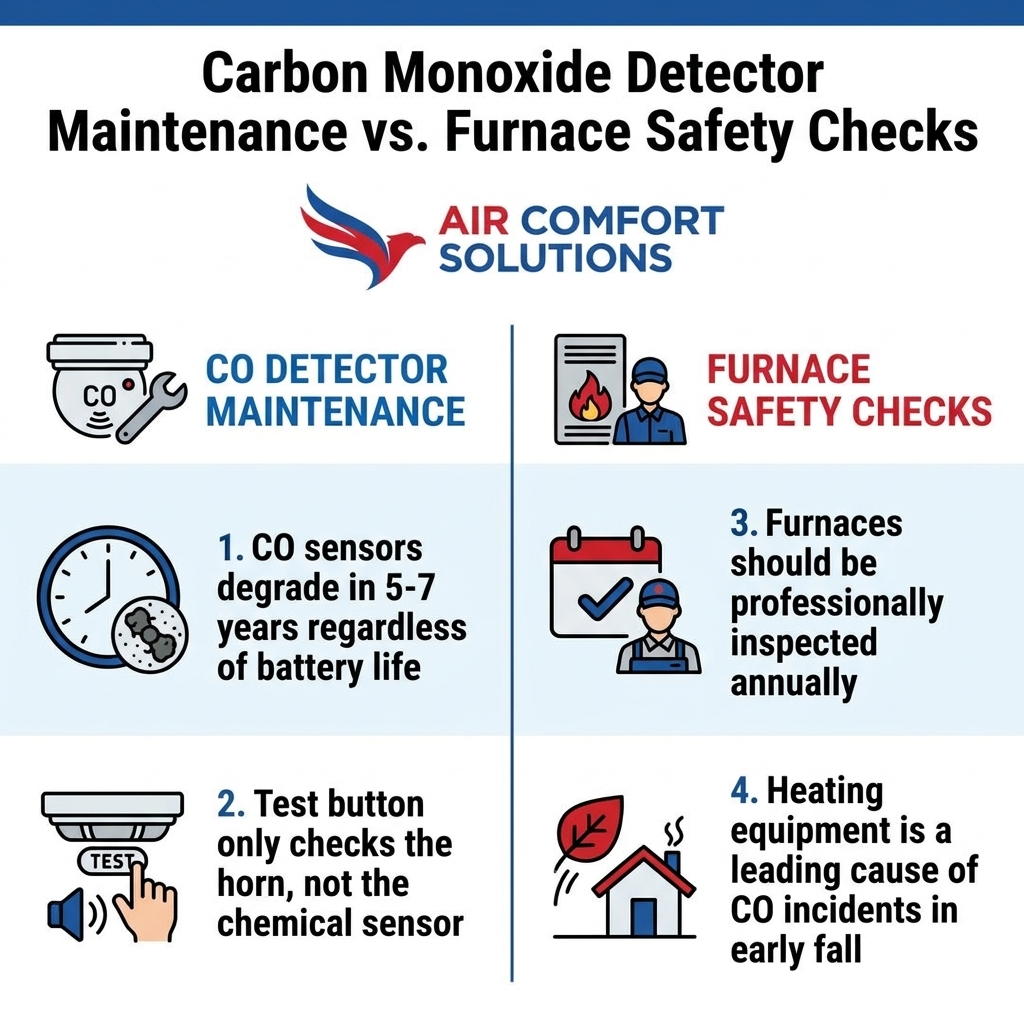
A pattern we see often during our early fall service calls is the widespread misconception among homeowners that pressing the "test" button on the front of a carbon monoxide alarm confirms the device is fully functional. In reality, pressing that button often only tests the unit's circuitry, battery power, and the audible alarm horn. It proves that the device has power and can make a loud noise, but it does not verify the health of the internal chemical sensor.
The data on this is clear: carbon monoxide sensors degrade over time. Most residential detectors use electrochemical sensors that rely on a specific chemical reaction to detect the presence of CO molecules in the air. As the device ages, these chemicals deplete. Regardless of how often you change the batteries, we remind our customers that the actual sensor typically reaches the end of its reliable lifespan within 5 to 7 years from the date of manufacture. After this window, the unit may still beep when you press the test button, creating a dangerous false sense of security.
During the September pre-heating transition, you must make the proactive decision to verify the manufacturing dates on every detector in your home. Simply swapping in fresh AA batteries is not enough. If the unit is past its expiration date, it cannot accurately measure ambient CO levels, rendering it useless during a furnace malfunction.
Treating your detectors as consumable safety equipment rather than permanent fixtures is a cornerstone of responsible homeownership. By replacing expired units promptly, you maintain a robust defense against airborne hazards. For households looking to further optimize their indoor environment, exploring comprehensive indoor air quality solutions can provide additional layers of monitoring and filtration alongside standard CO detection.
Carbon Monoxide Detector Maintenance vs. Furnace Safety Checks
Steps to Verify Your Carbon Monoxide Alarms This Fall
Taking control of your home's early warning system requires a methodical approach. During the September pre-heating transition, walk through your home and perform a comprehensive audit of every detector. Follow these specific steps to ensure your safety net is ready for the winter workload.
1. Locate the manufacturing date: Remove each carbon monoxide detector from its wall or ceiling mount. Look at the back of the device for a stamped or printed manufacturing date. Some newer models will explicitly print an "replace by" date, while older models only list the date it was built.
2. Enforce the 5-to-7-year rule: If the manufacturing date is more than 5 to 7 years in the past (check the specific manufacturer's lifespan recommendation on the back label), throw the unit away and purchase a replacement. Do this even if the unit still flashes a green light and sounds the horn when tested.
3. Replace backup batteries: For units that are still well within their operational lifespan, remove the old backup batteries and install fresh ones. This ensures the unit will continue monitoring the air even during a winter power outage.
4. Verify proper placement: The National Fire Protection Association (NFPA) guidelines state that CO detectors should be installed in a central location outside each sleeping area, and on every level of the home, including the basement. Ensure they are not blocked by furniture or draperies.
5. Check the distance from appliances: Keep detectors at least 15 feet away from fuel-burning appliances like your furnace or gas stove. Placing them too close can result in false alarms from the tiny, harmless amounts of CO emitted upon initial appliance startup.
Pairing Detector Checks with Professional Heating Maintenance
Testing your carbon monoxide detectors should never be treated as an isolated household chore. Instead, it must be viewed as one inseparable half of a comprehensive pre-season safety protocol. While functional detectors serve as your last line of defense against toxic gas, a professional heating tune-up from a qualified team is your absolute first line of defense. The goal is to prevent carbon monoxide from ever escaping the combustion chamber in the first place.
During the September pre-heating transition, proactive maintenance identifies small structural weaknesses before they have the chance to become active hazards. Trustworthy, comprehensive seasonal maintenance goes far beyond basic operational checks; it prioritizes genuine peace of mind for your family. Our technicians at Air Comfort Solutions do not just listen to the furnace run—we use specialized diagnostic tools to verify the mechanical integrity of the entire system.
This process includes a rigorous combustion analysis. We insert a probe into the exhaust flue to measure the exact chemical makeup of the gases leaving the furnace. If the carbon monoxide levels in the exhaust are abnormally high, it indicates that the burners are misaligned, the gas pressure is incorrect, or the primary air mixture is failing. Catching this imbalance early prevents heavy soot buildup and protects the heat exchanger from premature failure.
Furthermore, our technicians perform draft gauge testing to ensure the flue is actively pulling gases upward and out of the home. By enrolling in a seasonal maintenance plan, you ensure that these highly technical safety checks are performed reliably every fall, bridging the gap between your DIY detector testing and professional mechanical oversight.
Ensuring Comprehensive Safety Across All Heating Systems
While the central gas furnace is often the primary focus of fall safety preparations, we remind homeowners that it is not the only potential source of carbon monoxide in a residence. Any appliance that burns combustible fuel—natural gas, propane, oil, or wood—produces CO as a byproduct. In our experience working in Pinehurst TX, many homes utilize a combination of heating methods and appliances that require equal vigilance.
Gas water heaters, gas dryers, ovens, and wood-burning or gas fireplaces all demand regular monitoring. A blocked chimney or a poorly ventilated utility room can cause these appliances to backdraft just as easily as a furnace. Even if you rely primarily on electric space heaters for supplemental warmth, homes with attached garages face a unique risk. A vehicle left idling in an attached garage can quickly fill the home with carbon monoxide, making active monitoring critical regardless of how you heat your living space.
For homeowners looking to eliminate carbon monoxide risks entirely from their central heating system, we highly recommend transitioning to electric alternatives as an excellent strategy. Modern heat pump systems use electricity to transfer heat rather than burning fossil fuels to generate it. Because there is no combustion process, a heat pump physically cannot produce carbon monoxide. However, even these advanced electric systems require professional oversight to ensure electrical safety, optimal refrigerant levels, and peak efficiency before the winter weather arrives.
• Standard Furnace — Fuel Source: Natural Gas / Propane — Carbon Monoxide Risk Level: High (if poorly maintained) — Required Safety Action: Annual inspection, CO detectors
Frequently Asked Questions About Carbon Monoxide and Furnace Safety
How do you know if your carbon monoxide detector is expired?
The most reliable way to check for expiration is to remove the device from the wall and look at the back panel. You will find a stamped manufacturing date or a specific expiration date printed on the plastic casing. If the unit is older than 5 to 7 years from the manufacturing date, the internal chemical sensor has likely degraded, and our team advises that the entire unit must be replaced immediately.
Can a dormant furnace cause carbon monoxide?
Yes, a dormant furnace poses a significant risk when first turned on. If a heat exchanger developed a hairline crack during the previous winter, or if a flue became blocked by pest nests over the summer, the first startup can force exhaust gases to backdraft. This pushes carbon monoxide directly into the home instead of venting it safely outdoors.
What is the difference between testing a CO battery and a CO sensor?
Pressing the test button on your detector usually only verifies that the battery has enough power to trigger the alarm horn and light up the LED indicators. It does not guarantee that the internal electrochemical sensor is still capable of accurately detecting carbon monoxide gas in the air, which is why replacing the unit every 5 to 7 years is mandatory.
Why is my CO detector beeping after changing the battery?
A continuous chirp or specific beeping pattern immediately after a fresh battery change often indicates an end-of-life warning from the unit itself. Manufacturers program these devices to alert homeowners when the sensor has officially expired. Consult the back of the detector or the user manual to decode the specific beep pattern.
How often should you schedule a professional furnace inspection?
Heating equipment should be comprehensively inspected by a licensed professional once a year. We recommend this tune-up take place during the September pre-heating transition, ensuring the heat exchanger, burners, and flue pipes are structurally sound before the system is needed for daily winter use.
Take Proactive Steps for a Safe Heating Season
Understanding the strict lifespans of carbon monoxide sensors is a critical component of household safety. Your detectors are the ultimate fail-safe against an invisible threat, but they can only protect you if their internal chemistry is active and uncompromised. As we enter the September pre-heating transition, take ten minutes to walk through your home, check the dates on the back of every unit, and replace any hardware that has aged past its prime.
Once your safety net is verified, ensure the mechanical source of your heat is equally secure. Testing your carbon monoxide detectors before turning on the furnace is vital, but having the licensed professionals at Air Comfort Solutions clear the heat exchanger and calibrate the burners prevents those alarms from ever needing to sound. Schedule your comprehensive fall maintenance today to secure a safe, reliable, and comfortable indoor environment for the months ahead.
Zane came out and did an amazing job! Super friendly, honest and transparent about the work that needed to be done. This is my second time working with Air Comfort Solutions and they’re my go to for HVAC services. Highly recommend.
Markeith H.
God's AMAZING grace sent us Robert and Zane. We have been without air in this Texas heat for six weeks and four days. We've had a few contractors give us quotes all trying to upsell when we're at a low point. But not the guys at Air Comfort Solutions. They came in assessed our situation, gave us honest feedback, and showed us the issues as they proceeded with the assessment for clear understanding. We highly recommend them for their professionalism, quality products, and fair pricing. We hands down support them for all the work they do 💯 %.
Lena N.
Robert and Zane gone above and beyond to make the process easy and affordable. Would definitely recommend!!
Cameron J.
I’m writing this review to let everyone know that Air Comfort Solutions is the company to work with. I know the owner ( Robert) for several years now. He has been taking care of my residential and business work orders. Robert is professional, knowledgeable and will save you money. I just want to thank Robert for great job you have been doing for me.