Why Your Carbon Monoxide Detectors Need Testing Before Turning on the Furnace
Before the first cold snap hits, verifying your carbon monoxide sensors is a non-negotiable safety step. Learn the difference between battery and sensor testing.
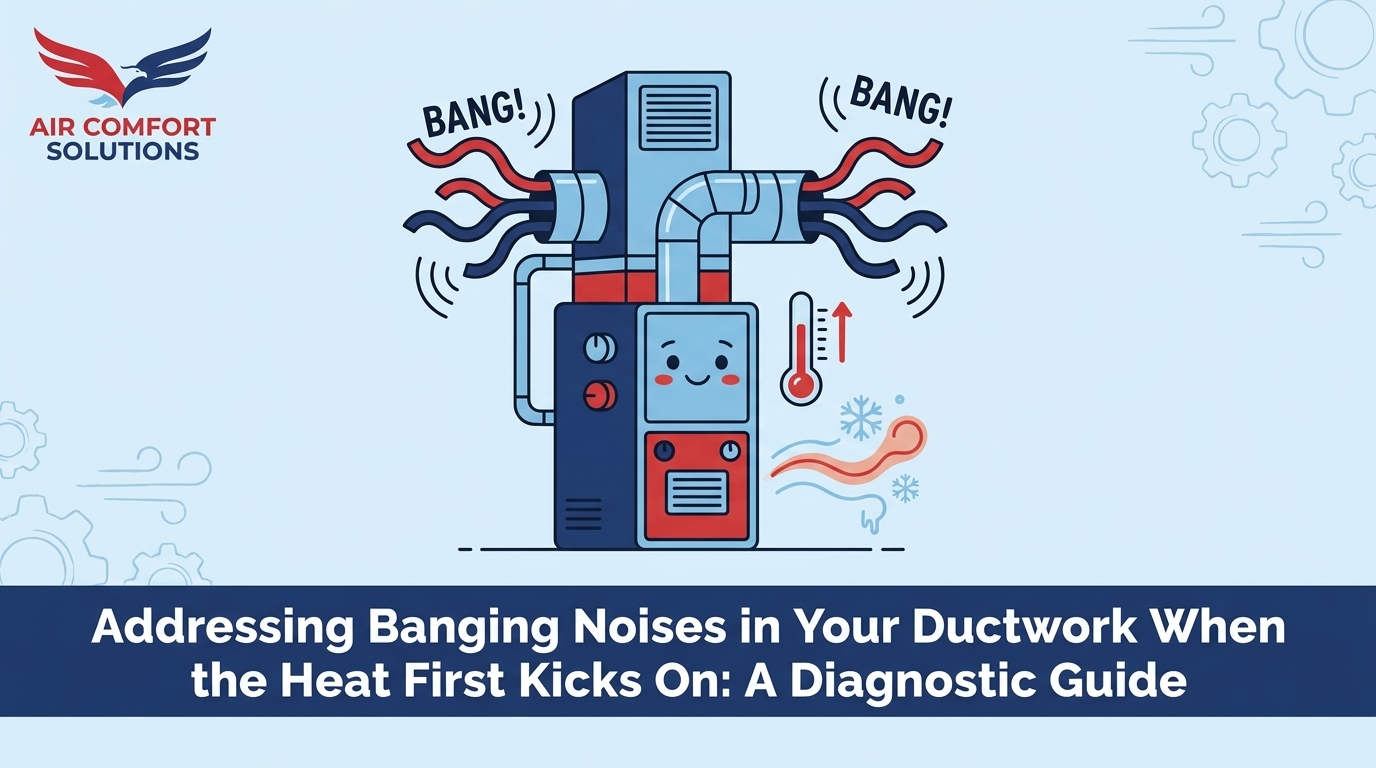
The first chilly evening of the early fall heating transition has finally arrived, but addressing banging noises in your ductwork when the heat first kicks on probably wasn't part of your cozy night in. You walk over to the thermostat, switch the system from cooling to heating, and wait for that comforting rush of warm air. Instead, a few moments later, a loud metallic bang echoes through the ceiling or floorboards. It is a jarring sound that immediately raises red flags for any homeowner. Your first thought is likely that something inside your furnace has broken, or worse, that your heating system is entirely unsafe to operate. At Air Comfort Solutions, our dispatchers field dozens of panicked calls about this exact issue every autumn.
For immediate professional assistance with your system, explore our HVAC services or learn more about our options for heat pump repair and installation.
That initial moment of panic is completely understandable. When large mechanical systems make sudden, unexpected noises, it is always wise to pay attention. However, not every loud noise points to a catastrophic failure. The key to protecting your home and your heating equipment lies in understanding the root cause of the sound. You face an important decision point: determining whether that loud pop is simply harmless thermal expansion as the metal reacts to sudden heat, or if it is a dangerous mechanical failure that requires immediate shutdown. By learning how to distinguish between normal structural reactions and urgent warning signs, you can take the right steps toward a safe, effective resolution before the bitter cold of winter sets in.
To understand why your vents sound like they are hitting each other, we have to look closely at the physical properties of your home's ventilation system. In the countless Pinehurst homes our technicians have serviced, we've found that most residential ductwork is constructed from thin, galvanized sheet metal. This material is highly conductive and reacts noticeably to changes in temperature. During the early fall heating transition, your ducts have likely been sitting idle in a relatively cool environment. When the furnace suddenly blasts hot air through these cold metal channels, a physical reaction known as thermal expansion (oil-canning) occurs.
This reaction is completely natural. As the metal absorbs the heat, its molecules become more active and take up more space, causing the sheet metal to physically expand. Because the metal is fastened tightly to your home's framing, it has very little room to grow. This built-up tension eventually forces the metal to buckle or flex, resulting in a sudden, loud sound. While it can be highly annoying, pure thermal expansion is generally a harmless structural reaction.
The term "oil-canning" comes from the distinct sound the metal makes, which closely resembles the noise of pressing your thumb into the side of an old-fashioned, flexible metal oil can. When you press the metal in, it resists until it suddenly gives way with a sharp "pop." When you release it, it pops back out.
Your ductwork does the exact same thing. Rectangular ducts are particularly susceptible to oil-canning. Because they feature large, flat surface areas, they lack the inherent structural rigidity of round ducts. When the pressure or temperature changes, these wide, flat expanses of sheet metal warp outward or inward. Once the tension reaches a breaking point, the metal snaps into a new position, sending a loud bang echoing through the hollow chambers of your ventilation system.
The severity of the noise is directly tied to the temperature differential—the difference between the cold ambient temperature of the ductwork and the hot air being pushed through it. If your ductwork runs through an unconditioned space like a crawlspace or an attic, the metal can get quite cold during an autumn night.
When your furnace ignites, it pushes air that is significantly hotter than the surrounding metal. This extreme, sudden shift from ambient cold to forced heat causes rapid molecular expansion. The faster the metal heats up, the more violent the expansion, and the louder the resulting bang. You will often notice that this noise is most prominent during the first heating cycle of the day or the season. Once the ductwork reaches a consistent, warm operating temperature, the metal remains expanded, and the popping noises usually subside until the system cools down again.
While temperature changes are the primary culprit behind oil-canning, air pressure plays an equally significant role. Your heating system relies on a delicate balance of positive and negative air pressure to circulate conditioned air throughout your home. When that balance is disrupted, the resulting pressure differentials can force your sheet metal ducts to flex violently, amplifying any banging noises.
A pattern we see often during our pre-heating-season tune-ups is how air pressure interacts with ductwork, which clarifies why proper maintenance is so critical. Here is a breakdown of how pressure issues create and worsen duct noises:
1. The Blower Motor Engages: When your system calls for heat, the blower motor spins up to push air through the home. This creates a zone of negative pressure in the return ducts (pulling air in) and positive pressure in the supply ducts (pushing air out). If the ductwork is undersized or poorly supported, this sudden rush of pressure alone can cause the metal to pop outward.
2. Dirty Air Filters Restrict Intake: The most common cause of severe pressure imbalances is a clogged air filter. When the filter is choked with dust and debris, the blower motor has to work much harder to pull air through it. This creates an intense vacuum (negative pressure) in the return ductwork. The suction can become so strong that it literally pulls the sheet metal walls inward with a loud bang. When the blower turns off, the vacuum releases, and the metal pops back out.
3. Closed Vents Choke Output: On the supply side, closing too many room registers or blocking vents with furniture creates severe backpressure. The blower is trying to push a specific volume of air into the house, but the closed vents act like a dam. The static pressure inside the supply ducts builds up rapidly, forcing the rectangular metal to bulge outward and create a loud popping sound.
4. System Strain and Wear: These airflow restrictions do more than just create annoying noises. They force the blower motor to operate under extreme strain, which can lead to overheating, increased energy consumption, and premature failure of internal components.
If you have noticed other odd sounds alongside the banging, such as whistling or grinding, it may be related to these pressure imbalances. You can learn more about what different sounds indicate by reading our guide on an AC making strange noises, as many of the same airflow principles apply to both heating and cooling cycles.
Up to this point, we have discussed noises that originate within the ductwork itself. These sounds, while startling, are generally harmless structural reactions. However, there is a very different type of loud bang that homeowners must be aware of—one that originates directly from the furnace cabinet. In our years of inspecting heating systems, delayed ignition is one of the most serious red flags we encounter, and it is a highly dangerous mechanical failure.
Delayed ignition occurs when combustible gas builds up inside the furnace's combustion chamber before the igniter or pilot light can successfully light it. In a properly functioning furnace, the gas ignites the instant it enters the burner. But if the burners are dirty, the igniter is failing, or the gas pressure is incorrect, the gas valve may open and release fuel for several seconds before a spark catches. When that accumulated gas finally does ignite, it creates a small, localized explosion. This results in a deep, concussive "boom" that shakes the furnace.
The physical force of delayed ignition is incredibly dangerous. Repeated explosive ignitions place immense stress on the heat exchanger—the metal shield that separates the toxic combustion gases from the breathable air circulating into your home. Over time, these explosions can crack the heat exchanger, allowing deadly carbon monoxide to leak directly into your ductwork and living spaces. If you ever hear a loud boom coming from the mechanical closet or basement exactly when the furnace tries to light, you must shut the system down immediately at the thermostat and call our professionals.
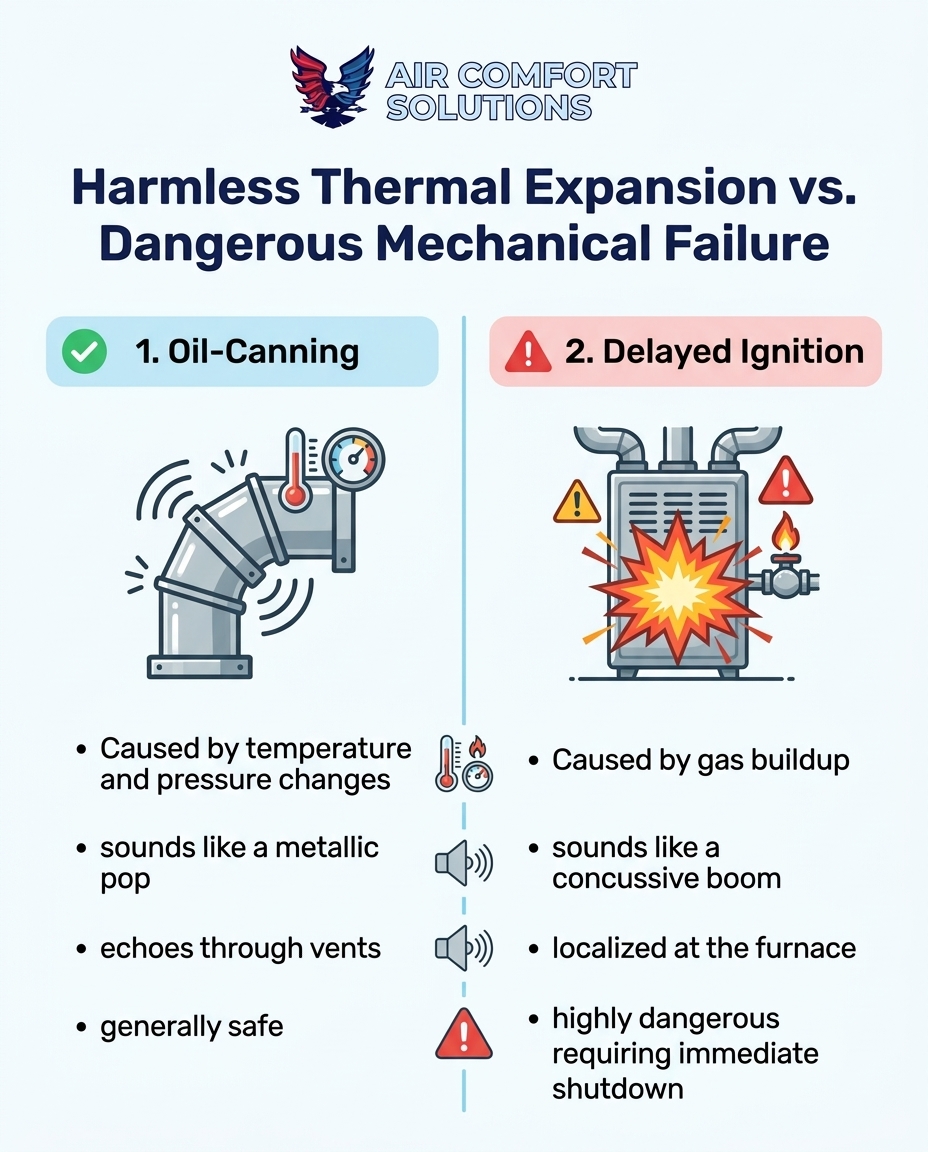
• Sound Profile — Harmless Oil-Canning (Thermal Expansion): A sharp, metallic pop, flex, or crinkling sound. — Dangerous Delayed Ignition: A deep, concussive boom or muffled explosion.
• Location of the Noise — Harmless Oil-Canning (Thermal Expansion): Echoes through the vents, ceilings, or floorboards. — Dangerous Delayed Ignition: Localized directly at the furnace unit in the basement or closet.
• Timing of the Sound — Harmless Oil-Canning (Thermal Expansion): Occurs throughout the heating cycle as metal warms and cools. — Dangerous Delayed Ignition: Happens exactly at the moment the furnace burners attempt to ignite.
• Danger Level — Harmless Oil-Canning (Thermal Expansion): Low. A harmless structural reaction to heat and pressure. — Dangerous Delayed Ignition: Extremely High. Risks cracking the heat exchanger and causing carbon monoxide leaks.
The environment your HVAC system operates in plays a massive role in how it behaves, and local weather patterns are a major factor in the noises you hear. Here in the Pinehurst TX area, our team at Air Comfort Solutions prepares for a very specific set of challenges our local climate creates for heating equipment. We are known for experiencing long, mild autumns where the weather remains temperate for weeks on end. During this extended period, your heating system sits completely idle, and the metal ductwork acclimates to the moderate ambient temperatures.
However, this mild weather is frequently interrupted by sudden, sharp cold snaps. Overnight, the temperature can plummet, leaving the ductwork running through unconditioned spaces—like your attic or crawlspace—exceptionally cold. When you wake up shivering and turn the thermostat to heat, you are asking a system that has been dormant for months to immediately push high-heat air through freezing cold metal.
This sudden local temperature swing maximizes the thermal expansion (oil-canning) stress on your idle system. The temperature differential is at its absolute peak during these first cold snaps. The attic may be near freezing, while the furnace is suddenly outputting air that is well over 100 degrees Fahrenheit. Because the metal has been resting in a contracted state for so long, the violent, rapid expansion creates the loudest bangs of the entire year. Understanding how this regional weather pattern specifically impacts HVAC physics can help you anticipate these noises. If you are preparing your home for these sudden shifts, reaching out to your Pinehurst TX HVAC experts can ensure your system is ready to handle the stress of the changing seasons.
When you hear a startling noise from your vents, your first instinct might be to start taking things apart to find the problem. However, modern heating systems are complex and contain dangerous components, including high-voltage electricity and combustible gas. As your trusted local experts at Air Comfort Solutions, our goal is to provide honest, clear diagnostics so you can safely distinguish between harmless noises and serious mechanical failures without putting yourself at risk.
There are several safe, homeowner-level diagnostic steps you can take to rule out basic airflow issues before calling our team for backup. By checking these common trouble spots, you can often resolve pressure-related banging noises entirely on your own.
• Check and replace dirty air filters: This is the single most important step. Pull out your furnace filter and hold it up to a light. If you cannot see light shining through the material, it is severely clogged. Replace it immediately with a fresh filter to restore proper pressure balance and stop the return ducts from oil-canning.
• Ensure all supply vents are fully open: Walk through every room in your home and check the floor, wall, or ceiling registers. Make sure the louvers are in the fully open position. Even in unused guest rooms, vents should remain open to prevent static backpressure from building up in the supply ducts.
• Clear obstructions from return registers: Locate the large return grilles in your hallways or living areas. Ensure that no heavy furniture, thick rugs, or heavy curtains are blocking the airflow. The system needs to breathe freely to prevent negative pressure vacuums.
• Listen closely to the location of the sound: Stand near the furnace when it kicks on. Note whether the sound is a metallic crinkle coming from the ceiling, or a deep boom coming from the metal cabinet in front of you. This information is vital for your technician.
• Never open the furnace cabinet yourself: We explicitly warn against attempting to open the burner compartment, adjusting gas valves, or trying to modify the ductwork structure. If the noise is coming from inside the unit, shut it off at the thermostat and wait for a professional. Honest diagnostics mean knowing exactly when a problem exceeds safe DIY limits.
It is primarily caused by thermal expansion, where cold metal ducts rapidly expand when filled with hot air. As the galvanized sheet metal absorbs the sudden heat from the furnace, it flexes and buckles against its structural constraints. Additionally, sudden pressure changes from the blower motor engaging can cause the flat sides of the metal to pop inward and outward, amplifying the noise.
If the noise is strictly thermal expansion in the sheet metal, it is not dangerous, though it can be disruptive to your daily life. This oil-canning effect is a normal physical reaction to temperature differentials and pressure changes within the ventilation system. However, if the sound is a loud boom coming directly from the furnace cabinet itself, it could indicate delayed ignition, which is highly dangerous and requires immediate attention.
You can often reduce the noise by ensuring clean air filters and opening all household vents to reduce extreme pressure differentials. If basic airflow maintenance does not solve the issue, professional solutions are available. Our HVAC technicians can insulate the ductwork to slow down temperature changes, adjust the blower motor speeds for a softer startup, or add structural reinforcement to the weak points of the sheet metal.
Oil canning refers to the flexing or buckling of sheet metal caused by sudden temperature changes or extreme pressure imbalances. Because rectangular ducts have large, flat surfaces, they lack structural rigidity. When stressed, the metal warps and snaps into a new position, producing a distinct popping or banging sound similar to pressing your thumb into a flexible metal oil can.
Yes, a severely clogged filter restricts incoming airflow, creating intense negative pressure within the system. The blower motor has to fight the clog, which creates a strong vacuum that literally pulls the sheet metal return ducts inward. This causes a loud bang when the system turns on, and another bang when the system turns off and the metal pops back outward.
A banging noise originating directly from the furnace unit is extremely dangerous and should never be ignored. This specific sound often points to delayed gas ignition, where combustible fuel builds up in the chamber before exploding. This explosive force can crack the heat exchanger, which may release dangerous carbon monoxide gases into your home's breathing air.
Navigating the early fall heating transition doesn't have to be a stressful experience. While we have established that thermal expansion and oil-canning are normal reactions to sudden temperature shifts, loud banging noises should never be completely ignored if you are uncertain of their exact origin. Differentiating between harmless metal quirks and failing internal components is the key to protecting your home.
Scheduling a professional pre-season inspection is the most effective way to guarantee that your equipment is operating safely and efficiently. Our expert technicians can evaluate your ductwork, check your gas pressure, and ensure your blower motor is perfectly calibrated. By investing in a routine HVAC maintenance plan, you secure your peace of mind, knowing your system will provide safe, quiet, and reliable comfort long before the peak winter weather arrives.


Zane came out and did an amazing job! Super friendly, honest and transparent about the work that needed to be done. This is my second time working with Air Comfort Solutions and they’re my go to for HVAC services. Highly recommend.
God's AMAZING grace sent us Robert and Zane. We have been without air in this Texas heat for six weeks and four days. We've had a few contractors give us quotes all trying to upsell when we're at a low point. But not the guys at Air Comfort Solutions. They came in assessed our situation, gave us honest feedback, and showed us the issues as they proceeded with the assessment for clear understanding. We highly recommend them for their professionalism, quality products, and fair pricing. We hands down support them for all the work they do 💯 %.
Robert and Zane gone above and beyond to make the process easy and affordable.
Would definitely recommend!!
I’m writing this review to let everyone know that Air Comfort Solutions is the company to work with. I know the owner ( Robert) for several years now. He has been taking care of my residential and business work orders. Robert is professional, knowledgeable and will save you money. I just want to thank Robert for great job you have been doing for me.