Home Maintenance Tips and Troubleshooting: Safely Evaluating Your Fall Heating Startup
Smell burning during a fall heating startup? Apply these home maintenance tips and troubleshooting to see if it's normal dust burn-off or time to call a pro.
How to help your AC during a Houston area heat wave is something every North Harris County homeowner should know before the mercury tops 100°F. Houston summers are no joke — and when outdoor temps push past what your AC was designed to handle, the difference between a cool house and a miserable one comes down to a few simple habits and the right maintenance.
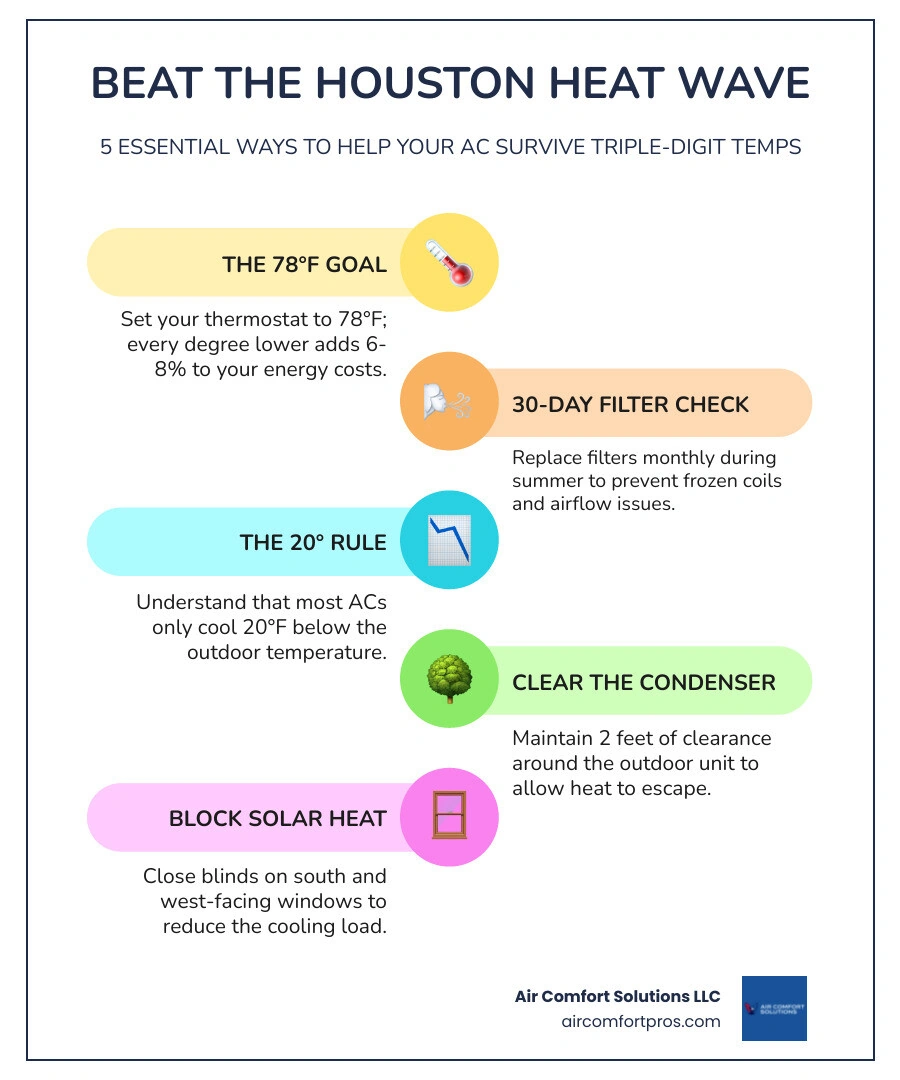
Here is a quick overview of the most effective steps:
1. Set your thermostat to 78°F — each degree lower increases energy use by 6-8%
2. Replace your air filter every 30 days during a heat wave — dirty filters cause frozen coils and weak airflow
3. Clear at least 2 feet around your outdoor condenser unit so it can release heat properly
4. Close blinds on south and west-facing windows during peak afternoon hours
5. Use ceiling fans to make rooms feel up to 4°F cooler without touching the thermostat
6. Avoid turning your AC off when you leave — set it higher instead to prevent heat soak
7. Watch for warning signs like ice on the lines, warm air from vents, or unusual noises
8. Schedule a professional tune-up before or during peak season — not after a breakdown
Most central AC systems are engineered to keep your home about 20°F cooler than the outdoor temperature. That means on a 100°F Houston day, getting your home down to 78-80°F is actually your system doing exactly what it was built to do. Expecting 68°F when it is blazing outside puts enormous strain on components that were never designed for that kind of load — and in a city where the heat index regularly makes triple-digit temps feel even worse, that strain adds up fast.
The good news? Most of what protects your AC during a heat wave is straightforward, low-cost, and something you can start today.
We’ve all been there: it’s 3:00 PM in July, the outdoor thermometer reads 103°F, and your thermostat says it’s 77°F inside even though you have it set to 72°F. Before you assume your system is broken, it’s important to understand the physics of cooling in Houston TX.
Most air conditioning units are engineered to handle outdoor temperatures up to about 95°F. Once we hit triple digits — which has happened week after week in recent years — the system enters a "stress test" mode. The industry standard is a 20-degree differential. This means if it is 100°F outside, your AC is performing perfectly if it keeps your indoor air at 80°F. If your home manages to stay at 72°F or 73°F on a 100-degree day, your system is actually an overachiever!
During these extreme peaks, it is perfectly normal for your AC to run continuously. In fact, it is designed to run long cycles to remove the thick Houston humidity. However, when the system runs 24/7 without a break, any small mechanical issue can quickly turn into a total shutdown. This is often When Your AC Can't Keep Up with the Heat, leading many homeowners to panic. Understanding these limits helps you manage your expectations and reduces the urge to "crank it down" to 60°F, which doesn't make the air colder—it just forces the compressor to work longer under brutal conditions.
You don’t need a tool belt to be a hero for your HVAC system. The single most important thing you can do to how to help your ac during a houston area heat wave is to change your air filter.
In normal weather, a high-quality pleated filter might last 90 days. But in May 2026, with the AC running 18 to 20 hours a day, that filter is acting like a giant vacuum cleaner for dust, pet dander, and pollen. When a filter gets "furry," it restricts airflow. This restriction causes the pressure to drop in your evaporator coil, which leads to the moisture in our humid air freezing solid. Once your coils are a block of ice, no cool air can pass through, and your house will start warming up fast.
We recommend switching to a 30-day filter replacement cycle during the peak of summer. It is a small investment that prevents multi-thousand-dollar compressor failures. For more on the timing of these tasks, check out How Often Should You Service Your AC in Texas and ensure you are staying on top of AC Maintenance Houston TX.
While the indoor unit is busy pulling heat out of your air, the outdoor condenser unit has the thankless job of dumping that heat into the already-boiling Houston air. If that unit is "suffocating," it can't do its job.
Take a walk outside and look at your condenser. It needs at least two feet of clear space on all sides to breathe. In many Pinehurst and Magnolia backyards, vining plants, tall grass, or stored patio furniture can crowd the unit. Trim back any bushes and remove any "stuff" leaning against it.
You can also give the unit a gentle rinse. Over time, dust and pollen clog the tiny metal fins on the outdoor coil. With the power off, a gentle spray from a garden hose (don't use a pressure washer!) can wash away the grime, helping the unit release heat more efficiently. This simple bit of AC Service Houston TX can significantly lower the internal pressure of your system.
We know it’s tempting to drop the thermostat to 70°F the moment you walk in the door, but this is one of the hardest things you can do to your system. Instead, aim for a steady 78°F when you are home. According to ENERGY STAR, this is the ideal balance for energy savings and comfort.
One of the biggest mistakes we see is homeowners turning the AC completely off when they leave for work. In a Houston heat wave, this leads to "heat soak." Your walls, furniture, flooring, and even the studs in your walls absorb the 90-degree heat. When you turn the AC back on at 5:00 PM, the system has to work for hours just to remove the heat stored in your couch before it can even start cooling the air.
Instead, raise the temp by only 3-5 degrees when you are away. This keeps the humidity under control and prevents the house from becoming a giant thermal battery. Using these smart habits is a key part of AC Service Houston.
Your AC isn't just fighting the air temperature; it's fighting the sun. Windows account for up to 30% of unwanted heat gain in a typical home. In the afternoon, when the sun hits the south and west sides of your house, it creates a greenhouse effect.
Thermal curtains or blackout blinds can reduce heat transfer by up to 25%. If you aren't ready to replace your curtains, even reflective window film can reject up to 70% of solar heat. Beyond the windows, look at your lightbulbs. Traditional incandescent bulbs are basically tiny space heaters—90% of the energy they use is released as heat. Switching to LEDs is a "double win" because they stay cool and use 75% less energy.
• Incandescent — Heat Output: High (90% heat) — Energy Efficiency: Low
• Halogen — Heat Output: High — Energy Efficiency: Moderate
• LED — Heat Output: Very Low (10% heat) — Energy Efficiency: Very High
Every little bit of heat you keep out of the house is heat your AC doesn't have to remove. If you ignore these small steps, you might find out the hard way What Happens If You Skip AC Maintenance in Texas.
Sometimes, despite your best DIY efforts, the heat simply wins. Knowing how to spot the early warning signs of a failing system can save you from a "no-AC emergency" in the middle of a Saturday night.
• Ice Buildup: If you see white frost or ice on the copper lines leading to your outdoor unit, turn the system off immediately. This usually indicates a major airflow restriction or a refrigerant leak.
• Warm Air: If the air coming out of the vents feels like a blow dryer, your compressor or capacitor may have failed.
• The "Hum of Death": If you hear a loud humming noise from the outdoor unit but the fan isn't spinning, you likely have a failed capacitor. This is the most common part to fail in Houston heat because it is sensitive to high temperatures.
• Frequent Cycling: If the unit turns on and off every few minutes, it’s "short-cycling," which can quickly burn out the motor.
When these symptoms appear, it’s time to look into Signs Your AC Needs Repair in Houston Area Heat. Don't try to DIY electrical components or refrigerant—these require specialized tools and certification. If your vents are blowing hot, you need to know Why Is My AC Blowing Warm Air before the problem gets worse.
While DIY tips help in the short term, some issues require a professional touch to ensure your home stays a sanctuary all summer long. For instance, refrigerant isn't like gas in a car—it doesn't get "used up." If your levels are low, you have a leak. A professional technician can find and seal that leak, preventing your system from running inefficiently and eventually dying.
Another major factor is ductwork. In many older homes in The Woodlands or Conroe, leaky ducts can waste 20-30% of your cooled air before it ever reaches your living room. Sealing these leaks ensures the air you are paying to cool actually stays inside your home.
Finally, there is the question of sizing. If your AC is over 10-15 years old, it was likely designed for a climate that wasn't quite as extreme as what we are seeing in May 2026. If your system is consistently Why Is My AC Running But Not Cooling, it might be undersized for your home's current needs. We can perform a Manual J Load Calculation to see if a high-SEER upgrade could save you 20-40% on your cooling costs. If the unit won't start at all, check out our guide on AC Not Turning On During a Heatwave.
We recommend 78°F when you are home. While it sounds high to some, pairing this with a ceiling fan (running counter-clockwise) makes the room feel like 74°F. Each degree you set the thermostat below 78°F can increase your bill by up to 8% during a heat wave.
This usually happens during peak afternoon hours (2:00 PM – 6:00 PM). If the outdoor temp is 105°F and your home is 80°F, your AC is doing its job but the sun is adding heat faster than the AC can remove it. However, if the temp keeps rising after the sun goes down, you likely have a dirty filter, dirty coils, or a mechanical issue.
A quick, gentle rinse to clean the coils is a great idea. However, do not leave a sprinkler running on your AC unit. Houston water is full of minerals that will create a "scale" buildup on your condenser fins, eventually acting like insulation and making it harder for the unit to release heat.
Surviving a Houston summer is all about teamwork between you and your air conditioning system. By understanding the 20-degree rule, keeping your filters clean, and managing your home's thermal load, you can significantly reduce the risk of a mid-summer breakdown.
At Air Comfort Solutions LLC, we’ve spent over 35 years helping our neighbors in Pinehurst, Magnolia, and throughout Harris County stay cool. Whether you need a quick tune-up to beat the rush or an emergency repair when the heat becomes too much, our certified technicians are here to provide honest, reliable solutions.
Don't wait for your system to start blowing warm air. Give your AC the help it needs today so it can keep you comfortable all summer long. For professional help, schedule your AC Maintenance Houston TX with us today and breathe easy knowing your comfort is in expert hands.
How to help your AC during a Houston area heat wave is something every North Harris County homeowner should know before the mercury tops 100°F. Houston summers are no joke — and when outdoor temps push past what your AC was designed to handle, the difference between a cool house and a miserable one comes down to a few simple habits and the right maintenance.
Here is a quick overview of the most effective steps:
Most central AC systems are engineered to keep your home about 20°F cooler than the outdoor temperature. That means on a 100°F Houston day, getting your home down to 78-80°F is actually your system doing exactly what it was built to do. Expecting 68°F when it is blazing outside puts enormous strain on components that were never designed for that kind of load — and in a city where the heat index regularly makes triple-digit temps feel even worse, that strain adds up fast.
The good news? Most of what protects your AC during a heat wave is straightforward, low-cost, and something you can start today.
We’ve all been there: it’s 3:00 PM in July, the outdoor thermometer reads 103°F, and your thermostat says it’s 77°F inside even though you have it set to 72°F. Before you assume your system is broken, it’s important to understand the physics of cooling in Houston TX.
Most air conditioning units are engineered to handle outdoor temperatures up to about 95°F. Once we hit triple digits — which has happened week after week in recent years — the system enters a "stress test" mode. The industry standard is a 20-degree differential. This means if it is 100°F outside, your AC is performing perfectly if it keeps your indoor air at 80°F. If your home manages to stay at 72°F or 73°F on a 100-degree day, your system is actually an overachiever!
During these extreme peaks, it is perfectly normal for your AC to run continuously. In fact, it is designed to run long cycles to remove the thick Houston humidity. However, when the system runs 24/7 without a break, any small mechanical issue can quickly turn into a total shutdown. This is often When Your AC Can't Keep Up with the Heat, leading many homeowners to panic. Understanding these limits helps you manage your expectations and reduces the urge to "crank it down" to 60°F, which doesn't make the air colder—it just forces the compressor to work longer under brutal conditions.
You don’t need a tool belt to be a hero for your HVAC system. The single most important thing you can do to how to help your ac during a houston area heat wave is to change your air filter.
In normal weather, a high-quality pleated filter might last 90 days. But in May 2026, with the AC running 18 to 20 hours a day, that filter is acting like a giant vacuum cleaner for dust, pet dander, and pollen. When a filter gets "furry," it restricts airflow. This restriction causes the pressure to drop in your evaporator coil, which leads to the moisture in our humid air freezing solid. Once your coils are a block of ice, no cool air can pass through, and your house will start warming up fast.
We recommend switching to a 30-day filter replacement cycle during the peak of summer. It is a small investment that prevents multi-thousand-dollar compressor failures. For more on the timing of these tasks, check out How Often Should You Service Your AC in Texas and ensure you are staying on top of AC Maintenance Houston TX.
While the indoor unit is busy pulling heat out of your air, the outdoor condenser unit has the thankless job of dumping that heat into the already-boiling Houston air. If that unit is "suffocating," it can't do its job.
Take a walk outside and look at your condenser. It needs at least two feet of clear space on all sides to breathe. In many Pinehurst and Magnolia backyards, vining plants, tall grass, or stored patio furniture can crowd the unit. Trim back any bushes and remove any "stuff" leaning against it.
You can also give the unit a gentle rinse. Over time, dust and pollen clog the tiny metal fins on the outdoor coil. With the power off, a gentle spray from a garden hose (don't use a pressure washer!) can wash away the grime, helping the unit release heat more efficiently. This simple bit of AC Service Houston TX can significantly lower the internal pressure of your system.
We know it’s tempting to drop the thermostat to 70°F the moment you walk in the door, but this is one of the hardest things you can do to your system. Instead, aim for a steady 78°F when you are home. According to ENERGY STAR, this is the ideal balance for energy savings and comfort.
One of the biggest mistakes we see is homeowners turning the AC completely off when they leave for work. In a Houston heat wave, this leads to "heat soak." Your walls, furniture, flooring, and even the studs in your walls absorb the 90-degree heat. When you turn the AC back on at 5:00 PM, the system has to work for hours just to remove the heat stored in your couch before it can even start cooling the air.
Instead, raise the temp by only 3-5 degrees when you are away. This keeps the humidity under control and prevents the house from becoming a giant thermal battery. Using these smart habits is a key part of AC Service Houston.
Your AC isn't just fighting the air temperature; it's fighting the sun. Windows account for up to 30% of unwanted heat gain in a typical home. In the afternoon, when the sun hits the south and west sides of your house, it creates a greenhouse effect.
Thermal curtains or blackout blinds can reduce heat transfer by up to 25%. If you aren't ready to replace your curtains, even reflective window film can reject up to 70% of solar heat. Beyond the windows, look at your lightbulbs. Traditional incandescent bulbs are basically tiny space heaters—90% of the energy they use is released as heat. Switching to LEDs is a "double win" because they stay cool and use 75% less energy.
| Lightbulb Type | Heat Output | Energy Efficiency |
|---|---|---|
| Incandescent | High (90% heat) | Low |
| Halogen | High | Moderate |
| LED | Very Low (10% heat) | Very High |
Every little bit of heat you keep out of the house is heat your AC doesn't have to remove. If you ignore these small steps, you might find out the hard way What Happens If You Skip AC Maintenance in Texas.
Sometimes, despite your best DIY efforts, the heat simply wins. Knowing how to spot the early warning signs of a failing system can save you from a "no-AC emergency" in the middle of a Saturday night.
When these symptoms appear, it’s time to look into Signs Your AC Needs Repair in Houston Area Heat. Don't try to DIY electrical components or refrigerant—these require specialized tools and certification. If your vents are blowing hot, you need to know Why Is My AC Blowing Warm Air before the problem gets worse.
While DIY tips help in the short term, some issues require a professional touch to ensure your home stays a sanctuary all summer long. For instance, refrigerant isn't like gas in a car—it doesn't get "used up." If your levels are low, you have a leak. A professional technician can find and seal that leak, preventing your system from running inefficiently and eventually dying.
Another major factor is ductwork. In many older homes in The Woodlands or Conroe, leaky ducts can waste 20-30% of your cooled air before it ever reaches your living room. Sealing these leaks ensures the air you are paying to cool actually stays inside your home.
Finally, there is the question of sizing. If your AC is over 10-15 years old, it was likely designed for a climate that wasn't quite as extreme as what we are seeing in May 2026. If your system is consistently Why Is My AC Running But Not Cooling, it might be undersized for your home's current needs. We can perform a Manual J Load Calculation to see if a high-SEER upgrade could save you 20-40% on your cooling costs. If the unit won't start at all, check out our guide on AC Not Turning On During a Heatwave.
We recommend 78°F when you are home. While it sounds high to some, pairing this with a ceiling fan (running counter-clockwise) makes the room feel like 74°F. Each degree you set the thermostat below 78°F can increase your bill by up to 8% during a heat wave.
This usually happens during peak afternoon hours (2:00 PM – 6:00 PM). If the outdoor temp is 105°F and your home is 80°F, your AC is doing its job but the sun is adding heat faster than the AC can remove it. However, if the temp keeps rising after the sun goes down, you likely have a dirty filter, dirty coils, or a mechanical issue.
A quick, gentle rinse to clean the coils is a great idea. However, do not leave a sprinkler running on your AC unit. Houston water is full of minerals that will create a "scale" buildup on your condenser fins, eventually acting like insulation and making it harder for the unit to release heat.
Surviving a Houston summer is all about teamwork between you and your air conditioning system. By understanding the 20-degree rule, keeping your filters clean, and managing your home's thermal load, you can significantly reduce the risk of a mid-summer breakdown.
At Air Comfort Solutions LLC, we’ve spent over 35 years helping our neighbors in Pinehurst, Magnolia, and throughout Harris County stay cool. Whether you need a quick tune-up to beat the rush or an emergency repair when the heat becomes too much, our certified technicians are here to provide honest, reliable solutions.
Don't wait for your system to start blowing warm air. Give your AC the help it needs today so it can keep you comfortable all summer long. For professional help, schedule your AC Maintenance Houston TX with us today and breathe easy knowing your comfort is in expert hands.
How to help your AC during a Houston area heat wave is something every North Harris County homeowner should know before the mercury tops 100°F. Houston summers are no joke — and when outdoor temps push past what your AC was designed to handle, the difference between a cool house and a miserable one comes down to a few simple habits and the right maintenance.
Here is a quick overview of the most effective steps:
Most central AC systems are engineered to keep your home about 20°F cooler than the outdoor temperature. That means on a 100°F Houston day, getting your home down to 78-80°F is actually your system doing exactly what it was built to do. Expecting 68°F when it is blazing outside puts enormous strain on components that were never designed for that kind of load — and in a city where the heat index regularly makes triple-digit temps feel even worse, that strain adds up fast.
The good news? Most of what protects your AC during a heat wave is straightforward, low-cost, and something you can start today.
We’ve all been there: it’s 3:00 PM in July, the outdoor thermometer reads 103°F, and your thermostat says it’s 77°F inside even though you have it set to 72°F. Before you assume your system is broken, it’s important to understand the physics of cooling in Houston TX.
Most air conditioning units are engineered to handle outdoor temperatures up to about 95°F. Once we hit triple digits — which has happened week after week in recent years — the system enters a "stress test" mode. The industry standard is a 20-degree differential. This means if it is 100°F outside, your AC is performing perfectly if it keeps your indoor air at 80°F. If your home manages to stay at 72°F or 73°F on a 100-degree day, your system is actually an overachiever!
During these extreme peaks, it is perfectly normal for your AC to run continuously. In fact, it is designed to run long cycles to remove the thick Houston humidity. However, when the system runs 24/7 without a break, any small mechanical issue can quickly turn into a total shutdown. This is often When Your AC Can't Keep Up with the Heat, leading many homeowners to panic. Understanding these limits helps you manage your expectations and reduces the urge to "crank it down" to 60°F, which doesn't make the air colder—it just forces the compressor to work longer under brutal conditions.
You don’t need a tool belt to be a hero for your HVAC system. The single most important thing you can do to how to help your ac during a houston area heat wave is to change your air filter.
In normal weather, a high-quality pleated filter might last 90 days. But in May 2026, with the AC running 18 to 20 hours a day, that filter is acting like a giant vacuum cleaner for dust, pet dander, and pollen. When a filter gets "furry," it restricts airflow. This restriction causes the pressure to drop in your evaporator coil, which leads to the moisture in our humid air freezing solid. Once your coils are a block of ice, no cool air can pass through, and your house will start warming up fast.
We recommend switching to a 30-day filter replacement cycle during the peak of summer. It is a small investment that prevents multi-thousand-dollar compressor failures. For more on the timing of these tasks, check out How Often Should You Service Your AC in Texas and ensure you are staying on top of AC Maintenance Houston TX.
While the indoor unit is busy pulling heat out of your air, the outdoor condenser unit has the thankless job of dumping that heat into the already-boiling Houston air. If that unit is "suffocating," it can't do its job.
Take a walk outside and look at your condenser. It needs at least two feet of clear space on all sides to breathe. In many Pinehurst and Magnolia backyards, vining plants, tall grass, or stored patio furniture can crowd the unit. Trim back any bushes and remove any "stuff" leaning against it.
You can also give the unit a gentle rinse. Over time, dust and pollen clog the tiny metal fins on the outdoor coil. With the power off, a gentle spray from a garden hose (don't use a pressure washer!) can wash away the grime, helping the unit release heat more efficiently. This simple bit of AC Service Houston TX can significantly lower the internal pressure of your system.
We know it’s tempting to drop the thermostat to 70°F the moment you walk in the door, but this is one of the hardest things you can do to your system. Instead, aim for a steady 78°F when you are home. According to ENERGY STAR, this is the ideal balance for energy savings and comfort.
One of the biggest mistakes we see is homeowners turning the AC completely off when they leave for work. In a Houston heat wave, this leads to "heat soak." Your walls, furniture, flooring, and even the studs in your walls absorb the 90-degree heat. When you turn the AC back on at 5:00 PM, the system has to work for hours just to remove the heat stored in your couch before it can even start cooling the air.
Instead, raise the temp by only 3-5 degrees when you are away. This keeps the humidity under control and prevents the house from becoming a giant thermal battery. Using these smart habits is a key part of AC Service Houston.
Your AC isn't just fighting the air temperature; it's fighting the sun. Windows account for up to 30% of unwanted heat gain in a typical home. In the afternoon, when the sun hits the south and west sides of your house, it creates a greenhouse effect.
Thermal curtains or blackout blinds can reduce heat transfer by up to 25%. If you aren't ready to replace your curtains, even reflective window film can reject up to 70% of solar heat. Beyond the windows, look at your lightbulbs. Traditional incandescent bulbs are basically tiny space heaters—90% of the energy they use is released as heat. Switching to LEDs is a "double win" because they stay cool and use 75% less energy.
| Lightbulb Type | Heat Output | Energy Efficiency |
|---|---|---|
| Incandescent | High (90% heat) | Low |
| Halogen | High | Moderate |
| LED | Very Low (10% heat) | Very High |
Every little bit of heat you keep out of the house is heat your AC doesn't have to remove. If you ignore these small steps, you might find out the hard way What Happens If You Skip AC Maintenance in Texas.
Sometimes, despite your best DIY efforts, the heat simply wins. Knowing how to spot the early warning signs of a failing system can save you from a "no-AC emergency" in the middle of a Saturday night.
When these symptoms appear, it’s time to look into Signs Your AC Needs Repair in Houston Area Heat. Don't try to DIY electrical components or refrigerant—these require specialized tools and certification. If your vents are blowing hot, you need to know Why Is My AC Blowing Warm Air before the problem gets worse.
While DIY tips help in the short term, some issues require a professional touch to ensure your home stays a sanctuary all summer long. For instance, refrigerant isn't like gas in a car—it doesn't get "used up." If your levels are low, you have a leak. A professional technician can find and seal that leak, preventing your system from running inefficiently and eventually dying.
Another major factor is ductwork. In many older homes in The Woodlands or Conroe, leaky ducts can waste 20-30% of your cooled air before it ever reaches your living room. Sealing these leaks ensures the air you are paying to cool actually stays inside your home.
Finally, there is the question of sizing. If your AC is over 10-15 years old, it was likely designed for a climate that wasn't quite as extreme as what we are seeing in May 2026. If your system is consistently Why Is My AC Running But Not Cooling, it might be undersized for your home's current needs. We can perform a Manual J Load Calculation to see if a high-SEER upgrade could save you 20-40% on your cooling costs. If the unit won't start at all, check out our guide on AC Not Turning On During a Heatwave.
We recommend 78°F when you are home. While it sounds high to some, pairing this with a ceiling fan (running counter-clockwise) makes the room feel like 74°F. Each degree you set the thermostat below 78°F can increase your bill by up to 8% during a heat wave.
This usually happens during peak afternoon hours (2:00 PM – 6:00 PM). If the outdoor temp is 105°F and your home is 80°F, your AC is doing its job but the sun is adding heat faster than the AC can remove it. However, if the temp keeps rising after the sun goes down, you likely have a dirty filter, dirty coils, or a mechanical issue.
A quick, gentle rinse to clean the coils is a great idea. However, do not leave a sprinkler running on your AC unit. Houston water is full of minerals that will create a "scale" buildup on your condenser fins, eventually acting like insulation and making it harder for the unit to release heat.
Surviving a Houston summer is all about teamwork between you and your air conditioning system. By understanding the 20-degree rule, keeping your filters clean, and managing your home's thermal load, you can significantly reduce the risk of a mid-summer breakdown.
At Air Comfort Solutions LLC, we’ve spent over 35 years helping our neighbors in Pinehurst, Magnolia, and throughout Harris County stay cool. Whether you need a quick tune-up to beat the rush or an emergency repair when the heat becomes too much, our certified technicians are here to provide honest, reliable solutions.
Don't wait for your system to start blowing warm air. Give your AC the help it needs today so it can keep you comfortable all summer long. For professional help, schedule your AC Maintenance Houston TX with us today and breathe easy knowing your comfort is in expert hands.
How to help your AC during a Houston area heat wave is something every North Harris County homeowner should know before the mercury tops 100°F. Houston summers are no joke — and when outdoor temps push past what your AC was designed to handle, the difference between a cool house and a miserable one comes down to a few simple habits and the right maintenance.
Here is a quick overview of the most effective steps:
Most central AC systems are engineered to keep your home about 20°F cooler than the outdoor temperature. That means on a 100°F Houston day, getting your home down to 78-80°F is actually your system doing exactly what it was built to do. Expecting 68°F when it is blazing outside puts enormous strain on components that were never designed for that kind of load — and in a city where the heat index regularly makes triple-digit temps feel even worse, that strain adds up fast.
The good news? Most of what protects your AC during a heat wave is straightforward, low-cost, and something you can start today.
We’ve all been there: it’s 3:00 PM in July, the outdoor thermometer reads 103°F, and your thermostat says it’s 77°F inside even though you have it set to 72°F. Before you assume your system is broken, it’s important to understand the physics of cooling in Houston TX.
Most air conditioning units are engineered to handle outdoor temperatures up to about 95°F. Once we hit triple digits — which has happened week after week in recent years — the system enters a "stress test" mode. The industry standard is a 20-degree differential. This means if it is 100°F outside, your AC is performing perfectly if it keeps your indoor air at 80°F. If your home manages to stay at 72°F or 73°F on a 100-degree day, your system is actually an overachiever!
During these extreme peaks, it is perfectly normal for your AC to run continuously. In fact, it is designed to run long cycles to remove the thick Houston humidity. However, when the system runs 24/7 without a break, any small mechanical issue can quickly turn into a total shutdown. This is often When Your AC Can't Keep Up with the Heat, leading many homeowners to panic. Understanding these limits helps you manage your expectations and reduces the urge to "crank it down" to 60°F, which doesn't make the air colder—it just forces the compressor to work longer under brutal conditions.
You don’t need a tool belt to be a hero for your HVAC system. The single most important thing you can do to how to help your ac during a houston area heat wave is to change your air filter.
In normal weather, a high-quality pleated filter might last 90 days. But in May 2026, with the AC running 18 to 20 hours a day, that filter is acting like a giant vacuum cleaner for dust, pet dander, and pollen. When a filter gets "furry," it restricts airflow. This restriction causes the pressure to drop in your evaporator coil, which leads to the moisture in our humid air freezing solid. Once your coils are a block of ice, no cool air can pass through, and your house will start warming up fast.
We recommend switching to a 30-day filter replacement cycle during the peak of summer. It is a small investment that prevents multi-thousand-dollar compressor failures. For more on the timing of these tasks, check out How Often Should You Service Your AC in Texas and ensure you are staying on top of AC Maintenance Houston TX.
While the indoor unit is busy pulling heat out of your air, the outdoor condenser unit has the thankless job of dumping that heat into the already-boiling Houston air. If that unit is "suffocating," it can't do its job.
Take a walk outside and look at your condenser. It needs at least two feet of clear space on all sides to breathe. In many Pinehurst and Magnolia backyards, vining plants, tall grass, or stored patio furniture can crowd the unit. Trim back any bushes and remove any "stuff" leaning against it.
You can also give the unit a gentle rinse. Over time, dust and pollen clog the tiny metal fins on the outdoor coil. With the power off, a gentle spray from a garden hose (don't use a pressure washer!) can wash away the grime, helping the unit release heat more efficiently. This simple bit of AC Service Houston TX can significantly lower the internal pressure of your system.
We know it’s tempting to drop the thermostat to 70°F the moment you walk in the door, but this is one of the hardest things you can do to your system. Instead, aim for a steady 78°F when you are home. According to ENERGY STAR, this is the ideal balance for energy savings and comfort.
One of the biggest mistakes we see is homeowners turning the AC completely off when they leave for work. In a Houston heat wave, this leads to "heat soak." Your walls, furniture, flooring, and even the studs in your walls absorb the 90-degree heat. When you turn the AC back on at 5:00 PM, the system has to work for hours just to remove the heat stored in your couch before it can even start cooling the air.
Instead, raise the temp by only 3-5 degrees when you are away. This keeps the humidity under control and prevents the house from becoming a giant thermal battery. Using these smart habits is a key part of AC Service Houston.
Your AC isn't just fighting the air temperature; it's fighting the sun. Windows account for up to 30% of unwanted heat gain in a typical home. In the afternoon, when the sun hits the south and west sides of your house, it creates a greenhouse effect.
Thermal curtains or blackout blinds can reduce heat transfer by up to 25%. If you aren't ready to replace your curtains, even reflective window film can reject up to 70% of solar heat. Beyond the windows, look at your lightbulbs. Traditional incandescent bulbs are basically tiny space heaters—90% of the energy they use is released as heat. Switching to LEDs is a "double win" because they stay cool and use 75% less energy.
| Lightbulb Type | Heat Output | Energy Efficiency |
|---|---|---|
| Incandescent | High (90% heat) | Low |
| Halogen | High | Moderate |
| LED | Very Low (10% heat) | Very High |
Every little bit of heat you keep out of the house is heat your AC doesn't have to remove. If you ignore these small steps, you might find out the hard way What Happens If You Skip AC Maintenance in Texas.
Sometimes, despite your best DIY efforts, the heat simply wins. Knowing how to spot the early warning signs of a failing system can save you from a "no-AC emergency" in the middle of a Saturday night.
When these symptoms appear, it’s time to look into Signs Your AC Needs Repair in Houston Area Heat. Don't try to DIY electrical components or refrigerant—these require specialized tools and certification. If your vents are blowing hot, you need to know Why Is My AC Blowing Warm Air before the problem gets worse.
While DIY tips help in the short term, some issues require a professional touch to ensure your home stays a sanctuary all summer long. For instance, refrigerant isn't like gas in a car—it doesn't get "used up." If your levels are low, you have a leak. A professional technician can find and seal that leak, preventing your system from running inefficiently and eventually dying.
Another major factor is ductwork. In many older homes in The Woodlands or Conroe, leaky ducts can waste 20-30% of your cooled air before it ever reaches your living room. Sealing these leaks ensures the air you are paying to cool actually stays inside your home.
Finally, there is the question of sizing. If your AC is over 10-15 years old, it was likely designed for a climate that wasn't quite as extreme as what we are seeing in May 2026. If your system is consistently Why Is My AC Running But Not Cooling, it might be undersized for your home's current needs. We can perform a Manual J Load Calculation to see if a high-SEER upgrade could save you 20-40% on your cooling costs. If the unit won't start at all, check out our guide on AC Not Turning On During a Heatwave.
We recommend 78°F when you are home. While it sounds high to some, pairing this with a ceiling fan (running counter-clockwise) makes the room feel like 74°F. Each degree you set the thermostat below 78°F can increase your bill by up to 8% during a heat wave.
This usually happens during peak afternoon hours (2:00 PM – 6:00 PM). If the outdoor temp is 105°F and your home is 80°F, your AC is doing its job but the sun is adding heat faster than the AC can remove it. However, if the temp keeps rising after the sun goes down, you likely have a dirty filter, dirty coils, or a mechanical issue.
A quick, gentle rinse to clean the coils is a great idea. However, do not leave a sprinkler running on your AC unit. Houston water is full of minerals that will create a "scale" buildup on your condenser fins, eventually acting like insulation and making it harder for the unit to release heat.
Surviving a Houston summer is all about teamwork between you and your air conditioning system. By understanding the 20-degree rule, keeping your filters clean, and managing your home's thermal load, you can significantly reduce the risk of a mid-summer breakdown.
At Air Comfort Solutions LLC, we’ve spent over 35 years helping our neighbors in Pinehurst, Magnolia, and throughout Harris County stay cool. Whether you need a quick tune-up to beat the rush or an emergency repair when the heat becomes too much, our certified technicians are here to provide honest, reliable solutions.
Don't wait for your system to start blowing warm air. Give your AC the help it needs today so it can keep you comfortable all summer long. For professional help, schedule your AC Maintenance Houston TX with us today and breathe easy knowing your comfort is in expert hands.
How to help your AC during a Houston area heat wave is something every North Harris County homeowner should know before the mercury tops 100°F. Houston summers are no joke — and when outdoor temps push past what your AC was designed to handle, the difference between a cool house and a miserable one comes down to a few simple habits and the right maintenance.
Here is a quick overview of the most effective steps:
Most central AC systems are engineered to keep your home about 20°F cooler than the outdoor temperature. That means on a 100°F Houston day, getting your home down to 78-80°F is actually your system doing exactly what it was built to do. Expecting 68°F when it is blazing outside puts enormous strain on components that were never designed for that kind of load — and in a city where the heat index regularly makes triple-digit temps feel even worse, that strain adds up fast.
The good news? Most of what protects your AC during a heat wave is straightforward, low-cost, and something you can start today.
We’ve all been there: it’s 3:00 PM in July, the outdoor thermometer reads 103°F, and your thermostat says it’s 77°F inside even though you have it set to 72°F. Before you assume your system is broken, it’s important to understand the physics of cooling in Houston TX.
Most air conditioning units are engineered to handle outdoor temperatures up to about 95°F. Once we hit triple digits — which has happened week after week in recent years — the system enters a "stress test" mode. The industry standard is a 20-degree differential. This means if it is 100°F outside, your AC is performing perfectly if it keeps your indoor air at 80°F. If your home manages to stay at 72°F or 73°F on a 100-degree day, your system is actually an overachiever!
During these extreme peaks, it is perfectly normal for your AC to run continuously. In fact, it is designed to run long cycles to remove the thick Houston humidity. However, when the system runs 24/7 without a break, any small mechanical issue can quickly turn into a total shutdown. This is often When Your AC Can't Keep Up with the Heat, leading many homeowners to panic. Understanding these limits helps you manage your expectations and reduces the urge to "crank it down" to 60°F, which doesn't make the air colder—it just forces the compressor to work longer under brutal conditions.
You don’t need a tool belt to be a hero for your HVAC system. The single most important thing you can do to how to help your ac during a houston area heat wave is to change your air filter.
In normal weather, a high-quality pleated filter might last 90 days. But in May 2026, with the AC running 18 to 20 hours a day, that filter is acting like a giant vacuum cleaner for dust, pet dander, and pollen. When a filter gets "furry," it restricts airflow. This restriction causes the pressure to drop in your evaporator coil, which leads to the moisture in our humid air freezing solid. Once your coils are a block of ice, no cool air can pass through, and your house will start warming up fast.
We recommend switching to a 30-day filter replacement cycle during the peak of summer. It is a small investment that prevents multi-thousand-dollar compressor failures. For more on the timing of these tasks, check out How Often Should You Service Your AC in Texas and ensure you are staying on top of AC Maintenance Houston TX.
While the indoor unit is busy pulling heat out of your air, the outdoor condenser unit has the thankless job of dumping that heat into the already-boiling Houston air. If that unit is "suffocating," it can't do its job.
Take a walk outside and look at your condenser. It needs at least two feet of clear space on all sides to breathe. In many Pinehurst and Magnolia backyards, vining plants, tall grass, or stored patio furniture can crowd the unit. Trim back any bushes and remove any "stuff" leaning against it.
You can also give the unit a gentle rinse. Over time, dust and pollen clog the tiny metal fins on the outdoor coil. With the power off, a gentle spray from a garden hose (don't use a pressure washer!) can wash away the grime, helping the unit release heat more efficiently. This simple bit of AC Service Houston TX can significantly lower the internal pressure of your system.
We know it’s tempting to drop the thermostat to 70°F the moment you walk in the door, but this is one of the hardest things you can do to your system. Instead, aim for a steady 78°F when you are home. According to ENERGY STAR, this is the ideal balance for energy savings and comfort.
One of the biggest mistakes we see is homeowners turning the AC completely off when they leave for work. In a Houston heat wave, this leads to "heat soak." Your walls, furniture, flooring, and even the studs in your walls absorb the 90-degree heat. When you turn the AC back on at 5:00 PM, the system has to work for hours just to remove the heat stored in your couch before it can even start cooling the air.
Instead, raise the temp by only 3-5 degrees when you are away. This keeps the humidity under control and prevents the house from becoming a giant thermal battery. Using these smart habits is a key part of AC Service Houston.
Your AC isn't just fighting the air temperature; it's fighting the sun. Windows account for up to 30% of unwanted heat gain in a typical home. In the afternoon, when the sun hits the south and west sides of your house, it creates a greenhouse effect.
Thermal curtains or blackout blinds can reduce heat transfer by up to 25%. If you aren't ready to replace your curtains, even reflective window film can reject up to 70% of solar heat. Beyond the windows, look at your lightbulbs. Traditional incandescent bulbs are basically tiny space heaters—90% of the energy they use is released as heat. Switching to LEDs is a "double win" because they stay cool and use 75% less energy.
| Lightbulb Type | Heat Output | Energy Efficiency |
|---|---|---|
| Incandescent | High (90% heat) | Low |
| Halogen | High | Moderate |
| LED | Very Low (10% heat) | Very High |
Every little bit of heat you keep out of the house is heat your AC doesn't have to remove. If you ignore these small steps, you might find out the hard way What Happens If You Skip AC Maintenance in Texas.
Sometimes, despite your best DIY efforts, the heat simply wins. Knowing how to spot the early warning signs of a failing system can save you from a "no-AC emergency" in the middle of a Saturday night.
When these symptoms appear, it’s time to look into Signs Your AC Needs Repair in Houston Area Heat. Don't try to DIY electrical components or refrigerant—these require specialized tools and certification. If your vents are blowing hot, you need to know Why Is My AC Blowing Warm Air before the problem gets worse.
While DIY tips help in the short term, some issues require a professional touch to ensure your home stays a sanctuary all summer long. For instance, refrigerant isn't like gas in a car—it doesn't get "used up." If your levels are low, you have a leak. A professional technician can find and seal that leak, preventing your system from running inefficiently and eventually dying.
Another major factor is ductwork. In many older homes in The Woodlands or Conroe, leaky ducts can waste 20-30% of your cooled air before it ever reaches your living room. Sealing these leaks ensures the air you are paying to cool actually stays inside your home.
Finally, there is the question of sizing. If your AC is over 10-15 years old, it was likely designed for a climate that wasn't quite as extreme as what we are seeing in May 2026. If your system is consistently Why Is My AC Running But Not Cooling, it might be undersized for your home's current needs. We can perform a Manual J Load Calculation to see if a high-SEER upgrade could save you 20-40% on your cooling costs. If the unit won't start at all, check out our guide on AC Not Turning On During a Heatwave.
We recommend 78°F when you are home. While it sounds high to some, pairing this with a ceiling fan (running counter-clockwise) makes the room feel like 74°F. Each degree you set the thermostat below 78°F can increase your bill by up to 8% during a heat wave.
This usually happens during peak afternoon hours (2:00 PM – 6:00 PM). If the outdoor temp is 105°F and your home is 80°F, your AC is doing its job but the sun is adding heat faster than the AC can remove it. However, if the temp keeps rising after the sun goes down, you likely have a dirty filter, dirty coils, or a mechanical issue.
A quick, gentle rinse to clean the coils is a great idea. However, do not leave a sprinkler running on your AC unit. Houston water is full of minerals that will create a "scale" buildup on your condenser fins, eventually acting like insulation and making it harder for the unit to release heat.
Surviving a Houston summer is all about teamwork between you and your air conditioning system. By understanding the 20-degree rule, keeping your filters clean, and managing your home's thermal load, you can significantly reduce the risk of a mid-summer breakdown.
At Air Comfort Solutions LLC, we’ve spent over 35 years helping our neighbors in Pinehurst, Magnolia, and throughout Harris County stay cool. Whether you need a quick tune-up to beat the rush or an emergency repair when the heat becomes too much, our certified technicians are here to provide honest, reliable solutions.
Don't wait for your system to start blowing warm air. Give your AC the help it needs today so it can keep you comfortable all summer long. For professional help, schedule your AC Maintenance Houston TX with us today and breathe easy knowing your comfort is in expert hands.


Zane came out and did an amazing job! Super friendly, honest and transparent about the work that needed to be done. This is my second time working with Air Comfort Solutions and they’re my go to for HVAC services. Highly recommend.
God's AMAZING grace sent us Robert and Zane. We have been without air in this Texas heat for six weeks and four days. We've had a few contractors give us quotes all trying to upsell when we're at a low point. But not the guys at Air Comfort Solutions. They came in assessed our situation, gave us honest feedback, and showed us the issues as they proceeded with the assessment for clear understanding. We highly recommend them for their professionalism, quality products, and fair pricing. We hands down support them for all the work they do 💯 %.
Robert and Zane gone above and beyond to make the process easy and affordable.
Would definitely recommend!!
I’m writing this review to let everyone know that Air Comfort Solutions is the company to work with. I know the owner ( Robert) for several years now. He has been taking care of my residential and business work orders. Robert is professional, knowledgeable and will save you money. I just want to thank Robert for great job you have been doing for me.