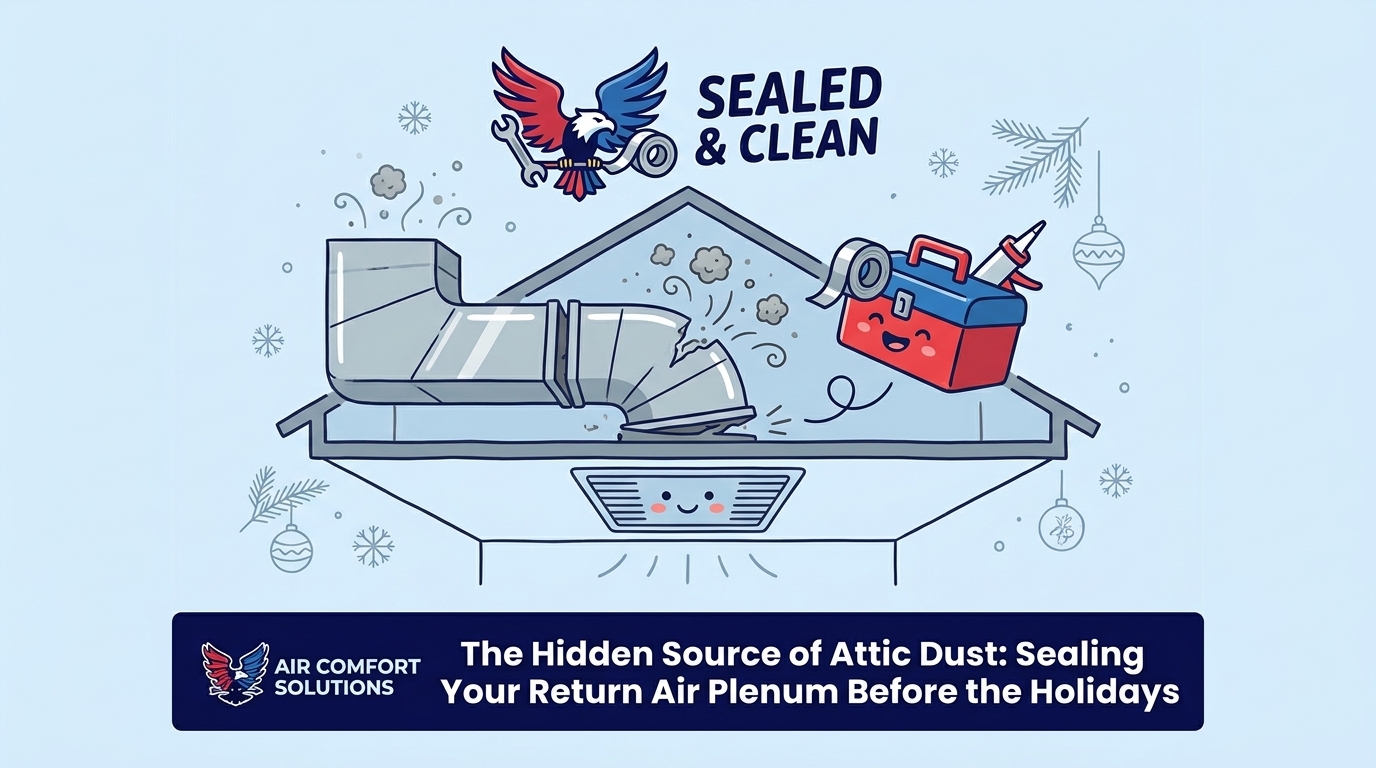
The Value of Sealing Your Return Air Plenum Before the Holidays
Most homeowners buy expensive filters to fix dusty air, not realizing a leaky return plenum in the attic is the real culprit. See why sealing it now saves your holiday gatherings.
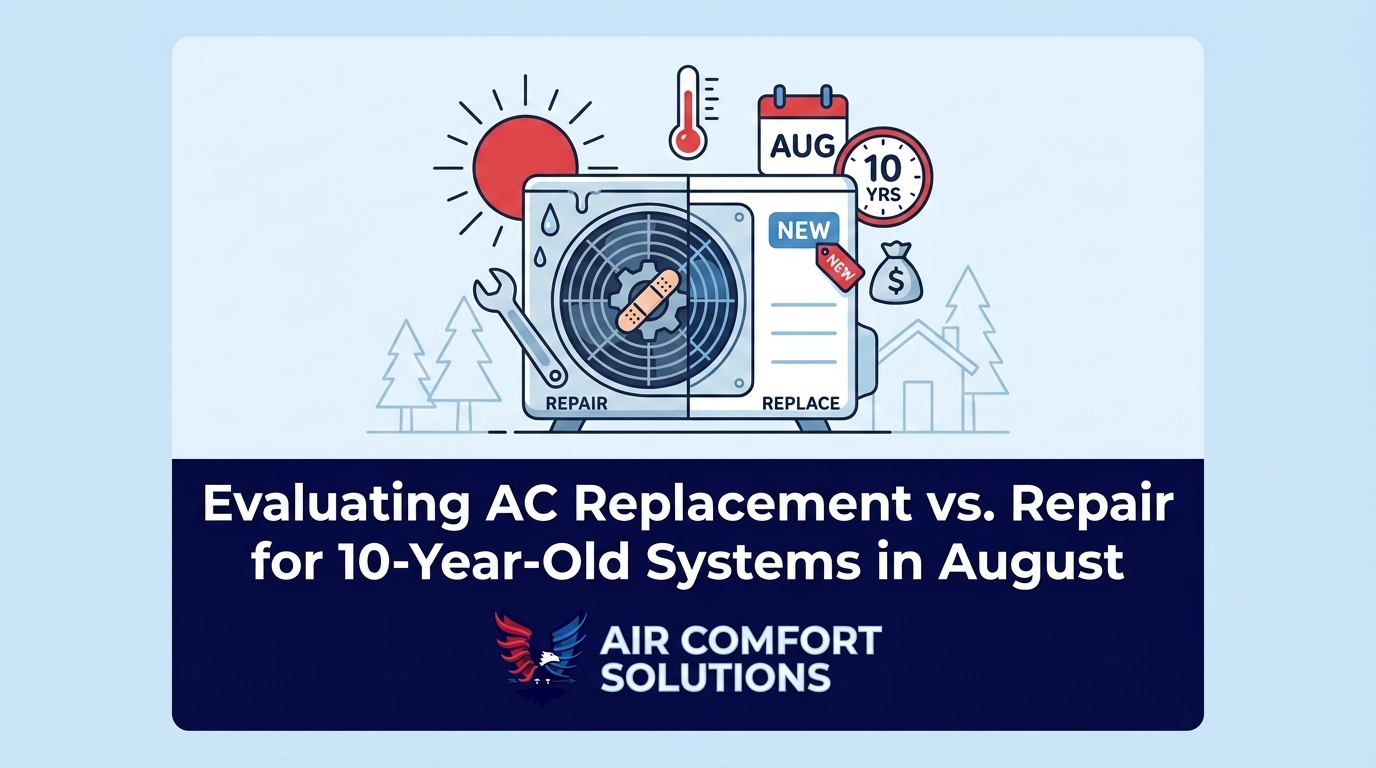
Is your air conditioning system actually broken—or is it just finally giving up after another grueling Texas summer? If you are evaluating replacement vs repair for systems over ten years old in August, you are dealing with one of the most stressful late-summer homeowner dilemmas we see here in Pinehurst. When a major breakdown happens right as the back-to-school transition begins, it creates immediate disruption in your home. You are suddenly forced to choose between investing in one last temporary fix or upgrading the system entirely.
Making this choice requires an objective, math-based look at your equipment's current health. A decade of August late-summer wear and tear takes a massive toll on mechanical components. However, rushing into a decision based purely on the discomfort of a hot house often leads to buyer's remorse. You need a logical framework to guide you through the decision without feeling pressured into a premature purchase or a wasteful repair.
When you rely on our comprehensive HVAC services at Air Comfort Solutions to assess the damage, you can make an informed choice. An expert evaluation from our team will look at the system's age, the frequency of recent breakdowns, and the overall efficiency loss. Let's break down the critical factors that determine whether that aging air conditioning unit can survive another season, or if it is finally time to cut your losses and upgrade.
In our years of servicing HVAC units across the Pinehurst area, our technicians typically see air conditioners fail right before the fall season because of the cumulative mechanical strain placed on the equipment. Extreme August heat and high humidity in Southeast Texas force aging AC units to work twice as hard. The system is not just lowering the temperature; it is actively fighting to dehumidify the heavy, moisture-laden air, which drastically accelerates wear and tear.
Throughout June and July, your air conditioner runs almost constantly to maintain a comfortable indoor environment. By the time late summer arrives, those continuous run cycles leave aging components severely weakened. August late-summer wear and tear is not an isolated event; it is the breaking point after months of relentless operation.
• Blower motor strain: Pushing heavy, humid air through your ductwork requires maximum effort from the blower motor. Over time, bearings wear down and electrical components overheat.
• Compressor stress: The compressor is the heart of your cooling system. When it operates without a break for weeks on end, the internal valves and electrical windings degrade.
• Capacitor and contactor failure: These electrical components handle massive surges of power every time the system cycles on. The intense outdoor heat combined with continuous use often causes them to swell, leak, or fail completely.
An early-season breakdown in May is often a simple fix—perhaps a clogged drain line or a weak capacitor. However, the breakdowns our team responds to in August are frequently much more severe due to this cumulative stress. The parts have been operating at their absolute limits for months. When a vital component finally gives out under these conditions, it often causes a ripple effect, damaging surrounding parts and turning a minor issue into a catastrophic system failure.
When faced with a broken air conditioner in late summer, the immediate instinct is often to just get it running again as quickly as possible. However, this mindset frequently leads homeowners straight into the sunk cost trap.
A pattern we see often at Air Comfort Solutions is the sunk cost trap. This occurs when you pay for a major repair in August, hoping to limp through the rest of the cooling season, only to experience another fatal breakdown the following spring. For systems 10+ years old (installed around 2016 or earlier), this is a highly common and frustrating scenario. You invest heavily in replacing a single part, but the rest of the system remains heavily worn and prone to immediate failure.
The root cause of this trap is the diminishing returns of repairing obsolete equipment. If your mechanic told you that replacing the transmission in a twenty-year-old car wouldn't stop the engine from failing next week, you probably wouldn't authorize the repair. We tell our customers that the same logic applies to HVAC systems. Putting a brand-new compressor into a system with a deteriorating evaporator coil and a failing blower motor does not reset the lifespan of the entire unit. It simply puts a temporary bandage on a terminal problem.
Avoiding this trap requires a shift in perspective. Instead of asking "Can this be fixed?" you should ask "Is this worth fixing?" If the cost of the repair approaches a significant portion of the cost of a new system, and the unit has already exceeded its expected lifespan, walking away is usually the smartest financial move. For a deeper dive into this specific dilemma, deciding on a late-season AC repair requires evaluating your long-term plans for the home and your tolerance for sudden breakdowns.
One of the most critical factors we discuss with homeowners during the repair versus replacement debate is the status of their manufacturer's warranty. When a system is relatively new, major component failures are an inconvenience, but they do not typically cause financial ruin because the parts are covered.
When our technicians inspect systems 10+ years old (installed around 2016 or earlier), we almost always find they are out of their original manufacturer warranties. Most reputable HVAC manufacturers provide a 10-year registered parts warranty. Once that expiration date passes, the financial safety net vanishes. You transition from paying only for labor to being fully responsible for the cost of major parts.
When a warranty expires, the risk profile of your cooling system changes dramatically. If a compressor seizes or an evaporator coil develops a severe refrigerant leak, the out-of-pocket costs are substantial. Replacing a compressor involves recovering the existing refrigerant, removing the heavy broken unit, brazing in the new component, pulling a deep vacuum on the system, and recharging it. Paying for both the labor and the raw materials on a decade-old system rarely makes mathematical sense.
Contrast this vulnerability with the comprehensive warranty protection that comes with a new installation. Upgrading your system resets the clock. You gain a new 10-year parts warranty, protecting you from unexpected out-of-pocket expenses for a full decade. This peace of mind is a significant factor when weighing the true cost of keeping an obsolete system running.
Beyond the immediate threat of breakdowns and expired warranties, there is a hidden cost to keeping an aging air conditioner: severely degraded energy efficiency. Technology advances rapidly, and what was considered high-efficiency a decade ago is now well below modern baseline standards.
In our daily service calls around Pinehurst, we still encounter many systems installed a decade or more ago that rely on outdated refrigerants, such as R-22. Because R-22 has been phased out of production due to environmental regulations, the remaining supply is incredibly scarce. If your aging system develops a leak, recharging it with this obsolete refrigerant is prohibitively expensive. Modern systems use newer, environmentally friendly refrigerants that operate more efficiently and are readily available.
A system's Seasonal Energy Efficiency Ratio (SEER) measures how much cooling it provides per unit of electricity consumed. Over time, physical wear and tear cause an air conditioner to lose its original efficiency. A unit that was rated at 13 SEER when installed may be operating closer to a 9 or 10 SEER today. This means the system is drawing significantly more power to provide the exact same amount of cooling, driving your monthly utility bills higher every summer.
According to Department of Energy standards, upgrading from a decade-old system to a modern, high-efficiency model can reduce cooling energy consumption by 20% to 40%. These massive efficiency gains translate directly into lower monthly operating costs. When you factor in these continuous energy savings, an air conditioning replacement becomes a strategic upgrade rather than just an emergency expense. For systems 10+ years old (installed around 2016 or earlier), the energy savings alone often justify the transition.
When you are sweating through a late-summer heatwave in Southeast Texas, our Air Comfort Solutions experts recommend looking at the facts objectively. A side-by-side comparison matrix can help you weigh your options clearly, stripping away the stress of the moment to focus on long-term value.
• Reliability — Repairing a 10+ Year Old System: Provides short-term relief, but high risk of secondary component failure. — Replacing with a Modern System: Long-term reliability with entirely new, factory-tested components.
• Warranty Status — Repairing a 10+ Year Old System: Likely expired. Homeowner pays full price for parts and labor. — Replacing with a Modern System: Protected by a new 10-year manufacturer parts warranty.
• Energy Consumption — Repairing a 10+ Year Old System: High. Outdated technology operating at a degraded SEER rating. — Replacing with a Modern System: Low. Modern technology can reduce cooling energy usage by 20% to 40%.
• Maintenance Needs — Repairing a 10+ Year Old System: Requires constant monitoring and frequent emergency calls. — Replacing with a Modern System: Resets the maintenance baseline entirely.
• Refrigerant Type — Repairing a 10+ Year Old System: May use phased-out, highly expensive R-22 refrigerant. — Replacing with a Modern System: Uses modern, compliant, and readily available refrigerants.
If you ultimately choose to repair the system and push your luck through the end of the season, you must mitigate your risk. We emphasize the absolute necessity of enrolling in a strict AC maintenance plan. Routine professional oversight is the only way to catch the next impending failure before it leaves you stranded in the heat again. Because August late-summer wear and tear is so severe, skipping maintenance on a patched-up older system guarantees another breakdown.
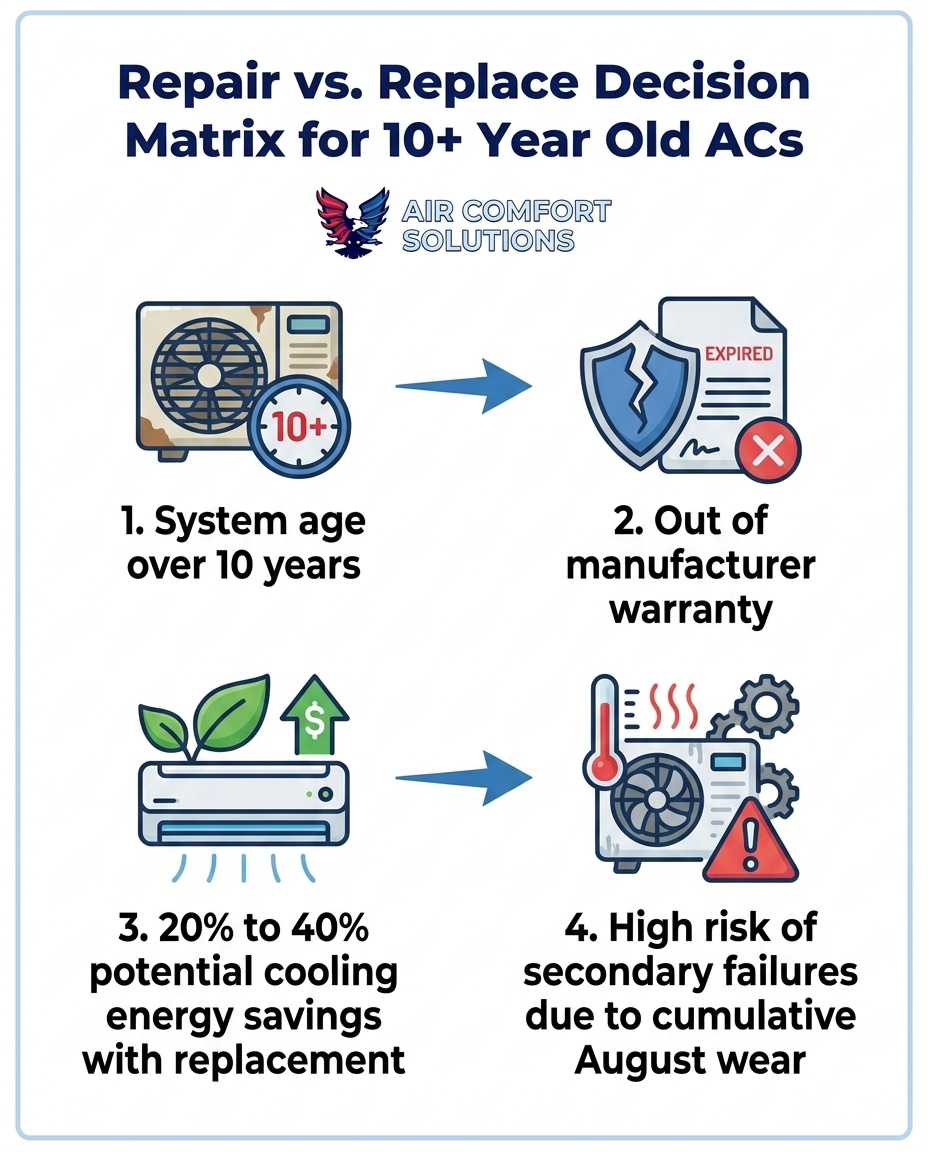
As the summer winds down and the back-to-school transition begins, your home should be a place of comfort and routine, not a source of mechanical anxiety. Synthesizing the decision framework comes down to three objective criteria: the exact age of your system, the frequency of your recent breakdowns, and the severity of your efficiency loss.
If your system is constantly breaking down, uses outdated refrigerant, and is no longer covered by a warranty, the math points clearly toward replacement. You do not have to navigate this transition with cash out of pocket. There are flexible HVAC financing options available that make upgrading more manageable, allowing you to enjoy immediate reliability without draining your savings.
At Air Comfort Solutions, our commitment is to provide honest, local guidance focused on long-term financial sense for the homeowner. We believe in presenting the math and the facts, rather than pushing unnecessary temporary fixes or using high-pressure sales tactics. For systems 10+ years old (installed around 2016 or earlier), a logical, math-based decision is always the best approach to late-summer HVAC crises.
In our experience, a major component failure on a decade-old system generally signals it is time for replacement due to efficiency loss and lack of warranty. Systems 10+ years old (installed around 2016 or earlier) have usually reached the end of their reliable lifespan. Investing heavily in repairs at this stage often yields diminishing returns, as secondary parts are equally worn and likely to fail soon.
Replacing is often wiser to avoid paying for a repair now and a replacement in the spring, avoiding the sunk cost trap. The cumulative stress of running continuously through June and July leaves older components highly vulnerable in August. A full replacement provides immediate reliability and prevents you from throwing money at a system that cannot survive another full season.
We always recommend proactive replacement because it prevents emergency downtime during peak heat and allows time to review financing and system options. Waiting for a catastrophic failure often forces a rushed decision when your house is uncomfortably hot. By replacing an aging system on your own terms, you can carefully select the best high-efficiency model for your home's specific needs.
Our team typically sees average lifespans range from 10 to 15 years before major efficiency drops occur due to extreme heat and heavy usage. The intense climate forces cooling systems to operate for more months out of the year than in cooler regions. Once a unit hits the decade mark in this environment, mechanical fatigue becomes a daily reality.
High humidity forces the system to run longer cycles to dehumidify the air, adding severe mechanical strain to an already worn compressor. The system cannot properly cool the home until the latent heat (moisture) is removed from the indoor air. This relentless workload is exactly why so many older compressors lock up or fail entirely right at the end of the summer.
Yes, modern systems provide immediate reductions in cooling energy usage, and general tax credits or utility incentives may be available for high-efficiency models. Upgrading before the season ends allows you to capture those energy savings immediately while taking advantage of potential rebates. Always verify current incentive programs with your utility provider or a tax professional to maximize your long-term value.
You do not have to navigate a major late-summer breakdown alone. If you are tired of patching up an aging system and worrying about the next failure, it is time to get an objective evaluation of your equipment. August late-summer wear and tear does not have to dictate your comfort or your budget. Reach out to the Air Comfort Solutions team to schedule a professional consultation today, and let us help you explore replacement options that restore reliable, efficient cooling to your home for the next decade.


Zane came out and did an amazing job! Super friendly, honest and transparent about the work that needed to be done. This is my second time working with Air Comfort Solutions and they’re my go to for HVAC services. Highly recommend.
God's AMAZING grace sent us Robert and Zane. We have been without air in this Texas heat for six weeks and four days. We've had a few contractors give us quotes all trying to upsell when we're at a low point. But not the guys at Air Comfort Solutions. They came in assessed our situation, gave us honest feedback, and showed us the issues as they proceeded with the assessment for clear understanding. We highly recommend them for their professionalism, quality products, and fair pricing. We hands down support them for all the work they do 💯 %.
Robert and Zane gone above and beyond to make the process easy and affordable.
Would definitely recommend!!
I’m writing this review to let everyone know that Air Comfort Solutions is the company to work with. I know the owner ( Robert) for several years now. He has been taking care of my residential and business work orders. Robert is professional, knowledgeable and will save you money. I just want to thank Robert for great job you have been doing for me.