Are Two-Stage and Variable-Speed AC Systems a Good Upgrade for Homeowners in Pinehurst, TX?
If you’re replacing your air conditioner and wondering whether a two-stage or variable-speed system makes sense for your home in Pinehurst, TX, you’re not alone. Homeowners across Southeast Texas often ask this when dealing with high humidity, uneven cooling, or an older system that runs constantly.
Here’s the short answer:
• Single-stage — Best For: Basic cooling needs — Key Benefit: Simple operation
• Two-stage — Best For: Homeowners wanting better comfort — Key Benefit: Better humidity control and more even temperatures
• Variable-speed — Best For: Homes needing top-level comfort and efficiency — Key Benefit: Precise temperature control and excellent moisture removal
Bottom line: For many Pinehurst homeowners, two-stage and variable-speed systems can be a smart upgrade because they improve comfort, control humidity better, and help your system run more smoothly in the Texas heat.
The biggest difference is how they operate. A standard single-stage AC turns on at full power, cools the space, then shuts off. Two-stage and variable-speed systems can run longer at lower speeds, which helps maintain more consistent indoor temperatures and remove more moisture from the air.
For homeowners dealing with hot rooms, sticky indoor air, or a system that seems to start and stop all day, a multi-stage AC system may be worth a closer look.
Understanding the Technology: How Different Stages Operate
To understand why some systems carry a higher price tag, we have to look under the hood. In May 2026, air conditioning technology has advanced to the point where “on or off” is no longer the only way to stay cool.
Single-Stage Basics
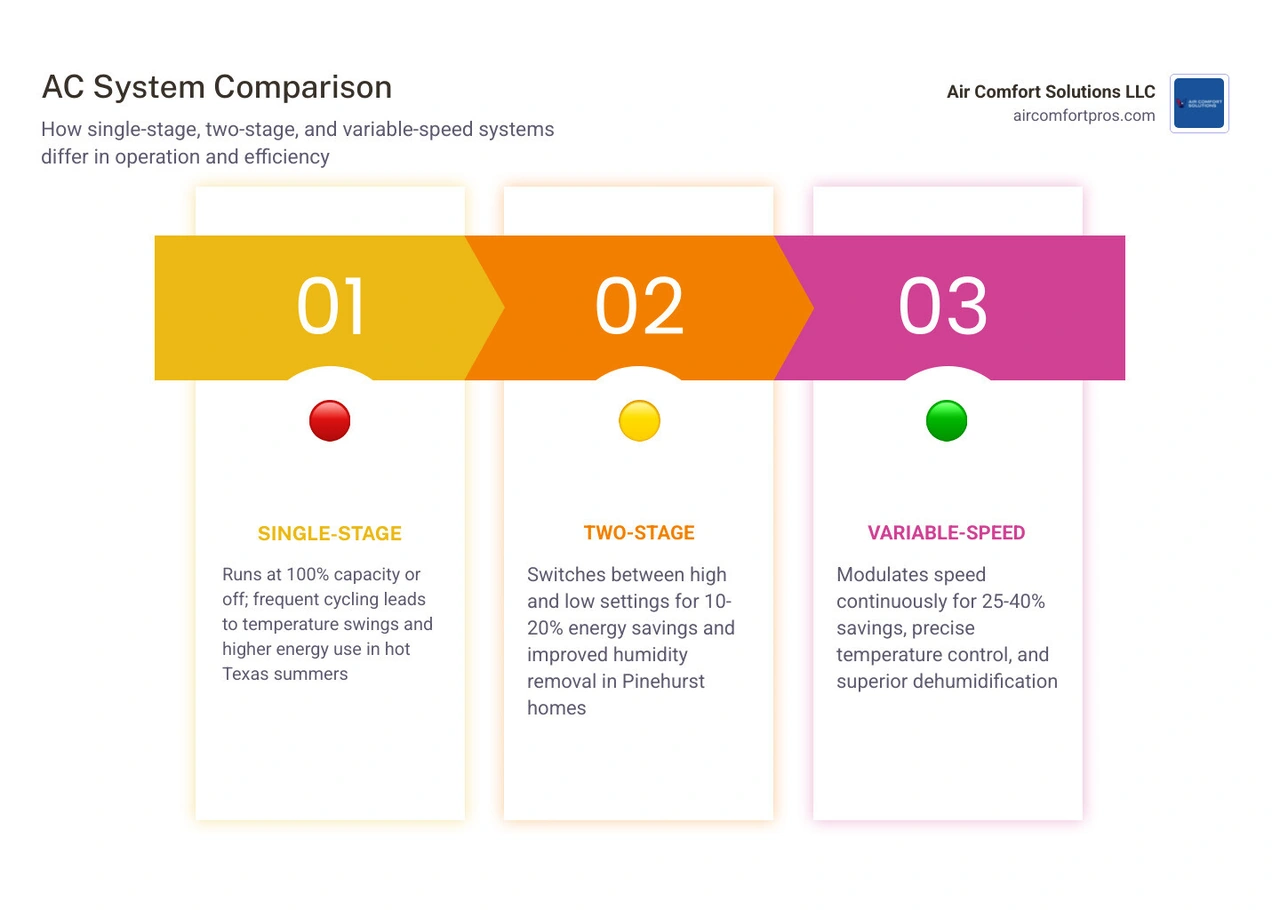
Think of a single-stage air conditioner like a light switch—it is either 100% on or 100% off. When your thermostat detects the temperature has risen, the compressor kicks on at full capacity. Once the target temperature is reached, it shuts down. This constant “on/off” cycling is known as short-cycling. While effective at cooling quickly, it is the least efficient way to operate and often leads to temperature swings of 3 to 5 degrees.
Two-Stage Functionality
A two-stage system is more like a high/low switch. It has two levels of operation: high (100% capacity) for those blistering July afternoons in Tomball or Spring, and low (typically around 65-70% capacity) for milder days. Most of the time, the system stays in the lower stage. This allows for longer, gentler cooling cycles that use less electricity and do a much better job of circulating air.
Variable-Speed Modulation
Variable-speed systems, often called inverter-driven systems, are the “dimmer switches” of the HVAC world. Instead of just one or two settings, these compressors can adjust their output in tiny increments—sometimes as low as 25% up to 100%. They “learn” the needs of your home and modulate their speed to match the cooling load exactly. Because they rarely need to run at full blast, they are incredibly quiet and efficient.
When comparing these technologies, you’ll often see a SEER2 rating. This number tells you how much cooling you get for every watt of electricity used. For a deeper dive into these numbers, check out our guide on What is a SEER2 Rating on an AC Unit.
Are two stage and variable speed systems worth the extra cost for Pinehurst homeowners?
Living on the north side of Harris County means AC systems work hard for much of the year. When homeowners ask whether two-stage and variable-speed systems are worth considering, the conversation usually comes down to three things: efficiency, system performance, and indoor comfort.
Determining if two stage and variable speed systems worth the extra cost for your long-term comfort
While these systems are more advanced than standard single-stage equipment, they can offer meaningful day-to-day benefits.
• Two-stage systems typically run at a lower setting most of the time, which can improve comfort and reduce frequent full-power cycling.
• Variable-speed systems adjust output more precisely, helping the system match your home’s cooling needs throughout the day.
In homes across Pinehurst, Magnolia, and nearby areas, that often means steadier indoor temperatures and less strain from constant stop-and-start operation. For more on how these tiers stack up, see our Standard Efficiency vs High Efficiency AC Comparison.
Beyond comfort, startup sequences create the most stress on an AC compressor. Because single-stage units start and stop more often, they can experience more wear over time. Variable-speed units are designed to run more consistently at lower levels, which can support smoother operation. Learn more about the Average Lifespan of an HVAC System in Texas.
Why two stage and variable speed systems worth the extra cost in high-humidity climates
In Pinehurst and Magnolia, humidity is a major part of the cooling challenge. A single-stage AC can cool the house quickly, but if it shuts off too soon, it may not remove enough moisture from the air. That can leave the home feeling cool but still damp or clammy.
Two-stage and variable-speed systems are especially helpful in humid conditions. Because they run longer at lower speeds, they pull more moisture from the air and help create a more comfortable indoor environment. That added moisture control can make a noticeable difference during long Southeast Texas summers. If you are considering a heat pump for these benefits, you might want to read about Heat Pump Benefits for Southeast Texas Homeowners.

When we talk about performance, we aren’t just talking about the temperature on the wall. We are talking about how the air feels in every corner of your home.
• Temperature Consistency: Single-stage units create “hot spots” and “cold spots” because they blast air and then stop. Variable-speed systems can maintain your home’s temperature within 0.5 degrees of your set point.
• Quiet Operation: Have you ever had to pause a conversation or turn up the TV because the AC kicked on? Single-stage units usually operate at 72-78 decibels. Variable-speed units on low speed can drop to a whisper-quiet 45-55 decibels.
• Better Filtration: Because these systems run longer, your air is being pulled through your filtration system more frequently. This leads to cleaner indoor air and fewer allergens.
For those looking at modern alternatives, there are many Heat Pump Advantages Over Traditional HVAC that incorporate this variable-speed technology for year-round comfort.
Critical Factors to Consider Before Upgrading
Before you decide that a variable-speed system is the right choice, there are a few technical hurdles we need to clear. These systems are highly sophisticated, and they require a home that is ready for them.
Ductwork and Insulation
A variable-speed system moves air differently than a standard unit. One specific risk in our humid climate is condensation on uninsulated ductwork. Because variable-speed systems run for long periods at lower speeds, the air inside the ducts stays colder for longer. If your ducts are bare metal or poorly insulated in a hot attic, they can “sweat,” leading to moisture damage or mold. We always perform a thorough inspection of your ductwork before recommending an upgrade.
Proper Sizing (Manual J)
We cannot emphasize this enough: sizing is more important than the number of stages. An oversized variable-speed system will still perform poorly. We use Manual J load calculations to ensure the system is perfectly matched to your home’s square footage, window orientation, and insulation levels.
If your current system is struggling, we can help you walk through How to Decide Between AC Repair and Replacement. If you decide replacement is the way to go, there are Optimal Times for Upgrading Your Home’s Air Conditioning System to ensure you get the best scheduling and value.
Frequently Asked Questions
How do these systems impact long-term maintenance?
While two-stage and variable-speed systems have more complex electronics, they often suffer fewer mechanical failures because they avoid the violent “hard starts” of single-stage units. However, because the parts are more specialized, regular maintenance is non-negotiable. To keep your warranty valid and your efficiency high, we highly recommend a professional plan. You can learn more here: Is an HVAC Maintenance Plan Worth It.
Can variable-speed systems work with my existing thermostat?
In most cases, no. True variable-speed systems use “communicating” technology. This means the thermostat, the indoor fan, and the outdoor compressor are constantly talking to each other to adjust speeds. A standard thermostat (like an older Nest or a basic Honeywell) usually only has the wiring for “on” and “off.” You will typically need the manufacturer’s specific smart thermostat to unlock all the benefits of the system.
Will a multi-stage system solve uneven cooling in my two-story home?
It will certainly help! By running longer at a lower speed, the system provides a more constant “mix” of air throughout the house, which helps eliminate the pocket of hot air that often gets trapped on the second floor. For the ultimate solution, we can often pair these systems with zoning dampers that allow you to control the upstairs and downstairs temperatures independently.
Conclusion
At Air Comfort Solutions, we’ve spent over 35 years helping homeowners in Pinehurst, Magnolia, and The Woodlands stay comfortable through every Texas season. Whether a two-stage or variable-speed system is the right fit depends on your home’s layout, humidity levels, and comfort goals, but these systems can offer clear advantages for many households in our area.
If you’re dealing with uneven temperatures, indoor humidity, or an older AC that no longer keeps up, our team can help you choose the right replacement option for your home. We provide professional evaluations and homeowner-focused recommendations based on real comfort needs in the Texas climate.
Explore our high-efficiency cooling solutions and let us help you find the right AC upgrade for your home.
Are Two-Stage and Variable-Speed AC Systems a Good Upgrade for Homeowners in Pinehurst, TX?
If you're replacing your air conditioner and wondering whether a two-stage or variable-speed system makes sense for your home in Pinehurst, TX, you're not alone. Homeowners across Southeast Texas often ask this when dealing with high humidity, uneven cooling, or an older system that runs constantly.
Here’s the short answer:
| System Type | Best For | Key Benefit |
|---|
| Single-stage | Basic cooling needs | Simple operation |
| Two-stage | Homeowners wanting better comfort | Better humidity control and more even temperatures |
| Variable-speed | Homes needing top-level comfort and efficiency | Precise temperature control and excellent moisture removal |
Bottom line: For many Pinehurst homeowners, two-stage and variable-speed systems can be a smart upgrade because they improve comfort, control humidity better, and help your system run more smoothly in the Texas heat.
The biggest difference is how they operate. A standard single-stage AC turns on at full power, cools the space, then shuts off. Two-stage and variable-speed systems can run longer at lower speeds, which helps maintain more consistent indoor temperatures and remove more moisture from the air.
For homeowners dealing with hot rooms, sticky indoor air, or a system that seems to start and stop all day, a multi-stage AC system may be worth a closer look.
Understanding the Technology: How Different Stages Operate
To understand why some systems carry a higher price tag, we have to look under the hood. In May 2026, air conditioning technology has advanced to the point where "on or off" is no longer the only way to stay cool.
Single-Stage Basics
Think of a single-stage air conditioner like a light switch—it is either 100% on or 100% off. When your thermostat detects the temperature has risen, the compressor kicks on at full capacity. Once the target temperature is reached, it shuts down. This constant "on/off" cycling is known as short-cycling. While effective at cooling quickly, it is the least efficient way to operate and often leads to temperature swings of 3 to 5 degrees.
Two-Stage Functionality
A two-stage system is more like a high/low switch. It has two levels of operation: high (100% capacity) for those blistering July afternoons in Tomball or Spring, and low (typically around 65-70% capacity) for milder days. Most of the time, the system stays in the lower stage. This allows for longer, gentler cooling cycles that use less electricity and do a much better job of circulating air.
Variable-Speed Modulation
Variable-speed systems, often called inverter-driven systems, are the "dimmer switches" of the HVAC world. Instead of just one or two settings, these compressors can adjust their output in tiny increments—sometimes as low as 25% up to 100%. They "learn" the needs of your home and modulate their speed to match the cooling load exactly. Because they rarely need to run at full blast, they are incredibly quiet and efficient.
When comparing these technologies, you’ll often see a SEER2 rating. This number tells you how much cooling you get for every watt of electricity used. For a deeper dive into these numbers, check out our guide on What is a SEER2 Rating on an AC Unit.
Are two stage and variable speed systems worth the extra cost for Pinehurst homeowners?
Living on the north side of Harris County means AC systems work hard for much of the year. When homeowners ask whether two-stage and variable-speed systems are worth considering, the conversation usually comes down to three things: efficiency, system performance, and indoor comfort.
Determining if two stage and variable speed systems worth the extra cost for your long-term comfort
While these systems are more advanced than standard single-stage equipment, they can offer meaningful day-to-day benefits.
- Two-stage systems typically run at a lower setting most of the time, which can improve comfort and reduce frequent full-power cycling.
- Variable-speed systems adjust output more precisely, helping the system match your home's cooling needs throughout the day.
In homes across Pinehurst, Magnolia, and nearby areas, that often means steadier indoor temperatures and less strain from constant stop-and-start operation. For more on how these tiers stack up, see our Standard Efficiency vs High Efficiency AC Comparison.
Beyond comfort, startup sequences create the most stress on an AC compressor. Because single-stage units start and stop more often, they can experience more wear over time. Variable-speed units are designed to run more consistently at lower levels, which can support smoother operation. Learn more about the Average Lifespan of an HVAC System in Texas.
Why two stage and variable speed systems worth the extra cost in high-humidity climates
In Pinehurst and Magnolia, humidity is a major part of the cooling challenge. A single-stage AC can cool the house quickly, but if it shuts off too soon, it may not remove enough moisture from the air. That can leave the home feeling cool but still damp or clammy.
Two-stage and variable-speed systems are especially helpful in humid conditions. Because they run longer at lower speeds, they pull more moisture from the air and help create a more comfortable indoor environment. That added moisture control can make a noticeable difference during long Southeast Texas summers. If you are considering a heat pump for these benefits, you might want to read about Heat Pump Benefits for Southeast Texas Homeowners.
When we talk about performance, we aren't just talking about the temperature on the wall. We are talking about how the air feels in every corner of your home.
- Temperature Consistency: Single-stage units create "hot spots" and "cold spots" because they blast air and then stop. Variable-speed systems can maintain your home's temperature within 0.5 degrees of your set point.
- Quiet Operation: Have you ever had to pause a conversation or turn up the TV because the AC kicked on? Single-stage units usually operate at 72-78 decibels. Variable-speed units on low speed can drop to a whisper-quiet 45-55 decibels.
- Better Filtration: Because these systems run longer, your air is being pulled through your filtration system more frequently. This leads to cleaner indoor air and fewer allergens.
For those looking at modern alternatives, there are many Heat Pump Advantages Over Traditional HVAC that incorporate this variable-speed technology for year-round comfort.
Critical Factors to Consider Before Upgrading
Before you decide that a variable-speed system is the right choice, there are a few technical hurdles we need to clear. These systems are highly sophisticated, and they require a home that is ready for them.
Ductwork and Insulation
A variable-speed system moves air differently than a standard unit. One specific risk in our humid climate is condensation on uninsulated ductwork. Because variable-speed systems run for long periods at lower speeds, the air inside the ducts stays colder for longer. If your ducts are bare metal or poorly insulated in a hot attic, they can "sweat," leading to moisture damage or mold. We always perform a thorough inspection of your ductwork before recommending an upgrade.
Proper Sizing (Manual J)
We cannot emphasize this enough: sizing is more important than the number of stages. An oversized variable-speed system will still perform poorly. We use Manual J load calculations to ensure the system is perfectly matched to your home's square footage, window orientation, and insulation levels.
If your current system is struggling, we can help you walk through How to Decide Between AC Repair and Replacement. If you decide replacement is the way to go, there are Optimal Times for Upgrading Your Home's Air Conditioning System to ensure you get the best scheduling and value.
Frequently Asked Questions
How do these systems impact long-term maintenance?
While two-stage and variable-speed systems have more complex electronics, they often suffer fewer mechanical failures because they avoid the violent "hard starts" of single-stage units. However, because the parts are more specialized, regular maintenance is non-negotiable. To keep your warranty valid and your efficiency high, we highly recommend a professional plan. You can learn more here: Is an HVAC Maintenance Plan Worth It.
Can variable-speed systems work with my existing thermostat?
In most cases, no. True variable-speed systems use "communicating" technology. This means the thermostat, the indoor fan, and the outdoor compressor are constantly talking to each other to adjust speeds. A standard thermostat (like an older Nest or a basic Honeywell) usually only has the wiring for "on" and "off." You will typically need the manufacturer’s specific smart thermostat to unlock all the benefits of the system.
Will a multi-stage system solve uneven cooling in my two-story home?
It will certainly help! By running longer at a lower speed, the system provides a more constant "mix" of air throughout the house, which helps eliminate the pocket of hot air that often gets trapped on the second floor. For the ultimate solution, we can often pair these systems with zoning dampers that allow you to control the upstairs and downstairs temperatures independently.
Conclusion
At Air Comfort Pros, we’ve spent over 35 years helping homeowners in Pinehurst, Magnolia, and The Woodlands stay comfortable through every Texas season. Whether a two-stage or variable-speed system is the right fit depends on your home's layout, humidity levels, and comfort goals, but these systems can offer clear advantages for many households in our area.
If you're dealing with uneven temperatures, indoor humidity, or an older AC that no longer keeps up, our team can help you choose the right replacement option for your home. We provide professional evaluations and homeowner-focused recommendations based on real comfort needs in the Texas climate.
Explore our high-efficiency cooling solutions and let us help you find the right AC upgrade for your home.
Are Two-Stage and Variable-Speed AC Systems a Good Upgrade for Homeowners in Pinehurst, TX?
If you're replacing your air conditioner and wondering whether a two-stage or variable-speed system makes sense for your home in Pinehurst, TX, you're not alone. Homeowners across Southeast Texas often ask this when dealing with high humidity, uneven cooling, or an older system that runs constantly.
Here’s the short answer:
| System Type | Best For | Key Benefit |
|---|
| Single-stage | Basic cooling needs | Simple operation |
| Two-stage | Homeowners wanting better comfort | Better humidity control and more even temperatures |
| Variable-speed | Homes needing top-level comfort and efficiency | Precise temperature control and excellent moisture removal |
Bottom line: For many Pinehurst homeowners, two-stage and variable-speed systems can be a smart upgrade because they improve comfort, control humidity better, and help your system run more smoothly in the Texas heat.
The biggest difference is how they operate. A standard single-stage AC turns on at full power, cools the space, then shuts off. Two-stage and variable-speed systems can run longer at lower speeds, which helps maintain more consistent indoor temperatures and remove more moisture from the air.
For homeowners dealing with hot rooms, sticky indoor air, or a system that seems to start and stop all day, a multi-stage AC system may be worth a closer look.
Understanding the Technology: How Different Stages Operate
To understand why some systems carry a higher price tag, we have to look under the hood. In May 2026, air conditioning technology has advanced to the point where "on or off" is no longer the only way to stay cool.
Single-Stage Basics
Think of a single-stage air conditioner like a light switch—it is either 100% on or 100% off. When your thermostat detects the temperature has risen, the compressor kicks on at full capacity. Once the target temperature is reached, it shuts down. This constant "on/off" cycling is known as short-cycling. While effective at cooling quickly, it is the least efficient way to operate and often leads to temperature swings of 3 to 5 degrees.
Two-Stage Functionality
A two-stage system is more like a high/low switch. It has two levels of operation: high (100% capacity) for those blistering July afternoons in Tomball or Spring, and low (typically around 65-70% capacity) for milder days. Most of the time, the system stays in the lower stage. This allows for longer, gentler cooling cycles that use less electricity and do a much better job of circulating air.
Variable-Speed Modulation
Variable-speed systems, often called inverter-driven systems, are the "dimmer switches" of the HVAC world. Instead of just one or two settings, these compressors can adjust their output in tiny increments—sometimes as low as 25% up to 100%. They "learn" the needs of your home and modulate their speed to match the cooling load exactly. Because they rarely need to run at full blast, they are incredibly quiet and efficient.
When comparing these technologies, you’ll often see a SEER2 rating. This number tells you how much cooling you get for every watt of electricity used. For a deeper dive into these numbers, check out our guide on What is a SEER2 Rating on an AC Unit.
Are two stage and variable speed systems worth the extra cost for Pinehurst homeowners?
Living on the north side of Harris County means AC systems work hard for much of the year. When homeowners ask whether two-stage and variable-speed systems are worth considering, the conversation usually comes down to three things: efficiency, system performance, and indoor comfort.
Determining if two stage and variable speed systems worth the extra cost for your long-term comfort
While these systems are more advanced than standard single-stage equipment, they can offer meaningful day-to-day benefits.
- Two-stage systems typically run at a lower setting most of the time, which can improve comfort and reduce frequent full-power cycling.
- Variable-speed systems adjust output more precisely, helping the system match your home's cooling needs throughout the day.
In homes across Pinehurst, Magnolia, and nearby areas, that often means steadier indoor temperatures and less strain from constant stop-and-start operation. For more on how these tiers stack up, see our Standard Efficiency vs High Efficiency AC Comparison.
Beyond comfort, startup sequences create the most stress on an AC compressor. Because single-stage units start and stop more often, they can experience more wear over time. Variable-speed units are designed to run more consistently at lower levels, which can support smoother operation. Learn more about the Average Lifespan of an HVAC System in Texas.
Why two stage and variable speed systems worth the extra cost in high-humidity climates
In Pinehurst and Magnolia, humidity is a major part of the cooling challenge. A single-stage AC can cool the house quickly, but if it shuts off too soon, it may not remove enough moisture from the air. That can leave the home feeling cool but still damp or clammy.
Two-stage and variable-speed systems are especially helpful in humid conditions. Because they run longer at lower speeds, they pull more moisture from the air and help create a more comfortable indoor environment. That added moisture control can make a noticeable difference during long Southeast Texas summers. If you are considering a heat pump for these benefits, you might want to read about Heat Pump Benefits for Southeast Texas Homeowners.
When we talk about performance, we aren't just talking about the temperature on the wall. We are talking about how the air feels in every corner of your home.
- Temperature Consistency: Single-stage units create "hot spots" and "cold spots" because they blast air and then stop. Variable-speed systems can maintain your home's temperature within 0.5 degrees of your set point.
- Quiet Operation: Have you ever had to pause a conversation or turn up the TV because the AC kicked on? Single-stage units usually operate at 72-78 decibels. Variable-speed units on low speed can drop to a whisper-quiet 45-55 decibels.
- Better Filtration: Because these systems run longer, your air is being pulled through your filtration system more frequently. This leads to cleaner indoor air and fewer allergens.
For those looking at modern alternatives, there are many Heat Pump Advantages Over Traditional HVAC that incorporate this variable-speed technology for year-round comfort.
Critical Factors to Consider Before Upgrading
Before you decide that a variable-speed system is the right choice, there are a few technical hurdles we need to clear. These systems are highly sophisticated, and they require a home that is ready for them.
Ductwork and Insulation
A variable-speed system moves air differently than a standard unit. One specific risk in our humid climate is condensation on uninsulated ductwork. Because variable-speed systems run for long periods at lower speeds, the air inside the ducts stays colder for longer. If your ducts are bare metal or poorly insulated in a hot attic, they can "sweat," leading to moisture damage or mold. We always perform a thorough inspection of your ductwork before recommending an upgrade.
Proper Sizing (Manual J)
We cannot emphasize this enough: sizing is more important than the number of stages. An oversized variable-speed system will still perform poorly. We use Manual J load calculations to ensure the system is perfectly matched to your home's square footage, window orientation, and insulation levels.
If your current system is struggling, we can help you walk through How to Decide Between AC Repair and Replacement. If you decide replacement is the way to go, there are Optimal Times for Upgrading Your Home's Air Conditioning System to ensure you get the best scheduling and value.
Frequently Asked Questions
How do these systems impact long-term maintenance?
While two-stage and variable-speed systems have more complex electronics, they often suffer fewer mechanical failures because they avoid the violent "hard starts" of single-stage units. However, because the parts are more specialized, regular maintenance is non-negotiable. To keep your warranty valid and your efficiency high, we highly recommend a professional plan. You can learn more here: Is an HVAC Maintenance Plan Worth It.
Can variable-speed systems work with my existing thermostat?
In most cases, no. True variable-speed systems use "communicating" technology. This means the thermostat, the indoor fan, and the outdoor compressor are constantly talking to each other to adjust speeds. A standard thermostat (like an older Nest or a basic Honeywell) usually only has the wiring for "on" and "off." You will typically need the manufacturer’s specific smart thermostat to unlock all the benefits of the system.
Will a multi-stage system solve uneven cooling in my two-story home?
It will certainly help! By running longer at a lower speed, the system provides a more constant "mix" of air throughout the house, which helps eliminate the pocket of hot air that often gets trapped on the second floor. For the ultimate solution, we can often pair these systems with zoning dampers that allow you to control the upstairs and downstairs temperatures independently.
Conclusion
At Air Comfort Pros, we’ve spent over 35 years helping homeowners in Pinehurst, Magnolia, and The Woodlands stay comfortable through every Texas season. Whether a two-stage or variable-speed system is the right fit depends on your home's layout, humidity levels, and comfort goals, but these systems can offer clear advantages for many households in our area.
If you're dealing with uneven temperatures, indoor humidity, or an older AC that no longer keeps up, our team can help you choose the right replacement option for your home. We provide professional evaluations and homeowner-focused recommendations based on real comfort needs in the Texas climate.
Explore our high-efficiency cooling solutions and let us help you find the right AC upgrade for your home.
Are Two-Stage and Variable-Speed AC Systems a Good Upgrade for Homeowners in Pinehurst, TX?
If you're replacing your air conditioner and wondering whether a two-stage or variable-speed system makes sense for your home in Pinehurst, TX, you're not alone. Homeowners across Southeast Texas often ask this when dealing with high humidity, uneven cooling, or an older system that runs constantly.
Here’s the short answer:
| System Type | Best For | Key Benefit |
|---|
| Single-stage | Basic cooling needs | Simple operation |
| Two-stage | Homeowners wanting better comfort | Better humidity control and more even temperatures |
| Variable-speed | Homes needing top-level comfort and efficiency | Precise temperature control and excellent moisture removal |
Bottom line: For many Pinehurst homeowners, two-stage and variable-speed systems can be a smart upgrade because they improve comfort, control humidity better, and help your system run more smoothly in the Texas heat.
The biggest difference is how they operate. A standard single-stage AC turns on at full power, cools the space, then shuts off. Two-stage and variable-speed systems can run longer at lower speeds, which helps maintain more consistent indoor temperatures and remove more moisture from the air.
For homeowners dealing with hot rooms, sticky indoor air, or a system that seems to start and stop all day, a multi-stage AC system may be worth a closer look.
Understanding the Technology: How Different Stages Operate
To understand why some systems carry a higher price tag, we have to look under the hood. In May 2026, air conditioning technology has advanced to the point where "on or off" is no longer the only way to stay cool.
Single-Stage Basics
Think of a single-stage air conditioner like a light switch—it is either 100% on or 100% off. When your thermostat detects the temperature has risen, the compressor kicks on at full capacity. Once the target temperature is reached, it shuts down. This constant "on/off" cycling is known as short-cycling. While effective at cooling quickly, it is the least efficient way to operate and often leads to temperature swings of 3 to 5 degrees.
Two-Stage Functionality
A two-stage system is more like a high/low switch. It has two levels of operation: high (100% capacity) for those blistering July afternoons in Tomball or Spring, and low (typically around 65-70% capacity) for milder days. Most of the time, the system stays in the lower stage. This allows for longer, gentler cooling cycles that use less electricity and do a much better job of circulating air.
Variable-Speed Modulation
Variable-speed systems, often called inverter-driven systems, are the "dimmer switches" of the HVAC world. Instead of just one or two settings, these compressors can adjust their output in tiny increments—sometimes as low as 25% up to 100%. They "learn" the needs of your home and modulate their speed to match the cooling load exactly. Because they rarely need to run at full blast, they are incredibly quiet and efficient.
When comparing these technologies, you’ll often see a SEER2 rating. This number tells you how much cooling you get for every watt of electricity used. For a deeper dive into these numbers, check out our guide on What is a SEER2 Rating on an AC Unit.
Are two stage and variable speed systems worth the extra cost for Pinehurst homeowners?
Living on the north side of Harris County means AC systems work hard for much of the year. When homeowners ask whether two-stage and variable-speed systems are worth considering, the conversation usually comes down to three things: efficiency, system performance, and indoor comfort.
Determining if two stage and variable speed systems worth the extra cost for your long-term comfort
While these systems are more advanced than standard single-stage equipment, they can offer meaningful day-to-day benefits.
- Two-stage systems typically run at a lower setting most of the time, which can improve comfort and reduce frequent full-power cycling.
- Variable-speed systems adjust output more precisely, helping the system match your home's cooling needs throughout the day.
In homes across Pinehurst, Magnolia, and nearby areas, that often means steadier indoor temperatures and less strain from constant stop-and-start operation. For more on how these tiers stack up, see our Standard Efficiency vs High Efficiency AC Comparison.
Beyond comfort, startup sequences create the most stress on an AC compressor. Because single-stage units start and stop more often, they can experience more wear over time. Variable-speed units are designed to run more consistently at lower levels, which can support smoother operation. Learn more about the Average Lifespan of an HVAC System in Texas.
Why two stage and variable speed systems worth the extra cost in high-humidity climates
In Pinehurst and Magnolia, humidity is a major part of the cooling challenge. A single-stage AC can cool the house quickly, but if it shuts off too soon, it may not remove enough moisture from the air. That can leave the home feeling cool but still damp or clammy.
Two-stage and variable-speed systems are especially helpful in humid conditions. Because they run longer at lower speeds, they pull more moisture from the air and help create a more comfortable indoor environment. That added moisture control can make a noticeable difference during long Southeast Texas summers. If you are considering a heat pump for these benefits, you might want to read about Heat Pump Benefits for Southeast Texas Homeowners.
When we talk about performance, we aren't just talking about the temperature on the wall. We are talking about how the air feels in every corner of your home.
- Temperature Consistency: Single-stage units create "hot spots" and "cold spots" because they blast air and then stop. Variable-speed systems can maintain your home's temperature within 0.5 degrees of your set point.
- Quiet Operation: Have you ever had to pause a conversation or turn up the TV because the AC kicked on? Single-stage units usually operate at 72-78 decibels. Variable-speed units on low speed can drop to a whisper-quiet 45-55 decibels.
- Better Filtration: Because these systems run longer, your air is being pulled through your filtration system more frequently. This leads to cleaner indoor air and fewer allergens.
For those looking at modern alternatives, there are many Heat Pump Advantages Over Traditional HVAC that incorporate this variable-speed technology for year-round comfort.
Critical Factors to Consider Before Upgrading
Before you decide that a variable-speed system is the right choice, there are a few technical hurdles we need to clear. These systems are highly sophisticated, and they require a home that is ready for them.
Ductwork and Insulation
A variable-speed system moves air differently than a standard unit. One specific risk in our humid climate is condensation on uninsulated ductwork. Because variable-speed systems run for long periods at lower speeds, the air inside the ducts stays colder for longer. If your ducts are bare metal or poorly insulated in a hot attic, they can "sweat," leading to moisture damage or mold. We always perform a thorough inspection of your ductwork before recommending an upgrade.
Proper Sizing (Manual J)
We cannot emphasize this enough: sizing is more important than the number of stages. An oversized variable-speed system will still perform poorly. We use Manual J load calculations to ensure the system is perfectly matched to your home's square footage, window orientation, and insulation levels.
If your current system is struggling, we can help you walk through How to Decide Between AC Repair and Replacement. If you decide replacement is the way to go, there are Optimal Times for Upgrading Your Home's Air Conditioning System to ensure you get the best scheduling and value.
Frequently Asked Questions
How do these systems impact long-term maintenance?
While two-stage and variable-speed systems have more complex electronics, they often suffer fewer mechanical failures because they avoid the violent "hard starts" of single-stage units. However, because the parts are more specialized, regular maintenance is non-negotiable. To keep your warranty valid and your efficiency high, we highly recommend a professional plan. You can learn more here: Is an HVAC Maintenance Plan Worth It.
Can variable-speed systems work with my existing thermostat?
In most cases, no. True variable-speed systems use "communicating" technology. This means the thermostat, the indoor fan, and the outdoor compressor are constantly talking to each other to adjust speeds. A standard thermostat (like an older Nest or a basic Honeywell) usually only has the wiring for "on" and "off." You will typically need the manufacturer’s specific smart thermostat to unlock all the benefits of the system.
Will a multi-stage system solve uneven cooling in my two-story home?
It will certainly help! By running longer at a lower speed, the system provides a more constant "mix" of air throughout the house, which helps eliminate the pocket of hot air that often gets trapped on the second floor. For the ultimate solution, we can often pair these systems with zoning dampers that allow you to control the upstairs and downstairs temperatures independently.
Conclusion
At Air Comfort Pros, we’ve spent over 35 years helping homeowners in Pinehurst, Magnolia, and The Woodlands stay comfortable through every Texas season. Whether a two-stage or variable-speed system is the right fit depends on your home's layout, humidity levels, and comfort goals, but these systems can offer clear advantages for many households in our area.
If you're dealing with uneven temperatures, indoor humidity, or an older AC that no longer keeps up, our team can help you choose the right replacement option for your home. We provide professional evaluations and homeowner-focused recommendations based on real comfort needs in the Texas climate.
Explore our high-efficiency cooling solutions and let us help you find the right AC upgrade for your home.
Are Two-Stage and Variable-Speed AC Systems a Good Upgrade for Homeowners in Pinehurst, TX?
If you're replacing your air conditioner and wondering whether a two-stage or variable-speed system makes sense for your home in Pinehurst, TX, you're not alone. Homeowners across Southeast Texas often ask this when dealing with high humidity, uneven cooling, or an older system that runs constantly.
Here’s the short answer:
| System Type | Best For | Key Benefit |
|---|
| Single-stage | Basic cooling needs | Simple operation |
| Two-stage | Homeowners wanting better comfort | Better humidity control and more even temperatures |
| Variable-speed | Homes needing top-level comfort and efficiency | Precise temperature control and excellent moisture removal |
Bottom line: For many Pinehurst homeowners, two-stage and variable-speed systems can be a smart upgrade because they improve comfort, control humidity better, and help your system run more smoothly in the Texas heat.
The biggest difference is how they operate. A standard single-stage AC turns on at full power, cools the space, then shuts off. Two-stage and variable-speed systems can run longer at lower speeds, which helps maintain more consistent indoor temperatures and remove more moisture from the air.
For homeowners dealing with hot rooms, sticky indoor air, or a system that seems to start and stop all day, a multi-stage AC system may be worth a closer look.
Understanding the Technology: How Different Stages Operate
To understand why some systems carry a higher price tag, we have to look under the hood. In May 2026, air conditioning technology has advanced to the point where "on or off" is no longer the only way to stay cool.
Single-Stage Basics
Think of a single-stage air conditioner like a light switch—it is either 100% on or 100% off. When your thermostat detects the temperature has risen, the compressor kicks on at full capacity. Once the target temperature is reached, it shuts down. This constant "on/off" cycling is known as short-cycling. While effective at cooling quickly, it is the least efficient way to operate and often leads to temperature swings of 3 to 5 degrees.
Two-Stage Functionality
A two-stage system is more like a high/low switch. It has two levels of operation: high (100% capacity) for those blistering July afternoons in Tomball or Spring, and low (typically around 65-70% capacity) for milder days. Most of the time, the system stays in the lower stage. This allows for longer, gentler cooling cycles that use less electricity and do a much better job of circulating air.
Variable-Speed Modulation
Variable-speed systems, often called inverter-driven systems, are the "dimmer switches" of the HVAC world. Instead of just one or two settings, these compressors can adjust their output in tiny increments—sometimes as low as 25% up to 100%. They "learn" the needs of your home and modulate their speed to match the cooling load exactly. Because they rarely need to run at full blast, they are incredibly quiet and efficient.
When comparing these technologies, you’ll often see a SEER2 rating. This number tells you how much cooling you get for every watt of electricity used. For a deeper dive into these numbers, check out our guide on What is a SEER2 Rating on an AC Unit.
Are two stage and variable speed systems worth the extra cost for Pinehurst homeowners?
Living on the north side of Harris County means AC systems work hard for much of the year. When homeowners ask whether two-stage and variable-speed systems are worth considering, the conversation usually comes down to three things: efficiency, system performance, and indoor comfort.
Determining if two stage and variable speed systems worth the extra cost for your long-term comfort
While these systems are more advanced than standard single-stage equipment, they can offer meaningful day-to-day benefits.
- Two-stage systems typically run at a lower setting most of the time, which can improve comfort and reduce frequent full-power cycling.
- Variable-speed systems adjust output more precisely, helping the system match your home's cooling needs throughout the day.
In homes across Pinehurst, Magnolia, and nearby areas, that often means steadier indoor temperatures and less strain from constant stop-and-start operation. For more on how these tiers stack up, see our Standard Efficiency vs High Efficiency AC Comparison.
Beyond comfort, startup sequences create the most stress on an AC compressor. Because single-stage units start and stop more often, they can experience more wear over time. Variable-speed units are designed to run more consistently at lower levels, which can support smoother operation. Learn more about the Average Lifespan of an HVAC System in Texas.
Why two stage and variable speed systems worth the extra cost in high-humidity climates
In Pinehurst and Magnolia, humidity is a major part of the cooling challenge. A single-stage AC can cool the house quickly, but if it shuts off too soon, it may not remove enough moisture from the air. That can leave the home feeling cool but still damp or clammy.
Two-stage and variable-speed systems are especially helpful in humid conditions. Because they run longer at lower speeds, they pull more moisture from the air and help create a more comfortable indoor environment. That added moisture control can make a noticeable difference during long Southeast Texas summers. If you are considering a heat pump for these benefits, you might want to read about Heat Pump Benefits for Southeast Texas Homeowners.
When we talk about performance, we aren't just talking about the temperature on the wall. We are talking about how the air feels in every corner of your home.
- Temperature Consistency: Single-stage units create "hot spots" and "cold spots" because they blast air and then stop. Variable-speed systems can maintain your home's temperature within 0.5 degrees of your set point.
- Quiet Operation: Have you ever had to pause a conversation or turn up the TV because the AC kicked on? Single-stage units usually operate at 72-78 decibels. Variable-speed units on low speed can drop to a whisper-quiet 45-55 decibels.
- Better Filtration: Because these systems run longer, your air is being pulled through your filtration system more frequently. This leads to cleaner indoor air and fewer allergens.
For those looking at modern alternatives, there are many Heat Pump Advantages Over Traditional HVAC that incorporate this variable-speed technology for year-round comfort.
Critical Factors to Consider Before Upgrading
Before you decide that a variable-speed system is the right choice, there are a few technical hurdles we need to clear. These systems are highly sophisticated, and they require a home that is ready for them.
Ductwork and Insulation
A variable-speed system moves air differently than a standard unit. One specific risk in our humid climate is condensation on uninsulated ductwork. Because variable-speed systems run for long periods at lower speeds, the air inside the ducts stays colder for longer. If your ducts are bare metal or poorly insulated in a hot attic, they can "sweat," leading to moisture damage or mold. We always perform a thorough inspection of your ductwork before recommending an upgrade.
Proper Sizing (Manual J)
We cannot emphasize this enough: sizing is more important than the number of stages. An oversized variable-speed system will still perform poorly. We use Manual J load calculations to ensure the system is perfectly matched to your home's square footage, window orientation, and insulation levels.
If your current system is struggling, we can help you walk through How to Decide Between AC Repair and Replacement. If you decide replacement is the way to go, there are Optimal Times for Upgrading Your Home's Air Conditioning System to ensure you get the best scheduling and value.
Frequently Asked Questions
How do these systems impact long-term maintenance?
While two-stage and variable-speed systems have more complex electronics, they often suffer fewer mechanical failures because they avoid the violent "hard starts" of single-stage units. However, because the parts are more specialized, regular maintenance is non-negotiable. To keep your warranty valid and your efficiency high, we highly recommend a professional plan. You can learn more here: Is an HVAC Maintenance Plan Worth It.
Can variable-speed systems work with my existing thermostat?
In most cases, no. True variable-speed systems use "communicating" technology. This means the thermostat, the indoor fan, and the outdoor compressor are constantly talking to each other to adjust speeds. A standard thermostat (like an older Nest or a basic Honeywell) usually only has the wiring for "on" and "off." You will typically need the manufacturer’s specific smart thermostat to unlock all the benefits of the system.
Will a multi-stage system solve uneven cooling in my two-story home?
It will certainly help! By running longer at a lower speed, the system provides a more constant "mix" of air throughout the house, which helps eliminate the pocket of hot air that often gets trapped on the second floor. For the ultimate solution, we can often pair these systems with zoning dampers that allow you to control the upstairs and downstairs temperatures independently.
Conclusion
At Air Comfort Pros, we’ve spent over 35 years helping homeowners in Pinehurst, Magnolia, and The Woodlands stay comfortable through every Texas season. Whether a two-stage or variable-speed system is the right fit depends on your home's layout, humidity levels, and comfort goals, but these systems can offer clear advantages for many households in our area.
If you're dealing with uneven temperatures, indoor humidity, or an older AC that no longer keeps up, our team can help you choose the right replacement option for your home. We provide professional evaluations and homeowner-focused recommendations based on real comfort needs in the Texas climate.
Explore our high-efficiency cooling solutions and let us help you find the right AC upgrade for your home.