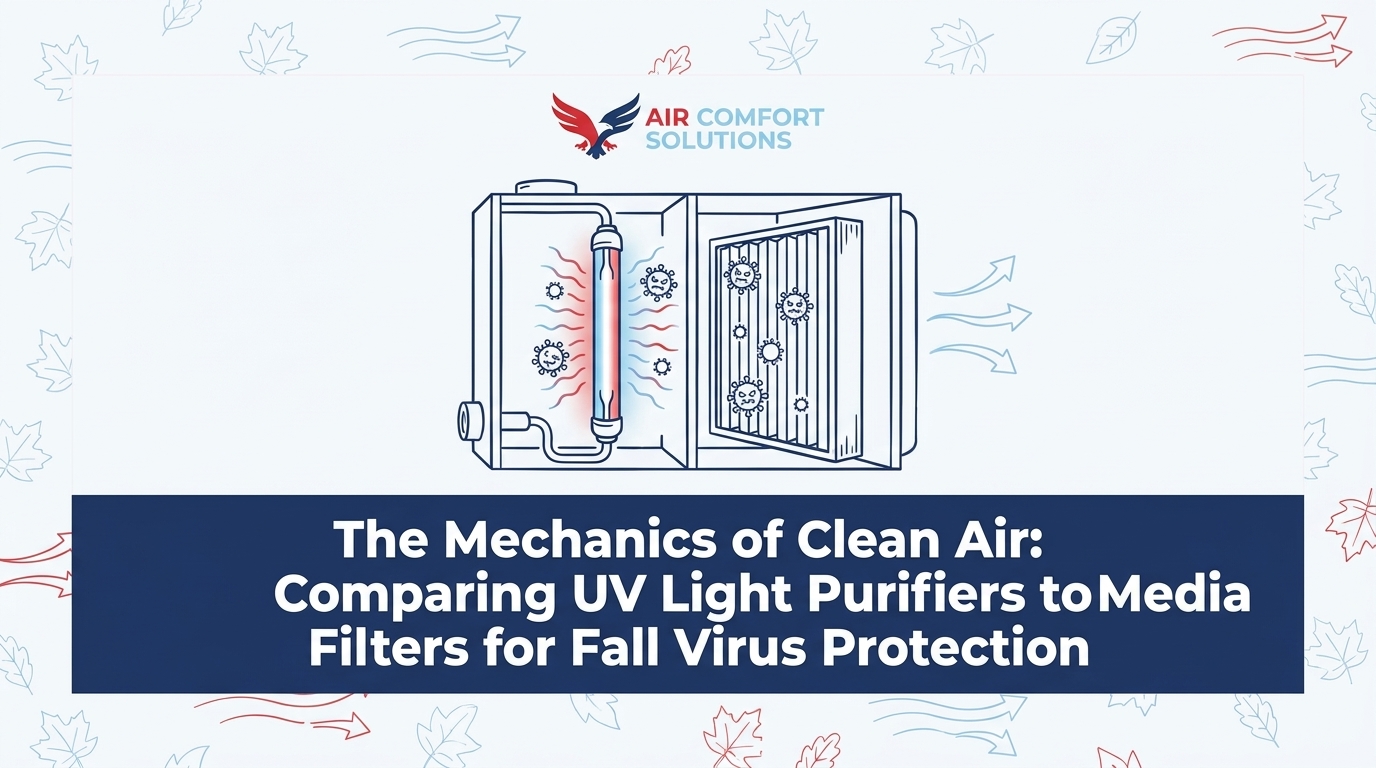
Comparing UV Light Purifiers to Media Filters for Fall Virus Protection
Deciding between biological neutralization and particulate capture? See the exact differences between UV lights and media filters to protect your indoor air this fall.
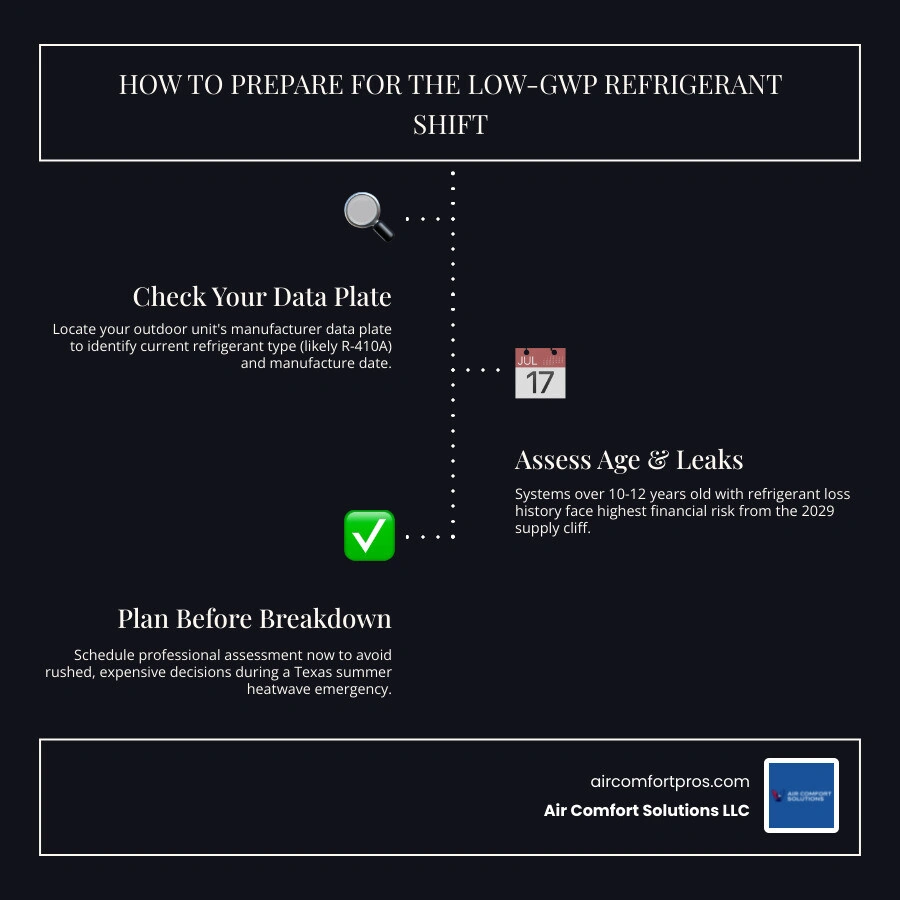
How to prepare for the shift to low GWP refrigerants starts with five clear steps most homeowners can take right now:
Here is the reality for homeowners in Pinehurst, TX and across North Harris County: the refrigerant in your air conditioner or heat pump is almost certainly changing, and the timeline is already underway. The EPA's American Innovation and Manufacturing (AIM) Act set January 1, 2025 as the date after which new residential systems can no longer be manufactured using refrigerants with a Global Warming Potential (GWP) above 700. R-410A — the refrigerant in the vast majority of systems installed over the past two decades — carries a GWP of 2,088. That puts it well outside the new standard.
What this means practically is that R-410A is not being banned from your existing system overnight. You can still repair and recharge your current unit. But the supply of that refrigerant is being tightened year by year under the AIM Act phasedown schedule, and the steepest reduction arrives in 2029. Homeowners who wait until a breakdown forces their hand are far more likely to face limited technician availability, constrained parts supply, and rising service costs — especially during a Texas summer.
Think of it this way: a system failure during a July heatwave forces rushed, stressful, and expensive decisions. A planned, off-season upgrade gives you time to compare options, budget carefully, and avoid the worst of the supply squeeze.
My name is Robert Patterson, and in this guide I will walk you through everything you need to know — from decoding the EPA's regulatory timeline to auditing your system, comparing the new refrigerants, and deciding whether to repair, replace, or run out your current equipment.
Easy how to prepare for the shift to low gwp refrigerants glossary:
The transition away from high-GWP hydrofluorocarbons (HFCs) is governed by the American Innovation and Manufacturing (AIM) Act, which was enacted by Congress in late 2020. The AIM Act grants the EPA the authority to phase down the production and consumption of listed HFCs in the United States by 85% by the year 2036.
This phasedown is not a sudden ban on owning or running an older air conditioner. Instead, it is a structured, multi-step reduction in the total volume of HFCs that chemical manufacturers are legally allowed to produce or import. By slowly choking off the supply of virgin refrigerants, the regulation naturally drives the market toward more sustainable, environmentally friendly alternatives.
To understand why learning how to prepare for the shift to low gwp refrigerants is so critical right now in 2026, we have to look at the specific regulatory milestones that are reshaping the HVAC industry:
For a deeper dive into how these changing rules affect your home comfort decisions, read our guide on How AC Refrigerant Changes Affect Homeowners.
As the industry pivots away from R-410A, two primary low-GWP alternatives have emerged to take its place in residential air conditioning and heat pump systems: R-32 and R-454B. Both options represent a massive leap forward in environmental sustainability, but they have distinct chemical and physical properties that homeowners should understand.
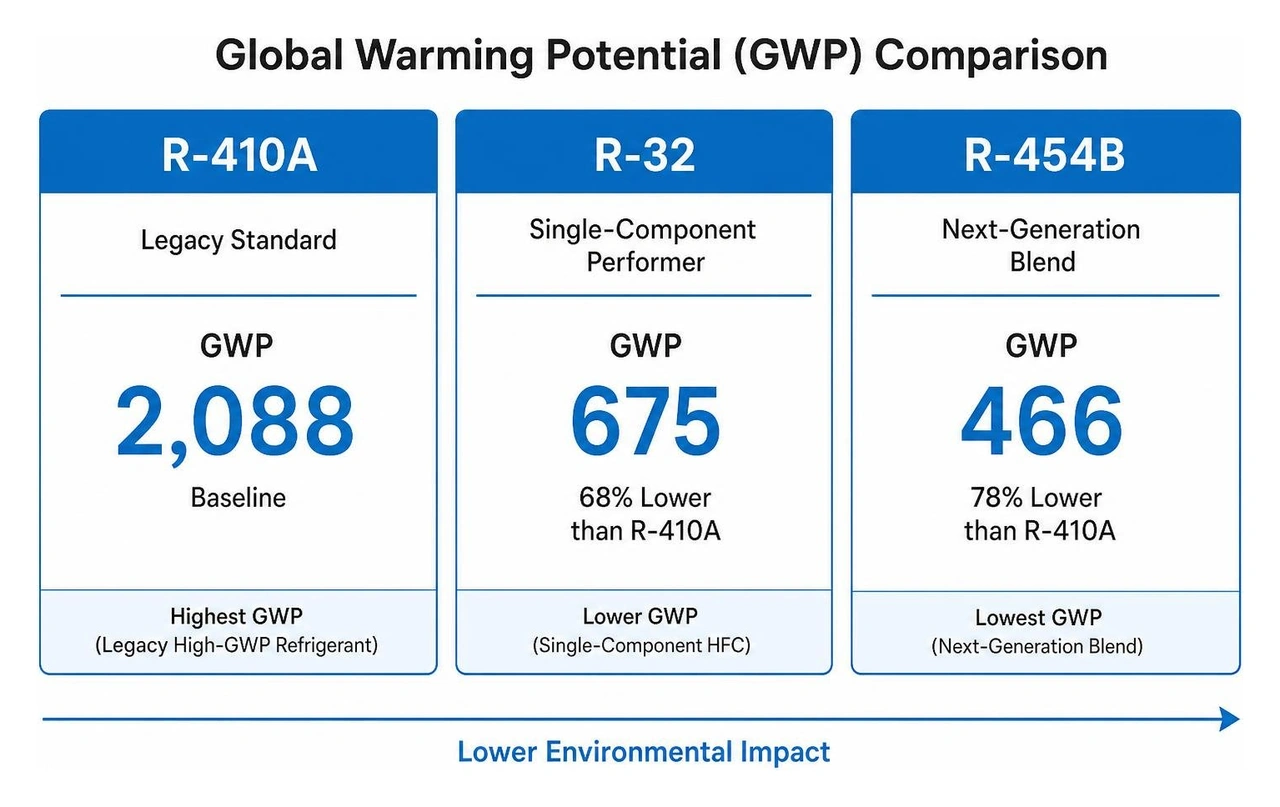
For over two decades, R-410A was the gold standard for residential cooling. While it does not deplete the ozone layer (unlike its predecessor, R-22), it has a very high Global Warming Potential of 2,088. This means that releasing one pound of R-410A into the atmosphere has the same warming effect as releasing over a ton of carbon dioxide.
R-32 is a synthetic HFC with a GWP of 675, representing a 68% reduction in global warming impact compared to R-410A. One of the greatest engineering advantages of R-32 is that it is a single-component refrigerant. Unlike blended refrigerants, it does not suffer from "temperature glide" (where different components of the gas evaporate or condense at different temperatures). This makes R-32 incredibly stable, highly efficient, and significantly easier to reclaim and recycle.
Additionally, R-32 can use up to 30% less charge weight compared to R-410A to achieve the same cooling capacity. This reduced charge size allows the system to operate with smaller, more efficient compressors and heat exchangers.
R-454B is a zeotropic blend consisting of R-32 and a hydrofluoroolefin (HFO) known as R-1234yf. It boasts a GWP of 466, which is a 78% reduction compared to R-410A and the lowest GWP among the primary residential replacement options. Because it is a blend, it has a very minor temperature glide of approximately 1°C, which is easily managed by modern system controls. Many major HVAC manufacturers have selected R-454B as their primary refrigerant for residential systems because its operating pressures and performance characteristics are very closely matched to R-410A, allowing for highly reliable system designs.
| Refrigerant Property | R-410A (Legacy) | R-32 (New Standard) | R-454B (New Standard) |
|---|---|---|---|
| GWP (IPCC AR5) | 2,088 | 675 | 466 |
| GWP Reduction | Baseline | 68% Lower | 78% Lower |
| Safety Class | A1 (Non-Flammable) | A2L (Mildly Flammable) | A2L (Mildly Flammable) |
| Composition | 50/50 HFC Blend | 100% Single Component | HFC/HFO Blend |
| Relative Charge Size | 100% | Up to 30% Less | Similar to R-410A |
| Temperature Glide | Negligible | 0°C (None) | ~1°C (Very Low) |
To learn more about the exact mechanical differences between these two new options, check out our detailed comparison article, R410A vs. R454B Refrigerant: What You Need to Know.
One of the most common questions we receive from homeowners in Pinehurst, Magnolia, and Tomball is: "I heard the new refrigerants are flammable. Are they safe for my home and family?"
The short answer is yes, they are exceptionally safe. However, understanding the science behind the safety classification can help put your mind at ease.
The American Society of Heating, Refrigerating and Air-Conditioning Engineers (ASHRAE) classifies refrigerants based on toxicity and flammability. Under this system:
A2L refrigerants like R-32 and R-454B are incredibly difficult to ignite. Unlike highly flammable hydrocarbon gases like propane (classified as A3), A2L gases have a very high Lower Flammability Limit (LFL). This means they require a highly concentrated volume of gas mixed with air and a high-energy ignition source (like an open flame from a blowtorch) to ignite. Common household items like matchbox sparks, static electricity, or light switch clicks do not carry enough thermal energy to ignite an A2L refrigerant. Furthermore, their burning velocity is less than 10 centimeters per second, meaning that even if they do somehow ignite under extreme, laboratory-like conditions, they do not produce an explosive force; instead, they slowly fizzle out.
To make these systems even safer, modern A2L HVAC units are engineered with redundant, active safety controls:
You do not want to wait until your air conditioner breaks down on a humid, 100-degree July afternoon in Conroe or Spring to start thinking about your upgrade path. Taking a proactive approach allows you to make informed decisions on your own schedule.
Performing a self-audit of your current heating and cooling equipment is the best way to start. Follow these simple steps:
If your R-410A system is relatively new (installed within the last 5 to 7 years) and has a clean service record, your best strategy is a managed run-out. This means keeping the system well-maintained through regular annual tune-ups, washing the condenser coils, and changing filters regularly to prevent mechanical stress that can lead to vibration leaks.
However, if your system is over 12 years old and experiences a major component failure (like a failed compressor or a leaking evaporator coil) in 2026 or beyond, a full replacement is almost always the more economical long-term decision. Trying to keep an aging, leak-prone system running on a phased-out refrigerant is a gamble. As the 2029 production cut approaches, the cost of repairing R-410A leaks will rise dramatically.
By planning your upgrade proactively during the milder spring or fall seasons, you can take advantage of federal tax credits (such as the Energy Efficient Home Improvement Credit under Section 25C) and local utility rebates, while ensuring your home is equipped with a highly efficient SEER2 system that can deliver a 10% to 15% reduction in cooling energy consumption.
No, you absolutely cannot. There is a common myth that you can simply drain the old R-410A from your system and "drop in" a new low-GWP refrigerant. Doing so is a major safety hazard, will instantly void your manufacturer's warranty, and will likely destroy your system.
A2L refrigerants operate under different pressures, require specialized synthetic POE lubricants, and must only be used in systems specifically engineered with safety mitigation controls, spark-proof electrical components, and integrated leak sensors. Legacy R-410A systems lack these safety features and cannot handle the physical properties of the new gases.
If your system develops a leak this year, it can still be legally repaired and recharged. The EPA's AIM Act does not ban the servicing of existing R-410A systems, nor does it mandate that you retire working equipment.
However, you should expect the service to become more expensive over time. Because the EPA is actively squeezing the production of new HFCs, the industry is relying more heavily on reclaimed and recycled R-410A. As supply shrinks and demand remains high, the cost of the refrigerant itself will continue to climb. If your system has a major leak, we highly recommend having a certified technician perform a comprehensive leak search and repair, rather than simply "topping it off" year after year.
Yes, they are incredibly safe. As discussed in our section on safety classifications, A2L refrigerants are highly resistant to ignition. Standard household ignition sources do not possess enough energy to ignite them. Furthermore, modern HVAC systems designed for R-32 or R-454B are built with redundant safety controls — including automatic leak sensors and blower-fan mitigation — that virtually eliminate the risk of a hazardous concentration accumulating inside your home.
The shift to low-GWP refrigerants represents a major milestone in environmental responsibility, but it also requires homeowners to be proactive. By understanding the regulatory timeline, auditing your current system, and knowing your options, you can avoid stressful emergency replacements and ensure your home remains a cool, comfortable sanctuary through the hot Texas summers.
At Air Comfort Solutions LLC, we have spent over 35 years providing honest, reliable, and expert heating, cooling, and indoor air quality services to our neighbors in Pinehurst, Magnolia, The Woodlands, Conroe, Spring, Tomball, Montgomery, Plantersville, and North Houston. Our certified technicians are fully trained in the latest A2L safety protocols and installation standards.
Don't wait for the next major heatwave to find out where your system stands. Schedule your professional AC assessment today with Air Comfort Solutions LLC, and let us help you plan for a cooler, greener, and more efficient future.
How to prepare for the shift to low GWP refrigerants starts with five clear steps most homeowners can take right now:
Here is the reality for homeowners in Pinehurst, TX and across North Harris County: the refrigerant in your air conditioner or heat pump is almost certainly changing, and the timeline is already underway. The EPA's American Innovation and Manufacturing (AIM) Act set January 1, 2025 as the date after which new residential systems can no longer be manufactured using refrigerants with a Global Warming Potential (GWP) above 700. R-410A — the refrigerant in the vast majority of systems installed over the past two decades — carries a GWP of 2,088. That puts it well outside the new standard.
What this means practically is that R-410A is not being banned from your existing system overnight. You can still repair and recharge your current unit. But the supply of that refrigerant is being tightened year by year under the AIM Act phasedown schedule, and the steepest reduction arrives in 2029. Homeowners who wait until a breakdown forces their hand are far more likely to face limited technician availability, constrained parts supply, and rising service costs — especially during a Texas summer.
Think of it this way: a system failure during a July heatwave forces rushed, stressful, and expensive decisions. A planned, off-season upgrade gives you time to compare options, budget carefully, and avoid the worst of the supply squeeze.
My name is Robert Patterson, and in this guide I will walk you through everything you need to know — from decoding the EPA's regulatory timeline to auditing your system, comparing the new refrigerants, and deciding whether to repair, replace, or run out your current equipment.
Easy how to prepare for the shift to low gwp refrigerants glossary:
The transition away from high-GWP hydrofluorocarbons (HFCs) is governed by the American Innovation and Manufacturing (AIM) Act, which was enacted by Congress in late 2020. The AIM Act grants the EPA the authority to phase down the production and consumption of listed HFCs in the United States by 85% by the year 2036.
This phasedown is not a sudden ban on owning or running an older air conditioner. Instead, it is a structured, multi-step reduction in the total volume of HFCs that chemical manufacturers are legally allowed to produce or import. By slowly choking off the supply of virgin refrigerants, the regulation naturally drives the market toward more sustainable, environmentally friendly alternatives.
To understand why learning how to prepare for the shift to low gwp refrigerants is so critical right now in 2026, we have to look at the specific regulatory milestones that are reshaping the HVAC industry:
For a deeper dive into how these changing rules affect your home comfort decisions, read our guide on How AC Refrigerant Changes Affect Homeowners.
As the industry pivots away from R-410A, two primary low-GWP alternatives have emerged to take its place in residential air conditioning and heat pump systems: R-32 and R-454B. Both options represent a massive leap forward in environmental sustainability, but they have distinct chemical and physical properties that homeowners should understand.
For over two decades, R-410A was the gold standard for residential cooling. While it does not deplete the ozone layer (unlike its predecessor, R-22), it has a very high Global Warming Potential of 2,088. This means that releasing one pound of R-410A into the atmosphere has the same warming effect as releasing over a ton of carbon dioxide.
R-32 is a synthetic HFC with a GWP of 675, representing a 68% reduction in global warming impact compared to R-410A. One of the greatest engineering advantages of R-32 is that it is a single-component refrigerant. Unlike blended refrigerants, it does not suffer from "temperature glide" (where different components of the gas evaporate or condense at different temperatures). This makes R-32 incredibly stable, highly efficient, and significantly easier to reclaim and recycle.
Additionally, R-32 can use up to 30% less charge weight compared to R-410A to achieve the same cooling capacity. This reduced charge size allows the system to operate with smaller, more efficient compressors and heat exchangers.
R-454B is a zeotropic blend consisting of R-32 and a hydrofluoroolefin (HFO) known as R-1234yf. It boasts a GWP of 466, which is a 78% reduction compared to R-410A and the lowest GWP among the primary residential replacement options. Because it is a blend, it has a very minor temperature glide of approximately 1°C, which is easily managed by modern system controls. Many major HVAC manufacturers have selected R-454B as their primary refrigerant for residential systems because its operating pressures and performance characteristics are very closely matched to R-410A, allowing for highly reliable system designs.
| Refrigerant Property | R-410A (Legacy) | R-32 (New Standard) | R-454B (New Standard) |
|---|---|---|---|
| GWP (IPCC AR5) | 2,088 | 675 | 466 |
| GWP Reduction | Baseline | 68% Lower | 78% Lower |
| Safety Class | A1 (Non-Flammable) | A2L (Mildly Flammable) | A2L (Mildly Flammable) |
| Composition | 50/50 HFC Blend | 100% Single Component | HFC/HFO Blend |
| Relative Charge Size | 100% | Up to 30% Less | Similar to R-410A |
| Temperature Glide | Negligible | 0°C (None) | ~1°C (Very Low) |
To learn more about the exact mechanical differences between these two new options, check out our detailed comparison article, R410A vs. R454B Refrigerant: What You Need to Know.
One of the most common questions we receive from homeowners in Pinehurst, Magnolia, and Tomball is: "I heard the new refrigerants are flammable. Are they safe for my home and family?"
The short answer is yes, they are exceptionally safe. However, understanding the science behind the safety classification can help put your mind at ease.
The American Society of Heating, Refrigerating and Air-Conditioning Engineers (ASHRAE) classifies refrigerants based on toxicity and flammability. Under this system:
A2L refrigerants like R-32 and R-454B are incredibly difficult to ignite. Unlike highly flammable hydrocarbon gases like propane (classified as A3), A2L gases have a very high Lower Flammability Limit (LFL). This means they require a highly concentrated volume of gas mixed with air and a high-energy ignition source (like an open flame from a blowtorch) to ignite. Common household items like matchbox sparks, static electricity, or light switch clicks do not carry enough thermal energy to ignite an A2L refrigerant. Furthermore, their burning velocity is less than 10 centimeters per second, meaning that even if they do somehow ignite under extreme, laboratory-like conditions, they do not produce an explosive force; instead, they slowly fizzle out.
To make these systems even safer, modern A2L HVAC units are engineered with redundant, active safety controls:
You do not want to wait until your air conditioner breaks down on a humid, 100-degree July afternoon in Conroe or Spring to start thinking about your upgrade path. Taking a proactive approach allows you to make informed decisions on your own schedule.
Performing a self-audit of your current heating and cooling equipment is the best way to start. Follow these simple steps:
If your R-410A system is relatively new (installed within the last 5 to 7 years) and has a clean service record, your best strategy is a managed run-out. This means keeping the system well-maintained through regular annual tune-ups, washing the condenser coils, and changing filters regularly to prevent mechanical stress that can lead to vibration leaks.
However, if your system is over 12 years old and experiences a major component failure (like a failed compressor or a leaking evaporator coil) in 2026 or beyond, a full replacement is almost always the more economical long-term decision. Trying to keep an aging, leak-prone system running on a phased-out refrigerant is a gamble. As the 2029 production cut approaches, the cost of repairing R-410A leaks will rise dramatically.
By planning your upgrade proactively during the milder spring or fall seasons, you can take advantage of federal tax credits (such as the Energy Efficient Home Improvement Credit under Section 25C) and local utility rebates, while ensuring your home is equipped with a highly efficient SEER2 system that can deliver a 10% to 15% reduction in cooling energy consumption.
No, you absolutely cannot. There is a common myth that you can simply drain the old R-410A from your system and "drop in" a new low-GWP refrigerant. Doing so is a major safety hazard, will instantly void your manufacturer's warranty, and will likely destroy your system.
A2L refrigerants operate under different pressures, require specialized synthetic POE lubricants, and must only be used in systems specifically engineered with safety mitigation controls, spark-proof electrical components, and integrated leak sensors. Legacy R-410A systems lack these safety features and cannot handle the physical properties of the new gases.
If your system develops a leak this year, it can still be legally repaired and recharged. The EPA's AIM Act does not ban the servicing of existing R-410A systems, nor does it mandate that you retire working equipment.
However, you should expect the service to become more expensive over time. Because the EPA is actively squeezing the production of new HFCs, the industry is relying more heavily on reclaimed and recycled R-410A. As supply shrinks and demand remains high, the cost of the refrigerant itself will continue to climb. If your system has a major leak, we highly recommend having a certified technician perform a comprehensive leak search and repair, rather than simply "topping it off" year after year.
Yes, they are incredibly safe. As discussed in our section on safety classifications, A2L refrigerants are highly resistant to ignition. Standard household ignition sources do not possess enough energy to ignite them. Furthermore, modern HVAC systems designed for R-32 or R-454B are built with redundant safety controls — including automatic leak sensors and blower-fan mitigation — that virtually eliminate the risk of a hazardous concentration accumulating inside your home.
The shift to low-GWP refrigerants represents a major milestone in environmental responsibility, but it also requires homeowners to be proactive. By understanding the regulatory timeline, auditing your current system, and knowing your options, you can avoid stressful emergency replacements and ensure your home remains a cool, comfortable sanctuary through the hot Texas summers.
At Air Comfort Solutions LLC, we have spent over 35 years providing honest, reliable, and expert heating, cooling, and indoor air quality services to our neighbors in Pinehurst, Magnolia, The Woodlands, Conroe, Spring, Tomball, Montgomery, Plantersville, and North Houston. Our certified technicians are fully trained in the latest A2L safety protocols and installation standards.
Don't wait for the next major heatwave to find out where your system stands. Schedule your professional AC assessment today with Air Comfort Solutions LLC, and let us help you plan for a cooler, greener, and more efficient future.
How to prepare for the shift to low GWP refrigerants starts with five clear steps most homeowners can take right now:
Here is the reality for homeowners in Pinehurst, TX and across North Harris County: the refrigerant in your air conditioner or heat pump is almost certainly changing, and the timeline is already underway. The EPA's American Innovation and Manufacturing (AIM) Act set January 1, 2025 as the date after which new residential systems can no longer be manufactured using refrigerants with a Global Warming Potential (GWP) above 700. R-410A — the refrigerant in the vast majority of systems installed over the past two decades — carries a GWP of 2,088. That puts it well outside the new standard.
What this means practically is that R-410A is not being banned from your existing system overnight. You can still repair and recharge your current unit. But the supply of that refrigerant is being tightened year by year under the AIM Act phasedown schedule, and the steepest reduction arrives in 2029. Homeowners who wait until a breakdown forces their hand are far more likely to face limited technician availability, constrained parts supply, and rising service costs — especially during a Texas summer.
Think of it this way: a system failure during a July heatwave forces rushed, stressful, and expensive decisions. A planned, off-season upgrade gives you time to compare options, budget carefully, and avoid the worst of the supply squeeze.
My name is Robert Patterson, and in this guide I will walk you through everything you need to know — from decoding the EPA's regulatory timeline to auditing your system, comparing the new refrigerants, and deciding whether to repair, replace, or run out your current equipment.
Easy how to prepare for the shift to low gwp refrigerants glossary:
The transition away from high-GWP hydrofluorocarbons (HFCs) is governed by the American Innovation and Manufacturing (AIM) Act, which was enacted by Congress in late 2020. The AIM Act grants the EPA the authority to phase down the production and consumption of listed HFCs in the United States by 85% by the year 2036.
This phasedown is not a sudden ban on owning or running an older air conditioner. Instead, it is a structured, multi-step reduction in the total volume of HFCs that chemical manufacturers are legally allowed to produce or import. By slowly choking off the supply of virgin refrigerants, the regulation naturally drives the market toward more sustainable, environmentally friendly alternatives.
To understand why learning how to prepare for the shift to low gwp refrigerants is so critical right now in 2026, we have to look at the specific regulatory milestones that are reshaping the HVAC industry:
For a deeper dive into how these changing rules affect your home comfort decisions, read our guide on How AC Refrigerant Changes Affect Homeowners.
As the industry pivots away from R-410A, two primary low-GWP alternatives have emerged to take its place in residential air conditioning and heat pump systems: R-32 and R-454B. Both options represent a massive leap forward in environmental sustainability, but they have distinct chemical and physical properties that homeowners should understand.
For over two decades, R-410A was the gold standard for residential cooling. While it does not deplete the ozone layer (unlike its predecessor, R-22), it has a very high Global Warming Potential of 2,088. This means that releasing one pound of R-410A into the atmosphere has the same warming effect as releasing over a ton of carbon dioxide.
R-32 is a synthetic HFC with a GWP of 675, representing a 68% reduction in global warming impact compared to R-410A. One of the greatest engineering advantages of R-32 is that it is a single-component refrigerant. Unlike blended refrigerants, it does not suffer from "temperature glide" (where different components of the gas evaporate or condense at different temperatures). This makes R-32 incredibly stable, highly efficient, and significantly easier to reclaim and recycle.
Additionally, R-32 can use up to 30% less charge weight compared to R-410A to achieve the same cooling capacity. This reduced charge size allows the system to operate with smaller, more efficient compressors and heat exchangers.
R-454B is a zeotropic blend consisting of R-32 and a hydrofluoroolefin (HFO) known as R-1234yf. It boasts a GWP of 466, which is a 78% reduction compared to R-410A and the lowest GWP among the primary residential replacement options. Because it is a blend, it has a very minor temperature glide of approximately 1°C, which is easily managed by modern system controls. Many major HVAC manufacturers have selected R-454B as their primary refrigerant for residential systems because its operating pressures and performance characteristics are very closely matched to R-410A, allowing for highly reliable system designs.
| Refrigerant Property | R-410A (Legacy) | R-32 (New Standard) | R-454B (New Standard) |
|---|---|---|---|
| GWP (IPCC AR5) | 2,088 | 675 | 466 |
| GWP Reduction | Baseline | 68% Lower | 78% Lower |
| Safety Class | A1 (Non-Flammable) | A2L (Mildly Flammable) | A2L (Mildly Flammable) |
| Composition | 50/50 HFC Blend | 100% Single Component | HFC/HFO Blend |
| Relative Charge Size | 100% | Up to 30% Less | Similar to R-410A |
| Temperature Glide | Negligible | 0°C (None) | ~1°C (Very Low) |
To learn more about the exact mechanical differences between these two new options, check out our detailed comparison article, R410A vs. R454B Refrigerant: What You Need to Know.
One of the most common questions we receive from homeowners in Pinehurst, Magnolia, and Tomball is: "I heard the new refrigerants are flammable. Are they safe for my home and family?"
The short answer is yes, they are exceptionally safe. However, understanding the science behind the safety classification can help put your mind at ease.
The American Society of Heating, Refrigerating and Air-Conditioning Engineers (ASHRAE) classifies refrigerants based on toxicity and flammability. Under this system:
A2L refrigerants like R-32 and R-454B are incredibly difficult to ignite. Unlike highly flammable hydrocarbon gases like propane (classified as A3), A2L gases have a very high Lower Flammability Limit (LFL). This means they require a highly concentrated volume of gas mixed with air and a high-energy ignition source (like an open flame from a blowtorch) to ignite. Common household items like matchbox sparks, static electricity, or light switch clicks do not carry enough thermal energy to ignite an A2L refrigerant. Furthermore, their burning velocity is less than 10 centimeters per second, meaning that even if they do somehow ignite under extreme, laboratory-like conditions, they do not produce an explosive force; instead, they slowly fizzle out.
To make these systems even safer, modern A2L HVAC units are engineered with redundant, active safety controls:
You do not want to wait until your air conditioner breaks down on a humid, 100-degree July afternoon in Conroe or Spring to start thinking about your upgrade path. Taking a proactive approach allows you to make informed decisions on your own schedule.
Performing a self-audit of your current heating and cooling equipment is the best way to start. Follow these simple steps:
If your R-410A system is relatively new (installed within the last 5 to 7 years) and has a clean service record, your best strategy is a managed run-out. This means keeping the system well-maintained through regular annual tune-ups, washing the condenser coils, and changing filters regularly to prevent mechanical stress that can lead to vibration leaks.
However, if your system is over 12 years old and experiences a major component failure (like a failed compressor or a leaking evaporator coil) in 2026 or beyond, a full replacement is almost always the more economical long-term decision. Trying to keep an aging, leak-prone system running on a phased-out refrigerant is a gamble. As the 2029 production cut approaches, the cost of repairing R-410A leaks will rise dramatically.
By planning your upgrade proactively during the milder spring or fall seasons, you can take advantage of federal tax credits (such as the Energy Efficient Home Improvement Credit under Section 25C) and local utility rebates, while ensuring your home is equipped with a highly efficient SEER2 system that can deliver a 10% to 15% reduction in cooling energy consumption.
No, you absolutely cannot. There is a common myth that you can simply drain the old R-410A from your system and "drop in" a new low-GWP refrigerant. Doing so is a major safety hazard, will instantly void your manufacturer's warranty, and will likely destroy your system.
A2L refrigerants operate under different pressures, require specialized synthetic POE lubricants, and must only be used in systems specifically engineered with safety mitigation controls, spark-proof electrical components, and integrated leak sensors. Legacy R-410A systems lack these safety features and cannot handle the physical properties of the new gases.
If your system develops a leak this year, it can still be legally repaired and recharged. The EPA's AIM Act does not ban the servicing of existing R-410A systems, nor does it mandate that you retire working equipment.
However, you should expect the service to become more expensive over time. Because the EPA is actively squeezing the production of new HFCs, the industry is relying more heavily on reclaimed and recycled R-410A. As supply shrinks and demand remains high, the cost of the refrigerant itself will continue to climb. If your system has a major leak, we highly recommend having a certified technician perform a comprehensive leak search and repair, rather than simply "topping it off" year after year.
Yes, they are incredibly safe. As discussed in our section on safety classifications, A2L refrigerants are highly resistant to ignition. Standard household ignition sources do not possess enough energy to ignite them. Furthermore, modern HVAC systems designed for R-32 or R-454B are built with redundant safety controls — including automatic leak sensors and blower-fan mitigation — that virtually eliminate the risk of a hazardous concentration accumulating inside your home.
The shift to low-GWP refrigerants represents a major milestone in environmental responsibility, but it also requires homeowners to be proactive. By understanding the regulatory timeline, auditing your current system, and knowing your options, you can avoid stressful emergency replacements and ensure your home remains a cool, comfortable sanctuary through the hot Texas summers.
At Air Comfort Solutions LLC, we have spent over 35 years providing honest, reliable, and expert heating, cooling, and indoor air quality services to our neighbors in Pinehurst, Magnolia, The Woodlands, Conroe, Spring, Tomball, Montgomery, Plantersville, and North Houston. Our certified technicians are fully trained in the latest A2L safety protocols and installation standards.
Don't wait for the next major heatwave to find out where your system stands. Schedule your professional AC assessment today with Air Comfort Solutions LLC, and let us help you plan for a cooler, greener, and more efficient future.
How to prepare for the shift to low GWP refrigerants starts with five clear steps most homeowners can take right now:
Here is the reality for homeowners in Pinehurst, TX and across North Harris County: the refrigerant in your air conditioner or heat pump is almost certainly changing, and the timeline is already underway. The EPA's American Innovation and Manufacturing (AIM) Act set January 1, 2025 as the date after which new residential systems can no longer be manufactured using refrigerants with a Global Warming Potential (GWP) above 700. R-410A — the refrigerant in the vast majority of systems installed over the past two decades — carries a GWP of 2,088. That puts it well outside the new standard.
What this means practically is that R-410A is not being banned from your existing system overnight. You can still repair and recharge your current unit. But the supply of that refrigerant is being tightened year by year under the AIM Act phasedown schedule, and the steepest reduction arrives in 2029. Homeowners who wait until a breakdown forces their hand are far more likely to face limited technician availability, constrained parts supply, and rising service costs — especially during a Texas summer.
Think of it this way: a system failure during a July heatwave forces rushed, stressful, and expensive decisions. A planned, off-season upgrade gives you time to compare options, budget carefully, and avoid the worst of the supply squeeze.
My name is Robert Patterson, and in this guide I will walk you through everything you need to know — from decoding the EPA's regulatory timeline to auditing your system, comparing the new refrigerants, and deciding whether to repair, replace, or run out your current equipment.
Easy how to prepare for the shift to low gwp refrigerants glossary:
The transition away from high-GWP hydrofluorocarbons (HFCs) is governed by the American Innovation and Manufacturing (AIM) Act, which was enacted by Congress in late 2020. The AIM Act grants the EPA the authority to phase down the production and consumption of listed HFCs in the United States by 85% by the year 2036.
This phasedown is not a sudden ban on owning or running an older air conditioner. Instead, it is a structured, multi-step reduction in the total volume of HFCs that chemical manufacturers are legally allowed to produce or import. By slowly choking off the supply of virgin refrigerants, the regulation naturally drives the market toward more sustainable, environmentally friendly alternatives.
To understand why learning how to prepare for the shift to low gwp refrigerants is so critical right now in 2026, we have to look at the specific regulatory milestones that are reshaping the HVAC industry:
For a deeper dive into how these changing rules affect your home comfort decisions, read our guide on How AC Refrigerant Changes Affect Homeowners.
As the industry pivots away from R-410A, two primary low-GWP alternatives have emerged to take its place in residential air conditioning and heat pump systems: R-32 and R-454B. Both options represent a massive leap forward in environmental sustainability, but they have distinct chemical and physical properties that homeowners should understand.
For over two decades, R-410A was the gold standard for residential cooling. While it does not deplete the ozone layer (unlike its predecessor, R-22), it has a very high Global Warming Potential of 2,088. This means that releasing one pound of R-410A into the atmosphere has the same warming effect as releasing over a ton of carbon dioxide.
R-32 is a synthetic HFC with a GWP of 675, representing a 68% reduction in global warming impact compared to R-410A. One of the greatest engineering advantages of R-32 is that it is a single-component refrigerant. Unlike blended refrigerants, it does not suffer from "temperature glide" (where different components of the gas evaporate or condense at different temperatures). This makes R-32 incredibly stable, highly efficient, and significantly easier to reclaim and recycle.
Additionally, R-32 can use up to 30% less charge weight compared to R-410A to achieve the same cooling capacity. This reduced charge size allows the system to operate with smaller, more efficient compressors and heat exchangers.
R-454B is a zeotropic blend consisting of R-32 and a hydrofluoroolefin (HFO) known as R-1234yf. It boasts a GWP of 466, which is a 78% reduction compared to R-410A and the lowest GWP among the primary residential replacement options. Because it is a blend, it has a very minor temperature glide of approximately 1°C, which is easily managed by modern system controls. Many major HVAC manufacturers have selected R-454B as their primary refrigerant for residential systems because its operating pressures and performance characteristics are very closely matched to R-410A, allowing for highly reliable system designs.
| Refrigerant Property | R-410A (Legacy) | R-32 (New Standard) | R-454B (New Standard) |
|---|---|---|---|
| GWP (IPCC AR5) | 2,088 | 675 | 466 |
| GWP Reduction | Baseline | 68% Lower | 78% Lower |
| Safety Class | A1 (Non-Flammable) | A2L (Mildly Flammable) | A2L (Mildly Flammable) |
| Composition | 50/50 HFC Blend | 100% Single Component | HFC/HFO Blend |
| Relative Charge Size | 100% | Up to 30% Less | Similar to R-410A |
| Temperature Glide | Negligible | 0°C (None) | ~1°C (Very Low) |
To learn more about the exact mechanical differences between these two new options, check out our detailed comparison article, R410A vs. R454B Refrigerant: What You Need to Know.
One of the most common questions we receive from homeowners in Pinehurst, Magnolia, and Tomball is: "I heard the new refrigerants are flammable. Are they safe for my home and family?"
The short answer is yes, they are exceptionally safe. However, understanding the science behind the safety classification can help put your mind at ease.
The American Society of Heating, Refrigerating and Air-Conditioning Engineers (ASHRAE) classifies refrigerants based on toxicity and flammability. Under this system:
A2L refrigerants like R-32 and R-454B are incredibly difficult to ignite. Unlike highly flammable hydrocarbon gases like propane (classified as A3), A2L gases have a very high Lower Flammability Limit (LFL). This means they require a highly concentrated volume of gas mixed with air and a high-energy ignition source (like an open flame from a blowtorch) to ignite. Common household items like matchbox sparks, static electricity, or light switch clicks do not carry enough thermal energy to ignite an A2L refrigerant. Furthermore, their burning velocity is less than 10 centimeters per second, meaning that even if they do somehow ignite under extreme, laboratory-like conditions, they do not produce an explosive force; instead, they slowly fizzle out.
To make these systems even safer, modern A2L HVAC units are engineered with redundant, active safety controls:
You do not want to wait until your air conditioner breaks down on a humid, 100-degree July afternoon in Conroe or Spring to start thinking about your upgrade path. Taking a proactive approach allows you to make informed decisions on your own schedule.
Performing a self-audit of your current heating and cooling equipment is the best way to start. Follow these simple steps:
If your R-410A system is relatively new (installed within the last 5 to 7 years) and has a clean service record, your best strategy is a managed run-out. This means keeping the system well-maintained through regular annual tune-ups, washing the condenser coils, and changing filters regularly to prevent mechanical stress that can lead to vibration leaks.
However, if your system is over 12 years old and experiences a major component failure (like a failed compressor or a leaking evaporator coil) in 2026 or beyond, a full replacement is almost always the more economical long-term decision. Trying to keep an aging, leak-prone system running on a phased-out refrigerant is a gamble. As the 2029 production cut approaches, the cost of repairing R-410A leaks will rise dramatically.
By planning your upgrade proactively during the milder spring or fall seasons, you can take advantage of federal tax credits (such as the Energy Efficient Home Improvement Credit under Section 25C) and local utility rebates, while ensuring your home is equipped with a highly efficient SEER2 system that can deliver a 10% to 15% reduction in cooling energy consumption.
No, you absolutely cannot. There is a common myth that you can simply drain the old R-410A from your system and "drop in" a new low-GWP refrigerant. Doing so is a major safety hazard, will instantly void your manufacturer's warranty, and will likely destroy your system.
A2L refrigerants operate under different pressures, require specialized synthetic POE lubricants, and must only be used in systems specifically engineered with safety mitigation controls, spark-proof electrical components, and integrated leak sensors. Legacy R-410A systems lack these safety features and cannot handle the physical properties of the new gases.
If your system develops a leak this year, it can still be legally repaired and recharged. The EPA's AIM Act does not ban the servicing of existing R-410A systems, nor does it mandate that you retire working equipment.
However, you should expect the service to become more expensive over time. Because the EPA is actively squeezing the production of new HFCs, the industry is relying more heavily on reclaimed and recycled R-410A. As supply shrinks and demand remains high, the cost of the refrigerant itself will continue to climb. If your system has a major leak, we highly recommend having a certified technician perform a comprehensive leak search and repair, rather than simply "topping it off" year after year.
Yes, they are incredibly safe. As discussed in our section on safety classifications, A2L refrigerants are highly resistant to ignition. Standard household ignition sources do not possess enough energy to ignite them. Furthermore, modern HVAC systems designed for R-32 or R-454B are built with redundant safety controls — including automatic leak sensors and blower-fan mitigation — that virtually eliminate the risk of a hazardous concentration accumulating inside your home.
The shift to low-GWP refrigerants represents a major milestone in environmental responsibility, but it also requires homeowners to be proactive. By understanding the regulatory timeline, auditing your current system, and knowing your options, you can avoid stressful emergency replacements and ensure your home remains a cool, comfortable sanctuary through the hot Texas summers.
At Air Comfort Solutions LLC, we have spent over 35 years providing honest, reliable, and expert heating, cooling, and indoor air quality services to our neighbors in Pinehurst, Magnolia, The Woodlands, Conroe, Spring, Tomball, Montgomery, Plantersville, and North Houston. Our certified technicians are fully trained in the latest A2L safety protocols and installation standards.
Don't wait for the next major heatwave to find out where your system stands. Schedule your professional AC assessment today with Air Comfort Solutions LLC, and let us help you plan for a cooler, greener, and more efficient future.
How to prepare for the shift to low GWP refrigerants starts with five clear steps most homeowners can take right now:
Here is the reality for homeowners in Pinehurst, TX and across North Harris County: the refrigerant in your air conditioner or heat pump is almost certainly changing, and the timeline is already underway. The EPA's American Innovation and Manufacturing (AIM) Act set January 1, 2025 as the date after which new residential systems can no longer be manufactured using refrigerants with a Global Warming Potential (GWP) above 700. R-410A — the refrigerant in the vast majority of systems installed over the past two decades — carries a GWP of 2,088. That puts it well outside the new standard.
What this means practically is that R-410A is not being banned from your existing system overnight. You can still repair and recharge your current unit. But the supply of that refrigerant is being tightened year by year under the AIM Act phasedown schedule, and the steepest reduction arrives in 2029. Homeowners who wait until a breakdown forces their hand are far more likely to face limited technician availability, constrained parts supply, and rising service costs — especially during a Texas summer.
Think of it this way: a system failure during a July heatwave forces rushed, stressful, and expensive decisions. A planned, off-season upgrade gives you time to compare options, budget carefully, and avoid the worst of the supply squeeze.
My name is Robert Patterson, and in this guide I will walk you through everything you need to know — from decoding the EPA's regulatory timeline to auditing your system, comparing the new refrigerants, and deciding whether to repair, replace, or run out your current equipment.
Easy how to prepare for the shift to low gwp refrigerants glossary:
The transition away from high-GWP hydrofluorocarbons (HFCs) is governed by the American Innovation and Manufacturing (AIM) Act, which was enacted by Congress in late 2020. The AIM Act grants the EPA the authority to phase down the production and consumption of listed HFCs in the United States by 85% by the year 2036.
This phasedown is not a sudden ban on owning or running an older air conditioner. Instead, it is a structured, multi-step reduction in the total volume of HFCs that chemical manufacturers are legally allowed to produce or import. By slowly choking off the supply of virgin refrigerants, the regulation naturally drives the market toward more sustainable, environmentally friendly alternatives.
To understand why learning how to prepare for the shift to low gwp refrigerants is so critical right now in 2026, we have to look at the specific regulatory milestones that are reshaping the HVAC industry:
For a deeper dive into how these changing rules affect your home comfort decisions, read our guide on How AC Refrigerant Changes Affect Homeowners.
As the industry pivots away from R-410A, two primary low-GWP alternatives have emerged to take its place in residential air conditioning and heat pump systems: R-32 and R-454B. Both options represent a massive leap forward in environmental sustainability, but they have distinct chemical and physical properties that homeowners should understand.
For over two decades, R-410A was the gold standard for residential cooling. While it does not deplete the ozone layer (unlike its predecessor, R-22), it has a very high Global Warming Potential of 2,088. This means that releasing one pound of R-410A into the atmosphere has the same warming effect as releasing over a ton of carbon dioxide.
R-32 is a synthetic HFC with a GWP of 675, representing a 68% reduction in global warming impact compared to R-410A. One of the greatest engineering advantages of R-32 is that it is a single-component refrigerant. Unlike blended refrigerants, it does not suffer from "temperature glide" (where different components of the gas evaporate or condense at different temperatures). This makes R-32 incredibly stable, highly efficient, and significantly easier to reclaim and recycle.
Additionally, R-32 can use up to 30% less charge weight compared to R-410A to achieve the same cooling capacity. This reduced charge size allows the system to operate with smaller, more efficient compressors and heat exchangers.
R-454B is a zeotropic blend consisting of R-32 and a hydrofluoroolefin (HFO) known as R-1234yf. It boasts a GWP of 466, which is a 78% reduction compared to R-410A and the lowest GWP among the primary residential replacement options. Because it is a blend, it has a very minor temperature glide of approximately 1°C, which is easily managed by modern system controls. Many major HVAC manufacturers have selected R-454B as their primary refrigerant for residential systems because its operating pressures and performance characteristics are very closely matched to R-410A, allowing for highly reliable system designs.
| Refrigerant Property | R-410A (Legacy) | R-32 (New Standard) | R-454B (New Standard) |
|---|---|---|---|
| GWP (IPCC AR5) | 2,088 | 675 | 466 |
| GWP Reduction | Baseline | 68% Lower | 78% Lower |
| Safety Class | A1 (Non-Flammable) | A2L (Mildly Flammable) | A2L (Mildly Flammable) |
| Composition | 50/50 HFC Blend | 100% Single Component | HFC/HFO Blend |
| Relative Charge Size | 100% | Up to 30% Less | Similar to R-410A |
| Temperature Glide | Negligible | 0°C (None) | ~1°C (Very Low) |
To learn more about the exact mechanical differences between these two new options, check out our detailed comparison article, R410A vs. R454B Refrigerant: What You Need to Know.
One of the most common questions we receive from homeowners in Pinehurst, Magnolia, and Tomball is: "I heard the new refrigerants are flammable. Are they safe for my home and family?"
The short answer is yes, they are exceptionally safe. However, understanding the science behind the safety classification can help put your mind at ease.
The American Society of Heating, Refrigerating and Air-Conditioning Engineers (ASHRAE) classifies refrigerants based on toxicity and flammability. Under this system:
A2L refrigerants like R-32 and R-454B are incredibly difficult to ignite. Unlike highly flammable hydrocarbon gases like propane (classified as A3), A2L gases have a very high Lower Flammability Limit (LFL). This means they require a highly concentrated volume of gas mixed with air and a high-energy ignition source (like an open flame from a blowtorch) to ignite. Common household items like matchbox sparks, static electricity, or light switch clicks do not carry enough thermal energy to ignite an A2L refrigerant. Furthermore, their burning velocity is less than 10 centimeters per second, meaning that even if they do somehow ignite under extreme, laboratory-like conditions, they do not produce an explosive force; instead, they slowly fizzle out.
To make these systems even safer, modern A2L HVAC units are engineered with redundant, active safety controls:
You do not want to wait until your air conditioner breaks down on a humid, 100-degree July afternoon in Conroe or Spring to start thinking about your upgrade path. Taking a proactive approach allows you to make informed decisions on your own schedule.
Performing a self-audit of your current heating and cooling equipment is the best way to start. Follow these simple steps:
If your R-410A system is relatively new (installed within the last 5 to 7 years) and has a clean service record, your best strategy is a managed run-out. This means keeping the system well-maintained through regular annual tune-ups, washing the condenser coils, and changing filters regularly to prevent mechanical stress that can lead to vibration leaks.
However, if your system is over 12 years old and experiences a major component failure (like a failed compressor or a leaking evaporator coil) in 2026 or beyond, a full replacement is almost always the more economical long-term decision. Trying to keep an aging, leak-prone system running on a phased-out refrigerant is a gamble. As the 2029 production cut approaches, the cost of repairing R-410A leaks will rise dramatically.
By planning your upgrade proactively during the milder spring or fall seasons, you can take advantage of federal tax credits (such as the Energy Efficient Home Improvement Credit under Section 25C) and local utility rebates, while ensuring your home is equipped with a highly efficient SEER2 system that can deliver a 10% to 15% reduction in cooling energy consumption.
No, you absolutely cannot. There is a common myth that you can simply drain the old R-410A from your system and "drop in" a new low-GWP refrigerant. Doing so is a major safety hazard, will instantly void your manufacturer's warranty, and will likely destroy your system.
A2L refrigerants operate under different pressures, require specialized synthetic POE lubricants, and must only be used in systems specifically engineered with safety mitigation controls, spark-proof electrical components, and integrated leak sensors. Legacy R-410A systems lack these safety features and cannot handle the physical properties of the new gases.
If your system develops a leak this year, it can still be legally repaired and recharged. The EPA's AIM Act does not ban the servicing of existing R-410A systems, nor does it mandate that you retire working equipment.
However, you should expect the service to become more expensive over time. Because the EPA is actively squeezing the production of new HFCs, the industry is relying more heavily on reclaimed and recycled R-410A. As supply shrinks and demand remains high, the cost of the refrigerant itself will continue to climb. If your system has a major leak, we highly recommend having a certified technician perform a comprehensive leak search and repair, rather than simply "topping it off" year after year.
Yes, they are incredibly safe. As discussed in our section on safety classifications, A2L refrigerants are highly resistant to ignition. Standard household ignition sources do not possess enough energy to ignite them. Furthermore, modern HVAC systems designed for R-32 or R-454B are built with redundant safety controls — including automatic leak sensors and blower-fan mitigation — that virtually eliminate the risk of a hazardous concentration accumulating inside your home.
The shift to low-GWP refrigerants represents a major milestone in environmental responsibility, but it also requires homeowners to be proactive. By understanding the regulatory timeline, auditing your current system, and knowing your options, you can avoid stressful emergency replacements and ensure your home remains a cool, comfortable sanctuary through the hot Texas summers.
At Air Comfort Solutions LLC, we have spent over 35 years providing honest, reliable, and expert heating, cooling, and indoor air quality services to our neighbors in Pinehurst, Magnolia, The Woodlands, Conroe, Spring, Tomball, Montgomery, Plantersville, and North Houston. Our certified technicians are fully trained in the latest A2L safety protocols and installation standards.
Don't wait for the next major heatwave to find out where your system stands. Schedule your professional AC assessment today with Air Comfort Solutions LLC, and let us help you plan for a cooler, greener, and more efficient future.


Zane came out and did an amazing job! Super friendly, honest and transparent about the work that needed to be done. This is my second time working with Air Comfort Solutions and they’re my go to for HVAC services. Highly recommend.
God's AMAZING grace sent us Robert and Zane. We have been without air in this Texas heat for six weeks and four days. We've had a few contractors give us quotes all trying to upsell when we're at a low point. But not the guys at Air Comfort Solutions. They came in assessed our situation, gave us honest feedback, and showed us the issues as they proceeded with the assessment for clear understanding. We highly recommend them for their professionalism, quality products, and fair pricing. We hands down support them for all the work they do 💯 %.
Robert and Zane gone above and beyond to make the process easy and affordable.
Would definitely recommend!!
I’m writing this review to let everyone know that Air Comfort Solutions is the company to work with. I know the owner ( Robert) for several years now. He has been taking care of my residential and business work orders. Robert is professional, knowledgeable and will save you money. I just want to thank Robert for great job you have been doing for me.