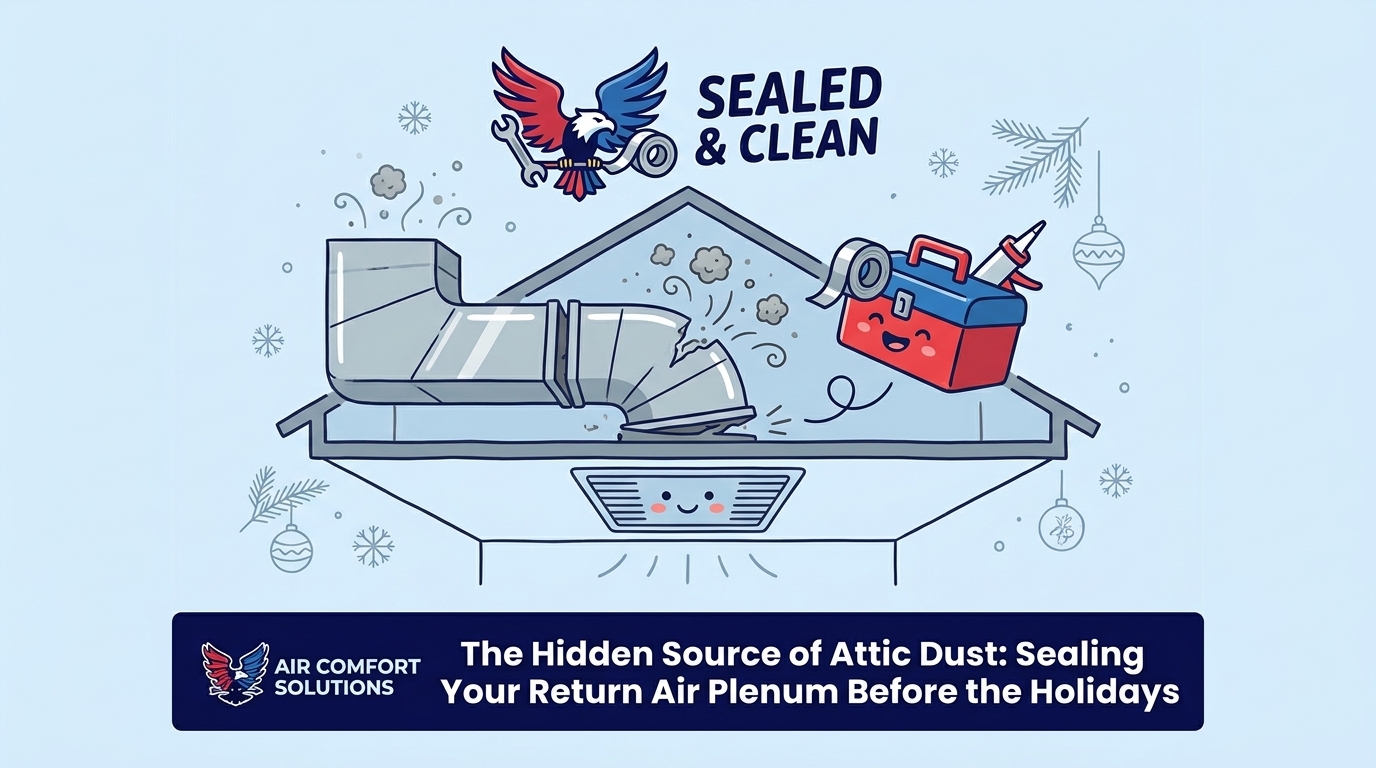
The Value of Sealing Your Return Air Plenum Before the Holidays
Most homeowners buy expensive filters to fix dusty air, not realizing a leaky return plenum in the attic is the real culprit. See why sealing it now saves your holiday gatherings.
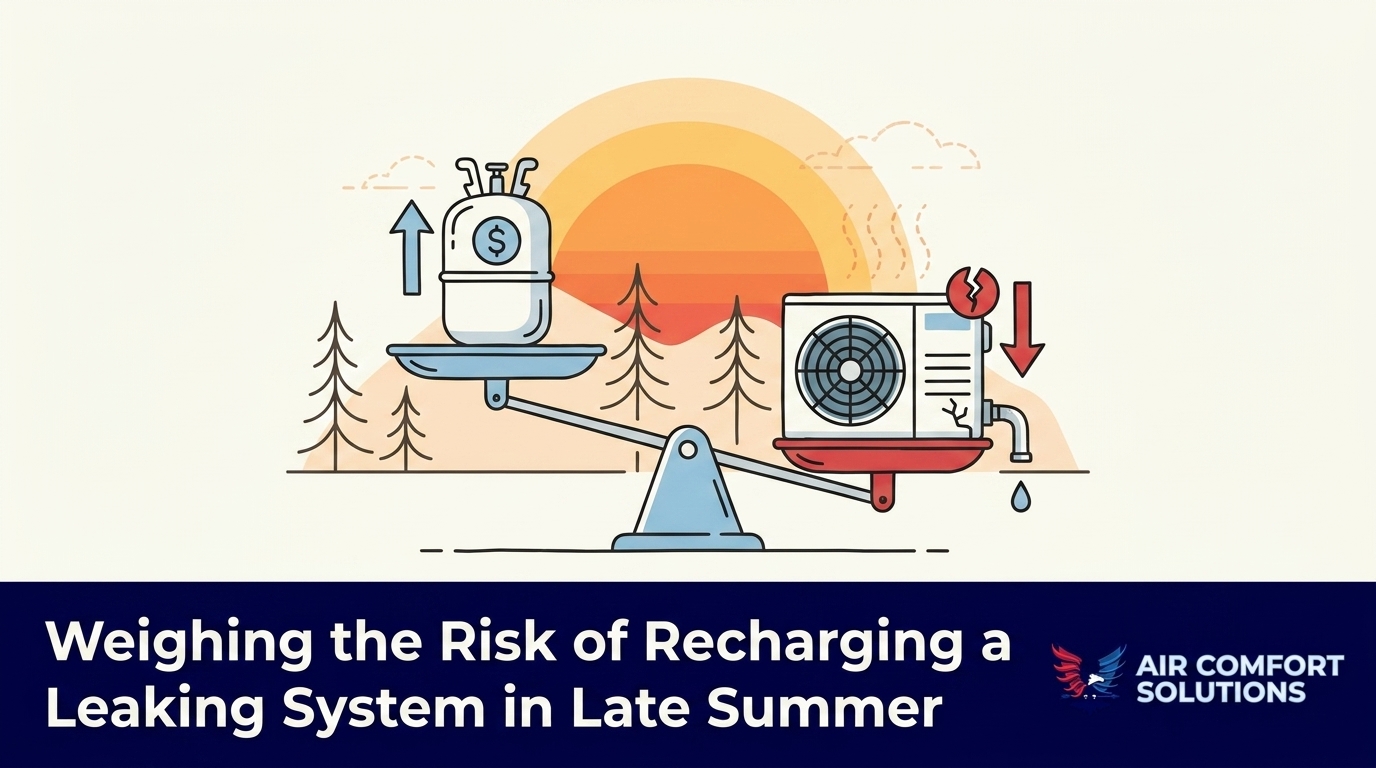
Assuming that the worst of the summer heat is behind us just because the calendar flipped to August is a common misconception that costs homeowners heavily, especially when you find yourself weighing the risk of recharging a leaking system in late summer. Right during the hectic August back-to-school transition, when your family's schedule is already packed, your air conditioner might suddenly start blowing lukewarm air. It is an incredibly frustrating moment. The house feels sticky, the vents are barely pushing out a breeze, and you are faced with a critical decision: do you just get a quick refrigerant top-off to survive the next few weeks, or do you invest the time to find and permanently fix the underlying leak?
The immediate temptation is always the quick fix. A simple recharge seems like the path of least resistance. You might think that if the system can just limp along until autumn, you can worry about the real repair next year. However, treating a closed, pressurized mechanical system this way ignores the severe underlying damage that is actively occurring. Refrigerant does not just disappear; it escapes through a physical hole in your copper lines or coils. When you are facing this frustrating dilemma, reaching out for professional HVAC services is the first step toward a reliable solution.
The objective of this guide: We are going to evaluate the true mechanical and long-term risks of ignoring an active refrigerant leak. By understanding how low refrigerant levels destroy compressors, freeze coils, and drain efficiency, you can make an informed decision that protects your home's comfort and your system's lifespan.
The Problem: Many homeowners apply a traditional seasonal mindset to their cooling systems, believing that late summer means the demand on their air conditioner is rapidly dropping. They assume a quick refrigerant top-off will easily bridge the gap between the August heat and the cool breezes of autumn.
The Cause: In Pinehurst TX, the climate does not adhere to a standard four-season calendar. Our region experiences an extended cooling season where August and September continue to deliver some of the highest sustained heat indexes of the entire year. The cooling degree days remain remarkably high well into October. Your air conditioning system is not winding down; it is still operating under peak mid-summer strain. A temporary refrigerant recharge is highly unpredictable because the size of the leak can expand under this continuous pressure.
The Solution and Reality: A top-off might literally leak out before October arrives, leaving your home uncooled during a brutal September heat wave. This creates a deeply frustrating cycle where you pay for a recharge, enjoy a week or two of comfort, and then face the exact same warm air blowing from your vents shortly after. The system must endure months of continued heavy operation, not just a brief grace period. Working with experienced Pinehurst AC experts ensures that you receive guidance based on our specific, extended regional climate, rather than generic advice that assumes the heat is already over.
When you run an air conditioner with low refrigerant, you are not just sacrificing indoor comfort; you are actively degrading the most critical component of the entire system. The compressor is the heart of your cooling equipment. It is responsible for pumping refrigerant through the lines, creating the pressure changes necessary to absorb and release heat. What many homeowners do not realize is that the refrigerant returning to the outdoor unit is actually responsible for cooling the compressor motor during operation.
When the system is actively leaking during the August back-to-school transition, the volume of refrigerant returning to the compressor drops significantly. Without this vital cooling effect, the compressor motor begins to run incredibly hot. Continuous top-offs simply mask this underlying problem. You might feel cool air inside the house for a few days, but the compressor is still suffering from inconsistent thermal management as the fluid levels constantly fluctuate. This is a critical factor to consider, especially when you are deciding on a late-season AC repair.
A compromised compressor is one of the most extensive and resource-intensive failures a system can experience. If the compressor burns out due to sustained overheating, the required repair often rivals the effort of replacing the entire outdoor unit.
To truly grasp why a band-aid top-off is so dangerous, you have to look at the internal mechanics of compressor overheating:
• The cycle of short-cycling: As the system struggles to reach the temperature set on your thermostat due to low refrigerant, it runs continuously. Eventually, internal thermal overload switches trip to protect the motor, shutting the system down abruptly. Once it cools slightly, it turns back on, creating a damaging cycle of rapid starting and stopping known as short-cycling.
• Degradation of internal components: The lack of proper thermal management causes the specialized lubricating oil inside the compressor to break down and become acidic. This acidic oil eats away at the electrical windings of the motor.
• The cascading effect: Once the electrical insulation inside the compressor is compromised by acid and extreme heat, an electrical short is inevitable. This cascading effect turns a simple, repairable leak into a catastrophic total system failure.
The dangers of a leaking system are not confined to the outdoor unit. Inside your home, dropping refrigerant levels create a completely different set of mechanical disasters. When you try to stretch out a leaking system in Pinehurst TX, the high late-summer humidity interacts disastrously with the compromised equipment. Here is exactly how a simple leak cascades into a frozen system and potential water damage:
1. Refrigerant pressure drops: As the system loses fluid, the pressure inside the indoor evaporator coil decreases significantly. According to the laws of thermodynamics, a drop in pressure results in a corresponding drop in temperature.
2. Coil temperatures plummet below freezing: The evaporator coil, which normally sits around 40 degrees Fahrenheit, quickly drops below the freezing point of water.
3. Condensation freezes on contact: In our humid regional climate, the indoor coil is constantly extracting moisture from the air. When the coil is below freezing, this condensation does not drip into the drain pan; it instantly turns to ice.
4. Airflow becomes completely blocked: The ice builds up rapidly, forming a solid block over the aluminum fins. This completely chokes off the airflow, which is why you might notice weak, warm air coming from your vents.
5. Uncontrollable melting and water damage: When the system is finally turned off, that massive block of ice melts rapidly. The volume of water often overwhelms the condensate drain pan, spilling over and causing significant water damage to your ceilings, floors, or drywall.
This destructive cycle will repeat rapidly if the underlying leak is not addressed. Recharging the system temporarily thaws the coil, but as soon as the refrigerant leaks out again, the ice returns.
Beyond the immediate mechanical dangers, there are significant regulatory and environmental factors that make continuous top-offs a poor long-term strategy. The HVAC industry is currently undergoing a massive transition driven by the EPA AIM Act, which mandates a strict phasedown of hydrofluorocarbons (HFCs), including the widely used R-410A refrigerant.
As this phasedown progresses, the production and importation of these older refrigerants are being drastically reduced. This means that as the years go on, relying on continuous top-offs will become increasingly unviable and difficult to source. If your system springs a leak during the August back-to-school transition, pouring more of a phased-down refrigerant into a failing system is a step backward.
Furthermore, allowing refrigerant to continuously leak into the atmosphere has a documented environmental impact. Air conditioning systems are designed to be closed loops; they should never consume or lose refrigerant during normal operation. A leak means that potent greenhouse gases are escaping directly into the air. Framing your decision around permanent leak repair or a full system replacement is the only way to future-proof your home's cooling infrastructure against these ongoing regulatory shifts.
When evaluating your next steps in Pinehurst TX, it helps to look at a clear, side-by-side comparison of your two primary options. While a top-off might seem appealing in the heat of the moment, the long-term realities paint a very different picture. Remember that locating and handling refrigerant leaks requires specialized diagnostic equipment and a licensed professional—this is never a safe or effective DIY project.
• Immediate Gratification — Band-Aid Top-Off: Restores cooling quickly, but only for an unpredictable, temporary period. — Permanent Leak Repair: Requires time for diagnostics and repair, but restores reliable, consistent cooling.
• Compressor Risk — Band-Aid Top-Off: Extremely high. The system will inevitably run low again, risking catastrophic burnout. — Permanent Leak Repair: Low. The closed loop is restored, ensuring the compressor receives proper thermal cooling.
• System Efficiency — Band-Aid Top-Off: Poor. As fluid leaks, the system runs longer and harder, driving up energy consumption. — Permanent Leak Repair: High. The system returns to its factory-designed operating pressures and efficiency levels.
• Environmental Impact — Band-Aid Top-Off: Negative. Continues to vent phased-down refrigerants into the atmosphere. — Permanent Leak Repair: Positive. Seals the closed loop and stops harmful atmospheric venting completely.
• Long-Term Viability — Band-Aid Top-Off: Fails to address the root cause, guaranteeing future breakdowns and frustration. — Permanent Leak Repair: Solves the root issue. If the system is too old, finding the leak justifies a full replacement.
In scenarios where the air conditioning equipment is severely aged, the diagnostic process of finding the leak is still highly valuable. Identifying a massive failure in an old evaporator coil provides the concrete evidence needed to confidently move forward with air conditioning repair and replacement, rather than throwing good money after bad.
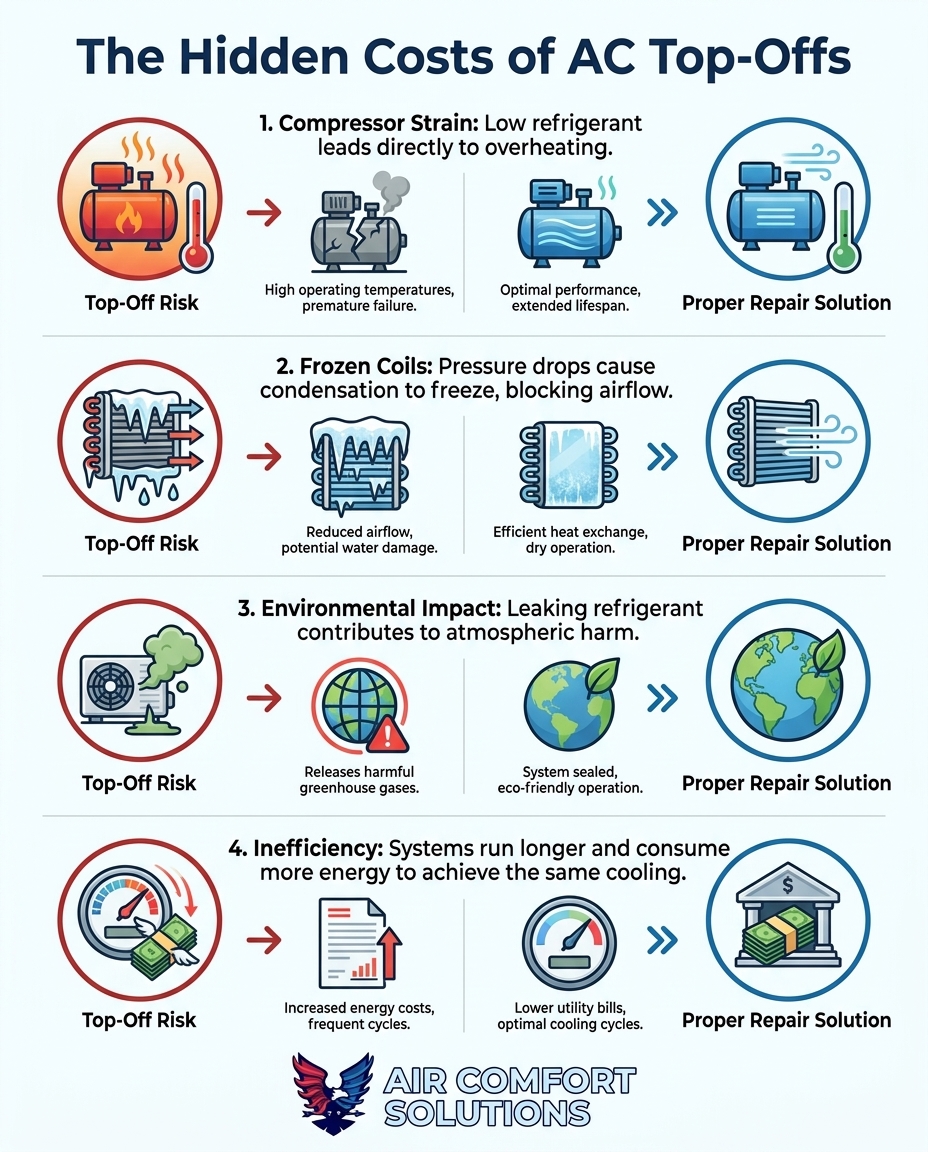
The risks of compressor failure, frozen coils, and severe system inefficiency far outweigh the fleeting convenience of a quick recharge. When your system starts failing during the August back-to-school transition, the most strategic move you can make is to request a comprehensive leak search rather than a simple top-off.
Air Comfort Solutions prioritizes honest, transparent advice to ensure homeowners do not waste resources on 'band-aid' fixes when a long-term solution is necessary. We believe in diagnosing the root cause so you understand exactly what is happening inside your equipment. Furthermore, enrolling in a preventative AC maintenance plan can help catch these micro-leaks and pressure drops during routine inspections, long before they result in a mid-August breakdown. By weighing the risk of recharging a leaking system in late summer against the immense benefits of a permanent fix, you secure a reliable, efficient, and comfortable home for years to come.
What happens if you just recharge a leaking AC?
If you just recharge a leaking AC, the new refrigerant will eventually escape through the same hole, leaving you right back where you started. In the meantime, the fluctuating pressure levels put immense strain on your compressor, increasing the risk of a total system breakdown. It is a temporary band-aid that masks a serious mechanical defect.
How long does a refrigerant recharge last if there is a leak?
The lifespan of a recharge depends entirely on the size of the leak, ranging from a few months to literally just a few days. Because the system operates under high pressure, a small pinhole leak can expand rapidly over time. There is no reliable way to predict how long a top-off will last, making it a highly risky gamble during hot weather.
Why is my AC compressor overheating after a top-off?
Your AC compressor may overheat after a top-off if the refrigerant has already leaked out again, or if the system was improperly charged. Refrigerant is required to cool the compressor motor during operation. When levels drop, the motor loses its thermal management, causing it to run dangerously hot and potentially trip its internal overload switches.
Can you just keep putting refrigerant in an AC?
While technically possible, continuously putting refrigerant into an AC is highly discouraged and environmentally harmful. It is incredibly inefficient, risks destroying your compressor, and releases phased-down greenhouse gases into the atmosphere. Regulatory shifts are also making older refrigerants harder to source, making continuous top-offs an unsustainable strategy.
Is it worth fixing a refrigerant leak in an older AC?
It is generally only worth fixing a leak in an older AC if the leak is small, easily accessible, and the rest of the system is in excellent condition. If the system is over 10-15 years old, uses phased-out refrigerant, or has a leak hidden deep within the evaporator coil, investing in a full system replacement is usually the more cost-effective and reliable choice.
How do professionals safely locate an AC refrigerant leak?
Professionals safely locate leaks using specialized diagnostic tools such as electronic leak detectors, ultraviolet (UV) dye injections, and ultrasonic testing equipment. They methodically scan the closed loop, checking the evaporator coil, condenser coil, and all copper line connections. This process requires specialized training and licensing to ensure the refrigerant is handled safely and legally.


Zane came out and did an amazing job! Super friendly, honest and transparent about the work that needed to be done. This is my second time working with Air Comfort Solutions and they’re my go to for HVAC services. Highly recommend.
God's AMAZING grace sent us Robert and Zane. We have been without air in this Texas heat for six weeks and four days. We've had a few contractors give us quotes all trying to upsell when we're at a low point. But not the guys at Air Comfort Solutions. They came in assessed our situation, gave us honest feedback, and showed us the issues as they proceeded with the assessment for clear understanding. We highly recommend them for their professionalism, quality products, and fair pricing. We hands down support them for all the work they do 💯 %.
Robert and Zane gone above and beyond to make the process easy and affordable.
Would definitely recommend!!
I’m writing this review to let everyone know that Air Comfort Solutions is the company to work with. I know the owner ( Robert) for several years now. He has been taking care of my residential and business work orders. Robert is professional, knowledgeable and will save you money. I just want to thank Robert for great job you have been doing for me.