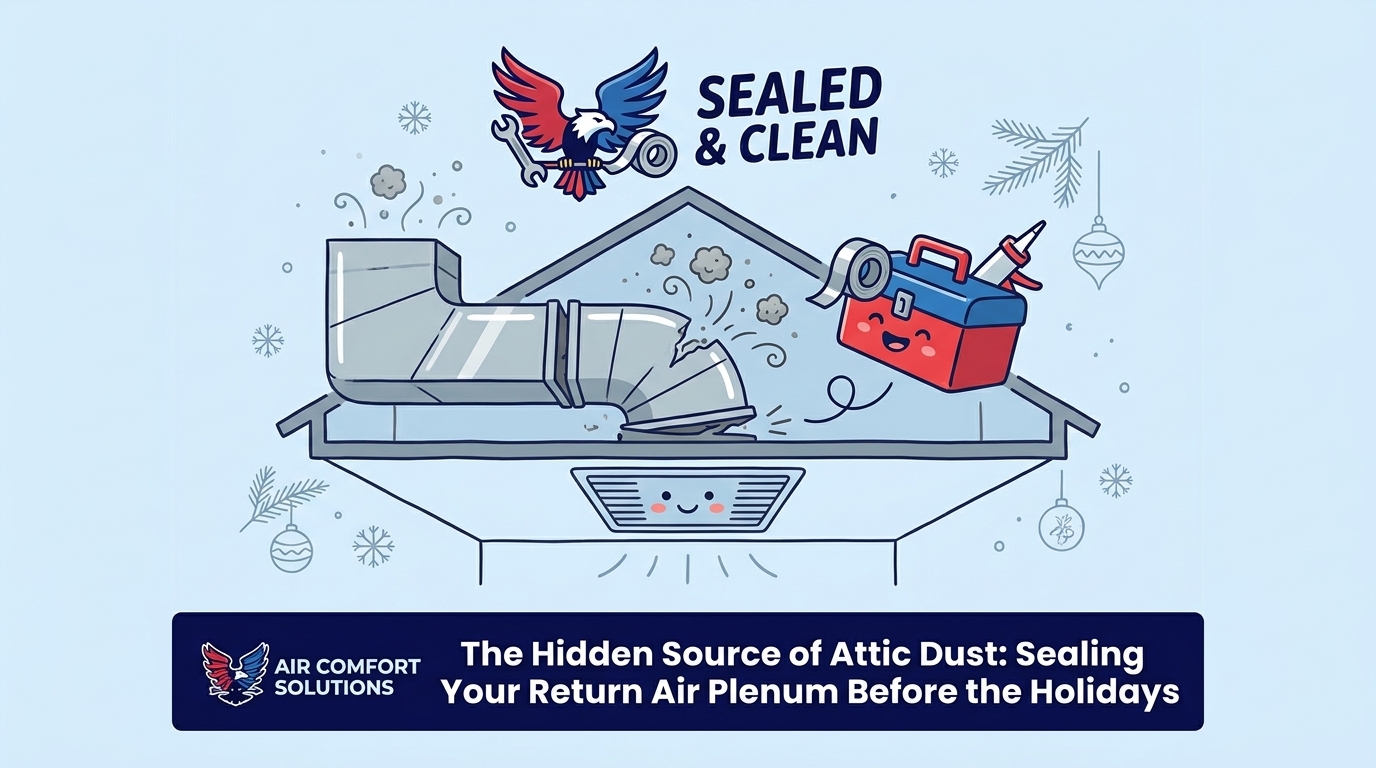
The Value of Sealing Your Return Air Plenum Before the Holidays
Most homeowners buy expensive filters to fix dusty air, not realizing a leaky return plenum in the attic is the real culprit. See why sealing it now saves your holiday gatherings.
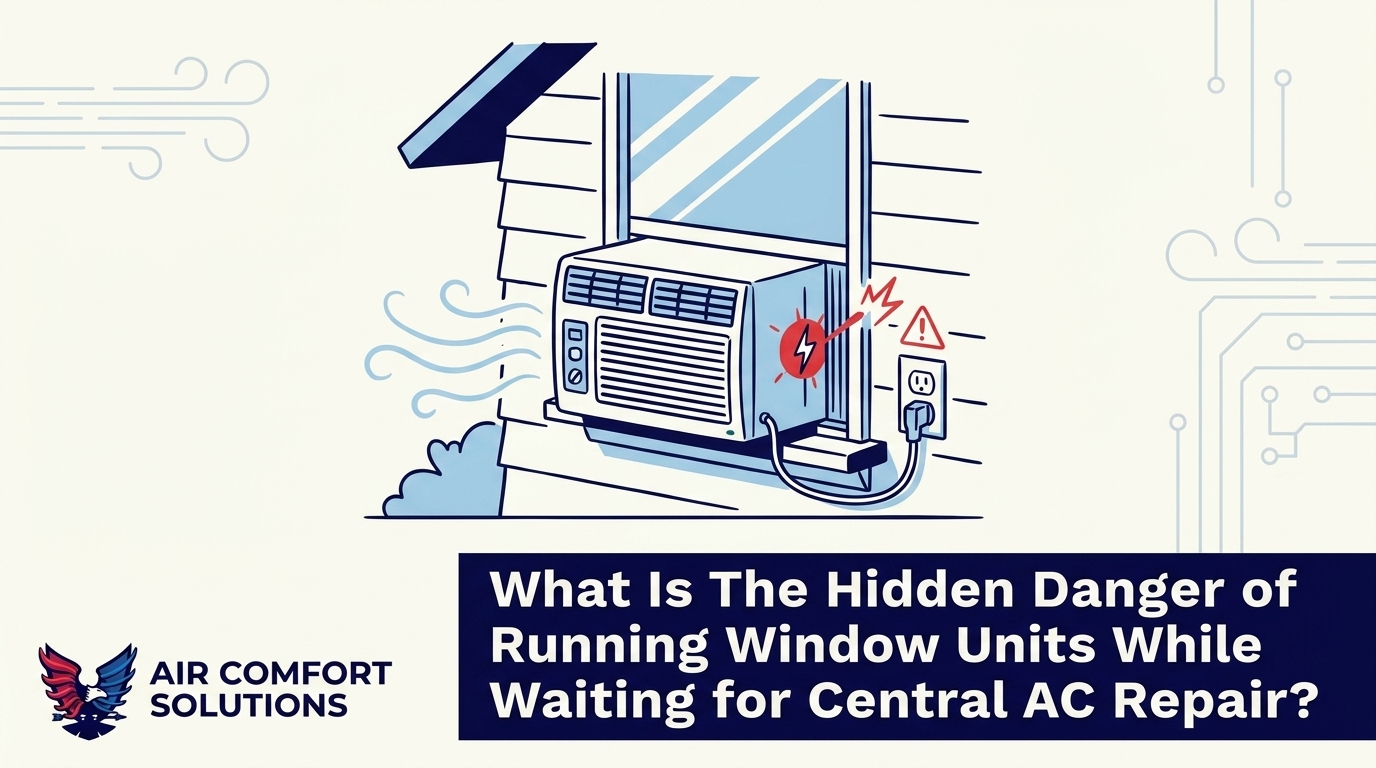
Are you trying to figure out how to cool your home right now, unaware of The Hidden Danger of Running Window Units While Waiting for Central AC Repair? When your primary system fails during peak July summer heat, the immediate instinct is to rush to the hardware store, purchase several temporary units, and plug them into every bedroom. The desperation to escape the sweltering indoor temperatures is completely understandable. However, at Air Comfort Solutions, our team frequently sees how this rapid deployment creates a severe, unseen hazard behind your drywall.
While temporary cooling is necessary for your family's well-being, improper setup introduces significant electrical and fire hazards. Your home's electrical system was engineered with specific load limitations in mind. When you introduce heavy, continuous-draw appliances into standard wall outlets, you are fundamentally altering how your home's wiring operates. Before you plug in another unit, our team strongly recommends developing a safe strategy to bridge the gap until you can secure professional HVAC services.
Understanding the limits of your residential electrical system is the first step in protecting your property. Most standard outlets are simply not designed to handle the massive energy demands of modern cooling equipment running simultaneously. By balancing your need for comfort with strict electrical safety protocols, you can navigate an unexpected outage without putting your electrical panel at risk.
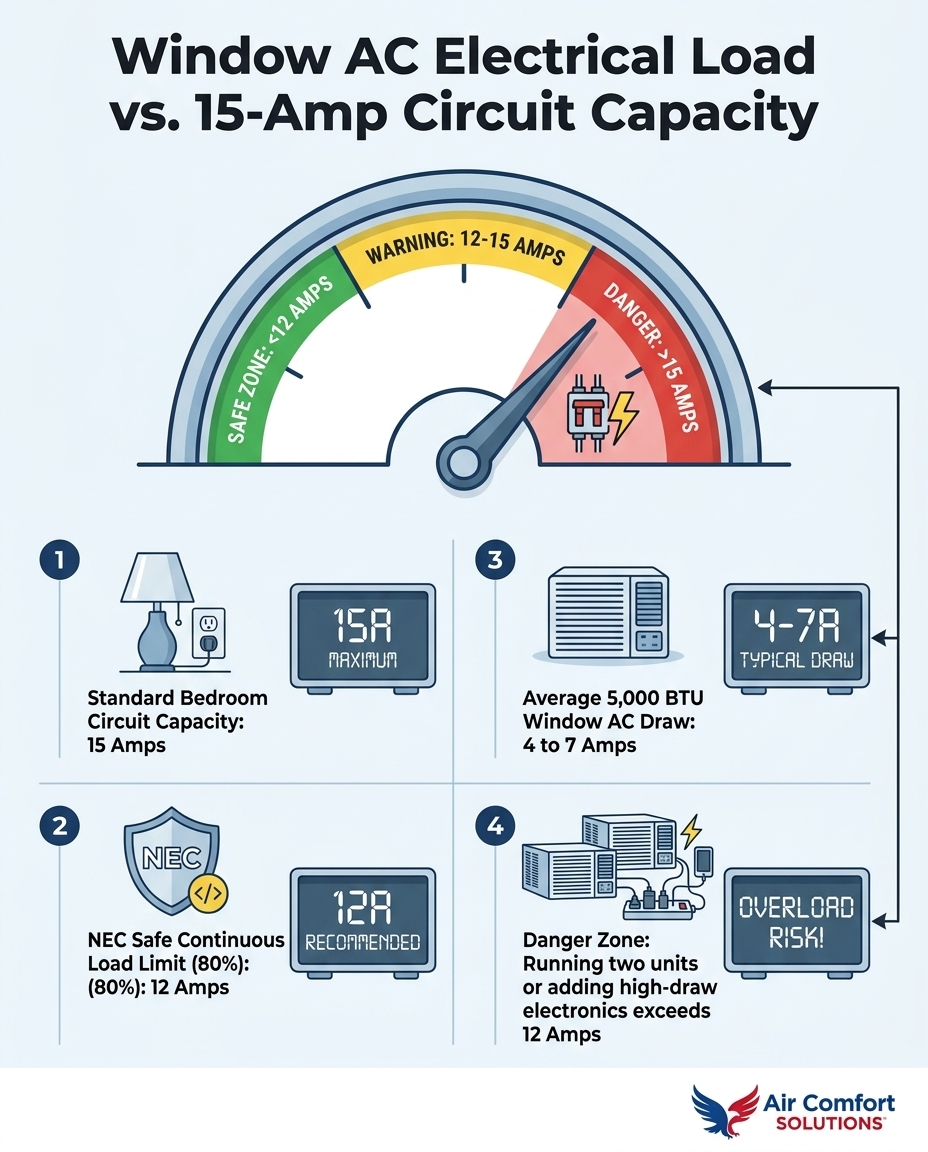
In our years of serving the Pinehurst area, we've found that to understand why temporary cooling can be so dangerous, we have to look at the math behind your electrical panel. Standard 15-amp residential bedroom circuits are the most common type of wiring found in modern living spaces. These circuits are designed to handle standard household items like lamps, televisions, phone chargers, and ceiling fans. They are not engineered to serve as heavy-duty power sources for major mechanical equipment.
A typical 5,000 to 8,000 BTU window air conditioner draws between 4 and 7 amps of electricity while running. On the surface, 7 amps seems perfectly safe for a 15-amp circuit. However, the National Electrical Code (NEC) dictates a strict 80% rule for continuous loads. Any appliance that runs for three hours or more is considered a continuous load, and it must not exceed 80% of the circuit's total capacity. For a 15-amp circuit, your absolute maximum safe continuous limit is just 12 amps.
If you plug a 7-amp window unit into a bedroom outlet, you only have 5 amps of safe capacity remaining for everything else on that circuit. If you turn on a television, a desktop computer, and a vacuum cleaner, you will instantly exceed that 12-amp threshold. Even worse, if you attempt to plug two window units into the same room, you are mathematically guaranteed to overload the wiring.
Here is a breakdown of how quickly a standard 15-amp residential bedroom circuit reaches its safe limit of 12 amps:
• Standard 8,000 BTU Window AC — Estimated Amperage Draw: 7.0 Amps — Cumulative Load on Circuit: 7.0 Amps
• Desktop Computer & Monitor — Estimated Amperage Draw: 3.0 Amps — Cumulative Load on Circuit: 10.0 Amps
• Large LED Television — Estimated Amperage Draw: 1.5 Amps — Cumulative Load on Circuit: 11.5 Amps
• Ceiling Fan & Lights — Estimated Amperage Draw: 1.0 Amps — Cumulative Load on Circuit: 12.5 Amps (Over Safe Limit)
This rapid accumulation of electrical demand is exactly why relying on makeshift cooling while waiting for central AC repair requires careful planning and strict adherence to electrical limits.
The danger of temporary cooling goes beyond simple amperage math; it involves how long that amperage is sustained. In the HVAC industry, a "duty cycle" refers to the percentage of time a compressor runs compared to the time it rests. A properly sized central system cycles on, cools the house, and then cycles off. These resting periods are critical because they allow the electrical components, wiring, and breakers to cool down.
During peak July summer heat and high humidity in Southeast Texas, our technicians constantly see temporary window units forced to draw maximum amperage as they struggle to dehumidify and cool simultaneously. Because the unit can never satisfy the thermostat's demand in these harsh conditions, it runs continuously without ever cycling off. This results in a 100% duty cycle.
Running at a 100% duty cycle fundamentally changes the nature of the appliance. It transitions from a standard household device into a severe, continuous electrical load. When wires carry electrical current continuously for hours or days on end during peak July summer heat, they encounter electrical resistance. This resistance generates friction, which manifests as physical heat inside your walls.
If the wiring cannot shed this heat because the current never stops flowing, the protective insulation around the copper wires begins to degrade, become brittle, and eventually melt. This compounding thermal stress is a primary cause of electrical fires during summer power emergencies. Understanding this invisible stress is vital for keeping your property safe.
Your home's electrical system will usually give you warning signs before a catastrophic failure occurs. Recognizing these symptoms early allows you to intervene before the wiring sustains permanent damage or sparks a fire. Because 15-amp residential bedroom circuits are so easily overwhelmed, our repair crews always warn homeowners to remain vigilant while running temporary equipment.
If you notice any of the following symptoms, you are actively overloading your electrical circuit and must take immediate action:
• Dimming or flickering lights: If the overhead lights dim significantly every time the window AC compressor kicks on, the unit is pulling too much voltage away from the rest of the circuit.
• Warm or hot outlet covers: Place the back of your hand against the plastic wall plate where the unit is plugged in. If it feels warm or hot to the touch, the internal wiring is experiencing dangerous levels of resistance and heat buildup.
• Frequently tripping breakers: A circuit breaker that flips off is not a nuisance; it is a critical safety mechanism doing its exact job. If the breaker trips, it means the wires were moments away from overheating.
• Burning odors near outlets: A faint smell of melting plastic or ozone near the receptacle is an immediate emergency indicating that the wire insulation is actively breaking down.
• Buzzing or crackling sounds: Any audible noise coming from the electrical panel or the wall outlet points to loose connections or arcing electricity caused by thermal expansion.
If you experience any of these warning signs, unplug the unit immediately. Do not attempt to reset a breaker repeatedly without reducing the electrical load, and reach out to Pinehurst AC experts to expedite your permanent cooling solution.
One of the most common and dangerous mistakes we encounter on emergency service calls is homeowners using standard indoor extension cords to power window units. Because standard 15-amp residential bedroom circuits often lack conveniently placed outlets near the windows, it is tempting to run a cord across the room. The Consumer Product Safety Commission (CPSC) explicitly warns against using standard indoor extension cords for air conditioners.
The primary danger lies in a physics concept called voltage drop. When electricity travels over a distance, the wire itself provides resistance. The longer the cord, the more resistance the electricity faces, resulting in a drop in voltage by the time the power reaches the AC unit. Air conditioning compressors require a very specific voltage to operate. When the voltage drops due to a long extension cord, the compressor must pull significantly more amperage to compensate and keep running.
This spike in amperage overwhelms the thin gauge wire used in standard household extension cords. The cord's insulation is not rated for this level of continuous thermal stress. Within hours, the cord can overheat, melt into the carpet, and ignite a fire. Furthermore, the voltage drop forces the AC compressor to run hotter and work harder, drastically shortening the lifespan of the temporary unit itself.
The strict, non-negotiable rule we give for temporary cooling is that window units must be plugged directly into a grounded wall receptacle. If the cord cannot reach the outlet, you must move the unit to a different window. Never compromise your home's safety for the sake of convenience.
Surviving the heat safely requires a disciplined approach to how you manage your home's available electrical capacity. You can maintain a tolerable indoor environment without violating safety rules or resorting to dangerous DIY electrical modifications. By following strict load management protocols, you can protect your property in Spring, TX while waiting for our professionals to arrive.
Implement these safe interim strategies immediately:
1. Limit usage to one unit per circuit: Never plug two window units into the same room or the same breaker circuit. Map out your electrical panel to ensure each unit is drawing from an entirely separate 15-amp or 20-amp breaker.
2. Unplug non-essential electronics: Free up electrical capacity on the active circuit by physically unplugging televisions, desktop computers, gaming consoles, and unnecessary lamps. Every amp matters when running a continuous load.
3. Isolate the cooling zone: Keep the bedroom doors tightly closed. Minimizing the square footage the temporary unit has to cool helps it cycle off occasionally, reducing the 100% duty cycle stress on your wiring.
4. Utilize thermal curtains: Block out direct sunlight during the hottest parts of the day. Preventing solar heat gain reduces the thermal load on the room, allowing the undersized unit to operate more effectively.
5. Never bypass safety mechanisms: If a breaker trips, do not tape it down, attempt to swap it for a larger breaker, or modify the electrical panel in any way. Consult a licensed professional for any electrical panel issues.
By treating your electrical capacity as a finite resource, you can safely navigate the waiting period until you can secure 24-hour AC repair in Spring, TX.
Our technicians often explain that the unit is drawing more amperage than the circuit is rated for, triggering the breaker's safety mechanism to prevent an electrical fire. This usually happens when the window AC is sharing a standard 15-amp residential bedroom circuit with other electronics, pushing the total electrical load past the breaker's safe operational limit. You must unplug other devices or move the unit to a dedicated circuit.
No. Two standard window units will easily exceed the 15-amp limit of a typical bedroom circuit, leading to overloads and tripped breakers. Even small 5,000 BTU units pull around 4 to 5 amps each. Running two of them continuously puts you dangerously close to the 80% continuous load limit, leaving absolutely no capacity for lights or other essential room fixtures.
Never use a standard household extension cord. It can cause voltage drops, overheating, and severe fire hazards. Always plug directly into the wall. If you absolutely must use an extension cord due to outlet placement, it must be a heavy-duty, appliance-rated cord (typically 12-gauge or thicker) that is as short as physically possible, though direct wall connection remains the only truly safe method.
A standard 5,000 to 8,000 BTU window unit typically draws between 4 and 7 amps, consuming nearly half of a standard 15-amp circuit's capacity. Larger units, such as 12,000 BTU models, can draw up to 10 or 12 amps, which maxes out the continuous load limit of a standard residential breaker entirely on its own.
The National Electrical Code states that any appliance running for three hours or more should not exceed 80% of the circuit's total capacity. For standard 15-amp residential bedroom circuits, this means your continuous draw cannot exceed 12 amps. Because temporary window units often run nonstop during outages, they fall strictly under this continuous load regulation.
You can run a window unit continuously as long as it is plugged directly into a wall outlet that is not exceeding its safe amperage limits. However, running an undersized unit nonstop puts immense wear and tear on its internal compressor. We highly recommend using them strictly as short-term stopgaps until a professional can restore your primary central system.
Ultimately, window units are only a temporary, electrically taxing stopgap. They are not a sustainable substitute for a fully functioning central air conditioning system. Every day you rely on makeshift cooling, you are forcing standard household wiring to handle continuous, heavy-duty mechanical loads. Restoring your primary central system is the only way to permanently remove these dangerous continuous loads from your bedroom circuits.
When you transition back to a centralized system, the heavy electrical lifting is moved back to the dedicated, high-capacity 220-volt circuits designed specifically for that purpose. This restores the natural balance of your home's electrical panel. Fast, reliable emergency AC repair is not just about getting comfortable again; it is a critical safety necessity that eliminates the severe electrical risks of relying on temporary window units.
We believe homeowners in Spring and Pinehurst, TX deserve the peace of mind that comes from safe, distributed whole-home cooling. By prioritizing permanent repairs over long-term reliance on makeshift setups, you protect your property from unseen thermal stress inside the walls. Investing in the prompt restoration of your complete HVAC systems is the smartest decision for both your comfort and your home's structural safety.
Addressing a central AC failure promptly is about much more than just beating the peak July summer heat; it is about protecting your home's entire electrical infrastructure from dangerous overloads. Do not let a mechanical breakdown force you into relying on hazardous, makeshift cooling strategies for longer than absolutely necessary. Schedule a thorough inspection with the experts at Air Comfort Solutions to diagnose and resolve your primary cooling issues. Professional intervention is the safest, most effective path forward to ensure your family remains comfortable and your home remains secure.


Zane came out and did an amazing job! Super friendly, honest and transparent about the work that needed to be done. This is my second time working with Air Comfort Solutions and they’re my go to for HVAC services. Highly recommend.
God's AMAZING grace sent us Robert and Zane. We have been without air in this Texas heat for six weeks and four days. We've had a few contractors give us quotes all trying to upsell when we're at a low point. But not the guys at Air Comfort Solutions. They came in assessed our situation, gave us honest feedback, and showed us the issues as they proceeded with the assessment for clear understanding. We highly recommend them for their professionalism, quality products, and fair pricing. We hands down support them for all the work they do 💯 %.
Robert and Zane gone above and beyond to make the process easy and affordable.
Would definitely recommend!!
I’m writing this review to let everyone know that Air Comfort Solutions is the company to work with. I know the owner ( Robert) for several years now. He has been taking care of my residential and business work orders. Robert is professional, knowledgeable and will save you money. I just want to thank Robert for great job you have been doing for me.