Why Your AC Compressor Fails and What to Do: A Homeowner's Guide for Pinehurst, TX
Why your AC compressor fails and what to do is one of the most urgent questions a homeowner can face — especially when temperatures in Pinehurst, TX are climbing past 95°F and your home suddenly stops cooling.
Here is a quick answer before we dive deeper:
The most common reasons your AC compressor fails:
- Electrical issues - Voltage imbalances, failed capacitors, or a bad contactor overload the motor windings
- Dirty condenser coils - Restricted heat transfer forces the compressor to work harder until it overheats
- Refrigerant problems - Low charge starves the compressor of lubrication; overcharge or liquid slugging destroys valves
- Lack of maintenance - Neglected systems accumulate moisture, debris, and acid that eat away at internal components
- Age and wear - Most compressors last 10 to 15 years; extreme Texas heat shortens that window
What to do right now if you suspect compressor failure:
- Turn off your AC system at the thermostat to prevent further damage
- Check your circuit breaker — reset it once, but do not reset it again if it trips a second time
- Do not run the system if it is making grinding, clanking, or rattling noises
- Call a licensed HVAC technician for a proper diagnosis before assuming the compressor is dead
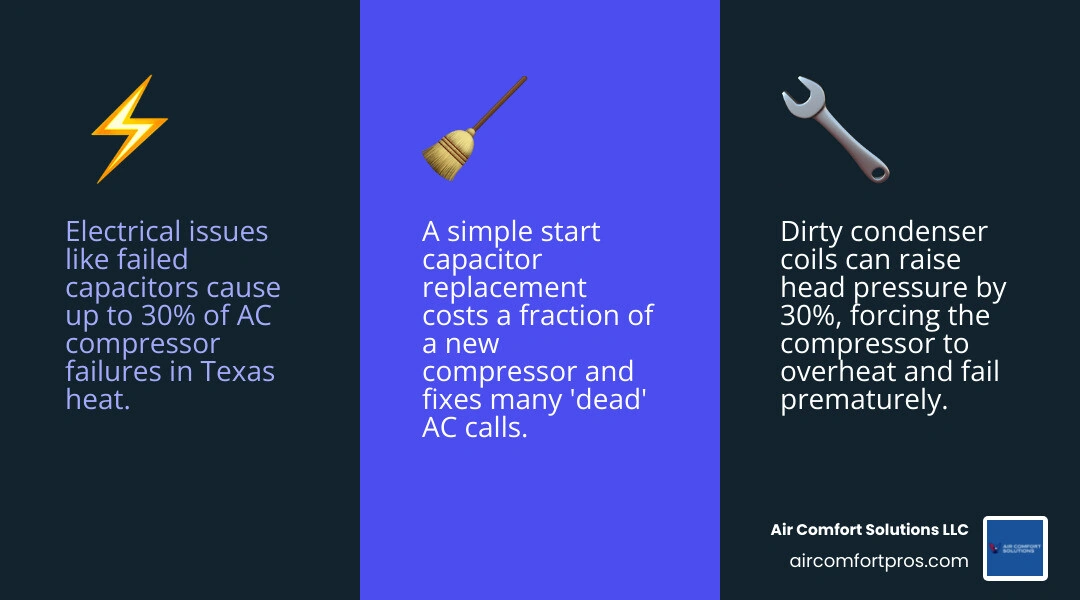
The good news? Not every compressor "failure" is actually a dead compressor. A simple, inexpensive part like a start capacitor is frequently the real culprit — and replacing it costs a fraction of a full compressor swap.
I'm Robert Patterson, and in this guide I'll walk you through every cause, warning sign, and decision point you need to handle this situation confidently.
Why your ac compressor fails and what to do terminology:
Understanding the Heart of Your HVAC: Why Your AC Compressor Fails and What to Do
To make sense of why your ac compressor fails and what to do, we first have to understand what this component actually does.
Think of your air conditioning system as a giant heat sponge. It doesn't actually "create" cold air; instead, it absorbs the heat inside your home and dumps it outside. The vehicle for this heat transfer is the refrigerant, and the engine that pumps this refrigerant through the system is the compressor.
Because it serves as the literal heart of your HVAC system, the compressor is under tremendous physical and electrical strain. It is hermetically sealed inside a heavy steel canister to protect its motor windings and mechanical pistons from the elements. However, this sealed design also means that if an internal mechanical part snaps or the motor windings burn out, the unit cannot be opened and repaired. The entire canister must be replaced.
Understanding this design is crucial when reading our guide on How to Tell If Your AC Compressor Is Failing. When a compressor struggles, it is often the victim of external system faults that force it to run too hot, too long, or under too much pressure.
What Does the AC Compressor Do?
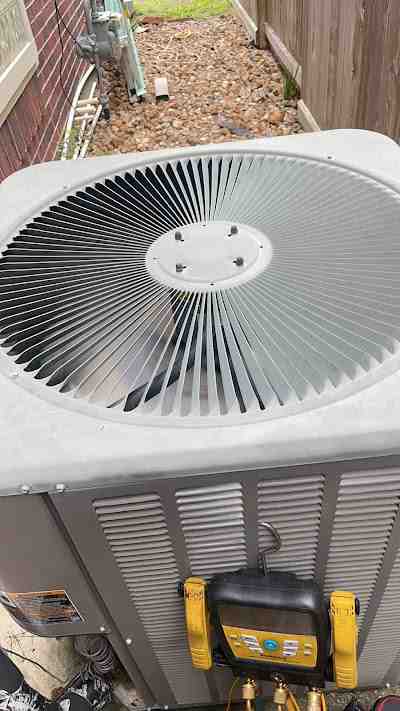
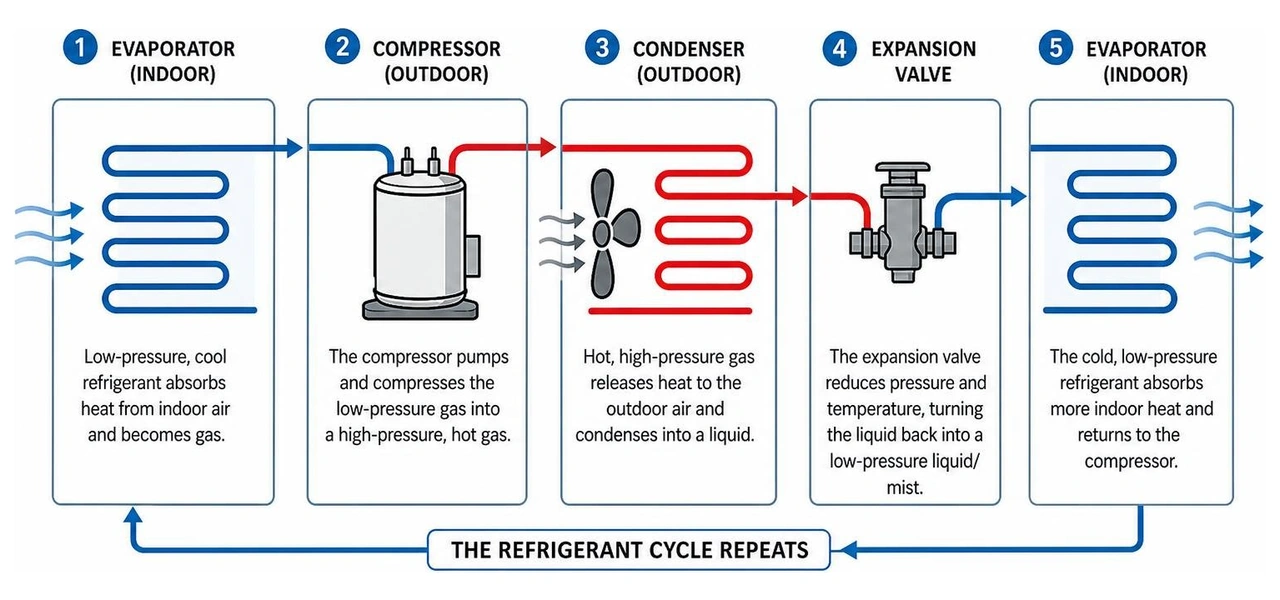
The cooling cycle begins when low-pressure, cool refrigerant gas leaves your indoor evaporator coil and enters the outdoor compressor. The compressor's primary job is to compress this low-pressure gas into a highly concentrated, high-pressure, hot gas.
By raising the pressure and temperature of the refrigerant, the compressor makes it easy for the outdoor condenser coil to shed heat. As the hot gas flows through the condenser coil, the outdoor fan blows air across the metal fins, releasing the indoor heat into the outdoor air. The refrigerant then cools down, condenses into a liquid, passes through an expansion valve to drop its pressure, and heads back indoors to absorb more heat.
Without the compressor, the refrigerant sits idle. There is no movement, no pressure differential, and absolutely no heat transfer.
The Danger of Ignoring a Struggling Compressor
Running an air conditioner with a struggling compressor is a recipe for a catastrophic system burnout. If your compressor is experiencing electrical resistance, drawing high amperage, or running low on oil, it will generate extreme internal heat.
This heat breaks down the refrigeration oil, leading to "oil carbonization." When oil carbonizes, it loses its lubricating properties and turns highly acidic. This acid eats away at the protective enamel coating on the motor windings.
Once the insulation fails, a short-to-ground occurs, resulting in a compressor burnout. This burnout releases acid and carbon soot throughout your entire copper line set, contaminating your indoor evaporator coil and outdoor condenser. If this happens, simply putting in a new compressor is useless; the acid left in the lines will quickly eat through the new unit. A complete, highly labor-intensive system flush—or a total system replacement—becomes your only option.
How to Tell If Your AC Compressor Is Failing vs. Another Component
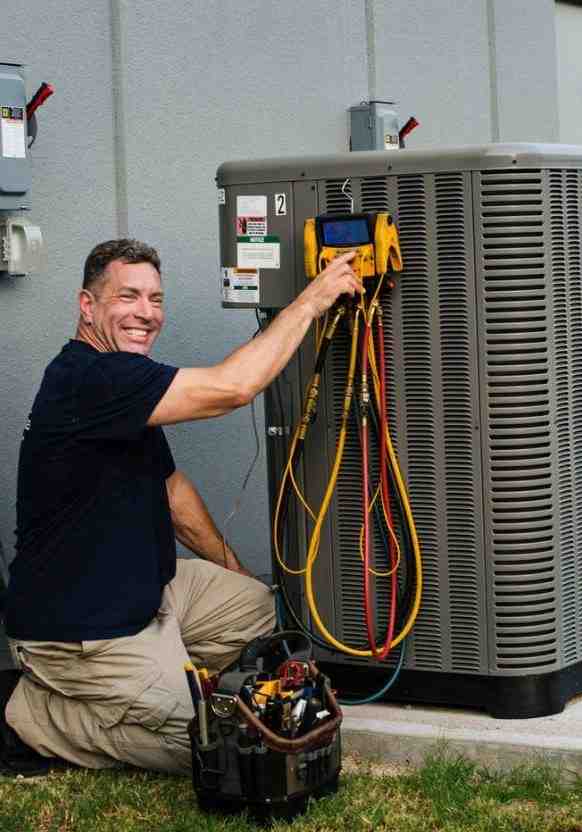
When your air conditioning stops blowing cold, it is easy to panic and assume the worst. However, many components in an outdoor condensing unit can fail and mimic the symptoms of a dead compressor. Before you assume you need a massive system overhaul, we must isolate the problem.
For a deeper look into seasonal symptoms, check out our article on the Signs Your AC Compressor Is Failing in Spring.
Early Warning Signs of a Failing Compressor
If your compressor is on its last legs, it will rarely go quietly. Keep an eye and ear out for these common warning signs:
- Lukewarm Air from Vents: If your indoor blower fan is running but the air coming out of your supply registers is warm, the compressor may not be turning on or pumping refrigerant.
- Loud Clanking, Rattling, or Grinding: A healthy compressor should run with a steady, low hum. If you hear metallic clanking, rattling, or high-pitched squealing from the outdoor unit, internal valves or pistons are likely failing.
- Hard Starting and Shaking: If the outdoor unit visibly shakes or makes a loud, struggling "clunk" when it tries to start, the compressor is hard starting.
- Repeatedly Tripped Circuit Breakers: The compressor draws more electrical current than any other part of your system. If it has internal electrical resistance, it will draw excessive amps and instantly trip your home's main electrical breaker.
Is It a Bad Capacitor or a Dead Compressor?
One of the most common service calls we make in Pinehurst involves a system that won't cool, accompanied by a loud, repeating humming noise from the outdoor unit. To the untrained ear, it sounds like a dead compressor.
In reality, this is often a classic case of a failed run or start capacitor. The capacitor acts like a temporary battery, providing the electrical "shove" your compressor needs to start spinning.
If the capacitor bulges, leaks, or loses its electrical capacitance, the compressor will try to start, hum loudly for a few seconds, and then shut down on its thermal overload switch.
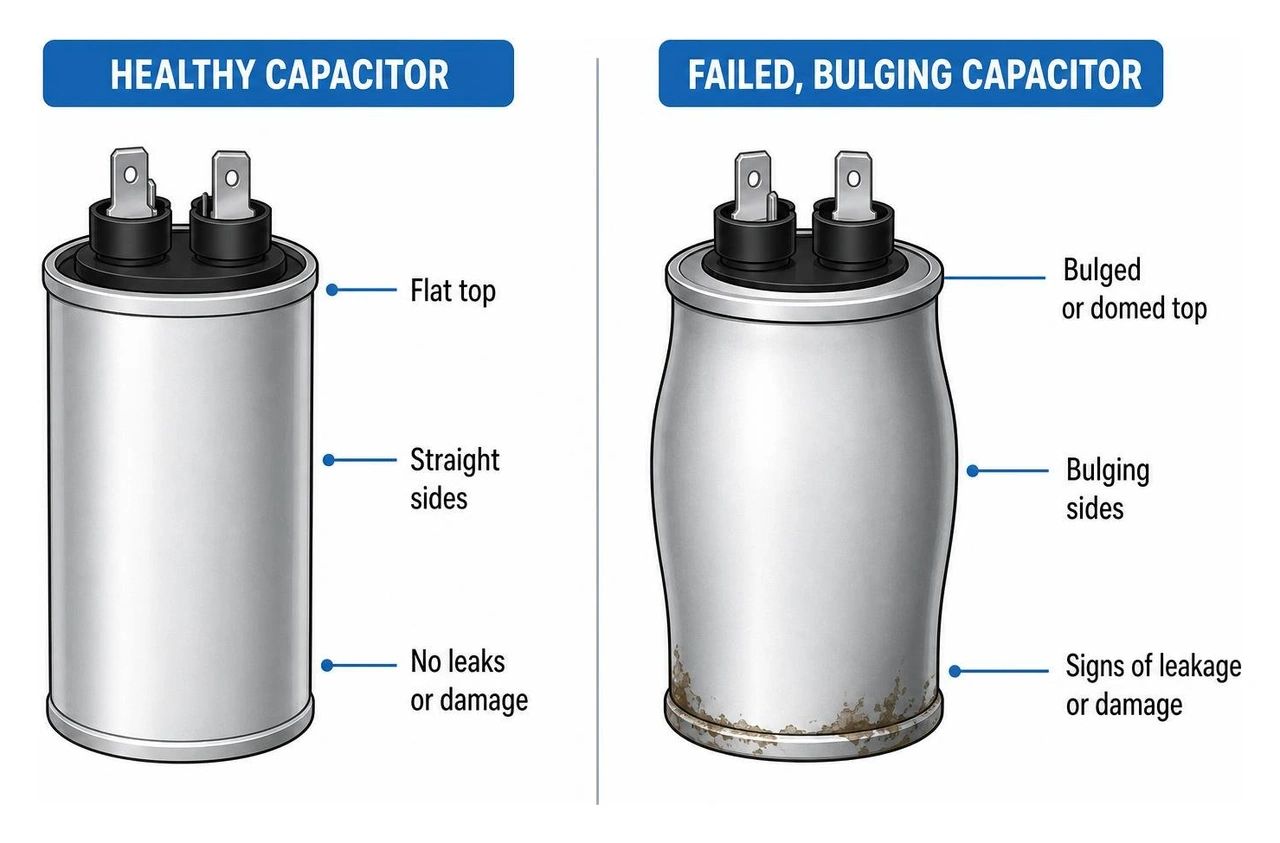
Before assuming your compressor is ruined, a technician will use a multimeter to test the microfarad rating of the capacitor. Replacing a failed capacitor is a quick, routine repair. To understand why this part fails so often in our extreme climate, read about Capacitor Failure: Why It Is the Most Common AC Repair.
Common Causes of AC Compressor Failure in Hot, Humid Climates
In Southeast Texas, our cooling systems face some of the harshest operating conditions in the country. The combination of intense summer heat and high relative humidity means AC systems run for hours on end without a break. This constant load accelerates wear and tear, making proper maintenance absolutely essential.
To learn more about what keeps local repair technicians busy during the summer, explore our breakdown of the Most Common AC Repairs and What Causes Them.
Electrical Issues and Voltage Imbalances: Why Your AC Compressor Fails and What to Do
The electrical grid undergoes massive strain during Texas summers, leading to voltage fluctuations. A voltage imbalance as small as 3% to 4% can cause the motor windings inside your compressor to spike in temperature.
Additionally, the contactor—the electrical switch that sends power to your compressor—can pit, corrode, or get stuck. If the contactor contacts stick together, the compressor will run continuously, even when your thermostat is satisfied, leading to rapid mechanical failure.
Refrigerant Leaks and Liquid Slugging: Why Your AC Compressor Fails and What to Do
Refrigerant does more than just transfer heat; it also carries the lubricating oil that keeps the compressor's internal pistons and bearings moving smoothly.
If your system develops a refrigerant leak, two things happen:
- The compressor is starved of the cooling gas it needs to keep its motor cool.
- The compressor loses its oil charge, leading to metal-on-metal friction and physical seizure.
Conversely, too much refrigerant or restricted indoor airflow (due to a frozen evaporator coil) can cause liquid refrigerant to flood back down the suction line. Because liquids cannot be compressed, this "liquid slugging" instantly destroys the compressor's internal valves and pistons.
Dirty Coils and Restricted Airflow
Your outdoor condenser coil needs to breathe. If it is coated in dirt, pollen, grass clippings, or pet dander, it cannot release heat. This causes the pressure inside the system (head pressure) to skyrocket.
The compressor must work twice as hard to pump refrigerant against this high pressure, drawing high amperage and overheating.
| System Condition | Condenser Head Pressure | Compressor Temperature | System Energy Efficiency | Compressor Lifespan |
|---|
| Clean Coils | Normal / Low | Cool / Optimal | Max Efficiency | 10 to 15+ Years |
| Dirty Coils | Extremely High | Dangerous / Overheating | Reduced by up to 30% | Premature Failure (6-8 Years) |
Repair vs. Replace: Making the Best Decision for Your Home
When a compressor officially fails, you are faced with a major decision: do you replace just the compressor, or is it time to upgrade the entire system?
The Age of Your System and the R-22 Factor
If your home's air conditioner was installed before 2010, there is a very high probability that it uses R-22 refrigerant. The EPA phased out R-22, meaning reclaimed or recycled refrigerant supplies are incredibly scarce and expensive.
If an R-22 compressor fails, replacing the compressor alone is rarely a wise investment. The cost of the replacement part combined with the price of R-22 refrigerant to recharge the system makes it financially impractical. In this scenario, upgrading to a modern system utilizing eco-friendly, highly efficient refrigerant is almost always the best path forward.
Even if your system uses R-410A, age is a major factor. If your system is over 10 to 12 years old, other major components like the indoor evaporator coil, blower motor, and outdoor fan motor are also nearing the end of their operational lifespans. Replacing only the compressor leaves you vulnerable to another major component failure next month or next year.
The 50% Rule for HVAC Decisions
To make an objective, stress-free decision, we recommend using the 50% Rule.
If the cost of repairing your current compressor (including labor, parts, and refrigerant) exceeds 50% of the cost of a brand-new, fully installed, high-efficiency AC system, replacement is the smarter financial decision.
A new system not only comes with a brand-new 10-year parts warranty, but it also meets modern SEER2 efficiency standards, which can cut your monthly cooling bills by 20% to 40% compared to an older, struggling unit.
Frequently Asked Questions About AC Compressor Failure
Can I safely troubleshoot or replace my AC compressor myself?
No. Under federal law (EPA Section 608), it is strictly illegal for anyone without proper certification to handle, recover, or purchase chemical refrigerants.
Additionally, replacing a compressor requires advanced technical skills, including:
- Using a recovery machine to safely evacuate refrigerant
- Brazing copper lines with an oxy-acetylene torch
- Performing nitrogen pressure tests to check for leaks
- Using a vacuum pump to pull the system down to a deep vacuum (below 500 microns)
- Working with high-voltage electricity
Attempting to DIY a compressor replacement can result in severe personal injury, system contamination, and voided manufacturer warranties.
How long does a typical AC compressor last in Texas?
With regular professional maintenance, a residential AC compressor typically lasts between 10 and 15 years. However, in our hot and humid Texas climate, neglected systems that are forced to run with dirty coils or incorrect refrigerant charges can suffer catastrophic compressor failure in as little as 6 to 8 years.
If your AC is blowing warm air, making strange noises, or tripping your circuit breaker, follow these steps immediately:
- Shut Down the System: Turn your thermostat to the "OFF" position. Running a struggling compressor can cause permanent electrical or mechanical damage.
- Check the Air Filter: A completely clogged air filter restricts airflow, causing the system to freeze up and flood the compressor with liquid refrigerant. Replace it if it is dirty.
- Check the Breaker: If your circuit breaker has tripped to the middle position, reset it once. If it trips a second time, do not reset it again. This indicates a direct electrical short, and attempting to force it can cause an electrical fire.
- Call a Professional: Contact a licensed HVAC company to perform a professional diagnostic test.
Conclusion
Your AC compressor is the heart of your home's comfort system. Understanding why your ac compressor fails and what to do can save you from a hot, uncomfortable home and prevent minor issues from turning into major, expensive failures.
Whether you need a quick capacitor replacement, a professional coil cleaning, or an honest assessment of your system's health, we are here to help. At Air Comfort Solutions LLC, we have spent over 35 years serving our neighbors in Pinehurst, Plantersville, Magnolia, Houston, The Woodlands, Montgomery, Conroe, Spring, and Tomball.
If you suspect your air conditioner is struggling to keep up with the Texas heat, don't wait for a total system blowout. Contact us today or schedule your expert AC repair in Tomball, TX to keep your home cool and comfortable all summer long.
Why Your AC Compressor Fails and What to Do: A Homeowner's Guide for Pinehurst, TX
Why your AC compressor fails and what to do is one of the most urgent questions a homeowner can face — especially when temperatures in Pinehurst, TX are climbing past 95°F and your home suddenly stops cooling.
Here is a quick answer before we dive deeper:
The most common reasons your AC compressor fails:
- Electrical issues - Voltage imbalances, failed capacitors, or a bad contactor overload the motor windings
- Dirty condenser coils - Restricted heat transfer forces the compressor to work harder until it overheats
- Refrigerant problems - Low charge starves the compressor of lubrication; overcharge or liquid slugging destroys valves
- Lack of maintenance - Neglected systems accumulate moisture, debris, and acid that eat away at internal components
- Age and wear - Most compressors last 10 to 15 years; extreme Texas heat shortens that window
What to do right now if you suspect compressor failure:
- Turn off your AC system at the thermostat to prevent further damage
- Check your circuit breaker — reset it once, but do not reset it again if it trips a second time
- Do not run the system if it is making grinding, clanking, or rattling noises
- Call a licensed HVAC technician for a proper diagnosis before assuming the compressor is dead
The good news? Not every compressor "failure" is actually a dead compressor. A simple, inexpensive part like a start capacitor is frequently the real culprit — and replacing it costs a fraction of a full compressor swap.
I'm Robert Patterson, and in this guide I'll walk you through every cause, warning sign, and decision point you need to handle this situation confidently.
Why your ac compressor fails and what to do terminology:
Understanding the Heart of Your HVAC: Why Your AC Compressor Fails and What to Do
To make sense of why your ac compressor fails and what to do, we first have to understand what this component actually does.
Think of your air conditioning system as a giant heat sponge. It doesn't actually "create" cold air; instead, it absorbs the heat inside your home and dumps it outside. The vehicle for this heat transfer is the refrigerant, and the engine that pumps this refrigerant through the system is the compressor.
Because it serves as the literal heart of your HVAC system, the compressor is under tremendous physical and electrical strain. It is hermetically sealed inside a heavy steel canister to protect its motor windings and mechanical pistons from the elements. However, this sealed design also means that if an internal mechanical part snaps or the motor windings burn out, the unit cannot be opened and repaired. The entire canister must be replaced.
Understanding this design is crucial when reading our guide on How to Tell If Your AC Compressor Is Failing. When a compressor struggles, it is often the victim of external system faults that force it to run too hot, too long, or under too much pressure.
What Does the AC Compressor Do?
The cooling cycle begins when low-pressure, cool refrigerant gas leaves your indoor evaporator coil and enters the outdoor compressor. The compressor's primary job is to compress this low-pressure gas into a highly concentrated, high-pressure, hot gas.
By raising the pressure and temperature of the refrigerant, the compressor makes it easy for the outdoor condenser coil to shed heat. As the hot gas flows through the condenser coil, the outdoor fan blows air across the metal fins, releasing the indoor heat into the outdoor air. The refrigerant then cools down, condenses into a liquid, passes through an expansion valve to drop its pressure, and heads back indoors to absorb more heat.
Without the compressor, the refrigerant sits idle. There is no movement, no pressure differential, and absolutely no heat transfer.
The Danger of Ignoring a Struggling Compressor
Running an air conditioner with a struggling compressor is a recipe for a catastrophic system burnout. If your compressor is experiencing electrical resistance, drawing high amperage, or running low on oil, it will generate extreme internal heat.
This heat breaks down the refrigeration oil, leading to "oil carbonization." When oil carbonizes, it loses its lubricating properties and turns highly acidic. This acid eats away at the protective enamel coating on the motor windings.
Once the insulation fails, a short-to-ground occurs, resulting in a compressor burnout. This burnout releases acid and carbon soot throughout your entire copper line set, contaminating your indoor evaporator coil and outdoor condenser. If this happens, simply putting in a new compressor is useless; the acid left in the lines will quickly eat through the new unit. A complete, highly labor-intensive system flush—or a total system replacement—becomes your only option.
How to Tell If Your AC Compressor Is Failing vs. Another Component
When your air conditioning stops blowing cold, it is easy to panic and assume the worst. However, many components in an outdoor condensing unit can fail and mimic the symptoms of a dead compressor. Before you assume you need a massive system overhaul, we must isolate the problem.
For a deeper look into seasonal symptoms, check out our article on the Signs Your AC Compressor Is Failing in Spring.
Early Warning Signs of a Failing Compressor
If your compressor is on its last legs, it will rarely go quietly. Keep an eye and ear out for these common warning signs:
- Lukewarm Air from Vents: If your indoor blower fan is running but the air coming out of your supply registers is warm, the compressor may not be turning on or pumping refrigerant.
- Loud Clanking, Rattling, or Grinding: A healthy compressor should run with a steady, low hum. If you hear metallic clanking, rattling, or high-pitched squealing from the outdoor unit, internal valves or pistons are likely failing.
- Hard Starting and Shaking: If the outdoor unit visibly shakes or makes a loud, struggling "clunk" when it tries to start, the compressor is hard starting.
- Repeatedly Tripped Circuit Breakers: The compressor draws more electrical current than any other part of your system. If it has internal electrical resistance, it will draw excessive amps and instantly trip your home's main electrical breaker.
Is It a Bad Capacitor or a Dead Compressor?
One of the most common service calls we make in Pinehurst involves a system that won't cool, accompanied by a loud, repeating humming noise from the outdoor unit. To the untrained ear, it sounds like a dead compressor.
In reality, this is often a classic case of a failed run or start capacitor. The capacitor acts like a temporary battery, providing the electrical "shove" your compressor needs to start spinning.
If the capacitor bulges, leaks, or loses its electrical capacitance, the compressor will try to start, hum loudly for a few seconds, and then shut down on its thermal overload switch.
Before assuming your compressor is ruined, a technician will use a multimeter to test the microfarad rating of the capacitor. Replacing a failed capacitor is a quick, routine repair. To understand why this part fails so often in our extreme climate, read about Capacitor Failure: Why It Is the Most Common AC Repair.
Common Causes of AC Compressor Failure in Hot, Humid Climates
In Southeast Texas, our cooling systems face some of the harshest operating conditions in the country. The combination of intense summer heat and high relative humidity means AC systems run for hours on end without a break. This constant load accelerates wear and tear, making proper maintenance absolutely essential.
To learn more about what keeps local repair technicians busy during the summer, explore our breakdown of the Most Common AC Repairs and What Causes Them.
Electrical Issues and Voltage Imbalances: Why Your AC Compressor Fails and What to Do
The electrical grid undergoes massive strain during Texas summers, leading to voltage fluctuations. A voltage imbalance as small as 3% to 4% can cause the motor windings inside your compressor to spike in temperature.
Additionally, the contactor—the electrical switch that sends power to your compressor—can pit, corrode, or get stuck. If the contactor contacts stick together, the compressor will run continuously, even when your thermostat is satisfied, leading to rapid mechanical failure.
Refrigerant Leaks and Liquid Slugging: Why Your AC Compressor Fails and What to Do
Refrigerant does more than just transfer heat; it also carries the lubricating oil that keeps the compressor's internal pistons and bearings moving smoothly.
If your system develops a refrigerant leak, two things happen:
- The compressor is starved of the cooling gas it needs to keep its motor cool.
- The compressor loses its oil charge, leading to metal-on-metal friction and physical seizure.
Conversely, too much refrigerant or restricted indoor airflow (due to a frozen evaporator coil) can cause liquid refrigerant to flood back down the suction line. Because liquids cannot be compressed, this "liquid slugging" instantly destroys the compressor's internal valves and pistons.
Dirty Coils and Restricted Airflow
Your outdoor condenser coil needs to breathe. If it is coated in dirt, pollen, grass clippings, or pet dander, it cannot release heat. This causes the pressure inside the system (head pressure) to skyrocket.
The compressor must work twice as hard to pump refrigerant against this high pressure, drawing high amperage and overheating.
| System Condition | Condenser Head Pressure | Compressor Temperature | System Energy Efficiency | Compressor Lifespan |
|---|
| Clean Coils | Normal / Low | Cool / Optimal | Max Efficiency | 10 to 15+ Years |
| Dirty Coils | Extremely High | Dangerous / Overheating | Reduced by up to 30% | Premature Failure (6-8 Years) |
Repair vs. Replace: Making the Best Decision for Your Home
When a compressor officially fails, you are faced with a major decision: do you replace just the compressor, or is it time to upgrade the entire system?
The Age of Your System and the R-22 Factor
If your home's air conditioner was installed before 2010, there is a very high probability that it uses R-22 refrigerant. The EPA phased out R-22, meaning reclaimed or recycled refrigerant supplies are incredibly scarce and expensive.
If an R-22 compressor fails, replacing the compressor alone is rarely a wise investment. The cost of the replacement part combined with the price of R-22 refrigerant to recharge the system makes it financially impractical. In this scenario, upgrading to a modern system utilizing eco-friendly, highly efficient refrigerant is almost always the best path forward.
Even if your system uses R-410A, age is a major factor. If your system is over 10 to 12 years old, other major components like the indoor evaporator coil, blower motor, and outdoor fan motor are also nearing the end of their operational lifespans. Replacing only the compressor leaves you vulnerable to another major component failure next month or next year.
The 50% Rule for HVAC Decisions
To make an objective, stress-free decision, we recommend using the 50% Rule.
If the cost of repairing your current compressor (including labor, parts, and refrigerant) exceeds 50% of the cost of a brand-new, fully installed, high-efficiency AC system, replacement is the smarter financial decision.
A new system not only comes with a brand-new 10-year parts warranty, but it also meets modern SEER2 efficiency standards, which can cut your monthly cooling bills by 20% to 40% compared to an older, struggling unit.
Frequently Asked Questions About AC Compressor Failure
Can I safely troubleshoot or replace my AC compressor myself?
No. Under federal law (EPA Section 608), it is strictly illegal for anyone without proper certification to handle, recover, or purchase chemical refrigerants.
Additionally, replacing a compressor requires advanced technical skills, including:
- Using a recovery machine to safely evacuate refrigerant
- Brazing copper lines with an oxy-acetylene torch
- Performing nitrogen pressure tests to check for leaks
- Using a vacuum pump to pull the system down to a deep vacuum (below 500 microns)
- Working with high-voltage electricity
Attempting to DIY a compressor replacement can result in severe personal injury, system contamination, and voided manufacturer warranties.
How long does a typical AC compressor last in Texas?
With regular professional maintenance, a residential AC compressor typically lasts between 10 and 15 years. However, in our hot and humid Texas climate, neglected systems that are forced to run with dirty coils or incorrect refrigerant charges can suffer catastrophic compressor failure in as little as 6 to 8 years.
If your AC is blowing warm air, making strange noises, or tripping your circuit breaker, follow these steps immediately:
- Shut Down the System: Turn your thermostat to the "OFF" position. Running a struggling compressor can cause permanent electrical or mechanical damage.
- Check the Air Filter: A completely clogged air filter restricts airflow, causing the system to freeze up and flood the compressor with liquid refrigerant. Replace it if it is dirty.
- Check the Breaker: If your circuit breaker has tripped to the middle position, reset it once. If it trips a second time, do not reset it again. This indicates a direct electrical short, and attempting to force it can cause an electrical fire.
- Call a Professional: Contact a licensed HVAC company to perform a professional diagnostic test.
Conclusion
Your AC compressor is the heart of your home's comfort system. Understanding why your ac compressor fails and what to do can save you from a hot, uncomfortable home and prevent minor issues from turning into major, expensive failures.
Whether you need a quick capacitor replacement, a professional coil cleaning, or an honest assessment of your system's health, we are here to help. At Air Comfort Solutions LLC, we have spent over 35 years serving our neighbors in Pinehurst, Plantersville, Magnolia, Houston, The Woodlands, Montgomery, Conroe, Spring, and Tomball.
If you suspect your air conditioner is struggling to keep up with the Texas heat, don't wait for a total system blowout. Contact us today or schedule your expert AC repair in Tomball, TX to keep your home cool and comfortable all summer long.
Why Your AC Compressor Fails and What to Do: A Homeowner's Guide for Pinehurst, TX
Why your AC compressor fails and what to do is one of the most urgent questions a homeowner can face — especially when temperatures in Pinehurst, TX are climbing past 95°F and your home suddenly stops cooling.
Here is a quick answer before we dive deeper:
The most common reasons your AC compressor fails:
- Electrical issues - Voltage imbalances, failed capacitors, or a bad contactor overload the motor windings
- Dirty condenser coils - Restricted heat transfer forces the compressor to work harder until it overheats
- Refrigerant problems - Low charge starves the compressor of lubrication; overcharge or liquid slugging destroys valves
- Lack of maintenance - Neglected systems accumulate moisture, debris, and acid that eat away at internal components
- Age and wear - Most compressors last 10 to 15 years; extreme Texas heat shortens that window
What to do right now if you suspect compressor failure:
- Turn off your AC system at the thermostat to prevent further damage
- Check your circuit breaker — reset it once, but do not reset it again if it trips a second time
- Do not run the system if it is making grinding, clanking, or rattling noises
- Call a licensed HVAC technician for a proper diagnosis before assuming the compressor is dead
The good news? Not every compressor "failure" is actually a dead compressor. A simple, inexpensive part like a start capacitor is frequently the real culprit — and replacing it costs a fraction of a full compressor swap.
I'm Robert Patterson, and in this guide I'll walk you through every cause, warning sign, and decision point you need to handle this situation confidently.
Why your ac compressor fails and what to do terminology:
Understanding the Heart of Your HVAC: Why Your AC Compressor Fails and What to Do
To make sense of why your ac compressor fails and what to do, we first have to understand what this component actually does.
Think of your air conditioning system as a giant heat sponge. It doesn't actually "create" cold air; instead, it absorbs the heat inside your home and dumps it outside. The vehicle for this heat transfer is the refrigerant, and the engine that pumps this refrigerant through the system is the compressor.
Because it serves as the literal heart of your HVAC system, the compressor is under tremendous physical and electrical strain. It is hermetically sealed inside a heavy steel canister to protect its motor windings and mechanical pistons from the elements. However, this sealed design also means that if an internal mechanical part snaps or the motor windings burn out, the unit cannot be opened and repaired. The entire canister must be replaced.
Understanding this design is crucial when reading our guide on How to Tell If Your AC Compressor Is Failing. When a compressor struggles, it is often the victim of external system faults that force it to run too hot, too long, or under too much pressure.
What Does the AC Compressor Do?
The cooling cycle begins when low-pressure, cool refrigerant gas leaves your indoor evaporator coil and enters the outdoor compressor. The compressor's primary job is to compress this low-pressure gas into a highly concentrated, high-pressure, hot gas.
By raising the pressure and temperature of the refrigerant, the compressor makes it easy for the outdoor condenser coil to shed heat. As the hot gas flows through the condenser coil, the outdoor fan blows air across the metal fins, releasing the indoor heat into the outdoor air. The refrigerant then cools down, condenses into a liquid, passes through an expansion valve to drop its pressure, and heads back indoors to absorb more heat.
Without the compressor, the refrigerant sits idle. There is no movement, no pressure differential, and absolutely no heat transfer.
The Danger of Ignoring a Struggling Compressor
Running an air conditioner with a struggling compressor is a recipe for a catastrophic system burnout. If your compressor is experiencing electrical resistance, drawing high amperage, or running low on oil, it will generate extreme internal heat.
This heat breaks down the refrigeration oil, leading to "oil carbonization." When oil carbonizes, it loses its lubricating properties and turns highly acidic. This acid eats away at the protective enamel coating on the motor windings.
Once the insulation fails, a short-to-ground occurs, resulting in a compressor burnout. This burnout releases acid and carbon soot throughout your entire copper line set, contaminating your indoor evaporator coil and outdoor condenser. If this happens, simply putting in a new compressor is useless; the acid left in the lines will quickly eat through the new unit. A complete, highly labor-intensive system flush—or a total system replacement—becomes your only option.
How to Tell If Your AC Compressor Is Failing vs. Another Component
When your air conditioning stops blowing cold, it is easy to panic and assume the worst. However, many components in an outdoor condensing unit can fail and mimic the symptoms of a dead compressor. Before you assume you need a massive system overhaul, we must isolate the problem.
For a deeper look into seasonal symptoms, check out our article on the Signs Your AC Compressor Is Failing in Spring.
Early Warning Signs of a Failing Compressor
If your compressor is on its last legs, it will rarely go quietly. Keep an eye and ear out for these common warning signs:
- Lukewarm Air from Vents: If your indoor blower fan is running but the air coming out of your supply registers is warm, the compressor may not be turning on or pumping refrigerant.
- Loud Clanking, Rattling, or Grinding: A healthy compressor should run with a steady, low hum. If you hear metallic clanking, rattling, or high-pitched squealing from the outdoor unit, internal valves or pistons are likely failing.
- Hard Starting and Shaking: If the outdoor unit visibly shakes or makes a loud, struggling "clunk" when it tries to start, the compressor is hard starting.
- Repeatedly Tripped Circuit Breakers: The compressor draws more electrical current than any other part of your system. If it has internal electrical resistance, it will draw excessive amps and instantly trip your home's main electrical breaker.
Is It a Bad Capacitor or a Dead Compressor?
One of the most common service calls we make in Pinehurst involves a system that won't cool, accompanied by a loud, repeating humming noise from the outdoor unit. To the untrained ear, it sounds like a dead compressor.
In reality, this is often a classic case of a failed run or start capacitor. The capacitor acts like a temporary battery, providing the electrical "shove" your compressor needs to start spinning.
If the capacitor bulges, leaks, or loses its electrical capacitance, the compressor will try to start, hum loudly for a few seconds, and then shut down on its thermal overload switch.
Before assuming your compressor is ruined, a technician will use a multimeter to test the microfarad rating of the capacitor. Replacing a failed capacitor is a quick, routine repair. To understand why this part fails so often in our extreme climate, read about Capacitor Failure: Why It Is the Most Common AC Repair.
Common Causes of AC Compressor Failure in Hot, Humid Climates
In Southeast Texas, our cooling systems face some of the harshest operating conditions in the country. The combination of intense summer heat and high relative humidity means AC systems run for hours on end without a break. This constant load accelerates wear and tear, making proper maintenance absolutely essential.
To learn more about what keeps local repair technicians busy during the summer, explore our breakdown of the Most Common AC Repairs and What Causes Them.
Electrical Issues and Voltage Imbalances: Why Your AC Compressor Fails and What to Do
The electrical grid undergoes massive strain during Texas summers, leading to voltage fluctuations. A voltage imbalance as small as 3% to 4% can cause the motor windings inside your compressor to spike in temperature.
Additionally, the contactor—the electrical switch that sends power to your compressor—can pit, corrode, or get stuck. If the contactor contacts stick together, the compressor will run continuously, even when your thermostat is satisfied, leading to rapid mechanical failure.
Refrigerant Leaks and Liquid Slugging: Why Your AC Compressor Fails and What to Do
Refrigerant does more than just transfer heat; it also carries the lubricating oil that keeps the compressor's internal pistons and bearings moving smoothly.
If your system develops a refrigerant leak, two things happen:
- The compressor is starved of the cooling gas it needs to keep its motor cool.
- The compressor loses its oil charge, leading to metal-on-metal friction and physical seizure.
Conversely, too much refrigerant or restricted indoor airflow (due to a frozen evaporator coil) can cause liquid refrigerant to flood back down the suction line. Because liquids cannot be compressed, this "liquid slugging" instantly destroys the compressor's internal valves and pistons.
Dirty Coils and Restricted Airflow
Your outdoor condenser coil needs to breathe. If it is coated in dirt, pollen, grass clippings, or pet dander, it cannot release heat. This causes the pressure inside the system (head pressure) to skyrocket.
The compressor must work twice as hard to pump refrigerant against this high pressure, drawing high amperage and overheating.
| System Condition | Condenser Head Pressure | Compressor Temperature | System Energy Efficiency | Compressor Lifespan |
|---|
| Clean Coils | Normal / Low | Cool / Optimal | Max Efficiency | 10 to 15+ Years |
| Dirty Coils | Extremely High | Dangerous / Overheating | Reduced by up to 30% | Premature Failure (6-8 Years) |
Repair vs. Replace: Making the Best Decision for Your Home
When a compressor officially fails, you are faced with a major decision: do you replace just the compressor, or is it time to upgrade the entire system?
The Age of Your System and the R-22 Factor
If your home's air conditioner was installed before 2010, there is a very high probability that it uses R-22 refrigerant. The EPA phased out R-22, meaning reclaimed or recycled refrigerant supplies are incredibly scarce and expensive.
If an R-22 compressor fails, replacing the compressor alone is rarely a wise investment. The cost of the replacement part combined with the price of R-22 refrigerant to recharge the system makes it financially impractical. In this scenario, upgrading to a modern system utilizing eco-friendly, highly efficient refrigerant is almost always the best path forward.
Even if your system uses R-410A, age is a major factor. If your system is over 10 to 12 years old, other major components like the indoor evaporator coil, blower motor, and outdoor fan motor are also nearing the end of their operational lifespans. Replacing only the compressor leaves you vulnerable to another major component failure next month or next year.
The 50% Rule for HVAC Decisions
To make an objective, stress-free decision, we recommend using the 50% Rule.
If the cost of repairing your current compressor (including labor, parts, and refrigerant) exceeds 50% of the cost of a brand-new, fully installed, high-efficiency AC system, replacement is the smarter financial decision.
A new system not only comes with a brand-new 10-year parts warranty, but it also meets modern SEER2 efficiency standards, which can cut your monthly cooling bills by 20% to 40% compared to an older, struggling unit.
Frequently Asked Questions About AC Compressor Failure
Can I safely troubleshoot or replace my AC compressor myself?
No. Under federal law (EPA Section 608), it is strictly illegal for anyone without proper certification to handle, recover, or purchase chemical refrigerants.
Additionally, replacing a compressor requires advanced technical skills, including:
- Using a recovery machine to safely evacuate refrigerant
- Brazing copper lines with an oxy-acetylene torch
- Performing nitrogen pressure tests to check for leaks
- Using a vacuum pump to pull the system down to a deep vacuum (below 500 microns)
- Working with high-voltage electricity
Attempting to DIY a compressor replacement can result in severe personal injury, system contamination, and voided manufacturer warranties.
How long does a typical AC compressor last in Texas?
With regular professional maintenance, a residential AC compressor typically lasts between 10 and 15 years. However, in our hot and humid Texas climate, neglected systems that are forced to run with dirty coils or incorrect refrigerant charges can suffer catastrophic compressor failure in as little as 6 to 8 years.
If your AC is blowing warm air, making strange noises, or tripping your circuit breaker, follow these steps immediately:
- Shut Down the System: Turn your thermostat to the "OFF" position. Running a struggling compressor can cause permanent electrical or mechanical damage.
- Check the Air Filter: A completely clogged air filter restricts airflow, causing the system to freeze up and flood the compressor with liquid refrigerant. Replace it if it is dirty.
- Check the Breaker: If your circuit breaker has tripped to the middle position, reset it once. If it trips a second time, do not reset it again. This indicates a direct electrical short, and attempting to force it can cause an electrical fire.
- Call a Professional: Contact a licensed HVAC company to perform a professional diagnostic test.
Conclusion
Your AC compressor is the heart of your home's comfort system. Understanding why your ac compressor fails and what to do can save you from a hot, uncomfortable home and prevent minor issues from turning into major, expensive failures.
Whether you need a quick capacitor replacement, a professional coil cleaning, or an honest assessment of your system's health, we are here to help. At Air Comfort Solutions LLC, we have spent over 35 years serving our neighbors in Pinehurst, Plantersville, Magnolia, Houston, The Woodlands, Montgomery, Conroe, Spring, and Tomball.
If you suspect your air conditioner is struggling to keep up with the Texas heat, don't wait for a total system blowout. Contact us today or schedule your expert AC repair in Tomball, TX to keep your home cool and comfortable all summer long.
Why Your AC Compressor Fails and What to Do: A Homeowner's Guide for Pinehurst, TX
Why your AC compressor fails and what to do is one of the most urgent questions a homeowner can face — especially when temperatures in Pinehurst, TX are climbing past 95°F and your home suddenly stops cooling.
Here is a quick answer before we dive deeper:
The most common reasons your AC compressor fails:
- Electrical issues - Voltage imbalances, failed capacitors, or a bad contactor overload the motor windings
- Dirty condenser coils - Restricted heat transfer forces the compressor to work harder until it overheats
- Refrigerant problems - Low charge starves the compressor of lubrication; overcharge or liquid slugging destroys valves
- Lack of maintenance - Neglected systems accumulate moisture, debris, and acid that eat away at internal components
- Age and wear - Most compressors last 10 to 15 years; extreme Texas heat shortens that window
What to do right now if you suspect compressor failure:
- Turn off your AC system at the thermostat to prevent further damage
- Check your circuit breaker — reset it once, but do not reset it again if it trips a second time
- Do not run the system if it is making grinding, clanking, or rattling noises
- Call a licensed HVAC technician for a proper diagnosis before assuming the compressor is dead
The good news? Not every compressor "failure" is actually a dead compressor. A simple, inexpensive part like a start capacitor is frequently the real culprit — and replacing it costs a fraction of a full compressor swap.
I'm Robert Patterson, and in this guide I'll walk you through every cause, warning sign, and decision point you need to handle this situation confidently.
Why your ac compressor fails and what to do terminology:
Understanding the Heart of Your HVAC: Why Your AC Compressor Fails and What to Do
To make sense of why your ac compressor fails and what to do, we first have to understand what this component actually does.
Think of your air conditioning system as a giant heat sponge. It doesn't actually "create" cold air; instead, it absorbs the heat inside your home and dumps it outside. The vehicle for this heat transfer is the refrigerant, and the engine that pumps this refrigerant through the system is the compressor.
Because it serves as the literal heart of your HVAC system, the compressor is under tremendous physical and electrical strain. It is hermetically sealed inside a heavy steel canister to protect its motor windings and mechanical pistons from the elements. However, this sealed design also means that if an internal mechanical part snaps or the motor windings burn out, the unit cannot be opened and repaired. The entire canister must be replaced.
Understanding this design is crucial when reading our guide on How to Tell If Your AC Compressor Is Failing. When a compressor struggles, it is often the victim of external system faults that force it to run too hot, too long, or under too much pressure.
What Does the AC Compressor Do?
The cooling cycle begins when low-pressure, cool refrigerant gas leaves your indoor evaporator coil and enters the outdoor compressor. The compressor's primary job is to compress this low-pressure gas into a highly concentrated, high-pressure, hot gas.
By raising the pressure and temperature of the refrigerant, the compressor makes it easy for the outdoor condenser coil to shed heat. As the hot gas flows through the condenser coil, the outdoor fan blows air across the metal fins, releasing the indoor heat into the outdoor air. The refrigerant then cools down, condenses into a liquid, passes through an expansion valve to drop its pressure, and heads back indoors to absorb more heat.
Without the compressor, the refrigerant sits idle. There is no movement, no pressure differential, and absolutely no heat transfer.
The Danger of Ignoring a Struggling Compressor
Running an air conditioner with a struggling compressor is a recipe for a catastrophic system burnout. If your compressor is experiencing electrical resistance, drawing high amperage, or running low on oil, it will generate extreme internal heat.
This heat breaks down the refrigeration oil, leading to "oil carbonization." When oil carbonizes, it loses its lubricating properties and turns highly acidic. This acid eats away at the protective enamel coating on the motor windings.
Once the insulation fails, a short-to-ground occurs, resulting in a compressor burnout. This burnout releases acid and carbon soot throughout your entire copper line set, contaminating your indoor evaporator coil and outdoor condenser. If this happens, simply putting in a new compressor is useless; the acid left in the lines will quickly eat through the new unit. A complete, highly labor-intensive system flush—or a total system replacement—becomes your only option.
How to Tell If Your AC Compressor Is Failing vs. Another Component
When your air conditioning stops blowing cold, it is easy to panic and assume the worst. However, many components in an outdoor condensing unit can fail and mimic the symptoms of a dead compressor. Before you assume you need a massive system overhaul, we must isolate the problem.
For a deeper look into seasonal symptoms, check out our article on the Signs Your AC Compressor Is Failing in Spring.
Early Warning Signs of a Failing Compressor
If your compressor is on its last legs, it will rarely go quietly. Keep an eye and ear out for these common warning signs:
- Lukewarm Air from Vents: If your indoor blower fan is running but the air coming out of your supply registers is warm, the compressor may not be turning on or pumping refrigerant.
- Loud Clanking, Rattling, or Grinding: A healthy compressor should run with a steady, low hum. If you hear metallic clanking, rattling, or high-pitched squealing from the outdoor unit, internal valves or pistons are likely failing.
- Hard Starting and Shaking: If the outdoor unit visibly shakes or makes a loud, struggling "clunk" when it tries to start, the compressor is hard starting.
- Repeatedly Tripped Circuit Breakers: The compressor draws more electrical current than any other part of your system. If it has internal electrical resistance, it will draw excessive amps and instantly trip your home's main electrical breaker.
Is It a Bad Capacitor or a Dead Compressor?
One of the most common service calls we make in Pinehurst involves a system that won't cool, accompanied by a loud, repeating humming noise from the outdoor unit. To the untrained ear, it sounds like a dead compressor.
In reality, this is often a classic case of a failed run or start capacitor. The capacitor acts like a temporary battery, providing the electrical "shove" your compressor needs to start spinning.
If the capacitor bulges, leaks, or loses its electrical capacitance, the compressor will try to start, hum loudly for a few seconds, and then shut down on its thermal overload switch.
Before assuming your compressor is ruined, a technician will use a multimeter to test the microfarad rating of the capacitor. Replacing a failed capacitor is a quick, routine repair. To understand why this part fails so often in our extreme climate, read about Capacitor Failure: Why It Is the Most Common AC Repair.
Common Causes of AC Compressor Failure in Hot, Humid Climates
In Southeast Texas, our cooling systems face some of the harshest operating conditions in the country. The combination of intense summer heat and high relative humidity means AC systems run for hours on end without a break. This constant load accelerates wear and tear, making proper maintenance absolutely essential.
To learn more about what keeps local repair technicians busy during the summer, explore our breakdown of the Most Common AC Repairs and What Causes Them.
Electrical Issues and Voltage Imbalances: Why Your AC Compressor Fails and What to Do
The electrical grid undergoes massive strain during Texas summers, leading to voltage fluctuations. A voltage imbalance as small as 3% to 4% can cause the motor windings inside your compressor to spike in temperature.
Additionally, the contactor—the electrical switch that sends power to your compressor—can pit, corrode, or get stuck. If the contactor contacts stick together, the compressor will run continuously, even when your thermostat is satisfied, leading to rapid mechanical failure.
Refrigerant Leaks and Liquid Slugging: Why Your AC Compressor Fails and What to Do
Refrigerant does more than just transfer heat; it also carries the lubricating oil that keeps the compressor's internal pistons and bearings moving smoothly.
If your system develops a refrigerant leak, two things happen:
- The compressor is starved of the cooling gas it needs to keep its motor cool.
- The compressor loses its oil charge, leading to metal-on-metal friction and physical seizure.
Conversely, too much refrigerant or restricted indoor airflow (due to a frozen evaporator coil) can cause liquid refrigerant to flood back down the suction line. Because liquids cannot be compressed, this "liquid slugging" instantly destroys the compressor's internal valves and pistons.
Dirty Coils and Restricted Airflow
Your outdoor condenser coil needs to breathe. If it is coated in dirt, pollen, grass clippings, or pet dander, it cannot release heat. This causes the pressure inside the system (head pressure) to skyrocket.
The compressor must work twice as hard to pump refrigerant against this high pressure, drawing high amperage and overheating.
| System Condition | Condenser Head Pressure | Compressor Temperature | System Energy Efficiency | Compressor Lifespan |
|---|
| Clean Coils | Normal / Low | Cool / Optimal | Max Efficiency | 10 to 15+ Years |
| Dirty Coils | Extremely High | Dangerous / Overheating | Reduced by up to 30% | Premature Failure (6-8 Years) |
Repair vs. Replace: Making the Best Decision for Your Home
When a compressor officially fails, you are faced with a major decision: do you replace just the compressor, or is it time to upgrade the entire system?
The Age of Your System and the R-22 Factor
If your home's air conditioner was installed before 2010, there is a very high probability that it uses R-22 refrigerant. The EPA phased out R-22, meaning reclaimed or recycled refrigerant supplies are incredibly scarce and expensive.
If an R-22 compressor fails, replacing the compressor alone is rarely a wise investment. The cost of the replacement part combined with the price of R-22 refrigerant to recharge the system makes it financially impractical. In this scenario, upgrading to a modern system utilizing eco-friendly, highly efficient refrigerant is almost always the best path forward.
Even if your system uses R-410A, age is a major factor. If your system is over 10 to 12 years old, other major components like the indoor evaporator coil, blower motor, and outdoor fan motor are also nearing the end of their operational lifespans. Replacing only the compressor leaves you vulnerable to another major component failure next month or next year.
The 50% Rule for HVAC Decisions
To make an objective, stress-free decision, we recommend using the 50% Rule.
If the cost of repairing your current compressor (including labor, parts, and refrigerant) exceeds 50% of the cost of a brand-new, fully installed, high-efficiency AC system, replacement is the smarter financial decision.
A new system not only comes with a brand-new 10-year parts warranty, but it also meets modern SEER2 efficiency standards, which can cut your monthly cooling bills by 20% to 40% compared to an older, struggling unit.
Frequently Asked Questions About AC Compressor Failure
Can I safely troubleshoot or replace my AC compressor myself?
No. Under federal law (EPA Section 608), it is strictly illegal for anyone without proper certification to handle, recover, or purchase chemical refrigerants.
Additionally, replacing a compressor requires advanced technical skills, including:
- Using a recovery machine to safely evacuate refrigerant
- Brazing copper lines with an oxy-acetylene torch
- Performing nitrogen pressure tests to check for leaks
- Using a vacuum pump to pull the system down to a deep vacuum (below 500 microns)
- Working with high-voltage electricity
Attempting to DIY a compressor replacement can result in severe personal injury, system contamination, and voided manufacturer warranties.
How long does a typical AC compressor last in Texas?
With regular professional maintenance, a residential AC compressor typically lasts between 10 and 15 years. However, in our hot and humid Texas climate, neglected systems that are forced to run with dirty coils or incorrect refrigerant charges can suffer catastrophic compressor failure in as little as 6 to 8 years.
If your AC is blowing warm air, making strange noises, or tripping your circuit breaker, follow these steps immediately:
- Shut Down the System: Turn your thermostat to the "OFF" position. Running a struggling compressor can cause permanent electrical or mechanical damage.
- Check the Air Filter: A completely clogged air filter restricts airflow, causing the system to freeze up and flood the compressor with liquid refrigerant. Replace it if it is dirty.
- Check the Breaker: If your circuit breaker has tripped to the middle position, reset it once. If it trips a second time, do not reset it again. This indicates a direct electrical short, and attempting to force it can cause an electrical fire.
- Call a Professional: Contact a licensed HVAC company to perform a professional diagnostic test.
Conclusion
Your AC compressor is the heart of your home's comfort system. Understanding why your ac compressor fails and what to do can save you from a hot, uncomfortable home and prevent minor issues from turning into major, expensive failures.
Whether you need a quick capacitor replacement, a professional coil cleaning, or an honest assessment of your system's health, we are here to help. At Air Comfort Solutions LLC, we have spent over 35 years serving our neighbors in Pinehurst, Plantersville, Magnolia, Houston, The Woodlands, Montgomery, Conroe, Spring, and Tomball.
If you suspect your air conditioner is struggling to keep up with the Texas heat, don't wait for a total system blowout. Contact us today or schedule your expert AC repair in Tomball, TX to keep your home cool and comfortable all summer long.
Why Your AC Compressor Fails and What to Do: A Homeowner's Guide for Pinehurst, TX
Why your AC compressor fails and what to do is one of the most urgent questions a homeowner can face — especially when temperatures in Pinehurst, TX are climbing past 95°F and your home suddenly stops cooling.
Here is a quick answer before we dive deeper:
The most common reasons your AC compressor fails:
- Electrical issues - Voltage imbalances, failed capacitors, or a bad contactor overload the motor windings
- Dirty condenser coils - Restricted heat transfer forces the compressor to work harder until it overheats
- Refrigerant problems - Low charge starves the compressor of lubrication; overcharge or liquid slugging destroys valves
- Lack of maintenance - Neglected systems accumulate moisture, debris, and acid that eat away at internal components
- Age and wear - Most compressors last 10 to 15 years; extreme Texas heat shortens that window
What to do right now if you suspect compressor failure:
- Turn off your AC system at the thermostat to prevent further damage
- Check your circuit breaker — reset it once, but do not reset it again if it trips a second time
- Do not run the system if it is making grinding, clanking, or rattling noises
- Call a licensed HVAC technician for a proper diagnosis before assuming the compressor is dead
The good news? Not every compressor "failure" is actually a dead compressor. A simple, inexpensive part like a start capacitor is frequently the real culprit — and replacing it costs a fraction of a full compressor swap.
I'm Robert Patterson, and in this guide I'll walk you through every cause, warning sign, and decision point you need to handle this situation confidently.
Why your ac compressor fails and what to do terminology:
Understanding the Heart of Your HVAC: Why Your AC Compressor Fails and What to Do
To make sense of why your ac compressor fails and what to do, we first have to understand what this component actually does.
Think of your air conditioning system as a giant heat sponge. It doesn't actually "create" cold air; instead, it absorbs the heat inside your home and dumps it outside. The vehicle for this heat transfer is the refrigerant, and the engine that pumps this refrigerant through the system is the compressor.
Because it serves as the literal heart of your HVAC system, the compressor is under tremendous physical and electrical strain. It is hermetically sealed inside a heavy steel canister to protect its motor windings and mechanical pistons from the elements. However, this sealed design also means that if an internal mechanical part snaps or the motor windings burn out, the unit cannot be opened and repaired. The entire canister must be replaced.
Understanding this design is crucial when reading our guide on How to Tell If Your AC Compressor Is Failing. When a compressor struggles, it is often the victim of external system faults that force it to run too hot, too long, or under too much pressure.
What Does the AC Compressor Do?
The cooling cycle begins when low-pressure, cool refrigerant gas leaves your indoor evaporator coil and enters the outdoor compressor. The compressor's primary job is to compress this low-pressure gas into a highly concentrated, high-pressure, hot gas.
By raising the pressure and temperature of the refrigerant, the compressor makes it easy for the outdoor condenser coil to shed heat. As the hot gas flows through the condenser coil, the outdoor fan blows air across the metal fins, releasing the indoor heat into the outdoor air. The refrigerant then cools down, condenses into a liquid, passes through an expansion valve to drop its pressure, and heads back indoors to absorb more heat.
Without the compressor, the refrigerant sits idle. There is no movement, no pressure differential, and absolutely no heat transfer.
The Danger of Ignoring a Struggling Compressor
Running an air conditioner with a struggling compressor is a recipe for a catastrophic system burnout. If your compressor is experiencing electrical resistance, drawing high amperage, or running low on oil, it will generate extreme internal heat.
This heat breaks down the refrigeration oil, leading to "oil carbonization." When oil carbonizes, it loses its lubricating properties and turns highly acidic. This acid eats away at the protective enamel coating on the motor windings.
Once the insulation fails, a short-to-ground occurs, resulting in a compressor burnout. This burnout releases acid and carbon soot throughout your entire copper line set, contaminating your indoor evaporator coil and outdoor condenser. If this happens, simply putting in a new compressor is useless; the acid left in the lines will quickly eat through the new unit. A complete, highly labor-intensive system flush—or a total system replacement—becomes your only option.
How to Tell If Your AC Compressor Is Failing vs. Another Component
When your air conditioning stops blowing cold, it is easy to panic and assume the worst. However, many components in an outdoor condensing unit can fail and mimic the symptoms of a dead compressor. Before you assume you need a massive system overhaul, we must isolate the problem.
For a deeper look into seasonal symptoms, check out our article on the Signs Your AC Compressor Is Failing in Spring.
Early Warning Signs of a Failing Compressor
If your compressor is on its last legs, it will rarely go quietly. Keep an eye and ear out for these common warning signs:
- Lukewarm Air from Vents: If your indoor blower fan is running but the air coming out of your supply registers is warm, the compressor may not be turning on or pumping refrigerant.
- Loud Clanking, Rattling, or Grinding: A healthy compressor should run with a steady, low hum. If you hear metallic clanking, rattling, or high-pitched squealing from the outdoor unit, internal valves or pistons are likely failing.
- Hard Starting and Shaking: If the outdoor unit visibly shakes or makes a loud, struggling "clunk" when it tries to start, the compressor is hard starting.
- Repeatedly Tripped Circuit Breakers: The compressor draws more electrical current than any other part of your system. If it has internal electrical resistance, it will draw excessive amps and instantly trip your home's main electrical breaker.
Is It a Bad Capacitor or a Dead Compressor?
One of the most common service calls we make in Pinehurst involves a system that won't cool, accompanied by a loud, repeating humming noise from the outdoor unit. To the untrained ear, it sounds like a dead compressor.
In reality, this is often a classic case of a failed run or start capacitor. The capacitor acts like a temporary battery, providing the electrical "shove" your compressor needs to start spinning.
If the capacitor bulges, leaks, or loses its electrical capacitance, the compressor will try to start, hum loudly for a few seconds, and then shut down on its thermal overload switch.
Before assuming your compressor is ruined, a technician will use a multimeter to test the microfarad rating of the capacitor. Replacing a failed capacitor is a quick, routine repair. To understand why this part fails so often in our extreme climate, read about Capacitor Failure: Why It Is the Most Common AC Repair.
Common Causes of AC Compressor Failure in Hot, Humid Climates
In Southeast Texas, our cooling systems face some of the harshest operating conditions in the country. The combination of intense summer heat and high relative humidity means AC systems run for hours on end without a break. This constant load accelerates wear and tear, making proper maintenance absolutely essential.
To learn more about what keeps local repair technicians busy during the summer, explore our breakdown of the Most Common AC Repairs and What Causes Them.
Electrical Issues and Voltage Imbalances: Why Your AC Compressor Fails and What to Do
The electrical grid undergoes massive strain during Texas summers, leading to voltage fluctuations. A voltage imbalance as small as 3% to 4% can cause the motor windings inside your compressor to spike in temperature.
Additionally, the contactor—the electrical switch that sends power to your compressor—can pit, corrode, or get stuck. If the contactor contacts stick together, the compressor will run continuously, even when your thermostat is satisfied, leading to rapid mechanical failure.
Refrigerant Leaks and Liquid Slugging: Why Your AC Compressor Fails and What to Do
Refrigerant does more than just transfer heat; it also carries the lubricating oil that keeps the compressor's internal pistons and bearings moving smoothly.
If your system develops a refrigerant leak, two things happen:
- The compressor is starved of the cooling gas it needs to keep its motor cool.
- The compressor loses its oil charge, leading to metal-on-metal friction and physical seizure.
Conversely, too much refrigerant or restricted indoor airflow (due to a frozen evaporator coil) can cause liquid refrigerant to flood back down the suction line. Because liquids cannot be compressed, this "liquid slugging" instantly destroys the compressor's internal valves and pistons.
Dirty Coils and Restricted Airflow
Your outdoor condenser coil needs to breathe. If it is coated in dirt, pollen, grass clippings, or pet dander, it cannot release heat. This causes the pressure inside the system (head pressure) to skyrocket.
The compressor must work twice as hard to pump refrigerant against this high pressure, drawing high amperage and overheating.
| System Condition | Condenser Head Pressure | Compressor Temperature | System Energy Efficiency | Compressor Lifespan |
|---|
| Clean Coils | Normal / Low | Cool / Optimal | Max Efficiency | 10 to 15+ Years |
| Dirty Coils | Extremely High | Dangerous / Overheating | Reduced by up to 30% | Premature Failure (6-8 Years) |
Repair vs. Replace: Making the Best Decision for Your Home
When a compressor officially fails, you are faced with a major decision: do you replace just the compressor, or is it time to upgrade the entire system?
The Age of Your System and the R-22 Factor
If your home's air conditioner was installed before 2010, there is a very high probability that it uses R-22 refrigerant. The EPA phased out R-22, meaning reclaimed or recycled refrigerant supplies are incredibly scarce and expensive.
If an R-22 compressor fails, replacing the compressor alone is rarely a wise investment. The cost of the replacement part combined with the price of R-22 refrigerant to recharge the system makes it financially impractical. In this scenario, upgrading to a modern system utilizing eco-friendly, highly efficient refrigerant is almost always the best path forward.
Even if your system uses R-410A, age is a major factor. If your system is over 10 to 12 years old, other major components like the indoor evaporator coil, blower motor, and outdoor fan motor are also nearing the end of their operational lifespans. Replacing only the compressor leaves you vulnerable to another major component failure next month or next year.
The 50% Rule for HVAC Decisions
To make an objective, stress-free decision, we recommend using the 50% Rule.
If the cost of repairing your current compressor (including labor, parts, and refrigerant) exceeds 50% of the cost of a brand-new, fully installed, high-efficiency AC system, replacement is the smarter financial decision.
A new system not only comes with a brand-new 10-year parts warranty, but it also meets modern SEER2 efficiency standards, which can cut your monthly cooling bills by 20% to 40% compared to an older, struggling unit.
Frequently Asked Questions About AC Compressor Failure
Can I safely troubleshoot or replace my AC compressor myself?
No. Under federal law (EPA Section 608), it is strictly illegal for anyone without proper certification to handle, recover, or purchase chemical refrigerants.
Additionally, replacing a compressor requires advanced technical skills, including:
- Using a recovery machine to safely evacuate refrigerant
- Brazing copper lines with an oxy-acetylene torch
- Performing nitrogen pressure tests to check for leaks
- Using a vacuum pump to pull the system down to a deep vacuum (below 500 microns)
- Working with high-voltage electricity
Attempting to DIY a compressor replacement can result in severe personal injury, system contamination, and voided manufacturer warranties.
How long does a typical AC compressor last in Texas?
With regular professional maintenance, a residential AC compressor typically lasts between 10 and 15 years. However, in our hot and humid Texas climate, neglected systems that are forced to run with dirty coils or incorrect refrigerant charges can suffer catastrophic compressor failure in as little as 6 to 8 years.
If your AC is blowing warm air, making strange noises, or tripping your circuit breaker, follow these steps immediately:
- Shut Down the System: Turn your thermostat to the "OFF" position. Running a struggling compressor can cause permanent electrical or mechanical damage.
- Check the Air Filter: A completely clogged air filter restricts airflow, causing the system to freeze up and flood the compressor with liquid refrigerant. Replace it if it is dirty.
- Check the Breaker: If your circuit breaker has tripped to the middle position, reset it once. If it trips a second time, do not reset it again. This indicates a direct electrical short, and attempting to force it can cause an electrical fire.
- Call a Professional: Contact a licensed HVAC company to perform a professional diagnostic test.
Conclusion
Your AC compressor is the heart of your home's comfort system. Understanding why your ac compressor fails and what to do can save you from a hot, uncomfortable home and prevent minor issues from turning into major, expensive failures.
Whether you need a quick capacitor replacement, a professional coil cleaning, or an honest assessment of your system's health, we are here to help. At Air Comfort Solutions LLC, we have spent over 35 years serving our neighbors in Pinehurst, Plantersville, Magnolia, Houston, The Woodlands, Montgomery, Conroe, Spring, and Tomball.
If you suspect your air conditioner is struggling to keep up with the Texas heat, don't wait for a total system blowout. Contact us today or schedule your expert AC repair in Tomball, TX to keep your home cool and comfortable all summer long.