AC Blowing Hot in the Day and Heater Smelling at Night? Fall HVAC Troubleshooting
See why your heater smells like burning dust in fall. Apply these home maintenance tips and troubleshooting to decide when to call a professional.
According to the U.S. Department of Energy, nearly 75% of unexpected winter heating breakdowns trace back to a lack of routine care, making reliable home maintenance tips and troubleshooting essential for every homeowner. As the intense heat fades, the transition period leading up to your mid-fall heating startup becomes the most critical window for your HVAC system's overall health. Your equipment has been working overtime to keep your living space cool for months. Now, it must seamlessly pivot to generating heat. This seasonal shift exposes hidden wear and tear that accumulated during the summer, creating vulnerabilities that can lead to sudden failures.
Here at Air Comfort Solutions, our team typically sees that addressing minor degradation right now is the most effective way to prevent emergency breakdowns when the first sudden cold snap arrives. Homeowners who take a proactive approach avoid the stress of waking up to a freezing house and a malfunctioning furnace. If you want to see how a proactive approach benefits local families, take a moment to read our customer reviews. Taking action in October ensures your system is tested, cleaned, and fully prepared before the heavy winter demands begin.
Prolonged summer usage degrades system parts in ways that are not always immediately obvious. In our years serving Pinehurst TX, we've seen firsthand how the intense summer heat combined with persistent high humidity forces cooling systems to run continuously for months on end. This relentless operation takes a severe toll on internal components, setting the stage for why a thorough inspection is non-negotiable before switching to heating mode.
During peak cooling season, electrical components like capacitors and relays endure constant strain. Capacitors act as large batteries that deliver the jolt of electricity needed to start your compressor and fan motors. Over thousands of cycles, these parts lose their ability to hold a charge. If a capacitor is weak, the motor runs hotter and draws more amperage, eventually leading to premature motor failure. Furthermore, high humidity causes condensate lines to fill with algae, mold, and sludge. A clogged condensate line can trip safety switches, shutting down your entire system right as you attempt your first fall startup.
Your indoor blower motor is the hardest-working component in your HVAC system. Whether you are running the air conditioner or the furnace, the blower motor is responsible for pushing conditioned air through your ductwork. Continuous operation throughout the summer causes subtle degradation in the motor windings and bearings. As the lubrication breaks down, the motor experiences increased friction.
This friction forces the motor to draw more electrical current to maintain its speed. Professional amp-draw testing is required before winter to measure exactly how much electricity the motor is using. If the amp draw exceeds the manufacturer's specifications, it indicates that the motor is dangerously close to failing. Identifying this electrical fatigue early is especially important if you operate variable-speed AC systems, which rely on precise electrical communication to adjust airflow dynamically.
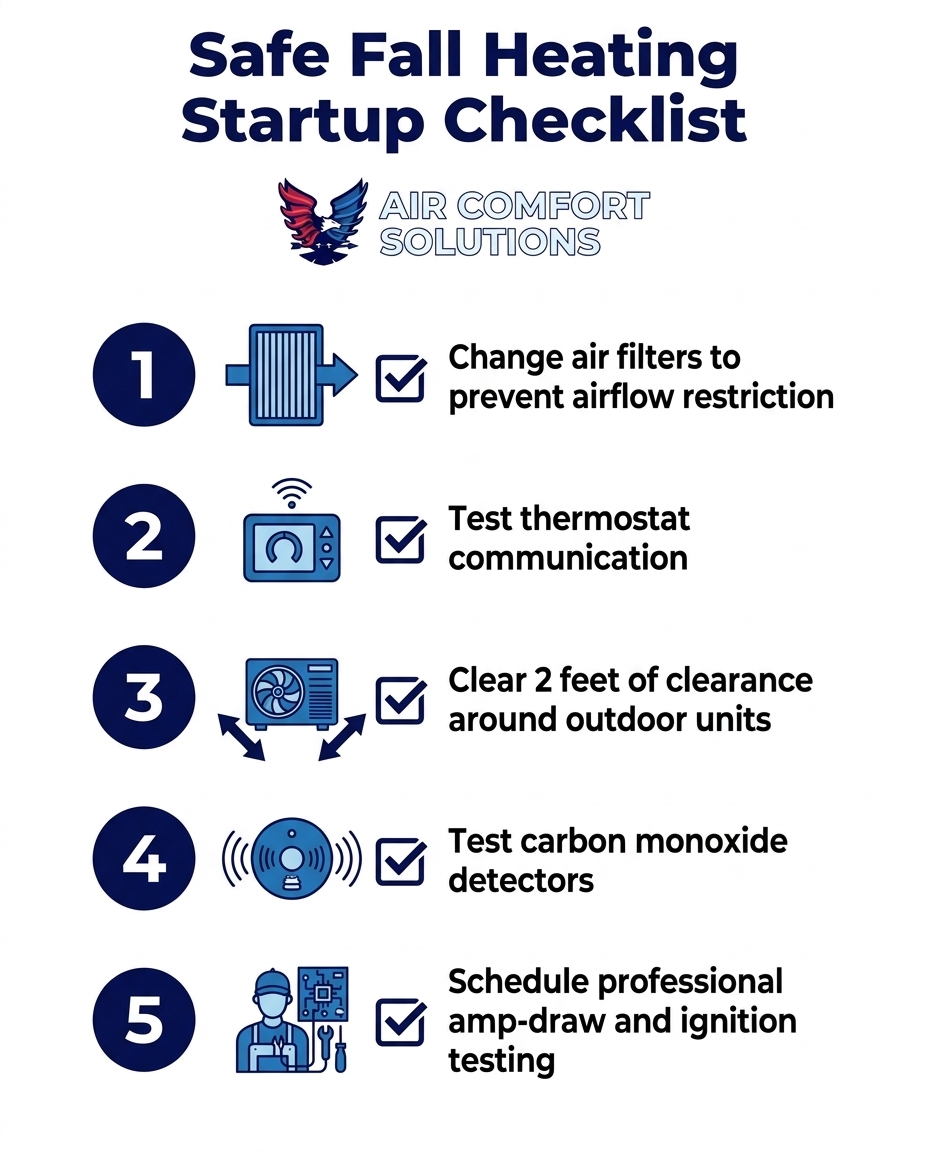
Preparing for a mid-fall heating startup involves a combination of safe homeowner tasks and professional oversight. Following a structured checklist ensures that you address the most common causes of early-season issues without crossing into dangerous internal repairs.
• Change your air filters: A fresh filter ensures unrestricted airflow before turning on the furnace. A clogged filter suffocates the system and forces it to overheat almost immediately.
• Test thermostat communication: Switch your thermostat to "heat" and raise the temperature a few degrees above the current room temperature. Listen for the system to engage and verify that warm air eventually flows from the vents.
• Clear debris from outdoor units: While your heat pump or AC condenser may not run as frequently in the winter, it still needs at least two feet of clearance. Remove fallen leaves, overgrown branches, and dirt that accumulated over the summer.
• Inspect all indoor vents: Walk through your home and ensure that all supply registers and return grilles are fully open and unblocked by furniture, rugs, or curtains.
• Test carbon monoxide detectors: Heating season brings an increased risk of carbon monoxide exposure from gas furnaces. Test the alarms and replace the batteries in every detector before the heating season begins.
When our technicians respond to early-season heating failures, the most common culprit we find is restricted airflow. When a furnace cannot push enough air over its heat exchanger, the internal temperature of the system skyrockets. This trapped heat creates a severe safety hazard and puts immense stress on the metal components.
Your furnace is equipped with a critical safety mechanism called a high-limit switch. This sensor constantly monitors the temperature inside the unit. If the heat exchanger gets too hot due to a clogged filter or blocked vents, the high-limit switch trips and immediately shuts down the burners to prevent a fire. The blower fan will usually continue to run to cool the system down. While this safety feature protects your home, a pattern we see often is that repeated limit-switch trips will cause permanent damage. The constant expansion and contraction of overheating metal eventually lead to cracks in the heat exchanger, which can leak deadly carbon monoxide into your living space.
• Short-cycling (furnace turns off quickly) — Underlying Cause: Restricted airflow causing the high-limit switch to trip. — Safe Homeowner Action: Check and replace the air filter. Ensure all vents are fully open.
• Weak airflow from vents — Underlying Cause: Dirty blower wheel or blocked return ducts. — Safe Homeowner Action: Clear obstructions near return grilles. Call a pro for blower cleaning.
• System locks out entirely — Underlying Cause: High-limit switch has tripped multiple times in a row. — Safe Homeowner Action: Do not attempt to bypass the switch. Call a certified technician.
There is a strict boundary between safe filter replacement and dangerous internal diagnostics. Homeowners should never attempt to bypass a limit switch or open the blower compartment. Often, airflow restrictions noticed in the fall are actually lingering issues from summer, making it wise to rely on professional air conditioning services to evaluate ductwork and blower health before the weather turns freezing.
One of the most frequent issues our team encounters during a fall startup is a homeowner turning on the heat only to feel cold air blowing from the vents. This usually points to a failure within the ignition sequence. Modern furnaces follow a strict, automated sequence of operations to ensure gas is burned safely. If any single step fails, the system halts the process and blows cold air.
The sequence begins with the inducer draft motor, which clears leftover gases from the combustion chamber. Next, a pressure switch verifies that the draft is strong enough to vent exhaust safely outside. Only then does the hot surface igniter glow orange, and the gas valve opens. Finally, a flame sensor detects whether a fire has actually started. If the flame sensor is dirty with carbon buildup, it will fail to detect the flame, causing the gas valve to snap shut within seconds to prevent an explosion.
Common reasons for cold air on startup include dirty flame sensors, cracked igniters, or a failing gas valve. Attempting to clean a flame sensor or test a gas valve without proper training presents extreme safety risks, including fires, gas leaks, and carbon monoxide poisoning. Because these components deal directly with combustible gas and high voltage, DIY troubleshooting is strictly prohibited for safety reasons. If your furnace is blowing cold air, shut off the system at the thermostat and reach out for professional heat pump installation and repair or furnace diagnostics immediately.
Transitioning from cooling to heating is not just about flipping a switch; it requires a comprehensive evaluation of the system's mechanical and safety integrity. October is the critical transition month in Pinehurst TX to test heating sequences before November cold snaps cause a surge in emergency service calls.
A comprehensive fall tune-up goes far beyond a simple visual check. When you schedule a professional pre-winter inspection, a certified technician performs a detailed series of tests designed to ensure efficiency and safety.
1. Combustion Analysis: The technician measures the exhaust gases to ensure the furnace is burning fuel cleanly and efficiently, checking for any signs of carbon monoxide leaks.
2. Electrical Testing: All capacitors, relays, and motors are tested with a multimeter to verify they are drawing the correct amperage and are not at risk of failing under heavy load.
3. Safety Control Verification: The high-limit switch, pressure switches, and flame rollout sensors are physically tested to guarantee they will shut the system down in an emergency.
4. Burner and Sensor Cleaning: The ignition assembly and flame sensor are carefully cleaned using specialized tools to prevent nuisance lockouts.
Routine professional care also satisfies manufacturer warranty requirements. Most equipment manufacturers stipulate that failure to perform annual maintenance voids the warranty on expensive parts like heat exchangers and compressors. Investing in a routine HVAC maintenance plan offers long-term cost benefits by preventing expensive midnight emergency repairs and keeping your monthly energy bills as low as possible.
When it comes to the safety and comfort of your home, the company you choose to perform your maintenance matters just as much as the maintenance itself. Hiring technicians who understand regional weather patterns and specific local building codes ensures that your system is calibrated for the actual climate you live in, not a generic national average.
Our team at Air Comfort Solutions has built a strong local reputation based on proven reliability and a deep commitment to the Pinehurst community. Unlike national chains that rely on high-pressure sales tactics and rotating rosters of technicians, a locally rooted company focuses on building long-term relationships through transparent communication. A proven track record in the community translates to faster response times during extreme weather events, meaning you are never left waiting in the cold when you need help the most.
Local expertise also means that technicians are familiar with the specific types of homes, ductwork layouts, and common architectural challenges in the area. This localized knowledge allows for faster, more accurate diagnostics. Consistent, reliable service builds long-term home safety, giving you the peace of mind that your heating system has been inspected by professionals who genuinely care about the well-being of their neighbors.
Prepping your HVAC for winter starts with replacing your air filter and clearing all debris away from your outdoor unit. These simple steps guarantee proper airflow, which is the foundation of a healthy heating system. Beyond these basic tasks, we highly recommend scheduling a professional fall tune-up so a certified technician can inspect the electrical connections, test the safety switches, and verify the integrity of the heat exchanger.
A furnace blowing cold air usually indicates a failure in the automated ignition sequence, prompting the system to shut off the gas while the blower fan continues to run. The most frequent culprits are a dirty flame sensor that cannot detect the fire, a cracked hot surface igniter, or a tripped high-limit switch caused by restricted airflow. Because this involves combustible gas, you should turn the system off and call a professional for diagnostics.
The most common issue during the fall transition is an overheating furnace caused by restricted airflow. Homeowners often forget to change the air filter after a long summer of heavy AC usage, leaving the filter completely clogged with dust and pet dander. When the furnace turns on, the trapped heat trips the high-limit safety switch, causing the system to short-cycle and potentially damaging the heat exchanger.
A heating system should be professionally serviced at least once a year, ideally in the fall before the freezing weather arrives. Annual maintenance is required by most manufacturers to keep the equipment warranty valid. Regular servicing ensures the system operates safely, burns fuel efficiently, and is far less likely to suffer a catastrophic breakdown during the winter months.
No, cleaning a furnace flame sensor is not a recommended DIY project due to the significant safety risks involved. The sensor sits directly in the path of the gas burners and requires careful handling to avoid damaging the delicate rod or misaligning the assembly. A licensed technician has the proper tools to clean the sensor safely without compromising the furnace's critical safety mechanisms.
A burning dust smell during the first few heating cycles of the season is completely normal and usually harmless. Over the summer, dust settles on the heat exchanger and burners while the system sits idle. When the furnace ignites for the first time in autumn, that accumulated dust burns off, creating a distinct odor that should dissipate within a few hours.
There is profound peace of mind that comes from knowing your heating system has been professionally inspected and cleared for winter. Skipping your mid-fall heating startup maintenance leaves your home vulnerable to sudden breakdowns, decreased energy efficiency, and serious safety hazards like carbon monoxide leaks. Do not wait for a freezing night to discover that your furnace is struggling. Take a proactive approach today and schedule an inspection with trusted local experts. A clear, professionally grounded evaluation will ensure your equipment operates safely, keeping your family warm and comfortable all season long.


Zane came out and did an amazing job! Super friendly, honest and transparent about the work that needed to be done. This is my second time working with Air Comfort Solutions and they’re my go to for HVAC services. Highly recommend.
God's AMAZING grace sent us Robert and Zane. We have been without air in this Texas heat for six weeks and four days. We've had a few contractors give us quotes all trying to upsell when we're at a low point. But not the guys at Air Comfort Solutions. They came in assessed our situation, gave us honest feedback, and showed us the issues as they proceeded with the assessment for clear understanding. We highly recommend them for their professionalism, quality products, and fair pricing. We hands down support them for all the work they do 💯 %.
Robert and Zane gone above and beyond to make the process easy and affordable.
Would definitely recommend!!
I’m writing this review to let everyone know that Air Comfort Solutions is the company to work with. I know the owner ( Robert) for several years now. He has been taking care of my residential and business work orders. Robert is professional, knowledgeable and will save you money. I just want to thank Robert for great job you have been doing for me.