
The Value of Sealing Your Return Air Plenum Before the Holidays
Most homeowners buy expensive filters to fix dusty air, not realizing a leaky return plenum in the attic is the real culprit. See why sealing it now saves your holiday gatherings.

If you find yourself pulling the blankets up because the house is freezing at 6 AM, but sweating by 3 PM, transitioning your thermostat strategy for unpredictable September weather in Pinehurst is the only way to stay comfortable. You are not alone in this frustration. The early fall season in Southeast Texas brings massive 30-degree daily temperature swings, leaving many homeowners constantly adjusting their thermostats by hand. The standard "set it and forget it" rules that worked perfectly in July simply fail when the mornings are crisp and the afternoons are sweltering.
To bridge the gap between these extremes without overworking your equipment, you need a smarter approach to programming. By optimizing your daily schedules, configuring deadbands, and adjusting your fan settings, you can keep your home consistently comfortable. If your equipment is struggling to keep up with these wild temperature shifts, exploring modern air conditioning systems can provide the advanced climate control your home needs.
During the peak of summer, your cooling system has a straightforward job: run consistently to battle relentless heat. However, the September early fall transition introduces a complex set of challenges that standard settings are not designed to handle. When you leave your thermostat on a rigid summer schedule, the system becomes confused by the fluctuating outdoor temperatures.
One of the biggest risks during this transitional weather is short-cycling. If your thermostat demands full cooling capacity during a cooler morning, the air conditioner turns on, rapidly cools the house, and shuts off within minutes. This rapid on-and-off cycle prevents the system from properly circulating air and puts immense mechanical strain on the compressor. Worse, short-cycling destroys your system's ability to dehumidify.
The Hidden Challenge of Coastal Humidity
In Pinehurst, the drop in sensible heat (the temperature you read on a thermometer) does not mean a drop in latent heat (the humidity in the air). Coastal-adjacent moisture persists heavily into the fall. Your air conditioner must run in long, steady cycles during the afternoon to pull that lingering summer moisture out of the air. If you manually turn the system off in the morning and wait until the house is hot and sticky at 3 PM to turn it back on, the system has to work twice as hard to remove both the heat and the accumulated humidity.
• Morning Temperatures — Summer Strategy: Heavy cooling required — Early Fall Transition Strategy: Natural warming; avoid heavy AC use
• Afternoon Heat — Summer Strategy: Continuous cooling — Early Fall Transition Strategy: Targeted cooling to manage humidity
• Humidity Levels — Summer Strategy: High; managed by constant AC — Early Fall Transition Strategy: High; requires specific fan/schedule settings
• System Operation — Summer Strategy: Long, steady cooling cycles — Early Fall Transition Strategy: Risk of short-cycling if mismanaged
Constantly walking up to the wall and manually adjusting the temperature up and down wastes energy, degrades your system's efficiency, and leaves your indoor air feeling clammy. A proactive, automated strategy is the only way to maintain true comfort.
Most modern thermostats have a feature designed exactly for days when you might need heating in the morning and cooling in the afternoon: auto-changeover mode. Instead of manually flipping the switch from "Heat" to "Cool," auto-changeover allows the thermostat to automatically decide which system to run based on the indoor temperature. However, if configured incorrectly, it can cause your furnace and air conditioner to fight each other.
The secret to making auto-changeover work is mastering the deadband. A deadband is the temperature buffer or gap between your heating setpoint and your cooling setpoint. For example, if you want the house to stay around 72 degrees, you cannot set both the heat and the AC to 72. If you do, the furnace will heat the house to 72, which might trigger the AC to turn on to cool it back down, creating an endless, expensive loop.
How to Set Up Your Deadband Correctly:
1. Access the advanced settings: Check your smart thermostat's mobile app or the on-screen menu for a setting labeled "Auto-Changeover," "Auto Mode," or "Deadband."
2. Establish the cooling limit: Set your maximum comfortable temperature for the afternoon (e.g., 74 degrees).
3. Establish the heating limit: Set your minimum comfortable temperature for the morning (e.g., 69 degrees).
4. Verify the buffer zone: Ensure there is a minimum deadband of 2 to 3 degrees between these two numbers. In this example, the 5-degree gap ensures the systems will never overlap.
Much of the generic national advice you find online ignores the aggressive lingering heat of Southeast Texas afternoons. They might recommend a narrow 1-degree deadband, which works in mild climates but fails spectacularly here. Setting a wider deadband of at least 3 degrees is a strategy specific to our regional climate swings, preventing energy waste while keeping you comfortable.
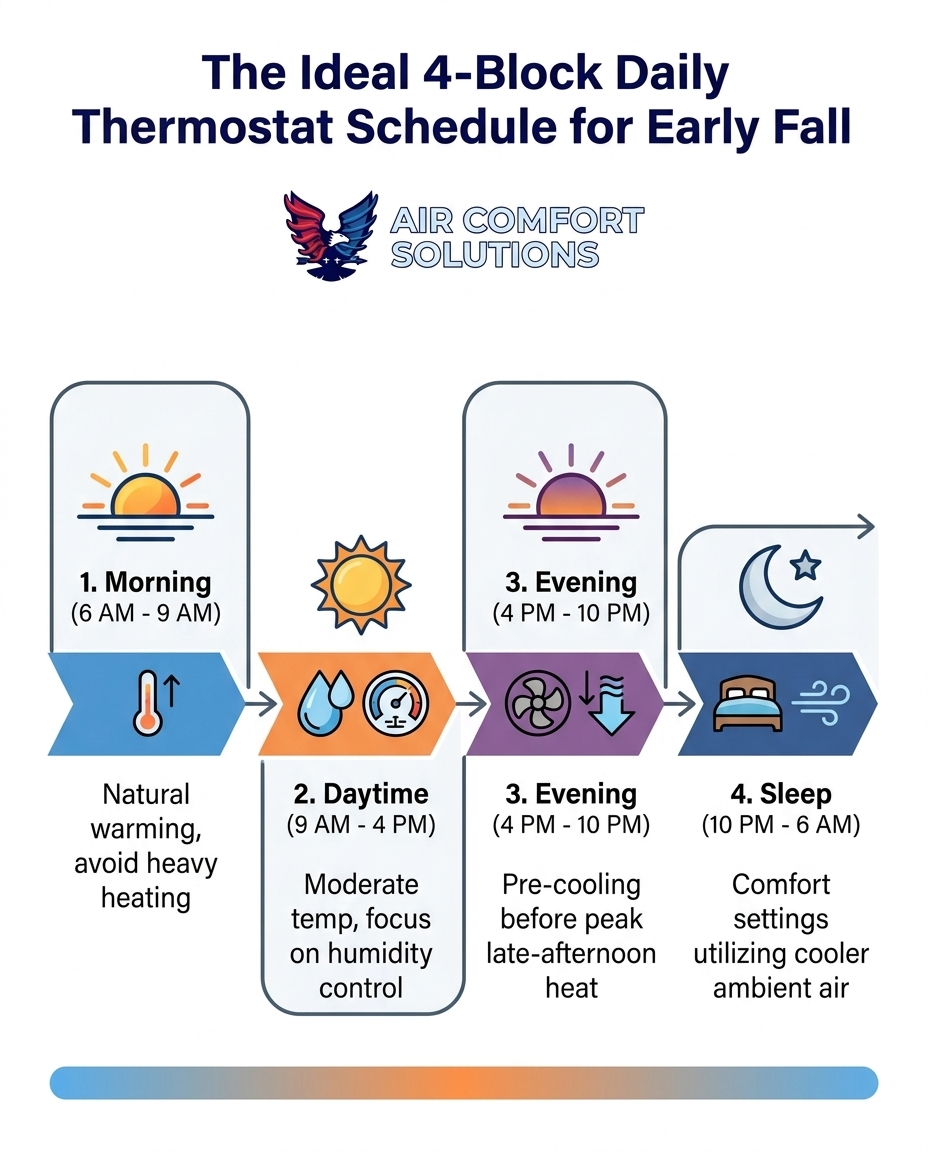
To truly beat the 30-degree swing, you need to program your thermostat to anticipate the weather changes before they happen. The September early fall transition requires breaking your day into four distinct temperature blocks. This strategy prevents short-cycling in the morning while ensuring your home is dry and comfortable by the evening.
• Morning Block (6 AM - 9 AM): Let the house warm up naturally. Instead of blasting the furnace to combat a chilly 65-degree morning, set your heating setpoint low (around 66-68 degrees). The sun will naturally warm the house within a few hours, saving you money and unnecessary furnace cycles.
• Daytime Away Block (9 AM - 4 PM): Allow the temperature to rise slightly, but keep it cool enough to manage humidity. Set the cooling setpoint to 75-78 degrees. The goal here is not to keep the house ice-cold while you are away, but to ensure the AC runs just enough to pull the coastal humidity out of the air.
• Evening Return Block (4 PM - 10 PM): Pre-cool slightly before the peak heat infiltrates. Set the cooling to 72-74 degrees starting around 3:30 PM. By the time you walk through the door at 5 PM, the house is already cool, and the system is not struggling against the hottest part of the late afternoon.
• Sleep Block (10 PM - 6 AM): Prioritize your sleeping comfort. You can lower the cooling setpoint to 70-72 degrees. Because the outdoor ambient temperatures drop significantly overnight during the fall, your AC can achieve this lower temperature with very little effort or energy consumption.
One of the most advanced strategies for managing unpredictable fall weather is using your home's own structure to your advantage. This concept revolves around "thermal mass." Everything inside your home—the drywall, the hardwood floors, the heavy furniture, and the cabinetry—absorbs and holds heat. When your house feels hot at 5 PM, it is not just the air that is hot; the actual structure of the house is radiating heat.
During the September early fall transition, you can leverage thermal mass by pre-cooling the home during the milder late morning and early afternoon. When the outdoor temperature is a pleasant 75 degrees at 11 AM, your air conditioner does not have to work very hard to cool the house down to 72 degrees. By running the system then, you are cooling down the walls, floors, and furniture.
When the aggressive 90-degree heat hits at 3 PM, your home's structure is already deeply cooled. The thermal mass acts like a giant ice cube, absorbing the incoming heat and delaying the need for heavy air conditioning. This strategy dramatically reduces your peak-hour energy consumption.
If you wait until 4 PM to turn the AC down, the system has to fight against both the hot outdoor air and the heat radiating from your walls and furniture. Pre-cooling keeps the indoor environment incredibly stable, eliminating the stuffy, suffocating feeling that often accompanies the late afternoon in Pinehurst.
Even with the perfect temperature schedule, your home will feel miserable if you do not manage the moisture. In early fall, the way you configure your thermostat's fan setting dictates your indoor air quality. The fan controls how air moves over the evaporator coil, which is the part of your AC that extracts both heat and humidity.
The Problem: Many homeowners switch their thermostat fan setting from "AUTO" to "ON" during the fall, thinking that constantly circulating the air will keep the house feeling fresh. In humid climates, this is a massive mistake.
The Cause: When your AC runs, it pulls moisture out of the air. That moisture condenses on the cold evaporator coil and drips down a drain line. If you leave the fan set to "ON," the fan continues to blow air over that wet coil even after the cooling cycle stops. This immediately re-evaporates the moisture right back into your ductwork and into your living room.
The Solution: You must keep your fan set to "AUTO." This ensures the fan only runs when the compressor is actively cooling. When the cooling cycle finishes, the fan shuts off, allowing the condensed moisture to safely drain outside. Because Pinehurst TX experiences heavy humidity well into the fall, this "AUTO" setting is non-negotiable for maintaining comfort. If you are struggling with persistent moisture or odors, integrating dedicated indoor air quality solutions can provide the extra dehumidification and filtration your home requires.
Because your air conditioner is running specifically to remove humidity during the fall transition, it still moves a massive volume of air. This means your filter is still trapping dust, pollen, and pet dander at a rapid pace. A clogged filter restricts airflow, which causes the indoor coil to freeze up and completely halts the dehumidification process. We highly recommend reviewing the best practices for changing your AC filter in humid Texas heat to ensure your system maintains the proper airflow required to keep your home dry and comfortable.
A smart thermostat and a perfectly optimized schedule are only as effective as the mechanical equipment they control. As you transition your thermostat strategy for the unpredictable September weather, you must also consider the physical health of your furnace or heat pump. The cool mornings are a gentle reminder that the true heating season is just around the corner.
Before the first major cold front hits, it is vital to have your heating equipment inspected and calibrated. A system that has been sitting dormant since last February needs professional oversight to ensure all electrical connections are secure, the burners are clean, and the safety sensors are fully operational. Seasonal calibration ensures your system runs safely and at peak efficiency when you finally need to rely on it for deep heating.
Air Comfort Solutions takes a community-focused, reliable approach to helping local families transition safely into the heating season. We understand the specific demands that our regional climate places on your equipment. Proactive preparation prevents sudden breakdowns on the coldest night of the year. If you want peace of mind this fall, relying on trusted Pinehurst HVAC services ensures your entire system is ready for whatever the Texas weather brings.
What is the best thermostat setting for fall in Texas?
The best setting balances comfort with humidity control. We recommend setting your cooling to 74-76 degrees during the day and 70-72 degrees at night. Allowing the house to warm naturally in the morning prevents unnecessary furnace use, while afternoon cooling manages the lingering coastal humidity.
How do I stop my AC from short cycling in cooler weather?
To stop short-cycling, widen the temperature gap between your heating and cooling setpoints. Ensure you have a deadband of at least 3 degrees. Additionally, avoid turning the AC down drastically during cool mornings, as the system will cool the space too quickly and shut off before it can dehumidify.
Should I turn my AC off on cool early fall mornings?
Yes, it is often best to let the system rest on cool mornings. Instead of turning it off completely, you can set the cooling setpoint a few degrees higher. This allows the home to warm up naturally with the sunrise and prevents the AC from running short, inefficient cycles.
How do you set a thermostat for cold mornings and hot afternoons?
The most effective method is using your thermostat's auto-changeover feature with a proper schedule. Set a morning heating limit (e.g., 68 degrees) and an afternoon cooling limit (e.g., 74 degrees). This creates a comfortable buffer zone that prevents the furnace and AC from fighting each other.
What is a thermostat deadband and how do I set it?
A deadband is the mandatory temperature gap between your heating and cooling setpoints when using auto-changeover mode. You can set it in your thermostat's advanced settings or mobile app. A minimum deadband of 2 to 3 degrees is required to keep the systems from running simultaneously.
Can using auto-changeover mode damage my HVAC system?
No, auto-changeover will not damage your system as long as the deadband is configured correctly. If the deadband is set too narrow (like 1 degree), it can cause the heat and AC to cycle on and off rapidly, which wastes energy and causes unnecessary wear and tear on the components.
Mastering your thermostat settings is the critical first step to staying comfortable during the unpredictable early fall season. By utilizing auto-changeover, setting proper deadbands, and keeping your fan on "AUTO," you can beat the 30-degree daily temperature swings without wasting energy. However, even the best programming cannot fix a system that is mechanically unprepared for the changing seasons.
Now is the time to ensure your entire HVAC system is ready for the transition. Do not wait for the first freezing morning to find out your furnace is struggling. Secure a comprehensive inspection and tune-up through a professional HVAC maintenance plan to guarantee your equipment delivers reliable, efficient comfort all season long.


Zane came out and did an amazing job! Super friendly, honest and transparent about the work that needed to be done. This is my second time working with Air Comfort Solutions and they’re my go to for HVAC services. Highly recommend.
God's AMAZING grace sent us Robert and Zane. We have been without air in this Texas heat for six weeks and four days. We've had a few contractors give us quotes all trying to upsell when we're at a low point. But not the guys at Air Comfort Solutions. They came in assessed our situation, gave us honest feedback, and showed us the issues as they proceeded with the assessment for clear understanding. We highly recommend them for their professionalism, quality products, and fair pricing. We hands down support them for all the work they do 💯 %.
Robert and Zane gone above and beyond to make the process easy and affordable.
Would definitely recommend!!
I’m writing this review to let everyone know that Air Comfort Solutions is the company to work with. I know the owner ( Robert) for several years now. He has been taking care of my residential and business work orders. Robert is professional, knowledgeable and will save you money. I just want to thank Robert for great job you have been doing for me.