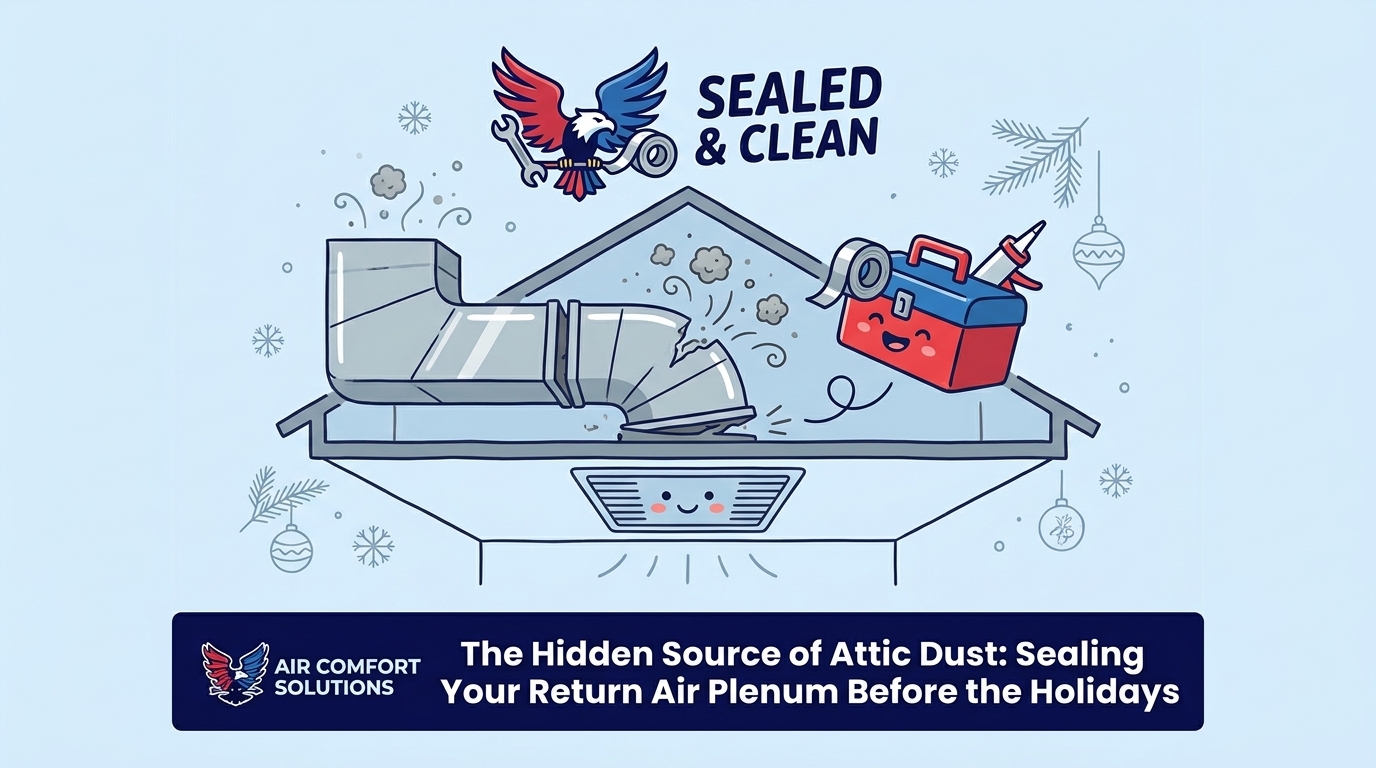
The Value of Sealing Your Return Air Plenum Before the Holidays
Most homeowners buy expensive filters to fix dusty air, not realizing a leaky return plenum in the attic is the real culprit. See why sealing it now saves your holiday gatherings.
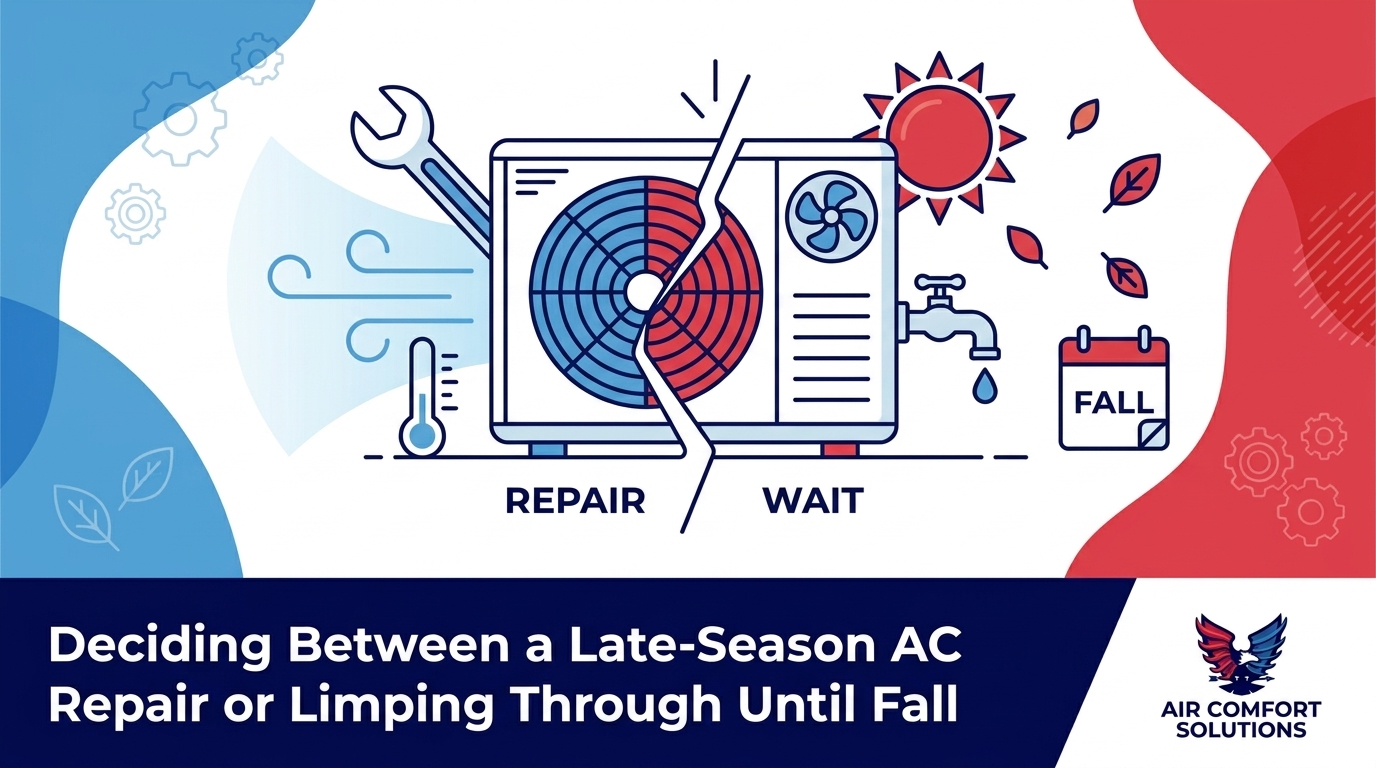
Many homeowners believe that once the calendar flips to September, their cooling worries are over—but deciding between a late-season AC repair or limping through until fall is actually one of the riskiest choices you can make for your home. It is a common misconception that the end of summer means the immediate end of heavy air conditioning usage. At Air Comfort Solutions, we see this exact scenario every year: when your cooling system suddenly stops working properly right in the middle of the late-August back-to-school transition, the timing could not feel worse. Household routines are shifting, schedules are tightening, and the last thing you want to deal with is a hot, uncomfortable house.
When faced with a sudden breakdown during this transitional time of year, you generally have three main choices in front of you. First, you can authorize a major repair to get the current unit running again. Second, you can invest in a full system replacement. Third, you might be tempted to attempt temporary mitigation—essentially trying to limp through the rest of the season with a struggling system. Making this decision objectively is critical. Choosing the wrong path can lead to long-term mechanical issues, higher energy bills, and a complete loss of indoor comfort.
To navigate this frustrating situation, you need a clear understanding of your equipment's health and the actual weather patterns in your region. If you are currently dealing with a failing system, reaching out for professional HVAC services is the best way to get an accurate diagnosis. Whether you ultimately need air conditioning repair and replacement, getting a professional assessment prevents a minor issue from turning into a total disaster.
There is a widespread myth that autumn brings an immediate, refreshing drop in outdoor temperatures. In many parts of the country, this might be true. However, the climate reality in our region tells a completely different story. Assuming that you only have a few weeks of heat left can lead to disastrous decisions for your HVAC equipment.
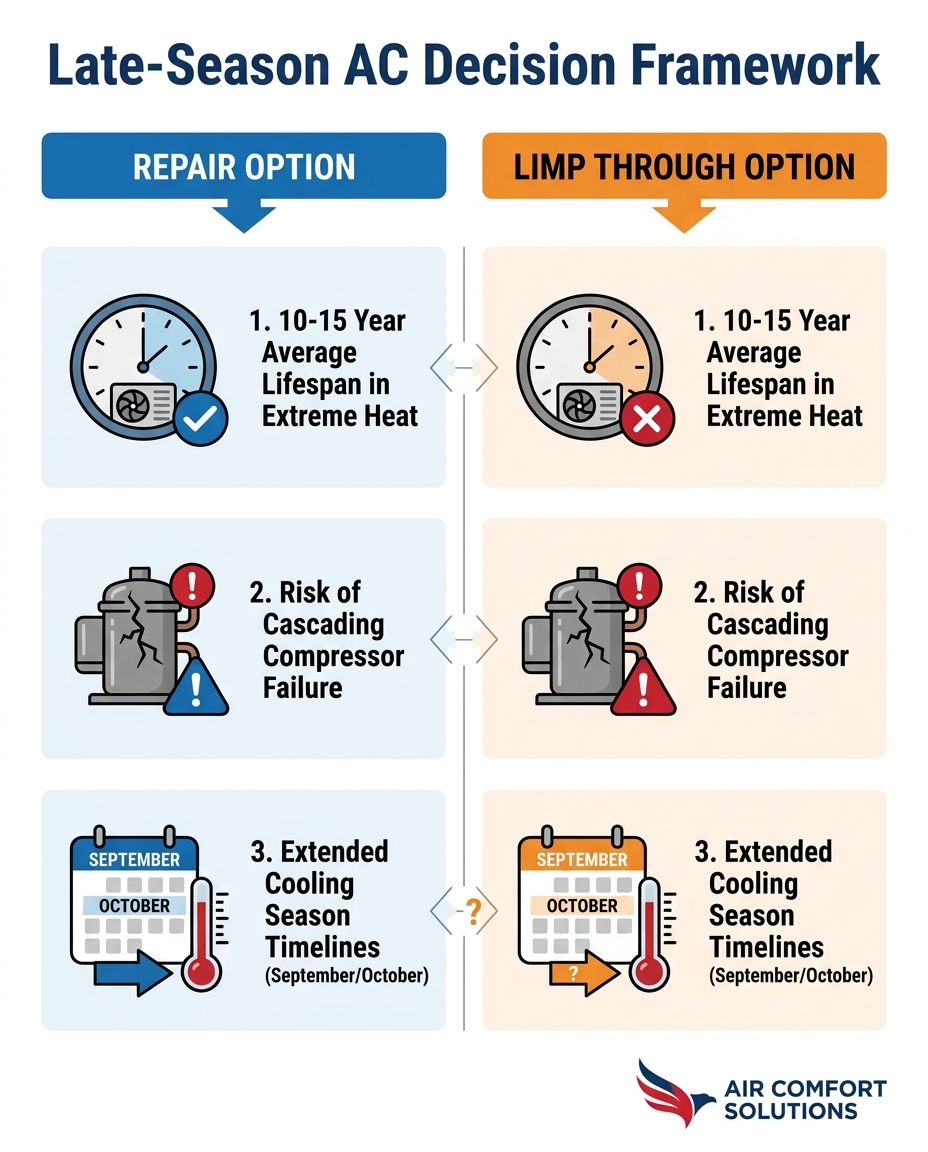
In our years of serving Pinehurst TX and the greater Houston area, our technicians at Air Comfort Solutions know firsthand that extreme heat and heavy humidity extend well into October. Our cooling season is typically two to three months longer than the national average. Temperatures regularly exceed 85 to 90 degrees long after the official start of fall. If you decide to delay a repair thinking you only need to survive a couple of weeks, you are actually committing to running a broken system through months of intense heat.
Continuous high temperatures put immense strain on a compromised air conditioner. When a system is already struggling, forcing it to battle high ambient heat and thick humidity pushes internal components past their breaking point. Beyond the mechanical damage, there is a significant physical toll on your household. Inadequate indoor cooling during this extended season leads to poor sleep quality, heightened allergy symptoms, and serious safety risks for vulnerable family members.
The disconnect between the official start of autumn and actual regional weather is a major blind spot for many homeowners. The calendar might say it is time for sweaters, but your thermostat knows the truth. Furthermore, prolonged humidity has a massive impact on perceived indoor temperatures. Even if the actual temperature drops a few degrees, high indoor humidity makes the air feel sticky, heavy, and significantly hotter than the number on the wall suggests. A struggling AC unit loses its ability to dehumidify the air properly, leaving your home feeling like a swamp.
The Problem: A pattern we see often on late-summer service calls is homeowners noticing their air conditioner running longer cycles, making strange noises, or blowing lukewarm air. Because it is the late-August back-to-school transition, they decide to ignore the symptoms, hoping the system will just hold together until the weather cools down.
The Cause: Air conditioning systems are highly interconnected machines. When you force a struggling unit to operate, you trigger a chain reaction of stress inside the cabinet. In our daily work, we frequently see how minor component failures force the major components to overwork. For example, a weakened capacitor is a relatively minor issue. Its job is to provide the initial jolt of electricity to start the compressor. When the capacitor weakens, it cannot deliver that charge efficiently. The compressor then has to pull excessive electrical current (high amp draw) to force itself to start. This causes the compressor to overheat repeatedly during every single cooling cycle.
The Solution: The only way to stop this cascading mechanical failure is immediate professional intervention. Ignoring a weakened component essentially guarantees that a larger, far more vital component will be destroyed. This is the concept of cascading mechanical failure: one ignored issue destroys the entire system. Running a compromised unit also drastically reduces your overall energy efficiency. The system runs longer, consumes more electricity, and provides less comfort. Delaying service is a false economy—you might save money today, but you will pay for a total system failure tomorrow.
• Electrical strain: The relationship between electrical components and compressor health is absolute. Bad wiring, failing contactors, or weak capacitors send irregular voltage to the compressor motor, slowly burning it out.
• Refrigerant leaks: A system low on refrigerant cannot absorb heat properly. This forces the compressor to run continuously, eventually causing it to overheat and seize up completely.
• Airflow restrictions: A failing blower motor or a frozen evaporator coil restricts airflow. Continuous operation during peak heat with restricted airflow accelerates wear and tear across every moving part in the system.
When facing a major breakdown, you need objective criteria to help you gauge if a repair is actually worthwhile. The Department of Energy (DOE) and Energy Star provide clear guidelines for cooling equipment lifespan. While a well-maintained system can last a long time, the rules change depending on where you live.
In our experience repairing and replacing units across Pinehurst TX, systems operating in our high-heat region typically have shorter functional lives. Because the cooling season is so long, these units accumulate run hours much faster than units in milder climates. It is common for an air conditioner in our area to reach the end of its reliable lifespan between 10 and 15 years. If your system is approaching this age bracket, the cumulative wear and tear on the internal components is significant. You can learn more about how long an AC system typically lasts in Texas to better understand these regional timelines.
Another critical factor is the type of refrigerant your system uses. Older units often rely on R-22 refrigerant, which has been completely phased out by the Environmental Protection Agency due to its environmental impact. If your aging system uses R-22 and develops a refrigerant leak, repairing it becomes incredibly difficult and highly impractical. The phase-out of older refrigerants heavily impacts the viability of repairing older units, often making replacement the only logical choice.
Our team often relies on a formula known as the 5,000 rule to help homeowners make objective choices. You multiply the age of your equipment by the estimated severity or frequency of the required repair. If the resulting calculation exceeds 5,000, replacing the unit is generally the smarter path. How do you apply this rule objectively without relying on specific price tags? You look at the relative value of the repair. If your system is 12 years old and requires a major component overhaul—like a new compressor or an evaporator coil replacement—the severity of that repair combined with the advanced age of the unit clearly points toward replacement. It is a way to measure mechanical risk rather than just looking at a single invoice.
To remove the emotion and panic from this situation, our experts at Air Comfort Solutions have synthesized these factors into a clear, non-salesy comparison framework. This checklist helps you make a logical choice based on objective go/no-go indicators: system age, frequency of past breakdowns, and current efficiency levels. We constantly remind our customers of the importance of making a definitive choice rather than relying on temporary fixes that put your home at risk during the late-August back-to-school transition.
• System Age — Indicators for Repair: Under 10 years old with low accumulated run hours. — Indicators for Replacement: Over 10-15 years old, especially in high-heat climates.
• Repair Severity — Indicators for Repair: Isolated to a single, easily accessible component (e.g., capacitor). — Indicators for Replacement: Major component failure (e.g., compressor, evaporator coil).
• Refrigerant Type — Indicators for Repair: Uses modern, environmentally friendly R-410A or newer. — Indicators for Replacement: Relies on phased-out R-22 refrigerant.
• Efficiency Levels — Indicators for Repair: System maintains comfortable temperatures without excessive energy use. — Indicators for Replacement: Unit struggles to cool the house and energy bills are steadily climbing.
• Maintenance History — Indicators for Repair: System has received consistent, professional seasonal tune-ups. — Indicators for Replacement: System has a history of neglected maintenance and frequent breakdowns.
Repairing your system is usually the right call if the unit is under 10 years old and the issue is isolated to a single, easily accessible component. For example, replacing a faulty contactor, a worn fan belt, or a weak capacitor makes sense for a younger system. This is especially true if the unit has been consistently maintained throughout its life. Proactive care extends the life of your equipment significantly. If you decide to repair, protect that investment by enrolling in a routine AC maintenance plan to prevent future late-season surprises.
Replacement becomes the most logical option when the system exceeds regional lifespan averages. If your unit is over 12 years old and facing a compressor failure or severe refrigerant leaks, sinking more resources into it is a poor investment. Furthermore, if the unit struggles to maintain comfort even when fully operational—running constantly but leaving the house feeling warm and humid—it has likely lost its mechanical efficiency. Upgrading to a new system restores reliability and lowers your monthly energy consumption.
Major HVAC decisions are rarely planned expenses. Almost no one wakes up in the morning expecting their air conditioner to fail. We understand that an unexpected breakdown in Pinehurst TX creates immediate stress, especially when the weather is unforgiving. However, you do not have to let panic dictate your decision-making process.
By choosing a local team like Air Comfort Solutions that prioritizes rapid response times, you can restore household comfort quickly, minimizing the disruption to your daily life. When a technician arrives promptly, diagnoses the issue accurately, and presents clear options, the situation instantly becomes more manageable.
If the objective criteria point toward a full system replacement, utilizing flexible financing options can turn a stressful emergency into a structured, manageable upgrade. Financing removes the immediate financial barrier, allowing you to choose a highly efficient system that meets your home's needs without compromising due to upfront constraints. Additionally, general energy rebates or federal tax credits may apply to qualifying high-efficiency installations. We always advise our customers to verify current programs with their utility provider or a tax professional, as these incentives can make upgrading to a premium system much more accessible.
Delaying an AC repair forces the system to work harder to achieve the same level of cooling. This extra strain causes minor issues to escalate rapidly into major mechanical failures. For example, a system operating with restricted airflow will eventually freeze the evaporator coil or burn out the blower motor. Ultimately, putting off a repair compromises your comfort, inflates your energy bills, and dramatically increases the likelihood of needing a complete system replacement.
No, it is generally not safe for the equipment to run a struggling air conditioner. When a unit is fighting against a failing component, it draws excessive electrical current, which can lead to overheating wires and damaged circuitry. Mechanically, running a compromised system accelerates wear and tear on the compressor, which is the heart of the unit. Shutting the system off and calling a professional is the safest way to prevent irreversible damage.
Our team recommends determining if your AC is worth fixing by evaluating its age, repair history, and overall efficiency. A common rule of thumb is to weigh the severity of the repair against the age of the unit; older units requiring major component overhauls rarely justify the investment. If your system is under ten years old, uses modern refrigerant, and has been well-maintained, a targeted repair is usually the best route to restore functionality.
Yes, a bad capacitor is one of the most common causes of premature compressor failure. The capacitor acts like a battery that provides a massive jolt of energy to start the compressor motor. When the capacitor is weak or failing, the compressor struggles to start, pulling excess amperage and overheating in the process. If left unresolved, this repeated overheating will eventually cause the compressor to seize completely.
There is no exact timeline, as total failure depends entirely on which component is struggling and how hot the weather is outside. However, during peak summer heat, a struggling system can go from functioning poorly to failing completely in a matter of days or even hours. The longer the system runs under stress, the faster the internal components degrade, making rapid failure highly likely.
Replacing an aging, inefficient AC before it breaks completely is often the smartest strategy. Proactive replacement allows you to research your options, secure financing, and schedule the installation at your convenience, rather than making a rushed decision during a sweltering emergency. It also ensures that your home remains consistently comfortable without the looming threat of a sudden, total breakdown.
Ultimately, deciding between a late-season AC repair or limping through until fall requires looking at the facts rather than hoping for a sudden change in the weather. By evaluating the true age of your system, understanding the risk of cascading damage, and acknowledging our region's extended cooling season, the team at Air Comfort Solutions can help you make a confident, logical choice that keeps your home comfortable and safe.


Zane came out and did an amazing job! Super friendly, honest and transparent about the work that needed to be done. This is my second time working with Air Comfort Solutions and they’re my go to for HVAC services. Highly recommend.
God's AMAZING grace sent us Robert and Zane. We have been without air in this Texas heat for six weeks and four days. We've had a few contractors give us quotes all trying to upsell when we're at a low point. But not the guys at Air Comfort Solutions. They came in assessed our situation, gave us honest feedback, and showed us the issues as they proceeded with the assessment for clear understanding. We highly recommend them for their professionalism, quality products, and fair pricing. We hands down support them for all the work they do 💯 %.
Robert and Zane gone above and beyond to make the process easy and affordable.
Would definitely recommend!!
I’m writing this review to let everyone know that Air Comfort Solutions is the company to work with. I know the owner ( Robert) for several years now. He has been taking care of my residential and business work orders. Robert is professional, knowledgeable and will save you money. I just want to thank Robert for great job you have been doing for me.