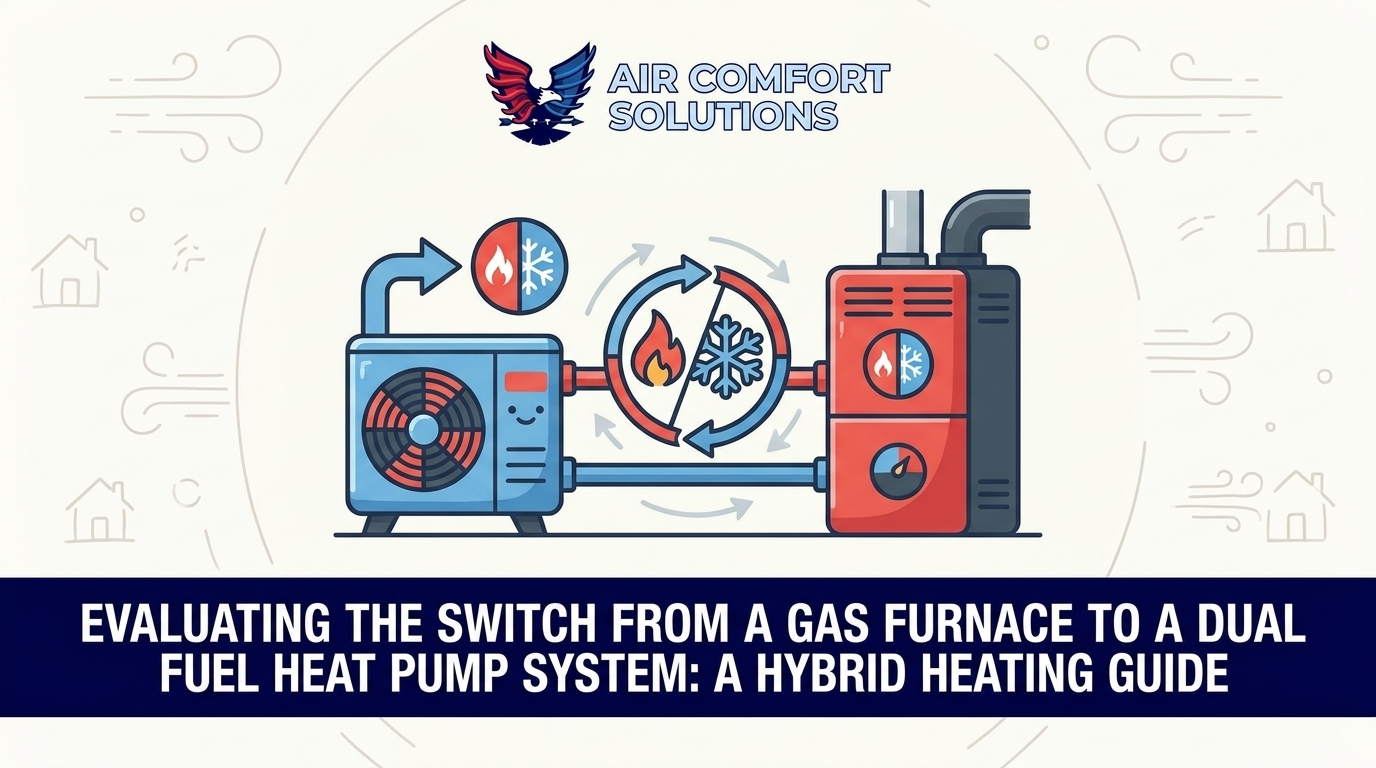
Evaluating the Switch from a Gas Furnace to a Dual Fuel Heat Pump System
As the pre-heating season approaches, many homeowners are weighing the benefits of hybrid heating. See how pairing an electric heat pump with gas backup offers reliable warmth.
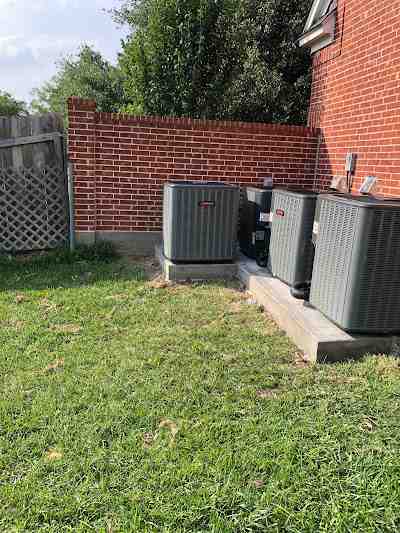
How long does an AC system last in Texas is one of the most important questions you can ask as a homeowner — especially in North Harris County, where your air conditioner runs harder and longer than almost anywhere else in the country. The short answer:
• Central AC (Split System) — Texas Lifespan (With Maintenance): 12–15 years — Texas Lifespan (Without Maintenance): 8–12 years — National Average: 15–20 years
• Ductless Mini-Split — Texas Lifespan (With Maintenance): 15–20 years — Texas Lifespan (Without Maintenance): 10–14 years — National Average: 15–20 years
• Heat Pump — Texas Lifespan (With Maintenance): 9–13 years — Texas Lifespan (Without Maintenance): 7–10 years — National Average: 10–15 years
Texas AC systems consistently fall short of the national average — and that gap is no accident. Your system runs roughly 2,000 or more hours per cooling season in the greater Houston area, compared to just 600 to 800 hours for a comparable unit in a northern city like Chicago. That kind of relentless demand takes a real toll on compressors, coils, and electrical components alike.
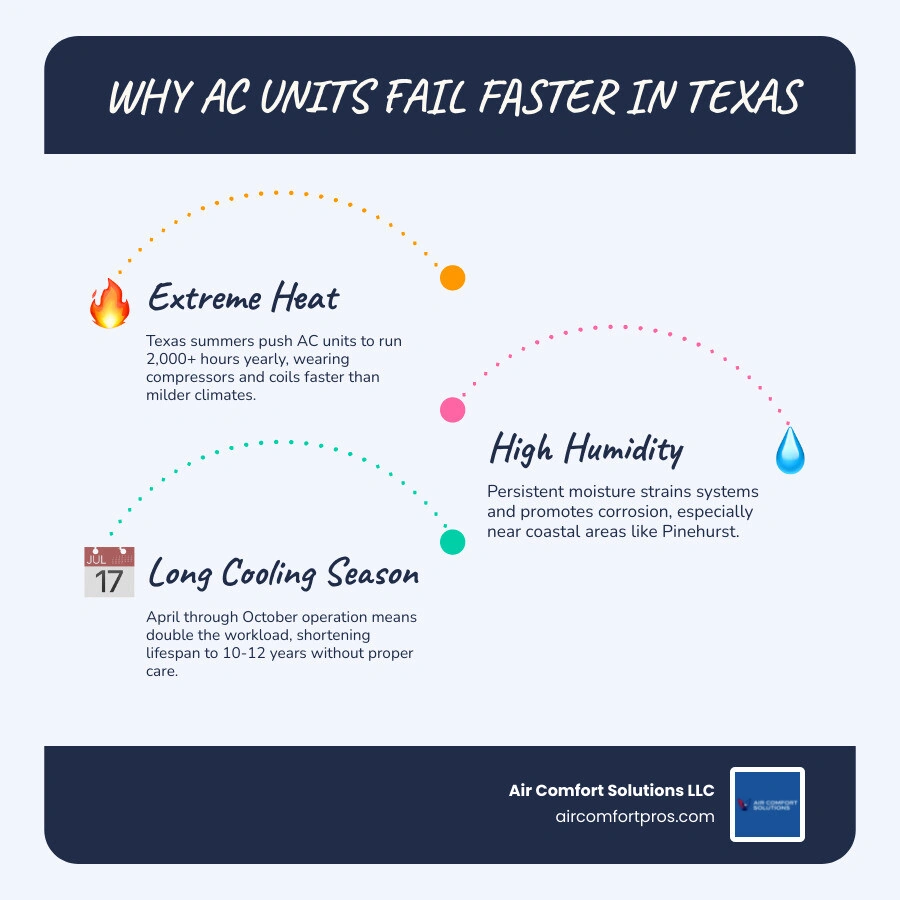
In Pinehurst, TX and surrounding communities, the combination of intense summer heat, high humidity, and long cooling seasons means your AC is essentially working double shifts from April through October. A system that might last 18 years in a mild climate may only make it 10 to 12 years here without the right care.
Understanding what shortens your system's life — and what you can do about it — is the first step toward protecting your home's comfort and avoiding a costly emergency replacement.
How long does an ac system last in texas basics:
• how to extend the life of your ac in texas
• when should you replace your ac in a hot climate
• why do ac units wear out faster in hot climates
When looking at national home improvement guides, you will often see a reassuring estimate that central air conditioners last up to two decades. However, here in the Lone Star State, we have to deal with what we call the "Texas Tax" on mechanical equipment. Because our cooling season is exceptionally long and intense, our HVAC units accumulate equivalent operating wear in roughly half the calendar time of a northern-state installation.
To put this in perspective, a typical air conditioner in a milder climate might only run for a few hours a day during the peak of mid-summer. In Southeast Texas, our systems regularly run 12 to 16 hours a day during relentless summer heatwaves. This constant operation compresses the functional lifespan of even the highest-quality equipment.
According to regional industry data, residential split systems in Texas typically reach their functional end-of-life between 12 and 16 years when they are maintained annually. If a system is neglected, that lifespan can easily drop to just 8 to 12 years. For a deeper breakdown of these local timelines, you can read our guide on the Average Lifespan of an HVAC System in Texas.
• Annual Cooling Hours — Texas Operating Conditions: 2,400 to 3,200 hours — Northern/Moderate Climates: 600 to 1,000 hours
• Peak Attic Temperatures — Texas Operating Conditions: 140°F to 160°F — Northern/Moderate Climates: 100°F to 110°F
• Average Compressor Cycles — Texas Operating Conditions: 10,000+ per season — Northern/Moderate Climates: 4,000 to 6,000 per season
• Expected System Lifespan — Texas Operating Conditions: 10 to 15 years — Northern/Moderate Climates: 15 to 20 years
For homeowners in Pinehurst, TX, and across northern Harris County, regional climate factors play an even bigger role in equipment degradation. While we are not sitting directly on the Gulf beach, our proximity to the coast means we experience extreme, heavy humidity and occasional salt-tinged air currents.
High humidity forces your air conditioner to work double duty. An AC unit does not just cool the air; it also acts as a dehumidifier, pulling moisture out of the indoor air and draining it away. In Southeast Texas, an AC system can easily extract 5 to 20 gallons of water from a home every single day. This constant moisture removal places incredible physical strain on the evaporator coil and condensate drainage system.
Over time, this humid environment, paired with airborne particles and local pollen, accelerates the corrosion of the delicate copper and aluminum coils. To understand the exact mechanics of how this moisture-heavy environment damages your system, take a look at our detailed article on How Hot Humid Climate Shortens HVAC Lifespan.
The type of cooling system you install also influences how long you can expect it to run. Standard central air conditioners (split systems) are the most common choice in our area, typically lasting 12 to 15 years under normal local operating loads.
Ductless mini-split systems, on the other hand, offer a different operational profile. Because they do not rely on a sprawling network of attic ducts, they avoid the static pressure issues and thermal losses that plague central systems. In Texas, a high-quality ductless mini-split system can last 15 to 20 years. This longer lifespan is largely due to their variable-speed inverter compressors, which ramp up and down smoothly rather than cycling on and off at full capacity.
Heat pumps are another popular option, but they have a unique drawback when it comes to longevity. Unlike a standard central AC that rests during our mild winters while a gas furnace takes over, a heat pump operates year-round to provide both heating and cooling. Because it never gets a true "off-season," a heat pump in Texas typically has a slightly shorter lifespan, averaging about 9 to 13 years due to this continuous, year-round operation.
To truly understand why air conditioners age faster in Texas, we have to look at the physical and mechanical stress caused by our weather.
First, consider thermal cycling. When your system turns on, its components rapidly heat up, and when it shuts off, they cool down. This constant expansion and contraction put mechanical stress on electrical connections, fan motors, and the compressor itself. In moderate climates, a compressor might experience 4,000 to 6,000 cycles per year. In the hot, humid environment of Southeast Texas, that number easily climbs past 10,000 cycles per season.
Second, we have to talk about attic temperatures. In places like Magnolia, Tomball, and Spring, TX, many residential air handlers and duct systems are installed in unconditioned attic spaces. When the outdoor temperature hits 95°F, your attic can easily reach a staggering 140°F to 160°F. Your air handler has to operate in this extreme heat, forcing it to work significantly harder just to keep the cooled air cold as it travels through your attic ducts.
Finally, our local power grid introduces electrical stress. Heavy summer demand on the ERCOT grid can lead to subtle voltage fluctuations. These quick, minor drops and surges in power place extra strain on sensitive AC electrical parts, frequently leading to failed run capacitors, worn contactors, and damaged compressor motors.
While the local climate is a major factor, several other elements determine how many years of service you will get out of your cooling system:
• Rate of Use: How you run your system directly impacts its wear and tear. Running your AC 24/7 at 68°F during a heatwave will wear it out much faster than setting it to a moderate temperature.
• Thermostat Settings: Keeping your thermostat set closer to 78°F rather than 70°F when outdoor temperatures exceed 100°F can reduce your system's daily workload. This simple habit can lower your cooling strain and keep your system running years longer.
• Temperature Drop Limits: Most residential air conditioners are designed to lower the indoor temperature by about 20 degrees compared to the outdoor air. When it is 100°F outside, asking your system to maintain 68°F indoors forces it to run continuously at maximum capacity, which can lead to premature compressor failure.
Many homeowners do not realize that the most important day in an air conditioner's lifespan is the day it is installed. If a system is not put in correctly, it will suffer from hidden mechanical strain that will shorten its life from day one.
A high-quality installation must always begin with a professional Manual J load calculation. This mathematical formula takes into account your home's square footage, insulation quality, window placement, local climate, and ductwork design to determine the exact cooling capacity your home needs.
Additionally, new systems installed in Texas must meet strict regional efficiency guidelines. As of recent energy standards, all new residential central air conditioners installed in the southern region of the United States must meet a minimum rating of 15 SEER2. Ensuring your new system complies with these standards guarantees you are getting equipment engineered to handle our high-demand climate efficiently.
Sizing an air conditioner is a delicate balancing act. Some homeowners believe that installing a larger system than necessary is a smart way to cool their home faster, but this actually causes major mechanical issues.
An oversized system will cool your home too quickly and shut off before completing a full cycle. This is known as short-cycling. Because the system turns on and off rapidly, it never runs long enough to pull humidity out of the air, leaving your home feeling damp and clammy. This constant starting and stopping also places extreme wear on the compressor, which can cause it to fail years ahead of schedule.
Conversely, an undersized system will run continuously without ever reaching your thermostat's set temperature. This constant operation overheats the compressor and fan motors, leading to premature wear on critical moving parts.
Proper sizing also relies on the health of your ductwork. If your ducts are too small, leaky, or poorly designed, they create high static pressure. This airflow restriction forces your blower motor to work much harder to push air through your home, leading to early motor failure and high energy bills.
While the Texas heat is tough, you do not have to sit by and watch your system wear out early. There are several practical steps you can take to keep your AC running smoothly for as long as possible:
• Change Air Filters Regularly: This is the easiest and most effective DIY task you can perform. A dirty filter blocks airflow, forcing your system to work harder and run longer to cool your home. During the peak of summer, check your filter every 30 days and replace it as soon as it looks dirty.
• Keep the Outdoor Condenser Clear: Your outdoor unit needs room to breathe so it can release the heat it pulls from your home. Maintain at least two feet of clear space around your outdoor unit, keeping it free of grass clippings, weeds, leaves, and outdoor storage.
• Upgrade to a Smart Thermostat: A programmable or smart thermostat allows you to set up cooling schedules. By raising the temperature by 5 to 7 degrees when you are away at work, you can reduce your system's daily run hours without sacrificing comfort when you are home.
While DIY steps are helpful, nothing replaces the value of professional care. Scheduling a professional AC tune-up every spring is the absolute best way to add three to five years to your system's lifespan.
During a professional maintenance visit, a certified technician will check your refrigerant levels, clean the outdoor condenser coils, inspect electrical connections, measure voltage draw, and lubricate moving parts. Catching a weak capacitor or a minor refrigerant leak in April prevents those small issues from turning into a complete compressor failure during a scorching July afternoon.
Regular maintenance also keeps your manufacturer's warranty valid. Most major HVAC brands require proof of annual professional service to honor parts warranties if a major component fails. To make keeping up with this service simple and affordable, we offer a structured HVAC Maintenance Plan designed to keep your system running at peak efficiency year after year.
For more details on how often you should have your system inspected, check out our guide on How Often Should You Service Your AC in Texas, and learn about the risks of skipping this step in What Happens If You Skip AC Maintenance in Texas.
No matter how well you care for your air conditioner, every system eventually reaches the point where it needs to be replaced. Knowing the warning signs of a failing unit can help you plan a replacement on your own terms, rather than dealing with an emergency breakdown in the middle of summer.
Keep an eye out for these common warning signs:
• Rising Energy Bills: If your electric bills are climbing month after month but your cooling habits haven't changed, your system is likely losing its operating efficiency as its internal components wear down.
• Frequent Repairs: Needing one minor repair every few years is normal. However, if you are calling for service multiple times a season to fix failing capacitors, fan motors, or contactors, your system is telling you it is reaching the end of its reliable life.
• Weak Airflow or Uneven Cooling: If some rooms in your house remain warm while others are cold, or if the air blowing from your vents feels weak, your compressor or blower motor may be struggling to keep up.
• Unusual Noises: Squealing, grinding, clanking, or hissing sounds are clear signs of mechanical trouble within your compressor or fan assembly.
When deciding whether to repair or replace an aging system, we recommend using the $5,000 Rule. Multiply the age of your system by the cost of the proposed repair. If the result is greater than $5,000, investing that money into a new, energy-efficient system is generally the smarter financial choice.
For example, if a 12-year-old system needs a repair that costs $600, multiplying 12 by 600 gives you $7,200. Since this is over $5,000, replacing the unit is likely the better long-term decision.
During our hot summer months, you should inspect your air filter every 30 days. If you use standard 1-inch pleated filters, they will likely need to be replaced every 30 to 60 days. If you have pets, allergies, or live in an area with high cedar pollen or dust, you may need to change them every single month to maintain proper airflow and protect your system from extra strain.
Typically, no. Because a heat pump provides both heating in the winter and cooling in the summer, it runs year-round. This continuous operation means it accumulates wear and tear much faster than a standard central AC, which gets to rest during our milder winter months. In our area, you can expect a heat pump to last about 9 to 13 years, compared to 12 to 15 years for a standard central air conditioner.
It depends on the type of repair and the overall condition of your system. If the issue is a simple, inexpensive part like a capacitor, a repair is usually worth it. However, if the system has a major refrigerant leak or a failed compressor, a repair is rarely a wise investment.
Older systems manufactured before 2020 often rely on R-22 refrigerant, which has been phased out by the EPA. Because R-22 is no longer produced, refilling a system after a leak is incredibly expensive. In these cases, upgrading to a modern system is almost always the better choice. For tips on keeping your system running smoothly through its later years, check out our AC Tune-Up Spring TX Guide.
At Air Comfort Solutions LLC, we have spent over 35 years helping homeowners in Pinehurst, TX, and across the north side of Harris County keep their homes comfortable. We understand the unique challenges our local climate presents, and our team of certified technicians is dedicated to providing honest, reliable HVAC solutions tailored to your home.
Whether you need a quick repair, a seasonal tune-up, or a complete system replacement, we are here to help you get the absolute most out of your air conditioning system. We offer upfront pricing, professional installations, and flexible financing options to make keeping your home comfortable as stress-free as possible.
Don't wait for the next major heatwave to find out if your air conditioner is up to the task. Contact us today to schedule your system evaluation, or sign up for our Comfort Club Maintenance Plan to protect your home's cooling system for years to come.
How long does an AC system last in Texas is one of the most important questions you can ask as a homeowner — especially in North Harris County, where your air conditioner runs harder and longer than almost anywhere else in the country. The short answer:
| AC System Type | Texas Lifespan (With Maintenance) | Texas Lifespan (Without Maintenance) | National Average |
|---|---|---|---|
| Central AC (Split System) | 12–15 years | 8–12 years | 15–20 years |
| Ductless Mini-Split | 15–20 years | 10–14 years | 15–20 years |
| Heat Pump | 9–13 years | 7–10 years | 10–15 years |
Texas AC systems consistently fall short of the national average — and that gap is no accident. Your system runs roughly 2,000 or more hours per cooling season in the greater Houston area, compared to just 600 to 800 hours for a comparable unit in a northern city like Chicago. That kind of relentless demand takes a real toll on compressors, coils, and electrical components alike.
In Pinehurst, TX and surrounding communities, the combination of intense summer heat, high humidity, and long cooling seasons means your AC is essentially working double shifts from April through October. A system that might last 18 years in a mild climate may only make it 10 to 12 years here without the right care.
Understanding what shortens your system's life — and what you can do about it — is the first step toward protecting your home's comfort and avoiding a costly emergency replacement.
How long does an ac system last in texas basics:
When looking at national home improvement guides, you will often see a reassuring estimate that central air conditioners last up to two decades. However, here in the Lone Star State, we have to deal with what we call the "Texas Tax" on mechanical equipment. Because our cooling season is exceptionally long and intense, our HVAC units accumulate equivalent operating wear in roughly half the calendar time of a northern-state installation.
To put this in perspective, a typical air conditioner in a milder climate might only run for a few hours a day during the peak of mid-summer. In Southeast Texas, our systems regularly run 12 to 16 hours a day during relentless summer heatwaves. This constant operation compresses the functional lifespan of even the highest-quality equipment.
According to regional industry data, residential split systems in Texas typically reach their functional end-of-life between 12 and 16 years when they are maintained annually. If a system is neglected, that lifespan can easily drop to just 8 to 12 years. For a deeper breakdown of these local timelines, you can read our guide on the Average Lifespan of an HVAC System in Texas.
| Factor | Texas Operating Conditions | Northern/Moderate Climates |
|---|---|---|
| Annual Cooling Hours | 2,400 to 3,200 hours | 600 to 1,000 hours |
| Peak Attic Temperatures | 140°F to 160°F | 100°F to 110°F |
| Average Compressor Cycles | 10,000+ per season | 4,000 to 6,000 per season |
| Expected System Lifespan | 10 to 15 years | 15 to 20 years |
For homeowners in Pinehurst, TX, and across northern Harris County, regional climate factors play an even bigger role in equipment degradation. While we are not sitting directly on the Gulf beach, our proximity to the coast means we experience extreme, heavy humidity and occasional salt-tinged air currents.
High humidity forces your air conditioner to work double duty. An AC unit does not just cool the air; it also acts as a dehumidifier, pulling moisture out of the indoor air and draining it away. In Southeast Texas, an AC system can easily extract 5 to 20 gallons of water from a home every single day. This constant moisture removal places incredible physical strain on the evaporator coil and condensate drainage system.
Over time, this humid environment, paired with airborne particles and local pollen, accelerates the corrosion of the delicate copper and aluminum coils. To understand the exact mechanics of how this moisture-heavy environment damages your system, take a look at our detailed article on How Hot Humid Climate Shortens HVAC Lifespan.
The type of cooling system you install also influences how long you can expect it to run. Standard central air conditioners (split systems) are the most common choice in our area, typically lasting 12 to 15 years under normal local operating loads.
Ductless mini-split systems, on the other hand, offer a different operational profile. Because they do not rely on a sprawling network of attic ducts, they avoid the static pressure issues and thermal losses that plague central systems. In Texas, a high-quality ductless mini-split system can last 15 to 20 years. This longer lifespan is largely due to their variable-speed inverter compressors, which ramp up and down smoothly rather than cycling on and off at full capacity.
Heat pumps are another popular option, but they have a unique drawback when it comes to longevity. Unlike a standard central AC that rests during our mild winters while a gas furnace takes over, a heat pump operates year-round to provide both heating and cooling. Because it never gets a true "off-season," a heat pump in Texas typically has a slightly shorter lifespan, averaging about 9 to 13 years due to this continuous, year-round operation.
To truly understand why air conditioners age faster in Texas, we have to look at the physical and mechanical stress caused by our weather.
First, consider thermal cycling. When your system turns on, its components rapidly heat up, and when it shuts off, they cool down. This constant expansion and contraction put mechanical stress on electrical connections, fan motors, and the compressor itself. In moderate climates, a compressor might experience 4,000 to 6,000 cycles per year. In the hot, humid environment of Southeast Texas, that number easily climbs past 10,000 cycles per season.
Second, we have to talk about attic temperatures. In places like Magnolia, Tomball, and Spring, TX, many residential air handlers and duct systems are installed in unconditioned attic spaces. When the outdoor temperature hits 95°F, your attic can easily reach a staggering 140°F to 160°F. Your air handler has to operate in this extreme heat, forcing it to work significantly harder just to keep the cooled air cold as it travels through your attic ducts.
Finally, our local power grid introduces electrical stress. Heavy summer demand on the ERCOT grid can lead to subtle voltage fluctuations. These quick, minor drops and surges in power place extra strain on sensitive AC electrical parts, frequently leading to failed run capacitors, worn contactors, and damaged compressor motors.
While the local climate is a major factor, several other elements determine how many years of service you will get out of your cooling system:
Many homeowners do not realize that the most important day in an air conditioner's lifespan is the day it is installed. If a system is not put in correctly, it will suffer from hidden mechanical strain that will shorten its life from day one.
A high-quality installation must always begin with a professional Manual J load calculation. This mathematical formula takes into account your home's square footage, insulation quality, window placement, local climate, and ductwork design to determine the exact cooling capacity your home needs.
Additionally, new systems installed in Texas must meet strict regional efficiency guidelines. As of recent energy standards, all new residential central air conditioners installed in the southern region of the United States must meet a minimum rating of 15 SEER2. Ensuring your new system complies with these standards guarantees you are getting equipment engineered to handle our high-demand climate efficiently.
Sizing an air conditioner is a delicate balancing act. Some homeowners believe that installing a larger system than necessary is a smart way to cool their home faster, but this actually causes major mechanical issues.
An oversized system will cool your home too quickly and shut off before completing a full cycle. This is known as short-cycling. Because the system turns on and off rapidly, it never runs long enough to pull humidity out of the air, leaving your home feeling damp and clammy. This constant starting and stopping also places extreme wear on the compressor, which can cause it to fail years ahead of schedule.
Conversely, an undersized system will run continuously without ever reaching your thermostat's set temperature. This constant operation overheats the compressor and fan motors, leading to premature wear on critical moving parts.
Proper sizing also relies on the health of your ductwork. If your ducts are too small, leaky, or poorly designed, they create high static pressure. This airflow restriction forces your blower motor to work much harder to push air through your home, leading to early motor failure and high energy bills.
While the Texas heat is tough, you do not have to sit by and watch your system wear out early. There are several practical steps you can take to keep your AC running smoothly for as long as possible:
While DIY steps are helpful, nothing replaces the value of professional care. Scheduling a professional AC tune-up every spring is the absolute best way to add three to five years to your system's lifespan.
During a professional maintenance visit, a certified technician will check your refrigerant levels, clean the outdoor condenser coils, inspect electrical connections, measure voltage draw, and lubricate moving parts. Catching a weak capacitor or a minor refrigerant leak in April prevents those small issues from turning into a complete compressor failure during a scorching July afternoon.
Regular maintenance also keeps your manufacturer's warranty valid. Most major HVAC brands require proof of annual professional service to honor parts warranties if a major component fails. To make keeping up with this service simple and affordable, we offer a structured HVAC Maintenance Plan designed to keep your system running at peak efficiency year after year.
For more details on how often you should have your system inspected, check out our guide on How Often Should You Service Your AC in Texas, and learn about the risks of skipping this step in What Happens If You Skip AC Maintenance in Texas.
No matter how well you care for your air conditioner, every system eventually reaches the point where it needs to be replaced. Knowing the warning signs of a failing unit can help you plan a replacement on your own terms, rather than dealing with an emergency breakdown in the middle of summer.
Keep an eye out for these common warning signs:
When deciding whether to repair or replace an aging system, we recommend using the $5,000 Rule. Multiply the age of your system by the cost of the proposed repair. If the result is greater than $5,000, investing that money into a new, energy-efficient system is generally the smarter financial choice.
For example, if a 12-year-old system needs a repair that costs $600, multiplying 12 by 600 gives you $7,200. Since this is over $5,000, replacing the unit is likely the better long-term decision.
During our hot summer months, you should inspect your air filter every 30 days. If you use standard 1-inch pleated filters, they will likely need to be replaced every 30 to 60 days. If you have pets, allergies, or live in an area with high cedar pollen or dust, you may need to change them every single month to maintain proper airflow and protect your system from extra strain.
Typically, no. Because a heat pump provides both heating in the winter and cooling in the summer, it runs year-round. This continuous operation means it accumulates wear and tear much faster than a standard central AC, which gets to rest during our milder winter months. In our area, you can expect a heat pump to last about 9 to 13 years, compared to 12 to 15 years for a standard central air conditioner.
It depends on the type of repair and the overall condition of your system. If the issue is a simple, inexpensive part like a capacitor, a repair is usually worth it. However, if the system has a major refrigerant leak or a failed compressor, a repair is rarely a wise investment.
Older systems manufactured before 2020 often rely on R-22 refrigerant, which has been phased out by the EPA. Because R-22 is no longer produced, refilling a system after a leak is incredibly expensive. In these cases, upgrading to a modern system is almost always the better choice. For tips on keeping your system running smoothly through its later years, check out our AC Tune-Up Spring TX Guide.
At Air Comfort Solutions LLC, we have spent over 35 years helping homeowners in Pinehurst, TX, and across the north side of Harris County keep their homes comfortable. We understand the unique challenges our local climate presents, and our team of certified technicians is dedicated to providing honest, reliable HVAC solutions tailored to your home.
Whether you need a quick repair, a seasonal tune-up, or a complete system replacement, we are here to help you get the absolute most out of your air conditioning system. We offer upfront pricing, professional installations, and flexible financing options to make keeping your home comfortable as stress-free as possible.
Don't wait for the next major heatwave to find out if your air conditioner is up to the task. Contact us today to schedule your system evaluation, or sign up for our Comfort Club Maintenance Plan to protect your home's cooling system for years to come.
How long does an AC system last in Texas is one of the most important questions you can ask as a homeowner — especially in North Harris County, where your air conditioner runs harder and longer than almost anywhere else in the country. The short answer:
| AC System Type | Texas Lifespan (With Maintenance) | Texas Lifespan (Without Maintenance) | National Average |
|---|---|---|---|
| Central AC (Split System) | 12–15 years | 8–12 years | 15–20 years |
| Ductless Mini-Split | 15–20 years | 10–14 years | 15–20 years |
| Heat Pump | 9–13 years | 7–10 years | 10–15 years |
Texas AC systems consistently fall short of the national average — and that gap is no accident. Your system runs roughly 2,000 or more hours per cooling season in the greater Houston area, compared to just 600 to 800 hours for a comparable unit in a northern city like Chicago. That kind of relentless demand takes a real toll on compressors, coils, and electrical components alike.
In Pinehurst, TX and surrounding communities, the combination of intense summer heat, high humidity, and long cooling seasons means your AC is essentially working double shifts from April through October. A system that might last 18 years in a mild climate may only make it 10 to 12 years here without the right care.
Understanding what shortens your system's life — and what you can do about it — is the first step toward protecting your home's comfort and avoiding a costly emergency replacement.
How long does an ac system last in texas basics:
When looking at national home improvement guides, you will often see a reassuring estimate that central air conditioners last up to two decades. However, here in the Lone Star State, we have to deal with what we call the "Texas Tax" on mechanical equipment. Because our cooling season is exceptionally long and intense, our HVAC units accumulate equivalent operating wear in roughly half the calendar time of a northern-state installation.
To put this in perspective, a typical air conditioner in a milder climate might only run for a few hours a day during the peak of mid-summer. In Southeast Texas, our systems regularly run 12 to 16 hours a day during relentless summer heatwaves. This constant operation compresses the functional lifespan of even the highest-quality equipment.
According to regional industry data, residential split systems in Texas typically reach their functional end-of-life between 12 and 16 years when they are maintained annually. If a system is neglected, that lifespan can easily drop to just 8 to 12 years. For a deeper breakdown of these local timelines, you can read our guide on the Average Lifespan of an HVAC System in Texas.
| Factor | Texas Operating Conditions | Northern/Moderate Climates |
|---|---|---|
| Annual Cooling Hours | 2,400 to 3,200 hours | 600 to 1,000 hours |
| Peak Attic Temperatures | 140°F to 160°F | 100°F to 110°F |
| Average Compressor Cycles | 10,000+ per season | 4,000 to 6,000 per season |
| Expected System Lifespan | 10 to 15 years | 15 to 20 years |
For homeowners in Pinehurst, TX, and across northern Harris County, regional climate factors play an even bigger role in equipment degradation. While we are not sitting directly on the Gulf beach, our proximity to the coast means we experience extreme, heavy humidity and occasional salt-tinged air currents.
High humidity forces your air conditioner to work double duty. An AC unit does not just cool the air; it also acts as a dehumidifier, pulling moisture out of the indoor air and draining it away. In Southeast Texas, an AC system can easily extract 5 to 20 gallons of water from a home every single day. This constant moisture removal places incredible physical strain on the evaporator coil and condensate drainage system.
Over time, this humid environment, paired with airborne particles and local pollen, accelerates the corrosion of the delicate copper and aluminum coils. To understand the exact mechanics of how this moisture-heavy environment damages your system, take a look at our detailed article on How Hot Humid Climate Shortens HVAC Lifespan.
The type of cooling system you install also influences how long you can expect it to run. Standard central air conditioners (split systems) are the most common choice in our area, typically lasting 12 to 15 years under normal local operating loads.
Ductless mini-split systems, on the other hand, offer a different operational profile. Because they do not rely on a sprawling network of attic ducts, they avoid the static pressure issues and thermal losses that plague central systems. In Texas, a high-quality ductless mini-split system can last 15 to 20 years. This longer lifespan is largely due to their variable-speed inverter compressors, which ramp up and down smoothly rather than cycling on and off at full capacity.
Heat pumps are another popular option, but they have a unique drawback when it comes to longevity. Unlike a standard central AC that rests during our mild winters while a gas furnace takes over, a heat pump operates year-round to provide both heating and cooling. Because it never gets a true "off-season," a heat pump in Texas typically has a slightly shorter lifespan, averaging about 9 to 13 years due to this continuous, year-round operation.
To truly understand why air conditioners age faster in Texas, we have to look at the physical and mechanical stress caused by our weather.
First, consider thermal cycling. When your system turns on, its components rapidly heat up, and when it shuts off, they cool down. This constant expansion and contraction put mechanical stress on electrical connections, fan motors, and the compressor itself. In moderate climates, a compressor might experience 4,000 to 6,000 cycles per year. In the hot, humid environment of Southeast Texas, that number easily climbs past 10,000 cycles per season.
Second, we have to talk about attic temperatures. In places like Magnolia, Tomball, and Spring, TX, many residential air handlers and duct systems are installed in unconditioned attic spaces. When the outdoor temperature hits 95°F, your attic can easily reach a staggering 140°F to 160°F. Your air handler has to operate in this extreme heat, forcing it to work significantly harder just to keep the cooled air cold as it travels through your attic ducts.
Finally, our local power grid introduces electrical stress. Heavy summer demand on the ERCOT grid can lead to subtle voltage fluctuations. These quick, minor drops and surges in power place extra strain on sensitive AC electrical parts, frequently leading to failed run capacitors, worn contactors, and damaged compressor motors.
While the local climate is a major factor, several other elements determine how many years of service you will get out of your cooling system:
Many homeowners do not realize that the most important day in an air conditioner's lifespan is the day it is installed. If a system is not put in correctly, it will suffer from hidden mechanical strain that will shorten its life from day one.
A high-quality installation must always begin with a professional Manual J load calculation. This mathematical formula takes into account your home's square footage, insulation quality, window placement, local climate, and ductwork design to determine the exact cooling capacity your home needs.
Additionally, new systems installed in Texas must meet strict regional efficiency guidelines. As of recent energy standards, all new residential central air conditioners installed in the southern region of the United States must meet a minimum rating of 15 SEER2. Ensuring your new system complies with these standards guarantees you are getting equipment engineered to handle our high-demand climate efficiently.
Sizing an air conditioner is a delicate balancing act. Some homeowners believe that installing a larger system than necessary is a smart way to cool their home faster, but this actually causes major mechanical issues.
An oversized system will cool your home too quickly and shut off before completing a full cycle. This is known as short-cycling. Because the system turns on and off rapidly, it never runs long enough to pull humidity out of the air, leaving your home feeling damp and clammy. This constant starting and stopping also places extreme wear on the compressor, which can cause it to fail years ahead of schedule.
Conversely, an undersized system will run continuously without ever reaching your thermostat's set temperature. This constant operation overheats the compressor and fan motors, leading to premature wear on critical moving parts.
Proper sizing also relies on the health of your ductwork. If your ducts are too small, leaky, or poorly designed, they create high static pressure. This airflow restriction forces your blower motor to work much harder to push air through your home, leading to early motor failure and high energy bills.
While the Texas heat is tough, you do not have to sit by and watch your system wear out early. There are several practical steps you can take to keep your AC running smoothly for as long as possible:
While DIY steps are helpful, nothing replaces the value of professional care. Scheduling a professional AC tune-up every spring is the absolute best way to add three to five years to your system's lifespan.
During a professional maintenance visit, a certified technician will check your refrigerant levels, clean the outdoor condenser coils, inspect electrical connections, measure voltage draw, and lubricate moving parts. Catching a weak capacitor or a minor refrigerant leak in April prevents those small issues from turning into a complete compressor failure during a scorching July afternoon.
Regular maintenance also keeps your manufacturer's warranty valid. Most major HVAC brands require proof of annual professional service to honor parts warranties if a major component fails. To make keeping up with this service simple and affordable, we offer a structured HVAC Maintenance Plan designed to keep your system running at peak efficiency year after year.
For more details on how often you should have your system inspected, check out our guide on How Often Should You Service Your AC in Texas, and learn about the risks of skipping this step in What Happens If You Skip AC Maintenance in Texas.
No matter how well you care for your air conditioner, every system eventually reaches the point where it needs to be replaced. Knowing the warning signs of a failing unit can help you plan a replacement on your own terms, rather than dealing with an emergency breakdown in the middle of summer.
Keep an eye out for these common warning signs:
When deciding whether to repair or replace an aging system, we recommend using the $5,000 Rule. Multiply the age of your system by the cost of the proposed repair. If the result is greater than $5,000, investing that money into a new, energy-efficient system is generally the smarter financial choice.
For example, if a 12-year-old system needs a repair that costs $600, multiplying 12 by 600 gives you $7,200. Since this is over $5,000, replacing the unit is likely the better long-term decision.
During our hot summer months, you should inspect your air filter every 30 days. If you use standard 1-inch pleated filters, they will likely need to be replaced every 30 to 60 days. If you have pets, allergies, or live in an area with high cedar pollen or dust, you may need to change them every single month to maintain proper airflow and protect your system from extra strain.
Typically, no. Because a heat pump provides both heating in the winter and cooling in the summer, it runs year-round. This continuous operation means it accumulates wear and tear much faster than a standard central AC, which gets to rest during our milder winter months. In our area, you can expect a heat pump to last about 9 to 13 years, compared to 12 to 15 years for a standard central air conditioner.
It depends on the type of repair and the overall condition of your system. If the issue is a simple, inexpensive part like a capacitor, a repair is usually worth it. However, if the system has a major refrigerant leak or a failed compressor, a repair is rarely a wise investment.
Older systems manufactured before 2020 often rely on R-22 refrigerant, which has been phased out by the EPA. Because R-22 is no longer produced, refilling a system after a leak is incredibly expensive. In these cases, upgrading to a modern system is almost always the better choice. For tips on keeping your system running smoothly through its later years, check out our AC Tune-Up Spring TX Guide.
At Air Comfort Solutions LLC, we have spent over 35 years helping homeowners in Pinehurst, TX, and across the north side of Harris County keep their homes comfortable. We understand the unique challenges our local climate presents, and our team of certified technicians is dedicated to providing honest, reliable HVAC solutions tailored to your home.
Whether you need a quick repair, a seasonal tune-up, or a complete system replacement, we are here to help you get the absolute most out of your air conditioning system. We offer upfront pricing, professional installations, and flexible financing options to make keeping your home comfortable as stress-free as possible.
Don't wait for the next major heatwave to find out if your air conditioner is up to the task. Contact us today to schedule your system evaluation, or sign up for our Comfort Club Maintenance Plan to protect your home's cooling system for years to come.
How long does an AC system last in Texas is one of the most important questions you can ask as a homeowner — especially in North Harris County, where your air conditioner runs harder and longer than almost anywhere else in the country. The short answer:
| AC System Type | Texas Lifespan (With Maintenance) | Texas Lifespan (Without Maintenance) | National Average |
|---|---|---|---|
| Central AC (Split System) | 12–15 years | 8–12 years | 15–20 years |
| Ductless Mini-Split | 15–20 years | 10–14 years | 15–20 years |
| Heat Pump | 9–13 years | 7–10 years | 10–15 years |
Texas AC systems consistently fall short of the national average — and that gap is no accident. Your system runs roughly 2,000 or more hours per cooling season in the greater Houston area, compared to just 600 to 800 hours for a comparable unit in a northern city like Chicago. That kind of relentless demand takes a real toll on compressors, coils, and electrical components alike.
In Pinehurst, TX and surrounding communities, the combination of intense summer heat, high humidity, and long cooling seasons means your AC is essentially working double shifts from April through October. A system that might last 18 years in a mild climate may only make it 10 to 12 years here without the right care.
Understanding what shortens your system's life — and what you can do about it — is the first step toward protecting your home's comfort and avoiding a costly emergency replacement.
How long does an ac system last in texas basics:
When looking at national home improvement guides, you will often see a reassuring estimate that central air conditioners last up to two decades. However, here in the Lone Star State, we have to deal with what we call the "Texas Tax" on mechanical equipment. Because our cooling season is exceptionally long and intense, our HVAC units accumulate equivalent operating wear in roughly half the calendar time of a northern-state installation.
To put this in perspective, a typical air conditioner in a milder climate might only run for a few hours a day during the peak of mid-summer. In Southeast Texas, our systems regularly run 12 to 16 hours a day during relentless summer heatwaves. This constant operation compresses the functional lifespan of even the highest-quality equipment.
According to regional industry data, residential split systems in Texas typically reach their functional end-of-life between 12 and 16 years when they are maintained annually. If a system is neglected, that lifespan can easily drop to just 8 to 12 years. For a deeper breakdown of these local timelines, you can read our guide on the Average Lifespan of an HVAC System in Texas.
| Factor | Texas Operating Conditions | Northern/Moderate Climates |
|---|---|---|
| Annual Cooling Hours | 2,400 to 3,200 hours | 600 to 1,000 hours |
| Peak Attic Temperatures | 140°F to 160°F | 100°F to 110°F |
| Average Compressor Cycles | 10,000+ per season | 4,000 to 6,000 per season |
| Expected System Lifespan | 10 to 15 years | 15 to 20 years |
For homeowners in Pinehurst, TX, and across northern Harris County, regional climate factors play an even bigger role in equipment degradation. While we are not sitting directly on the Gulf beach, our proximity to the coast means we experience extreme, heavy humidity and occasional salt-tinged air currents.
High humidity forces your air conditioner to work double duty. An AC unit does not just cool the air; it also acts as a dehumidifier, pulling moisture out of the indoor air and draining it away. In Southeast Texas, an AC system can easily extract 5 to 20 gallons of water from a home every single day. This constant moisture removal places incredible physical strain on the evaporator coil and condensate drainage system.
Over time, this humid environment, paired with airborne particles and local pollen, accelerates the corrosion of the delicate copper and aluminum coils. To understand the exact mechanics of how this moisture-heavy environment damages your system, take a look at our detailed article on How Hot Humid Climate Shortens HVAC Lifespan.
The type of cooling system you install also influences how long you can expect it to run. Standard central air conditioners (split systems) are the most common choice in our area, typically lasting 12 to 15 years under normal local operating loads.
Ductless mini-split systems, on the other hand, offer a different operational profile. Because they do not rely on a sprawling network of attic ducts, they avoid the static pressure issues and thermal losses that plague central systems. In Texas, a high-quality ductless mini-split system can last 15 to 20 years. This longer lifespan is largely due to their variable-speed inverter compressors, which ramp up and down smoothly rather than cycling on and off at full capacity.
Heat pumps are another popular option, but they have a unique drawback when it comes to longevity. Unlike a standard central AC that rests during our mild winters while a gas furnace takes over, a heat pump operates year-round to provide both heating and cooling. Because it never gets a true "off-season," a heat pump in Texas typically has a slightly shorter lifespan, averaging about 9 to 13 years due to this continuous, year-round operation.
To truly understand why air conditioners age faster in Texas, we have to look at the physical and mechanical stress caused by our weather.
First, consider thermal cycling. When your system turns on, its components rapidly heat up, and when it shuts off, they cool down. This constant expansion and contraction put mechanical stress on electrical connections, fan motors, and the compressor itself. In moderate climates, a compressor might experience 4,000 to 6,000 cycles per year. In the hot, humid environment of Southeast Texas, that number easily climbs past 10,000 cycles per season.
Second, we have to talk about attic temperatures. In places like Magnolia, Tomball, and Spring, TX, many residential air handlers and duct systems are installed in unconditioned attic spaces. When the outdoor temperature hits 95°F, your attic can easily reach a staggering 140°F to 160°F. Your air handler has to operate in this extreme heat, forcing it to work significantly harder just to keep the cooled air cold as it travels through your attic ducts.
Finally, our local power grid introduces electrical stress. Heavy summer demand on the ERCOT grid can lead to subtle voltage fluctuations. These quick, minor drops and surges in power place extra strain on sensitive AC electrical parts, frequently leading to failed run capacitors, worn contactors, and damaged compressor motors.
While the local climate is a major factor, several other elements determine how many years of service you will get out of your cooling system:
Many homeowners do not realize that the most important day in an air conditioner's lifespan is the day it is installed. If a system is not put in correctly, it will suffer from hidden mechanical strain that will shorten its life from day one.
A high-quality installation must always begin with a professional Manual J load calculation. This mathematical formula takes into account your home's square footage, insulation quality, window placement, local climate, and ductwork design to determine the exact cooling capacity your home needs.
Additionally, new systems installed in Texas must meet strict regional efficiency guidelines. As of recent energy standards, all new residential central air conditioners installed in the southern region of the United States must meet a minimum rating of 15 SEER2. Ensuring your new system complies with these standards guarantees you are getting equipment engineered to handle our high-demand climate efficiently.
Sizing an air conditioner is a delicate balancing act. Some homeowners believe that installing a larger system than necessary is a smart way to cool their home faster, but this actually causes major mechanical issues.
An oversized system will cool your home too quickly and shut off before completing a full cycle. This is known as short-cycling. Because the system turns on and off rapidly, it never runs long enough to pull humidity out of the air, leaving your home feeling damp and clammy. This constant starting and stopping also places extreme wear on the compressor, which can cause it to fail years ahead of schedule.
Conversely, an undersized system will run continuously without ever reaching your thermostat's set temperature. This constant operation overheats the compressor and fan motors, leading to premature wear on critical moving parts.
Proper sizing also relies on the health of your ductwork. If your ducts are too small, leaky, or poorly designed, they create high static pressure. This airflow restriction forces your blower motor to work much harder to push air through your home, leading to early motor failure and high energy bills.
While the Texas heat is tough, you do not have to sit by and watch your system wear out early. There are several practical steps you can take to keep your AC running smoothly for as long as possible:
While DIY steps are helpful, nothing replaces the value of professional care. Scheduling a professional AC tune-up every spring is the absolute best way to add three to five years to your system's lifespan.
During a professional maintenance visit, a certified technician will check your refrigerant levels, clean the outdoor condenser coils, inspect electrical connections, measure voltage draw, and lubricate moving parts. Catching a weak capacitor or a minor refrigerant leak in April prevents those small issues from turning into a complete compressor failure during a scorching July afternoon.
Regular maintenance also keeps your manufacturer's warranty valid. Most major HVAC brands require proof of annual professional service to honor parts warranties if a major component fails. To make keeping up with this service simple and affordable, we offer a structured HVAC Maintenance Plan designed to keep your system running at peak efficiency year after year.
For more details on how often you should have your system inspected, check out our guide on How Often Should You Service Your AC in Texas, and learn about the risks of skipping this step in What Happens If You Skip AC Maintenance in Texas.
No matter how well you care for your air conditioner, every system eventually reaches the point where it needs to be replaced. Knowing the warning signs of a failing unit can help you plan a replacement on your own terms, rather than dealing with an emergency breakdown in the middle of summer.
Keep an eye out for these common warning signs:
When deciding whether to repair or replace an aging system, we recommend using the $5,000 Rule. Multiply the age of your system by the cost of the proposed repair. If the result is greater than $5,000, investing that money into a new, energy-efficient system is generally the smarter financial choice.
For example, if a 12-year-old system needs a repair that costs $600, multiplying 12 by 600 gives you $7,200. Since this is over $5,000, replacing the unit is likely the better long-term decision.
During our hot summer months, you should inspect your air filter every 30 days. If you use standard 1-inch pleated filters, they will likely need to be replaced every 30 to 60 days. If you have pets, allergies, or live in an area with high cedar pollen or dust, you may need to change them every single month to maintain proper airflow and protect your system from extra strain.
Typically, no. Because a heat pump provides both heating in the winter and cooling in the summer, it runs year-round. This continuous operation means it accumulates wear and tear much faster than a standard central AC, which gets to rest during our milder winter months. In our area, you can expect a heat pump to last about 9 to 13 years, compared to 12 to 15 years for a standard central air conditioner.
It depends on the type of repair and the overall condition of your system. If the issue is a simple, inexpensive part like a capacitor, a repair is usually worth it. However, if the system has a major refrigerant leak or a failed compressor, a repair is rarely a wise investment.
Older systems manufactured before 2020 often rely on R-22 refrigerant, which has been phased out by the EPA. Because R-22 is no longer produced, refilling a system after a leak is incredibly expensive. In these cases, upgrading to a modern system is almost always the better choice. For tips on keeping your system running smoothly through its later years, check out our AC Tune-Up Spring TX Guide.
At Air Comfort Solutions LLC, we have spent over 35 years helping homeowners in Pinehurst, TX, and across the north side of Harris County keep their homes comfortable. We understand the unique challenges our local climate presents, and our team of certified technicians is dedicated to providing honest, reliable HVAC solutions tailored to your home.
Whether you need a quick repair, a seasonal tune-up, or a complete system replacement, we are here to help you get the absolute most out of your air conditioning system. We offer upfront pricing, professional installations, and flexible financing options to make keeping your home comfortable as stress-free as possible.
Don't wait for the next major heatwave to find out if your air conditioner is up to the task. Contact us today to schedule your system evaluation, or sign up for our Comfort Club Maintenance Plan to protect your home's cooling system for years to come.
How long does an AC system last in Texas is one of the most important questions you can ask as a homeowner — especially in North Harris County, where your air conditioner runs harder and longer than almost anywhere else in the country. The short answer:
| AC System Type | Texas Lifespan (With Maintenance) | Texas Lifespan (Without Maintenance) | National Average |
|---|---|---|---|
| Central AC (Split System) | 12–15 years | 8–12 years | 15–20 years |
| Ductless Mini-Split | 15–20 years | 10–14 years | 15–20 years |
| Heat Pump | 9–13 years | 7–10 years | 10–15 years |
Texas AC systems consistently fall short of the national average — and that gap is no accident. Your system runs roughly 2,000 or more hours per cooling season in the greater Houston area, compared to just 600 to 800 hours for a comparable unit in a northern city like Chicago. That kind of relentless demand takes a real toll on compressors, coils, and electrical components alike.
In Pinehurst, TX and surrounding communities, the combination of intense summer heat, high humidity, and long cooling seasons means your AC is essentially working double shifts from April through October. A system that might last 18 years in a mild climate may only make it 10 to 12 years here without the right care.
Understanding what shortens your system's life — and what you can do about it — is the first step toward protecting your home's comfort and avoiding a costly emergency replacement.
How long does an ac system last in texas basics:
When looking at national home improvement guides, you will often see a reassuring estimate that central air conditioners last up to two decades. However, here in the Lone Star State, we have to deal with what we call the "Texas Tax" on mechanical equipment. Because our cooling season is exceptionally long and intense, our HVAC units accumulate equivalent operating wear in roughly half the calendar time of a northern-state installation.
To put this in perspective, a typical air conditioner in a milder climate might only run for a few hours a day during the peak of mid-summer. In Southeast Texas, our systems regularly run 12 to 16 hours a day during relentless summer heatwaves. This constant operation compresses the functional lifespan of even the highest-quality equipment.
According to regional industry data, residential split systems in Texas typically reach their functional end-of-life between 12 and 16 years when they are maintained annually. If a system is neglected, that lifespan can easily drop to just 8 to 12 years. For a deeper breakdown of these local timelines, you can read our guide on the Average Lifespan of an HVAC System in Texas.
| Factor | Texas Operating Conditions | Northern/Moderate Climates |
|---|---|---|
| Annual Cooling Hours | 2,400 to 3,200 hours | 600 to 1,000 hours |
| Peak Attic Temperatures | 140°F to 160°F | 100°F to 110°F |
| Average Compressor Cycles | 10,000+ per season | 4,000 to 6,000 per season |
| Expected System Lifespan | 10 to 15 years | 15 to 20 years |
For homeowners in Pinehurst, TX, and across northern Harris County, regional climate factors play an even bigger role in equipment degradation. While we are not sitting directly on the Gulf beach, our proximity to the coast means we experience extreme, heavy humidity and occasional salt-tinged air currents.
High humidity forces your air conditioner to work double duty. An AC unit does not just cool the air; it also acts as a dehumidifier, pulling moisture out of the indoor air and draining it away. In Southeast Texas, an AC system can easily extract 5 to 20 gallons of water from a home every single day. This constant moisture removal places incredible physical strain on the evaporator coil and condensate drainage system.
Over time, this humid environment, paired with airborne particles and local pollen, accelerates the corrosion of the delicate copper and aluminum coils. To understand the exact mechanics of how this moisture-heavy environment damages your system, take a look at our detailed article on How Hot Humid Climate Shortens HVAC Lifespan.
The type of cooling system you install also influences how long you can expect it to run. Standard central air conditioners (split systems) are the most common choice in our area, typically lasting 12 to 15 years under normal local operating loads.
Ductless mini-split systems, on the other hand, offer a different operational profile. Because they do not rely on a sprawling network of attic ducts, they avoid the static pressure issues and thermal losses that plague central systems. In Texas, a high-quality ductless mini-split system can last 15 to 20 years. This longer lifespan is largely due to their variable-speed inverter compressors, which ramp up and down smoothly rather than cycling on and off at full capacity.
Heat pumps are another popular option, but they have a unique drawback when it comes to longevity. Unlike a standard central AC that rests during our mild winters while a gas furnace takes over, a heat pump operates year-round to provide both heating and cooling. Because it never gets a true "off-season," a heat pump in Texas typically has a slightly shorter lifespan, averaging about 9 to 13 years due to this continuous, year-round operation.
To truly understand why air conditioners age faster in Texas, we have to look at the physical and mechanical stress caused by our weather.
First, consider thermal cycling. When your system turns on, its components rapidly heat up, and when it shuts off, they cool down. This constant expansion and contraction put mechanical stress on electrical connections, fan motors, and the compressor itself. In moderate climates, a compressor might experience 4,000 to 6,000 cycles per year. In the hot, humid environment of Southeast Texas, that number easily climbs past 10,000 cycles per season.
Second, we have to talk about attic temperatures. In places like Magnolia, Tomball, and Spring, TX, many residential air handlers and duct systems are installed in unconditioned attic spaces. When the outdoor temperature hits 95°F, your attic can easily reach a staggering 140°F to 160°F. Your air handler has to operate in this extreme heat, forcing it to work significantly harder just to keep the cooled air cold as it travels through your attic ducts.
Finally, our local power grid introduces electrical stress. Heavy summer demand on the ERCOT grid can lead to subtle voltage fluctuations. These quick, minor drops and surges in power place extra strain on sensitive AC electrical parts, frequently leading to failed run capacitors, worn contactors, and damaged compressor motors.
While the local climate is a major factor, several other elements determine how many years of service you will get out of your cooling system:
Many homeowners do not realize that the most important day in an air conditioner's lifespan is the day it is installed. If a system is not put in correctly, it will suffer from hidden mechanical strain that will shorten its life from day one.
A high-quality installation must always begin with a professional Manual J load calculation. This mathematical formula takes into account your home's square footage, insulation quality, window placement, local climate, and ductwork design to determine the exact cooling capacity your home needs.
Additionally, new systems installed in Texas must meet strict regional efficiency guidelines. As of recent energy standards, all new residential central air conditioners installed in the southern region of the United States must meet a minimum rating of 15 SEER2. Ensuring your new system complies with these standards guarantees you are getting equipment engineered to handle our high-demand climate efficiently.
Sizing an air conditioner is a delicate balancing act. Some homeowners believe that installing a larger system than necessary is a smart way to cool their home faster, but this actually causes major mechanical issues.
An oversized system will cool your home too quickly and shut off before completing a full cycle. This is known as short-cycling. Because the system turns on and off rapidly, it never runs long enough to pull humidity out of the air, leaving your home feeling damp and clammy. This constant starting and stopping also places extreme wear on the compressor, which can cause it to fail years ahead of schedule.
Conversely, an undersized system will run continuously without ever reaching your thermostat's set temperature. This constant operation overheats the compressor and fan motors, leading to premature wear on critical moving parts.
Proper sizing also relies on the health of your ductwork. If your ducts are too small, leaky, or poorly designed, they create high static pressure. This airflow restriction forces your blower motor to work much harder to push air through your home, leading to early motor failure and high energy bills.
While the Texas heat is tough, you do not have to sit by and watch your system wear out early. There are several practical steps you can take to keep your AC running smoothly for as long as possible:
While DIY steps are helpful, nothing replaces the value of professional care. Scheduling a professional AC tune-up every spring is the absolute best way to add three to five years to your system's lifespan.
During a professional maintenance visit, a certified technician will check your refrigerant levels, clean the outdoor condenser coils, inspect electrical connections, measure voltage draw, and lubricate moving parts. Catching a weak capacitor or a minor refrigerant leak in April prevents those small issues from turning into a complete compressor failure during a scorching July afternoon.
Regular maintenance also keeps your manufacturer's warranty valid. Most major HVAC brands require proof of annual professional service to honor parts warranties if a major component fails. To make keeping up with this service simple and affordable, we offer a structured HVAC Maintenance Plan designed to keep your system running at peak efficiency year after year.
For more details on how often you should have your system inspected, check out our guide on How Often Should You Service Your AC in Texas, and learn about the risks of skipping this step in What Happens If You Skip AC Maintenance in Texas.
No matter how well you care for your air conditioner, every system eventually reaches the point where it needs to be replaced. Knowing the warning signs of a failing unit can help you plan a replacement on your own terms, rather than dealing with an emergency breakdown in the middle of summer.
Keep an eye out for these common warning signs:
When deciding whether to repair or replace an aging system, we recommend using the $5,000 Rule. Multiply the age of your system by the cost of the proposed repair. If the result is greater than $5,000, investing that money into a new, energy-efficient system is generally the smarter financial choice.
For example, if a 12-year-old system needs a repair that costs $600, multiplying 12 by 600 gives you $7,200. Since this is over $5,000, replacing the unit is likely the better long-term decision.
During our hot summer months, you should inspect your air filter every 30 days. If you use standard 1-inch pleated filters, they will likely need to be replaced every 30 to 60 days. If you have pets, allergies, or live in an area with high cedar pollen or dust, you may need to change them every single month to maintain proper airflow and protect your system from extra strain.
Typically, no. Because a heat pump provides both heating in the winter and cooling in the summer, it runs year-round. This continuous operation means it accumulates wear and tear much faster than a standard central AC, which gets to rest during our milder winter months. In our area, you can expect a heat pump to last about 9 to 13 years, compared to 12 to 15 years for a standard central air conditioner.
It depends on the type of repair and the overall condition of your system. If the issue is a simple, inexpensive part like a capacitor, a repair is usually worth it. However, if the system has a major refrigerant leak or a failed compressor, a repair is rarely a wise investment.
Older systems manufactured before 2020 often rely on R-22 refrigerant, which has been phased out by the EPA. Because R-22 is no longer produced, refilling a system after a leak is incredibly expensive. In these cases, upgrading to a modern system is almost always the better choice. For tips on keeping your system running smoothly through its later years, check out our AC Tune-Up Spring TX Guide.
At Air Comfort Solutions LLC, we have spent over 35 years helping homeowners in Pinehurst, TX, and across the north side of Harris County keep their homes comfortable. We understand the unique challenges our local climate presents, and our team of certified technicians is dedicated to providing honest, reliable HVAC solutions tailored to your home.
Whether you need a quick repair, a seasonal tune-up, or a complete system replacement, we are here to help you get the absolute most out of your air conditioning system. We offer upfront pricing, professional installations, and flexible financing options to make keeping your home comfortable as stress-free as possible.
Don't wait for the next major heatwave to find out if your air conditioner is up to the task. Contact us today to schedule your system evaluation, or sign up for our Comfort Club Maintenance Plan to protect your home's cooling system for years to come.


Zane came out and did an amazing job! Super friendly, honest and transparent about the work that needed to be done. This is my second time working with Air Comfort Solutions and they’re my go to for HVAC services. Highly recommend.
God's AMAZING grace sent us Robert and Zane. We have been without air in this Texas heat for six weeks and four days. We've had a few contractors give us quotes all trying to upsell when we're at a low point. But not the guys at Air Comfort Solutions. They came in assessed our situation, gave us honest feedback, and showed us the issues as they proceeded with the assessment for clear understanding. We highly recommend them for their professionalism, quality products, and fair pricing. We hands down support them for all the work they do 💯 %.
Robert and Zane gone above and beyond to make the process easy and affordable.
Would definitely recommend!!
I’m writing this review to let everyone know that Air Comfort Solutions is the company to work with. I know the owner ( Robert) for several years now. He has been taking care of my residential and business work orders. Robert is professional, knowledgeable and will save you money. I just want to thank Robert for great job you have been doing for me.