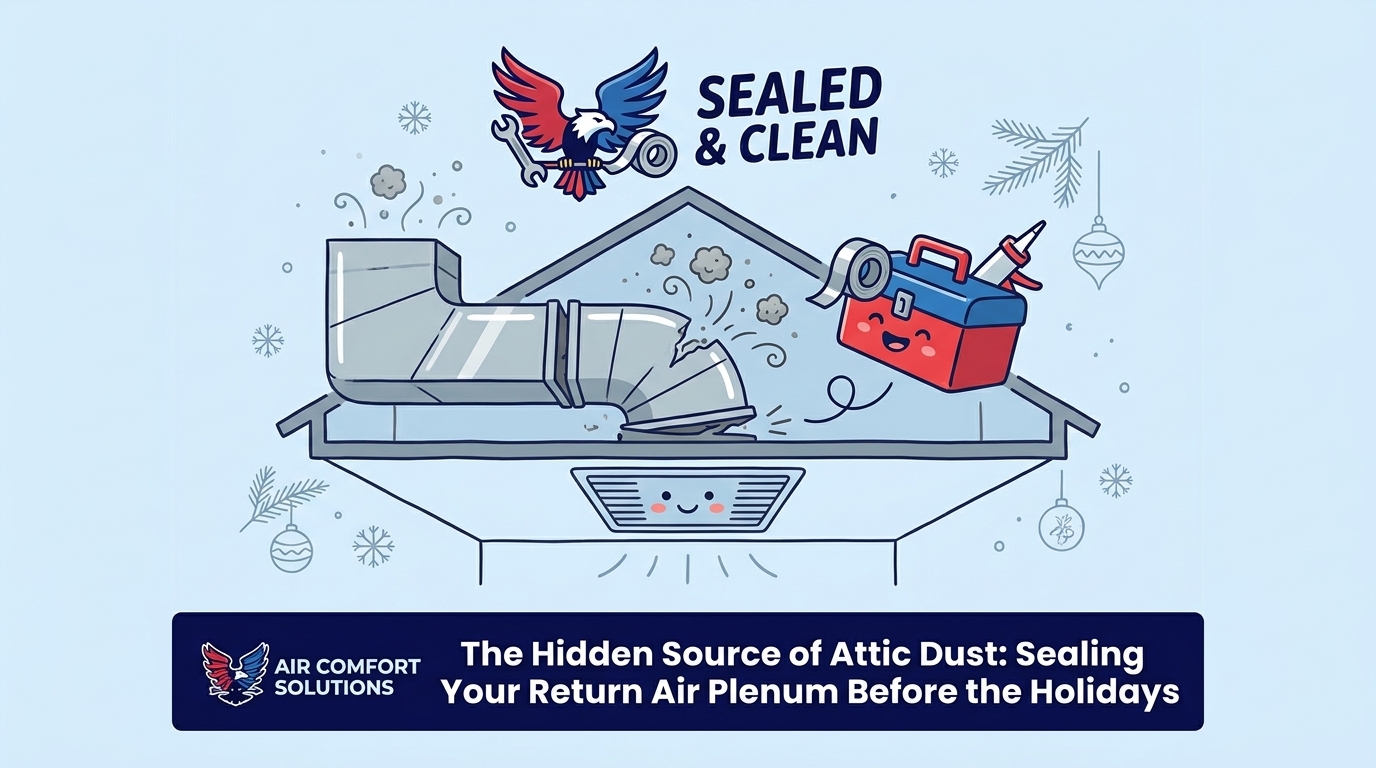
The Value of Sealing Your Return Air Plenum Before the Holidays
Most homeowners buy expensive filters to fix dusty air, not realizing a leaky return plenum in the attic is the real culprit. See why sealing it now saves your holiday gatherings.
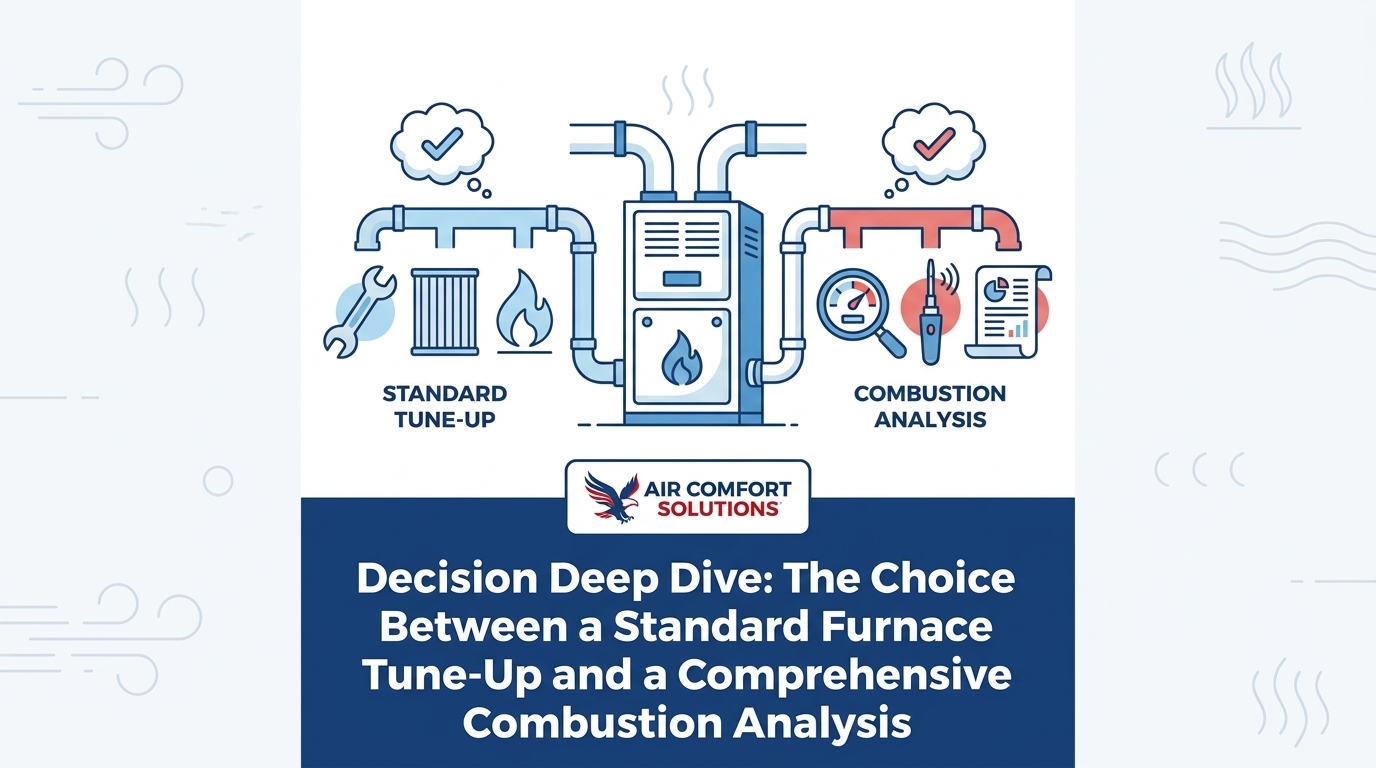
A widespread misconception we encounter at Air Comfort Solutions is that any basic fall maintenance visit guarantees your home is completely safe from carbon monoxide. In our experience servicing Pinehurst homes, the reality is that The Choice Between a Standard Furnace Tune-Up and a Comprehensive Combustion Analysis is one of the most critical decisions you will make for your home this fall. Many homeowners assume that a quick visual inspection will catch every potential hazard, but our team routinely discovers that simply is not the case for older systems. Determining whether your aging gas furnace requires advanced safety testing or just basic maintenance is a concrete problem that requires clear answers. As we move through the September pre-heating season transition, making this choice before the first freeze is highly important for your family's safety. This guide provides an objective look at both options to help you choose the precise level of testing your system needs.
Whether you need general HVAC services or want to secure a comprehensive HVAC maintenance plan, understanding these technical differences is your first step.
To make an informed decision, you first need to understand the scope and limits of standard maintenance. A basic tune-up is designed to establish a reliable baseline for the upcoming season. It ensures that your system turns on correctly, communicates properly with the thermostat, and operates efficiently under normal conditions.
During a standard visit in Pinehurst TX, our technicians focus on operational reliability. This process typically includes:
• Visual inspections: The technician examines the burner flames, wiring, and accessible mechanical components for obvious signs of wear or damage.
• Basic cleaning: Dust and debris are cleared from the burner compartment and sensors to prevent misfires and short-cycling.
• Filter changes: Replacing a clogged filter restores proper airflow, which is highly important for both efficiency and preventing the system from overheating.
• Heat exchanger check: The technician uses a flashlight and sometimes an inspection mirror to look for large, visible cracks or heavy soot buildup in the heat exchanger.
While a standard tune-up is highly beneficial, it has distinct limitations. A visual inspection of a heat exchanger relies entirely on what the human eye can see. If a crack is located on the backside of a tubular cell, or if the fracture is microscopic and only opens up when the metal gets hot, a flashlight will not reveal it.
For newer furnaces in good condition—typically those under five years old—our team finds this level of service is often perfectly sufficient. The metal components are still factory-fresh, and the risk of a sudden structural failure is exceptionally low. In these cases, standard maintenance keeps your warranty valid and your energy bills in check. If you are wondering how these basic visits fit into a broader strategy, you might ask, Is an AC Maintenance Plan Worth It in Pinehurst, TX? The answer is usually yes, as it provides the operational baseline every modern system requires.
When a visual inspection is no longer enough to guarantee safety, a comprehensive combustion analysis takes over. This advanced procedure moves beyond flashlights and mirrors, utilizing digital, precise measurements of your furnace's exhaust gases. It is a highly technical diagnostic test that reveals exactly how your furnace is burning fuel and venting the byproducts.
During the September pre-heating season transition, our licensed professionals use a specialized digital analyzer to sample the gases inside your furnace's exhaust flue. This tool measures several critical factors simultaneously:
• Oxygen (O2) levels: Too much oxygen indicates that the furnace is pulling in excess air, which cools the combustion process and wastes energy.
• Carbon Monoxide (CO) levels: The analyzer detects CO in parts per million (PPM). Even trace amounts of CO in the exhaust stream can indicate incomplete combustion or a developing problem in the burner assembly.
• Stack temperature: By measuring the temperature of the exhaust gases leaving the system, the technician can calculate true combustion efficiency. If the stack temperature is too high, it means heat is escaping up the chimney instead of warming your home.
Beyond measuring the gases themselves, comprehensive analysis includes draft pressure testing. This ensures that the exhaust gases are properly venting out of the home rather than spilling back inside. If your home has negative air pressure—often caused by powerful exhaust fans, tight insulation, or blocked flues—the toxic combustion byproducts can be pulled right back into your living space.
This level of testing detects microscopic exhaust leaks and early-stage heat exchanger failures long before they become visible to the naked eye. Because this requires tapping into the exhaust flue and interpreting complex digital readouts, it is strictly a professional-level diagnostic. It provides verifiable data about your system's safety, removing all guesswork from the equation.
As a gas furnace ages, the metal components endure immense physical stress. Understanding these hidden dangers is critical for recognizing why advanced testing becomes non-negotiable over time.
Carbon monoxide is an odorless, colorless gas that poses severe health risks if a heat exchanger fails. Because it cannot be seen or smelled, a leak can go undetected for weeks or months, slowly compromising your home's air supply. The primary barrier keeping this toxic gas out of your breathing air is the heat exchanger—a series of metal tubes or clamshells that separate the combustion process from the air blowing through your vents.
In our years inspecting heating systems, we've seen firsthand how the climate in Pinehurst TX plays a massive role in the lifespan of these components. We experience mild but unpredictable winters. When sudden cold snaps hit, furnaces that have been sitting dormant for months are forced to work intensely. They rapidly cycle from completely off to high output. Every time the burners ignite, the metal heat exchanger heats up and expands. When the cycle ends, the metal cools and contracts.
Over a decade of unpredictable Texas winters, our technicians find that this constant expansion and contraction leads to metal fatigue. Eventually, the stressed metal develops hairline fractures. A cracked heat exchanger is the most common cause of residential CO leaks. During the ignition cycle, the blower fan pushes high-pressure air over the outside of the cracked heat exchanger, which can actually alter the burner flame and push toxic gases into the ductwork.
A flashlight cannot detect a hairline fracture that only opens when the metal reaches peak temperature. Advanced digital testing is the only way to confirm zero emissions are entering your home. By addressing this during your fall maintenance, you protect your home's indoor air quality and eliminate the risk of a dangerous mid-winter failure.
When evaluating your options during the September pre-heating season transition, seeing the differences laid out clearly can help you make a confident decision. While both services aim to prepare your system for winter, their methods, tools, and depth of insight are vastly different.
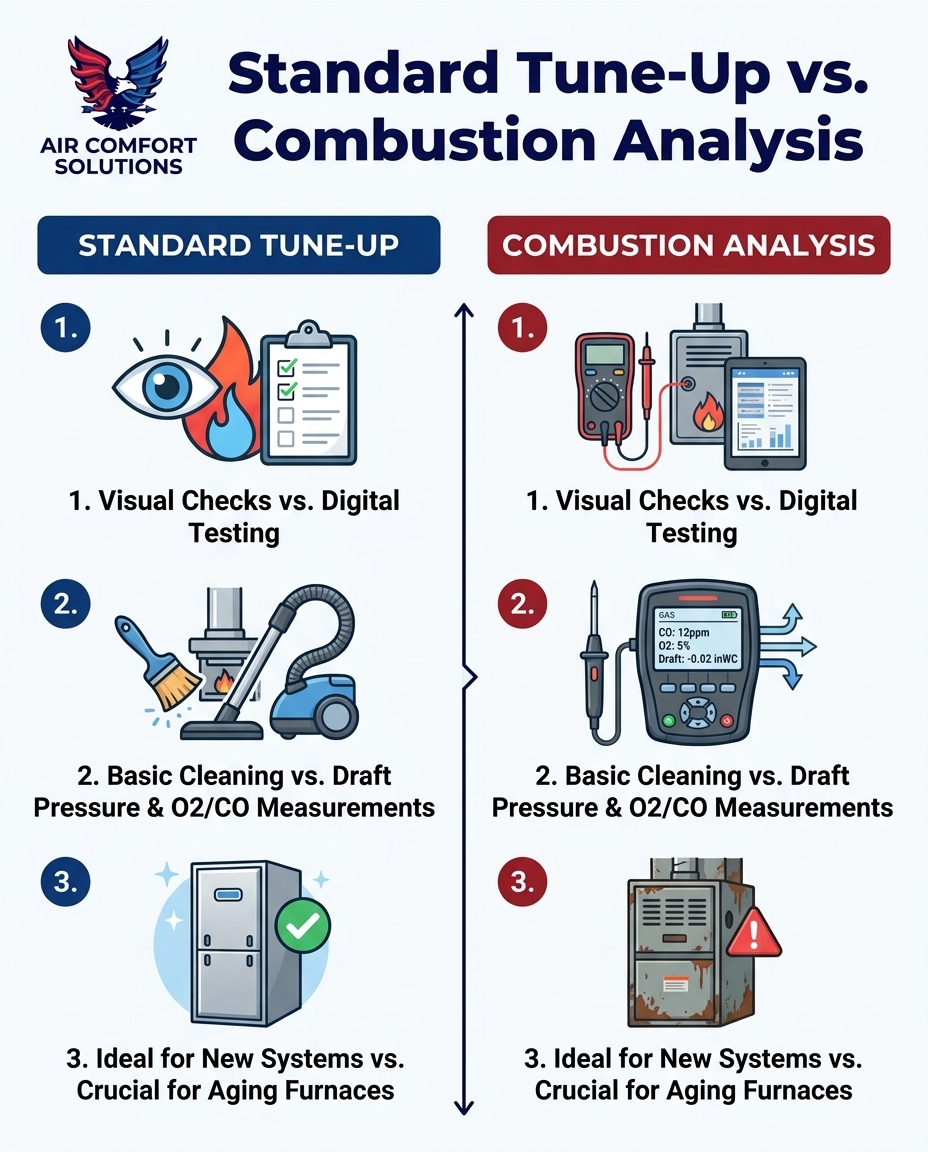
Here is a clear breakdown of how a standard visual inspection compares to digital safety testing:
• Primary Tools Used — Standard Visual Inspection: Flashlight, inspection mirror, basic multimeter. — Comprehensive Combustion Analysis: Digital combustion analyzer, draft gauge, specialized probes.
• Measurement Style — Standard Visual Inspection: Pass/fail visual check based on obvious damage. — Comprehensive Combustion Analysis: Precise parts-per-million (PPM) readings and percentage calculations.
• Carbon Monoxide Detection — Standard Visual Inspection: Relies on ambient room alarms (if present). — Comprehensive Combustion Analysis: Directly measures CO levels inside the exhaust flue.
• Efficiency Check — Standard Visual Inspection: Ensures the system turns on and runs steadily. — Comprehensive Combustion Analysis: Calculates exact combustion efficiency based on stack temperature and O2.
• Ideal Candidate — Standard Visual Inspection: Newer systems (under 5-7 years old) in good condition. — Comprehensive Combustion Analysis: Aging systems (10+ years) or units with unknown maintenance histories.
• Core Focus — Standard Visual Inspection: Operational baseline and basic cleanliness. — Comprehensive Combustion Analysis: Verifiable, data-backed safety and microscopic leak detection.
The short answer is that a standard tune-up focuses on an operational baseline, ensuring the mechanical parts move and function as expected. Comprehensive analysis focuses on verifiable, data-backed safety. It provides a mathematical certainty that your furnace is burning fuel cleanly and venting it safely out of your home.
You do not need to guess whether your system requires advanced testing. There are specific, technical criteria that indicate when a standard check is no longer sufficient. If any of the following apply to your Pinehurst TX home, upgrading to a comprehensive analysis is the right next step.
• Furnace Age Approaching 10 Years: The most significant factor is age. Any gas furnace approaching or exceeding a decade of use has endured thousands of heating cycles. At this stage, the risk of metal fatigue in the heat exchanger increases exponentially, making digital testing highly recommended.
• Unusual Flame Colors: A healthy gas furnace produces a crisp, steady blue flame with perhaps a tiny tip of yellow. If you look into the burner compartment and see a lazy, flickering yellow or orange flame, it indicates incomplete combustion. This warrants immediate digital testing to determine why the fuel is not burning cleanly.
• Gaps in Maintenance History: If your system has skipped regular tune-ups in previous seasons, dirt and soot have likely accumulated on critical components. This buildup traps heat and accelerates wear. A comprehensive test establishes exactly how much damage the neglect has caused.
• Unexplained Health Symptoms: If anyone in your household experiences unexplained headaches, dizziness, nausea, or fatigue during the heating season, these are major red flags. These symptoms mirror low-level carbon monoxide exposure and require urgent, professional analysis to rule out a furnace leak.
• Excessive Moisture on Windows: An unexpected sign of poor venting is heavy condensation on the inside of your windows during winter. If exhaust gases are spilling back into the home instead of venting outside, they bring excess water vapor with them.
At Air Comfort Solutions, a pattern we see often is homeowners feeling overwhelmed by technical jargon, worrying that advanced safety tests are just an excuse to sell a new system. The truth is, not every furnace requires a comprehensive combustion analysis every single year. If your unit is three years old and running perfectly, we will be the first to tell you that a standard tune-up is exactly what you need.
The real value lies in receiving transparent advice based on the actual age and condition of your specific unit. Air Comfort Solutions is dedicated to providing honest, transparent safety recommendations. Our goal is to ensure you get the precise level of testing your system needs without paying for unnecessary services. When our technicians evaluate your equipment during the September pre-heating season transition, they explain their findings clearly and provide hard data from their instruments rather than relying on high-pressure sales tactics.
Homeowners should partner with Pinehurst HVAC technicians who view themselves as consultants rather than salespeople. When you have access to the exact PPM readings of your exhaust gases and a clear explanation of what those numbers mean, you remain in complete control of the decision. Ultimately, the goal is total confidence before the heavy heating season begins, knowing your family is safe and your equipment is ready.
A comprehensive combustion analysis includes a complete digital evaluation of your furnace's exhaust gases. It measures exact oxygen (O2) levels, carbon monoxide (CO) output, and stack temperatures to calculate true combustion efficiency. Additionally, it tests the draft pressure to ensure that all toxic exhaust gases are properly venting outside your home instead of spilling back into your living space.
You usually do not need an annual combustion analysis for a brand-new system. For the first few years of a furnace's life, a standard tune-up is generally perfectly sufficient to keep it running cleanly. However, baseline testing at the time of installation is highly recommended to ensure the unit is operating exactly to factory specifications right out of the box.
A standard tune-up focuses on operational reliability, using visual inspections, basic cleaning, and filter changes to keep the system running. Safety testing goes much further by using specialized digital analyzers to detect invisible issues. While a tune-up ensures the furnace turns on, safety testing provides mathematical proof that it is operating without leaking harmful gases.
Industry experts recommend performing a combustion analysis annually for older gas furnaces, typically those over 10 years old. It is also critical to schedule this testing if there has been a significant gap in your maintenance history. Furthermore, it becomes absolutely mandatory if you notice visual signs of poor combustion, such as a yellow burner flame or excessive soot buildup.
A digital combustion analyzer primarily measures oxygen (O2) and carbon monoxide (CO) levels within the exhaust flue. By tracking the exact ratio of oxygen used during the burn, the technician can determine if the furnace is wasting fuel. Monitoring carbon monoxide in parts per million ensures that the combustion process is complete and that no dangerous emissions are escaping the heat exchanger.
Securing clear, technical criteria helps you confidently choose the right level of maintenance for your home's safety. Whether your system requires a basic operational check or a deep dive into its combustion efficiency, having the right data makes all the difference.
Do not wait until the first major freeze pushes your aging equipment to its breaking point. Taking action during the September pre-heating season transition gives you the time to weigh your options without the stress of a breakdown. Schedule an evaluation today to determine the exact needs of your system. Talk to an expert, review the condition of your equipment, and secure the peace of mind that comes with knowing your home is safe, efficient, and ready for whatever winter brings.


Zane came out and did an amazing job! Super friendly, honest and transparent about the work that needed to be done. This is my second time working with Air Comfort Solutions and they’re my go to for HVAC services. Highly recommend.
God's AMAZING grace sent us Robert and Zane. We have been without air in this Texas heat for six weeks and four days. We've had a few contractors give us quotes all trying to upsell when we're at a low point. But not the guys at Air Comfort Solutions. They came in assessed our situation, gave us honest feedback, and showed us the issues as they proceeded with the assessment for clear understanding. We highly recommend them for their professionalism, quality products, and fair pricing. We hands down support them for all the work they do 💯 %.
Robert and Zane gone above and beyond to make the process easy and affordable.
Would definitely recommend!!
I’m writing this review to let everyone know that Air Comfort Solutions is the company to work with. I know the owner ( Robert) for several years now. He has been taking care of my residential and business work orders. Robert is professional, knowledgeable and will save you money. I just want to thank Robert for great job you have been doing for me.