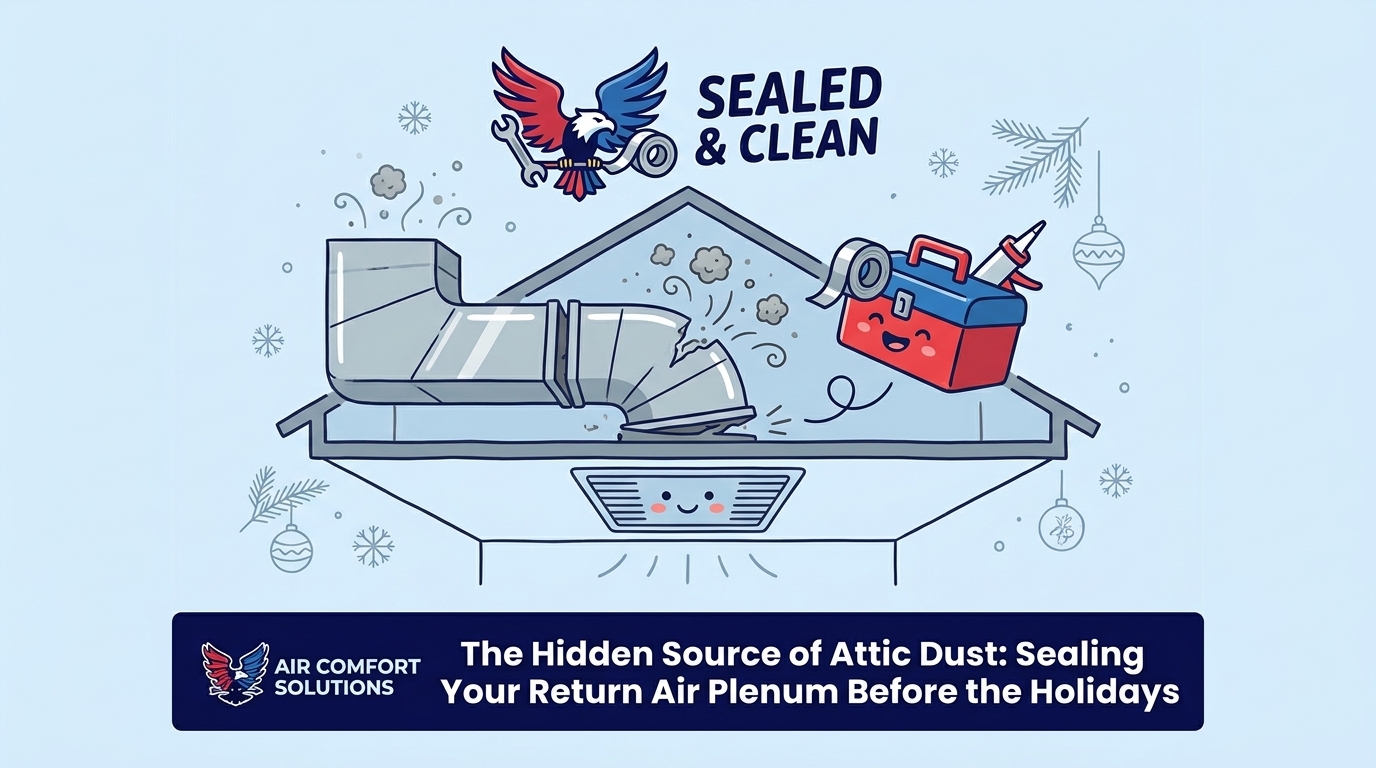
The Value of Sealing Your Return Air Plenum Before the Holidays
Most homeowners buy expensive filters to fix dusty air, not realizing a leaky return plenum in the attic is the real culprit. See why sealing it now saves your holiday gatherings.
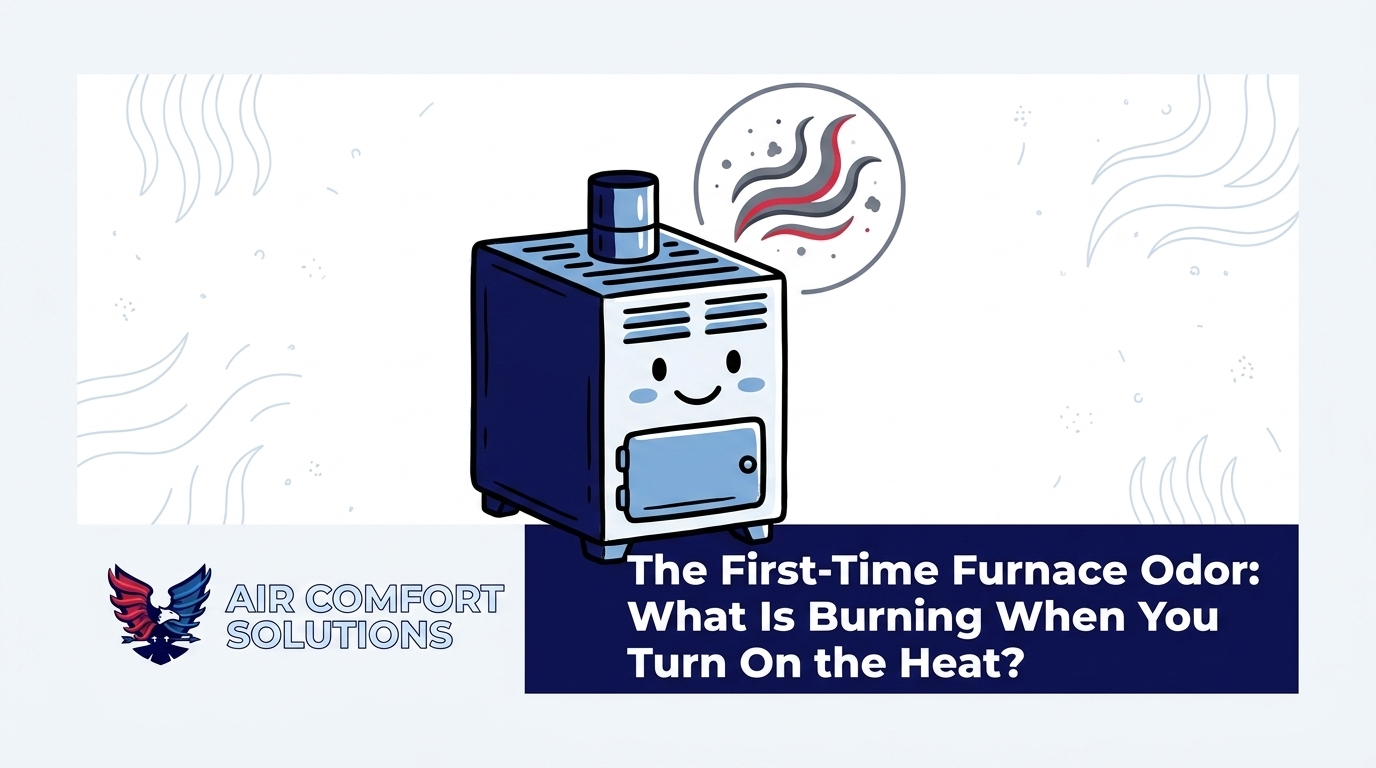
Why does your house suddenly smell like a campfire? If you are frantically searching for The First-Time Furnace Odor: What is Burning When You Turn on the Heat, you are likely experiencing a common but terrifying moment. Here at Air Comfort Solutions, our dispatchers field dozens of calls every September from Pinehurst homeowners who just adjusted their thermostats for the very first fall heating cycle. Within minutes, a distinct burning scent filled their homes. Now, you face an urgent decision point: is this just normal household debris burning off the internal components, or is it a dangerous electrical or mechanical emergency that requires immediate action?
If you need immediate assistance diagnosing a strange odor, learn more about our comprehensive HVAC services, or explore efficient heat pump systems for your home.
The quick answer: When you turn on your heat for the first time, the burning smell is caused by accumulated household dust burning off the heat exchanger or heating elements. Our technicians always reassure customers that this is normal after a long summer and should dissipate within 30 to 60 minutes.
In the vast majority of cases, this initial smell is not a house fire, and there is no need to panic. Almost all central heating systems experience some level of this phenomenon when they transition from months of dormancy to active heating. The sudden blast of heat carbonizes the microscopic particles that have settled on the unit, creating a temporary, slightly alarming odor that travels through your ductwork and out of your vents.
It is important to note that this happens across various types of heating equipment. Traditional gas furnaces rely on a metal heat exchanger that gets incredibly hot to warm the air passing over it. When that metal heats up for the first time in months, any settled debris is instantly incinerated.
Even if you do not have a gas furnace, you might still experience this. Modern electric systems often use auxiliary or emergency heat strips to supplement warming on particularly cold nights. These exposed metal coils act much like the inside of a toaster. Because they sit unused for most of the year, they also gather airborne debris, which flash-burns the moment the electrical current activates them.
To truly understand what is burning when you turn on the heat, you have to look at what circulates through your home's air every single day. Homes naturally circulate pet dander, dead skin cells, volatile organic compounds (VOCs), and microscopic dirt. Even with a high-quality air filter in place, a small percentage of this debris makes its way into the inner workings of your HVAC cabinet.
During the cooling season, your heating components sit entirely dormant. In our specific climate, cooling seasons often last 8 to 9 months. In our years of servicing HVAC systems across Pinehurst, we've noticed this extended downtime allows significantly more airborne debris to settle directly onto the cold metal surfaces of your heating equipment compared to homes in northern climates. When the first sudden cold front arrives and you switch the system to "Heat," those surfaces go from room temperature to several hundred degrees in a matter of minutes.
The flash-burn effect: The settled debris cannot withstand these extreme operating temperatures. It instantly incinerates, turning into microscopic carbon particles. The smell you detect in your living room is literally the carbonization of this organic matter. Because the blower motor is actively pushing air over these hot components to warm your house, that carbonized scent is forcefully distributed into every room simultaneously, making it seem much more severe than it actually is.
Setting clear expectations is the best way to handle this seasonal transition. As our team typically advises, the intensity of the smell will peak within the first 10 to 15 minutes of continuous operation. After that initial burn-off, the odor should steadily decrease.
As a general rule, the scent should completely clear within 30 to 60 minutes of the system running. To help speed up the process and improve your indoor air quality, you can temporarily open a few windows to allow fresh air to circulate and flush the carbonized smell out of the house. If the smell persists beyond an hour, or if it grows stronger instead of weaker, that is your signal to investigate further.
Our team at Air Comfort Solutions believes that knowing how to categorize the smell coming from your vents is crucial for protecting your Pinehurst TX home. While the dust burn-off is harmless, other odors indicate severe malfunctions that require immediate intervention.
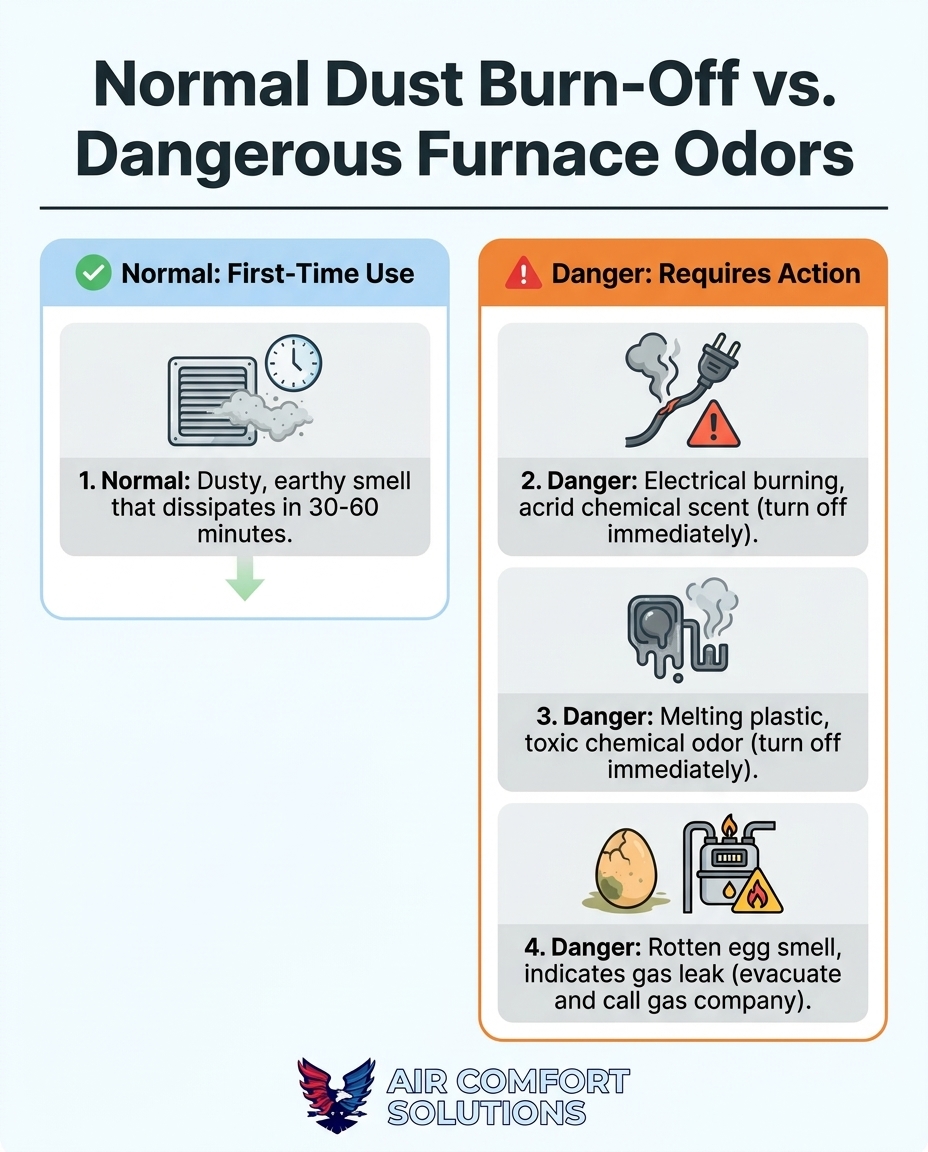
The standard dust burn-off has a very specific profile. It typically smells like a warm, dusty radiator, or perhaps slightly singed, earthy dirt. It does not sting your eyes, and it does not smell like harsh chemicals. As long as this specific earthy scent is actively fading after the first 15 minutes, your system is functioning normally and you can safely let it run.
If you detect any of the following scents, do not wait for the 60-minute mark. Turn off your system immediately at the thermostat to prevent property damage or health hazards.
• Electrical Warning — What It Smells Like: Sharp, acrid, metallic, or resembling melting wire insulation. — Potential Cause: Overheating blower motor, failing capacitor, or a short circuit in the wiring. — Required Action: Turn off the thermostat and flip the breaker. Call a professional.
• Plastic Hazard — What It Smells Like: Toxic, harsh chemical odor, like a melting synthetic material. — Potential Cause: A foreign object (toy, wrapper, or component housing) has melted against the heat exchanger. — Required Action: Turn off the system immediately to stop toxic fumes from circulating.
• Gas Leak — What It Smells Like: Distinct "rotten egg" or sulfur smell (mercaptan). — Potential Cause: A cracked heat exchanger or a leaking gas supply line. — Required Action: Evacuate the home immediately and call your local gas provider.
• Check the vents: Walk around to different rooms to see if the smell is localized to one vent (which might indicate something dropped down that specific duct) or system-wide.
• Listen for noises: Dangerous smells are often accompanied by grinding, squealing, or loud banging.
• Trust your instincts: If the smell makes you feel dizzy, nauseous, or instinctively unsafe, shut the unit down.
If you have waited patiently during that first fall heating cycle in September, but the smell remains strong after an hour, you must transition from observation to action. A persistent burning odor is your system's way of telling you that something is actively failing, overheating, or melting.
Your first step is always to stop the heating cycle. Go to your thermostat and switch the system mode to "Off." Do not just lower the temperature; ensure the system is completely deactivated so the blower motor stops circulating air.
If the thermostat is unresponsive, or if the electrical burning smell is particularly strong, locate your home's main electrical panel and flip the breaker dedicated to your HVAC system. This completely severs the power supply, stopping any electrical shorts from sparking or causing further damage to the internal components.
Under no circumstances should you attempt DIY repairs on a furnace that smells like it is burning. Opening the cabinet exposes you to high-voltage electrical components, sharp metal edges, and potentially dangerous combustion gases. Modern heating systems are complex, tightly calibrated machines that require specialized diagnostic tools to safely evaluate.
In our field experience, persistent smells often indicate a failing blower motor that is overheating due to friction, a heavily clogged filter that is choking off airflow and causing the heat exchanger to reach dangerous temperatures, or frayed wiring that is actively shorting out against the metal casing. Furthermore, if you notice that the burning smell is accompanied by loud banging, scraping, or strange HVAC noises, you are dealing with a severe mechanical emergency that requires one of our licensed technicians to resolve.
Many homeowners believe that enduring this alarming, smoky odor is just a mandatory part of homeownership. The truth is, you do not have to subject your family to this stressful experience every single year. By taking a proactive approach, you can completely bypass the panic of wondering if your house is safe.
Our team at Air Comfort Solutions provides comprehensive seasonal maintenance to safely clean out accumulated dust and debris before you ever need to turn on the heat, giving you peace of mind and eliminating the odor. When you schedule a pre-season tune-up for your Pinehurst TX home, our technicians handle the dirty work before the extreme cold arrives.
Here is how a professional tune-up prevents the smell and protects your system:
1. Physical Cabinet Cleaning: The technician opens the system and physically vacuums out the 8 to 9 months of accumulated pet dander, skin cells, and household dust that has settled on the dormant components.
2. Heat Exchanger Inspection: The metal heat exchanger is carefully inspected for hairline cracks that could leak carbon monoxide, and its surface is wiped down so there is nothing left to flash-burn.
3. Burner Calibration: For gas systems, the burners are cleaned and calibrated to ensure they ignite smoothly and burn fuel efficiently without creating excess soot.
4. Electrical Tightening: All high-voltage connections are checked and tightened to prevent the electrical shorts that cause those dangerous acrid smells.
5. Airflow Verification: The blower motor is inspected and lubricated (if applicable) to ensure it can move air freely without overheating.
Beyond simply stopping the smell, a comprehensive HVAC maintenance plan restores your system's energy efficiency, lowers your monthly utility bills, and catches small wear-and-tear issues before they escalate into mid-winter breakdowns. Additionally, upgrading your system to high-efficiency models may qualify you for federal tax credits or local utility incentive programs (we always advise verifying current programs with your utility provider or a tax professional).
While the smell of dust burn-off is technically harmless to your equipment, it is important to consider what is burning when you turn on the heat and how it impacts the humans breathing it in. When that settled dust is incinerated, it doesn't just disappear; it turns into fine particulate matter and soot.
This fine particulate matter is then blown through your ductwork and directly into your living spaces. For individuals with asthma, severe allergies, or respiratory sensitivities, this sudden influx of airborne particulates during the early fall can trigger coughing, sneezing, and discomfort.
Your first line of defense: This is why installing a brand-new, high-quality air filter immediately before the first heating cycle is absolutely critical. A clean filter captures a significant portion of this circulating soot before it can settle on your furniture or enter your lungs. Conversely, if you start the season with a filter that is already clogged from the summer, you restrict the system's airflow. This causes the internal temperature of the cabinet to rise even higher, making the burning smell much more intense and prolonging the time it takes to dissipate.
If you want to reduce the amount of dust that settles on your furnace in the first place, you need to look at your home's overall filtration strategy. Standard 1-inch fiberglass filters are designed to protect the equipment from large debris, not to purify the air you breathe. By upgrading to deep-pleated media filters or exploring advanced indoor air quality solutions like whole-home air purifiers and UV lights, you can drastically reduce the volume of pet dander and microscopic dirt circulating through your home year-round. Less dust in the air means less dust settling on your dormant furnace, resulting in a cleaner, safer start-up next fall.
When panic sets in, we find that homeowners across Pinehurst TX often turn to search engines for immediate answers. Here are the most common questions our team fields regarding seasonal heating smells.
A normal dust burn-off smell should peak within the first 10 to 15 minutes and completely dissipate within 30 to 60 minutes of continuous operation. If the smell lasts longer than an hour, or if it grows stronger instead of fading, turn off the system and call a professional to investigate.
A burning smell becomes dangerous when it smells like melting plastic, harsh chemicals, acrid electrical wiring, or rotten eggs (sulfur). These specific odors indicate melting components, electrical shorts, or gas leaks, all of which require an immediate system shutdown and emergency professional service.
An electrical burning smell usually means a component is actively overheating or a wire is short-circuiting. This is commonly caused by a failing blower motor struggling against friction, a dying capacitor, or damaged wire insulation. Turn off the power at the breaker immediately to prevent a fire hazard.
A burning plastic smell indicates that a foreign object has found its way into the ductwork or the HVAC cabinet and is melting against the hot heat exchanger. This could be a child's toy, a dropped wrapper, or even a piece of the system's own wire casing. Shut the unit down immediately to stop toxic fumes from circulating.
Changing your air filter will not instantly stop the smell if the dust is already burning on the heat exchanger, but it is crucial for resolving the issue faster. A clean filter ensures proper airflow, which keeps the system from overheating and helps filter out the circulating soot once the burn-off occurs.
No, it is never safe to go to sleep if your heater is actively emitting a burning smell. You must stay awake and monitor the system for the first 30 to 60 minutes to ensure the dust burn-off odor completely fades. If you fall asleep and the smell is actually an electrical fire or gas leak, you put your household in extreme danger.
The transition into cooler weather shouldn't be a source of anxiety. While a brief, earthy odor during the first fall heating cycle in September is a completely normal part of owning a central HVAC system, you should never have to guess whether your home is actually safe. Knowing the clear differences between harmless dust and dangerous electrical or chemical odors gives you the confidence to act appropriately.
If you are ever in doubt about The First-Time Furnace Odor: What is Burning When You Turn on the Heat, err on the side of caution. Shutting the system down and relying on our professional oversight provides true peace of mind. By scheduling proactive maintenance with Air Comfort Solutions before the deep winter cold sets in, you can bypass the panic entirely and enjoy a safe, comfortable, and odor-free home all season long.


Zane came out and did an amazing job! Super friendly, honest and transparent about the work that needed to be done. This is my second time working with Air Comfort Solutions and they’re my go to for HVAC services. Highly recommend.
God's AMAZING grace sent us Robert and Zane. We have been without air in this Texas heat for six weeks and four days. We've had a few contractors give us quotes all trying to upsell when we're at a low point. But not the guys at Air Comfort Solutions. They came in assessed our situation, gave us honest feedback, and showed us the issues as they proceeded with the assessment for clear understanding. We highly recommend them for their professionalism, quality products, and fair pricing. We hands down support them for all the work they do 💯 %.
Robert and Zane gone above and beyond to make the process easy and affordable.
Would definitely recommend!!
I’m writing this review to let everyone know that Air Comfort Solutions is the company to work with. I know the owner ( Robert) for several years now. He has been taking care of my residential and business work orders. Robert is professional, knowledgeable and will save you money. I just want to thank Robert for great job you have been doing for me.