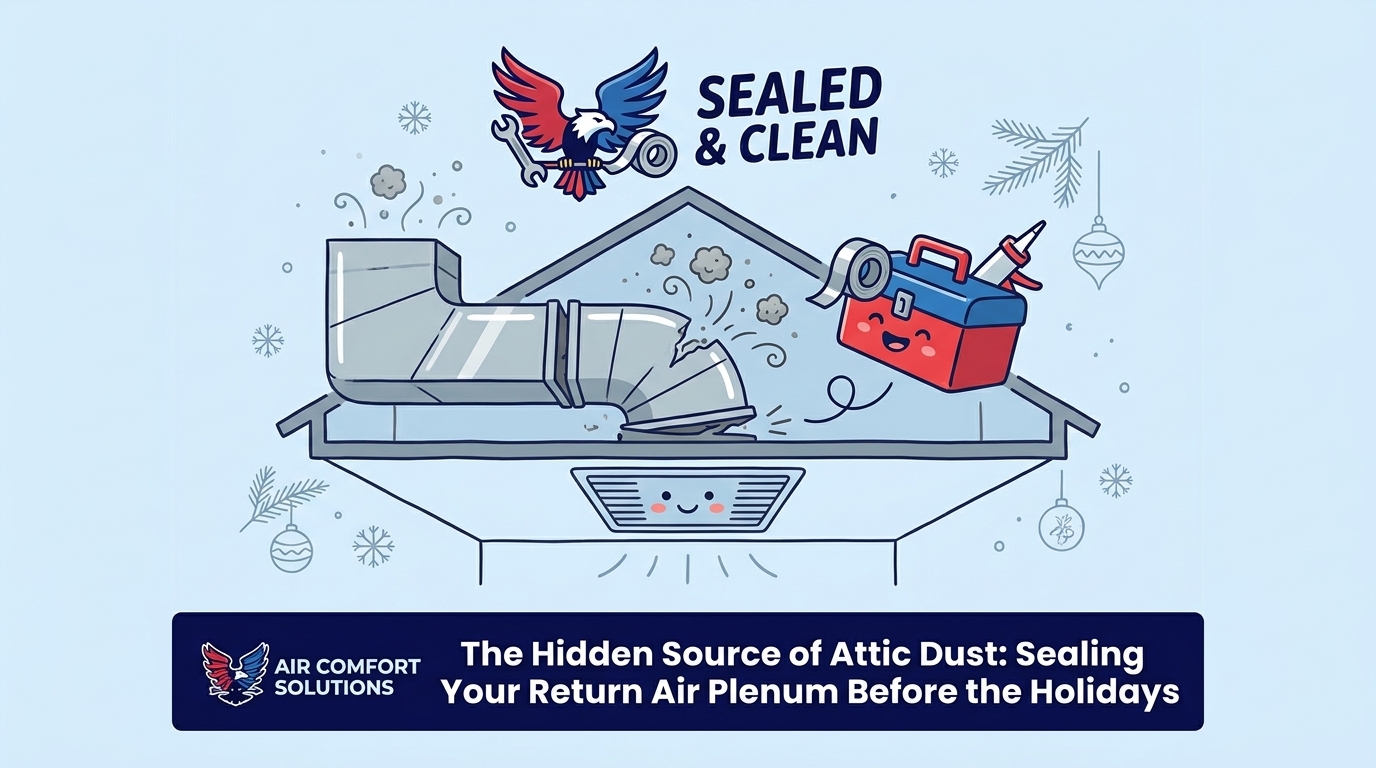
The Value of Sealing Your Return Air Plenum Before the Holidays
Most homeowners buy expensive filters to fix dusty air, not realizing a leaky return plenum in the attic is the real culprit. See why sealing it now saves your holiday gatherings.
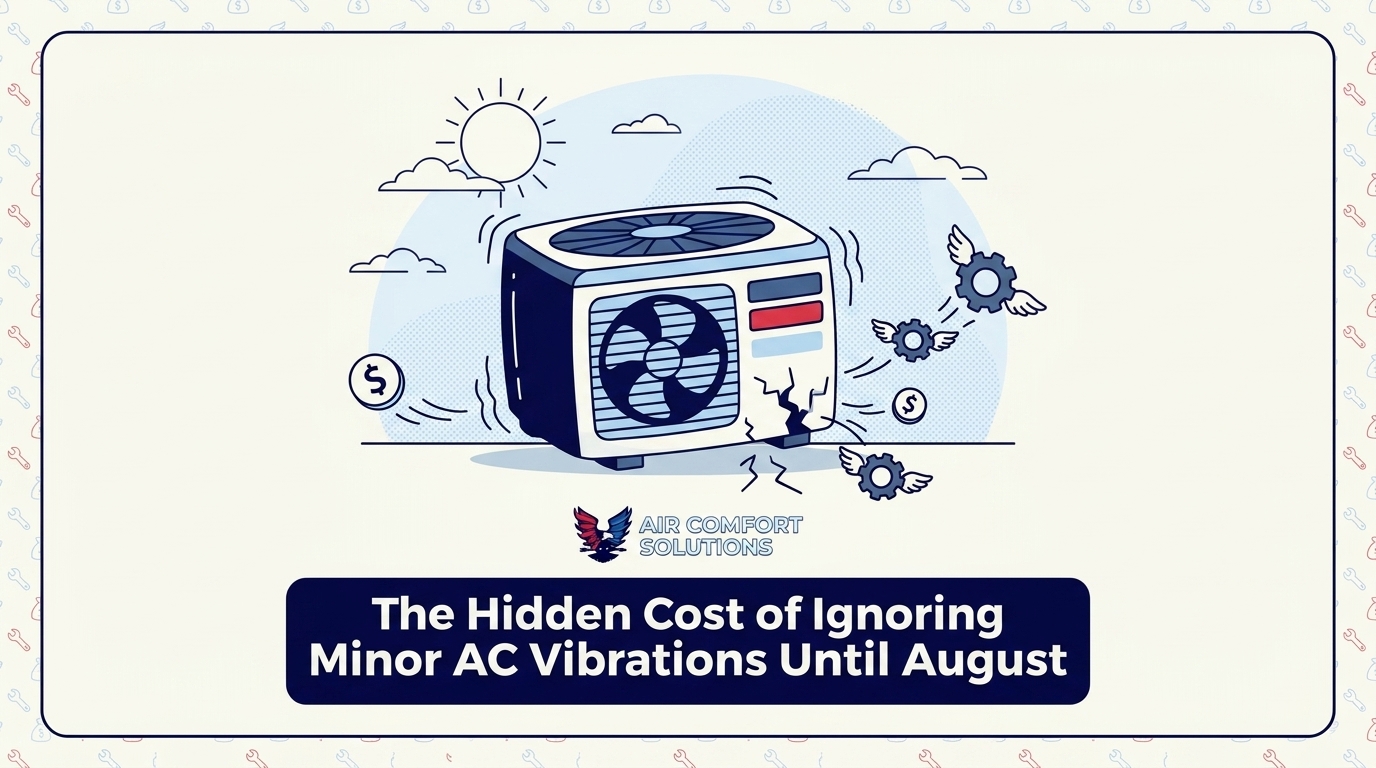
Your AC has been making a subtle rattling noise since June, but because the house still feels cool, it is easy to push the hidden cost of ignoring minor AC vibrations until August to the back of your mind. That strange, low hum or intermittent rattle that started weeks ago is not going to resolve itself. Here at Air Comfort Solutions, we know that right now, as families prepare for the back-to-school transition, we are deep into the August late-summer peak wear-and-tear season. The temperatures are unforgiving, and your cooling system is running under maximum stress just to keep your living space comfortable.
You are now facing a critical decision point. It is incredibly tempting to cross your fingers and hope the system survives until the fall cooldown arrives. However, our technicians see it time and time again: ignoring mechanical vibrations leads to compounding, catastrophic damage rather than just a temporary auditory annoyance. A vibrating air conditioner is a system operating out of balance, and every hour it runs in that state accelerates the degradation of vital internal components.
When an air conditioning unit shakes, rattles, or hums abnormally, it is sending a direct warning signal. The forces causing that vibration are actively tearing away at metal, grinding down bearings, and loosening electrical connections. To protect your home and your equipment, you need comprehensive air conditioning services to diagnose the root cause before a minor adjustment turns into a total system replacement.
To understand why a minor rattle is so dangerous, you have to look at how modern cooling equipment is engineered. The internal moving parts of your condenser and indoor air handler are balanced to microscopic tolerances. They are designed to spin smoothly, quietly, and efficiently. When something knocks that balance off—even slightly—the resulting physical vibration sends shockwaves through the entire chassis of the unit.
• Increased friction: Parts that should glide past each other begin to scrape and grind.
• Heat generation: The excess friction creates secondary heat, which degrades lubricants faster than normal.
• Structural fatigue: Constant shaking weakens the metal brackets, screws, and mounts holding the heavy components in place.
By the time late summer arrives, what began as a barely noticeable hum has often escalated into a serious mechanical hazard.
Air conditioning systems in our region operate under a completely different set of rules compared to the national average. From May through the end of summer, cooling equipment rarely gets a break. When our Air Comfort Solutions technicians are dispatched to Cypress and Pinehurst area homes during these late-summer heatwaves, we see firsthand that outdoor condensers and indoor blowers are running almost non-stop. This continuous, high-load operation accelerates mechanical fatigue at an alarming rate, leaving virtually no recovery time for stressed components.
When mechanical components operate under a continuous load while vibrating, they experience exponential wear. This is not a linear degradation where a part loses a tiny, predictable amount of its lifespan each day. Instead, as the part wears down, the vibration worsens. As the vibration worsens, the wear accelerates even faster. According to engineering guidelines from organizations like ASHRAE and the Department of Energy, eccentric loading—the technical term for an off-center or unbalanced rotational force—drastically reduces the life expectancy of HVAC equipment.
If you need an expert eye on your system, our local Pinehurst HVAC experts understand exactly how this regional climate impacts your machinery. The intense, prolonged Southeast Texas summer heat forces your AC to run through the hottest parts of the afternoon and well into the humid nights.
To visualize how quickly a minor vibration can destroy a system during a continuous heat wave, consider the difference between normal wear and tear versus the exponential damage caused by an unbalanced load.
• Linear Wear — System Condition: Balanced, properly maintained, clean components — Progression Rate: Slow, steady, and predictable over 10 to 15 years — End Result Over 90 Days: Normal end-of-season fatigue; ready for fall maintenance
• Exponential Wear — System Condition: Unbalanced, vibrating, or rattling components — Progression Rate: Accelerates rapidly; damage doubles as friction increases — End Result Over 90 Days: Catastrophic failure of bearings, motors, or brackets
Because the unit never powers down long enough to cool off, the heat friction generated by the vibration compounds the ambient heat of the day. The metal expands, the lubricants thin out, and the structural integrity of the moving parts compromises rapidly.
One of the most common sources of outdoor unit vibration is a slightly loose or unbalanced condenser fan blade. The large fan at the top of your outdoor unit is responsible for pulling air through the condenser coils to exhaust the heat removed from your home. When a fan blade loosens, gets bent by falling debris, or loses its balancing clip, it creates eccentric loading.
This imbalance does not just make a loud noise; it transfers a violent, wobbling force directly down the shaft and into the fan motor bearings. The motor bearings are small, precisely engineered metal spheres encased in a lubricated track. They are designed to handle rotational force, not side-to-side wobbling. When a loose fan blade forces the shaft to wobble, it literally grinds those bearings into dust over the course of 90 or more days of summer operation.
If you are hearing strange sounds outside, decoding strange AC noises early is your best defense. The contrast between early-season and late-season intervention is stark. Tightening a loose fan blade or replacing a bent fan in June takes one of our technicians less than an hour. However, if that same imbalance is allowed to grind away at the motor bearings until August, the entire motor will overheat, seize up, and burn out—a pattern we see far too often at the end of the season.
Understanding the domino effect helps clarify why professional intervention is necessary. Here is exactly how a loose blade takes down the entire motor:
• The initial wobble: The fan blade spins slightly off-center, creating a rhythmic vibration.
• The lubricant breakdown: The side-to-side force generates excessive heat, causing the factory-sealed lubricant inside the bearing casing to bake and dry out.
• The metal-on-metal grind: Without lubrication, the steel bearings scrape against their housing, creating a high-pitched squeal or grinding noise.
• The final seizure: The bearings warp from the heat, locking the motor shaft in place. The motor continues to draw high electrical current trying to turn the jammed shaft, eventually melting its internal wiring.
This entire process happens out of sight, masked by the loud hum of the outdoor unit, which is why ignoring the initial vibration is so risky.
While the outdoor unit takes the brunt of the weather, vibrations originating from the indoor unit are equally destructive. The indoor blower motor and its attached squirrel-cage blower wheel are responsible for pushing cold air through your ductwork. In our years of servicing HVAC units in Southeast Texas, we frequently discover that these components begin to vibrate due to heavy dust buildup, loose mounting brackets, or a deteriorating motor.
A blower wheel is made up of dozens of small, cupped blades. If your air filter is bypassed or heavily clogged, dust and dirt bypass the filter and stick to these blades. Because dust does not accumulate perfectly evenly, one side of the wheel becomes heavier than the other. When this unbalanced wheel spins at high speeds, it shakes the entire air handler cabinet.
This vibrating blower wheel drastically reduces airflow efficiency. When the indoor unit cannot move enough air over the evaporator coil, the refrigerant returning to the outdoor unit is too cold. This forces the outdoor condenser to work even harder, straining the compressor. Furthermore, if the vibration is ignored, the constant shaking can cause the metal welds on the blower wheel to fracture. A shattered blower wheel spinning at high speed can tear apart the interior housing of your furnace or air handler.
Because the indoor unit is often tucked away in an attic, closet, or garage, you have to pay close attention to the symptoms of an unbalanced blower.
• Shaking walls or floors: You can physically feel a vibration through the floorboards or drywall when the AC kicks on.
• Rattling ductwork: The vibration travels down the sheet metal ducts, causing a metallic rattle at your ceiling vents.
• Weak airflow: The system sounds loud, but very little air is actually making it out of the registers.
• Whirring or thumping sounds: A distinct, rhythmic thud that speeds up and slows down with the fan motor.
Addressing these indoor vibrations promptly restores your system's airflow efficiency and protects the delicate internal housing from severe physical damage.
When you walk past your outdoor condenser unit and notice it is visibly shaking or vibrating loudly against its concrete pad, you are witnessing a severe mechanical threat. Inside that metal cabinet sits the compressor—the absolute heart of your air conditioning system. The compressor is a heavy, powerful pump responsible for circulating refrigerant through the lines.
Because the compressor naturally vibrates when it runs, manufacturers mount it on thick rubber isolator feet. These rubber pads act as shock absorbers, isolating the compressor's movement from the rest of the chassis. However, years of intense Southeast Texas heat, combined with constant operation, cause these rubber feet to dry rot, crack, and eventually disintegrate.
When the isolator feet fail, the compressor's heavy vibrations transfer directly into the copper refrigerant lines attached to it. Copper is a soft metal. If it is forced to shake violently for weeks on end, the copper lines will suffer metal fatigue and fracture. A fractured line results in an immediate, total loss of refrigerant. Even worse, the excessive vibration can permanently damage the internal valves of the compressor itself, leading to the ultimate mechanical breakdown.
Monitoring the physical stability of your outdoor unit can prevent catastrophic compressor failure. Here is how the isolator feet break down over time:
• Healthy (New) — Physical Condition of Isolator Feet: Soft, pliable, thick rubber — Impact on the AC System: Compressor hums quietly; chassis remains completely still.
• Early Wear — Physical Condition of Isolator Feet: Surface cracking, hardening rubber — Impact on the AC System: Slight vibration felt when touching the outer cabinet.
• Advanced Decay — Physical Condition of Isolator Feet: Flattened, brittle, missing chunks — Impact on the AC System: Loud rattling; visible shaking of the outer metal panels.
• Total Failure — Physical Condition of Isolator Feet: Completely disintegrated or detached — Impact on the AC System: Violent shaking; immediate risk of fractured copper lines.
Replacing worn isolator feet is a straightforward professional repair that our Air Comfort Solutions team performs regularly, saving the most critical and expensive component of your entire cooling system from shaking itself to death.
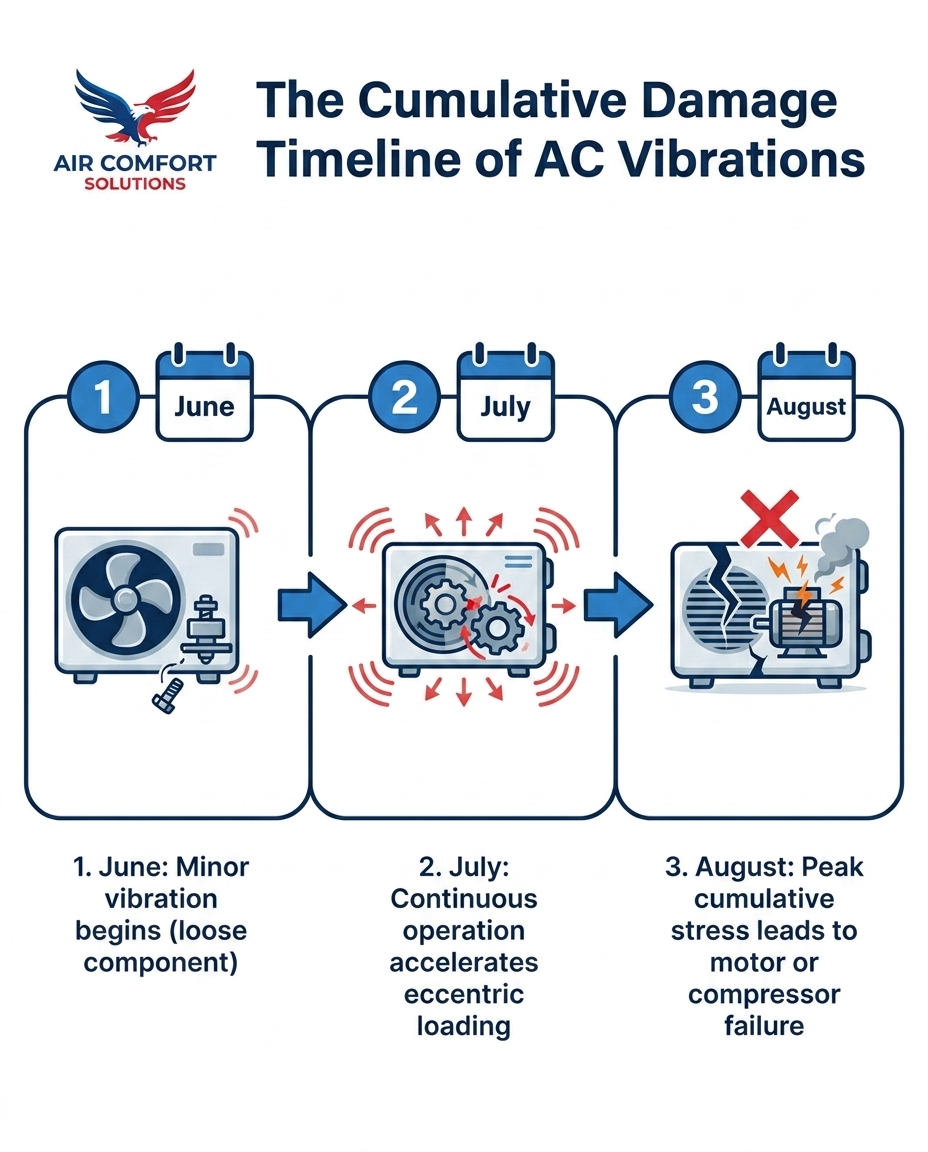
Understanding how continuous wear compounds over the summer months highlights exactly why August late-summer peak wear-and-tear is the danger zone. When a vibration begins early in the season, it follows a predictable, destructive timeline. Mapping out this progression logically explains why urgent action is required, even if the system is still technically blowing cold air today.
If you are currently experiencing the late stages of this timeline, you need comprehensive HVAC repairs immediately to stop the chain reaction of mechanical failure.
In early summer, the system is just ramping up for the season. A minor rattle begins as a single component slightly loosens. Perhaps a fan blade gets bumped by a stray tree branch, or a blower wheel accumulates just enough dust to throw off its balance. The system still cools perfectly, and the noise is easy to ignore. The eccentric loading has started, but the structural damage is still microscopic.
By July, the continuous heat wave forces the unit to run nearly non-stop. The minor vibration is now a constant, aggressive force. The friction inside the motor bearings generates excess heat, baking away the protective lubricants. The rubber isolator feet under the compressor begin to crack under the relentless shaking. Because Cypress and Pinehurst area homes demand constant cooling during this month, the system never rests long enough for the metals to cool and contract. The wear accelerates rapidly.
August represents the peak cumulative cooling degree days for the region. The equipment has endured thousands of hours of unbalanced, high-friction operation. The cumulative damage reaches a breaking point. The dry motor bearings finally seize, causing the fan motor to burn out. The vibrating blower wheel snaps a weld and shatters inside the cabinet. The shaking compressor fractures a copper line, venting all the refrigerant. As the back-to-school season kicks off, our emergency dispatch lines ring constantly with these exact scenarios. What could have been a simple tightening job in June is now a catastrophic, multi-day repair scenario.
When dealing with a vibrating HVAC system, the most dangerous assumption you can make is that the problem is purely cosmetic. Many internal vibrations cannot be seen from the outside of the cabinet. The damage is happening inside sealed motor casings, beneath heavy compressor shrouds, and deep inside the ductwork. Diagnosing these subtle stresses requires professional tools, electrical meters, and a trained ear.
This is where Air Comfort Solutions' deep local expertise makes all the difference. Working with a team that understands the specific demands placed on systems in this region ensures that honest, reliable diagnostics catch these subtle stresses before they cause breakdowns. Our professional technicians will not just tighten a visible screw; we will measure the electrical draw of the motors, check the rotational balance of the fan blades, and inspect the integrity of the compressor mounts.
Waiting for the fall cooldown is a dangerous gamble that often ends in total system failure on the hottest day of the year. Do not let a minor rattle turn into a major headache. Securing a professional AC maintenance plan ensures that an expert evaluates your system's mechanical balance, tightening up loose components and lubricating stressed bearings before they fail completely.
Is it safe to run my AC if it's vibrating?
No, it is generally not safe to continue running a vibrating AC unit. A noticeable vibration indicates a mechanical imbalance, and running the system in this state forces components to grind against each other. Continuing to operate the unit will rapidly accelerate the wear and tear on motors and brackets, often leading to a much larger mechanical failure.
Can a vibrating AC cause damage?
Yes, a vibrating AC causes significant internal damage over time. The constant shaking creates excessive friction that destroys motor bearings, fractures metal mounting brackets, and can even snap the copper refrigerant lines attached to the compressor. What starts as a small vibration compounds into severe structural fatigue.
Why is my outside AC unit shaking?
Your outside AC unit is likely shaking due to an unbalanced condenser fan blade, worn-out motor bearings, or degraded rubber compressor isolator feet. Debris inside the unit or a loose mounting bolt can also cause the entire cabinet to rattle violently when the heavy internal components power on.
What happens if I ignore my AC vibrating?
If you ignore your AC vibrating, the unbalanced mechanical forces will eventually destroy the moving parts. A loose fan blade will grind down the motor bearings until the motor seizes, or a shaking compressor will fracture its refrigerant lines. Ignoring the issue almost always results in a complete system breakdown.
How quickly can a loose AC fan blade cause motor damage?
A loose AC fan blade can cause irreversible motor damage in just a few weeks of continuous summer operation. The eccentric wobbling force pushes the motor shaft out of alignment, grinding away the internal bearings. During peak summer heat when the unit runs constantly, this degradation happens exponentially faster.
Can continuous summer operation make AC vibrations worse?
Absolutely. Continuous summer operation prevents the system from resting, meaning the metal components remain hot and expanded while vibrating constantly. This relentless, non-stop friction accelerates mechanical fatigue, turning a minor early-summer rattle into a major hazard by late summer.
If you are tired of listening to your system rattle and worry about it surviving the rest of the season, now is the time to act. A clear, professional mechanical inspection will identify exactly why your system is vibrating. Schedule your expert diagnostic with Air Comfort Solutions today to stop the damage in its tracks and restore your peace of mind before a total breakdown occurs.


Zane came out and did an amazing job! Super friendly, honest and transparent about the work that needed to be done. This is my second time working with Air Comfort Solutions and they’re my go to for HVAC services. Highly recommend.
God's AMAZING grace sent us Robert and Zane. We have been without air in this Texas heat for six weeks and four days. We've had a few contractors give us quotes all trying to upsell when we're at a low point. But not the guys at Air Comfort Solutions. They came in assessed our situation, gave us honest feedback, and showed us the issues as they proceeded with the assessment for clear understanding. We highly recommend them for their professionalism, quality products, and fair pricing. We hands down support them for all the work they do 💯 %.
Robert and Zane gone above and beyond to make the process easy and affordable.
Would definitely recommend!!
I’m writing this review to let everyone know that Air Comfort Solutions is the company to work with. I know the owner ( Robert) for several years now. He has been taking care of my residential and business work orders. Robert is professional, knowledgeable and will save you money. I just want to thank Robert for great job you have been doing for me.