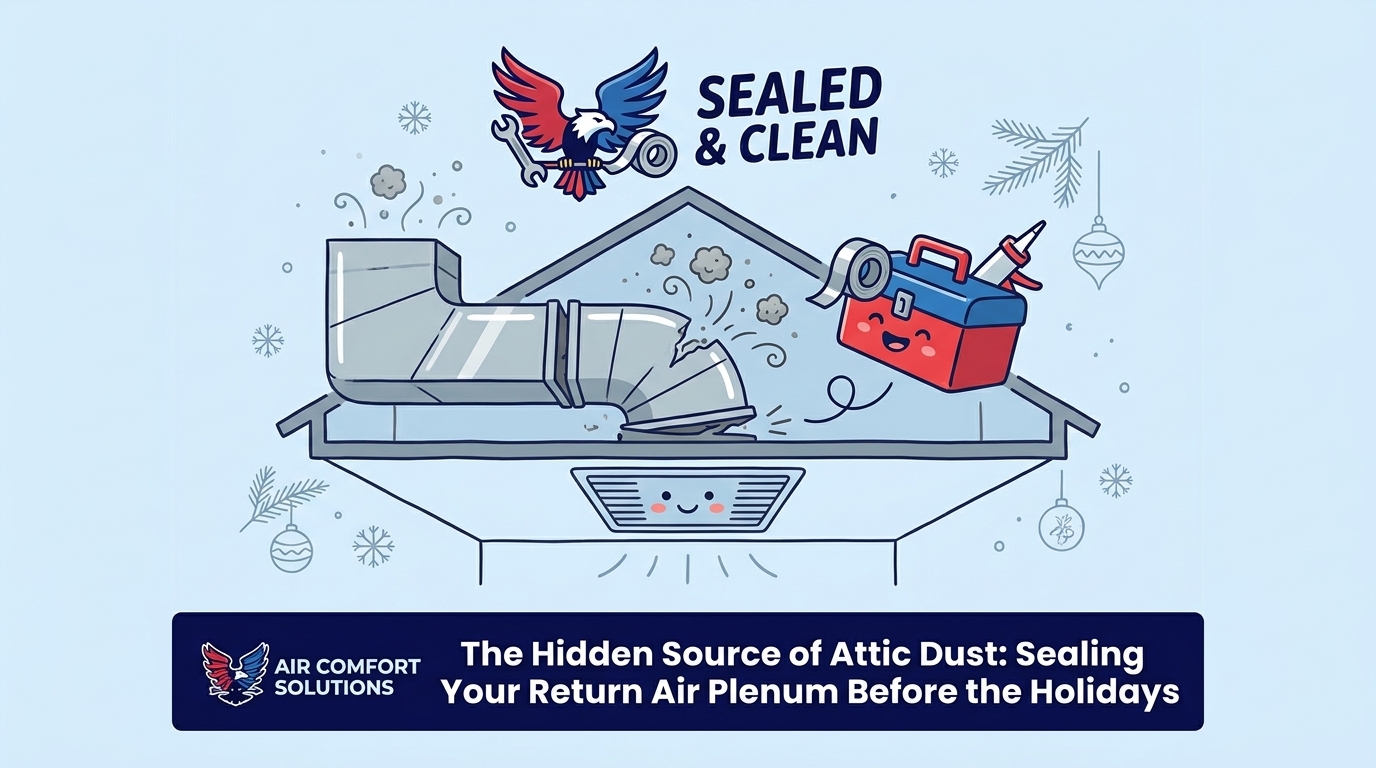
The Value of Sealing Your Return Air Plenum Before the Holidays
Most homeowners buy expensive filters to fix dusty air, not realizing a leaky return plenum in the attic is the real culprit. See why sealing it now saves your holiday gatherings.
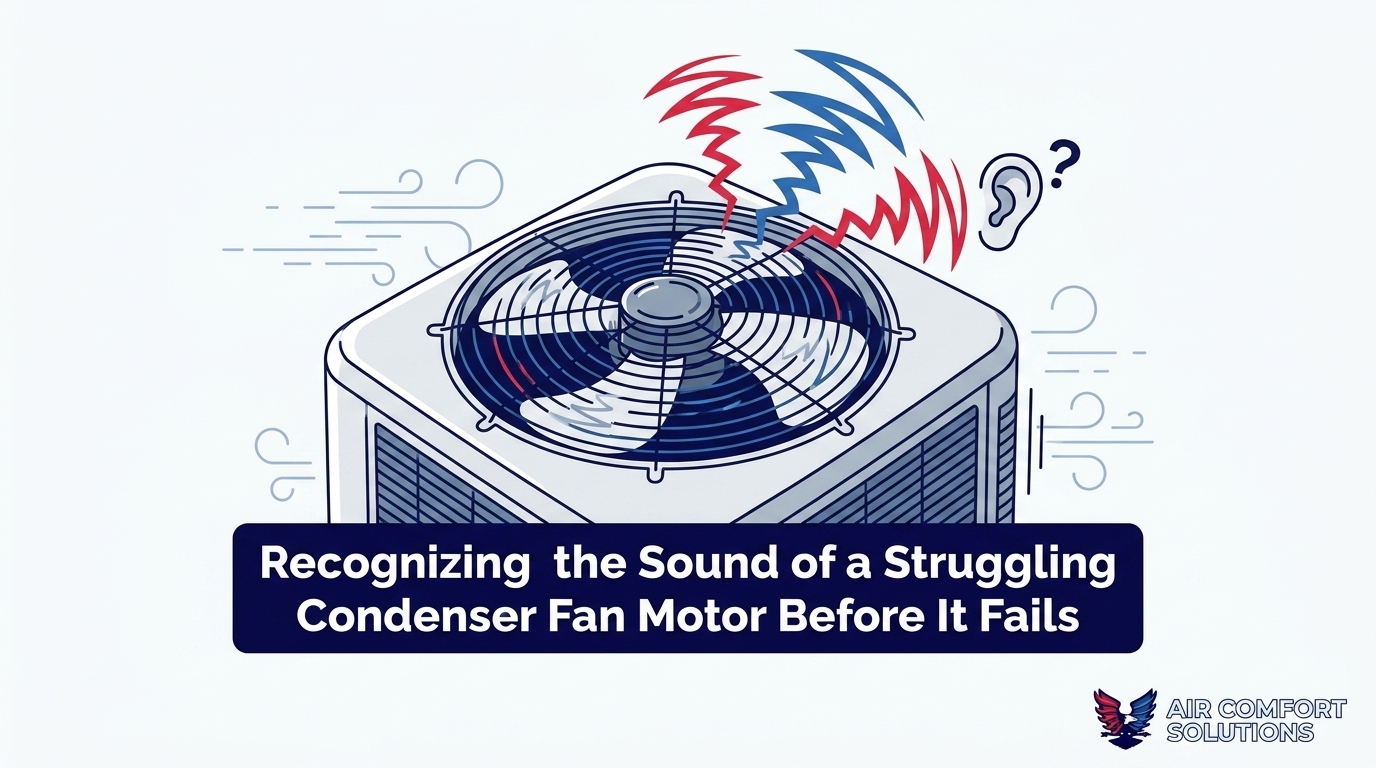
At Air Comfort Solutions, we know the feeling well: You walk outside on a sweltering afternoon, and instead of the smooth, steady rush of air from your outdoor unit, you are greeted by an aggressive, electrical buzzing. Recognizing the sound of a struggling condenser fan motor is often the only warning you get before a minor component failure cascades into a total system breakdown. That loud hum means your equipment is drawing power but failing to perform its single most important job: exhausting latent heat from your house.
When you hear this warning sign, fast action is critical to protect your system. For comprehensive guidance on how your equipment should operate, explore our complete air conditioning resources, or keep reading to understand exactly what that noise means and how to stop the damage.
By the time late summer arrives, outdoor units have already endured months of continuous operation. This intense period brings significant August late-summer cooling wear to every moving part in your system. The condenser fan motor sits at the very top of the outdoor unit, spinning a heavy metal or composite blade through extreme heat, rain, and debris. Its job is to pull cooler outside air through the hot condenser coils, cooling the refrigerant inside so it can return indoors to absorb more heat.
When that motor begins to struggle, the heat stays trapped. This presents a critical decision point for any homeowner: ignore the sound and risk catastrophic failure, or shut the system down immediately to save the compressor. Understanding why this specific sound occurs during peak cooling demand gives you the power to make the right call.
Not all outdoor unit noises point to the same problem. A healthy air conditioner produces a consistent, rhythmic hum accompanied by the loud rush of air moving upward. When the fan motor begins to fail, the acoustic profile changes dramatically. In our experience serving Pinehurst TX area homes, we often find units situated near patios or bedroom windows, making it easier to notice when the normal background noise turns into an aggressive mechanical or electrical complaint.
If your system is producing unusual sounds, it is always best to investigate. You can learn more about differentiating these sounds by reading our guide on what to do when your air conditioner making strange noises starts disrupting your peace.
The most common and alarming sound of a failing fan motor is a loud, vibrating electrical buzz. This is known in the HVAC industry as locked rotor amperage (LRA). Here is what is happening inside the cabinet:
• Power is flowing: The contactor has closed, sending a full 240 volts of electricity to the motor.
• Movement is blocked: Whether due to a failed capacitor, seized bearings, or internal electrical shorts, the motor physically cannot spin.
• Energy converts to heat: Because the electrical energy cannot convert into mechanical rotation, it rapidly converts into intense heat, producing that aggressive buzzing sound.
You might even see the fan blade twitch slightly when the unit kicks on, only to freeze in place while the buzzing continues. This is a severe state of thermal overload.
Before a motor locks up completely, it often gives an audible warning through mechanical distress. The bearings inside the motor are designed to provide a frictionless spin. Over time, the factory lubrication breaks down, or moisture bypasses the weather seals and causes rust.
When bearings fail, you will hear a distinct metal-on-metal grinding or a high-pitched screeching sound. This friction forces the motor to work much harder to achieve its normal RPMs. The harder it works, the more heat it generates, eventually leading to a complete electrical failure if left running.
• Smooth, steady hum with rushing air — Likely Cause: Normal operation — Immediate Action Required: None; system is healthy.
• Aggressive, vibrating electrical buzz — Likely Cause: Locked rotor (seized motor or bad capacitor) — Immediate Action Required: Shut off power immediately at the thermostat.
• Metal-on-metal grinding or screeching — Likely Cause: Failing motor bearings — Immediate Action Required: Schedule professional diagnostics before it seizes.
• Loud rattling or clanking — Likely Cause: Loose fan blade or debris in the cabinet — Immediate Action Required: Turn off power and inspect for physical obstructions.
Motors rarely fail on a mild spring morning. They almost always quit during the most brutal heatwaves of the year. In the intense heat and humidity of Southeast Texas, condenser fan motors work overtime to exhaust heat, making late-summer thermal overload highly probable. By the time August arrives, your system has accumulated thousands of hours of continuous operation.
This massive amount of August late-summer cooling wear degrades internal components. The physics of exhausting heat dictate that as the outside air temperature rises, the motor must work harder and run in much longer cycles to achieve the same cooling effect indoors. Our Pinehurst AC repair experts frequently see this specific pattern: a motor that was slightly weak in June completely gives out under the sustained thermal stress of late August.
Thermal overload occurs when:
• The ambient outdoor temperature exceeds 95°F.
• The motor is running continuously for hours without a break.
• The internal heat generated by the motor outpaces its ability to dissipate that heat into the surrounding air.
Older motors are particularly susceptible to this seasonal stress. As the internal insulation on the copper windings degrades over years of use, the motor naturally runs hotter. Add the punishing regional climate, and a breakdown becomes a matter of when, not if.
The condenser fan motor is relatively affordable to replace. The compressor—the massive pump that circulates refrigerant through your entire home—is not. These two components are intimately connected, and the failure of the fan directly threatens the survival of the compressor.
Many Pinehurst TX area homes suffer total system losses simply because a homeowner heard the buzzing fan but let the system keep running, hoping it would fix itself. Without the fan pulling air across the condenser coils, the heat absorbed from inside your house has nowhere to go. It stays trapped inside the outdoor cabinet.
Air conditioning works by manipulating refrigerant pressure. When the fan stops spinning, the trapped heat causes the refrigerant pressure inside the outdoor unit to spike rapidly. This creates a dangerous "pressure cooker" effect.
• Stage 1: Extreme Pressure Spike. The compressor is suddenly forced to pump against massive head pressure, causing it to draw excessive electrical current and overheat.
• Stage 2: Thermal Limit Trip. To protect itself, a safety switch inside the compressor (the internal thermal overload) will trip, shutting the compressor down.
• Stage 3: Short-Cycling. Once the compressor cools off, the switch resets. The compressor turns back on, immediately faces the same extreme pressure because the fan is still dead, and trips again.
• Stage 4: Fused Windings. Repeatedly tripping this thermal limit switch will eventually melt the internal insulation, fusing the compressor windings together. At this point, the compressor is dead, and a major replacement is required.

Here is the most frustrating part of outdoor unit failures: a relatively minor, easily replaceable component sounds exactly the same as a major motor failure. The dual-run capacitor is a small, cylindrical device that stores electrical energy. It acts like a battery, providing the massive jolt of torque required to get the heavy fan blade spinning from a dead stop.
If the capacitor fails—which is incredibly common during August late-summer cooling wear—the motor will receive running voltage but lack the starting torque to spin. The result? That exact same loud, locked-rotor buzzing sound. Our technicians at Air Comfort Solutions often respond to frantic calls where homeowners fear the worst, only to find the dual-run capacitor has failed.
This is where accurate professional diagnostics matter. Working with a local team that provides honest, reliable diagnostics helps homeowners identify minor issues (like a swollen capacitor) before they are misdiagnosed as a dead motor, or worse, left to cascade into an expensive compressor failure.
Why professional testing is required:
• Visual inspection is not enough: While some bad capacitors bulge at the top, many fail internally while looking perfectly normal.
• Multimeter testing under load: A technician must test the microfarad output of the capacitor using a specialized multimeter to determine if it is delivering the correct voltage.
• Motor winding tests: If the capacitor is good, the technician must test the ohms of resistance across the motor windings to confirm if the motor itself has shorted out.
Guessing which part has failed often leads to prolonged heat exposure in your home and unnecessary part replacements.
If you walk outside and hear your unit buzzing without the fan spinning, you are in a race against the clock to save your compressor. Do not wait to see if it improves. Follow this strict protocol to protect your equipment. Routine care, like our routine preventative maintenance, can help prevent these emergencies, but once the buzzing starts, you must act fast.
1. Step 1: Turn the thermostat to the 'OFF' position immediately. Do not just turn the temperature up; switch the system mode completely to OFF. This stops the indoor thermostat from calling for cooling and cuts the low-voltage signal to the outdoor unit.
2. Step 2: Shut off the high-voltage power. Locate the outdoor electrical disconnect box mounted on the wall near the AC unit. Pull the disconnect block out or flip the breaker switch to OFF. If you cannot find the outdoor box, go to your main electrical panel and turn off the dedicated double-pole breaker labeled "AC" or "Condenser."
3. Step 3: Keep your hands and tools out of the unit. Never attempt to "jump-start" the fan blade by pushing it with a stick or screwdriver. This is incredibly dangerous. If the motor suddenly catches, it can shatter the stick and cause severe injury. Furthermore, jump-starting a fan only masks a failing capacitor or motor, guaranteeing it will stop again the next time the cycle ends.
4. Step 4: Contact a licensed professional. Outdoor AC units operate on 240 volts of electricity, which carries severe, potentially fatal shock risks. The capacitor can hold a dangerous electrical charge even after the power is turned off. DIY electrical repairs on outdoor HVAC equipment are dangerous and will void your manufacturer warranty.
Many Pinehurst TX area homes have saved themselves from catastrophic system failures simply by executing steps one and two the moment they heard the wrong sound.
A bad AC fan motor typically produces a loud, aggressive electrical buzzing or humming sound. This occurs when the motor receives electrical power but is physically unable to spin the fan blade, a condition known as a locked rotor. In the days leading up to complete failure, you may also hear a metal-on-metal grinding or screeching noise, which indicates that the internal bearings have worn out and are creating severe friction.
The most obvious sign is that the outdoor unit is making a loud humming noise, but the fan blade is completely stationary. You might also notice that the top of the metal cabinet feels excessively hot to the touch, and the air blowing out of your indoor vents is warm. However, because a failed dual-run capacitor produces these exact same symptoms, a licensed technician must test the electrical components with a multimeter to confirm if the motor itself has failed.
The short answer is no, your AC will not work properly, and leaving it on will destroy your system. While the indoor blower might still push air through your vents, the outdoor unit cannot exhaust the heat it absorbs from your home. Without the fan, the compressor will quickly overheat, trip its internal safety switches, and eventually suffer permanent damage from the trapped thermal energy.
Yes, you should turn off the AC immediately at the thermostat and shut off power at the breaker. Allowing the system to run while the fan is immobile forces the compressor to operate under extreme pressure and heat. Shutting the system down immediately is the single most important step you can take to prevent a minor electrical repair from turning into a catastrophic compressor replacement.
No, you should never attempt to replace a capacitor yourself. The dual-run capacitor stores a massive amount of high-voltage electricity and can deliver a severe, potentially fatal shock even after the main power to the unit has been turned off. Additionally, performing DIY electrical work on 240-volt outdoor equipment violates safety codes and instantly voids the manufacturer's warranty on your system.
Catching a failing component early is the secret to a long-lasting air conditioning system. When you hear that distinct outdoor buzzing sound, your system is crying out for help. Early detection of a struggling fan motor saves compressors, and shutting the power off immediately is the best defense you have against a total system loss.
The massive toll of August late-summer cooling wear means that aging motors in Pinehurst TX area homes are highly vulnerable right now. Do not let a simple capacitor issue or a standard motor swap turn into a ruined compressor. If your outdoor unit is making unusual noises, struggling to keep up with the heat, or failing to spin, reach out for professional AC services today to get honest, accurate diagnostics and restore safe, reliable cooling to your home.


Zane came out and did an amazing job! Super friendly, honest and transparent about the work that needed to be done. This is my second time working with Air Comfort Solutions and they’re my go to for HVAC services. Highly recommend.
God's AMAZING grace sent us Robert and Zane. We have been without air in this Texas heat for six weeks and four days. We've had a few contractors give us quotes all trying to upsell when we're at a low point. But not the guys at Air Comfort Solutions. They came in assessed our situation, gave us honest feedback, and showed us the issues as they proceeded with the assessment for clear understanding. We highly recommend them for their professionalism, quality products, and fair pricing. We hands down support them for all the work they do 💯 %.
Robert and Zane gone above and beyond to make the process easy and affordable.
Would definitely recommend!!
I’m writing this review to let everyone know that Air Comfort Solutions is the company to work with. I know the owner ( Robert) for several years now. He has been taking care of my residential and business work orders. Robert is professional, knowledgeable and will save you money. I just want to thank Robert for great job you have been doing for me.